

Read the complete book below or use the contents to jump to a chapter. The single master PDF contains all 36 chapters, reader aids and the subject and scripture index.
Download the Chapter 12 research companion ZIP — five reproducibility files; no third-party source dataset is bundled.
DEBUNKED: ISLAM
Testing scripture, miracles and moral authority
Lovepreet Singh
Copyright © 2026 Lovepreet Singh
First English edition
Original analysis and explanatory text by Lovepreet Singh. Quotations, translations and source works are credited in the notes. Their inclusion does not imply endorsement by their authors or publishers.
This book examines religious, historical, scientific and ethical claims. Its medical and legal discussions analyse arguments and evidence; they are not individual treatment instructions or legal advice.
Scripture references use chapter and verse numbers. Hadith identifiers follow the collection and reference system named in the notes. English renderings are identified where they are used. Hypothetical examples are illustrations of reasoning, not accounts of the author's personal experiences.
For the correction procedure, see “Checking and correcting a claim” in the supporting material.
Before you begin
A religious claim can ask for much more than agreement. It can ask you to build your life around a message, obey a rule, trust a promised reward or fear a punishment you cannot independently inspect. When the authority being claimed is that large, asking for evidence is a reasonable response.
This book examines arguments offered for Islam's divine authority and some of the rules defended through that authority. It asks what the sources actually say, how their claims can be checked and whether the conclusions follow. The explanations begin with ordinary questions. How does a copied text reach us? What makes a prediction different from a resemblance noticed afterwards? How do measurements reveal a past nobody alive witnessed? What would justify one person controlling another person's life?
I do not accept the divine authority claimed in the arguments examined here. That conclusion must earn its place through the chapters. The word DEBUNKED in the title cannot decide whether a particular translation is accurate or a particular criticism succeeds. Where an objection fails, I say so. Where a defence answers one question but leaves another unresolved, I separate the two.
There are several kinds of conclusion in these pages. A specified physical claim may conflict with evidence. A historical claim may remain uncertain. A text may allow more than one reasonable interpretation. An argument may fail to prove revelation even though one of its factual premises is correct. A moral rule may be accurately reported and still deserve rejection on grounds that need to be explained. Calling all of those results simply “false” would make the book less reliable.
The person and the proposition
A Muslim reader may recognise some of the arguments considered here and reject others. That is a reason to identify an argument carefully. A Qur'an verse, a Sunni hadith collection, a jurist's ruling and a modern preacher's explanation do not have identical authority for every Muslim. The chapters distinguish those sources where the difference changes the case.
The same care applies to the reader. A person's religious identity does not tell us whether they support a particular law or share a particular interpretation. Criticism should address the claim they actually defend. If an argument in this book succeeds against a rule you reject, you have no obligation to defend that rule merely because someone else calls it Islamic.
Nor does disagreement with a religious teaching establish a person's ignorance or dishonesty. “Mistaken” and “lying” make different accusations. An allegation of deliberate deception needs evidence of intention. The book can reject a claim firmly without pretending to know the private motives of everyone who repeats it.
I also distinguish the value someone finds in a practice from the explanation offered for it. Comfort, friendship and a sense of purpose deserve attention as experiences. Whether they establish a revelation is a further question. A critic should neither erase the experience nor accept every conclusion attached to it.
Where to start
Read Chapters 1 and 2 first if these debates are new to you. They explain the standards of evidence and the kinds of religious sources used throughout the book. You do not need previous knowledge of Arabic, philosophy or science. Necessary terms are explained when they enter the argument.
Chapters 3–6 examine the philosophical questions: a first cause, divine hiddenness, freedom, suffering and punishment. These chapters ask what follows from an argument's premises and whether those premises deserve acceptance. They do not present philosophical disagreement as a laboratory result.
Chapters 7–12 turn to transmission and interpretation. They examine manuscripts, readings, reports about Muhammad, literary claims and numerical arguments. This section is useful before reading a dispute that depends on a verse or hadith. A citation tells us where a statement appears; the reliability and authority of that statement require further examination.
Chapters 13–24 examine the physical world, human origins, miracles, predictions and health claims. The scientific explanations include how evidence is obtained. You should be able to follow the reasoning behind an age estimate or a comparison between explanations, instead of being asked to accept a number because a respected institution printed it.
Chapters 25–34 examine moral authority and its consequences for people's lives. Chapter 25 states the ethical grounds used in the later discussions. The relevant historical and textual facts matter, but no measurement alone settles what one person is entitled to do to another. Consent, freedom of conscience, equal standing and proportionate treatment need reasons as well as names.
Chapters 35 and 36 consider what survives the examination. Real intellectual achievements deserve accurate recognition. The final chapter draws together the conclusions and explains how they should change if better evidence arrives.
You can also follow a particular question. If you begin with a scientific-miracle claim, use the references back to the source and interpretation chapters. If you begin with a legal controversy, keep the moral framework and the difference between a historical ruling and a current law in view. You do not have to accept every chapter's verdict in order to assess one of them.
What the notes let you check
Source notes identify the work or passage supporting a factual claim. A Qur'an reference uses chapter and verse numbers. A hadith reference names its collection and report identifier. Research papers and books are identified by title, author and publication information, with page or passage details where the argument needs them. Online links provide a route to the source; they are not substitutes for reading it.
The notes also identify limits of access that affect the claim. An abstract is not a complete paper. A publisher's excerpt is not a whole book. A scholar's analysis of a medieval work is not the same as an independent comparison of all its surviving manuscripts. When only a limited portion supports the discussion, that limitation matters more than making the bibliography look impressive.
English translations involve choices. Short quotations retain their attributed wording; paraphrases explain the content in the author's words. When a disputed translation changes the argument, the chapter compares relevant readings instead of letting one convenient English phrase settle the issue. A translated commentary is identified as such.
Many everyday examples are hypothetical. The imagined debts, classrooms, envelopes and family stories help explain a step in reasoning. They are not reported experiments, encounters from my life or evidence that an actual religious event happened in the same way. After using an analogy, we still have to return to the real claim.
Some sources defend views this book rejects. They are included because a defence should be examined in a form its proponent actually uses. Citing a source for its own position does not endorse every statement on its website or authenticate every older quotation it contains.
Disagreement that improves the argument
The most useful objection identifies a particular mistake. It can show that a passage means something different, that a source does not support the sentence assigned to it, that a calculation is wrong or that an argument overlooks a serious alternative. The correction should then change the conclusion by as much as the mistake warrants.
A broken link may need repair without changing the historical evidence. A mistaken attribution may undermine an entire case. An overlooked interpretation may defeat a criticism of one reading while leaving a different criticism intact. Keeping track of that scope prevents both the author and the reader from declaring a larger victory than the correction supplies.
You are free to remain unconvinced by my conclusions. The same freedom to examine a claim belongs to believers and critics. What I ask of the arguments is consistency: give evidence its weight when it supports a religious defence, and let it have consequences when it does not.
Chapter 1: What would count as evidence?
Imagine that a message arrives on your phone. A stranger says you owe him fifty thousand rupees. He gives you a deadline. If you refuse to pay, he says, the consequences will be terrible.
You ask for the loan agreement or the record of a transfer. He sends a longer message explaining how certain he is. His father believed in the debt. His neighbours believe in it. Some very educated people believe in it. He is offended that you keep asking for a receipt.
You still do not have a reason to pay.
This imaginary exchange contains a problem that becomes harder to see when a claim is religious. A person has made an assertion, attached serious consequences to it, and treated your hesitation as a failure on your part. Yet the consequences do not establish the assertion. Before worrying about how to repay the debt, you need a reason to think the debt exists.
The same order of questions applies when someone says that a god has spoken, that a particular book contains his words, and that your future depends on accepting them. Each part requires support. A warning about punishment cannot do the work of that support. Otherwise anyone could create a new obligation simply by inventing a more frightening penalty.
My question is straightforward: what makes this claim worth believing?
Start with a sentence that can be examined
“Islam is true” is too large a statement to investigate in one movement. It contains claims about the existence and nature of God, the authority of Muhammad, the origin of the Qur'an, events in the past, the future of human beings and rules for living. Evidence that supports one part does not automatically establish the rest.
Suppose someone establishes that the universe has an explanation beyond the physical events we currently understand. We would then need to ask what that explanation is. Calling it a personal creator would require a further argument. Identifying that creator with the speaker of a particular scripture would require more work still. The steps cannot be skipped because the destination is familiar.
Or consider a less ambitious claim: a certain verse appears in an early manuscript. A photograph of the manuscript, a reliable transcription and a defensible date might support it. That finding would matter. It would not, by itself, establish that the verse came from God. Human messages can also be copied accurately.
I will therefore ask a critic or defender to put the relevant claim into a reasonably precise sentence. What happened? When? What does the text supposedly mean? Which observation would support that reading? The sentence can be revised as we learn more, but it must remain clear enough to examine.
Stating the claim precisely prevents a discussion from quietly changing its subject. If a debate begins with a claim that a passage predicts a particular scientific discovery, the defence cannot end merely with the observation that the passage is spiritually moving. It may be moving. That answers a different question.
Belief, confidence and knowledge
To believe a statement is to accept it as true. Confidence describes how strongly you accept it. Neither word tells us whether the statement is actually correct.
In the debt example, the stranger may be completely sincere. Perhaps he has confused you with someone else. Perhaps someone gave him false information. Perhaps he has a document that looks convincing but contains a mistake. His certainty is a fact about his state of mind. Whether you borrowed the money is a separate matter.
Calling something knowledge normally makes a stronger claim than reporting a belief. It suggests that the belief is true and held on adequate grounds. Philosophers disagree about the exact conditions for knowledge. We do not need to settle that debate before agreeing that a confident guess and a checked bank record provide different reasons for believing a transfer occurred.
The word “proof” also changes meaning between conversations. In a mathematical argument, a conclusion can follow necessarily from definitions and premises. In an investigation of the world, evidence usually supports a conclusion with some degree of uncertainty. A document could be forged. A measurement could be misread. The existence of such possibilities does not make every conclusion equally doubtful.
If your bank record, the recipient's record and the agreed loan document match, a speculative claim that all three were fabricated is not automatically a serious alternative. Someone proposing that explanation must show why it deserves attention. Reasonable confidence does not require eliminating every story a person can imagine.
This cuts both ways. A believer cannot demand absolute certainty from science while accepting a much weaker standard for a miracle story. A sceptic cannot demand an impossible demonstration of a religious event while treating a preferred historical explanation as established merely because it sounds natural.
Who has to provide the evidence?
The person asking us to accept a claim needs to give reasons for accepting it. This is often called the burden of proof. It is a responsibility within an argument, not a special punishment imposed on religion.
When the stranger asks for repayment, the burden begins with him. You do not have to reconstruct every day of your life to show that you never borrowed from him. If he produces a signed agreement that appears to be yours, the discussion changes. You now have something substantial to address. Perhaps the signature is authentic; perhaps it is not. The evidence determines the next step.
A critic also takes on a burden when making a positive accusation. If I say that a narrator deliberately fabricated a report, I need evidence of fabrication and, if I allege deliberate dishonesty, evidence relevant to intention. A report can be unreliable without its surviving compiler having invented it. A person can pass on an error honestly.
Likewise, “this argument does not establish God” and “no god could possibly exist” are different conclusions. Showing a gap in an argument establishes the first. Reaching the second would require an argument broad enough to address the particular kind of god being denied.
There is no useful rule that all negative claims are impossible to support. If a sealed, empty box is opened under conditions everyone can inspect, we can have good evidence that it contains no coin. Whether absence can be established depends on the claim and the available test. A claim about an invisible being with no detectable effects is much harder to evaluate than a claim about a coin in a box. That difficulty does not turn the being's existence into a demonstrated fact.
The Qur'an itself appeals to proof in some disputes. In 2:111, it challenges an exclusive claim to admission into Paradise attributed to Jews and Christians. The demand for support occurs within a religious argument, followed in 2:112 by the Qur'an's own account of who will receive a reward. It would misread the passage to present it as a modern instruction to abandon religion. Still, the passage makes one useful point clear: asking for grounds is not an activity that can simply be dismissed as alien to religious discussion.[1]
I apply that demand in both directions. A statement does not earn an exemption because it appears in the book whose authority is under examination.
What makes an observation evidence?
An observation supports an explanation when it is more to be expected if that explanation is correct than under a relevant alternative. We use this idea without giving it a technical name.
Imagine that you hear a loud crash from the kitchen. A broken plate on the floor makes the explanation “a plate fell” more plausible. Finding a fallen shelf, several broken plates and loose screws gives you a more specific explanation. The crash alone does not tell you who was responsible, whether anyone acted deliberately or whether the shelf was badly installed.
Religious arguments also need this discrimination. A person feeling peaceful during prayer is evidence that the person experienced peace. Whether it supports the existence of a particular external being depends on what else could explain the experience and what would distinguish the explanations. Calling the feeling powerful tells us its intensity. It does not yet identify its cause.
The objection is not that everything a person experiences must be measured by a machine. Testimony, documents, reasoning and personal observation can all contribute evidence. The question is whether the evidence supports the conclusion being drawn from it.
Think again of the debt. The stranger showing that he owns your telephone number gives us one fact. Showing that he knows your address gives us another. Neither fact is a loan agreement. A collection of relevant-looking details can make a claim feel persuasive while leaving its central step unsupported.
A test that could actually fail
Here is a deliberately simple imaginary experiment. Someone claims to receive the exact number hidden inside an envelope through divine communication. We use the ten digits, from zero to nine. An independent person selects one digit at random for each trial, and the claimant cannot see the selection. We agree in advance to run exactly six trials and record every result. We write down each answer before opening its envelope.
If each digit is equally likely, a random guess has one chance in ten of succeeding. Under the additional assumption that the trials are independent, six correct answers in a row have a chance of one in ten multiplied by itself six times: one in a million.
That calculation describes the specified guessing model. It is not automatically the chance that God was absent, the chance that the experiment was honest, or the chance that the claimant's religion is true. Information could have leaked. The selection could have been biased. We could have heard only about the successful run after thousands of unsuccessful attempts. These possibilities need investigation; they cannot simply be assumed to have happened either.
If repeated trials held up under independent scrutiny, I would have to take the result seriously. It would be evidence of an ability or process that our original guessing model did not explain. We would then investigate its cause. Identifying a surprising result and identifying God as its source are separate achievements.
Now change the rules. A wrong answer counts as a test of the observers' faith. A correct answer counts as confirmation. Refusing to answer counts as divine wisdom. An opened envelope with no digit inside counts as a sign that numbers cannot contain God.
Under those rules, no possible result counts against the claim. The claimant has protected the claim from a failed test by removing the test's ability to discriminate. This does not prove the claim false. It does mean the demonstration cannot establish it in the way originally advertised.
Not every religious proposition has to resemble the envelope claim. A philosophical account of necessary existence is assessed by its definitions, premises and inferences. But when someone offers a measurable prediction as evidence, the prediction must face the possibility of being wrong. The standard follows the kind of claim being made.
More witnesses, or more copies?
Imagine receiving the same account of a miracle from thirty people. Before counting thirty witnesses, ask where each person obtained the story. If every person copied one voice message, you have thirty transmissions of one report. You do not have thirty independent observations of the event.
Independence means that one source did not obtain the relevant information from another in the group. It can be difficult to establish, particularly for events far in the past. Two accounts may share an earlier source that has not survived. They may also preserve genuinely different information. We have to investigate rather than count names on a page.
Repetition can accurately show that a belief was widespread. It may tell us something important about a community's history. The further claim that the reported event happened still needs assessment of the reports themselves.
The same caution applies to this book. Ten websites repeating one study are not ten studies. Several scholars citing one manuscript are not several independent manuscripts. A long bibliography is useful only if the sources support the work assigned to them.
Qur'an 49:6 tells believers to investigate news brought by a person described in the passage as an evildoer, because acting in ignorance can harm others. The qualification about the messenger is part of the verse and should not be quietly removed. The passage nevertheless recognizes that a report and a justified response to it are different things.[2] We will need a more general method that can also detect an honest mistake by a trusted person.
The strongest reply: faith is more than an argument
A serious believer may object that I have described religion as though it were a faulty invoice. Religious faith can involve moral commitment, trust, personal experience and a way of living. It need not begin with a formal demonstration.
Zohair Abdul-Rahman develops a version of this response in his essay on faith and certainty for Yaqeen Institute. He describes an initial orientation towards God through fitrah, an innate disposition, and a further encounter with revelation. His account of yaqeen, or certainty, includes spiritual experience and its role in guiding action. He does not reduce religious conviction to the conclusion of an abstract argument.[3]
Ordinary life does require forms of trust that cannot wait for mathematical proof. We rely on memory, other people and our ability to reason. Demanding that a person prove every starting point from nothing would make any inquiry impossible, including mine.
But this does not show that all further beliefs deserve equal trust. A basic reliance on memory can coexist with checking a disputed memory against a photograph or a written record. Trust in a friend can be reasonable while leaving open the possibility that the friend has misunderstood a particular event. A reasonable starting point does not grant immunity to every conclusion built upon it.
The religious response also has to explain selection. Suppose two people live sincerely, reflect deeply and experience what each regards as divine guidance. They then reach incompatible conclusions about revelation. That hypothetical case does not prove either conclusion false. It shows what their methods must help us resolve. The strength of conviction alone cannot establish two contradictory claims in the same sense.
A defender may offer additional arguments about the Qur'an, Muhammad or the world. Those arguments should be examined. They would be doing the work of distinguishing the belief from its competitors. Simply announcing that a correct spiritual disposition produces the correct answer leaves us needing a way to identify that disposition without first assuming the answer.
An experience can be profoundly important to the person who has it while providing less information to someone else. That difference is especially important when private conviction is offered as a reason to restrict another person's choices. The other person is entitled to ask for grounds they can assess.
When missing evidence matters
“There is no evidence” is sometimes used carelessly. Before making that statement, we should specify what we looked for and what we would expect to find.
If someone says an elephant has lived in your small kitchen for a week, the absence of the animal, disturbed objects and the ordinary traces of its presence matters. If someone says a small insect crossed the same kitchen ten years ago, a clean inspection today tells us very little. The expected traces are different.
This distinction will matter when we examine manuscripts, floods and miracle reports. The failure to find a record is much more informative when the event would probably have produced a record that was likely to survive and that we were in a position to discover. Each part of that sentence needs care. A record might never have been made, might have been lost or might remain inaccessible.
There is also a cost to explaining every missing trace by saying that God removed it. Such an explanation may preserve logical possibility, depending on how the claim is defined. It also removes the traces that could have made the event independently identifiable. We cannot then offer the missing traces as scientific confirmation.
For an old event, the strength of the conclusion should reflect the evidence we can recover; reproducing the event on demand is not a requirement.
Different problems require different verdicts
A book called DEBUNKED must resist the temptation to use one triumphant word for every result.
Sometimes a claim is contradicted by evidence. A source may be said to contain a sentence that is absent from it, or a measurement may conflict with a precisely stated prediction. In such cases, we should say what is wrong and show it.
Sometimes the proposed evidence fails to establish the claim. A photograph may show a geological feature without showing that a supernatural event produced it. The appropriate conclusion concerns the failed inference. It does not require pretending we have discovered every detail of the feature's history.
Sometimes the dispute turns on interpretation. If two defensible readings have different consequences, a criticism of one must not silently become a criticism of both. Equally, a defender who adopts the second reading must accept its costs, including any loss of the original claim to a clear scientific prediction.
Historical uncertainty is another possible result. The surviving sources may leave more than one account plausible. An uncertain date does not become certain because a confident date would make a better paragraph.
Finally, a moral objection needs a stated moral principle. A rule might be accurately reported and historically explicable while still conflicting with freedom of conscience, meaningful consent or equal treatment. Evidence helps establish the rule and its consequences. An ethical argument explains why those consequences are acceptable or objectionable. A laboratory measurement cannot supply every moral premise on its own.
Keeping these verdicts distinct makes criticism more demanding. It also makes it harder to evade. A defender should be able to identify exactly which conclusion is being challenged, rather than escape a documented problem by pointing to an unrelated exaggeration.
What would change my mind?
Several kinds of evidence could lead me to revise the judgments in this book.
A newly examined manuscript could change a claim about when a passage was in circulation. A better translation, supported by the grammar and historical use of the words, could defeat an argument that depended on an English ambiguity. An independently checked prediction could deserve a much stronger assessment than an interpretation constructed after the event. A philosophical defence could expose a premise that I had accepted too quickly.
None of those corrections requires surrendering every other conclusion in the book. Beliefs can be revised one claim at a time. If I get a hadith citation wrong, the proper response is to correct it and reassess the argument that depended on it. Refusing a correction because it would benefit a religious opponent would reproduce the fault I am criticizing.
The Qur'an's warning in 17:36 against following what one lacks knowledge of is relevant here too. It appears among moral instructions, not as a manual of modern research methods.[4] I take the practical obligation seriously: do not announce more than you have grounds to say.
This book will be blunt about arguments that fail and rules that deserve criticism. It will also distinguish those conclusions from questions that remain open. A reader should finish it better able to examine a claim, including one made by me. Agreement with the author is a poor substitute for that ability.
Before we test the major claims, we need to know what their sources are. A verse of the Qur'an, a report attributed to Muhammad, a medieval legal opinion and a modern preacher's explanation can carry very different kinds of authority. Confusing them would make the investigation unreliable before it had properly begun.
Sources and notes
1. Qur'an 2:111–112, consulted in Mustafa Khattab's The Clear Quran as displayed by Quran.com. The discussion above paraphrases the passage and preserves its context: competing claims about admission to Paradise. Passage and context. Accessed 26 October 2026. ↩
2. Qur'an 49:6–8, Mustafa Khattab translation, Quran.com. The passage specifically describes news from an evildoer; the broader evidential method developed in this chapter is the author's argument. Passage and context. Accessed 26 October 2026. ↩
3. Zohair Abdul-Rahman, “Faith & Certainty,” In Pursuit of Conviction, Yaqeen Institute, published 13 June 2019, updated 22 July 2024. Relevant sections: “Faith in Islam” and “The point of yaqeen.” These sections establish the author's religious account; citing them does not independently verify its theological or neuroscientific claims. Essay. Accessed 26 October 2026. ↩
4. Qur'an 17:36, read with the surrounding instructions in 17:31–40, Mustafa Khattab translation, Quran.com. Passage and context. Accessed 26 October 2026. ↩
Chapter 2: Which Islam, which text, which meaning?
Imagine opening a folder labelled “What the law says.” Inside are a constitution, a witness statement, a lawyer's textbook, a judge's decision and a message from your uncle. All five may be relevant to a dispute. They do not have the same authority or establish the same facts.
You would want to know which document you were reading before deciding what it proved. A sentence in the lawyer's textbook might summarize the constitution, argue for a disputed interpretation or describe a rule that has since changed. The uncle's message might be accurate. Its accuracy would still need checking.
Religious discussion requires similar care. A sentence beginning “Islam says” might introduce a Qur'an verse, a report attributed to Muhammad, a legal opinion, a modern translation or a preacher's personal claim. Sometimes the speaker has moved between several of these without noticing.
We need a way to follow the evidence back to its source. Otherwise a critic can attack a position the defender does not hold, while a defender can answer a criticism of one source by changing to another. Both leave the original question unanswered.
Begin with the Qur'an citation
The Qur'an is Islam's scripture. A chapter is called a surah, and an individual verse an ayah. A reference such as 4:59 means surah 4, verse 59. It is an address in the text, not a page number. Page numbers change between editions; this reference allows us to find the passage in different printings and translations.
In Mustafa Khattab's English translation, 4:59 instructs believers to obey Allah, the Messenger and those in authority, and to refer disagreements to Allah and the Messenger.[5] We can now distinguish several questions that might otherwise become tangled together.
Does the verse contain that instruction? Reading the text answers this question. How should obedience apply to a particular dispute? That calls for interpretation. Did God actually issue the instruction? That is a claim about the text's origin. A citation establishes where a statement appears; it does not settle all three questions at once.
The verse also helps explain why a defender of prophetic authority will not necessarily accept the rule “show me the exact instruction in the Qur'an or it has nothing to do with Islam.” The defender can argue that the Qur'an itself directs believers to the Messenger. The argument deserves examination on its own terms.
However, an instruction to obey a messenger does not automatically authenticate every later statement attributed to that messenger. We would still need to establish what he said, what he meant and whether the report applies to the case under discussion. The authority of a speaker and the reliability of a quotation are separate questions.
For a beginner, keeping those questions apart prevents a great deal of confusion. You can understand a religious argument without accepting its conclusion, just as you can understand the terms of a contract before deciding whether it is valid.
A report about Muhammad is not a Qur'an verse
A hadith is a report. In discussions of Muhammad, it can describe something he reportedly said, did or approved, as well as other features of his life. Reports are gathered in collections. Sahih al-Bukhari names one such collection; Sahih Muslim names another. Here “Muslim” is the name of its compiler, Muslim ibn al-Hajjaj, rather than a label meaning every Muslim's book.[6]
Consider the first report in Sahih al-Bukhari. The English text identifies Umar ibn al-Khattab as the narrator and attributes to Muhammad a teaching about intentions and the purposes for which people migrate.[7] Bukhari is the compiler of the collection. Umar is the person to whom this report traces the hearing of the statement. Confusing those roles would distort the evidence before we assessed it.
A hadith commonly gives a chain of transmission, called an isnad, followed by the reported content, called the matn. The chain tells us who is said to have received the report from whom. The content tells us what was reportedly said or done. In this example, the displayed Arabic includes a sequence of transmitters, while the English presentation begins with Umar and the reported teaching.
An imaginary family example may help. “My aunt told me that her mother heard our great-grandfather say this” contains a transmission chain. The great-grandfather's alleged statement is the content. If the aunt never met her mother, something has gone wrong in our description. If the chain is possible, that still leaves questions about memory, wording and whether the original statement was understood correctly. The example illustrates the questions; it does not establish the reliability of any particular hadith.
Bukhari and Muslim were compilers of the ninth century. Their collections were not recordings made by the compilers while standing beside Muhammad. Sunnah.com's introductions identify their deaths as 870 and 875 CE respectively.[8] That time gap is relevant, but it is not a complete argument against every report. Later collections can preserve earlier material. We have to investigate how the material reached them, rather than pretend that the date of a collection automatically dates the invention of everything inside it.
The reverse shortcut is equally weak. A respected collection cannot turn every report into a recording we can replay. Respect for the compiler is one consideration; the evidence for the individual report remains another. Chapter 9 will examine these methods in detail.
What does “authentic” mean here?
Readers will often encounter the labels sahih, hasan and da'if, commonly rendered sound, good and weak. These are technical assessments within hadith scholarship. In a traditional explanation by Jamir Meah, a sound report requires a connected chain, reliable transmitters and freedom from specified irregularities and serious defects. A good report has a lower degree of precision among its transmitters. A weak report fails to meet the relevant sound or good criteria.[9]
Such criteria show that the tradition did not simply accept every attractive story. They also give us something specific to examine. Who assessed a transmitter's reliability? What information did that assessor have? Does a seemingly connected chain describe an actual transmission? Can other versions of the report help answer these questions?
The English word “authentic” can hide these further steps. In ordinary conversation it may sound like a guarantee that an event happened exactly as printed. In a hadith citation it usually reports a classification reached within a scholarly method. We need to identify the method and its grounds before deciding what historical confidence it warrants.
Similarly, “weak” does not always mean “someone has demonstrated that this was deliberately invented.” Missing information can make a report weak. An argument against accepting a report may be strong without supporting an accusation of fraud against a named person.
A fair criticism should identify the report and the grading being used. Quoting a weak report as though every Muslim must accept it creates an easy escape from the argument. Treating a troubling sound report as weak merely because it is troubling is no better. The label must follow an assessment of evidence, not the conclusion a speaker would prefer.
Sunnah: an example, a practice and a disputed relationship
Sunnah often refers to the authoritative example or way associated with the Prophet. Hadith reports are important evidence used to identify that example. The terms can overlap, but scholars do not use them identically in every setting.
The contemporary Muslim scholar Mohammad Akram Nadwi, for example, distinguishes individual reports from an inherited, established practice. He argues that their relationship is more complicated than making the two words interchangeable. Another traditional explanation, published by Islamweb, treats them as synonyms in one usage while explaining that jurists also use “sunnah” for a recommended, non-obligatory act.[10]
This variation is a reason to ask what a speaker means. If someone says “that action is sunnah,” the statement may be classifying a practice as recommended. It does not necessarily mean that the action is compulsory. If someone cites “the Sunnah” as a source of authority, the intended scope may be much broader.
There is a further distinction between a reported action and a rule for everybody. Even when a report is accepted, applying it can require deciding whether it describes a general instruction, a special circumstance or ordinary human conduct.
Sahih Muslim 2363 supplies a useful example. In the report, advice about work on trees is followed by a poor yield, and Muhammad acknowledges the people's greater knowledge of their worldly affairs. The page places the report beneath a chapter heading distinguishing religious instruction from worldly matters.[11]
The report and the heading are two things a reader should notice separately. The heading guides interpretation; it is not another sentence uttered inside the reported event. Nor does this one report resolve every dispute about which actions are religiously binding. It shows why the question of scope cannot be skipped. Someone defending a particular application must explain how that application follows.
Commentary explains; it also makes choices
A tafsir is a commentary on the Qur'an. It helps explain words, connections between passages, reported circumstances and possible meanings. Reading commentary can reveal an interpretation that an English sentence alone would conceal.
It can also reveal that the text and its explanation are not identical. A commentator may supply a connection, background account or interpretation that is not explicitly stated in the verse. The reader should be able to see where the verse ends and the explanation begins.
Take Qur'an 51:47. Khattab's translation uses the phrase “certainly expanding” in describing what God does to the universe. Pickthall's translation instead speaks of making “the vast extent.” These English choices lead a present-day reader towards different impressions: continuing enlargement in one case, an emphasis on vastness in the other.[12]
The abridged English presentation of Ibn Kathir's commentary on the same passage explains it in terms of making heaven vast and raising its roof without supporting pillars.[13] That is evidence of an earlier interpretive approach as transmitted in this edition. It is not a survey of everything every earlier commentator believed.
We will examine the cosmology claim properly in Chapter 14. For now, notice the research problem. If someone argues that the Qur'an clearly predicted a modern discovery, choosing the English translation that sounds most like the discovery cannot settle what the Arabic conveyed. We need to examine the wording, the range of reasonable readings and the interpretation's history.
A critic has the same obligation. Picking the translation that sounds easiest to ridicule does not establish that other readings are impossible. A translation comparison opens a question; it does not answer it by majority vote among translators.
Why translations need names
Translation requires decisions about meaning. An everyday English word such as “light” can describe illumination, low weight or a pale colour. If you encounter it in a sentence about a suitcase, context narrows the possibilities. Listing every dictionary meaning would not entitle you to choose whichever one helps your argument.
The same principle applies when a debate turns on an Arabic word. A word's root can help us investigate its range of use, but a root is not a machine that produces one correct interpretation of every sentence containing a related word. Grammar, surrounding words and historical usage matter.
Added words also deserve attention. An English translator may insert a word to make the sentence readable or to state an understood referent. In the displayed Khattab translation of 51:47, special brackets mark the supplied English pronoun referring back to what is being expanded. A reader should preserve these signals rather than quote the English as if every explanatory addition had an exact, separate Arabic counterpart.[12]
This does not make translation useless. Most readers will depend on it, including in this book. It means that an argument resting on one disputed phrase needs more work than an argument about a straightforward feature shared by the relevant translations.
I will name the translation when the choice matters and distinguish a quotation from my own paraphrase. If a case requires expertise beyond what the sources establish, the honest conclusion is that further work is needed. A confident English sentence cannot supply missing Arabic evidence.
Law involves reasoning between text and ruling
Fiqh is Islamic jurisprudence: the work of understanding and deriving practical religious rulings. Sharia can refer to the divine guidance or order those rulings aim to express. The distinction matters because a jurist's conclusion involves human reasoning about the sources.
Egypt's Dar al-Ifta makes this point explicitly in its account of Islamic law. It treats fiqh as a human activity whose conclusions can be correct or incorrect. Its discussion describes methods including interpretation of the Qur'an and prophetic tradition, consensus and analogy. A madhhab is a legal school or tradition of legal reasoning.[14]
Consider an imaginary rule forbidding vehicles in a garden. A bicycle seems to fit, but what about a wheelchair, an emergency ambulance or a child's toy car? The wording alone may not settle every case. An interpreter asks about the rule's purpose, related rules and relevant distinctions. Different answers can result from different methods, even when everyone reads the same sentence.
This example is not an account of a particular Islamic ruling. It explains why quoting a text and applying a text are different stages. If a jurist reaches an objectionable conclusion, we need to examine the steps between the source and that conclusion. A criticism might concern the text itself, the method of interpretation or the treatment of a particular case.
A defender is therefore right to object when a critic presents one legal opinion as though it were a verbatim Qur'an verse. Correcting that error does not make the legal opinion unimportant. If people are expected to obey it, its justification and consequences still deserve scrutiny.
It is also necessary to distinguish a legal argument from an enacted state law and from what happens in practice. A textbook, a statute and a court judgment can give different information. When this book discusses a present law, it will identify the jurisdiction and the rule being examined. A historical ruling cannot establish the current law of every country whose population includes Muslims.
The same collection is not authoritative for everyone
The sources introduced so far are especially familiar in Sunni discussions. Sunni Islam contains disagreements of its own; it is not a single opinion on every verse or legal question. Other Islamic traditions can also differ over which transmitted authorities carry weight.
For a clear example, consider Twelver Shi'a Islam. In his introduction to A Shi'ite Anthology, Seyyed Hossein Nasr explains the place of traditions attributed to the twelve Imams alongside reports from Muhammad. In this account, the Imams have a special religious authority. “Imam” here means more than the person leading a local prayer.[15]
That account concerns Twelver belief. It should not be carelessly assigned to every group called Shi'a. Nor should a Sunni assessment of a report be presented as automatically decisive for a Twelver reader. A criticism of a particular authority requires establishing the role that authority plays in the view being criticized.
There are also Muslims who argue that the Qur'an alone should provide binding scriptural authority. Aisha Y. Musa's study of Qur'anist approaches distinguishes objections to the reliability of hadith from objections to granting them religious authority in the first place.[16] These are different objections. Someone could think a report preserves a historical event while denying that it establishes a religious obligation.
None of this requires pretending that all positions have equal numbers of adherents or equal institutional influence. It requires stating which position an argument addresses. A report from Bukhari can pose a serious question for a defence that treats that report as authoritative. The same report cannot refute a Qur'an-only position simply by being printed in Bukhari.
The disagreement can itself raise a further question: how should a seeker identify the correct authority? That question deserves an argument, not a headcount. It will return when we examine divine clarity and religious disagreement.
Biography is another kind of source
Sira refers here to accounts of Muhammad's life. A biography can draw on reports, arrange them into a sequence and connect events into a larger narrative. It may help a reader understand a setting that a short isolated report does not explain.
But a smooth narrative is not evidence that every link in the narrative is equally secure. Imagine assembling a family history from a dated letter, an undated photograph and a story remembered by a grandchild. Each item might be useful. Joining them into a readable chapter does not give the remembered story the date or certainty of the letter.
This is why a historical claim needs more than the title of a biography. Where does the particular account appear? What earlier material does the biographer identify? Which parts are the writer's reconstruction? Are there independent sources, or do later books repeat this account?
These questions apply to a flattering anecdote and an embarrassing one alike. A critic should not become sceptical about transmission only when a report makes Muhammad look good. A believer should not switch from historical certainty to unlimited doubt solely when a report becomes difficult to defend.
Chapter 10 will examine the historical evidence more closely. Here the point is practical: the description “it is in a book about his life” is the beginning of a source check, not its end.
Context must do identifiable work
“Read the context” can be excellent advice. It can also become a way to postpone answering a question indefinitely. We need to know what the context changes.
Suppose an imaginary instruction says, “Remove everyone from the building.” If the previous sentence says that a fire has started, the purpose is evacuation. If it is an order to expel tenants permanently, the same words would have different implications. The surrounding information matters because it changes what the instruction is doing.
For an actual religious passage, we should therefore ask about the speaker, audience, preceding and following material, conditions and relevant historical reports. When a proposed background story comes from a separate source, that source also needs assessment. We cannot turn an uncertain story into an unquestionable setting just because it resolves a difficulty.
Context does not automatically make a command morally acceptable. It may explain why the command was given while leaving the ethical question open. Equally, leaving out a condition can turn a limited instruction into an invented universal rule. In either case, the critic's conclusion must match the passage actually established.
A source check a reader can repeat
Return to Sahih Muslim 2363. You can find the collection, open the numbered report and read its displayed text. You can distinguish the English translator's parenthetical explanations from the report's underlying wording, and the chapter heading from the words inside the narrative. The site also supplies an in-book reference, Book 43, Hadith 186, and an older numbering scheme.[11] This helps explain why two citations with different-looking numbers might lead to the same material.
You can then ask what the report establishes for the particular argument. It certainly establishes that this collection presents the account. Establishing what happened historically involves transmission and other evidence. Establishing a general rule about prophetic knowledge or authority involves an additional argument about scope.
Apply that sequence to any quotation used in the following chapters. Locate it, identify its type, inspect its context and decide what conclusion it can support. If a criticism survives those checks, it becomes more difficult to dismiss. If it fails, it should be corrected, however satisfying the original accusation sounded.
There is no need to master an entire library before questioning a specific claim. There is a need to read the relevant page carefully enough to know whose claim it is.
Sources and notes
5. Qur'an 4:59, read with 4:57–59, Mustafa Khattab, The Clear Quran, as displayed by Quran.com. The discussion separates the verse's instruction from the author's analysis of how later attributions could be verified. All web sources in this chapter accessed 26 October 2026. ↩
6. Mohammad Akram Nadwi, “Sunnah and Ḥadīth”, Al-Salam Institute, opening definitions; Sunnah.com, “About Sahih Muslim”, collection and compiler identification. These are traditional self-descriptions, not independent authentication of the reports. ↩
7. Sahih al-Bukhari 1, Book 1, Hadith 1, intentions report attributed through Umar ibn al-Khattab. Arabic transmission chain and displayed English examined. English translation identified by the collection's introduction as M. Muhsin Khan's. ↩
8. Sunnah.com, “About Sahih al-Bukhari”, death date; “About Sahih Muslim”, compiler identification and death date. No claims about the compilers' extraordinary memories or the site's sweeping consensus statements are adopted here. ↩
9. Jamir Meah, “What Is the Difference Between a Sahih, Hasan, and Da'if Hadith?”, SeekersGuidance, 19 February 2018, classification and definition sections. The chapter gives a basic traditional account, not every subcategory or disputed application. ↩
10. Nadwi, “Sunnah and Ḥadīth”, opening discussion and distinction between report and inherited practice; Islamweb, “The difference between Sunnah and Hadeeth”, fatwa 186791, 21 September 2012. These sources illustrate differing usages; neither is treated as every scholar's definition. ↩
11. Sahih Muslim 2363, Book 43, Hadith 186; the displayed English begins with Anas, while the Arabic includes transmission through Aisha and Anas. English by Abdul Hamid Siddiqui, as identified by the collection introduction. The discussion describes this report and its displayed heading, without treating it as independently established agronomic history. ↩
12. Qur'an 51:47, Khattab translation, compared with Pickthall in the Quranic Arabic Corpus parallel translations. Only short English fragments are quoted. This comparison does not itself adjudicate Arabic grammar or the later scientific-miracle claim. ↩
13. Ibn Kathir, abridged English commentary on Qur'an 51:47–51, especially the explanation following the Arabic phrase wa-inna la-musi'un. The source is the displayed abridged translation, not a claim to have collated the complete Arabic work or all historical commentaries. ↩
14. Egypt's Dar al-Ifta, “Shariah Law”, sections “The definition of fiqh,” “The difference between shari'a and fiqh” and “The sources of fiqh.” Used for an institutional account of human interpretation and legal methods; its wider claims of unanimity are not adopted. ↩
15. Seyyed Hossein Nasr, Introduction to A Shi'ite Anthology, signed November 1979, opening discussion of Twelver hadith and the Imams. The anthology's selections are by Sayyid Muhammad Husayn Tabatabai and translated by William Chittick; the introduction is Nasr's. Used for a religious self-description, not independent proof of inspired authority. ↩
16. Aisha Y. Musa, “The Qur'anists,” Religion Compass 4/1 (2010), 12–21, DOI 10.1111/j.1749-8171.2009.00189.x, opening discussion as reproduced on 19.org. The consulted copy identifies the original publication; the publisher's copy has not been independently collated. No current population estimate is inferred from this 2010 article. ↩
Chapter 3: Does a first cause get us to Allah?
Why does anything exist?
You can answer a question about a chair by explaining its wood, its maker and the work that produced it. You can then ask about the tree, the tools and the maker's parents. Each answer opens further questions. Eventually, the inquiry reaches beyond this chair or that tree. Why is there a world in which any of these explanations operate?
That is a serious question. Ridiculing it does not answer it. Neither does treating the question's difficulty as proof that a particular religion has already supplied the solution.
Qur'an 52:35–36 asks whether its audience was created without anything or created itself, and whether it created the heavens and the earth. The questions appear within a challenge to those rejecting the prophetic message.[17] A modern defender can develop an argument from such questions, but we must examine the argument's actual steps. A powerful question is not automatically a completed demonstration.
Two families of argument matter here. One begins with the claim that the universe had a beginning and therefore requires a cause. Another asks why dependent things exist at all, whether or not their history has a first moment. They overlap in some presentations, but confusing them makes a criticism unreliable.
Give the argument its proper form
A familiar version of the kalam cosmological argument can be stated this way:
- Anything that starts to exist requires a cause.
- The universe started to exist.
- The universe therefore requires a cause.
William Lane Craig, a contemporary Christian philosopher, defends this form and connects it with medieval Islamic argument. His 2015 lecture also offers philosophical reasons for rejecting an infinite past and further arguments for a personal creator.[18] Craig is useful here as a clear defender of a shared argument, not as a spokesman for Muslim belief.
Notice the first step. It does not say that everything has a cause. It restricts the claim to things that begin. A defender who holds that God never began is not contradicting that premise simply by denying that God has a cause. The popular objection “then who created God?” misses this version unless it first challenges the distinction the defender has made.
There are better questions. Is the first premise true? Does it apply to the origin of all physical reality? Has the second premise been established in the required sense? And what follows if both premises succeed?
A valid argument can still have a doubtful premise
Imagine a shop with this rule: every item marked with a blue sticker costs one hundred rupees. A mug has a blue sticker. If both statements are true, the mug costs one hundred rupees.
The conclusion follows from the premises. Philosophers call that relationship validity. But suppose the shopkeeper never adopted the rule, or poor lighting made a green sticker look blue. The argument's structure remains valid while its premises fail to establish the price.
A sound argument has both a valid structure and true premises. This is why merely displaying an argument as three neat numbered lines does not complete the investigation. Numbering makes the reasoning easier to inspect. It does not verify what goes into it.
The basic kalam argument has a straightforward valid structure if the words retain the same meanings throughout. The dispute concerns its premises and the further conclusions attached to it. We should not claim to have refuted its logic when our real objection concerns the support for one premise.
What our experience of causes establishes
We ordinarily look for causes when something happens. If a window breaks, we inspect the glass, the frame and the circumstances. “It happened for no reason” would be a poor first response. The search might identify an impact, a structural problem or a change in temperature. Looking for an explanation is often productive.
But there is a difference between that practical success and a demonstrated rule about the origin of every possible reality. A broken window exists within a physical setting. So does a newly built chair. Materials change, conditions interact and time passes. An argument about the origin of the whole physical setting is extending the inquiry to a different scale and possibly a different kind of explanation.
That extension is not automatically forbidden. A critic who says “causation applies only inside the universe” also owes an argument for that restriction. We cannot settle the dispute by making either extension or restriction a rule of conversation.
A defender may instead argue that causation is a requirement of reason: a thing cannot acquire existence without something accounting for it. This is a philosophical defence, rather than simply a summary of observed broken windows. It should be assessed as such. We must ask what the principle means, what supports it and whether it applies to the kind of beginning being proposed.
There is another distinction worth protecting. “No cause has been identified” describes our knowledge. “There was no cause” describes reality. The first statement does not establish the second. It also does not identify a divine cause. Ignorance leaves work to do; it does not choose the answer.
“Nothing” must keep the same meaning
An empty room still contains space and usually air, radiation and physical fields. A physical vacuum is also a state described within a physical theory. Neither is the complete absence of reality imagined in the philosophical question about why anything exists.
This matters when someone says that physics has shown how things appear from “nothing.” We need to inspect what that word means in the proposed model. If the explanation uses a physical state, mathematical structure or laws, then those are part of the explanation. Calling them nothing does not remove them.
Conversely, denying that absolute nothingness can produce something does not establish that the only alternative is a personal creator. A defender would still have to show why reality could not be beginningless, necessary in some non-personal form, or otherwise different from the options assumed by the argument. These are possibilities to investigate, not established scientific answers offered as substitutes for God.
There is also a logical difference between claiming that “nothing caused the universe” and claiming that the universe has no cause. In the first expression, careless language can make nothing sound like an unusual agent. In the second, the claim is that no such explanatory agent or event exists. The latter may be mistaken, but it cannot be refuted merely by pointing out that nothing has no hands with which to make things.
The sensible debate is about whether a cause is required and what could supply it. Trading ambiguous uses of nothing leaves that debate untouched.
What cosmology can tell us about a beginning
The evidence for an early hot, dense universe is not a photograph of reality appearing out of absolute nothingness. Cosmology reconstructs physical history from observations and models. Its account of expansion, cooling and structure formation can be well supported while questions about an ultimate origin remain unsettled.
NASA's account of the early universe discusses inflation, a proposed period of extremely rapid expansion, and explicitly notes uncertainty about what preceded or powered it.[19] This is a useful warning against turning an account of early physical development into a complete answer to the philosophical origin question. We will examine the observations and dating methods in Chapters 13 and 14.
A more technical result is often brought into this discussion: the Borde–Guth–Vilenkin theorem. In their 2003 paper, the authors show that a spacetime satisfying a specified positive average expansion condition has relevant paths that cannot be extended indefinitely into the past within that description. These are geodesics: the paths used to describe freely moving particles or light. Their result is called past incompleteness.[20]
The condition matters. So does the conclusion. The paper's discussion says that inflation alone does not give a complete description and that additional physics is needed at the boundary. It does not derive a personal creator or identify a scripture. Nor does it establish that every imaginable physical history has been ruled out.
An incomplete description is a real scientific limitation, not permission to dismiss the result. It is also not a licence to write a theological conclusion into the part the theorem does not describe. An argument for an ultimate beginning must address what the physics establishes and what further philosophical premises it needs.
For the same reason, it would be dishonest to announce that science has demonstrated an eternal universe and therefore defeated every creation argument. The evidence does not justify replacing one overstatement with its opposite.
Can an infinite past be dismissed in a sentence?
A common objection to an infinite past says that we could never reach today if infinitely many earlier moments had to pass. Craig presents a developed version of this concern as an argument against forming an infinite sequence by successive addition.[18]
The difficulty needs careful wording. A beginningless past has no first moment located an infinite distance behind us. It does not describe someone starting at a point called minus infinity and then attempting to finish an endless journey. There is no such first point in the proposed history.
Consider the sequence of negative whole numbers ending at zero: ..., minus three, minus two, minus one, zero. For any particular number you select, the distance to zero is finite. The sequence as a whole has no earliest member. That mathematical description does not establish that physical time actually has this structure. It does show why “where did the journey start?” assumes something a beginningless model denies.
A defender can reply that the whole history would still contain infinitely many completed events and that such a reality is impossible. That is a further philosophical claim. It needs an argument about physical possibility, rather than merely our difficulty imagining a very long history.
Equally, the existence of mathematical infinite sets does not by itself prove that an infinite physical past is possible. Mathematical consistency and physical reality are different questions. Neither side gains a complete cosmological theory by writing an infinity symbol.
My conclusion here is limited. The slogan about never arriving at today does not settle the matter without defending its assumptions about time, succession and completion. A detailed argument might do more. It must provide those details rather than count the reader's surprise as a contradiction.
Dependence is not just a question about the first moment
Now consider the second family of arguments. A contingent thing or fact, in the sense relevant here, could have failed to exist or could have been otherwise. A necessary being would exist in every genuinely possible way reality could be. “Necessary” here is much stronger than useful, long-lasting or required for a particular task.
We should also distinguish contingency from dependence. Contingency concerns whether something could have been otherwise; dependence concerns what explains or sustains it. Arguments connecting the two need a principle explaining why a contingent reality requires an explanation beyond itself. The connection should not disappear inside a definition.
An iERA account of a lecture by the Muslim writer Hamza Andreas Tzortzis presents an argument from dependency: the universe depends ultimately on an independent, necessary reality.[21] In a Yaqeen interview, Muslim teacher Hamza Karamali emphasizes dependence now, rather than only a first event long ago. His illustration involves people who require support from others, with the argument ending in something that does not itself require support.[22]
This is an important improvement over a crude beginning argument. Even if the universe had always existed, a defender could still ask why this dependent reality exists. An endless history does not obviously provide an explanation of its own existence. Answering that the universe might be eternal therefore does not, by itself, answer the dependency argument.
Imagine an electric lamp connected to a working supply. Knowing when the lamp was manufactured and knowing what keeps it lit are different explanations. The example illustrates the distinction between past origin and present dependence. It does not prove that the universe resembles a lamp or that its underlying explanation must be electrical, personal or anything else.
The principle doing the work
A common philosophical basis for contingency arguments is the Principle of Sufficient Reason. In a relevant version, it says that every contingent fact has an explanation. Philosopher Alexander Pruss defends this principle and distinguishes two further issues: whether the principle is true and whether the resulting first explanation can be identified with the God of traditional theism.[23]
The attraction is easy to understand. An explanation that stops with “that is just how it is” can feel incomplete. If every dependent reality is explained by another dependent reality, the defender asks whether we have ever explained why there is any such reality at all.
Here is an original simplified reconstruction of that reasoning. There are contingent realities. Their existence requires explanation. Explaining the whole contingent order only by referring to another member of that order leaves the overall question unanswered. Therefore its ultimate explanation must involve something whose existence is not contingent.
This is more serious than claiming that everything has a creator and then granting God a convenient exemption. The distinction between contingent and necessary existence is meant to justify the stopping point. The critic needs to engage with that justification.
There are nevertheless questions at each stage. How do we establish that the relevant reality is contingent? Does the explanatory principle have no exceptions? Does an explanation of each member leave a further fact about the collection requiring explanation? What rules out an explanatory structure without the proposed endpoint?
Saying that every member of a group has a property does not always establish that the group has it. Every tile might be small while the tiled floor is large. That observation warns against a careless inference, but it does not refute every contingency argument. A defender may argue directly that the total contingent order itself could have been otherwise. We then need to examine that argument, rather than chant “the parts are not the whole” as a universal answer.
Nor does imagining a different universe automatically prove that such a universe is genuinely possible. I can imagine having solved a mathematical problem incorrectly without noticing the error. Imagination can overlook a contradiction. Arguments about what could or could not exist therefore need more than a vivid picture.
Does accepting uncertainty destroy the search for explanations?
A defender may object that allowing an unexplained fact would undermine rational inquiry. If we can stop anywhere, why investigate the broken window, the universe or anything else?
That objection has force against someone who uses mystery as an excuse to avoid available evidence. It has less force against the distinction between a research policy and a universal claim about reality. “Keep looking for explanations” is a productive policy. “Every contingent fact necessarily has an explanation” is a much stronger proposition.
Imagine a person who says, “I will keep searching for a missing document, although I do not know whether it still exists.” The uncertainty does not make the search irrational. It prevents the person from announcing discovery before finding the document. Similarly, investigating deeper explanations does not require claiming to have proved that a particular kind of final explanation must exist.
An unexplained fact is sometimes called a brute fact. Accepting that there could be one is not an explanation of it. The honest critic should admit that cost. A complete, coherent and well-supported explanation would be preferable to unexplained reality. The unresolved issue is whether the proposed divine explanation actually meets those conditions.
Calling an entity necessary describes the status the defender wants it to have. Establishing that an entity with this status exists requires argument. A definition can tell us what would count as a solution; it cannot guarantee that the world contains one.
This also clarifies the appropriate response to “who created God?” If the argument has established a genuinely necessary, uncaused reality, demanding an earlier creator misses its conclusion. If the argument has merely assigned those words to God, the work remains unfinished. The question becomes why that stopping point is justified and why competing proposed stopping points fail.
Even granting an ultimate explanation, why a mind?
Suppose we grant, for the sake of argument, that physical reality has an ultimate explanation beyond the contingent things it contains. We have not yet specified the nature of that explanation.
A personal creator has intentions and knowledge. A cause is not automatically a person. The word “cause” alone gives us no entitlement to add a mind, perfect goodness, concern for humans or an instruction to follow a particular prophet.
Craig offers an additional argument: a timeless cause producing a world with a beginning requires a free personal act, rather than an impersonal sufficient condition that would always have its effect.[18] This is an argument we must address, not ignore while accusing every defender of simply skipping the step.
The proposed solution raises questions of its own. What is a choice without a process of consideration or a change from not acting to acting? If the choice is timeless, why does a timeless intention explain a temporal effect better than another proposed timeless condition? If the act is the first temporal event, what shows that only personal agency can relate to the temporal boundary in that way?
These questions do not demonstrate that timeless agency is impossible. They identify what needs explaining. Familiar human choices occur in time; using them as evidence for timeless agency requires an account of which features are retained and why. Adding “free will” cannot be the end of the explanation if the explanatory role of that freedom is precisely what is disputed.
There is a related question for the dependency argument. If the necessary reality could produce different worlds, what explains this choice? A defender may appeal to reasons that guide a free agent without forcing one outcome. We would then need to examine that account of explanation. If the necessary reality could produce only this world, the argument must explain in what sense the world remains contingent. These are genuine philosophical tasks, not contradictions established merely by asking questions.
What design would add
Someone might accept these gaps and turn to design: the order or life-permitting character of the universe supposedly indicates intelligent choice. Karamali explicitly presents design as further work connecting the underlying reality with knowledge, wisdom and power.[22]
Such an argument deserves its own assessment. We should ask what feature is being explained, what alternatives are being compared and why that feature is more expected under the proposed designer. The observation that a world has regularities does not, by itself, identify the regularities as instructions issued by a mind.
The expression “laws of nature” can encourage a misleading analogy. A traffic law tells people how they should act, and people can disobey it. A physical law describes or expresses how a physical system behaves within a theory. Whether nature's regularities have a deeper explanation is a real question. The shared word “law” does not settle it by importing a legislature.
Probability claims require similar care. To say that a particular life-permitting result is extremely unlikely, we need a justified account of the possible alternatives and how their probabilities are assigned. A small interval of numbers is not automatically improbable unless we know the relevant distribution. A designer's intentions also need specifying before we can say what the designer would probably produce.
These requirements do not make every design argument worthless. They prevent an unexplained probability estimate from doing the work of evidence. The claim that the universe must be either deliberately designed or the product of utterly unrestricted randomness also needs defending; those are not automatically the only kinds of explanation available.
The final step still matters
Suppose the defender succeeds further and establishes a conscious creator. We must still ask which, if any, religious messages come from that creator. A creator's existence does not authenticate every book claiming divine authority, and rival claimants cannot all win by pointing to the same universe.
Karamali acknowledges a separate argument is required for Muhammad's genuine messengerhood and for a commanded obligation to worship.[22] That concession is important. It means that testing prophetic authority, scripture and religious rules is not an optional distraction after a cosmological argument. It is necessary work within a serious defence of Islam itself.
A cumulative case is possible: different arguments might support different parts of the conclusion. But cumulative does not mean that unfinished steps stop mattering. We need to know which evidence supports existence, which supports personhood and which identifies a revelation. Several arguments can reinforce one another; several unfilled gaps do not automatically do so.
My verdict is that these philosophical arguments raise substantial questions and can provide reasons some people find persuasive. The disputed premises prevent me from treating them as compulsory demonstrations. More decisively for this book, the existence of a first cause or necessary explanation would not on its own establish the Qur'an's divine origin or the authority of Islamic law.
That conclusion neither proves that every possible god is absent nor supplies a completed natural account of ultimate reality. It identifies the point at which an argument has been asked to deliver more than it has established. The remaining chapters examine the additional claims directly, beginning with a practical question: if the creator wants humans to recognize him, why is honest uncertainty so persistent?
Sources and notes
17. Qur'an 52:35–36, read with 52:29–43, Mustafa Khattab, The Clear Quran, Quran.com. The chapter paraphrases the challenge; its distinction between philosophical arguments is the author's analysis. Web access for this chapter: 26 October 2026. ↩
18. William Lane Craig, “The Kalam Cosmological Argument”, text of a 2015 University of Birmingham lecture. Consulted formulation, premise defences, philosophical arguments about infinity and concluding argument for personal agency. Craig's historical quotations are not represented here as independently collated editions of al-Ghazali. The critique and worked examples in this chapter are original analysis. ↩
19. NASA, “Early Universe”, section “Cosmic Inflation.” Used for its explicit uncertainty about what preceded or powered inflation, not as proof that a specific pre-inflationary model is correct. ↩
20. Arvind Borde, Alan H. Guth and Alexander Vilenkin, “Inflationary Spacetimes Are Incomplete in Past Directions,” Physical Review Letters 90 (2003), 151301, DOI 10.1103/PhysRevLett.90.151301. Consulted author preprint, version 2, titled “Inflationary spacetimes are not past-complete,” particularly the introduction, equation 11 and section IV. Positive average expansion and the kind of geodesic considered are essential to the result. No complete quantum-gravity model or theological conclusion is inferred. ↩
21. iERA, “God: Delusion or Simple Conclusion?”, 28 March 2018, institutional report of Hamza Andreas Tzortzis's Cardiff lecture. Used for the report's summary of dependency reasoning; this is not a verbatim transcript or a claim to have reviewed the whole lecture. ↩
22. Hamza Karamali, interviewed on Yaqeen Institute's DoubleTake, season 4, episode 1, “Prove that God Exists”. Consulted the publisher's displayed transcript at approximately 07:56–15:00 for dependency, 15:38–19:23 for messengerhood and the obligation to worship, and 32:11–33:08 for design and attributes. Transcript wording has not been independently checked against the audio; the chapter uses paraphrase, not direct quotation. ↩
23. Alexander R. Pruss, The Principle of Sufficient Reason: A Reassessment (Cambridge University Press, 2006), publisher's excerpt, chapter 1, printed pages 3–5. Consulted the definition and discussion of its role in cosmological arguments and scientific inquiry. This is not a review of Pruss's entire defence or a claim that all philosophers accept it. ↩
Chapter 4: Why is a clear God so difficult to find?
Imagine receiving an invitation from someone who says that knowing him will be the most important relationship of your life. You ask how to contact him. His friends give you different answers. Some offer a book. Some describe a feeling. Others say that your difficulty finding him is part of his plan.
This imagined situation does not prove anything about God. It helps identify a question that can disappear beneath arguments about the origin of the universe. Even if reality has a creator, why should identifying that creator require so much uncertainty? If he wants us to know him, what prevents him from making that knowledge available?
The difficulty is especially sharp when the same message combines divine closeness with human responsibility. Qur'an 2:186 describes God as near and responsive to prayer. Qur'an 41:53 promises signs through which the truth will become clear. These are claims about guidance and access, not simply about a remote cause of the cosmos.[24]
We should examine what those claims require without turning them into a promise the text never made. Nearness need not mean a visible object beside your chair. A response to prayer need not mean getting every requested result. But once those qualifications are made, a question remains: what distinguishes a relationship with an existing God from a sincere person interpreting life as though such a relationship exists?
Hidden does not mean invisible
You cannot see another person's thoughts. You can still have excellent reasons to believe that the person is thinking. Their words, actions and responses provide evidence. Similarly, a God who is not a physical object would not have to appear in a photograph to make his existence reasonably clear.
The problem of divine hiddenness concerns the apparent absence of adequate access to God, especially for people who would welcome that access. It is poorly stated as, “If God exists, why can't I see him?” Sight is only one possible route to knowledge.
A more careful question is: why would a perfectly loving, capable God allow someone who is open to him to remain unable to believe that he exists?
Here unable does not mean physically incapable of saying a sentence. Anyone can repeat “I believe.” It means unable honestly to reach the conviction the words express. Try deciding, for the next five minutes, that a person you know to be dead is alive. You can imagine it, hope for it or pretend. Genuine conviction is harder to produce by command.
Belief can change through study, experience and reflection. We have some influence over what we examine and how carefully we examine it. Yet that influence is different from having an internal switch that makes any desired statement seem true.
That difference matters when disbelief is treated as deliberate rejection. Refusing a person you know exists and remaining unconvinced that the person exists are different situations. A fair argument must not slide between them.
A careful version of the argument
The philosopher J. L. Schellenberg developed a prominent hiddenness argument. Its central idea can be expressed briefly: a perfectly loving personal God would keep a meaningful, conscious relationship available to every capable person who was not resisting it. Such availability would require belief in God's existence. If there are people who lack that belief without resisting God, this particular conception of God faces a contradiction.[25]
Nonresistant nonbelief is the label for that last condition. It does not mean that a person is flawless, has read every religious book or has never felt angry about religion. It means that their lack of belief does not result from shutting themselves off from a relationship with God.
Consider a hypothetical reader who says: “If there is a good God, I would like to know. I have tried praying and examining the arguments, but they have not convinced me.” We should not assume that this person is necessarily describing their motives perfectly. We also should not assume that they are secretly lying merely because their answer inconveniences a theology.
The argument needs more than the observation that people disagree. Some disagreements result from carelessness. Some people reject evidence they dislike. The difficult case is a person who is sufficiently open and still lacks belief. A sweeping claim that every nonbeliever is resisting requires evidence about every relevant case; it cannot be established by finding one dishonest critic.
There are two major points a defender can challenge. Does perfect love necessarily require the proposed availability? And does a worthwhile relationship require belief in quite the way the argument assumes? These are philosophical premises. They are not measurements that can be read directly from a telescope.
Does divine love have to work like human love?
Philosophers Imran Aijaz and Markus Weidler challenge the inference from divine love to the absence of nonresistant nonbelief. They argue that our understanding of human love does not by itself establish a necessary truth about God's conduct. They also explore whether a person could participate in a relationship through positive acceptance of God's existence, even while lacking belief.[26]
This objection deserves attention. If I say, “Every perfectly loving being must always do this,” I have made a very strong claim. A familiar example of a caring parent may help explain my expectation, but it cannot, on its own, settle everything an unlimited being could have reason to do.
It would also be a mistake to assume that all Islamic accounts of God contain precisely the same idea of love. Qur'an 85:14 calls God loving. In 3:31, God's love is linked with following the messenger; 3:32 speaks of God's disapproval of disbelievers. A religious account must explain how these passages fit together. It cannot simply import the premise that every person must enjoy every kind of divine relationship on identical terms.[27]
Here is a possible defence, stated as a reconstruction rather than a quotation from a particular school. God's goodness might consist partly in giving creatures life, capacities and opportunities. It might not include an intention to make his identity consciously accessible to every willing person at every stage. On that view, hiddenness would not contradict the definition of divine goodness being proposed.
This defence blocks a quick logical disproof. If a model does not include a promise of constant availability, failure to provide that availability cannot contradict that promise.
It also changes what the model offers. A defender cannot assure the doubtful reader that a loving God necessarily makes himself available to every honest seeker, then abandon that assurance when an honest seeker reports finding nothing. The revised position may be coherent, but the assurance has become weaker.
There is a further difficulty with making divine love too unlike every familiar form of care. If no conceivable conduct counts against it, what informative meaning remains in calling God loving? We do not need to assume that God has human limitations. We do need some account of what the word rules in and rules out. Otherwise “loving” risks functioning as praise that cannot be examined.
My criticism here concerns that loss of meaning. It does not establish that every difference between divine and human love is illegitimate. A defender can reasonably distinguish them, provided the distinction explains something instead of merely protecting the conclusion.
Could a doubter still have a relationship?
The second objection is easier to understand through a modest hypothetical case. Someone says, “God, I do not know whether you exist, but I am willing to listen.” That person has performed an intentional act of openness. If God exists and responds, some form of interaction might begin before the person has settled belief.
This possibility weakens a careless claim that doubt makes every kind of relationship logically impossible. A person can also remain committed to religious practice while uncertain about its ultimate explanation. We should not erase that position by defining every uncertain participant as insincere.
But a possible beginning leaves a further question. If the person remains uncertain for years about whether anyone is responding, what makes the interaction a consciously recognised relationship with God? The opportunity to speak into uncertainty is available whether or not a listener exists. It does not, by itself, distinguish the two situations.
Think of an imaginary email address that may belong to a missing friend. You can write sincerely to it. You can even hope the message arrives. That action shows your openness, but it does not establish successful communication. A reply containing independently identifiable information would change the situation. The example illustrates the difference between reaching out and having grounds to believe contact occurred; it is not a demand that God use email.
Acceptance without settled belief may therefore offer a religious way to live with doubt. Whether it satisfies every claim made about divine guidance is a separate question. The defender still needs to explain why a willing person's access can remain so uncertain, and the critic must explain why the relationship they expect is one God would necessarily provide.
Does clear evidence destroy the test?
Qur'an 67:2 presents life and death as a test of deeds. A contemporary answer on dawah.pro uses the test of faith to explain hiddenness: people receive signs and opportunities, but not the kind of final disclosure that ends their opportunity to respond. The article explicitly accepts honest nonbelief and distinguishes knowing that God exists from obeying him.[28]
That is stronger than saying, “Any clear evidence would make people robots.” Knowing a fact plainly does not remove every choice about how to respond to it.
In an ordinary classroom, a student knows the teacher exists and still chooses whether to cheat. Knowing that another person can be hurt does not force us to treat them well. Likewise, knowledge that God exists need not settle every question about generosity, courage or honesty. If the test concerns those qualities, hiddenness requires an additional explanation.
A defender might answer that the test includes trust under uncertainty. This is intelligible. Relationships sometimes involve trusting someone without knowing every outcome. The difficult question is how trust in an already credible person differs from trust that the person exists at all.
Suppose, in another hypothetical example, a financial adviser asks you to trust a bank. You have strong evidence the bank exists, operates under identifiable rules and has previously returned deposits. You do not know what every future transaction will bring. That is one kind of uncertainty. If you have no adequate reason to believe the bank exists, the same request for trust asks much more of you.
Religious faith need not be identical to either banking case. The comparison identifies an obligation in the argument: explain why the available grounds are enough to justify the particular trust demanded. Calling the situation a test cannot supply those grounds by itself.
There is also a difference between sufficient evidence and an overwhelming spectacle. The alternatives are not total ambiguity or a terrifying divine appearance that crushes every other thought. A capable God could, in principle, give evidence suited to a person's capacity without making every decision for them. The defender must explain why that middle possibility would frustrate the test.
Some reasons may concern gradual development, humility or the value of a search. These are possible explanations, not automatically established explanations. We would need to ask why the same goods could not develop while someone had reasonable confidence that God existed. Believers themselves still face uncertainty about what to do, how to interpret events and how to treat others. Belief does not exhaust the opportunities for moral growth.
A fair judgment is different from a clear message
Qur'an 17:15 says that punishment does not occur before a messenger is sent. This gives a defender a textual basis for resisting the claim that everyone with inadequate access must automatically be condemned. Exactly how responsibility applies to people with different opportunities requires further interpretation; the verse alone does not settle every case.[29]
That reply addresses an important problem of justice. If a person did not have a fair opportunity, perhaps they will not be treated as though they did. A critic who ignores that possibility would overstate the case.
It leaves the question about access itself. Being excused for failing to recognise a message is different from having a message you can reasonably recognise. A future fair judgment could answer the complaint about punishment while leaving the present uncertainty unchanged.
We should also be careful with arguments about upbringing. Imagine two equally sincere children taught different religions by adults they trust. If their initial beliefs differ, that fact alone cannot identify which religion is true. It does show why sincerity cannot be used as a truth test that selects only the religion we favour.
Nor would a demonstrated social influence make a belief false. Your family may have taught you arithmetic correctly. The relevant question is whether the belief survives checking beyond the authority that first supplied it.
For religion, the proposed check must distinguish competing claims. If each community points to its own confidence, its own inherited book and its own experiences of being guided, we need a reason to give one interpretation greater weight. Simply repeating one community's assurance does not complete that comparison.
What a private experience can establish
Suppose someone reports feeling a powerful peace during prayer. We should separate several questions. Did the person have the experience? Was it valuable to them? What caused it? Does the cause establish the detailed teachings of a particular religion?
An affirmative answer to the first question does not automatically answer the last. A feeling can be real while an explanation of it remains uncertain.
This is an ordinary feature of experience. In an imagined case, you hear a familiar voice outside your room and conclude that your brother has arrived. You really heard something. Later you discover a recording playing on a phone. The correction concerns the source, not whether you had an auditory experience.
A spiritual experience may carry more detail than a general feeling. Perhaps the person reports an apparent message, an unusually specific coincidence or information they believe they could not have known. Each added feature creates something further to examine. We can ask what was recorded beforehand, what information was available, how specific the prediction was, and whether less memorable failures have been counted.
Those questions do not amount to a diagnosis of the person or an accusation of fraud. They distinguish a report from an interpretation. Nor must an outsider's inability to verify an experience make the experience worthless to its recipient. People can have evidence that others lack. The recipient, however, still faces the possibility of misidentifying its source.
Consider two hypothetical reports of equally intense certainty, one supporting a claim and the other supporting its denial. Both people may be honest. Their sincerity cannot make the contradictory claims true together. We need some means of choosing between interpretations that goes beyond the intensity each person reports.
An experience of presence, even if correctly interpreted as contact with something beyond oneself, would also leave many religious questions open. It would not automatically establish which historical reports are accurate or which legal rules have divine approval. Those further conclusions require further grounds.
What would count as an answered prayer?
An appeal to prayer can mean different things. Someone may say prayer helps them endure a difficult period. Someone else may claim a particular request changed an external event. Another may regard prayer as worship whose value does not depend on an observable outcome.
We must identify which claim we are examining. A report of comfort is not, by itself, evidence that a requested event occurred through divine intervention. Equally, an unsuccessful request does not show that the person received no comfort.
Traditional interpretation also resists treating every prayer as a promise of the requested worldly result. In his commentary on 2:186, Ibn Kathir presents a report attributed to Abu Sa'id in which an eligible supplication may be answered promptly, preserved for the hereafter, or met by averting an equivalent harm. The report excludes requests involving sin or severing family ties.[30]
Within that framework, not receiving the requested thing is compatible with an answer of another kind. A critic cannot fairly disprove this whole conception by pointing to one unsuccessful request.
There is an evidential cost, however. If a wanted outcome is visible proof of an answer, while an unwanted outcome is explained by an unseen benefit, the explanation can accommodate opposite results. That flexibility may be part of a person's faith, but it weakens the use of those results as a public test of the faith.
Imagine an organiser announcing that a particular prayer reliably increases the chance of a specified outcome. We could ask for the outcome and conditions to be defined before the results arrive. We could compare similar groups and record successes and failures. Without a comparison, we cannot tell whether the prayed-for outcomes occur more often than they otherwise would.
For a simple invented example, suppose 80 of 100 prayed-for applications succeed. That sounds impressive until we learn that 85 of 100 comparable applications succeeded without the organised prayer. Conversely, if the comparable rate were 20, the difference would deserve investigation. Neither comparison automatically establishes its cause. Perhaps the groups differed in qualifications, resources or how they were selected.
Random assignment is one way to reduce that problem: use chance to decide who enters each group, instead of allowing people to select the apparently stronger group. It does not guarantee identical groups. It makes a systematic selection difference less likely and allows the uncertainty to be analysed. A sound comparison also requires consistent outcome recording and enough observations to distinguish a stable difference from ordinary variation.
A real study, with limited conclusions
The 2006 STEP trial, led by Herbert Benson and colleagues, studied 1,802 cardiac bypass patients at six US hospitals. Three Christian groups supplied the study prayers. Among patients uncertain whether they would receive those prayers, the main analysis counted complications within 30 days in 315 of 604 receiving them, about 52%, and 304 of 597 not receiving them, about 51%. It conservatively treated missing outcome information as a complication; excluding those cases gave a similar comparison. The study found no benefit on this specified outcome. Patients told they would receive prayer had a higher complication rate, about 59%; the result did not establish why. The trial did not control all prayer from families or patients, and its authors stressed the limits of its design.[31]
This was not a test of Islamic supplication. It cannot establish that no prayer, under any circumstances, has any effect. Its relevance here is methodological: a specific claim about an observable benefit can be investigated without pretending to settle every religious question.
The distinction works in both directions. If a comparable study found a reproducible difference, we would still need to investigate its cause and limits. We could not jump directly from a difference between groups to the truth of an entire theology.
A believer can also deny that God would cooperate with an experiment. That possibility prevents the experiment from functioning as a universal test for God's existence. It does not turn an absent experimental benefit into positive evidence that God intervened. If no definite pattern is expected, no definite pattern has been confirmed.
The conclusion the evidence permits
Hiddenness raises a serious challenge to a God described as both willing and able to make a conscious relationship available to every open person. Its force depends on defending that description and establishing that some nonbelief really is nonresistant. Those premises deserve argument; they cannot be concealed inside the word “God.”
Some religious models permit more distance or uncertainty. They therefore avoid particular versions of the objection. The remaining discussion concerns what those models can consistently promise about guidance, love and responsibility. Escaping one contradiction does not establish that the model is true.
I do not find “You would believe if you were sincere” an adequate answer. It turns a disputed explanation of another person's mind into a substitute for evidence. Nor do I think every private experience should be dismissed. A serious examination asks what happened, what it supports and where interpretation begins.
When someone offers an experience or an answered prayer as proof of Islam, ask one practical question: what feature of this evidence distinguishes the proposed explanation from the alternatives? A clear answer gives us something to examine. If every possible result can be made to fit, confidence may remain, but a public demonstration has not been supplied.
Sources and notes
24. Qur'an 2:185–186 and 41:52–54, Mustafa Khattab, The Clear Quran, displayed by Quran.com. These passages were read in their immediate contexts. The supplied word “Quran” in Khattab's 41:53 is marked as explanatory in the translation. See also Ibn Kathir's abridged commentary on 41:52–54, which includes historical victories and human composition among proposed signs. The chapter does not treat the verse as a specific modern scientific prediction. Accessed 26 October 2026. ↩
25. J. L. Schellenberg, “Does ‘divine hiddenness’ belong to theists or to atheists?”, Oxford University Press blog, 15 August 2015. The argument is paraphrased from the philosopher's own explanation. Its target is the relevant conception of a perfectly loving personal deity, not every conceivable supernatural reality. Accessed 26 October 2026. ↩
26. Imran Aijaz and Markus Weidler, “Some critical reflections on the hiddenness argument”, International Journal for Philosophy of Religion 61 (2007), 1–23. See especially pp. 3–8 on the proposed entailment and pp. 17–21 on belief, acceptance and relationship. Publisher PDF. The chapter's email and financial examples are original illustrations, not examples attributed to these authors. Accessed 26 October 2026. ↩
27. Qur'an 85:12–16 and 3:31–32, Khattab translation; Ibn Kathir's abridged commentary on 85:11–22, including its treatment of al-Wadud. These references establish textual differences that an account of divine love must address; they do not establish that all Islamic schools share one philosophical interpretation. Accessed 26 October 2026. ↩
28. Qur'an 67:1–4, Khattab translation. For the contemporary defence discussed, see dawah.pro, “Why doesn't God make Himself obvious?”, especially its replies on honest nonbelief and free choice. No individual author or publication date was supplied in the accessed article. It is cited as an example of a stated apologetic position, not an authority representing every Muslim. Its secondary summaries of classical commentators have not been independently verified here. Accessed 26 October 2026. ↩
29. Qur'an 17:15–17, Khattab translation. The passage connects responsibility and punishment with the sending of a messenger. The chapter does not infer a complete doctrine about the fate of every uninformed person from this passage alone. Accessed 26 October 2026. ↩
30. Ibn Kathir, abridged commentary on Qur'an 2:186, section on acceptance of supplication, Quran.com English edition. The commentary attributes the report to Abu Sa'id through Ahmad. This is evidence for an interpretive position in the commentary, not an independent authentication of the report's attribution to Muhammad. No separate hadith grade is asserted here. Accessed 26 October 2026. ↩
31. Herbert Benson et al., “Study of the Therapeutic Effects of Intercessory Prayer (STEP) in cardiac bypass patients: A multicenter randomized trial of uncertainty and certainty of receiving intercessory prayer”, American Heart Journal 151, no. 4 (2006), 934–942. Methods, p. 935; results, pp. 938–940; limitations and scope, pp. 941–942. PubMed record; published-paper copy hosted by the University of Málaga. This is an illustrative individual trial, not a systematic review of prayer research. Accessed 26 October 2026. ↩
Chapter 5: What is an all-knowing God testing?
An omniscient, or all-knowing, God does not discover on Friday something he failed to know on Thursday. But that observation alone does not defeat the religious idea of a test. A test might be intended to develop a person, make their choices actual, or establish a record of their conduct. It need not exist to supply the examiner with missing information.
The harder question concerns the relationship between the examiner and the choices being examined. Does God merely know what you will choose? Does he create your ability to choose? Does he determine the particular choice? Does he decide which circumstances you will encounter, knowing exactly what will happen in them?
Those questions are often bundled into the word destiny. Separating them makes the difficulty clearer and prevents several easy but unsuccessful criticisms.
A test need not be a fact-finding exercise
Qur'an 29:2–3 speaks of testing those who profess belief and distinguishing the truthful from the untruthful. In his commentary, Ibn Kathir explicitly preserves God's knowledge of what has happened and what will happen. The test makes the distinction manifest; it does not repair a gap in divine knowledge.[32]
Consider an imaginary music teacher who is confident that a student can perform a piece. The student may still need to perform it. Playing the piece is an achievement, not just a way of giving the teacher information. Other people may also gain a basis for recognising the student's ability.
The analogy has a limit. A teacher's confidence can be mistaken, whereas the God under discussion is supposed to know without error. The example establishes only the modest point that an event can have a purpose other than informing someone who observes it.
A defender can therefore say that life gives people the opportunity to act, develop and encounter the consequences of their choices. A judgment can concern what they actually did rather than what they would have done in an unrealised situation. These are possible purposes for a test even if the final result is already known.
I accept that reply to the narrow objection. “God already knows, therefore any test is pointless” moves too quickly.
The reply leaves the more difficult questions open. Why this test? Why these conditions? What degree of control does each participant have? What makes the resulting reward or punishment appropriate? A test can have a purpose and still be unfair. Establishing a possible purpose is the beginning of the moral argument, not its completion.
Knowing an action is different from causing it
Suppose you watch a recording of a football match. You know how a particular shot ended. Your knowledge does not push the ball. The recorded event explains your knowledge of it.
This example is about the past, so it is not a complete model of divine foreknowledge. It illustrates a distinction between knowing a result and producing it. Adding certainty to knowledge does not automatically turn the knowledge into a physical or psychological cause.
A common argument runs as follows: God knows that I will choose tea tomorrow. God cannot be wrong. Therefore I cannot choose coffee. Therefore my choice is forced.
The argument needs closer examination. If God knows that you choose tea, you cannot both choose coffee and leave that knowledge unchanged and correct. That follows from the meaning of knowledge. It does not immediately follow that, in a situation where you freely chose coffee, God would still know that you chose tea. A defender can say that his knowledge would correspond to the different choice.
This does not require God to make a mistake and then update himself. It proposes a different possible situation in which the content of his knowledge is different from the beginning, or known timelessly. The claim is that knowledge tracks the action, rather than an action being forced to make a prediction come true.
There is still a serious philosophical problem about whether this account preserves the relevant ability to do otherwise. If God's earlier knowledge is now a fixed fact, can a later action genuinely be open? Different theories answer that question differently. The essential point for our examination is that a contradiction has not been established simply by repeating “God knew.” We must explain which facts are fixed, what the person's alternatives are, and why the knowledge removes them.
Nor does a teacher's accurate prediction solve the whole problem for religion. Human prediction is fallible, and the teacher did not create the student together with every condition of the student's life. An analogy that explains observation may leave creation and responsibility untouched.
The scriptural claim goes beyond knowledge
The Qur'an presents both human willing and its dependence on divine willing. In 76:29, people are invited to take a way to their Lord; 76:30 then makes their willing conditional on God's will. The same combination appears in 81:28–29.[33]
We cannot fairly quote the invitation and ignore the dependence. We also cannot quote the dependence and pretend the text never attributes choices to human beings. The interpretive task is to explain how the two fit together.
The Sunni creed of al-Tahawi offers one influential formulation. In Justin Parrott's translation, human actions are God's creations and are earned by the servants. The surrounding passage connects ability with action, distinguishes relevant capacities, and says that events occur within divine will and knowledge.[34]
Acquisition, often represented by the Arabic word kasb, is a technical way of attributing an act to the person even while its existence depends on God. The word cannot settle the issue by itself. We need to know what the person contributes and why that contribution makes them responsible.
Egypt's Dar al-Ifta gives a contemporary answer that affirms freedom and the ability to choose while also affirming that God creates the person, choice, action and result. It rejects using predestination as an excuse for wrongdoing or refusing to seek a livelihood.[35]
These formulations are stronger than the claim that God simply watches from a distance. They affirm a substantial divine role in the action's existence. A critic must address that role, and a defender must explain how it fits the responsibility being claimed for the person.
What do we mean by a free choice?
Imagine two cases involving a shopkeeper. In the first, someone physically grabs the shopkeeper's arm and uses it to strike another person. In the second, the shopkeeper decides to strike the person because he wants revenge.
The movement of the arm might look similar on a recording. The role of intention is different. In the second case, the action expresses the shopkeeper's purpose. In the first, it happens against his will.
One account of freedom takes that difference as central. A person acts freely when the action comes through their own deliberation and motives, without the relevant kind of coercion. This account may allow the motives and deliberation themselves to have causes. The general philosophical position that meaningful freedom can coexist with causal determination is called compatibilism.
Another account requires more. It says that a person must have a genuine alternative that is not already settled by all the preceding conditions. In philosophical discussions, this family of views is often called libertarian free will. The word here is about agency, not a political programme.
These are broad categories, and each contains disagreements. Their value for us is that they prevent an argument from changing definitions halfway through. If a defender means freedom from coercion, answering “But your desires have causes” is not yet a refutation. If a defender promises an open alternative under exactly the same complete determining conditions, merely pointing out that the person acted willingly does not establish that stronger promise.
The original shopkeeper example shows why intention matters. It does not settle whether intention is enough for every kind of responsibility. A person might knowingly act from a desire that another agent deliberately engineered. We would then have reason to investigate the engineer's role as well as the person's conduct.
This is where the divine case becomes more difficult than an ordinary observation of choice. If God selects the complete conditions that settle a person's motives and acts, then saying “The person wanted to do it” does not by itself explain why the creator bears no responsibility for those conditions. A theory needs an account of both agents, not just a word for the human contribution.
Causes can work through a person's decision
It is possible to describe an action as dependent on God without describing it as an interruption of human decision-making. The Shi'a thinker Murtadha Mutahhari makes this point in Man and His Destiny. In the section on divine destiny and material compulsion, he treats human decisions as part of the system of causes through which events occur. Divine knowledge and will do not simply bypass that system.[36]
This approach resists a picture in which a person forms an intention and God forcibly makes them do the opposite. A defender can say that God gives existence to a world in which deliberation itself produces results. The person's reasoning is a real part of the explanation.
For an ordinary illustration, imagine choosing to take an umbrella because you notice rain. Your decision helps explain why you remain dry. The fact that the decision has an explanation does not make it causally irrelevant. Removing your decision from the story would remove an important step.
That is a useful answer to the claim that any caused choice is a meaningless choice. It does not automatically answer the separate claim that a completely determined choice deserves unlimited punishment. Causal importance, freedom from coercion, and moral desert are different questions. Desert here means what a person deserves because of their conduct.
Mutahhari's account, al-Tahawi's creedal formulation and a contemporary fatwa should not be compressed into one identical theory. They are examples of Muslim attempts to hold divine dependence and human agency together. A full history would require many more distinctions. For this chapter, the relevant point is that serious defences exist, and they must be tested according to the agency each actually attributes to a person.
Determination does not mean that effort is useless
Another frequent mistake is to confuse a determined outcome with an outcome that occurs regardless of what anyone does.
Suppose, in a hypothetical example, a student studies and passes an examination. A deterministic account might say that prior conditions led the student to study, and studying helped produce the pass. It does not say that the student would have passed without studying. The work is part of the causal explanation.
Fatalism, in the sense relevant here, treats an outcome as unavoidable regardless of the steps taken. The distinction matters. Belief in causes can make preparation important. It need not make preparation pointless.
Dar al-Ifta's rejection of passivity is therefore not an obvious inconsistency. Someone can coherently believe that events occur under divine decree and that seeking food is one of the means through which they obtain it. Whether the decree itself is true remains a different question.
Ignorance of the outcome also gives a practical reason to deliberate. You do not have access to a complete future record. Choosing carefully is how you try to produce a better result.
But ignorance cannot, by itself, establish a freedom that the underlying account removes. Imagine a sealed envelope containing the only outcome a mechanism can produce. Not knowing what is inside does not give the mechanism extra possibilities. Similarly, “You do not know your destiny” may explain why you should act, but it does not alone prove that you could act otherwise. That stronger claim needs its own argument.
Permission, approval and responsibility
A defender may also distinguish what God allows to occur from what God commands or approves. A Yaqeen Institute paper on divine decree makes this distinction and affirms human willing within God's sovereignty. It ultimately appeals to limits in our understanding of a reality beyond time and space.[37]
The distinction between permission and approval is valid. A person can allow an event they dislike. A teacher might let a student make a small mistake so that the student learns. The mistake's occurrence does not establish that the teacher values mistakes for their own sake.
However, permission still requires justification when the person permitting an event knows that it will cause serious harm and could prevent it. The teacher example works partly because the imagined harm is limited and the educational benefit is credible. We cannot automatically carry that justification over to every permitted event, whatever its severity.
The issue becomes stronger under a view that God creates the particular choice, rather than only permitting an independent agent to make it. A defence of permission may not be sufficient for a claim of determination. We need to keep track of which claim is being defended at each point.
Here is a deliberately simplified thought experiment. An engineer creates a decision-making system and selects every condition that fixes its response. She knows it will choose a harmful option and could have built a different system. Saying that the response passed through the system's internal decision process leaves a question about her responsibility for producing it.
Human beings are not thereby proved to be machines, and God is not thereby proved to be an engineer. The comparison isolates a feature of the argument: internal decision-making does not automatically erase the responsibility of an agent who deliberately fixes its conditions. A theological reply must explain why the relevant difference changes that result.
Perhaps the difference lies in a valuable kind of independence that creatures possess. Perhaps it lies in goods that could not otherwise be realised. Those proposals can be examined. Simply repeating that God permits what he does not approve gives us a distinction, but not yet a justification for every instance of permission.
Iblis is not a rival God
The story of Iblis brings these questions into a concrete narrative. In Qur'an 7:11–18, Iblis refuses the command to prostrate before Adam, claims superiority, asks for delay and announces an intention to mislead. God grants him a delay. Qur'an 18:50 identifies him as one of the jinn, not a second creator outside divine power.[38]
Within this story, Iblis addresses God and recognises God's role in creation. His refusal differs from the nonbelief of someone unconvinced by the evidence. His rebellion therefore illustrates, within the story, that recognition of God need not force obedience. This reinforces the distinction made in the previous chapter.
Satan is also not presented as an irresistible power making every human action involuntary. Qur'an 14:22 portrays Satan telling his followers that he called them and they responded; he disclaims authority over them.[39]
The more difficult criticism concerns God's permission for the tempter to continue. Why preserve an agent whose announced purpose is deception? One possible answer is that resistance to temptation makes moral achievement possible. Another is that the narrative represents a test in which responsibility remains with those who respond.
Those answers identify possible purposes. They still need to explain why this degree and form of temptation are necessary or justified. A world with choices need not obviously contain every possible source of deception. Removing one deceiver would not, by itself, remove all opportunities to choose honestly or dishonestly.
Nor does Iblis's own accusation that God left him to stray automatically settle the theological issue. A statement spoken by a character inside a narrative is not necessarily the narrator's endorsement of that character's excuse. We must distinguish what the story reports from what it asks its reader to accept.
The story can therefore be criticised without pretending it says that Satan defeated God's control or that human beings have no responsibility at all. The question is why the proposed creator permits this arrangement, knowing its consequences, and how the responsibility is distributed within it.
Does timelessness solve the problem?
The suggestion that God is outside time can address one part of the difficulty. On a timeless account, God does not first guess what will happen and then wait to see whether the guess was correct. His knowledge does not change from prediction into memory.
That changes how the knowledge is described. It does not, by itself, settle the causal or moral questions. An act of creation described as timeless can still be an act that deliberately establishes a world. We can still ask what the creator determines, what the person contributes and why the result warrants punishment.
Likewise, human intellectual limits are real, but an appeal to limits has a specific argumentative role. It can support caution about declaring a contradiction proved. It cannot supply the missing explanation merely by naming our inability to understand it.
A believer who already has strong reasons to trust revelation may choose to live with a mystery. The sceptic is entitled to ask whether those independent reasons are strong enough. If the unresolved doctrine is itself being offered as proof of divine wisdom, the mystery cannot simultaneously serve as its complete explanation.
We should apply the same restraint to a critic's theory of human agency. Removing God does not automatically solve every question about causes, choices and responsibility. Nor would adding randomness solve them: an event happening by chance is not, simply for that reason, an event someone controls. The philosophical problem is wider than this religion.
The distinctive religious question concerns the combination of complete divine knowledge, creative power, moral government and judgment. Each part changes what must be explained. An answer to one part should not be announced as an answer to all of them.
What survives the argument?
The claim that foreknowledge alone forces every action has not been established. The claim that an informed examiner can have no reason to allow a test is also too strong. Defenders have credible replies to both.
More difficult questions remain for accounts in which God creates and settles every relevant condition of a person's action, then punishes that person for the result. Freedom from immediate coercion may not be sufficient for the full responsibility being claimed. If it is sufficient, the defender must explain why. If a stronger ability to do otherwise is required, the defender must show where that ability exists within the account.
I regard this as an unresolved philosophical and moral challenge, not an experimentally established disproof of all Islamic belief. We should demand an explanation precise enough to reveal its commitments. “God knows,” “God wills” and “you choose” are not interchangeable answers.
Before accepting any proposed solution, ask its author to complete one sentence: A person deserves responsibility here because the person controls... What follows should identify a real contribution by the person and explain why that contribution supports the judgment. The severity of that judgment, especially when it is said to last forever, requires a further examination of its own.
Sources and notes
32. Qur'an 29:2–3, read with Ibn Kathir's abridged commentary on 29:1–4, Quran.com English edition. The commentary explicitly affirms God's knowledge of future events while interpreting the testing language. Its claims of consensus are not independently established here. The music-teacher illustration is hypothetical. Accessed 26 October 2026. ↩
33. Qur'an 76:29–31 and 81:27–29, Mustafa Khattab, The Clear Quran, on Quran.com. Human willing and its dependence on divine willing are considered together. These verses do not, by themselves, select one complete philosophical model of agency. Accessed 26 October 2026. ↩
34. Abu Ja'far al-Tahawi, Al-Aqidah al-Tahawiyyah, English and Arabic, translated and annotated by Justin Parrott (Abu Amina Elias), especially the passage headed “Ability is accompanied by deeds,” with translator's notes 121–130. The short creedal statement is distinguished from a full explanation of the various theories of acquisition. Accessed 26 October 2026. ↩
35. Egypt's Dar al-Ifta, “Reconciling between being held accountable and destiny”, fatwa 7145, 8 May 2014. The full short answer affirms choice while attributing the creation of the person, choice, action and result to God. It supplies the institution's stated defence, not an independently demonstrated account of causation. Accessed 26 October 2026. ↩
36. Murtadha Mutahhari, Man and His Destiny, Part 11, “Divine Destiny and Material Compulsion”, English text hosted by Al-Islam.org. See its opening discussion of causes and human liberty. Book record identifies the Islamic Seminary Publications English edition, 1984. The selected argument is paraphrased; broader claims in the section about materialists, history and spiritual forces are not adopted as findings. Accessed 26 October 2026. ↩
37. Yaqeen Institute, “Predestination vs. Free Will in Islam: Understanding Allah's Qadr”, published 31 July 2017, updated 8 September 2026, currently credited to “Anonymous Guest Author.” Relevant sections distinguish what is willed from what is loved, affirm responsibility, and appeal to limits of human understanding and divine transcendence. Quoted classical works within this article have not all been independently collated; this chapter cites the article's own defence. Accessed 26 October 2026. ↩
38. Qur'an 7:11–18, with the surrounding narrative displayed at 7:14 and 7:17; also 18:50, Khattab translation. The analysis is of the scriptural narrative, not a claim that the episode has been historically demonstrated. Iblis's statement in 7:16 is not treated as an independently authoritative explanation. Accessed 26 October 2026. ↩
39. Qur'an 14:22, Khattab translation, in its judgment scene. The speech attributes a response to the followers and denies Satan's authority over them. This is distinguished from the separate question of divine permission for deception. Accessed 26 October 2026. ↩
Chapter 6: Suffering, mercy and endless punishment
A person can learn courage during a frightening experience. That does not mean someone was entitled to frighten them. A community can become generous after a disaster. That does not establish that the disaster was necessary. We need to distinguish the good people manage to create after suffering from a good reason for allowing the suffering in the first place.
This distinction matters whenever religion explains pain as part of a divine plan. The explanation might offer hope, suggest a possible purpose, or claim to solve a philosophical problem. Those are different achievements. Comfort can be real even when the explanation providing it remains unproved.
The question in this chapter concerns a particular account of God: a creator who knows what creatures experience, has the power to prevent harm, and acts with perfect wisdom and justice. Qur'an 4:40 explicitly denies that Allah wrongs anyone, even to the smallest degree.[40] The challenge is to understand what that assurance means when set beside the conditions of life and the doctrine of hell.
Two problems that should not be confused
The logical problem of evil alleges a contradiction. It claims that a perfectly good, all-knowing, all-powerful God and a world containing evil cannot possibly exist together.
That is a demanding claim. To establish it, the critic must rule out every morally sufficient reason God could have for permitting any evil. Showing that a terrible event occurred does not complete that argument. A defender might propose that some valuable kind of freedom or achievement is impossible without a risk of harm. If such a proposal is genuinely possible, it can obstruct the claim of strict contradiction even before anyone proves it describes our world.
Alvin Plantinga developed an influential defence along these lines. His argument explores whether God might be unable to create a world containing the relevant kind of free creatures and guarantee that they never act wrongly. Its immediate task is to defend compatibility, using a proposed possibility. It does not establish that every actual instance of suffering is necessary.[41]
Here is an ordinary example of the distinction. Imagine a school whose director promises to protect children. A child is injured during an evacuation. There could be a good reason: perhaps leaving the building avoided a greater danger. That possibility defeats the immediate accusation that any injury proves the director dishonest. It does not establish that this particular evacuation was necessary, well conducted, or the safest available response. We still need to examine the incident.
The evidential problem of evil asks that further question about the world. It concerns what the amount, distribution and kinds of suffering give us reason to believe. A world may be logically compatible with a claim while providing evidence against it.
William Rowe's 1979 argument concentrates on suffering that appears preventable without losing a greater good or allowing an equally serious or worse evil. He uses an imagined animal caught in a forest fire to explain the difficulty. It is a thought experiment, not a reported field observation. Rowe acknowledges that failing to see a justification does not prove none exists. He nevertheless argues that the wider pattern can support doubt about a wholly good, all-powerful God.[42]
This disagreement is about reasonable inference under uncertainty. The critic cannot inspect every possible future. The defender cannot convert a possible hidden justification into a demonstrated explanation merely by naming it.
What free will explains, and what it leaves open
One strong religious response begins with the value of agency. A world in which people can care for each other voluntarily differs from a world of programmed gestures. Meaningful action may require consequences, including consequences that hurt.
Mohammad Elshinawy's Muslim defence connects agency with life's role as a moral test. He also presents suffering as potentially involved in purification, development and goods that a limited observer cannot fully understand. These purposes belong to an account guided by revelation; he is not claiming that a laboratory has measured God's intentions.[43]
Keeping a promise voluntarily involves commitment and choice; a machine printing the words “promise kept” displays neither. Preventing every bad intention before it forms could change the kind of beings we are.
But freedom to choose and unlimited power to carry out a choice are different things. Imagine someone attempting an assault. Another person locks a door and protects the intended victim. The assailant still formed the intention and attempted the act. Preventing the injury did not retrospectively turn that choice into kindness.
This example does not prove that constant divine intervention would leave society unchanged. If every harmful action visibly failed, people would learn the rule, and the conditions of choice would change. A defender can reasonably insist that stable consequences matter. The example establishes a narrower point: blocking an outcome does not always erase agency. Therefore, “free will” by itself cannot explain why every degree of successful harm must be permitted.
We already have limited abilities. No ordinary person can destroy a distant city simply by wishing for it. Those limits do not make all our remaining decisions meaningless. A defence of the present limits needs to explain why this range of power and vulnerability is appropriate. It cannot assume that any reduction in destructive power would abolish freedom altogether.
The problem also extends beyond deliberate human wrongdoing. An infection is not a person's decision. An animal's injury before humans existed cannot be explained as the direct result of a human choosing badly. These cases require further arguments about nature, other agents, or the larger purposes of creation.
What an ancient injury can establish
In 2021, Julien Benoit, Claire Browning and Luke Norton described an embedded tooth in the fossil snout of a gorgonopsian, an extinct relative on the mammal side of the vertebrate family tree. The specimen comes from Middle Permian rocks in South Africa. Bone had grown around the embedded tooth. The researchers interpret that healing as evidence that the animal was bitten while alive and survived the injury.[44]
The reasoning is understandable without specialist training. A tooth lodged in a dead animal could result from scavenging. Healing changes the evidence: the body had time to respond. The authors consider both attempted predation and biting between animals of the same species. The identity of the attacker remains uncertain.
A fossil does not preserve a recording of subjective experience. This specimen cannot tell us exactly what the animal felt or for how long. It documents an ancient injury and biological repair, not a numerical measurement of pain.
That is already relevant. Injury existed long before human societies. An explanation centred only on human misconduct leaves part of the evidence untouched. We should not attach an invented story of agony to the fossil, but we should not erase the injury either.
The wider philosophical question concerns a world in which living bodies are vulnerable to damage. Natural processes can sustain life while also threatening individual organisms. Explaining how a process operates is different from explaining why an unlimited, perfectly merciful creator would choose those conditions. The first is a scientific question. The second concerns the proposed creator's purposes and available alternatives.
Growth does not explain every injury
The soul-making response holds that difficulties can develop virtues: patience, generosity, perseverance and courage. We can understand the idea through ordinary learning. A student who works through a difficult problem gains an ability they would not gain by receiving the answer immediately.
The trouble begins when this modest observation becomes a universal explanation. A manageable challenge and a devastating injury are not interchangeable. Nor does the fact that one person grows through a difficulty establish that every person needs an equally severe experience.
Imagine a training course with two instructors. One sets demanding tasks, gives feedback and makes room for recovery. The other imposes arbitrary punishments, including on people who cannot understand the lesson. Both courses contain hardship. Merely pointing to hardship tells us nothing about which course promotes learning.
For suffering to be justified by development, we need a connection between the suffering and a worthwhile development, and a reason to think a less harmful route would not serve the purpose adequately. That requirement is moral reasoning, not an experimental discovery about God's curriculum.
Some defences shift attention from the person suffering to those who help. Their courage and compassion are valuable. Yet treating one person's injury as an opportunity for somebody else's improvement introduces another difficulty. The victim has interests of their own. A neighbour's chance to become more generous does not automatically justify someone arranging a crisis in your life.
The analogy is limited: God, if he exists, would have knowledge and opportunities unavailable to a human planner. That difference could matter. It means the defender needs an account of those differences. It does not mean the word “development” has already answered the objection.
The strongest reply: we do not see the whole story
Suleiman Hani's Islamic response emphasises limited human knowledge, life's character as a test, and the possibility of compensation in an eternal afterlife. It also explicitly rejects using belief in an afterlife to excuse continuing oppression. The position is stronger than the careless slogan that victims should simply accept whatever happens to them.[45]
The knowledge argument deserves attention. Failing to identify a purpose is not always evidence that a purpose is absent. If I open an unfamiliar machine, I may find a component whose function I cannot recognise. My ignorance alone does not make it useless.
But the force of that reply depends on what we are trying to infer. If a machine is sold as silent and repeatedly produces deafening noise, the seller cannot settle the matter by saying that engineering is complicated. The claim that it is silent gave us some expectation about what we would encounter. A defence must explain the mismatch or change the claim.
Likewise, calling a creator merciful appears to give us some reason to expect concern for suffering creatures. If every possible pattern of suffering fits perfect mercy equally well, the description has stopped helping us distinguish mercy from its absence.
A believer may respond that divine goodness is independently established, so unexplained suffering should be treated as a difficulty within a well-supported worldview. That is a serious position. It makes the strength of the independent evidence crucial. Someone convinced by revelation will assess an unexplained event differently from someone still evaluating whether the revelation is trustworthy.
We cannot settle the disagreement by assuming the conclusion at the start. “The revelation is true because its God is perfectly wise, and the God is perfectly wise because the revelation says so” gives the undecided reader no independent reason to accept either proposition.
Nor should a critic pretend that uncertainty always favours disbelief. Unknown considerations could alter either side's assessment. The proper question is whether the proposed belief explains the evidence better than its alternatives, given the reasons we actually possess. There is no honest percentage calculator for God's hidden intentions.
Does an atheist need a complete moral theory first?
Hani also challenges atheism's ability to account for objective evil.[45] That raises an important debate about moral foundations, but it does not remove the need to examine the claim being made about God.
An internal criticism tests a view using commitments it already accepts. A critic can say: “You describe this being as just and compassionate. You also say it permits or inflicts this suffering. Explain how those claims fit together.” The critic does not have to prove every part of a rival moral system before asking that question.
Imagine a company advertising equal treatment while paying two equally qualified workers differently solely because it dislikes one of them. Someone can expose the tension between the company's promise and its conduct without first solving every philosophical question about equality. The organisation has supplied a standard by which its behaviour can be assessed.
God is not a company, and the analogy establishes no duties by itself. It shows why a criticism can address an account's own standards. If the reply is that divine justice bears no recognisable relationship to fairness, we then need to ask what praising it as justice communicates.
This chapter's moral premise is explicit: causing or permitting severe avoidable suffering requires an adequate justification, especially when the sufferer is not responsible for the situation. Readers can dispute that premise. It must be defended through moral reasoning; scientific observations alone do not establish it.
Compensation and permission are separate questions
An afterlife could change the scale on which a person's life is evaluated. If a suffering person ultimately enjoys enduring happiness and restoration, their whole story differs greatly from a story ending in loss. A fair examination must allow that this is part of the religious proposal.
Nevertheless, compensation and permission are separate moral questions. Imagine someone deliberately destroying your home, then giving you a much better home. The second act can improve your circumstances. It does not, without further explanation, establish that the first act was justified.
The defender might add that the destruction was necessary to rescue you from a danger you did not understand. That additional fact could change the moral assessment. Notice what does the work: a reason for permitting the harm, not simply a later improvement in your position.
Applied to God, the question becomes whether restoration is accompanied by a sufficient account of why the earlier suffering was allowed. A promised happy ending can be part of that account. It cannot serve as independent evidence that the promise is true.
This distinction also protects the seriousness of the sufferer's experience. We do not need to call a person's suffering unreal in order to hope it will end. We can acknowledge future recovery while still asking what should have been prevented.
The specific claim about hell
Hell introduces a different problem. We are no longer discussing only suffering God allows within nature. We are considering suffering described as divine punishment.
Qur'an 4:56 describes replacement of burned skin so that punishment continues to be experienced. Qur'an 98:6 describes those who disbelieve among the People of the Book and the polytheists as remaining in the fire. These are substantive descriptions; reducing them to a vague warning that bad choices have consequences would remove important content.[46]
That does not entitle us to say every Muslim thinks every person entering hell remains there forever. Sahih al-Bukhari 22 describes the eventual release of people possessing even a very small measure of faith. Jordan's General Iftaa Department distinguishes temporary punishment for sinful believers from the permanent punishment it assigns to those dying in disbelief.[47]
The tradition also contains argument about the ultimate duration of punishment. Jon Hoover's study of Ibn Qayyim al-Jawziyya examines texts that suspend judgment and a treatment that supports an eventual end to chastisement. In that account, punishment can have a restorative purpose. Hoover does not describe a single uniform position repeated across every work. Qur'an 11:107, which includes an exception depending on God's will, is among the passages discussed in this historical debate.[48]
These distinctions change the criticism. An objection to endless punishment does not automatically refute a view in which punishment eventually ends. The present argument therefore addresses the doctrine of punishment without any final release. A defender who rejects that doctrine has moved to a different position, which deserves a different assessment.
How long is a proportionate punishment?
A weak objection says a punishment cannot last longer than the action being punished. That would make little sense. An intentional killing can take seconds and cause an irreversible loss. Moral seriousness is not measured with a stopwatch.
The stronger objection concerns proportion. How does a finite person's wrongdoing justify suffering that never reaches a sufficient point? Eternity is not just a very long prison term. After any imaginable duration, no fraction of the remaining endless duration has been used up.
If the purpose is rehabilitation, a punishment with no possible release cannot complete that purpose in the usual sense. If the purpose is protection, we need an argument that endless suffering is necessary to protect others. Restraint and torment are different things. If the purpose is retribution, or giving an offender what they deserve, the defender must explain why the desert is unlimited.
The phrase “God is infinitely great” does not supply that explanation on its own. Even granting the claim about greatness, another premise is required: that a finite offence against such a being deserves unlimited suffering. The conclusion does not follow merely because both sentences contain a reference to God. We need to defend the connection between the offender's act and the punishment's scale.
I am evaluating a possible rationale here, not claiming that every Muslim theologian uses it. A more directly documented defence focuses on continuing rejection. Islam Question & Answer's answer 235026 argues that the condemned would persist in wrongdoing if returned to earthly life. It appeals to Qur'an 6:27–28, where those facing the fire express a wish to return and the text says they would revert to what was forbidden.[49]
This response addresses the duration objection more seriously than simply saying that God is powerful enough to punish. It proposes an enduring disposition rather than an isolated moment of misconduct.
It also leaves questions. A statement about what someone would do in another life is not identical to a series of acts they actually perform. If punishment concerns an unending pattern of actual rejection, the defender must explain the condemned person's continuing opportunities, knowledge and capacity to change. If it concerns what they would do but never get the opportunity to do, we need a further moral argument for punishing that unrealised future.
God's perfect knowledge, if granted, would remove the risk of a mistaken prediction. It would not automatically settle what punishment the predicted conduct deserves. Knowing an outcome accurately and judging it justly remain different matters, as the previous chapter showed.
The defence also must not quietly identify honest uncertainty with conscious rebellion. A person asking whether a message is divine is not, simply by asking, knowingly rejecting its divine author. An account that excludes the genuinely uninformed or nonculpably mistaken must explain those exclusions. It cannot rely on a caricature in which every doubter already knows the entire religion is true.
What remains after the replies
There are real answers to some careless criticisms. A test need not inform an ignorant examiner. Free agency can have value. Some hardships can contribute to worthwhile achievements. Human observers can miss relevant reasons. A belief in eventual restoration changes the proposed account of suffering. Islamic discussions of hell are more varied than a single hostile slogan suggests.
None of those points demonstrates that every permitted injury is necessary, that the present world is the best available setting for moral development, or that endless punishment is proportionate. Each larger claim requires more support than the smaller point offered in its defence.
My judgment is that the scale and distribution of suffering pose a serious evidential challenge to a creator described as perfectly powerful and merciful. Endless punishment adds a distinct moral challenge concerning proportion and purpose. These conclusions depend on stated assumptions about goodness, responsibility and evidence. They are not laboratory demonstrations that no conceivable god exists.
A person can find courage in belief while those questions remain unanswered. Respect for that person's experience does not require us to treat the explanation as established. The next stage of this examination concerns the proposed source of the answers: how the Qur'an reached us, what its early manuscripts show, and what preservation can actually prove.
Sources and notes
40. Qur'an 4:40, read with 4:39–42. English verse paraphrases in this chapter were checked against Mustafa Khattab's The Clear Quran on Quran.com; these paraphrases are not presented as the Arabic wording itself. ↩
41. Alvin Plantinga, The Nature of Necessity, chapter IX, “God, Evil, and the Metaphysics of Freedom,” pp. 164–195, publisher's chapter record and abstract, DOI 10.1093/0198244142.003.0009. The publisher abstract, rather than the paywalled full chapter, was available for this limited account of his stated aim. The argument is not represented here as a complete proof independently reconstructed from that abstract. ↩
42. William L. Rowe, “The Problem of Evil and Some Varieties of Atheism,” American Philosophical Quarterly 16, no. 4 (1979): 335–341, especially 335–338; university-hosted scan. His imagined fawn is a philosophical example, not empirical evidence from a reported incident. His own discussion explicitly distinguishes rational support from certainty. ↩
43. Mohammad Elshinawy, “Why Do People Suffer? God's Existence & the Problem of Evil”, Yaqeen Institute, 2 July 2018; page updated 22 July 2024. See “The Wisdom Behind Evil” and its discussion of agency, testing and purification. Cited as the author's defence, not as independent proof that the proposed divine purposes exist. ↩
44. Julien Benoit, Claire Browning and Luke A. Norton, “The First Healed Bite Mark and Embedded Tooth in the Snout of a Middle Permian Gorgonopsian (Synapsida: Therapsida)”, Frontiers in Ecology and Evolution 9 (2021): 699298, especially abstract, materials and methods, description and conclusion. Specimen SAM-PK-11490. This chapter uses the evidence of a healed injury, not a claim that the attacker's identity or subjective pain is directly known. ↩
45. Suleiman Hani, “The Problem of Evil: A Multifaceted Islamic Solution”, Yaqeen Institute, 20 April 2020. The page header gives an update of 22 July 2024; the article body also bears an update of 13 September 2022. Relevant sections concern moral foundations, human perspective, eternal reward and the duty to oppose injustice. The arguments and their attribution have been separated from this chapter's assessment of them. ↩
46. Qur'an 4:56 and 98:6, with the latter's displayed context, 98:5–8. These passages do not by themselves settle every question about who counts as culpably rejecting revelation. ↩
47. Sahih al-Bukhari 22, narration attributed to Abu Sa'id al-Khudri; and Jordan's General Iftaa Department, fatwa 534, 14 March 2010. These are evidence for a reported doctrine and a contemporary Sunni explanation, not historical verification of an observed afterlife. ↩
48. Jon Hoover, “Islamic Universalism: Ibn Qayyim al-Jawziyya's Salafi Deliberations on the Duration of Hell-Fire”, The Muslim World 99, no. 1 (2009): 181–201, DOI 10.1111/j.1478-1913.2009.01260.x. See its introduction, discussion of Mukhtasar al-sawa'iq al-mursala, and conclusion. This is Hoover's specialist analysis and translation of selected classical texts, not a claim to have independently collated their Arabic manuscripts. Compare Qur'an 11:106–108; the exception in 11:107 is part of the interpretive dispute, not a stand-alone proof of universal salvation. ↩
49. Islam Question & Answer, answer 235026, “The one who disbelieves in Allah will abide in the fire of hell forever”, 20 October 2024, particularly its first two arguments; Qur'an 6:28, read with 6:27–30. The website's descriptions of opponents are not adopted here. The defence is examined on its substantive claim about persistent rejection. ↩
Chapter 7: A preserved book is not yet a divine book
Imagine receiving a letter that has been copied perfectly. Every sentence, spelling and punctuation mark matches the original. The letter says that a treasure lies beneath your house.
Perfect copying gives you a reliable answer to one question: what did the original letter say? It gives you no answer, by itself, to whether the treasure exists. The author might have known something important, made an honest mistake, told a story or tried to deceive you. To decide, you need evidence about the claim and its source.
Scripture requires the same separation. Establishing what an early community read is an important historical achievement. Establishing that the text came from God requires an additional argument. We should neither inflate the first achievement into the second nor deny the first because we doubt the second.
The Qur'an has substantial early manuscript evidence. An honest criticism of Islam must acknowledge it. The interesting questions concern what that evidence establishes, how the text was transmitted, what kind of variation exists, and why any of this should count as evidence for revelation.
What does “preserved” mean?
People can agree that a book has been preserved while making different claims. One person may mean that we possess substantially the same work as its earliest readers. Another may mean that every spoken sound has been transmitted without variation. A third may mean that an authorised range of readings has survived. Those propositions cannot be tested as though they were identical.
There are several things to keep apart: the physical object, the words written on it, the conventions used to spell those words, the way people pronounce them, and the meaning they assign to them. A change in handwriting is not necessarily a change of wording. A change of wording is not necessarily a complete reversal of meaning. Agreement in meaning does not guarantee identical wording.
Consider a simple invented example. One copy says “colour,” another says “color.” Their spelling differs, but that fact alone does not establish a different claim about the world. Change “the visitor arrived” to “the visitor did not arrive,” and the difference is much more consequential. Both are textual differences; they require different judgments.
This example is in English and is not an actual Qur'anic variant. Its purpose is to prevent two opposite mistakes: treating every visible difference as a major change of doctrine, or calling every difference mere spelling before examining it.
Qur'an 15:9 expresses a divine assurance of preservation.[50] That tells us what the text claims. To investigate whether and how the assurance was fulfilled, we still need to define preservation and examine evidence outside the assurance itself. A promise of accuracy cannot function as its own accuracy test.
The collection story in the tradition
Two reports in Sahih al-Bukhari are especially important to the traditional account. They concern distinct stages, so combining them into one vague story creates confusion.
In report 4986, attributed to Zayd ibn Thabit, Umar worries that the deaths of reciters could endanger the preservation of the Qur'an. Abu Bakr commissions a collection. Zayd describes gathering material from written sources and people who knew the text. The collected sheets pass from Abu Bakr to Umar and then to Hafsa.[51]
In report 4987, attributed to Anas ibn Malik, Hudhayfa warns Uthman about disputes over recitation. Uthman requests Hafsa's sheets, appoints a copying committee, sends copies to the regions, and orders other Qur'anic written materials to be burned. The report includes an instruction about resolving disagreement with reference to the language of Quraysh.[52]
These reports describe human activity: concern, collection, comparison, copying and decisions about a public standard. Calling that activity human does not establish that it was corrupt. A believer can understand human care as the means through which God preserves a text. Equally, the claim of divine oversight cannot substitute for historical examination of the process.
The reports are transmitted accounts, not surviving administrative minutes signed by the participants. Their reliability must be investigated. A collection compiled later can preserve genuine earlier information; its later date does not automatically make the contents false. But its classification as authoritative within a religious tradition does not make every historical detail independently confirmed.
The most useful question is how the literary reports compare with material evidence. Do the manuscripts show a largely stable textual family? Do they show relationships consistent with copying and standardisation? Where do they complicate the familiar account? Those questions allow a more careful assessment than accepting or rejecting the reports in one block.
What standardisation would explain
To standardise a text is to establish a form that serves as a reference for subsequent copies or use. A standard may preserve an older text accurately. It may also select among existing alternatives. The word alone tells us neither how faithful the result is nor how the selection was made.
Imagine a group preparing an authorised edition of a teacher's lectures. They consult notebooks, recordings and people who attended. Publishing one checked edition could prevent errors. Yet a later historian would still want to know which materials were consulted, what disagreements existed and how the editors resolved them.
If the group withdrew other copies, the authorised edition might become very stable. That stability would tell us something about the success of the publishing decision. Assessing its relationship to the teacher's original words would require evidence about the earlier stages.
This is a methodological analogy, not an allegation that Uthman's committee invented the Qur'an. It identifies questions that arise in any reconstruction of textual history. Consistency after an event cannot, by itself, tell us everything about what happened before it.
Burning is similarly easy to overinterpret. A critic may treat the act as conclusive evidence of fraud. A defender may treat it as conclusive evidence that all the destroyed material was worthless. Neither conclusion follows merely from knowing that destruction occurred. A correct text can be protected by removing mistaken copies; an imposed text can also become dominant by eliminating competitors. Evidence about the actual materials and process must distinguish those possibilities.
An order also differs from a verified account of complete execution. The report of an instruction to destroy material does not give us an inventory of every document destroyed, every copy retained or every local response. We should not turn a reported policy into knowledge of events the report does not describe.
The Birmingham manuscript: early evidence with a precise limit
The University of Birmingham holds a manuscript catalogued as Mingana Islamic Arabic 1572a. It consists of two leaves, providing four pages, with portions of surahs 18, 19 and 20. It is an early fragment, not an intact ancient copy of the entire Qur'an.[53]
Radiocarbon testing placed the parchment within the calibrated range 568–645 CE at 95.4% probability. The university reports that the result was received in 2014 and announced publicly in 2015. Its research account explicitly explains that the test dates the animal whose skin became the parchment. It does not directly date the act of writing.[54]
The finding matters because it provides physical evidence from close to Islam's beginnings. Its limits matter just as much. We cannot select the earliest endpoint and announce that the text was written in 568. We cannot select the latest endpoint and announce an exact writing date of 645. Neither endpoint is a signature left by the scribe.
The percentage describes the reported dating result under its scientific procedure and assumptions. It is not a 95.4% probability that the Qur'an is divine, that the scribe knew Muhammad, or that every verse of the present text already appeared in the missing parts of this particular object. Those are different propositions requiring different evidence.
A fragment is evidence for the passages it contains. Its importance can extend further when scholars connect it with other leaves or textual families, but those connections have to be demonstrated. Four pages cannot silently become a complete manuscript because a headline calls them an ancient Qur'an.
How carbon dating helps
Carbon-14 is a radioactive form of carbon. Living organisms acquire carbon through their environment and food. After death, the supply is no longer renewed in the same way, and carbon-14 decays. Scientists measure what remains and use calibration to relate the result to calendar dates. Calibration is necessary because the amount of radiocarbon in the environment has varied over time.[55]
For parchment, the relevant biological event is the animal's death. The skin must then be prepared, and writing happens afterward. This order is straightforward even when the interval between the stages is uncertain.
Suppose, as a purely illustrative case, that an animal died in the year 620 and its prepared skin was stored for twenty years. A text written on it in 640 would still rest on material from the earlier animal. The example does not tell us that the Birmingham parchment was stored for twenty years. It shows why dating the material and dating the writing are different tasks.
Nor does the possibility of storage make an early parchment irrelevant. An investigator can combine material testing with handwriting, ink, manuscript structure and textual comparisons. Palaeography means the study of historical handwriting. It can help place a script within a period, though it does not ordinarily supply an exact day or year.
The Library of Congress likewise cautions that radiocarbon dating of paper or parchment establishes the age of the material, rather than directly dating the content added to it.[56] This is an ordinary feature of the method, not an objection invented to avoid an inconvenient religious discovery.
The sensible response is to use each technique for the question it can answer. A chemical measurement cannot name a writer. A handwriting comparison cannot establish divine inspiration. Combining different kinds of evidence can strengthen a historical conclusion without changing the kind of conclusion it is.
Tiny spelling habits can reveal a family tree
Textual historians do more than ask whether manuscripts look old. They compare their contents and patterns of agreement. A shared unusual feature may tell us how copies are related.
In a 2019 study, Marijn van Putten examined fourteen early Qur'anic manuscripts. He found strongly shared patterns in the spelling of a recurring expression concerning God's favour. He argued that these manuscripts descended from a common written ancestor and were copied through written exemplars. The study supports an early standardisation associated with the Uthmanic text type. It also discusses orthographic variation, so its conclusion should not be inflated into the claim that every visible mark in every manuscript is identical.[57]
An archetype is a reconstructed common ancestor in the history of a text. The term does not mean that scholars possess the actual physical copy. We can infer a relationship from the descendants even when the ancestor is missing.
Here is an invented comparison. Three handwritten menus use the unusual spelling “lemmon” in the third item, but “lemon” correctly elsewhere. They also use a peculiar abbreviation in the same place. Those agreements could indicate that the writers copied a shared source, directly or through intermediate copies. Independent writers listening to an ordinary spoken menu would have less reason to reproduce the same silent spelling peculiarities in the same positions.
This does not mean that one matching spelling proves a complete family tree. Familiar conventions, coincidence and later correction can also produce agreement. The argument becomes stronger when a distinctive pattern recurs across many locations and witnesses. Scholars must examine the alternatives, not merely count matching letters.
The example also explains why written transmission and oral knowledge need not be enemies. Someone can know a text by heart and still copy its written form from a manuscript. A spelling pattern may reveal dependence on writing without showing that nobody memorised or recited the text.
Evidence of a common ancestor should not be counted as many entirely independent accounts of that ancestor's origin. Ten copies can provide valuable evidence for reconstructing what their shared source contained. They do not become ten independent eyewitnesses to the event that the source describes. The distinction between repeated transmission and independent testimony remains essential.
A broad timeline, with the uncertainties left visible
It helps to place the main claims in order. The following dates concern different kinds of evidence and should not be treated as interchangeable:
| Period or date | What it refers to |
|---|---|
| 568–645 CE | The reported calibrated range for the Birmingham parchment; the range concerns the animal skin, not an exact writing date |
| Muhammad's lifetime, ending in 632 CE in the standard chronology | The setting to which the Islamic tradition attributes the Qur'anic proclamations |
| The period following his death | The Abu Bakr collection described in the transmitted account |
| Around the middle of the seventh century | The standardisation traditionally associated with Uthman; early manuscript research supports an early common textual ancestor |
| 2014–2015 | Receipt of the Birmingham dating result and its public announcement |
The historical framework is discussed in the manuscript studies cited here.[58] The table deliberately avoids an exact year for every step. Where evidence supports a period, adding a precise date for a cleaner story would make the account less accurate.
The Sana'a palimpsest complicates a simple slogan
A palimpsest is a manuscript whose earlier writing was erased and whose writing surface was used again. Sometimes traces of the earlier layer remain recoverable. The surface can therefore preserve evidence from two acts of writing.
In their study of the Sana'a manuscript known as Sanaa 1, Behnam Sadeghi and Mohsen Goudarzi distinguish an upper Qur'anic text belonging to the standard tradition from an underlying Qur'anic text representing a different textual tradition. Their analysis treats the lower layer as evidence of variation in early transmission, while also finding evidence that the arrangement of material into surahs predates the standardisation associated with Uthman.[58]
This finding resists two convenient stories. It complicates the claim that all early witnesses were identical in every respect. It also resists the suggestion that any variation proves the Qur'an was assembled arbitrarily at a very late date. Evidence can challenge a simplified religious claim while also challenging an exaggerated sceptical claim.
We must be precise about what survives. A lower text is not automatically the author's original. Earlier does not always mean more accurate: an early copyist can make a mistake, and a later copy can follow a better source. Nor does erasure, on its own, reveal the person's motive. Reusing a writing surface is an event; deliberate concealment of a theological scandal is a further hypothesis.
The significance of a variant depends on its content, context and relationship to other witnesses. Does it involve spelling, wording, sequence, an omission or an addition? Is a reading clear or partly reconstructed? Does it change the claim being made? Those are questions for examination, not conclusions we can extract from the dramatic word “erased.”
The next chapter examines readings more closely. Here the essential point is that stable transmission and early variation can coexist. A tradition can become highly consistent without every stage of its earlier history having been uniform.
The strongest Muslim response
Ammar Khatib and Nazir Khan present preservation as involving memorisation, written records and testimony together. Their account of the Uthmanic codex treats standardisation as protection against confusion and acknowledges small differences among regional codices, which they relate to authorised readings. This is more developed than a claim that every manuscript everywhere has always displayed identical marks.[59]
That combined model deserves to be tested on its actual claims. Public recitation, repeated teaching and comparison between written copies could provide checks against some transmission errors. The existence of several methods does not guarantee perfection, but a critic should not pretend those methods are irrelevant.
Their independence also matters. If a written copy corrects a reciter and the reciter later corrects another written copy, the channels interact. That may improve stability. It also means their agreement cannot automatically be treated as agreement between completely separate sources.
Imagine two students checking each other's notes. Their final agreement can be reassuring, especially if they identify and correct mistakes. But if both inherited the same initial omission, agreement alone will not reveal it. A third record made independently may add something their mutual checking cannot. This is a possibility that an investigation must consider, not evidence that a particular Qur'anic passage was omitted.
The most persuasive preservation argument therefore needs both a clear definition of what was preserved and evidence connecting successive stages. It should explain why particular variations are authorised, accidental or irrelevant, with reasons that can be examined. Declaring a difficult witness irrelevant merely because it differs would assume the desired result.
Even perfect preservation would leave the central question open
Suppose, for the sake of argument, that the strongest preservation claim were established. Imagine we knew exactly what Muhammad recited and that every authorised reading had reached us accurately. Would that prove God supplied the recitation?
It would establish the transmitted content with exceptional confidence. The explanation of its origin would remain a further question. A message can be faithfully preserved whether it began as revelation, reflection, a mistaken experience or another human process. Naming those alternatives does not establish any one of them. It shows why preservation alone cannot choose between them.
A defender can make a more careful claim: perhaps preservation is one part of a cumulative argument that also includes the text's content, the messenger's credibility and alleged predictions. That proposal avoids the simplest logical mistake. Each additional part must then be examined, and the parts must not borrow all their support from one another.
The preservation promise in 15:9 can also be examined as a purported prediction. To assess its evidential force, we would need to establish when the promise existed, what it predicts, what would count as failure, and how surprising the outcome would be without divine assistance. A community committed to protecting a valued text is itself a possible contributor to its survival. That fact does not disprove divine involvement; it prevents us from assuming that preservation could occur only through a miracle.
Nor does uniqueness settle truth. Even if one scripture were demonstrably better preserved than every competitor, a ranking of preservation would remain a ranking of preservation. The best-preserved statement in a room can still be false. What matters is whether the particular conclusion follows from the particular evidence.
Early manuscripts provide substantial evidence for the Qur'an's early textual history and for a stable Uthmanic tradition. That evidence deserves acknowledgement without evasions. The claim that stability itself proves divine authorship does not follow. To decide whether the message is true, we must examine what it says and the reasons offered for accepting it.
Sources and notes
50. Qur'an 15:9, read with its displayed surrounding passage; Mustafa Khattab, The Clear Quran. The verse's assurance is paraphrased, not offered as an external historical test. ↩
51. Sahih al-Bukhari 4986, report attributed to Zayd ibn Thabit, Book 66, Hadith 8. The narrative is identified as a transmitted account throughout; its authenticity within Sunni classification and its independent historical confirmation are different questions. ↩
52. Sahih al-Bukhari 4987, report attributed to Anas ibn Malik, Book 66, Hadith 9. Read in full in the displayed English translation alongside the Arabic. The burning order is reported explicitly; the text does not provide a complete inventory of its execution. ↩
53. University of Birmingham, “Frequently Asked Questions” about the Birmingham Qur'an, especially manuscript contents, catalogue identity, age and discovery. The library identifies two leaves containing portions of surahs 18–20. It does not claim these leaves constitute a complete Qur'an. ↩
54. University of Birmingham, “Conservation and research”. The published account distinguishes dating the animal's skin from directly dating the writing and records testing in 2014 and announcement in 2015. Its later ink investigations are not represented here as an independent exact date for the writing. ↩
55. Oxford Radiocarbon Accelerator Unit, “Radiocarbon Dating”, especially “What can be dated?”, “The dating principle” and “Complications.” Calibration and contamination require consideration; the simplified explanation here does not reproduce a laboratory protocol or assign a new date to any manuscript. ↩
56. Library of Congress, Preservation Science, “Radiocarbon Dating of Materials”. Its distinction between the substrate and the content added to it supports the methodological limit, not a claim that this particular manuscript was written late. ↩
57. Marijn van Putten, “‘The Grace of God’ as evidence for a written Uthmanic archetype: the importance of shared orthographic idiosyncrasies”, Bulletin of the School of Oriental and African Studies 82, no. 2 (2019): 271–288. See abstract, introduction, orthographic argument and implications, with the qualifications concerning word-internal alif. The English menu example is this book's explanatory analogy, not a variant in the manuscripts. ↩
58. Behnam Sadeghi and Mohsen Goudarzi, “Sanaa 1 and the Origins of the Qur'an,” Der Islam 87 (published 2012): 1–129, DOI 10.1515/islam-2011-0025; accessible article scan. Relevant here: abstract, historical framing and description of the palimpsest, especially pp. 1–7. Their interpretation is attributed; this chapter does not claim an independent collation of all 129 pages or every reconstructed reading. The timeline also draws on the Birmingham records and van Putten's study above. ↩
59. Ammar Khatib and Nazir Khan, “The Uthmanic Codex: Understanding how the Qur'an was Preserved”, Yaqeen Institute, 22 June 2022, page updated 22 July 2024. See introduction, discussion of the compilation and sections on regional codices. Cited for the authors' preservation argument; its many historical assertions have not all been independently verified for this chapter. ↩
Chapter 8: One text, several readings
Two people open their Qur'ans. Both are using recognised Muslim reading traditions. They arrive at the same verse, but pronounce a word differently. The difference changes its meaning.
One possible answer is corruption. Another is that the original revelation allowed more than one reading. A third is that the difference changes nothing important. These answers make different claims. We cannot decide between them by repeating the word “preserved” more loudly.
The first job is to establish what the difference actually is. Is it a change in accent? A different grammatical form? A different word? Does it produce a contradiction, or two statements that can both be true? Only then can we ask what it tells us about the book's history and the claim that God revealed it.
There are real differences in recognised Qur'anic readings. Some affect meaning. That fact is inconvenient for the claim that every accepted recitation contains precisely the same wording with precisely the same meaning. It does not, by itself, disprove the more careful Muslim claim that God authorised several readings.
What the terms mean
The previous chapter distinguished the written text from every detail of its pronunciation. Here that distinction becomes essential.
Rasm means the basic written form. In this discussion, think of the framework of letters, considered separately from the fuller pronunciation markings found in a modern printed Qur'an. Such a framework can constrain how a word is read without always specifying a single pronunciation.
A qira'ah, plural qira'at, is a reading tradition. A riwayah is a transmission associated with a particular transmitter within such a tradition. The familiar names Hafs and Warsh refer to transmitters: Hafs transmits from Asim, and Warsh from Nafi. These are not the names of two people who each wrote a new Qur'an.[60]
The word canonical means recognised as authoritative within the tradition being discussed. It describes an accepted status. Calling a reading canonical does not, by definition alone, establish either that Muhammad taught it or that God revealed it. Those are further historical and theological claims.
Another term, ahruf, appears in reports about the revelation. It is not simply another name for the later list of seven canonical readers. We will return to that distinction after looking at actual verses.
Do not worry about memorising the terminology. Keep three questions in view: what is written, how it is read, and why that reading is accepted.
“Master” and “King” are not the same word
The first example is in the opening chapter of the Qur'an, at 1:4. In the reading transmitted by Hafs from Asim, the relevant word is mālik. The long line over the first vowel means that the vowel is long. In the reading transmitted by Warsh from Nafi, it is malik, with a short vowel.
The distinction is commonly represented in English by “Master” or owner, on one side, and “King”, on the other. Fadel Soliman's Bridges translation records the variant. The Arabic commentary of al-Tabari also discusses the difference between ownership and kingship.[61][62]
This is not merely two English translators selecting different words for one unchanged Arabic expression. There are two Arabic forms behind the translation difference. Nor is it merely the same word spoken with a regional accent. The vowel distinction carries a difference in meaning.
For an English comparison, consider “ship” and “sheep”. A change in vowel sound can distinguish words. Arabic has its own rules, so this comparison does not reproduce the Arabic grammar. It simply shows why “only a vowel” need not mean “only an accent”. Small changes in sound can do real work.
Does the Qur'anic example produce a contradiction? No. A person could own a building and also rule a kingdom. Ownership and kingship are different ideas, but they are not mutually exclusive. Within Islamic theology, describing God through both ideas is readily understandable.
That gives us two conclusions at once. The readings differ in meaning. The meanings can be compatible.
Neither conclusion cancels the other. If someone asks whether two keys are identical, pointing out that both open the door does not answer the question. If someone asks whether both keys work, pointing out that their shapes differ does not answer that question either. Identity and compatibility are separate matters.
Al-Tabari's discussion adds another useful detail: he gives reasons for preferring the kingship reading. This was an issue discussed within Muslim scholarship, not a secret discovered by modern critics. His preference should not be confused with a claim that later Muslim authorities rejected the other canonical reading.
The lesson is modest but firm. A person defending the Qur'an should not dismiss every meaningful variant as an accent. A person criticising it should not describe every meaningful variant as a contradiction.
A command becomes a report
The next example is Qur'an 2:125, in the passage concerning Abraham's standing place and prayer. One reading contains an instruction: “take”. Another contains a report: “they took”.
The first tells people to do something. The second describes people doing something. The Bridges annotation assigns the reporting form to Nafi and Ibn Amir. Al-Tabari's Arabic commentary explicitly discusses the grammatical difference: one vocalisation is a command, the other a report. He prefers the command and explains why.[63][64]
Here is an ordinary example of the distinction:
“Use this room for meetings.”
“They used this room for meetings.”
The first sentence gives an instruction. The second tells us about an action. You cannot translate them as though the difference does not exist. If an employee asks whether the manager instructed everyone to use the room, a report that some people used it is not an exact substitute.
Yet both sentences can fit the same events. The manager may have given the instruction, and the employees may have followed it. Likewise, a command to use a place for prayer and a report that people used it for prayer are not automatically opposed.
To establish a contradiction, we would need more. For example, one statement might require an action while another forbids that same action for the same people in the same circumstances. Merely changing from a command to a report does not meet that test. Neither of the readings in this example says “do not take”.
Could the difference matter when interpreting a religious rule? Potentially. A command and a historical report can carry different argumentative weight. But we must be careful here too. A legal ruling may depend on other verses, reports and interpretive principles. It would be reckless to announce that this single variant creates two incompatible legal systems without examining those additional sources.
This example therefore supports a precise finding: accepted variation can change grammatical meaning. It does not establish that the whole message collapses, or that believers using the two readings must practise different religions.
There is no advantage in making the criticism larger than the evidence. An exaggerated argument gives its opponent an easy escape. The narrower argument survives: a claim of no meaningful variation is false for these examples.
Why “seven” needs an explanation
Sahih al-Bukhari preserves a report in which Umar hears Hisham ibn Hakim reciting a chapter differently from the way Umar had learned it. The disagreement is brought to Muhammad. In the report, Muhammad approves both recitations and refers to the Qur'an being revealed in seven ahruf.[65]
That is important evidence for the traditional defence. It presents variation as authorised from the beginning. The story does not depict a later teacher giving himself permission to change whatever he likes.
But the report does not supply the particular words over which Umar and Hisham disagreed. We cannot fill that gap with a convenient modern example and then announce that we have identified their disagreement. Nor does the report name the later seven-reader canon.
The seventh-century setting of the reported encounter and the tenth-century work of Ibn Mujahid belong to different historical discussions. Ibn Mujahid is associated with establishing the system of seven named readings. Nasser's study of that system examines precisely this later process of canonisation.[66]
The repeated number seven can mislead a beginner. Imagine an early document saying that a speech was delivered in seven forms. Centuries later, an academy recognises seven teaching traditions. The matching number does not prove that each teaching tradition corresponds to exactly one original form. That relationship would need evidence.
It is equally mistaken to say that a later canon proves the readings were invented when they were selected. An editor can gather old poems into a new anthology. The anthology has a date of compilation; the poems may be much older. Establishing an accepted list and creating everything on that list are different activities.
The disputed meaning of ahruf also matters. Khatib and Khan's Muslim defence acknowledges disagreement about the term. We should therefore avoid confidently replacing it with “seven dialects” and treating the translation as a settled explanation.[60]
The later Sunni canon recognises ten readings, incorporating the seven and three others. This is another reason to keep the categories separate: the ahruf report, the seven-reader selection and the ten-reading canon are not interchangeable labels.[60]
We must examine the early authorisation reports, the transmission of particular readings, and the later decisions about acceptance. A repeated number cannot do that historical work for us.
The strongest defence: God allowed plurality
A serious Muslim response can be put plainly: the revelation was not restricted to one permitted spoken form. Muhammad taught authorised variation. The community transmitted it under rules. Differences within that authorised range are therefore part of preservation.
Khatib and Khan defend such an account and describe acceptance through transmission, conformity with the Uthmanic written framework and compatibility with Arabic grammar.[60]
This response is logically possible. Suppose an author approves two versions of a sentence before publication. A publisher who preserves both has not necessarily corrupted the author's work. An insistence on only one approved sentence would actually misdescribe what the author permitted.
Consequently, “there is variation” does not defeat “there was authorised variation”. A critic who treats those as a direct contradiction has attacked a claim the careful defender is not making.
However, the defence changes what must be demonstrated. We now need evidence that these particular forms were authorised, and that the relevant transmission preserved that authorisation. It is not enough to observe that two forms exist and then classify both as divine because the community accepts them.
The distinction between a rule and its successful application is familiar. A university might require every certificate to be authentic. That requirement does not make every certificate submitted to it authentic. The institution must investigate. Likewise, a tradition's rule that a reading must have reliable transmission tells us what it aims to establish. To assess a particular reading historically, we need to examine the evidence supporting that judgement.
Grammar and compatibility with the written form also answer limited questions. They can help determine whether a pronunciation is possible. They do not, by themselves, determine who spoke it. A grammatically correct sentence that fits the surviving words in a damaged personal letter is not automatically what its author wrote.
None of this proves that the traditional account is false. It identifies the work needed to support it. An explanation becomes stronger when its evidence can be inspected, not when the standard of inspection is treated as disrespectful.
Writing and memory can work together
The absence of every vowel in an early written text does not mean that its readers were helplessly guessing. People can already know how to recite a text and use the written page as a reminder. A page does not have to carry all the information that a trained reader brings to it.
English offers a simple illustration. The word “read” can refer to the present or the past while keeping the same spelling. Context or prior knowledge tells a reader how to pronounce it. Arabic writing has different conventions, but the general point remains: written ambiguity and spoken knowledge can coexist.
The opposite mistake is to assume that the written page could never influence what people recited. If a teacher, a student's memory and a manuscript interact, influence may run in more than one direction. A manuscript can help preserve a recitation. It can also encourage a particular interpretation where the available written forms permit choices.
Marijn van Putten investigates one specific case involving the name Abraham. His study compares spelling patterns with the reading transmitted by Hisham from Ibn Amir, where forms corresponding to Ibrāhām and Ibrāhīm occur. He argues that the relationship is best explained by written forms influencing this reading tradition. He considers alternative explanations rather than treating the correlation alone as decisive.[67]
His conclusion is not that oral transmission did not exist. The article explicitly recognises evidence for an oral component. The argument concerns interaction between writing and recitation, not the invention of every reading through random guesses.
The Hisham in this study is Hisham ibn Ammar, a later transmitter. He is not Hisham ibn Hakim, the man in the earlier report about Umar. Similar names must not become invented continuity.
What difference does this research make? It challenges an account in which oral transmission remained wholly independent of writing at every relevant point. It does not establish a complete history of every verse. A result about one pattern must not be stretched into a verdict about all patterns.
Consider an old song known both from performances and from handwritten music. If a later performance follows a distinctive feature of one manuscript, that may suggest the manuscript influenced the performance. It does not show that no one ever learned the song by listening. Nor does it settle how every other passage travelled. Mixed transmission is a historical possibility that needs detailed examination, not a slogan to dismiss.
What would actually settle the claim?
When someone says that the Qur'an has been preserved, ask what they mean before accepting or rejecting the statement.
They may mean that one modern edition can be reproduced consistently. They may mean that the broad written text has early manuscript support. They may mean that several accepted recitations descend faithfully from Muhammad. Or they may mean that God personally guaranteed the entire process.
These propositions require different evidence. A printing comparison can test a printing claim. Early manuscripts can illuminate the history of the written text. A transmission claim requires work on the sources and relationships that connect a later practice with an earlier teacher. Divine supervision is a further conclusion; it does not appear on a laboratory report merely because parchment is old.
Evidence may support more than one proposition, but the connection must be explained. A manuscript can support a history of recitation. A recitation can help interpret a manuscript. Neither is made irrelevant by the existence of the other. What we cannot do is establish the easier claim and quietly substitute the harder one at the end.
The critic has obligations too. If the allegation is that a reading was added without authorisation, evidence of a difference is only the starting point. The critic must explain why the difference is outside the supposed original permission, or why the evidence for that permission should not be accepted. Otherwise the conclusion has outrun the argument.
We should also distinguish uncertainty from an adverse finding. If we cannot independently reconstruct every link in a transmission, we have a limit to our knowledge. That limit is not proof that every link was invented. Conversely, gaps do not become positive proof of accuracy because no surviving document exposes a mistake.
These limits apply to both sides. Neither a believer's confidence nor a critic's suspicion can supply a missing historical link.
The conclusion the examples support
The statement that all recognised Qur'anic readings have identical meanings does not survive the examples in this chapter. Ownership and kingship differ. An instruction and a report differ. These are observable distinctions, discussed within the Islamic tradition itself.
The statement that such differences automatically produce contradiction does not survive either. Different descriptions can be compatible. A recognised range of variation could, in principle, preserve an originally authorised range.
The central unresolved question is therefore authorisation and transmission: which forms were taught, how they travelled, and what evidence connects the accepted forms with the claimed origin. Historical research can investigate those questions. It cannot bypass them by defining every accepted form as authentic in advance.
I do not need to pretend that Muslims were unaware of their own reading traditions. The criticism is stronger when it takes their scholarship seriously. Once meaningful plurality is admitted, the defence must explain that plurality and support its history. It cannot retreat to the simpler claim that no such differences exist.
Even successful preservation would still leave the larger question from the previous chapter: why should we believe the preserved words came from God? A reliable account of what a person said is valuable. It does not, on its own, establish the truth of everything that person claimed.
Sources and notes
60. Ammar Khatib and Nazir Khan, The Origins of the Variant Readings of the Qur'an, Yaqeen Institute, 2019, subsequently updated. Used for terminology, the acknowledgement of debate over ahruf and the authors' defence of authorised variation and acceptance criteria. This is a documented Muslim position, not evidence that every Muslim holds an identical theory. ↩
61. Fadel Soliman, Bridges translation, annotation to Qur'an 1:4, available through Quran.com's verse endpoint and variant note 79577. Resource 149 identifies the Bridges translation. The note records the kingship reading alongside the ownership/master reading; the project retains the API responses. Short transliterations in the chapter explain the distinction without reproducing a manuscript's spelling conventions. ↩
62. Al-Tabari, Jami' al-bayan, commentary on Qur'an 1:4, Arabic text. The discussion distinguishes kingship and ownership and explains al-Tabari's preference. Consultation of this online text is not an independent collation of its manuscript sources. ↩
63. Fadel Soliman, Bridges translation, Qur'an 2:125, verse endpoint and variant note 79639. The annotation attributes the reporting form to Nafi and Ibn Amir. The chapter compares the grammatical force of the two readings, not a complete jurisprudential history of the verse. ↩
64. Al-Tabari, commentary on Qur'an 2:125, Arabic discussion of the reading with kasra under kha as a command and the reading with fatha as a report. Al-Tabari favours the command; this chapter does not represent him as equally preferring both. ↩
65. Sahih al-Bukhari 4992, report concerning Umar and Hisham ibn Hakim. The report describes approved differences and seven ahruf but does not reproduce the exact disputed words. A report's content and an independent historical demonstration of its content are distinct matters. ↩
66. Shady Hekmat Nasser, The Second Canonization of the Qur'an (324/936): Ibn Mujahid and the Founding of the Seven Readings (Brill, 2020). Publisher description and bibliographic record. Only the description and contents were consulted here; the book is cited narrowly for the identification and subject of Ibn Mujahid's seven-reading system, not as though its entire historical argument had been independently audited. ↩
67. Marijn van Putten, “Hisam's 'Ibraham: Evidence for a Canonical Quranic Reading Based on the Rasm”, Journal of the Royal Asiatic Society 30(2), 2020, 231–250, DOI: 10.1017/S1356186319000518. The abstract, introduction, competing explanations and concluding implications were read. The manuscript tables were not independently collated. The chapter attributes the author's inference and preserves his recognition of oral as well as written transmission. ↩
Chapter 9: Can a chain of narrators carry certainty?
A name beneath a quotation can make it look reliable. A whole chain of names can make it look almost impossible to doubt. Someone heard it from someone who heard it from someone who knew the speaker. Surely the chain brings us back to the event.
The chain gives us a proposed route back to the speaker. How far that route can be verified depends on the evidence for its connections.
Many statements attributed to Muhammad come from hadith: reports about his words, actions or approvals. The Qur'an and a hadith collection are different kinds of source. A reader who treats everything printed in an Islamic book as one undifferentiated revelation will misunderstand both the believer's position and the critic's argument.
The strongest defence of hadith is that Muslim scholars developed methods for checking who transmitted a report, how accurately they transmitted it, and whether other evidence supported it. That deserves examination. Dismissing the whole enterprise as a children's whispering game saves time by removing the subject we were supposed to study.
The strongest criticism asks a harder question: what can those methods establish in a particular case, and where does a judgement of reliability become a claim of certainty?
This chapter focuses on Sunni hadith scholarship and selected Sunni collections. Other Muslim traditions do not simply inherit every classification and authority discussed here.
What a chain actually contains
A hadith has a reported message, called its matn, and a route of transmission, called its isnad. Imagine a notebook containing this statement:
“Amir told me that Leena heard from Harun that the head teacher cancelled the examination.”
This is an invented example. The cancellation is the content. Amir, Leena and Harun form the reported route through which the information reached the writer.
Several questions immediately arise. Did the head teacher cancel the examination? Did Harun hear the announcement personally? Did Leena accurately understand Harun? Did Amir report Leena correctly? Did the notebook writer record Amir's statement faithfully?
A problem can occur at any stage. Harun may have heard “the examination might be cancelled” and remembered a definite announcement. Leena may have confused two examinations. The writer may have made a copying mistake. None of these possibilities requires a conspiracy.
There is another possibility: someone could invent a route. Writing “Harun told Leena” does not force an actual meeting between Harun and Leena to have occurred. The names describe the claimed history of the message. Evidence is needed to establish that history.
Yet the chain is useful. It gives an investigator something to check. A bare rumour says only that an examination was cancelled. A named route lets us ask who was present, who could have spoken to whom, and where two versions begin to differ. We should neither worship the chain nor throw away the information it provides.
What “sound” was meant to mean
Ibn al-Salah, a thirteenth-century scholar of hadith, gives an influential description of a sound, or sahih, report. Its chain must be connected; its transmitters must have integrity and accuracy; and it must be free of disqualifying anomaly or defect. He also recognises that scholars can disagree over whether a report meets the conditions.[68]
Those requirements address different risks. Honesty concerns whether a person means to deceive. Accuracy concerns whether the person transmits correctly. An honest witness can make a mistake. Someone with an excellent memory can also lie. Treating the two qualities separately is sensible.
Continuity concerns whether the claimed connections hold. If two people never lived at the same time, direct transmission between them would be impossible. If their lives overlapped, transmission becomes possible, but overlap alone does not show that they met. Two people can live in the same city for fifty years without having a conversation.
Anomalies and hidden defects make the method more demanding than checking a list of respected names. Suppose a generally reliable student attributes a statement to a teacher, while several better-placed students attribute it to someone else. The student's good reputation does not make that particular attribution immune to correction.
Jonathan Brown's account of Sunni criticism emphasises comparison and corroboration. Early critics assessed a transmitter partly by comparing that person's reports with other reports; their practice was more flexible than a later terminology chart might suggest.[69]
It would therefore be wrong to say that the scholars simply asked whether each person was religious and stopped there. The more useful criticism concerns how their information was obtained and what their comparisons could establish. Was a favourable description of a narrator independent of the reports being defended? How early was the description? Did apparent corroboration come from a separate source or from the same teacher?
These questions do not become irrelevant because the method had sophisticated terminology. Sophistication can improve an investigation. It cannot supply information that no available source contains.
Two books can lead back to the same witness
We can see the problem of independence in a famous real example: the report about intentions. It appears at the beginning of Sahih al-Bukhari and also in Sahih Muslim. Both selected versions attribute the teaching to Muhammad through Umar ibn al-Khattab.[70][71]
Look at the Arabic chains, rather than just the shorter English introduction. In both, the early route passes through the same sequence of people. Written in the direction in which the teaching is said to travel, the shared portion is:
Muhammad → Umar → Alqama ibn Waqqas → Muhammad ibn Ibrahim → Yahya ibn Said.
After Yahya, the selected routes diverge. The version in Bukhari 1 goes through Sufyan and al-Humaydi. The version in Muslim 1907a goes through Malik and Abd Allah ibn Maslama. These arrows represent the routes claimed by the texts; they do not mean that we have independently witnessed each act of transmission.
The two collections are therefore not presenting two separate eyewitnesses to Muhammad's statement in these particular chains. Their routes share Umar and several subsequent transmitters. Counting two book titles as two independent original witnesses would overstate the evidence.
This does not make the agreement worthless. Separate later routes may help establish that a report circulated before the surviving books, or that a particular teacher transmitted it. They can help us identify where agreement is strong and where a difference appears. Their value depends on which stage we are investigating.
Return to the examination example. If five students independently heard Leena make an announcement, their agreement can strongly support the claim that Leena made it. If Leena received her information from Harun, the five students are still not five independent witnesses to the head teacher's original decision.
This comparison is deliberately limited to the two cited versions. It is not a complete inventory of every route of the intentions report, and it does not demonstrate that the report is fabricated. It shows why book counts and witness counts answer different questions. Traditional specialists also examine transmission routes; this is not an objection they were incapable of understanding.
The date of a book is not the date of everything inside it
Another common criticism takes a shortcut in the opposite direction: Bukhari compiled his collection long after Muhammad, so the reports must have been invented then. Bukhari belongs to the ninth century, while the events attributed to Muhammad belong to the seventh.[72] The gap needs investigation. It does not settle the investigation.
Imagine a historian writing today about a railway built a century ago. The book is new, but it might quote an old engineer's notebook. That notebook could preserve an eyewitness account. Alternatively, it might be a late forgery, an inaccurate recollection or an authentic notebook containing errors. The date on the modern book's cover cannot decide between these possibilities.
We need to keep several dates apart: the date of the alleged event, the earliest point at which a report can be supported, the date of a collection containing it, and the date of the surviving physical copy. These can all differ.
A later manuscript can preserve an earlier composition. An earlier composition can contain a still earlier report. Each movement backwards needs reasons. We cannot simply travel back through the dates because the text asks us to, but neither can we forbid the journey because the surviving object is late.
Muntasir Zaman's defence of hadith transmission describes supervised readings, comparison of copies and documentation of the people transmitting books. His argument is a useful correction to the idea that the literature passed through an entirely uncontrolled sequence of whispers.[73]
The book's preservation and the truth of its contents nevertheless remain separate questions. Suppose we establish that a modern edition accurately represents a ninth-century compiler's work. We have learned something important. We still need to investigate how the compiler obtained a particular seventh-century story.
A carefully preserved biography can carefully preserve an error. A poorly preserved work can sometimes contain a true statement. That is why neither the age of the paper nor the reputation of the collector can replace examination of the individual report.
Did the critics ignore what reports actually said?
The claim that traditional critics examined chains while never examining content is too sweeping. Brown's research identifies examples of early criticism involving what a report said, rather than merely who transmitted it.[72]
One example concerns a prediction placing signs of the end after the year 200 of the Islamic calendar. Brown discusses a rejection attributed to Bukhari on the ground that the relevant period had passed without the expected signs. The detailed wording survives through later citation of a lost work; Brown also identifies earlier corroboration of the rejection. We should preserve that qualification rather than pretend to have Bukhari's original page in our hands.
The example is sufficient to challenge “they never considered content”. It cannot prove that every content judgement was correct or that every accepted report survived adequate scrutiny.
Consider a person checking a collection of family stories. She notices that one story places her grandfather in a city before he was born and rejects it. That proves she can detect a chronological problem. It does not prove that every remaining story is accurate. She may lack the information needed to detect other mistakes.
There is also a difference between comparing a statement with other accepted religious statements and comparing it with external evidence. The first can expose disagreement within a tradition. The second may challenge the tradition's shared starting assumptions. Both forms of comparison can be useful, but their conclusions need not coincide.
Suppose two reports disagree about where a speech occurred. Choosing the report with stronger support may solve that local problem. It does not establish that every claim made in the speech was true. The truth of an attribution and the truth of the attributed statement remain separate issues.
I would rather criticise a real limitation than repeat a false description of the entire discipline. Otherwise a defender needs only one counterexample to dismiss the criticism, while the harder questions remain untouched.
Comparing the words as well as the names
Modern historical study also uses chains, but it can ask different questions of them. One method, called isnad-cum-matn analysis, compares transmission routes and wording together. Harald Motzki explains the approach as an attempt to date reports by examining whether patterns in their texts correspond to patterns in their chains.[74]
Here is a simplified invented example. Six surviving documents contain a story. Three attribute it through teacher A and use a distinctive phrase. Three attribute it through teacher B and consistently use a different phrase. The relationship between wording and attributed route may help explain how the story travelled.
If the documents were all copied indiscriminately from one late text, why would their wording sort into those particular groups? A genuine transmission relationship might explain the pattern. But other possibilities must be considered: one compiler might have copied another, chains might have been borrowed, or surviving evidence might hide connections between the groups.
The point is to test explanations against features of the material, not simply declare every chain genuine or every chain fictional before starting.
A person through whom several routes pass is often called a common link. Identifying such a person raises a further question: did this person invent the report, gather it, teach it widely, or become unusually visible because other evidence disappeared? The diagram alone does not decide. Motzki explicitly recognises that identifying a disseminator need not establish who first invented or uttered the report.[74]
Imagine finding that every surviving printed version of an old recipe comes through one editor. That could mean the editor invented it. It could also mean the editor preserved a recipe that had circulated in handwritten notebooks. The second possibility needs evidence, but it cannot be ruled out merely by drawing a diagram in which the editor sits at the centre.
Such analysis can support earlier transmission without validating every attribution to Muhammad. If a report can be traced confidently to a teacher in the eighth century, that is a historical result. Whether the teacher accurately transmitted something said in the seventh century remains a further question.
This is why a scholarly statement that a tradition is “early” must be read carefully. Early relative to which proposed date? A report circulating before a famous collection was compiled is not thereby an eyewitness record. Equally, a finding that pushes circulation earlier can weaken a theory that the compiler invented it. We should accept whichever consequence the evidence supports.
Reliability, probability and certainty
In ordinary life, certainty often means that we feel no hesitation. Historical inquiry needs a more careful vocabulary. A strongly supported conclusion can remain open to correction. An unsupported conclusion can be held with complete personal confidence.
Ibn al-Salah's discussion makes an important distinction. An ordinary sound classification need not establish that the report is certainly true in reality. Correspondingly, a judgement that a chain is unsound does not establish that its content is necessarily false.[68]
That is a distinction between the available support and the underlying event. If a witness cannot remember a date reliably, the event may still have happened. We simply cannot extract a firm date from that witness. Conversely, a witness who usually remembers well can be wrong on a particular occasion.
There is, however, a stronger argument within the tradition that critics must not conceal. Ibn al-Salah also argues for certainty concerning accepted material in Bukhari and Muslim, appealing to communal acceptance and the community's protection from error. He acknowledges certain criticised exceptions.[75]
This changes the argument. The conclusion now depends partly on a theological premise about the community. A person who already accepts that premise may regard consensus as decisive. A reader examining whether the religion is true is entitled to ask what establishes the premise.
If communal protection is supported by a report, and that report's certainty is supported by the community's protected acceptance, the reasoning risks returning to its own starting point. A defender may offer additional arguments to escape the circle. Those arguments must be stated and assessed; the word “consensus” cannot make the problem disappear.
Agreement among knowledgeable people can still provide evidence without being infallible. Its force depends on their access to information, the independence of their judgements, their methods and their ability to correct mistakes. Ancient scholars, like present-day investigators, could work carefully and still reach a mistaken conclusion.
The terms mutawatir and ahad belong to another important discussion. Broadly, the first concerns transmission judged sufficiently extensive to exclude coordinated fabrication; the second covers reports falling short of that standard. Scholars have debated the conditions and what kinds of certainty particular reports provide.[69]
A report's enormous popularity today does not alone establish independent transmission at every earlier stage. A million copies of one newspaper still share the newspaper's original source. Nor should a limited route automatically be dismissed: a single well-placed witness can sometimes provide strong evidence. Quantity, quality and independence need to be considered together.
There is no honest shortcut in which we assign every ancient narrator a made-up reliability percentage and multiply the figures. The calculation would look scientific while its inputs remained guesses. Without justified numbers and an appropriate model of dependence, precision becomes decoration.
What the evidence can require of us
A hadith's classification is relevant information. It tells us something about how scholars evaluated it. To decide what confidence we should place in the report, we also need to know what supported the classification and what exactly is being claimed.
An attribution may concern the broad substance of a teaching, its exact words, a date, a private motive or an extraordinary event. Evidence adequate for one may leave another unresolved. A witness might remember that a speaker urged generosity while failing to preserve the precise sentence. A later retelling might accurately identify the occasion but add an explanation of motives that no witness could have observed.
This is especially important when a report is used to demand obedience. There are several steps between “a collection contains this report” and “God requires everyone to follow this rule forever”. The report must be attributed adequately, interpreted responsibly and connected to the claimed kind of authority. Its scope may also need explanation. Skipping those steps does not become reasonable because the conclusion is delivered confidently.
The same discipline applies when a critic uses an unpleasant report to condemn Islam. We need to identify the collection, wording, grade, context and relevant interpretation. A fabricated report cannot fairly establish what Muhammad did. A disputed report cannot be presented as uncontested history. An influential accepted report can nevertheless be examined as a source of doctrine or precedent, even when its historical origin is debated. Its effects as an authority and its accuracy as history are different questions.
For a beginner, a practical investigation can begin with the full source rather than a screenshot. Read the chain if the claim concerns transmission. Compare parallel versions if someone claims multiple witnesses. Locate the critic's reasons if a grade is disputed. Check what a scholarly study actually dates. Ask whether its conclusion concerns circulation, attribution, exact wording or the truth of the reported event.
The claim that fails
The claim that a sound chain automatically gives an outsider unquestionable certainty is not justified merely by presenting the chain. Its connections and evaluations remain evidential claims, and stronger arguments from protected consensus introduce theological premises that require their own support.
The sweeping claim that hadith scholarship was nothing more than uncontrolled gossip also fails. There were methods of criticism, comparison and supervised transmission. Their existence makes the evidence worth studying; it does not make every outcome beyond question.
What survives is a demanding, case-by-case approach. Some reports may support substantial historical confidence. Others may support only an earlier stage of circulation, remain doubtful or fail under examination. A serious book should be prepared for each result.
For each report used in the following chapters, we must ask how far its attribution can be supported and what remains uncertain. That answer should determine how much weight the report carries.
Sources and notes
68. Ibn al-Salah, An Introduction to the Science of the Hadith, translated by Eerik Dickinson, Category 1, printed p. 5. Consulted scan, PDF p. 28. The page was inspected visually because the scan lacks a useful text layer. The definition, acknowledgement of disagreement and distinction between classification and reality are all on this page. His stronger position on accepted canonical reports is addressed separately below. ↩
69. Jonathan A. C. Brown, Authenticating Hadith and the History of Hadith Criticism, Yaqeen Institute, 24 June 2021, subsequently updated. Consulted introduction, corroboration discussion, content criticism and sections on certainty. Used for Brown's account of Sunni methods and debates, not as proof that every school or historical critic used one identical system. ↩
70. Sahih al-Bukhari 1, report from Umar concerning intentions. The comparison uses the displayed Arabic chain, which contains intermediaries omitted from the site's short English introduction. The chapter paraphrases the teaching rather than reproducing its modern translation. ↩
71. Sahih Muslim 1907a, report from Umar concerning intentions. The Arabic chain shares Umar, Alqama ibn Waqqas, Muhammad ibn Ibrahim and Yahya ibn Said with the selected Bukhari version. This two-report comparison is not an exhaustive transmission study. ↩
72. Jonathan A. C. Brown, How We Know Early Hadith Critics Did Matn Criticism and Why It's So Hard to Find, Islamic Law and Society 15(2), 2008, 143–184, DOI 10.1163/156851908X290574. See pp. 154–155, especially notes 31–34, and conclusion pp. 182–184. The author distinguishes evidence for the existence of content criticism from a claim that it matched all modern historical standards. The original works discussed were not all independently collated for this chapter. ↩
73. Muntasir Zaman, Can We Trust Hadith Literature? Understanding the Processes of Transmission and Preservation, Yaqeen Institute, 30 October 2018, subsequently updated. Consulted the preservation procedures, public readings and authorship defence. These are arguments about the transmission of collections; establishing a collection's authorship is distinct from establishing every event it reports. ↩
74. Harald Motzki, Introduction: Methods of Dating Early Legal Traditions, Islamic Law and Society 19, 2012, 1–10, DOI 10.1163/156851912X611248. Full article consulted, especially pp. 3–4 on combined analysis and p. 7 on disseminators and origins. The invented examples in this chapter illustrate reasoning; they are not replacements for the article's historical case studies or claims to have independently reproduced them. ↩
75. Ibn al-Salah, Dickinson translation, Category 1, printed pp. 15–16, PDF pp. 38–39 in the consulted scan. Read alongside p. 5. His appeal to acceptance, consensus and protection from error prevents the ordinary grading caveat from being misrepresented as rejection of certainty in every canonical case. The translator's note 63 also records further nuance in Ibn Hajar's interpretation. ↩
Chapter 10: Muhammad between history and sacred biography
Imagine finding an old biography of your town's founder. It names the market he established, records a quarrel over land, and describes a journey to a nearby city. Then it says that, during the journey, a stranger recognised a light shining from his face and announced that heaven had chosen him.
You visit the market. It exists. An old document confirms the land dispute. A map shows the road to the city.
You have checked several ordinary details. The claim about a supernatural sign still needs evidence of its own. Equally, if the light story looks doubtful, the market does not vanish. A real founder can acquire an unreliable biography.
When we examine Muhammad, his historical existence, the details of his life, and his authority to speak for God are different claims. Evidence can support one without establishing the others. A serious criticism of Islam has to keep them separate, even when collapsing them would produce a more exciting accusation.
My conclusion is that the evidence supports a historical Muhammad associated with the early movement. It does not give every later story about him the same credibility. And establishing that people regarded him as God's messenger does not establish that God sent him.
What is the source actually evidence for?
Suppose a museum holds a royal seal declaring a king the rightful ruler of the entire world. The seal can help establish that a ruler made this claim, used this title, or governed an administration that promoted it. It cannot establish his ownership of Australia simply because the words were stamped into something old.
An object can be genuine while its message is exaggerated or false. Authenticity concerns the object and its origin; truth concerns what it says.
Consider a real example. The Metropolitan Museum of Art catalogues a gold dinar made in Syria, dated 79 AH, corresponding to 698–99 CE. Its description identifies a profession of faith presenting Muhammad as God's messenger.[76]
AH labels years in the Islamic calendar; CE is the common calendar used for dates such as 698. These are two ways of locating the coin in time. The catalogue's date belongs to this particular object. It should not be confused with the museum's separate discussion of an earlier coinage reform.
By that late seventh-century date, the claim about Muhammad appeared on official currency. It had a public expression beyond a private storyteller's account. A theory that places the invention of the entire claim much later has something concrete to explain.
The inscription supplies no independent test of a divine appointment. A government can put its religious convictions on money. That tells us about the government's convictions and public presentation; further evidence is needed to establish their truth.
Nor does one coin, by itself, reconstruct a life. It gives no continuous record of Muhammad's childhood, conversations, or private intentions. Treating it as proof of all those things would ask a small object to carry information it does not contain.
Reading the Qur'an as a historical source
The Qur'an names Muhammad as a messenger in 33:40. In 3:144 it asks how the community would respond if he died or were killed.[77] For our present question, we can examine these statements without first agreeing that their author is God.
They present a named messenger within a community that has concerns about his role and mortality. That is relevant historical material. The claim of revelation and the social setting portrayed in the text can be studied separately.
There is no contradiction in using a religious text as evidence while questioning its theology. A historian could learn about a community's festivals from a religious calendar without accepting the gods honoured at those festivals. Rejecting a text's divine authority does not make its ordinary historical information disappear.
There is, however, a dating problem to handle carefully. A text cannot prove its own age simply by describing an early event. A novel written yesterday can be set in ancient Egypt. Dating requires evidence about manuscripts, transmission and composition, such as the material considered in Chapter 7. We should bring that evidence to our reading of the Qur'an rather than quietly assuming the entire traditional chronology at the beginning.
The Qur'an also leaves many questions unanswered. These two passages do not provide a birth certificate, a complete travel diary, or the exact circumstances of every sermon. They cannot settle questions that they never address.
Notice, too, the conditional wording in 3:144. A question about what would happen if Muhammad died does not, on its own, tell us that the verse was composed after his death. Turning a possible future event into a dated report of a completed event would manufacture evidence from a grammatical mistake.
What people outside the community reported
Early non-Muslim sources help because they show how the emerging movement appeared beyond its own religious literature. But an outsider is not automatically an accurate observer. Distance from a community may reduce one kind of loyalty while increasing ignorance, hostility or dependence on rumour.
Historian Sean W. Anthony examines a Syriac notice, often attributed to Thomas the Presbyter, composed around 640 CE. It associates Muhammad with Arab forces and reports a battle near Gaza in 634. Anthony also discusses the Armenian history conventionally called Pseudo-Sebeos, written in the decades shortly after Muhammad's traditionally dated death in 632. It portrays Muhammad as a merchant and religious preacher.[78]
These are useful early reports. Their value does not depend on treating their writers as eyewitnesses to Muhammad's whole career. Their accounts show that a figure named Muhammad was associated with the movement in early sources outside the later Muslim biographies.
Keep the dates straight. In the Syriac example, 634 is the reported event's date; around 640 is the date assigned to the account's composition. Those are not interchangeable. Neither date, simply stated, tells us the age of every surviving manuscript copy. An ancient work can survive through later copying, just as a recent edition can reproduce an old letter. The work, the copy and the reported event each require their own date.
A second distinction concerns what the observer knew. Knowing that an army was associated with a leader does not mean knowing the leader personally. Hearing a community's account of its founder does not make someone a witness to the founder's childhood. An external report may preserve information received from believers. Its location outside a religious collection does not guarantee complete independence from religious informants.
The Qur'an's presentation, early outside reports and later seventh-century material evidence form a cumulative case. They do not all have the same purpose or preserve the same information. Taken together, they support a historical figure connected with the movement more readily than a claim that he was invented centuries afterwards.
This conclusion can be tested and revised. It does not require us to accept every traditional date or anecdote. It requires a rival theory to explain the surviving evidence at least as well.
How a biography reaches the reader
The Arabic word sira means a life account or biography in this context. A biography arranges material into a person's story. Hadith collections, discussed in the last chapter, often preserve individual reports for purposes that include religious teaching and law. The two bodies of literature can overlap without being identical.
Ibn Ishaq was an eighth-century collector of material about Muhammad. Much of the familiar account reaches readers through the subsequent work of Ibn Hisham. Other quotations and transmissions also help scholars recover material associated with Ibn Ishaq.[79]
This is a history of transmission and editing. It should affect how confidently we describe particular episodes. It does not justify saying that nothing existed before the surviving edited account. A later compiler can preserve older material. The difficult work is identifying which material is older, how it was transmitted, and what reason there is to trust it.
Imagine a biography published in 2025 about a person who died in 1900. Its publication date is late relative to the life. Yet it might reproduce an authentic letter written in 1890. Alternatively, it might include a family anecdote first recorded in 2024. Calling both items merely “a late source” hides an important difference.
Now make the problem harder. The original letter is missing, and the biography says an earlier collector copied it. The claim of an older source deserves investigation, but it is not the same as holding the original letter. You would want to compare other copies, examine who transmitted it, and look for reasons to suspect later changes.
The same distinction applies to early Islamic biography. A chain of transmission can provide useful leads. Its presence does not automatically establish that the report travelled exactly as described. Conversely, the absence of a surviving original document does not establish that the compiler invented the report.
The responsible outcome may differ from episode to episode. One account may fit early independent evidence. Another may depend on a single later narration. A third may contain conflicting versions. Confidence should follow those differences instead of spreading evenly across a book's entire contents.
An editor tells us that he has selected material
Ibn Hisham explicitly describes omissions. His reasons include brevity and relevance, doubtful poetry, material considered improper or distressing, and reports that his transmitter al-Bakkai would not accept as trustworthy.[80]
That statement deserves attention because the selection rules affect the historical picture available to readers. Removing unreliable material can improve a biography. Removing material because it distresses people raises a different question: could the wish to protect reputations influence what survives?
We should acknowledge both possibilities. Quoting only the uncomfortable part would conceal the editor's stated concern with reliability. Quoting only the reliability part would conceal the uncomfortable part. Neither selective reading gives the reader the whole issue.
Ibn Hisham's account follows several editorial aims and does not reproduce everything he encountered.
We cannot fill the gaps with whatever allegations would be most damaging. A statement that some material was omitted does not tell us that all the missing material was true. It certainly does not reveal the precise contents of every omission.
Suppose a school historian says she omitted gossip about a former headmaster. That gives us reason to investigate her selection. It does not prove the headmaster committed the particular offence we happen to suspect. The omission and the accusation are separate claims.
This limit applies to defenders too. They cannot simply assume that everything omitted was false, since the editor names several grounds for exclusion. Historical uncertainty remains where the evidence does not settle which reason applied to which item.
The monk inside the story is not an independent source
The biography's Bahira episode describes a monk recognising signs of Muhammad's future importance during a childhood journey. The narrative includes a cloud shading him and the monk's recognition of a bodily sign associated with prophethood.[81]
A reader might take this as independent Christian confirmation: a monk saw the signs, therefore a person outside Islam verified Muhammad's status.
In the evidence we are examining, the monk's testimony appears as a character's recognition within the biography. We have a narrative saying that he recognised Muhammad. That is not automatically a separate document written by the monk, a record made by another witness at the time, or a Christian institutional record of the encounter.
Consider a hypothetical advertisement: “A rival company's chief engineer tested our machine and admitted it was perfect.” The advertisement contains a claim about an independent judge. To assess that claim, we would want the engineer's report or another reason to trust the account. The mere appearance of a rival inside the advertisement does not create a second independent source.
This does not prove the encounter never happened. A genuine meeting can be reported in a later biography. The point is that the account cannot supply its own independent corroboration merely by placing an outsider in the scene.
Nor would an ordinary journey, if independently established, verify the supernatural details. A caravan could travel along a real route while a later story attached extraordinary signs to the trip. We need evidence for the claimed signs themselves.
There is another question after that. Suppose we had good evidence that a monk really expressed this conviction. Would his conviction establish divine appointment? We would still need to examine how he reached it. A witness's sincere religious interpretation can be mistaken. His identity and sincerity cannot substitute for the missing argument connecting what he observed to a message from God.
There are therefore several possible findings: a journey occurred; a meeting occurred; a monk made a prediction; unusual events occurred; those events established revelation. Each step asks for additional support. A biography can narrate the entire sequence smoothly, but smooth narration does not remove those evidential gaps.
The strongest defence of the tradition
A serious defender need not claim that every popular story is sound. The preservation defence examined in Chapter 9 points to transmission practices, named authorities, written material and criticism of reports. Applied to biography, it supports a reasonable objection: later surviving collections should not be treated as though their compilers had no access to earlier knowledge.[82]
That objection succeeds against a crude argument from lateness. The date on a compilation does not determine the age of every item inside it. It is also reasonable to distinguish a weak anecdote from a report supported through stronger routes. Dismissing a whole tradition because one story fails would repeat the same mistake as defending the whole tradition because one detail succeeds.
The defence becomes insufficient when it asks a reader to transfer confidence from the system to each particular claim without examining the claim. Evidence that collectors cared about accuracy establishes a relevant practice. Whether their methods successfully protected a given report requires a closer examination.
A conscientious editor can inherit a mistaken account. Several reliable people can repeat information from the same unreliable source. A community can preserve a story faithfully after that story has already developed. These are possibilities to test against evidence, not accusations that automatically explain every report.
A believer might additionally hold that God protected the essential record. That theological belief can explain the believer's confidence. It cannot independently settle an investigation intended to discover whether the religion has divine authority. If divine protection is assumed in order to prove that the sources establish divine authority, the conclusion has entered the argument as a premise.
We should allow the defender to present positive historical evidence, including evidence inconvenient to a critic. We should also ask that the conclusion stay within what that evidence supports.
Doubt does not make every alternative equally good
Once someone discovers problems in sacred biography, a more sweeping theory can become attractive: perhaps the founder was invented, perhaps the movement began somewhere entirely different, perhaps all the sources were coordinated much later.
These are claims with burdens of their own. Finding a weakness in one account does not establish a replacement. If a witness gets a journey's date wrong, that error is evidence against the date. It is not evidence that the traveller never existed.
An alternative origins theory should explain the documents and objects already on the table. It should identify when its proposed changes occurred, what evidence supports them, and why its reconstruction explains the record better. “The traditional account has problems” is a starting observation, not a completed reconstruction.
This is especially important where surviving evidence is sparse. A gap allows several possibilities. It does not favour whichever possibility most embarrasses a religion.
The historical case for Muhammad's existence survives the criticisms examined here. The claim that every familiar biographical detail is securely known does not follow from that case. Neither does a divine commission. Those conclusions belong at different levels of confidence because the evidence answers different questions.
For the rest of this book, that distinction will guide how particular reports are used. When we examine a miracle or a moral precedent, identifying the report's source will be the beginning of the inquiry. We will still have to ask what the report establishes, how strong its transmission is, and whether the conclusion drawn from it goes beyond the evidence.
Sources and notes
76. Metropolitan Museum of Art, Dinar, object 99.35.2386, dated 79 AH/698–99 CE, made in Syria. The object details and curatorial description were checked. The earlier reform date discussed in the description is not the date of this object. The catalogue establishes the museum's identification; this book does not claim an independent examination of the coin. ↩
77. Qur'an 33:40, read with 33:37–39, and 3:144, read with 3:145. The displayed English translation is Mustafa Khattab's The Clear Quran. The present argument concerns the passages' presentation of Muhammad and mortality, not a disputed translation of the seal of the prophets. Manuscript dating is addressed in Chapter 7. ↩
78. Sean W. Anthony, Muhammad and the Empires of Faith: The Making of the Prophet of Islam (University of California Press, 2020), pp. 38–41 and 60–63; research copy. These sections were read in the complete book file. Anthony dates the Syriac notice's composition to approximately 640 and the reported battle to 634; the chapter does not treat 634 as the composition date. His discussion identifies the Armenian work's conventional attribution as uncertain. These are historical notices accessed through a modern scholar's discussion and translations, not manuscripts independently deciphered for this book. The more disputed dating of the Doctrina Iacobi is not used as a foundation here. ↩
79. Alfred Guillaume, translator and editor, The Life of Muhammad: A Translation of Ibn Ishaq's Sirat Rasul Allah, first published 1955; consulted scan of the Oxford University Press Pakistan thirteenth impression, 1998. Introduction, pp. xiii–xvii; research copy. The discussion distinguishes Ibn Hisham's edited text from additional transmissions and quotations. It does not imply that an unchanged, complete authorial original survives. ↩
80. Guillaume, Life of Muhammad, p. 691, “Ibn Hisham's Notes,” note 10. The paragraph states several different editorial grounds for omission. The chapter paraphrases those grounds together, without assigning imagined contents to missing material. In this scan, the printed pages 690–691 occupy PDF page 369. ↩
81. Guillaume, Life of Muhammad, pp. 79–81, “The Story of Bahira,” read in context. This is used as a primary example of what a biographical narrative claims. No claim is made here to have independently established the episode or exhaustively compared its later versions. ↩
82. See Chapter 9, especially its discussion of Muntasir Zaman, “Can We Trust Hadith Literature? Understanding the Processes of Transmission and Preservation”, Yaqeen Institute (2018, later updated). The documented defence concerns transmission practices. Its application to the biography question here is the author's reconstruction; it is not presented as a quotation from Zaman or a claim that he authenticates every sira episode. ↩
Chapter 11: Can literary beauty prove revelation?
A person can hear a recitation, feel deeply moved, and sincerely believe that no human could have composed it. I do not doubt that such an experience can be powerful. I question the last step: how does the experience identify the author as God?
That question leaves room for appreciation. We can admire a passage while examining the argument made for it. Criticism does not require us to pretend that religious language is ugly, empty or incapable of moving an intelligent reader.
The Qur'an makes a challenge stronger than a request for admiration. In 2:23 it challenges doubters to produce a surah like what has been revealed. A surah is a chapter of the Qur'an. The next verse declares that they will not be able to do so. In 17:88, the inability extends to humans and jinn working together.[83]
The doctrine associated with this challenge is called i'jaz: the Qur'an is beyond the capacity of its challengers to match. Many defenders take that inability as evidence of divine origin. The claim therefore needs more than a demonstration that the Qur'an is good literature. It needs a reason to move from literary achievement to an achievement humans cannot produce, and from there to a particular divine source.
Four different claims hidden in one compliment
Imagine someone showing you an intricate wooden box. No other box has exactly the same pattern. Its joins are excellent. Several experienced craftspeople admit that they could not make one as good.
You now have reasons to call the box distinctive and skilfully made. You might also have reasons to regard its maker as unusually talented. You have not established that every human being, under every relevant condition, is incapable of making it.
If the seller adds that an angel delivered it, that claim needs evidence too. The example separates four propositions: a work is unique; it is excellent; it exceeds human ability; and it comes from God. Each proposition adds a claim that was absent from the previous one.
Uniqueness is particularly easy to misunderstand. A sentence can be unique because nobody happens to have arranged those words in that order before. That would not make it good. A dreadful novel can have an original plot. Conversely, a writer can produce excellent work within a familiar form. Uniqueness and quality need separate arguments.
Human incapacity adds another difficulty. Establishing that nobody in a particular comparison has equalled a performance is different from establishing that the performance lies outside human capacity. If the performer is human, an unmatched achievement could reveal the upper end of human ability. To rule that out, we need evidence beyond the fact that the achievement is unmatched.
We can compare the proposed explanation with alternatives without demanding mathematical certainty from historical arguments. “I cannot explain how a human did this” describes the limits of my explanation. It does not, by itself, identify a supernatural author.
The defence deserves more than “beauty is subjective”
Some literary judgments have clear reasons behind them. A sentence can be grammatically malformed. A translation can erase a contrast. A repeated sound can reinforce a rhythm. An image can connect an ending to an earlier passage. Readers can explain these features, point to the words involved, and argue about their effects.
It would therefore be careless to dismiss every literary claim as personal taste. Learning a language and studying its literature can improve judgment. Someone unfamiliar with Arabic should not pretend that an English translation reveals every feature of the Arabic text.
Serious Muslim defences also go beyond saying that the Qur'an sounds beautiful. Suleiman Hani's account of i'jaz describes an argument involving wording, arrangement, meaning and other claimed signs. His broader case combines literary qualities with claims about knowledge, moral guidance and effects on readers.[84]
Hamza Andreas Tzortzis offers a more specific analysis of Al-Kawthar, Qur'an 108. His proposed challenge includes rhetorical density, the relation between sound and meaning, structural features and the claimed circumstances of delivery. He also responds to comparisons with exceptional human writers.[85]
A critic should engage with these proposed criteria. Saying that nobody has ever supplied any would misrepresent the discussion. The questions are whether the criteria are well justified, whether the comparison is fair, and whether success under those criteria establishes divine authorship.
A short passage and a large conclusion
Al-Kawthar contains three verses. They speak of abundant goodness given to the addressee, command prayer and sacrifice to the Lord, and describe the hostile opponent as cut off.[86]
Even this short paraphrase reveals a contrast: abundance is set against deprivation. The passage connects a gift with a response of worship. Those are features a reader can examine without declaring that the text came from God.
The Arabic adds features that a paraphrase cannot reproduce. Tzortzis draws attention to the endings, emphatic expressions and choices of words. A fair discussion can grant, for the sake of the argument, that the combination is exceptionally effective. The question would remain: what makes that combination impossible for a human?
Consider how an analysis might label features in a sentence. A repeated word could count as repetition; its placement could count as emphasis; its sound could contribute to rhythm. All three descriptions may be informative. They do not necessarily describe three independent achievements.
That is why a device count needs rules. Are we counting different kinds of device, individual occurrences, effects on the listener, or all of these together? Can one feature receive several labels? Do we apply the same generous interpretation to comparison texts?
These questions do not show that a particular count is false. They show what we need before treating the count as a measurement with decisive significance. A list of observations becomes an argument about human limits only after further work.
We would also need to justify the link between the number and literary quality. Adding devices does not automatically improve a sentence. A writer can overload a simple instruction with rhyme, alliteration and wordplay until its meaning becomes difficult to follow. A sparse line may work better for its purpose. The relevant question is how the features serve the passage, not merely how many labels an analyst can attach to it.
Suppose, however, that the proposed features genuinely work together and that the passage wins a careful comparison. That would establish an achievement under the comparison's conditions. To establish a miracle, the defender must still explain why exceptional human composition is inadequate. The conclusion cannot be smuggled into the definition of “exceptional.”
Rules that let a challenger lose and win
Imagine a writing competition in which the organiser supplies an admired text and asks entrants to produce something like it. One entrant follows its rhythm and is rejected for copying. Another chooses a different rhythm and is rejected for failing to resemble the original. A third reproduces some structural features but is rejected because the result lacks the original's spiritual effect.
This hypothetical competition has a problem: the grounds of success remain unclear. Entrants cannot tell which similarities are required, which count as imitation in a disqualifying sense, and which differences would be acceptable.
A meaningful comparison should state those distinctions as clearly as the subject permits. We might assess coherence, precision of expression, structural control and the relation of sound to meaning. Those criteria will still involve judgment, but judgments can be explained and challenged. Complete numerical objectivity is not required for a useful literary discussion.
Some structural requirements raise a different issue. If the requirements are selected after examining one particular work, they may fit that work unusually well by design. Imagine declaring that the finest photograph must contain exactly the colours and proportions found in my favourite photograph. My favourite will predictably perform well. The test needs a reason for its standards beyond their presence in the favoured object.
This does not make every text-specific challenge illegitimate. Asking someone to write a sonnet imposes a particular form, and writing well within that form can be demanding. The difficulty is using a successful fit to selected constraints as proof of a nonhuman origin.
We could improve a comparison by asking qualified readers from different backgrounds to explain their judgments and by withholding authorship where practicable. Familiarity with the Qur'an would make complete blinding difficult. Even so, explicit criteria and scrutiny of disagreements would reveal more than simply announcing a winner.
No such experiment is being reported here. And even a convincing victory for the Qur'an in a literary comparison would not, by itself, identify God as its author. The test would measure the qualities it was designed to compare.
Does the expert's judgment settle the question?
Most of us cannot personally verify everything we reasonably believe. We rely on teachers, historians and people who understand subjects we have not studied. There is nothing automatically irrational about learning from an expert.
We still need to understand the scope of that expertise. An Arabic specialist may be well placed to explain an unusual construction, a choice of word or a relation between passages. A specialist's informed assessment can give a non-specialist good reasons to recognise a literary achievement. It does not follow that expertise in those matters includes knowledge of the maximum possible ability of every human writer.
Nor does it automatically include a method for identifying supernatural authorship. That requires additional reasoning. If an architect says a building is exceptionally designed, we can respect the professional judgment without accepting an added assertion that no human mind could have designed it.
There are also different claims that might be hidden inside an appeal to consensus. Experts might agree that a work is influential. They might agree that its style is distinctive. They might disagree about whether it is better than all possible alternatives. Those agreements and disagreements must be described accurately.
We should read the exact statements, including their context, before treating praise as an endorsement of a miracle. Calling a text remarkable does not commit the speaker to believing that its author is God. Equally, a critic should not distort an expert's sincere theological conclusion into mere appreciation if the expert explicitly argues for more.
The same standard applies to readers who cannot examine the original language. They can acknowledge that a particular stylistic objection exceeds their competence. They can still ask whether the conclusion follows even if the stylistic claim is granted. That logical question does not require pretending to be an Arabic literary critic.
Why opponents' failure would need a history
One defence argues that Muhammad's opponents had both the ability and the incentive to defeat his message through a literary response. Their resort to other forms of opposition is then taken as evidence that they could not answer the challenge. Tzortzis presents this historical argument alongside his analysis of the text.[85]
There are several steps to investigate. What responses were attempted? What survives? Who judged the responses? What would have persuaded Muhammad's followers that a challenger had succeeded? And how do we know that literary defeat would have ended the movement?
The last assumption is substantial. A group can remain committed to a leader despite criticism of the leader's arguments. Its members may regard the criticism as mistaken, regard other evidence as stronger, or refuse the challenger's standards. Merely identifying these possibilities does not tell us which one occurred in early Islam. It does show that the movement's survival is not a direct measurement of literary impossibility.
Similarly, choosing a costly form of opposition does not logically prove that a less costly option was impossible. That conclusion requires evidence about the options people believed they had and the effects they expected. Human political behaviour cannot be reduced to a rule that everyone always chooses the cheapest effective argument.
Reports of opponents' admiration require the source checks discussed in the previous chapters. A hostile character praising the Qur'an within a later account does not automatically supply a surviving independent statement by that opponent. The report may deserve attention, but its provenance still matters.
Nor should a critic jump to the opposite extreme and announce that every such account is fabricated. The immediate conclusion is narrower: historical claims about universal failure need historical support. They cannot acquire certainty merely because they would make the apologetic argument stronger.
Does unplanned delivery change the argument?
A passage delivered fluently without preparation can be more impressive than one revised over many months. A defender may therefore say that the circumstances of the Qur'an's delivery add to the literary case. Hani and Tzortzis both attach importance to claims about the delivery of the text.[84][85]
That makes the circumstances part of the evidence to be established. A polished surviving text does not reveal, all by itself, how much preparation preceded its first delivery or how every stage of its transmission occurred. We need sources for those historical propositions.
There is also a distinction between absence of formal schooling and absence of linguistic experience. A hypothetical speaker might lack lessons in written composition while spending years hearing skilled speech and using language. That possibility does not establish Muhammad's particular training or explain the Qur'an's composition. It prevents us from treating “no formal training” as equivalent to “no possible human resources.”
If strong evidence established genuinely spontaneous and extraordinary composition, the achievement would deserve explanation. Even then, the inference to God would need an account of why extraordinary human ability is insufficient. The critic does not have to reconstruct every mental process before noticing that the argument has not ruled out a human source.
This is where claims about a unique literary form also need care. If a work fails to fit existing categories, one possibility is that the categories do not cover everything humans can create. A classification of familiar forms is not automatically a complete map of human creative capacity. A defender must explain why the categories mark a natural limit, rather than treating their boundaries as established limits by definition.
What if the evidence is cumulative?
The strongest version of the defence may combine literary qualities with independent knowledge, successful predictions and other evidence. Hani explicitly favours considering multiple facets together.[84] It would be unfair to refute only an isolated beauty argument and then announce that this entire cumulative case had been settled.
Evidence can accumulate. Several observations may support an explanation more strongly together than separately. But we still have to check the observations and understand how they relate.
Consider a hypothetical author praised for perfect wisdom, perfect morality and perfect accuracy. If all three judgments arise from an initial assumption that the author is divine, we do not yet have three independent confirmations. We have several descriptions resting on the same assumption. Alternatively, if the author made a precise, securely dated prediction that was independently fulfilled, that would be a different kind of evidence and would deserve its own examination.
This book therefore examines the other claimed signs in their own chapters. The literary argument cannot borrow the force of untested scientific or prophetic claims while those claims, in turn, borrow their credibility from the literary argument. Each needs some support that does not simply send the reader back to the other.
Literary admiration, detailed analysis and even a strong case for exceptional achievement do not by themselves establish divine authorship. The missing step is evidence that connects the identified achievement to a supernatural source and distinguishes that explanation from a human one.
You do not have to dislike the Qur'an to recognise that gap. You also do not have to write a rival surah. The question is whether the offered evidence warrants the claim about origin. Asking the critic to become a better writer changes the task without supplying the missing evidence.
Sources and notes
83. Qur'an 2:23–24 and 17:88, with 17:85–87 read for context. English translation checked: Mustafa Khattab, The Clear Quran. These are primary statements of the challenge. The chapter paraphrases them and does not claim that every historical interpretation of the challenge is identical. ↩
84. Suleiman Hani, “Introduction to I'jaz al-Qur'an: The Miraculous Nature of the Qur'an”, Yaqeen Institute, 18 June 2020, updated 22 July 2024. Relevant sections: “The scope,” “The inimitability,” and “The literary miracle.” Used as the author's documented defence, including the combination of facets and the importance he assigns to delivery. His historical and evaluative assertions are not treated as independently established merely because the essay states them. ↩
85. Hamza Andreas Tzortzis, “Produce One Chapter Like It: The Miraculous Inimitability of the Qur'an's Shortest Chapter”, Sapience Institute, updated 1 February 2022. Opening challenge; “The Linguistic Environment”; the numbered literary-feature discussion; “Objections and Points to Consider”; conclusion. The chapter assesses the structure of the argument without presenting the author's device count as an independently verified measurement or claiming that he offers no criteria. His replies to comparisons with Shakespeare and al-Mutanabbi were read. No claim is made here to have verified all historical statements or all lexical claims in his essay. ↩
86. Qur'an 108:1–3, Al-Kawthar, complete Arabic text and displayed English translation checked. The chapter's English summary is a paraphrase, not a substitute for analysis of the Arabic. It does not independently authenticate a particular reported occasion of revelation or decide between all interpretations of al-kawthar. ↩
Chapter 12: When numbers look like miracles
A number can be correct while the conclusion attached to it is wrong.
Suppose someone counts a particular word in a book and gets 365. That is a result we can check. Suppose the same person then says that the number proves God wrote the book. We now have a second claim, and recounting the word does not settle it. We need to understand why this word was chosen, which forms were included, how many other patterns were examined, and what would distinguish divine authorship from ordinary composition or coincidence.
Numbers give an argument an appearance of precision. The steps leading to the number can still contain choices. A computer follows those choices faster than a person with a pencil; it does not justify them.
We can test these questions against a reproducible word count, a code that rejects part of the received text, and an inheritance calculation whose fractions exceed the available estate. The evidence leads to different conclusions in each case.
What exactly are we counting?
Consider this invented sentence:
Day after day, the days passed.
How often does the word day occur? If we ignore capital letters and count only the singular spelling, twice. If we include its plural, three times. Both answers can be correct because they answer different questions.
Linguists use the term lemma for a dictionary form under which related grammatical forms are grouped. In an English example, walk, walks and walked can belong under the lemma walk. A search for the exact printed letters and a count of the lemma are therefore different operations.
Arabic adds further decisions. Small grammatical elements can attach to a word. A word can have a form for one thing, a form for two, or a plural for more than two. The form for two is called the dual. A possessive ending can also attach to a noun, doing work that English often assigns to a separate word such as your.
Accurate counting requires a stated rule. Before accepting a total, we should be able to ask for the text used, the list of included occurrences, and the exclusions. A reader should not have to guess what the counter silently left out.
An English translation is unsuitable for checking a claim about the number of Arabic words. Translators can express one Arabic form in several English words or choose different wording for the same passage. We need an identified Arabic text and an analysis appropriate to the claim.
The 365-day claim, counted openly
The website Qur'an by Numbers publishes a method for obtaining 365 occurrences of yawm, meaning day. It specifies a version of the Quranic Arabic Corpus and explicitly excludes plural and dual forms, certain compounds, and forms with possessive endings. That disclosure allows its count to be tested.[87]
The reproduction for this chapter uses the same identified data version: the mustafa0x fork of the Quranic Arabic Corpus, revision 8f38b39. A fork is a separately maintained version of a project. This one divides words into grammatical segments and labels them. The check selects segments labelled with the lemma yawm, groups them by their positions in the text, and classifies the forms. It does not search an English translation or alter the Arabic to reach a desired answer.[88]
The result is:
| Category in the specified data | Occurrences |
|---|---|
| Remaining singular forms after the exclusions below | 365 |
| Singular forms with possessive endings, such as your day or their day | 10 |
| Compounds of the type commonly rendered that day | 70 |
| Plural forms, meaning days | 27 |
| Dual forms, meaning two days | 3 |
| Total selected day segments across these categories | 475 |
The advertised 365 is reproducible under these rules. Whether it supports divine authorship depends on what the selected category can tell us.
The number is a total for a selected grammatical category. It is not the total of every form associated with day. Including the ten possessive singulars, while continuing to exclude the compounds, plural and dual, gives 375. Including all five categories in this particular analysis gives 475.
The extra ten are existing occurrences. An accurate presentation should tell the reader that they have been excluded, as this particular website does.
This also shows why saying only “count the singular” is incomplete. A possessive ending does not necessarily turn one day into several. In ordinary English, your day is still singular. A counter can define a narrower category that excludes attached possessives, but should explain why that narrower category is relevant to the proposed miracle.
There is a reasonable defence here. Languages have meaningful grammatical categories, and a pattern need not include every related form to be interesting. Excluding plurals when investigating singular occurrences is not automatically dishonest. Nor does every distinction between a compound and a separate noun amount to cheating.
I accept that defence against the accusation that any exclusion invalidates a count. The remaining question concerns the reason for the selection. Was this category specified independently of the desired total? Does a linguistic or textual argument explain it? Or did it become the favoured category because it gave the familiar number?
The available count alone does not answer those questions. We should not pretend to know the counter's private motives. We can assess the disclosed method and ask for evidence that supports the further inference.
The source data also need care. The dataset uses more than one label for plural forms. A procedure that recognises only one of them leaves one plural occurrence in the wrong group. The form at 3:24:8, the eighth word of verse 3:24, is plural, and the text's sense of days agrees with the translations. Counting both relevant plural labels gives 27 plurals and the 365 result above. A programming oversight would have produced a spurious objection.[89]
Criticism does not improve when its arithmetic is wrong in the opposite direction. The complete list of 475 locations and the counting procedure belong with the research record so another reader can reproduce the result and identify a mistake if there is one.
How a true pattern can become a weak argument
Imagine that I hand you a long novel and ask you to find something numerical that seems significant. You may count words, sentences or letters. You may examine the whole book or one chapter. You may count singular forms, include plurals, or group words by meaning. You may compare the results with dates, calendar numbers, ages, or the number of chapters.
I have given you many chances to find a match. If you report only the successful match, your audience sees the winning attempt but not the search that produced it.
This is often called a selection effect. The evidence has been selected in a way that can make the result look more unusual than the full set of attempts would justify. The problem does not require anyone to falsify a count. A collection of entirely accurate numbers can still give a misleading impression when the unsuccessful searches disappear.
A simple imaginary example helps. Suppose a person claims an unusual ability to guess a two-digit code from 00 to 99. If the code is chosen uniformly at random, a single guess made in advance has one chance in a hundred of being right. If the person is allowed to submit all hundred codes, one answer will certainly match. Reporting the successful answer without reporting the other ninety-nine would conceal the most important fact about the test.
A real text search is more complicated. Its possible counts are not all equally likely, and different searches can overlap. We therefore cannot honestly assign a probability to a Quranic pattern merely by borrowing the one-in-a-hundred figure from this example. The example explains why the number of opportunities matters; it does not calculate the chance of the actual text.
Claims that a pattern has a fantastically tiny probability need a stated model. What sort of comparison texts are possible in that model? How are their word frequencies determined? Which tests were permitted? Were the tests chosen before the result was known? Are several matches independent, or do they follow from the same underlying fact?
If two observations are mathematically linked, treating them as two independent miracles exaggerates the evidence. Suppose a book has ten chapters and each has twenty pages. The fact that it has two hundred chapter pages follows from the first two facts. We have learned a consequence of the arrangement, not discovered a third independent act of design.
The same caution applies when totals, digit sums, verse numbers and products are combined. Each calculation may be valid. The argument still has to explain which calculations were allowed and why those operations, among the alternatives, should count as evidence.
There is a further gap even if a pattern is intentional. Human beings can count. An author can arrange repeated words, an editor can impose a numerical structure, and a poet can work within demanding constraints. These possibilities are not an established history of the Qur'an's composition. They show why the general inference “there is a pattern, therefore no human could have composed it” requires more work.
Evidence against a particular human explanation must be examined on its own. Claims about the timing of composition, opportunities for revision and transmission belong to historical investigation. A number cannot supply that history by itself.
Nineteen and the choice of text
Rashad Khalifa's Qur'an: The Final Testament offers a much stronger claim than a modest observation about word frequency. Appendix 1 presents a mathematical system based on nineteen as proof of divine authorship and protection against textual alteration. Appendix 24 explicitly rejects verses 9:128 and 9:129 as additions, saying that the code identifies them for removal.[90]
That is Khalifa's position. It should not be attributed to every Muslim who notices a numerical pattern, or to the separate counting website discussed above.
The number nineteen does appear in Qur'an 74:30. The following verse discusses the angelic wardens of the Fire and their number as a test. This passage gives nineteen religious significance. It does not set out a procedure for counting every word and letter, selecting a spelling convention, or removing two verses from another chapter.[91]
A defender of a code could reasonably reply that a hidden structure might reveal information not stated as an ordinary instruction. A code could, in principle, help identify an error in a copied text. We already use checking systems in other settings. But to use a pattern as a test of a text, we need grounds for trusting the test independently of the changes it recommends.
Suppose I propose a rule for a document, remove the passages that violate the rule, and then point to the remaining document's agreement with it. I have not yet shown that the removed passages were historical additions. I have shown that my edited version fits my rule. Historical evidence for an addition would need its own examination.
This concern cannot be settled by repeating that the pattern is perfect. If perfection partly results from rejecting whatever prevents it, the claimed test and the accepted text support each other in a circle.
Khalifa's appendix also supplies a historical narrative for the alleged additions. That narrative is a separate claim requiring source criticism; its appearance beside calculations does not authenticate it. This chapter does not purport to audit every total in his system or every source he invokes. Its narrower finding is enough: an argument built on his exclusions cannot simply be presented as a count of the unmodified received text, and those exclusions cannot be established by the desired numerical fit alone.
A serious numerical argument should survive a published procedure that permits failure. It should identify the text in advance, make the allowed operations clear, disclose unsuccessful checks, and explain how the result bears on authorship. A display of large numbers, however impressive, is not a substitute for those steps.
An estate that cannot meet all the stated fractions
Inheritance arithmetic raises a different problem. Here we are not looking for a hidden number. We are applying fractions stated in the text to a specified family.
Qur'an 4:11 assigns two-thirds collectively to the daughters in the relevant daughters-only case and one-sixth to each parent when the deceased has a child. Verse 4:12 assigns a wife one-eighth when her deceased husband has a child. The passages also refer to bequests and debts. We must account for those qualifications before calculating the distributable estate.[92]
Take an illustrative case in which a man dies leaving a wife, a mother, a father and three daughters, with no sons. These are the heirs in our example. Assume that the earlier estate obligations have already been settled and that 216,000 rupees remain to be distributed. We are not adding fractions for different families or ignoring a debt that would change the available amount.
Applying the stated fractions to that same estate gives:
| Heir or group | Stated fraction used in the example | Amount out of 216,000 rupees |
|---|---|---|
| Wife | 1/8 | 27,000 |
| Mother | 1/6 | 36,000 |
| Father | 1/6 | 36,000 |
| Three daughters together | 2/3 | 144,000 |
| Total | 9/8 | 243,000 |
The requested amounts exceed the estate by 27,000 rupees. We have 216,000 available and 243,000 in nominal allocations.
For readers uneasy with fractions, a denominator tells us how many equal pieces make a whole. In one-eighth, eight pieces make the whole and the share is one piece. To add fractions with different denominators, we first describe them in pieces of the same size.
Twenty-four works here. An eighth is three twenty-fourths; a sixth is four twenty-fourths; two-thirds is sixteen twenty-fourths. The total is therefore:
3/24 + 4/24 + 4/24 + 16/24 = 27/24.
One complete estate contains twenty-four of those pieces. The nominal allocations demand twenty-seven. Dividing both numbers in 27/24 by three gives 9/8, or 112.5 percent of the estate.
No rearrangement of the same money can give everyone those full fractions of the same original whole. Something in the allocation has to change.
What the awl rule actually does
Islamic jurists have a response to this situation. Awl is the rule that reduces the competing shares proportionately when their total exceeds the estate. Islam Question & Answer discusses the same family configuration and explicitly acknowledges the total of 27/24. Its defence is that proportional reduction distributes the shortfall fairly.[93]
The calculation is straightforward. Keep the relative numbers of parts assigned to each group: three to the wife, four to each parent, and sixteen to the daughters together. Instead of trying to take those twenty-seven parts from twenty-four, divide the available estate into twenty-seven equal parts.
Each part is now smaller. With 216,000 rupees available, one twenty-seventh is 8,000 rupees. The allocation becomes:
| Heir or group | Fraction after awl | Amount |
|---|---|---|
| Wife | 3/27, which equals 1/9 | 24,000 rupees |
| Mother | 4/27 | 32,000 rupees |
| Father | 4/27 | 32,000 rupees |
| Three daughters together | 16/27 | 128,000 rupees |
| Total | 27/27 | 216,000 rupees |
The method works. The total now equals the available estate. Every group receives eight-ninths of its original nominal amount. For example, eight-ninths of the wife's initial 27,000 is 24,000.
That adjustment does not make 1/8 equal to 1/9. It changes the amount actually received. The wife receives one-ninth of the estate in this example, although the initial fraction was one-eighth. A defender should acknowledge the adjustment; a critic should acknowledge that it provides an executable allocation rule.
The defence compares this situation with competing creditors when assets are insufficient to pay every claim. Such a system can recognise claims and then specify how a shortfall is shared. The existence of a shortfall does not make that system incapable of distributing money.
The adjustment answers the criticism that Islamic inheritance is unusable because the fractions exceed one. It gives the distributor a rule that can be followed to completion.
A solution still needs authority
We must now distinguish a workable legal system from the stronger claim that the quoted fractions always fit without any further rule.
The second claim fails in this example. They do not fit. The first claim survives because an additional rule tells the distributor how to handle the shortfall.
A defender may argue that scripture is intended to be interpreted through a larger legal tradition. On that view, extracting a few fractions and refusing to consult the interpretive rules misrepresents the system. This is a substantial answer, especially if the argument under examination concerns the full system rather than a modern claim of self-explanatory numerical perfection.
The critic can still ask why this particular adjustment is authoritative, how it follows from the relevant sources, and whether a different rule would also be defensible. Arithmetic tells us that an adjustment is needed. It does not choose the legal principle that should determine who bears the loss.
There is an actual disagreement within Islamic law on that question. Muhammad Jawad Mughniyya's comparative account explains that the four Sunni schools accept proportional awl, whereas the Imamiyyah, a Shi'a legal tradition, protects the specified shares of the spouse and parents and places the shortfall on daughters or sisters in the relevant cases.[94]
Applying that priority approach to the shares in our example leaves the wife at 1/8 and each parent at 1/6. Together, they take 11/24. The daughters collectively receive the remaining 13/24. In our 216,000-rupee illustration, that is 27,000 for the wife, 36,000 for each parent, and 117,000 for the daughters together. The total is again exactly 216,000.
The two methods distribute the same estate differently. One spreads the reduction proportionately; the other protects certain shares and reduces another. Both can be calculated consistently. They cannot both describe the same final amounts in this case.
This disagreement does not establish that every interpretation is equally good. It shows why an appeal to “the mathematics” cannot settle the interpretive dispute. The mathematical constraint is shared: the available estate cannot supply more than its whole value. The disputed issue is which claims should be reduced.
I would therefore reject two overstatements. It is wrong to say that the initial fractions always add up neatly without qualification. It is also wrong to say that Muslim jurists had no answer and left an impossible distribution as their practical rule.
The defensible criticism is more precise. These verses, read as simultaneous unconditional fractions of the same estate, produce an over-allocation in this family configuration. A functioning distribution requires an interpretive adjustment. Whether that adjustment is justified by a divine legal authority is a further argument; successful division of the money does not establish it.
What a calculation can establish
The day count establishes a result for a disclosed category. The code discussion shows why the choice of text cannot be hidden inside a claim to verify that text. The inheritance example establishes both an over-allocation in the initial fractions and the mathematical effectiveness of the proposed adjustments.
These findings give no licence to deny a correct number because we dislike the believer's conclusion. They also give no licence to turn a correct number into a certificate of revelation.
When the next numerical miracle appears, ask for something a reader can actually check: an identified text, a precise rule, a complete list, and an explanation of what would count against the claim. Then examine the step from the result to God. That step remains an argument even when every digit on the page is correct.
Sources and notes
87. Quran by Numbers, How we count, accessed 27 October 2026. Method and explicit exclusions read. The site's count is distinguished from stronger theological conclusions that other numerical arguments draw. Its general self-description is a study aid. ↩
88. mustafa0x, quran-morphology, revision 8f38b39, based on the Quranic Arabic Corpus. The pinned quran-morphology.txt was downloaded and counted; SHA-256: 742bfac59941b2cb09736d5b7aae694af50792261fb8450cbf6afafcc340645f. The companion research files for this edition include check_chapter12_counts.py, the complete location list chapter-12-day-count-locations.csv, and instructions for reproducing the count. These counts depend on this version's segmentation and annotation; this is not a fresh independent linguistic annotation of the whole Qur'an or a claim about every reading tradition. ↩
89. Quranic Arabic Corpus, Qur'an 3:24, parallel translations. The pinned dataset labels the plural at 3:24:8 FP; other plural day forms use MP. The script recognises both. The public day-root dictionary uses a different grouping from the fork's split compounds; its displayed total should not be substituted for this reproduction without aligning the rules. ↩
90. Rashad Khalifa, Quran: The Final Testament, Appendix 1: One of the Great Miracles, opening statement and introductory claims; Appendix 24: Tampering with the Word of God, opening rejection of 9:128 and 9:129 and historical explanation. Accessed 27 October 2026. Used as primary evidence of Khalifa's argument, not as verified evidence for his reconstruction of early textual history. No claim is made here to have reproduced his complete coding system. ↩
91. Qur'an 74:30 and 74:31, Arabic and displayed English translation, compared with Sahih International and Pickthall at the Quranic Arabic Corpus. The discussion paraphrases the passage's references to nineteen, the Fire's angelic wardens and a test. It does not claim that mentioning nineteen by itself rules out every proposed symbolic interpretation. ↩
92. Qur'an 4:11 and 4:12, Sahih International translation, compared with the Arabic and displayed translations at 4:11 and 4:12. The example deliberately uses three daughters and a fully specified family. It assumes the amount distributable to heirs after prior estate obligations, rather than trying to settle a real estate or exhaust the inheritance rules. ↩
93. Islam Question & Answer, Objection from an atheist to the awl process in cases of inheritance, answer 131556, 24 April 2016. Full answer read. Primary modern statement of the defence, including the exact family configuration, proportional reduction and creditor analogy. Its general claim about scholarly agreement is not extended to all Islamic traditions. The rupee examples and fraction checks in this chapter are independently calculated with exact rational arithmetic in the research script. ↩
94. Muhammad Jawad Mughniyya, Inheritance according to the Five Schools of Islamic Law, Al-Awl. Complete short section read. It compares the four Sunni schools with Imamiyyah treatment of excess shares. Its historical reports about early disputes are not independently established here. Rules are briefly paraphrased; the book's translated prose is not reproduced. ↩
Chapter 13: Six days and a universe billions of years old
The Qur'an says six days. It does not say seven days, and the verses considered here do not give Earth's age as six thousand years. A criticism that imports those claims from somewhere else begins by changing the subject.
Qur'an 7:54 describes God creating the heavens and Earth in six ayyam, the plural of the Arabic word commonly translated as day. English translations already reveal an interpretive question: Sahih International and Pickthall use “days,” while Shakir uses “periods of time.”[95]
If those are six ordinary days, the total is 144 hours. If they are six periods of unspecified length, their total cannot be calculated from this verse. Those are different claims, and evidence must test them separately.
I want to establish what the scientific evidence actually challenges. That requires more than placing “six days” beside “13.8 billion years” and expecting the numbers to conduct the argument themselves.
Age and construction time are different questions
Imagine a chair made in one afternoon, two hundred years ago. Its age is two hundred years; its construction took one afternoon. There is no contradiction. Finding that the chair is old would not show that it took centuries to make.
The same distinction applies here. The present age of the universe, considered alone, does not disprove a six-day creation long ago. The relevant question is whether the physical history reconstructed from evidence fits into one six-day interval containing both the early universe and Earth's formation.
The scientific account places the early hot universe about 13.8 billion years in the past and Earth's formation about 4.54 billion years in the past. Subtracting the rounded figures gives roughly 9.26 billion years between them. Earth belongs to a much later part of that history.[96]
If both events are supposed to lie inside one 144-hour interval, that separation is a problem. Moving the whole interval further into the past does not solve it. Two appointments nine years apart cannot both fit into the same week merely because the week occurred long ago.
Of course, the comparison depends on what someone means by “heavens,” “creation” and “day.” If a defender means something other than the physical development of the universe and Earth, we need to hear that account before testing it. But changing the meaning also changes what scientific agreement can be claimed.
Evidence can outlive the event
Suppose you find a dented car beside a broken wall. You did not see the collision. That does not prevent investigation. The position of the damage, paint transferred between surfaces and marks on the road can constrain what happened. A witness would add evidence, but the absence of a witness does not make the physical traces disappear.
Past events leave different kinds of traces. Their usefulness depends on whether we understand how they form, whether they survive, and whether another event could have produced them. An investigator who ignores those questions can reach a confident wrong answer. An investigator who tests them can learn something about an event that nobody alive witnessed.
Dating an ancient mineral follows that general logic, with measurements and physical relationships that can be expressed numerically. It is possible to question a particular result. It is not enough to ask whether the scientist stood beside the mineral when it formed.
The small clocks inside matter
Matter consists of atoms. At an atom's centre is a nucleus containing protons and, in most atoms, neutrons. The number of protons identifies the element. Atoms of the same element can have different numbers of neutrons; these versions are called isotopes. The number in a name such as uranium-238 counts its protons and neutrons together.
Some isotopes are unstable. Their nuclei change through radioactive decay. In dating, the original radioactive isotope is called the parent, and a product of its decay is called the daughter. These are labels for a physical process, with no biological reproduction involved.
A half-life is the time over which half the parent atoms in a large population are expected to decay. One atom does not carry an appointment for its own decay. The predictable relationship concerns the population.[97]
Consider an invented, simplified clock with a half-life of 100 million years. Assume that the sample began with parent atoms, no daughter atoms, and that nothing relevant entered or escaped afterwards. For simplicity, let each parent decay produce one stable daughter.
| Elapsed time | Parent atoms remaining, as a share of the original population | Daughter atoms produced |
|---|---|---|
| At the start | 100% | 0% |
| 100 million years | 50% | 50% |
| 200 million years | 25% | 75% |
| 300 million years | 12.5% | 87.5% |
These are the expected fractions for a very large population. Notice what halves each time: the amount still present. During the second interval, half of the remaining fifty per cent decays, leaving twenty-five per cent. The clock does not subtract fifty percentage points from the original amount forever.
Suppose our measurements find one parent atom for every three daughters produced by decay. One out of four is a quarter. In this idealised example, a quarter of the original parent population remains, corresponding to two half-lives, or 200 million years.
We did not need a written record of the starting number. Under the assumptions of this example, the surviving parents plus the daughters produced account for that original population. However, we did need to know the rate, distinguish the relevant isotopes, and establish that our assumptions about the sample were appropriate.
Scientists do not wait a billion years to measure a rate
A reasonable question is how a researcher can measure a very long half-life within a human lifetime. The answer involves observing many atoms together. A very small probability of decay for each atom can still produce a measurable number of decays when the sample contains an enormous population.
Researchers measure the amount of the isotope and its rate of decay. The relationship between those quantities gives the decay probability per atom and, through the decay law, the half-life. Counting events requires corrections for the detector's performance and for radiation from other isotopes.
An actual example is the uranium work published by A. H. Jaffey and colleagues in 1971. Their reported measurements included about 746 uranium-238 disintegrations per minute per milligram, corresponding to a half-life of about 4.468 billion years. They stated statistical errors and discussed possible systematic errors.[98]
That is a measurement procedure a critic can examine. It does not depend on deciding in advance that Earth must be old.
Measuring the contents of a geological sample is another task. A mass spectrometer separates charged particles according to their mass relative to charge, allowing researchers to measure isotope proportions. Sample preparation, calibration and contamination control matter; an instrument's elaborate name does not make every result trustworthy.[99]
Different radioactive clocks also serve different timescales. Carbon-14 has a half-life of about 5,730 years. It is useful for relatively recent carbon-bearing material, generally over tens of thousands of years. Uranium-238 decays much more slowly, and uranium-235 has a half-life of about 704 million years. These much slower clocks can investigate billion-year histories.[100]
Therefore, “carbon dating cannot measure billions of years” is a correct observation followed by the wrong objection if it is offered against uranium-based dating. A kitchen timer cannot measure a century either. That tells us to choose the appropriate instrument.
What if the sample started with daughter atoms?
Then the simple example above would need adjustment. Counting every daughter atom as newly produced would overestimate the time elapsed if some were already there.
Dating methods do not all solve this problem in the same way. An isochron approach compares several related samples or minerals with different parent-to-reference isotope ratios. If the samples began with the same relevant daughter-isotope ratio and remained appropriately closed, their measurements should form a line. Its slope estimates elapsed time, while its intercept estimates that initial ratio. The fit can be tested; the starting ratio need not simply be declared zero.[101]
A ratio here means the amount of one isotope divided by another. Researchers choose a stable reference isotope that the relevant parent does not produce. Dividing both the parent and daughter amounts by that reference allows samples containing different quantities of material to be compared. On the graph, the slope describes how much the daughter ratio increases for an increase in the parent ratio. The intercept is the daughter ratio where the line reaches a parent ratio of zero.
For an invented illustration, suppose three related samples have parent ratios of 1, 2 and 3, and daughter ratios of 3, 4 and 5. Each daughter ratio is the parent ratio plus 2. The line therefore has a slope of 1 and an intercept of 2. Under the simple closed-system decay model, the intercept estimates the shared initial daughter ratio, while the slope of 1 corresponds to one half-life: as many daughters have been produced as parents remain. Real measurements have uncertainties, and the samples' relationship still needs geological support. A line alone does not prove that unrelated materials shared a history.
“The method has assumptions” and “the method arbitrarily assumes the answer” are different accusations. The first is true of measurement generally. The second requires evidence that the proposed checks fail or that the result has been built into the procedure.
Samples can be disturbed. Heating or later geological change can let material move, and a date may record a later event rather than the first formation of a rock. Uranium-lead dating offers an internal check because two uranium isotopes decay to different lead isotopes at different rates. Their calculated ages can be compared. Agreement is called concordance. Disagreement can reveal inherited lead, loss of lead or mixed mineral histories; it calls for investigation, not quiet deletion.[102]
None of this guarantees that every reported age is correct. It explains why one suspicious result cannot automatically invalidate every other result. If a shop's clock has stopped, you have found a problem with that clock. To show that the entire town has the wrong time, you need an argument that reaches the other clocks too.
There is also a geological question beyond the laboratory calculation: Which event did this sample record? The age of a recent lava flow is not the age of Earth. A building's new paint does not date its foundations. Interpreting a measured age requires understanding the material and its history.
Why meteorites help date Earth
Earth's age is not obtained by picking up any stone and reading 4.54 billion years from it. Earth's rocks have experienced different episodes of formation and alteration. Researchers also study meteorites because they preserve material from the Solar System's early history. The connection rests on an account of that shared history, not on the idea that everything falling from the sky must have Earth's age.
In 1956, C. Patterson published lead-isotope measurements and an analysis relating meteorites to Earth's age. His result was 4.55 billion years, with a stated uncertainty of 0.07 billion years. The paper explicitly discussed assumptions about initial lead, closed systems and the history shared by the samples.[103]
One useful material was an iron meteorite mineral containing very little uranium. With little uranium available to generate new lead, its lead composition helped constrain the starting composition used in the comparison. Measurements of other meteorites and terrestrial lead then tested the proposed history.
Patterson's paper matters because it shows an actual route from measurements to an age. It should not be treated as a sacred document whose every assumption is permanently beyond revision. Modern summaries place Earth's age at about 4.54 billion years. “Formation” here describes a physical process; it does not supply an exact birthday on which an already finished planet suddenly appeared.
A critic can challenge sample histories, corrections or decay measurements. To replace the billion-year conclusion, the criticism must explain the relevant patterns better. Merely announcing that nobody watched Earth form leaves those patterns unexplained.
How can we date the universe?
We do not put a piece of the universe into the same geological clock. Cosmic dating uses different evidence.
The cosmic microwave background is radiation left from an early stage when the universe became transparent, about 380,000 years into its hot expanding history. We receive it today as microwave radiation. Planck measured tiny variations in its temperature across the sky. These patterns carry information about the conditions and subsequent development of the universe.[104]
A useful analogy is a journey reconstructed from records. Knowing where a vehicle is now and how fast it moves now does not necessarily tell us when it left. It may have accelerated, slowed or stopped. A better reconstruction uses evidence about the journey itself. Cosmic expansion also changes with time, so dividing a distance by today's recession speed is not the full calculation.
Cosmologists compare observations with models that describe expansion and the effects of matter, radiation and other components. The age is inferred from a model's fitted history. A widely used model is called Lambda-CDM: its name refers to a cosmological constant and cold dark matter, two of its ingredients. Those ingredients and the evidence for expansion deserve their own explanation, which the next chapter provides.
The Planck collaboration's parameter analysis gives an age of 13.797 billion years, with a stated uncertainty of 0.023 billion years for its baseline combination of observations and this model. That is roughly 13.8 billion years. The smaller number is about 23 million years, not twenty-three years.[105]
The uncertainty is conditional on the analysis and model. It is not a guarantee that no different physical theory could change the inferred age. Nor does the calculation, by itself, settle whether reality had an ultimate beginning from nothing. It dates the history described by the cosmological account.
We should be as careful about these limits as about the text's wording. A provisional scientific model can still provide powerful evidence. To replace it, a proposed account must address the observations that made the model useful. “Scientists might revise this” supplies no calculation that turns billions of years into six ordinary days.
The strongest reply: a day need not be twenty-four hours
This defence has substance. A critic should not pretend that every nonordinary reading was invented yesterday to escape modern astronomy.
The abridged Ibn Kathir commentary on Qur'an 7:54 records disagreement over ordinary days and days lasting a thousand years. It also presents the creation days through named weekdays. The existence of both views shows that the interpretive history cannot be reduced to a single universally agreed duration.[106]
A thousand-year day would make six such days equal six thousand years. That is longer than 144 hours, but it still would not accommodate the billion-year separation just discussed if it describes one complete physical formation interval. Changing the unit helps only if the resulting duration actually meets the evidence.
The modern commentator Abul Ala Maududi allows a broader reading: periods whose lengths need not equal ordinary days. He points to Qur'an 22:47 and 70:4, which mention a day in relation to a thousand years and fifty thousand years respectively.[107]
Those passages show why an automatic insistence on twenty-four hours is too quick. Their contexts also matter. Qur'an 22:47 concerns the demand for threatened punishment to arrive; 70:4 describes an ascent of angels and the Spirit amid a passage about judgment. Neither supplies a universal rule that every occurrence of “day” must be converted into exactly one of those numbers.[108]
An unspecified long-period reading can therefore avoid the simple duration conflict. I accept that. It would be dishonest to announce that measuring Earth's age has refuted every possible interpretation of these verses.
But what has this reading established positively? The verse does not provide the measured ages. It does not identify a sequence of six physical stages with independently specified boundaries. A person who already knows modern cosmology can divide its history into six large sections, but another person could divide it into five or nine by combining or separating events.
Imagine being told that a journey had six stages, with no distances, durations or stopping points. Almost any sufficiently eventful journey could be described that way afterwards. To make a prediction, the description would need to constrain what the investigator expects to find.
The long-period interpretation may be a defensible theological reading. Its flexibility, however, cannot also be presented as precise scientific foreknowledge without a further argument. Avoiding contradiction and supplying evidence of revelation remain different achievements.
Six or eight, and what happened first?
Qur'an 41:9–12 presents another issue. Earth is described as created in two days. Its provisions are associated with four days. The heavens are then completed as seven heavens in two days. Adding two, four and two produces eight.[109]
There is an established reply: the four days include the first two. The sequence is then two days for the first work, another two bringing the terrestrial work to four, and two more for the heavens. The total is six. Islam Question & Answer explicitly defends this inclusive reading.[110]
Inclusive counting is possible. If I say that I spent two days preparing a room and four days getting it ready for visitors, the second figure might describe the whole job. Context must decide; arithmetic alone cannot decide whether the statements refer to separate or overlapping periods. Some translations make the inclusive interpretation explicit, while others leave “four days” for the reader to interpret.
The stronger question concerns sequence. Verse 41:11 describes the heaven as smoke when God turns to it. It would therefore be inaccurate to paraphrase the passage as saying that absolutely nothing heavenly existed before Earth. The text describes a heaven already in a smoke-like condition, followed by its ordering into seven heavens and the nearest heaven's adornment with lamps.
The abridged Ibn Kathir commentary nevertheless gives Earth priority in creation and compares it with a foundation laid before a roof. It distinguishes this from Earth's later spreading, discussed in Qur'an 79:27–33.[111]
That distinction answers one proposed internal contradiction: initial creation and later spreading need not refer to the same event. It does not, on its own, establish agreement with a scientific history in which Earth forms billions of years into the universe's development.
Anyone defending agreement needs to identify the physical events assigned to each phrase. Is the smoke an early cosmic state? What constitutes the completion of seven heavens? Does adorning the nearest heaven mean the creation of stars, their visibility from Earth, or something else? Different answers produce different claims. A scientific test cannot proceed by sliding between them whenever a difficulty appears.
The words do not give an unambiguous modern astronomical timetable. A reading that places Earth's formation before the development of the physical cosmos it belongs to faces a serious chronological problem. A reading about later arrangement, visibility or theological order needs to be assessed on its own stated terms. It cannot inherit scientific precision merely by avoiding the first reading's difficulty.
Could a miracle make everything appear old?
A believer could propose that God created a world containing the traces of a long history without that history having occurred. That is a possible philosophical response, constructed here for examination rather than attributed to every Muslim.
It would permit mature isotope patterns and ancient-looking radiation to exist from the beginning. It could explain any apparent age by saying that the appearance was deliberately included.
The cost is that ordinary observations no longer distinguish the proposed creation from a genuinely long history. What evidence would tell us that the world was made last week with complete records, rather than a thousand years ago with slightly fewer records? The proposal supplies no answer unless it adds some independently supported way to identify the real event.
Appealing to scripture at that point returns us to the authority question. If the text's divine origin has not been independently established, it cannot settle the dispute simply by being designated the only trustworthy record.
There is also a weaker criticism worth avoiding. “There was no Sun yet, so a day was impossible” is not sufficient. A duration can be expressed in units equivalent to present-day hours without a Sun physically marking that interval. A defender can mean an amount of elapsed time. The serious objection concerns whether that amount and sequence fit the evidence.[112]
A single six-day physical history encompassing the early universe and Earth's formation conflicts with the measured chronology. A six-period account with unspecified lengths escapes that particular objection, but it does not predict the scientific ages or establish six uniquely identified scientific stages. An apparent-age miracle can be protected from measurement by design, at the cost of losing a publicly testable chronology.
These conclusions leave a believer room to reinterpret creation. They do not leave the scientific evidence optional for someone claiming that the text has already described the universe's physical history with exceptional accuracy. That stronger claim has to meet the measurements, including the long interval before Earth existed.
Sources and notes
95. Qur'an 7:54, parallel translations, especially Sahih International, Pickthall and Shakir. The contrast concerns the translators' renderings, not a claim that a dictionary alone settles the intended duration. ↩
96. Rounded comparison based on the terrestrial and cosmological sources identified in notes 6, 9 and 11 below. The subtraction, 13.8 − 4.54 = 9.26 billion years, is illustrative; it is not an independently measured interval with a newly calculated uncertainty. ↩
97. Pieter Vermeesch, Isotope Geology, Chapter 2, sections 2.1–2.3, isotope definitions and decay equation. The 100-million-year clock and percentage table are original idealised examples. They assume a large population, a known decay law, no initial daughter and a closed system; they are not measurements of a real sample. ↩
98. A. H. Jaffey et al., Precision Measurement of Half-Lives and Specific Activities of uranium-235 and uranium-238, Physical Review C 4, 1889 (1971). Publisher abstract read, including counting method, specific activities, half-lives and error qualifications. The numerical example uses the abstract; the complete experimental paper has not been independently audited here. ↩
99. Vermeesch, Isotope Geology, Chapter 3, section 3.1, mass spectrometry. The brief explanation distinguishes isotope measurement from the separate interpretation of a geological age. ↩
100. NIST, How Do You Know the Age of Fossils and Other Old Things?, created 24 February 2025, updated 3 April 2025. Checked for uranium and carbon half-lives and the approximate Earth age. For the practical radiocarbon timescale and calibration, see Vermeesch, Chapter 4, section 4.1. Method limits depend on material and measurement conditions. ↩
101. Vermeesch, Isotope Geology, Chapter 4, section 4.3, isochron slope, intercept and fit. Estimating the initial ratio does not remove assumptions about the relationship and subsequent histories of the samples. ↩
102. Pieter Vermeesch, IsoplotR: a free and open toolbox for geochronology, Geoscience Frontiers (2018), DOI 10.1016/j.gsf.2018.04.001, especially sections 4–7 and 12. Relevant sections read for uncertainty, common lead, concordance and disturbance. Agreement is an internal check, not a guarantee against every possible shared error. ↩
103. C. Patterson, Age of meteorites and the earth, Geochimica et Cosmochimica Acta 10, 230–237 (1956). Harvard course copy downloaded; extracted text read, with the abstract, isotope table, figures and conclusion checked on rendered pages. Historical result and explicit assumptions are distinguished from a claim that every meteorite formed at exactly one instant. ↩
104. European Space Agency, Planck science highlights, mission account of the microwave background, its epoch and mapped temperature variations. Used for the approximate physical context; older ingredient percentages on that page are not used as current parameter estimates. ↩
105. Planck Collaboration, Planck 2018 results. VI. Cosmological parameters, Astronomy & Astrophysics 641, A6 (2020), DOI 10.1051/0004-6361/201833910. Section 2.1 and Table 2 checked. The quoted age is the baseline flat Lambda-CDM result for TT, TE, EE + lowE + lensing; Table 2 reports 68% parameter intervals. Version 4 incorporates the correction concerning early reionization optical-depth bounds, which was also checked. This chapter does not claim a full replication of the collaboration's analysis. ↩
106. Ibn Kathir, abridged commentary on Qur'an 7:54, creation section. The online English abridgment records ordinary and thousand-year-day views. No claim is made that this exhausts Islamic interpretation or resolves the authenticity of every narration included in that commentary. ↩
107. Abul Ala Maududi, Towards Understanding the Quran, 7:54, note 40, ordinary-day and period interpretations. Primary evidence of this commentator's defence. ↩
108. Qur'an 22:47, with neighbouring verses, and 70:4, with the surrounding passage; displayed translation by Mustafa Khattab, The Clear Quran. The chapter paraphrases their contexts and makes no universal numerical conversion from these examples. ↩
109. Qur'an 41:9–12, supplemented by the separately checked 41:12. Compare 41:10, especially Sahih International and Pickthall, with the displayed Clear Quran rendering that makes the inclusive total explicit. Interpretive additions in English are not treated as independent Arabic evidence. ↩
110. Islam Question & Answer, Were the Heavens and Earth Created in 6 or 8 Days?, answer 31865, 5 February 2009. Full answer read. Used as a primary modern defence of inclusive counting; its quotations of earlier commentators were not independently collated against their complete original works. ↩
111. Ibn Kathir, abridged commentary on Qur'an 41:9–12, foundation-and-roof comparison and distinction between creation and spreading. Compare 79:27–33 and 79:30, parallel translations. The argument concerns this documented interpretation, not every Muslim's account of the heavens. ↩
112. Islam Question & Answer, answer 187655, 7 April 2015, distinguishes duration from its measurement by celestial motions. Full answer read. The conceptual defence is separable from an erroneous light-year analogy on the page, which is not adopted here. ↩
Chapter 14: Did the Qur'an predict the Big Bang?
An old text and a new discovery can resemble each other without the text having predicted the discovery. That is the central question in the claim that the Qur'an described the Big Bang and the expansion of the universe centuries before astronomy established them.
The claim usually joins two passages. Qur'an 21:30 describes the heavens and Earth as joined or closed before God separates or opens them. Qur'an 51:47 describes the construction of heaven and uses a word that some translations render in terms of expansion. The proposed connection is attractive: a joined beginning followed by an expanding universe.
Sherif Alkassimi's article on IslamReligion.com makes this argument explicitly. It identifies 51:47 with cosmic expansion and 21:30 with the Big Bang, then asks whether Muhammad could have known these things without divine revelation.[113]
This is a stronger claim than saying that a believer finds the verses meaningful after learning astronomy. It offers the correspondence as evidence that the text comes from a source with knowledge beyond its human setting. We therefore need to examine the correspondence closely.
What the Big Bang describes
The name can create the wrong picture. Imagine a bomb exploding in an empty room: a small object sits at one location, explodes, and sends fragments into the surrounding space. The hot Big Bang account is not that event enlarged to an impressive size.
It describes an earlier hot, dense condition of the universe and its subsequent expansion and cooling. In the standard large-scale picture, there is no special explosion site from which everything else flies away. The expansion concerns distances throughout space. NASA's explanation by cosmologist John Mather specifically warns against the firecracker picture with its central point.[114]
Earth was not a completed planet attached to the sky when this early history began. As Chapter 13 explained, it formed much later. The scientific account also does not consist simply of the proposition that something separated from something else. Many ordinary events satisfy that description without resembling cosmic expansion.
A claim about the Big Bang must therefore be tested against the actual model. Matching scripture to a misleading cartoon of an explosion proves very little about either.
How expansion leaves evidence in light
Light has a wavelength: the distance between successive crests of its wave pattern. Within visible light, red wavelengths are longer than blue wavelengths. Light can also have wavelengths outside the range our eyes detect.
Atoms interact with particular wavelengths, producing recognisable patterns in a spectrum, the spread of light into its different wavelengths. Researchers can compare the positions of those features in a galaxy's light with their laboratory positions. If the pattern is shifted towards longer wavelengths, it is called a redshift. Cosmic expansion stretches light during its journey and produces such a shift.[115]
Here is an invented numerical example. Suppose a recognisable feature occurs at a wavelength of 500 units in the laboratory but is measured at 550 units in a distant source. The increase is 50 units. Divide that increase by the original 500, and the result is 0.10. Astronomers denote this fractional shift by the letter z:
z = (550 − 500) / 500 = 0.10.
The example uses arbitrary wavelength units to keep the calculation visible. It does not report a particular galaxy. A redshift of 0.10 means the wavelength is ten per cent longer; it does not mean that the galaxy is ten per cent older, or that the universe's age is ten years.
One redshift alone is not a complete argument for cosmic expansion. The case depends on patterns across observations and their explanation. Edwin Hubble's 1929 paper compared galaxy distances with their apparent radial velocities, meaning velocities along the direction of observation. Its evidence included a plotted relationship between distance and velocity.[116]
The approximate nearby relationship is that greater distance corresponds to greater recession speed. Modern cosmology develops this with a model of expanding space. It does not require Earth to occupy a privileged centre.
To see why, imagine three marks on a uniformly stretching line. Initially, A is at zero, B at ten and C at twenty. After stretching, they are at zero, twelve and twenty-four. From A, B has moved two units farther away and C four. From B, A and C have both moved two units farther away. Each observer sees increasing separations. A is only the zero point chosen for the calculation.
This is an illustration of proportional stretching, not a claim that space is made of rubber or that the universe has the line's endpoints. Its purpose is to remove the mistaken inference that seeing galaxies recede from us makes us the centre of creation.
The background radiation is a separate test
An expanding history alone does not tell us every detail of the earlier universe. Evidence for the hot stage includes the cosmic microwave background introduced in Chapter 13.
The relevant question is more demanding than whether there is some unexplained radio noise. Radiation in thermal equilibrium, a state in which energy exchanges have established a shared temperature, has a characteristic distribution across wavelengths. This is called a blackbody spectrum. Despite the name, it describes radiation, not a requirement that something look black to the eye.
The COBE satellite carried FIRAS, an instrument that compared the sky's radiation with a carefully controlled reference. Its measurements found that the microwave background's spectrum closely follows this thermal pattern. The NASA archive describes the measurements, corrections for emission from our galaxy, and refinements to the calibration. The inferred temperature is approximately 2.725 kelvin, a few degrees above absolute zero.[117]
That agreement matters because the model has to account for a measured pattern across wavelengths. A vague assertion that the universe once changed would not specify that pattern.
The background also contains small variations across the sky. The Planck analysis discussed in Chapter 13 uses those patterns to constrain a cosmological model. An investigator cannot simply choose any age or any mixture of ingredients while keeping every observed feature unchanged. The details of the measurements limit the possible account.
This does not make the model the final answer to every cosmic question. It means that a replacement must do more than point out an unanswered question. It must explain the successful measurements too.
What remains uncertain
Two terms in the model often cause confusion: dark matter and dark energy.
Dark matter is inferred from gravitational effects that the observed ordinary matter does not adequately explain within the model. These include motions and the bending of light by concentrations of mass. Calling it dark records that we have not identified it by ordinary light emission. Its physical identity remains an open question. In cold dark matter, “cold” refers to relatively slow particle motion in the relevant early history, not a lump of familiar material chilled in a freezer.[118]
Dark energy concerns the accelerated expansion of the universe. A cosmological constant is one way to represent that behaviour in the equations: an energy density associated with space that stays constant as the universe expands. It is not the same thing as dark matter. The physical explanation of acceleration is still being investigated.[119]
These uncertainties are real. They should not be hidden behind a confident television graphic. Equally, they do not mean that scientists have no evidence for expansion or the hot early universe. A description can succeed in substantial ways while leaving some of its ingredients unexplained.
There is a further distinction between reconstructing an early hot state and proving how existence arose from absolute nothing. The observations discussed here do the former. They do not settle every question about an ultimate beginning, a cause of existence or the limits of physical explanation. Those philosophical arguments need their own premises, as we saw in Chapter 3.
Joined and separated: Qur'an 21:30
In Sahih International's translation, 21:30 describes the heavens and Earth as a “joined entity” that God separated. Shakir instead uses the language of being closed and then opened. Arberry uses an image of sewing and unsewing. The verse continues by connecting living things with water.[120]
The words can suggest a change from an undivided condition to differentiation. That gives the modern comparison something real to work with. It would be unfair to say that the verse contains no idea remotely resembling separation.
The question is how specific that idea is. Does it identify the hot early universe, the expansion of distances, the thermal history, or any observation that distinguishes this model from other accounts of a world becoming ordered?
The passage does not state those features. To obtain them, the interpreter must assign modern physical meanings to the heavens, Earth, joining and separating. Those assignments require justification.
The medieval Qur'an commentator Ibn Kathir preserves more than one explanation in the abridgment consulted here. It describes a joined heaven and Earth separated with air between them. It also records an explanation associated with Ibn Abbas in which the sky did not give rain and the ground did not produce vegetation until they were opened in those respects.[121]
These are not modern descriptions of the hot Big Bang. They demonstrate that the wording supported quite different explanations before modern cosmology. The rain-and-growth interpretation also connects naturally with the verse's reference to water and life.
This does not prove that Ibn Kathir, or any other commentator, exhausted every possible meaning. Nor does a later commentary automatically establish what the earliest audience understood. It supplies documented interpretive history against which a claim of clear scientific prediction can be tested.
If the wording unmistakably communicates a particular scientific account, why does a serious reader have to import that account before recognising the supposed precision?
Could “Earth” mean the material that later became Earth?
This is a stronger reply than insisting that the completed planet existed at the Big Bang. A defender can argue that the verse refers to things through what they later became. Everyday language permits that kind of expression: someone might call timber “the new house” while pointing to the materials intended for construction.
The Islam Guide discussion makes a common-origin argument of this general kind. It links 21:30 with 41:11's smoke imagery and describes Earth and the heavens as developing from a shared material origin.[122]
We should grant the interpretive possibility. A reference to later products need not imply that those products already existed in their completed forms. The objection that Earth was absent from the early hot universe therefore defeats a strictly literal planet-and-sky picture more readily than it defeats every common-material reading.
Once Earth means its eventual ingredients and separation means some development from a shared prior condition, the description becomes broad. The reader still has to supply the expansion history and the relevant physical stages.
An account of common material origins might be compatible with science without uniquely identifying the Big Bang. Compatibility is significant if the objection was that no reasonable interpretation could fit. It is much less powerful if the advertised conclusion is that the passage contains knowledge obtainable only from the creator of the universe.
The smoke image raises a similar issue. If used loosely for a hot, opaque condition, it may invite a comparison. It is not a technical identification of a particular cosmic phase. The question becomes which properties the image actually commits the text to, rather than how many familiar pictures can be attached to it.
There is no need to accuse a believer of dishonesty for finding the connection persuasive. The evidential problem remains even when the interpreter is entirely sincere.
Expansion: Qur'an 51:47
This verse deserves separate attention because expansion is more specific than a general creation or separation.
Mustafa Khattab's Clear Qur'an renders its ending as “We are certainly expanding ˹it˺.” Sahih International uses “[its] expander.” Pickthall refers to making a vast extent, while Shakir speaks of making things ample.[123]
A reader presented only with the ongoing English verb and the word universe may understandably hear modern cosmology. But that impression does not independently establish which physical proposition the Arabic conveys. Translation already involves decisions about meaning.
The Qur'anic Arabic Corpus identifies lamusi'una as an emphatic prefix attached to an active participle. An active participle is a word describing an agent or bearer of an action or quality. Its annotation is useful, but the grammatical label does not by itself supply a history of cosmic distances.[124]
The abridged Ibn Kathir commentary explains the phrase through the heaven's vast extent and its raised roof without supporting pillars. Its discussion is not a measurement of distances increasing with cosmic time.[125]
Here the distinction between large and getting larger matters. A hall can be enormous while its dimensions remain constant. Saying that a builder made a spacious hall does not tell us that the walls continue moving apart. Conversely, a clear statement that distances are increasing would assert more than present spaciousness.
The range of translations and the older explanation mean that a critic should not simply replace all possible readings with one convenient English sentence. They also mean that a defender should not present one modern rendering as though it settles the history of the interpretation.
I am not claiming that ongoing expansion is linguistically impossible. That would require a stronger argument than has been supplied here. The narrower conclusion is that the selected phrase has not been shown to give an unambiguous advance description of modern cosmic expansion. A possible reading is insufficient for the claim that modern astronomy was already clearly stated.
What would make an advance prediction stronger?
A prediction need not contain equations. A plain sentence can make a definite, surprising claim. The useful question is whether the statement distinguishes possible outcomes before the result is known.
Suppose a sealed note says that a currently fixed distance between two specified markers will increase tomorrow. After opening it, we measure the increase. That is a recognisable prediction. If the note says only that the builder has great capacity and made something spacious, an increase might prompt a creative interpretation, but a constant distance would not obviously have contradicted it.
The difference is the range of outcomes that the wording allows. The more outcomes fit, the less a particular match tells us about exceptional knowledge.
An early, securely dated interpretation explicitly describing an ongoing increase in cosmic distances would strengthen the historical case for the expansion reading. It would not automatically prove divine authorship, but it would address the concern that the scientific meaning is supplied only after the discovery.
The sources examined here do not provide that demonstration. That is a limit on this evidential case, not a claim that every commentary in every language has been searched and none could possibly contain a relevant remark.
We can also ask about a new test. Once a method of reading these verses is fixed, does it generate a further physical expectation that can be checked? Or does the reader wait for each discovery, then decide which image was referring to it?
Waiting for the discovery leaves more room for the reader's expectations to determine the interpretation.
The strongest theological response
A thoughtful defender can reply that revelation is meant for audiences with different levels of knowledge. The original audience could understand a general message about divine power, while later readers discover additional layers. The earlier commentators' failure to describe modern astronomy would then be expected rather than embarrassing.
This is a possible defence of layered meaning. I am formulating its logic here, not claiming that every Muslim or every defender uses it.
It answers one overstatement: a meaning cannot be dismissed solely because earlier readers did not recognise it. A text can contain implications that its first readers overlook. Scientific and mathematical writing can do that too.
However, the defender still needs a way to distinguish an overlooked implication from a newly supplied interpretation. Otherwise, almost any later resemblance can become another hidden layer.
Imagine two readers using the same freedom on different sacred books. Each chooses broad images, connects them with scientific discoveries and describes the connections as intended hidden knowledge. If the method cannot explain why one set of matches is stronger than the other, it has not established the special origin of either book.
The appropriate test is not whether layered meaning is conceivable. It is whether this particular proposed layer follows from the wording with enough independence and precision to support the advertised conclusion.
Nor does the absence of a telescope settle the matter. We must first establish what information the author actually conveyed. If the information is only a broad statement about a world with a common origin or a vast heaven, the question “How could he know modern cosmology?” assumes the very identification being disputed.
Chapter 10 examined the limits of reconstructing Muhammad's life, and Chapter 11 considered claims about his abilities. None of those biographical questions can substitute for showing what these particular sentences mean.
Two verses do not automatically become two independent proofs
The combined argument can feel stronger: one verse suggests a joined beginning, and another suggests expansion. Surely the combination is too striking to dismiss.
A combination can strengthen evidence, but only after examining the links. If both matches depend on the reader first learning the same cosmological model and then choosing meanings that fit it, their independence cannot simply be assumed. The shared interpretive process may account for part of the apparent agreement.
This is the same basic caution that arose with numerical miracles. Two results produced through related choices cannot automatically be treated as two wholly separate successes. That does not make them worthless. It means the strength of the combined case must be argued rather than multiplied by impression.
A useful exercise is to state each proposed physical claim without scientific vocabulary borrowed from the discovery. Then ask another reader what observations it predicts and what observations would count against it. If every answer needs the interpreter to insert the physical model first, the passage is serving as a place to express that model after the fact.
What these passages establish
The Qur'an contains language of joining, separating, vastness and divine creative power. Modern readers can relate some of that language to cosmology. The existence of the resemblance is not the central dispute.
The claim that these passages clearly predicted the hot Big Bang and cosmic expansion goes further than the evidence examined here supports. Their wording allows interpretations that do not identify those discoveries, and the documented older commentary does not supply the missing precision. The common-origin and ongoing-expansion readings can be discussed without pretending that they are impossible; they also cannot be promoted into verified scientific foreknowledge merely by displaying them beside a galaxy photograph.
A believer may continue to read these verses as meaningful reflections on a universe studied by science. That is a defensible description of a religious response. It is different from demonstrating that the scientific findings could have been extracted from the text in advance, or that their eventual resemblance establishes divine authorship.
I would reject the advertised proof. The observations supporting cosmic history were obtained through measurement, model-building and correction. The reader should not be asked to transfer their evidential strength to an ancient passage until the proposed connection has been independently established.
Sources and notes
113. Sherif Alkassimi, The Quran on the Expanding Universe and the Big Bang Theory, published 16 June 2008, modified 9 April 2023. Relevant expansion and Big Bang arguments read. Used as a primary example of the religious argument, not as an authority for the history or measurements of cosmology. Its explosion imagery and numerical account of the original microwave discovery are not adopted. ↩
114. John Mather, Webb Telescope and the Big Bang: a short Q&A, NASA. Relevant explanations of expansion, absence of a central explosion site and background radiation read. The chapter does not adopt the interview's unqualified statement that the entire universe is infinite, or treat its older prelaunch discussion of Webb as current mission status. ↩
115. NASA, Hubble Cosmological Redshift, sections on spectroscopy, shifted absorption patterns and the distance relationship. The 500-to-550 calculation and stretching-line example are original illustrations, not observations. The chapter does not claim that any individual redshift, by itself, uniquely proves expansion. ↩
116. Edwin Hubble, A relation between distance and radial velocity among extra-galactic nebulae, Proceedings of the National Academy of Sciences 15, 168–173 (1929). Publisher introduction and Figure 1 description checked; conclusion available in a university-hosted paper excerpt. This is a limited historical illustration, not a full replication or a claim that Hubble alone developed modern cosmology. Original distance calibration is not used for present numerical estimates. ↩
117. NASA LAMBDA, COBE FIRAS: CMB Monopole Spectrum, complete data-description text read, and About FIRAS, instrument and calibration description. The archive distinguishes the original 1996 analysis from later calibration refinements. The chapter uses the approximate temperature, not a new independent reduction of the data. ↩
118. Chelsea Gohd, NASA/JPL, Dark Matter, sections on gravitational evidence, cold versus fast-moving candidates and unresolved physical identity. No claim that a particular dark-matter particle has been detected. Other speculative details on the page are not needed for this argument. ↩
119. NASA, Expand our Knowledge of Dark Energy, substantive text read; Planck Collaboration, 2018 results VI, baseline model in section 2.1, also examined for Chapter 13. The cosmological constant is identified as a model ingredient, not declared a settled explanation of dark energy's physical nature. ↩
120. Qur'an 21:30, parallel translations, especially Sahih International, Shakir and Arberry. Brief translated phrases identify the interpretive range; the whole translated verse is not reproduced. ↩
121. Ibn Kathir, abridged commentary on 21:30–33, especially the joined-heaven-and-Earth and rain-and-vegetation explanations. The online English commentary was read. Reports attributed there to Ibn Abbas and others are evidence of the commentary's interpretive content; their earliest historical provenance has not been independently established here. ↩
122. A Brief Illustrated Guide to Understanding Islam, The Quran on the Origin of the Universe, complete short section read. It connects 41:11 and 21:30 through a common material origin. The chapter does not endorse all of its scientific language, reproduce its illustrations or rely on the scientist quotations and old video links as independently verified testimony. ↩
123. Qur'an 51:47, parallel translations, compared with Mustafa Khattab, The Clear Quran, at 51:47–51. Sahih International's brackets and Khattab's supplied-pronoun marks are retained in the quoted fragments. The Corpus page's apparent typo in its Yusuf Ali rendering is not reproduced or used as evidence. ↩
124. Quranic Arabic Corpus, 51:47, word 5, morphology, emphatic prefix and form IV masculine plural active participle. Grammatical annotation alone is not treated as a complete semantic argument. The chapter makes no claim that Arabic grammar rules out every ongoing reading. ↩
125. Ibn Kathir, abridged commentary on 51:47–51, relevant commentary read in full. It explains vastness and a raised roof without pillars, alongside the surrounding discussion of Earth and creation. This one commentary does not stand for every interpretation throughout Islamic history. ↩
Chapter 15: The sun, the Earth and the language of appearances
You are standing beside the sea. The Sun approaches the horizon, touches the water and disappears. Someone says, “The Sun has gone into the sea.” You probably understand the scene. You probably do not imagine a star getting wet.
Now imagine a teacher explaining that the Sun really enters a pool at the end of each day, remains there while the world is dark, and comes out again in the morning. That is a physical explanation. We can compare it with observations and find it wrong.
The difference matters when reading scripture. An account of what someone sees is not automatically an account of how the universe works. But calling a passage poetic cannot be a licence to turn every inconvenient physical claim into a harmless description. We must look at the particular words, their setting and the interpretations actually offered.
This chapter examines three connected disputes: the setting Sun, the Sun's movement and the shape of Earth. They do not all deserve the same verdict.
What disappears at sunset?
Start with an ordinary lamp and a ball. Put a small sticker on the ball to represent your home. Shine the lamp at the ball from one side. One part is lit; the opposite part is dark. Slowly turn the ball. The sticker moves into the light, travels across the illuminated side and then moves into darkness.
The lamp has not gone anywhere. The sticker has changed its position relative to the light.
This is a useful model of the daily cycle. Earth spins about its axis, an imaginary line through the poles. Your location moves with it. During sunset, Earth's surface increasingly blocks your view of the Sun. The horizon is the boundary of that view, not a place where a star lands. Earth's rotation produces the familiar daily change between light and darkness.[126]
The demonstration leaves out many details. Earth's axis is tilted, which affects the seasons and the length of daylight. The atmosphere bends light, complicating the exact moment of visible sunset. A desk lamp also illuminates a nearby ball differently from the distant Sun illuminating Earth. None of these qualifications requires a sunset pool.
Nor is there one sunset for the whole planet. Different places turn away from the Sun at different times. While you watch it disappear, someone elsewhere can still see it. A traveller who keeps heading west does not eventually catch the Sun climbing into a hole. The traveller keeps reaching new viewpoints.
There are also two useful ways to measure Earth's daily turn. Relative to distant stars, one rotation takes about 23 hours and 56 minutes. The average interval from one solar noon to the next is about 24 hours. During the shorter interval Earth has also moved a little along its orbit around the Sun. It must turn a little farther for the Sun to return to the same position in the local sky. “One day” therefore needs a reference point.[127]
A ball and lamp explain the geometry; they do not by themselves prove that the real Earth rotates. One independent test uses a Foucault pendulum, named after the nineteenth-century physicist Léon Foucault. A freely suspended weight swings back and forth. Over time, its line of swing changes direction relative to the floor in a way that depends on latitude. Harvard's demonstration describes an expected change of about ten degrees per hour at its latitude of roughly 42 degrees north. The direction reverses between the northern and southern hemispheres.[128]
Watching the Sun cross the sky leaves open the question of which object moved. The pendulum provides a mechanical test here on Earth: rotation predicts a change in the direction of swing that depends on latitude. Unwanted twists and pushes must be controlled; otherwise the apparatus measures its own faults.
The physical scale also matters. The Sun is about 1.4 million kilometres across. Earth is about 12,756 kilometres across at the equator. Dividing those rounded figures gives roughly 110 Earth diameters across one solar diameter.[129] An actual terrestrial spring cannot receive that star. Saying the water was muddy rather than hot does nothing to solve the problem.
What does Qur'an 18:86 say?
The passage concerns Dhul-Qarnayn, a ruler whose travels the chapter recounts. Verse 18:86 describes his reaching the Sun's setting place and finding it setting in a spring. Translations differ over muddy or warm water. They also differ in how explicitly they signal an appearance. Sahih International includes the bracketed words “as if”; Pickthall's rendering does not contain that clarification.[130]
Brackets matter. They show that a translator is explaining an interpretation. We should not treat the explanation as an extra phrase in the Arabic. But the absence of an explicit “as if” does not settle the opposite interpretation either. Ordinary language often describes appearances without attaching a warning label to every sentence.
The serious defence is that the passage reports what the traveller saw at the western limit of his journey. It need not mean that he reached the physical destination of the Sun.
This defence has a real history. Ibn Kathir, the fourteenth-century Muslim commentator, expressly rejects the idea that the traveller reached the Sun's location in the sky. In the abridged English commentary, he explains the scene through the experience of a person at the coast: the Sun appears to enter the sea while remaining on its celestial path.[131]
That does not establish that every earlier reader held the same interpretation. It does establish that an appearance reading was not invented yesterday after someone saw a NASA photograph. A criticism that depends on that accusation fails.
There is still room to ask whether the story's overall geography encourages a more literal reading. A critic can argue that reaching a setting place sounds stronger than casually describing an evening. A defender can answer that journeys commonly have eastern and western limits described through sunrise and sunset. Neither side should conceal the interpretive step.
My conclusion is narrower than the familiar internet verdict. The literal claim that the Sun physically enters earthly water is false. The verse alone does not compel that claim beyond reasonable interpretive dispute. It is a poor choice for an argument advertised as an effortless, translation-proof refutation.
The hadith is a separate problem
There is another source, and it should not disappear behind the discussion of poetic language. Sunan Abi Dawud 4002 reports Abu Dharr riding behind Muhammad on a donkey at sunset. In the report, Muhammad asks where the Sun sets; the answer attributed to him places it in a spring of warm water. The Sunnah.com entry gives Al-Albani's assessment as “Sahih in chain.”[132]
That final qualification matters. A chain is the series of transmitters through whom a report is said to have passed. Calling a chain sound is not the same as establishing that every scholar accepts this exact wording, still less independently proving that the conversation happened. Chapter 9 explained why transmission and historical certainty must be distinguished.
Here the wording really is disputed. Islam Question & Answer, in its answer 176375, compares the warm-water version with reports that describe the Sun prostrating beneath God's Throne. It favours the latter, pointing to the differing transmission routes and the wider support it attributes to that wording. It argues that the water version should not be accepted simply because its chain received a favourable assessment.[133]
This is a substantive response. Comparing versions is part of textual criticism, not automatically an evasion. Yet a critic need not accept every conclusion of that particular comparison. A modern apologetic answer is evidence of a documented Muslim response; it is not a substitute for a complete independent study of every transmitter and surviving version.
We can still state what follows without pretending to have completed that larger study. There is an identifiable report with problematic physical wording, and there is an identifiable argument for rejecting that wording within the tradition. Presenting the report as unanimously accepted would mislead the reader. Pretending that the report does not exist would mislead the reader too.
The alternative deserves its own examination. Sahih al-Bukhari 3199 describes the Sun going to prostrate beneath the Throne, receiving permission to rise and eventually being ordered to return, rising from the west.[134]
Prostration ordinarily expresses submission through bowing down. The Islam Q&A response treats the Sun's prostration as an unseen reality whose manner is unknown, rather than requiring a star to perform human bodily movements. That reply avoids an immediate astronomical contradiction if it makes no claim that the observed daily cycle requires a measurable pause in solar motion.
But the qualification cannot be removed halfway through the defence. A claim about unseen submission has not become a scientific discovery merely because astronomy cannot inspect it. If someone instead proposes one global evening when the Sun stops its ordinary motion to produce everyone's night, the claim becomes physical and the mismatch with local day and night returns.
The future reversal also needs a different kind of assessment from a description of today's sunrise. A claimed future miracle is not an observed present mechanism. Its possibility and the evidence for expecting it are separate questions. Calling it supernatural does not supply that evidence.
The responsible verdict is conditional: the spring account, taken as physical astronomy, fails; its precise attribution is disputed. Unseen prostration is not independently confirmed by astronomy. Neither result requires inventing a claim that all Muslims hold the same interpretation.
Does the Sun move?
Yes. Criticising scripture by saying that science has proved the Sun completely motionless would simply introduce another error.
The Sun rotates, and the solar system travels around the centre of the Milky Way. NASA gives about 230 million years for one galactic circuit. That is a very different movement from the Sun's apparent daily journey across your sky.[135]
Think of sitting in a rotating chair on a moving train. Turning the chair changes which window you face. The train's journey changes where you are in the countryside. Both movements are real. Explaining the view through the window requires knowing which movement matters to that particular change.
Likewise, the Sun's real motion through the Galaxy does not turn the daily disappearance of the Sun into a journey beneath Earth's edge. Earth's rotation and the Sun's galactic movement belong to different explanations and very different timescales.
Qur'an 36:37–40 discusses night and day, the Sun, the Moon's phases and celestial courses. At 36:38, English translations vary between a resting place, a stopping point and an appointed period or term.[136] It would be careless to pick the one English phrase most convenient to the argument and pretend the others did not exist.
The earlier commentary also contains more than one view. Ibn Kathir discusses a location beneath the Throne and an interpretation involving the end of the Sun's appointed time. The same commentary includes a physical account of the Sun's position at noon and midnight relative to the Throne.[137] It is not a description of a modern galactic orbit. Respecting a commentator's appearance reading in one passage does not require treating all his cosmology as modern astronomy.
In The Qur'an and Modern Science, Zakir Naik connects the discussion of celestial motion with solar rotation and the Sun's movement through the Milky Way.[138] The scientific facts can be true while the proposed inference about the text remains weak.
A stronger inference would require wording that distinguishes the claimed motion from the obvious daily appearance and from other possible celestial schemes. It need not provide a modern equation. But it must supply the distinguishing idea somewhere. A statement that the Sun moves along a course does not, by itself, identify the centre of the Milky Way, separate axial rotation from orbital motion, or explain the local cause of sunset.
This is the same test used in Chapter 14. Finding a compatible modern fact is a beginning. Showing that the text independently communicated that fact is the work still to be done.
The ostrich egg that entered the translation
The Earth-shape argument is more specific, and therefore easier to check.
On page 9 of the examined edition of Naik's book, Qur'an 79:30 is rendered as a statement that God made Earth egg-shaped. The accompanying explanation says that dahaahaa means an ostrich egg and connects the egg with Earth's shape. A footnote acknowledges Yusuf Ali's rendering involving a vast expanse but says the word also means an ostrich egg.[139]
This is not merely the claim that a verse is compatible with a round Earth. It is a claim about what a particular Arabic expression means. Its force depends on that linguistic step.
The Quranic Arabic Corpus identifies the relevant word as a verb, with the gloss of spreading. That is a useful grammatical starting point, not the last word on meaning.[140] For more detail, we can consult the entry for d-h-w in Edward William Lane's nineteenth-century Arabic-English Lexicon.
Lane records spreading, extending and making wide. He also records an ostrich connection. The bird spreads or prepares the place where it will lay its eggs; related nouns refer to that laying or hatching place in the sand. They do not thereby turn the verb into a description of the egg's outline. The reproduced Arabic entry from al-Zabidi's Taj al-Arus similarly distinguishes preparing the place from laying eggs in it.[141]
Here is the missing distinction in ordinary English. Suppose you read that a bird “beds down,” then find that a related word refers to its bedding. It would not follow that every object described with the verb has the shape of a bird's egg. Related words can tell us something about a history of usage. They do not allow us to transfer every feature of one associated object into every sentence.
Nor would finding a rounded object elsewhere in a root's dictionary entry settle the matter. A root can generate words with several meanings. We need evidence for the particular expression in the particular sentence. Selecting a convenient associated meaning without checking the sentence gives the reader no reason to prefer that meaning over its rivals.
The surrounding passage helps. Qur'an 79:31–33 discusses water, pasture, mountains and provision for people and livestock. Ibn Kathir explains the spreading in terms of Earth's provisions. The interpretation concerns a habitable landscape, not a comparison between polar and equatorial radii.[142]
This objection is not confined to critics of Islam. IslamWeb's answer 92448, published in 2006, rejects the egg-shaped interpretation, explains the word through spreading and the following verses, and simultaneously accepts that Earth is round.[143]
That combination exposes a false choice. A Muslim does not have to defend this translation to accept a round Earth. A sceptic does not have to deny the planet's slight flattening to reject the translation. We can accept the science and reject an unsupported claim about the Arabic.
What shape do the measurements show?
Earth is roughly spherical, with a small equatorial bulge. Its full physical surface also has mountains, trenches and other irregularities. Geodesy is the measurement of Earth's shape, size and gravity. It uses carefully defined reference surfaces rather than pretending that every hill lies on a perfect ball.[144]
One widely used reference is the WGS 84 ellipsoid. An ellipsoid is a three-dimensional shape obtained by stretching or compressing a sphere along its axes. For this Earth model, the distance from the centre to the equator is 6,378.137 kilometres. The corresponding distance to a pole is approximately 6,356.752 kilometres.[145]
Subtract them:
6,378.137 − 6,356.752 = approximately 21.385 kilometres.
That difference is about one-third of one per cent of the equatorial radius. On a model with an equatorial diameter of 30 centimetres, the pole-to-pole diameter would be shorter by about one millimetre. You would not need an obviously elongated egg to represent it.
These numbers describe a useful smooth reference model, not an assertion that the real surface is perfectly smooth. Nor is a model's numerical definition, by itself, evidence that nature matches it. Its scientific value comes from comparison with measured positions and Earth observations. The National Geospatial-Intelligence Agency documents the coordinate system, the reference stations and comparisons with an international terrestrial reference frame. Measurement can reveal a poor fit; the model is not protected from disagreement by calling itself correct.
Even if an egg made an acceptable rough visual analogy, the language problem would remain. An object's resemblance to something does not establish that a particular ancient sentence named that thing. The translation still needs support from the language and context.
Can land be spread out on a round planet?
Yes. A description of an extensive landscape does not require a flat planet extending without curvature. A small patch of a large curved surface can look level. A farmer can describe land stretching into the distance without making any claim about Earth's complete geometry.
That is why I would also reject the reverse shortcut: “The verse says spread, therefore it necessarily teaches a globally flat Earth.” More evidence would be needed to establish that conclusion. Different images, contexts and historical interpretations should be examined together, rather than making one everyday word do all the work.
A defender may prefer Qur'an 39:5, which describes night and day being wrapped over one another. Naik also appeals to that passage in the examined page.[139] A reader can reasonably connect such imagery with a globe. But a possible connection is weaker than a demonstration that the image permits only that model. It certainly does not establish that the different word in 79:30 means ostrich egg.
The strongest reasonable defence therefore concedes less than a scientific miracle. These passages can be read in ways compatible with the world we observe. That is a defensible interpretive position. It does not provide the missing evidence that the text disclosed a precise fact unavailable through ordinary human knowledge.
The evidence supports several distinct conclusions. A physical Sun entering an earthly spring is contradicted by astronomy. The appearance reading of 18:86 has substantial interpretive support. The related hadith requires attention to its disputed wording. The Sun really moves, but a general reference to its motion is not a unique prediction of galactic astronomy. The claim that 79:30 straightforwardly says ostrich-egg-shaped is unsupported by the lexical and contextual evidence examined here.
The practical question is simple: when someone calls a sentence a scientific miracle, what does the sentence tell us before the scientific explanation is supplied? If nearly all the distinguishing information arrives in the explanation, the evidence belongs to the explanation's sources. It has not yet been shown to belong to the verse.
Sources and notes
126. NASA, Facts About Earth, “Orbit and Rotation,” and Chapter 2: Reference Systems, “Rotation and Revolution.” The lamp-and-ball demonstration is an original explanatory model, not a claim that this demonstration alone establishes Earth's rotation. Online sources were accessed 27 October 2026; the alternative host of the same Naik PDF and the Harvard demonstration were checked again on 29 October. ↩
127. NASA, Chapter 2: Reference Systems, “Earth's Rotation.” It distinguishes mean solar time from rotation relative to distant stars. The values in the text are rounded; the solar day is an average, not a statement that every apparent solar day has exactly the same length. ↩
128. Harvard Natural Sciences Lecture Demonstrations, Foucault Pendulum, “What it shows” and “How it works.” The latitude and approximate rate refer to the demonstration's stated expectation. This is evidence from the institution's own demonstration description, not a newly conducted experiment by this author. ↩
129. NASA, Sun: Facts, introductory diameter, and Facts About Earth, “Size and Distance.” Calculation: 1,400,000 / 12,756 = approximately 109.75. The comparison concerns diameters, not masses or volumes. ↩
130. Qur'an 18:86, seven parallel English translations, especially Sahih International and Pickthall. The distinction between the verse and a translator's bracketed explanation is intentional. See also the narrative setting at 18:83–88 and the commentary in the next note. This chapter does not attempt a complete study of the muddy/hot reading variants. ↩
131. Ibn Kathir, abridged English commentary on 18:85–88, “His traveling and reaching the Place where the Sun sets (the West).” The claim here is that this premodern commentator offers an appearance reading; it is not that the English abridgment reproduces every earlier interpretation or that his entire cosmology agrees with modern science. ↩
132. Sunan Abi Dawud 4002, Abu Dharr; in-book reference Book 32, Hadith 34. Sunnah.com displays Al-Albani's grade specifically as “Sahih in chain.” Older English numbering is Book 31, Hadith 3991. The content and displayed qualification were checked together. ↩
133. Islam Question & Answer, answer 176375, The correct way to describe the sun is that it “prostrates beneath the Throne” and not that it “sets in a spring of warm water”, 3 August 2014. Used as a primary source for this modern traditionalist defence, including its comparison of transmission routes and its unseen-prostration interpretation. Its broader historical consensus claims are not adopted here. The book has not independently collated every work it lists. ↩
134. Sahih al-Bukhari 3199, Abu Dharr; Book 59, Hadith 10. Arabic and displayed English report read. The future westward rising is part of this report; it is not presented here as an observed event. ↩
135. NASA, Sun: Facts, “Orbit and Rotation.” The approximate 230-million-year galactic period is not the Sun's axial rotation period. The rotating-chair/train analogy is original and distinguishes simultaneous motions; it is not an astronomical measurement. ↩
136. Qur'an 36:37–40, displayed translation by Mustafa Khattab, The Clear Quran; compare seven translations of 36:38. The neighbouring material concerns night, day, the Moon's phases and celestial courses. ↩
137. Ibn Kathir, abridged English commentary on 36:37–40, discussion of 36:38. The location and appointed-time interpretations, and the noon/midnight cosmological description, were read in the displayed commentary. A commentary's explanation is distinguished from the verse itself. ↩
138. Zakir Abdul Karim Naik, The Qur'an and Modern Science: Compatible or Incompatible?, Islamic Research Foundation, 67-page PDF copy, p. 13. The text connects solar rotation and galactic motion with the scriptural discussion. Publication date not established from the inspected pages. Title/author page and cited page were rendered and visually checked; no full-book audit is claimed. ↩
139. Naik, The Qur'an and Modern Science, same PDF, p. 9 and its footnote. The page's rendition of 79:30, ostrich-egg explanation and argument from 39:5 were visually checked against the PDF. The egg-shaped wording is attributed to this publication, not silently substituted for the translations elsewhere in this chapter. For the wrapping passage itself, see seven translations of Qur'an 39:5, especially Sahih International and Arberry. ↩
140. Quranic Arabic Corpus, root d-h-w, occurrence 79:30:4. The entry identifies a form-I verb and a spreading gloss. A gloss is not treated as an exhaustive account of meaning. ↩
141. Edward William Lane, An Arabic-English Lexicon, entry d-h-w, and al-Zabidi, Taj al-Arus, corresponding Arabic entry, digital reproductions at The Arabic Lexicon. Read the verb and the related laying-place nouns together. The online expansion of abbreviations sometimes has presentation errors; the argument rests on the actual definitions, cross-checked with the Arabic entry, not those expanded labels. The scanned-page endpoint was inaccessible; no scan collation is claimed. ↩
142. Qur'an 79:27–33 and Ibn Kathir, abridged English commentary, particularly the explanation of spreading by water, pasture and provision. Chapter 13 separately examines the creation/spreading chronology. ↩
143. IslamWeb, Meaning of Quran 79:30, fatwa 92448, 19 September 2006. The answer rejects the egg-shaped reading while accepting a round Earth. Its assertion of scholarly agreement is not used to claim that every historical Muslim held one view. ↩
144. NOAA National Ocean Service, Is the Earth round?, updated 23 September 2026. Used for the distinction between a simple sphere and Earth's irregular ellipsoidal shape. No illustration from that page is reproduced. ↩
145. National Geospatial-Intelligence Agency, World Geodetic System 1984, “World Geodetic System 1984 Reference System,” defining parameters and relationship to the international reference frame. Equatorial radius a = 6,378,137 metres; inverse flattening 1/f = 298.257223563. Polar radius calculated as b = a(1 − f), giving approximately 6,356,752.314 metres. The numerical examples use this reference ellipsoid and deliberately do not equate it with every point on Earth's physical surface. ↩
Chapter 16: Do mountains stop earthquakes?
A mountain looks like the most dependable object in the landscape. Buildings age and roads need repair, while the mountain seems to remain. It is easy to understand why people use mountains as images of permanence.
Yet a mountain range can stand above an active fault. The same slow collision that raises the landscape can load the rocks with stress until they suddenly slip. Its apparent permanence does not reveal what is moving beneath it.
The claim examined here takes that appearance further. Mountains, it says, are deep pegs that stabilise Earth and prevent shaking. Their hidden roots are offered as evidence that the Qur'an described modern geology long before human beings could have known it.
There is a real geological fact inside this argument: thickened crust can extend beneath a mountain belt. The question is what that fact establishes. Does a deep root work like a peg fastening a tent to the ground? Does supporting a mountain's weight mean preventing an earthquake? The answer to the first question cannot simply be carried over to the second.
The passages and the claim
Qur'an 78:6–7 compares Earth to a resting place or bed and mountains to pegs or stakes. Qur'an 16:15 links firm mountains with preventing the land from shaking or shifting with its inhabitants. Similar wording appears in 21:31 and 31:10. The English translations differ: Sahih International uses shifting, Pickthall uses quaking, and Yusuf Ali uses shaking in 16:15.[146]
Those differences matter. We should not pretend that a modern technical term for an earthquake is the only possible meaning of the original expression. Nor should we pretend the movement-prevention idea was invented by hostile translators. It appears across these translations and in traditional commentary.
Ibn Kathir's explanation of 16:15 describes mountains as keeping Earth from shaking in a way that would make life impossible. His commentary on 78:7 describes them as holding Earth firm and making it suitable for habitation.[147] That is a stronger claim than merely saying mountains look impressive, but it is not necessarily a promise that no local earthquake can ever occur.
The modern scientific argument is explicit. A Brief Illustrated Guide to Understanding Islam connects mountain roots with the peg image, then says mountains hinder shaking and that plate tectonics supports their stabilising role. Its references for the stabilisation claim lead to El-Naggar's The Geological Concept of Mountains in the Quran. A geology textbook is cited for roots, but that is a separate proposition.[148]
Zakir Naik's The Qur'an and Modern Science likewise describes mountains as stakes holding the crust, cites the prevention-of-shaking passage, and claims agreement with geological knowledge.[149]
A reference establishing an underlying root does not automatically support every claim placed next to it. If a medical textbook establishes that a plant contains a chemical, it has not thereby endorsed a seller's claim that the plant cures every illness. Each step requires its own support.
What is moving beneath our feet?
Earth's outer rigid region is divided into tectonic plates. A plate includes crust and the rigid uppermost mantle beneath it. The crust is therefore not another name for the whole plate. Plates move relative to one another, commonly by a few centimetres each year. Some separate, some slide past one another, and some converge.[150]
Converge means come together. In a continental collision, rocks can fold, thicken and move over one another along faults. A fault is a surface along which rock masses move relative to each other. A mountain belt can be part of this deforming system.
The mantle beneath the plates is not simply a worldwide ocean of liquid rock. It is predominantly solid, although parts of it deform and flow over geological timescales. The distinction between seconds and millions of years matters. The British Geological Survey explains that both compressional and shear seismic waves travel through the mantle, while its long-term behaviour permits slow flow.[150]
For an everyday comparison, a material may resist a quick push yet deform under a sustained load. That comparison helps us separate short-term response from long-term behaviour. It does not mean that mantle rock has the composition of putty or that a small classroom demonstration reproduces its pressure and temperature.
Stress means force acting over an area of rock. At a fault, friction can keep two surfaces locked while the surrounding region continues to deform under that stress. Elastic energy accumulates. Elastic means that a material can recover some deformation when the load changes. Rock can behave elastically even though we do not normally think of it as springy. When the fault suddenly slips, some stored energy travels outward as seismic waves. The moving waves produce ground shaking.[151]
Imagine pulling a heavy book across a rough table with a spring attached. Your hand moves, but the book initially stays put. The spring stretches. When the pull exceeds the friction holding the book, it jerks forward. This is a simplified analogy for a locked fault and accumulated strain, not a scale model of a real earthquake.
A temporary lack of movement does not prove that a system is becoming safer. It may mean that energy is being stored for a later release.
We have evidence beyond the analogy. Surveys can measure changes in position across a fault. Earthquakes can leave roads, fences and other features displaced. Seismic instruments record waves. The US Geological Survey's account of elastic rebound explains how gradually distributed deformation can be released in sudden fault movement and illustrates an offset fence from the 1906 California earthquake.[152]
To test the claim about mountains, we need to know how stresses develop, where faults lie and whether the proposed mechanism agrees with observations.
What a mountain root actually supports
A mountain root is not a metal spike hammered from the surface into an immovable layer. In a simple model of a mountain belt, it is a downward extension of relatively low-density crust into denser surrounding mantle. Density means mass per unit volume: how much material is packed into a given amount of space.
The model is related to isostasy, the gravitational balance between material of different thicknesses and densities. In the Airy model, named after the nineteenth-century scientist George Airy, crustal material is assigned a uniform density. Higher regions can be supported by thicker crust extending downward. A USGS model of the Aleutian region explains both the usefulness and limitations of this approach.[153]
A floating piece of wood gives a first approximation. Much of it lies below the water. A thicker piece of the same wood can project farther above the water while also extending farther below it. Its lower portion has not been nailed to the lake bed. Buoyancy supports the load.
The Earth version requires qualifications. The mantle is not water, the crust has strength, density varies, and the distribution of loads can be supported over a wider region. In an active tectonic setting the system need not be in perfect local balance. The USGS model explicitly acknowledges such limits. A diagram of a root should therefore be read as a model of support, not as a photograph proving that every summit has an identical downward spike.
We can make the buoyancy argument concrete with an idealised calculation. The numbers below are chosen for explanation; they are not measurements of a particular mountain.
Suppose crustal rock has a density of 2,800 kilograms per cubic metre and the surrounding mantle has a density of 3,300 kilograms per cubic metre. Take two columns with equal horizontal areas. Add a mountain that is one kilometre high above the reference surface of one column. Ignore bending and other complications.
For an area of one square metre, the extra one-kilometre column contains 1,000 cubic metres of crust. Its added mass is:
1,000 × 2,800 = 2,800,000 kilograms.
Below it, a root replaces denser mantle with lighter crust. Every cubic metre of this replacement reduces the mass by:
3,300 − 2,800 = 500 kilograms.
To balance the extra mass above the reference surface, the model needs:
2,800,000 ÷ 500 = 5,600 cubic metres of replacement.
For our one-square-metre column, that corresponds to a root extending 5,600 metres, or 5.6 kilometres, below the neighbouring crustal base. The total crust is thicker; the root is not an additional empty space. Comparing equal-area columns down to a common depth allows the extra mass above to be balanced by a mass deficit below.[154]
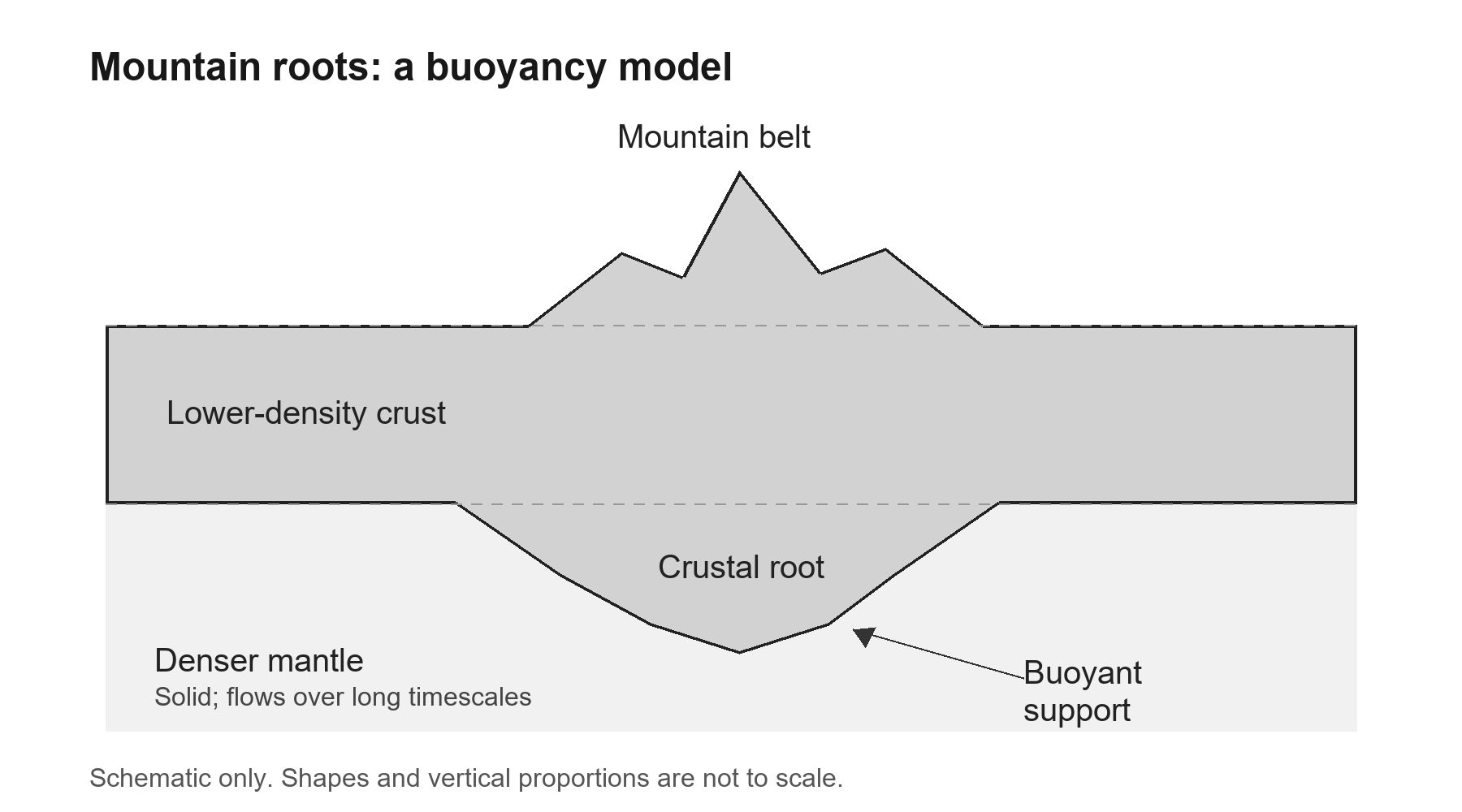
Figure 16.1. A simplified cross-section of the buoyancy model. The mountain and root are part of the same crust. Shapes and vertical proportions are schematic; the calculation above concerns idealised columns, not this outline's dimensions.
Notice what the calculation contains: heights, volumes and densities. It contains no fault friction, no earthquake frequency and no amount of shaking prevented. A successful balance of weight is not a calculation of seismic protection.
That is the central gap in the peg argument. The hidden part can help account for the mountain's elevation without fastening the moving plates to a stationary foundation.
How could we know what lies underground?
We cannot expose an entire mountain belt by digging a trench through it. Instead, geophysicists combine measurements that respond to underground structure.
Seismic waves travel at different speeds through different materials. Some bend or reflect at boundaries. By comparing arrival times at many recording sites with predicted times for possible underground structures, researchers can estimate where major changes occur. The boundary commonly called the Moho separates the crust from the mantle in seismic models.[155]
Gravity provides another kind of constraint. An unexpectedly small gravitational pull relative to a simple model can indicate that the distribution of mass differs from the one assumed. Low-density material beneath elevated terrain can contribute to such a pattern. The result still has to be interpreted alongside other measurements; a gravity anomaly is not a labelled picture of a root.
This is an inference with checks and uncertainties, not direct vision. Different arrangements of material can sometimes produce similar observations. More data can rule out some arrangements and leave others plausible. The USGS Aleutian model is particularly useful as an example because it plainly calls its crustal base a model and describes how additional seismic work could improve it.[153]
The evidence for underground structure therefore does not require taking the word “root” literally. Geologists use familiar words to describe physical relationships. A geological root does not feed a mountain as a plant root feeds a tree, and it does not automatically anchor a plate as a steel peg anchors a rope.
A mountain belt that still ruptured
On 25 April 2015, the magnitude-7.8 Gorkha earthquake struck Nepal. The USGS identifies thrust faulting associated with the boundary between the Indian and Eurasian plates. Thrust faulting involves one rock mass moving up and over another along an inclined fault. The Himalayan collision system both builds high terrain and produces major earthquakes.[156]
The connection is supported by measurements. Daniel McNamara and colleagues combined seismic observations with satellite radar and GPS information to model the event. Their reported rupture covered a patch approximately 150 by 60 kilometres on the Main Himalayan Thrust.[157]
A rupture is not merely a dot on a map. The dot commonly shown for an earthquake marks a location associated with its beginning or a representative position. A large event involves movement across an extended fault area. The reported dimensions help make that distinction visible: 150 kilometres is the length of a substantial road journey, not the width of a crack beside one house.
Mountain building and fault slip can be consequences of the same tectonic interaction. Confusing that shared cause with a simple claim that mountains always cause earthquakes would be another mistake.
The Nepal example decisively refutes a universal promise that mountains make earthquake occurrence impossible. It does not, by itself, refute every claim that some mountain feature can reduce shaking in some circumstances. We need a separate test for that weaker claim.
The strongest reply deserves an actual comparison
A careful defender can say: a seat belt reduces danger without preventing every injury. Why could mountains not reduce instability while leaving some earthquakes possible?
That is a reasonable logical objection to an absolute rebuttal. An earthquake in a mountain region is not enough to prove that every stabilising effect is absent. But the reply creates a measurable question: reduced relative to what, in which location, by what mechanism and over which timescale?
There is relevant research. In 2020, Mark van der Meijde and colleagues modelled how surface topography affected shaking around Kathmandu during the Gorkha earthquake. Topography means the shape of the land surface. Their simulations compared realistic terrain with a flat surface. They found reduced motion in much of the valley interior for the principal source location, alongside greater motion towards its margins. Moving the simulated source changed the pattern; some alternative locations produced substantial amplification inside the valley.[158]
The study deliberately simplified the source and underground material and omitted the valley sediments to isolate the terrain effect. Its findings concern wave propagation at bedrock level. They are not a finding that roots prevented the earthquake or that mountains generally hold Earth's crust still.
We should accept the limited result. Local terrain can matter, and a blanket claim that mountains could never reduce shaking anywhere would be too strong. The authors' changing-source comparison also shows why that result cannot become a universal shield. The location and direction of the incoming waves matter.
The scriptural miracle argument still needs to establish its particular mechanism and scope. Selecting the favourable region of one simulation while ignoring the increased motion elsewhere would repeat the selective reading criticised in earlier chapters.
A further reply is that the verse means prevention of a continuous, planet-wide swaying that would make Earth uninhabitable. Ibn Kathir's account of habitability gives this interpretation a historical basis. It is not defeated merely by pointing to a local tremor.
But where is the geological evidence that a comparable Earth without mountains would sway in that way, and that mountain roots prevent it? The claim concerns a hypothetical alternative world. It needs a physical model with stated assumptions and a clear measure of instability. The fact that we currently inhabit a world with mountains does not establish what would happen if they were absent.
Removing mountains in a model also requires care. Are we eroding only the surface relief? Removing the underlying root? Changing the plate collision that produced the range? Each change describes a different system. The defender cannot leave all this unspecified and then cite the word “balance” as if the experiment had already been completed.
What survives the test?
Mountains can have deep crustal roots. The peg image can suggest something substantial below the visible surface. Those observations do not establish a divinely supplied account of isostasy, still less a general mechanism that prevents earthquakes.
The resemblance becomes less informative when we ask what the image predicts. Does it tell us that the root is relatively buoyant? That crustal thickness and density affect elevation? That the moving system can store elastic energy and rupture? Or are these details supplied only after geology has explained them?
The earthquake-prevention claim fails when it is made absolute. The claim that geology has confirmed mountains as general seismic stabilisers is unsupported by the evidence offered. A local reduction in shaking is possible and documented in modelling, but it depends on conditions and is accompanied by different effects elsewhere. A broader theological description of a habitable Earth remains an interpretation; it has not been demonstrated as a scientific prediction.
Mountain roots help explain the landscape we see. The step from that explanation to earthquake prevention still needs evidence.
Sources and notes
146. Qur'an 16:15, 21:31, 31:10 and 78:7, seven parallel English translations at Quranic Arabic Corpus. For the repeated movement verb, see the root m-y-d. A brief lexical gloss is not treated as a complete account of contextual meaning. Neighbouring passages were checked through the commentaries below. Online sources accessed 27 October 2026; the alternative host of the same Naik PDF was checked on 29 October. ↩
147. Ibn Kathir, abridged English commentary on 16:14–18, especially the explanation of mountain stability and habitability, and 78:1–16, explanation of 78:6–7. These are identifiable interpretations, not proof that all Muslims hold one account. ↩
148. A Brief Illustrated Guide to Understanding Islam, The Quran on Mountains, entire short section and footnotes. References for roots and for stabilisation were distinguished. The cited editions of Press and Siever and El-Naggar were not independently collated here; the chapter does not attribute the website's complete stabilisation argument to Press. ↩
149. Zakir Abdul Karim Naik, The Qur'an and Modern Science: Compatible or Incompatible?, Islamic Research Foundation, 67-page PDF copy, pp. 24–26. All three pages rendered and visually checked. Publication date not established from inspected pages. Its simplified crust, mantle and Earth-radius claims are not adopted as scientific authorities. ↩
150. British Geological Survey, What causes earthquakes?, sections on Earth's structure, plate tectonics and convergent boundaries. The distinction between mantle behaviour over short and geological timescales is essential. No claim that every mountain forms by the same process is intended. ↩
151. Lisa Wald, US Geological Survey, The Science of Earthquakes, sections on fault slip, plate boundaries and seismic waves. The book-and-spring example is an original simplified analogy. Some stored energy becomes seismic waves; the text does not imply that all released energy becomes shaking. ↩
152. US Geological Survey, Reid's Elastic Rebound Theory. The explanation, diagram caption and photographed-fence caption were read. The underlying 1910 Reid report was identified but not independently read for this chapter. No claim of newly conducted fieldwork. ↩
153. US Geological Survey, Eastern Aleutian Volcanic Arc Digital Model—Version 1.0, Open-File Report 00-0365, report, introduction on Airy isostasy and model-constraints section on the continental upper mantle. This is an actual modelling report with explicit limitations, including possible departure from local isostatic balance and the need for additional seismic constraints. Its illustrative root geometry is not promoted to a universally measured shape. ↩
154. Original worked example using specified illustrative densities, equal-area columns and local Airy-type compensation. Extra topographic mass per square metre is 2,800,000 kg; density contrast is 500 kg/m³; compensating root extension is 5,600 m. This is a conditional calculation, not a field measurement or a universal 5.6-to-1 ratio. Figure 16.1 is an original schematic, with no third-party figure reproduced. ↩
155. British Geological Survey, What causes earthquakes?, “The structure of the Earth,” and USGS Aleutian model report, discussion of the Moho, seismic constraints and gravity anomalies. Wave speed depends on material properties beyond density alone; the chapter deliberately avoids treating travel time as a direct density photograph. ↩
156. USGS, 25 April 2015 Nepal earthquake, event us20002926, reviewed event and tectonic summary; also M7.8 Nepal Earthquake, 2015—A Small Push to Mt. Everest. Indexed event text and substantial agency-summary excerpts read; the dynamic event interface did not render in the text browser. No casualty total is necessary to the argument. ↩
157. Daniel E. McNamara and colleagues, “Source modeling of the 2015 Mw 7.8 Nepal (Gorkha) earthquake sequence: Implications for geodynamics and earthquake hazards,” Tectonophysics 714–715 (2017), 21–30, DOI 10.1016/j.tecto.2016.08.004; USGS author/institution publication record and abstract. The methods and approximate 150-by-60-km rupture dimensions used here are explicitly reported in the abstract. Full article not independently obtained; no reanalysis of its data is claimed. ↩
158. Mark van der Meijde, Md Ashrafuzzaman, Norman Kerle, Saad Khan and Harald van der Werff, “The Influence of Surface Topography on the Weak Ground Shaking in Kathmandu Valley during the 2015 Gorkha Earthquake, Nepal,” Sensors 20(3), 678 (2020), DOI 10.3390/s20030678. Complete main text, methods, results, discussion and conclusions read through Europe PMC's full-text XML, after browser and publisher access failures. The model compared terrain with a flat surface, used simplified point sources and uniform material properties, excluded valley sediments, and compared its signal with a bedrock station. Its conditional results are not a global causal law or a root-anchoring experiment. ↩
Chapter 17: Seas, barriers, water and iron
Imagine pouring a glass of fresh water into a bucket of seawater. Stir it. The added water does not remain inside an invisible glass. You now have a larger quantity of less salty water.
That simple observation is enough to challenge one claim: fresh and salty water cannot mix. It is not enough to explain an estuary, where a river enters the sea. An estuary is continually receiving water, losing water and being stirred by currents. Parts of it can remain different even while exchange continues.
This distinction matters because the religious argument comes in more than one version. One says that waters meet without mixing. Another says that waters exchange material while maintaining recognisable differences. The first conflicts with observation. The second describes a real possibility, but still has to establish why a passage about a barrier counts as a discovery of its physical explanation.
Water is essential to known life, and the iron in our planet has a history older than Earth. The other arguments in this chapter concern whether the Qur'an disclosed those facts in a way that demonstrates knowledge unavailable to a human author.
What the water passages say
Qur'an 25:53 describes two bodies of water, one pleasant and fresh, the other salty, with a barrier and a forbidden partition between them. Qur'an 55:19–20 describes two seas meeting, separated by a barrier that they do not transgress. These are paraphrases; the English wording varies across translators.[159]
The variation is relevant to the argument. For 55:20, Shakir's translation describes a barrier the waters cannot pass. Muhammad Sarwar instead describes their not merging completely. The second wording already expresses a less absolute interpretation. We cannot choose whichever translation helps our conclusion and pretend no interpretive choice has been made.
There is also a difference between the ancient passage and the modern explanation attached to it. In the English abridgment of Ibn Kathir's commentary, the barrier in 25:53 is dry land. His explanation of 55:19–20 again refers to land separating fresh and salty waters so that their characteristics are preserved.[160] That is evidence of a documented premodern reading. It is not evidence that every earlier commentator agreed, or that this interpretation settles the passage forever.
It does show why calling the verse a clear description of a modern oceanographic boundary needs an argument. A reader could take it to describe the arrangement of rivers, seas and intervening land without identifying an underwater density boundary at all.
The modern Brief Illustrated Guide to Understanding Islam offers a different reading. Its section on seas and rivers describes water masses with different properties and connects their separation to these verses. It then explicitly denies mixing across the barrier, even in the presence of currents and tides.[161]
We should test that denial against measured water movement.
Difference does not mean isolation
Salinity tells us how much dissolved salt water contains. Density tells us how much mass occupies a given volume. Two equal-sized containers can therefore hold water of different masses, depending on conditions such as temperature and salt content.
NOAA's estuary tutorial explains that less dense river water can lie above denser seawater. In a strongly layered estuary, the boundary can be sharp and mixing across it relatively limited. In other estuaries, tidal stirring mixes water much more thoroughly. The pattern depends on river flow, winds, tides and the shape of the basin. Even a salt wedge, where layering is especially clear, does not exclude all mixing.[162]
Consider a deliberately simplified calculation. We have one kilogram of salt-free water and one kilogram of salt solution. The solution contains 35 grams of salt. That is 35 grams per kilogram of solution; it does not mean adding 35 grams to an already complete kilogram of water.
Mix the two completely, without spilling or evaporating anything. The total mass becomes two kilograms. The amount of salt remains 35 grams. Its average concentration is therefore:
35 grams ÷ 2 kilograms = 17.5 grams per kilogram.
No salt has vanished. No special third substance has appeared. We have diluted the salt by distributing it through more water. This is an illustrative mass balance, not a measurement of a particular river mouth.
Now change the example. Put a tap at one end of a long tank, supplying fresh water continuously. Feed salty water at the other end, and provide outlets so that the tank does not overflow. Depending on the flows and stirring, one part can remain fresher than another. Mixing does not require the entire tank to reach the same concentration at every instant.
The distinction is between a closed batch left to mix and a system whose inputs keep renewing differences. Saying that the second system retains differences does not establish a wall through which nothing passes.
Scientists map these differences by measuring salinity at different positions and depths. Lines joining equal salinity values are called isohalines. They describe the distribution, rather as lines on a contour map describe equal heights. They are not solid surfaces in the water.
A sharp change in salinity with depth is called a halocline. A layer in which density increases sharply with depth is a pycnocline. These names describe gradients: properties changing over a distance. Calling something a boundary does not specify whether it is impermeable. The edge of a cloud is a boundary too; the word alone tells us little about what can cross it.[163]
What happens near Gibraltar?
The Mediterranean and Atlantic example is particularly useful because it appears in the miracle argument itself. We do not have to substitute an unrelated glass of water for the actual sea.
A research paper by James Price and colleagues, published in Science in 1993, describes Mediterranean outflow mixing with Atlantic water. Its abstract reports a dense, salty current drawing in less salty surrounding water as it descends. The current's volume transport roughly doubles while its density difference from surrounding water decreases substantially.[164]
Drawing surrounding fluid into a moving flow is called entrainment. Think of a moving stream of water carrying nearby water along with it. The combined flow then contains material from both sources. This is more specific than saying that two differently coloured regions can be photographed beside one another.
The paper also describes the mixed outflow eventually reaching a depth where it can remain buoyantly balanced with its surroundings. A water mass can thus retain a recognisable signature after it has mixed. Recognisable does not mean chemically untouched.
The Islam Guide also describes Mediterranean outflow as less dense than Atlantic water. The research describes dense Mediterranean outflow entraining less saline Atlantic water. The relevant comparison is with the water encountered along its path; neither ocean has one uniform density at every depth. A blanket comparison conceals the very changes that explain the flow.
We need not pretend that every boundary disappears immediately. The evidence establishes exchange and transformation. That is enough to reject a claim of complete nonmixing at this example.
The stronger defence deserves a different answer
Zakir Naik's The Qur'an and Modern Science explicitly allows water to pass between seas and become mixed. On pages 27–29, his barrier is a transition through which properties change, rather than a solid partition. He nevertheless presents the verses as advance knowledge of oceanography.[165]
An objection based only on the existence of mixing leaves Naik's actual claim unanswered.
The remaining question is whether the text identifies the scientific explanation clearly enough to establish knowledge beyond ordinary observation. Where does it distinguish a density gradient from separating land? How does it tell us which properties change, which persist, or under what conditions mixing becomes stronger? The modern explanation supplies those details; the passage does not select them unambiguously.
This is not a demand that scripture contain a laboratory manual. A sentence can make a clear physical claim without equations. But if several different arrangements fit its words, the later success of one arrangement cannot be treated as though the text had ruled out the others in advance.
A defender may understand the passage more broadly: God sustains a world in which fresh and salty waters retain useful differences despite meeting. That can be a coherent religious interpretation. Oceanography does not disprove the believer's attribution of natural processes to God. It also does not establish that attribution, or show that this description could only have come from God.
The verdict therefore depends on the proposition. A watertight separation is contradicted. Partial separation with mixing is real. The further claim of an unmistakable scientific prediction remains unestablished.
Life from water
Qur'an 21:30 connects every living thing with water. In Chapter 14 we considered the earlier part of the verse about the heavens and Earth. Here the question is its biological claim.[166]
Water has a fundamental role in known life. It is a solvent: a liquid in which many other substances can dissolve. Within cells, an aqueous environment allows substances to move and chemical reactions to proceed. NASA's astrobiology teaching material explains why this makes water central to the search for familiar forms of life.[167]
But “water is essential” does not mean “an organism consists only of water.” Nor does it mean that a container of water automatically becomes alive. The liquid provides conditions in which living chemistry operates; it does not by itself supply an organised, reproducing system.
It also helps to separate three questions. Do existing organisms depend on water? What was the detailed route by which the first life arose? Must every conceivable form of life elsewhere use the same solvent? The strong evidence supporting the first does not automatically answer the other two. NASA's discussion explicitly leaves room for unfamiliar life that might use something else. We have not discovered such organisms, so they cannot be presented as an established counterexample either.
The verse can reasonably be read in a way that agrees with life's dependence on water. There is no need to manufacture a contradiction here.
Naik asks how someone in seventh-century Arabia, especially a region with scarce water, could have reached such a statement.[165] Scarcity does not make water's importance harder to notice. Thirst, failed crops and the difference between watered and dry ground make dependence visible. That observation is an alternative route to the general idea, not proof of exactly how this particular sentence originated.
The strongest reply is that the verse says every living thing, a reach extending beyond what an ancient observer could inspect. That is a fair point about its breadth. Yet making a universal statement and experimentally establishing it are different achievements. A generalisation can turn out broadly right without its author possessing the later explanation.
To establish a scientific miracle, the argument needs more than modern agreement. It needs a reason to exclude an ordinary generalisation from visible dependence on water. The verse gives no account of cells, dissolved substances or the distinction between life's maintenance and its first emergence that would settle that issue.
Iron older than Earth
Qur'an 57:25 discusses messengers, scripture, justice and iron's strength and usefulness. Several translations render the relevant expression as iron being sent down. Others use wording such as brought forth or made.[168]
The article “The Miracle of Iron,” credited to A.O. on IslamReligion.com, reads the downward language physically and links it to iron's stellar origin. It acknowledges a possible figurative meaning, but argues that the literal reading reveals knowledge unavailable in the seventh century.[169]
The scientific fact behind this argument is real: Earth's iron was not originally manufactured by ordinary chemical reactions inside our planet.
An atom has a central nucleus. Changing the arrangement of atoms in a chemical reaction can make a different substance without making a new kind of nucleus. Rusting changes iron's chemical surroundings; it does not create iron nuclei from scratch. The production of elements requires nuclear processes, which alter nuclei themselves.
Stars and stellar explosions provide such conditions. Massive stars build heavier nuclei during their evolution, and their explosions can both make and disperse elements. Iron's history also includes another major route: the thermonuclear explosions of white dwarfs, compact stellar remnants. These are called Type Ia supernovae. We should not reduce all iron production to one kind of giant star exploding.[170]
One important sequence runs from radioactive nickel-56 to cobalt-56 and then stable iron-56. Radioactive decay is a transformation of an unstable nucleus. The numbers identify isotopes, versions distinguished by the total number of protons and neutrons in the nucleus. Along this sequence, the element changes while that total remains 56.[171]
How do we know this is more than an attractive story? Different nuclear transitions emit gamma rays at characteristic energies. Gamma rays are a high-energy form of light. Instruments can compare the energies arriving from an explosion with those expected from radioactive decay.
In 2014, Eugene Churazov and colleagues reported cobalt-56 gamma-ray lines from supernova SN2014J using the Integral observatory. This was observational evidence for the radioactive chain associated with iron production. The observation supported the general account without resolving every detail of how the exploding star had been triggered.[171]
The inference connects independently studied nuclear behaviour with measured radiation from an actual explosion. It is not merely the assertion that scientists can imagine stars making iron.
Making an element and building a planet
The next distinction is chronological. Iron nuclei existed before Earth. Iron-bearing material was among the ingredients from which the solar system and Earth formed.[172] An older ingredient can be present from the beginning of a younger object.
If a house is built from old bricks, the house did not first exist without bricks and receive them afterwards. The age of the bricks and the age of the house answer different questions. Likewise, a statement that iron has a cosmic origin does not imply an already completed, iron-free Earth waiting for its entire iron supply to fall from the sky.
Earth assembled through the accumulation of material. Its present interior includes a large iron-rich core.[173] Later arrivals from space are a separate part of planetary history; they should not be confused with the origin of all the iron already incorporated during formation.
We must also avoid pretending that science can point to the particular ancestral star responsible for every iron atom in a particular spoon. The general production mechanisms and the history of solar-system material are well supported. An individual atom's complete itinerary is usually unavailable.
What does “sent down” establish?
The interpretive issue cannot be solved simply by saying that the literal English phrase sounds like space travel. Qur'an 39:6 uses related downward language for livestock. Yusuf Ali renders it with “sent down,” while other translators use produced or provided. Ibn Kathir's commentary explains the livestock clause in terms of their creation.[174]
This comparison does not prove that physical descent is impossible in 57:25. A word can have different senses in different contexts. It does show that divine provision or creation is a serious alternative within the text's own usage, rather than an escape invented for this discussion.
In Ibn Kathir's treatment of 57:25, the focus is iron's role in weapons and useful tools.[175] That fits the surrounding discussion of power and justice. It does not supply an account of stellar nuclear reactions, planetary assembly or radioactive decay.
A possible defence is that God deliberately chose wording broad enough to express provision for the original audience while also pointing toward a deeper cosmic origin. That possibility cannot be disproved just by showing another meaning. But possibility is not the conclusion being advertised. The claim is that the scientific agreement demonstrates divine authorship.
To reach that conclusion, the defender would need grounds for selecting the cosmic meaning independently of the discovery being matched to it. Otherwise, the explanation can accommodate both a terrestrial provision reading and a cosmic production reading, and its flexibility is being counted as precision.
The short scriptural expression leaves both readings open: a cosmic history and the ordinary religious idea of giving humanity a useful material. Iron's stellar origin does not remove that interpretive choice.
Across these examples, the work is to identify what survives examination. Water masses mix without instantly losing every difference. Known life depends on water. Earth's iron has a cosmic past. Those conclusions remain intact. What fails is the automatic promotion of a compatible reading into proof that no human author could have written the passage.
Sources and notes
159. Qur'an 25:53 and 55:19–20; seven translations compared for 25:53 and 55:20 at the Quranic Arabic Corpus: 25:53, 55:20. Context 55:14–25 also checked in the commentary below. Translation differences are not treated as independent ancient witnesses. ↩
160. Ibn Kathir, English abridged tafsir, 25:51–54 and 55:14–25, passages explaining the barrier as land. This identifies a particular commentary tradition, not a unanimous history of interpretation. ↩
161. I. A. Ibrahim, A Brief Illustrated Guide to Understanding Islam, “The Quran on Seas and Rivers”, full section and references checked. Its oceanography textbook references were not independently collated. The website is evidence of its own argument. ↩
162. NOAA, “Classifying Estuaries: By Water Circulation”, sections on salt-wedge, partially mixed and vertically mixed estuaries. The numerical tank example is original and hypothetical. ↩
163. NOAA, “Monitoring Estuaries”, salinity and isohaline explanation, read directly on 29 October 2026. NOAA's Tides and Currents Glossary, entries for isohaline, isopleth, halocline and pycnocline, checked on the same date, supplies the technical definitions. A contour map alone is not a direct measurement of mixing rate. ↩
164. J. F. Price et al., “Mediterranean outflow mixing and dynamics,” Science 259 (5099), 1277–1282 (1993), DOI 10.1126/science.259.5099.1277; complete abstract and bibliographic record. Only results explicitly stated in the abstract are used here; the full paper and underlying observations have not been independently reanalysed. ↩
165. Zakir Naik, The Qur'an and Modern Science: Compatible or Incompatible?, Islamic Research Foundation, 67-page PDF, pp. 27–29 on water exchange and p. 33 on life's relation to water. These pages were extracted and visually checked. The language claim about the Arabic verb is not adopted as a definitive lexical ruling. The named scientists' endorsements and the Cape Point example are not relied upon. ↩
166. Qur'an 21:30, seven translations compared. The context and Ibn Kathir's 21:30–33 commentary were examined in Chapter 14. This chapter does not equate dependence on water with a fully established account of life's origin. ↩
167. NASA Astrobiology, “Why is water so important for life as we know it?”, adult/beginner and older-student sections, substantive indexed text checked. Used for the solvent role and the limit to known life, not as proof that other biochemistries exist. ↩
168. Qur'an 57:25, seven complete translations compared. Context within the verse includes scripture, justice, strength and benefit; the cosmic interpretation is a further argument. ↩
169. A.O., “The Miracle of Iron”, 14 May 2007, revised 12 January 2015. Its stellar-origin and linguistic argument checked. Its medical claims, old iron-60 half-life figure and detailed stellar temperatures are not adopted here. ↩
170. NASA, “Supernovae”, discussion of element production and dispersal; substantive indexed sections checked. For Type Ia production, see the direct observational source below. Older outreach claims that every heavy element comes only from massive-star supernovae should not be used as a complete modern account. ↩
171. E. Churazov et al., “Cobalt-56 gamma-ray emission lines from the type Ia supernova 2014J,” Nature 512, 406–408 (2014), DOI 10.1038/nature13672; author abstract and record. Complete abstract read; full-paper numerical analysis not independently checked. ESA, “Integral catches dead star exploding in a blaze of glory”, 27 August 2014, mission report read. The chapter does not claim the observation uniquely settled the explosion's trigger. ↩
172. NASA, “Our Cosmic Connection to the Elements”, introductory discussion of pre-existing elements in the solar nebula and at Earth's formation. The text's simplified allocation of elements to stellar categories is not used to exclude Type Ia production. ↩
173. NASA, “Facts About Earth”, Formation and Structure sections. Used for planetary assembly and the iron-rich core; its loose description of mantle rock as molten is not adopted. ↩
174. Qur'an 39:6, parallel translations; Ibn Kathir, commentary on 39:5–6, livestock clause. The comparison demonstrates interpretive alternatives, not a rule that every occurrence must be metaphorical. ↩
175. Ibn Kathir, commentary on 57:25, sections on justice and iron's weapons and tools. Commentary claims about war and individual reports are not independently established by citing this explanation; their ethical and historical assessment belongs to later chapters. ↩
Chapter 18: Noah's flood and the traces history should leave
A flood can destroy everything a person knows without destroying everything on Earth. Someone watching their home, fields and neighbours disappear beneath water may experience the end of their world. That does not tell us whether another community, beyond the mountains, remained dry.
The difference is geographical, but it changes the evidence we need. A regional disaster and a flood covering every continent are different events. Finding evidence for the first does not establish the second. Rejecting the second does not prove that the first never happened.
Noah's story therefore needs a more careful examination than pointing at an ancient mud layer and announcing either victory or fraud. We need to identify the claim, give it a time and place where possible, and ask what physical history would follow from it.
Which flood does the claim describe?
The Qur'an presents Noah, or Nuh, as a messenger to his people. In its account, rejection of his warning is followed by a devastating flood. A vessel carries the survivors. Noah's son attempts to take refuge on a mountain but drowns. The waters eventually subside, and the vessel comes to rest on al-Judi. Other passages describe rain, bursting springs and the rescue of Noah's household.[176]
These passages do not give a date in the modern calendar. Nor do they supply a complete scientific description of the flood's area, water volume or duration. We should not insert a particular Christian chronology into the Qur'an and then congratulate ourselves for refuting it.
That does not make the global interpretation an invention of hostile critics. IslamQA.info's answer 130293 explicitly defends the drowning of all people and animals outside the vessel. It cites Qur'an 37:77, concerning the survival of Noah's descendants, and reproduces a description attributed to Ibn Kathir in which water covers the Earth and its mountains.[177]
There are also documented Muslim disagreements. An Askimam answer by Saleem Ibn Sajawal Khan, approved by Mufti Ebrahim Desai, says that the Qur'an does not specify the flood's exact location or magnitude. It discusses both worldwide and regional interpretations. Its references include regional reasoning from Ibn Atiyyah, but also his consideration of a global alternative. Quoting only the regional passage would conceal part of the source.[178]
IslamWeb offers another useful distinction. It favours the worldwide reading while acknowledging that the relevant texts do not establish that geographical scope with certainty. It also accepts, in principle, that decisive rational evidence could outweigh an uncertain interpretation.[179]
We consequently have at least three claims to consider. One is a recent, prolonged, physically destructive flood that covered the world's land and mountains. Another is a disastrous regional flood affecting Noah's community. A third leaves the event's physical details open and centres its religious meaning.
Only the first requires a worldwide catastrophe. Before arguing about it, a defender should also explain what “recent” means. An event four thousand years ago and one hundreds of thousands of years ago cannot be assessed against exactly the same records. Moving the event outside a particular record's reach avoids that particular test; it does not supply positive evidence that the event occurred.
Water leaves evidence, but evidence needs a date
Imagine two excavations. At one, investigators find a flood deposit dated to around 4,500 years ago. At another, they find a deposit dated to around 3,200 years ago. Suppose each date has an uncertainty of roughly fifty years. These are invented numbers to illustrate the reasoning.
Both sites contain evidence of flooding. They do not contain evidence of the same flood. Their date ranges remain more than a thousand years apart.
Calling both layers “ancient” hides the disagreement rather than resolving it. The same mistake occurs when photographs of water-shaped landscapes from different continents are placed side by side without establishing when each feature formed.
A worldwide catastrophe would not necessarily leave one identical layer of mud everywhere. Different terrain and currents would produce different effects; erosion could remove deposits. The sensible test is broader. Do records from the proposed time fit a common catastrophic interruption? Do they instead preserve sequences of growth and accumulation that the proposed disaster should have disrupted?
Evidence that ordinary processes continued through the proposed date can test the claim even where we find no remains of the flood itself.
Trees can preserve a calendar longer than one tree's life
In suitable trees, seasonal growth produces a sequence of wood rings. Ring widths vary with growing conditions. Several trees in an area may therefore share a recognisable pattern of relatively wide and narrow rings. Researchers compare those patterns to establish which years overlap. This procedure is called crossdating.[180]
Consider an imaginary example with three trees. After successful dating, Tree A covers the years 1000–1099. Tree B covers 1050–1149. Tree C covers 1100–1199. Each contains a hundred years of growth, but the combined calendar covers two hundred years, not three hundred. Overlapping years are counted once.
Tree B connects the other two. Its older rings overlap A's later rings; its younger rings overlap C's earlier rings. None of the trees lived for the entire two centuries.
The dates in this example describe the result of establishing the matches. Researchers cannot simply assign convenient dates to unrelated pieces of wood. The challenge is to demonstrate that the sequence of growth patterns genuinely lines up, using many samples and statistical checks. A few broadly similar rings would be poor evidence.
Starting with wood of known age, overlapping samples can extend the calendar backwards. That is why a tree-ring record lasting thousands of years does not require a single tree thousands of years old.
There are complications. A ring may be absent from part of a trunk. Growth within one year may also produce a misleading extra band. The University of Arizona's tree-ring laboratory illustrates both problems. Careful crossdating and examination of the wood help distinguish annual growth from these anomalies.[181] “I counted some lines” is not a sufficient description of the method.
One substantial example is the Hohenheim chronology. Friedrich and colleagues' 2004 report describes an oak sequence running from 8480 BCE to 2002 CE, built from more than seven thousand individual oaks. Pine samples extend the combined record further. The paper's title gives a span of 12,460 years, but the authors call the link at its oldest extension tentative. We should keep that qualification rather than advertising every part of the record as equally secure.[182]
A proposed catastrophe within the well-replicated oak sequence must account for the overlapping lifetimes represented by the wood. A prolonged, violent, mountain-covering inundation that destroyed the region's forests is difficult to reconcile with trees continuing to grow across the proposed date.
That is an inference from the record, not a claim that every tree dies whenever its roots get wet. Flood tolerance, depth and duration matter. Indeed, the Hohenheim researchers explain that river erosion and burial helped preserve many of their samples. Local floods belong within this history. A catastrophe that eliminates all those growing forests at once is a different proposition.
To challenge the chronology, identify a defective match, a mistaken annual assignment or another error capable of changing the result. The fact that errors are possible does not show that thousands of years have been invented. The relevant question is whether a proposed error explains the actual patterns across the samples.
Reading seasons in ice
Greenland supplies another kind of record. Successive snowfall becomes buried and compressed into ice. Researchers drill through the ice sheet and recover long cylinders, called cores. Measurements along them reveal changes in the material deposited over time.
Counting these layers is more demanding than treating every visible stripe as a year. A year can contain many storms. A single measurement can also contain several peaks within one year. Scientists therefore compare seasonal patterns in several measurements, including chemical constituents, electrical properties and water isotopes. Isotopes are forms of the same element with different masses; their proportions in water help track changing conditions.[183]
Think of dating a box of undated shop receipts. Counting every receipt as one day would fail because the shop makes many sales a day. Repeated sequences of opening, trading and closing could provide better information. Recognising a repeating cycle is the useful idea here. In ice, researchers must demonstrate that the measured signals follow seasons.
Svensson and colleagues' 2008 paper extended the Greenland Ice-Core Chronology 2005 to sixty thousand years using annual-layer identification. The authors recorded uncertain layers and compared their chronology with other records. They also reported disagreements with earlier timescales. The dates carry error estimates and remain open to revision.[183]
A later data paper, published by Rasmussen and colleagues in 2023, makes the limits clearer. The counted chronology reaches sixty thousand years; beyond that, an extension uses an ice-flow model. Those are different methods. The paper also describes a revised chronology covering the most recent 3,800 years and acknowledges that the earlier chronology had been less accurate than initially assumed.[184]
The size and cause of a correction matter. Revising the date of an event does not necessarily remove the layers accumulated before it. An argument that thousands of annual cycles never occurred would require evidence for that much larger error.
There is another caution. Several ice cores can be assigned a common timescale by matching shared events, such as volcanic signals. Their matching dates are then not wholly independent confirmations. Distinct measurements can support a common reconstruction without every number having been obtained independently.[184]
What does this mean for the flood? A recent catastrophe covering Greenland's high interior with deep floodwater must explain the survival of long, ordered records of snowfall and atmospheric deposition. It is not enough to say that water could freeze. The explanation has to produce the observed sequences, their internal structure and their agreement with other evidence.
Neither cited paper was written as a direct test of Noah's story. The application here is an inference: an event with enormous physical effects must fit the physical history preserved in the affected place. If the proposed flood leaves the ice sheet untouched because that region was never flooded, the proposal has already surrendered worldwide coverage.
Do not turn every layer into a year
Lake sediments provide a useful warning against careless arguments on either side. Some lakes preserve seasonal layers called varves. A storm deposit, however, is not automatically a year, and a complete-looking cylinder of sediment is not automatically a complete calendar.
Research at Japan's Lake Suigetsu shows how investigators address such problems. A 2012 study used overlapping cores to overcome recovery gaps in an earlier record, distinguished event deposits from ordinary accumulation, and combined layer information with radiocarbon measurements. Its chronology did not consist of directly counted annual layers throughout the entire period discussed. The recent part also depended on tree-ring calibration.[185]
It would be misleading to present that study as an entirely independent, uninterrupted annual calendar for every recent millennium. Its value here is methodological: different records have different strengths, gaps and dependencies. The actual methods section matters more than a dramatic number in a headline.
A possible objection is that a flood can lay down several layers quickly. That is true. The task is to determine which process produced the particular layers being examined. Rapidly deposited layers cannot simply be assumed to have the same structure and sequence as repeated seasonal growth or deposition. Equally, seasonal deposition must be demonstrated rather than assumed from stripes alone.
Could a real regional disaster lie behind the story?
It could. Rejecting a recent global inundation does not require rejecting ordinary catastrophic floods. Nor does it require believing that ancient stories contain no historical memories.
The difficulty is identification. Suppose an archaeologist establishes that a settlement was flooded and then rebuilt. The finding tells us something substantial about that settlement. By itself, it does not identify the survivors, establish that one was Noah, connect the event to a particular text, or reveal a divine intention. Establishing those details requires evidence beyond the flood deposit.
The Black Sea provides an example of why the distinction matters. Researchers have investigated whether a major rise in its waters might be associated with ancient flood traditions. Woods Hole Oceanographic Institution describes work by Liviu Giosan and colleagues using sediment cores to reconstruct past water levels. Their findings challenged a proposed enormous deluge, suggesting a much smaller event if that flood occurred at all.[186]
This is a debate about reconstructing a regional environment. The familiar label “Noah's flood” can obscure how much remains to be established before associating the event with a particular person.
Even discovering an ancient vessel would begin a further investigation. Was the object actually built by people? How was it dated? Where was it found, and was that its original location? What evidence identifies its occupants? A boat-shaped landform would not answer those questions merely by resembling a boat.
The regional interpretation nevertheless survives an important criticism. Tree growth elsewhere on Earth cannot disprove a flood confined to another region. A critic who continues using worldwide consequences against a regional claim is arguing against the wrong proposition.
What survives is a possibility, however, not a demonstrated history. The absence of a geological contradiction is a lower standard than establishing that a named messenger built a vessel under divine instruction and survived a punishment sent against his community.
What if God protected the evidence?
A believer might propose that God preserved trees and ice during the flood, or restored their earlier appearance afterwards. This is a possible philosophical response, not a claim attributed here to every Muslim commentator.
An unlimited miracle could be defined to prevent every expected physical consequence. Such a proposal escapes the ordinary geological test because it has deliberately removed the consequences the test would examine.
But it has also given up the claim that the surviving physical record independently confirms the event. If the world would look exactly the same whether the flood happened or not, its present appearance cannot distinguish the alternatives.
Imagine claiming that a library burned down last night, but every book was miraculously restored, every witness's memory replaced and every sign of fire removed. The books now on the shelves cannot establish that hidden history. Belief would have to rest on some separate reason for trusting the claim. Introducing restoration explains why expected evidence is missing only after the restoration itself has been assumed.
Miracles remain logically possible under this description. So do many incompatible histories, each protected by its own extraordinary interventions. Logical possibility alone gives us no reason to select this particular account of the past.
The same applies to an appeal to scientific fallibility. IslamWeb is right that scientific findings are not automatically infallible. Yet the choice is not between perfect knowledge and equal confidence in every story. We routinely distinguish a well-supported reconstruction from a bare possibility while accepting that further evidence could change our judgment.
For a recent, prolonged, physically destructive worldwide flood, the continuous records examined here present serious contrary evidence. The defender needs a specified chronology and a physical account that explains those records. Pointing to floods somewhere, or to the possibility of error somewhere, does not do that work.
A regional interpretation avoids the worldwide contradiction. It still needs historical evidence connecting a particular disaster to the particular religious narrative. A wholly miraculous version can be insulated from physical testing, but then geology cannot supply its advertised proof.
The question to ask when someone presents a flood discovery is therefore precise: what, exactly, has been found: a record of flooding, evidence of a worldwide event, or evidence identifying Noah? Moving between those three claims without showing the missing steps is how an ordinary geological discovery becomes a religious conclusion it cannot carry.
Sources and notes
176. Qur'an 11:25–49, 23:23–30, 54:9–15 and 37:75–82. Passages read in Saheeh International's English translation; the chapter paraphrases rather than quotes it. Surah Hud, beginning at 11:25; 23:23; 54:9; 37:75. Full passage extracts and translation metadata are retained in the research record. These passages do not specify a date in BCE or CE. ↩
177. IslamQA.info, answer 130293, 29 December 2013, discussion of who survived Noah's flood, including Qur'an 37:77 and an attributed extract from Ibn Kathir's Al-Bidayah wa'l-Nihayah. Answer 130293. Used as a primary source for this contemporary defence; the cited Arabic book editions have not been independently collated. ↩
178. Saleem Ibn Sajawal Khan, checked and approved by Mufti Ebrahim Desai, “Was the flood in the time of Nuh (A.S) a global event or a regional event?”, Askimam answer preserved by IslamQA.org. Answer and references. Read the whole answer, including its two different Ibn Atiyyah passages; the English headline summary alone omits the second qualification. ↩
179. IslamWeb, fatwa 381285, “Did the Flood of Nooh Encompass the Entire Earth?”, 13 August 2018. Full answer. This source favours global coverage but distinguishes that interpretation from categorical certainty. The questioner's assertion about a million years is not used as scientific evidence. ↩
180. NOAA Ocean Service, “Be a Tree Ring Detective”, especially the explanations of growth conditions, crossdating and overlapping samples. Teaching resource. The three-tree numerical example in this chapter is original and hypothetical; it is not a reported dataset. ↩
181. Paul R. Sheppard, Laboratory of Tree-Ring Research, University of Arizona, “Ring-Growth Anomalies”, revised September 2014. Missing rings and false bands. See also the laboratory's crossdating exercise on absent and false rings. ↩
182. Michael Friedrich et al., “The 12,460-Year Hohenheim Oak and Pine Tree-Ring Chronology from Central Europe—A Unique Annual Record for Radiocarbon Calibration and Paleoenvironment Reconstructions”, Radiocarbon 46(3), 1111–1122 (2004), doi:10.1017/S003382220003304X. Full article read. Oak span and replication: pp. 1111–1114; false matches and pine links: pp. 1115–1117; the oldest Zurich extension is explicitly qualified on p. 1117. The 12,460-year headline is the span reported in that paper, not the age of one tree. ↩
183. Anders Svensson et al., “A 60,000 year Greenland stratigraphic ice core chronology”, Climate of the Past 4, 47–57 (2008), doi:10.5194/cp-4-47-2008. Main article read, including methods, comparisons and conclusions. Uncertain-layer counts do not capture every possible systematic error. Comparisons that assume synchronous climate events are not treated here as assumption-free independent dates. ↩
184. Sune Olander Rasmussen et al., “Ice-core data used for the construction of the Greenland Ice-Core Chronology 2005 and 2021 (GICC05 and GICC21)”, Earth System Science Data 15, 3351–3364 (2023), doi:10.5194/essd-15-3351-2023. Abstract and introduction establish the counted/modelled distinction, common chronology and revision to 3,800 years. This describes the publication's reported scope; it is not a claim that no later revision exists. ↩
185. Christopher Bronk Ramsey et al., “A Complete Terrestrial Radiocarbon Record for 11.2 to 52.8 kyr B.P.”, Science 338(6105), 370–374 (2012), doi:10.1126/science.1226660. Main paper read; supplementary files not read. Its reconstruction combines methods and does not provide directly counted varves throughout the Holocene. Used to explain methodological limits, not to announce the latest Suigetsu chronology. ↩
186. Woods Hole Oceanographic Institution, “Drilling for clues”, 21 October 2009, institutional account of Liviu Giosan and colleagues' Danube-delta fieldwork and reconstruction. Research description. The short account was read in full. It documents this team's challenge to a much larger proposed Black Sea flood; it neither establishes a link to Noah nor supplies a complete review of later research. ↩
Chapter 19: Embryology without the miracle sales pitch
The claim sounds impressive: the Qur'an described a human embryo centuries before microscopes revealed how one develops. A passage about a drop, a clinging substance, a lump, bones and flesh appears beside modern medical pictures. An embryologist's endorsement supplies the final reassurance. How could Muhammad have known?
To answer, we need to separate several questions. Does the passage describe development? Does a particular translation fit something we can observe? Does it give information that earlier people could not have possessed? And does that information establish a divine author?
These questions require different evidence. A resemblance between a word and a photograph may answer the second while leaving the others open. Much of the persuasive force of the miracle argument comes from moving between them without showing the steps.
What the passage says
Qur'an 23:12–16 places human development inside an argument about creation, death and resurrection. It begins with an origin from clay, moves to a drop in a secure place, then describes successive changes. Verse 14 uses the terms alaqah and mudghah, followed by bones clothed with flesh and a further creation. The next verses say that people will die and be raised again.[187]
English versions already show why care is needed. In the Qur'anic Arabic Corpus comparison, Sahih International renders alaqah as a clinging clot; Yusuf Ali uses congealed blood. Translations of mudghah include a lump, a little lump and tissue. Shakir's rendering describes bones being made in the lump, where several other versions describe the lump being made into bones.[188]
Choosing whichever English wording produces the strongest accusation would be poor criticism. Choosing whichever wording most closely resembles a modern textbook would be poor evidence for a miracle. The Arabic expression, its context and its history of interpretation must constrain both sides.
Ibn Kathir's commentary, in the English abridgement available through Quran.com, understands alaqah in terms of a red, elongated clot and mudghah as a piece of flesh without clear features. His discussion of bones includes the developing body's form and parts; he is not writing a modern account of mineral deposition in skeletal tissue.[189]
This older reading matters. It prevents a modern presentation from treating today's preferred scientific interpretation as the only meaning the words have ever carried. It does not, by itself, prove that every later interpretation is forbidden. A later interpretation still has to explain why the wording supports it.
From a fertilised cell to developing tissues
Fertilization occurs when a sperm and an egg unite. The resulting cell is called a zygote. It divides, and its descendants continue dividing and becoming organised. An early structure called a blastocyst contains an inner group of cells and an outer layer. Development involves cells multiplying, moving, changing their activities and forming different tissues.[190]
A cell is a tiny living unit. A tissue is an organised collection of cells and material around them, such as muscle or cartilage. Differentiation means that cells become specialised: they acquire characteristics suited to particular jobs. Calling the early embryo a lump does not tell us how these jobs are assigned or how different structures develop together.
Implantation is the process in which the blastocyst attaches to and becomes embedded in the lining of the uterus, or womb. It begins near the end of the first week after fertilisation and continues into the second. The tissues connecting the developing pregnancy to the mother are themselves undergoing complicated changes.[191]
Comparisons of developmental dates can also be confused by two different clocks. Pregnancy's clinical clock usually starts with the first day of the last menstrual period. A developmental clock may instead count from fertilisation. Under the usual convention, the first is approximately two weeks ahead of the second.[190]
An embryo six weeks after fertilisation can therefore belong to a pregnancy described as eight weeks along. That is not necessarily a scientific disagreement. Six plus two equals eight; the starting points differ. The difference is approximate because real cycles vary. Any claim that one tissue appears in “week six” should identify which clock it means before comparing it with another source.
Clot, attachment and leech
The word alaqah is central to the argument. Edward William Lane's Arabic-English lexicon records blood and clot senses, as well as a leech, under the relevant entry. The verbal family includes clinging and hanging. These are real lexical possibilities, not words that can simply be dismissed because they are useful to a defender.[192]
But a dictionary gives possible meanings. It does not announce that every meaning is simultaneously intended in every sentence. If an English writer calls someone a “star,” astronomy and celebrity are both possible associations. That does not make the sentence a scientific statement about nuclear fusion. Context determines which sense is doing the work.
The modern website Islam Guide presents alaqah through three comparisons: a leech, something suspended, and a blood clot. It connects these to appearance, attachment and dependence on maternal nourishment. Its clot comparison includes how the embryo and its surroundings look; it need not be read as the claim that the entire embryo consists of coagulated blood.[193]
That distinction changes the criticism. A literal account in which a clot turns into a human embryo conflicts with the cellular process just described. An embryo develops through descendants of the fertilised cell and their organised interactions. Calling it a clot mistakes one kind of biological material for another.
A comparison based on appearance is less vulnerable, because different objects can resemble one another. An early embryo can look elongated. A selected image may remind someone of a leech. Attachment is also relevant to pregnancy. We do not have to deny all resemblance to question the conclusion.
Instead, ask how much information the comparison supplies. Does “leech-like” identify a particular stage without being shown the desired picture first? Does it distinguish a human embryo from other curved, elongated forms? Does it specify what is attached to what, or explain the developing support tissues? Which similarities are essential, and which differences are being ignored?
An analogy can be useful without answering all those questions. The difficulty arises when a loose analogy is presented as a precise discovery. A shape chosen after modern photographs are available has not shown that an earlier reader could have predicted those photographs.
There is also an uneven standard in accepting every attractive sense of a word while discarding an inconvenient one as figurative. If blood clot is only a visual comparison, say so. Then judge it as a visual comparison, with the limited precision that implies. It cannot be a technical description when praise is being awarded and become ordinary imagery whenever its biology is questioned.
The chewed-lump comparison
Islam Guide also compares mudghah with chewed material, using the segmented appearance of an embryo to support the resemblance. The structures involved are somites.[193]
During early development, cells become arranged into three main layers. One is the mesoderm. Part of this layer forms a series of paired segments called somites. They appear along the developing body's axis. The University of New South Wales teaching material describes this segmentation as beginning in the third week after fertilisation.[194]
Repeated groups of developing cells produce a segmented appearance. The defender compares that visible pattern with marks left by chewing.
Suppose, as an imaginary exercise, that several people are shown a small curved object with repeated bumps and asked to describe it without using technical vocabulary. One might say a piece of chewed gum. Another might say a small bean with ridges. A third might compare it with a segmented creature. A resemblance does not become false merely because other descriptions are possible. It does become less distinctive as evidence for an otherwise inaccessible discovery.
A stronger test would specify the expected arrangement before the image is selected. It would explain which features would count against the interpretation. Otherwise almost any sufficiently soft, irregular object can qualify as a lump, while the photograph supplies the detail absent from the words.
The comparison may help someone remember what an embryo looks like. That educational use is separate from establishing where a scripture came from.
Bones and flesh: what is actually developing?
The phrase about bones being clothed with flesh raises a more substantial issue. A simple reading can suggest that a body first becomes a bare skeleton, which then receives its soft tissues. That is not how human development proceeds.
Even the word “bone” needs clarification. Cartilage is a specialised supporting tissue, different from mineralised bone. Many bones develop through an early cartilage model that is later replaced by bone. Other bones form by a different route without first making the same sort of cartilage model. A study of human skeletal development by Ken To and colleagues distinguishes these routes in the skull and the rest of the regions it examines.[195]
This matters because a drawing of an early skeleton may show the shapes of future bones without showing a complete skeleton of hard bone. A critic who calls every early skeletal model “finished bone” has misread the biology. So has a defender who changes from a cartilage model to mature bone whenever one definition gives a more convenient timeline.
Muscle also has a history. There are early cells committed towards muscle development, later muscle cells and progressively organised muscles. Finding an early muscle precursor does not mean finding a finished adult muscle. Equally, a muscle's later arrangement does not mean that no muscle development had happened before it.
Bao Zhang and colleagues studied human embryonic limb development using tissue from five to nine weeks after conception. Their atlas describes developing cartilage structures alongside a sequence of muscle progenitors, myoblasts and myocytes: progressively specialised cells on the way to muscle. It identifies overlapping waves of muscle development. Its figure 4 displays the changing proportions of those muscle cell types across stages.[196]
These observations give us developing tissues with different beginnings and different rates of maturation. They do not give us one moment when an entire body becomes bone, followed by another when flesh finally starts.
The strongest defence already acknowledges early muscle
There is a documented response more careful than the bare-skeleton claim. A special 1983 edition of Keith L. Moore's The Developing Human contains Islamic additions credited to Abdul-Majeed A. Azzindani. The title page distinguishes those additions from Moore's underlying embryology textbook.[197]
In the addition's discussion of bones and muscle, the early skeleton is described through cartilage models and bodily form. The text explicitly recognises that both muscle and bone beginnings are present during the first forty days. It argues that the relevant sequence concerns later recognisable shapes and the positioning of muscles around skeletal structures.[197]
Pointing to early muscle precursors therefore does not, by itself, answer this defence. The authors already acknowledge them.
On this interpretation, “bones” can name the developing skeletal pattern, and “clothing” can name the later organisation of surrounding muscles. Parts of that description can fit local developmental events. The Qur'anic passage is brief, and ordinary language need not describe every overlapping process to say something meaningful.
The remaining question is whether this fit establishes a scientific miracle. Here the definition of “formed” becomes decisive. Are we counting the first cells on a developmental path, a recognisable tissue, a recognisable shape, or a mature structure? Those are different milestones. A claim of exact order must tell us which milestone applies to each tissue and why.
Consider a building under construction. Its frame, wiring and walls can be at different stages on different floors. We might truthfully say that the frame took shape before the rooms were finished. It would be wrong to infer that no wiring work had begun anywhere until the entire frame was complete. It would also be wrong to treat “began” for one job and “finished” for another as equivalent measurements of which came first.
This analogy only illustrates the timing problem. The biological evidence comes from the tissues. A useful developmental description has to keep track of location, tissue type and the milestone being compared.
The stronger defence can therefore answer an overconfident accusation that the words could only mean mature bare bones. It has not thereby shown that the words independently reveal the detailed process. Much of the precision comes from the later explanation: cartilage models, tissue beginnings, stages of muscle organisation and selected time windows. Those details are doing the scientific work. They need to be demonstrated in the text if the text is to receive credit for predicting them.
How researchers know more than a picture can show
A modern embryo atlas does not consist of someone looking at a shape and choosing a familiar object that resembles it. Researchers examine tissue structure and molecular evidence. Among the measurements are patterns of gene activity: which genetic instructions particular cells are using. Different patterns help distinguish cell populations. Methods that retain the cells' positions then connect those populations to places in the developing body.[195][196]
This is why an atlas can tell us more than an outline sketch. Two cells may look broadly similar while carrying out different developmental programmes. Combining their molecular activity with their location provides evidence about what kind of tissue they belong to and how it is becoming organised.
There are limits. The limb atlas uses specimens from different developmental ages; it is not a continuous film of one embryo growing. Age estimates, sampling and the particular cells recovered affect the reconstruction. A computer-inferred path between cell states is also not identical to directly tracking a living cell and every one of its descendants.[196]
Those limitations warrant caution about precise universal dates. They do not erase the observed coexistence of developing tissues. Nor do they turn a simple chain of drop, lump, bones and flesh into a substitute for the evidence.
The miracle interpretation depends heavily on findings already supplied by science. The photographed embryo is dated using modern knowledge. Its segments receive a modern identification. “Bone” is explained as cartilage when the developmental account requires it. The interpretation is being guided by findings already available to the interpreter.
That may produce a reading a believer finds compatible with faith. To establish advance scientific knowledge, we would need a reason to think the information came from the old wording rather than from the modern explanation supplied around it.
Earlier people had developmental theories
The claim that nobody before modern science could describe development in stages is historically too strong. Galen's On Semen contains an account divided into four periods. In Phillip De Lacy's English translation, the discussion moves from a semen-dominated beginning to a blood-filled, fleshy state, then to clearer outlines of principal parts and later differentiated limbs and movement.[198]
Galen's account is not identical to the Qur'an's. It is also not a modern embryology textbook. Its relevance is narrower: staged descriptions of development existed in ancient medicine before Islam.
This does not establish that Muhammad read Galen, that a particular informant delivered a particular passage, or that the Qur'an copied a particular manuscript. Those are separate historical claims requiring evidence of transmission. Similarity alone cannot identify the route by which an idea travelled, or prove that it travelled at all.
But the absence of a proven borrowing route does not restore the assertion that staged descriptions were unavailable to human thought. The ancient account is evidence against that sweeping assertion. A critic can make that point without inventing a secret medical education for Muhammad.
To reject the proposition that only divine revelation could produce a staged description, one need not reconstruct every sentence's historical origin. Showing that human authors had already produced developmental theories weakens the claimed monopoly on explanation. Establishing the precise origin of the Qur'anic passage would require further work.
What an expert endorsement can establish
Islam Guide quotes Moore as judging the Qur'anic statements remarkable and attributing their source to God. It also presents the simple descriptive stages as useful. This is an endorsement reported by the apologetic source; it deserves to be evaluated as an argument rather than dismissed through speculation about Moore's motives.[193]
An embryologist's expertise is relevant to embryos. If an expert says that a comparison captures a feature, we should examine the feature. If the expert concludes that God must have supplied the words, the conclusion also depends on linguistics, historical possibilities and a philosophical inference about divine action. Expertise in one field does not automatically settle all those questions.
We can assess the endorsement by examining its reasons. Which biological observation supports it? Which Arabic meaning is being selected? Were alternatives ruled out? Is the claim compatibility, educational usefulness or unique knowledge unavailable by human means?
None of this requires a story about dishonesty. A respected scientist can sincerely judge a religious argument persuasive. Another reader can accept the scientist's biological observations while finding the argument for revelation incomplete. The reasons remain available for inspection regardless of the name attached to them.
Where the evidence leaves the claim
A human embryo is not a blood clot transforming into a person. A complete bare bony skeleton does not appear first and wait for all soft tissue to begin. Those literal biological accounts fail.
Some comparisons are more flexible. Attachment, an elongated appearance and a segmented lump can resemble aspects of development. A description involving skeletal models and later muscle arrangement is also more defensible than the bare-skeleton picture. Giving those interpretations their due prevents criticism from winning against an argument the better-informed defender does not make.
Their flexibility, however, limits their force as proof. A description adjusted through several permissible meanings and several different definitions of formation has not demonstrated a uniquely precise prediction. Older staged accounts further undermine the claim that development in stages was unimaginable before Islam.
I do not find a demonstrated scientific miracle here. The argument offers suggestive comparisons, a disputed developmental sequence and a conclusion about authorship that goes beyond what those comparisons establish. A believer may value the passage as a religious reflection on human dependence and mortality. That is a different basis for belief, and it should be defended on its own terms.
The next time an embryo photograph is offered as proof, cover the photograph first. Ask what the words alone allow someone to predict, including what would count as a failure. Then uncover it. The gap between those two exercises is often the information the miracle claim has quietly borrowed from modern science.
Sources and notes
187. Qur'an 23:12–16, Saheeh International translation; contextual sequence checked using the edition identified by the AlQuran Cloud API, surah 23. Compare the Quran.com passage. References to “further creation” preserve the passage's interpretive question rather than silently equating it with a single modern stage. ↩
188. Qur'anic Arabic Corpus, seven English translations of 23:14. Translators include Sahih International, Pickthall, Yusuf Ali, Shakir, Muhammad Sarwar, Mohsin Khan and Arberry. These comparisons demonstrate translation choices; they do not replace analysis of the Arabic. ↩
189. Ibn Kathir, Tafsir, English abridged presentation of the commentary on 23:12–16, under 23:14. This edition's whole displayed commentary was read. Its report of embryological timing traditions is not independently evaluated in this chapter. ↩
190. MedlinePlus Medical Encyclopedia, “Fetal development”, review dated 18 August 2025. Used for fertilization, early divisions and the gestational-age convention; not as a detailed source on muscle and bone histology. ↩
191. University of New South Wales, Embryology, “Implantation”, introductory account and Carnegie stage 5 description. Timing here is deliberately approximate and counted after fertilization. ↩
192. Edward William Lane, An Arabic-English Lexicon, root ʿ-l-q, noun entry ʿalaq and related verbal entry. The original-entry transcription was read in the Lisan ul Quran Lane explorer, under “Show Lane's original text.” The site's separately labelled generated summaries were not used as Lane's words. Lexical senses alone do not establish which sense a verse intends. ↩
193. I. A. Ibrahim, A Brief Illustrated Guide to Understanding Islam, “The Quran on Human Embryonic Development”, full page and notes. This is the primary source for its own comparisons and reported Moore endorsement, not independent verification of revelation. Linked legacy video footage was not authenticated or used as a separate source. ↩
194. University of New South Wales, Embryology, “Foundations Practical — Week 3 and 4”, sections on gastrulation and somitogenesis. Relevant teaching text was retrieved and read; linked videos were not used. ↩
195. Ken To, Lijiang Fei, J. Patrick Pett et al., “A multi-omic atlas of human embryonic skeletal development”, Nature 635 (2024), 657–667. Introduction, sampling account, discussion and figure 1 inspected; the figure distinguishes cartilage-related and direct bone-forming routes. The chapter does not treat this as a longitudinal recording of one embryo or assert that every bone follows the same pathway. ↩
196. Bao Zhang, Peng He, J. E. G. Lawrence et al., “A human embryonic limb cell atlas resolved in space and time”, Nature 635 (2024), 668–678; first published online 6 December 2023. Relevant skeletal and muscle results, discussion, tissue methods and figure 4 inspected. The authors' PCW5.6 notation means five weeks and six days, not 5.6 decimal weeks. This chapter avoids turning age-specific sampling into a universal date for the first appearance of every muscle. ↩
197. Keith L. Moore, The Developing Human, third edition, with Islamic additions credited to Abdul-Majeed A. Azzindani, Dar Al-Qiblah special edition, 1983. Title and edition pages and printed pp. 86a–86c inspected; the key defence is on 86a–86b, PDF pages 129–130 in the available scan. Do not attribute every sentence in the additions solely to Moore or assume that all editions contain them. ↩
198. Galen, On Semen I.9.1–9, in Phillip De Lacy, ed. and trans., Galeni De semine, Corpus Medicorum Graecorum V 3,1 (Berlin, 1992), English translation pp. 93–95. Original page images checked through the Berlin-Brandenburg Academy's CMG edition. The four-period discussion begins in I.9; a catalogue's broad I.8 label should not be substituted for the passage's actual section numbering. No claim of a proven direct transmission to Muhammad follows from this comparison. ↩
Chapter 20: Where reproductive fluid comes from
An argument about three short verses can go wrong before anyone reaches the science. A critic says that the Qur'an places sperm production inside the backbone. A defender replies that the verse describes the embryonic origin of the testes. They are now discussing different substances, different events and different stages of a person's life.
Qur'an 86:5–7 asks a human being to consider the origin of his creation, describes an ejected fluid, and speaks of emergence from between the sulb and the tara'ib. These last two terms are commonly translated as backbone or loins, and ribs or breastbones. The following verses connect this beginning with God's power to restore the human being and with a day of judgment.[199]
The passage says “between.” It does not explicitly say that bone manufactures sperm. A criticism should not add that claim and then refute its own addition.
There is nevertheless a real anatomical question. If the passage describes reproductive fluid issuing from a region bounded by the back and chest, does that match where the fluid is produced and the route by which it leaves? And if it means something else, what supports that reading?
First distinguish sperm from semen
A sperm is a reproductive cell. Semen is the fluid mixture released during ejaculation. Sperm can be carried in that mixture, but sperm cells and the whole mixture are not interchangeable terms.
Sperm develop in tiny coiled tubes inside the testes, also called testicles. The technical name for these tubes is seminiferous tubules. The testes normally lie in the scrotum, the sac outside the main body cavity. Sperm then pass into another coiled structure, the epididymis, where further maturation occurs. A muscular tube called the vas deferens carries them onward during ejaculation.[200]
Other organs contribute fluid. The seminal vesicles are paired glands behind the bladder. The prostate lies below the bladder and surrounds part of the urethra, the passage leading towards the outside. The bulbourethral glands, near the base of the penis, provide another secretion. These glands and their ducts contribute to the final mixture.[201]
Think of sperm cells being carried in a mixture to which several organs contribute. Locating the cells' production site does not locate every source of the surrounding liquid.
Consequently, “Semen is made entirely in the testicles” is an inaccurate correction to the Qur'an. The critic would have replaced one alleged anatomical error with another. Most of the fluid volume comes from accessory glands. A fair comparison must include them.
That correction does not move those glands into the chest. It gives us a more accurate map of reproductive organs and ducts, mostly in the pelvis and external genital region. The pelvis is the lower part of the trunk supported by the hip bones. It is distinct from the chest enclosed by the rib cage.
This anatomy can be checked
At the tissue level, an adult human testis contains identifiable developing reproductive cells within its tubules. Columbia University's histology laboratory manual directs students to examine a human specimen and distinguish those stages under magnification. Histology means the study of tissues at this small scale.[202]
A slice through a coiled tube produces round or oval profiles. Within those profiles, cells at different stages can be recognised. The anatomical explanation connects their arrangement to the production of sperm and the connected ducts. It therefore specifies structures that other observers can inspect, rather than merely assigning the word “source” to a large region of the body.
A clinical procedure supplies another useful distinction. In a vasectomy, the tubes carrying sperm are blocked, cut or sealed. Ejaculation of semen can continue even though sperm delivery has been interrupted. This illustrates why sperm and semen cannot be the same thing. The result is not immediate: clearance and success require subsequent confirmation.[203]
No one observation supplies the entire account. Tissue examination reveals small structures; anatomy traces connections; the consequences of interrupting a connection help test its function. These forms of evidence support a specific explanation of where cells and secretions come from.
If that explanation were wrong, the error would have to account for the observed tissues, the duct system and the functional distinction. Merely announcing that science changes does not answer any of them.
What earlier commentary understood
The English abridged Ibn Kathir commentary interprets the passage through fluid from the man and the woman. It associates the man's contribution with his backbone or loins and the woman's contribution with her chest or ribs. The commentary also explains the passage's religious purpose: the creator can restore the person after death.[204]
Religious purpose and anatomical accuracy are separate questions. An argument can aim to teach resurrection and still contain a claim about where reproductive fluid comes from. Calling the purpose spiritual does not automatically remove every factual assertion used along the way.
At the same time, older commentary contains more variety than the claim “every scholar always read it literally in exactly the same way” would allow. Al-Qurtubi records multiple explanations of the bodily terms. Near the end of his discussion, he reports a grammatical distinction in which the subject of the emerging can be the water or the human being, depending on the interpretation.[205]
That is important evidence against dismissing every alternative as an invention made after modern anatomy became inconvenient. It is not evidence that every interpretation is equally persuasive. Nor does the existence of a human referent in an older commentary establish every detail of a modern childbirth explanation.
We should keep the levels clear. There is the wording of the verse, the meaning proposed by a commentator, and the biological claim produced when that interpretation is taken literally. A problem in one commentary does not automatically settle every possible reading of the verse. A possible alternative does not make the old physiological account correct.
Does “fluid” solve the location problem?
Salih Hamid Fatih and Hamza Andreas Tzortzis, writing for Sapience Institute, correctly stress that the verse speaks of fluid. One of their defences locates the semen-producing organs between broadly understood loins or backbone and ribs, extending the backbone to include the tailbone.[206]
This shifts the question to the area that “between” identifies.
In ordinary speech, a location can be broad. “Inside the trunk” need not name an organ with surgical precision. But “between” does not identify a fixed area unless we know the boundaries and the direction being described. Between a front surface and a back surface is different from below an upper boundary and above a lower boundary.
Imagine a building with a front staircase and a rear staircase. Saying that a room lies between them normally identifies a region on a particular floor. If the room turns out to be in the basement, it is not enough to draw a long diagonal from the roof of one staircase to the foundation of the other. The description needs to justify why that is the intended meaning of “between.”
An anatomical diagram presents the same problem. Including the whole spine, a loosely defined loin region and the lower edge of the ribs may create a very large area. Some reproductive structures may then fall within a chosen drawing of it. But the wider and more adjustable the area, the less the wording tells us about their actual location.
This does not prove that a broad bodily description is illegitimate. It does mean that broad compatibility cannot be advertised as remarkably precise anatomy. A defender who uses ordinary regional language should accept the modest information that ordinary regional language supplies.
The sperm-versus-semen distinction corrects a genuine mistake. It does not, on its own, answer which geographical reading the Arabic supports or why the passage identifies a particular gland.
The embryonic-origin defence
IslamQA.info offers a different explanation. Its answer 118879 argues that the testes and ovaries first develop near the kidneys before moving towards their later positions. It treats this earlier location as the scientific meaning of the backbone-and-ribs passage.[207]
There is real developmental biology behind part of that claim. The gonads, meaning testes or ovaries, do not begin as finished adult organs in their adult positions. An early gonadal ridge develops in association with structures of the embryonic urinary system. The testes later descend towards the scrotum; the ovaries also change position during development.[208]
It would be wrong to deny that movement merely because an apologist mentions it. The question is what follows from it.
An organ's embryonic origin and its adult production site are different facts. The adult testes do not produce sperm in their former location and transport them invisibly from there. Sperm production occurs in the testicular tubules, beginning at puberty. An account of the organ's earlier position does not relocate its later activity.[200]
Consider an imaginary bakery. The bakery began in one neighbourhood, moved to another and now makes its bread at the new premises. Someone could truthfully describe the business as originating in the first neighbourhood. That would not make the first neighbourhood the place from which today's freshly baked bread emerges.
To connect the embryonic account to the verse, the interpreter must therefore explain a shift. The passage speaks of a fluid involved in a person's creation. The proposed explanation moves back to a time when that person's parent was developing, long before the parent produced the reproductive fluid in question.
Such a reference to ancestry or earlier origins is conceivable in language. The issue is whether the passage gives us sufficient reason to choose it. Where does it identify the parent's embryonic stage? Where does it distinguish the origin of an organ from the emergence of fluid? Where does it describe descent?
Those questions do not demand modern technical vocabulary. An ancient statement could distinguish earlier and later locations in ordinary words. What matters is whether the sequence is conveyed, not whether it includes Latin anatomical labels.
Without that connection, the reasoning runs backwards: a modern fact about organ development is found, then used to supply an unstated time shift. The fact can be correct while the claim that the verse predicted it remains unsupported.
The early cells are not already semen
Development also involves several kinds of cells. Germ cells are the lineage that ultimately gives rise to eggs or sperm. Supporting cells help build and maintain the gonad. These should not be collapsed into a single blob of reproductive fluid.
In a 2022 study, Luz Garcia-Alonso and colleagues mapped developing human gonads from six to twenty-one weeks after conception. They examined tissue and patterns of gene activity, with separate mouse data used for comparison. Their account describes early gonadal structures, supporting cells and germ-cell precursors following different developmental paths.[209]
The study's human samples came from different developmental ages. It did not follow one person's gonads continuously from conception to adulthood. The researchers used established anatomical staging for earlier samples and body measurements to estimate later ages. This is a reconstruction from observations with specified methods, not an eyewitness film of every step.
Even with those limits, the distinctions matter. A fetal gonad, a germ-cell precursor, a mature sperm cell and a mixture of seminal secretions are different biological things. Evidence about the first cannot silently be substituted for evidence about the fourth.
This is why a defence should identify exactly what it believes the verse describes. A location claim about an organ, a claim about the origin of a cell lineage and a claim about ejected fluid each require their own comparison with anatomy. Moving among them makes a conclusion look stronger while leaving the original question unanswered.
Blood supply and nerve connections
IslamQA's answer also appeals to the blood vessels and nerves associated with the gonads, tracing connections back towards the region invoked in its interpretation.[207]
We can examine the logic even before settling every anatomical boundary. An organ needs supplies and signals. The location from which a blood vessel branches, or a nerve reaches an organ, does not automatically become the place where the organ's product is made.
For comparison, a factory can receive electricity from a distant station and raw material by road. A claim about where its products are manufactured cannot be answered merely by locating that station or road. Those are connections relevant to manufacture, but they are not the same event as manufacture.
In the body, blood supply, nervous control, production and the route of release likewise name different relationships. A single word such as “comes from” can sometimes be used loosely for several of them. A claim of scientific precision must say which relationship is meant and apply that meaning consistently.
There is a further difficulty with using remote nourishment as the decisive answer: many bodily products depend on materials delivered through shared circulatory pathways. Such a reading can become so broad that it distinguishes very little. The more processes a phrase can accommodate, the less evidence it supplies for one uniquely predicted process.
The connections may help explain how reproductive organs function. They do not establish that reproductive fluid is produced wherever an earlier supply route happens to begin.
Could the emerging subject be the child?
Sapience Institute also presents a contextual reading associated with Muhammad Abdel Haleem: the human being emerges from the mother, and the next verse's restoration of that human fits the chapter's resurrection theme. Under this interpretation, the thing emerging in verse 7 is not the reproductive fluid.[206]
This is a substantial change in the claim under examination. If the subject is the human being, an objection about the place of sperm production has lost its direct target. It cannot simply continue as though the interpretation still made the same statement about semen.
The older human-referent option recorded by al-Qurtubi gives the discussion some historical basis. It prevents us from dismissing the grammatical possibility merely because the childbirth reading is attractive to a modern defender. However, al-Qurtubi's reported option and the full modern argument from childbirth and resurrection should not be treated as identical without examining their differences.
A reader may still ask whether the childbirth interpretation is the best reading. How naturally does the passage move from fluid to human emergence? How does its bodily description fit the mother? Does the context outweigh the apparent continuity with the preceding fluid? Those are serious interpretive questions. A laboratory finding about semen cannot decide all of them.
The proportionate conclusion is that a possible human referent weakens the claim that verse 7 can only be an erroneous statement about semen. It does not supply a new scientific miracle. Human birth was an ordinary fact of life long before modern embryology. Explaining the verse as birth avoids one accusation by changing what it asserts; it does not demonstrate inaccessible anatomical knowledge.
Could the bodily terms stand for the parents?
Another reading treats the terms as indirect references to the man and woman involved in reproduction. Asadullah Ali's essay on the passage argues for a sexual euphemism and rejects treating the words as a lesson in modern anatomical science.[210]
Language often names a person through an associated body part or activity. An imaginary notice asking for “extra hands” in a workshop is requesting workers, not detached hands. The literal meaning of each word cannot determine the meaning of the whole expression by itself.
That general fact makes an indirect reading possible in principle. It does not prove that any chosen body-part expression has the required meaning in a particular language and historical context. The interpretation still needs evidence from usage and the passage, rather than being accepted solely because it avoids an error.
There is also a distinction within two-parent explanations. Saying that the words stand for the parents is different from saying that a woman's chest literally produces her reproductive contribution. The first is an indirect expression. The second adds physiology. A defence cannot move between them while claiming that nothing has changed.
If the passage is understood simply as reproduction through the parents, ordinary human experience supplies the relevant information. The precise-anatomy claim has been relinquished. That may be acceptable to a believer who never intended to make a scientific-miracle argument, but it cannot count as confirmation of that argument.
What this case establishes
Sperm develop in the testes; other glands provide much of the fluid in semen. The organs have developmental histories, supplies and connections. Those histories do not make adult semen emerge from the organs' former embryonic positions.
A literal reading that locates reproductive-fluid production in the chest or a chest-and-back region is anatomically wrong. The embryonic-origin and remote-supply explanations do not establish that the passage predicted reproductive biology. They change the event or the sense of origin being discussed, and must justify those changes from the text.
The interpretation question is less simple. There are documented alternatives involving a human referent or indirect references to parents. These deserve examination on linguistic and contextual grounds. Their existence means that “one undisputed sentence proves every possible understanding of the Qur'an false” overstates this case.
I find no demonstrated scientific miracle in the passage. The better defences establish, at most, ways of reading it without the particular anatomical error alleged. That limited result should be acknowledged. It still leaves the larger claim of divine authorship unproved.
The practical lesson is to keep the object and time fixed while testing a claim. Is the discussion about sperm, semen, an early gonad or a child? Is it about production, descent, nourishment or birth? Once those questions have clear answers, a modern biological fact can be compared with the actual assertion instead of being recruited to rescue whichever assertion happens to be under pressure.
Sources and notes
199. Qur'an 86:1–17, Saheeh International, checked through the named translation edition; see particularly 5–10. Compare all seven translations of 86:7 in the Qur'anic Arabic Corpus. The wording “between” is preserved throughout the analysis. ↩
200. J. Gordon Betts et al., Anatomy and Physiology, OpenStax (2013), 27.1, “Anatomy and Physiology of the Male Reproductive System”, sections on testes, spermatogenesis and sperm transport. Used for the anatomical pathway and its maturation, without importing a single exact production-time estimate or copying its illustrations. ↩
201. U.S. National Cancer Institute, SEER Training, “Accessory Glands”, anatomical locations, ducts and semen composition. Exact percentages and clinical fertility cutoffs are unnecessary to the argument and are not adopted here. ↩
202. Columbia University, SBPMD Histology Laboratory Manual, “Testis and Epididymis”, especially specimen 56, labelled adult human testis. The laboratory instructions were read; this book does not claim an original microscopic investigation. Other specimens on the same page are animal tissues and should not be relabelled as human. ↩
203. NHS, “What happens during a vasectomy” and “Recovering after a vasectomy”, reviewed 28 February 2024. The first explains continued ejaculation despite interruption of sperm delivery; the second specifies that success requires later confirmation. Used to explain anatomy, not to recommend a procedure to the reader. ↩
204. Ibn Kathir, English abridged Tafsir, commentary grouped under 86:7, covering 86:1–10. Its interpretation of the male and female contributions is distinguished from modern anatomy. ↩
205. Al-Qurtubi, Al-Jami li-ahkam al-Qur'an, Arabic commentary on 86:7, especially the closing discussion attributed to al-Mahdawi that distinguishes water and human referents. The English description here paraphrases that Arabic passage. It does not claim that al-Qurtubi expressly endorses every feature of the modern childbirth reading. ↩
206. Salih Hamid Fatih and Hamza Andreas Tzortzis, “Does the Qur'an make a mistake on where semen or sperm is produced?”, Sapience Institute, updated 7 September 2022. Whole article and references read. Its attribution to Abdel Haleem is reported through this source; the cited page of his 2017 book was not independently inspected. ↩
207. IslamQA.info, answer 118879, commentary on Qur'an 86:6–7, 10 June 2012. The embryonic-location and vascular/nerve arguments are its reported defences, including passages attributed to Muhammad Dawdah and Muhammad Ali al-Barr. Their presence on the page is not independent confirmation of every anatomical detail. ↩
208. University of New South Wales, Embryology, “Lecture — Genital Development”, sections on the indifferent gonad, germ cells, internal genital development, descent and puberty. Early gonadal tissue and migrating germ cells are distinct; neither is a store of adult semen. No single universal day of descent is asserted. ↩
209. Luz Garcia-Alonso, Valentina Lorenzi, Cecilia Icoresi Mazzeo et al., “Single-cell roadmap of human gonadal development”, Nature 607 (2022), 540–547. Abstract, introduction, sampling account, selected discussion and human collection/staging methods read. The human series begins at six postconceptional weeks and therefore is not direct evidence of every earlier event. Mouse comparisons are distinguished from human observations. ↩
210. Asadullah Ali, “Between a Backbone and Ribs: How Science Obscures the Beauty of the Qur'an”, 23 January 2020. Abstract and relevant interpretation sections checked. The essay establishes its author's proposed euphemistic reading; its broader claims of exegetical consensus and its Adam-and-Eve allusion are not adopted as established findings. ↩
Chapter 21: Adam, Eve and the human family
Imagine that someone hands you a family photograph and says, “Everyone in this picture descends from the couple in the middle.” That may be true. Now imagine the same person adds, “The couple had no ancestors, and nobody outside their family contributed to any later generation.” The photograph does not establish either addition. Being an ancestor, being the first human and being the exclusive source of a population are different claims.
Much confusion about Adam and Eve begins when these claims are treated as interchangeable. A believer points to shared human ancestry. A critic replies that two people could never have children who produced a large population. Someone else announces that scientists have discovered “mitochondrial Eve,” as though a laboratory had recovered her marriage certificate.
Two people can have descendants. A common ancestor need not be the first member of a species. A name borrowed from a religious story does not turn a genetic finding into evidence for that story.
The substantial question is how well particular accounts of human origins explain the evidence. What do fossils show? What information survives in our DNA? Which versions of the Adam claim conflict with that information, and which avoid conflict by making fewer claims about biology?
What the religious sources say
The Qur'an compares Adam with Jesus in 3:59, referring to creation from dust and God's command. In 38:71–76, creation from clay appears in the account of the angels and Iblis. Verse 4:1 describes humanity's origin in one soul and its mate, followed by the spreading of many men and women. These passages make claims about creation, divine authority and human kinship. They do not give Adam a calendar date.[211]
Translation requires care. The Arabic expression translated as “one soul” in Saheeh International becomes “a single person” in Yusuf Ali's rendering of 4:1. Mohsin Khan inserts Adam and Hawwa in explanatory brackets or parentheses. Those names make his interpretation explicit; the names are not themselves written in that verse. We should distinguish the wording from the translator's explanation.[212]
The traditional personal reading has substantial history. Ibn Kathir's commentary identifies the individual as Adam and the mate as Eve, and describes her creation from his rib. The English abridgment also connects their shared parenthood with obligations of kindness towards relatives and weaker people. Its account is not merely an abstract statement that living things share chemical ingredients.[213]
Modern defenders disagree about what follows for evolution. IslamQA's answer “Falseness of the theory of evolution” rejects human evolutionary origins through an appeal to direct creation. A different Muslim argument, developed by David Solomon Jalajel, permits human evolution while retaining a miraculously created Adam and Eve. We will examine that proposal after understanding why ancestry is more complicated than a single founding couple.[214]
There is no reason to import a six-thousand-year biblical chronology into this discussion and then announce that we have refuted the Qur'an. If a speaker gives Adam a recent date, that particular date can be tested. If no date is supplied, we must say what conclusion the evidence supports without inventing one for our opponent.
What evolution changes
DNA is a molecule that carries inherited information. Much of it is packaged into chromosomes inside a cell's nucleus. In the usual human arrangement, there are twenty-three chromosome pairs: one member of each pair comes from each parent. A gene is a stretch of DNA containing instructions for a functional product, such as a protein. Proteins perform many of a cell's jobs. Different versions of a gene are called alleles. A person's whole genetic collection is their genome.[215]
Children inherit a mixture, not an unchanged copy of either parent. When eggs and sperm form, corresponding chromosomes can exchange sections. This is recombination. Mutations are changes in DNA sequence. Some have little detectable effect, some are harmful in a particular setting, and some can be beneficial. Evolution concerns changes in inherited characteristics across generations of a population.[216]
Consider an invented population of animals with inherited differences in resistance to a disease. Suppose resistant animals, on average, survive long enough to produce more surviving offspring. Their descendants can make the resistance-associated variants more common. Nobody has to decide that the population needs to improve. Repeated differences in reproduction can change what later generations inherit. This is natural selection.
Chance also changes inheritance. Imagine that a storm kills animals regardless of their resistance. By chance, the survivors may carry a different mix of variants. Their offspring inherit from that surviving sample. This change through chance is called genetic drift. A small population is especially vulnerable to losing a variant simply because its few carriers leave no descendants.[217]
Migration can bring variants from another population. Recombination reshuffles inherited material, while mutation can introduce sequence changes. These processes can operate together. Saying “evolution is random” hides the distinction between a chance event and a consistent difference in reproductive success.
This account concerns how living populations change and branch. The origin of the earliest life is a further question. Even if we had no satisfactory explanation of that first origin, we could still investigate whether later organisms share ancestors. A missing explanation of how a library was founded would not erase evidence that two surviving editions were copied from an earlier manuscript.
Why chimpanzees still exist
The familiar objection “If humans came from monkeys, why are there still monkeys?” pictures evolution as a ladder on which every animal must eventually become a human. The scientific claim is about branches. Living humans and chimpanzees have earlier ancestors in common. Today's chimpanzees are our relatives, not a population waiting to finish turning into us.[218]
Your cousin's existence does not contradict your shared grandparents. One branch of a family can continue while another branch changes its location, habits and appearance. The comparison is limited: evolutionary branches involve populations over much longer periods. But it shows why the continued existence of a relative is no objection to common ancestry.
There is also no requirement that an unmistakably nonhuman mother suddenly gave birth to a fully modern person. Many changes accumulate across populations. When scientists divide a long history into named species, they are classifying a complicated record. The boundary between two labels need not correspond to one extraordinary delivery in an ancient maternity ward.
Imagine arranging one photograph from every year of a person's life. The adult looks very different from the infant, although neighbouring photographs differ only a little. This does not prove evolution; a growing individual and an evolving population are different processes. It illustrates a narrower point: small differences between neighbours can coexist with large differences across a long sequence.
Fossils and genomes must supply the actual evidence. The family and photograph examples help us understand the claim we are asking that evidence to test.
A fossil is not a date written on a bone
At Jebel Irhoud in Morocco, researchers identified fossils with a mixture of features: relatively modern-looking faces alongside a more elongated braincase than is typical of people today. Jean-Jacques Hublin and colleagues reported these findings in 2017. The combination matters because features need not all acquire their modern form together.[219]
A companion study led by Daniel Richter dated fire-heated flint from the deposits associated with the fossils. Its weighted estimate for the main fossil-bearing layer was 315,000 years, with a reported uncertainty of 34,000 years. This was not a human skeleton carbon-dated to an exact birthday.[220]
The method was thermoluminescence: dating through light released from heated material. Radiation can leave trapped electrical charges in a mineral's crystal structure. Sufficient heating clears the relevant stored signal. After the stone cools, radiation begins building up a new signal. Researchers measure that accumulated signal and estimate the rate at which radiation was delivered. Dividing accumulated dose by dose per year gives an estimate of time since heating.
Here is an invented calculation to make the division clear. Suppose a sample records 900 units of accumulated dose and the estimated average rate is 0.003 units per year. Then:
900 ÷ 0.003 = 300,000 years.
Those are teaching numbers, not the Jebel Irhoud measurements. If the rate were underestimated, the calculated age would be too large. If it were overestimated, the calculated age would be too small. A convincing date therefore needs investigation of the material and its surroundings, not merely a calculator.
Richter's team examined whether the flints had been sufficiently heated and measured radiation conditions in the sediments. They also addressed uncertainty in those conditions. Their method depends on assumptions about the history of the dose rate; the paper states them. Dating the associated deposit also requires a defensible archaeological relationship between the dated objects and the fossils.[220]
What follows? There were people with this combination of features in a very ancient African population. The discovery does not identify the first human. It supplies no names or marriage relationships. A person could propose an Adam older than these remains, but the proposal would need its own support. Moving a character further into the past avoids one dating objection without establishing that the character existed.
The evidence also explains why “scientists keep changing the dates” is an incomplete criticism. New measurements can improve a chronology. That does not make all dates equally plausible. A revision within a history hundreds of thousands of years deep does not, by itself, support a claim that the whole history began a few thousand years ago.
A join in chromosome 2
Our genomes preserve another kind of evidence. Humans usually have forty-six chromosomes; chimpanzees, gorillas and orangutans have forty-eight. Counting alone leaves several possible explanations. The important question is how the chromosomes' contents correspond.[221]
If two ancestral chromosomes joined into one, a descendant could have fewer separate chromosomes without losing the two chromosomes' combined information. Think of joining two volumes into one binding. The number of books changes even though much of the text remains. This comparison explains why chromosome number is not a simple measure of how much biological information an organism possesses.
Human chromosome 2 has evidence of such a fusion. Telomeres are structures at chromosome ends containing characteristic repeated DNA sequences. In 1991, J. W. IJdo and colleagues reported two oppositely oriented arrays of telomere-like repeats at an internal location in chromosome 2. Their arrangement and surrounding sequences support a joining of ancestral chromosome ends.[222]
A later investigation by Yuxin Fan and colleagues studied the region in greater detail, comparing more than 600,000 DNA letters around the fusion site and related sequences elsewhere. The junction contains altered remnants of repeats, not two perfectly preserved modern chromosome ends. The surrounding region also has a history of duplications and rearrangements. Its complexity is part of the research, rather than a reason to pretend the fusion claim depends on one flawless little sequence.[221]
Why is this stronger than saying that humans and other apes look alike? Similar-looking bodies might encourage several guesses. Matching chromosome arrangements and a predicted kind of joining trace are more specific observations. Common ancestry offers a historical explanation of how they came to be there.
Someone can answer that God created the same arrangement directly. That is a possible addition to a religious account. But what independently supported reason does it supply for this particular arrangement? If the answer is that God could have created any sequence whatsoever, then both the observed sequence and every competing sequence are allowed. The proposal gains flexibility while offering little help in choosing among observations.
A sufficiently flexible creation claim can accommodate a fusion-like trace. Accommodation does not make it as informative as an explanation that connects the trace with chromosome correspondence and inheritance. The question is which account earns our confidence through the evidence it explains and the possibilities it rules out.
Could the population have started with only two people?
The careless answer is that two people could not reproduce into a large population. That is not the right criticism. Population growth and genetic history are different questions. A small founding group can have many descendants; the harder question is what those descendants would inherit and whether the proposed history fits what we observe.
Suppose, as a deliberately simplified model, that everyone descends exclusively from one ordinary biological couple. Nobody outside their descendants contributes children, and no miraculous changes are inserted into the DNA. At a small stretch of an ordinary paired chromosome, the couple initially supplies at most four copies, two from each person. Those copies may contain fewer than four different versions. Later mutation and recombination can produce further variation.
The word “later” carries a burden. A proposed history must allow enough generations and the relevant biological processes to produce the observed patterns. It must explain which variants occur together, how they are shared across people, and how long their histories appear to extend. Simply observing that there are many variants today does not establish a precise minimum number of founders. Counting present-day versions while ignoring mutation and recombination would be another bad argument.
Nor does calculating rapid population growth solve the problem. An imaginary couple whose descendants repeatedly double in number might produce a large total in a short arithmetic exercise. That calculation contains no information about the descendants' DNA. It answers “How fast could this head count grow under these assumptions?” It does not answer “Does this history fit human genomes?”
A severe reduction in the number of ancestors is called a population bottleneck. Picture a large library that can survive only through a few volumes taken out of a fire. Making thousands of copies of those volumes afterwards increases the number of books. It does not automatically restore the lost contents. New writing could introduce new material, just as mutations introduce changes, but the amount, pattern and time available would need explanation.
The analogy should not be pushed too far. Genomes recombine; books ordinarily do not. A real test must model inheritance, not replace it with a library story. The analogy identifies why abundance today and diversity inherited from the past are different measurements.
What population genetics actually estimates
Population genetics studies how inherited variants are distributed and change. One quantity used in this work is effective population size. It describes the size of an idealised population that would show a specified genetic behaviour comparable to the real one, such as a particular rate of random genetic change. It is not a head count recovered from a prehistoric attendance register.[223]
Imagine two communities containing the same number of adults. In one, reproduction is distributed fairly widely. In the other, a small minority produces most of the next generation. The same census count can accompany different patterns of genetic inheritance. This is why turning an estimate of effective size directly into “exactly this many people were alive” misstates what the estimate means.
In 2011, Heng Li and Richard Durbin developed a way to infer aspects of population history from whole genomes. The two chromosome copies carried by a person differ in some places and match in others. Their local patterns, interpreted through a model of mutation and recombination, contain information about shared ancestry at different parts of the genome. The resulting estimates describe histories of populations, with changes in their effective sizes.[224]
The method has limits. Li and Durbin showed that their reconstruction blurred a sudden simulated population drop across many thousands of years. Its precision also depends on the period examined and assumptions used to turn genetic change into elapsed time. A smooth curve is not a guarantee that no short event happened between its resolved features.
It would therefore be wrong to hold up that one curve and announce that science has counted every generation and excluded every imaginable two-person episode at every date. The study does not perform that universal test. A specific sole-couple model needs a specific date, duration and account of inheritance before its predictions can be compared properly.
This qualification does not rescue the claim that science has established a recent sole couple. The research cited here establishes no such couple. Human evolutionary history is supported by evidence from populations and shared ancestry. A replacement story must explain that evidence. If its starting genomes are allowed to contain any desired appearance of ancient history, the explanation has changed from ordinary biological founding to specially manufactured evidence.
I reject the use of Adam and Eve as an evidence-based alternative to human evolution. The fossils and chromosome evidence discussed here support an evolutionary history; a story of special creation has not supplied a comparably tested explanation. But claiming that every possible bottleneck has been mathematically excluded would require more than the studies discussed here provide.
Your family tree is larger than your DNA record
A genealogical ancestor is anyone from whom you descend through a chain of parenthood. A genetic ancestor, in the sense relevant here, also contributes inherited DNA that survives in you. The two categories increasingly differ as we look further back.
You have two parental positions in a family tree, four grandparental positions and eight great-grandparental positions. If we keep doubling, ten generations contain 1,024 positions, and twenty contain 1,048,576. These are positions, not necessarily that many distinct people. When two branches of a family reconnect, the same person occupies more than one position.
Your amount of DNA does not double with every earlier generation. Inheritance repeatedly samples and recombines material. A distant person may remain in your family tree even when no identifiable stretch of their DNA reaches you. Genealogical relationships survive the loss of a particular inherited segment.
Consider an invented woman whose granddaughter has children with descendants of another family. Over many generations, her descendants become part of several communities. The expanding family connections do not require those communities' other ancestors to disappear. A person can become an ancestor of everyone in a group while being only one of their many ancestors.
Douglas Rohde, Steve Olson and Joseph Chang explored this distinction in mathematical and computer models published in 2004. Their models allowed surprisingly recent common genealogical ancestors even with substantial population structure. The results depend on assumptions about migration, intermarriage and isolation. They do not identify a real person named Adam or establish a universally accepted date for such a person.[225]
Notice what changes when this argument is used in a religious defence. “Everyone has this couple somewhere in their family tree” permits many other ancestors. “This couple supplied the entire ancestral population” excludes them. The first proposition cannot be used to prove the second. A defence that permits other humans may avoid the genetic restriction precisely because it has stopped requiring an exclusive two-person origin.
What mitochondrial Eve means
Mitochondria are structures within cells that contain a small amount of DNA of their own. In the usual pattern of human inheritance, mitochondrial DNA comes through the mother. Researchers can therefore trace a particular maternal line: your mother, her mother, her mother's mother, and so on. This ignores the other branches in your family tree.
“Mitochondrial Eve” is the name commonly given to the most recent woman at whom all living people's maternal mitochondrial lineages meet. It does not mean that she was the only woman alive. In a similar way, “Y-chromosomal Adam” concerns the common ancestor along the paternal lines represented by the relevant Y-chromosome sequences. Neither label identifies the first human of that sex.[226]
An invented family makes the distinction easier. Suppose two women, Mira and Sana, live in the same village. Mira has a daughter who has daughters. Sana has a son who has children. Both women can have surviving descendants. Under the usual maternal inheritance pattern, however, Sana's mitochondrial line does not continue through her son's children. They receive mitochondrial DNA from their mothers.
If we examined only surviving mitochondrial lines, Sana could disappear from that record even though she remains a real ancestor of living people. The disappearance of one route of inheritance is not the disappearance of the person from the whole family tree.
The maternal and paternal common ancestors also need not have lived together. Estimates of their ages depend on sampled lineages and calibration. A 2013 study led by G. David Poznik compared Y-chromosome and mitochondrial histories using equivalent methods; it discussed how earlier sampling and methods affected the results. Such investigations estimate lineage histories. They do not recover a couple, a wedding or a supernatural creation event.[226]
Even overlapping date ranges would not show that two people met. Two strangers can live in the same century. A religiously familiar nickname cannot supply the missing relationship.
The serious compatibility defence
Jalajel's argument deserves a direct answer. In his 2018 paper on theological non-commitment, or tawaqquf, he argues that Muslims can accept human evolution while believing that Adam and Eve were created without parents. His proposal leaves room for existing biologically human populations and intermarriage with Adam's descendants. He distinguishes an individual's miraculous origin from the biological history of a species, and allows universal descent through ordinary family relationships.[227]
This avoids an important objection. If other humans contribute to later generations, an exclusive two-person genetic bottleneck is no longer required. A critic who keeps attacking that bottleneck has stopped addressing this particular defence.
The cost is evidential. Where is the independently identifiable evidence of the exceptional creation? If the individuals have genomes that cannot be distinguished from those of evolved people, genetics cannot simply point to the miracle. Accepting the possible compatibility of the account is different from finding a reason to think the exceptional event happened.
Consider an invented historical claim: one resident of an ancient town arrived by a miracle, looked ordinary, left ordinary descendants and produced no surviving distinctive record. Archaeology might never refute it. Yet there is also no particular reason to add it to the town's history. Its lack of a detectable difference protects it from one kind of test while leaving its truth unsupported by that test.
Nor does calling an event a miracle automatically remove all of its claims from investigation. If someone says a miraculous event produced a particular physical result, that result can sometimes be checked. A worldwide flood still raises questions about deposits. A claim that all humans recently came from an exclusive biological pair still raises questions about inheritance. The relevant issue is whether a claim predicts an observable consequence.
A believer may reply that scripture supplies the reason to accept the exceptional event. That returns us to the reliability and divine authority of scripture, examined elsewhere in this book. It cannot also be presented as independent genetic confirmation of the scripture. Otherwise the reasoning circles back to the authority it was supposed to establish.
What survives the examination
Human common ancestry is supported by observations that can be examined: fossils in dated contexts, comparative anatomy and the structure of genomes. The chromosome evidence does not depend on discovering every fossil, and a fossil's age does not depend on accepting a religious conclusion. Different investigations contribute to the history.
A recent exclusive couple, universal genealogical ancestors and an undetectable miracle are distinct proposals. They should receive distinct judgments. The first needs a biological model that fits the genetic and archaeological evidence; the studies examined here do not establish it. The second is compatible with the existence of many other ancestors and supplies no identification of Adam or Eve. The third can be framed to evade a direct empirical contradiction, but that framing supplies no positive empirical evidence.
I find the evolutionary account far better supported than a claim that humanity began through a specially created couple. That conclusion does not require declaring every conceivable miracle logically impossible. It requires asking why we should believe one occurred, and refusing to confuse the absence of disproof with the presence of evidence.
When someone next says that genetics has “proved Adam and Eve,” ask what they mean by ancestor. Does the argument concern all our inherited material, one maternal line, one paternal line or any path through a family tree? If the answer changes halfway through, the conclusion has probably changed with it.
Sources and notes
211. Qur'an 3:55–64, 4:1–3 and 38:71–85, Saheeh International; passages checked in the named translation through AlQuran Cloud's surah 3, surah 4 and surah 38 records. These passages supply no numerical date for Adam. They are evidence of the textual claims, not independent verification of the narrated events. ↩
212. Qur'anic Arabic Corpus, seven parallel translations of 4:1 and 3:59. Saheeh International, Yusuf Ali and Mohsin Khan are distinguished in the prose. The chapter does not claim that an English gloss settles every interpretation of the Arabic. ↩
213. Ibn Kathir, English abridged Tafsir, commentary on Qur'an 4:1, section on creation and kindness to relatives. This documents a traditional interpretation, including its rib account. The chapter does not use that account as independently established anatomy or history. ↩
214. IslamQA.info, answer 34508, “Falseness of the theory of evolution”, 27 June 2003. The substantive answer was read. Its scriptural rejection of evolution is its own position, not a survey of all Muslims. A miscitation in its clay passage is not repeated here. ↩
215. National Human Genome Research Institute, glossary entries “Chromosome”, “Gene”, “Allele” and “Genome”, definitions and narrations. Used for the basic terms and usual inheritance pattern; biological exceptions are not treated as absent. Genes can also encode functional RNA, rather than proteins. ↩
216. University of California Museum of Paleontology, Understanding Evolution, “Descent with modification” and “Mechanisms of change”. The substantive explanations of inherited change, mutation, migration, drift and selection were checked. For chromosome exchange during egg and sperm formation, see NHGRI, “Crossing Over”, definition and narration. The numerical examples and analogies in this chapter are invented teaching examples, not reported experiments. ↩
217. National Human Genome Research Institute, “Genetic Drift”, definition and narration. Used for change through chance and loss of variants, not for any specific ancient population count. ↩
218. Smithsonian Human Origins Program, “Introduction to Human Evolution”, sections on human evolution, paleoanthropology and the evolutionary process. Its account of branching relationships and multiple kinds of evidence is used; every numerical migration estimate on this educational page is not adopted. ↩
219. Jean-Jacques Hublin et al., “New fossils from Jebel Irhoud, Morocco and the pan-African origin of Homo sapiens”, Nature 546 (2017), 289–292; abstract and correction notice checked. See also the Max Planck Institute and INSAP's 2017 research announcement. No figure is reproduced and no fossil is identified as the first human. ↩
220. Daniel Richter et al., “The age of the hominin fossils from Jebel Irhoud, Morocco, and the origins of the Middle Stone Age”, Nature 546 (2017), 293–296; author-institution PDF, particularly main-text context, Table 1 and Methods on thermoluminescence and dosimetry. The layer-7 estimate is 315 ± 34 thousand years; reported uncertainties are not absolute outer bounds. The 900 ÷ 0.003 example is invented and is not a reconstruction of a measured sample. ↩
221. Yuxin Fan, Elena Linardopoulou, Cynthia Friedman, Eleanor Williams and Barbara J. Trask, “Genomic Structure and Evolution of the Ancestral Chromosome Fusion Site in 2q13–2q14.1 and Paralogous Regions on Other Human Chromosomes”, Genome Research 12 (2002), 1651–1662, doi:10.1101/gr.337602. Abstract and relevant introductory account checked. The chapter uses the chromosome counts, fusion interpretation and scope of the sequence analysis; it does not claim to reanalyse the underlying sequences or inspect every figure. ↩
222. J. W. IJdo et al., “Origin of human chromosome 2: an ancestral telomere-telomere fusion”, PNAS 88 (1991), 9051–9055, doi:10.1073/pnas.88.20.9051. Abstract and bibliographic record checked. The claim here is limited to the reported repeat orientation and surrounding sequence evidence; the full scanned paper was not read. ↩
223. Friso P. Palstra and Dylan J. Fraser, “Effective/census population size ratio estimation: a compendium and appraisal”, Ecology and Evolution (2012), Table 1 definition. The table's definition was retrieved; repeated full-page access was inconsistent. No general conversion ratio or numerical estimate for ancient humans is adopted. The two-community comparison is an explanatory hypothetical. ↩
224. Heng Li and Richard Durbin, “Inference of human population history from individual whole-genome sequences”, Nature 475 (2011), 493–496; author-hosted PDF. Main text, method description and simulation limitation checked. The paper's simulated 12,000-to-1,200 change was temporally blurred. It does not establish a universal exclusion of every brief bottleneck. Mutation and generation-time assumptions affect its time and size scales. ↩
225. Douglas L. T. Rohde, Steve Olson and Joseph T. Chang, “Modelling the recent common ancestry of all living humans”, Nature 431 (2004), 562–566. Abstract, model description and discussion of migration, isolation and genetic versus genealogical ancestry consulted in a saved public copy. The chapter does not adopt a precise real-world common-ancestor date or the paper's dated assertions about particular Indigenous populations. Family-tree powers of two are independently calculated slot counts. ↩
226. G. David Poznik et al., “Sequencing Y Chromosomes Resolves Discrepancy in Time to Common Ancestor of Males versus Females”, Science (2013), doi:10.1126/science.1237619. Abstract, introduction, sampling discussion and limitations checked. Its calibration-dependent estimates are not presented as fixed current dates. The Mira-and-Sana example is invented to explain the difference between a lineage and a whole pedigree. ↩
227. David Solomon Jalajel, “Theological Non-Commitment (Tawaqquf) in Sunni Islam and Its Implications for Muslim Acceptance of Human Evolution”, 2018, especially pp. 21–27 and note 31. This is the author's documented compatibility argument. Its characterization of the bounds of Sunni orthodoxy is not adopted as an independently established consensus. The paper's disclaimer distinguishes its author's opinions from institutional endorsement. ↩
Chapter 22: A split moon and a journey through heaven
A photograph can be genuine while the story attached to it is false. A line on the Moon may be a real geological feature without being the repaired seam of a miracle. A historical text can genuinely contain a report without everything in that report having happened. An impressive image and a respected book can make a weak inference feel much stronger than it is.
This chapter examines two celebrated claims: that the Moon divided during Muhammad's lifetime, and that he travelled by night to Jerusalem and through the heavens. The questions are related but different. The first concerns an event involving a publicly visible celestial body. The second concerns an extraordinary journey whose central experiences are reported through the traveller. We should not demand identical evidence for them, or pretend that a failure to verify either one proves every possible supernatural event impossible.
What does the Moon passage say?
Qur'an 54 opens by linking the nearness of the Hour with the splitting of the Moon. The following verses describe rejection of a sign as magic, denial and the approach of judgment. Saheeh International renders the first verse, “The Hour has come near, and the moon has split [in two].” The bracketed words explain the translator's understanding of the splitting; the verse gives no calendar date or geographical list of witnesses.[228]
The familiar interpretation treats this as a past event during Muhammad's mission. Ibn Kathir's commentary explicitly connects it with reports of a miracle witnessed in his lifetime. It presents several traditions and regards their accumulated transmission as decisive. This is a serious traditional claim, not something invented recently to accompany a space photograph.[229]
There is also a future-oriented interpretation: the passage describes the world's coming upheaval. The medieval commentator al-Qurtubi records such a view before defending the past-event reading himself. A reader who cites his discussion as though he endorsed only the future interpretation has removed the disagreement from the source.[229]
Muhammad Asad, a modern Muslim translator and commentator, prefers the future reading. He appeals to the connection with the Last Hour and to the use of past-tense language for events presented as certain. He also proposes an unusual eclipse-related appearance as a possible background to the reports. That last suggestion is a possibility he raises, not an independently established reconstruction of what observers saw.[230]
The distinction changes the argument. A prophecy about a future cosmic event does not require a seventh-century lunar scar. But it also supplies no seventh-century miracle with which to prove Muhammad's authority. One cannot defend the verse as future imagery and then count the same verse as verified evidence of a past physical event.
Nor can a critic settle the interpretation merely by pointing to an English verb. The relevant questions include the surrounding passage, the language, the reports and the history of interpretation. We can acknowledge that dispute while testing the strongest familiar physical claim directly.
A report of witnesses is not the same as interviewing them
Sahih al-Bukhari 3868 attributes to Anas ibn Malik an account in which the Meccans request a sign and see the Moon divided, with Mount Hira visible between its parts. Bukhari 3869 attributes to Abdullah ibn Mas'ud a report placing him with Muhammad at Mina. Sahih Muslim 2800b gives a related account through Ibn Mas'ud. These texts plainly present an extraordinary occurrence.[231]
The collections were compiled in the ninth century, after the period they describe. Their chains of transmission claim to connect the compilers to earlier speakers. The Qur'anic passage supplies an earlier textual claim, interpreted above; the collections supply fuller narratives with attributed speakers. Their later compilation does not prove invention, because later books can preserve earlier information. It does mean that we must investigate the transmission rather than describe the surviving collection as a diary written on the night itself.[232]
Chapter 9 explained why independence matters. Here we can see the issue in actual chains. The main chains displayed for Bukhari 3869 and Muslim 2800b both pass through al-A'mash, Ibrahim and Abu Ma'mar to Ibn Mas'ud. Two collection titles therefore do not automatically give us two independent eyewitnesses. Their overlap is visible in the sources themselves.[231]
Bukhari 3868 has a different route, through Qatadah to Anas. It would be equally wrong to pretend that every report is simply the same chain copied without variation. The proper task is to compare where reports converge, where they differ and how far their earlier stages can be established. Counting citations is easier than doing that work, but counting cannot replace it.
An invented example shows the problem. Three newspapers print that a bridge collapsed. If all three obtained the story from one agency, we have three publications but only one immediately identifiable source of the information. If one paper also has a photograph taken by a local reporter and another has a dated engineering record, the evidence has become more varied. The publications' number alone never told us which situation we had.
A defender can reasonably reply that traditional hadith scholars examined transmitters and accepted these reports. That is part of the evidence to consider. But accepting a traditional assessment of transmission and establishing a physical event through independently checkable observations are not identical achievements. The distinction is especially important when the report is being offered to someone who has not already accepted the tradition's religious authority.
The evidence examined here does not justify a complete reconstruction of every early route or a claim to have identified a particular inventor. It does justify rejecting the shortcut from “several books mention it” to “several independently verified observers recorded it at the time.”
Would everyone on Earth have seen it?
The objection that every person on Earth must have seen a split Moon is too strong. At any moment the Moon is below the horizon for many observers. Clouds, buildings, sleep and inattention can prevent observation where it is above the horizon. A short event is less likely to be noticed and recorded than one lasting hours.
Abul A'la Mawdudi uses the brevity and unexpectedness of the event in his defence. He also argues that the following verse's reference to rejection as magic supports a sign already seen. These are actual arguments from a defender, and the visibility point answers an exaggerated objection.[233]
It does not answer every historical question. We can still ask what evidence would be expected from people who were in a position to observe the event, how long it supposedly lasted, and whether any surviving accounts are independently dated. A claim about a globally accessible object creates opportunities for checking that a private experience does not.
An absence of records matters only in relation to a reasonable expectation of records. If no one kept a relevant record, silence tells us little. If several careful observers were known to be watching the right part of the sky at the right time and left detailed records, their silence would matter more. Establishing that situation requires actual documents, dates and observing conditions. It cannot be assumed from a vague reference to ancient astronomers.
I am not claiming to have searched every surviving astronomical archive. Nor have the sources examined here supplied a securely dated, independent contemporary observation establishing the Moon's physical separation. Those are different statements. The first would exaggerate the research; the second describes its evidential result.
The king in Kerala
One proposed external confirmation concerns Cheraman Perumal, a ruler associated with Kerala. Kerala Tourism's account describes a tradition in which he witnesses the divided Moon, learns about Muhammad from Arab merchants and travels to meet him. The same account calls the episode controversial among historians and notes versions placing it substantially later.[234]
That is evidence that the tradition exists. It is not a seventh-century observation log. A present-day official website can faithfully describe a community's story without authenticating every event in it. The word “official” tells us who operates the website; it does not turn the website into a contemporary witness.
For the story to provide strong external confirmation, we would need to identify the earliest recoverable record, establish its date, examine the wording and investigate how it relates to the already circulating miracle tradition. A later narrator can place a story in a distant country. Geographic distance between the places in a narrative does not by itself establish independence between the sources of that narrative.
Consider an invented claim that a medieval visitor saw a luminous horse cross the sea. Centuries later, a local history says that a ruler in another country also saw it and subsequently joined the visitor's religious community. The second account might preserve independent information. It might also have developed after the visitor's story reached that community. We need evidence to choose between those possibilities.
None of this establishes that no ruler converted or travelled. It shows why a conversion tradition, an uncertain chronology and an unexamined chain of retellings cannot bear the weight of a verified astronomical event. The specific confirmation remains unestablished by the source offered here.
What the lunar photograph actually shows
NASA's description of Rima Ariadaeus identifies a linear rille, a long surface feature on the near side of the Moon. Its 2009 explanation describes a fault system with a well-developed graben, extending approximately 300 kilometres. It discusses geological mechanisms, not the repair of two separated lunar halves.[235]
A fault is a break in rock across which movement occurs. A graben is a relatively lowered block between bounding faults. Imagine three adjacent blocks, with the middle one settling lower relative to the blocks beside it. That arrangement can produce a long trough without the entire object containing the blocks being cut in half.[236]
The shape and extent of the damage matter. A crack in the plaster of a wall does not establish that the whole building was once divided into two detached buildings. The location, depth, extent and surrounding structure matter. A surface photograph requires geological interpretation; the word “crack” supplies no history by itself.
Scale helps. NASA lists the Moon's equatorial circumference at about 10,917 kilometres. Using the roughly 300-kilometre figure in its rille description gives:
300 ÷ 10,917 × 100 ≈ 2.7 per cent.[237]
This is a scale comparison, not a reconstruction of a miraculous event. It shows that the described feature is a small fraction of the distance around the Moon. A photograph of it is not a photograph of a continuous seam circling the entire body.
NASA's account also distinguishes uncertainty over the detailed origin of linear rilles from the identification of this feature as a fault system. Researchers can debate whether a feature developed in connection with an impact or deep geological activity without thereby finding evidence of a seventh-century separation and reassembly. Uncertainty within one explanation does not automatically support a completely different story.
The claim that this NASA description verifies the miracle is therefore false. The source does not say that, and the geological feature it describes does not establish it. The objection concerns what the proposed scientific evidence actually establishes.
What if God removed every trace?
A defender may answer that an all-powerful God could separate the Moon, restore it and remove any disturbance. As a reconstructed theological possibility, that avoids the expectation of a lasting geological signature. It also abandons the claim that a particular geological signature proves the event.
These two defences cannot be swapped whenever convenient. If a visible scar is offered as evidence, it can be examined. If the event is defined as leaving no distinguishable trace, the scar no longer verifies it. The historical testimony must then carry the argument without borrowed support from lunar geology.
The critic should be equally careful. A calculation of what would happen under ordinary physical conditions does not refute a proposal that expressly adds extraordinary divine intervention. It can show that the event is not explained by the ordinary processes in that calculation. It cannot demonstrate that a being defined as able to suspend those processes lacks that ability.
But logical room for intervention is a very low standard. Consider two imaginary histories: in one, a mountain remained in place yesterday; in the other, a supernatural agent moved it, returned it and erased every detectable consequence. If both predict exactly what we can now observe, the second has gained no observational support over the first. Its flexibility prevents a particular disproof while supplying no reason to believe the extra event.
That is the problem with the trace-free lunar defence. It can preserve a prior religious commitment. It does not turn the event into a scientific discovery, and it does not make someone unreasonable for asking for better historical evidence.
What the Night Journey adds
Qur'an 17:1 describes a night journey from the Sacred Mosque to the Farthest Mosque, whose surroundings are blessed, so that the servant may be shown divine signs. The verse itself does not narrate the full sequence of meetings in heaven or the reduction of daily prayers. Those details come through further religious reports and interpretation.[238]
Sahih Muslim 162a gives an extended account attributed to Muhammad through Anas. It describes travel on Buraq, an extraordinary animal, to Jerusalem, prayer there, an ascent with Gabriel through the heavens and meetings with earlier prophets. It then narrates the imposition of fifty daily prayers and repeated requests for reduction, with Moses' advice, until five remain with the reward of fifty.[239]
The night journey is commonly called the isra; the ascent is the mi'raj. Distinguishing the terms helps us distinguish the claims. A journey to an earthly location raises questions about that location and travel. An ascent into a divine realm raises additional questions about what kind of place or experience is being described.
Ibn Kathir defends a journey involving body and soul while Muhammad was awake. He appeals to the wording about God's servant, the magnitude of the claimed sign and reports of the audience's reaction. A physical reading therefore cannot fairly be dismissed as a misunderstanding confined to uninformed believers.[240]
Asad describes the journey as a mystic experience. His commentary on 17:1 and discussion of the journey place spiritual understanding at the centre. That provides a different interpretive approach; it is not an admission that the account is meaningless or that its defenders necessarily regard it as an ordinary dream.[241]
What would verify the journey?
The physical account faces an evidential problem that calling it a miracle does not solve. How do we establish that the travel occurred? Buraq's exceptional nature is part of what needs support. It cannot independently explain and verify the journey merely because it appears in the same report.
A familiar argument appeals to Muhammad's description of Jerusalem. Bukhari 3886 reports that, when challenged, he was shown the place by God and described it to his audience.[242] That deserves examination as a claimed test within the story. It is not equivalent to possessing the original questions, the answers, independent accounts from the questioners and a record of how prior knowledge was excluded.
Imagine that someone today claims to have visited a distant city without ordinary travel. They correctly describe a gate. That detail might be interesting, but we would still ask how specific it was and what ordinary sources of knowledge were available. Had they seen pictures, heard travellers or visited earlier? Were unsuccessful answers recorded as carefully as successful ones? These are questions a test must address, not allegations that a particular historical person used one of those routes.
There is a second distinction. Even an independently verified description of Jerusalem would establish something about access to information about Jerusalem. It would not automatically verify every claimed conversation in heaven. A single accurate detail cannot certify an entire narrative, especially when the other claims cannot be checked in the same way.
Nor does a report of divine negotiation prove that God initially lacked information. A believer could interpret the sequence as a deliberately arranged lesson about mercy and prayer. A critic may find that explanation unpersuasive, but the text's sequence alone does not logically force a story in which an all-knowing being discovers a mistake. The more basic question remains why we should accept the narrated encounter as an event at all.
Experience, interpretation and public evidence
A spiritual interpretation avoids some objections aimed at ordinary bodily transport. Asking how an inner experience obtained oxygen treats that interpretation as something it does not claim to be. Likewise, failing to locate a divine realm with a telescope does not refute a view that does not place it among visible astronomical objects.
What the interpretation does not supply is independent confirmation of the experience's supernatural source. A person might have an experience, describe it sincerely and understand it religiously. Establishing those points would still leave a further question: does the interpretation correctly identify what caused it or what exists outside the person's experience?
An invented example makes the gap clear. Someone experiences a vivid encounter with a deceased teacher and comes away determined to live more generously. The resulting change in conduct can be real and valuable. It does not, by itself, establish that the teacher existed in the room as an external visitor. The person's sincerity and the encounter's meaning cannot do all the work of identifying its cause.
This is not a retrospective medical diagnosis of Muhammad. The surviving material does not authorise one here. A critic does not need to invent a disorder, deception or precise psychological mechanism to decline an unsupported supernatural explanation. The burden is to assess what the evidence warrants, not to replace every religious narrative with a confident counter-story.
The spiritual defence may preserve the experience's theological significance for someone who already accepts the revelation. Its evidential reach is narrower when offered as a reason for outsiders to accept that revelation. A meaning that fits within a faith is not automatically a test of whether that faith is true.
The conclusions should stay separate
The lunar-feature argument fails: the NASA material examined here describes geology and does not verify a divided and rejoined Moon. The historical miracle claim has religious testimony, but the sources examined do not establish it through independent contemporary confirmation. A future-oriented interpretation changes what the Qur'anic passage claims. A trace-free miracle remains a theological possibility without geological confirmation.
The Night Journey has substantial religious importance and detailed accounts in authoritative Sunni collections. That establishes its place in the tradition. It does not independently verify physical transport through the heavens. A spiritual interpretation changes the kind of experience being proposed, while leaving its divine source unestablished by the public evidence considered here.
I do not accept either event as demonstrated evidence of Islam's divine authority. That judgment requires neither ridicule nor a claim to have disproved every possible intervention by a god. It follows from examining the evidence offered and refusing to let a respected source, a sincere experience or a striking photograph establish more than it actually can.
Sources and notes
228. Qur'an 54:1–8, Saheeh International, checked in the AlQuran Cloud surah record; compare the seven renderings at the Qur'anic Arabic Corpus, 54:1. The short quotation preserves the translation's brackets. The passage is evidence of what the scripture says, not an independent astronomical record. ↩
229. Ibn Kathir, English abridged commentary on 54:1–5, sections on the splitting and attributed narrations; al-Qurtubi, Arabic commentary on 54:1, especially the paragraph beginning wa-qala qawm and his response beginning qultu. Both substantive discussions were read. Qurtubi records a future view but argues for the Meccan event. The chapter does not independently authenticate every attribution within either commentary. ↩
230. Muhammad Asad, The Message of the Qur'an, 54:1, note 1, reproduced by Alim. The complete note was read. Its future-event interpretation is distinguished from its speculative eclipse explanation; the latter is not adopted as established history. ↩
231. Sahih al-Bukhari 3868, 3869 and Sahih Muslim 2800b. English reports and displayed Arabic chains checked. Bukhari's primary 3869 route and Muslim's 2800b routes converge on al-A'mash, Ibrahim, Abu Ma'mar and Ibn Mas'ud; Bukhari also displays supporting routes. This limited comparison is not a complete isnad-cum-matn reconstruction of the tradition. See Chapter 9 for the method and its limits. ↩
232. Sunnah.com, About Sahih al-Bukhari and About Sahih Muslim, biographical and collection descriptions. The displayed translations are attributed respectively to M. Muhsin Khan and Abdul Hamid Siddiqui. These traditional introductions establish how the site presents its collections; their devotional assessments are not treated as independent historical findings. ↩
233. Abul A'la Mawdudi, Towards Understanding the Qur'an / Tafhim al-Qur'an, 54:1, note 1, especially the discussion of context, brief visibility and external records. Those passages were read. His proposed natural mechanism and broad assertions about ancient recordkeeping are not adopted. The chapter accepts the limited visibility objection without treating his reconstruction of the event's precise duration or circumstances as independently established. ↩
234. Department of Tourism, Government of Kerala, “Cheraman Perumal Episode”, full substantive text read. Used as a direct record of the publicly presented tradition and acknowledged chronological disagreement, not as a contemporary source for the alleged event. No complete manuscript history or independent dating of the legend is claimed here. ↩
235. NASA/GSFC/Arizona State University, “Rima Ariadaeus — A Linear Rille”, Photojournal PIA12908, image addition 28 September 2009. Full description read. It identifies a graben/fault system and discusses alternatives concerning linear-rille formation. Its approximate 300-km length is used only for a scale illustration; no precise dating of the feature to a historical year is supplied or inferred. ↩
236. USGS, “What is a fault and what are the different types?”, substantive indexed explanation of faults and normal faulting; USGS Open-File Report 82-732, glossary, printed p. 49, indexed graben definition. The full geological report was not read. The three-block and plaster examples are explanatory analogies, not models of the Moon's complete interior. ↩
237. NASA, “Compare Earth and the Moon”, equatorial-circumference entry, about 10,917 km. The ratio 300/10,917 × 100 is an independent calculation using rounded source values. It illustrates scale and cannot specify what an unconstrained supernatural event would leave behind. ↩
238. Qur'an 17:1–3 and 17:60, Saheeh International, surah record. These passages were read in context; 17:1 is distinguished from the extended hadith narrative. The chapter does not use the history of a later mosque building as a disproof of a reference to an earlier sacred site. ↩
239. Sahih Muslim 162a, Book of Faith, Anas's report of the journey and ascent. Full displayed English narrative read, with Arabic available alongside it. The chapter paraphrases a limited selection of its details and does not treat the narrator's attributed speech as a transcript independently recorded during the journey. ↩
240. Ibn Kathir, English abridged commentary on 17:1, opening interpretation and concluding section “The Time that Isra' took place, and the Fact that it included both Body and Soul.” Those sections were read; not every intervening report was separately authenticated. The argument from wording, audience reaction and bodily sight is attributed to the commentary. ↩
241. Muhammad Asad, The Message of the Qur'an, 17:1 and its notes; also “The Night Journey (Al-Isra’ wal-Mi’raj)”, his discussion reproduced by the Islamic Renaissance Front on 18 February 2023. The verse notes and reproduced essay were read on 29 October 2026. Asad treats the experience as spiritually real, not as an ordinary dream; citing his interpretation does not independently authenticate reports attributed to Aisha or endorse his wider claims about psychical research. The reproduction date is not the date of original authorship. ↩
242. Sahih al-Bukhari 3886, attributed through Jabir ibn Abdullah; full displayed report and chain checked. The claim of describing Jerusalem is distinguished from an independently surviving record of questions, answers and controls. The modern-city test is an invented example, not an allegation about how Muhammad obtained information. ↩
Chapter 23: What makes a prophecy impressive?
Imagine finding a notebook that says a struggling business will recover within five years. The business did recover. Before calling the writer a prophet, you would want to know when the words were written, what counted as recovery, and how much the writer knew about the business. You would also want to see the rest of the notebook. Perhaps it contains fifty forecasts, most of which failed.
Those questions would be reasonable even if the writer were your favourite person. A correct forecast can be impressive without establishing that its author received information from God.
Islamic prophecy arguments deserve the same patient examination. Some contain more information than critics acknowledge. Others become impressive only after a modern event supplies details that the old text never gave. This chapter examines three cases and explains how to tell the difference. The method applies just as well to a Christian preacher, a financial forecaster or a confident atheist predicting religion's disappearance.
Put the prediction on the calendar
Three dates matter. There is the date on which someone supposedly made the prediction. There is the date of the event it supposedly predicted. And there is the date of the evidence now available for the prediction.
In an invented example, a woman is said to have predicted an earthquake in 1900. The earthquake happened in 1905. A biography published in 1930 describes her prediction. We have a book from 1930 reporting a statement attributed to 1900. That book may preserve an accurate memory. But it is also a document written after the earthquake, when the author knew what had happened.
A dated letter from 1900 containing the same statement would improve the case. Several independently preserved copies would help further. If the prediction identifies a place, a short period and a measurable event, we can test it more strictly than a warning that trouble will come someday.
Demanding a modern recording from an ancient speaker would be absurd. Ancient history works with the evidence that survives. The sensible question is how much confidence that evidence supports. A chain of transmitters can be relevant; its existence does not turn a later collection into a contemporary transcript. Nor does a late collection automatically make everything it preserves false.
We also need a success rule. Suppose a forecast says that a country will recover. Does recovery mean winning one battle, regaining a province, signing a peace treaty or restoring its old borders? Any of those might be a reasonable meaning in context. They are not interchangeable when the forecast includes a deadline.
To test a prediction fairly, decide what would count as success before selecting the event that makes it succeed. When a deadline has passed, widening the meaning of success makes the prediction easier to defend. It also reduces what it could have told a listener beforehand.
The Romans: a serious case deserves a serious reading
The opening of Qur'an 30 describes the Romans, here meaning the eastern Roman or Byzantine power, as defeated and predicts a reversal. The passage places the reversal within a limited number of years. The Arabic expression bid' sinin is conventionally understood here as three to nine years, a range made explicit in Saheeh International's translation and in the betting traditions discussed below. The surrounding verses connect victory with God's authority and the believers' rejoicing.[243]
This is more specific than saying that powerful countries sometimes recover. It identifies a defeated side and gives a limited period. A critic who removes those features has weakened the claim before testing it.
The modern Muslim writer Mohammad Elshinawy presents this as an extraordinary forecast made while Byzantium appeared close to collapse. His argument treats the eventual recovery, and its timing, as evidence that Muhammad had knowledge unavailable through ordinary human judgment.[244]
The historical danger was real. Gerrit Reinink's study describes the shock of the Persian capture of Jerusalem in 614 and places Heraclius's decisive success in 628, following a campaign of six years. Tommaso Tesei also records a Roman victory in Armenia in 622.[245] A recovery from severe losses need not be dismissed as obvious merely because we know the ending.
Yet the passage itself does not name Jerusalem, specify a year of revelation or identify a particular battle as the promised reversal. Historical interpretation supplies those connections. Their quality therefore matters to the argument.
Consider the arithmetic. From 614 to 622 is eight calendar years. From 614 to 628 is fourteen. Those subtractions illustrate why the chosen endpoints matter. They do not establish that the verses were announced in 614, or give an exact elapsed interval without months and dates. A first significant victory and the final conclusion of a war are different events.
A defender may reasonably argue that an early victory satisfies the wording. The text does not explicitly require the entire war to end. That answer makes an eight-year comparison possible if the proposed starting point is independently supported. It cannot make every proposed starting point equally well established. Selecting whichever defeat and victory fit the range would give the method too much freedom.
The proposed date and definition of victory need support that does not depend on making the prediction succeed.
What the betting reports tell us
Two reports in Jami' al-Tirmidhi describe Abu Bakr wagering on the Roman recovery. They provide more detail than the Qur'anic passage, including how the deadline was understood. In report 3193, the initial period is five years. It passes without the expected victory, and the report then invokes a period below ten. A further statement attributed to Sufyan associates the victory with the day of Badr.[246]
Report 3194 gives a six-year wager. Abu Bakr loses when that period expires; Roman victory follows in the seventh year. The account explicitly explains the relevant expression as covering three to nine years.[247]
These reports can support a defence: a human participant selected too short a deadline while the larger range in the prophecy still allowed success. A failed wager would then be a mistake in applying the prophecy, not necessarily a failure of the prophecy itself.
The accounts also differ in the initial deadline and how the episode is narrated. It would be misleading to present both as one perfectly precise contemporary record. Such differences need explanation before a modern writer uses the story as an exact clock for the announcement and fulfilment.
Variation alone does not prove deliberate fabrication. People can preserve the broad shape of an event while disagreeing about a number. Nor does traditional acceptance of a report remove the historian's task of assessing its transmission and relationship to other reports. As Chapter 9 explained, different assessments can answer different questions.
Someone who already accepts these reports as reliable history can reasonably give the prediction more weight than someone who remains uncertain about their dating details. The disagreement concerns the reliability of the dating details and should be addressed at that level.
Could ordinary people have hoped for a reversal?
The claim that absolutely nobody could have expected a Roman recovery is much stronger than the claim that recovery looked difficult. To establish the first, we would need extraordinary access to what all informed people thought. A defeated state can retain resources, allies and the possibility of a change in leadership or strategy. How much these possibilities mattered in a particular war requires historical work; the bare fact of serious losses does not eliminate them.
Heraclius's silver coinage supplies a useful reminder of the difference between despair and the abandonment of hope. Reinink discusses coins bearing a prayer translated as “God, help the Romans,” issued from 615.[245] A prayer is not a precise forecast. It does show that an appeal for the Roman cause belonged to the historical world in which the conflict unfolded.
Neither side should invent a probability. Saying that the Romans could either win or lose does not make their chances fifty-fifty. A weak team and a strong team also face two broad outcomes, but the outcomes need not be equally likely. Conversely, describing the recovery as shocking does not produce a defensible figure such as one chance in a million.
A successful forecast can come from informed judgment, loyal hope, chance or information we have not reconstructed. Which explanation is strongest depends on the evidence. We do not need to identify Muhammad's private mental process to see that success alone leaves more than one possibility open.
There is also a scholarly disagreement about when this passage took shape. Tesei argues for composition after the war's outcome, reading it alongside other late antique prophecies and religious interpretations of the conflict. He acknowledges that traditional chronology, and the chronology associated with Theodor Nöldeke, place the passage before Muhammad's move to Medina in 622. His later dating is a proposed historical reconstruction, not a date written on an original manuscript.[248]
We should not turn that proposal into a settled fact merely because it helps a sceptical argument. Similarity to other texts can illuminate a setting without proving direct borrowing or a particular composition date. Equally, presenting the traditional date as independently unquestionable conceals the point being debated.
Even if we grant a genuine prediction before the reversal, another step remains: showing why the result establishes divine communication. A good forecast supports confidence in that forecast or forecaster. The much larger conclusion, that a particular religion's revelation is therefore true, requires further argument. Otherwise, we would have to confer comparable religious authority on other people whenever they successfully predicted an unlikely event.
The uncertainties concern the precise chronology, the event counted as fulfilment, and the leap from success to revelation. A claim of conclusive proof must resolve them.
Shepherds and tall buildings
Another familiar claim connects a hadith with the spectacular buildings of the modern Gulf. Sahih Muslim 8a describes poor shepherds competing in impressive construction. Sahih al-Bukhari 50, in a related account of Gabriel's questions, explicitly describes camel shepherds competing in higher buildings. These are presented as signs associated with the Hour, while the timing of the Hour itself remains unknown.[249]
Elshinawy connects the report with the modern transformation of the Gulf and its competition in monumental construction.[244] The proposed match includes a reversal of social position: communities associated with poverty and pastoral life acquire wealth and display it through buildings. Reducing the claim to “people will build things” ignores part of its content.
We should also concede that these reports were recorded long before modern skyscrapers. This case does not depend on suggesting that someone inserted a description of a contemporary tower into a newly written hadith. The question is how precisely the older statement picks out the modern event.
The reports do not name Dubai, oil, a construction date or a height. They do not provide a rule for distinguishing one period of conspicuous building from another. A reader given only the wording would have considerable difficulty identifying the particular modern development before it occurred.
That matters because a fit after an event is easier to find than a useful forecast before it. Imagine a prediction that poor fishing communities will someday compete to build enormous boats. A later observer could point to new shipowners, descendants of fishermen, coastal states or wealthy sponsors. Some matches might be more natural than others. The range of acceptable matches still needs to be acknowledged.
A defender can reasonably interpret shepherds as the people or descendants of a pastoral society. Demanding that a tower's owner personally herd animals barefoot on the day construction begins would impose a narrow meaning that ordinary language need not bear. Similarly, people can be said to build a hospital when they finance it, even if construction workers do the physical work. A foreign workforce does not automatically defeat the prophecy.
Once those reasonable allowances are made, however, the claim becomes broader. We are matching a social description across generations and allowing wealth to change the people's occupations. That may produce a plausible historical resemblance. It supplies less information than a forecast naming the population, the mechanism of its enrichment and a deadline.
Lack of a deadline creates another problem. If the buildings had never appeared in the period chosen by today's defender, the event could still be expected tomorrow or centuries later. The prediction offers many opportunities to count a success and no specified date at which we must count a failure.
An open-ended warning can still have religious or moral meaning. It may criticise status competition, luxury or social upheaval. Such meaning should not be confused with a tightly tested claim to knowledge of a uniquely identifiable future event. The Gulf comparison is an interpretation of the report's fulfilment; the report does not contain all the information displayed in a modern skyline photograph.
What happened to “no Caesar after him”?
Sahih al-Bukhari 3120 reports that, after the destruction of Khosrau and Caesar, there will be no further Khosrau or Caesar, and their treasures will be spent in God's cause. Here the royal names function as designations of the Persian and Roman rulers.[250] A claim that this straightforwardly foretold the end of all Roman emperors with Heraclius runs into a basic historical problem: later emperors existed.
The Acropolis Museum holds a gold coin of Constans II, dated to his reign in 641–668. Its inscription identifies the ruler with an imperial title, Augustus.[251] The coin does not literally bear the English word Caesar; it provides evidence for the continued emperorship. Heraclius was not the final Roman emperor.
A serious defence narrows the territorial claim. Islam Question & Answer explains the report as the end of Caesar's rule over Syria and Khosrau's over Iraq. Its answer reproduces classical passages attributed to al-Shafi'i through al-Bayhaqi, as well as al-Nawawi and al-Khattabi, and explicitly acknowledges the continuation of Roman power elsewhere.[252]
Calling the territorial interpretation an excuse invented yesterday would misrepresent its documented history. The proposed context concerns lands familiar to the original audience, including their trade. Ordinary speech can use a ruler's title with a region understood from the conversation.
But an interpretation's age does not establish that it was the original speaker's meaning. The words “in Syria” do not appear in the report as displayed in Bukhari 3120. The contextual explanation therefore carries part of the evidential burden. A reader is entitled to ask how securely that context is known and whether the restriction would have been clear before subsequent political events supplied it.
We should distinguish the claims being assessed. The claim that Heraclius was the last Roman emperor is false. The claim that the report concerns the loss of particular territories is different and has a documented defence. Establishing that narrower historical correspondence would not automatically establish divine foresight, especially when the dating and transmission of the report also require examination.
Someone might instead place the final disappearance of Caesar in a remote future. That move creates another claim again. It gives up the argument that a specific seventh-century event has already provided a completed test. We cannot move between past fulfilment and an indefinitely future event while treating both as the same proof.
The successes must come with the rest of the record
Imagine ten independent predictions, each with a one-in-ten chance of being right. These numbers describe a made-up example. They are not estimates of the probability of any Islamic prophecy.
Each forecast has a nine-in-ten chance of failing. For all ten to fail, we multiply 0.9 by itself ten times. The result is about 0.349, or 34.9 per cent. Subtracting that from 100 per cent leaves about 65.1 per cent: the chance that at least one succeeds.
A collection of individually unlikely successes therefore needs careful accounting. Show a reader only the best result and the forecaster may look astonishing. Show the complete set and the reader can judge the record. The arithmetic changes if the forecasts influence one another or share a common cause, which is why the independence assumption was stated at the start.
Real religious traditions are much more complicated than this invented example. A verse may not be a prediction at all. Several reports may describe one claim rather than independent forecasts. Some interpretations may arise only after the event. We cannot responsibly count every saying as an independent trial and attach an impressive probability to the result.
The same caution applies to a sceptic displaying only apparent failures. We need a defined collection, a justified account of what each statement meant, and rules applied consistently. A favourable case should not receive unlimited interpretive generosity while an unfavourable one is forced into the most brittle possible reading.
There is a further distinction between predicting an event and encouraging it. If an influential leader says that followers will build a school, and they build it because of that appeal, the statement may have helped create its fulfilment. A war between outside empires is less directly under a preacher's control. Different kinds of forecast require different explanations; one general accusation cannot settle every case.
How much should success persuade us?
A defender may answer that no single prediction carries the whole argument. Several predictions, together with other evidence, could make a cumulative case. Several pieces of evidence can support a conclusion more strongly together than each does alone.
It accumulates properly when the separate items genuinely add information. Ten retellings of the same report are not ten independent confirmations. Several vague matches may reflect the same flexible method of interpretation. Stronger examples should receive more weight, and uncertainties about dates or meaning must remain in the calculation rather than disappear when a list becomes long.
For a prediction to carry substantial weight, I would want clear evidence that its relevant content preceded the event, a reasonably fixed meaning, and a result that would have been difficult to identify by ordinary means. I would also want a fair account of misses and competing interpretations. These conditions do not make prophecy logically impossible. They explain what would make evidence for prophecy persuasive.
The cases in this chapter yield different judgments. The Roman reversal is a substantial claim whose precise historical test remains contested. The building report predates modern towers and offers a recognisable comparison, but leaves its date and many identifying details open. The no-Caesar report cannot support the claim that Heraclius was the final Roman emperor; its territorial defence changes what must be tested.
None of those conclusions requires contempt for a person who finds a prophecy meaningful. They do require refusing to call every resemblance proof. When a prediction is offered as a reason to accept divine authority over our lives, asking how it was dated, interpreted and tested is a necessary part of deciding whether to trust it.
Sources and notes
243. Qur'an 30:1–10, especially 30:2–7, Saheeh International translation. Text and translations; parallel translations of 30:3. The surrounding ten verses were checked through the Saheeh International API edition. The three-to-nine gloss is also explicit in Tirmidhi 3194 below. ↩
244. Mohammad Elshinawy, “The Prophecies of Prophet Muhammad: Proofs of Prophethood Series”, Yaqeen Institute, originally published 9 April 2018, page displaying an update of 11 August 2025. See the authored sections “The Byzantines will rebound” and “Competing in materialism.” Used as a primary source for the apologetic case, not as independent verification of every historical claim on the page. ↩
245. Gerrit J. Reinink, “Heraclius, the New Alexander. Apocalyptic Prophecies during the Reign of Heraclius,” in Gerrit J. Reinink and Bernard H. Stolte, eds., The Reign of Heraclius (610–641): Crisis and Confrontation (Peeters, 2002), pp. 81–94, especially pp. 81–82, scanned volume. Those opening pages, not the whole volume, were read for this discussion. The 622 event is in Tesei, p. 19, cited in note 6. The simple year subtractions in the chapter are illustrative; they do not independently date the Qur'anic announcement. ↩
246. Jami' al-Tirmidhi 3193, Sa'id ibn Jubayr reporting from Ibn Abbas. The displayed English and Arabic accounts distinguish the main report from Sufyan's additional statement about Badr. Five years is the wager's initial period in this version. ↩
247. Jami' al-Tirmidhi 3194, report attributed to Niyar ibn Mukram al-Aslami. Six years is the wager's initial period in this account, followed by victory in the seventh. Comparison here concerns the wording of these reports, not an exhaustive reconstruction of their transmission. ↩
248. Tommaso Tesei, “‘The Romans Will Win!’ Q 30:2–7 in Light of 7th c. Political Eschatology”, Der Islam 95(1) (2018), pp. 1–29; author-copy PDF. See especially pp. 18–19 and 25–26 for his proposed dating and conclusions. This chapter does not present that model as scholarly consensus. Pages 1–9, 18–19 and 25–29 were inspected; a download of the entire article is not a claim to have read every page. ↩
249. Sahih Muslim 8a, the Gabriel report attributed through Ibn Umar to Umar; and Sahih al-Bukhari 50, attributed to Abu Huraira. The displayed English versions differ in wording. Bukhari's version expressly mentions competition in higher buildings; neither text names Dubai, oil or a calendar deadline. ↩
250. Sahih al-Bukhari 3120, attributed to Abu Huraira. Compare Sahih Muslim 2918a. The versions' tenses and English translations should not be silently merged into a new quotation. ↩
251. Acropolis Museum, “Tremissis of Constans II”, Asklepieion hoard 1876/77, no. 138, official collection record: gold, AD 641–668. The museum transcribes and explains the imperial inscription. The coin is cited as evidence of continued Roman emperorship, not as bearing the literal word Caesar. ↩
252. Islam Question & Answer, Arabic answer 322701, “The hadith: When Caesar perishes, there will be no Caesar after him”, 3 February 2020. The answer documents its territorial defence and quotes classical works, including al-Nawawi's commentary on Muslim, 18:43. Those quoted passages were read in this answer; the underlying classical editions were not independently inspected for this chapter. This access limit matters when evaluating exact wording and attribution. ↩
Chapter 24: Medicine, fasting and invisible causes
A medical claim has consequences beyond winning an argument. Someone may swallow a substance, postpone treatment or decide that a frightening symptom is a spiritual attack. The standard of evidence must reflect what is at stake for that person.
Religious tradition can preserve a useful observation. It can also preserve a mistaken explanation, a treatment that helped in a narrow situation, or a story whose details cannot now be recovered. Respect for the people involved cannot tell us which of these we have. Neither can disgust. An unpleasant substance might contain a useful chemical; a pleasant natural product might be ineffective or harmful in a particular use.
This chapter examines black seed, the instruction to immerse a fly in a drink, camel urine, fasting and the attribution of illness to jinn. These are different claims, with different kinds of evidence. They should not receive one blanket verdict. The discussion concerns how treatments and explanations are tested; it is not a treatment plan for any reader.
What does “it works” mean?
Imagine a fictional experiment in which a plant extract damages cancer cells in a dish. That is a result worth investigating. But the dish does not answer whether a person can absorb enough of the substance, whether it reaches a tumour, or whether the required amount also damages healthy tissue. It says nothing by itself about whether patients live longer or feel better.
Researchers distinguish preclinical work, which precedes human testing, from clinical research involving people. The FDA explains that preclinical findings cannot substitute for investigating how a proposed drug behaves in humans. The population, dose and way the substance is given are part of the question being tested.[253]
A purified ingredient is also different from the material from which it was obtained. Suppose researchers discover a useful molecule in a plant. That would not establish that eating an unknown quantity of the entire plant is an equally effective treatment. Extraction, concentration and preparation can change what a patient receives. A discovery about one ingredient cannot be transferred to every bottle or mixture bearing the plant's name.
We must then distinguish improvement from cure. A treatment might reduce a symptom while leaving the underlying disease. It might change a blood measurement without establishing a benefit in survival. Those outcomes can still matter, but the claim should name the outcome actually measured.
“I took it and improved” leaves a further question: what would have happened without it? In an invented example, twenty people with the same short-lived illness take a remedy and sixteen recover within a week. That sounds encouraging. But if sixteen out of twenty comparable people recover without the remedy, the observation has not shown an added benefit.
A comparison group helps answer that question. Random allocation assigns treatments by chance, reducing the ability of patients or investigators to place systematically different people in each group. A placebo resembles the test product without its intended active treatment. Blinding keeps participants, assessors or both from knowing the assignment when that is feasible. These methods reduce particular sources of bias; they do not make a small or poorly designed study infallible.[254]
The same rules apply whether a remedy comes from a multinational company, a family recipe or a religious book. An expensive medicine does not earn trust merely by being modern. A traditional remedy does not earn it merely by being old.
Black seed and the size of the promise
Sahih al-Bukhari 5688 attributes to Muhammad the statement: “There is healing in black cumin for all diseases except death.”[255] The breadth of that wording is the issue. Evidence that black seed helps with one measurement in one condition cannot establish healing for all diseases.
There is a serious interpretive disagreement within the tradition. An Islam Question & Answer discussion records a restricted reading, associated with earlier commentators, in which general wording concerns particular treatable illnesses. It also defends a broader reading: different diseases may require different preparations, additional ingredients and appropriate conditions. The answer appeals to medical experience and research in determining how the seed should be used.[256]
These explanations should be examined separately. On the restricted reading, the statement can express medicinal usefulness without promising a universal cure. But the narrower claim cannot then be advertised as scientific confirmation that one seed treats every disease.
On the broader reading, combinations and preparation might matter. That is a reasonable point about medicines in general. It also creates work that must be done: identify the preparation, the condition, the dose and the outcome. Until these are specified and tested, an unspecified possible combination is not a demonstrated treatment.
Consider an imaginary medicine called R. Its promoter says it cures every disease when used with the correct additional ingredients. If a successful treatment contains R plus a medicine already known to work, we still need to find out whether R contributes anything. Otherwise, adding an inert ingredient to an effective treatment would allow that ingredient to claim credit for the recovery.
There is research suggesting limited benefits from black seed, usually identified as Nigella sativa. A 2015 study led by Huda Kaatabi enrolled 114 people with type 2 diabetes and compared seed powder with a placebo over a year. Participants continued their ordinary diabetes medicines. The study reported improvements in some glucose-control measures; between-group differences were not significant at every assessment. For example, the difference in HbA1c, a measure of longer-term glucose control, was significant at six and nine months but not at twelve. The authors also acknowledged limitations, including missing diet and exercise records.[257]
That study gives grounds for further investigation of a possible additional treatment. It did not show that patients could replace their usual medicine with the seed, and it did not investigate every disease. It would be unfair to erase its favourable findings. It would be equally unfair to turn them into a universal promise.
A treatment's failure in one person does not always refute every claim for it. Dose, diagnosis and other conditions can affect the result. Yet those conditions must eventually become clear enough to test. If every success confirms the promise while every failure is assigned to an unknown impediment, the promise cannot guide a patient reliably.
“Black seed may have useful effects” and “black seed is an established cure for all disease except death” are claims of radically different size. The evidence discussed here supports investigating the first. It does not establish the second.
A fly in the cup
Sahih al-Bukhari 5782 instructs someone whose vessel contains a fly to immerse it fully and then discard it, explaining that one wing carries disease and the other healing. This wording does not identify the healing wing as the right one.[258]
The practical claim is more demanding than the possibility that some material associated with an insect can inhibit a microbe. It concerns what happens when a whole fly falls into a vessel and is then pushed beneath the surface. To evaluate that instruction, we need to compare relevant actions under relevant conditions.
An experiment by Ivena Claresta and colleagues, published in 2020, investigated removed right wings in water contaminated with Escherichia coli, a bacterial species. Its five treatment conditions had two repetitions. The authors reported no detectable colony growth in the wing-treated samples under their test conditions. Their experiment did not include a left-wing comparison or a comparison between immersing an intact fly and immediately removing it. It measured laboratory growth, not illness in people drinking the water.[259]
Even if the reported inhibition of growth is correct and reproducible, the practical safety question remains open. The difference between the interventions needs to be tested.
Imagine testing whether a cleaning substance suppresses one kind of bacterium on a surface. That result would not establish that every object containing the substance is safe to put in drinking water. The amount present, the contact time and other contaminants would all need consideration. The same reasoning applies to an insect-associated substance without assuming the result must be negative.
Finding a biological defence against microbes would also be compatible with the organism carrying microbes. There is no logical rule that a thing containing an antimicrobial substance must be harmless overall. The net effect of the actual exposure is what matters.
A well-matched investigation of the drinking instruction would have to establish reproducible effects in the relevant setting and assess safety. A laboratory lead could contribute to that investigation. It cannot replace the missing stages simply because the lead resembles part of a religious explanation.
This examination covers one specific study, not every paper about flies. Its stated purpose connects the experiment to the religious instruction. Reading its methods shows that the experiment and the instruction involve different interventions. Treating it as proof that dipping a whole fly makes a drink safe exceeds what it tested.
Camel urine: the original account and the modern claim
Sahih al-Bukhari 5686 describes a particular group who became unwell in Medina and were directed to drink camel milk and urine. The account reports their recovery, followed by their killing of the shepherd and the punishment imposed on them.[260] It does not identify their illness with a modern diagnostic test, and it does not instruct every cancer patient to use this mixture.
That distinction answers an exaggerated criticism. A modern cancer study cannot establish that these particular seventh-century people never improved. Conversely, an account of their improvement cannot establish the mixture as a cancer therapy today. The diseases, preparations and evidence are different.
Even if we accept that the group recovered after following the instruction, the report does not isolate the contribution of urine. Several things changed together, including consumption of milk and their surroundings. Without a comparison, we cannot determine which change caused recovery, or whether the illness would have improved anyway.
The presence of a potentially useful chemical in urine would be a separate research question. No substance becomes scientifically uninteresting merely because people find its source unpleasant. But isolating a useful component, determining its properties and testing a standard preparation are different from advising people to drink raw urine.
Actual patient outcomes deserve attention. In 2023, Ali Al Zahrani and colleagues reported observations of twenty cancer patients who chose camel urine mixed with milk while declining conventional treatment. They found no clinical benefit in the group and reported disease progression. Two patients developed brucellosis, an infection. This was a small observational series, with different cancers and no randomised comparison group.[261]
The series gives no basis for recommending the mixture as cancer treatment. It also cannot prove that every conceivable purified compound from camel urine is useless. Because the patients consumed milk and urine together, the report does not isolate which component caused an infection. And we cannot calculate the extra harm caused by delayed treatment from this uncontrolled group alone.
The CDC's guidance on Middle East respiratory syndrome (MERS), a viral illness, relays WHO advice for travellers to avoid drinking raw camel milk or camel urine.[262] That precaution should not be rewritten as a claim that every urine sample contains the virus. Nor should an unconfirmed infection be described as confirmed merely to make the criticism stronger.
The relevant verdict is specific: the historical story does not supply clinical evidence for a modern cancer remedy, and the patient series supplies no observed benefit. Whatever further laboratory work may discover, patients should not be asked to substitute that possibility for established care.
Fasting can have benefits without proving a revelation
Qur'an 2:183 presents fasting as a practice directed towards righteousness. Verses 184–185 address illness and travel, and verse 187 regulates eating and drinking between night and dawn. These are religious instructions with exemptions, not the protocol of a modern weight-loss trial.[263]
A critic does not need to deny every possible health benefit of fasting. A person may find a restricted eating schedule useful. That result would tell us something about the schedule and the person's circumstances. It would not by itself establish who authored a scripture, whether a prophet received revelation, or whether all accompanying religious claims are true.
The scientific comparison also needs to be precise. “Fasting” can describe different arrangements: a shorter eating window, fewer calories on selected days, or abstinence from food and drink during daylight. The timing, total food intake and participants' health can differ. Results from one arrangement do not automatically apply to all the others.
In a 2022 randomised trial, Deying Liu and colleagues assigned 139 adults with obesity to calorie restriction with or without an eating window from 8 a.m. to 4 p.m. After twelve months, the reported average losses were about eight kilograms and 6.3 kilograms respectively. The trial did not establish a statistically significant additional weight-loss benefit from the restricted window.[264]
This does not mean the participants failed to lose weight. Both groups did. It also does not prove that timing can never matter, or that the two approaches have exactly identical effects. It means this comparison did not establish the additional benefit being tested. A numerically larger average is not, by itself, enough to distinguish a reliable treatment difference from uncertainty in a sample.
The trial's daytime eating window also differs from Ramadan's pattern. Treating it as a direct test of Ramadan would ignore that difference. Likewise, taking a study of a particular fasting schedule and labelling its results proof of Islam adds a theological conclusion that the experiment did not investigate.
Health suitability varies. The Norwegian Directorate of Health notes that most healthy adults can tolerate fasting for limited periods with adequate food and fluid outside the fast, while illness and medicines may require different arrangements. Its advice for people with diabetes emphasises individual planning with a clinician.[265] Religious exemptions for illness should be acknowledged in any fair account of the practice.
Someone may value fasting for worship, discipline or community even when no special medical advantage has been established. Those reasons can be discussed on their own terms. Calling a practice meaningful does not require inventing a clinical result; finding a clinical benefit does not certify a revelation.
When illness is attributed to jinn
Jinn are beings described in Islamic tradition, commonly understood as normally unseen. Claims that they cause illness vary. It would be wrong to assign one preacher's medical claim to every Muslim or to assume that belief in jinn always means rejecting a doctor.
There are, however, explicit claims worth testing. In an Islam Question & Answer response attributed to Shaykh Abd al-Kareem al-Khudayr, most epilepsy is said to arise from jinn, while physical causes are also acknowledged.[266] “Most” is a claim about the frequency of causes. It needs evidence capable of distinguishing those causes in actual patients.
The hadith discussed in that answer describes a woman who experienced attacks and requested prayer. In the wording of Bukhari 5652, jinn are not explicitly identified as the cause.[267] A translated description of an ancient person's attacks also cannot substitute for a modern medical assessment. We should not retrospectively diagnose her with certainty in either direction.
Modern medicine distinguishes several problems that an observer might loosely group together as unusual behaviour. Epilepsy concerns the brain and recurrent seizures; epileptic seizures involve abnormal electrical activity. WHO identifies several kinds of causes, including brain injury, genetic conditions and infections, as well as cases in which the cause remains unknown. Appropriate treatment can control seizures for many patients, although not everyone becomes seizure-free.[268]
Psychosis is a different term, describing symptoms that involve impaired contact with reality. These can include hallucinations, such as hearing voices others do not hear, or delusions, such as a persistent false belief that television presenters are sending personal messages. It can occur in different conditions. NIMH discusses possible contributions from mental or physical illness, some medicines, drug use and sleep deprivation, and stresses assessment and treatment.[269] A seizure is not automatically psychosis, and neither label should be applied by watching a short video.
These explanations do not depend on insulting someone who is frightened or on assuming that the person is pretending. Symptoms can be real even when the explanation offered for them is mistaken. The patient deserves attention regardless of how relatives or observers interpret the experience.
A defender may respond that a jinn could act through the physical processes medicine observes. Finding an electrical mechanism would then not logically exclude an unseen agent operating through it. That is a possible way to reconcile the beliefs. It does not supply positive evidence that the agent is present, or establish that it causes most cases.
To support that further claim, we would need a reliable way to distinguish cases involving jinn from cases without them. The method would need to work beyond the judgment of the person proposing it. Otherwise, an ordinary symptom, an unusual symptom, recovery and failure to recover could all be fitted into the same explanation.
An unknown cause provides no shortcut. If a clinician cannot yet explain a particular case, the honest statement is that its cause has not been established. An unexplained noise in a house does not tell us what made it. Likewise, a gap in medical knowledge does not identify an invisible being.
Improvement during a religious ritual needs the same careful reasoning as improvement after a medicine. What else changed? Was there concurrent treatment? How was improvement measured, and did it last? What happened to comparable patients? These questions leave room to investigate a claim without declaring a preferred explanation true in advance.
Voluntary prayer or spiritual support can remain part of a person's life while medical care continues. That is different from using an unverified explanation to delay assessment, stop treatment or justify coercion. No patient's suffering should be turned into evidence that they failed to believe hard enough.
The patient comes before the argument
The tradition itself contains encouragement to seek treatment. Sunan Abi Dawud 3855 reports Muhammad answering affirmatively when asked whether medical treatment should be used.[270] A fair criticism should therefore target particular medical assertions and their use, rather than announce that Islam simply commands people to avoid medicine.
The cases examined here show why that precision matters. Limited evidence for black seed does not establish a cure-all. A small experiment with removed fly wings does not establish the safety of whole-fly immersion. A historical recovery account does not establish cancer treatment, and an uncontrolled series must not be oversold as a universal disproof. Fasting's benefits and risks depend on the practice and the person. Unknown causes of illness do not identify jinn.
Someone defending a treatment should be able to explain what it treats, what evidence supports it, and what its limitations are. Someone criticising it owes the reader the same care. I would rather revise an argument than protect it by hiding a favourable result or exaggerating an unfavourable one. The person who needs help has more to lose than either side of a debate.
Sources and notes
253. US Food and Drug Administration, “Step 3: Clinical Research”, opening and clinical-trial-design sections. This supports the distinction between preclinical and human evidence; no approval claim about any particular traditional product is implied. ↩
254. NIH Clinical Center, “The Basics”, especially protocols and the explanation of placebo, randomization and blinding. The twenty-person example is invented to explain the need for comparison, not drawn from a real trial. ↩
255. Sahih al-Bukhari 5688, attributed to Abu Huraira. Quotation follows the displayed English translation. The Arabic and Ibn Shihab's explanation of al-sam were also checked. ↩
256. Islam Question & Answer, “Black Seed in Islam: A Healing for Every Disease?”, answer 154257, 11 April 2015. Read the full discussion of restricted and general interpretations, preparations and conditions. The underlying classical works quoted on the page were not independently inspected for this chapter. ↩
257. Huda Kaatabi et al., “Nigella sativa Improves Glycemic Control and Ameliorates Oxidative Stress in Patients with Type 2 Diabetes Mellitus”, PLOS ONE 10(2) (2015), e0113486. Publisher PDF. See methods pp. 3–4, results pp. 6–10, Table 3, and limitations/conclusion p. 13. This is an illustrative trial, not a systematic review of all black-seed research. Its participants continued usual medicines; between-group results should not be confused with changes from baseline within one group. ↩
258. Sahih al-Bukhari 5782, attributed to Abu Huraira. The displayed Arabic and English give different wings as carrying disease and healing but do not specify right and left. ↩
259. Ivena Claresta, Dianti Desita Sari, Susi Nurohmi, Fathimah and Amilia Yuni Damayanti, “The Right-Wing of Fly (Musca domestica) as a Neutralization of Drinks Contaminated by Microbe”, Journal of Nutritional Science and Vitaminology 66, Supplement (2020), S283–S285. Publisher text and PDF. Substantive methods, results and discussion were read; the figure on S284 was visually inspected. The critique concerns what this experiment tested, without asserting that every study on the subject has been reviewed. ↩
260. Sahih al-Bukhari 5686, attributed to Anas. The account's later violence and punishment are acknowledged so that the medical episode is not mistaken for the whole report. Neither a modern diagnosis nor a universal cancer prescription appears in this wording. ↩
261. Ali Al Zahrani et al., “Use of camel urine is of no benefit to cancer patients: observational study and literature review”, Eastern Mediterranean Health Journal 29(8) (2023), 657–663; official final PDF, pp. 657–658, abstract, methods and results. This was the authors' observational research published in a WHO journal, not a randomized trial conducted by WHO. The chapter does not claim that the report's suspected MERS-like illness was confirmed MERS. ↩
262. US Centers for Disease Control and Prevention, “About Middle East Respiratory Syndrome (MERS)”, 4 December 2024, prevention section. Advice against consuming raw camel products is not evidence that every sample is infected or that a particular exposure caused a particular patient's disease. ↩
263. Qur'an 2:183–187, Saheeh International translation, passage; all five verses checked through the API edition. The purpose of fasting, illness/travel provisions and eating/drinking period are distinguished from later claims about specific medical effects. ↩
264. Deying Liu et al., “Calorie Restriction with or without Time-Restricted Eating in Weight Loss”, New England Journal of Medicine 386 (2022), 1495–1504; PubMed record. The complete primary abstract in PubMed was read on 29 October 2026, upgrading the initial check of indexed excerpts; full publisher access remains unavailable. The abstract reports an adjusted between-group difference of −1.8 kg (95% confidence interval −4.0 to 0.4; P = 0.11). It does not establish exact equality, and this chapter does not claim inspection of the full article or supplement. ↩
265. Norwegian Directorate of Health, “Advice on Ramadan and health”, updated 2 February 2024. Used for general distinctions concerning health and individual assessment, not to prescribe a fasting regimen or reproduce its condition lists as universal rules. ↩
266. Islam Question & Answer, “Is epilepsy caused by the jinn?”, answer 9117, 30 May 2002, response attributed to Shaykh Abd al-Kareem al-Khudayr. This documents a particular religious claim; it does not establish what all Muslims believe or how common such beliefs are. ↩
267. Sahih al-Bukhari 5652, Ata ibn Abi Rabah reporting from Ibn Abbas. Its wording was checked separately from later explanations and reports of other versions. A translated historical account is not a clinical diagnosis. ↩
268. World Health Organization, “Epilepsy”, 7 February 2024, overview, causes and treatment sections. WHO reports that the cause remains unknown in about half of cases globally and estimates that up to 70% could become seizure-free with appropriate treatment. Neither figure licenses a diagnosis of a particular person. ↩
269. US National Institute of Mental Health, “Understanding Psychosis”, definitions, causes and treatment sections. Epilepsy, psychosis and other possible explanations of symptoms must not be conflated. ↩
270. Sunan Abi Dawud 3855, attributed to Usamah ibn Sharik, displayed grade Sahih (al-Albani). This particular report encourages treatment and excepts old age in its statement about remedies. It should not be silently merged with differently worded reports. ↩
Chapter 25: Does a command make an action good?
Imagine being shown a rule that allows one person to control another person's life. You ask who benefits, who suffers, and whether the person being controlled can refuse. The answer is that God commanded it.
That answer introduces several questions. Did God actually issue the command? Has it been transmitted accurately? What does it mean? And if these questions could be answered, would divine authorship settle the moral question by itself?
The next part of this book examines rules concerning marriage, authority, slavery, punishment and freedom of belief. Before judging those rules, I owe the reader an account of the standards I will use. Calling something cruel is the beginning of an argument, not a substitute for one. A critic who demands reasons from religion must also give reasons for his own judgments.
Four questions that are easily confused
Start with behaviour. Can someone who does not believe in God care for a child, keep a promise or protect a stranger? This is a question about what people do.
Next comes knowledge. How can someone recognise that an action is wrong? A person might understand the terror caused by a threat, notice that a rule treats similar people differently, or learn from having harmed someone. This concerns how we reach a moral judgment.
A third question concerns grounding: what makes that judgment true, if it is true? A believer might argue that kindness is genuinely good because goodness ultimately rests in God's nature. On that account, an atheist can recognise goodness without recognising its ultimate source.
Finally, there is motivation. What moves someone to do what they believe is right? Love, sympathy, duty, fear of punishment and concern for reputation are different possible motives. Knowing a duty and wanting to fulfil it are not the same thing.
Hamza Andreas Tzortzis, a contemporary Muslim apologist, explicitly allows that atheists can behave admirably. His argument is that objective moral truths require God, not that unbelievers cannot act well. In his account, God's commands express an essentially good nature. He distinguishes this foundation from how people discover moral truths.[271]
That is the argument to answer. Listing kind atheists would not, by itself, answer it. Nor would listing cruel believers prove that every moral teaching they profess is false. Their conduct might violate the very rule they claim to accept.
An additional distinction helps. A judgment can aim to be objective while depending on circumstances. Saying that a harmful attack is wrong does not require saying that every use of force is wrong. Holding someone down to prevent an immediate assault differs morally from holding a peaceful dissenter down to silence them. The relevant circumstances have changed. Objectivity concerns whether the judgment is true beyond someone's approval; it need not mean ignoring circumstances.
The question behind the famous dilemma
In Plato's dialogue Euthyphro, Socrates asks about piety and what the gods love. A modern adaptation asks whether an action is good because God commands it, or whether God commands it because it is good. This modern wording is not a quotation from Plato, whose discussion concerns multiple gods and the nature of holiness.[272]
Consider the first answer in its simplest form: a command alone makes an action good, regardless of its content.
In a deliberately imaginary case, a ruler orders people to torment someone solely for entertainment. If the order itself supplies every moral reason, the victim's suffering contributes nothing independently to the judgment. Replace the ruler with an unlimited divine commander and the same problem remains: could the act become good merely because the command changed?
The problem is not that a rule comes from an authority. Many justified rules do. It is that the authority's decision appears to do all the moral work. The wrongness of the suffering would depend entirely on which instruction had been issued.
The second answer says that God commands kindness because kindness is good. This gives the command a reason. Yet it also seems to permit us to discuss that reason: the welfare of the person helped, the importance of their needs, or the unfairness of ignoring them. A critic can then ask why a divine command is necessary to make those reasons morally relevant.
These questions trouble a theory based on unconstrained commands. They do not finish the discussion of religious ethics.
The strongest reply: goodness belongs to God's nature
Tzortzis offers a further answer. God is necessarily good, and divine commands cannot contradict that nature. Goodness is therefore neither an arbitrary decision nor a standard standing outside God.[273]
“Necessarily” matters here. The proposal is not that God happens to be pleasant at present and might become cruel tomorrow. It says that being perfectly good belongs to what God is. A being who enjoyed cruelty for its own sake would fail to be the God described by this theory.
William Lane Craig, a Christian philosopher defending a related answer, makes the distinction explicit: God's moral character is essential, not a feature God could have lacked. He also allows that people can understand moral terms without referring to God. His argument concerns what moral reality rests on, rather than whether people possess a usable moral vocabulary.[274]
The critic must acknowledge what this answer accomplishes. Asking whether such a God might randomly declare cruelty good does not expose an inconsistency by itself. The theory denies that possibility. To challenge it, we need to examine the account it actually offers.
One question is whether the proposed being exists. Describing an essentially good being does not establish that reality contains one. Another is whether identifying goodness with that being explains moral reasons better than the alternatives. A third is how the account establishes a particular religion's authority. Even a successful argument for a divine moral foundation would not, without further evidence, identify a particular book, prophet or legal interpretation.
There is also a question about what the description explains. When we identify compassion, honesty and justice as features of perfect goodness, we need an account of why those features qualify. The believer may answer that they express the necessary divine nature and that explanation ends there. A critic may instead regard people's suffering, agency and claims upon one another as fundamental moral considerations.
Both positions must explain why their starting point deserves acceptance. It would be unfair to demand an endless chain of explanations from the second while allowing the first to end with an assertion. It would be equally unfair to pretend that the non-religious starting point needs no defence.
This leaves a serious philosophical disagreement. The divine-nature answer avoids the crudest charge of arbitrary commands. It has not thereby demonstrated that every rule attributed to God is just.
An obligation needs more than a powerful speaker
Suppose someone says that duties require a person to whom they are owed, and therefore require God. Why could a duty not be owed to the person affected?
If I borrow your savings under a promise to repay them, you have a claim on me. Your dependence on the money, my voluntary undertaking and the trust I invited supply reasons for repayment. These reasons do not become unintelligible before we identify a further command. The religious account may explain them through God; that remains an additional argument.
Nor does the ability to punish automatically create moral authority. A threatening person can give me a powerful reason to fear disobedience. That fact does not establish a duty to obey. Otherwise, the strongest threat would determine what is right.
Creation alone also needs a connecting argument. In an ordinary human comparison, parents' role in bringing a child into existence does not give them unlimited moral ownership over that child. The analogy does not prove what follows from divine creation, which is a different relationship. It shows why the bare statement “I made you” is not already a complete explanation of an unlimited right to command.
A believer can add that God is perfectly wise, benevolent and worthy of trust. Those additions matter because they introduce moral reasons for accepting the authority. We then have to examine whether the evidence supports those descriptions and the alleged command. Repeating the authority claim cannot perform that examination.
Science helps with consequences; it does not choose every value
The opposite shortcut is to announce that science has replaced moral philosophy.
An investigation might establish that a practice causes pain, limits education or increases the risk of injury. Those findings matter greatly. But to conclude that the practice ought to be changed, we also need a moral premise: that the affected people's suffering and opportunities deserve consideration.
David Hume drew attention to writers moving from statements about what is to statements about what ought to be without explaining the new step. His observation appears in A Treatise of Human Nature. We need not accept his entire moral philosophy to take that challenge seriously.[275]
Imagine a fictional experiment showing that a humiliating punishment makes workers more productive. The measurement alone does not tell us whether the extra output justifies humiliating them. Someone who values only output and someone who values the workers' dignity could agree on the data while disagreeing about the policy. Further measurements may clarify the costs. They will not remove the need to discuss which costs we should accept.
Evolutionary origins and social popularity raise similar issues. Learning how a tendency developed does not show that we ought to follow it. Learning that most people approve a rule does not show that its victims are treated fairly. Explaining a belief's origin, reporting its popularity and justifying its content are separate tasks.
The same applies to religious influence. A moral idea may have reached a person through religious teaching. That history does not prove divine authorship, and it does not discredit the idea. We should test its reasons instead of deciding its truth from its birthplace.
The standards I will use
My starting point is that another person's life matters to them in ways that require consideration from me. They can suffer, form attachments, pursue purposes and lose opportunities. I do not acquire a general permission to disregard these interests merely because the person belongs to another religion, sex or social group.
This is a moral commitment. I am not presenting it as a reading on a laboratory instrument. Its defence begins with consistency: if my suffering counts as a reason against harming me, what relevant difference makes another person's comparable suffering count for nothing?
Sometimes there is a relevant difference. Urgent medical need can justify giving one person priority. Responsibility for an assault can justify restraining the assailant. Equal consideration does not mean identical treatment regardless of conduct or circumstances. It means that differences in treatment need reasons connected to the matter being decided.
The demand also applies when the person cannot argue back. An infant, an unconscious patient or a person unable to communicate does not lose protection because they cannot negotiate. Their vulnerability strengthens the need for care. Reciprocity must not become a contract that excludes everyone too weak to sign it.
John Stuart Mill's Utilitarianism provides one influential example of reasoning from the interests of those affected. He stresses the happiness of everyone concerned, rather than the actor's private advantage, and distinguishes a moral standard from the motive for following it. He also discusses compatibility with belief in God. Concern for consequences is not the exclusive property of atheists.[276]
I will not use a simple rule that whatever pleases the greater number is justified. Imagine a hundred spectators enjoying the humiliation of one unwilling person. Counting the spectators cannot settle whether their enjoyment outweighs that person's protection against abuse. A person's standing must place limits on what others may do for amusement or convenience.
That requires attention to both consequences and rights. By a right, I mean a justified claim that places duties or limits on others. Calling something a right is not enough; we must explain what it protects, why that protection matters and when competing claims can limit it.
The following chapters will therefore examine severe avoidable harm, meaningful consent, freedom of conscience, equal standing and proportionate restrictions. I will ask who bears a burden, whether they have a real choice, what reason supports the burden and whether a less harmful arrangement could serve the legitimate purpose.
These standards will sometimes conflict. Preventing an immediate assault can justify restricting the assailant's movement. That does not justify permanent detention without evidence. A difficult emergency does not remove the need to explain necessity, limits and review. A moral account should help distinguish these cases, not erase their differences with one word such as “harm.”
What makes consent meaningful?
Consent matters because people have lives of their own to direct. Agreeing to a relationship, a medical procedure or a job can change what others may legitimately do. But an audible “yes” does not tell us everything.
Consider an invented case in which someone is told: accept this intimate relationship or face a beating. The answer may be “yes,” but the threat explains the answer. Treating it as freely given permission would allow the threatening person to manufacture consent.
Meaningful consent requires enough understanding of what is proposed, the relevant capacity to decide, and a genuine opportunity to refuse. Deception about an essential fact can undermine it. So can coercion. Whether a person has these conditions must be assessed in the actual situation.
Unequal power deserves scrutiny, though inequality alone does not make every agreement invalid. A teacher and a learner, or an employer and a worker, may have unequal power without every interaction becoming coercive. The questions are what power can be used, what pressures operate, which protections exist and whether refusal is realistically available.
Consent also has limits. One person's agreement cannot authorise harming an uninvolved person. And where someone cannot consent, those responsible for care need a justification based on that person's interests rather than a pretence that silence is permission.
These distinctions will matter when examining childhood, marriage and ownership. The analysis must consider the person expected to comply, not only the person authorised to decide.
Why conscience and equal standing matter
Freedom of conscience protects a person's ability to examine beliefs, accept them, question them and leave them. The justification does not depend on declaring every belief equally true. It depends on recognising that a threat can produce obedience without supplying evidence that a belief is true. Institutions can also be wrong about the belief they enforce.
Imagine two neighbours, one Muslim and one atheist. Each thinks the other is mistaken. If the Muslim may punish the atheist for expressing disbelief, what principle prevents an atheist majority from punishing the Muslim for expressing faith? “Our side is correct” supplies competing claims, not a procedure both sides can use to test them.
A fair rule protects peaceful belief and discussion while permitting restrictions on genuine threats and attacks. We can then dispute the truth of the neighbours' ideas without giving either neighbour ownership of the other's conscience.
This argument does not prove that every determined authoritarian must become tolerant. A consistently selfish person could say that only their own interests matter. There need be no formal contradiction in that refusal. My objection is that it gives other people's interests no weight simply because those interests belong to someone else. It offers the affected person no reason to accept the disadvantage beyond the speaker's preference or power.
That objection rests on the moral premise that other people deserve consideration. I have defended that premise through our comparable vulnerability, the importance of each person's life to them, and the need to justify rules to those who bear their costs. I have not derived it from premises containing no moral commitments at all. Someone can still reject equal standing. The burden is then to defend that rejection, including why their group deserves powers they would deny to others. Their refusal to accept a moral reason does not automatically show that no reason exists.
The same challenge applies to me. A standard that protects only sceptical speech would fail the test. Muslim readers must retain the freedom to criticise this book and argue that its reasoning is mistaken.
Criticism from within and criticism from outside
Islamic scripture itself contains appeals to justice. Qur'an 4:135 calls for justice even against oneself or close relatives. Qur'an 5:8 warns against allowing hostility to produce injustice. These are religious commands addressed within a framework of devotion to God; they are also claims that give the reader something substantive to examine.[277]
One kind of criticism asks whether a particular rule fits such commitments. This is an internal criticism: it tests the position against standards it already accepts. A defender may answer that justice requires different treatment in the relevant case. We must then examine the proposed difference rather than assume the contradiction has been established.
A second kind begins from an independently defended principle, such as meaningful consent, and argues that a rule violates it. This is an external criticism. It must explain why the principle deserves acceptance instead of quietly treating the critic's preference as a universal verdict.
The two approaches can overlap. Qur'an 7:28 rejects the attribution of immorality to God, while 16:90 commands justice and good conduct. Whether a disputed practice fits those descriptions still requires interpretation and moral reasoning.[278]
A defender can argue that revelation has already been established on other grounds and should therefore correct our moral judgments. That is a serious possible position. Its strength depends on the evidence establishing the revelation, the reliability of the interpretation and the reasons for accepting that authority when a grave moral conflict appears. Those are precisely the questions the earlier chapters and the chapters ahead investigate.
What a moral criticism can establish
Historical context can explain why a practice existed. Evidence of improvement can show that one arrangement was better than an earlier alternative. Neither conclusion, by itself, establishes that the arrangement is a timeless ideal or that every person should accept it now.
The comparison must therefore match the claim. If the claim is limited historical improvement, compare the relevant conditions. If the claim is perfect justice for all times, the standard is more demanding. A defence should not move between those claims unnoticed.
Nor should the critic demand immunity for modern secular institutions. Abuse by a government, employer or family remains abuse when it has no religious justification. The standards defended here apply to their conduct as well.
I cannot offer a paragraph that settles every dispute about the ultimate nature of moral truth. Neither does an appeal to divine nature settle whether a particular text is divine or whether a particular law is just. What I can offer is an accountable method: identify the rule, establish what it requires, give the strongest reasons for it, and examine its treatment of the people subject to it.
The conclusion of a moral chapter may therefore be a defended ethical rejection, rather than a scientific disproof. Its force depends on the quality of its reasons and evidence, and it should be assessed on those terms.
Sources and notes
271. Hamza Andreas Tzortzis, The Divine Reality, Sapience Institute online edition, October 2020 v1.1, chapter 9, pp. 193–195 and 202. The account distinguishes moral conduct and knowledge from moral grounding. The complete substantive chapter, pp. 193–203, was read for this discussion; the entire book was not. Author's book, publisher PDF. ↩
272. Plato, Euthyphro, especially 10a–11b, Benjamin Jowett translation. The dialogue discusses what makes the pious pious, rather than using the modern monotheistic wording presented here. Primary text. ↩
273. Tzortzis, The Divine Reality, pp. 196–198, the response based on God's necessarily good nature. This is a documented contemporary defence, not a claim that every Muslim theologian adopts an identical ethical theory. Publisher PDF. ↩
274. William Lane Craig, “Euthyphro Dilemma,” Question 44, 18 February 2008. Craig's own response distinguishes essential character, the meaning of moral terms, knowledge and grounding. His account is Christian and is cited as a related philosophical defence. Author's response. ↩
275. David Hume, A Treatise of Human Nature, book III (1740), part I, section I, paragraph 27. This paragraph and its surrounding discussion were checked. The chapter uses the challenge to explain a move from descriptive statements to moral conclusions, without claiming that a brief summary exhausts Hume's position. Primary text. ↩
276. John Stuart Mill, Utilitarianism, chapter II, passages on the happiness of all concerned, the distinction between standard and motive, and the response to the claim that utility is necessarily godless. Selected passages were read; this book does not adopt Mill's entire theory or present a complete assessment of it. Primary text. ↩
277. Qur'an 4:135 and 5:8, checked with neighbouring verses in the Saheeh International translation. The paraphrases concern explicit appeals to justice; they do not settle the interpretation of every particular legal rule. ↩
278. Qur'an 7:28 and 16:90, checked with neighbouring verses in the Saheeh International translation. These are religious claims about God's commands, not independent evidence that an alleged revelation is authentic. ↩
Chapter 26: Women, authority and equal standing
Two adults can be praised equally while being given unequal authority. Imagine a family rule that calls both partners valuable, but gives one the final right to discipline the other. The praise does not tell us whether the arrangement is fair. We have to examine what each person may decide, refuse and challenge.
That is the distinction this chapter brings to claims about women in Islam. Spiritual worth, financial protection, legal rights and power inside a marriage are connected questions. They are not interchangeable answers.
There are also several subjects that must be kept separate: what a Qur'anic verse says, how a commentator understands it, what a legal school permits, what a state enforces and how particular Muslims live. A woman living in a loving Muslim household has not disproved every criticism of traditional law. A woman mistreated by a Muslim husband has not demonstrated that every action he took was religiously authorised.
We will examine three specific issues: marital authority, witnessing and inheritance. Each contains a real asymmetry, but each also contains qualifications that careless criticism often removes.
Equal before God: a real claim with a limited scope
Qur'an 33:35 places believing men and women alongside one another in its description of religious virtues and divine reward. It includes devotion, truthfulness, patience, charity and remembrance of God. The surrounding passage is explicitly religious, including obedience to God and the messenger; it is not a modern declaration of identical civil powers.[279]
The verse matters. A claim that Islamic scripture simply denies women religious worth would misrepresent it. But the promise of reward does not answer whether spouses possess the same authority over each other, or whether comparable witnesses face the same requirements.
A defender may say that equality does not require identical roles. That is true as a general principle. Two partners may freely divide responsibilities differently. One may manage money while the other manages appointments. Such differences need not express lesser worth.
The harder questions are whether the roles are compulsory, whether they can change, and whether one role includes power over the other adult. Equal worth can coexist with different tasks. It cannot, without further argument, justify assigning authority to one sex as a permanent entitlement.
What is being disputed in Qur'an 4:34?
The opening of 4:34 connects men's position in relation to women with divine preference or provision and with financial expenditure. It then describes righteous women and addresses feared misconduct by wives. The sequence involves admonition, separation in bed and the disputed final action expressed by wa-dribuhunna. The verse also tells men not to pursue further action when the wives obey. The following verse, 4:35, calls for an arbitrator from each family when a breach is feared.[280]
English translations make some interpretive choices visible. Saheeh International renders the final action as “strike them.” Pickthall uses “scourge them.” Mustafa Khattab's The Clear Quran uses “discipline them ˹gently˺.” The last formulation incorporates a restrictive interpretation into the wording the English reader sees. None of these differences should be hidden when discussing what readers are being told.
The dispute does not begin and end with an English verb. The questions include what counts as the wife's misconduct, what the husband's responsibility entails, which restrictions apply and whether the instruction should operate differently in different circumstances.
The fourteenth-century commentator Ibn Kathir offers a recognisably hierarchical account. In the available English abridgment, the husband maintains, leads and disciplines the wife. The misconduct discussed includes disobedience, while physical discipline is restricted to a form that is not severe. The commentary also prohibits further harassment once obedience resumes and warns men against unjust treatment.[281]
That is not unrestricted permission for violence. It is also not a description of two adults holding identical disciplinary powers. The restriction and the asymmetry are both present.
The strongest case against a violent reading
The tradition contains substantial material that a critic must confront. In Sahih Muslim 2328a, Aisha reports that Muhammad did not strike a woman or servant with his hand. The report includes an exception concerning fighting in God's cause; it should not be edited into a statement that he never used force in any circumstances.[282]
Sunan Abi Dawud 2146 is more complicated than a short quotation suggests. It begins with an instruction against beating women, then reports Umar's complaint about wives' conduct, a permission to beat, women's subsequent complaints and Muhammad's disapproval of the husbands involved. Quoting only the first instruction or only the permission distorts the report's sequence.[283]
Modern Muslim arguments draw on this material in different ways. Nazir Khan, Tesneem Alkiek and Safiah Chowdhury, writing for Yaqeen Institute, defend a reading directed against spousal harm. They discuss restrictive precedents, preference for avoiding physical discipline, changed social conditions and a purely symbolic gesture. Their argument acknowledges historical disciplinary interpretations rather than simply pretending those interpretations never existed.[284]
Zainab Alwani, in a paper hosted by Karamah, reads 4:34 through wider Qur'anic principles and the prophetic example. She presents an interpretation of the disputed verb as separation, alongside a traditional symbolic-tapping interpretation. Her account also explains differentiated family responsibilities as compatible with equal worth.[285]
These are serious attempts to build a nonviolent understanding from within the tradition. They cannot fairly be dismissed merely because their authors are believers. Equally, their moral appeal does not establish that their preferred interpretation was the only historical meaning.
The existence of several meanings for an Arabic root is not, by itself, enough to choose one in a particular sentence. English works similarly: knowing that “strike” appears in “strike a bargain” does not tell us what “strike him” means. This analogy illustrates the need to consider grammar and usage; it does not settle the Arabic. An adequate interpretation must account for the construction, surrounding instructions, transmitted reports and earlier commentary as well as the text's broader aims.
The documented debate rules out two easy shortcuts: treating the verse as permission for any beating, or treating every physical-discipline reading as a dishonest translation. A critical reading should explain why it accepts or rejects a particular interpretation.
Why limits do not settle equality
Suppose, for the sake of argument, that a particular interpretation permits only a gesture that causes no injury and no pain. That is materially different from permission to injure. A critic should concede the difference before continuing.
The next question concerns authority. Why does the husband possess a disciplinary role over the wife at all? If the gesture signifies that one adult may correct the other from a superior position, its moral significance is not measured only by the force involved.
Imagine a workplace where one category of adult employees may administer a harmless but deliberately humiliating correction to another category. The absence of injury would answer one objection. It would not establish the fairness of the hierarchy. We would still ask why those employees have the authority, what safeguards constrain it and why the targeted adults lack an equivalent standing.
The analogy is limited: marriage is not employment. Its purpose is to separate two questions that otherwise become blurred. How harmful is an action? Who has the right to impose it?
Financial support is a relevant responsibility, but it does not automatically supply disciplinary authority. A spouse may contribute income while the other contributes unpaid care. Either arrangement can involve dependence. Providing resources gives the provider a legitimate interest in shared decisions; it does not, without another argument, make the other adult a subordinate whose obedience may be enforced.
A role-based defender can answer that family order requires a designated leader. Even if some households benefit from clear coordination, that does not establish a universal male entitlement. An agreed division of tasks, a jointly chosen decision procedure and an imposed hierarchy are different arrangements. The defence must explain why the last is necessary and why sex, rather than consent or competence, determines the position.
An interpretation that removes both physical punishment and unilateral male disciplinary authority would escape this particular objection. It would still need to explain how it accounts for the wording and the interpretations considered above. The critic cannot attribute a power to someone who expressly rejects it merely because another interpreter accepts it.
The book's objection here rests on the equal standing defended in Chapter 25. Adult partners should be able to challenge decisions, negotiate arrangements and leave relationships under fair conditions. Temporary intervention to stop an immediate assault is a different matter from disciplinary power over a peaceful spouse. The former can be justified by protection against harm; the latter needs its own justification.
The husband's misconduct and the wife's options
The Qur'an also addresses misconduct by husbands. In 4:128, a woman who fears nushuz or withdrawal from her husband is permitted to reach a settlement with him. The same term associated with the wife's misconduct in 4:34 appears here in reference to the husband. The surrounding passage addresses unequal inclination between wives and, in 4:130, the possibility of separation.[286]
The responses are not written as mirror images. The wife is not given the same sequence of disciplinary measures against her husband. In Ibn Kathir's abridged discussion of 4:128, settlement can include her relinquishing some entitlements to preserve the marriage.[287]
This does not prove that a wife has no rights or recourse anywhere in Islamic law. These verses alone are not a complete divorce code, and different doctrines and institutions require separate examination. It establishes a narrower point: these particular passages distribute responses to marital conflict asymmetrically.
A settlement may be freely chosen and preferable to separation. It can also be accepted under severe pressure. The moral question is whether the person giving something up has credible alternatives. Calling an agreement voluntary does not answer that question; neither does assuming that every concession is coerced.
Other Qur'anic instructions demand kindness in marriage and condemn taking back a wife's property unjustly. Those protections must remain part of the account.[288] They supply reasons to reject mistreatment. They do not erase the difference between having protections within a hierarchy and having equal authority to negotiate the relationship.
Does a woman's testimony always count as half?
No. That slogan is broader than the evidence it usually cites.
Qur'an 2:282 concerns recording a debt payable at a specified time. It discusses a scribe, the debtor's obligations and witnesses. It calls for two men or, if two men are unavailable, a man and two women, so that one woman may remind the other if she errs. The next verse addresses security in a journey and the duty not to conceal testimony.[289]
That is a specified arrangement for a specified setting. It cannot simply be turned into a universal rule that any woman's statement, about anything, is worth exactly half a man's.
Consider Qur'an 24:6–9. In the procedure concerning a husband's accusation against his wife without other witnesses, each spouse makes a corresponding series of oaths. The wife's oaths avert the punishment described. This is not the two-women arrangement from the debt passage.[290]
The procedures are different, and that difference is precisely the point. An oath in a marital accusation, recording a transaction, reporting a prophetic saying and giving evidence to a judge are not automatically governed by one numerical formula.
Egypt's Dar al-Ifta defends a distinction between documenting a debt and the evidence a judge may use. Its article argues that credibility and relevant knowledge matter, cites situations involving women's testimony, and presents an interpretation tied to historical experience in financial dealings. It also distinguishes testimony from transmitting hadith.[291]
This defeats the careless universal slogan. It does not make the gender distinction within 2:282 disappear. We still need to examine the justification for that particular arrangement and the scope of interpretations that extend or restrict it.
Experience, sex and the test of a proposed explanation
Take the strongest competence-based defence: the rule addressed a social setting in which women were generally less involved in commercial transactions. An additional participant could therefore help make the record reliable.
As an explanation, this is more specific than saying that women are inherently worth less. But it creates a question that can be examined with an ordinary hypothetical case.
Imagine a woman who has managed the accounts of a business for twenty years and a man who has no experience of the transaction being recorded. If relevant experience explains the witness requirement, why should the inexperienced man automatically have the advantage? If the rule instead changes with demonstrated competence, what remains of a permanent sex-based distinction?
A contextual defender can accept the consequence and argue for judging actual expertise. That answers this objection to a permanent classification. A defender who maintains a fixed requirement despite changed circumstances needs another reason for the difference. An explanation based on usual experience cannot, by itself, establish that the same arrangement is justified in every individual case.
None of this requires us to pretend that every witness is equally reliable. Memory, attention, honesty and familiarity with an event matter. The question is whether the rule measures those characteristics in the people involved or substitutes a group classification for that assessment.
There is a further text to address. In Sahih al-Bukhari 304, during an address to women at a festival prayer, Muhammad is reported to describe a deficiency in intelligence and religion. When asked to explain, he links the former to the two-women witnessing arrangement and the latter to missed prayer and fasting during menstruation.[292]
The reported explanation is important. The passage should not be quoted as if it contained a measured finding that every woman possesses half a man's general intelligence. It does not contain such a study. It connects the language of deficiency to particular legal and ritual circumstances.
That narrower reading does not remove every objection. A ritual exemption is not itself evidence of lesser moral character, and a witness rule cannot serve as independent scientific proof of the capacities used to justify that rule. If the argument becomes “the rule is justified by women's deficiency, and we know the deficiency from the rule,” the conclusion is being assumed rather than independently established.
A defender may treat the report as an explanation of religious classifications instead of a statement about general capability. In that case, the critic should address those classifications and their justification. A contemporary empirical claim about memory or intelligence would need contemporary empirical evidence, with a defined task and a defensible comparison. A broad accusation against women cannot acquire scientific authority from this report alone.
Inheritance: calculate the actual case
Qur'an 4:11 gives a son twice a daughter's share when they inherit together in the stated arrangement. But the same verse gives each parent a sixth where the deceased leaves children. The formula is not that every female heir always receives half of every male heir.[293]
Use a simple invented estate to see the first rule clearly. Suppose the amount available for distribution is ₹900,000 after the relevant debts, expenses and valid bequests. Suppose the only heirs are one son and one daughter.
The ratio is two shares to one share. There are three shares altogether:
₹900,000 ÷ 3 = ₹300,000 per share.
The son receives ₹600,000. The daughter receives ₹300,000.
Now consider a different invented family. The same distributable amount is ₹900,000, and the deceased leaves a mother, a father and a son, with no other heirs. The parental shares described in 4:11 are one sixth each. Each parent therefore receives ₹150,000. In this configuration, the mother's stated share is equal to the father's. The son takes the residue under the standard residuary arrangement; this example's point is the equality of the parental shares, not a full inheritance manual.
These cases answer different claims. The second disproves the blanket assertion that a woman always receives half. It does not remove the first case's unequal treatment of a son and daughter who stand in the same relationship to the deceased.
The arithmetic also shows why counting the number of possible scenarios is a poor substitute for examining them. One unequal rule does not become equal because another scenario favours a woman. Equally, one unequal scenario does not prove that every woman receives less. The family configuration and the proposed justification must be stated.
Chapter 12 examined a separate question: how jurists handle distributions in which the initially stated fractions do not fit the estate. That issue should not be confused with the ethical question here, which concerns the reasons for allocating different shares.
The financial-duty defence deserves a real answer
Egypt's Dar al-Ifta explains the larger male share through financial responsibilities. On its account, a man must support dependants, while the woman retains her property and is not burdened with the corresponding household obligation. The proposed comparison is therefore between packages of rights and duties, rather than inheritance amounts considered alone.[294]
That is a relevant defence. Imagine two invented beneficiaries. One receives ₹600,000 but must spend ₹350,000 on specified dependants. Another receives ₹300,000 and has no equivalent obligation. Their retained amounts would be ₹250,000 and ₹300,000 respectively. Those invented figures demonstrate why a larger receipt need not mean a greater net benefit. They are not measurements of Muslim families or the actual cost of any legal duty.
The defence nevertheless requires more than pointing to an obligation on paper. Are the duties fulfilled and enforceable? Do they match the needs of the people affected? Does the woman have direct control over resources, or depend on another person's compliance? What happens when the actual responsibilities differ from the assumed arrangement?
A defender can reasonably say that failure to enforce support is a failure to follow the system, not a refutation of its ideal form. That answer addresses some cases. It does not settle whether the ideal allocation remains fair where the individuals' circumstances differ.
Consider a hypothetical daughter providing extensive care to a parent and a son with few comparable responsibilities. The point is not that every family looks like this. It is that a fixed rule must explain how it handles cases that do. If financial burden is the decisive moral reason, actual burden seems relevant. If the prescribed ratio must remain regardless, the ultimate reason is something beyond matching that burden.
Dar al-Ifta makes that further commitment explicit in a separate ruling. It treats textually specified shares as enduring devotional obligations and says that the relevant inheritance and expense rules do not change merely because a woman works.[295]
The dispute is now clear. A functional explanation may illustrate why a rule could benefit some families. It does not independently demonstrate fairness in every family. The appeal to an unchangeable divine command then depends on the prior case for that command's authority, discussed in Chapter 25.
What survives the examination?
Several sweeping criticisms fail. These sources do not establish that women possess no religious worth, that every female statement counts as half a male statement, or that every woman receives half a man's inheritance. A book that repeats those claims would weaken its own case.
The qualifications also leave substantial questions for defenders. Religious praise does not establish equal legal authority. Limits on injury do not, by themselves, justify a husband's disciplinary position. Counterexamples to a universal inheritance slogan do not explain the son–daughter distinction. A possible social rationale is not proof that a fixed classification remains fair under every relevant change in circumstances.
The strongest disagreements are therefore specific. Can one spouse possess disciplinary authority over the other because of sex and support duties? When should actual competence replace a sex-based witness arrangement? Should financial allocations respond to individual responsibilities, or remain fixed because their source is treated as divine?
Muslims can disagree about these questions, and the interpretations discussed here show some of that disagreement. A person may defend equality and nonviolence through religious reasoning. That position deserves to be examined on its arguments, just as a traditional hierarchy does.
My criticism is directed at unequal powers and rules whose justifications do not adequately answer the interests of those subject to them. It does not require inventing an inferior moral character for Muslim men or denying Muslim women their judgment. Those women are among the people whose choices and reasons must be taken seriously.
Sources and notes
279. Qur'an 33:35, read with 33:34 and 33:36 in Saheeh International. The passage establishes parallel religious virtues and reward; equal powers in every legal relationship are a different claim. ↩
280. Qur'an 4:34–35. Compared Saheeh International and M. M. Pickthall with Mustafa Khattab's The Clear Quran as displayed on Quran.com. Adjacent verses 4:32–33 were also checked. The brief English quotations identify translation choices; they are not independent translations by this book's author. ↩
281. Ibn Kathir, commentary on 4:34, English abridgment, especially its opening discussion, “Dealing with the Wife's Ill-Conduct,” and the restriction on further action after obedience. The complete displayed commentary was read. This is a particular influential commentary, not a census of every jurist or an independently checked full Arabic edition. ↩
282. Sahih Muslim 2328a, Aisha's report concerning Muhammad's conduct. The full displayed report includes the fighting exception and a distinction concerning personal revenge. Its traditional attribution is not a modern independent reconstruction of every event. ↩
283. Sunan Abi Dawud 2146, Iyas ibn Abdullah ibn Abu Dhubab; displayed grade Sahih, al-Albani. The complete sequence of prohibition, permission, complaints and disapproval was checked. Do not confuse this wording with another version that is said to renew the prohibition. ↩
284. Nazir Khan, Tesneem Alkiek and Safiah Chowdhury, Women in Islamic Law: Five Prevalent Myths, Yaqeen Institute, 2018, pp. 10–16. Publisher PDF. These pages and the author information were read; the paper is cited for its authors' argument. The underlying classical editions and every report cited in its notes were not independently checked for this chapter. ↩
285. Zainab Alwani, Domestic Violence: Islamic Perspective, pp. 4–7 and 10–11. Karamah-hosted author paper. These selected passages were read. The separation interpretation is presented there through Abdul-Hamid Abu Sulayman's work, which was not independently read for this chapter. The URL's upload date is not treated as the paper's original publication date. ↩
286. Qur'an 4:128–130, Saheeh International, with the Arabic form of nushuz compared in 4:34 and 4:128. The comparison concerns the different stated responses, not a claim that these passages exhaust matrimonial law. ↩
287. Ibn Kathir, English abridged commentary on 4:128–130. The complete displayed section was read, including settlement, unequal inclination and separation. Reports quoted within the commentary were not all independently traced. ↩
288. Qur'an 4:19–21, read with 4:17–18 in Saheeh International. The text includes exceptions and circumstances; it should not be replaced by an unconditional paraphrase of every property rule. ↩
289. Qur'an 2:282–283, Saheeh International; both verses read in full. The immediate setting is debt documentation, with other contractual and evidentiary instructions in the passage. ↩
290. Qur'an 24:6–9, Saheeh International, the mutual-oath procedure associated with li'an. This is a distinct procedure, not an assertion that every judicial witness rule is identical for both sexes. ↩
291. Egypt's Dar al-Ifta, “The Testimony of Women in Islam”. The article's substantive distinction between documentation and judicial evidence, experience-based argument and examples were checked. Citations to earlier authors are reported as the institution's interpretation; their complete primary editions were not independently verified here. Claims about present-day women's typical commercial experience are not adopted as verified data. ↩
292. Sahih al-Bukhari 304, Abu Sa'id al-Khudri, festival-prayer address and explanation concerning witness requirements and menstruation. The complete displayed English report was read. The chapter distinguishes the report's classifications from an independently tested claim about general intelligence. ↩
293. Qur'an 4:11–12, read with 4:10 and 4:13; 4:176 also checked. The examples are invented and assume a net distributable estate and the specified heirs only. They illustrate the stated son–daughter ratio and equal parental fractions, not personal inheritance advice. The standard residuary description is also reflected in Dar al-Ifta's case discussion in note 16. ↩
294. Egypt's Dar al-Ifta, “Do Women take Unequal Shares of Inheritance in Islam”, especially the opening account of kinship, generation and financial responsibilities. The article's case counts and every numerical example are not adopted as independently verified. The numerical burden example in this chapter is explicitly hypothetical. ↩
295. Egypt's Dar al-Ifta, “Can women receive equal inheritance shares like men?”, fatwa 8314, 24 March 2015. Entire substantive answer read. It distinguishes adjustable juristic rulings from fixed textual shares and explicitly addresses women's employment. The questioner's statement about Canadian law is not used as a verified legal fact. ↩
Chapter 27: Marriage, childhood and consent
A parent can choose a school for a child. It does not follow that the same parent should be able to commit that child to marriage. Both decisions may shape a life, but marriage involves another person's intimate access, family obligations and authority over everyday choices. Calling both decisions “parental responsibility” leaves the important difference unexplained.
That difference is at the centre of this chapter. We need to examine what meaningful consent requires, how childhood changes the question, and what happens when an old marriage becomes a religious precedent.
Aisha's reported age is the most familiar case. The dispute can tempt us into two mistakes: treating transmitted reports as a modern birth certificate, or assuming that challenging one reported age proves a different one. A sound historical argument has to explain what the sources establish and where the uncertainty begins.
Three questions need separate answers. What do the surviving religious texts say? How securely do they establish what happened? And what would make the conduct described morally defensible? The answers may interact, but they are not interchangeable.
What the canonical reports actually say
Sahih al-Bukhari 5134 attributes to Aisha a marriage contract at six and consummation at nine. Sahih Muslim 1422c gives seven for the contract and nine for becoming a bride; 1422d gives six and nine. The difference between six and seven should be acknowledged. It does not remove their shared report of nine for the later stage.[296]
Here, a contract means the formal arrangement establishing the marriage. Consummation means the beginning of its sexual relationship. A discussion that says only “married at six” can conceal this distinction. A defence that mentions only an early contract can conceal the later part of the reports.
These are influential Sunni canonical collections. Their status does not automatically express the position of every Muslim tradition. Nor is their inclusion equivalent to a surviving document written at Aisha's birth. As earlier chapters explained, a hadith presents a report and a chain of people through whom it was transmitted. Assessing those chains is part of assessing the evidence.
One popular reply says the age story depends entirely on a single transmitter, Hisham ibn Urwa. That is too simple. The Muslim collection also prints routes through al-Zuhri and through al-Aswad. The former goes through Urwa; the latter provides a different route to Aisha. Neither printed chain contains Hisham.[297]
This establishes something limited but important: a critic cannot dispose of the surviving material merely by crossing Hisham's name off one list. Whether the additional routes represent genuinely independent early information requires another argument.
Three chains are not automatically three witnesses
Imagine three newspapers carrying the same striking story. Each says it obtained the information from a different person. That looks stronger than one newspaper making the claim. But suppose all three people learned the story from the same earlier rumour. We then have three routes of repetition, not three independent observations.
The opposite mistake is also possible. Similar wording may reflect accurate repetition of a real event. It does not, by itself, prove copying or invention. The investigator must ask when the accounts appear, which details vary together, who could have heard whom, and which explanation best fits the pattern.
This is an illustration of source criticism, not evidence that any particular hadith was fabricated. Applying it to historical material takes detailed work. A printed chain is evidence to examine; it is not a guarantee that every link is historically accurate. Equally, a modern suspicion about a chain is not proof that it is false.
Joshua Little's Oxford doctoral research argues that the marital-age tradition developed later, with a central role for Hisham's transmission in Iraq. He compares chains, wording and the distribution of reports, including routes that do not name Hisham. His reconstruction treats apparent corroboration as potentially dependent. He does not establish that Aisha was eighteen. His conclusion allows an older age, suggesting twelve to fourteen or above as a general historical expectation while acknowledging that her precise age cannot currently be known.[298]
Waqar Akbar Cheema disputes this reconstruction. His substantive objections include the incomplete survival of early material, the possibility of ordinary paraphrase, the significance of additional transmission routes, and the speculative character of proposed motives for the report's development.[299]
These objections deserve answers on the evidence. An absence matters more if we had strong reason to expect an account in the missing place. A proposed motive may help explain a fabrication after independent evidence of fabrication exists; a possible motive alone cannot establish one. Many true reports would also be useful to somebody.
Neither a doctoral title nor a religious commitment settles the disagreement. Nine is plainly present in major canonical reports, while the historical development of those reports remains contested. This chapter does not claim to have resolved every transmitter identification or every comparison in that debate.
Why a neat calculation can still be uncertain
The Muslim hadith scholar Salah al-Din al-Idlibi argues for an older chronology while accepting the soundness of relevant transmission chains. In the English translation of his study, he proposes a contract at fourteen and a wedding at seventeen, approaching eighteen. One argument compares Aisha with her sister Asma, using reports about Asma's death, lifespan and age difference.[300]
The rough calculation often presented is easy to follow. Suppose Asma died in the year 73 after the Hijra, the migration used to begin the Islamic calendar. Suppose she was exactly one hundred, and exactly ten years older than Aisha. Ignoring finer calendar and birthday adjustments, one hundred minus seventy-three gives about twenty-seven at the Hijra. Subtract ten and Aisha would be about seventeen then.
The subtraction works. The problem is whether the inputs deserve that precision. Cheema questions the reliability and exactness of the lifespan and age-gap reports, including wording that gives a gap of ten years “or so.”[299]
Imagine estimating a house's age from a neighbour who says it is about a hundred years old and another who says it was built about ten years before a nearby shop. A calculator cannot turn those approximate memories into a dated construction certificate. The output inherits the uncertainty of the inputs.
That does not prove the older-age argument false. It explains why displaying arithmetic is not enough to prove it true. Nor does weakening the age-nine evidence automatically verify eighteen. Several ages may remain possible when the evidence is weak. Uncertainty is a conclusion in its own right; it is not a blank space where we may write whichever answer is more comfortable.
The disagreement about Aisha's biography therefore needs to remain visible. The next question can still be examined: what do the relevant rules permit, and is the permission defensible?
What Qur'an 65:4 regulates
Surah 65 concerns divorce. Verse 4 specifies waiting periods for categories including women past menstruation, those who have not menstruated, and pregnant women. A waiting period is the interval before a divorced woman may enter another marriage; it belongs to a wider set of rules about the consequences of divorce.[301]
The phrase concerning those who have not menstruated has been read as including girls who have not yet reached menstruation. The English abridgment of Ibn Kathir's commentary examined here explicitly gives that interpretation.[302]
A contemporary defence on IslamQA uses this verse to support the permissibility of a prepubertal marriage contract. Its answer distinguishes the contract from consummation and conditions the latter on physical capacity. Egypt's Dar al-Ifta also acknowledges the historical guardianship framework while supporting restrictions intended to protect minors.[303][304]
These sources establish that the child-marriage reading is real and influential. It was not invented by a hostile English translator. They do not establish that every Muslim accepts it, that all legal schools agree on every detail, or that every present legal system permits the same thing.
The verse is also not a command that everyone should marry a child. It regulates a consequence of marriage and divorce. Permission, recognition, recommendation and obligation are different claims. A criticism becomes less accurate if it treats them as interchangeable.
But saying “it only concerns divorce” does not make the ethical question disappear. A rule governing the dissolution of a relationship can still reveal that the legal framework recognises that relationship. If a law specifies how to sell an inherited slave, its immediate subject is a sale; the law's recognition of ownership remains relevant.
Qur'an 33:49 adds another piece: it says that a marriage ended before the spouses have touched does not require the waiting period in question.[305] Read alongside the traditional interpretation of 65:4, this makes the claim that the framework concerns only harmless, unconsummated childhood engagements inadequate. The waiting-period rules are not exhausted by arrangements that never proceed beyond a contract.
This is a limited textual argument. It is not a complete account of every jurist's rules, and it does not tell us the incidence of the practice in a particular century. A permission in a text and the frequency of people using it are different matters.
An alternative principle within the Qur'an
Qur'an 4:6 instructs guardians to test orphans until marriageable age and to release their property when sound judgment is found. Islamic Relief draws on this kind of maturity requirement in its case against early and forced marriage.[306][307]
That provides a serious internal argument: a child who is not ready to take independent responsibility for property should not be treated as automatically ready for the responsibilities of marriage. The comparison is morally intelligible. Both involve understanding consequences, making decisions and living with obligations.
The verse does not itself print the number eighteen. Moving from its principle to a specific legal threshold requires further reasoning. A reformer can defend that reasoning through protection, education, consent and the conditions of modern life. It is more honest to describe this as an interpretation and policy argument than to pretend the exact threshold appears in the verse.
A defender may also distinguish the orphan's own management of wealth from a guardian's authority to arrange a marriage. That distinction can explain how someone reads 4:6 without rejecting all earlier contracts. It does not answer the ethical objection to handing intimate decisions to a guardian. For that, the defender must explain why the guardian's judgment is an adequate substitute for the young person's meaningful agreement.
Puberty answers the wrong question on its own
Puberty concerns biological development. Consent concerns whether a person understands and freely agrees to a particular act or commitment. The two may be related to age, but they do not measure the same thing.
Even perfect knowledge that someone had reached puberty would not tell us whether she understood the obligations being imposed, could refuse without losing her home, or had any realistic alternative. A bodily milestone cannot answer those questions.
Consider an invented case. A dependent child is told that a respected adult will become her husband. Her parents approve, the community approves, and refusing would mean disappointing everyone who provides her food and security. She says yes. The sound of that word does not, on its own, tell us how much choice she had.
Now change the case. Nobody threatens her. She likes the adult and sincerely wants approval. There is still a question about her ability to understand a long-term intimate commitment. Absence of an explicit threat is necessary for consent, but it is not sufficient. Understanding matters too.
We already recognise a similar distinction in decisions that do not involve marriage. A young child may eagerly agree to sign away a valuable inheritance in exchange for a bicycle. Her enthusiasm would not remove the need to protect her interests. This example illustrates a principle about decision-making; it is not a claim that marriage is a commercial purchase.
Nor is physical capacity to endure an act the same as freedom to choose it. A rule that tries to prevent bodily injury addresses one part of the problem. It can still leave comprehension, dependency, refusal and long-term consequences unanswered.
This is why the contract–consummation distinction, although important, does not settle the entire question. An early contract can itself create expectations and obligations that make a later refusal difficult. Delaying consummation protects against some harms; whether the person can later reject the marriage freely remains a separate test.
What health evidence adds
The World Health Organization reports greater risks of certain pregnancy complications among adolescent mothers aged ten to nineteen than among women aged twenty to twenty-four. It also reports higher risks of premature birth and some other adverse outcomes for their babies.[308]
This is population evidence. It does not diagnose Aisha, tell us her experience, or provide an exact risk estimate for a particular nine-year-old in a seventh-century setting. Social conditions and access to care also matter. A careful argument should not pretend that one modern comparison supplies every answer about the past.
It does undermine a casual inference that reproductive capacity means reproductive safety. Being capable of becoming pregnant is not a medical assurance that pregnancy presents no special risk.
The ethical objection is broader than pregnancy, however. Even if a particular marriage produced no pregnancy or detectable physical injury, meaningful consent would still matter. A person has an interest in deciding who may enter an intimate relationship with her. That interest cannot be reduced to whether a doctor later finds an injury.
Science helps us identify risks and consequences. The judgment that children deserve protection from commitments they cannot meaningfully understand also contains a moral premise. Chapter 25 explained why that premise needs reasons rather than a claim that a laboratory has measured right and wrong.
Parental permission is not the child's consent
A serious defender may argue that a loving guardian knows the child's interests better than the child does. Guardians do have responsibilities precisely because children cannot make every important decision independently. It would be absurd to require an infant's informed permission for every necessary act of care.
The issue is the scope of that authority. A guardian's temporary responsibility should protect the child's developing ability to make decisions. It should not automatically authorise commitments that transfer intimate access to another person before the child can understand or refuse them.
There is a practical difference between arranging necessary treatment that cannot safely wait and arranging a marriage that can. The first may protect the possibility of future choice. The second may narrow it. A claim that both serve the child's interests needs to explain that difference.
A guardian may be sincere and mistaken. He may also face incentives that conflict with the child's interests: family prestige, a useful alliance, money or relief from responsibility. These are possible conflicts in the imagined situation, not accusations against every parent or claims about a particular historical family. A protective rule should not rely entirely on every guardian making the best decision.
Nor does a child bear responsibility for failing to object forcefully enough. The adults control the arrangement and possess more power. The burden belongs to them to establish adequate protection and meaningful choice.
The consent reports deserve their full place
Bukhari 5136 requires consultation or permission in marriage and treats a virgin's silence as an indication of permission. Bukhari 5138 tells of Khansa bint Khidam, a previously married woman whose father arranged a marriage she disliked; the Prophet invalidated it.[309][310]
These reports matter. A claim that Islamic sources contain no concern for a woman's agreement is false. They provide material for a serious argument against coercion.
The difficulty is how they are interpreted alongside age-specific guardianship rules. A report protecting a previously married woman's objection does not, by itself, demonstrate that every jurist gave every minor the same independent veto. The IslamQA answer examined above expressly maintains a prepubertal guardianship permission. A reader should compare the rules instead of assuming that quoting one report has made the tension vanish.
Silence also requires careful interpretation. It may express shy agreement. It may express fear, confusion or resignation. Suppose an adult asks a dependent young person a question in front of the people she fears disappointing. Treating her failure to speak as reliable proof of freedom risks mistaking submission for choice.
A defender can answer that the report assumes a situation in which silence genuinely indicates willingness. That qualification improves the principle. It also means that the surrounding conditions must be examined. Silence cannot carry the entire evidential burden regardless of pressure, understanding and opportunity to refuse.
Even explicit adult consent requires attention to coercion. A clear spoken yes does not make a threat disappear. Childhood adds a further question about capacity; it does not create the only circumstance in which agreement can be compromised.
“Normal then” and “an ideal for everyone”
Historical context matters when judging people. A person can grow up inside institutions that seem ordinary, lack information available later, and face choices very different from ours. Recognising that context is part of fair historical judgment.
But explaining why an action was accepted does not establish that it should remain acceptable. Otherwise every deeply embedded injustice would acquire a defence merely by lasting long enough.
Consider a society where children routinely perform dangerous work because their families need income. Understanding the poverty makes the parents' choices more intelligible. It does not prove that children flourish under the arrangement or that a society with safer alternatives should preserve it.
The religious claim creates an additional issue. If a reported action is presented as a timeless model backed by perfect divine guidance, a defence based solely on local custom is incomplete. The defender must explain which part of the action is universal and which part belongs to circumstances that should not be repeated.
A believer may give a coherent contextual answer: the enduring principles are welfare and justice, while particular historical arrangements are not instructions for every age. That position should be assessed on its actual terms. It does not require defending present childhood marriage merely because an old report describes one.
The disagreement then moves to interpretation. Which principles control the precedent? Why should the restrictive interpretation prevail over the permissive one? How is the protection enforced when a family disagrees? These are substantive questions, not evidence that reform is impossible.
I do not need to assign a psychological diagnosis to a historical figure to reject the use of a reported childhood marriage as present permission. The evaluation concerns an identifiable rule: whether parental approval and physical development are enough to authorise marriage before meaningful independent consent. They are not.
A protective boundary is not a magic birthday
Islamic Relief's policy brief advocates eighteen as the minimum marriage age for both sexes and emphasises broader maturity and free consent. It makes that case from within an Islamic account of protection and responsibility.[307]
That is evidence against treating support for childhood marriage as an unavoidable personal characteristic of Muslims. People can draw on their faith to oppose it, just as others draw on inherited permissions to defend it. The arguments and their consequences still need examination.
A legal threshold does not mean that every seventeen-year-old has identical capacities or that every eighteen-year-old is fully ready for marriage. Development does not happen at midnight on a birthday. A uniform boundary can nevertheless serve a protective purpose: it reduces the room for powerful adults to declare a particular child exceptionally mature whenever a proposed marriage benefits them.
Age alone also cannot make a marriage consensual. An adult can be forced, deceived or threatened. A defensible approach needs both a protective minimum and meaningful freedom of decision. It should preserve education, the opportunity to delay marriage and the ability to reject a particular partner without punishment.
Major Sunni sources report a childhood marriage; their historical formation is disputed. Specific traditional interpretations recognise prepubertal contracts; modern Muslim arguments also support firm restrictions. Puberty, parental permission and historical prevalence do not establish adequate consent.
A child's future should not depend on winning a historical argument about someone else's birthday. Even if new evidence settled Aisha's exact age tomorrow, the present obligation would remain: adults must protect children's freedom to grow into decisions they can understand and make for themselves.
Sources and notes
296. Sahih al-Bukhari 5134; Sahih Muslim 1422c and 1422d. Complete displayed reports checked. These references establish the collections' claims, not independently dated birth records. ↩
297. Muslim 1422c–d, same links above. Printed routes through Ma'mar–al-Zuhri–Urwa and al-A'mash–Ibrahim–al-Aswad compared. Their historical independence is part of the dispute. ↩
298. Joshua J. Little, The Hadith of ʿĀʾišah's Marital Age, Oxford DPhil, 2022; author's unabridged version 1.1, 2023. Abstract, introduction, printed pp. 370–375 and conclusion pp. 515–518 checked; not the entire dissertation. His reconstruction is reported as his argument, not a settled consensus. ↩
299. Waqar Akbar Cheema, The Age of Aisha: An Appraisal of the Traditional and Revisionist Perspectives, 23 January 2024, particularly sections 3.1–3.4. Selected passages checked; not every cited classical edition. The chapter uses substantive objections without adopting personal attacks or a claim that the debate is closed. ↩
300. Salah al-Din al-Idlibi, 2018 study of Aisha's marriage age, English translation by Ikram Hawramani, 4 November 2018. Opening and first chronological argument checked. The translator labels it a rough draft; the original Arabic paper was not independently checked. Do not confuse the translator's introduction with the author's study. ↩
301. Qur'an 65:1–7, especially 65:4, Saheeh International. Entire surah checked. Discussion distinguishes regulating a relationship from commanding everyone to enter it. ↩
302. Ibn Kathir, commentary on 65:4–5, English abridgment. Opening treatment of young girls and waiting periods checked; not a complete comparison of Arabic editions or legal schools. ↩
303. IslamQA, answer 12708, 21 June 2003. Full substantive answer checked. Its classical quotations and assertion of consensus are the website's claims, not independently verified here as universal agreement. ↩
304. Egypt's Dar al-Ifta, What is the ruling on marrying a minor?, fatwa 8184, 15 March 2015. Full answer checked for the institutional argument. This chapter does not use it as a current survey of national law. ↩
305. Qur'an 33:49, Saheeh International, checked directly. The comparison concerns the stated exemption before consummation, not every technical issue concerning waiting periods. ↩
306. Qur'an 4:6, Saheeh International, checked directly. The verse connects testing, marriageable age, judgment and transfer of an orphan's property; it specifies no numerical marriage age. ↩
307. Islamic Relief Worldwide, Don't Force Me! A policy brief on early and forced marriage, title page and pp. 4–5, 16–18 checked. Organizational policy and reasoning, not a claim of universal Muslim agreement. The URL's 2018 upload date does not by itself establish the original publication date. ↩
308. World Health Organization, Adolescent pregnancy, 10 April 2024, key facts and opening overview. Group comparison is ages 10–19 versus 20–24; no historical individual diagnosis or exact risk at nine is inferred. ↩
309. Sahih al-Bukhari 5136, report attributed to Abu Huraira. Full displayed report checked, including the treatment of silence. ↩
310. Sahih al-Bukhari 5138, report of Khansa bint Khidam. Full displayed report checked; the text identifies her as previously married. ↩
Chapter 28: Slavery and sexual ownership
Imagine being told that the person who owns you is generous. You eat well. Your clothes are good. You are rarely made to work beyond your strength. Then you ask to leave, and discover that leaving requires his permission.
The arrangement gives you material comfort while leaving someone else in control of whether you may leave. A fair assessment has to account for both.
Discussions of slavery in Islam often become arguments about which half of that description may be mentioned. A defender lists protections and acts of emancipation. A critic lists sales, captivity and sexual access. Both can be describing features of the same system. The question is whether the protections justify the authority that remains.
This chapter examines particular texts and rules. It does not assume that every enslaved person had the same experience, or that every Muslim today accepts inherited permissions. It asks whether the ownership itself can be defended, especially when it establishes a man's claim to a woman's sexual availability.
What does ownership mean here?
Ownership does not always mean unlimited power. Someone can own an animal while being legally forbidden to torture it. Restrictions on the owner matter, but they do not mean ownership has disappeared.
When the object of ownership is a person, we should ask what powers the arrangement gives. Can the owner sell her? Decide where she lives? Claim her labour? Prevent her from leaving? Acquire sexual rights without entering a marriage she freely chooses? We can examine those questions without pretending that all forms of slavery were identical.
The 1926 Slavery Convention offers a useful definition based on the exercise of powers attached to ownership. It does not require every owner to exercise every possible power, or every enslaved person to be treated equally badly.[311] That makes the definition more useful than a picture of one particularly brutal plantation treated as the only possible form of slavery.
Jonathan Brown and Abdullah Hamid Ali make a different methodological emphasis in their essay on slavery. They argue that the label covers highly varied conditions and can distract from severe exploitation outside formal slave status. They favour attention to actual domination and deprivation rather than assuming that a legal label settles the whole comparison.[312]
That warning is useful. A worker whose documents are confiscated and whose family is threatened may be trapped despite being called an employee. A change of terminology does not free him. Conversely, the particular rights and opportunities of a historically enslaved person deserve investigation rather than automatic assumptions.
But we can evaluate conditions and ownership together. Suppose two households provide equally good food and shelter. In one, the resident may leave and reject intimate demands. In the other, another person has legally recognised powers over those decisions. The meals are equal; the authority is not. Improving the second household's food does not answer the objection to its structure.
What the religious sources recognise
Qur'an 23:5–7 describes lawful sexual relations by referring to spouses and those whom one's right hand possesses. Saheeh International and Pickthall preserve that distinction, although their explanatory wording differs. Qur'an 4:24 also contains an exception concerning those possessed, following a prohibition relating to married women.[313]
The expression about the right hand is unfamiliar to many English readers. Within the traditional interpretation examined here, it concerns ownership of enslaved people. It should not be softened into an ordinary job contract merely because “possession” sounds less disturbing than “slavery.”
Sahih Muslim 1456a reports that captives were taken at Awtas and that some companions hesitated to have sexual relations with captured women because the women already had polytheist husbands. The report connects the resolution to 4:24 and the completion of the relevant waiting period. Ibn Kathir's commentary likewise explains the exception through women acquired in war.[314][315]
This is evidence about what the transmitted report and commentary permit. The account does not tell us what each woman thought, whether she resisted, or what later happened to her. Inventing those details would make the criticism less trustworthy. The rule can be examined without inventing a scene.
Nor does that particular captive case mean every purchase of an enslaved married woman automatically cancelled her marriage. The Muwatta of Malik records cases in which an existing husband restricts the purchaser's access. The legal details differ with the situation.[316]
Qur'an 4:25 separately discusses marriage to believing enslaved women, with permission from their people and payment of their due compensation.[317] Marriage involving an enslaved woman and concubinage are therefore not terms we should casually exchange. Concubinage, in the doctrine discussed here, means a recognised sexual relationship between an owner and an enslaved woman outside marriage to one another.
In this traditional reading, concubinage is permitted. The passages do not require every Muslim man to acquire a concubine. The moral question concerns whether the permission is justified.
The legal reasoning is explicit
Malik's Muwatta includes a report from Abdullah ibn Umar about the powers a man should possess over an enslaved woman before sexual access is permitted. Malik then explains a transaction in which the purchaser has accepted restrictions on selling or giving her away. In that case, he says, the purchaser lacks complete ownership and should not have intercourse with her.[318]
This is a legal argument about ownership. It is attributed to Ibn Umar and explained by Malik; it is not presented here as a direct statement by Muhammad. The distinction matters because texts, companion reports and juristic opinions carry different kinds of authority.
The passage also does not give a man permission to disregard every other rule. Its concern is a particular defect in the ownership arrangement. Other restrictions and special statuses must still be considered. Yet the basis of the reasoning remains revealing: the disputed condition is the owner's legal power, rather than a stated requirement for the woman's freely given agreement.
A separate report in the Muwatta, attributed to Umar, addresses an enslaved woman who bears her owner's child. It forbids selling, giving away or bequeathing her, while allowing the relationship to continue; she becomes free at his death.[319]
That protection can greatly change a woman's legal position. It also shows why we should not turn the previous transaction rule into a universal claim that every concubine must always remain saleable. The system contains exceptions. What the exception does not give her is immediate freedom simply because she wishes to leave.
We can recognise a protection against sale while still asking why her freedom depends on the owner's death. Calling that question unfair would require an argument that the existing control is justified, not simply another description of the protection.
Protections that a criticism must acknowledge
Qur'an 4:36 includes those possessed among the people to whom good treatment is owed. Bukhari 2545 instructs owners to provide food and clothing comparable to their own, avoid unbearable workloads and help when work is demanding. Bukhari 2227 condemns selling a free person and taking the price, alongside other wrongs.[320][321]
Those are morally relevant provisions. A claim that the sources recognise no duties towards enslaved people is false. A claim that they forbid every sale of a person is also false: the free person's protected status is precisely what distinguishes the sale condemned in the latter report from transactions recognised elsewhere.
Consider the difference between two rules. One forbids kidnapping people who are legally free. Another forbids anyone from being owned. The first can protect many people while leaving an established slave population in place. It does not become the second merely because both can be described as protections against enslavement.
The same reasoning applies to treatment. Limits on violence and excessive labour improve the situation. They do not, by themselves, establish that the person imposing the labour is entitled to own the worker. An employee may have a demanding employer, but the employer's purchase of the employee as a transferable possession would require an entirely different defence.
Some defenders emphasise that the terminology of family and brotherhood expresses human dignity. It does express a demand for humane regard. The remaining question is why one brother may own the other. Equal spiritual worth can coexist in a text with unequal legal powers, as Chapter 26 showed in another setting.
Freeing a person and ending the institution
Manumission means releasing an enslaved person from slavery. Abolition means ending the institution's recognised legitimacy. An owner can free one person while retaining others and purchasing more. His act of release is real, but abolition has not occurred.
The Qur'an praises freeing an enslaved person in 90:13. It also includes emancipation in particular forms of expiation, an act required or permitted to address a wrong: mistaken killing in 4:92, a broken oath in 5:89, and the marital declaration discussed in 58:3–4.[322]
The declaration in 58:3 is zihar, a form of repudiation in which a man likens his wife to his mother and thereby treats her as sexually forbidden. The passage requires expiation before the relationship resumes. In 5:89, freeing a slave is one option alongside feeding or clothing needy people; fasting follows inability to provide the prescribed alternatives. It would be inaccurate to tell the reader that every broken oath necessarily removes someone from slavery.
Qur'an 24:33 also addresses agreements through which enslaved people seek freedom and calls for material assistance. Such an agreement is often called mukataba: an arrangement for emancipation through an agreed payment. Ibn Kathir's commentary includes an interpretation making the granting of a suitable requested contract obligatory.[323]
That is more substantial than a vague suggestion that owners might be generous. A compulsory route, where recognised and enforced, can limit the owner's discretion. We should not erase it merely because it complicates the argument.
Still, freedom under an agreement is conditional. The person must satisfy its requirements rather than simply be recognised as entitled to leave. Imagine being required to buy back authority over your own life. The opportunity can be a great improvement over permanent captivity, while the demand for payment remains open to criticism. Both judgments can be true.
Does gradual release guarantee abolition?
Egypt's Dar al-Ifta offers a gradual-abolition defence. Its answer argues that abrupt abolition would have disrupted social and economic life, that Islam restricted the routes into slavery and expanded the routes out, and that later binding agreements against slavery fit that direction. It concludes that slavery is now impermissible.[324]
This is a serious account of reform within inherited conditions. A critic should answer it instead of pretending the only available defence is indifference to suffering.
Begin with the proposed mechanism. Suppose an imaginary community starts with one hundred enslaved people. Ten are freed during the year, while fifteen enter slavery. The new total is one hundred minus ten plus fifteen: one hundred and five. Every emancipation was genuine, yet the population grew. These invented numbers illustrate a logical point; they are not historical estimates.
To establish a reliable movement towards zero, we need to know about both departures and entries. Encouraging release cannot, on its own, demonstrate abolition while new enslavement or inherited slave status continues to replenish the institution.
The strong version of gradual abolition would identify a binding endpoint, or rules that eliminate new entries and ensure the release of those remaining. The weaker version says that moral encouragement might eventually inspire people to abandon ownership. That is a possibility, but it leaves later people with the task of choosing abolition over permissions that remain available to them.
The distinction also prevents a misleading answer to every delay. If an institution continues, one cannot indefinitely treat its continuation as proof that its abolition was wisely gradual. There must be some way to distinguish a transition from a stable system that occasionally frees people.
Dar al-Ifta's statement is evidence for its own present religious position. Some of its historical assertions should not be adopted without scrutiny. Its claim about worldwide abolition through a Berlin treaty in 1860, for example, is not a reliable account. The 1926 Slavery Convention still required progressive abolition and referred to different earlier instruments.[311][324]
The broader interpretation can be considered without repeating that error. A modern Muslim may reasonably argue that emancipation, dignity and welfare should now govern the entire institution. That supports an abolitionist reading. It does not demonstrate that earlier law had already removed the permission to own people.
Would immediate freedom have meant starvation?
A transition must account for food, housing and support. Telling a person she is free while abandoning her without the means to survive can leave her vulnerable to another exploiter. A serious account of emancipation should include the conditions that make freedom usable.
But ownership and support are separable. A household or community can owe someone maintenance without owning her. A person can receive shelter without giving the provider a right to sell her or claim sexual access. The suggestion that we must choose between ownership and starvation leaves those possibilities unexplained.
This is not a claim that a complete welfare system could have appeared overnight in every ancient society. It is a demand for a proportionate defence. Economic difficulty might explain the time needed to establish support. It does not automatically justify every power historically attached to slave status during that time.
For example, a defender who argues that an elderly person needed continued care has supplied a reason to provide care. He has not supplied a reason why her caregiver should be able to transfer ownership of her. The moral conclusion must match the practical problem that is being offered to support it.
A transition designed around freedom would also distinguish unavoidable short-term constraints from conveniences enjoyed by owners. Otherwise the people benefiting from the arrangement can always declare that ending it would be too disruptive.
War custody does not establish sexual entitlement
Another defence begins with war. Captured enemies may pose a danger if immediately released. A society may lack the prisons and administrative resources of a modern state. Enslavement is then presented as a humane alternative to killing captives.
Those considerations can explain why custody and support are difficult. They do not establish that private ownership is the only possible response. Qur'an 47:4 itself names release by favour or ransom after capture.[325] That verse does not, by itself, resolve every classical disagreement about prisoners, but it prevents a simple textual claim that killing and enslavement are the only imaginable alternatives.
There is also a gap between needing to restrain someone during hostilities and claiming an indefinite right over that person's life. Custody can be tied to a threat, a process and a condition of release. Ownership can survive the immediate danger and pass between people. Defending the former does not automatically defend the latter.
The gap is wider when the proposed right is sexual. Feeding and guarding a captive do not require sexual access to her. Even if we granted that a particular form of detention was unavoidable, the captor would still need a separate moral argument for that additional entitlement.
Nor can responsibility be inferred from membership in the defeated community. A person needs protection as a person, whether or not her side lost. We should not assume from the existence of female captives that every woman taken had been a fighter, or that her capture established personal guilt.
The familiar justification that the captor has saved her life therefore remains incomplete. Preventing one wrong does not create ownership rights over the person protected. Rescuing someone from drowning would not entitle the rescuer to sell her. The analogy does not reproduce every feature of war; it isolates the invalid step from assistance to possession.
Consent in the juristic framework
Kecia Ali's study of formative Sunni legal texts reports no requirement in the examined material for an owner to obtain his enslaved woman's consent to their sexual relationship. She tests the possibility that silence means consent was assumed by comparing explicit discussions of permission in other relationships. She also distinguishes a possible theological reinterpretation of Qur'an from the historical question of what jurists taught. Her evidence concerns a defined body of texts; it does not prove that no enslaved woman's wishes ever affected events.[326]
The ownership reasoning already examined in Malik makes that question concrete. It directs attention to the man's legal entitlement. Our ethical test directs attention to whether the woman has a meaningful choice. These are different questions, even when a legal system uses the word “lawful” to answer the first.
A defender may reply that the law forbids harm and therefore protects the woman against unwanted sex. A prohibition on harm is valuable. Its adequacy depends on what counts as harm and what she can refuse. If she must demonstrate bodily injury before her objection matters, the rule leaves unwanted acts without visible injury insufficiently addressed.
The principle defended here is that a person's refusal matters even when another person believes the act would cause no physical damage. A medical finding of no injury cannot supply the missing agreement. Neither can the owner's expenditure on food or shelter.
Terminology needs care. Historical jurists classified unlawful sex under categories that do not map neatly onto every modern use of the word rape. Explaining that difference is necessary for understanding their law. It does not settle the moral evaluation. By the consent standard defended in this book, nonconsensual sex is wrong regardless of whether the historical legal category treated ownership as making the relationship licit.
That judgment does not require pretending every concubinage relationship involved the same behaviour. Affection, negotiation and resistance are possible within unequal relationships. The institutional objection concerns the power to override refusal, and the absence of a secure freedom to leave. An individual's ability to influence an owner does not equal an enforceable right against him.
The prohibition on forced prostitution
Qur'an 24:33 prohibits compelling enslaved women into prostitution for financial gain. Ibn Kathir discusses owners who demanded the earnings of women forced into that situation.[323]
This prohibition should be credited. It is also narrower than a complete rule requiring consent within every relationship. Under the traditional distinction, prostitution and an owner's relationship with his concubine belong to different legal categories. Banning the first does not establish that the second requires her independent permission.
A reformer can argue that the protection against sexual coercion should extend consistently to the owner's own conduct. That is a morally strong extension. To describe it as the unambiguous position of every earlier jurist would require historical evidence that the examined material does not supply.
Here again, one can argue for a better interpretation without rewriting the record of existing interpretations. Recognising that distinction gives reform a clear task: secure the person's freedom and make her agreement necessary, rather than trying to demonstrate that ownership already guaranteed both.
What follows from the evidence
Several claims fail. Slavery in these sources was not simply ordinary paid work under another name. The sale rules and ownership-based sexual permissions make that clear. Nor did encouragement to release individual slaves, by itself, abolish the institution. And restrictions on injury cannot substitute for a person's authority to refuse intimacy.
Other criticisms need correction. The sources do contain protections and routes to emancipation. Historical forms of slavery varied. A particular legal permission does not tell us every individual's experience. Contemporary Muslims can argue against slavery through religious principles, as Dar al-Ifta's prohibition demonstrates.
My objection concerns the remaining entitlement. A person's welfare and freedom both matter. Providing one does not cancel the claim to the other. If we would reject an arrangement that allowed a stranger to own us while promising considerate treatment, we need an adequate reason to accept that power over someone else. Defeat in war, a purchase and an inherited legal status do not supply it.
The practical standard is straightforward: care should not depend on ownership, and sexual access should depend on meaningful consent. A religious interpretation that secures those principles meets this objection. A rule that retains the owner's entitlement must answer it.
Sources and notes
311. League of Nations, Convention to Suppress the Slave Trade and Slavery, 25 September 1926, especially preamble and Articles 1–2. Complete displayed treaty checked on UNHCR Refworld. Definition and historical commitment, not a claim that present enforcement is complete everywhere. ↩
312. Jonathan Brown and Abdullah Hamid Ali, Slavery and Islam Part One: The Problem of Slavery, Yaqeen Institute, 2017. Opening, selected ownership discussion and conclusion, printed pp. 17–18, checked. Not the entire essay or Brown's later book. The chapter addresses their methodological argument without adopting all historical examples. ↩
313. Qur'an 23:5–7 and 4:24, Saheeh International; 23:6 and 4:24 compared with Pickthall. Neighbouring passages checked. Translation comparison does not claim independent Arabic expertise. ↩
314. Sahih Muslim 1456a, Abu Sa'id al-Khudri report. Complete displayed text checked. The report and the modern display's chapter heading are distinct textual elements. ↩
315. Ibn Kathir, commentary on 4:24, English abridgment. Substantive displayed commentary checked, particularly its opening treatment of Awtas. ↩
316. Malik, Muwatta, Book 31, reports 7–8 in the displayed English numbering. Specific cases of an existing marriage restricting access; not a survey of every school's treatment of captive marriages. ↩
317. Qur'an 4:25, Saheeh International, read with 4:23–26. Marriage and ownership are distinguished in the traditional framework examined here. ↩
318. Malik, Muwatta, Book 31, report 6, displayed Arabic reference 1298. Ibn Umar report and Malik's explanation checked in full. The surrounding purchase restriction is part of the context. ↩
319. Malik, Muwatta, Book 38, report 6, displayed Arabic reference 1471, attributed to Umar through Ibn Umar and Nafi. Complete displayed text checked. It concerns an owner's own child and the mother's resulting status; it does not establish a rule that every child of every enslaved mother is free. ↩
320. Qur'an 4:36; Sahih al-Bukhari 2545, Al-Ma'rur ibn Suwaid's report of Abu Dharr's account. Full relevant texts checked. ↩
321. Sahih al-Bukhari 2227, Abu Huraira report. Full text checked; its condemnation specifies selling a free person. ↩
322. Qur'an 90:13, 4:92, 5:89 and 58:3–4, Saheeh International, with surrounding passages. Conditions and alternatives preserved. ↩
323. Qur'an 24:32–34, Saheeh International; Ibn Kathir, commentary on the passage, English abridgment. Discussion of emancipation agreements, assistance and forced prostitution checked. Cited earlier reports were read through this commentary, not independently verified in every original edition. ↩
324. Egypt's Dar al-Ifta, Why didn't Islam abolish slavery immediately?, fatwa 6830, 9 December 2013. Full answer checked. Cited for its gradualism and prohibition argument; its worldwide-abolition-in-1860 assertion is not adopted. See also note 1. ↩
325. Qur'an 47:4, Saheeh International, read with 47:3–6. Release and ransom are explicit; the chapter makes no claim to have settled the complete juristic debate from this verse alone. ↩
326. Kecia Ali, Concubinage and Consent, International Journal of Middle East Studies 49(1), 2017, pp. 148–152. Entire article and notes checked. Her research's stated scope and limits are retained; underlying classical editions are not all independently verified for this book. ↩
Chapter 29: Can belief be free when leaving is punished?
Imagine that you have spent two years trying to save your faith. You have read the explanations, prayed for help and asked questions you were afraid to say aloud. Eventually, you reach a conclusion you did not want: you no longer believe the religion is true.
You have attacked nobody. You have stolen no secrets, joined no enemy army and threatened no worshipper. You want to tell your family the truth and carry on living.
What should happen to you?
That question is a better test of religious freedom than whether a religion welcomes converts. Most movements are pleased when people join. The harder test comes when someone wants to leave, especially when that person explains why.
The claim examined here is that Islam protects freedom of belief and that its apostasy punishments concern treason rather than a peaceful change of mind. There are serious Muslim arguments for that position. There are also influential texts and legal interpretations that do not fit its reassuring simplicity. We need to examine both.
An apostate is someone who leaves a religion they previously belonged to. The word describes a change of religious identity. It does not, by itself, tell us whether the person has harmed anyone.
What the Qur'an gives the freedom argument
Qur'an 2:256 rejects compulsion in religion and presents the true path as distinguishable from error. The verse gives Muslim defenders of religious freedom substantial material to work with.[327]
Other passages matter too. Qur'an 4:137 describes people believing, disbelieving, believing again and then disbelieving again. Its stated consequence concerns God's forgiveness and guidance; it does not instruct a court to execute those people. Qur'an 18:29 speaks of believing or disbelieving, but immediately follows this with a terrifying description of punishment in the next life. Removing that second part would make the passage sound more relaxed about unbelief than it is.[328]
We should distinguish two questions. Does the text condemn unbelief before God? Does it direct human authorities to punish a peaceful unbeliever? A religious person can answer yes to the first and no to the second. Disapproving of someone's decision does not require imprisoning them for it.
However, it would be too quick to say that these verses, on their own, settle the entire legal tradition. A Sunni jurist can argue that the Qur'an establishes general principles while the Prophet's reported teachings explain particular rules. From within that method, a punishment's absence from one Qur'anic passage does not automatically invalidate a rule found in hadith.
The repetition of belief and unbelief in 4:137 matters, but the debate also concerns the relationship between different kinds of religious authority. A serious criticism has to confront the additional sources that defenders of punishment actually use.
The reports that cannot be wished away
In Sahih al-Bukhari 6922, Ibn Abbas responds to news that Ali has burned a group described as zanadiqa. He objects to the use of fire but says he would have killed them, invoking a command attributed to Muhammad concerning those who change their religion. His objection concerns the method of punishment, not the preservation of their lives.[329]
The historical label zanadiqa should not simply be equated with everyone who calls themselves an atheist today. Nor should the religious-change command be read as condemning conversion to Islam: the legal interpretation under discussion concerns departure from it. Those qualifications help us read accurately. They do not remove the execution rule from the report.
Bukhari 6878 gives three grounds for taking a Muslim's life. The relevant category combines leaving the religion with leaving the community. That second element matters. Someone arguing that the report concerns political betrayal has a textual feature to explain, not merely an excuse invented from nothing.[330]
Yet leaving a community can mean several things. Resigning from membership, speaking against its teachings and fighting its members are different actions. This report's wording does not itself spell out an armed attack as the necessary condition. That limitation has to be argued for using further interpretation and evidence.
Another report is particularly difficult for the claim that the punishment always concerned an independently established act of violence. In Bukhari 6923, Muadh encounters a bound man with Abu Musa in Yemen. The man is described as having been Jewish, become Muslim and returned to Judaism. Muadh insists that he be killed, invoking the judgment of God and His Messenger. The narrative says that the execution follows.[331]
The report does not specify an armed rebellion. Because it is a short narrative, we cannot prove that we possess every historical detail. But missing details cannot automatically become whatever would rescue our preferred conclusion. An interpreter who says this man must have been a violent traitor needs evidence for that additional claim.
Our evidence here consists of transmitted reports whose historical accuracy cannot simply be assumed from their religious authority. Even with that historical limit, they are among the authoritative materials from which the legal debate developed.
What a jurist did with the rule
Malik's Muwatta helps us move from a short report to an explicit legal interpretation. In Book 36, report 15, the explanation distinguishes publicly leaving Islam from changing between other religions. A person who openly departs from Islam is to be called to repent; refusal leads to execution. The passage also treats concealed heresy differently, denying the same acceptance of a subsequent profession of repentance. It therefore cannot be reduced to a rule concerning only voluntary public announcements.[332]
This is evidence for a particular classical formulation. It does not prove that every ruler enforced it, that every school agreed on every detail or that every Muslim living now endorses it. None of those sweeping claims is needed. The narrower finding is serious enough: a major legal source attaches lethal consequences to religious departure without stating a separate requirement to prove an armed attack.
The next report describes Umar objecting after learning that a man who had disbelieved after accepting Islam had been killed. He asks why the man was not confined, fed and given three days to repent. That is evidence of a demand for restraint and an opportunity to return. It is not an explicit declaration that the man had a right to remain outside Islam indefinitely.[332]
A hearing, adequate food and time to reconsider can matter enormously to someone facing a punishment. We should recognise those protections while still asking whether peaceful religious departure should be a crime.
Jonathan Brown describes the classical rule as a matter for authorised rulers and judges, with vigilantism prohibited.[333] That distinction matters: a legal argument about state punishment is not permission for a neighbour to attack someone. It also leaves the underlying moral question open. A court can follow careful procedures while enforcing an unjust restriction.
The strongest defence: religious departure meant political betrayal
The strongest defence begins with a historical point: a religious community can also be a political community. In that setting, rejecting its allegiance may accompany rebellion, desertion or collaboration with an enemy. Reading every historical use of apostasy as the equivalent of a modern private change of opinion would be careless.
Jonathan Brown's study places apostasy law within this connection between religion, public identity and political order. It discusses interpretive restrictions, differences over repentance and cases used to argue against an automatic execution policy. Its conclusion also questions severe punishments that undermine the religious community they are supposed to protect. Brown's argument deserves to be assessed in that form, rather than reduced to an endorsement of every punishment described in his survey.[333]
Singapore's Islamic Religious Council, MUIS, makes a more direct argument for freedom. Its 2021 advisory reads the Qur'anic principle against compulsion together with reports of people not being executed, and links the capital ruling to rebellion or treason rather than a mere change of faith.[334]
This is an identifiable Muslim position. A criticism that announces there is no Islamic argument for freedom would simply ignore it.
One report used in that discussion concerns a Bedouin who pledges allegiance for Islam, develops a fever, asks to have the pledge cancelled and then leaves Medina. Bukhari 7209 records Muhammad refusing the request, but does not describe an execution. It also does not explicitly say that the man abandoned every religious belief he had accepted. The relationship between leaving the city, withdrawing allegiance and abandoning faith requires interpretation.[335]
The same standards must apply to both reports. We cannot invent violent context for the difficult one while giving the favourable one the broadest possible meaning.
Even if political danger explains some historical cases, the defence still needs to establish the limits of the rule. A historical association between two activities does not make them the same activity. Someone may leave a political party without plotting to murder its members. Someone may reject a state religion while continuing to obey laws against theft and violence. We need to know what the accused person actually did.
Three people, three different acts
Consider three hypothetical citizens.
The first stops believing and tells a close friend. The second stops believing and publishes a careful essay explaining the reasons. The third gives information to an armed group so that it can attack neighbours.
The third person's wrongdoing can be identified without asking which religion they hold. The threatened neighbours need protection whether the attacker is Muslim, Christian, Hindu or atheist. The first two people have not committed that act merely by reaching or explaining a conclusion.
Now suppose a defender says that only public apostasy is punished. Which of these people does that exclude?
It may protect the first person, provided the conversation remains private. It does not necessarily protect the second. A rule that tolerates silent unbelief while criminalising its peaceful expression still restricts religious freedom. It permits a hidden conclusion while controlling what the person may honestly say about it.
The word treason can obscure this distinction. Sometimes it means a concrete betrayal such as helping an enemy carry out an attack. Sometimes, in an argument about religion, it expands to mean persuading other people that the dominant religion is mistaken. Those are very different claims about what deserves punishment.
Egypt's Dar al-Ifta says in a 2015 answer that merely rejecting faith carries no worldly punishment, while an additional threat to society belongs before a judicial system. Another article on its website describes using apostasy to cause others to leave the religion as part of the problem of religious warfare. These statements require attention to what counts as the additional harmful act.[336]
If that act is planning violence, specify it and prove it. If it is giving a peaceful argument that other people find convincing, calling it warfare does not supply the missing violence.
A community may sincerely experience disagreement as threatening. Parents may fear losing a child's faith. Clerics may fear losing authority. Neighbours may fear cultural change. These feelings are real. They do not automatically give anyone a right to force another person to profess a belief.
Some defenders expressly reject the restriction
There is another problem with presenting the treason explanation as the uncontested meaning of Islamic law: some religious authorities explicitly reject it.
Islam Question & Answer's answer 14231 argues that the execution rule applies whether the apostate is waging war or not. It recognises excuses such as ignorance, coercion and mistakes, and it calls for opportunities to repent and resolve doubts. But persistence in apostasy remains punishable under its stated position. The answer also argues that certain verbal attacks on Islam can count as warfare and can be more damaging than physical fighting.[337]
That is a direct disagreement about the rule's scope. It cannot be resolved by saying that all apparent disagreement comes from outsiders misunderstanding a single agreed position.
The site does not speak for every Muslim. MUIS does not speak for every Muslim either. Reporting both positions gives the reader a more accurate picture than choosing whichever one supports a preferred slogan.
For the freedom question, the difference has practical consequences. Does a person have the right to say that they have become unconvinced? Can they explain the reasons to someone who asks? May the listener agree? A defence that becomes vague at those questions has not yet established freedom of belief.
Did the person agree to stay forever?
Another possible defence treats religious membership as a binding commitment. The person joined a community, accepted its obligations and should not be free to walk away when those obligations become inconvenient.
Consider the person in our opening example. Suppose their family raised them as Muslim from birth. At what point did they knowingly accept a lifelong penalty for changing their mind? Learning prayers as a child or using the religious label of one's parents does not establish informed agreement to such a condition.
Even an adult conversion does not settle the issue. A person may sincerely accept a teaching and later discover reasons to reject it. The sincerity of the first decision does not prove the second is fraudulent. A commitment may create specific responsibilities: returning borrowed money, supporting a child or keeping another person's information confidential. Leaving a religion need not cancel any of those duties. They can be enforced by showing what is owed and to whom.
Permanent religious conviction is a different demand. To justify punishment, the defender still has to explain why a past profession of belief entitles an authority to control a person's later judgment. Describing membership as a contract does not answer whether that particular term would be just.
Why an invitation to repent does not solve the problem
Suppose a judge tells an unbeliever: you have three days to recover your faith, after which you will be punished.
The judge may sincerely believe that this is merciful. Perhaps he thinks the person's eternal future matters more than a short period of fear. He may arrange patient conversations and competent answers. Compared with immediate punishment, the opportunity can reduce harm.
But the threat changes the meaning of the conversation. The accused is no longer simply asking whether an argument is convincing. They must also decide what to say to survive.
Think about an ordinary belief. You can choose to say that a locked empty room contains an elephant. You cannot necessarily make yourself believe it merely because somebody sets a deadline. You might investigate, discover new evidence and change your mind. You might also pretend. Speaking the required sentence and finding the claim convincing are different events.
Religious beliefs can change through reflection, experience, relationships and new arguments. None of that establishes that a person can honestly manufacture the required conclusion on command. A threat gives them a powerful reason to perform agreement, regardless of whether the argument succeeds.
The Qur'an itself recognises a distinction between outward statements under coercion and inward faith in 16:106. That verse concerns a believer forced to renounce faith; it does not directly grant an apostate permission to leave. But it illustrates why words extracted under pressure are an unreliable guide to what someone believes.[338]
The same difficulty confronts a judge demanding a declaration of restored faith. If the statement is enough, outward compliance may replace conviction. If the judge demands certainty about the heart, how is that certainty obtained? More threats do not turn private conviction into something a court can inspect.
A public belief needs a public test
Someone may answer that religion is too important to leave entirely to individual choice. It shapes families, charity, education and moral expectations. A change in public belief can change a society.
That is true of many important ideas. Claims about government, medicine and justice can also reshape lives. Their importance gives us reasons to examine them carefully. It does not establish that the current authorities possess the final truth or that peaceful disagreement should be punished.
Imagine a religious leader confidently announcing that nobody has publicly rejected his teaching for ten years. If public rejection is punishable, that observation cannot tell us how many people remain convinced. Some may believe sincerely. Others may be silent because the cost of honesty is too high. The evidence has become difficult to interpret.
This does not prove that believers are secretly unbelievers. It shows why coerced conformity cannot be counted as independent confirmation of a doctrine's persuasive power. A system can make dissent less visible without making its teachings more convincing.
A further defence says that dissent may be manipulative: someone might pretend to convert and then leave publicly to damage a community. That conduct could be dishonest. Qur'an 3:72 itself describes a strategy of professing belief and then rejecting it to unsettle believers.[339]
But identifying that possible strategy does not establish that every departure is dishonest. The person who investigated sincerely must not be treated as a saboteur simply because the conclusion is unwelcome. Even where deception is established, the response still needs justification. Calling a rival argument harmful does not settle what harm occurred or make execution proportionate.
Try the rule from the other side
Imagine that a Christian state welcomes people who join Christianity but punishes Christians who become Muslim. Its officials say that the religion provides social unity, that Islam endangers souls and that public conversion damages the community. They offer converts a chance to repent before imposing punishment.
Would those explanations establish that Muslims there enjoyed freedom of belief?
If the answer is no, we should identify what changes when the religious labels are reversed. Perhaps the response is that Islam is true and Christianity is not. That is precisely the disputed question. Every authority cannot settle the rights of dissenters merely by declaring its own beliefs correct.
A Muslim may hold Islam to be true while defending a Christian's right to reject it. An atheist may regard both religions as mistaken while defending the right to practise them. Equal freedom does not require pretending that all claims are equally convincing. It requires allowing people to disagree without treating peaceful disagreement itself as a crime.
The state does not need to decide the afterlife in order to protect its citizens. It can investigate threats, fraud and violence through evidence about those acts. A change of belief should not be used as a substitute for that evidence.
What the evidence supports
The sources support several conclusions with different levels of certainty. Qur'anic passages provide substantial grounds for Muslim arguments against compulsion. Authoritative hadith reports and major legal formulations also provide real grounds for apostasy punishments. Modern Muslim authorities disagree about their meaning, scope and application.
The broad reassurance that punishment always meant armed treason goes beyond the evidence examined here. Some texts do not specify that condition, and some interpreters expressly reject it. Restricting a rule to public apostasy does not solve the freedom problem when peaceful explanation or persuasion remains punishable.
I judge a person's freedom by what they can do when they disagree. Someone must be able to leave a religion, explain the decision and permit others to consider the reasons, while remaining responsible for independently harmful conduct.
Muslims who defend that freedom deserve to have their arguments represented honestly. Muslims who remain convinced of their faith are entitled to the same protection. The criticism falls on the coercive rule and the reasons offered for it. A person's religious identity is not evidence of guilt.
An execution threat cannot establish that a revelation is true. It establishes that an authority is prepared to punish the person who rejects it. If the case for belief is strong, let the unconvinced person hear it without having to calculate the cost of answering honestly.
Sources and notes
327. Qur'an 2:256, compared in Saheeh International and Mustafa Khattab, The Clear Quran. Ibn Kathir, abridged commentary explains the prohibition in relation to forcing people to embrace Islam. The scope of departure remains a separate interpretive dispute. ↩
328. Qur'an 4:136–140 and 18:28–30. The latter passage's warning about hell must accompany any discussion of its language about choice. These passages' contents are distinguished here from a complete ruling about all sources of law. ↩
329. Sahih al-Bukhari 6922, report of Ikrima. The English presentation adds interpretive language; the chapter paraphrases the report rather than presenting those additions as a literal translation of every Arabic word. ↩
330. Sahih al-Bukhari 6878. Both religious departure and departure from the community appear in the reported category. The conclusion about what this does or does not establish is the author's analysis. ↩
331. Sahih al-Bukhari 6923, Abu Burda's report from Abu Musa. Its account of the man's return to Judaism does not supply a separate allegation of armed rebellion. That observation is limited to the narrative as preserved here. ↩
332. Malik, Muwatta, Book 36, English reports 15–16; Arabic reference numbers 1419–1420. Report 15 includes Malik's explanation of the rule; report 16 concerns Umar and a missed opportunity for repentance. Numbering differs between editions. ↩
333. Jonathan A. C. Brown, The Issue of Apostasy in Islam, 2017 PDF, especially pp. 11–21 and 24–27. Used for Brown's argument and survey, not as independent verification of every historical case or as a current survey of national laws. ↩
334. Islamic Religious Council of Singapore, Freedom of Religion and Apostasy in Islam, advisory signed 11 September 2021. Its interpretive conclusion is reported as an institutional position, not an uncontested consensus. ↩
335. Sahih al-Bukhari 7209. The report names a pledge for Islam and departure following fever; it does not provide a detailed account of the man's subsequent convictions. ↩
336. Egypt's Dar al-Ifta, fatwa 8002, 3 March 2015; and The Reality of Apostasy in Islam, undated article. These are distinct texts. The chapter does not adopt their historical generalizations or infer a country's current criminal law from a religious advisory. ↩
337. Islam Question & Answer, Punishment for Apostasy in Islam, answer 14231, displayed date 9 October 2024. The summary includes its limiting excuses and repentance discussion as well as its expressly coercive conclusion. Its cited classical works require separate checking before being quoted independently. ↩
338. Qur'an 16:105–110, especially 16:106. The chapter distinguishes the verse's actual direction of coercion from the broader inference about forced professions and inward conviction. ↩
339. Qur'an 3:71–74, especially 3:72. The hypothetical examples elsewhere in this chapter are explanatory inventions, not descriptions of identified individuals or measured frequencies. ↩
Chapter 30: Blasphemy and the right to question
Suppose a reader finds what appears to be a mistake in a sacred book. They check the translation, read the surrounding passage and consult a defence. The problem still seems unresolved. They publish their reasons.
One person calls the article careful criticism. Another calls it an insult to God. A third says that publishing it has endangered public order because some readers may react violently.
The article may be identical in all three accounts. The different descriptions carry different claims about who may punish its author and why.
Blasphemy generally means contemptuous or insulting treatment of something regarded as sacred. That makes it different from an ordinary factual error. A factual error can be challenged by showing what is wrong with it. A charge of blasphemy may instead ask whether the speaker showed the reverence that a religious authority demands.
This chapter asks whether that demand justifies punishment. We must also ask how a rule against insult affects serious criticism when people disagree about where one ends and the other begins.
Several things called offensive speech
Imagine someone saying that a religious argument fails because its conclusion does not follow from its premises. That is criticism. It may upset a believer, but the emotional response does not determine whether the criticism is accurate.
Now imagine someone falsely accusing a named neighbour of stealing money. This is a claim about an identifiable person's conduct. Evidence can establish whether it happened, and the false allegation can damage that person's reputation.
Consider a third person who repeatedly sends threatening messages to a family because of its religion. The problem includes targeting and intimidation. It does not disappear because the sender calls the messages a philosophical opinion.
Finally, imagine a speaker directing an armed crowd towards a place of worship and urging an attack. Here, words are being used to help cause violence against people.
Speech can harm in these different ways. We have to identify the kind of harm, its evidence and an appropriate response. Otherwise, a rule designed to stop threats can become a rule against unwanted conclusions.
The distinction also protects Muslims. An argument against a Qur'anic interpretation does not justify threatening a Muslim neighbour. A religious label tells us neither what that neighbour believes about the disputed passage nor what they have done. Criticising a rule and assigning collective guilt are different acts.
Restraint has sources too
The Qur'an contains passages instructing believers to withdraw from offensive religious discussion. In 6:68, the response to objectionable discourse about the revelations is to turn away until the subject changes. Qur'an 73:10 directs patience and a courteous separation from what opponents say. Its following verses leave punishment of the deniers with God.[340]
Qur'an 6:108 also prohibits insulting what others worship, partly because they may retaliate by insulting Allah. That is a rule for a believer's own conduct. It does not, in that verse, lay out a criminal procedure for executing someone who violates the rule.[341]
These passages give believers reasons to reject abusive exchanges and respond with restraint. They do not require the belief that all religious claims are equally true. A person can regard another belief as profoundly mistaken while deciding to argue carefully or leave the discussion.
Hadith literature also contains examples of restraint. Bukhari 6927 describes visitors giving Muhammad a hostile greeting wishing death upon him. Aisha responds angrily. Muhammad calls for gentleness and points to his own restrained reply. The report does not describe an execution.[342]
It would be wrong to hide this material. It would also be wrong to treat one episode as proof that every other report must have the same outcome. The sources require comparison, and legal interpreters have disagreed about how to do that.
A disturbing report and a real dispute
Abu Dawud 4361 describes a blind man killing an enslaved woman who has borne him children after she repeatedly insults Muhammad. The man explains what he did, and the report attributes to Muhammad a declaration that her killing carries no retaliation or compensation for her blood.[343]
The important issues are the reported reason for killing her and the subsequent judgment. Her own account is absent. We should acknowledge that limit rather than invent her thoughts or add details that the wording does not securely establish.
The page presenting the report gives al-Albani's classification of it as sahih, or sound. That is a scholarly assessment within hadith criticism. It is not universal agreement or independent access to the event.
Other Muslim writers dispute the report. Justin Parrott, writing as Abu Amina Elias, challenges the reliability of a transmitter, Uthman al-Shuhham, and argues that the apparent permission conflicts with wider legal principles. A SeekersGuidance answer by Ilyas Patel also rejects the chain and condemns extrajudicial killing (killing outside a lawful judicial process). Both discuss a conditional interpretation involving assistance to, or incitement of, an enemy if the incident occurred.[344]
Those objections deserve to be stated. This book has not independently resolved every evaluation of that transmitter. It would be dishonest to announce that the report is unanimously authentic or that its weakness is beyond dispute.
There is a further question, however, about the proposed context. The inference that the woman must have been assisting an enemy comes from an attempt to reconcile the report with other principles. The short narrative itself does not provide a separate account of her planning an attack. A proposed reconciliation should be labelled as such, rather than presented as a newly discovered eyewitness detail.
Islam Question & Answer's answer 103739 takes a different position. It defends the basic incident's authenticity while acknowledging problems with some details. It treats repeated insults as a breach of protection and a reason for capital punishment. Its interpretation therefore cannot simply be summarised as punishment for an independently documented armed act.[345]
This report has been used to defend punishment for insulting Muhammad, and that use is contested by other Muslim interpreters. A responsible argument must show the reader the dispute instead of selecting the most convenient grading and pretending the rest does not exist.
What if the person apologises?
Another argument explains why examples of Muhammad forgiving insults do not settle every later legal position.
Islam Question & Answer's answer 150989 distinguishes repentance before God from liability for violating Muhammad's personal right. It favours a position under which sincere repentance can restore a person's religious standing without cancelling execution for the insult. It reasons that Muhammad could waive his own right during his lifetime, while others cannot assume that waiver after his death. The answer also advises someone whose matter has not reached a judge to repent privately rather than confess to the court.[346]
This reasoning is severe, but it should be represented accurately. Simply replying that Muhammad sometimes forgave people does not address the distinction being drawn. The defender already acknowledges those cases and proposes a reason for treating later ones differently.
We can then examine the reason. Why should uncertainty about whether a dead person would forgive an insult justify taking a living person's life? What establishes that execution is an appropriate remedy for the insult in the first place?
A personal right does not automatically determine an unlimited punishment. If someone damages my reputation, we must still establish what they said, whether it was false, what harm it caused and what remedy could be justified. Describing my reputation as important would not, by itself, entitle me to kill the speaker.
A defender may answer that a prophet's standing is uniquely sacred. That moves the dispute to the claim of divine authority. We then need evidence for that authority and for the particular rule attributed to it. The allegation that a person insulted the authority cannot itself serve as proof that the authority is genuine.
The right to a court is not the end of the argument
Muslim objections to private revenge are important. A neighbour's accusation cannot give that neighbour unrestricted power over someone else's life. The SeekersGuidance answer explicitly rejects the idea that a private fatwa or individual reading of a report authorises an extrajudicial execution.[344]
Yet there are two questions: who may enforce a punishment, and whether the conduct deserves punishment. Requiring a court addresses the first. It does not automatically answer the second.
Imagine a perfectly careful court. It correctly identifies a speaker, recovers an unedited recording and proves that the person knowingly said a religious doctrine was false. There is no mistaken identity, fabricated evidence or procedural shortcut.
Should the speaker be imprisoned for that statement?
If the answer is no, the problem cannot be solved entirely by improving evidence. We also need to examine what the law treats as an offence. A reliable procedure can establish that somebody did something they should have been free to do.
This is why the distinction between blasphemy and incitement matters. Incitement concerns encouraging others towards prohibited harm; it requires more than showing that a listener disliked a religious opinion. A court may need to investigate an attempt to organise an attack. It should not replace evidence of that attempt with proof that the accused was irreverent.
The cost of an accusation
The historical case of Asia Bibi illustrates the separate danger of unreliable accusations. The International Commission of Jurists recounts that a Pakistani trial court sentenced her to death in 2010, the Lahore High Court upheld the conviction in 2014, and the Supreme Court acquitted her in October 2018. Its account identifies conflicting witness evidence, a delayed complaint and problems with reliance on an alleged confession. She denied the alleged blasphemous statements.[347]
She should therefore be described as a woman accused and later acquitted, not as a proven offender who was generously forgiven. Nor should an acquittal in an individual case be mistaken for abolition of the offence itself.
This example does not establish that every accusation is false or that every official acts maliciously. It demonstrates why an accusation cannot safely be treated as the verdict. The more severe the threatened punishment, the greater the consequences of allowing anger or religious certainty to replace proof.
There is also a question beyond the verdict. Years spent defending oneself cannot simply be returned once a case ends. A legal system must consider what the process itself does to the accused, while protecting witnesses and adjudicating genuine wrongdoing fairly.
The standard must apply consistently. A Muslim falsely accused of insulting another religion deserves the same care. Defending the accused person's rights does not require endorsing every statement attributed to them.
Does preventing unrest justify the ban?
The public-order defence is stronger than the claim that hurt feelings alone should determine the law. It says that inflammatory speech may trigger riots, endanger vulnerable people and tear communities apart. An authority responsible for preventing harm cannot simply ignore those risks.
But we must identify who is threatening what.
In one hypothetical case, a speaker urges followers to attack believers. In another, a researcher criticises a doctrine and an angry group threatens to attack the researcher. Treating both as identical examples of dangerous speech gives the threatening group a powerful tool: threaten enough violence, and the authorities may silence the person you dislike.
An urgent situation may require practical protective measures. That does not justify a permanent rule allowing the most threatening audience to determine what everyone else may say. The immediate task of preventing injury and the long-term question of what speech is lawful need separate reasoning.
The UN Human Rights Committee's General Comment 34 says that prohibitions on disrespect towards religion are incompatible with the Covenant, except in the specific circumstances of Article 20(2), concerning incitement to discrimination, hostility or violence. Any such restriction must also meet the strict requirements of Article 19, including necessity and proportionality. The Committee rejects using blasphemy prohibitions to suppress criticism of religious leaders or doctrine.[348]
The Rabat threshold guidance offers a more concrete way to examine incitement: consider the setting, the speaker's influence, intent, the content and form, the reach of the communication, and the likelihood of resulting harm, including its imminence. The relevant harm includes discrimination and hostility as well as violence. Actual violence need not already have occurred before incitement can be assessed.[349]
Applying these standards still requires judgment about particular facts. They demand more than an audience saying it was offended. They direct attention to the action encouraged, the people endangered and the evidence connecting the words to that danger.
Could a ban protect every religion equally?
Someone may propose a compromise: prohibit insults against all religions, with equal penalties. No faith would receive special treatment, and believers of every kind could feel protected.
Equality of restriction would still leave the central difficulty. Religions make incompatible claims. A statement that one scripture is corrupted can be part of another religion's sincere teaching. Denying a prophet's authority may be unavoidable for someone explaining why they do not accept that prophet. A rule against giving religious offence could therefore restrict believers as well as unbelievers.
The meaning of respect becomes decisive. If it means respecting a person's safety and freedom to worship, I support it. If it means accepting the person's religious claims or withholding criticism of them, agreement is being demanded under another name.
A ban limited to deliberate insults might appear clearer, but intention does not remove every difficulty. A satirist may deliberately ridicule an argument to expose what they see as its absurdity. A historian may publish an unflattering finding knowing that it will offend. An ordinary critic may speak clumsily. We still need to establish why the particular expression deserves a legal penalty rather than disagreement, correction or refusal to listen.
None of this makes cruelty admirable. There are good reasons to avoid humiliating someone who has come for an honest conversation. Careless contempt can make understanding harder. Those judgments about how to speak well are different from granting the state power to imprison people who speak badly.
Muslims can defend a different answer
An article hosted by Egypt's Dar al-Ifta and credited to Maher Hathout's In Pursuit of Justice argues for broad freedom of expression. It distinguishes obligations owed to God from the state's authority, rejects punishment for blasphemy as an offence against God's right, and favours answering speech with speech. It treats an actual threat to public safety as a different matter.[350]
That article should not be presented as the position of every Muslim scholar or every document issued by the institution. It nevertheless supplies a clear Muslim argument against coercion. The tradition contains participants willing to make it.
A critic should engage that argument honestly. If a believer defends the right to reject and criticise their religion, it is unfair to attribute a contrary fatwa to them simply because both speakers identify as Muslim. The same person may be devout, offended by a criticism and committed to protecting the critic's freedom.
For my part, I do not need a religious permission slip to ask whether a religious claim is true. But I can recognise the importance of believers defending that freedom from within their own commitments. Protecting inquiry is a task people with different conclusions can share.
What criticism owes its reader
The freedom to criticise places no guarantee of quality on the criticism. A writer can be free and still be wrong. Misquoting a verse, hiding a serious defence or inventing a historical detail weakens an argument even when the subject is a harsh rule.
A reader should be able to distinguish what a report says from judgments about its reliability and its moral or legal authority.
Offence at religious criticism does not establish a right to punish the critic. This conclusion is compatible with recognising harmful speech and the many Muslims who reject blasphemy penalties. Documented punitive interpretations cannot be made to disappear, and documented Muslim arguments for freedom should not be erased either.
If a claim about God is mistaken, people need the freedom to discover the mistake. If it is well supported, its defenders need the freedom to explain the evidence. Punishing a peaceful objection obstructs that shared inquiry. It leaves the central question unanswered: was the objection wrong?
Sources and notes
340. Qur'an 6:67–70 and 73:9–14, read in context. Saheeh International compared with Mustafa Khattab for 73:10. The chapter describes these passages' directions, not an exhaustive ruling on every Qur'anic passage about conflict. ↩
341. Qur'an 6:107–109, particularly 6:108, compared in Saheeh International and Mustafa Khattab. A moral prohibition and a stated human criminal penalty are distinguished in the analysis. ↩
342. Sahih al-Bukhari 6927, Aisha's report of a hostile greeting and the instruction in gentleness. ↩
343. Sunan Abi Dawud 4361, with the displayed grading attributed to al-Albani. The report's umm walad is a woman enslaved to a man who has borne him a child. The related report 4362 has a different displayed chain assessment and is not silently merged with this one. ↩
344. Abu Amina Elias (Justin Parrott), Blind man kills his concubine for blasphemy?, 4 July 2016; Ilyas Patel, How to Properly Understand the Sources of Blasphemy Law?, 11 November 2022, checked by Faraz Rabbani. Cited for their arguments; the chapter does not claim an independent full audit of the classical narrator evaluations they quote. ↩
345. Islam Question & Answer, answer 103739. Its authentication and legal interpretation differ from those in note 5. Its additional historical anecdotes are not treated here as independently verified events. ↩
346. Islam Question & Answer, answer 150989. Its chosen view distinguishes acceptance of repentance before God, an asserted personal right of the Prophet, and judicial punishment; it also discusses differing opinions. Its sweeping claims of agreement are not adopted as an independently established consensus. ↩
347. International Commission of Jurists, Violations of the Right to Freedom of Religion or Belief in Pakistan, July 2021, pp. 24–25, case of Asia Bibi. The account here is based on this legal briefing; its linked original Supreme Court PDF was unavailable during checking. This is a historical case discussion, not an audit of current Pakistani statutes. ↩
348. UN Human Rights Committee, General Comment 34, CCPR/C/GC/34, 12 September 2011, especially paragraphs 22, 34–35 and 48. This is the Committee's interpretation of the International Covenant on Civil and Political Rights; it is not a claim that all domestic legal systems apply the same rules. ↩
349. OHCHR, One-pager on incitement to hatred: the Rabat threshold test. The threshold concerns advocacy of national, racial or religious hatred constituting incitement to discrimination, hostility or violence. The chapter's examples illustrate distinctions rather than giving legal rulings about actual people. ↩
350. Freedom of speech vs. blasphemy: Where to draw the line?, article on Egypt's Dar al-Ifta website, credited there to Maher Hathout, In Pursuit of Justice. Article date not established. Its opening reference to Asia Bibi's death sentence predates the later acquittal and is not used as a statement of her current status. ↩
Chapter 31: War, conquest and the outsider
An army arrives at the edge of a country. Its commander offers the inhabitants a choice: accept the army's religion, accept its political authority and pay a special tax, or face war.
The inhabitants are not required to change their beliefs if they accept the second option. A defender therefore says that their religious freedom has been respected.
They can keep their faith, which matters. They cannot refuse the conqueror's authority without being attacked. We need to examine both conditions before deciding how much freedom this arrangement provides.
This opening is a simplified hypothetical, not a claim about every Muslim army or every historical surrender. It introduces a distinction we will need when reading the sources. A person can oppose forced conversion while accepting conquest. A ruler can protect some rights of a defeated population while denying it political equality. Whether those arrangements were better than other available arrangements is a further question.
Three questions must therefore remain separate. When may a war begin? What may an army do during it? What rights do the people under its control retain afterward?
An answer to one does not automatically answer the others. An army that treats prisoners decently may still have invaded without sufficient cause. An army fighting a justified defensive war can still commit unjust acts. And an orderly system of government does not, merely by being orderly, justify the force that established it.
What does jihad mean here?
The word jihad has uses broader than armed warfare. The International Islamic Fiqh Academy's 2015 resolution describes its general meaning in terms of legitimate effort for God's cause, communicating Islam and promoting justice. It then separately discusses armed conflict.[351]
Someone describing a personal religious struggle has not thereby announced an intention to fight anybody. Conversely, a passage giving instructions to an army cannot be explained away merely by pointing to a non-military use of the same word.
Words acquire meaning in sentences and situations. Consider the English word campaign. It can describe fundraising, an election or military operations. Learning about a fundraising campaign would not tell us whether a particular military campaign was justified. We would have to examine what happened and why.
The same care is needed here. This chapter concerns teachings and interpretations about armed force, conquest and the position of outsiders. It does not treat every use of jihad as a reference to those things.
Read the verses on both sides of the screenshot
Read by itself, Qur'an 9:5 can appear to be a command to attack every polytheist. It orders fighting after a stated period and includes killing, capture and siege. The severity of that language needs to be faced, along with the surrounding instructions.[352]
But the preceding verse, 9:4, requires the fulfilment of treaties with polytheists who have kept their commitments and have not supported an enemy. The following verse, 9:6, directs that a polytheist seeking protection be allowed to hear the message and then escorted to safety. The passage therefore contains protected outsiders as well as targets of fighting.
Later in the same opening section, 9:12–13 speaks of broken agreements, an attempt to expel the Messenger and an enemy that began hostilities. These details belong in any account of the passage. Omitting them makes the argument easier to dramatise and harder to trust.
There is also a translation issue worth noticing. Mustafa Khattab's rendering of 9:5 supplies a treaty-violation explanation inside distinctive brackets. Saheeh International does not insert that same explanation in the verse. The surrounding treaty discussion provides a basis for the contextual reading, but the supplied words should not be presented as a separate, explicit phrase in the Arabic sentence.[353]
This is how a reader can avoid two mistakes. One is to remove the exceptions and turn the verse into an unrestricted order against all outsiders. The other is to insert an explanation and then treat every question about the command's scope as already settled.
The text supports a firm, limited conclusion: treaty obligations and safe conduct cannot honestly be erased from this passage. Establishing exactly how its commands apply beyond that setting requires additional interpretation. The chapter does not pretend that a modern translation alone resolves every later legal debate.
The protections are real evidence
Other Qur'anic passages reinforce the need for care. Verse 2:190 directs fighting against those who fight the believers and prohibits transgression. Verses 22:39–40 connect permission to fight with people being wronged and expelled; they also mention monasteries, churches, synagogues and mosques in describing what unchecked violence could destroy.[354]
Verse 8:61 instructs acceptance when an opponent inclines toward peace. Verses 60:8–9 distinguish people who have not fought or expelled the believers from those responsible for such hostility, permitting kindness and justice toward the former.[355]
These passages give a Muslim argument against indiscriminate aggression a basis in the scripture itself. A critic who quotes only the fighting commands has withheld relevant evidence.
A report in Sahih al-Bukhari adds a severe warning against killing someone protected by a covenant.[356] A protected non-Muslim is therefore not simply a person whose life the sources treat as available for anyone to take.
Recognising these protections leaves further questions open. How are protected people identified? How is an enemy identified? Under what conditions may a ruler end an agreement or demand submission? A rule protecting people inside one category does not settle the fairness of the rules that place others outside it.
Think of a government that promises excellent treatment to everyone it recognises as a lawful resident. That promise matters. We would still need to examine the criteria for recognition before concluding that its entire system is just. The same method applies to religious and secular governments alike.
Verse 9:29 raises a different question
Qur'an 9:29 addresses fighting involving People of the Book, a scriptural category that includes Jews and Christians. Its descriptions concern belief and religious conduct, and its stated stopping condition is payment of jizya with submission. Jizya is the tax associated here with the non-Muslim population's subordinate political position.[357]
The verse itself does not contain an explicit clause saying that these particular people must first have attacked. A defender can argue that such a restriction comes from the historical setting or other passages. That is a contextual argument requiring support; it is not wording we can simply insert into the verse and call a direct quotation.
Equally, the verse does not require every person concerned to profess Islam. Payment supplies another outcome. Describing it as an unqualified choice between conversion and death would conceal that option.
The question to examine is what justifies compelling these people to accept the political and financial terms being demanded of them.
If a community has launched an attack, defensive action may have a justification independent of its religion. If it has committed no relevant aggression, the mere fact that it rejects a religious message is a very different proposed reason for force. A sound defence must explain which reason is doing the work.
The distinction matters even if the religious message is sincerely believed to be true. Being convinced that another person is mistaken does not establish ownership of that person's country. The missing argument concerns authority over other people, not merely confidence in one's own beliefs.
A tax can provide protection and express inequality
The argument for jizya is often presented in practical terms: government and defence cost money, Muslims have financial obligations of their own, and non-Muslims receive protection. Those considerations should be examined rather than dismissed.
Malik's Muwatta supplies a useful example because it includes several features together. The relevant entry exempts women and children from jizya, describes adult male liability and distinguishes it from zakat, a Muslim religious levy. It also describes protection against enemies and the ability of the affected communities to remain in their religion. At the same time, Malik explicitly attaches a humbling rationale to jizya.[358]
The entry thus does not support a one-sided description. It contains both protections and a hierarchy of religious status.
Suppose two hypothetical towns contribute to the same defence budget. In the first, people owe a tax under rules concerning their income or property. In the second, one religious group pays under a rule expressly intended to mark its inferior standing. Even if the amounts happened to match, the rules would make different claims about the people paying.
The objection to the second arrangement cannot be answered solely by showing that the government used some money for roads or defence. Useful expenditure does not remove the stated distinction in status.
Nor should we invent the opposite conclusion: that every non-Muslim necessarily paid more than every Muslim. Comparing burdens would require evidence about the place, period, rates, exemptions, wealth and other obligations involved. The single entry examined here cannot establish a universal financial comparison.
There is a narrower conclusion we can defend. When a source itself combines protection with religious subordination, a description that reduces the arrangement to a neutral payment for services is incomplete. The protection should be acknowledged; the subordination should be examined.
What the commentary says
The English abridgment of Ibn Kathir's commentary on 9:29 interprets the final wording in terms of defeat, subservience and humiliation. It argues against elevating protected non-Muslims above Muslims and reproduces a transmitted set of restrictive conditions for Christian communities.[359]
This is evidence for the interpretation presented in that commentary. It is not proof that every restriction was applied everywhere, or that every Muslim accepts the interpretation today. Nor does the commentary alone establish the precise historical origin of every condition it transmits.
Nevertheless, it is enough to defeat a categorical claim that religious inequality appears only in hostile outsiders' descriptions. Here it appears within the interpretive source itself.
A defender may reject that interpretation, narrow its historical application or argue for an equal citizenship model. Each response deserves a hearing. The response should identify the principle that justifies the change and explain which earlier conclusions it rejects.
Saying that a critic has misunderstood the tradition is not sufficient when the critic has accurately identified an interpretation inside it. The disagreement may be with that interpretation. Naming the disagreement gives the reader a chance to assess the reasons.
The commander's instructions
Sahih Muslim 1731a reports instructions to a military commander. They prohibit betrayal, mutilation and killing children. They also describe approaching enemies with an invitation to Islam, then demanding jizya if that is refused, and fighting if the further demand is refused.[360]
The restrictions must not be omitted from an account of the report. Neither should its terms of submission disappear behind the restrictions. Both form part of what the text says.
The report speaks of enemies. It therefore does not, by itself, establish that every unbeliever is already an enemy. But it also does not provide, within this sequence alone, a complete answer about how the enemy became a legitimate target in the first place.
We can now return to the chapter's three questions. The prohibitions address how an army must behave. The offered terms address possible outcomes. The justification for beginning the conflict remains a further issue.
Imagine receiving a letter that promises considerate treatment if you surrender a disputed piece of land. The promise may be better than a threat of indiscriminate harm. You are still entitled to ask why the sender has any right to demand your land. Good conduct during the demand cannot supply a missing claim of entitlement.
This does not mean every demand for surrender is unjust. A force stopping an actual aggressor may have good reason to require surrender. It means that the reason must be supplied and assessed. Calling the commander religious, disciplined or merciful does not finish that assessment.
The strongest defence deserves a real answer
Egypt's Dar al-Ifta offers a defence of the commander report that limits legitimate warfare to defence or protection of human rights. It presents the offered terms as a way to limit bloodshed and distinguishes them from compelled conversion.[361]
If that restriction is consistently maintained, it rules out war merely because a peaceful population follows a different faith. That would answer a substantial part of the objection. The remaining work is to show that the restriction governs the case being defended.
A fuller historical argument appears in Abu Aaliyah's 2018 essay for Yaqeen Institute. He acknowledges classical formulations involving recurring military expeditions, then interprets them against a world of hostile neighbouring powers and anticipated attacks. He also emphasises treaty obligations and peaceful conditions in which Islam can be communicated.[362]
The explanation takes the martial formulations seriously. We can assess it by asking what evidence established the particular threat.
A neighbouring army massing for an imminent attack and a neighbouring population that might become hostile someday are not the same evidence. The first can provide a concrete defensive concern. The second, without more, could be claimed about almost any country.
If a ruler is allowed to conquer whenever another ruler might eventually pose a danger, almost every conquest can be renamed prevention. That would make the proposed restriction too weak to distinguish a necessary defence from an ambitious expansion.
A dangerous historical environment can explain why rulers feared their neighbours. It does not independently prove that each war they chose was necessary. To evaluate a campaign, we would need evidence about threats, agreements, available alternatives and the actual decisions taken. A general description of an age cannot substitute for those details.
Freedom to preach needs a reciprocal test
Another defence concerns removing barriers to communicating Islam. There is a serious moral difference between stopping persecution and overriding peaceful rejection.
Consider two imaginary countries. Country A imprisons a Muslim simply for explaining a religious belief to a willing listener. Country B allows that conversation but its people remain unconvinced, and its government declines to adopt Islamic rule.
Country A has restricted a basic freedom. Country B has exercised one. An argument that treats both situations as equivalent obstacles has confused freedom to offer a message with authority to secure its political acceptance.
Even in Country A, identifying the wrong does not automatically justify every military remedy. A proposed intervention would still have to address likely harm, practical alternatives and the rights of the people it claims to protect. These are moral questions about the proposed action, not a denial that persecution is wrong.
Reciprocity makes the issue clearer. Would the same rule protect a Christian offering Christianity to Muslims? Would it protect an atheist explaining why they reject revelation? If peaceful preaching is protected only when the message is Islamic, the principle is religious privilege rather than a general freedom of inquiry.
Some believers will reply that a true religion deserves privileges a false one does not. That returns us to the question of how its truth is established. An army's success cannot settle it. A stronger army can enforce a conclusion without supplying evidence for the conclusion.
Muslim arguments for peaceful relations
The International Islamic Fiqh Academy's 2015 resolution places peace and tolerance at the base of international relations. It links fighting to aggression rather than religious difference. It also discusses freedom to communicate Islam, contemporary international agreements and the opportunities provided by modern communications. Its account of defensive fighting ties the justification to an attack and its ending.[351]
These commitments are evidence of an institutional Muslim position. They are not a survey of every Muslim, and the resolution cannot retrospectively establish that every earlier campaign complied with its reasoning.
They do show why it is wrong to treat a modern Muslim's commitment to peaceful coexistence as necessarily dishonest. The commitment has documented support within Muslim religious argument. A critic should assess what that person actually defends.
That courtesy does not require agreement with all the theology behind the commitment. People can converge on protecting one another while disagreeing about God. The practical question is whether the protections remain available when the disagreement becomes uncomfortable.
A map cannot tell us why people believed
Political expansion and religious conversion also need separate evidence. Imagine a hypothetical province whose ruler surrenders on Monday. A map changes colour to show the new government. That change tells us nothing, by itself, about how many inhabitants changed their minds about God on Tuesday.
Suppose a later record shows that more inhabitants follow the conqueror's religion. We would then have further questions: who converted, when, under what pressures or incentives, and for what stated reasons? Sincere persuasion and social advantage are different explanations; neither can simply be assumed from the map.
This also explains why evidence that some people remained non-Muslim does not settle every question about coercion. It establishes that conversion was not universal. We would still need to examine the political terms under which those people lived. Conversely, evidence of military conquest alone cannot establish that every later believer's faith was forced.
Those distinctions prevent a religious population from being used as a retrospective vote approving every action of an earlier empire. A person's present conviction is their own. It does not supply missing evidence about an army's earlier decisions.
What this evidence establishes
These sources give us grounds to reject several broad claims. They do not support treating every Muslim as a supporter of conquest, every outsider as an unprotected target or every reference to jihad as a call to violence.
They also leave serious objections for defenders of religious conquest to answer. Permission to retain a religion does not establish the absence of coercion. Rules limiting an army's conduct do not establish the justice of its invasion. The documented language of religious subordination carries an ethical claim about people's standing that a description of tax revenue alone cannot address.
This chapter has examined particular texts and arguments. It has not counted every conquest, explained every conversion or reconstructed every ruler's motives. Those historical tasks require evidence of their own. Neither flattering generalizations nor hostile ones should be smuggled in as substitutes.
My objection is to making religious superiority an independent entitlement to rule other people by force. Defending a community against an actual attack is one argument. Demanding power over a peaceful community because it has rejected your faith is another, and the first cannot justify the second merely by lending it the word defence.
The outsider is entitled to ask for the reason behind the demand. The willingness to answer that question without a threat is itself a test of how seriously freedom is being taken.
Sources and notes
351. International Islamic Fiqh Academy, Resolution 207 (3/22), Offensive Jihad and Defensive Jihad, 22nd session, 22–25 March 2015. Cited for its own institutional position, not unanimous acceptance or an independently binding rule of international law. Its general definition and contemporary peace/treaty arguments are distinguished from its further discussion of armed conflict. ↩
352. Qur'an 9:1–15, especially the treaty exception in 9:4, command in 9:5, safe conduct in 9:6 and hostility described in 9:12–13. Saheeh International read in context. The chapter does not claim to resolve all later legal debates about these verses. ↩
353. Qur'an 9:5, Mustafa Khattab, The Clear Quran, compared with Saheeh International. Khattab visibly marks the supplied treaty-violation phrase. This distinction concerns translation and explanation, not a denial of the treaty material in the neighbouring verses. ↩
354. Qur'an 2:190–194 and 22:39–40, Saheeh International. The chapter uses the stated fighting limits and expulsion context without treating the disputed range of fitnah in 2:193 as settled by one English equivalent. ↩
355. Qur'an 8:58–61 and 60:8–9, Saheeh International. These passages are evidence relevant to a peace-based reading; the chapter does not infer universal historical compliance. ↩
356. Sahih al-Bukhari 3166, warning concerning the killing of a person protected by a covenant. ↩
357. Qur'an 9:29, Saheeh International compared with Mustafa Khattab. The distinction between explicit wording, proposed historical context and moral justification is the author's analysis. ↩
358. Malik, Muwatta, Book 17, English reference 46; Arabic reference 622. The relevant entry includes a report concerning Umar ibn Abd al-Aziz followed by Malik's discussion of jizya, protection, zakat and religious status. It is not used as an exhaustive account of taxation across Islamic history. ↩
359. Ibn Kathir (Abridged), English commentary on Qur'an 9:28–29, especially its discussion of jizya and subordination. The chapter cites the interpretation in this edition. It does not independently authenticate the origin of every transmitted treaty condition or claim uniform implementation. ↩
360. Sahih Muslim 1731a, b, displayed together as Book 32, Hadith 3 (older English reference Book 19, Hadith 4294). The complete combined entry was rechecked on 29 October 2026. The report also discusses migration, distribution of spoils, guarantees and the commander's judgment. The chapter selects the conduct rules and offered terms relevant to its argument without presenting that selection as the entire report. ↩
361. Egypt's Dar al-Ifta, fatwa 6906, Did Islam force Christians to pay jizyah to spare their lives?, 2 January 2014. This is the institution's interpretive defence, not independent proof of the motives of every historical campaign. ↩
362. Shaykh Abu Aaliyah (Surkheel Sharif), Is Islam a Conquest Ideology? On Jihad, War, & Peace, Yaqeen Institute, 2018, especially pp. 10–13. The chapter evaluates the author's contextual defence. Classical formulations he cites have not been checked here against their original editions; his comparative casualty estimates are not adopted. ↩
Chapter 32: Punishment, evidence and proportionality
Imagine a court that never convicts an innocent person. Its judges have complete, reliable evidence and face no pressure to reach a particular verdict. A man deliberately steals a valuable object. The evidence establishes his guilt beyond any sensible doubt. The court orders his hand removed.
Have we proved that the punishment is just?
We have proved, within this imaginary example, that the court identified the right person. We still need a reason for imposing this particular injury. Certainty about who committed an offence cannot tell us how much suffering the offence deserves. A perfectly accurate court could sentence every shoplifter to death. Its accuracy would not rescue its sentencing policy.
A defender of Islamic criminal law may answer criticism of severe punishments by explaining their demanding conditions. Those conditions deserve careful attention. Some popular criticisms ignore them entirely. But a demanding procedure and a defensible penalty are separate achievements. We should ask whether a system provides both.
The claim examined here is that the prescribed punishments are just because they come from God, are tightly restricted and protect society. We need evidence for the divine source and an accurate description of the restrictions. The prediction that frightened people will behave better is also insufficient to establish how well a penalty protects society.
What the sources actually say
Qur'an 5:38 prescribes cutting off the hands of male and female thieves. The next verse speaks of repentance, reform and divine forgiveness. Both statements belong in an honest account. Mustafa Khattab and Saheeh International both translate the first instruction as physical removal.[363]
That agreement between translations does not by itself settle every possible reinterpretation. It does establish that the physical reading criticised here is present in serious Muslim translations. It is also developed explicitly in Ibn Kathir's commentary and in the legal discussions considered below. Qur'an 24:2 prescribes one hundred lashes for zina, the term used for prohibited sexual intercourse. Saheeh International inserts “unmarried” in brackets in its translation. Those brackets matter: they signal explanatory material rather than a separately written word in the Arabic sentence. The distinction between flogging and stoning in traditional doctrine requires additional sources; we should not silently put the whole doctrine into that one verse.[364]
The same chapter contains protection against accusations. Verse 24:4 specifies eighty lashes for those who accuse chaste women and fail to produce four witnesses. Verse 24:5 then addresses repentance. Verses 24:6–9 give a separate procedure of opposing oaths when a husband accuses his wife without other witnesses. An account that reports the punishment while concealing these neighbouring provisions is incomplete.[365]
We also need a small legal vocabulary. Hudud, the plural of hadd, denotes the category of prescribed penalties discussed here. Qisas concerns retaliation for killing or bodily injury; diya concerns financial compensation in that area. Ta'zir refers to discretionary punishment. These categories help us understand why the failure to establish a particular hadd offence need not end every possible legal proceeding.[366]
Qur'an 2:178, for example, discusses retaliation in murder cases alongside pardon and payment. These provisions address different offences and responses. Their differences matter when assessing what the law requires.[367]
This chapter focuses on a few well-documented doctrines. It does not claim that every Muslim accepts them, that all legal schools agree on their details or that every contemporary state calling its laws Islamic applies the same rules.
Which theft qualifies?
The statement that Islam automatically cuts off the hand of anyone who steals anything is inaccurate.
A report attributed to Aisha in Sahih al-Bukhari 6790 specifies a quarter-dinar threshold. Ibn Kathir's commentary discusses different positions on the minimum value, including a ten-dirham position associated with Abu Hanifa and his students. A dinar and a dirham are historical monetary units. Converting them into today's rupees without explaining the method would give a misleading impression of precision.[368]
The legal conditions also concern how property was kept and taken. In the Muwatta, the eighth-century jurist Malik discusses guarded goods and their removal from a place of custody. In his example of a house occupied by one person, the thief must take the property outside the house for the specified condition to be met. His discussion distinguishes that arrangement from separately secured rooms used by different residents.[369]
The location of the goods and their removal from that location affect liability in this account. A bare statement that someone stole something leaves out facts the jurist regards as essential.
A critic should concede this fully. Someone defending the tradition is entitled to object when every petty theft is described as an automatic amputation case. Correcting that error improves the criticism that remains: when the defined conditions really are satisfied, what justifies permanently injuring the offender?
Imagine a hypothetical theft from a locked store. Assume that the offender is responsible, understands what he is doing and deliberately takes goods above the applicable threshold. Assume also that no relevant exemption applies. The imagined case removes the easy response that the critic has picked someone who would never qualify for the punishment. It leaves the harder question about the punishment itself.
A rule can be carefully limited and still authorise too much harm within its limits. Specifying which cases qualify does not answer every question about what should happen to the people who qualify.
Doubt has a real place in the tradition
Another common defence is that Islamic law directs judges to avoid prescribed penalties when there is doubt. The legal history gives this defence substance.
Legal historian Intisar Rabb traces the development of doctrines of doubt and disagreements about their scope. Her account describes jurists using interpretation to restrict punishment and assert limits on rulers. It also acknowledges that the surviving evidence does not establish with certainty how successful those efforts were. A protective legal doctrine and its reliable enforcement are different historical claims.[370]
The source of a particular saying needs equal care. Jami al-Tirmidhi 1424 contains a report attributed to Aisha that urges avoiding penalties where possible and prefers mistaken forgiveness to mistaken punishment. The Darussalam grading displayed with that report is da'if: weak. That judgment about transmission leaves a separate question about the principle's acceptance by jurists.[371]
A legal maxim can therefore be important without being an uncontested authentic sentence spoken by Muhammad.
For a simple illustration, suppose a person removes a bag believing it belongs to him. Doubt about his intention differs from doubt about whether he touched the bag at all. Or suppose everyone agrees about the action, but lawyers disagree about whether the relevant rule covers it. That is uncertainty about the law's application. These are hypothetical examples, not an attempt to assign a ruling to every school.
These distinctions require a court to investigate intention and the scope of the law as well as the physical act. The harder issue is what follows when the court believes it has eliminated those doubts. A principle against doubtful convictions cannot, by itself, establish that the punishment for a certain conviction is acceptable.
Four witnesses do not make punishment impossible
The four-witness requirement is sometimes used to suggest that the harsh sexual penalties are effectively incapable of being applied. That goes too far, because witness testimony is not the only route described in the sources.
Sahih Muslim 1695a reports that Ma'iz repeatedly approached Muhammad seeking purification. Muhammad initially directed him to seek God's forgiveness. After repeated approaches, the account describes questions about his mental condition and possible intoxication, an admission of adultery and his death by stoning. The narrative includes both reluctance to proceed and the eventual execution.[372]
This is a transmitted religious account, not a court file independently verified by this book. It nevertheless matters for an argument built on the authority of these reports. A defender cannot use the reported reluctance as evidence for mercy while treating the reported punishment as though it disappeared.
Rabb's study also examines competing juristic readings of the Ma'iz material, including the significance of withdrawal and attempted escape. Her reconstruction draws on multiple reports; it should not be substituted silently for the wording of the individual Muslim report just described.[370]
The limited conclusion is enough: four eyewitnesses are not the sole conceivable basis of punishment within the cited tradition. Questions about voluntary admissions, their withdrawal and the treatment of uncertainty remain essential.
Nor should this discussion be turned into the claim that a rape victim always needs four eyewitnesses before any redress is possible. Rape and consensual intercourse are different acts. In a specific Muwatta passage, Malik assigns punishment to the rapist and none to the raped woman. That passage does not give us the entire law of evidence or prove that every historical court protected complainants adequately.[373]
Both errors should be avoided: collapsing assault into consensual conduct, and assuming that a statement protecting victims settles every practical problem of proof. A full assessment needs the particular doctrine, the procedure and, where a real state is involved, evidence of what its courts actually do.
The strongest defence deserves an answer
Jonathan Brown's defence emphasises restrictive legal conditions, mercy and the wider setting of Islamic law. He presents severe penalties as moral signals and deterrents in societies with limited enforcement capacity. He also challenges the assumption that imprisonment is automatically humane and notes that avoiding a hadd penalty can leave discretionary punishment available. These points form a stronger argument than simply demanding obedience.[366]
Several parts deserve agreement. A legal system should be assessed in context. Prison is not harmless merely because it keeps violence out of public view. A comparison between a carefully described religious ideal and a badly run prison system, however, is only one comparison. We also need to consider a religious ideal against other proposed ideals, and actual institutions against actual institutions.
Suppose someone argues that removing a hand is better than spending twenty years in a violent prison. The comparison may expose a terrible prison sentence. It does not establish that these are the only available responses to the theft. Why twenty years? Why a violent institution? What about restitution, a proportionate restriction of liberty, supervised work or other penalties appropriate to the offender and harm?
None of those proposals is guaranteed to work simply because it sounds kinder. Each requires rules, evidence, resources and scrutiny. The point is that an unnecessarily brutal alternative cannot prove the necessity of the punishment being defended.
Likewise, cultural familiarity cannot decide the question. If I condemn deliberate permanent injury, I must explain why. I cannot rely on disgust while treating familiar forms of state cruelty as normal. My reasons are that bodily damage imposes an enduring burden, limits the possibility of correcting mistakes and demands a justification proportionate to the harm and danger involved. These reasons apply regardless of the religion or political identity of the court.
Does greater severity mean greater safety?
Deterrence means preventing an offence because a person expects an unwelcome consequence. The basic idea is easy to understand: someone may decide against stealing because being caught would cost more than the stolen object is worth to them.
The difficulty comes when an intuitive story is promoted into a proven ranking of punishments. How much more crime does a particular severe penalty prevent than a less severe one? Under what conditions? At what human cost? Those are empirical questions.
Consider an explicitly imaginary town. It records 100 thefts one year and 60 the next after introducing a harsher sentence. Has the new sentence prevented forty thefts?
Possibly, but the two numbers do not establish that. More effective patrols or better shop security might have prevented some offences. Fewer victims might have reported their losses, or the definition used in the records might have changed. We would need to investigate these possibilities and compare the trend with suitable evidence about what would probably have happened without the sentencing change.
The missing comparison is called the counterfactual: the alternative course of events against which we evaluate a claimed effect. We cannot observe the same town both adopting and not adopting the rule at the same moment. Researchers therefore need carefully chosen comparisons and methods that address competing explanations. A photograph of an unattended shop cannot supply that analysis.
The United States National Institute of Justice's synthesis of deterrence research places considerable weight on the likelihood of being caught. It cautions against assuming that increasing severity produces substantial added deterrence, especially when already lengthy prison sentences are extended. That is relevant evidence against a simple more-pain-means-more-safety argument. It is not a controlled experiment establishing the effect of every Islamic penalty in every society.[374]
A harsh punishment may deter some people. Anyone claiming that a particular penalty is necessary or superior still needs evidence for that comparison, including how much harm it prevents beyond what less severe measures could prevent.
Even evidence of some deterrence would leave a moral question. A threat against an offender's innocent family might frighten potential offenders too. We would reject it because their relatives have not earned punishment. Consequences matter, but they do not erase every limit on what may be done to people.
Proportionality begins with the victim and includes the offender
Theft can cause serious suffering. A stolen work tool may threaten someone's income; money taken from a household may have been reserved for urgent needs. An argument about humane punishment must not treat victims as an inconvenience.
Proportionality asks whether the state's response is justified by the seriousness of the wrong, the person's responsibility and legitimate protective aims. It requires attention to the victim's loss while limiting the harm imposed on the offender. Saying that an act deserves punishment does not settle the amount or form.
Imagine a worker whose equipment is stolen and then recovered intact. She still deserves recognition of the wrong, and recovery may not compensate for lost work or fear. Now imagine that the thief can be required to repay additional losses and face a proportionate penalty. What further purpose requires the permanent removal of his hand?
The question cannot be answered merely by pointing out that theft uses a hand. Hands also cook food, earn wages and care for children. Damaging the body part involved in an offence requires an independent account of why the damage is deserved. Otherwise the reasoning would support maiming people for a wide range of unrelated actions performed with the same body part.
Ibn Kathir explicitly connects the removal of the hand with its use in taking others' property. That explains a retributive rationale: punishment as a deserved response to wrongdoing. It does not, without further reasoning, demonstrate that the response is proportionate.[375]
Malik's discussion makes the disagreement sharper. He states that returning stolen property after the qualifying theft does not cancel the prescribed hand penalty. Repairing the owner's property loss and imposing the penalty are therefore separate matters in that account.[369]
My objection concerns the extra justification required for permanent bodily injury. It is strongest where the loss can be repaired and future danger can be addressed by less destructive measures. Whether a proposed alternative achieves those aims needs investigation. Invoking divine wisdom cannot replace that investigation for a reader who is still asking whether the doctrine deserves divine authority.
A court must be designed for the possibility of error
Return now to the flawless court with which we began. Real legal institutions cannot simply declare themselves flawless. The existence of safeguards shows that error is a concern; it does not establish that error has become impossible.
Suppose a hypothetical court convicts one innocent person in every thousand cases. The number is invented for illustration, not an estimate for Islamic law or any modern country. Across ten thousand cases, one per thousand would amount to ten wrongful convictions. Describing the process as extremely reliable does not remove those ten people.
The appropriate comparison includes what happens after a mistake is discovered. A prison release cannot return lost years. Compensation cannot fully repair humiliation or damaged relationships. All wrongful punishment is serious. Yet ending confinement can stop an ongoing deprivation. An overturned sentence cannot restore an executed person's life, and a finding of innocence cannot simply restore a removed hand.
The possibility of correction adds a reason to demand especially strong justification before choosing irreversible harm. A punishment that can be stopped still needs to satisfy the other tests of fairness and proportion.
A defender may reply that God knows the correct punishment even when people do not. That proposition, if granted, would explain obedience within the faith. For someone evaluating the faith, however, it places the weight back on the evidence that this particular rule comes from a perfectly good, knowledgeable authority. The rule's claimed authority cannot establish its own source.
The verdict the evidence permits
The tradition contains demanding conditions, doctrines of doubt and genuine arguments for mercy. Criticism that erases them is inaccurate. The texts also retain physical penalties and describe circumstances in which they are applied. Explaining the safeguards does not make those penalties disappear.
The claim that the penalties are morally justified has therefore not been established merely by listing restrictions or appealing to deterrence. It still requires a defence of proportionality, a serious comparison with alternatives and an account of irreversible error. A believer may supply divine command as the final reason; the sceptic is entitled to ask for independent grounds for trusting that claimed command.
My position is that protection of victims and accountability for wrongdoing should be pursued with punishments whose burdens can be justified, whose effectiveness can be examined and whose errors can be corrected as far as possible. Permanent mutilation demands more than inherited authority and a frightening example.
There is a further question that stricter evidence cannot answer: should the state be punishing the conduct at all? A careful trial can enforce a law that intrudes where government has no good reason to enter. That problem becomes particularly clear when the subject is consenting adults' private lives.
Sources and notes
363. Qur'an 5:38–40; compare Mustafa Khattab, 5:38 and 5:39 with Saheeh International. Physical interpretation and commentary distinguished from novel reinterpretations. All sources in this chapter checked 29 October 2026. ↩
364. Qur'an 24:2, Khattab; Saheeh International translation, including its bracketed explanatory qualification. This verse alone does not present the full traditional doctrine on stoning. ↩
365. Qur'an 24:4–5 and 24:6–9, Khattab, compared with Saheeh International. Adjacent verses displayed in context. These procedures must not be collapsed into a general rule for proving every sexual offence. ↩
366. Jonathan A. C. Brown, “Stoning and Hand Cutting—Understanding the Hudud and the Shariah in Islam”, Yaqeen Institute, 12 January 2017; page updated 19 October 2026. Sections on legal categories, ambiguity, non-hudud punishment, deterrence and imprisonment. Cited for Brown's own argument; historical statistics and comparative rankings in the article are not adopted here. ↩
367. Qur'an 2:178–179, Khattab. The brief category description is not a complete account of retaliation, compensation, their conditions or disputes about status. ↩
368. Sahih al-Bukhari 6790, attributed to Aisha; and Ibn Kathir, abridged English commentary on 5:38–40, discussion of thresholds. No conversion into current currency is attempted. ↩
369. Malik, Muwatta, Book 41, closing discussion of guarded property, places of custody and return of stolen goods. This identifies Malik's stated doctrine, not uniform rules or enforcement across all Islamic societies. ↩
370. Intisar A. Rabb, “‘Reasonable Doubt’ in Islamic Law”, Yale Journal of International Law 40 (2015): 41–94, especially 42–44, 51–59 and 93–94. Selected sections read. Her reconstruction and juristic history are distinguished from the wording of individual hadith reports. ↩
371. Jami al-Tirmidhi 1424, attributed to Aisha; displayed Darussalam grade: da'if. The grade concerns this reported transmission; the chapter does not claim to grade every version of the maxim. ↩
372. Sahih Muslim 1695a, Sulayman ibn Burayda reporting from his father. The chapter describes the Ma'iz portion as a transmitted account. The entry also contains a separate narrative about a woman from Ghamid. ↩
373. Malik, Muwatta, Book 36, English reference 14; Arabic reference 1418, passage on rape. The passage differentiates compensation according to free or enslaved status; citing its protection against punishing the victim does not endorse those status distinctions or establish a complete evidentiary procedure. ↩
374. National Institute of Justice, “Five Things About Deterrence”, 5 June 2016, including its explanatory addendum. Institutional synthesis drawing on Daniel S. Nagin's 2013 work; it is not a study directly comparing every hudud penalty with alternatives. ↩
375. Ibn Kathir, abridged English commentary on 5:38–40, explanation connecting the instrument of theft with the punishment. The proportionality criticism is the author's moral argument, not an empirical conclusion supplied by the commentary. ↩
Chapter 33: Whose private life belongs to the state?
Imagine two adults who share a home. They have chosen their relationship freely. Neither is deceiving a spouse, forcing anyone into sex or preventing anyone from leaving. They pay their bills, look after each other and argue over ordinary things. Their neighbour believes that their relationship violates God's law.
The neighbour may explain his disagreement, decline an invitation or pray for them. Those actions raise questions about kindness and friendship, but they do not all raise the same question about power. Calling the police asks the state to do something very different: enter these people's lives and punish them.
This imaginary case separates two claims that are often run together. A person can believe an action is sinful. It does not follow, without further argument, that the state should make it a crime. Even people who accept the same religion can disagree about that step.
The claim examined in this chapter is that a religious prohibition supplies sufficient authority to punish a consensual adult relationship. To test it, we need to understand the prohibition accurately, consider its strongest defence and ask what could justify imposing it on another person.
Attraction, conduct and consent
Sexual orientation concerns patterns of attraction. An act is something a person does. Identity concerns how a person understands or describes themselves. These are related, but they are not interchangeable. A person can experience an attraction without acting on it. Knowing someone's identity does not tell us whether they are honest, considerate or faithful to a partner.
Consent also needs a clear meaning. In the argument here, it means a capable adult freely agrees to a particular activity, without force or coercion, and remains free to withdraw. Someone's silence, dependence or inability to resist should not be treated as automatic agreement. Consent to one act does not authorise every other act. Children and adults who cannot meaningfully agree are outside the example we are examining.
These distinctions prevent a serious confusion. Assault is wrong because a person is subjected to another person's will. A freely chosen adult relationship cannot be placed in the same category merely because an observer dislikes the people involved.
Consent does not answer every moral question. A relationship may involve a broken promise to someone else, a problem we will return to. But force and agreement remain morally important differences.
What the story of Lot says
The Qur'anic account of Lot is central to traditional Muslim objections to sex between men. In 7:80–84, Lot condemns his people, and the passage explicitly contrasts desire directed towards men with desire directed towards women. Similar contrasts appear in 26:165–166 and 27:54–58. These features cannot be removed by observing that the Qur'an does not use a modern English identity label.[376]
An ancient text can prohibit conduct without possessing our present vocabulary for the people who practise it. A rule about taking another person's goods does not cease to concern theft because it lacks a modern criminological term. The same caution applies here: the absence of the word “homosexuality” cannot, by itself, settle what the passages condemn.
But the narrative contains more than an abstract statement about desire. In 11:77–83, Lot is distressed by the arrival of guests and confronted by people whose intentions he fears. He pleads concerning his guests and wishes he had the strength or support to resist. This is a scene of threat and hostility, not a description of two adults peacefully establishing a home. In 29:28–35, sexual condemnation appears alongside obstructing the road and wrongdoing in assemblies.[377]
The two observations need to be held together. The text includes a threatening encounter. It also includes explicit contrasts between males and females. A reading that notices only one feature has left evidence unexplained.
Ibn Kathir's commentary on 7:80–81 interprets the condemnation as involving sexual intercourse with males instead of women. That is a documented traditional reading, not an invention by modern opponents of Islam.[378] Recognising its existence does not require accepting its moral conclusion.
The disagreement within Muslim interpretation
An affirming Muslim reading is presented in a Muslims for Progressive Values resource adapted by Tynan Power from Scott Siraj al-Haqq Kugle's work. It emphasises coercion, abuse of visitors, rejection of the prophet and the wider wrongdoing of Lot's people. It argues against treating that story as a condemnation of loving, consensual relationships between people of the same sex. The resource also distinguishes modern sexual identity from the acts and categories discussed in older texts.[379]
This interpretation addresses something a blunt traditional summary can obscure: the guests' threatened treatment matters. It should not disappear when someone explains the story to a reader.
Its harder task is explaining why the passages repeatedly contrast men with women. If the condemnation concerns only force, why is that contrast included? An affirming interpreter can propose an answer about the particular abuses and social setting being condemned. But the answer needs textual support. A morally attractive conclusion does not make every route to it persuasive.
A traditional defence published by Yaqeen Institute argues that the male–female contrast identifies prohibited sexual conduct and that reducing the narrative to rape or inhospitality fails to explain it. Its broader account distinguishes unchosen desires from chosen conduct and presents sexual restraint within a divine framework of marriage, family and lineage.[380]
That position should also be stated accurately. It need not mean that merely experiencing an attraction makes a person guilty of every act associated with it. The criticism becomes stronger when it addresses the actual demand: a person whose desired relationship is prohibited is expected to refrain from that relationship.
We do not have to pretend that these interpretations are equally easy to establish, or announce that one represents every Muslim. Nor does civil freedom have to wait until every theological argument is resolved. A person can conclude that the traditional prohibition is a plausible reading of the text and still reject the prohibition as a basis for state punishment.
A defence of freedom that depends entirely on finding a favourable interpretation leaves people vulnerable whenever that interpretation fails.
A prohibition is not yet a complete criminal law
The narrative's account of divine destruction does not, on its own, tell a human court how to define an offence, establish guilt or determine a sentence. Those questions lead into hadith and jurisprudence.
There are reports prescribing execution for the conduct associated with Lot's people. Jami al-Tirmidhi 1456 carries a displayed Darussalam grade of hasan, commonly translated as good. Abu Dawud 4462 carries an al-Albani grade of hasan sahih. These are attributed scholarly assessments of transmission. They are not independently verified recordings of an event, but they also prevent a critic from casually claiming that every relevant report is universally classified as fabricated.[381]
Disagreement about punishment is equally important. In his critique of Kugle, Mobeen Vaid discusses Ibn Hazm's rejection of a specified hadd penalty in this area alongside his acceptance of prohibition and discretionary punishment. I am relying here on Vaid's account of the juristic text, not claiming to have independently checked the entire original work.[382]
Hadd refers to a prescribed penalty; discretionary punishment leaves a different kind of authority to the legal system. A disagreement between these categories can be substantial. It does not automatically amount to acceptance of the relationship.
Critics should preserve these differences between schools. Defenders, in turn, need to explain whether the position they cite rejects punishment itself or only a particular route to it.
As the previous chapter argued, we also need to distinguish accurate enforcement from a justified offence. A court could be completely certain that two adults had a relationship and still lack a good reason to punish them for it. Better evidence cannot repair an unjust definition of wrongdoing.
Privacy has a place in the sources
It would be inaccurate to describe the tradition as containing no protection for private life. Qur'an 49:12 warns against suspicion, spying and backbiting. Qur'an 24:27–29 instructs people to seek permission before entering other people's homes, to leave when asked and to respect conditions on entry.[383]
A report in Abu Dawud 4890 describes Ibn Masud responding to information about a man with signs of drinking. He distinguishes searching out hidden faults from acting on something that becomes apparent. The displayed assessment is that its chain is sound. This is a reported statement by a companion, not a sentence that the entry directly attributes to Muhammad.[384]
Such protections matter. A rule against investigating someone's private conduct can prevent a great deal of intrusion. Someone who takes these teachings seriously may reject the neighbour's attempt to send investigators into the imagined couple's home.
Yet privacy can mean different things. One position says that the conduct is punishable but outsiders should not hunt for evidence. Another says that the adults are entitled to the relationship and should be able to live openly without punishment for it. The first can limit persecution while leaving the second question unresolved.
Imagine that the couple want to introduce each other to friends, share a rental agreement or tell a hospital whom to contact. A freedom that lasts only while they conceal their ordinary life is narrower than equal treatment. The difference is practical: whether they must organise their lives around avoiding discovery.
Someone asking for equal civil standing is asking for this ordinary public life as well as protection from intrusion at home.
The strongest objection: desire is not the highest authority
A thoughtful defender may say that this whole argument gives too much weight to personal choice. Human desires can conflict with duties. Families require sacrifice. Sexual decisions can affect people who are not in the room. On the traditional account considered here, God's purposes for sex and marriage provide a standard beyond whatever two individuals happen to want.[380]
The general warning is right: wanting something does not establish a right to do it. A person may want to abandon a dependent child, deceive a partner or exploit a worker. Consent between two participants may leave an injured third person out of the picture.
But acknowledging that problem does not establish the religious conclusion. The defender still needs to identify the relevant injury or justify the authority being invoked. Otherwise, the argument moves from the reasonable statement that some desires should be restrained to the unsupported statement that this particular relationship must be forbidden.
If the answer is that God has prohibited it, the earlier questions in this book return. How do we establish that the command comes from God? How do we establish the interpretation? Why should people who do not accept those claims be subject to the penalty?
A command cannot supply independent evidence for its own divine authority. And sincerely believing in that authority does not make one's interpretation binding on everyone else.
What would evidence of harm need to show?
A different defence says that allowing such relationships undermines the family or society. This makes a claim about consequences. It needs evidence suited to that claim.
We would need to know what harm is predicted, to whom, under which conditions and compared with what alternative. A broken promise is an identifiable problem. The statement that an unfamiliar household threatens civilisation is far less precise. Without a clear prediction, almost any social difficulty can be blamed on the people already being criticised.
Consider the argument that if everyone formed relationships unable to produce children together, humanity would disappear. Even if the imagined outcome follows, it does not establish that every person must reproduce. If everyone became a surgeon, food production would suffer. That does not make surgery an immoral occupation. A functioning society contains different lives and contributions.
This analogy does not answer every question about reproduction. It exposes a faulty step: an activity need not be suitable for literally everyone to be permissible for some people. Anyone who wants to establish a population-level threat must supply evidence that connects the actual freedom being proposed with the predicted outcome.
Nor does the value of raising children exhaust the value of a relationship. Care during illness, companionship and shared responsibility matter to the people receiving them. The fact that two people cannot produce a child together does not make those benefits imaginary. This is a moral judgment about what deserves consideration, not a claim that a laboratory has measured the correct meaning of marriage.
I am not relying on an unexamined claim that every possible family arrangement produces identical outcomes. The burden is more specific: before using force against adults, show why that particular interference is necessary and justified. Disapproval cannot substitute for the missing argument.
Equal wording can impose unequal burdens
A defender may point out that a rule reserving sex for a permitted male–female marriage formally applies to everyone. Nobody receives unrestricted permission to follow every desire. Yet identical wording can leave people with very different available lives.
Imagine two adults who want a faithful, lasting relationship. The system gives one a recognised route to such a relationship with a person they love. It tells the other that their desired relationship can never qualify. Describing both as subject to the same sentence of law does not erase this difference.
A chosen life of celibacy can be meaningful. It is a different proposition to require lifelong abstention from the kind of relationship someone wants, and then threaten punishment for refusal. The justification must address that burden rather than dismiss it as equivalent to every ordinary act of self-restraint.
This argument does not depend on proving that every attraction is fixed from birth. People should not have to win a debate about the precise biological origin of their feelings before receiving protection against coercion. The relevant questions include what they do, whether they harm others and what right anyone has to force them into a prescribed life.
Adultery requires a separate argument
Criticising religious sexual prohibitions does not require pretending that betrayal is harmless. Qur'an 17:32 condemns zina; the term covers prohibited sexual intercourse and should not be casually reduced to only the modern idea of cheating on a spouse. Qur'an 24:2 specifies a corporal penalty. The previous chapter examined why describing the conditions for that penalty does not settle its justice.[385]
Take a hypothetical marriage in which both partners have freely promised sexual exclusivity. One secretly begins another relationship. Even if the new partner consents, the spouse may be deceived about the relationship they are living in and decisions they make within it. Two people's agreement has not obtained the third person's agreement to deception.
That gives us a reason to criticise the betrayal. It does not automatically give the state a reason to whip anyone. We still have to ask what response protects those harmed and what consequences are proportionate. Ending the relationship, settling shared responsibilities fairly and seeking repair address different problems from deliberately injuring the offender.
These are moral possibilities, not advice about the law in a particular country. Their purpose is to show why rejecting corporal punishment need not mean celebrating dishonesty. A person can oppose both betrayal and an abusive response to betrayal.
Likewise, an unmarried couple with no deceived partner cannot be assigned the same harm merely because their conduct falls under a religious category that also includes other cases. The facts of the relationship matter.
Freedom must work in both directions
The standard defended here begins with bodily autonomy, protection against force and equal civil standing. Bodily autonomy means that a person has a strong claim to make decisions about their own body. It is not unlimited permission to injure other people. Equal standing means that the state owes people reasons for its actions that do not simply assume one disputed religious authority must govern everyone.
These are moral premises, and I am defending them openly. They allow people who deeply disagree to live together without granting the largest group unrestricted power over everyone else's intimate life. They also protect Muslims. A majority's disgust at Muslim prayer, dress or marriage customs would not, by itself, justify punishment. The same reasoning should apply when Muslims form the majority and someone else's conduct meets with disapproval.
Civil recognition and religious blessing are also separate questions. Recognising a couple before the state does not, by itself, settle what a particular religious community must teach or which ceremonies its ministers must perform. Disputes involving employment, public services and institutional duties require further arguments. We should not pretend that saying “religious freedom” or “equality” answers every possible case without examining it.
A person who wants the freedom to follow a religious sexual ethic owes other adults a reason before seeking power to punish them for choosing differently.
What the argument establishes
The traditional prohibition has real textual support. Affirming Muslim interpretations also exist and identify features of the narrative that deserve attention. Neither fact should be concealed to make the dispute easier.
But establishing a plausible religious interpretation is not enough to establish a just criminal prohibition. The case for coercion still needs a defensible account of authority, harm and proportionate response. Rules against spying can protect people while leaving that deeper problem unresolved.
The conclusion is ethical, not a scientific measurement of sin. Adults should not be punished for a freely chosen relationship merely because someone else believes it violates God's wishes. The neighbour can continue to disagree. The couple should be able to continue their lives without his religious judgment becoming a warrant for punishment.
Sources and notes
376. Qur'an 7:80–84, 26:165–166 and 27:54–58. The selected passages and surrounding narrative were read in Saheeh International and compared with Mustafa Khattab, The Clear Quran. Paraphrases here preserve the explicit male–female contrast without treating a modern identity category as an exact ancient equivalent. ↩
377. Qur'an 11:77–83 and 29:28–35, compared in the same two translations. Khattab's explanation “for marriage” in 11:78 is a marked interpretive insertion. This chapter does not adopt a speculative reconstruction of the episode or claim the text explicitly uses the modern legal term rape. ↩
378. Ibn Kathir, abridged English commentary on 7:80–81. This establishes the interpretation in that commentary. Its further claim about the historical origin of the conduct is not treated here as an independently established historical fact. ↩
379. Scott Sirajal-Haqq Kugle, adapted by Tynan Power, “Sexual Diversity in Islam: Is There Room in Islam for Lesbian, Gay, Bisexual and Transgender Muslims?”, Muslims for Progressive Values, 2010. The public adaptation and its Lot discussion were consulted; this is not a claim to have read the complete original book or verified every historical assertion in the adaptation. ↩
380. Yaqeen Institute, “Islam and the LGBT Question: Reframing the Narrative”, 7 October 2022, updated 4 June 2026, based on a presentation by Carl Sharif El-Tobgui. Selected sections on moral authority, marriage and lineage, the Lot passages and the distinction between desire and action were consulted. Its empirical claims about contemporary society are not adopted here without separate investigation. ↩
381. Jami al-Tirmidhi 1456, displayed grade Hasan (Darussalam), and Sunan Abi Dawud 4462, displayed grade Hasan Sahih (Al-Albani), checked for this chapter. The reference concerns reported doctrine and its attributed grading, not a survey of present-day state law or a claim of unanimous historical authenticity. ↩
382. Mobeen Vaid, “Can Islam Accommodate Homosexual Acts? Qur'anic Revisionism and the Case of Scott Kugle”, American Journal of Islamic Social Sciences 34, no. 3 (2017), 45–97, especially printed pages 74–76. Journal PDF. The narrowly attributed point is the distinction between rejecting a hadd penalty and permitting the conduct. Ibn Hazm's complete original text was not independently examined for this chapter. ↩
383. Qur'an 49:12 and 24:27–29, Saheeh International and Khattab. The distinction between protection against investigation and a positive civil right is this chapter's analysis, not a quotation from those verses. ↩
384. Sunan Abi Dawud 4890, account of Ibn Masud transmitted by Zayd ibn Wahb; displayed grading Sahih in chain (Al-Albani). Preserve the distinction between a companion's reported statement and a directly attributed prophetic saying. ↩
385. Qur'an 17:32 and 24:2. The fuller punishment and evidentiary discussion is in Chapter 32. The hypothetical relationship examples and judgments about autonomy, deception, equal standing and proportionality are arguments advanced by this book, not purported experimental findings. ↩
Chapter 34: A prophet's special permissions
A person who teaches a rule and receives an exception to it owes us an explanation. The exception might be justified. A surgeon is permitted to cut a patient in circumstances where another person is not. The permission depends on a relevant purpose, competence and the patient's agreement. It does not follow merely from the surgeon announcing that ordinary rules do not apply.
Religious authority raises a harder version of this problem. If a leader announces that God has granted him a personal permission, the source of the permission is also the authority whose status we are trying to establish. We need a way to examine that claim without simply accepting the leader's account in advance.
This chapter considers special permissions associated with Muhammad's marriages and household. Different duties and permissions can be legitimate. We need to establish whether these particular differences are.
The sources let us examine the rules directly, even where they leave private feelings uncertain.
An example whom believers cannot copy in every respect
Qur'an 33:21 presents the Messenger as an excellent example for believers. In the same surah, 33:50 specifies a marital permission exclusive to him. These two statements mean that a simple instruction to copy everything Muhammad did cannot be a complete account of the religious rules.[386]
A serious Muslim explanation can accommodate this. Believers follow the rule that applies to them, while the prophet follows a rule assigned to his role. Following an example may involve following someone's obedience to God rather than reproducing every action that their particular position permits.
There is no formal contradiction in that explanation. A teacher can model honesty while possessing authority to mark an examination that students do not possess. Different permissions do not automatically destroy the possibility of a shared moral example.
But they change the claim that needs defending. We must now ask how the role is authenticated and why it requires the exception. The title “prophet” cannot settle those questions for a reader who is still asking whether its divine basis has been established.
Four wives and a different rule
Qur'an 4:3 permits two, three or four wives and directs the man who fears he cannot act justly to one. Ibn Kathir's commentary explains the ordinary ceiling as four concurrent wives. This is not a rule limiting someone to four marriages over an entire lifetime.[387]
The traditional account of Muhammad's household is different. A report attributed to Anas in Sahih al-Bukhari 5068 describes him as having nine wives. Ibn Kathir's discussion of 33:50 explicitly contrasts the community's restrictions with Muhammad's exemption.[388]
We do not need an exact count of every marriage over his lifetime to establish the difference. Combining wives, disputed marriages and enslaved women into one large number would obscure the categories we need to understand. The reported concurrent marriages establish a difference from the ordinary four-wife limit.
A defence may appeal to responsibilities attached to his position. Even granting that special responsibilities can justify special rules, we still need to connect a particular responsibility with a particular permission. The argument cannot stop at saying that an exceptional person deserves exceptions.
Imagine a community that gives its leader a larger house because meetings take place there. The purpose could justify extra meeting space. It would not automatically justify every other privilege the leader might request. Each permission requires its own explanation. This is a hypothetical illustration of how justification works, not an assertion that Muhammad's household was a modern public institution.
The woman who offers herself
Qur'an 33:50 lists categories of women lawful to Muhammad. Among them is a believing woman who offers herself to him, if he wishes to marry her. The passage expressly distinguishes this provision from the rules for other believers.[389]
The ordinary English word “dowry” can confuse this discussion. Here it translates mahr, a provision from the groom to the bride. It does not mean a payment demanded from the bride's parents. Ibn Kathir interprets the special offering provision as allowing Muhammad to marry without the mahr obligation that ordinarily applies. Mustafa Khattab includes the explanation “without dowry” in marked brackets; those words explain the interpretation rather than reproduce an additional phrase in the Arabic verse.
There is a further distinction worth keeping. Qur'an 4:4 allows a wife voluntarily to give up some of her marital gift. An ordinary woman's ability to remit something owed to her is different from a special exemption from the obligation itself.[390] A claim that only Muhammad's wives could ever choose to forgo a payment would therefore be misleading.
The exception remains explicit. Yet permission and use are separate matters. Ibn Kathir also records a report attributed to Ibn Abbas that Muhammad did not marry a woman through this offering arrangement.[389] That report should stop us from converting every permission in the text into an established event.
A rule can be worth questioning even when we cannot establish that its beneficiary used it. The authority claimed for the exception is open to examination regardless of whether the permission was used.
Who decides the arrangement?
Qur'an 33:51 gives Muhammad discretion concerning whom to defer or receive. Ibn Kathir discusses two readings: the women offering themselves to him, and the allocation of time among existing wives. The commentary also presents an interpretation that includes both. Under the latter account, equal division of time is not an obligation in the same way it would otherwise be.[391]
That is a substantial permission. But a description of it should include the neighbouring evidence. Sahih al-Bukhari 4789 reports that Muhammad still sought a wife's permission when he wanted to change the turn assigned to her. The report therefore supplies evidence within the tradition of consideration beyond the exemption's minimum requirements.[392]
A fair assessment distinguishes a rule's scope from the way someone is reported to have used it. Seeking agreement is relevant to conduct. It does not erase the difference between an enforceable expectation and something granted at another person's discretion.
For a hypothetical comparison, suppose an employer may change a worker's schedule without consultation but usually asks first. Asking is better than refusing to listen. The worker's position would still differ from having a recognised right to refuse. The analogy concerns the structure of discretion; it does not imply that a marriage and employment are identical relationships.
We can acknowledge the reported consideration while asking why the wives' expectations should depend on this discretion.
Aisha's remark and what it cannot prove
The preceding entry, Sahih al-Bukhari 4788, attributes a striking response to Aisha. After describing her reaction to women offering themselves and the revelation of 33:51, it reports her observation that the Lord was quick to fulfil Muhammad's wishes.[393]
The remark is preserved within a major Sunni hadith collection. A critic does not need to invent it. But its existence does not establish that Aisha had secretly concluded the revelation was fraudulent. A short reported exchange does not give us her tone of voice, every assumption behind the remark or a complete statement of her beliefs.
One reader may hear affectionate sharpness or jealousy. Another may hear a more searching criticism. The words are relevant to how the permission could be perceived, but choosing a psychological interpretation requires further evidence.
The same restraint applies in the other direction. Explaining the sentence as affection does not remove the permission that prompted it. We can set aside the uncertain emotional reconstruction and still ask whether the exception is justified.
Here the report establishes the remark attributed to Aisha. A conclusion about her private religious convictions would go beyond it.
The restriction critics must also include
The next verse, 33:52, restricts further women and replacing wives, with an exception concerning enslaved women. A presentation that quotes permissions and omits this restriction gives the reader an incomplete picture.[394]
Its interpretation also has a history. Ibn Kathir records an account in which the restriction was later lifted, while Muhammad did not take another wife. He also records a reading that understands it as restricting categories of women beyond those already specified. The different readings matter. The order in which verses appear on a printed page does not, by itself, establish the chronological order of every associated ruling.
It would be inaccurate to announce either that the sources contain no restriction or that every scholar interprets the restriction identically. The more defensible observation is that the household receives a distinct set of permissions and limits whose authority the tradition explains through revelation.
The wider passage is not simply a list of rewards. Verses 33:28–29 offer the wives a choice involving separation and provision or remaining with Muhammad and seeking the hereafter. Verses 33:30–34 describe special expectations, including doubled punishment for specified misconduct and doubled reward for obedience and righteous action.[395]
Those provisions complicate a crude account in which every sentence exists only to make life comfortable. They also remind us that a rule governing the prophetic household can place a burden on its women, not just on the prophet himself. Counting all household burdens as though Muhammad personally carried each one would distort the comparison.
Zayd and Zaynab: begin with what is actually written
Qur'an 33:37 names Zayd. It describes Muhammad telling him to keep his wife, while concealing something that God would disclose and fearing people's reaction. It then authorises Muhammad's marriage to the woman after Zayd's marriage has ended. The stated purpose is to remove difficulty for believers concerning marriage to the former wives of their adopted sons.[396]
The woman is identified in the commentaries as Zaynab bint Jahsh. Ibn Kathir describes Zayd as Muhammad's freedman and adopted son and explains the marriage as confirming the distinction between adopted and biological sons. The same distinction appears in 33:4–5, while 4:23 specifies the wives of biological sons among prohibited marriage relations.[397]
Calling Zayd Muhammad's biological son would be false. Describing the episode as taking a woman who was still married to Zayd would also contradict the sequence presented in the text. A serious criticism should not depend on either error.
The verse does, however, connect a rule of wider application with a marriage involving the messenger who announces the rule. That connection is part of the evidence. It does not vanish when a traditional explanation is supplied.
The reform explanation deserves a real answer
Ma'arif al-Qur'an explains the episode as a practical demonstration needed to remove an entrenched custom. On its account, announcing the rule was insufficient; the prophet's own action would make the change effective. It interprets the concealed matter as knowledge and intention concerning a future marriage disclosed through revelation, rather than treating a story of sudden romantic attraction as established fact.[398]
This is a coherent defence within the religious account. Reformers sometimes do need to act publicly when people will ignore a verbal instruction. A defender can reasonably ask why a prophet would avoid the very example needed to overturn a rule judged mistaken.
The defence nevertheless contains premises that require examination. First, it assumes that the customary restriction ought to be removed. Second, it assumes divine direction of this particular marriage. Third, it assumes the necessity or special appropriateness of using the prophet's marriage to demonstrate the change.
Stating the purpose in a verse establishes the purpose the text gives. It does not independently establish that God supplied it. Likewise, showing that an action could serve a reforming purpose does not demonstrate that this was the only reason for the action, or that no other method could have served the purpose.
A critic need not prove a secret motive to notice these gaps. The explanation may be possible without becoming established merely because the same authority under examination provides it.
Adoption involves more than a biological fact
The biological distinction is clear: declaring someone a son does not create a genetic relationship. But that fact alone cannot settle every moral question about a family role.
An adult who brings a child into a family can acquire responsibilities through care and dependence. Those responsibilities are not imaginary because the adults do not share the child's genes. A moral argument about marriage restrictions within such relationships therefore needs to consider social roles as well as biology.
This general point does not reconstruct every detail of Zayd's life or establish which modern adoption arrangement resembles his situation. It explains why a biological observation cannot do all the ethical work. We should not move from “these people are not genetically related” to “no family relationship could matter here.”
Nor should we move from the Qur'anic rules concerning lineage to a claim that Islam forbids caring for children who need a family. Sahih al-Bukhari 6005 praises the person who cares for an orphan.[399] Legal status, lineage and care are different questions. Criticism of one rule should not erase evidence relevant to another.
Why a rebuke does not settle authorship
The reproach within 33:37 is sometimes treated as decisive evidence that Muhammad could not have produced the text: why would someone include criticism of himself?
It is a reasonable feature to consider. A text that contains uncomfortable material is more complicated than a collection of uninterrupted praise. But the inference to divine authorship is too strong.
People can criticise themselves sincerely. Communities can preserve criticism of leaders they admire. A narrative can include a rebuke while ultimately affirming the leader's role and the disputed action. These are possible human processes. Listing them does not establish which occurred here; it shows why the mere existence of a rebuke cannot exclude every human explanation.
In this passage, the reproach concerns concealment and fear of people, while the marriage is authorised. A reader must consider the function of both elements together. It would be selective to notice only the authorisation, but equally selective to treat the reproach as if it cancelled the authorisation.
The honest conclusion is limited: the text includes criticism. Moving from that observation to a divine source requires an additional argument.
Privilege, burdens and the evidence still needed
Qur'an 33:53 addresses entry into Muhammad's houses and visitors who linger. Wanting guests to leave is an ordinary human need, and a religious text's attention to it is not automatically absurd. The verse also prohibits marrying his wives after him. Together with the description of the wives as mothers of believers in 33:6, this marks their distinctive position.[400]
A claim of honour does not eliminate the practical restriction. The wives' possible future relationships are affected. A moral evaluation needs to consider their interests as well as the status assigned to Muhammad. We cannot assume that calling a restriction prestigious answers every question about the freedom it removes.
This brings us back to the problem of authority. Imagine an organisation whose leader announces an exception beneficial to himself. His sincerity may be beyond doubt among close followers. He may also accept burdens other members avoid. Neither fact makes independent scrutiny unreasonable. We would still ask who checked the exception and why it was needed.
The religious case is distinctive because the claimed authorisation comes from God through the person who benefits. That creates a difficulty for an outsider trying to verify it. It is not a deductive proof of deception: genuine authority, if independently established, could grant a justified exception. But the exception cannot authenticate the authority that grants it without making the reasoning circular.
The sources establish personal exceptions. To establish their legitimacy, we need evidence beyond their assertion of divine approval. That requirement holds even when the beneficiary's motives remain uncertain.
A conclusion that does not depend on mind-reading
Muhammad's special permissions are documented in the Qur'an and traditional commentary. Their exact scope requires attention to interpretation, and a fair account includes restrictions, reported consideration towards wives and the tradition's explanations of reform.
These concessions do not answer the central evidential question. We are still being asked to accept a divine authority transmitted through the beneficiary of some of its exceptional rules. The record examined here does not independently settle that authority or make the exceptions compulsory moral models for everyone else.
I do not need to claim that every marriage arose from one motive, or that a reported private thought can be recovered with certainty. The more substantial criticism concerns what is publicly claimed: divine authorisation, an exemplary role and unequal permissions. Those claims can be examined without pretending that suspicion is proof.
Sources and notes
386. Qur'an 33:21 and 33:50, Saheeh International and Mustafa Khattab, The Clear Quran. The distinction between exemplary conduct and role-specific permissions is the argument assessed here; the chapter does not attribute a simplistic copy-every-act position to every Muslim. ↩
387. Qur'an 4:3 and Ibn Kathir, abridged English commentary on 4:2–4, especially the sections on four wives, justice and mahr. This supplies the traditional interpretation of the concurrent limit. ↩
388. Sahih al-Bukhari 5068, report attributed to Anas; Ibn Kathir on 33:50, concluding discussion of the rules for the community and exemption for the prophet. No exact lifetime count or independent authentication of every biographical detail is claimed. ↩
389. Qur'an 33:50; Ibn Kathir's commentary, including the report attributed to Ibn Abbas concerning whether the offering arrangement was used. The interpretation of the exemption and the report about its use are distinct propositions. ↩
390. Qur'an 4:4, Saheeh International; also the mahr discussion in the grouped Ibn Kathir commentary. Voluntary remission of an entitlement should not be confused with absence of the entitlement. ↩
391. Qur'an 33:51; Ibn Kathir, commentary on 33:51. The entry distinguishes women offering themselves, the wives' turns and a reading that includes both. Its description of doctrine is not proof that every possible permission was exercised. ↩
392. Sahih al-Bukhari 4789, Mu'adha's report from Aisha about permission concerning turns after 33:51. The hypothetical workplace example is this chapter's analogy, not a historical comparison asserted by the source. ↩
393. Sahih al-Bukhari 4788, attributed to Aisha. The remark is paraphrased. No inference about secret disbelief, certainty of sarcasm or an accusation of fabrication is presented as a historical fact. ↩
394. Qur'an 33:52 and Ibn Kathir's commentary. The later-lifting account and the categories interpretation are attributed readings; this chapter has not independently established a complete chronology of the rulings. ↩
395. Qur'an 33:28–34, read in Saheeh International, with 28–30 compared in Khattab. Describing burdens on the household is not the same as showing that all those burdens fell on Muhammad personally. ↩
396. Qur'an 33:37–40, compared in Saheeh International and Khattab. Zayd is named in the verse; the identification of Zaynab and further narrative details come from interpretation and reports. ↩
397. Ibn Kathir, commentary on 33:37; Qur'an 33:4–5 and 4:23. The chapter distinguishes the text's legal explanation from an independent reconstruction of every event. ↩
398. Mufti Muhammad Shafi, Ma'arif al-Qur'an, English commentary on 33:37, sections on the concealed matter and practical removal of the adopted-son marriage restriction. Its report evaluations are not represented as a fresh independent audit of all transmission chains. ↩
399. Sahih al-Bukhari 6005, attributed to Sahl ibn Sa'd, on caring for an orphan. No contemporary jurisdiction's adoption law is described in this chapter. ↩
400. Qur'an 33:53 and 33:6, Saheeh International; 33:53 also compared in Khattab. The ethical assessment of interests, freedom and independent scrutiny is the author's argument, not a claimed experimental result. ↩
Chapter 35: Real achievements do not need invented miracles
Scholars writing in Arabic and other languages in Islamic societies helped develop mathematics, investigate light and revise medical knowledge. Their achievements deserve attention in a book that asks what evidence can establish.
There are two ways to misuse that history. One is to treat a scientist's achievement as proof that the scientist's religion came from God. The other is to minimise the achievement because one rejects the religion. Both replace examination of the work with a judgment about which side should receive credit.
We can avoid that contest by opening the books themselves. A mathematical solution can be checked. An experiment can be understood. A medical claim can be compared with the account it challenged. The achievement becomes more interesting when it is explained, rather than displayed as a famous name in an argument.
A problem you can solve with al-Khwarizmi
Al-Khwarizmi was a mathematician working in ninth-century Baghdad. In his algebra, a problem asks for a square which, together with ten of its roots, amounts to thirty-nine. Frederic Rosen's 1831 English translation gives both a calculation and a later geometrical explanation.[401]
The language sounds unfamiliar, but the problem is manageable. Let x be the unknown positive number. Its square means x multiplied by itself, written x². Ten roots here means ten times the unknown number. In modern symbols, the question becomes:
x² + 10x = 39.
We could guess. If x is 1, the left side is 1 + 10, which is 11. If x is 2, it is 4 + 20, which is 24. If x is 3, it is 9 + 30, which is 39. We have found the answer. But guessing becomes inconvenient when the answer is less obvious. A method explains how to reach it without trying numbers at random.
The procedure in the text is to halve ten, giving five; square five, giving twenty-five; add that to thirty-nine, giving sixty-four; take the square root, giving eight; and subtract five, leaving three. The square sought is therefore nine.
Why does adding twenty-five help? Picture a square whose side is x. Attach a rectangle five units wide along one side and another five units wide along the adjoining side. Each rectangle has area 5x. The original square and the two rectangles therefore have total area x² + 10x, which the problem tells us is thirty-nine.
This shape almost forms a larger square. It is missing a corner measuring five by five. Fill that corner and you add twenty-five square units. The larger square has area sixty-four and a side of eight. Its side is also x + 5. Therefore x must be three. This follows the text's second geometrical demonstration, expressed here in modern language.[402]
The corresponding calculation is:
x² + 10x + 25 = 39 + 25.
(x + 5)² = 64.
For the positive length in the geometrical problem, x + 5 = 8, so x = 3.
This method is called completing the square. We have not merely learned an answer. We have seen why a transformation works. The same addition is made to both sides, preserving equality, while the left side becomes the square of a simpler expression.
There is a useful historical qualification. In modern algebra, the equation also has the solution x = −13, because 169 − 130 equals 39. The geometrical presentation is dealing with positive magnitudes, not presenting every solution in our modern system of signed numbers. Describing the historical method accurately means recognising both its strength and its scope.
Another person can inspect each step and use the method on a different problem. Its usefulness depends on that reasoning, regardless of whether anyone calls it miraculous.
The religious setting should not be erased
Al-Khwarizmi's preface praises God and Muhammad, acknowledges earlier scholars and credits the encouragement of the caliph al-Mamun. It presents practical purposes for the work, including inheritance, trade, land measurement and other calculations. It also recognises that scholars contribute in different ways: finding new results, explaining difficult material and correcting earlier work.[403]
A critic of religion should not quietly rewrite this preface as though its religious language were absent. Nor should we assume that it gives us complete access to every private motive. It is evidence of how the author presented his work and the support he acknowledged.
The important distinction is between what encourages someone to investigate and what makes their conclusion correct. A person might study mathematics because they believe the world reflects divine order, because a ruler funds the work or because a practical problem needs solving. These motives can overlap. Once the calculation is offered, its validity depends on the steps.
A Muslim, a Christian and an atheist can all check that three squared plus ten times three equals thirty-nine. None has to adopt the author's entire worldview before using the result. Equally, discovering an error in a religious argument would not make this calculation stop working.
That independence protects the achievement. It allows the work to become part of human knowledge rather than remain the property of one community's argument about itself.
Light investigated through a small opening
Ibn al-Haytham, a scholar of light and vision who lived around 965–1040 CE, gives a concrete example of designed investigation in his Optics. In Book I, he describes several lamps placed before an opening into a dark space. Separate patches of light appear on the opposite wall. Screening one lamp removes its corresponding patch; uncovering it restores the patch. He uses this arrangement to examine whether the lights lose their distinct paths by meeting at the opening.[404]
Notice the difference between simply looking at a wall and arranging a test. The investigator changes one relevant condition and observes what happens. A claim about light is exposed to a result that can be checked. The explanation has to account for the pattern, including what changes and what remains when one source is blocked.
We do not need to award anyone the title of first scientist in all history to recognise the value of this approach. Nor does this experiment make every physiological explanation in the same book correct. It demonstrates an instance of disciplined inquiry, not a guarantee of universal accuracy.
The distinction is familiar outside a laboratory. Suppose you want to know which switch controls a particular light. Turning every switch at once tells you less than changing one while keeping the others fixed. That household example is not a reconstruction of Ibn al-Haytham's experiment. It illustrates why deliberate variation can reveal something that passive observation leaves uncertain.
An experiment also creates the possibility of disagreement without relying solely on status. Someone who doubts the result can inspect the setup or identify a mistake. A celebrated author's name may lead us to read the work. It cannot substitute for the work's success.
A reader who repeats the test or identifies a limitation is engaging with the inquiry the book describes.
Medicine developed through correction
The National Library of Medicine's manuscript catalogue describes a specific contribution by Ibn al-Nafis, a thirteenth-century physician who died in 1288: his account of blood travelling from the heart's right ventricle to the left side by way of the lungs, rather than through the passage between the ventricles assumed in the Galenic account. The catalogue identifies this discussion in his commentary on the anatomy of Ibn Sina's Canon.[405]
A ventricle is one of the heart's lower pumping chambers. In the present physiological account, blood from the right ventricle goes to the lungs, returns to the left atrium, and then enters the left ventricle before being pumped around the body. “Pulmonary” means relating to the lungs.[406]
The historical point is a correction to an inherited explanation. We should not enlarge it into a claim that Ibn al-Nafis already possessed every part of modern cardiovascular science, or that identifying this route amounts to discovering all the chemistry of oxygen transport. A contribution can be substantial without containing everything learned afterwards.
Its later transmission is also a separate question. The National Library of Medicine describes uncertainty over whether this anatomical commentary reached European physicians through translation, while documenting the translation of another part of his commentary.[405] A discovery's existence, its date and another person's access to it are different historical claims.
To see why this matters, imagine finding an old notebook with a correct answer to a problem. You have evidence that the writer recorded the answer. To establish that a later writer copied it, you need evidence of access or transmission. Similarity may prompt an investigation. It cannot, without more, identify every link in the chain.
This distinction protects credit from both erasure and exaggeration. We can recognise earlier work without inventing an undocumented theft, and acknowledge uncertainty about influence without pretending the earlier work never existed.
Translation was work, not a photocopier
The story of knowledge crossing languages is easy to flatten. Someone says that scholars “only translated,” as though translation required no judgment and contributed nothing. Another account credits a civilisation with creating every idea preserved in its language. Neither describes the evidence well.
The National Library of Medicine documents a layered transmission of Galen's On the Usefulness of the Parts. Hunayn ibn Ishaq prepared a Syriac version; his nephew Hubaysh translated from Syriac into Arabic; Hunayn revised the Arabic. The library's surviving copy is catalogued as a much later manuscript, approximately seventeenth century, rather than an autograph from the translators' lifetimes.[407]
This gives us several dates to keep apart: the composition of a work, its translation and the copying of the particular object now in a library. A seventeenth-century copy of an older translation is not evidence that the underlying work was first composed in the seventeenth century. Conversely, the age of the original work does not make every surviving copy equally old.
Translation itself raises difficult questions. Does a technical term have an equivalent in the receiving language? Is a sentence obscure because the author is difficult, because a copy contains an error or because the translator has misunderstood? How should a disagreement between copies be handled? A person must make decisions that affect what later readers can learn.
Original investigation and transmission deserve different kinds of credit. Preserving a text does not make the preserver its original author. Producing a new correction does not cancel the debt owed to the material being corrected. We can recognise both without forcing history into a contest with one winner.
“Islamic” does not mean every participant was Muslim
When historians discuss science in Islamic societies, the label can describe a political and cultural setting rather than the religious identity of every person involved. The National Library of Medicine identifies Hunayn as Christian and describes cooperation among Muslim, Jewish and Christian scholars in the medical learning of Baghdad. Its holdings also illustrate the movement of Arabic medical works into Latin learning.[408]
That history complicates an attempt to assign the whole achievement to one confession. It also complicates the idea that these communities lived in completely separate intellectual worlds.
Naming a Christian translator's contribution leaves Muslim participants' work intact. When several people carry out different parts of a project, each can receive credit for the work the evidence attributes to them.
Think of a hypothetical scientific paper. One researcher develops the question, another improves an instrument and another discovers an error in the analysis. Their contributions differ. Awarding the entire result to the religion of one member would tell us much less than describing what each person did.
The same care is needed with historical labels. Language, birthplace, political rule and religious affiliation do not always coincide. A book written in Arabic does not, solely for that reason, establish the author's ethnicity or the theology of every person who helped transmit it.
Can a civilisation's success prove its religion?
The strongest religious response need not claim that an equation is a verse in disguise. It can argue that faith helped create an intellectual culture in which inquiry flourished. The religious language and acknowledgment of patronage in al-Khwarizmi's preface give us reasons to take questions of motivation and support seriously.
But several propositions remain distinct. A religion can encourage a person to study. An institution shaped by that religion can support the study. A scholar can produce a correct result. None of these, by itself, establishes that all the religion's supernatural claims are true.
Suppose a person believes that understanding nature is a duty to God. That belief may motivate years of careful work. The work can be excellent even if the motivating theological claim has not been established. Human beings often pursue valuable projects for reasons about which others disagree.
The reverse inference is equally weak. Finding a religious restriction that hinders inquiry in one setting does not prove that every scientific contribution by believers occurred despite every part of their religion. Such a conclusion would require much more historical evidence than one example.
To investigate a civilisation's intellectual productivity, we would need to examine where particular work happened, who could study, how scholars were supported, what materials they could obtain and how criticism was treated. Those are research questions, not a list of causes already ranked by this chapter.
For a simple hypothetical example, imagine two schools that share a religion. One has books, trained teachers and time for study; the other has none of those resources. If their results differ, the shared religion alone cannot explain the difference. That does not make religion irrelevant. It shows why a label is too coarse to do the whole explanatory job.
Likewise, the phrase “golden age” names an evaluation of a period. It does not explain every achievement within it or identify a single cause for every later change. A serious account needs a specified place, discipline and period before assigning credit or blame.
What admiration should commit us to
The examples in this chapter support something more useful than a claim of civilisational perfection. They show procedures that can be taught, observations that can be examined and inherited explanations that can be revised.
Al-Khwarizmi's positive solution can be checked by substitution and understood through geometry. Ibn al-Haytham's described test makes the arrangement of an investigation part of the argument. The medical example illustrates the value of challenging a received account. The translation record shows how much intellectual work depends on people making knowledge available across languages.
A reader can value these achievements while rejecting a particular argument for revelation. A believer can value them without pretending they anticipated every modern discovery. Neither position requires minimising the people whose work survives.
The fairest recognition is specific. Say what was written, identify the evidence and explain what the result does. Where the result was incomplete, acknowledge that too. The scholar does not need to become infallible to deserve a place in history.
A religious tradition may form part of the setting in which valuable knowledge is produced. Whether a revelation is divine still has to be tested through evidence relevant to that claim. A correct calculation cannot establish the source of an unrelated command, just as a weak theological argument cannot invalidate a correct calculation.
The historical works remain available for that kind of examination. Their methods and results deserve readers who will check them as carefully as the religious claims considered elsewhere in this book.
Sources and notes
401. Al-Khwarizmi, The Algebra of Mohammed ben Musa, edited and translated by Frederic Rosen (London: Oriental Translation Fund, 1831), printed p. 8, scan and transcription. The original scan was visually checked. The prose procedure gives the correct arithmetic; the symbolic footnote is not reproduced. Modern notation and the negative-root comparison here are the author's explanatory additions, independently checked by substitution. For the approximate period and Baghdad setting, see the University of St Andrews MacTutor biography, opening biographical sections, checked 29 October 2026; its broader priority claims are not adopted here. ↩
402. Rosen translation, printed pp. 13–16, especially p. 15 and p. 16. The explanation uses the second construction with two rectangles and one missing corner. This public-domain translation is the historical source; no claim is made that the whole book was read for this chapter. ↩
403. Al-Khwarizmi's preface in Rosen, printed pp. 1–4, particularly the statement of purpose and patronage on p. 3. The chapter reports the author's written presentation without claiming access to every private motivation. ↩
404. Ibn al-Haytham, The Optics of Ibn al-Haytham, Books I–III: On Direct Vision, translated with introduction and commentary by A. I. Sabra, vol. I, Translation (London: Warburg Institute, 1989), Book I, chapter 6, paragraphs 85–87, printed pp. 90–91; institutional research copy, PDF page 50. Only selected passages were examined. The narrow historical account is paraphrased; the subsequent switch example and methodological discussion are this book's explanation. No scan or long translated passage is reproduced. The approximate lifespan is given in Qatar National Library's account of its Ibn al-Haytham exhibition, 6 September 2016, checked 29 October 2026. ↩
405. National Library of Medicine, Islamic Medical Manuscripts, “Anatomy and Physiology”, especially its account of Ibn al-Nafis and the uncertainty over transmission of the anatomical commentary. This is the institution's collection-based historical account. The complete Arabic commentary was not independently translated or read for this chapter. ↩
406. National Heart, Lung, and Blood Institute, “How Blood Flows through the Heart”, updated 25 June 2025, section on adding oxygen to blood. Used only for the brief present-day physiological comparison, not to attribute modern knowledge of oxygen to a medieval author. ↩
407. National Library of Medicine, “Galen: Genuine,” MS A 30.1, catalogue entry for On the Usefulness of the Parts. The entry distinguishes the translation history from the approximate date and incomplete condition of the surviving NLM copy. ↩
408. National Library of Medicine, Medieval Manuscripts, selected “Articella” and “Arabic Legacies” sections. Used for Hunayn's Christian identity, cooperation and translation into Latin learning; not adopted as a complete explanation of the rise or decline of science. The school and research-team examples are hypothetical. ↩
Chapter 36: What remains when the claims are tested?
This book began by asking what would count as evidence. That question mattered because a claim can be important, comforting or widely accepted without being well supported. It matters just as much when the claim comes from someone criticising religion.
I do not find the evidence examined in this book sufficient to establish Islam's divine authority. Some popular arguments fail because their factual assertions are wrong. Others ask accurate observations to support conclusions that do not follow. Some depend on disputed interpretations or historical evidence too limited to carry the certainty assigned to it. Several rules deserve ethical rejection for the power they authorise over other people's lives.
These conclusions have different scopes, which matter even on the final pages of a book called DEBUNKED: ISLAM. Each argument must support its own verdict; the title cannot settle a contested question.
What has been contradicted, and what has not been proved
Consider the difference between a false statement and an unsuccessful proof. If someone says that two plus two equals five, the statement is false. If they correctly calculate two plus two and then declare that the answer proves a particular scripture divine, the calculation is right and the claimed proof fails. Correcting the second argument does not require denying arithmetic.
Several cases in this book have that structure. Early manuscripts and textual stability can provide evidence about transmission. They do not, merely by existing, establish that God supplied the words. Recognised differences in Qur'anic readings can be meaningful without automatically being contradictions. We have to examine what each example actually shows.[409]
Other cases involve a clearer conflict with the physical world. A short, literal creation chronology cannot accommodate the measured history examined in Chapter 13. Describing mountains as a universal protection against earthquakes fails. A human embryo is not a blood clot that later becomes a person, and a complete bare skeleton does not await the first formation of all surrounding soft tissue.[410]
But those findings attach to specified claims and interpretations. A defender who understands creation days as unspecified periods has changed the chronology being asserted. A defender who uses a different sense of an embryological term has changed the comparison that needs testing. We should assess the changed claim rather than repeat an objection to a claim they no longer make.
This does not give interpretation a free pass. A reinterpretation needs support from language and context. It may avoid one error without predicting the scientific discovery now attached to it. Showing that a sentence can be made compatible with a fact is much less than showing that it disclosed that fact in advance.
In many of the miracle arguments examined here, the explanation supplies details that the old sentence did not independently specify. Crediting the sentence with those details overstates its content.
History leaves real limits
The chapters on miracles and prophecy do not establish that every reported extraordinary event is logically impossible. They examine the evidence offered for particular events and particular predictions.
A geological feature does not become evidence for a divided and rejoined Moon because a caption says so. A report's importance within a religious tradition does not, by itself, establish independent confirmation of the event. At the same time, a prediction should not be dismissed as a modern invention when the report really predates the modern development associated with it. The prophecy cases examined here differ in specificity and historical difficulty.[411]
Uncertainty is sometimes frustrating because it seems to deny both sides a final victory. Yet it is often the correct result of the available evidence. A surviving source may establish that a claim circulated without establishing that the claimed event occurred. Several retellings may preserve one stream of testimony rather than provide several independent witnesses.
Imagine a hypothetical claim copied onto twenty websites. If each site takes it from the same original article, the twenty pages do not amount to twenty separate investigations. They may help preserve the article's content, but they cannot multiply its original access to the facts.
The same principle applies when a critic repeats a dramatic story about a religious figure. Repetition does not remove the need to establish where the story first appears and what supports it. A useful criticism must survive the loss of a colourful anecdote that turns out to be poorly sourced.
We can withhold belief in a claimed miracle without pretending to possess a complete alternative account of every report about it. The person asking us to accept divine intervention still needs to supply adequate evidence. Our inability to reconstruct every step of the report's formation does not supply that evidence on their behalf.
A possibility is not an explanation we must accept
An all-powerful being can be invoked to explain why almost any expected trace is absent. The world could have been made to look old. A miracle could have occurred without leaving physical evidence. A history could have been altered and every sign of the alteration removed.
Such proposals are difficult to contradict precisely because they can be adjusted to fit whatever we observe. But the flexibility also limits their value as evidence. If the observed world would look the same whether the proposed event happened or not, its present appearance cannot distinguish those histories.
The human-origins discussion illustrates why this distinction matters. A recent exclusive ancestral couple, ancestors connected through a family tree and a miracle designed to leave no detectable trace are not the same claim. Evidence bearing on one must not be transferred to another merely because all three use the names Adam and Eve.[412]
A person may choose to believe a proposal that cannot be tested in this way. The proposal should then be described honestly. It has not become a scientific finding because science cannot exclude every concealed intervention imaginable.
This is also why a gap in knowledge cannot be assigned to the preferred explanation by default. If we do not know how something happened, the conclusion is that we do not know. To move further, we need evidence that distinguishes one proposed answer from the alternatives.
Ethical criticism has to give reasons
The moral chapters make a different kind of argument. No instrument measures whether an owner has a rightful claim to another human being or whether peaceful disbelief deserves punishment. Facts matter to those questions, but a judgment about what people may do to one another also requires moral reasoning.
The standards defended here include protection against coercion, meaningful consent and equal consideration of the people affected. They ask whether someone can refuse, leave or challenge an arrangement without being subjected to unjustified harm. These standards are stated so that readers can examine them, rather than hidden behind the claim that science has settled every moral question.[413]
An owner who treats a person kindly still claims a power the owned person has not freely granted. A rule that allows belief while punishing peaceful departure restricts the freedom it appears to offer. A punishment can be imposed through careful procedures and still be disproportionate. These objections address the substance of the authority being exercised.
Historical context helps explain how a rule arose. An improvement over an earlier practice may deserve recognition. Neither establishes that the resulting arrangement is the best possible rule for all people and all times.
The sources also contain protections, competing interpretations and arguments for reform. Muslims who defend freedom of belief, oppose slavery or seek stronger protection for children are part of the record examined in this book. Their existence does not make coercive doctrines disappear. It prevents us from confusing those doctrines with the personal character of every Muslim.[414]
The same standards apply outside religion. A secular government does not acquire a right to silence peaceful believers simply because it rejects their theology. A family does not acquire a right to control an adult's intimate life because it calls its preferences modern. Removing a religious justification leaves us responsible for examining whatever justification replaces it.
The conclusion about God should match the argument
A first-cause argument, even if accepted, does not automatically identify a particular revelation. A criticism of a particular revelation does not automatically disprove every possible creator. These are separate steps, and treating them separately is necessary for a defensible conclusion.[415]
My conclusion concerns the authority claimed for Islam in the arguments examined here. I do not accept that these arguments establish a divine source entitled to command belief and govern people's lives. That judgment does not depend on claiming to have solved the ultimate origin of existence or every dispute in philosophy.
Nor does the conclusion require treating religious lives as empty. A person may receive comfort from prayer, care from a community or discipline from a practice. Those experiences matter as parts of a life. They do not automatically establish the truth of every explanation offered for them.
The reverse holds for achievements in science. The mathematical and historical examples in Chapter 35 deserve recognition whether or not the reader accepts a revelation. We should not recruit a correct discovery to prove an unrelated doctrine or deny the discovery because we dislike that doctrine.[416]
A reader may accept some of this book's judgments and reject others. That is a more useful response than treating agreement with the author as a package that must be purchased whole. The arguments are available for separate assessment.
How to examine the next impressive claim
Suppose someone shares an invented example of a miracle argument: an old passage about “a city rising” is said to predict a particular modern skyline. The image is striking. The speaker is confident. Before accepting the conclusion, turn it into a statement that could be checked.
First, write down exactly what is being claimed. Does the claim identify a city, a date, a type of building or merely human construction? If the speaker alternates between a precise prediction and a loose resemblance, hold the versions apart.
Next, locate the source. Read the surrounding passage and identify the translation. Ask whether the phrase is in the original source, a commentary or the speaker's explanation. These may all be interesting, but they are not interchangeable evidence.
Then investigate timing. Was the relevant wording securely recorded before the event? Was the particular interpretation stated before it happened, or selected afterwards? A later interpretation may still be worth considering, but it does not have the same evidential force as a clear prior forecast.
Now ask what would have counted as a failure. If the city had remained small, could the interpreter have chosen another city? If no towers appeared, could “rising” have meant gaining political influence? An argument that can change its location and meaning whenever necessary is less informative than one that risks being wrong.
Look for the strongest serious defence. Perhaps the wording is more specific than the short clip suggests. Perhaps an earlier document supports the interpretation. Give that evidence its due. Investigating a claim should be capable of improving its standing as well as weakening it.
Finally, test the last step. Even if a real prediction succeeded, why does the success establish the particular divine authority being claimed? Ordinary expectation, available information and coincidence may or may not be adequate alternatives in the case. They need examination rather than automatic acceptance or dismissal.
The process may leave you with an unresolved question. That is a legitimate result. Record what is missing and what evidence would resolve it, so that the next investigation has somewhere to begin.
What should happen when this book is wrong?
A book that demands evidence must make room for correction. If a citation is mistaken, a translation misrepresented or a historical inference overstated, the error should be identified and repaired. The relevant question is what the correction changes.
A useful correction begins with the chapter and passage. State the disputed claim, provide the source or reasoning that challenges it and explain the scope of the problem. A broken link is different from a source that never supported the sentence. A better interpretation of one verse may change one argument without settling every claim about the text.
Revisions should preserve a record of substantial changes: what was corrected, why and which conclusions were affected. Quietly changing the wording while continuing to advertise the old argument would prevent readers from understanding the correction. The same applies to numerical mistakes and quotations whose context alters their meaning.
This obligation includes corrections that favour a religious defence. A standard that operates only when it embarrasses an opponent is not a reliable standard. Conversely, correcting a mistake does not require pretending that every other argument has collapsed. The consequences should be traced, not exaggerated.
I would revise a conclusion if new evidence changed the relevant facts or a better argument defeated a premise. I would not treat the popularity of a rebuttal, anger at a passage or the identity of its speaker as a substitute for that work.
Readers should apply the same discipline to the author that the author applies to religious authorities. That includes checking a confident conclusion on these pages rather than accepting it because earlier chapters seemed persuasive.
The freedom to reach an honest answer
People do not owe a writer agreement. They owe an argument only the attention they choose to give it. Someone may remain Muslim after reading this book, revise an interpretation, suspend judgment or leave the faith. None of those responses makes that person a legitimate target of coercion or humiliation.
Freedom also includes the ability to explain one's answer publicly and hear objections to it. Believers need room to defend their faith; critics need room to reject the defence. Neither group should have to secure the other's theological approval before speaking peacefully.
The conclusion I reach is direct: the claims examined here do not establish the divine authority demanded for them, and several specific claims and coercive rules fail for reasons set out in detail. What remains valuable in religious history, human relationships or scientific achievement can be valued without pretending those failures have been repaired.
When another claim arrives, write down what it asserts and examine the evidence offered for it. If the evidence is better than the evidence considered here, let that make a difference. The reader who disagrees with this book should have exactly the same freedom to test it.
Sources and notes
409. Chapters 7–8 and their source notes distinguish early textual evidence, preservation, meaningful reading variation and divine authorship. This synthesis does not replace those qualified findings with a claim of wholesale late invention or universal contradiction. ↩
410. Chapters 13, 16 and 19, including the measurement, geology and embryology sources cited there. The verdicts concern the stated physical claims. Alternative interpretations are evaluated separately in those chapters; no new empirical study is claimed here. ↩
411. Chapters 22–23 and their sources on the Moon, religious testimony and the different prophecy cases. The Roman reversal, building report and no-Caesar claim received different assessments. They are not collapsed into a universal allegation of fabrication. ↩
412. Chapters 13, 18 and 21 discuss apparent-age proposals, trace-free interventions, ancestry and the evidential cost of making a historical claim observationally indistinguishable from its alternatives. The twenty-website and skyline examples in this chapter are hypothetical. ↩
413. Chapter 25 states the moral framework. Chapters 28–34 apply it to ownership, departure from religion, expression, punishment, private life and exceptional authority. Ethical conclusions remain defended judgments rather than claims of scientific measurement. ↩
414. Chapters 27–30 provide the specific traditional and contemporary Muslim sources for the positions discussed. A general religious identity is not treated as evidence that an individual endorses every documented doctrine. ↩
415. Chapters 3–6 address cosmological arguments, hiddenness, testing and suffering. The distinction between an ultimate explanation and authentication of a particular revelation is preserved here. ↩
416. Chapter 35 and its primary-text and institutional source notes. The present chapter adds a conclusion about the scope of evidence, not new claims of scientific priority or historical transmission. The checking and correction procedures are the author's proposed standards. ↩
What each kind of verdict means
This guide is a route back to the arguments, not a substitute for them. Each conclusion applies to the claim identified in its chapter. A defence that answers one objection may leave a different objection standing.
Claims about evidence and God: Chapters 1–6
Chapters 1 and 2 establish the method: identify a claim, find its actual source, and distinguish evidence about a text from evidence for the event or authority it describes. No religious identity makes an argument automatically reliable or unreliable.
Chapter 3 argues that the move from a proposed ultimate explanation to the particular God and revelation of Islam needs additional premises. Even granting a first cause does not supply a whole theology. The argument is philosophical; it does not pretend that cosmology has measured the nonexistence of God.
Chapter 4 treats non-resistant doubt as a challenge to a perfectly loving personal God whose relationship with people requires belief. Its force depends on that conception of God and on the account of relationship. It is not an argument against every conceivable supernatural reality. The prayer evidence considered there has a narrower scope than a test of every kind of prayer.
Chapter 5 rejects the shortcut from foreknowledge to the claim that every test is pointless. A test can manifest a choice without teaching an examiner something new. Questions about willing, determining, permitting and holding a person responsible remain and must be addressed separately.
Chapter 6 argues that suffering and endless punishment create serious difficulties for claims of perfect goodness and justice. Free choices explain some sources of harm, but that explanation does not simply cover all animal suffering or every natural injury. Appeals to unknown reasons also affect what we can confidently infer about divine goodness.
Texts, reports and extraordinary authorship: Chapters 7–12
Chapter 7 acknowledges evidence of early written transmission and a common textual ancestor. It rejects the inference that preservation alone establishes revelation. A radiocarbon date for parchment is not a precise date for its writing.
Chapter 8 finds meaningful differences among recognised readings. Meaningful difference does not automatically mean direct contradiction. Defending authorised variation is a different claim from asserting that there is no variation at all.
Chapter 9 recognises serious traditional methods of evaluating reports, including attention to content. It challenges the move from a technical authenticity judgment to certainty about an event or timeless authority for its rule. Several chains may still depend on shared transmission.
Chapter 10 separates the historical study of Muhammad from accepting every episode in later sacred biography. A source can preserve valuable evidence while leaving particular reports uncertain. Neither complete credulity nor complete dismissal is a useful historical method.
Chapter 11 argues that literary excellence does not, without additional criteria and reasoning, establish that no human could have composed a text. A critic need not deny a reader's aesthetic experience to challenge that inference.
Chapter 12 tests specified numerical claims using stated counting rules. A numerical pattern's force depends on the text version, unit, exclusions and freedom to choose the rule after seeing the result. The companion files make the examined calculation traceable. A failure of one count is not proof that no pattern of any kind exists.
Physical claims: Chapters 13–20
Chapter 13 distinguishes six ordinary days from six periods of unspecified length. Evidence for an old Earth and universe contradicts an ordinary-day formation chronology. An unspecified-period reading avoids that specific conflict but does not provide the measured ages or independently establish revelation.
Chapter 14 examines the Big Bang and expansion claims separately. An interpretation can resemble a modern model without uniquely identifying that model before the discovery. Earlier meanings and alternative translations matter to the prediction claim.
Chapter 15 separates descriptions of appearance from assertions about physical mechanisms. Landscape language alone does not settle the global shape of Earth. Disputed reports about the Sun require their own textual and historical examination.
Chapter 16 rejects the claim that mountain ranges prevent earthquakes as a general physical explanation. Mountain roots, support and tectonic movement are different questions. An analogy with a peg does not establish the claimed mechanism.
Chapter 17 recognises real differences between bodies of water, the role of water in life and the pre-Earth origin of iron. It challenges the larger claims that water boundaries prohibit mixing or that broad scriptural language uniquely predicts modern oceanography and stellar physics.
Chapter 18 tests a recent global flood against records that should have been disrupted. That specified claim faces a different evidential problem from a regional flood. A miracle said to preserve or recreate every contrary trace cannot be verified from those traces.
Chapters 19 and 20 compare the actual wording and documented interpretations with development and reproductive anatomy. A resemblance, a flexible translation or the embryonic origin of an organ cannot silently become an exact modern account of adult function. Interpretations that avoid one conflict still need evidence for the claim of advance scientific knowledge.
Ancestry, miracles, predictions and medicine: Chapters 21–24
Chapter 21 distinguishes a sole recent founding pair from a couple somewhere in a much larger family tree. Population genetics and genealogy answer different questions. Neither mitochondrial ancestry nor rapid possible population growth establishes the proposed sole-founder history.
Chapter 22 does not claim that everyone on Earth would necessarily have seen a lunar event. It finds that the cited lunar feature and the historical reports do not establish the extraordinary splitting claim. A trace-free miracle and a private journey remain different evidential questions from an observable geological event.
Chapter 23 treats the Roman prediction as a serious case requiring dates, wording and a defined outcome. It also examines tall buildings and imperial titles. Success has to be evaluated with uncertainty, interpretive choices and the rest of the record in view; a picture chosen after an event supplies no missing advance detail.
Chapter 24 distinguishes clinical evidence from testimonial improvement and unrestricted healing claims. Possible benefits in a defined setting do not establish a cure for every disease or a revelation. Criticism of an overclaim does not justify ignoring useful treatment evidence.
Moral authority: Chapters 25–34
Chapter 25 makes the book's ethical premises explicit: meaningful consent, protection from harm, freedom of conscience, equal standing and proportionate treatment. Those premises are defended through reasons about affected people. The later moral conclusions are not disguised laboratory measurements.
Chapter 26 separates spiritual worth from powers and entitlements in particular rules. It rejects blanket claims that every woman's testimony or inheritance always counts as half, while examining the inequalities that the specified sources do establish.
Chapter 27 distinguishes canonical age reports, contested historical reconstruction and ethical use of a precedent. It does not turn approximate age arithmetic into a birth record. The argument about childhood and meaningful consent requires more than a claim that a practice was once normal.
Chapter 28 acknowledges protections and emancipation while showing why they are different from abolishing ownership. Ownership-based sexual entitlement is challenged on the grounds of consent. Historical restrictions do not themselves establish a person's freedom to refuse.
Chapters 29 and 30 distinguish peaceful departure and criticism from treason, threats and incitement. Treason-based defences must actually explain the scope of the sources and protect peaceful public dissent. A formal court can improve procedure without making every offence morally justified.
Chapter 31 reads war passages with their restrictions, treaty provisions and guarantees. Humane conduct in war does not settle the justice of initiating it or imposing political subordination. Conquest alone does not prove that every conversion was forced.
Chapter 32 separates accurate conviction from proportionate punishment. Doubt and demanding proof rules deserve recognition, but they do not eliminate all routes to conviction or the possibility of error. Greater severity cannot be assumed to produce greater deterrence.
Chapter 33 defends freedom for consenting adults while taking harm, betrayal and religious liberty seriously. A theological prohibition and a justified criminal law are different claims. Civil recognition does not by itself determine a religious community's ceremonies.
Chapter 34 examines special permissions as a problem of claimed authority and unequal powers. It includes restrictions and reform explanations. The evidence does not permit a confident diagnosis of private motives or a claim that self-interest alone proves deliberate invention.
Achievements and the final conclusion: Chapters 35–36
Chapter 35 explains real mathematical, experimental, medical and translational contributions. Their value can be examined without using them as a proof of revelation or denying them because of the surrounding religion.
Chapter 36 draws the conclusions together. The examined arguments do not justify the divine authority they claim, and several defended rules face serious ethical objections. The scope of that judgment is the arguments and rules examined. Better evidence or a demonstrated mistake should change the relevant conclusion by the amount it warrants.
A glossary for the argument
These definitions explain how terms are used in this book. The chapter references lead to the fuller discussion. A short definition cannot settle every dispute surrounding a term.
Abrogation (naskh). The claim that a later revelation replaces or changes the application of an earlier instruction. Identifying abrogation requires an argument about the texts and their relationship; an apparent tension does not establish it by itself. See Chapters 2 and 31.
Ahruf. A term in reports about the Qur'an being revealed in seven forms. Its exact meaning is disputed. It should not simply be equated with the seven or ten later canonical reading traditions. See Chapter 8.
Analogy. A comparison used to make a relationship easier to understand. A copied notebook can illustrate textual transmission, but it supplies no evidence about the history of a particular Qur'an manuscript. The comparison must return us to the actual evidence. See Chapters 1 and 7.
Authenticity. A judgment that something is what it is claimed to be. With a hadith, the word may refer to a technical assessment within a tradition of report criticism. That assessment should be distinguished from independent certainty that the reported event occurred. See Chapters 2 and 9.
Common ancestry. Descent from shared ancestors. Humans and living chimpanzees can share earlier ancestors without humans having descended from the chimpanzees alive today. Branches on a family tree can both continue after they separate. See Chapter 21.
Compatibility. The possibility that two claims can both be true. Showing that a verse can fit a scientific finding removes a particular contradiction; it does not establish that the verse predicted the finding. See Chapters 13–20.
Consonantal skeleton (rasm). The written framework of a Qur'anic text, distinguished from the complete pointing and vowel signs of many printed editions. How much information a particular manuscript displays must be checked from that manuscript. See Chapters 7 and 8.
Contingent. Dependent, or capable of being otherwise, in the philosophical sense under discussion. Arguments from contingency ask whether dependent realities require an ultimate explanation. The meaning of dependence and the proposed explanatory principle need separate defence. See Chapter 3.
Control or comparison group. A group used to help assess what would have happened without the intervention being tested. An improvement after a remedy may reflect recovery that would have occurred anyway. A suitable comparison helps distinguish those possibilities. See Chapters 4 and 24.
Correlation and causation. Two things may vary together without one producing the other. To establish causation, we must examine timing, alternative explanations and the way the evidence was collected. A falling crime count after a new penalty is not enough on its own. See Chapter 32.
Effective population size. A population-genetic parameter describing aspects of how ancestry and genetic variation behave under a model. It is not a direct census of every person alive at a particular moment. See Chapter 21.
Embryo. An early stage of a developing organism. In discussing human development, the age convention matters: time since fertilisation and time counted from the last menstrual period use different starting points. See Chapter 19.
Evidence. Information that changes how well a claim is supported compared with relevant alternatives. A report's existence is evidence that the report circulated; deciding what it establishes about the reported event requires further work. See Chapter 1.
Falsifiable. Open to being shown wrong by some possible observation or finding. A claim made compatible with every imaginable outcome loses the ability to distinguish those outcomes. That does not automatically make every untestable proposition meaningless. See Chapters 1 and 22.
Fiqh. Human jurisprudence: the work of interpreting sources and reasoning about religious law. A jurist's conclusion should be identified as a conclusion reached through that process, rather than silently presented as the words of a verse. See Chapters 2 and 25–34.
Genealogical and genetic ancestry. A genealogical ancestor appears somewhere in a family tree. Genetic ancestry concerns inherited DNA. Over many generations, an ancestor can belong to the family tree without leaving an identifiable stretch of DNA in a particular descendant. See Chapter 21.
Hadith. A report attributed to Muhammad or concerning his words, actions or approval; collections can also contain related material. The collection, individual reference and attribution matter. A hadith is not a Qur'an verse. See Chapters 2 and 9.
Half-life. The time in which half of a population of a specified radioactive isotope is expected to decay. Dating depends on a suitable material, measurements and a model of its history, not merely on finding something radioactive. See Chapter 13.
Harm. An adverse effect on someone's interests or well-being. Ethical arguments need to specify the effect, who bears it and the evidence for it. Calling an unfamiliar practice harmful does not identify a mechanism or demonstrate an injury. See Chapters 25 and 33.
Historical reconstruction. An account of past events developed from surviving evidence. It can be strongly supported without being a direct recording. Its confidence depends on the evidence's date, independence, purpose and other features. See Chapters 9, 10 and 27.
Hudud. The plural of hadd, used for a category of prescribed penalties in Islamic legal discussion. Definitions, qualifying conditions and evidentiary rules require attention; the word should not be used as a label for every punishment in every Muslim-majority state. See Chapter 32.
Independent evidence. Evidence that does not simply copy the same underlying source. Ten websites reproducing one story do not become ten independent witnesses. Independence may be partial and must be investigated. See Chapters 1, 9 and 22.
Internal and external criticism. Internal criticism asks whether a claim meets the standards of the view being examined. External criticism tests it against independently defended standards. Neither approach should conceal the premises it uses. See Chapter 25.
Isnad and matn. The isnad is a report's stated chain of transmission; the matn is its content. Both can be studied. A judgment about a chain should not quietly become certainty about every detail of the content. See Chapter 9.
Jihad. A term used for different kinds of striving, including armed struggle in relevant texts and legal discussions. Its meaning in a particular argument should be established from that context. See Chapter 31.
Jizya. A payment discussed in connection with non-Muslims under particular forms of Islamic rule. Its stated functions and conditions vary across sources. A discussion must distinguish protection, fiscal arrangements, political subordination and conversion. See Chapter 31.
Mahr. A marital gift or entitlement owed by the groom to the bride. The English word dowry can mislead if a reader understands it as a payment from the bride's family. See Chapter 34.
Meaningful consent. Agreement made by a person able to understand and decide, with a real ability to refuse. Ownership, threats, dependency and immaturity can undermine that ability. A spoken yes alone does not answer every question about consent. See Chapters 25, 27, 28 and 33.
Mitochondrial Eve. A name for the common ancestor traced along the relevant surviving maternal genetic lines. It does not mean that only one woman was alive in her time or that she was the first woman. See Chapter 21.
Model. A simplified representation used to investigate a system. Models can make useful, testable estimates, but their assumptions and uncertainty must be stated. A model of a population is not a photograph of the past. See Chapters 13 and 21.
Necessary. In the relevant philosophical use, unable to be otherwise or to fail to exist. This is stronger than being very important or difficult to remove. Calling something necessary requires an argument. See Chapters 3 and 25.
Prediction and retrospective fit. A prediction specifies an outcome before the relevant result is known. A retrospective fit selects a meaning after seeing the result. The second can explain an interpretation's appeal without establishing prior knowledge. See Chapters 12, 14 and 23.
Proportionality. A requirement that a response fit its justification and seriousness. Even if an offender's guilt is established accurately, the punishment still needs a separate defence. See Chapters 25 and 32.
Qira'at. Qur'anic reading traditions, transmitted through recognised readers and their transmitters. Differences may concern pronunciation, grammatical form or meaning. Their religious authorisation and their linguistic effects are separate questions. See Chapter 8.
Radiocarbon dating. A method using carbon-14 to estimate the age of suitable once-living material. Applied to parchment, it concerns the animal material and does not directly establish when ink was put on it. It is not the method used to date Earth's formation billions of years ago. See Chapters 7 and 13.
Randomisation. Assignment by a chance procedure in a study, intended to reduce systematic differences between comparison groups. A randomised design can improve a test without making every result conclusive; sample size, measurement and other design choices still matter. See Chapter 24.
Sahih, hasan and da'if. Terms commonly translated as sound, good and weak in hadith grading. The grader, method and particular report must be named where they affect the argument. Weak does not automatically mean demonstrated fabrication. See Chapters 2 and 9.
Selection effect. A distortion produced by noticing or retaining some cases while leaving out others. Counting successful predictions without recording failures can make ordinary success look extraordinary. See Chapters 12 and 23.
Sharia. A term used for divine guidance or law in Islamic discourse. It should be distinguished from particular juristic formulations and from the statutes and enforcement of an actual state. See Chapters 2 and 25–34.
Sira. Biographical literature about Muhammad. Its date, sources, literary purposes and individual reports need evaluation, as with other historical material. See Chapter 10.
Sunnah. An authoritative example or practice in Islamic discourse, with differing accounts of its relationship to transmitted reports. It is not simply interchangeable with every sentence in a hadith collection. See Chapter 2.
Tafsir. Qur'anic commentary. It can preserve readings, arguments and earlier traditions while making interpretive choices. A commentary is evidence for an interpretation, not automatically proof of the history or physical claim it describes. See Chapter 2.
Validity and soundness. A valid deductive argument has a conclusion that follows if its premises are true. A sound argument is valid and has true premises. Showing that the steps fit together does not establish the starting claims. See Chapter 3.
Variant. A difference between textual witnesses or readings. Its significance depends on what differs. A spelling change, a meaningful grammatical difference and a direct contradiction require different descriptions. See Chapters 7 and 8.
Zina. A term for prohibited sexual intercourse in Islamic legal discourse. The precise legal category, proof requirements and consequences must be checked; the term should not erase the distinction between consensual conduct and sexual assault. See Chapters 32 and 33.
Four source checks you can repeat
A reference is useful when it helps you inspect the step on which an argument depends. The following checks use cases already examined in the chapters. Their full sources are in the corresponding notes. They require patience more than specialist vocabulary.
1. Separate a verse from its English explanation
Open the sources for Qur'an 51:47 in Chapters 2 and 14. Read the named English translations side by side. Notice the difference between language suggesting ongoing expansion and language suggesting vastness. Record who supplied each rendering. A translation displayed on a website is still the work of a translator; the website's address does not remove that choice.
Then examine brackets and other marked additions. A translator may supply an object or explanation that makes an English sentence easier to follow. Such an addition can be reasonable. Its reasonableness still needs assessment when the added wording carries a scientific argument.
Next open the commentary cited in the chapter. Ask what it explains and whether it identifies the particular modern physical process being claimed. A general account of a vast heaven supplies less information than a specified model of cosmic expansion. The difference concerns the amount and precision of the information, not whether an ancient author used a modern scientific symbol.
At the end, write down two separate questions: can the words be read consistently with the finding, and did they identify that finding before it was known? If your evidence answers the first question, do not report it as an answer to the second.
2. Read a hadith entry beyond its headline
Use the combined Sahih Muslim 1731a, b entry cited in Chapter 31. Check the reference printed on the page; identifiers can differ between systems, and a convenient web address may display more than one reference. That is why the note records both the combined identifier and its book reference.
Read the entire displayed report. Identify who is said to give the instruction, to whom, and under what circumstances. Separate instructions concerning the conduct of war from the offered political arrangements and from the treatment of guarantees. A short quotation about one protection cannot silently describe every part of the report. Equally, an objection to political inequality cannot erase a protection the report actually includes.
Now distinguish three claims in your own notes: the collection contains this text; the text reliably reports the original instruction; the instruction has rightful authority over people today. The first can be checked by reading the entry. The second needs historical evaluation. The third requires a further religious or moral argument. A single reference cannot do all three jobs without explanation.
3. Read a medical result at the scale it studied
Turn to the sources on black seed in Chapter 24. Before reading a conclusion, identify the intervention, participants, comparison and measured outcome. A change in one laboratory measurement is different from fewer serious illnesses. A trial involving a defined group is different from evidence about every person with every disease.
Check what was actually available to the reader of the study. An abstract is a compressed account; details of selection, missing data and analysis may require the full paper and supplement. The chapter's notes identify access limits instead of pretending that an abstract supplied everything.
Keep the religious claim beside the clinical question. If a source makes an unrestricted claim about healing, a limited favourable finding does not establish that breadth. A limited unfavourable finding also does not prove that a substance has no useful effect in any setting. The outcome should change confidence in the claim that was tested.
This exercise concerns evaluating evidence. It is not a reason to replace treatment or test a remedy on yourself.
4. Check arithmetic, then check what its inputs mean
Chapter 27 discusses an age calculation based on reports about Asma. Under the stated assumptions, 100 minus 73 is 27, and 27 minus 10 is 17. A calculator can confirm those steps immediately.
It cannot establish that the lifespan was exactly one hundred, that the age gap was exactly ten or that the calendar and birthday adjustments can be ignored for a precise age claim. Those are historical questions about the inputs. A neat answer inherits their uncertainty.
Compare that case with Chapter 35's algebra problem. Substituting 3 into x² + 10x gives 9 + 30, which is 39. The calculation verifies the solution to the stated mathematical problem. It does not identify a manuscript's author or prove a story about how the method travelled. Each kind of question needs its own evidence.
For a numerical argument, keep four lines in your notes: the inputs, their sources, the operation, and the conclusion the result actually supports. A missing source for an input is not repaired by an accurate operation.
A reusable record
Write the exact claim before looking for supporting material. Record the source's author, title, date, edition or translation, passage, and link. Add what you actually inspected: the complete relevant passage, an abstract, a catalogue entry, a quoted extract or a later author's account. Then state what the source establishes and what it leaves open.
This record makes a correction easier. If a URL changes, you still have the source's identity. If a translation is challenged, you know which rendering the argument used. If a conclusion is too broad, you can narrow it without pretending that every part of the evidence disappeared.
Selected sources and further reading
The chapter notes are the full reference apparatus for this book. This selection gives starting points for readers who want to pursue a particular question. Inclusion does not mean agreement with a work's conclusions. Where the book used selected passages, an abstract or a catalogue description, the notes state that limit; the list below does not turn those limited readings into claims to have read every cited volume.
Religious texts and interpretation
The Qur'an is cited by surah and verse, with named English translations where wording matters. The comparison resources include Quran.com and the Quranic Arabic Corpus. Chapter notes identify particular translations, passages, annotations and commentary editions. A website containing several translations is not itself a single translation.
Hadith references identify collections and individual reports, usually through Sunnah.com. Displayed grades and English translations should be read with their attribution. The collection introductions and the specific notes provide the relevant details. Sunni collection status is not presented as a judgment shared by every Muslim tradition.
Commentaries used include the abridged English presentation of Ibn Kathir, al-Tabari where specified, and Ma'arif al-Qur'an. The chapter notes identify the version actually consulted. Contemporary Muslim arguments include work from Yaqeen Institute, Islam Question & Answer, Dar al-Ifta, MUIS and other named contributors. These sources establish their authors' positions; they do not speak for every Muslim or independently settle empirical questions.
Philosophy and moral reasoning
William Lane Craig, “The Kalam Cosmological Argument”, a lecture text from 2015. Chapter 3 examines its formulation and defences. The author's own exposition matters because a criticism should address the argument he actually gives.
J. L. Schellenberg, “Does ‘divine hiddenness’ belong to theists or to atheists?”, 2015. A short explanation by the philosopher whose hiddenness argument is discussed in Chapter 4. Its conception of a perfectly loving personal God is part of the argument's scope.
John Stuart Mill, Utilitarianism, especially chapter II. Chapter 25 uses selected passages on impartial concern, motive and moral standards. It does not adopt the entire theory as the book's moral foundation.
Transmission and historical method
University of Birmingham, Birmingham Qur'an frequently asked questions and research and conservation. These collection records help distinguish the leaves, their material and the claims made about dating. See Chapter 7.
Marijn van Putten, “‘The Grace of God’ as evidence for a written Uthmanic archetype”, Bulletin of the School of Oriental and African Studies 82(2), 2019, pp. 271–288. Chapter 7 uses the argument from shared spelling features, with its qualifications.
Behnam Sadeghi and Mohsen Goudarzi, “Sanaa 1 and the Origins of the Qur'an”, Der Islam 87, published 2012, pp. 1–129. The chapter's discussion uses the identified opening sections and description of the palimpsest, not an independent collation of every reconstructed reading.
Jonathan A. C. Brown, “How We Know Early Hadith Critics Did Matn Criticism and Why It's So Hard to Find”, Islamic Law and Society 15(2), 2008, pp. 143–184. Chapter 9 uses selected passages to avoid the false claim that traditional critics never considered report content.
Harald Motzki, “Introduction: Methods of Dating Early Legal Traditions”, Islamic Law and Society 19, 2012, pp. 1–10. Chapter 9 draws on the distinction between tracing transmission and identifying an original event or speaker.
Science and claims of advance knowledge
Planck Collaboration, “Planck 2018 results. VI. Cosmological parameters”, Astronomy & Astrophysics 641, A6, 2020. Chapters 13 and 14 use the specified model and table entries, with the distinction between a measured parameter estimate and a complete account of cosmic origins.
Jean-Jacques Hublin and colleagues, “New fossils from Jebel Irhoud, Morocco and the pan-African origin of Homo sapiens”, Nature 546, 2017, pp. 289–292. Chapter 21 identifies the abstract, correction and institutional research announcement consulted. The fossils are not labelled the first individual humans.
For geology, oceanography, anatomy and medicine, use the particular institutional explanations and research papers in Chapters 13–24. An organisation's name alone is not a reference. The note should take you to the relevant passage, research question or measurement, and should distinguish a research article from a public explanation of it.
Law, consent and authority
Joshua J. Little, The Hadith of ʿĀʾišah's Marital Age, Oxford doctoral thesis, 2022; author's unabridged version 1.1, 2023. Chapter 27 specifies the sections read and presents the reconstruction as an argument, not a settled consensus.
Waqar Akbar Cheema, “The Age of Aisha: An Appraisal of the Traditional and Revisionist Perspectives”, 2024. Read alongside the other positions in Chapter 27; its substantive objections are distinguished from polemical judgments.
Kecia Ali, “Concubinage and Consent”, International Journal of Middle East Studies 49(1), 2017, pp. 148–152. Chapter 28 retains the article's scope concerning legal reasoning. Reading the article is not the same as independently checking every classical edition it cites.
Intisar A. Rabb, “‘Reasonable Doubt’ in Islamic Law”, Yale Journal of International Law 40, 2015, pp. 41–94. Chapter 32 identifies the selected sections used and distinguishes a juristic reconstruction from the wording of one report.
Jonathan A. C. Brown, “Stoning and Hand Cutting—Understanding the Hudud and the Shariah in Islam”, 2017, subsequently updated. Chapter 32 examines the author's defence while keeping its unadopted historical comparisons separate from this book's claims.
Work that can be examined directly
Al-Khwarizmi, The Algebra of Mohammed ben Musa, edited and translated by Frederic Rosen, 1831. The calculation on printed page 8 and the geometrical passages identified in Chapter 35 let a reader check the worked example against an early English translation and its scan.
Ibn al-Haytham, The Optics of Ibn al-Haytham, Books I–III: On Direct Vision, translated with introduction and commentary by A. I. Sabra, volume I, 1989. Chapter 35 identifies Book I, chapter 6, paragraphs 85–87, and the institutional research copy. Only the specified passage is used; no scan or long translated extract is reproduced in this book.
National Library of Medicine, Islamic Medical Manuscripts: Anatomy and Physiology and the Galen catalogue. These records distinguish medical arguments, translation history and the actual manuscripts held by the library. See Chapter 35.
Research companion
The book's page in the Writing area of misterlove.in provides the complete PDF and a small research companion for Chapter 12. The companion contains the documented counting procedure and verification material. Third-party scans and the source dataset are not redistributed in that package. Follow the companion instructions to obtain the cited source and repeat the calculation under the stated rules.
Checking and correcting a claim
An error should be described precisely enough for another reader to locate and assess it. Use the chapter number and section heading, followed by the sentence or claim at issue. A page number helps within a particular edition, but chapter and section references remain useful when pagination changes.
Record the edition or file version you are reading. Then explain the problem and provide the evidence that changes the assessment. For a source error, identify the work, edition or translation and the relevant passage. For a calculation, show the numbers and steps. For an interpretive disagreement, explain why the proposed reading fits the language and context better. For a philosophical objection, identify the premise or inference being challenged.
Distinguish the consequences. Does the correction repair a label or date while leaving the reasoning intact? Does it weaken the confidence justified by the source? Does it defeat the conclusion? A correction that favours a religious argument deserves the same attention as one that strengthens a criticism.
The following record can be used by a reader or editor:
| Item | Information to record |
|---|---|
| Location | Edition or file version, chapter, section and page if available |
| Disputed claim | The specific assertion being challenged |
| Reason | What is wrong, missing or overstated |
| Evidence | Source, passage, calculation or argument supporting the correction |
| Proposed revision | Replacement wording or a change in confidence |
| Effect | Which conclusions change and which remain supported |
A substantial correction should be accompanied by a dated revision record identifying the old claim, the replacement and the reason. A link repair can be recorded separately from a change to the evidence. If a correction affects other chapters, their conclusions and cross-references also need review.
This procedure does not promise that every dispute has a final answer. It makes the disagreement traceable. A reader should be able to see what evidence was considered and why the judgment changed or remained the same.
Subject and scripture index
These links open the relevant chapters. Page numbers refer to the downloadable PDF. Scripture ranges are indexed by their first verse.
Subjects
Abrogation: Chapter 2, p. 23, Chapter 31, p. 395
Adam and Eve: Chapter 21, p. 262
Aisha, age reports: Chapter 27, p. 343
Al-Khwarizmi: Chapter 35, p. 444
Apostasy: Chapter 29, p. 371
Authorship and preservation: Chapter 7, p. 89, Chapter 8, p. 102, Chapter 11, p. 137
Big Bang and expansion: Chapter 3, p. 36, Chapter 14, p. 175
Blasphemy: Chapter 30, p. 384
Consent: Chapter 25, p. 317, Chapter 27, p. 343, Chapter 28, p. 357, Chapter 33, p. 421
Creation chronology: Chapter 13, p. 160
Dating methods: Chapter 7, p. 89, Chapter 13, p. 160, Chapter 18, p. 226, Chapter 21, p. 262
Divine command ethics: Chapter 25, p. 317
Embryology: Chapter 19, p. 237, Chapter 20, p. 250
Evil and suffering: Chapter 6, p. 76
Evolution and ancestry: Chapter 21, p. 262
Flood: Chapter 18, p. 226
Free will and foreknowledge: Chapter 5, p. 64
Hadith criticism: Chapter 2, p. 23, Chapter 9, p. 113
Hiddenness: Chapter 4, p. 50
Inheritance: Chapter 12, p. 147, Chapter 26, p. 329
Interpretation and translation: Chapter 2, p. 23, Chapter 8, p. 102, Chapter 14, p. 175, Chapter 19, p. 237, Chapter 20, p. 250
Jihad and conquest: Chapter 31, p. 395
Medical claims: Chapter 4, p. 50, Chapter 24, p. 304
Miracles: Chapter 11, p. 137, Chapter 12, p. 147, Chapter 22, p. 279, Chapter 23, p. 292
Moon splitting: Chapter 22, p. 279
Mountains and earthquakes: Chapter 16, p. 202
Muhammad, biography: Chapter 10, p. 126
Numerical patterns: Chapter 12, p. 147
Optics and medical history: Chapter 35, p. 444
Prediction and selection: Chapter 12, p. 147, Chapter 14, p. 175, Chapter 23, p. 292
Prophetic privileges: Chapter 34, p. 433
Punishment and evidence: Chapter 32, p. 408
Readings of the Quran: Chapter 8, p. 102
Sexual freedom: Chapter 33, p. 421
Slavery: Chapter 28, p. 357
Sun and Earth: Chapter 15, p. 189
Water and iron: Chapter 17, p. 214
Women and legal standing: Chapter 26, p. 329
Quran references
1:4 — Chapter 8, p. 102
2:23 — Chapter 11, p. 137
2:111 — Chapter 1, p. 11
2:112 — Chapter 1, p. 11
2:125 — Chapter 8, p. 102
2:178 — Chapter 32, p. 408
2:183 — Chapter 24, p. 304
2:186 — Chapter 4, p. 50
2:190 — Chapter 31, p. 395
2:256 — Chapter 29, p. 371
2:282 — Chapter 26, p. 329
3:24 — Chapter 12, p. 147
3:31 — Chapter 4, p. 50
3:32 — Chapter 4, p. 50
3:59 — Chapter 21, p. 262
3:72 — Chapter 29, p. 371
3:144 — Chapter 10, p. 126
4:1 — Chapter 21, p. 262
4:3 — Chapter 34, p. 433
4:4 — Chapter 34, p. 433
4:6 — Chapter 27, p. 343
4:11 — Chapter 12, p. 147, Chapter 26, p. 329
4:12 — Chapter 12, p. 147
4:23 — Chapter 34, p. 433
4:24 — Chapter 28, p. 357
4:25 — Chapter 28, p. 357
4:34 — Chapter 26, p. 329
4:35 — Chapter 26, p. 329
4:36 — Chapter 28, p. 357
4:40 — Chapter 6, p. 76
4:56 — Chapter 6, p. 76
4:59 — Chapter 2, p. 23
4:92 — Chapter 28, p. 357
4:128 — Chapter 26, p. 329
4:130 — Chapter 26, p. 329
4:135 — Chapter 25, p. 317
4:137 — Chapter 29, p. 371
5:8 — Chapter 25, p. 317
5:38 — Chapter 32, p. 408
5:89 — Chapter 28, p. 357
6:27 — Chapter 6, p. 76
6:68 — Chapter 30, p. 384
6:108 — Chapter 30, p. 384
7:11 — Chapter 5, p. 64
7:28 — Chapter 25, p. 317
7:54 — Chapter 13, p. 160
7:80 — Chapter 33, p. 421
8:61 — Chapter 31, p. 395
9:4 — Chapter 31, p. 395
9:5 — Chapter 31, p. 395
9:6 — Chapter 31, p. 395
9:12 — Chapter 31, p. 395
9:29 — Chapter 31, p. 395
9:128 — Chapter 12, p. 147
9:129 — Chapter 12, p. 147
11:77 — Chapter 33, p. 421
11:107 — Chapter 6, p. 76
14:22 — Chapter 5, p. 64
15:9 — Chapter 7, p. 89
16:15 — Chapter 16, p. 202
16:90 — Chapter 25, p. 317
16:106 — Chapter 29, p. 371
17:1 — Chapter 22, p. 279
17:15 — Chapter 4, p. 50
17:32 — Chapter 33, p. 421
17:36 — Chapter 1, p. 11
17:88 — Chapter 11, p. 137
18:29 — Chapter 29, p. 371
18:50 — Chapter 5, p. 64
18:86 — Chapter 15, p. 189
21:30 — Chapter 14, p. 175, Chapter 17, p. 214
21:31 — Chapter 16, p. 202
22:39 — Chapter 31, p. 395
22:47 — Chapter 13, p. 160
23:5 — Chapter 28, p. 357
23:12 — Chapter 19, p. 237
24:2 — Chapter 32, p. 408, Chapter 33, p. 421
24:4 — Chapter 32, p. 408
24:5 — Chapter 32, p. 408
24:6 — Chapter 26, p. 329, Chapter 32, p. 408
24:27 — Chapter 33, p. 421
24:33 — Chapter 28, p. 357
25:53 — Chapter 17, p. 214
26:165 — Chapter 33, p. 421
27:54 — Chapter 33, p. 421
29:2 — Chapter 5, p. 64
29:28 — Chapter 33, p. 421
31:10 — Chapter 16, p. 202
33:4 — Chapter 34, p. 433
33:6 — Chapter 34, p. 433
33:21 — Chapter 34, p. 433
33:28 — Chapter 34, p. 433
33:30 — Chapter 34, p. 433
33:35 — Chapter 26, p. 329
33:37 — Chapter 34, p. 433
33:40 — Chapter 10, p. 126
33:49 — Chapter 27, p. 343
33:50 — Chapter 34, p. 433
33:51 — Chapter 34, p. 433
33:52 — Chapter 34, p. 433
33:53 — Chapter 34, p. 433
36:37 — Chapter 15, p. 189
36:38 — Chapter 15, p. 189
37:77 — Chapter 18, p. 226
38:71 — Chapter 21, p. 262
39:5 — Chapter 15, p. 189
39:6 — Chapter 17, p. 214
41:9 — Chapter 13, p. 160
41:11 — Chapter 13, p. 160, Chapter 14, p. 175
41:53 — Chapter 4, p. 50
47:4 — Chapter 28, p. 357
49:6 — Chapter 1, p. 11
49:12 — Chapter 33, p. 421
51:47 — Chapter 2, p. 23, Chapter 14, p. 175
52:35 — Chapter 3, p. 36
55:19 — Chapter 17, p. 214
55:20 — Chapter 17, p. 214
57:25 — Chapter 17, p. 214
58:3 — Chapter 28, p. 357
60:8 — Chapter 31, p. 395
65:4 — Chapter 27, p. 343
67:2 — Chapter 4, p. 50
70:4 — Chapter 13, p. 160
73:10 — Chapter 30, p. 384
74:30 — Chapter 12, p. 147
76:29 — Chapter 5, p. 64
76:30 — Chapter 5, p. 64
78:6 — Chapter 16, p. 202
78:7 — Chapter 16, p. 202
79:27 — Chapter 13, p. 160
79:30 — Chapter 15, p. 189
79:31 — Chapter 15, p. 189
81:28 — Chapter 5, p. 64
85:14 — Chapter 4, p. 50
86:5 — Chapter 20, p. 250
90:13 — Chapter 28, p. 357
98:6 — Chapter 6, p. 76