

PrefaceBefore the questions
I do not believe a claim becomes true because a crowd calls it sacred. I want to know what supports it, what would count against it, and why I should accept its demands on my life.
This volume asks those questions of Hindu religious claims. The earlier volumes addressed Islam and Christianity. The same rule follows me here: a belief gets no exemption because it belongs to my neighbours, my ancestors, a famous teacher, or me.
Bhagat Singh's essay Why I Am an Atheist helped shape this question-led approach. His refusal to excuse suffering with a divine label remains worth taking seriously. The arguments and wording in this book are my own unless a source is named. This is neither a continuation of his essay nor a claim that he would endorse my conclusions.[1]
Which Hinduism?
There is no single answer to that question. A person who worships Krishna, an Advaita teacher, a devotee of Shiva or the Goddess, and someone who values Hindu customs without belief in a creator may disagree about basic matters. Even commentaries on the same Upanishad can give sharply different accounts of the relation between the self and God.[2][3]
I will therefore name the claim I am looking at. A criticism of a perfect personal creator applies to someone who defends such a creator. It needs a different form when addressed to someone who understands Brahman as impersonal ultimate reality. A rule in Manusmriti is evidence about that text; it does not show what every Hindu thinks or does.
The title is a challenge to claims made under the name Hinduism. It does not make every person carrying that name responsible for every text.
How to read an answer
Each chapter gives a direct question, a serious reply a believer could offer, and reasons to accept, reject or limit that reply. The conversations are constructed examples. They are not transcripts, survey findings or invented memories from my life.
Three kinds of question often appear together. A scientific question asks what happens in the world and how we can check it. A historical question asks what the surviving evidence supports about the past. A moral question asks what we should permit, protect or condemn. Evidence can inform all three; a laboratory result alone cannot supply every moral starting point.
Raised reference numbers lead to sources at the back. Religious texts show the teaching being discussed. A study supports only the result its methods allow. Translation, verse and commentary are kept distinct. Technical words are explained in context and in the glossary. Sanskrit names use familiar English spellings so a new reader can follow them.
My purpose is to make a belief answerable. A claim offered as knowledge owes us reasons.
Chapter 1Which claim am I being asked to believe?
My short answer
Ask for one clear claim at a time. A person may value a story, believe in rebirth or defend a social rule. Those claims need different kinds of reasons. The fact that a tradition has many views does not show that each view is true.
“Hinduism is true.” What exactly is true? That a creator made the world? That the self survives death? That a specific ritual changes a future birth? That a poem helps someone live well?
Those claims need different evidence. A moving poem can succeed as poetry even if nobody returns from the dead. A claim about rebirth remains a claim about what happens after death, however beautiful the words used to express it.
Before I challenge a belief, I want the belief stated clearly. Otherwise, a person can defend a testable claim with an untestable metaphor, then return to calling the original claim a fact.
The believer's strongest reply
“You are trying to squeeze a vast tradition into a yes-or-no box. We have many paths, arguments and ways of understanding reality. A demand for one creed misses the tradition.”
That objection is fair. Consider the difference between Shankara's and Madhva's readings of Chandogya Upanishad 6.8.7. The former understands a profound identity of self and ultimate being. The latter maintains the difference between the individual and the Supreme. These are serious disagreements, not interchangeable names for one easy idea.[2][3]
So I will ask a smaller question: which account are you defending, and what follows from it? Diversity makes that question more necessary.
Can a belief change its meaning to avoid a test?
Imagine someone says a ritual guarantees success in an exam. A student performs it and fails. The claim then changes: success really meant spiritual growth.
Spiritual growth might be valuable. But did the promise concern exam marks or spiritual growth? We need to know before the result arrives. A meaning chosen after every outcome can protect a claim from correction without showing that it predicts anything.
The same problem arises when a story is offered as literal history until someone asks for evidence, then becomes a symbol. Either reading can be discussed. We should keep track of which one is being defended.
A symbol may deserve thoughtful interpretation. Literal events need evidence appropriate to events. The permission to interpret does not make every interpretation equally well supported.
Does doubt mean contempt?
“You do not respect our culture.” I can respect a person's freedom to worship while rejecting a claim about the world. The believer has that same freedom when considering another religion's miracle.
I would not ask someone to accept my atheism because they like my family, my language or my food. Why should affection for a culture settle a question about an immortal self?
The creation hymn in Rig Veda 10.129 itself raises difficult questions about origins and knowing. Its meaning is debated, but it gives us good reason to avoid pretending that every sacred passage speaks in the same voice of certainty.[4]
Where the conversation starts
Ask the person to finish three sentences: “I believe that ...”; “My best reason is ...”; “I would reconsider if ...”. I should be willing to finish them too.
Someone may honestly say that a belief provides comfort and they cannot prove more. That tells us its present status. Trouble begins when personal comfort is promoted into public certainty, then used to control other people's choices.
My first demand is modest: say what you mean. A claim cannot earn belief while remaining too vague to look at.
Chapter 2Why should the Vedas count as revelation?
My short answer
A book's claim to be sacred does not prove that it is free from error. Ask how its source was checked. Passing words down with great care can preserve a claim. We still need reasons to think the claim is true.
“The Vedas are beyond human error.” How was that shown? Who checked it, using a method that does not first assume their authority?
The word apaurusheya means without a human author. In a defense associated with Mimamsa, Vedic authority does not depend on a prophet who might lie or make a mistake. The Veda is treated as an independent source for matters such as sacred duty that usual observation cannot reveal. This is more careful than simply saying that a very old book must be true.[5]
It still leaves a question: what gives this specific source that status?
“Every kind of knowledge has a proper source”
The believer may reply: “Eyes reveal colour. Ears reveal sound. Testimony teaches what you cannot see yourself. Why demand that a microscope settle sacred duty?”
I agree that no one checks everything alone. I learn from teachers, books and people who were present when I was absent. Rejecting all testimony would make usual life impossible.
But testimony can be checked for honesty, access, consistency and success in matters we can study. When several witnesses disagree, I need a way to decide between them. Calling one source self-validating does not give me that way.
Imagine two sealed boxes. Each carries a note saying its contents contain the only reliable message about an unseen world. Reading the notes shows what each box claims. It does not tell us which message is correct.
Does having no known author remove error?
An anonymous message can be wrong. A message with no identified author does not automatically become authorless in a cosmic sense. Even a perfectly preserved sentence can preserve an error perfectly.
The sophisticated reply distinguishes an eternal pattern of words from each human act of speaking them. That deserves an answer on its own terms. Yet even if a pattern could be eternal, why would every proposition expressed by it be true? The idea of a circle can be discussed without granting that every sentence about circles is correct.
I am asking for the missing link between the proposed nature of the words and the authority claimed for their content.
Does preservation prove the source?
Careful recitation and teaching can preserve a text. We should judge such achievements on the evidence and give credit where it is due. Preservation answers a question about transmission. It leaves open whether the transmitted claims came from a divine source.
Suppose a family faithfully passes down a recipe for five centuries. That shows continuity if the records support it. Whether the recipe cures a disease remains a separate question.
The tradition also contains resources for limiting scriptural claims. Sri Ram Sivan's account of Mimamsa distinguishes the Veda's spiritual purpose from empirical science. If a defender accepts that limit, I will not accuse the Veda of failing to be the physics textbook they never claimed it was.[5]
But the same limit prevents someone from using the text's sacred status as scientific proof whenever convenient.
The question that remains
What reason can someone outside your tradition inspect and use to distinguish revelation from sincere human teaching?
Until that reason is supplied, “this is our authority” describes a commitment. It does not show that everyone else should share it. A book may deserve study, admiration and criticism while its claim to perfect knowledge remains unproved.
Chapter 3Does the world need Brahman or a creator?
My short answer
We do not yet have a full answer to why anything exists. That gap is not proof of one chosen god. Even a sound case for a first cause would need more steps to show that the cause thinks, judges us or gives sacred rules.
“Everything must have a cause, so God caused the world.” Then what caused God?
That is a useful response to the claim as stated. A better believer's argument is different: things that begin, or things that depend on something else, need an explanation. An ultimate reality would not depend on another cause. Asking who made that reality can therefore miss the argument.
I want to challenge the stronger version. How do we get from “there may be an ultimate explanation” to the specific God or Brahman someone wants me to accept?
First define the proposed answer
Brahman commonly names ultimate reality in Vedanta. Brahma is the name of a creator deity in familiar Hindu accounts. A Brahmin is a social or priestly category. Similar spellings do not make these the same thing.
Even within Vedanta, the relation between ultimate reality and individual selves is disputed. Shankara's reading of Chandogya 6.8.7 and Madhva's reading show why it is careless to picture every Hindu account as a large person sitting outside the universe.[2][3]
An argument against a being with plans and powers may leave an impersonal account untouched. We need to follow the real claim.
Does a cause have to be a mind?
“A pot needs a potter. A world needs a maker.” We know potters make pots because we observe people making them. We can compare made pots with stones and rivers. We have no collection of observed universes, some manufactured and some naturally occurring, from which to draw the same comparison.
The analogy may suggest a question. It cannot carry the whole answer by itself.
Could reality have a necessary foundation? Perhaps. Could some physical account explain more than we currently know? Perhaps. Admitting those possibilities does not entitle either side to invent missing evidence.
Even if a first cause were shown, further work would be needed to show that it knows, chooses, answers prayer, judges conduct or speaks through a specific text. These are added claims.
“Brahman is existence itself”
A defender may say I am asking for the wrong kind of evidence. Brahman is the basis of any experience, rather than one object among others.
That changes the discussion. I experience a world; I do not dispute that something exists. The question becomes whether the proposed account of its deepest nature is justified. Defining the ultimate as consciousness does not show that every physical process is grounded in a universal conscious self.
An argument can be meaningful without being settled by a laboratory test. It still needs clear premises and reasons to prefer its conclusion over rival accounts. Calling the conclusion beyond thought does not repair a missing step in the argument offered for it.
What I will concede
I cannot give a complete explanation of why anything exists. I will not disguise that ignorance as proof that no ultimate reality could exist.
But ignorance belongs to both of us where neither has shown the answer. It is not an empty plot of land that the first confident speaker gets to own.
My question is precise: which parts of your conclusion follow from your argument, and which parts have been added by your religious commitments? A possible foundation of existence does not arrive carrying a verified list of rituals, social ranks and duties.
Chapter 4Why create beings who can suffer?
My short answer
Calling creation play does not explain why the play has to include so much pain. If a being can choose the rules, ask why these rules are fair. This challenge concerns a good creator who knows and can act. Other views need their own tests.
If a creator knows every consequence and can choose otherwise, why create a world in which children can suffer terrible pain?
I am asking about responsibility. A human who designs a dangerous system must answer for its foreseeable effects. Giving its designer unlimited wisdom and power should deepen the question, rather than make the effects too sacred to discuss.
This chapter applies to a defender of a knowledgeable, powerful and good creator. An impersonal reality without choice calls for a different argument.
“Creation expresses fullness, not need”
A familiar objection asks why a perfect God would want anything. Does creating show boredom, ego or an unfulfilled wish?
The believer has a serious reply. Action need not always repair a lack. A person may sing from joy. Brahma Sutras 2.1.33, with Ramanuja's commentary, describes creation as play. The point is that a fulfilled being need not create to obtain something missing.[6]
So I cannot prove divine insecurity just from the word “creates”. Purpose and needy craving are different ideas. The Gita's criticism of destructive desire and anger also does not automatically show that every divine act has those human faults.[7]
But a joyful motive does not settle the moral status of the result. If the play includes creatures in agony, why is that an acceptable form of play?
Can freedom explain all this pain?
“A world with freedom includes the chance to do wrong.” That can explain why some risks might accompany meaningful choice. It does not by itself explain a baby's illness, a forest fire that burns animals, or a parasite that damages a body.
Nor does freedom need the absence of every protective limit. A parent can stop a child from running into traffic without removing all choice from that child's life. We already live with limits on what we can do. Why would a few more limits on extreme harm destroy every worthwhile freedom?
The defender needs to identify the greater good and show why this degree of suffering is required for it. Simply saying that a reason must exist assumes the wisdom whose effects are being questioned.
“Karma makes the outcomes fair”
The next sutra addresses inequality and cruelty by appealing to the deeds of beings. The following one defends beginningless souls and deeds. This is a developed answer, not a theory in which every person necessarily begins with a blank record.[8][9]
I will look at it in the next chapters. Here the moral question remains: if a good creator can shape the conditions in which deeds bear fruit, why select conditions this harsh? A rule can distribute consequences consistently and still be cruel.
Imagine an examination system that assigns a lifetime of severe pain for one mistake. Correct marking would not make the penalty fair. We would question the rule itself.
Does calling the world maya end the objection?
An Advaita defender may distinguish ultimate reality from the world as experienced. That position deserves discussion without pretending that it is the same as usual creator belief.
Yet the pain of an injured person still demands care within our shared experience. A philosophical account cannot be used to dismiss that pain while treating worship, teaching and obedience as meaningful within the same experience.
My challenge is simple: show why the suffering was necessary, why the rules were fair, and what evidence supports that answer. A name for the mystery does not discharge a creator's responsibility.
Chapter 5If karma explains this life, what explains the first?
My short answer
Many schools say there was no first life. That answers the simple question as asked. It does not show that the endless chain is real or fair. Ask for evidence of the chain and reasons for the pain said to follow from it.
“Your present circumstances follow from past-life karma.” Then what determined the circumstances of the first life?
If a person claims that a creator made new souls with no previous actions, the question bites. Why did some begin with advantages and others with pain? No earlier deed can justify an unequal starting point in that account.
But many defenders do not accept the premise that there was a first life. We must hear their reply before celebrating a victory.
The beginningless answer
Brahma Sutras 2.1.35, in Ramanuja's commentary, answers an objection about deeds before creation by appealing to beginninglessness. Souls and their deeds form a stream without an initial starting point. A cosmic creation cycle need not be the first existence of all selves.[9]
Samsara means the cycle of birth and death. Anadi means without a beginning. If this is the position, demanding the first member of the cycle assumes exactly what the defender denies.
Imagine the negative whole numbers: before minus one comes minus two, then minus three, without a first negative number at the far end. That example shows what “no first member” means. It does not show that a real beginningless history of rebirth exists.
I therefore withdraw the easy objection against this version. A question can expose a flaw in one account and miss another.
Has beginninglessness been shown?
The next question is stronger: how do we know that lives and karmic results extend without a beginning?
An account can be arranged so that it avoids a first-life problem. That gives it a possible answer within its own system. We still need reasons to think the system describes reality.
Suppose I explain every lost object by an invisible collector. If asked where the collector puts the objects, I add invisible storage rooms. The added detail might remove a gap in the story. It would not supply evidence for the collector.
Beginningless karma is a far more developed philosophical position than that example. The example concerns the difference between completing an explanation and showing that it is true.
Does every earlier cause make the result just?
Even if the chain were real, justice would remain a separate question. Something can have an explanation without being deserved.
A child's hunger may have a long chain of causes: failed crops, low wages, unequal access to food, earlier political choices. The chain's length does not turn the hunger into a fair sentence against the child.
To show moral desert, a defender needs more: whose deed, what connection, what level of responsibility, and why this consequence? An infinite past cannot be used as a warehouse of unknown crimes that conveniently justify any present pain.
What follows for a creator?
Some accounts treat karma as impersonal. Others give God a role in administering its results. Ask which is meant.
If God can alter the result, divine responsibility returns. If God cannot, the claim about divine power needs a limit. A defender may offer a more subtle account of power and justice. That account must be stated and assessed; “karma” cannot answer every further question just by being repeated.
The honest conclusion is narrower than a quick debate slogan. “Who caused the first life?” fails against a genuinely beginningless account. “What evidence shows the chain, and why would its penalties be just?” remains unanswered until the defender provides reasons we can look at.
Chapter 6Does suffering prove a person's past-life guilt?
My short answer
Pain alone does not show guilt. If we know nothing about a person's past life, we cannot use it to call their pain deserved. Seek the causes we can check. Help the person. Do not add an unseen crime to the harm they face.
A child is born with a painful condition. Someone says, “It must be the result of deeds in a previous life.”
What evidence identifies those deeds? If we know nothing about a previous life, how can the child's pain become proof of guilt in it?
The reasoning can run in a circle. Why does the child suffer? Because of bad karma. How do we know there was bad karma? Because the child suffers. The conclusion has been used to support itself.
There is a concrete example in Swami Mukundananda's commentary on Gita 9.32. It links birth in pious families to earlier good deeds. It links birth in families described as drunken, criminal, gambling or atheist to earlier sins. Those are the commentary's judgments. The verse does not itself list that set of families.[10]
Why place atheism beside crimes in that list? More to the point, what evidence shows that a child's family is a result of the child's own hidden sins? The moral verdict needs support beyond the teacher's assurance.
“You are reducing a complex law to blame”
The believer can reasonably object: “Karma is not a license to condemn someone. We cannot inspect another person's whole history. Present events can involve many causes, including what other people do. Compassion remains our duty.”
That reply matters. A belief in karma does not force every believer to be cruel, and some use it to encourage responsibility for their own actions. I will not turn the worst use of a doctrine into a description of every follower.
But the more carefully we admit that an individual's past karma is unknown, the less entitled we are to pronounce their suffering deserved. We cannot both refuse access to the evidence and confidently announce the verdict.
Cause, responsibility and desert
These three ideas must be separated. A cause helps explain why an event occurred. Responsibility concerns what someone controlled or owed to others. Desert concerns what treatment they ought to receive.
Suppose a worker is injured because an employer removed a safety guard. The guard's removal helps explain the injury. The employer may bear responsibility. Calling the injury the worker's deserved karmic result would need an wholly different argument.
The example is fictional, but the logical point is general. Knowing that an event has causes does not identify a victim's moral guilt.
Brahma Sutras 2.1.34 offers karma as a defense against the charge that the creator distributes unequal conditions unfairly. If that defense is invoked, the connection between deed and result is doing moral work. It cannot be treated as a vague poetic thought whenever someone asks how it is known.[8]
Would compassion interfere with justice?
“If suffering is deserved, should we reduce it?” A thoughtful believer can answer yes: helping is itself right action, and the helper's action also belongs to the causal world. There is no logical contradiction in believing in karma while feeding a hungry person.
I accept that answer against the claim that karma necessarily forbids help. Then I ask for a practical commitment: will you offer the help without accusing the hungry person of hidden crimes?
If a doctrine cannot tell us the person's past, let us stop pretending that it can. We have present needs and present opportunities to act. Those do not need a reconstructed invisible biography.
A fair standard for accusation
Imagine someone blames you for a disaster by alleging a past-life offense. You ask for evidence. They reply that the law is beyond your memory and understanding. Would you accept the accusation?
The same standard should protect someone with less power to object.
The question I would put bluntly is this: are you explaining suffering, or are you making suffering look deserved without evidence? An answer that cannot tell the difference is dangerous when used against a person already in pain. We should study the causes we can look at and offer the care we can give.
Chapter 7What does punishment teach if nobody remembers?
My short answer
Ask what the pain is meant to achieve. If it teaches a lesson, how can the person learn which deed was wrong? If karma is just a natural process, ask for proof of that process. A cause and a fair punishment are different claims.
“Rebirth gives the self consequences for its earlier deeds.” What does that consequence teach a person who cannot remember the deed, the victim or the rule they broke?
Bhagat Singh pressed a related challenge against accounts of punishment through repeated births. His concern helps expose a moral question that survives even after a defender says there was no first life: what makes the process fair to the being who undergoes it?[1]
“Memory is not the whole person”
A serious reply says: “You do not remember every act from childhood, yet those acts can shape you. Deep tendencies can continue without a conscious memory. Karma works through those impressions, often called samskaras.”
That is stronger than saying that a person must recall every detail before any consequence can be fair. Usual forgetting does not erase all responsibility. Habits and effects can remain after an event is forgotten.
But two separate claims have entered the answer. One concerns familiar learning within a life. The other concerns a supposed transfer of tendencies across death into another body. The first does not show the second.
If cross-life impressions exist, what observations distinguish them from inheritance, upbringing, learning and chance? Naming a proposed carrier of the effects is a start to an explanation. It is not evidence that the carrier travels between lives.
Is karma punishment or a natural result?
The defender may say my language is wrong: “Fire burns without judging. Karma is an impersonal consequence, not a judge handing down a sentence.”
Then we should stop describing every result as deserved justice. A falling branch can hurt an innocent person. A natural consequence needs no moral verdict.
If karma is offered only as a causal mechanism, ask for evidence of that mechanism. If it is praised as morally fair, ask why its consequences fit the agent's responsibility. Moving between those claims leaves the central question unresolved.
A lesson with no readable instructions
Imagine a school where a new student is beaten for answers supposedly written in another school they cannot recall. Nobody produces the paper. The teacher says the beating will improve a deep tendency.
We would want to know whether the student wrote it, whether the penalty was proportionate, and how the student could understand and correct the mistake. The teacher's assurance would not settle those questions.
A believer may object that divine knowledge is greater than a teacher's. Greater knowledge could show facts hidden from us. We would still need a reason to think such knowledge exists and the penalty is fair. Otherwise the comparison just asks us to trust the disputed system.
Could a better system exist?
If the goal is learning, why not allow a clear memory of the harm and a chance to repair it? If the goal is protection, why place the cost on a newborn who cannot identify the danger? If the goal is repayment, why would pain itself repay an earlier victim?
Those questions do not show that every difficult consequence is unjust. They ask a defender to connect the consequence to its claimed purpose.
The clothes comparison in Gita 2.22 expresses continuity of an embodied self. It does not provide the missing account of evidence, memory or proportion.[11]
I will take a reply seriously when it explains those links. “You cannot remember, but you must deserve it” is an accusation whose evidence has been placed permanently out of reach.
Chapter 8Do past-life memories show rebirth?
My short answer
Take a strong report seriously, then check it. What was written down before a match was found? What failed to match? Could the facts have reached the child in other ways? A hard case calls for study. It does not prove every claim about rebirth.
“A child knew details of a dead stranger's life. How could that happen without reincarnation?”
That deserves study. Calling every family dishonest before looking at a case would be lazy. People can report strange experiences sincerely, and a difficult case should be described correctly even if it challenges my views.
But “I cannot yet explain this report” and “a self moved from that body to this one” are different conclusions. We need to look at the steps between them.
The strongest case for the believer
The University of Virginia's Division of Perceptual Studies investigates children who report apparent past-life memories. Its own account describes statements matching a deceased person's life, unusual behaviors and, in some cases, birthmarks compared with wounds. It says some cases are more compelling than others.[12]
This is a real research program. We should acknowledge that. A university address does not settle the result, just as an atheist's university address would not make every atheist argument sound.
What matters is the evidence in each case and how well the study rules out other routes to the information.
What was recorded before the search?
The first question is timing. Were the child's exact statements written down before anyone identified a possible previous person? Can we inspect that dated record?
If researchers hear the story only after two families have met, separating original statements from later additions becomes harder. That is a problem of method; it does not prove that anyone deliberately lied.
Ask what information could have arrived through relatives, visitors, media or earlier contact. Check how many wrong details appeared alongside the matches. Learn how many possible people were searched before a match was chosen.
A description that fits one person among ten candidates has a different force from a flexible description selected from thousands. To judge surprise, we need to know the opportunities for a match.
What would make the evidence stronger?
A strong study would preserve the child's statements before identification. It would keep the key people apart while checking them and use independent records. It would count misses as carefully as hits and let other researchers inspect the work where privacy permits.
We could also agree in advance what accuracy would exceed plausible chance and usual information transfer. These are proposed standards for a better test, not claims that every existing case has or lacks all of them.
No single checklist guarantees truth. It helps reveal which explanations the evidence can in fact distinguish.
Would one unexplained case show karma?
Even if a case gave strong evidence of information that researchers could not explain by usual means, further questions would remain. Does the evidence show personal identity, a transfer of information, or something else? Which facts decide between them?
And evidence for survival would not automatically show a moral law that assigns caste, disability or wealth by past deeds. That would need its own evidence. A claim should receive only the support the result in fact provides.
The answer I can defend
I have not interviewed these children or reanalyzed their case files. I cannot honestly certify that every report is solved. I also cannot treat the researchers' summary as a demonstration of the whole doctrine of rebirth.
Show me a case with strong records and controls. Let us look at it carefully, including the details that fail to fit. The question is too interesting to be settled by either instant ridicule or instant belief.
Chapter 9What evidence separates the self from the brain?
My short answer
Brain changes can go with changes in what a person does and reports. That gives the brain a central role. It does not prove that every kind of soul is impossible. A claim that a self lives beyond the brain still needs its own evidence.
“You are an immortal self using a temporary body.” How do we tell that this account is true?
Gita 2.20 describes the self as unborn and not destroyed with the body. That states the religious claim clearly. Reading the statement tells us what the text teaches. Showing that the self survives death needs a further argument.[13]
The hardest question concerns consciousness: the fact that there is something it feels like to see, remember, fear or love. We should not pretend that science has finished explaining it.
What brain research does show
We can change observable awareness by changing the state of the brain. In a controlled propofol study, researchers recorded electrical brain activity while participants performed an auditory task as they lost and regained responsiveness. Brain patterns changed with those transitions.[14]
An EEG records electrical activity through electrodes. It does not photograph a thought or measure every possible kind of experience. The study gives evidence about links between brain state and measured responses during anesthesia.
Such findings make the brain central to any account of usual mental life. A theory that treats the body as a disposable shell still owes an account of why changing the shell changes the person's observable abilities so systematically.
“The brain is a receiver”
The believer can reply: “Damage a radio and its sound changes. That does not show the music was created inside it. The brain might receive or express consciousness.”
The analogy shows a possible way to think about dependence. It does not show a signal, a sender or a receiver mechanism. We know radio reception happens because we can detect and manipulate the signal independently of one radio.
What comparable observation would distinguish a brain that receives a separate self from a brain whose activity produces mental functions? If the two accounts predict every observation equally well, the extra receiver claim has not yet earned empirical support.
That is a limit on what has been shown. It is not a proof that every imaginable nonphysical reality is impossible.
What about near-death experiences?
AWARE-II studied awareness around cardiac arrest, including audiovisual tests and brain monitoring. Of 28 survivors interviewed, some reported experiences. Nobody identified the visual target; one identified the auditory stimulus. The study also reported the emergence of brain activity during resuscitation and stressed the limits imposed by low survival.[15]
Those results deserve correct description. Cardiac arrest is a medical emergency; it is not proof that every part of the brain was permanently inactive throughout every reported experience. Resuscitation, recovery and the timing of memory need care.
The small target-test result cannot settle every near-death report. It also does not supply a clear demonstration of a self observing independently of the brain.
Which self is being proposed?
Some Vedanta accounts distinguish the changing mind from a deeper witnessing self. If that self is defined as pure awareness beyond memories and personality, the claim differs from a familiar person surviving with all their traits.
Ask which is meant. Evidence that a person remembers something is not automatically evidence for an unchanging witness; a philosophical argument for a witness is not automatically evidence for personal rebirth.
I can admit that consciousness raises open questions while refusing to fill each gap with an immortal soul. The burden remains: identify the proposed self, explain its relation to the brain, and show what makes that explanation better supported than its rivals.
Chapter 10What is moksha, and what shows it is real?
My short answer
Peace now can be a real gain. It does not by itself show that no further birth will occur. Ask what the practice has shown and which claim reaches beyond it. Schools also differ on what freedom means. We must say which view we are testing.
“The purpose of life is liberation from rebirth.” Why should I believe that I am trapped in rebirth, or that the proposed escape in fact occurs?
Moksha means liberation. The word can carry different accounts of what freedom finally consists in. An Advaita interpretation emphasizes realizing the self's identity with ultimate reality. Other Vedanta schools defend a lasting distinction between the individual and the Supreme. We cannot combine those views into one simple claim and pretend we have tested them together.[2][3]
The common question is how the promised condition is known.
“You must practice to understand”
The believer's strongest reply draws a comparison with skill. You cannot understand music wholly by reading a page about it. Practice may reveal something that argument from outside misses.
I accept the value of experience. A calm mind, less fear and a changed sense of self can matter deeply to the person who experiences them. I do not need to sneer at that change to question the explanation attached to it.
The next step is to ask what the experience shows. Does feeling free of usual self-concern show that no future birth will occur? Does a sense of unity show one specific account of ultimate reality?
The experience may be real while the interpretation remains open to dispute.
Is the test allowed to fail?
Imagine two teachers promise liberation through incompatible accounts. A student reports peace after studying with each. How do we decide which account of reality was confirmed?
Ask what a sincere student could observe that would count against the teaching. If success confirms it and every failure proves that the student practiced badly, the teaching has been given protection against correction.
That does not make the practice worthless. It limits the claim that its results have verified the whole philosophy.
If the promised result concerns what happens after death, an improved life before death can support a claim about well-being. It cannot by itself settle the later event.
What does divine grace change?
Gita 18.66 presents surrender to Krishna with a promise of release from sinful reactions. A devotional defender may therefore reject the idea that liberation is just a technical achievement earned by enough exercises or rituals.[16]
Then the questions concern the promise and the one said to make it. What shows that the promise comes from a divine being? How is release distinguished from a person's confidence that it will occur?
If grace can overcome karmic bonds, what does that imply for the claim that those bonds operate as unavoidable justice? A defender may explain grace as part of a wider moral order. They still need to give that explanation, rather than present karma as rigid in one conversation and freely cancelable in the next.
Could life have value without this destination?
“Without moksha, you are wasting your human birth.” That conclusion depends on the destination being real and uniquely valuable. It cannot be used as proof of itself.
I can value friendship, understanding, relief from pain and freedom from domination without claiming that any of them guarantees escape from future lives. Their present value is available for discussion in a world we share.
My question is not whether liberation sounds desirable. It is what has shown the condition from which we supposedly need release, and what evidence shows that this path reaches beyond the experiences it produces now.
Chapter 11Do 84 lakh life forms match biological species?
My short answer
Millions of species do not clash with 8.4 million. Eighty-four lakh already means 8.4 million. The real issue is the unit. What counts as one life form? Before comparing totals, show that both counts concern the same kinds of things.
“There are 84 lakh kinds of life. Our scriptures knew the number before science.” What exactly is being counted?
One lakh is 100,000. Eighty-four lakh is 8,400,000, or 8.4 million. The number is large. Saying that Earth has millions of species therefore does not contradict it. An objection that forgets this arithmetic defeats itself.
The real questions concern the source, the categories and the evidence.
Where does the claim appear?
Gita 2.22 compares a change of bodies with a change of clothes. That verse does not itself state a total of 8.4 million species.[11]
In a 1973 letter, Prabhupada presents 8.4 million as an exact count, attributes it to the Padma Purana, and includes 400,000 human forms among the categories. That verifies a named teacher's claim. It does not show that every Hindu text, school or meaning of yoni uses the same count.[17]
Yoni can concern a birth, origin or form of embodiment in a religious discussion. A modern biological species is a category used to study organisms and their relationships. We need an explicit rule before treating the two units as identical.
“Science got almost the same number”
A 2011 study by Camilo Mora and colleagues estimated about 8.7 million eukaryotic species on Earth, with a standard error of about 1.3 million. Eukaryotes include animals, plants and fungi; their cells have nuclei. The estimate was based on patterns in biological classification, rather than a completed census of every species.[18]
That estimate's uncertainty easily includes 8.4 million. I will not falsely present the difference between 8.4 and 8.7 as a decisive disproof.
But numerical closeness does not show a prediction when the counted categories differ. The study does not give an exact total of all bacteria, archaea, extinct forms, beings on other worlds or stages of rebirth.
If a defender adds those categories to the religious total only when needed, the proposed comparison changes with the result.
What would make it a scientific prediction?
First, name the passage and distinguish its words from later commentary. Then define each category in a way two researchers can apply independently. State whether the count concerns living species now, every species ever, or possible forms of embodiment.
Finally, show how observations test the count. Which discovered organism would need a revision? What would count as too many or too few?
The category of hundreds of thousands of human forms is especially revealing. Living humans belong to one surviving human species. If “human forms” means social types, conditions or beings in other realms, it is counting something different from biological human species.[19]
That difference may make sense inside a religious scheme. It prevents the scheme from being identified with a biological inventory without further argument.
Is it a metaphor instead?
A believer may understand 84 lakh as a traditional way of expressing vast numbers of possible births. Then its value would concern that teaching. It would no longer function as an exact scientific head count.
Choose the claim you want to defend. A metaphor deserves interpretation. An exact count needs a defined unit and a method of checking it.
The question to carry into a debate is sharper than “Why are there millions of species?” Ask: “What does one unit mean in your count, and how was the total tested?”
Chapter 12Does evolution need a ladder of souls?
My short answer
Evolution tracks how traits pass from parents to offspring and change in groups over time. Rebirth claims that a self moves to a new body after death. The first does not prove the second. A list of avatars is not a family tree of living things.
“Life moves from simpler forms to the human birth, so evolution confirms rebirth.” Which process does the evidence in fact show?
Biological evolution concerns inherited change in populations across generations. Rebirth concerns a self entering another body after death. A parent passing genes to offspring and a self moving between bodies are different proposed events.
Evidence for one does not automatically show the other.
How inherited change works
Individuals differ. Some differences can be inherited. If a difference helps its carriers leave more surviving offspring in a specific setting, that difference can become more common over generations. This is natural selection. Chance changes and other processes also affect populations.[20]
Imagine a population with inherited light and dark markings. In one setting, predators spot the lighter animals more easily. If darker animals leave more offspring, later generations can contain a larger share of dark animals. No individual needs to decide to evolve.
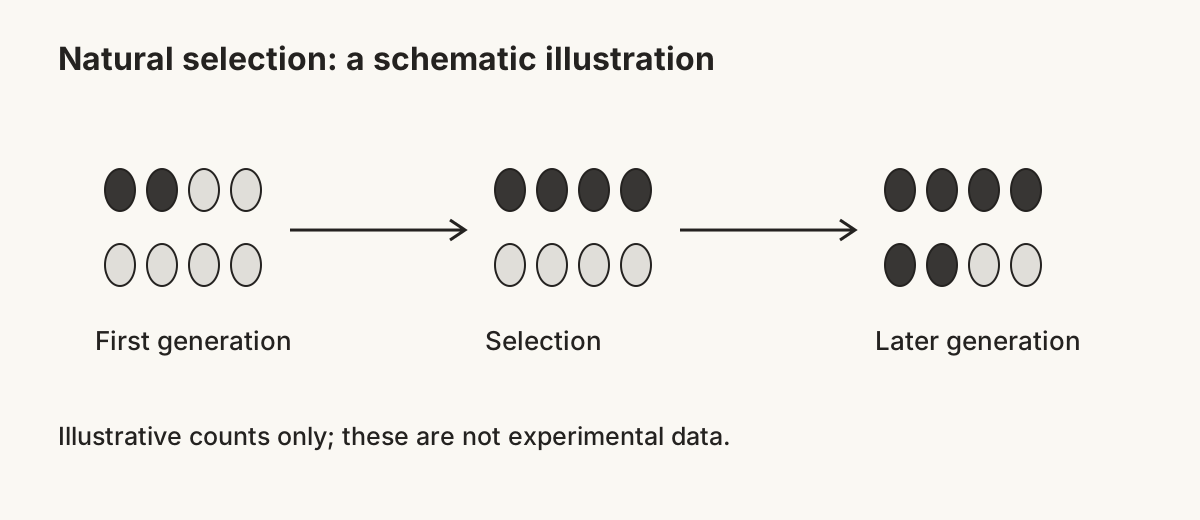
The example explains a mechanism. The invented numbers and marks in the drawing are not experimental data. Evolutionary science tests such mechanisms through observations, experiments, fossils and genetic comparisons.
What makes common ancestry more than a guess?
Human fossils show combinations of traits that changed through time. The record supports a branching family, with more than one early human species alive during some periods. Researchers debate the placement of specific branches.[19]
Genomes provide another line of evidence. Human chromosome 2 has features supporting a fusion of two ancestral ape chromosomes. A chromosome is a package of DNA; a fusion can leave traces of formerly separate ends within a larger package.[21]
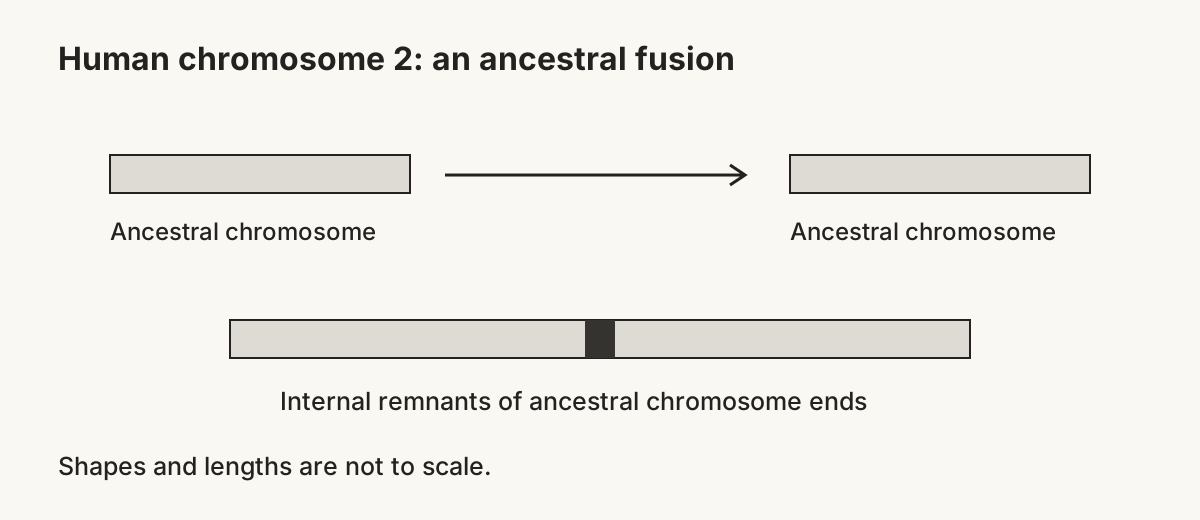
This is evidence about physical ancestry. Humans share ancestors with other living apes; our ancestors were not today's chimpanzees. The branching account predicts related patterns across many features. It earns confidence by explaining evidence that can be checked.
“The avatars already described the sequence”
Some defenders read animal and human avatars as an anticipation of evolution. An avatar is a divine manifestation or descent in the key religious account.
Ask which list is being used. Bhagavatam 1.3 gives a varied list that includes a boar before its fish and tortoise entries, as well as sages and other manifestations. The chapter also speaks of innumerable incarnations. It is not a single biological pedigree.[22]
Selecting a preferred sequence and matching it to biology after learning biology can produce a suggestive comparison. A scientific anticipation would need clear claims about inheritance and branching, fixed before the findings it supposedly predicted.
A usual list of water, land and human forms does not explain which populations descended from which ancestors or how we know.
Does evolution rule out every Hindu belief?
No. A believer may accept common ancestry and understand God as working through natural processes. Others may read life-form stories symbolically. Those positions differ from denying the evidence.
Evolution also does not claim to have fully solved the first origin of life. Explaining how living populations change is a distinct task. Gaps in origin-of-life research do not erase evidence about the ancestry of already living populations.
My conclusion follows the evidence's scope. Biology supports inherited descent and branching change. It does not grade organisms by virtue or show that a human birth was earned by a morally superior soul. A family tree cannot be turned into a moral ladder just by giving it sacred names.
Chapter 13Do huge cosmic ages make a text a cosmology?
My short answer
A very long age can be a striking idea. To call it a measured fact, ask what was measured and how. A day of Brahma and the age of Earth are not the same unit. A loose match between large numbers cannot settle the claim.
“Our tradition speaks in billions of years. Modern science took much longer to discover such great ages.” That is an interesting point about the scale of an idea. Does it show that a specific account of the universe is correct?
We should give an ancient account credit for what it in fact says, then compare like with like. A large number does not become a correct measurement simply because another large number appears nearby.
What is a day of Brahma?
Gita 8.17 describes a day of Brahma as a thousand age cycles, with a night of equal length. In Prabhupada's explanation, the four yugas total 4.32 million years; multiplying that by a thousand gives 4.32 billion years for the day.[23]
Those units matter. A day of a deity, an age of Earth, an age of the universe and a repeating cosmic cycle are different quantities. Someone claiming an exact match needs to say which quantity the text measured.
How is Earth's age estimated?
The geological estimate is about 4.54 billion years. It draws on the decay of radioactive isotopes and comparisons involving meteorites and ancient materials. The U.S. Geological Survey explains the reasoning behind that estimate.[24]
An isotope is a form of an element with a specific number of neutrons. Some isotopes change into other elements at measurable rates. Under suitable conditions, the amounts left and produced can help researchers estimate when a material formed or last underwent a key change.
That is a physical method, with assumptions, checks and uncertainty. A reader can ask how the measurements were made and whether different methods agree.
The number 4.32 billion is about 220 million below 4.54 billion. More importantly, the cited religious account calls it a day of Brahma. It does not thereby identify that interval with the measured age of Earth.
“The ancient description was symbolic”
A believer may say that the point is the vastness of time and repeated creation, rather than a modern geological date. I can accept that as the proposed reading.
But then the symbolic reading cannot also serve as an exact prediction of a measured age. The defender must decide what claim is on the table.
An image of cycles may inspire scientific questions. To become a scientific model, it needs specified processes and consequences that observations can distinguish from rival models. Sharing the word “cycle” with a modern hypothesis does not show that the processes are the same.
Can every mismatch be repaired afterward?
Imagine a text gives a long interval. After a discovery, one interpreter calls it the age of Earth. When the numbers fail to agree, another says it refers to a different world's day. When that cannot be measured, someone says it is beyond physical time.
Each interpretation could be discussed on its merits. None supplies a successful prediction unless the meaning and comparison were fixed clearly enough to risk being wrong.
Ask what the account predicted before the measurement, what would have contradicted it, and how the number was derived. These questions apply to modern scientific speculation too.
I do not need to belittle an ancient imagination capable of enormous spans. I need to distinguish imagination from measurement. Admiring the scale of a thought is reasonable. Declaring an entire cosmology verified by a loose numerical resemblance goes much further than the evidence allows.
Chapter 14What would make a miracle claim convincing?
My short answer
First show what happened. Then ask what caused it. A crowd can see an event while being wrong about its cause. Keep the first records, check other accounts and seek fair tests. An event we cannot yet explain does not name its own divine cause.
“Thousands saw it. How can you deny the miracle?” What exactly did they see, and which part of the explanation did they directly observe?
Someone might see liquid disappear near an image, watch a person appear to know a secret, or hear that a serious illness improved. The observation and the proposed divine cause need to be assessed separately.
I do not have to solve every event before asking whether its explanation has been shown.
The strongest reply
The believer may say: “You dismiss testimony because your worldview rules miracles out in advance. If you will never accept any report, your skepticism cannot be corrected.”
That would be a fair criticism of an absolute refusal to look at evidence. I should state what would make a report stronger and be willing to revise my judgment when those conditions are met.
A claim that a god acted in the physical world should have consequences we can study. Gita 4.7 describes divine manifestation when dharma declines. That is the religious claim; a specific alleged manifestation still needs evidence that identifies what happened.[25]
Begin with the original record
When did the event occur? Who recorded it? Can we inspect an unedited record, the object involved, the conditions and the names of witnesses? Are independent accounts genuinely independent, or do they repeat one report?
A thousand shares of one video remain a thousand copies of one source. A large crowd may show that something attracted attention. It does not automatically show the mechanism.
For an alleged recovery, ask for reliable before-and-after records and the timeline of treatment. A person feeling better, a condition being diagnosed differently and a documented physical change are different outcomes. I am proposing standards for evaluating evidence, not diagnosing anyone from a story.
Give usual explanations a fair test
Could hidden information, editing, physical properties, mistaken timing or an unreported treatment explain the result? These are questions to study. They are not verdicts that every claimant is a fraud.
An independent inspection helps precisely because sincere people can overlook something. Controls protect the believer from being misled as much as they protect the skeptic from accepting a bad explanation.
If the event is said to repeat, agree on the procedure before the next attempt. Preserve the failures. Let qualified people check the part of the claim they can test. Make the record available for criticism.
“God refuses to be tested”
A defender might say the divine act is free and cannot be summoned on demand. That limits repeatability; it does not show that the original report was divine.
Past events can be studied without being repeated. Their evidence may still be weak, strong or insufficient. The inability to arrange a repeat cannot become a reason to lower every other standard.
Even a well-documented unusual event would leave another question: why attribute it to this deity rather than another cause? The explanation needs evidence too.
My standard in one conversation
Show what happened. Show the key facts. Explain why the competing accounts fail. Then show why the proposed divine cause fits the evidence better.
That is demanding because the conclusion is demanding. My atheism should not be protected against a strong result. A miracle claim should not be protected against a weak one. If both of us care about truth, we should want a record good enough to correct us.
Chapter 15Do worship and ritual show intervention?
My short answer
Worship may help someone give thanks or feel close to what they love. That does not prove a god changed an outside event. If a result is promised, name it before the test. Count failures too. Ask what would show that the promise was wrong.
“I prayed, performed the ritual and got what I wanted.” How do we know which part of the sequence caused the result?
People succeed after praying. People also fail after praying, succeed without praying and fail without praying. To judge a claim that a ritual changes an external outcome, we need more than a memorable success.
The first task is to ask what the person says the practice does.
“Worship expresses love”
A believer can reply: “You have turned devotion into a bargain. I worship to remember, give thanks and direct my attention toward the divine.”
Gita 9.26 presents a simple offering made with devotion. The accompanying commentary discusses offerings before a picture or deity. That is a useful example of a believer's account in which the attitude matters more than the price of the offering.[26]
This reply defeats a crude objection that every act of worship is an attempt to bribe God. People can practice gratitude without expecting an exam pass or a winning lottery ticket.
It also leaves open whether a divine being receives the worship. Feeling grateful and showing the recipient's existence are separate questions.
What does an image stand for?
An easy criticism says, “Why worship a stone that cannot save itself?” But a defender may understand a murti, a sacred image, as a focus of devotion or a consecrated divine presence. They need not believe that usual stone, considered only as stone, has all the powers of a god.
We should challenge the account they hold. If the image is a symbol, ask what supports the belief it symbolizes. If a special presence is claimed, ask how that presence is shown and what follows from it.
Breaking a symbol does not logically disprove everything it represents. Nor does respecting a symbol show a supernatural presence within it.
What changes when a result is promised?
Suppose someone offers a ritual said to improve a harvest. In this fictional example, we would need to look at rainfall, seed, soil, farming methods and outcomes among suitable comparisons. We should agree on the promised result and the period of observation before seeing what happens.
That does not imply a simple experiment can test every aspect of religion. It explains what would be needed to support this specific claim about crops.
If a ritual promises inner calm, the key result differs. If it promises protection from a physical danger, calm alone cannot verify the protection. Clear claims protect people from being sold one outcome and handed another.
Who bears the cost of a failed promise?
Ask what happens when the promised result fails. Is the claim reconsidered, or is the participant told that their faith was inadequate? Can the person who made the promise ever be wrong?
If failure always belongs to the worshipper while success always belongs to the ritual, the account can absorb every result. That gives it a convenient defense, but little power to show what caused what.
People are free to spend time and resources on practices they value. Public promises about protection, healing or material success need evidence proportionate to the promise.
I can recognize the human value of a gathering, a song or an act of gratitude. My question is what justifies the added claim that a god intervened. A meaningful practice can remain meaningful without pretending that every fortunate event has verified its theology.
Chapter 16Can astrology pass its own prediction test?
My short answer
A chart claim should face a fair test. Hide the answers, set the rules first and compare the score with chance. One study cannot test every method. A method said to be different should face a test made for the claims it actually makes.
“My astrologer described me perfectly.” Could you recognize the same description if it carried another person's chart?
The question is direct because accuracy needs a comparison. A statement such as “you sometimes hide your worries” may feel personal. We need to know how many other people would accept it too.
Astrology covers many practices. This chapter examines claims that a birth chart can reveal personality or predict specific events. A criticism of one test should stay within what that test looked at.
“A skilled reading is too subtle for a crude test”
The believer may reply that the whole chart matters, the recorded birth time must be correct, and the astrologer needs proper training. A fair study should take those requirements seriously before collecting its results.
Then invite practitioners to help set the rules. Specify the information they need, the outcome they predict and how success will be scored. Hide the correct answers from everyone who could influence the choices.
Double-blind means that the key participants and researchers do not know the hidden assignment while the judgment is made. The point is to prevent usual clues from doing the work attributed to a chart.
What one well-known experiment found
Shawn Carlson's 1985 study included a test in which astrologers matched birth charts to personality profiles. They chose among three profiles. On first choices, the reported success rate was about 34 percent, close to the one-in-three chance rate, rather than the 50 percent success expected under the astrologers' stated prediction.[27]
That result did not show the claimed matching ability in this design. It does not individually test every system of Indian astrology, every kind of prediction, or every later claim.
If a practitioner says their method differs, the constructive reply is to design a test suited to that method. A different label cannot be a permanent excuse for avoiding a clear result.
What counts as a prediction?
“An important change may happen soon” leaves enormous room for interpretation. A job change, a new friend, a minor illness or a change of mind might all be counted afterward.
Ask for a defined event, a time window and a rule for a miss. Record the prediction before the event. Compare its success with what we could expect from usual knowledge and the frequency of such events.
If someone predicts rain during a rainy season, the right question is whether they do better than a suitable forecast without astrology. A correct guess alone does not identify the method that produced it.
“The planets influence Earth”
Of course physical bodies can affect other bodies. The existence of a physical influence does not show every meaning attached to a planet's position at birth.
The claim that a position predicts your marriage, temperament or career needs its own evidence. Knowing how to calculate a celestial position and knowing how to infer personal destiny from it are separate skills.
Why this matters outside a debate
Imagine someone rejects a capable job applicant or a willing marriage partner because of a chart. The person bears a real cost. What level of measured accuracy would justify that cost?
Astrological advice should be answerable to the consequences it claims to foresee. I do not need a theory of every planet's possible influence to ask whether the promised prediction works. If the chart is reliable, a fair test should help show that reliability. If every test is forbidden, confidence has outrun the evidence.
Chapter 17Do yoga's benefits prove its metaphysics?
My short answer
A practice can help without proving every belief taught beside it. A change in pain or stress is a claim we can study. A self beyond death is another claim. Give the practice credit for the gain shown. Ask for evidence of the added belief.
“Yoga helped me. Therefore the philosophy behind it must be true.” Which parts of the philosophy were tested by that improvement?
A practice can have real benefits. Accepting those benefits does not need accepting every explanation or promise associated with it. This principle should be obvious when we look at a practice we do not already love or dislike.
What the health evidence allows
The U.S. National Center for Complementary and Integrative Health reviews research on yoga. It describes possible benefits for some outcomes, including some pain and well-being measures, while noting differences in study quality, participants and styles of practice. It also notes that injuries can occur.[28]
That is a reason to evaluate specific claims carefully. “Yoga” can refer to a wide range of practices. A finding about one program, taught to one group for a set period, does not show the effects of every posture, breathing exercise or spiritual discipline.
This chapter is about evidence. It offers no personal exercise prescription or substitute for medical care.
“You are stripping away the whole tradition”
A believer may object: “Yoga is more than stretching. It includes ethics, attention and a transformed way of understanding the self.”
That is a fair correction to a shallow description. We should say which practice a study looked at and which parts it left unexamined.
But the same correction limits a large conclusion. If a study measures back pain, it has not automatically measured liberation from rebirth. If it measures attention, it has not automatically identified the ultimate nature of the self.
The strength of a result depends on the match between the claim and the measurement.
The helpful-meal example
Imagine a teacher recommends regular meals, rest and quiet reflection, then says the improvement proves an invisible guardian lives in the room. You might benefit from the routine. The benefit would leave the guardian claim open.
This fictional example does not show that yoga works through only one usual mechanism. It shows why an outcome does not uniquely identify an explanation when several accounts could fit it.
To support a specific explanation, we need a result that helps distinguish it from alternatives. The question is what the added metaphysical account predicts beyond the practical benefit already measured.
Can inner experience answer that question?
“I experienced unity, so I know.” I take the report seriously as a report of experience. I ask how you chose its interpretation.
Could two people undergo similar states and attach different religious explanations? Could a person describe peace correctly while drawing an uncertain conclusion about what exists beyond the experience?
We can look at those possibilities without calling the person dishonest. Confidence is part of what needs explaining; its presence does not end the study.
What a skeptical response should preserve
If a well-conducted study supports a benefit, my disbelief should not make me hide it. If a claim goes beyond the findings, my respect for the practice should not make me endorse it.
There is no need to choose between accepting everything and dismissing everything. We can value a practice, study its effects and reject an unsupported explanation at the same time.
The direct question is this: what exactly improved, how was it measured, and which added claim does that result show? A helpful practice earns credit for what it does. Its success cannot be spent as evidence for every claim placed beside it.
Chapter 18Can “quantum” or “energy” prove ancient wisdom?
My short answer
Ask what the science word means and what was measured. A result about particles does not by itself prove a claim about souls or gods. Show the steps between the result and the belief. A grand word cannot fill in a missing reason.
“Quantum physics proves that everything is one, just as our sages said.” Which experiment shows which sentence in the teaching?
The words sound powerful because physics has earned respect through precise work. Borrowing that respect needs meeting the standards that produced it.
Start with the meaning of the word
In physics, a term comes with a definition and a role in a measurable model. In spiritual speech, “energy” may mean mood, vitality, sacred presence or a sense of connection. Those meanings can be meaningful to a speaker without being the same physical quantity.
If a claim moves from one meaning to another, ask where the bridge was shown. A feeling of low energy does not by itself identify a measurable force surrounding a person. A metaphor about vibration does not supply a frequency, an instrument or a result.
What entanglement does show
Quantum entanglement concerns systems described by a shared state. Experiments recognized by the 2022 Nobel Prize in Physics tested correlations and violations of Bell inequalities. The Nobel background explains their methods and their importance for quantum information.[29]
A correlation is a relationship between results. The experiments concern specific physical systems and quantitative predictions. They do not identify those systems as Brahman, show that a self changes bodies, or show that thoughts can control any event a person wants.
Those are further claims, and each needs an argument connecting it to the real result.
“Science is only now catching up”
The strongest believer's reply is that an old insight may describe reality at a broad level before precise science develops. That is possible in principle. An earlier idea should receive credit when its content and date support the comparison.
But we need more than a resemblance discovered after the fact. What did the older account specify? Which competing outcome did it rule out? Could someone have used it to make the key experimental prediction before learning the modern result?
The statement “all things are connected” can fit a vast range of worlds. A mathematical prediction that allows one range of correlations and excludes another is much more specific.
Broad resemblance may support a philosophical conversation. It does not show identity between the accounts.
Could I tell a success from a failure?
Imagine a verse is said to predict either a continuous world or a world of discrete processes, depending on what physicists find. Its language might be rich enough for both readings. That flexibility reduces its power as a prediction.
A useful test is to ask a defender to write the proposed scientific consequence before the next measurement. State the units, method and expected result. Keep the interpretation fixed when the outcome arrives.
The demand applies to skeptical claims too. I should not change my criterion after a result just to protect my view.
What remains worth discussing
Questions about reality, awareness and unity can be philosophically serious. They do not become stronger when scientific terms are used without their technical meaning.
Nor does a poor physics analogy refute every spiritual philosophy. It refutes the offered shortcut from the named experiment to the claimed religious conclusion.
Ask for the real paper, the measured result and the missing reasoning between that result and the doctrine. If the answer contains only “quantum”, “frequency” or “energy”, the central work has still not been done. A scientific word is an invitation to precision, not a substitute for it.
Chapter 19Does Purusha's body justify social rank?
My short answer
A body needs all its parts. That does not show that a child's birth should fix their rank or work. If the image means that all people matter, defend their freedom to learn and choose. Praise for a fixed place does not make that place fair.
“The four social orders come from the cosmic person's body.” Even if that were true, how would it show that one person's birth should give them authority over another?
Rig Veda 10.90.12 maps the Brahmin to Purusha's mouth, the Rajanya to the arms, the Vaishya to the thighs and the Shudra to the feet. This is the passage being discussed. It should neither be hidden nor made to say every later caste rule by itself.[30]
Varna names the broad fourfold scheme. Jati concerns the many specific communities often involved in inherited caste identity. Their relationship has to be looked at rather than assumed to be one simple unchanged structure.
“Every part is necessary”
The believer's strongest defense says the body image expresses interdependence. A body needs its feet as well as its head. The image could therefore be read as a call for cooperation rather than contempt.
That reading raises a useful question: what social rules follow from the equal need for every part? Do all people get the same rights? Can they choose work and education? Can they disagree with a person placed above them?
If the answer is yes, the defender should support those freedoms without qualification. If the answer introduces inherited limits, the body image has not justified them.
A metaphor cannot allocate rights
A hand cannot become an eye. A human child can learn skills their parents did not have. Treating a social role as a fixed body part risks hiding that difference.
Imagine assigning every child of a musician to music and every child of a cleaner to cleaning. The community needs both jobs. That need does not show that family background should decide the child's work.
The fictional example shows the gap between a useful task and an inherited obligation. It also shows why praising a task can coexist with restricting the person who performs it.
If a body metaphor is used only to encourage cooperation, we can assess it as a metaphor. If it is used to defend a birth-based hierarchy, we need reasons for that hierarchy beyond the image.
What does the text show about history?
The hymn shows that this mapping appears in the religious text. On its own, it does not prove when every later practice began, how it operated in every region, or what every person believed.
Equally, differences in later practice do not remove the passage from the text. We can acknowledge complexity and still look at the ideas that were available to justify rank.
To evaluate a real rule, identify its source and consequences. Claims about initiation, penalties or marriage need the key passages and evidence rather than a sweeping appeal to one hymn.
The question of equal standing
If someone uses bodily origin to defend superiority, ask why the source of a body part should determine a person's moral worth. Is a mouth entitled to silence the feet? Does the metaphor show consent, ability or a right to rule?
Those are questions about how people may treat one another. The tale's sacred status cannot answer them by itself.
I can accept that societies need many kinds of work. I reject the leap from that fact to an inherited ladder of dignity. If every part matters, let that commitment appear in the freedoms given to the people, not just in praise for the place assigned to them.
Chapter 20Does “guna and karma” remove caste by birth?
My short answer
Test the claim through real freedoms. Can a person learn, choose work and reject the rank given to their family? If birth decides the answer, the rule still rests on birth. Calling it a rule about qualities has not removed the barrier.
“True varna depends on qualities and actions, not birth. You are blaming religion for a distortion.” What would that account permit a real person to do?
Gita 4.13 relates the fourfold division to guna and karma. Gita 18.41 speaks of duties distinguished through qualities arising from one's nature. Those words give a defender grounds to argue about character and work. They should not be erased from the discussion.[31][32]
The question is how the proposed interpretation works in practice and whether any unequal rights remain.
Define the claim before defending it
Guna can name a quality or mode in the key philosophy. Karma here can refer to action or work. These words do not by themselves provide a public test for assigning every child a fixed social role.
If varna means a flexible description of what a person in fact does, ask why it should determine inherited status at all. Someone who changes occupation would change the description. Their children would make their own choices.
If the classification also assigns privileges, restrictions or spiritual rank, the defender owes an account of why those unequal conditions are justified.
Who decides a person's nature?
Imagine a girl born in a family assigned to service work who wants to study philosophy and lead a congregation. Who can stop her, and on what evidence?
If the answer is “nobody, provided she develops the key skills”, that is a significant commitment. It supports evaluating the person rather than treating ancestry as destiny.
If the answer appeals to the parents' caste as evidence of her inner nature, birth has returned through the back door. Calling the classification quality-based does not change the rule being applied.
Ask also whether a person can challenge an assessment. Can the assessor be wrong? Can the individual retrain, leave, marry freely and refuse a hereditary occupation without losing usual rights?
Equal souls and unequal opportunities
Gita 5.18 offers equal vision across social and species boundaries. A believer can use that teaching to criticize contempt and argue for a deeper equality.[33]
That is a real resource for reform. The practical test remains whether spiritual equality supports equal standing in education, association and public life.
Saying that everyone is equal at the deepest level does not answer a question about unequal rules at the level where people must live. The person excluded from learning needs the exclusion removed, not just a compliment about their ultimate essence.
“The abuse was never the true teaching”
Sometimes a distinction between an ideal and a practice is well supported. A teacher may clearly reject inherited restrictions. We should acknowledge that position and ask how it is defended.
But “true religion” cannot be defined only as whatever survives our moral criticism. When a text or commentary supports a restriction, it needs to be confronted on its own terms. Otherwise good outcomes belong to the religion and bad rules are automatically declared foreign to it.
The issue is which rule we should accept now and why. A reformer and a skeptic may agree on removing inherited barriers while disagreeing about the best account of the past.
My direct question is this: will you defend every person's freedom to learn, choose work and reject a rank assigned at birth? If so, make that commitment clear. If not, explain the unequal rule instead of sheltering it behind two flexible words.
Chapter 21What does endogamy show about caste?
My short answer
Work and marriage are not the same thing. Ask why a rule about skills would need to control whom adults marry. People may freely choose shared customs. A threat used to keep a couple apart needs a much stronger reason than keeping a group boundary.
“Caste was only a division of work.” Then why should marriage between consenting adults depend on inherited group identity?
Endogamy means marriage within a defined group. A profession can have entry requirements based on skill. The demand that a person's children marry within the same inherited group is a further rule. We should ask what it protects and who pays for it.
Ambedkar's question
In Castes in India, Ambedkar treated the enforcement of endogamy as central to explaining caste. In Annihilation of Caste, he challenged a system that restricts people as well as distributes tasks. These are arguments from a named critic, not statements we should accept just because he made them.[34][35]
The arguments give us a useful test. If a social classification concerns work alone, why should a marriage between people doing different work threaten it? Why must their families' identities determine whether the relationship is allowed?
Imagine a society that assigns people to occupations but lets them retrain, move and marry freely. Compare it with one that punishes a couple for crossing an inherited boundary. Calling both systems a division of labor hides a major difference.
What genetic evidence can show
A 2013 study by Priya Moorjani and colleagues analyzed groups from the Indian subcontinent. Its models dated major population mixture in sampled groups to roughly 1,900-4,200 years before the study and described a later shift toward strong endogamy.[36]
These are model-based estimates, with assumptions and variation across groups. They do not assign one founding date to every caste. They also do not identify pure ancestral races or a ranking of human worth.
The key point is that patterns of ancestry can preserve evidence of who had children with whom. That helps study social boundaries. It cannot tell us that a boundary was morally right.
“Communities have a right to continue”
A believer or cultural defender may say: “Shared customs, language and family life matter. Choosing a partner with a similar background can make life easier.”
Adults may freely value those things. A preference becomes a different moral issue when another person's choice is controlled through threats, humiliation or loss of usual freedom.
The test concerns consent. Can a person choose outside the group without punishment? Can they change their mind? Are the same freedoms offered to women and men?
Protecting a custom does not automatically authorize controlling every person born near it.
Does “purity” justify the boundary?
If purity means genetic separation from all other human groups, the evidence of mixture undermines a simple story of timeless sealed populations. If it means ritual status, it needs a religious argument rather than a genetic one.
Neither meaning shows that a child inherits a superior right to education, respect or marriage choice. A laboratory can describe ancestry. It cannot read a certificate of moral rank from it.
Even if a group had remained isolated for a long time, isolation would not create a right to dominate others. History describes a pattern; it does not grant ownership of future people.
The question that exposes the rule
Ask whether two adults' informed, free choice is enough, or whether the group's inherited boundary has authority over them. Then ask what justifies that authority.
Ambedkar argued that intermarriage challenges caste boundaries. A defender can dispute his account of history while still confronting the moral question he raises.[37]
If a system survives only by denying people a free choice of partner, its defenders need to explain that cost openly. “Social order” is too vague an answer for a rule that reaches into a person's most intimate decisions.
Chapter 22Are Manusmriti's unequal rules just?
My short answer
Birth does not show that someone deserves a worse penalty. Read the rule. Ask what harm was done and what response would be fair. Calling a rule sacred does not make cutting someone's tongue just. A reader can reject the rule without denying that it exists.
“You are taking an ancient text out of context.” Then let us put the rule in context and ask whether that context makes it fair.
Manusmriti is a prescriptive text about duty and social order. A prescription states what its author or tradition says should happen. It is not, by itself, a record that every person obeyed the rule everywhere.
That distinction protects us from bad history. It does not place the prescription beyond moral criticism.
Begin with a named rule
Manusmriti 8.270 prescribes a severe bodily penalty for a Shudra who uses gross verbal abuse toward a twice-born person. In Ganganatha Jha's translation with Medhatithi's commentary, the penalty is cutting the tongue. The commentary discusses the targeted social categories; comparative notes also record disputes over its scope.[38]
The narrow claim is already serious. A rule makes birth category key to an extreme penalty for speech. We do not need to invent universal enforcement or modern assent to ask whether that rule is just.
Twice-born refers here to status associated with an initiatory rite, rather than a second biological delivery. Manusmriti 10.4 and its commentary distinguish the first three varnas from Shudras in relation to that status.[39]
“The rule protected social stability”
A defender might say harsh rules helped maintain order in their setting. That is a proposed explanation of purpose. A purpose still needs moral examination.
Many arrangements can produce stability by making resistance costly. Stability alone does not show fair treatment. A prison may be quiet because everyone fears abuse.
Ask why the same offense should receive different treatment because of the speaker's inherited category. Does that category change the harm caused? Does it change what response would be proportionate?
The questions remain even if a commentator narrows the rule to specific kinds of insult or specific targets. Narrowing an unequal rule can reduce its scope without making its principle fair.
Does historical context excuse the standard?
We should look at the options, beliefs and institutions available to people in the past before judging specific individuals. That is different from granting a timeless authority to every rule they produced.
If a defender says this text reflects a limited historical setting, then it should be open to correction. If they call it an expression of perfect, universal justice, its moral demands face a higher burden.
Which claim are they making? It cannot be a fallible historical document when criticized and an unquestionable source of authority when used against someone else.
“I reject that rule”
Then we have an important agreement. No one is required to defend every text associated with their religious identity. A Hindu reader may reject a rule on moral or interpretive grounds.
The useful next question is how that judgment is made. Does it use a principle of equal standing that can also test other passages? Can the same principle protect a person even when a more powerful interpreter disagrees?
An honest rejection is stronger than pretending the passage does not exist. It also shows that moral judgment can involve evaluating scripture, rather than just obeying it.
The answer I demand
State the rule correctly. State whether you defend it. If you defend it, explain why birth should affect the penalty and why the penalty is proportionate. If you reject it, protect people from its authority.
The age or sacred reputation of a text cannot make mutilation fair. Its defenders must answer for the rule's real content.
Chapter 23Does honoring goddesses give women equal freedom?
My short answer
Ask what happens when a woman says no. Praise for a goddess does not settle an adult woman's right to choose. Help that she can accept or refuse differs from lifelong control. Read both the praise and the limits, then judge the actual rule.
“We worship the feminine divine. How can our tradition be unfair to women?” What freedoms does a living woman receive from that worship?
Praise, protection, authority and independence are different things. A society can speak highly of mothers while controlling a daughter's education, a wife's movements or a widow's choices. The example is a possibility we must test against real rules, not an accusation about every family.
Read praise and restriction together
Manusmriti 3.56 praises honoring women. That passage belongs in the discussion. So does 9.3, which places a woman under male guardians across her life and denies her independence in the cited translation. Medhatithi's commentary distinguishes protection from dependence.[40][41]
The question is what the combined account permits. Does “honor” include a right to refuse a decision? Can an adult woman choose where to live, what to learn and whether to marry?
If praise leaves those decisions permanently with someone else, it has not shown equal freedom.
“Guardianship means care”
The strongest defense says family members have duties to protect one another. Dependence in a dangerous world can make support necessary. An isolated individual may be less free in practice than a person helped by a caring family.
I agree that care matters. The problem is a rule that assigns authority by sex rather than by need, consent and capacity.
Can the adult refuse the guardian? Who protects her from an abusive guardian? Why should a capable woman remain subject to a man who is less capable? Is the support available without surrendering her voice?
Mutual help can expand freedom. Compulsory lifelong control needs another justification.
What does the Gita offer?
Gita 9.32 opens the highest goal to those who take refuge in Krishna. The VedaBase translation groups women, Vaishyas and Shudras under lower birth. Swami Mukundananda's rendering instead emphasizes access whatever one's birth, race, gender or caste.[42][10]
Those English choices show why a responsible criticism must identify the edition. I will not pretend that one English phrase settles every grammatical and theological dispute.
A believer can make a strong case from the verse for inclusion in devotion. The further question is whether spiritual access also supports equal authority and choice in usual life. Access to a supreme destination does not automatically specify a woman's present social rights.
Can a woman be revered and overruled?
Imagine a family tells a daughter that women embody sacred power, then denies her the education freely offered to a son. She asks why. “We respect women” does not answer the question about unequal access.
Ask for the reason for the rule itself. Does the person's real ability matter? Is there a concrete need that could justify a temporary limit on anyone, or only an inherited expectation about women?
The same principle should apply to men. No one becomes another adult's owner by being told that protection is their duty.
The practical test
I will judge a claim of equal respect by what happens when a woman says no. Can she disagree with a religious authority, decline a role, choose a partner and leave a harmful arrangement without being treated as morally lesser?
Goddess worship can inspire some believers to defend those freedoms. I welcome the defense and will assess its reasons. The existence of a sacred female image cannot substitute for answering the woman standing in front of us.
Chapter 24What makes a person “pure” or “untouchable”?
My short answer
Ask which kind of purity is meant. Dirt, a health risk and a sacred status are different claims. A normal bodily process does not make someone morally lesser. If a rule keeps a person apart, ask what harm it prevents and why that cost is fair.
“This restriction protects purity.” What kind of purity? Cleanliness, freedom from infection, ritual status and moral character are different ideas.
A rule cannot borrow the practical authority of hygiene without explaining a physical risk. It cannot show moral inferiority just by applying a ritual label to a body.
“Ritual purity has its own meaning”
A believer may say: “You are mistaking a religious category for a scientific claim. Some restrictions concern preparation for worship, not a judgment that someone is a bad person.”
That distinction deserves a fair hearing. We should look at the specific rule, its stated purpose, who follows it and what happens to someone who refuses.
But calling a rule ritual does not end the moral inquiry. Does it deny a person access, dignity or usual freedom because of birth or a bodily process they did not choose? Is it optional, or enforced against them?
A meaning can be religious while its effects are social and physical.
Menstruation and a claim about the body
UNICEF explains menstruation as a normal biological process involving the shedding of the uterine lining. That gives us a physical account of the process. It supplies no evidence that a menstruating person has become morally inferior.[43]
Blood and other bodily materials call for usual hygiene appropriate to the circumstances. A need for hygiene does not show that a person contaminates a room by existing in it.
If someone claims a specific physical danger, ask for the mechanism and evidence. If they say the concern is ritual status alone, ask why that status should limit another person's choices.
“The rule gave women rest”
Rest can be welcome. It becomes more credible as an explanation when the person can choose it, receive support, and keep access to usual needs and relationships.
Imagine one household offers help and privacy to anyone in discomfort. Another forbids a woman to enter shared spaces regardless of what she wants. Both may be described as giving rest. The difference lies in consent and the restrictions imposed.
If care is the purpose, let the person help decide what care needs. A pleasant explanation cannot erase a compulsory rule's costs.
Untouchability and inherited status
A claim that someone is polluting by birth needs an account of why ancestry changes the person's entitlement to usual human contact and equal standing. Ritual classification alone cannot provide that moral reason.
Article 17 of India's Constitution abolishes untouchability and forbids its practice. That is a constitutional rule; it does not show that every prohibited practice has vanished.[44]
The moral argument can also be stated without appealing only to law. A person does not choose their birth group. Treating their body as inherently degrading makes them bear a burden they have not earned through any act.
Do food choices create a rank of people?
People may have ethical reasons to avoid harming animals, personal reasons to follow a diet, or religious reasons to make an offering. Those reasons should be assessed directly.
They do not automatically show that someone who eats differently deserves humiliation or exclusion from equal rights. A debate about an act and a verdict of inherited human inferiority are different matters.
My question is practical: what harm does the rule prevent, what evidence shows that harm, and can the purpose be met without degrading anyone? If the only answer is that some people must be kept apart because they are born impure, the hierarchy has been restated. It has not been justified.
Chapter 25Does sacred duty justify killing?
My short answer
A sacred role does not make every act within it right. Force may need reasons about harm, need and limits. Even if a self survives death, bodily loss still matters. Ask why the killing is just and who can challenge the person giving the order.
“Arjuna must fight because it is his duty.” What makes a duty just, especially when carrying it out ends other people's lives?
The Gita's battlefield setting puts that question directly before the reader. A responsible criticism should look at the argument offered in that setting rather than pretend the text simply tells everyone to attack anyone.
The VedaBase commentary on 2.19 explicitly rejects unrestricted killing and presents Arjuna's action as religiously justified. That is the defense we need to assess.[45]
Does an immortal self make death harmless?
The text distinguishes the enduring self from the vulnerable body. Even if that account were granted, it would not by itself show permission to destroy the body.
A person can still lose relationships, projects and years of life. Others can grieve and suffer. Why would the survival of something beyond the body make those losses morally irrelevant?
Imagine someone destroys your home and says you still exist, so no real harm was done. Your survival would not settle whether the destruction was justified. The example concerns the gap between what survives an act and whether the act is allowed.
“The war resists injustice”
A believer can offer a more serious argument: force may sometimes be needed to resist a grave wrong. Refusing to act can leave victims unprotected. Duty may need courage rather than private comfort.
That is an ethical position worth discussing. It does not depend solely on a claim about an immortal self. It asks whether force is necessary and proportionate in the circumstances.
Then ask the hard questions: what wrong is being resisted, what evidence shows it, what alternatives exist, and how will harm to uninvolved people be limited? Who can challenge the person who declares the cause sacred?
Calling a war righteous states a conclusion. The reasons supporting that conclusion still need examination.
What if a duty was assigned unfairly?
Gita 3.35 prefers one's own duty to another's, even when performed imperfectly. A defender may understand this as fidelity to one's character and responsibilities rather than an excuse for inherited oppression.[46]
But a role cannot make every command within it right. A soldier, official or family member still needs grounds to distinguish a legitimate responsibility from a demand to harm someone unjustly.
If “your duty” ends the inquiry, the person assigning duties gains enormous power. They can move a moral question into a category where obedience is treated as the answer.
Can Arjuna really deliberate?
Gita 18.63 invites reflection before action. A reader can appeal to that invitation in defense of inquiry. The invitation matters most if the reasoning itself remains open to criticism.[47]
What would justify refusing an order? Could evidence show that the proposed action is wrong? Would a believer allow someone to reach that conclusion without treating the refusal as proof of bad character?
These questions do not need a claim that every use of force is evil. They need that sacred language carry no automatic exemption from moral assessment.
The standard I would apply
Show the facts, the purpose, the necessity and the limits. Apply the same test when a rival religion or a political leader invokes duty. A favored scripture should not receive permission we would deny to everyone else.
If the action can be justified, explain the reasons. If it cannot, invoking an immortal self or a sacred role will not repair the harm. Duty deserves respect when it survives moral examination, not just because authority has named it duty.
Chapter 26How can we check an avatar story?
My short answer
A real place can appear in a story with unproved events. Check each claim on its own. Evidence that people told a story is not proof of all the acts in it. An account can have a basis in the past without showing that its hero was divine.
“The place exists, so the sacred story happened.” Which part of the story does the place show?
A real city can appear in a fictional story. A historical person can acquire later legends. A sacred narrative can preserve memories while also making claims that the surviving evidence cannot confirm.
We need to look at each claim at the level of detail it needs.
“The tradition preserved a historical core”
That is a reasonable possibility to study. Names, landscapes, objects and accounts may preserve information about earlier people and events. We should not dismiss useful evidence just because it appears in a religious setting.
But a historical core does not automatically verify every surrounding detail. Evidence of a settlement does not show that a deity visited it. Evidence of a conflict does not show the divine status of one participant.
An avatar claim adds a theological identity to a story. Gita 4.7 expresses divine manifestation in response to a decline in dharma. Whether a named person was such a manifestation needs reasons beyond the existence of the teaching.[25]
What evidence would help?
Ask how close a source is to the proposed event, how its date is shown, and whether another source independently supports it. Learn what an inscription or object in fact says rather than what a later caption claims it says.
Then separate levels of conclusion. “People at this date told this story” differs from “this event happened at that date”. Both may be important findings. They answer different questions about the past.
Where the evidence is insufficient, “not shown” is often the honest verdict. It does not mean that every detail has been disproved.
The ancient-aircraft claim
Some claims about ancient technology appeal to Vymanika Shastra. A 1974 study by Indian Institute of Science researchers looked at this specific work's history and technical content. It placed its production in the early twentieth century, roughly 1900-1922, and found severe problems with its aeronautical proposals.[48]
That is a specific finding about a specific work. It does not show that ancient India had no impressive technology. It also does not independently settle every reference to flying vehicles in religious literature.
It does show why calling a work ancient or assigning it to a revered sage cannot replace checking its origin and content.
“The vehicles were divine, so engineering does not apply”
Then the defender has changed the kind of claim being made. A divine vehicle beyond usual physical limits is a supernatural story. It cannot simultaneously be presented as a shown manual of practical aircraft engineering without further evidence.
If someone claims a real device could fly, ask for the design, materials, operating principles and a suitable test. If they claim a miracle, ask for evidence of that event and its cause. Each claim needs its own support.
We should also distinguish a name assigned by an author from evidence of authorship. A title page can attribute a work to someone. Showing that attribution is part of the historical task.
What survives a careful reading?
A story may remain powerful as literature, moral reflection or devotion. Those forms of value do not depend on pretending that every physical event in it has been independently verified.
My question is deliberately narrow: what evidence takes us from a cherished account to the specific historical or divine conclusion being asserted? If the answer shows only that people believed the story, we should say that clearly. Belief has a history. The history of a belief is not automatically a record of its object.
Chapter 27Can every religious path be equally true?
My short answer
Different paths may give people real benefits. Claims that clash cannot all be true in the same sense. We can defend each person's right to choose while still asking which claims are sound. Respect for people does not force us to agree with their beliefs.
“All paths lead to the same truth.” Does that mean people should be free to follow different paths, or that every claim made on those paths is correct?
The first is a principle of freedom. The second is a claim about reality. Confusing them can make tolerance sound like proof.
The strongest case for many paths
A believer may say human beings differ in temperament and understanding. Different practices can cultivate devotion, self-discipline or insight. No single form of worship has to suit everyone.
That is a serious proposal. Gita 4.11 describes Krishna's response to different approaches. A defender can read it as support for a broad view of religious seeking. The VedaBase commentary, however, still gives Krishna a central status and distinguishes forms of realization.[49]
That is one reason to ask whether the speaker means equal truth, equal value, different stages, or inclusion within one preferred account. Those are different positions.
What happens when claims conflict?
Imagine one teacher says a person lives exactly once. Another says the person has lived many lives. If both statements concern the same person, use the same meaning of “life”, and are meant literally, they cannot both be correct in the same respect.
We could reinterpret one or both. But then we need reasons for the reinterpretation. We cannot announce agreement just by ignoring what each teacher meant.
The same issue arises within Hindu thought. An account of the individual as ultimately identical with Brahman differs from an account preserving a fundamental distinction. Shankara's and Madhva's readings of Chandogya 6.8.7 illustrate that disagreement.[2][3]
Both traditions deserve a correct description. Respect does not make their conclusions identical.
“The differences are only surface language”
Sometimes apparently different statements do express a shared idea. We should look at that possibility rather than insist on conflict where none exists.
But a claim of hidden unity also needs support. Who decides which parts are superficial? Would the people whose views are being combined accept the proposed translation?
If a doctrine's central claims must be removed to make it agree with another, the unity may belong to the new interpreter's system. It has not simply been discovered intact inside every tradition.
Can several practices be valuable anyway?
Yes. Two exercises can both help a person focus even if their teachers disagree about the universe. Two communities can both provide friendship even if their accounts of the afterlife conflict.
That is a claim about shared benefits. It does not verify every explanation attached to those benefits.
We can also agree that people deserve freedom without reaching agreement about their beliefs. An atheist should protect a believer's right to worship. A believer should protect an atheist's right to decline. Neither protection needs pretending that the disagreement has vanished.
The question beneath the slogan
Ask what “same truth” permits us to reject. Can a path be wrong about a factual claim? Can a religious rule be cruel? If so, a standard remains necessary to distinguish better claims from worse ones.
If nothing can ever be wrong, the slogan offers no useful guidance when doctrines conflict or a person is harmed.
I welcome a refusal to persecute people over belief. I still want to know what is true. A generous attitude toward people and a demanding standard for claims can coexist. The freedom to take a path does not turn every destination described along it into an shown fact.
Chapter 28Can we judge right and wrong without revelation?
My short answer
Start by asking whose pain, choice and interests a rule affects. Give reasons that others can inspect. Science can help check the effects, though moral starting points still need thought. A claim of divine authority also needs reasons. The word sacred cannot do that work alone.
“Without God, morality is only your opinion.” Does adding the word “divine” explain why a rule is good?
I begin with a commitment: other people's pain, freedom and interests matter. I do not treat my own wishes as the only ones with weight. From that starting point, we can look at harm, consent, fairness, trust and the effects of rules.
That commitment needs philosophical defense. I will not pretend that a laboratory has measured a moral command in the same way it measures temperature.
The believer's serious challenge
“People disagree about what matters. Without a source beyond humans, how can a moral rule bind anyone?”
That is a real question about the basis of morality. A believer may answer with God's nature, divine commands, dharma or the order of reality. An atheist may answer with an account of reasons, well-being, rights or moral facts. Each account needs arguments.
The existence of disagreement does not automatically settle the contest in favor of revelation. Religious people also disagree about which revelation is reliable and what it needs. A source must be identified and interpreted before it can resolve the dispute.
Does a command make cruelty good?
Suppose a claimed revelation needs humiliating an innocent person. Is that good simply because the command is divine? Or would a good divine being reject the humiliation for reasons we can discuss?
A sophisticated believer may say goodness comes from God's nature rather than an arbitrary choice. Then ask what makes that nature good. Does the account explain concern for people, or just attach the word “good” to whatever the deity is said to be?
The question does not refute every possible religious ethic. It shows why naming an authority leaves work to do. We still need to distinguish a genuinely good command from a human claim falsely carrying divine authority.
What can evidence contribute?
Evidence can help show whether a rule causes suffering, blocks opportunity or protects someone from harm. Consent needs knowing whether a person had information, alternatives and freedom from coercion.
Moral reasoning then asks how those facts should count. If we say similar interests deserve similar consideration, an inherited social label needs a reason before it can justify unequal treatment.
Ambedkar's criticism of caste is useful here because it asks what restrictions do to people and their opportunities. Its force depends on reasons we can inspect, rather than only on accepting another sacred source.[35]
“Why behave well if nobody will punish you?”
Because another person's suffering matters even when I can escape a penalty. A threat may influence behavior. It does not create the injured person's interests from nothing.
A believer can also care from love rather than fear, and many do. I reject the caricature that religious goodness always comes from a wish for reward. I ask that the same fairness be given to a person whose concern has no supernatural reward attached.
Can secular moral reasoning fail?
Of course. People can hide selfishness behind moral language, misuse evidence or ignore those with less power. An atheist label gives no exemption from those failures.
That is why rules should remain open to criticism, especially by the people who bear their costs. We should correct factual mistakes, hear competing reasons and ask whether we would accept the rule from the other side of the boundary.
I do not need a complete theory of every moral fact before rejecting a birth-based right to humiliate someone. The defender of that right still owes a justification. “God says so” only helps after the source, interpretation and goodness of the demand have been shown.
Chapter 29Why should a guru be beyond criticism?
My short answer
A learner may need trust and guidance. They also need a way to spot a teacher's errors. Can they ask for reasons, get another view, refuse a demand and leave? A wise teacher can admit a mistake. A ban on questions does not prove wisdom.
“You cannot question the guru until you have reached the guru's level.” How, then, can a beginner distinguish a trustworthy teacher from a mistaken one?
Learning often needs trust before full understanding. A student may follow a mathematics teacher through a proof they could not have discovered alone. That is a reason to allow guidance. It is not a reason to remove every check on the guide.
“Discipline needs humility”
A believer can reply: “A student who rejects every instruction before trying it will learn little. Arrogance can disguise itself as independence.”
I agree. A person can be too impatient to learn, too proud to hear correction, or too quick to dismiss unfamiliar ideas. Skeptics are capable of all three.
But humility should also apply to the teacher. Can they admit error, explain a claim, state the limits of their knowledge and allow the student to leave? A demand for humility becomes suspect when it flows only downward.
The subject matters too. Trusting a teacher to explain a language does not automatically show their authority over your money, relationships, health or entire account of reality.
What does expertise show?
Expertise is specific. We can ask how someone acquired it, whether their work can be checked and how they respond to correction.
In a spiritual setting, some proposed expertise concerns experiences that are difficult for outsiders to inspect. That difficulty calls for careful limits on the authority claimed from it. It cannot grant unlimited power over other people.
If a claim concerns an external event, look at the evidence for that event. If it concerns a moral rule, look at the reasons for that rule. If it concerns an inner state, distinguish the experience from the claims about reality attached to it.
Is a teacher allowed to fail?
Imagine a teacher predicts a specific event. It does not happen. Followers say the prediction was secretly fulfilled or prevented by the teacher's power.
That could be a proposed explanation, but it needs its own evidence. If every failed prediction can be rewritten as hidden success, the teacher has gained a way to avoid correction.
The same problem arises when disagreement is treated as proof of impurity, ignorance or disloyalty. A critic may be wrong. The teacher still needs to answer the argument rather than use the criticism itself as a verdict against the critic.
These are warning signs in a hypothetical relationship. They are not unsupported allegations about a named living teacher.
Can scripture support inquiry?
Gita 18.63 invites reflection before action. A believer can use that passage to defend thoughtful acceptance. Then ask whether the invitation remains meaningful when reflection leads to rejection.[47]
I would support a teacher who welcomes a difficult question even while disagreeing with my answer. I would question an atheist leader who demanded obedience beyond evidence. The standard concerns power and accountability, rather than which label a teacher wears.
What would a healthy relation permit?
The student should be able to ask what supports a claim, seek another view, refuse a demand and leave without threats. The teacher should be able to say “I do not know.” Neither needs to pretend that every question is already solved.
Bhagat Singh's insistence on critical thought offers a useful reminder here. Admiration is no reason to surrender one's judgment, including admiration for a famous skeptic.[1]
No guru, book or author should need permanent immunity from criticism. Authority earns trust through how it answers questions and handles correction. The demand to stop asking cannot itself serve as the answer.
Chapter 30What would change my mind?
My short answer
Strong evidence should change my mind about the claim it supports. I must set fair tests and accept their results too. Some questions may stay open. While we disagree, we can still oppose cruelty and defend the right to ask for reasons.
After thirty chapters, a believer can fairly turn the questions around. “You have asked what would change my mind. What would change yours?”
I should answer plainly. Strong evidence for a specific claim would change my judgment about that claim. I do not need a guarantee of perfect knowledge before reconsidering. I do need more than a demand to trust the conclusion in advance.
Evidence should fit the claim
For an alleged past event, I would look for reliable records close to the event, independent support and a careful comparison of explanations. A discovery could strengthen one part of a story while leaving its divine interpretation open.
For a repeatable prediction, I would want a clear result specified beforehand, controls against usual clues, suitable comparisons and independent repetition. A practice that reliably succeeds deserves acknowledgment, even if its explanation remains uncertain.
For a claim about rebirth or perception beyond the body, I would look for evidence that distinguishes the proposed process from usual information transfer, chance and other competing accounts. The standards in the earlier chapters describe ways to make such a case stronger.
For an argument about ultimate reality, I would look at its premises, logic and reasons for preferring it over alternatives. A philosophical claim need not masquerade as a laboratory result to deserve serious thought.
“You can always invent another explanation”
That is a risk in skepticism. A just possible escape should not outweigh a strong body of evidence forever. The alternative must be assessed for how well it explains the facts, what it assumes and whether it can be checked.
I should also say what I would count as success before the test. Moving the target after a result would protect my belief by the same method I have criticized in religion.
The demand for evidence should be proportionate, consistent and open to correction. It should not be an endless excuse to refuse an unwelcome conclusion.
What this book has shown
It has identified claims, looked at named passages, explained key science and tested arguments. Some objections were narrowed or withdrawn when a stronger believer's reply required it. Beginningless samsara defeats a careless first-life objection. The closeness of two species numbers does not settle a comparison with undefined categories. A practice's benefit does not show every explanation attached to it.
Those corrections matter. A criticism becomes more useful when its mistakes can be removed.
I have not disproved every possible meaning of God or Brahman. I remain unconvinced by the claims looked at here where their evidence falls short. Some questions remain philosophical disputes; some factual claims have much stronger evidence against them than others.
What follows while we disagree?
We can still ask people to stop calling a child's pain deserved without evidence. We can defend freedom of conscience, equal standing and the right to question inherited authority. A person should not have to solve the origin of the universe before refusing humiliation.
Believers can join those commitments for their own reasons. Agreement on a humane action does not need an invented agreement about the afterlife.
I want a conversation in which reasons can change the answer. If the purpose is only to make the other person speechless, a loud slogan may suffice. If the purpose is truth, we must let the best objection speak, including an objection to our own position.
My closing question is the one I must keep answering myself: if the evidence led somewhere I disliked, would I follow it? Without that willingness, “reason” would become another sacred word used to protect a fixed belief.
QuestionsQuestions to carry into a conversation
These chains are starting points. Let the other person finish. Check whether the reply changes the claim, answers it, or raises a further question. Apply the same discipline to your own answers. Chapter numbers lead to the fuller reasoning and sources.
1. “Our tradition is true.”
Ask: Which claim do you mean: a creator, rebirth, a rule, a past event or the value of a practice?
If the reply is that the tradition has many paths, agree that it does. Then ask which specific account the person wants you to accept. Diversity does not make a clear claim unnecessary. See chapter 1.
2. “The Veda cannot be wrong.”
Ask: What shows that authority for someone who does not already accept it?
If the reply is that the Veda has no human author, ask what shows authorlessness and how it guarantees true content. If the reply concerns faithful preservation, distinguish preserving a statement from showing its source. See chapter 2.
3. “The universe needs a cause.”
Ask: Which kinds of things need causes in your argument, and why must the proposed explanation be a mind?
If the reply proposes a necessary ultimate reality, discuss that stronger argument. Then ask how the conclusion acquires the specific knowledge, preferences and religious instructions being attributed to it. See chapter 3.
4. “Creation is divine play.”
Ask: How does that explain or justify severe suffering among the beings who experience the play?
If the reply is that a perfect being acts without need, allow the distinction between action and craving. Then return to the costs of the chosen activity. A joyful motive does not by itself make every outcome fair. See chapter 4.
5. “Past karma explains unequal births.”
Ask: Do you propose a first life or beginningless samsara?
If the answer is beginningless samsara, stop demanding the first life as if that reply had not been given. Ask what shows the beginningless chain and why the specific consequences are just. See chapter 5.
6. “Their suffering must be deserved.”
Ask: What evidence identifies the person's deed and connects it to this suffering?
If suffering is offered as the evidence for guilt, point out the circle. If the person admits they cannot know the karmic history, ask them to withdraw the accusation of desert. Care can proceed without that accusation. See chapter 6.
7. “Rebirth teaches the soul.”
Ask: What can the person learn about a deed they cannot identify, and how is the consequence proportionate?
If the reply invokes deep impressions, ask what shows their transfer across death. If the reply calls karma an impersonal process, distinguish a causal claim from the claim of deserved punishment. See chapter 7.
8. “This child remembered a previous life.”
Ask: Were the exact statements recorded before a possible previous person was identified? What matched, what failed, and which usual routes to the information were checked?
If a case remains difficult, acknowledge the difficulty. Then ask which conclusion its evidence supports. An unexplained report does not automatically verify a whole moral system of rebirth. See chapter 8.
9. “The brain is only a receiver.”
Ask: What independently shows the signal or the receiving process?
If a radio is offered as an analogy, ask what plays the role of the independently measurable broadcast. An analogy can describe a possibility without showing that the possibility occurs. See chapter 9.
10. “Practice proves liberation.”
Ask: Which result does the practice show: peace now, a changed sense of self, or freedom from all future births?
If the result is an inner experience, discuss its value and ask how the proposed interpretation was chosen. A present benefit and a claim about what happens after death need distinct support. See chapter 10.
11. “Science confirmed 84 lakh species.”
Ask: What counts as one unit, and does the total concern living biological species, all past organisms or forms of embodiment?
If the reply cites a nearby scientific estimate, compare definitions and uncertainty. Do not claim that millions contradict 8.4 million. Ask for a specified count that observations could correct. See chapter 11.
12. “The avatars predicted evolution.”
Ask: Which list, which order, and which account of inheritance and shared ancestry were fixed before the biological findings?
If the reply offers a symbolic resemblance, assess it as a resemblance. Ask what specific observation the story predicted that an alternative account would not. Biological descent and a divine manifestation are different proposed processes. See chapter 12.
13. “The cosmic ages match modern science.”
Ask: Which age of which object is being compared, in which units?
If the interval is a day of Brahma, ask what identifies it with Earth's measured age. If it is a symbol for vast time, do not treat it as an exact physical prediction. See chapter 13.
14. “A crowd witnessed the miracle.”
Ask: What was directly observed, what was inferred, and how many accounts are independent?
If the reply repeats one circulating video, seek the original record and the key conditions. If the event cannot repeat, look at its evidence about the past. The cause still needs support. See chapter 14.
15. “My worship brought success.”
Ask: What was promised beforehand, and what would count as a failure?
If the reply concerns gratitude or devotion, discuss that claim. If it concerns an external result, ask for appropriate comparisons and usual causes. Do not exchange a failed material promise for a newly defined spiritual outcome. See chapter 15.
16. “My chart reading was correct.”
Ask: Could you distinguish it from suitable alternatives without being told which was yours?
If the method needs specific conditions, agree on those conditions before testing it. Define success, preserve misses and compare the result with chance or an appropriate usual forecast. See chapter 16.
17. “The practice works, so the philosophy is true.”
Ask: What outcome was measured, and how does it show the added claim?
If the reply cites yoga's health benefits, acknowledge the supported benefit. Ask what measurement shows rebirth or a universal self. If it invokes quantum physics, request the real experiment and the reasoning connecting it to the doctrine. See chapters 17-18.
18. “Varna is based on qualities.”
Ask: Can someone choose education and work outside the role assigned to their family? Can they marry outside the inherited group without punishment?
If the answer is yes, make those freedoms explicit. If ancestry is used as the decisive evidence of inner nature, ask why birth has returned as the rule. See chapters 19-21.
19. “Women are honored and protected.”
Ask: Can an adult woman refuse the proposed guardian and make the choices freely available to a man?
If the reply cites praise or a goddess, return to the real rule. If it cites rest or care, ask whether the woman can choose the help without compulsory exclusion. Look at the text and the practical freedom together. See chapters 22-24.
20. “You must trust sacred authority.”
Ask: How can I distinguish a trustworthy authority from a mistaken one, and what would justify refusal?
If the reply forbids the question, it has not supplied a method. If it invites inquiry, ask what would count against the teaching and state what would count against your own position. Let the conversation be able to change both minds. See chapters 25-30.
GlossaryWords used in this book
Advaita
A Vedanta tradition that teaches nonduality. Shankara's account understands the deepest self and Brahman as ultimately identical. The word does not mean every apparent difference is useless in ordinary life.
Anadi
Without a beginning. A beginningless account of samsara denies a first life in the chain.
Analogy
A comparison used to explain or support an idea. Similarity in one feature does not establish similarity in every feature.
Apaurusheya
Without a human author. A term used in defenses of Vedic authority. Authorlessness itself needs an argument.
Atman
The self in the relevant philosophical account. Schools disagree about its nature and relation to ultimate reality. It should not automatically be equated with every changing memory or personality trait.
Avatar
A divine manifestation or descent in the religious account being discussed. This is different from a species descending biologically from an ancestral population.
Bhakti
Devotion, often directed toward a personal deity. Devotional practice need not be a request for a material reward.
Brahma
A creator deity in familiar Hindu accounts. The word is distinguished here from Brahman and Brahmin.
Brahman
Ultimate reality in Vedanta. Schools disagree about its attributes and relationship to the world and individual selves.
Brahmin
A social or priestly category in the varna scheme. A claim about a person's actual knowledge should be assessed separately from an inherited label.
Cause
Something that contributes to an event occurring. A cause does not automatically establish guilt or deserved treatment.
Common ancestry
Descent of different populations from shared ancestral populations. Humans and living chimpanzees share ancestors; humans did not descend from today's chimpanzees.
Consecration
A religious act that gives an object or place a sacred status within a tradition. The claimed supernatural effects need separate support.
Consent
A person's informed, freely given agreement. A choice made under threats or without meaningful information raises questions about its freedom.
Correlation
A relationship between observations. A correlation alone does not establish which factor caused another or exclude other causes.
Dharma
A term with several meanings, including duty, right conduct and order. Its meaning in a particular text must be stated before assessing the rule claimed from it.
DNA
The molecule carrying genetic information. A chromosome is a package of DNA. A diagram in this book illustrates a concept; it does not reproduce a measured DNA sequence.
Double-blind test
A test in which the relevant participants and investigators do not know a hidden assignment while making the judgment. This reduces the influence of ordinary clues and expectations.
Dvaita
A Vedanta tradition associated with Madhva that maintains a fundamental distinction between the individual self and the Supreme.
EEG
Electroencephalogram: a recording of electrical brain activity through electrodes. It does not measure every possible mental event.
Empirical
Based on observation or measurement. A claim with empirical consequences can be examined against evidence about the world.
Endogamy
Marriage within a defined group. Inherited marriage boundaries require a different justification from the need for particular occupational skills.
Eukaryote
An organism whose cells have nuclei, including animals, plants and fungi. An estimate of eukaryotic species is not automatically an estimate of every form of life.
Evolution
Inherited change in populations across generations. Natural selection is one process contributing to it. Evolution and the first origin of life are distinct questions.
Falsifiable claim
A claim that could conflict with some possible observation. This is useful for empirical tests; it does not by itself settle every philosophical or moral question.
Guna
A quality or mode in the relevant Hindu philosophical account. Its meaning should be specified rather than assumed to be a modern scientific measurement.
Guru
A teacher or spiritual guide. Expertise and authority need clear limits and ways of handling correction.
Hypothesis
A proposed explanation that can be examined. Calling something a hypothesis identifies its status; it does not establish its truth.
Independent source
A source that does not merely copy or rely on the other report for the relevant information. Many copies of one account do not become many independent witnesses.
Isotope
A form of an element with a particular number of neutrons. Some isotopes decay at measurable rates useful for dating suitable materials.
Jati
A particular community often involved in inherited caste identity. The many jatis should be distinguished from the broad fourfold varna scheme.
Karma
Action, and in some accounts its consequences across lives. The word's meaning depends on context. A causal process and a morally deserved penalty are different claims.
Lakh
One hundred thousand. Eighty-four lakh equals 8.4 million.
Lila
Divine play. In a creation defense, it can express activity without an unmet need. The consequences for suffering beings remain open to moral examination.
Maya
A term used in accounts of appearance and reality, particularly in Advaita. Its meaning should not be reduced casually to a claim that pain never matters.
Metaphysics
Philosophical inquiry into the basic nature of reality, including questions about existence, self and mind. An empirical benefit does not automatically settle a metaphysical account.
Mimamsa
A tradition of interpreting Vedic texts and investigating duty. A particular teacher's explanation should be identified rather than treated as every Hindu's view.
Moksha
Liberation. Schools give different accounts of the liberated condition and how it is reached.
Murti
A sacred image. Depending on the believer's account, it may serve as a focus of devotion or be understood as a consecrated divine presence.
Natural selection
Change in the frequency of inherited traits when their carriers differ in survival and reproduction in a particular setting. It assigns no moral rank to organisms.
Prescription
A statement of what someone says should happen. It is different from evidence that the prescribed conduct occurred everywhere.
Purport
An explanatory commentary. A verse and a later explanation of it should be distinguished.
Sameness of treatment
The idea that comparable cases need comparable consideration. Relevant differences may justify different treatment; an inherited label does not justify it automatically.
Samsara
The cycle of birth and death in the relevant religious account. Believing it beginningless avoids a first-life premise but still requires reasons for the account.
Samskara
An impression or tendency in the account being discussed. Evidence of ordinary habits does not establish transfer between bodies after death.
Species
A category biologists use to study and distinguish organisms. Definitions have limits and can vary with the organisms under study. Religious life-form categories need not use the same unit.
Standard error
A statistical measure of uncertainty in an estimate. It is not a guarantee that the unknown value lies within the stated distance or that every source of error was included.
Testimony
A report given by someone. Its reliability depends on access, accuracy, independence and the evidence available to check it.
Twice-born
A status associated in the cited texts with initiation into particular religious privileges and duties. It is not a claim of two biological births.
Varna
The broad fourfold social scheme. It should be distinguished from the many particular jatis and from a person's freely chosen occupation.
Vedanta
A family of philosophical traditions drawing on the Upanishads and related texts. Its schools disagree on major questions; one commentary is not the whole family.
Yoni
A term that can concern birth, origin or a form of embodiment. It should not be translated automatically into a modern biological species count.
Yuga
An age in a traditional cosmic account. A proposed comparison with science needs a clearly defined interval and object of measurement.
Author’s noteAbout this volume
Atheist vs Believer: Questions Hinduism Must Answer is Volume Three of Lovepreet Singh's religion-by-religion inquiry. This is its first English edition, prepared in October 2026. The author name and website follow the existing series. No revised-edition history, personal experience or institutional endorsement has been invented.
The thirty chapters examine selected influential claims and arguments. They do not claim to be a complete history of Hindu traditions or a survey of every community. Islam and Christianity have separate volumes. Other traditions and a Hindi edition of this volume require later work.
Evidence and corrections
Sources were checked for this edition on 19 October 2026. Old translations are identified as old translations. A primary religious text establishes the teaching at issue; it is not independent confirmation that a supernatural event occurred. A commentary is distinguished from the verse it explains. Moral arguments are offered for the reader to examine.
Some scientific research was consulted through published abstracts, as stated in individual source notes. Other sources were available as full text or official explanations. This book performs no new laboratory experiment, clinical assessment, interview, archaeological investigation or analysis of raw genetic data. The diagrams are original teaching schematics.
If you find an error, identify the chapter, the disputed sentence and the evidence supporting the correction. A better translation, a missing qualification or a failed argument should lead to revision. Neither the book's atheist position nor a source's religious status exempts it from that standard.
Authorship and preparation
The manuscript was prepared with GPT-assisted research, drafting and editing for Lovepreet Singh's review. LibriScribe was used for local chapter organization and Markdown assembly. The Humanizer prose pass preserved source qualifications, counterarguments and the first-person voice. No paid provider generation was used.
The files are prepared for reading and paperback review. They have not been uploaded for this new volume, and no ISBN, retail acceptance or physical print proof is claimed. The reading copy includes front and back covers. A printer should use the separate interior and wrap cover supplied with the package.
For the author's published work and contact routes, visit misterlove.in. This mention does not imply that this new volume is already available on the website.
Notes and sources — Volume 3
SourcesNotes and sources
Why I Am an Atheist. Bhagat Singh, 1930; English text at Marxists Internet Archive.
Primary essay. Inspiration for critical questioning, not an endorsement of this book or a scientific study. Paraphrases and this author's arguments are distinguished from quotations.
Chandogya Upanishad 6.8, with Shankara's commentary. Ganganatha Jha translation; Wisdom Library.
Primary text and Advaita commentary, especially 6.8.7. Identity of self and ultimate being belongs to this interpretation; other Vedanta schools differ.
Chandogya Upanishad 6.8, with Madhva's commentary. Srisa Chandra Vasu translation; Wisdom Library.
Primary Dvaita interpretation, especially 6.8.7. Used to show a real disagreement over self and God. The translator's polemical judgments are not adopted as neutral facts.
Rig Veda 10.129, creation hymn. Ralph T. H. Griffith translation, 1896; Internet Sacred Text Archive.
Primary hymn in an older translation. Its closing questions admit more than one interpretation; no claim that the hymn establishes modern atheism or cosmology.
Mimamsa: The Study of Hindu Hermeneutics. Ub. Ve. Sri Ram Sivan, second edition, 18 June 2025, pp. 6-12.
A teacher's account of his tradition, including authorless Vedic authority, Jaimini's definition of dharma and limits of scriptural claims about empirical facts. Used as a stated religious position, not independent proof of revelation or a universal Hindu consensus.
Brahma Sutras 2.1.33, with Ramanuja's Sri Bhashya. George Thibaut translation, 1904; Wisdom Library.
Primary theological argument. Creative activity as play rather than the fulfillment of a lack. A statement of the defense, not evidence that its proposed mechanism exists.
Bhagavad Gita 16.21. A. C. Bhaktivedanta Swami Prabhupada, Bhagavad-gita As It Is; Bhaktivedanta Book Trust, VedaBase.
Primary scripture in a Gaudiya Vaishnava translation and commentary. Desire, anger and greed as destructive tendencies; divine purpose cannot simply be assumed to be identical with human craving. Other schools and translations may differ. Paraphrased, not quoted at length.
Brahma Sutras 2.1.34, with Ramanuja's Sri Bhashya. George Thibaut translation, 1904; Wisdom Library.
Primary theological argument. The reply to inequality and cruelty appeals to beings' karma. A statement of the defense, not evidence that its proposed mechanism exists.
Brahma Sutras 2.1.35, with Ramanuja's Sri Bhashya. George Thibaut translation, 1904; Wisdom Library.
Primary theological argument. The reply to a first-creation objection invokes beginningless souls and deeds; numbering follows this edition. A statement of the defense, not evidence that its proposed mechanism exists.
Bhagavad Gita 9.32, another devotional translation. Swami Mukundananda; Holy Bhagavad Gita.
Primary example of a different devotional interpretation and translation of access to the supreme goal. Compared with the VedaBase edition without claiming that English phrasing alone settles Sanskrit grammar or historical social practice.
Bhagavad Gita 2.22. A. C. Bhaktivedanta Swami Prabhupada, Bhagavad-gita As It Is; Bhaktivedanta Book Trust, VedaBase.
Primary scripture in a Gaudiya Vaishnava translation and commentary. Changing bodies is compared with changing clothes. The verse does not itself give an 8.4 million species count. Other schools and translations may differ. Paraphrased, not quoted at length.
Children Who Report Memories of Past Lives. University of Virginia, Division of Perceptual Studies, research overview.
Researchers' own description of their case work. It reports correspondences, behaviors and some birthmarks; an institutional affiliation or case collection is not by itself proof of reincarnation. No interviews or case-file reanalysis performed for this book.
Bhagavad Gita 2.20. A. C. Bhaktivedanta Swami Prabhupada, Bhagavad-gita As It Is; Bhaktivedanta Book Trust, VedaBase.
Primary scripture in a Gaudiya Vaishnava translation and commentary. The self is described as unborn and not destroyed with the body. Other schools and translations may differ. Paraphrased, not quoted at length.
Electroencephalogram signatures of loss and recovery of consciousness from propofol. Patrick L. Purdon et al., PNAS 110, E1142-E1151, 2013. DOI: 10.1073/pnas.1221180110.
Original research, published abstract consulted. Brain electrical patterns and responsiveness changed during controlled anesthesia. This supports dependence of observable mental function on brain state, not a deductive disproof of every possible nonphysical self.
AWAreness during REsuscitation-II. Sam Parnia et al., Resuscitation 191, 109903, 2023. DOI: 10.1016/j.resuscitation.2023.109903.
Original study, publisher abstract consulted. Prospective cardiac-arrest research with audiovisual testing and brain monitoring. Low survival and small interviewed sample limit inference. No claim that cardiac arrest establishes permanent loss of all brain function or that this study proves/disproves all afterlife claims.
Bhagavad Gita 18.66. A. C. Bhaktivedanta Swami Prabhupada, Bhagavad-gita As It Is; Bhaktivedanta Book Trust, VedaBase.
Primary scripture in a Gaudiya Vaishnava translation and commentary. Surrender to Krishna and promised release from sinful reactions. A grace claim, not a demonstrated cancellation of measurable harm. Other schools and translations may differ. Paraphrased, not quoted at length.
Letter to Karandhara, 27 July 1973. A. C. Bhaktivedanta Swami Prabhupada; Bhaktivedanta Archives, VedaBase.
Primary example of a teacher presenting 8,400,000 life forms as an exact count and attributing it to the Padma Purana. This book verifies the letter's claim, not a critical edition or universal agreement about the Purana's wording.
How Many Species Are There on Earth and in the Ocean?. Camilo Mora et al., PLOS Biology 9(8), e1001127, 2011. DOI: 10.1371/journal.pbio.1001127.
Original research, full text and abstract. A model-based estimate of about 8.7 million eukaryotic species, standard error about 1.3 million. Not an exact census of all life or a final count of bacteria, archaea, extinct organisms or extraterrestrial life.
Human Fossils: Fossil Evidence. Smithsonian National Museum of Natural History, Human Origins Program.
Institutional scientific explanation. Human ancestry is a branching tree; details of relationships are debated without making all common ancestry uncertain. No claim that every species is directly ancestral to ours.
Introduction to Human Evolution. Smithsonian National Museum of Natural History, Human Origins Program.
Institutional scientific explanation. Population change through inherited variation, with fossil and genetic evidence. Evolution of organisms is a different question from the first origin of life.
Scientists Analyze Chromosomes 2 and 4. National Human Genome Research Institute, 6 April 2005.
Research institution's account of chromosome sequencing. Supports the fusion origin of human chromosome 2 from ancestral ape chromosomes. The diagram is an original simplified schematic, not copied data or a nucleotide sequence.
Srimad Bhagavatam 1.3, incarnations. A. C. Bhaktivedanta Swami Prabhupada; Bhaktivedanta Book Trust, VedaBase.
Primary religious list and narrative. Includes a boar before the fish and tortoise in this ordering and describes innumerable incarnations. This differs from a single biological family tree; lists in other texts can differ. No literal historical or supernatural event is independently established by the list.
Bhagavad Gita 8.17. A. C. Bhaktivedanta Swami Prabhupada, Bhagavad-gita As It Is; Bhaktivedanta Book Trust, VedaBase.
Primary scripture in a Gaudiya Vaishnava translation and commentary. A day of Brahma as a thousand age cycles; numerical lengths are elaborated in the purport. Other schools and translations may differ. Paraphrased, not quoted at length.
Geologic Time: Age of the Earth. U.S. Geological Survey, educational explanation.
Radiometric reasoning for approximately 4.54 billion years. The page contains older ancillary cosmological estimates; those are not used. No original isotope measurements or recalculation undertaken.
Bhagavad Gita 4.7. A. C. Bhaktivedanta Swami Prabhupada, Bhagavad-gita As It Is; Bhaktivedanta Book Trust, VedaBase.
Primary scripture in a Gaudiya Vaishnava translation and commentary. Divine manifestation in response to decline in dharma. Textual testimony, not independent history. Other schools and translations may differ. Paraphrased, not quoted at length.
Bhagavad Gita 9.26. A. C. Bhaktivedanta Swami Prabhupada, Bhagavad-gita As It Is; Bhaktivedanta Book Trust, VedaBase.
Primary devotional teaching about a simple offering made with love; the later purport discusses offering before a picture or deity. Used for the believer's account of worship, not as independent evidence that the offering reaches a god.
A double-blind test of astrology. Shawn Carlson, Nature 318, 419-425, 1985. DOI: 10.1038/318419a0; author's scientific adviser's hosted copy.
Original paper consulted, including design and conclusions. Its natal-chart/personality matching experiment did not demonstrate the predicted success. One Western natal-astrology design does not constitute an individual test of every Indian astrological system.
Yoga: Effectiveness and Safety. U.S. National Center for Complementary and Integrative Health.
Official evidence review. Some health outcomes show benefit; quality and applicability vary, and injuries are possible. Clinical outcomes do not establish every philosophical or supernatural claim associated with yoga. This chapter gives no treatment or exercise prescription.
The Nobel Prize in Physics 2022: Popular Science Background. Royal Swedish Academy of Sciences, How entanglement has become a powerful tool.
Awarding institution's scientific explanation of entanglement experiments and Bell inequalities. These experiments do not identify Brahman, reincarnation, divine consciousness or a particular religious text as their result.
Rig Veda 10.90, especially verse 12. Ralph T. H. Griffith translation, 1896; Internet Sacred Text Archive.
Primary Purusha hymn. Four social categories are mapped to body parts. The hymn alone does not document every later caste rule or its enforcement.
Bhagavad Gita 4.13. A. C. Bhaktivedanta Swami Prabhupada, Bhagavad-gita As It Is; Bhaktivedanta Book Trust, VedaBase.
Primary scripture in a Gaudiya Vaishnava translation and commentary. Fourfold social division in relation to guna and karma; the purport is a later interpretation. Other schools and translations may differ. Paraphrased, not quoted at length.
Bhagavad Gita 18.41. A. C. Bhaktivedanta Swami Prabhupada, Bhagavad-gita As It Is; Bhaktivedanta Book Trust, VedaBase.
Primary scripture in a Gaudiya Vaishnava translation and commentary. Duties distinguished through qualities arising from one's nature. Other schools and translations may differ. Paraphrased, not quoted at length.
Bhagavad Gita 5.18. A. C. Bhaktivedanta Swami Prabhupada, Bhagavad-gita As It Is; Bhaktivedanta Book Trust, VedaBase.
Primary scripture in a Gaudiya Vaishnava translation and commentary. Equal vision toward beings across social and species boundaries. A resource for a believer's strongest reply. Other schools and translations may differ. Paraphrased, not quoted at length.
Castes in India: Their Mechanism, Genesis, and Development. B. R. Ambedkar, paper presented 9 May 1916; published 1917; Frances Pritchett's text archive.
Primary historical argument about endogamy and caste. The legacy university address redirects to the editor's current archive. Ambedkar's explanatory proposals are not treated as genetic measurements or a complete account of all regions.
Annihilation of Caste, section 4. B. R. Ambedkar, 1936; Columbia University annotated text.
Primary moral and social criticism of caste as a restriction on workers, opportunity and occupation. Its ethical argument is evaluated; it is not a current population survey.
Genetic Evidence for Recent Population Mixture in India. Priya Moorjani et al., American Journal of Human Genetics 93, 422-438, 2013. DOI: 10.1016/j.ajhg.2013.07.006.
Original paper, text and publisher/repository abstract checked. In sampled groups, model-based mixture dates ranged about 1,900-4,200 years before the study, followed by strong endogamy. This is not a date for every caste's founding, a claim of pure ancestral races or a measure of human worth.
Annihilation of Caste, section 20. B. R. Ambedkar, 1936; Columbia University annotated text.
Primary reform argument about intermarriage and the authority of the shastras. Agreement with its criticism does not require treating its author as infallible.
Manusmriti 8.270, with Medhatithi's commentary. Ganganatha Jha translation, 1920; Wisdom Library.
Primary prescriptive text and commentary. A severe bodily penalty for gross verbal abuse by a Shudra toward the twice-born. Commentary and comparative notes discuss its scope. Prescription is not proof of universal practice, a modern legal rule or assent by every Hindu. Verse numbers follow this edition.
Manusmriti 10.4, with Medhatithi's commentary. Ganganatha Jha translation, 1920; Wisdom Library.
Primary prescriptive text and commentary. The four varnas and unequal access to the twice-born status/initiatory rite in the commentary. Prescription is not proof of universal practice, a modern legal rule or assent by every Hindu. Verse numbers follow this edition.
Manusmriti 3.56, with Medhatithi's commentary. Ganganatha Jha translation, 1920; Wisdom Library.
Primary prescriptive text and commentary. Praise for honoring women; this does not automatically remove other restrictions. Prescription is not proof of universal practice, a modern legal rule or assent by every Hindu. Verse numbers follow this edition.
Manusmriti 9.3, with Medhatithi's commentary. Ganganatha Jha translation, 1920; Wisdom Library.
Primary prescriptive text and commentary. Male guardianship across a woman's life, including the denial of independence. The commentary distinguishes guarding from dependence. Prescription is not proof of universal practice, a modern legal rule or assent by every Hindu. Verse numbers follow this edition.
Bhagavad Gita 9.32. A. C. Bhaktivedanta Swami Prabhupada, Bhagavad-gita As It Is; Bhaktivedanta Book Trust, VedaBase.
Primary scripture in a Gaudiya Vaishnava translation and commentary. Access to the highest goal for women, Vaishyas and Shudras. Translations and grouping of papa-yonayah differ; this edition groups them under lower birth. Other schools and translations may differ. Paraphrased, not quoted at length.
Talking about periods at home. UNICEF Europe and Central Asia.
Official explanation of menstruation as a normal biological process involving the uterine lining. Biology and hygiene are distinct from a claim of moral or ritual inferiority. No individual medical assessment offered.
Constitution of India, Part III, Articles 15 and 17. Government of India, Ministry of Law and Justice, Legislative Department; English text in the 2025 English-Kannada diglot edition.
Primary constitutional text: discrimination provisions and abolition of untouchability. Used for these narrow provisions, not legal advice or a claim that prohibited discrimination has disappeared. Replaces an unavailable legacy MEA link.
Bhagavad Gita 2.19. A. C. Bhaktivedanta Swami Prabhupada, Bhagavad-gita As It Is; Bhaktivedanta Book Trust, VedaBase.
Primary scripture in a Gaudiya Vaishnava translation and commentary. The self does not kill or get killed. The accompanying purport explicitly rejects unrestricted killing. Other schools and translations may differ. Paraphrased, not quoted at length.
Bhagavad Gita 3.35. A. C. Bhaktivedanta Swami Prabhupada, Bhagavad-gita As It Is; Bhaktivedanta Book Trust, VedaBase.
Primary scripture in a Gaudiya Vaishnava translation and commentary. One's own duty is preferred to another's; interpretations of duty require context. Other schools and translations may differ. Paraphrased, not quoted at length.
Bhagavad Gita 18.63. A. C. Bhaktivedanta Swami Prabhupada, Bhagavad-gita As It Is; Bhaktivedanta Book Trust, VedaBase.
Primary scripture in a Gaudiya Vaishnava translation and commentary. Arjuna is invited to reflect and then act as he chooses. Other schools and translations may differ. Paraphrased, not quoted at length.
A Critical Study of the Work Vymanika Shastra. H. S. Mukunda, S. M. Deshpande, H. R. Nagendra, A. Prabhu and S. P. Govindaraju, Scientific Opinion, 1974; Indian Institute of Science archive.
Original technical and textual examination of this particular work. It places its production in 1900-1922 and criticizes its aeronautics. It does not prove the nonexistence of every ancient invention, every epic character or every conceivable divine event.
Bhagavad Gita 4.11. A. C. Bhaktivedanta Swami Prabhupada, Bhagavad-gita As It Is; Bhaktivedanta Book Trust, VedaBase.
Primary scripture in a Gaudiya Vaishnava translation and commentary. Krishna's response to different approaches; inclusion does not by itself mean all contradictory propositions are true. Other schools and translations may differ. Paraphrased, not quoted at length.