

PrefaceWhy I am asking these questions
I do not accept a claim because a priest calls it holy, a family repeats it, or a crowd fears its denial. If a belief is used to tell people how to live, it owes them reasons they can examine. Christianity makes large claims about the world, our origins, guilt, death and the right to rule. I want to know whether those claims earn the trust they demand.
This is the second religion volume of Atheist vs Believer. It examines Christianity. The first volume examined Islam. Each is a separate book in its first English edition; changing religions does not turn an unchanged book into a revised edition. The other religion volumes have not been written as part of this request.
Bhagat Singh's Why I am an Atheist inspires the habit of asking why a powerful creator permits suffering and demands worship. I draw no borrowed authority from his name. My own arguments still need to work. A famous atheist can be wrong too.[1]
What do I mean by Christianity?
I mainly examine beliefs defended within Catholic, Orthodox and Protestant Christianity. Those traditions differ, and people within them differ further. Some Christians accept evolution. Some read Genesis as a sacred story without treating it as a science lesson. Churches disagree about hell, salvation, scripture and women's roles. A question applies to the view a person actually holds.
Church statements in the notes establish what a church teaches. A biblical passage establishes what is written in that passage. Neither fact, by itself, proves a miracle or a divine author. The book names these sources so readers can check the argument instead of trusting my tone.
I use short, everyday examples. They are invented illustrations, not stories about my life. Believer replies are plain-English summaries of positions, unless a quotation is expressly identified. They are not transcripts of interviews.
Which kind of evidence is needed?
A claim about human ancestry needs evidence from the physical world. A claim about an ancient event needs careful work with sources. A moral rule needs reasons about the people who must live under it. These tasks overlap, but they are not the same task. A laboratory cannot measure whether an innocent child deserves blame for an ancestor's act.
I defend freedom, care, consent and equal standing. Those are moral commitments I can explain and be challenged about. I do not disguise them as measurements. I also do not accept a rule as good merely because a text attributes it to God.
The questions are direct because the stakes are real. A child needs protection. A captive needs freedom. A person who doubts needs room to speak. The wish to protect a doctrine cannot settle those needs.
Read the chapters in order, or use the contents and topic index. Harder words are explained when they appear and again in the glossary. Raised source numbers lead to notes with working web addresses. The final question chains offer follow-up questions for real conversations.
Chapter 1What would make a Christian claim worth believing?
Someone says that the Bible is God's word. I ask how they know. They say that the Bible tells us it is inspired. That gives me the book's claim about itself. I still need a reason to accept the claim.
Imagine a stranger hands you a note saying that you owe him money. At the bottom it says, "Every word on this note is true." Would that sentence settle the debt? We normally ask for something beyond the demand itself.
Second Timothy 3:14-17 describes scripture as inspired and useful. It is a source for the religious teaching. It cannot, just by being quoted, show the authority of every book in a later Bible.[2]
Which claim are we checking?
The claim might be that a teacher named Jesus lived, that his followers believed he rose, or that God physically raised him. Those are different claims. Support for an earlier step does not settle the later steps.
A person can correctly describe a village and still tell an untrue story set there. A text's correct place names matter, but they do not prove every event it describes. Equally, one mistaken detail does not make every sentence false. We must judge the part under discussion.
Ask for a clear sentence: what happened, when, to whom, and what makes the event divine? If the claim keeps changing, we cannot tell whether the offered evidence reaches it.
Does faith remove the need for reasons?
Many Christians understand faith as trust based on reasons, experience and a relationship with God. I should examine those reasons. Calling all faith mindless would avoid the work.
But trust still raises a question: why trust this source? If the answer is that the source feels sacred, how should we judge a person in another faith who feels the same certainty? The feeling may be real while its explanation is mistaken.
First Thessalonians 5:19-22 itself calls for examining claims and keeping what is good. A Christian can accept close review as part of their faith. Then the close review must be allowed to reach an unwelcome result.[3]
Who has to prove what?
If I claim that a story was deliberately invented, I owe evidence about invention. If I say that the offered evidence does not show a miracle, I need to explain that narrower judgment. I need not solve every mystery of the universe first.
Suppose a person sells a cure. Their customer may ask for evidence without knowing how to cure the illness. The seller cannot fill a missing test result with the customer's ignorance.
The same rule applies to me. If I claim that no possible god exists, that is a larger claim than rejecting a given proof of Christianity. I should defend the claim I actually make.
What should a good answer do?
It should address the question, identify its source and explain what follows. It should survive the same standard applied to a rival religion. It should say where knowledge ends.
I am willing to change my mind for a sound reason. I will not treat a demand for belief as the evidence that earns belief. A claim with power over people's lives must remain open to the next question.
Chapter 2If the universe needs a cause, why must it be the Christian God?
Why is there a universe at all? It is a serious question. Answering "God" gives a proposed explanation. We still need to ask what supports it, which kind of God it describes, and how it leads to Christianity.
Some arguments say that whatever begins to exist needs a cause. Others concern things that depend on something else right now. A dependent thing is one whose existence needs support beyond itself. Those arguments should be examined on their own terms.
Does asking who made God settle it?
Only if the argument really says that everything needs a maker. Many careful believers say that God never began and depends on nothing. Asking who made God then misses their stated premise.
The better question is why their proposed exception is justified. What shows that a being with a mind must exist without support? Why could the basic explanation not be something other than a personal creator? Has an argument ruled that out, or has a familiar name been placed in the gap?
A premise is a starting claim in an argument. The conclusion is what is supposed to follow. We should test both. A tidy chain of reasoning can still begin from a claim that has not been shown.
Does the Big Bang describe creation from nothing?
NASA's account describes an expanding universe and a hot early history, with an age of about 13.8 billion years. That is not the same as a shown event in which absolute nothing became something.[4]
Nothing in that scientific summary supplies the Trinity, the Bible or Jesus' resurrection. A believer may build a further argument. They must show its steps. An estimate of cosmic age does not carry a church's whole creed inside it.
Would design show a designer's religion?
A person may argue that the universe's order points to a mind. Ask which feature needs that mind and how the alternatives were compared. If the argument uses probabilities, what possible worlds were counted? Where did the chances come from?
Even if we granted a designer for discussion, further questions remain. One mind or several? A loving creator or an indifferent one? A creator who speaks, or one who never communicates? Why this scripture instead of another?
These questions do not show that a designer is impossible. They show how much more must be shown before a general design argument becomes a reason to obey a given church.
Can God be beyond science?
A believer can propose an ultimate cause outside the normal reach of experiments. That makes the argument philosophical. We should then judge its reasons without pretending a laboratory has confirmed the proposal.
If a further claim concerns events within the world, such as a flood or a healing, those events still have possible evidence. Moving the creator beyond nature does not remove every physical claim from examination.
My answer is limited and firm. An unanswered question about existence does not show Christianity. A first cause, if an argument succeeds in showing one, is the beginning of further questions about its nature and identity.
Chapter 3Does calling the Trinity a mystery explain it?
The Trinity is the teaching that the one God is Father, Son and Holy Spirit. A critic should first understand what is being claimed. The familiar joke that Christians cannot add one plus one plus one is too weak to do this work.
Catholic teaching distinguishes one divine being or substance from three persons. The Westminster Confession also affirms one God and three persons. Neither says that three persons are one person in exactly the same sense.[5][6]
What do the words mean?
In everyday speech, three persons are usually three separate beings. The doctrine uses these words in a special way. Ask the defender to explain that use without hiding the claim behind a label.
What makes the persons distinct? What makes each fully God while there is one divine being? What would count as misunderstanding the rule, and how could we tell?
A special meaning can be legitimate. Science also defines words carefully. But defining a concept does not show that something matching it exists. We can understand the rules of a fictional creature without finding one in the world.
Do familiar pictures prove the claim?
Water can be ice, liquid or vapour. One person can be a parent, worker and friend. An object can have three parts. Such pictures may help a speaker start a conversation. They also differ from the doctrine: forms, roles and pieces are not automatically three distinct divine persons.
Ask which features the comparison preserves and which it drops. An analogy is useful only within its limits. A picture that makes the claim sound familiar may quietly replace it with a different claim.
Does the Bible state the full doctrine in one place?
Matthew 28:19 places Father, Son and Holy Spirit together in a baptismal formula. John 1 gives the Word a divine status and speaks of the Word becoming flesh. Christians combine passages like these in defending the doctrine.[7][8]
The further interpretation still needs reasons. Why does that set of texts need this exact account of persons and being? What competing reading is being ruled out? A later definition can be an attempt to explain earlier sources; its later date alone does not make it false.
Nor should a critic pretend that showing one word is absent from a verse disproves every concept associated with that word. The question concerns the teaching and its support.
What does mystery permit us to conclude?
Some things can be partly understood without being fully explained. A defender may reasonably say that a finite mind cannot exhaust an infinite reality. That answer limits understanding. It does not supply missing evidence that the claimed reality exists.
If mystery excuses every difficulty, how could a rival faith's mystery be rejected? What boundary separates a profound truth from a confused sentence? The boundary needs reasons that do not assume the doctrine at the outset.
I do not claim that a quick arithmetic joke refutes the Trinity. I reject the demand to accept it before its meaning and grounds have been made clear. Naming a mystery does not settle who is entitled to teach it as fact.
Chapter 4How can Jesus be fully God and fully human?
Christianity does not just call Jesus a wise teacher. Its central churches teach that he is divine and human. John 1 describes the Word becoming flesh. Catholic teaching explains the incarnation as one person with two natures, divine and human.[8][9]
A nature here means what someone is. A person means who someone is. These are special terms in the doctrine. The claim needs more care than saying that God put on a costume.
What happens when the two sets of traits differ?
A normal human learns, becomes tired and can die. God is usually said to know all things and to be the source of life. If both descriptions apply to one person, we need to know how.
Mark 13:32 says that the Son does not know the day or hour in the passage about future events. Catholic teaching distinguishes Jesus' human knowledge from divine knowledge. That is the proposed answer, not an obvious admission that Christians have forgotten their own belief.[10][9]
Ask how the distinction works. In what sense does the one person know, and in what sense not know? Is this a coherent account of two ways of knowing, or a rule added whenever a difficulty appears? What evidence might help us decide?
Does a difficult doctrine have to be false?
No. Some true ideas are hard to grasp. Our discomfort does not prove a contradiction. A contradiction would need affirming and denying the same thing in the same respect.
But the possibility of making a distinction does not show that it describes a real person. I can grant the defender time to explain the concept while still asking why anyone should believe it happened.
The argument about the incarnation depends heavily on the texts about Jesus and the claim that they reveal God. Those sources need their own examination. A definition cannot replace that evidence.
Did God stop existing when Jesus died?
That question can miss the teaching. A Christian need not claim that the divine being vanished. They may say that Jesus truly underwent human death while his divinity continued.
The more useful question is what this death achieves and why it was needed. How does joining a divine person to a human nature make forgiveness possible? Why could a loving God not restore people through another means? The doctrine of two natures does not answer every question about redemption.
Does divine suffering answer human suffering?
A believer may find comfort in the idea that God entered human pain. That can explain the belief's emotional force. It does not by itself explain why a creator allows preventable suffering to occur.
Suppose a ruler visits an unsafe town and shares the danger. The visit may show courage. We can still ask why the ruler left the danger uncorrected. Joining people in harm and preventing harm are different achievements.
I want an account whose meaning can be examined and whose truth has support. I will not dismiss the incarnation with a cheap word game. I also will not accept sacred complexity as a substitute for evidence or a moral explanation.
Chapter 5Why would a loving God permit Satan and innocent suffering?
If God loves people and can protect them, why are innocent people left in severe pain? This question concerns the world a creator permits. It does not disappear when the person in pain belongs to another religion.
First John 4 gives love a central place in its account of God. The book of Job portrays an accuser receiving permission within a heavenly scene, followed by terrible losses and illness. It is a religious narrative about suffering, not independent evidence that such a meeting occurred.[11][12]
Does naming Satan remove God's responsibility?
It gives the story another agent. We can still ask who created that agent, knew the risk and had power to limit it. A claim about Satan's choices is not yet an answer about God's permission.
Christian teaching often describes Satan as a created angel who fell. Genesis 3 itself calls the creature in the garden a serpent. Revelation later identifies the ancient serpent with the Devil and Satan. Keeping those sources distinct prevents us from reading every later detail straight into the earlier chapter.[13][14][15]
If a creator knew the danger, why allow the harmful situation to continue? What good needed these victims and these conditions? If the proposed answer is free choice, we must ask which harms actually depend on a person's choice.
Does free will explain every harm?
The freedom to choose badly may explain why a person acts cruelly. It does not by itself explain an infant's disease or an earthquake. A further claim about a fallen world needs its own reasons.
Even in human wrongdoing, choice and damage are separable. We can stop an assault without removing the attacker's ability to want it. Why could a powerful God not preserve meaningful choice while placing tighter limits on its worst results?
Some defenders say that a world with stable natural processes permits action and learning. That is a serious reply. The next question is why these exact processes and this amount of suffering were necessary. Does stability need every disease and every disaster?
Could suffering produce courage or compassion?
Sometimes people respond well to harm. Their courage matters. It does not follow that the harm was arranged for a good purpose or that the victim owed others that lesson.
Would we injure a child to provide another person with an occasion for kindness? If not, what makes the creator's use of that child different? The defender needs a reason that includes the victim's interests.
Would an afterlife settle the objection?
A promised restoration could matter if the promise is true. Compensation and justification still differ. Paying for damage does not show that allowing it was necessary.
A believer may say that God has reasons beyond our sight. That leaves a possibility open. It also limits the confidence with which anyone can announce that a given tragedy was loving or deserved.
I cannot prove that no unknown reason exists. The defender cannot prove a good reason by naming our ignorance. If love is the claim, the suffering world is evidence that the claim must explain, not a problem its victims must be shamed out of raising.
Chapter 6Why would God leave an honest seeker unconvinced?
Imagine a person who wants to know whether Christianity is true. They read, listen and pray. They still cannot honestly say they believe. Have they chosen rebellion, or have they failed to find a convincing reason?
The difference matters whenever disbelief is treated as blameworthy. A person can choose to attend a church or repeat a sentence. They cannot always choose to find the sentence true.
Would clear evidence destroy freedom?
A common reply says that God remains partly hidden so people can choose freely. But knowing someone exists does not force us to love or obey them. I know that public officials exist. I remain free to question them.
Why could God not make his existence clear while leaving moral choice open? If a relationship needs trust, what amount of uncertainty is necessary? Why would a sincere request for clearer evidence be a moral defect?
The believer may distinguish knowledge about God from a loving relationship with God. That is a useful distinction. It also makes the question sharper: why withhold the first while demanding the second?
Does knowing the future mean forcing it?
Not by itself. A person may know what someone will do without causing the act. A critic should not simply treat knowledge and force as the same thing.
The larger claim includes a creator's choice of conditions and power to alter them. If God knew how those conditions would affect a person's belief, why choose them? If the answer is that another good needed them, what shows that need?
Some Reformed Christians go further and teach a divine decree of events and election. The Westminster Confession states that view while also denying that God authors sin. Romans 9 contains language about mercy, hardening and a potter's power.[6][16]
These are harder claims than simple foreknowledge. How is responsibility divided between the creator who determines the setting and the person judged within it? Calling the person a pot does not explain why a thinking, suffering being deserves a certain fate.
Is every unanswered prayer secretly an answer?
Perhaps a believer interprets silence as patience or a request to grow. Ask how they distinguish that account from no reply occurring. If every possible outcome confirms a relationship, what could reveal a mistaken belief about the relationship?
This question does not mock a person's inner life. It asks whether their interpretation supplies evidence that someone outside the experience should accept.
What if the seeker has hidden bad motives?
Some people do avoid unwelcome facts. That possibility applies to believers and atheists. It does not justify guessing a given person's motives without evidence.
Ask which argument the seeker has failed to answer. Address that argument. The charge that they secretly hate God cannot substitute for showing that God exists.
I reject a rule that turns honest uncertainty into automatic guilt. A loving teacher can make a lesson clear without taking away the student's freedom. A God said to care about every seeker owes a stronger explanation for unequal access to convincing evidence.
Chapter 7Can endless punishment be a loving judgment?
A punishment should have a purpose that can be defended. Does it protect others, repair harm, teach a person, or express deserved blame? The longer and harsher it becomes, the more weight its defence must carry.
Matthew 25:31-46 places care for vulnerable people beside a final judgment and language of eternal punishment and life. Catholic teaching affirms hell's eternity and describes it as final separation from God, connected with a person's free refusal.[17][18]
Is hell one claim shared by every Christian?
No. Some Christians defend continuing conscious punishment. Conditionalists defend final destruction instead. Rethinking Hell's Christian statement explicitly argues for that alternative. These views need different questions.[19]
A critic should not argue against endless torment while claiming to have answered someone who rejects it. Nor should a defender use a gentler view to escape a question and then return to the harsher one unchanged.
First ask what is being defended: continuing pain, separation, destruction, correction, or something else? For whom, for what conduct, and for how long?
Can a finite life deserve suffering without end?
If punishment continues forever, what fixes its relation to the wrongdoing? Does the status of the one offended make any offence infinitely serious? Why should that rule override the offender's limited knowledge and power?
In normal moral life, harming a powerful person does not become infinitely worse than harming a weak person. A divine-status argument needs its own justification. It cannot rely only on the fact that God is powerful.
Some defenders say that the person's refusal continues. Then ask whether learning, repentance or healing remains possible. If not, why is the state fixed? What purpose is served by preserving a person only within loss?
Is self-exclusion a complete answer?
It can explain why a relationship is not forced. It does not settle the design of the available choices. Who made separation have these results? Why are these the only options? Can a person refuse worship without being left in endless ruin?
Imagine someone refuses a host's invitation. The refusal alone does not justify any consequence the host chooses to attach. Freedom to say no is meaningful only when the effects themselves can be defended.
Would destruction avoid every objection?
It avoids the specific claim of pain continuing forever. We still need to know who loses life, why, and whether the judgment is fair. Honest misunderstanding and deliberate cruelty must not be silently treated as identical.
That narrower discussion is worth having. A revision that removes an indefensible harm should be acknowledged. It also creates a question about how the original teaching acquired such authority.
Does fear show truth?
Fear can make a possibility feel urgent. It cannot show which threat is real. Rival religions can issue threats too. We need evidence and moral reasons to judge them.
I do not accept endless punishment just because it is attributed to perfect love. If normal words such as love and justice are to explain anything, they must place some demands on the conduct described. Otherwise praise has replaced the judgment it was supposed to justify.
Chapter 8Why should salvation depend on the right belief?
Salvation means being saved from the danger or condition a religion describes. In Christian teaching, it concerns sin, separation from God and life beyond death. Churches disagree about how faith, grace, deeds and membership relate to it.
John 14:6 presents Jesus as the way to the Father. Ephesians 2:8-10 joins salvation by grace through faith with a life of good works. James 2 challenges a faith without deeds. A fair account must read more than one convenient line.[20][21][22]
Can everyone outside a church be called guilty?
That is not the teaching of every church. Catholic Catechism 847 allows for salvation of people who do not know Christ through no fault of their own, under its stated conditions. It would be false to say Catholic doctrine simply condemns every non-Christian by birth.[23]
The remaining questions concern the standard. What counts as an honest failure to know? What happens to someone who has studied the claim and remains unconvinced? Who can reliably judge their freedom, knowledge and aim?
A more generous reading may protect people from a harsh conclusion. We should recognize the change while still asking what supports the promised supernatural outcome.
Does grace make the arrangement fair?
Grace is understood as an unearned gift. A gift need not be earned to be welcome. But a creator's decision about who receives help still invites moral questions when the alternative is ruin.
If everyone lacks the same ability to save themselves, why is effective help not given to everyone? If it is offered to all, why do access and understanding differ so much? If only some are chosen, what makes the choice just?
The Westminster Confession gives one leading Reformed account of election. That view cannot be assumed of all Christians. Its defenders must explain their own rule, including its relation to responsibility.[6]
Does repentance erase responsibility to victims?
A person may change and seek forgiveness. That does not restore everything they harmed or make them entitled to the victim's trust. Moral repair can include truth, restitution and protection from further harm.
If a cruel person believes correctly while a kind person doubts, why should belief reverse the moral picture? A defender may reply that genuine faith includes a changed life. Then we need to examine that life, rather than allowing a spoken creed to settle the issue.
The Christian texts about deeds make the discussion more serious. They do not remove the need to explain why acceptance of the faith is a condition at all.
Would a fair God understand an honest atheist?
If the answer is yes, threats aimed at every doubter become harder to defend. If the answer is no, ask what wrongdoing lies in declining a claim that has not earned belief.
I can choose how carefully I inquire and how I treat people. Those choices can be criticized with reasons. I reject the demand to manufacture certainty as a price of moral safety. A just judgment must distinguish dishonesty from sincere lack of conviction.
Chapter 9Do six creation days fit the age of the Earth?
Genesis 1 presents an ordered account of creation across days, followed by a seventh day. Some Christians read these as normal days in a recent past. Others understand the passage through literary patterns or long periods. These are different claims, so they need different tests.[24]
How do we know the Earth is old?
The US Geological Survey explains an age of about 4.54 billion years using radioactive changes and evidence from Earth and meteorites. A meteorite is a piece of material from space that reaches the ground. The age estimate is not obtained by counting generations in a family tree.[25]
Some atoms are unstable. Over time they change into other atoms at a measurable rate. Under suitable conditions, amounts of the starting and resulting materials help estimate when a mineral formed. This is a physical method, with assumptions that must be checked.
Think of an hourglass whose flow rate is known. To use it, you need to understand how it started and whether sand has escaped. Scientists ask comparable questions about the material, using methods and checks suited to each case. Real dating is more involved than this illustration.
Is the method just a guess about the past?
All work about the past uses evidence that remains now. That includes religious history. The relevant question is whether a method's assumptions can be checked and whether different lines of evidence fit.
A defender can challenge a given sample or calculation. They should identify the exact problem and its effect on the result. One unsuitable sample does not invalidate every method, just as one broken clock does not show that time cannot be measured.
Carbon dating is not the method used to obtain the Earth's age. An argument against using carbon on very ancient rocks does not answer uranium-based methods on suitable material. The criticism must match the actual method.
Could God have made an old-looking world recently?
That is a different proposal. If God created every sign of age already in place, physical history becomes misleading by design. What independent evidence shows that this happened?
Why would the creator make measurements consistently point toward a long history and then blame people for trusting them? If the proposal can explain any possible appearance, what observation could distinguish it from normal deep time?
What if Genesis is about meaning rather than a timetable?
Then the conflict with a recent six-day account changes. A Christian can accept an old Earth and still believe God created it. Scientific age evidence does not, by itself, refute that broader belief.[26]
The next question concerns how the reading was chosen. Was the text being offered as a factual timetable? What rule allows a symbolic reading here? Is the same rule applied to difficult stories elsewhere?
I reject the recent creation claim because it fails to fit the evidence from the world. If a defender moves to a literary or religious account, we should discuss that new claim clearly. The words cannot serve as an exact scientific timetable and escape every scientific test at the same time.
Chapter 10What evidence places humans within evolution?
Evolution concerns changes in inherited features across generations and the branching history of life. An inherited feature is one passed from parents to offspring. The theory explains patterns of descent; it does not say that a modern chimpanzee suddenly gave birth to a human.
Humans and modern chimpanzees share older ancestors. Both lines changed. A family can have cousins without one cousin being the parent of the other. The Smithsonian's genetics account explains the close relationship of humans and other apes.[27]
Can changes be observed?
Yes. In a long laboratory study, researchers kept separate populations of E. coli bacteria. One line evolved the ability to use citrate as food while oxygen was present, under that experiment's conditions. Citrate is a chemical in the growth mixture.[28]
This did not turn bacteria into humans. It allowed researchers to study how a new inherited ability arose. The study is one piece of evolutionary evidence, with its own scale and limits.
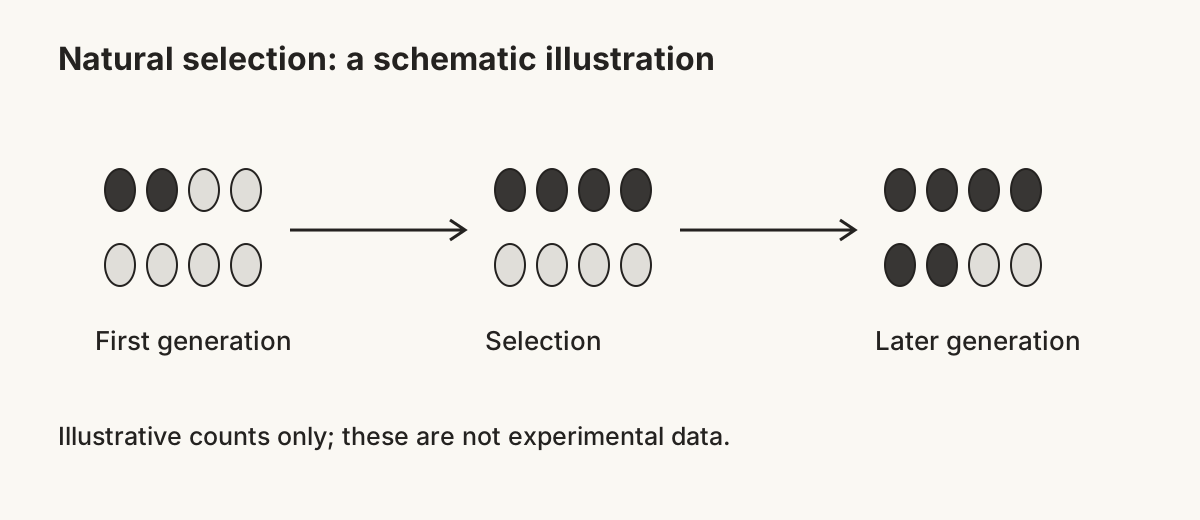
Natural selection means that inherited differences can affect survival and reproduction, changing how common features become. Chance and population history also matter. Evolution has no need to plan a goal before a change occurs.
Why does human chromosome 2 matter?
A chromosome is a package of DNA. Humans normally have 46, while chimpanzees normally have 48. If the lines share ancestors, why the different count?
One explanation is that two ancestral chromosomes joined in the human line. IJdo and colleagues reported internal DNA repeats in human chromosome 2 that fit an old end-to-end fusion. The signs expected at chromosome ends were found facing each other inside the chromosome.[29]
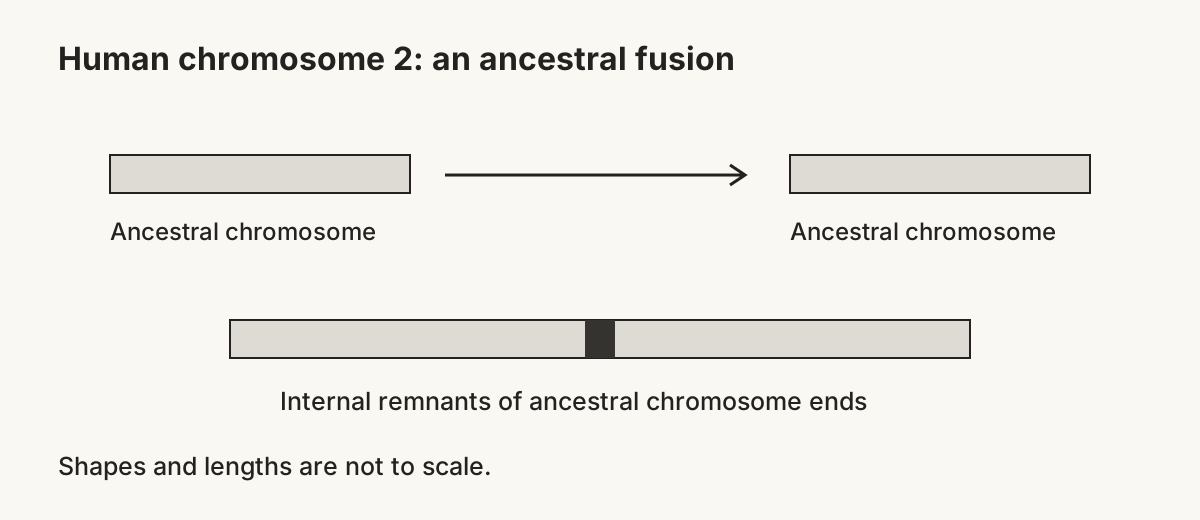
An exact pattern predicted by a proposed history carries more weight than a vague likeness. The drawing simplifies the concept. It is not a DNA sequence or a new experiment.
Is DNA the only evidence?
No. Fossils and other evidence from the world add a history of human forms and behaviour. The Smithsonian presents several kinds of evidence together. No single fossil is asked to prove every step.[30]
A gap in the fossil record does not erase a DNA finding. A disputed detail in one family-tree branch does not make every account equally good. We should identify which conclusion a new finding changes.
Does evolution explain the first life?
The origin of the first life is a further research question. Evolution studies what happens when systems reproduce and pass on differences. An incomplete account of the first life does not undo evidence about later descent.[31]
Could God have used evolution?
A Christian can hold that view. Then their claim is no longer that human ancestry contradicts evolution. The remaining question is what evidence shows the added divine purpose or guidance.
I reject a separate recent creation of humans under normal biology because it fails to explain the combined evidence as well as shared ancestry does. Evolution does not prove that every possible God is absent. It does force a literal origin story to meet evidence from the world it claims to describe.
Chapter 11Could Adam and Eve make everyone guilty?
Were Adam and Eve the only two people from whom all humans began? Could their wrong act make later people guilty? These are different questions. DNA can help with the first. It cannot tell us what blame a child deserves.
Genesis 3 describes the first disobedience and what follows. Romans 5 links Adam, sin and death with Christ. Churches use those passages in different ways. They do not all teach the same view of what later people inherit.[14][32]
Does DNA point to a recent start from just two people?
The evidence points to a longer, more complex human history. It includes descent from shared ancestors with other apes. A recent start from just one pair does not fit that picture under normal inheritance.[27]
Li and Durbin used whole genomes to study past groups. A genome is a person's full set of DNA. They used a model: a set of rules expressed in maths, which links possible histories with DNA patterns we see now.[33]
Their result called effective population size is not a count of everyone alive. It describes the group's genetic history under the model. The method also has limits. It is less good at resolving recent events and changes that are sudden and short.
We should not turn one graph into a claim that we know the exact number of people at every moment. The case uses several kinds of evidence. Someone defending a sole founding pair must explain that combined evidence.
What about one shared maternal ancestor?
A line of descent is not the whole family tree. If we trace only mothers' mothers, a shared ancestor on that line need not have been the only woman alive.
Think of a name passed down through one branch of a family. That branch can share one source of the name while other people also belong to the family tree. The comparison has limits, but it shows why one surviving line does not tell us the whole group's size.
Two people living within a larger group are a different claim from two people who alone began humanity. Adding a miracle changes the claim too. Neither move shows that DNA has identified the named pair.
Does original sin mean a baby's own fault?
In Catholic teaching, it is an inherited condition, not a fault personally committed by Adam's descendants. Catechism 390 also treats the story's language as figurative while keeping a claim about a first event. Figurative means using images to express an idea.[13]
The Westminster Confession gives a Reformed view that includes inherited guilt and a damaged nature. It does not speak for every Christian.[6]
Ask which claim is being defended. If a condition passes down, why did a good creator make the effects work that way? If guilt passes down, why is that fair to someone who did not choose the act?
Can an act harm a child without making the child guilty?
Yes. A parent's choices can leave a child in debt or danger. The child did not choose that situation. It gives us a reason to help, rather than a reason to blame the child.
Ezekiel 18 stresses a person's own deeds. A defender can offer a way to read that passage with Romans. They must explain the link; merely quoting both does not do the work.[34]
I reject blame passed to a person for an act they did not commit. An inherited wounded condition avoids that exact charge. It still leaves questions about the creator's design, the story's past and why this religious cure should be trusted.
Chapter 12Could a recent worldwide flood explain the evidence?
Genesis 6-9 tells of a flood, an ark, destruction and a covenant. Some readers defend a recent event covering the whole planet. Others defend a regional disaster or a theological story. Those versions predict different evidence.[35]
What would a global event need to explain?
A flood said to destroy nearly all land life is a claim about physical history. Ask how it fits rock sequences, the history of populations and long records from ice. Where is the event placed, and what trace should appear at that time?
NOAA archives an Antarctic ice-core record reaching about 801,000 years into the past on its stated age scale. The record uses scientific dating and interpretation. It is not a claim that researchers simply counted every visible mark as one year.[36]
The Earth's much older age is supported through radiometric evidence. Human DNA also records a history that must be explained. These sources do not describe a recent restart of the world from the survivors of one boat.[25][33]
The challenge is the fit of the combined account. A defender must give a physical explanation that works across the evidence, not an isolated story about one rock or one local flood.
Does a seashell on a mountain prove it?
It shows that the shell or the material containing it has a history needing explanation. It does not, by itself, date a worldwide flood or identify Noah's event.
The same reasoning applies to flood stories in different cultures. Shared themes can be historically interesting. To show one planet-wide event, we need dated evidence that the stories refer to that event, rather than separate disasters or traditions that travelled.
My point here is about what follows from evidence. I am not claiming to have tested a given mountain specimen or traced every flood tradition.
Can a miracle remove all the difficulties?
A defender may add supernatural help for the animals, water, travel and recovery. That makes the claim harder to test by normal physical methods. What separate evidence supports each added act?
If God restored the planet so that all surviving traces fit a different history, what physical observation could ever count against the story? A claim protected from every test cannot also be advertised as confirmed by the evidence it has made irrelevant.
Would a local flood solve the moral question?
It changes the physical claim and may change the task of studying the past. It does not by itself justify the killing described. If children and animals are destroyed because of others' wrongdoing, ask why they bear that cost.
Could a powerful creator restrain the harmful people directly? Could the vulnerable be protected? Why would destruction be the chosen lesson? Calling the event judgment states the proposed purpose; it does not prove the purpose just.
What if the story is symbolic?
Then we should examine what it teaches rather than treat it as a geology report. A Christian may find meaning in its warning or promise. That does not show that the physical event occurred as a literal recent global flood.
I reject that literal account as an explanation of the combined evidence from the world. I also reject the idea that placing a divine name on mass destruction ends the moral inquiry. The meaning of the story and the fate of its victims both deserve questions.
Chapter 13Does a healing after prayer show that God intervened?
A sick person receives prayer and later improves. The improvement may be real and welcome. The next question is what caused it. Timing alone does not settle that question.
John 14:12-14 contains promises about asking in Jesus' name. James 5 links prayer with care for the sick. A believer may explain these promises through God's will, the wider context or spiritual healing. We must identify the exact result being claimed before testing it.[37][38]
What evidence would help?
Ask for the diagnosis, records before and after, treatment received, time course and follow-up. Ask what doctors actually concluded. "Unexplained" means that the explanation is not known from the available evidence. It does not name God as the cause.
We also need unsuccessful cases. If a speaker shows only the people who improved, we cannot tell how often improvement would have happened anyway. A claim about an extra physical benefit needs a fair comparison.
This is not a request for a person to delay care. Clinical choices need qualified medical advice. Examining a supernatural claim gives no reason to abandon treatment.
What did one major prayer trial find?
The STEP trial studied 1,802 people undergoing heart-bypass surgery. Under its stated protocol, assigned intercessory prayer did not improve recovery free of complications. The group certain it was receiving prayer had more complications in that trial.[39]
That result concerns the particular study and setting. It does not prove that every prayer is useless, that every personal experience is false, or that no God can exist. It does challenge a simple claim that this assigned prayer clearly improved those measured outcomes.
We must respect those limits even when they make an atheist slogan less dramatic.
What if God refuses to be tested?
A believer may say that God acts freely and can decline an experiment. That preserves a possibility within the belief. It also limits the claim that prayer's physical effect has been scientifically shown.
If a failed outcome never counts against the claim, why should a successful outcome automatically count for it? The rule needs to treat favourable and unfavourable results fairly.
Could testimony still matter?
Yes. Testimony can lead to records worth studying. We should not declare every witness dishonest. A sincere person can misidentify a cause, lack medical details, or hear a story that changed while being repeated.
The same standard should apply to healing claims made in another religion. If we reject their divine explanation without rejecting every recovery, why should a Christian recovery receive an automatic exemption?
Can prayer have a real personal value?
A person may find peace, hope or company through prayer. Those experiences deserve an correct description. A sense of comfort and a shown cure are different claims.
I can welcome someone's recovery without assigning it a supernatural cause. If a church wants to use the recovery as evidence of its authority, it must supply more than a grateful story. The cause is the part that still needs to be shown.
Chapter 14What would make a miracle report convincing?
A miracle claim can contain several steps. Someone reported an event. Something unusual may have happened. Normal explanations may seem not good enough. The speaker then identifies a divine cause and a religious message.
Each step needs support. A gap in the explanation is not a signed message from the Christian God.
Must an ancient miracle come with a video?
No. That would be an unfair demand on every ancient event. Historians use documents, objects, dates and comparisons among sources. We can ask normal questions about who wrote an account and how the information reached them.
The event being claimed still matters. An account of a journey and an account of a dead person returning in a transformed body do not ask us to accept the same departure from normal experience. The stronger claim needs evidence able to carry its extra weight.
Are several accounts automatically independent?
No. Several people can repeat one source. Independence means that the evidence reaches us through genuinely separate routes, at least in the respect being tested.
Suppose five websites reproduce one witness's letter. We have five copies and one reported witness. The copies may help preserve the letter. They do not create four additional people who saw the event.
The Gospels have important relationships with one another. The USCCB's introduction discusses their shared material and formation. Those relationships must be considered before counting them as four fully separate reports.[40]
Does sincerity prove the cause?
A person may be certain, brave and honest while mistaken about what produced an experience. If a report of an appearance is sincere, that is evidence about the person's belief. A further argument is needed to identify the appearance's cause.
This does not mean that the cause has been explained away. Declining one explanation and proving a rival explanation are different tasks. I should not announce a hallucination, fraud or mistaken identity without grounds.
Can no natural explanation mean God did it?
It means that no adequate natural explanation has been shown in the discussion. The divine account still has to earn its place. What did God do? Why this God? What feature distinguishes the act from an unknown event or an incomplete report?
The argument becomes stronger if it identifies evidence a rival would not predict. It becomes weaker if it uses a divine power flexible enough to explain any result.
Would one real miracle prove every church teaching?
Even if an extraordinary event were firmly shown, its full religious meaning would remain a question. Why would it show a given canon, church office or rule about marriage? Those links cannot be smuggled into the word miracle.
A Christian may present a connected case about Jesus, his message and resurrection. That case should be heard in full. It must also explain each connection, rather than demanding acceptance because one part remains puzzling.
My standard leaves room for serious evidence. It does not make miracles impossible by definition. It asks why a divine account is better supported than the alternatives, and why the conclusion reaches as far as the authority claimed.
Chapter 15Who decided which books belong in the Bible?
A canon is a recognized list of sacred books. Before asking whether every Bible sentence is true, we should ask which collection is meant and why that collection has authority.
Catholic teaching lists 46 Old Testament books and 27 New Testament books. The Westminster Confession gives a Protestant list. It treats books known as the Apocrypha as outside its rule of scripture. These collections differ. The Orthodox Church in America also describes a longer Old Testament canon.[41][6][42]
The point is not that a difference proves every collection false. It is that the word Bible cannot silently settle the boundaries under dispute.
Can an inspired verse supply a complete table of contents?
Second Timothy's statement about scripture is often used to defend inspiration. It does not itself list every book that later churches placed between two covers.[2]
If a church identifies the list, why trust the church's judgment? If the church's authority is proved by a verse in the list it selected, what independent support prevents a circle?
A defender can appeal to how earlier churches received the books, apostolic connections or the Spirit's guidance. Those are proposed reasons. We can ask what evidence supports them and how they distinguish this collection from a competing one.
Does a long tradition prove correct selection?
It shows that a community preserved and valued certain books. That can provide important evidence about the community's history. Popular acceptance does not by itself show a divine decision.
Imagine an old archive whose librarians agree on a set of trustworthy records. Their care matters. We still examine why those records were selected and what each can show. The librarians' agreement does not make every reported event true.
Likewise, disagreement is not proof that no reliable judgment is possible. It creates a task: compare the reasons, rather than treating one's inherited list as beyond inquiry.
Must God dictate every word for scripture to matter?
Many Christians do not picture authors as passive pens. Catholic teaching discusses human authors, literary forms and what those authors meant. That is a richer claim than a simplistic account of mechanical dictation.[41]
It also raises a boundary question. Which parts express divine teaching, which reflect a setting, and which can be corrected? How is that distinction made before a difficult passage is encountered?
If a defender restricts the claim to the truth God meant for salvation, ask what falls within that scope. A rule cannot be made precise only after a factual problem has appeared.
What should the outsider conclude?
The existence of a canon is evidence of religious judgment and preservation. It is not yet evidence that the final collection has a divine author. The authority of the collection remains part of what needs to be shown.
I can read the Bible as a major body of literature and history without accepting every claim made for it. If someone asks me to obey it as God's final rule, the reasons for its boundaries and authority must be open to the same close review as its contents.
Chapter 16Does preserving a text make its claims true?
Suppose a diary survives in a perfect copy. We can be confident about what its writer said. We still need to know whether the writer's account was correct. Preserving words and verifying events are different achievements.
That distinction applies even if a Bible text has been passed on very carefully. A human claim can be copied without error and still remain a human claim.
Do manuscript differences make the whole Bible worthless?
No. A manuscript is a handwritten copy. Comparing copies can help us identify a text and locate differences. Evidence of variation does not mean that every line is unknown.
A defender who points to many copies has identified useful material for comparison. The next questions are which copies, from when, with which relationships, and with what differences. Numbers alone do not settle those questions.
If a critic counts every spelling variation as a separate destroyed doctrine, the count misleads. We must identify what a difference changes.
What happened to the ending of Mark?
Mark 16 includes a short ending at verse 8 and a longer ending in verses 9-20 in many printed Bibles. The USCCB's textual notes distinguish the longer ending's later composition from Mark's own work. They also explain that Catholics accept the longer ending as canonical.[43]
This is not an admission that the entire resurrection story was added in that ending. The empty-tomb account and announcement of resurrection occur before it. A critic who ignores that point overstates the evidence.[44]
The real question is how original composition, later inclusion and religious authority relate. A passage can be canonical within a church while still having a history that readers deserve to know.
What about the woman caught in adultery?
The familiar story appears in John 7:53-8:11 in many Bibles. The USCCB notes identify it as a later insertion at that location, absent from early Greek manuscripts and placed differently in some copies.[45]
Its moral appeal does not prove its original place in John's text. Its textual history also does not prove that every part of John's Gospel is false. The conclusion must match the evidence.
Would we accept a beloved line in another religion as original just because we liked it? Would we reject a line's moral insight only because its location changed? These are separate judgments.
Can translators be accused of secretly deleting verses?
Sometimes a difference reflects which manuscript reading a translation follows, openly explained in a note. Before alleging a plot, compare the notes and sources. A footnote can be a sign of disclosure.
Ask what evidence supports the reading and whether the edition makes the uncertainty visible. A reader should not need to discover a major textual issue only after being challenged in a debate.
What survives these questions?
Much can be learned from preserved texts and careful comparison. The religious claim still goes further: that these words carry divine authority. That needs reasons beyond their survival.
I reject two shortcuts. A preserved book is not necessarily true, and a book with manuscript differences is not necessarily useless. The serious task is to show the text, judge its claims and explain why any part should govern another person's life.
Chapter 17Are the Gospels four separate eyewitness reports?
The four Gospels in the Bible are named Matthew, Mark, Luke and John. A title gives a name passed down in a tradition. It does not, by itself, tell us who wrote each sentence or whether that writer saw the event.
The USCCB is the body of Catholic bishops in the United States. Its Bible notes explain how Gospel traditions took written form. Its notes on Matthew refer to an unknown writer who used Mark and other material. These are views about sources found within a Christian publication.[40][46]
Does an unknown writer mean a false story?
No. A writer whose name we lack can preserve correct facts. A named writer can make a mistake. Knowing who wrote a text helps us judge what they could have known and how they knew it.
If someone calls an account a direct eyewitness report, ask what shows that. Does the writer claim to have been there? Does a later source give them a name? What links that later claim to the actual writing?
We should neither assume the link nor rule it out before examining it. The argument needs the evidence that connects the steps.
What does Luke say it is doing?
Luke 1:1-4 says it draws on earlier accounts and material passed down by witnesses. Its stated aim is to give an orderly account. That is a claim about using sources, rather than personally watching every scene.[47]
The aim deserves to be taken seriously. We can still ask how well the writer carried it out. A careful opening does not prove every event in the pages that follow.
Think of someone writing a local history. They may work hard and use old letters. We would still check the letters, the dates and the claims made from them. The same task remains here.
What changes if one writer uses another?
Two matching accounts may preserve one earlier source. They do not always give us two separate routes back to the event. The USCCB's Matthew notes discuss use of Mark and place Matthew after it in their account of how the texts were written.[46]
Suppose two reports describe an accident. If one copies the other, their agreement has a different weight from two people seeing it for themselves. We need to know which case fits the sources.
This does not mean every similarity proves copying. It means that we must study the links before counting the reports.
Do differences prove honesty?
A defender may say that small differences show separate viewpoints. Sometimes that is a fair reading. Differences can also arise through retelling, editing or mistakes. Their mere presence does not choose among those causes.
A critic can make the opposite error by treating every omission as a clash. One writer can mention one visitor while another mentions two. Unless the first denies a second visitor, the statements need not conflict.
When accounts are hard to combine, an added story that joins them needs support too. Being able to imagine it is weaker than finding it in the evidence.
What does a strong case need?
It needs grounds for the dates, names, links between sources and events claimed. A report that people believed something should be kept apart from proof that it happened.
The Gospels deserve serious reading. Counting them as four separate modern witness statements before doing this work gives the conclusion a head start. I want the sources checked before being asked to trust them as God's word.
Chapter 18What does the resurrection evidence actually show?
Paul's first letter to the Corinthians puts great weight on Christ being raised. The faith's value is tied to the claim. We should examine its strongest case, rather than dismiss a weak version.[48]
The case joins an early report of appearances, an empty tomb and a group convinced Jesus had risen. Catholic teaching sets out its own case through those signs. The further claim is that God raised Jesus into a changed bodily life.[49]
What does Paul's witness list give us?
Paul says Christ appeared to named people and groups. One group was more than five hundred people at once. This is a written report of that claim. It is not five hundred separate statements that survive for us to read.[48]
How did Paul know about the group? What did each person experience? Which claims can be checked through a route that does not merely repeat Paul's list? The passage does not give an interview with each person.
That does not prove Paul lied. It identifies what we have. A sincere report, a real experience and the cause of that experience are still different things.
Would an empty tomb prove it?
If we could show a tomb was empty at the relevant time, we would still need to explain why. Even the Catholic Catechism says that a missing body is not direct proof of resurrection on its own.[49]
The reports of seeing Jesus matter to the wider case. John 20 describes encounters, including Thomas's doubt. We should ask how the account came to be written and how it relates to other reports.[50]
The two kinds of report may have more weight together. Joining them does not remove the need to check each one. Nor does it give us a direct record of the act of rising itself.
Must a critic tell a complete rival story?
No. A critic should not invent one. Fraud, visions, mistaken identity and changes in a story are possible ideas people discuss. Naming one does not show that it happened.
I may be unable to trace every event and still ask whether the evidence identifies a divine cause. The preferred account does not win simply because a rival account also has gaps.
A Christian can argue that their view fits the evidence best. They must show why the reports deserve trust, which normal causes they rule out and why God's action is the better answer. The comparison must do more than list the alternatives and reject them by name.
Does being willing to die prove a belief true?
It may show sincerity if the death and its setting are well known. People can sincerely believe something false. We also need evidence for each person's death and what they knew firsthand.
This chapter does not offer a verified death record for every apostle. A list passed around in a debate cannot replace that work. We should not assume each person faced the same choice or could check the same facts.
Why do I withhold belief?
The step from reports of encounters to God's raising a person is large. The sources need to carry that step. Their links, details and grounds for trust remain part of the inquiry.
I am not claiming to know every event after Jesus' death. I judge the case examined here too weak to prove a divine resurrection with the certainty demanded. Showing that an early group believed is a smaller result than showing the belief true.
That judgment can be challenged with further evidence. The belief's central place in a religion is a reason to examine it carefully, not a reason to protect it from questions.
Chapter 19What supports the virgin birth and the birth stories?
Matthew and Luke say that Jesus was conceived without a human father. They are sources for the belief. They are not separate medical records proving how the conception happened.[51][47]
A critic need not invent a story about Mary's private life. These birth accounts do not give her exact age at marriage. An unsupported charge does not help show the truth. The question is whether the divine account has enough evidence.
Does normal biology rule out every possible miracle?
No. A claim that God acted is a claim about an exception to the normal process. Explaining the normal process shows why the event would be strange. It does not, by itself, prove that no divine act could occur.
The defender must still show why we should accept the exception here. Who had access to the fact? How did it reach the writers? What could distinguish this account from another religious birth story?
The story's purpose in a faith cannot supply an observation that is missing. We should neither invent an accusation nor assume the miracle.
What is the Immaculate Conception?
In Catholic teaching, this means that Mary was free from original sin from the start of her own existence. It does not mean the same thing as Jesus being conceived without a human father.[52]
Getting the names right lets us ask the real question. Why could Mary receive that protection? Why was it not given to everyone? What supports the claim that she received it at all?
These questions concern the doctrine that is taught. They do not depend on mixing up two different beliefs.
Do the birth stories fit the same time?
Matthew places the birth in Herod's time. Luke links an enrollment with Quirinius. The USCCB's Luke notes point to a problem with these dates. They place Herod's death in 4 BCE and the relevant Quirinius census in 6-7 CE.[51][53]
A census is an official count or enrollment of people. BCE means before the common era, and CE means common era. There is no year zero between 1 BCE and 1 CE. The dates here come from work about the past, not from the date chosen for Christmas.
Defenders offer other readings, earlier duties for Quirinius or another enrollment. What separate evidence supports the exact proposal? An event that could have happened is not yet an event shown in a record.
The difficulty concerns how the two stories fit. It does not make every line in either Gospel false.
Does Isaiah clearly predict this birth?
Isaiah 7 gives a sign in the setting of Ahaz. Matthew applies a passage from it to Jesus. The USCCB notes discuss the first setting and the wording translated as young woman or virgin.[54][55]
A Christian may defend a fuller meaning fulfilled later. That claim needs reasons. Why would a reader before Jesus have derived this exact event? What rule shows the second meaning?
If the match depends on reading the earlier text through the later story, it is weaker as a separate prediction. It may still have meaning for those making the religious link.
What remains to be shown?
The claimed conception, trust in the birth accounts and the link to prophecy each need support. They cannot simply be made to prove each other in a circle.
I reject certainty built from that circle. A reader may value the stories as sacred. If they are offered as public proof of God's act, their sources and problems with the dates must face questions too.
Chapter 20When does a prophecy count as a successful prediction?
Suppose I say that a city will face danger and later recover. Many events could fit. If I name the city, event and time in advance, the claim becomes more demanding. A fulfilled prophecy argument needs that kind of care.
We must know what the words meant beforehand, when they were written, how securely that date is known and how the later event was shown. A striking match is the start of the inquiry.
Was the prediction fixed before the event?
If the text's date is part of the dispute, it cannot simply be assumed. What manuscript, quotation or other evidence places the wording earlier? How much of the wording is supported at that date?
A critic also owes reasons if they claim a passage was written after the event. Neither side can settle the date by preferring the explanation it would support.
Did the later writer know the earlier text?
If so, a reported match may reflect the way the story was told. It might also reflect a real event interpreted through scripture. We need independent grounds to choose.
The Isaiah example in the previous chapter shows why a first setting and a later Christian application must be distinguished. A broader pattern or symbolic fulfilment is a different claim from an exact forecast anyone could derive in advance.[55][51]
Ask what exact feature would have counted as a failed prediction. If every possible result can be fitted afterward, the apparent success tells us little.
What about the promised coming within a generation?
Mark 13 places language about cosmic events, the coming of the Son of Man and "this generation" within a larger discourse. It also says that the day and hour are not known to the Son in that passage.[10]
Christians differ over which parts concern Jerusalem's fall, which concern a future return, and how the generation language should be read. A critic must examine those views rather than assume every sentence has one uncontested time reference.
The difficulty remains real. What textual rule separates the events? Is that rule visible before we know which expectations appear fulfilled? What evidence would show the proposed reading wrong?
Does divine time answer a delay?
Second Peter 3 responds to doubts about the promised coming with a comparison between divine and human time and an appeal to patience. That is part of the religion's own response to delay.[56]
It may explain why a believer waits. If every length of delay is compatible with the promise, the waiting itself cannot serve as an exact prediction confirmed by a deadline.
A defender can offer a claim whose timing remains open. They should then describe its evidential strength honestly. An open timetable and an exact fulfilled schedule are different kinds of argument.
Could a prediction ever support a religious claim?
Clear, securely dated and independently confirmed information could matter greatly. We would still ask about normal sources of knowledge, chance, selection of successes and the further inference to a divine author.
I do not dismiss every prophecy by definition. I ask for the terms of success before the result is chosen. A prediction that becomes precise only after events have occurred has not earned the authority of a clear forecast.
Chapter 21Why would forgiveness need Jesus' death?
If God can forgive, why must someone die? If a debt must be paid in full, in what sense is it forgiven? These questions reach the idea of atonement: how Jesus' life and death are said to restore the relationship between God and humanity.
Hebrews 9 uses sacrifice and blood language. Matthew 6 teaches prayer for forgiveness and connects it with forgiving others. Christians build different accounts of redemption from these and other texts.[57][58]
Are all Christian accounts the same?
No. Some emphasize Christ bearing punishment. Others emphasize victory over death, healing, reconciliation or a loving example. Catholic teaching describes a voluntary self-offering in love. An argument against one model does not answer every other model.[59]
The useful first question is what the death accomplishes and why that result needed this means. A list of religious words is not yet an explanation of the connection.
Can guilt be transferred to an innocent person?
Someone can pay another person's financial debt. That does not make them the person who committed the wrong. Moral responsibility concerns an agent's action, knowledge and choice.
Suppose a judge lets a guilty adult go after punishing an innocent volunteer. The volunteer's consent may show generosity. Why would it make the judgment just? What has happened to the victim's claim against the offender?
A defender may say that the divine case differs from the example. Then they must explain the difference doing the moral work. Repeating that Christ is unique does not tell us why blame or punishment can rightly move.
Is this simply a father harming an unrelated child?
That description misses the Trinity and the teaching of voluntary self-offering. A Christian can say that God bears the cost himself through the Son, rather than imposing it on a stranger.[59]
This answers part of a crude accusation. The remaining question is why a cost in suffering and death was necessary for an all-powerful God. Why is restoration tied to this mechanism? What prevents a different form of forgiveness and repair?
If the answer is that perfect justice demands it, we need an account of justice that shows the demand. The word perfect cannot supply the missing argument.
Would resurrection cancel the sacrifice?
Not automatically. A person can undergo real pain even if they later recover. Saying that Jesus just gave up a weekend trivializes the suffering the doctrine describes.
The stronger question concerns necessity and effect. What did the death change that could not otherwise be changed? Does a later resurrection show the fairness of the earlier arrangement, or only complete the story being defended?
Does forgiveness remove the need for repair?
It should not. A victim may need safety, recognition and restitution even if an offender has repented. A spiritual declaration cannot settle those practical obligations on the victim's behalf.
I reject moral systems that make an innocent person's suffering a substitute for explaining responsibility. Other atonement models may avoid that exact problem. They still need reasons why their supernatural account is true, why it was necessary and how it protects the people harmed.
Chapter 22Does a rib story justify authority over women?
Genesis 2 describes a woman formed from the man and brought to him as a partner. Unlike the Quranic passage discussed in the first volume, this Bible narrative explicitly contains the rib account in familiar English translations.[60]
The first question is how it is being used. Is it a claim about a physical origin, an image of shared humanity, or a rule giving men authority? Those claims need different arguments.
Would being made second mean being worth less?
No. A person's worth does not follow from the order in which a story says they were made. Even accepting the narrative for discussion would not show a right to rule another adult.
If the claim is a literal miraculous origin, ask what evidence supports that event. If the claim is symbolic, ask what the symbol teaches and why its moral meaning should be accepted. A change of reading should be stated openly.
Nor would the story imply that every man today must be missing a rib. A supposed bodily change in one ancestor is not necessarily inherited by every descendant. That familiar joke does not reach the belief it hopes to refute.
What does the New Testament say about roles?
Ephesians 5 begins its relevant section with mutual submission. It also describes the husband as head and tells him to love his wife in a demanding way. Both parts must be included.[61]
Does the duty to love make the authority equal? If the husband has a standing final say, does the wife have the same right? What happens when they disagree about her work, education or safety?
Kind treatment by a superior is not the same as equal standing. A rule assigning authority by sex needs a reason beyond describing the superior as loving.
Why restrict teaching because a person is a woman?
First Timothy 2 includes a restriction on a woman teaching or exercising authority and gives an Adam-and-Eve rationale. Christians debate whether the passage addresses a local situation or an enduring rule.[62]
If it concerns a local problem, what evidence shows the limit? If it binds every church forever, why should a capable woman's sex overrule her knowledge, judgment and conduct?
Galatians 3:28 speaks of unity in Christ across male and female, as well as other divisions. A defender can distinguish spiritual equality from different roles. They must still explain why the roles allocate power unequally.[63]
What if a woman freely chooses the traditional role?
Her choice deserves respect. A woman can prefer a given family arrangement or defend a religious interpretation. That does not show a right to impose the arrangement on a woman who declines it.
Can she refuse without threats, exclusion or loss of basic freedom? Can she leave an unsafe relationship? Who decides whether her refusal is legitimate? The practical answers reveal what the pleasant language of different roles may hide.
I reject a lasting right of men to rule women because of sex. Adults deserve reasons that take their abilities, choices and interests seriously. A creation story can be discussed as literature or belief; it cannot carry an unargued claim of ownership or automatic authority.
Chapter 23Can slavery be defended as humane ownership?
Owning a person places their life under another person's power. Better food, gentler treatment or a kind owner may reduce a harm. They do not explain why the ownership is justified.
Leviticus 25:39-46 distinguishes rules for impoverished Israelites from rules about foreign slaves. It permits foreign people to be held and passed on as inherited property. Calling every arrangement in that passage normal employment misstates the text.[64]
Does historical context settle the moral question?
It can explain why a system existed and how its rules worked. It may show that some rules limited harm compared with other practices. Improvement and final moral approval are still different claims.
Would we defend a present system of inherited human property because it gave owners duties? If not, what additional fact makes the ownership right in the religious case? The age of a practice does not supply that fact.
The United Nations' Universal Declaration of Human Rights rejects slavery. I use that as an explicit moral standard, not as a scientific discovery. My reasons concern the person's freedom, interests and equal standing.[65]
Do the Christian letters simply abolish slavery?
Ephesians 6 gives instructions to slaves and masters. It places duties on masters as well as slaves. That is not the same as an explicit universal command ending the institution.[66]
Philemon appeals concerning Onesimus as a brother. Readers can see a moral pressure in that appeal. The letter does not state a general abolition law for every slave everywhere.[67]
A defender may argue that equality in Christ eventually undermines slavery. Galatians 3 provides language for that argument. Then ask why the stronger principle must be drawn out against the continuing permission rather than stated clearly as freedom from ownership.[63]
Could sudden abolition have caused harm?
A defender may worry about food, shelter or social collapse. Those are practical concerns. Why could a powerful lawgiver not combine a clear ban with a transition that protects people?
The existence of a difficult transition does not make permanent ownership good. It creates a reason to design the transition carefully. The enslaved person's needs should guide that design, not excuse the owner's power indefinitely.
Does a Christian abolitionist answer the criticism?
A Christian can oppose slavery through faith and moral reasoning. That person need not defend every old use of the Bible. Their opposition matters.
The question then concerns the method: which principle allowed them to reject an accepted permission or reading? Can the same method correct another harmful rule? Does moral judgment help evaluate the text, rather than just obey it?
Good acts by believers do not make every Bible rule good. Harmful acts by believers do not make every Christian cruel. The rule itself must be examined.
Can consent survive ownership?
Ask whether the person can leave, refuse work, protect their family and challenge the owner. Dependence can make a spoken yes a survival choice. The existence of agreement within captivity does not by itself make the arrangement free.
I reject human ownership. Instructions to be kind cannot replace the owned person's standing right to challenge the system. A divine label makes the claim more powerful; it does not make the loss of freedom less serious.
Chapter 24Can a command from God justify killing children?
First Samuel 15:1-3 presents Samuel giving Saul a command to destroy Amalek, including children. The text presents this as God's command. That claim creates the moral problem. We can ask whether the command is right without first proving that the event happened exactly as told.[68]
An account of a past war describes what may have happened. A moral defence asks whether the command was right. The two questions need separate answers.
Does a group's wrongdoing make its children guilty?
A child is not responsible for every act of their people or ancestors. If the defence is that the group was dangerous, why does that justify targeting those unable to choose its conduct?
Could a powerful God protect others while sparing the children? Could harmful adults be restrained? If the answer is that God alone knows the necessary result, what evidence shows that necessity in this case?
Calling a child part of an enemy group does not erase the child's own life and interests. A moral argument must account for them.
Does the giver of life have a right to end it?
Power to create and moral permission to destroy are different claims. Parents help bring a child into existence. That does not give them an unlimited right to dispose of the child's life.
A defender may say God's relation to life is wholly different. Then explain which difference grants the right and why it permits this means. The fact that the creator can end life does not by itself show that a given killing is good.
Could the war language be exaggerated?
A defender may read the destruction language as a way ancient writers described victory rather than an exact census of deaths. That changes the claim about the past and deserves examination.
It still leaves a question about presenting total destruction, including children, as a sacred command. Why is that image morally appropriate? If the text exaggerates, how is the limit shown? A possible reading should have evidence beyond making a difficult verse easier to accept.
What about captive women?
Deuteronomy 21:10-14 regulates taking a captive woman as a wife. The passage includes a waiting period and a release rule if she is rejected. Those limits belong in an honest account.[69]
They do not settle whether the captive freely agreed. Could she refuse the marriage at the outset? Could she choose a different life while under the victor's power? What protects her interests independently of his decision?
The moral issue is consent under control. A restriction on the captor may reduce harm while leaving that issue unresolved.
Do Christians have to carry out these commands now?
Many distinguish ancient Israel's laws and wars from the church's present duties. We should not pretend every Christian advocates copying them. The narrower question is why a command judged wrong today should still be called morally perfect in its original setting.
If the answer is that people once misunderstood God, ask how that possibility affects the text's authority. If the answer is that the command was right, ask for the moral reason.
I reject a rule that permits the killing of innocent children just because someone attributes it to God. Religious authority must be shown and morally examined before it is used to excuse irreversible harm. A sacred claim gives the victims more reason to demand close review, not less.
Chapter 25Why should a private adult relationship need church permission?
When adults freely choose a relationship, a prohibition needs an explanation. Who is harmed? Is there force, deceit or a broken commitment? Is the claim of wrongness supported by the actual situation, or only by an authority's disapproval?
Consent does not solve every moral issue. People can agree to something that harms others. It does mean that a serious prohibition must do more than point to the couple's difference from a traditional pattern.
What do the cited passages say?
Romans 1 includes same-sex conduct within a larger account of idolatry and wrongdoing. Leviticus 20:13 gives an ancient male same-sex prohibition with a bodily penalty. Christian interpretations of the passages and their application differ.[70][71]
Some defenders apply the prohibition to all same-sex relations. Other readers argue about the conduct and setting being addressed. Ask how each interpretation accounts for the words, context and proposed scope.
If someone defends the ban for everyone, ask what makes a faithful, consensual adult relationship wrong. If someone rejects that application, recognize their actual position. A critic cannot assign them a rule they deny.
Does calling a relationship unnatural explain its harm?
Natural can mean common, biologically produced or morally proper. Those meanings are not interchangeable. A fact about what occurs does not, on its own, settle what ought to be done.
An illness can occur naturally and still be something we have reason to prevent. A human-made aid can be helpful. The label alone is not a moral argument.
If a defender offers an account of human purpose, ask why that purpose is correct and what supports it. Why should it govern another person's life? Does it address the people involved as persons with their own interests?
Must every ancient penalty be a present Christian policy?
No. Christians can distinguish ancient Israel's civil rules from the church's present role. That distinction should be stated before accusing a person of supporting a penalty.
It also leaves a question about the original moral rule. If a bodily penalty was right then, what made it right? If it was wrong, how does the text's sacred authority relate to the error? Historical distance does not answer both questions at once.
Can a church set voluntary standards?
Adults can choose demanding personal commitments. Their freedom matters. The next questions concern people who do not choose them, people who leave, and people whose safety or family relationships depend on agreement.
Can they dissent without threats? Can they obtain support? Does the community protect their basic dignity while disagreeing? A religious rule becomes a public moral issue when it is imposed through force or unequal rights.
Does disagreement justify contempt for believers?
No. A believer can care for others while defending a rule I reject. I should address the rule and the harm it permits rather than pretend a population has one character.
My own judgment is clear. A person's same-sex relationship is not shown wrong simply by citing a prohibition. A defence must address consent, commitments, harms and equal standing. Divine permission remains part of the disputed claim; it cannot be assumed to settle the dispute.
Chapter 26Is doubt a failure of character?
A person asks a hard question at church and is told to have more faith. That reply might be meant as comfort. It can also close an inquiry before the question has been answered.
We should distinguish uncertainty, careful judgment, indifference and deliberate dishonesty. They are not one condition. A person may lack belief because they have tried to think honestly.
Does the Bible forbid asking for evidence?
The sources contain more than one kind of emphasis. Hebrews 11 speaks about faith and things not seen. John 20 portrays Thomas asking about evidence and then presents a purpose for the written signs. First Thessalonians calls for testing claims.[72][73][3]
A Christian can so defend inquiry within their own tradition. Ask how far that permission reaches. Can the inquiry end in disagreement, or is only a pre-approved conclusion allowed?
If an answer is permitted only when it preserves the belief, the inquiry has a fixed destination. The question is how it can correct an error.
Is faith the same as normal trust?
Ordinary trust can be reasonable. We rely on other people and on knowledge we have not personally tested. Good trust uses checks, track records and ways to correct mistakes.
The comparison does not make every religious trust equally justified. Ask which checks support this claim. Can the source be questioned? Is there independent evidence? What would reduce confidence?
I do not need to rebuild every scientific instrument before using a result. I do need reasons to trust the relevant method and the people reporting it. A church asking for trust owes comparable clarity about its own grounds.
Does a moral accusation answer an argument?
Someone may say an atheist just wants to avoid rules. Even if that motive were shown, it would not make a DNA finding disappear or repair a problem about the past.
A critic may be arrogant or unfair. A believer may be frightened or defensive. Those possibilities concern the people. The argument still needs to be judged on its evidence and reasoning.
Ask which premise is false or which step fails. If the only reply is a guess about the questioner's heart, the question remains unanswered.
Is fear a good reason to perform certainty?
A person may say they believe because disagreement risks hell, family conflict or exclusion. Those pressures can explain the words spoken. They do not show that the words are sincerely believed or true.
Would another religion become correct if its threat were stronger? If not, fear cannot decide which religious claim deserves acceptance.
What duty does the atheist have?
To listen, check sources, admit mistakes and avoid easy distortions. Rejecting a doctrine is not a licence to invent claims about it. Certainty without evidence is a bad habit on either side.
I defend the freedom to reach an honest conclusion, including a religious one. I also defend the freedom to say that a religious case has failed. A belief that can survive inquiry should not need to turn doubt into a character offence before giving an answer.
Chapter 27Who checks a church that claims to speak for God?
A church can teach, provide care and bring people together. It can also control money, schools and a person's place in a group. Who can challenge a church when it uses that power badly?
Matthew 16 contains the passage about Peter, the church, keys and binding or loosing. Churches differ over what power it gives them. The meaning of the passage is part of the dispute. Quoting it cannot settle the dispute for an outsider.[74]
Does a sacred role make its holder safe?
A role can give someone duties. It cannot make every person who holds it honest or wise. Ask what they have done, who checks their work and what happens when a complaint is made.
Can someone report harm without losing their place in the group? Can a child speak against a respected adult? If a leader can stop others from checking the leader, how will a victim be heard?
These questions apply to a large church and a small local ministry. A warm public image cannot replace checks on power. Trust should have grounds that can survive an unwelcome fact.
What did a real inquiry find?
Australia held a Royal Commission into Institutional Responses to Child Sexual Abuse. A royal commission is a public inquiry with powers to gather evidence. Its final report was delivered on 15 December 2017.[75]
The report's account of religious bodies found grave failures in how they dealt with abuse. It included failures by Catholic leaders and problems in other religious settings. It also called for better ways to protect children and handle complaints.[76]
These are findings by an inquiry. They are not a criminal conviction of every priest or proof that all churches have the same record. I have not checked how each church follows the advice today.
The findings are enough to reject a blanket promise that a religious role makes outside checks needless. A child needs safety that does not depend only on the accused body's word.
Does a wrongdoer disprove God?
No. A believer can set their faith apart from someone's bad acts. Jumping from abuse to the absence of every possible God would go beyond the evidence.
The challenge here concerns a church's claim to guide lives. If its leaders fail, who makes them answer for that failure? Can people test their claim to speak for God without being treated as enemies of God?
A divine claim can make refusal harder. That is a reason to check the use of power with greater care.
Can forgiveness replace the need for action?
A victim may choose to forgive. That choice belongs to the victim. It does not remove the need to keep others safe, save evidence or use the lawful process that applies.
Pressure to forgive can silence someone who still needs help. What is done before trust is restored? Who checks that work? Can the review uncover facts the church would prefer to hide?
These questions do not assume every complaint is proved. They ask for a fair process that protects people and tests claims. Neither a title nor a crowd should decide guilt in advance.
What does power owe the people under it?
Clear reasons, honest records and ways to correct mistakes. People must be able to challenge a decision without risking their basic safety.
I reject the claim that respect for a church should shield it from review. It may offer care and meaning. Its right to direct another person's life still needs grounds and limits. No one owes their safety to the defence of a sacred name.
Chapter 28Do we need God to know that cruelty is wrong?
If a child is hurt, the pain matters to that child. Their need for help does not wait for us to agree about the origin of the universe. We already have something concrete to discuss: suffering, vulnerability and what care could change.
That starting point does not solve every moral question. It does show why "without God anything is allowed" needs an argument rather than repetition.
Is an act good because God commands it?
If a command alone makes an act good, could any act become good by being commanded? If the answer is no, then some feature of the act or God's nature is already doing moral work.
The stronger Christian answer says that goodness flows from God's necessarily good nature. Necessarily means that the nature could not have been otherwise. This is a more serious proposal than a ruler issuing random orders.
Ask how that nature is identified. When a text attributes a harsh command to God, how do we tell whether it fits goodness? If all conduct becomes good just by receiving the divine label, the explanation has returned to obedience.
Can religious stories contain sound moral insight?
Of course. Matthew 7 gives a rule of treating others as one wishes to be treated. Luke 10's Good Samaritan story makes care concrete across a group boundary. We can discuss why those ideas help people.[77][78]
If their reasons are sound, they remain discussable by people outside the religion. Accepting a good teaching does not need accepting every supernatural claim attached to the collection containing it.
Likewise, finding a bad rule does not erase every humane teaching. The task is to judge reasons consistently rather than give one source a complete exemption.
Does science prove a whole moral code?
No. Science can help show effects: who suffered, what reduced harm, and what a policy changed. Deciding what ought to matter also needs moral starting points.
Mine include suffering, free consent and equal standing. I defend them because people have interests of their own and reasons to resist being used just as tools. I can be asked to explain those commitments further.
The Universal Declaration of Human Rights states a public standard of equal dignity, freedom and protection from slavery. It is a moral and political document, not a laboratory theorem.[65]
Does disagreement make every answer equally good?
People can disagree while some arguments are better supported. We can ask whether a rule treats similar cases alike, accounts for the people harmed and allows errors to be corrected.
If a defender would reject a rival religion's forced rule, why accept the same form of rule in their own? The religious identity of the speaker should not determine whether the person's suffering counts.
Is atheism itself a guarantee of decency?
No. Lack of belief does not give someone kindness, honesty or a complete ethical theory. Atheists can act badly and defend bad rules. They owe reasons and close review too.
My claim is that moral reasoning can proceed without first settling God's existence. I can reject cruelty through reasons about the people affected. A divine command theory is one proposed account of morality; it cannot prove its own necessity simply by declaring everyone else without a foundation.
Chapter 29Would life lose its meaning without an afterlife?
A believer may say that a short life cannot matter unless it continues forever. I do not see why duration alone determines value. A conversation can help a person even when it ends. A friendship can matter to both people during the time they share.
Those examples do not prove that there is no afterlife. They challenge the further claim that finite things are automatically worthless.
Must purpose be assigned from outside?
An assigned task can give a life direction. It can also serve the person who assigned it. Why should another being's wish automatically become the final purpose of my life?
We can ask what makes the task good. Does it help people, reduce suffering or express a freely chosen commitment? If those reasons matter, they can be discussed. If the only answer is obedience, the question of value has been replaced with a demand.
A creator's ability to make people would not by itself show an unlimited right to use them. Their lives become part of the moral question once they can experience the effects.
Is hope evidence of its own fulfilment?
Hope can be understandable and valuable. It does not guarantee that the hoped-for event will occur. Wanting to see a loved one again is not proof that a reunion awaits.
We should treat grief carefully. A person need not be mocked for longing, and an atheist need not pretend that death is emotionally easy. Honesty includes admitting loss without turning comfort into knowledge.
The question is what supports the promised future, beyond the need the promise answers.
Do all Christians describe death in the same way?
No. The Seventh-day Adventist statement describes death as an unconscious state before resurrection. Other traditions describe conscious life after death differently. A critic should identify the particular claim before challenging it.[79]
These differences do not themselves prove that no future life exists. They raise questions about the sources and how the different pictures were selected. A confident account of what happens after death must explain why it should be trusted.
Can a practice help even if its theology is uncertain?
A gathering can provide company. A ritual can structure grief. Prayer can give someone a way to express fear or gratitude. Those possible human functions are distinct from a shown supernatural explanation.
An atheist can acknowledge a benefit without accepting the doctrine. A believer can value a practice while allowing its historical or scientific claims to be examined. Neither position needs pretending the human experience is unreal.
Does disbelief need a cold life?
No. A person can care for family, enjoy art, pursue knowledge and work against harm without claiming an eternal reward. The reasons arise within lives that can be helped or hurt now.
This is a statement of available reasons, not a claim that every atheist finds purpose easily. People differ, and a loss of faith can change relationships and expectations. An honest account should allow that difficulty.
I do not accept a promised eternity just because I would prefer it to loss. I also do not accept that today's love or care becomes meaningless without it. The value of helping a person need not wait for a guarantee that the universe will remember the act forever.
Chapter 30What do these questions allow us to conclude?
I do not find the case examined here strong enough to show that Christianity speaks for God. A first cause, even if shown, would not by itself identify the Trinity. A well-kept text would not prove every event it reports. A report that people saw Jesus would still need to show what caused their experience.
I also reject claims that a sacred rule is enough to excuse harm. A child is not guilty because of the group they were born into. A woman's sex does not give a man a right to rule her. A captive's need for freedom cannot be answered only by telling an owner to be kind.
These claims use different kinds of reasons. DNA helps us study ancestry. Records help us study the past. Arguments about harm and fairness help us judge a rule. We should be clear about which task we are doing.
Has this book ruled out every possible God?
No. Rejecting a case for Christianity does not settle every idea of God. Evidence against a recent creation does not refute a creator said to work through evolution. Finding a bad rule does not tell us exactly how the rule began.
The narrower result still matters. A claim has not earned trust just because the person who doubts it cannot explain everything else. The demand to believe still needs support of its own.
Which replies should change the discussion?
The Trinity distinguishes being from person. That answers a crude claim that it says three persons are one person in the same sense. We can accept that point and still ask what supports the doctrine.
Knowing a choice is not the same as forcing it. That answers one simple objection about free will. We can then ask why a creator chose the conditions, knew their effects and allowed the harm.
A Christian who accepts an old Earth and evolution is making a different claim from a recent creationist. Someone who rejects endless torment needs different questions from someone who defends it. A Christian who opposes slavery should be heard about why they reject the old permission.
Those changes make the dispute more exact. They do not prove the new claim without further work.
What should I stop saying?
I should not say that differences between copies make every Bible sentence unknown. I should not pretend that Mark's longer ending contains the first claim of any resurrection. I should not call Paul's list five hundred surviving statements, or say that missing statements prove the people were invented.
I should not invent Mary's age or private life. I should not claim every ancient appearance was a hallucination. That means a perception without the object it seems to present, and it needs evidence before being used to explain a case.
I should not treat a public inquiry's findings about churches as a conviction of every member. An atheist must correct mistakes in their own case too.
What could change my mind?
Strong evidence could. So could a sound argument whose starting claims can be defended and whose conclusion reaches the claim being made. If a problem with a source is solved, that result deserves to be recognized.
Even a firmly shown strange event would leave questions about the power claimed from it. Why would it give someone a right to rule? Power and goodness still need separate reasons. Knowing who gave an order would not make every possible order just.
How should a conversation end?
It may end with a source to check, a smaller dispute or an honest lack of an answer. Making a person feel small is not a test of truth. They may need time to think, and so may the atheist asking the questions.
Bhagat Singh's example encourages us to ask why power should be worshipped and suffering accepted. His name does not spare me the duty to check my next claim. I grant no faith an exemption, and I grant none to my own preferred answers.[1]
If a belief has evidence, let people inspect it. If a rule harms people, its defender must address the people harmed. A demand for reverence cannot do either job on its own.
QuestionsQuestions to carry into a conversation
When the answer is "God caused the universe"
Which argument is being offered? What are its starting claims? If it reaches a first cause, what further evidence identifies Christianity, the Trinity and the Bible? Which step rules out the alternatives?
Asking who made God does not answer an argument explicitly limited to things that begin or depend on other things. Examine the real premise.
When the answer is "The Trinity is a mystery"
What do being and person mean here? Which claim is partly understood? What supports its truth? What stops a rival religion from using mystery in the same way?
Avoid pretending the doctrine simply says three persons are one person in the same sense. The question concerns meaning and support.
When the answer is "God gave us free will"
Which harm does that explain? What about harm unrelated to a person's choice? Could the creator preserve choice while limiting its worst results? Why were these conditions selected?
Knowing a choice and causing it are not the same. Ask separately about knowledge, creation, permission and control.
When the answer is "Hell is chosen"
What exactly is hell? Who designed the consequences? Can a person understand and freely reject the offer? Why must refusal lead to this result? Is learning or repair still possible?
Find out whether the person defends continuing torment, separation or final destruction. These views need different objections.
When the answer is "Salvation is a gift"
Who can receive effective help? What explains unequal access or understanding? What happens to an honest doubter? How does the account distinguish deliberate cruelty from failure to find a claim convincing?
When the answer is "Genesis is not a science book"
Which passages are being offered as claims about physical history? What rule identifies a symbolic reading? Is that rule applied consistently? What further evidence establishes the theological meaning?
Accepting an old Earth or evolution changes the disagreement. It should not be ignored.
When the answer is "Evolution is only a theory"
What does theory mean in science? Which evidence is rejected: inherited change, shared DNA patterns, chromosome fusion, fossils or dating? What alternative explains those findings better?
Keep the first origin of life separate from evidence about later descent. A gap in one problem does not undo another result.
When the answer is "Adam and Eve were our ancestors"
The only biological founders, or two people within a larger population? In a recent past or a remote one? Under normal inheritance or an added miracle? What would each claim predict, and what evidence identifies the named pair?
If the discussion shifts to original sin, ask whether guilt or a condition is inherited. Biology alone does not settle the moral question.
When the answer is "The Bible has been preserved"
What is preserved: the words, a core message or every detail? What do the manuscripts show? Even if the words were copied perfectly, what makes their account true?
A difference between copies is not proof that the entire collection is unknown. Identify what changes.
When the answer is "There were five hundred witnesses"
Which records survive? Are we reading separate statements or one writer's report of a group appearance? How did the writer know? What establishes the event and then its cause?
Recognize Paul's report without silently turning it into five hundred available interviews.
When the answer is "They would not die for a lie"
Which person's death is securely established? What did they know firsthand? Does the evidence show sincerity, truth or both? Would a sincere martyr in another religion make that religion true?
Do not invent an apostle's death record or assume every person had a chance to recant under the same conditions.
When the answer is "Jesus fulfilled prophecy"
What precise event was predicted? Was that meaning clear beforehand? How is the text dated? What independent evidence establishes the event? Did the later storyteller know the earlier passage?
Ask for the rule of success before choosing the match. A symbolic connection is different from a precise forecast.
When the answer is "God answered my prayer"
What was requested and recorded before the result? What happened? What treatment or other cause could matter? Were failures counted? How would a rival faith's similar story be assessed?
An unexplained recovery should be studied. It does not identify its own supernatural cause.
When the answer is "That was normal then"
Does normal mean common or right? Who bore the harm? Could they refuse? If the rule is morally perfect, why does its defence need a restricted historical setting?
Use these questions for slavery, captive marriage and unequal authority without pretending all three have the same history.
When the answer is "Men and women have equal value but different roles"
Who receives power? Who can refuse? What happens in a disagreement? Why should sex decide authority when abilities and circumstances vary? Can a voluntary role remain voluntary for someone who declines it?
When the answer is "God defines goodness"
How is God's good nature identified? Can a claimed command be morally mistaken? What would let us reject a false attribution? If the only answer is the command itself, how has the argument escaped a circle?
When the answer is "The church speaks for God"
What establishes the authority? What are its limits? Who checks wrongdoing, hears victims and corrects mistakes? Does questioning the leader become an offence before the evidence is heard?
When the answer is "Without heaven life is pointless"
Why does a finite benefit lack value? Must a purpose be assigned by someone else? What supports the promised afterlife independently of the comfort it offers?
Allow grief and uncertainty. A person's need for comfort does not make them foolish, and it does not make a promise proven.
When the answer is "You just want to sin"
Which argument has been answered? Would a guessed motive change the text or the physical evidence? Would the speaker accept the same dismissal of their own belief?
The atheist must also accept questions about their reasoning. No worldview earns an exemption merely by calling itself rational.
GlossaryWords used in this book
Adam and Eve
The first human pair in the Genesis narrative and central figures in many Christian accounts of the Fall. Their theological role and a claim of exclusive biological ancestry are different questions.
Analogy
A comparison used to explain part of an idea. It does not show that everything true of one side is true of the other.
Atonement
An account of how the relationship between God and humanity is restored through Christ. Christian explanations differ.
Atheism
Lack of belief in gods, or, in a stronger use, the view that no gods exist. An argument must specify which claim it defends.
BCE and CE
Before the common era and common era. These year labels use the same numbering as BC and AD, without a year zero between 1 BCE and 1 CE.
Canon
A recognized collection of sacred books. Christian traditions differ about parts of the Old Testament collection.
Catechism
A structured statement of religious teaching. The Catholic Catechism is a source for what that church teaches, not independent proof that every claim is true.
Chromosome
A package of DNA. Humans normally have 46 chromosomes, arranged in 23 pairs.
Conditionalism
A Christian view in which the unsaved ultimately lose life instead of continuing forever in conscious torment. Often called conditional immortality or annihilationism.
Consent
Free, informed agreement. A spoken yes under coercion or strong dependence may not be enough.
Divine decree
The belief that events occur under God's determination or will. Its relation to human choice is disputed.
DNA
Material that carries inherited biological information. Patterns in DNA can help researchers study ancestry.
Effective population size
A model's measure of a population's genetic history. It is not a direct count of everyone alive at a given time.
Election
God's choosing of people for salvation in certain theological accounts. Christians disagree about how this relates to grace, freedom and foreknowledge.
Evolution
Changes in inherited features across generations, and the wider branching history of life through common ancestry.
Fall
The religious account of humanity's first disobedience and its consequences. Interpretations of the story and inherited consequences vary.
Foreknowledge
Knowledge of an event before it occurs. Knowing is not, by itself, the same as forcing the event.
Gospel
In this book, one of the four canonical narratives about Jesus: Matthew, Mark, Luke and John. The word also means good news in Christian use.
Grace
Divine help or favour understood as an unearned gift. Churches explain its role in salvation differently.
Incarnation
The Christian teaching that the divine Son became human. Central churches describe one person with divine and human natures.
Independent evidence
Evidence whose answer does not merely repeat or assume the claim under examination. Copies of one report are not automatically separate observations.
Immaculate Conception
The Catholic teaching about Mary's preservation from original sin from the beginning of her own existence. It is distinct from Jesus' virgin conception.
Manuscript
A handwritten text or copy. Comparing manuscripts can help establish wording and locate differences.
Miracle
An event attributed to extraordinary divine action. Showing that an event is unexplained does not by itself identify a divine cause.
Model
A simplified account used to understand or test something. Scientific models have assumptions, predictions and limits.
Natural selection
A process in which inherited differences affect survival or reproduction, changing the proportions of features in a population.
New Testament
The Christian collection containing the Gospels, Acts, letters and Revelation. Catholic and standard Protestant collections contain 27 books.
Old Testament
Christian collections of scriptures preceding the New Testament. The collection and names of some books differ among traditions.
Omnipotent
All-powerful. Serious accounts usually concern the power to do what is logically possible, rather than to make contradictions true.
Omniscient
All-knowing. What counts as a knowable future fact and how this relates to freedom require further explanation.
Original sin
A Christian teaching concerning the inherited consequences of the first human sin. Inherited guilt and an inherited condition are not the same claim.
Predestination
God's determination of an eventual outcome, especially salvation, in some theological accounts. It should not be silently equated with mere foreknowledge.
Premise
A starting claim in an argument. A conclusion can follow logically from premises that are themselves untrue.
Prophecy
A religious message, sometimes including a claim about future events. A precise prediction and a later symbolic application need different evaluation.
Radiometric dating
Estimating an age from radioactive changes in suitable materials, with checks on the relevant conditions and assumptions. Carbon dating is not the method used to obtain the Earth's age.
Resurrection
Return from death. The central Christian claim concerns Jesus entering a transformed bodily life, not simply recovering from an illness.
Revelation
A message claimed to come from God. In book titles, Revelation also names the final New Testament book in the collections discussed here.
Salvation
Being saved from the danger or condition a religion describes. In Christianity, this concerns sin, relationship with God and life beyond death.
Scientific theory
A broad explanation supported by evidence and open to testing. It does not mean a casual guess.
Trinity
The Christian teaching of one God in three persons: Father, Son and Holy Spirit. It does not simply assert that three persons are one person in the same respect.
Typology
Reading an earlier person, event or text as a pattern fulfilled more fully later. Its religious meaning is a different claim from a clear advance forecast.
Virgin conception
The claim that Jesus was conceived without a human father. This is distinct from the Catholic Immaculate Conception of Mary.
Author’s noteAbout this volume
Atheist vs Believer: Questions Christianity Must Answer is Volume Two of a separate question-led religion series by Lovepreet Singh. This is its first English edition. The Islam volume is a different book, and the completed Sacred Mirage books and bilingual website series are separate projects.
The case presented here is atheist. It uses biblical texts, official church teachings, scientific work and historical source notes to reach claims that can be checked. Scientific findings, historical judgments and moral reasoning have different limits, which the text keeps visible.
The everyday scenarios are invented examples. They do not describe events in the author's life. Research, drafting and editing assistance used GPT tools. The manuscript remains available for author review and correction. No new laboratory experiments, interviews or examinations of original manuscripts were conducted for this book.
References do not imply endorsement by a cited author, church or institution. Primary religious sources establish teachings and reports; they do not independently establish a supernatural cause. Some scientific papers were consulted through their abstracts, as identified in the source notes.
Lovepreet Singh's writing is available at misterlove.in.
Notes and sources — Volume 2
SourcesNotes and sources
Why I am an Atheist. Bhagat Singh, 1930; transcription from The People, 27 September 1931, Marxists Internet Archive.
Primary essay. Inspiration for the method of questioning divine creation, suffering and authority; no invented quotation or endorsement.
2 Timothy 3:14-17. Bible, King James Version (public-domain text); passage paraphrased and compared with the contextual notes cited separately.
Inspiration and usefulness of scripture; does not supply a complete later table of contents.
1 Thessalonians 5:19-22. Bible, King James Version (public-domain text); passage paraphrased and compared with the contextual notes cited separately.
Instruction to examine claims and retain what is good.
Overview of the Universe. NASA Science.
Expansion, the hot early universe and approximately 13.8 billion years of cosmic history; no assertion of absolute creation from nothing.
Catechism 232-267: Trinity. Catechism of the Catholic Church; official Vatican text, a statement of Catholic doctrine.
One divine substance and three persons; not the claim that three persons are one person in the same respect.
Westminster Confession of Faith, chapters 1-3, 6, 8-10. Orthodox Presbyterian Church; official confessional text.
Representative Reformed Protestant positions on the canon, predestination, original guilt and Christ; not the view of all Christians.
Matthew 28:16-20. Bible, King James Version (public-domain text); passage paraphrased and compared with the contextual notes cited separately.
Father, Son and Holy Spirit in the baptismal commission; not itself a full later philosophical definition.
John 1:1-18. Bible, King James Version (public-domain text); passage paraphrased and compared with the contextual notes cited separately.
The Word and incarnation; the theological claim is distinguished from independent physical evidence.
Catechism 456-483: true God and true man. Catechism of the Catholic Church; official Vatican text, a statement of Catholic doctrine.
One person with divine and human natures; human knowledge and divine knowledge are distinguished in Catholic teaching.
Mark 13:24-37. Bible, King James Version (public-domain text); passage paraphrased and compared with the contextual notes cited separately.
Coming of the Son of Man, this generation, and the Son not knowing the day or hour; scope and readings discussed.
1 John 4:7-21. Bible, King James Version (public-domain text); passage paraphrased and compared with the contextual notes cited separately.
Love as a central theological and ethical claim.
Job 1-2. Bible, King James Version (public-domain text); passage paraphrased and compared with the contextual notes cited separately.
Narrative of the accuser, permission and suffering; not a report independently establishing a heavenly meeting.
Catechism 385-421: the Fall. Catechism of the Catholic Church; official Vatican text, a statement of Catholic doctrine.
Figurative language with a primordial event; inherited condition without personal fault in Adam's descendants (405). Satan described as a created fallen angel.
Genesis 3. Bible, King James Version (public-domain text); passage paraphrased and compared with the contextual notes cited separately.
Tree, serpent, disobedience and consequences. The chapter itself calls the creature a serpent, without naming it Satan.
Revelation 12:7-12. Bible, King James Version (public-domain text); passage paraphrased and compared with the contextual notes cited separately.
Later Christian text connects the ancient serpent with the Devil and Satan.
Romans 9:14-24. Bible, King James Version (public-domain text); passage paraphrased and compared with the contextual notes cited separately.
Mercy, hardening and the potter image; theological interpretation is contested.
Matthew 25:31-46. Bible, King James Version (public-domain text); passage paraphrased and compared with the contextual notes cited separately.
Judgment, care for vulnerable people, and eternal punishment/life in the narrative.
Catechism 1033-1037: hell. Catechism of the Catholic Church; official Vatican text, a statement of Catholic doctrine.
Eternal separation and self-exclusion; no claim that all Christian positions on hell are identical.
Our Statement on Evangelical Conditionalism. Rethinking Hell; Christian conditionalist organization.
A believer's stated case for final destruction instead of endless conscious torment; describes an alternative, not a survey of all churches.
John 14:1-7. Bible, King James Version (public-domain text); passage paraphrased and compared with the contextual notes cited separately.
Jesus as the way to the Father in the passage.
Ephesians 2:8-10. Bible, King James Version (public-domain text); passage paraphrased and compared with the contextual notes cited separately.
Grace, faith and good works within the same passage.
James 2:14-26. Bible, King James Version (public-domain text); passage paraphrased and compared with the contextual notes cited separately.
Criticism of a faith without deeds; traditions interpret its relation to Paul differently.
Catechism 846-848: salvation outside explicit membership. Catechism of the Catholic Church; official Vatican text, a statement of Catholic doctrine.
Includes those who do not know Christ through no fault of their own, with stated conditions; not a blanket condemnation of everyone born outside the church.
Genesis 1:1-2:3. Bible, King James Version (public-domain text); passage paraphrased and compared with the contextual notes cited separately.
Ordered creation days, lights and the seventh day; genre and literal physical claims are distinguished.
Geologic Time: Age of the Earth. US Geological Survey.
Radiometric evidence for approximately 4.54 billion years. Old page is used only for the Earth-age discussion, not its dated universe-age estimates.
Evolution Resources. US National Academies of Sciences, Engineering, and Medicine.
Scientific theory, evidence and the distinction between science and supernatural assertions.
Genetics. Smithsonian Institution, Human Origins Program.
Human and ape genetic relationships; percentages depend on which differences and regions are counted.
Historical contingency and the evolution of a key innovation in an experimental population of Escherichia coli. Blount, Borland and Lenski, PNAS 105 (2008), 7899-7906. DOI 10.1073/pnas.0803151105.
Original laboratory study: aerobic citrate use evolved in one experimental E. coli population. Not a demonstration of human evolution by itself.
Origin of human chromosome 2: an ancestral telomere-telomere fusion. IJdo et al., PNAS 88 (1991), 9051-9055. DOI 10.1073/pnas.88.20.9051.
Original research abstract: internal head-to-head telomeric repeats support an ancestral fusion. Abstract and institutional genetics explanations consulted.
Human Evolution Evidence. Smithsonian Institution, Human Origins Program.
Converging fossil, archaeological and genetic evidence, rather than one missing-link specimen.
About Astrobiology. NASA Astrobiology.
Origins and evolution of life are scientific research questions; no claim that the entire origin of life has been reconstructed.
Romans 5:12-21. Bible, King James Version (public-domain text); passage paraphrased and compared with the contextual notes cited separately.
Paul links Adam, sin, death and Christ; inheritance is interpreted differently across traditions.
Inference of human population history from individual whole-genome sequence. Li and Durbin, Nature 475 (2011), 493-496. DOI 10.1038/nature10231.
Original PSMC study. Effective population size is model dependent and is not a literal census; recent, brief bottlenecks have limited resolution.
Ezekiel 18:1-20. Bible, King James Version (public-domain text); passage paraphrased and compared with the contextual notes cited separately.
Individual responsibility contrasted with transferring guilt across generations; theological reconciliation still needs an argument.
Genesis 6-9. Bible, King James Version (public-domain text); passage paraphrased and compared with the contextual notes cited separately.
Flood, destruction, ark and covenant; recent global, local and symbolic accounts are different claims.
EPICA Dome C 801,000 Year Ice Core Ionic Chemistry Data. Wolff and colleagues; NOAA NCEI dataset and metadata, DOI 10.25921/611g-qd84.
Archived Antarctic ice-core record and its age scale. The metadata were read; no new analysis of the full dataset was performed. Not a claim that every layer is individually counted.
John 14:12-14. Bible, King James Version (public-domain text); passage paraphrased and compared with the contextual notes cited separately.
Promises about asking in Jesus' name; believers qualify the meaning and scope.
James 5:13-18. Bible, King James Version (public-domain text); passage paraphrased and compared with the contextual notes cited separately.
Prayer for the sick in its religious setting; not an instruction here to abandon medical care.
Study of the Therapeutic Effects of Intercessory Prayer (STEP). Benson et al., American Heart Journal 151 (2006), 934-942. DOI 10.1016/j.ahj.2005.05.028.
Randomized cardiac-bypass trial, 1,802 patients. No recovery benefit from assigned intercessory prayer in this protocol; not a test of all prayer or of every concept of God.
Introduction to the Gospels. US Conference of Catholic Bishops, New American Bible introductory notes.
Names in Gospel titles are traditional attributions; notes discuss composition and stages of tradition.
Catechism 101-141: scripture. Catechism of the Catholic Church; official Vatican text, a statement of Catholic doctrine.
Inspiration, interpretation, authors' intent and the Catholic canon; 46 Old Testament and 27 New Testament books.
Canon of Scripture. Orthodox Church in America; official questions and answers.
Describes the Orthodox longer Old Testament canon; evidence of Christian differences over the collection, not a claim that disagreement alone disproves scripture.
Mark 16: notes on the endings. USCCB, New American Bible textual notes.
Longer ending is treated as canonical by Catholics while its composition is distinguished from Mark's; no claim the entire resurrection story was added here.
Mark 16. Bible, King James Version (public-domain text); passage paraphrased and compared with the contextual notes cited separately.
Empty tomb and different endings; textual notes cited separately.
John 7:53-8:11: textual notes. USCCB, New American Bible textual notes.
Woman caught in adultery passage absent from early manuscripts; textual placement is distinct from moral appeal.
Introduction to Matthew. USCCB, New American Bible introductory notes.
Identifies an unknown author and use of Mark; dating and source analysis are historical judgments, not eyewitness recordings.
Luke 1-2. Bible, King James Version (public-domain text); passage paraphrased and compared with the contextual notes cited separately.
Luke's prologue, annunciation, census and infancy account; historical notes cited separately.
1 Corinthians 15:1-19. Bible, King James Version (public-domain text); passage paraphrased and compared with the contextual notes cited separately.
Paul transmits an appearance tradition, including an appearance to more than five hundred; one written report is not five hundred separately surviving statements.
Catechism 638-658: resurrection. Catechism of the Catholic Church; official Vatican text, a statement of Catholic doctrine.
The church's own case from the empty tomb and appearances; testimony is distinguished from independent contemporary measurement.
John 20. Bible, King James Version (public-domain text); passage paraphrased and compared with the contextual notes cited separately.
Mary Magdalene, other disciples, Thomas and the narrator's stated purpose; distinguishes experience claims from causal conclusions.
Matthew 1-2. Bible, King James Version (public-domain text); passage paraphrased and compared with the contextual notes cited separately.
Virgin conception, Joseph, Herod, magi, Egypt and return; not a calendar date for Christmas.
Catechism 484-511: Mary and virgin conception. Catechism of the Catholic Church; official Vatican text, a statement of Catholic doctrine.
Distinguishes Jesus' virgin conception from Catholic Immaculate Conception, which concerns Mary's freedom from original sin.
Luke 2: historical notes on the census. USCCB, New American Bible notes.
Notes discuss the chronological difficulty linking Herod's period and Quirinius' census; no invented census record or claim all harmonizations are logically impossible.
Isaiah 7:1-17. Bible, King James Version (public-domain text); passage paraphrased and compared with the contextual notes cited separately.
Sign in the setting of Ahaz; Christian later application in Matthew is distinguished from the first setting.
Isaiah 7: notes on the sign. USCCB, New American Bible notes.
Ahaz, the sign's first setting and the young-woman/virgin translation issue; later Christian typology is a different argument.
2 Peter 3:1-13. Bible, King James Version (public-domain text); passage paraphrased and compared with the contextual notes cited separately.
Response to delayed expectation and the divine-time comparison; does not set a testable modern return date.
Hebrews 9:11-28. Bible, King James Version (public-domain text); passage paraphrased and compared with the contextual notes cited separately.
Christ's sacrifice and blood language; not every Christian account of atonement has the same mechanism.
Matthew 6:9-15. Bible, King James Version (public-domain text); passage paraphrased and compared with the contextual notes cited separately.
Prayer and forgiveness; prompts a question about the further necessity of a sacrificial mechanism.
Catechism 599-623: Christ's redemptive death. Catechism of the Catholic Church; official Vatican text, a statement of Catholic doctrine.
Voluntary self-offering, love and redemption; does not teach that Christians worship three unrelated gods.
Genesis 2:18-25. Bible, King James Version (public-domain text); passage paraphrased and compared with the contextual notes cited separately.
Woman formed from the man in the narrative; rib/side renderings and moral implications distinguished.
Ephesians 5:21-33. Bible, King James Version (public-domain text); passage paraphrased and compared with the contextual notes cited separately.
Mutual-submission opening, wife/head language and the husband's duties all retained.
1 Timothy 2:8-15. Bible, King James Version (public-domain text); passage paraphrased and compared with the contextual notes cited separately.
Restriction on a woman teaching or exercising authority in the passage, with its Adam/Eve rationale; scope debated.
Galatians 3:26-29. Bible, King James Version (public-domain text); passage paraphrased and compared with the contextual notes cited separately.
Unity in Christ across Jew/Greek, slave/free and male/female; implications for roles are debated.
Leviticus 25:39-46. Bible, King James Version (public-domain text); passage paraphrased and compared with the contextual notes cited separately.
Different rules for impoverished Israelites and foreign slaves, including inheritance; not reduced to a modern employment contract.
Universal Declaration of Human Rights. United Nations, Articles 1, 4, 18 and 19.
An explicit modern moral and human-rights standard: equality, opposition to slavery, freedom of belief and expression. Not presented as a scientific theorem.
Ephesians 6:5-9. Bible, King James Version (public-domain text); passage paraphrased and compared with the contextual notes cited separately.
Instructions to slaves and masters; obligations on masters do not erase the ownership question.
Philemon 1. Bible, King James Version (public-domain text); passage paraphrased and compared with the contextual notes cited separately.
Paul appeals concerning Onesimus as a brother; a universal abolition command is not explicitly stated.
1 Samuel 15:1-3. Bible, King James Version (public-domain text); passage paraphrased and compared with the contextual notes cited separately.
Narrative attributes to Samuel a command of destruction including children; moral evaluation distinguished from proof that the event occurred exactly as narrated.
Deuteronomy 21:10-14. Bible, King James Version (public-domain text); passage paraphrased and compared with the contextual notes cited separately.
Captive-woman marriage rules include delay and a release provision; captivity and freedom of consent remain separate issues.
Romans 1:18-32. Bible, King James Version (public-domain text); passage paraphrased and compared with the contextual notes cited separately.
Same-sex conduct in a larger theological account of idolatry and wrongdoing; application debated.
Leviticus 20:13. Bible, King James Version (public-domain text); passage paraphrased and compared with the contextual notes cited separately.
Ancient male same-sex prohibition and bodily penalty; no assertion that every church applies ancient Israel's civil penalties today.
Hebrews 11:1-6. Bible, King James Version (public-domain text); passage paraphrased and compared with the contextual notes cited separately.
Faith and unseen things; interpretation is not reduced to a claim that Christians never use reasons.
John 20:24-31. Bible, King James Version (public-domain text); passage paraphrased and compared with the contextual notes cited separately.
Thomas and the signs/purpose statement; used to ask about evidence and faith.
Matthew 16:13-20. Bible, King James Version (public-domain text); passage paraphrased and compared with the contextual notes cited separately.
Peter, the church, keys and binding/loosing; interpretations of institutional authority differ.
Royal Commission: Final Report. Australian Government, official Royal Commissions archive.
Dates the final report to 15 December 2017; historical inquiry findings distinguished from current compliance status.
Religious institutions: Final Report findings. Australian Royal Commission into Institutional Responses to Child Sexual Abuse; official report overview, 2017.
Documents institutional failures and safeguarding recommendations; not a conviction of each named or unnamed clergy member, and not a claim about every church worldwide.
Matthew 7:7-12. Bible, King James Version (public-domain text); passage paraphrased and compared with the contextual notes cited separately.
Asking and the rule of treating others as one wishes to be treated.
Luke 10:25-37. Bible, King James Version (public-domain text); passage paraphrased and compared with the contextual notes cited separately.
Good Samaritan narrative and a concrete example of care beyond group boundaries.
Death and Resurrection, Fundamental Belief 26. Seventh-day Adventist Church; official belief statement.
Conditional immortality and unconscious death; used as evidence of Christian diversity about the afterlife.