

PrefaceWhy I ask these questions
I want a belief to earn my trust. A claim does not become true because it is old, loved, repeated or protected from questions. If a claim tells me who made the world, how I must live and what will happen after I die, I want reasons I can check.
This book makes an atheist case against the authority claimed for Islam. I ask whether its picture of God makes sense, whether its claims fit the evidence, and whether its rules deserve to be called just. My position is direct: I do not accept that calling a command divine settles whether the command is right.
Bhagat Singh asked why an all-powerful creator would make a world full of suffering. His essay, Why I am an Atheist, refuses to treat inherited belief as a reason to stop thinking. That demand helps shape my questions here. The arguments and wording in this book are my present case; they are not new words put into his mouth.[1]
I will use the Quran and named hadith reports so that the reader can inspect the claims. A hadith is a report about Muhammad's words or actions. Different Muslim traditions do not accept the same collections or the same readings. When I discuss a Sunni report, that label matters. A sentence in a book does not tell us what every Muslim believes or how every Muslim behaves.
The questions can be sharp. A child in pain is not a polite puzzle. A person threatened for changing belief has a serious reason to question religious power. I will not make those questions harmless to protect a doctrine's feelings. I will also not invent facts to make my case easier.
What kind of answer are we asking for?
Some questions concern the physical world. Did humans share ancestors with other apes? How do embryos develop? We can compare claims with fossils, DNA, observations and experiments. Science can test those claims.
Other questions concern logic. Does a conclusion follow from its reasons? If a cause exists, must it be Allah? Logic can expose a missing step. It cannot supply the missing evidence by itself.
Some questions concern values. Is endless punishment fair? May a person own another person? A machine cannot measure justice in the way a thermometer measures heat. I will state my moral reasons: suffering matters, people deserve equal standing, and consent must be free. Readers can challenge those reasons too.
I will not call every objection a scientific proof. I will not claim to have disproved every possible god. A god who leaves no testable trace is a different claim from a story about the origin of the human body. The first may resist a direct experiment. The second can clash with physical evidence.
A hard question should survive an answer
The useful sequence is simple. Ask what the person means. Ask why they believe it. Check the reason. Hear their strongest reply. Then ask what still follows and what remains unproved.
A person who pauses has not been defeated. Someone who speaks with great confidence has not won. We are testing reasons, not scoring facial expressions. A question that has an answer is not by itself a good objection. A reply that gives comfort is not by itself a good explanation.
If a Muslim gives a better answer than the one printed here, judge that answer. If a source has been misunderstood, correct the reading. I want my criticism to be strong enough to face correction. Refusing to correct it would copy the habit I am challenging.
How to read the questions
The numbered chapters move from God's nature to evidence and then to moral authority. Each can also be read on its own. A small raised number leads to the source list. Sources include religious texts, a believer's own defence, scientific work and institutional explanations. A citation shows where a claim can be checked. It does not mean that the source agrees with my conclusion.
Most religious passages are paraphrased. English words cannot capture every issue in an Arabic text. Where a disputed word changes the argument, I say so. Read the verse before and after the one cited. Check a serious commentary, and ask what the proposed reading can show.
The plain English is deliberate. Nobody should need a degree to ask why the creator of a dangerous test bears no responsibility for its design. Difficult words are explained when they appear, with a glossary at the back.
My demand is the same from the first page to the last: give a reason, show what supports it, and accept the next question.
Chapter 1What would count as a real answer?
Someone tells me, "Allah exists because the Quran says so." I ask, "Why should I trust the Quran?" They reply, "Because it is Allah's word." We have gone around a circle. The second claim depends on the first, and the first depends on the second. Neither has gained outside support.
Imagine a stranger gives you a letter saying that he owns your home. You ask for proof. He points to a line in the same letter which says that every line is true. Would you hand over your keys? A religious claim needs a better reason too.
Is the source proving itself?
Can the book's authority be shown without first taking for granted that the book is divine? Does a witness report something they saw, or repeat something they were taught? If ten videos repeat one story, do we have ten witnesses or one story told ten times?
These questions do not prove that the story is false. They tell us how much weight the offered evidence can carry. Independent support means support that does not get its answer from the claim we are checking.
The Quran itself challenges doubters to produce a comparable surah, or chapter. That is a claim we can discuss. Before accepting it as proof, I want to know who judges the comparison and what rule they use. If the judge must already believe that no human can match the Quran, the contest cannot fairly test that belief.[2]
What result would make you change your mind?
Suppose every possible result is called proof. A sick person recovers: Allah answered. The person dies: Allah had a better plan. The person stays ill: Allah is testing them. Those explanations may help someone cope. They do not tell us which result would count against the claim.
Can we name a result before it happens? Can a person who doubts the claim check it? Would the same result count as support if a rival faith claimed it?
An explanation that can fit any outcome may be impossible to test. That does not make it false by definition. It does mean that a successful outcome cannot be presented as a clear win while every failure is protected from review.
Does not knowing prove Allah?
Someone asks, "Can you explain exactly how life began?" I cannot supply a complete, settled account. They say, "Then Allah did it." But how did their chosen answer enter the gap? Why would the same gap not prove another creator, or some natural process we have yet to discover?
The National Academies describe science as a way to build explanations from evidence that can be checked. A scientific theory is a broad explanation supported by evidence. It is not just a guess. Science still contains open questions. Those questions are a reason to investigate, not a receipt for a specific god.[3]
The believer's serious reply
"We use reason, history, personal experience and the Quran together. Our case is not just one verse proving itself."
That is a stronger claim. I should examine those reasons together and one by one. Yet adding several weak reasons does not always produce a strong case. If they all depend on the same untested story, their number can mislead us. If they offer independent support, they deserve more weight.
Ask which part of the case would stand if the Quran's divine status were still an open question. Ask how that part distinguishes Islam from other possible explanations. Then inspect it.
A short exchange worth having
"What exactly do you claim?" The answer should name the claim, not just praise Islam.
"What supports it?" The answer should offer evidence or an argument.
"Why does that support this conclusion?" This checks the step between the reason and the claim.
"What could show the claim is mistaken?" This reveals whether the belief can face a fair test.
I must answer those questions about my own claims as well. Doubt does not excuse bad reasoning. It gives me a reason to look for it.
Chapter 2If the universe needs a cause, why must it be Allah?
"Everything has a creator. The universe exists. Therefore Allah created it."
The first question is obvious: if everything needs a creator, who created Allah? If the answer is that Allah does not need one, the opening rule has changed. We now need a reason why one thing may exist without a creator while the universe, or its deepest basis, may not.
That objection defeats the simple slogan. It does not defeat every serious argument for God. A stronger believer says that whatever begins to exist needs a cause. Another says that dependent things need a base that depends on nothing else. Dependent means needing something else in order to exist.
Which version are you defending?
Are you saying that everything needs a cause, only things that begin need a cause, or only dependent things need an explanation? Those are different claims. We should not move between them whenever a question becomes difficult.
If Allah never began, "Who created Allah?" does not by itself defeat the second version. The dispute moves to the reasons for an uncreated being and to whether the proposed cause has the features being claimed for it.
What does the Big Bang actually show?
NASA describes a universe that expanded from an early hot, dense state. That model explains a great deal about cosmic history. It does not, on its own, show that absolute nothingness existed before the universe, or that a person decided to create it. Questions about the first known state and the origin of the conditions remain.[4]
If time itself has an origin, what does "before time" mean? Is a cause outside time a literal earlier event, or a different kind of explanation? Ordinary examples, such as a builder making a house, happen within time and use material that already exists. How far can that example take us?
My question is not a declaration that the universe caused itself. I am asking the believer to show the steps they claim to know.
Even if there is a first cause, what have you proved?
Suppose I grant an ultimate cause for the sake of discussion. Why must it know every future event? Why must it be morally perfect? Why must it hear prayer? Why must there be exactly one? How does the argument identify Muhammad as its messenger?
A cause of the universe and the full Islamic account of Allah are not the same conclusion. The second contains many extra claims. Each needs support.
The Quran describes one incomparable God who neither begets nor is begotten. That tells us what the text teaches. It does not fill the missing steps in the argument from a cosmic cause to the truth of that text.[5]
The strongest reply
"An ultimate explanation must be necessary: it cannot fail to exist. The universe changes and depends on conditions, so it cannot be that explanation. A mind can explain why one possible world exists."
There is a real philosophical proposal here. I ask why necessary existence belongs to a mind. What shows that the whole physical basis of reality must depend in the same way as a normal object within it? If the mind chooses, what explains its choice? If its nature fixes the choice, in what sense could it have chosen otherwise?
These are questions about explanation and logic. A laboratory has not settled every form of the argument. I should not claim that it has.
Why does an unexplained God solve an unexplained world?
The believer may say that God is not unexplained: his necessary nature explains his existence. Then ask how that necessary nature is shown. Giving it a name is not enough.
An atheist may treat some basic fact as unexplained too. We should compare the proposals honestly. Which one explains more? Which one adds fewer unsupported claims? Which one fits what can be observed?
I do not accept that a mystery becomes solved when we place a conscious ruler behind it. If the argument reaches only an unknown foundation, it must stop there until it earns the next step.
Chapter 3Why would a perfect God create beings who can suffer?
Why create us at all? What did Allah gain? What need did creation meet? If nothing was missing, why choose a world in which fear, pain and failure were possible?
Quran 35:15 says that Allah needs nothing. Quran 51:56 gives worship as the purpose of creating humans and jinn. The following verses deny any need for food or provision from them. A fair criticism must keep both teachings in view.[6][7]
Is worship for God, or for us?
The common reply is that worship benefits humans. God needs nothing. Worship teaches gratitude, restraint and a proper relation to the creator.
Then why build beings who need this arrangement? Why give them a painful need and then describe obedience as its cure? Could an all-powerful creator give them those goods through a less dangerous design?
A parent may help a child become kind through practice. The parent did not invent the whole world or every possible way to develop a mind. The comparison leaves out the creator's alleged power. If Allah can choose the design itself, we may ask about the design.
Does wanting something prove a defect?
It would be too quick to say, "Allah chose to create, so Allah must be needy or insecure." A wish can come from generosity rather than lack. A person can share a good thing without feeling incomplete. A believer may describe creation as a free gift.
The harder question concerns the terms of that gift. Why does the gift include the risk of punishment? What makes its harms necessary? Who agreed to face them before being created?
Calling creation a gift does not settle whether all its conditions are just. If I give you a house that I know contains a lethal trap, the word "gift" does not answer your complaint.
Can we know that Allah has an ego?
I cannot look inside the mind of an unobserved being and diagnose its ego. "Egoist" can become a label that replaces an argument. I want a more exact question: what would distinguish a demand for deserved gratitude from a demand for submission backed by threats?
If worship serves us, why should honest doubt deserve punishment? If God is beyond injury, whose harm is being repaired when a doubter is punished? If the answer is that refusal disorders the soul, why create that kind of vulnerability?
These questions challenge the account of authority. They do not need me to pretend that I have measured divine emotions.
What if creation is an expression of goodness?
That is a serious believer's answer. Existing may allow love, friendship, learning and joy. A world with no conscious beings would contain none of those experiences. The believer may argue that creation is good overall, even when life includes hardship.
I ask about each person who bears the cost. Does a good total justify every harm within it? Can the pleasure of many justify a terrible life imposed on one? Would you accept that rule if a human ruler used it?
An afterlife may be offered as the answer. We must then ask what evidence supports that afterlife and why later healing makes the earlier harm necessary. Repair and prior permission are different questions. A promise to repair damage does not by itself justify choosing to cause or allow it.
Could God have created a safer world?
If yes, why choose this one? If no, what limits the claim of power? A believer can answer that some valuable freedoms need real risk. We should then ask which risks are needed and how much harm they justify.
I am not asking for a world without any challenge, disappointment or effort. I am asking why a perfect designer needs harms as extreme and uneven as the ones we see. The phrase "God has a purpose" names a possibility. It does not show us that the purpose is good, or that this cost was needed.
Chapter 4Why create Iblis and then let him mislead anyone?
First, get the story right. Quran 18:50 identifies Iblis as one of the jinn. Calling him simply a fallen angel can import a different religious picture into the argument. In the Quranic account, he refuses the command involving Adam. In 7:12, he defends himself by contrasting his creation from fire with Adam's creation from clay.[8][9]
The following exchange gives us the question worth pressing. Iblis asks for a delay. A reprieve is granted. He then announces his plan to mislead humans. Read Quran 7:14-18 as a sequence, not as one isolated line.[10]
Did Allah know what Iblis would do?
If Allah knew, why create this being under these conditions? Why allow the plan to continue after its danger is declared? Why expose later people to a tempter they did not choose?
If Allah did not know, the usual claim of complete divine knowledge needs revision. A believer who accepts that knowledge will usually choose the first answer and defend God's reasons for permitting the danger.
Does knowing cause the wrongdoing?
The strongest reply says no. Knowing a choice is not the same as forcing it. If I know a friend will refuse a meal, my knowledge does not make the refusal happen. Iblis can still bear responsibility for his own act.
That reply answers one objection: mere foreknowledge is not obviously a push inside the chooser's mind. It leaves another objection. Allah is described as creator and ruler, with the power to prevent the foreseeable harm. I am asking about the decision to create and permit, as well as the rebel's decision to rebel.
Think of a builder who knows that a bridge design will collapse. The driver who ignores a barrier may be at fault. The builder's prior knowledge and control still deserve scrutiny. This is an analogy about responsibility, not a claim that God is exactly like a human builder.
Why grant the reprieve?
Why could Iblis not keep his own freedom while being prevented from harming others? Does freedom need a right to tempt strangers? If stopping interference would destroy freedom, why do we stop fraud, coercion or abuse?
A believer can say that temptation creates a meaningful test. Then ask what the test is meant to achieve. Must a person face a supernatural tempter to become good? Could honesty, care and self-control grow through normal choices? Why add this extra danger?
Is Iblis the cause of every evil?
No argument here needs that claim. Human cruelty can involve choices, institutions and habits. Earthquakes are not explained by the same mechanism as a person lying. Blaming every harm on one rebel can hide the separate causes we need to understand.
The believer may also deny that Iblis can force anybody to sin. If his power is limited to suggestion, ask why that suggestion is permitted and what it adds to the account. If people remain responsible, that does not remove the question about the permission granted to him.
What answer would satisfy the question?
"Allah has wisdom we cannot see" is possible within the belief. But does it identify a reason, or tell us that there must be a reason because Allah must be good? If goodness is the point under examination, assuming it cannot settle the examination.
A Muslim defence may appeal to freedom, struggle and a final judgment that restores justice. Those are serious themes in Muslim responses to evil.[11] Each adds a further question: which harm was needed for which good, and how do we know?
I can accept that Iblis is responsible within the story and still ask why a perfect creator chose to set that story in motion. Assigning blame to a character does not finish the question about the author of the whole system.
Chapter 5What is an all-knowing God testing?
A normal test finds out something the examiner does not yet know. A teacher sees what a student has learned. A driving test checks whether a learner can drive safely. Quran 67:2 describes life and death as a test of deeds.[12]
If Allah already knows every choice and outcome, what information does this test provide? If the answer is "none," why carry it out?
What is the strongest answer?
The believer may say that the test makes our choices real and gives us a record we can see. God does not need to learn. We need to live, act and become the people who are judged. A predicted wrongdoing is not the same as a wrongdoing actually done.
That is more careful than saying that Allah is curious about the result. It also means my first question has an answer. The next questions concern the cost and fairness of the process.
Why must the record be produced through this much suffering? Could God show the truth of our choices without exposing others to the damage? Why create people whose final failure is already known to him?
Are all candidates taking the same test?
One person grows up with safety and patient teachers. Another grows up under hunger or violence. One hears a thoughtful form of Islam. Another meets cruelty presented as Islam. Do they have the same chance to judge the claim?
The believer can answer that Allah judges every circumstance fairly. That would address the unequal starting conditions if the judgment works as claimed. I then ask how we know that it does. The existence of a promised fair judgment is part of the doctrine being assessed; it cannot be treated as a fact already independently shown.
Quran 17:15 links punishment to the sending of a messenger and says that one person does not carry another's burden. This complicates the crude claim that everyone who lacks a Muslim label is judged in exactly the same way.[13] It still leaves us asking how a person can identify a trustworthy message amid rival claims.
Could you choose otherwise?
There are two different questions. Did someone physically force your choice? And, given the exact past and God's fixed knowledge, could your choice have been different? Saying "I felt free" answers neither in full.
Quran 76:29-30 places human willing alongside dependence on Allah's will. Quran 57:22 describes misfortunes as recorded before they occur.[14][15] Muslim schools have developed different accounts of human agency and divine decree. A single slogan does not settle their dispute.
If you could choose differently, could Allah's knowledge be wrong? The reply is often that, had you chosen differently, God would always have known that different choice. That avoids imagining God learning a new fact late. It leaves the question of whether your actual future is open and what kind of control moral blame needs.
Is responsibility possible without an open future?
Some people, religious and atheist, argue that a choice is free when it comes from your own reasons and wishes, even if those have prior causes. Others need a stronger ability to do otherwise. We must name the view being defended before claiming a contradiction.
Even on the first view, the creator question returns. Who chose the conditions that shaped those reasons and wishes? If God could create a different arrangement, what explains the arrangement he chose? Responsibility can exist at more than one level.
My objection is strongest when it stays exact. Foreknowledge alone does not prove coercion. The combination of foreknowledge, creation, control and punishment raises the larger problem: why does the designer of the entire test bear no share of the moral burden of its foreseeable results?
Chapter 6Why should a child suffer for a lesson someone else needs?
Picture a child in severe pain. This is a thought experiment, not a report of a named family. We are told that the pain may teach patience, bring relatives together or allow others to show compassion.
Whose lesson is it? Why is the child paying for it? Could the lesson be taught in another way? If I hurt a child to make an adult more generous, would the good result excuse me?
Does every suffering person need that suffering?
A believer may say that hardship can build character. Sometimes it can. That does not show that every hardship builds character, that every person benefits, or that a gentler path was impossible.
The distinction is simple. "Some people grow through difficulty" is a claim about some experiences. "This terrible harm was needed for a good purpose" is a claim about this harm. The second needs much more support.
Muslim defences can offer several possible purposes: testing, spiritual growth, forgiveness or goods understood only in the afterlife.[11] The existence of several possible explanations does not show which one is true in a given case.
Does free will explain natural harm?
Human choices can explain why someone commits violence. They do not by themselves explain why bodies are vulnerable to every kind of disease, or why a physical world includes destructive natural events. A person did not freely choose every hazard that reaches them.
Stable natural laws are a serious reply. A world with causes we can rely on lets us learn, act and help one another. Yet why must those laws include exactly this level of danger? Could the same creator make bodies more resilient or limit extreme pain?
If a safer world is said to be impossible, I want to know why. If it is possible but not chosen, I want the moral reason for that choice.
What about the boy in the story of Musa?
Quran 18 tells of Musa (Moses) travelling with a servant of God, commonly called Khidr in Muslim tradition. After the boy is killed, Musa objects. Later the account explains the act through the harm the boy was expected to bring to believing parents and the hope of a better replacement. The explanation belongs to the story and must be read with the event.[16][17]
Can a possible future wrongdoing justify killing a child before that wrongdoing occurs? Would a replacement child make the loss fair to the child who died? Why could an all-powerful God not protect the parents without that death?
The believer may answer that this was a unique act based on knowledge normal humans do not possess. It is not a licence for readers to harm children. That distinction matters. My objection concerns the justice of the divine act described, not a claim that Muslims are instructed to imitate it.
Would a future reward make the harm necessary?
An afterlife in which the child is safe could change the final balance of welfare. It would not, by itself, show why the earlier harm had to happen. Paying a victim back is one question. Having a good reason to expose them to the harm is another.
If the reply is that God's knowledge exceeds ours, I can accept our limits. But do those limits also weaken our claim to know that this act is perfectly just? We cannot use human judgment to praise every apparent good and then dismiss it whenever it detects cruelty, unless we explain the difference.
What should we do while the answer is disputed?
Help the child. Reduce pain. Protect people from preventable harm. Believers can and do make that moral choice; belief in providence does not force passivity. Quran 13:11 also connects change in a people with change in themselves.[18]
My challenge remains: why must human beings repair harms that an all-powerful and perfectly good creator could prevent? "There may be a reason" keeps a possibility open. It does not show that the reason exists.
Chapter 7Can endless punishment be called mercy?
If a person spends a limited life reaching a mistaken conclusion, what could justify punishment without end? How much doubt would deserve that? What would make the penalty proportionate to the wrong?
Proportionate means in reasonable balance. We can condemn a theft without thinking that a thief should suffer forever. The seriousness of a wrong matters, but so do the person's knowledge, intent and ability to act otherwise.
Quran 4:56 describes severe continuing punishment for rejecting its signs. Quran 98:6 describes those in the passage as abiding in the Fire. Quran 39:53 offers a strong appeal to divine mercy and forgiveness.[19][20][21] The question is how those teachings fit together.
Are all non-Muslims being judged in the same way?
It would be careless to say that every Muslim thinks every person outside Islam has exactly the same fate. Questions about ignorance, the message a person received, sincere error and the duration of punishment produce different answers.
Quran 17:15 also matters: it connects punishment with a messenger and individual responsibility.[13] A fair objection asks a believer to state the account they defend before challenging it.
If you defend endless punishment for a person who knowingly rejects a clear truth, how do you tell knowing rejection from sincere disbelief? Can another human read that person's mind? Does a forceful critic necessarily know that Islam is true and refuse it anyway?
Can belief be chosen by command?
Try to believe that a coin in your hand is a live bird. You may pretend. You may say the words. You cannot simply order yourself to find the claim convincing.
We can choose whether to study, listen or check a source. Those choices can affect belief. But after honest study, conviction still depends on what seems supported. If a person cannot sincerely believe, what purpose does a threat serve? Can fear produce truth, or only outward agreement?
The reply about an infinitely serious offence
The believer may argue that rejecting an infinite God is an offence of immense seriousness. But why should the status of the offended being decide the length of punishment? If God cannot be injured or deprived, what harm is the sentence repairing?
A second reply says that the person would continue to reject God forever. That introduces a new claim about what the person would do under future conditions. What supports it? Could understanding change after death? If it cannot, who fixed the conditions that make change impossible?
A third reply treats hell as the result of freely rejecting the good. Then ask whether an uninformed or unconvinced person has made that fully informed choice. If a door is truly open, is the person able to understand it and leave?
Could punishment have a purpose it never completes?
A penalty may protect others, repair harm or help an offender change. If it never ends, what goal is reached? If nobody can be changed or released, why continue it? If justice alone needs it, what account of justice explains the requirement?
These are moral questions. No fossil can calculate the correct length of a penalty. My stated judgment is that a system of endless suffering needs a defence much stronger than "the ruler has the right." Power explains who can impose a sentence. It does not show that the sentence is fair.
Does fear of hell make Islam more likely to be true?
A frightening claim can be false. A comforting claim can be false too. The size of a threatened penalty does not increase the evidence for it.
Ask what evidence would support the threat if you did not already fear it. Ask whether you would accept the same reasoning from another religion with a rival warning. Then ask whether the proposed judge treats honest inquiry as a wrong.
If mercy means anything we can understand, it must affect how judgment treats limited, fallible people. Otherwise the word has lost the very meaning used to praise God in the first place.
Chapter 8If Allah has no sex, is that a contradiction?
"Allah is neither male nor female."
An atheist may be tempted to answer, "Then how can Allah exist or create anything?" That is a weak objection. A creator, if there is one, need not reproduce as an animal does. Biological sex concerns bodies and reproduction. A proposed being without a body need not fit those categories.
Quran 112 denies that Allah begets or was begotten. Quran 42:11 says that nothing is like him.[5][22] The doctrine is trying to distinguish God from normal organisms. We should test that claim rather than invent a rule that everything must be male or female.
Does the word "he" prove a male body?
A grammatical label does not show anatomy. Languages classify words in different ways. An English reader should not treat a pronoun in translation as a scan of God's body.
The better question is what the language positively tells us. When a believer says that Allah knows, wills, loves or is angry, how much of the normal meaning remains? How do they decide which descriptions are literal and which work by comparison?
How unlike us can God be before the claims become unclear?
If divine knowledge is unlike all human knowledge, what does it mean to say that Allah knows our future? If divine goodness is unlike everything we call good, why should the word reassure us? If anger does not involve any change, frustration or response, what is being described?
The believer can give a serious answer: we understand something about the attribute without knowing exactly how God has it. We can know that an expert understands a subject without understanding the expert's mind in full.
That reply shows that incomplete knowledge is possible. It does not make every description meaningful. Ask what the claim rules out. What could be inconsistent with divine goodness? What would count as evidence against the stated attribute?
Does anger prove that God is insecure?
Not by itself. A person can be angry at injustice because they care about its victims. Anger need not come from a wounded ego. Likewise, choosing to act does not by itself prove need or weakness.
The sharper question concerns the stated reason and response. Why be angry at sincere doubt? Why should an unlimited being treat a limited person's disbelief as a reason for severe punishment? If the anger is a figure of speech for just judgment, what makes the judgment just?
Calling Allah an egoist without examining those steps gives the believer an easy answer: you have assumed human psychology. I want to challenge the actual reasoning, not hand it that escape.
Can "beyond understanding" answer every objection?
Suppose someone praises Allah for mercy because mercy is good in a sense we understand. When questioned about punishment, they reply that we cannot understand divine goodness. Why was human understanding trusted for the praise but dismissed for the criticism?
There may be a principled difference. The person needs to explain it. Otherwise the rule seems to be: a familiar word counts when it supports belief and changes its meaning when it causes trouble.
What question should replace the bad gender objection?
Ask, "Which attributes do you claim Allah has, what do they mean, and what supports them?"
If Allah is beyond bodily sex, accept that this is a coherent description in that respect. It still does not show that such a being exists. If Allah is called just, demand a defence of the actions said to express that justice. If Allah is called all-knowing, examine knowledge and responsibility.
An objection earns its place by reaching a real weakness. I lose nothing by discarding one that does not work. My case becomes stronger when it stops confusing a body question with an evidence question.
Chapter 9What does evolution explain, in plain words?
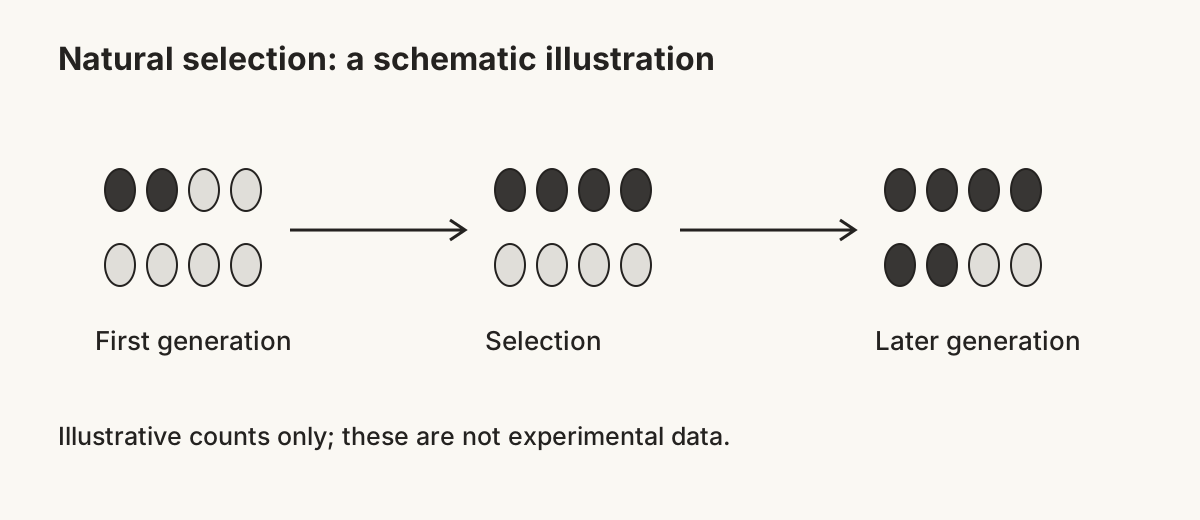
Evolution means that traits passed from parents to young can change in a group over many generations. A trait is a feature, such as a colour or a body shape. A generation is one step from parents to their young.
A single animal grows during its life. Evolution is about changes in the traits passed on through a group. The wider account says that forms of life share ancestors. A family tree can split into branches. One branch need not turn into all the rest.
Is it just luck?
Picture a group of small beetles. Some have a trait that helps them survive a danger. If that trait is passed on, and those beetles leave more young, more of the next group may have it. No beetle needs to decide to improve itself.
New changes in DNA do not arise because a creature needs them. But what happens to a change depends in part on how it affects life and having young. This is natural selection. It is not the same as making a whole finished animal by one random throw.
Other causes of change matter too. Chance can affect which members of a group leave young. Groups can split and follow different paths. The process does not think or aim to make every form of life better.[23]
Can we watch it happen?
We can watch traits change across generations. We can also test how some new traits arose. In a long lab study, researchers kept separate groups of E. coli bacteria. One line gained an ability to use citrate as food while oxygen was present, under the study's rules. Citrate is a chemical in the food mixture.[24]
The team could compare later bacteria with frozen samples from earlier stages. They could test how earlier changes affected the later result. This gave them a way to study the steps, rather than just guess from the end product.
What does this show? A group can gain a useful new ability through changes passed on to later generations.
What does it show on its own about humans? Much less. It is not a film of the whole path from early life to us. The wider case needs other evidence too. Each piece must do the job it is fit to do.
Where is the evidence for the long history?
Look for several kinds of support that agree. Fossils show past forms of life and their body traits. DNA lets us test patterns of kinship. The age and order of the rocks help us check when creatures lived. These lines of evidence can be tested against one another.
Whales give a useful example. Earlier forms had traits linked to life on land. Later forms were more suited to water. Their place in the family tree is based on several details of their bodies. It is not just a row of pictures that look a bit alike.[25]
Why are there still apes?
Because branches of a family can live at the same time. You and your cousin can share grandparents. Your cousin does not need to vanish when you are born.
Humans need not come from the chimpanzees alive today. Our lines share ancestors. Humans are also classed among the great apes. New traits do not erase a branch's past. The next chapter looks at the evidence for that link.
Does this explain the first life?
The first living systems are a related but separate question. Scientists study how life could arise from chemistry. They do not yet have a complete agreed account of how it first happened.[26]
Does that gap erase what we know about later change? If we did not know how the first book was made, we could still study which later copies came from earlier ones.
Could Allah guide the process?
A Muslim may accept evolution and add that Allah guides it. Evolution alone does not rule out that added claim. The next question is what evidence shows the guidance.
That view differs from saying that humans share no ancestors with other animals. The second claim must face the evidence about our bodies and past. Ask which claim the person defends. Do not let one be used as a reply to a question about the other.
Chapter 10What evidence puts humans inside the animal family?
Why does a shared body plan point to shared ancestors? Could Allah have reused a design? A vague likeness alone would not settle it. We need to ask about the pattern of details and which account best explains it.
The Smithsonian's Human Origins Program brings together fossils, tools and traces of past life, and DNA. The case does not rest on one bone, a drawn face or a demand to trust Darwin.[27]
What does DNA show?
DNA carries traits from one generation to the next. Groups that split from a shared past retain signs of that past. We can compare many parts of their DNA and check whether they point to the same family tree.
Humans and other great apes show close links in this evidence. A single percentage is not the whole case. The number changes with which parts and kinds of difference we count. What matters is whether many details fit the same past.[28]
If a designer could choose any pattern, why choose this one? The answer "Allah wanted it that way" can fit the result. But what would that answer lead us to expect before we look?
Why is chromosome 2 useful evidence?
A chromosome is a package of DNA. Humans usually have 46, while chimpanzees usually have 48. If our lines share ancestors, why the difference? Scientists can ask what sort of change might explain it.
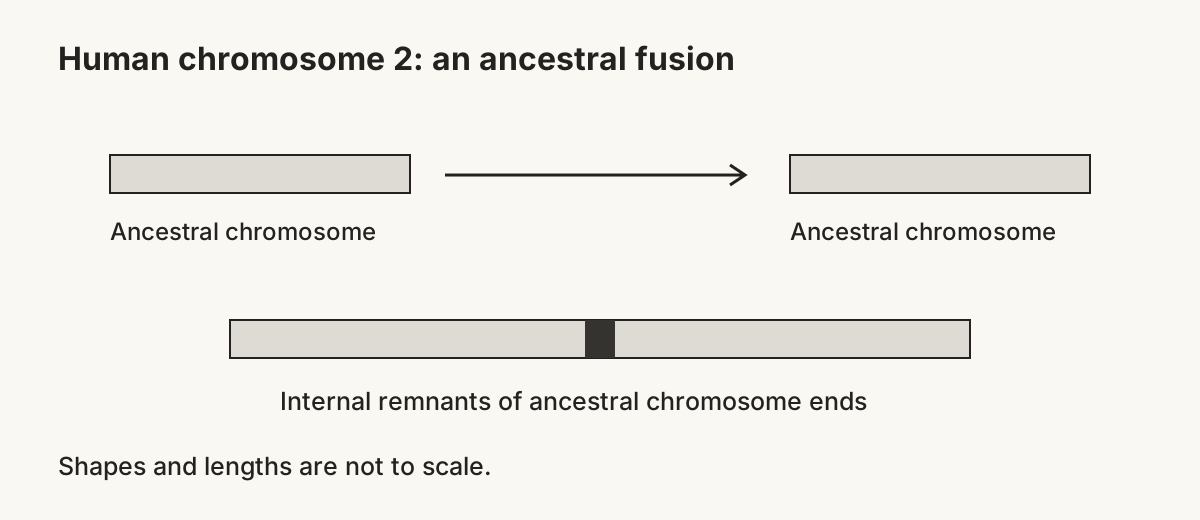
One idea is that two old chromosomes joined in the human line. Researchers found a pattern inside human chromosome 2 that fits an old end-to-end join. DNA repeats of the sort found at chromosome ends sit in a head-to-head pattern inside it. IJdo and colleagues reported this evidence in 1991.[29]
Picture two strips joined at their old ends. Signs of those ends at the join would tell us more than a vague likeness in colour. The real study is more detailed than the drawing. But its central idea is easy to grasp.
Does one finding prove every step of our past? No. It is one specific finding that fits a larger account. A claim that humans were made separately still needs to explain that pattern.
What do the fossils add?
The past held human relatives whose bodies had mixes of traits unlike ours today. Researchers study those traits and the places where the bones were found. Some links are disputed. There are gaps. Yet a gap does not make the bones we do have cease to count as evidence.
The Smithsonian places the rise of Homo sapiens, our species, in Africa roughly 300,000 years ago. A species is a kind of living thing; scientists need careful rules to draw its boundary. This account concerns groups over time. It does not name one exact first human baby.[30]
Why demand a moment when a wholly nonhuman parent gave birth to a wholly modern person? Slow change in groups need not follow the sharp labels people later choose.
What is the shared-designer reply?
"Allah reused a good plan. That is why our DNA is alike."
Reuse is a possible account. Does it predict the pattern we find? Could it also fit the opposite pattern by saying Allah wanted variety? An account that fits any result needs some further test before it can beat one that makes clear demands on the evidence.
Shared ancestry, the view that groups come from shared earlier groups, does make such demands. It can be checked against the details. An unlimited designer can fit almost any detail unless further limits are stated.
Could Allah make it look as if we share ancestors?
An unlimited power could be said to do that. But how would we tell a true past from an appearance made to mimic it? What evidence could count against the second story?
I choose the account that fits what we find without adding an unverified act to make the evidence misleading. This is a judgment about the best supported account. It does not claim to have banned every possible story about a god.
Chapter 11Could Adam and Hawwa have been our only ancestors?
Ask what the claim means. Were two people the only parents of the whole later human family, with no other group adding any DNA? Did they live among other people? Or does the story teach a lesson without giving the body's past?
These claims differ. A challenge to one does not defeat them all.
I use the Islamic names Adam (Arabic: Ādam) and Hawwa. The Quran names Adam but calls the woman his spouse, without giving her name. Hawwa is found in Islamic tradition. The Arabic of Sahih al-Bukhari 3330 uses it; its English text uses Eve. The Quran itself does not name her Hawwa.[31][32]
Quran 4:1 speaks of a single soul and its mate. Quran 3:59 links Adam to dust and God's command. Quran 32:7-9 describes clay and then how descendants come into being.[33][34][35] These passages underlie older creation readings. How they relate to the body's past is a further question.
What would only two founders mean?
All later DNA would have to pass through that pair and then change over the time allowed. This would be a severe narrowing of the human family. We can ask whether the varied patterns in human DNA fit that account.
Research points to groups with long histories and exchanges among them. Li and Durbin's study shows one way to infer past group sizes from whole genomes. A genome is a living thing's full set of DNA. Their study does not describe humans as coming recently from two isolated founders.[36]
We must keep the study's limits. Its "effective population size" is a measure in a model, not a headcount. A model is a simplified way to test an idea against data. This method has less power to detect very recent or brief changes. One graph is not a count of every person ever alive.
Could a pair have many descendants?
Yes. That answers a question about how numbers can grow. It does not answer the question about DNA.
Copy a short book a million times. You now have a million copies. That fact alone does not explain how those copies gained many different old passages. You need a process, enough time and evidence that the process fits the result.
Under normal inheritance, a recent pair as the only founders does not fit the wider fossil and DNA account. We need not pretend that one study has ruled out every date and every added miracle.
Is "mitochondrial Eve" the same as Hawwa?
No. That scientific name means a shared ancestor along one unbroken mother-to-mother line. It does not mean that she was the only woman alive. Other women could leave descendants even if their direct maternal lines later ended.
The matching idea of a shared father-line ancestor need not mean the only man alive. Those two ancestors need not have lived at the same time or been a couple. The names do not identify Adam and Hawwa.
One line cannot tell us the whole past. A whole genome has many parts with different histories. That is part of why the cited study uses many parts, rather than relying on one line alone.[36]
What if the pair lived among other people?
A pair can become shared ancestors in a family tree while many other people also contribute. A family-tree link can remain even when no DNA segment from one given ancestor can be identified in a later person.
That is not the claim that all human DNA passed only through two founders. It avoids that simple clash with larger past groups. But what shows that the named pair lived, received a message from God or held a special role? Those claims still need evidence.
What if Allah made the DNA by a miracle?
Then the account has moved beyond normal inheritance. What would test it? Why would it leave patterns that fit a much longer history? What separate reason supports the extra act?
The answer must match the claim. A recent pair as our only biological founders is not the history supported by the combined evidence. A symbolic story changes the claim. A pair within a larger group changes it too. Adding a miracle changes what we can test. None of those moves shows that the original literal account is a finding of science.
Chapter 12Did the Quran teach modern embryology?
An embryo is an organism in an early stage of development. Some Muslim arguments say that Quranic descriptions of human development contain knowledge no person could have had at the time. If true, that would be a claim worth checking carefully.
Quran 23:12-14 describes stages using terms translated in different ways, followed by bones and flesh. The term alaqah is rendered with ideas such as a clinging form or a clot.[37] If a defender compares the form to a leech, ask whether that reading is fixed by the text or chosen to fit a later image.
Which translation is making the prediction?
Was the claimed scientific meaning clear before modern embryology? Can it be drawn from the wording without importing later knowledge? Does the same translation work consistently, including the parts that are harder to match?
If a word has several possible meanings, choosing the one that resembles a modern image can produce an interesting comparison. It does not show that the text uniquely predicted what the image would show.
Ask for the exact scientific claim in plain words. "The embryo changes shape" is broad. "This given tissue develops through this mechanism at this stage" is much more precise. The strength of a claimed prediction depends on that difference.
Do finished bones appear before all muscle?
Development is not a simple assembly line that first finishes a bare skeleton and then dresses it in muscle. Muscle development, skeletal patterning, cartilage formation and later bone formation involve overlapping processes. Many bones develop through a cartilage model; cartilage is not already hardened bone.[38]
A rigid reading of "bones, then flesh" can misdescribe how the body grows. A believer may reply that the verse gives broad visible stages, or uses "bones" to include early structures. That may change the alleged clash. It also weakens a claim that the words give an exact, unmistakable textbook account.
Can a flexible reading count as exact science?
If a passage is allowed to mean several things, how do we decide which one Allah intended? If the reading changes after scientific discoveries, are we learning science from the text or fitting science back into it?
A useful test is to give the passage to readers who do not know the modern result. Ask what specific finding they can derive. Then compare their answer with what is actually observed. This proposed test is a way to judge the claim; I am not reporting that I have conducted it.
What about the backbone and ribs passage?
Quran 86:5-7 refers to human creation, a gushing fluid and emergence in relation to the backbone and ribs. English renderings and explanations differ about what is emerging and how the bodily terms should be understood.[39]
A critic should not simply choose the least plausible English reading and declare the matter closed. A defender should not jump from one reading to a different part of the body whenever the first is challenged.
Ask, "What exactly does the Arabic sentence refer to? What evidence shows that reading? What physical observation does it predict?" A detailed claim about the body needs a source about the body, not just an appeal to a speaker's confidence.
Could an old text contain a correct observation?
Yes. Age does not make a statement false. It also does not make the statement supernatural. A claim of divine knowledge must show more than a possible fit with a fact known today. We need to judge precision, normal sources of knowledge, rival readings and the chance of a match.
The fair conclusion is neither that every line is nonsense nor that a few matching words prove revelation. The scientific-miracle argument must earn its most ambitious claim: that the wording gives specific knowledge which is better explained by divine revelation than by normal language, observation or later reading.
Chapter 13Did the Quran predict the expanding universe?
Quran 51:47 is often offered as evidence that the text predicted cosmic expansion. Some English translations use language of expansion. Others emphasize vastness, power or making things ample. A comparison of translations shows the range.[40][41]
The first task is to state the alleged prediction. Is the claim that space grows with time? That the heavens are very large? That God has great power? These are different statements.
Could the finding be obtained from the verse beforehand?
If the modern result had not been known, would the wording have led researchers to the same specific conclusion? What observation would readers have expected? How would they have measured it?
NASA's account of cosmic history describes expansion and an early hot universe using physical evidence. Its age estimate is about 13.8 billion years. The account does not depend on first accepting the Quran.[4]
The religious claim goes further: the passage predicted this exact result, so it must be divine. A possible verbal fit cannot carry all of that weight without more argument.
Does a broad phrase become a scientific theory?
Suppose an old poem says that the sky is spreading. That may be compatible with a later discovery. It does not by itself specify what is expanding, how the rate is measured or what other observations should follow.
This is an invented example to test the rule. If a Muslim would not accept that poem as divine on the basis of a loose match, why should a different standard apply here?
Compatibility can show that a passage need not clash with a finding. Prediction is a stronger claim. Evidence of revelation is stronger again. Each step must be defended.
Does the joined-and-separated passage describe the Big Bang?
Quran 21:30 speaks of the heavens and earth as joined and then separated. It also associates living things with water.[42] The question is whether this gives an exact account of the early universe or a broad creation image that can receive several readings.
In the scientific account, the Earth forms much later than the early hot universe. A literal picture of an already formed Earth being pulled away from a finished sky would be a different model. A defender may reject that picture and read the verse more broadly. Then the claim of a precise scientific prediction needs to become broader too.
It is fair to ask what the words could have meant to their first audience. It is also fair to ask whether modern knowledge is deciding the reading after the fact.
What about the creation days?
Quran 41:9-12 presents a creation sequence with periods described as days. A popular objection adds two, four and two to announce an obvious eight-day contradiction. But the four can be read as including the first two; the translation used in the cited page explicitly reads the total that way.[43]
That simple arithmetic objection is not decisive. Better questions concern what the sequence means and what supports the reading. Are the days normal days or broad periods? Are the heavens physical layers? How does the reading relate to cosmic history?
If every difficulty is resolved by expanding the meaning of a word, what prevents any ancient creation story from being made compatible with modern science?
The believer's stronger case
"The Quran gives signs in language people can understand. It was never intended to be a physics textbook."
That is a reasonable account of a religious text's purpose. It changes the argument. If the text is offering broad signs and reflection, it should not also be advertised as a precise scientific paper whenever a phrase appears to match a discovery.
I reject the jump from a flexible passage to a proven divine author. To defend that jump, show the exact prediction, its clear prior meaning, the evidence for it, and why a normal human explanation is not enough.
Chapter 14Why would a gap in science prove Allah?
"Where did the first life come from?" is a good question. "Therefore Islam is true" is a conclusion with many missing steps.
Scientists study how chemistry could give rise to living systems. NASA includes the origin of life within astrobiology, the study of life's place in the universe. A complete, agreed reconstruction of the first life is not available.[26] We should say so without embarrassment.
Why does an unknown cause become your chosen cause?
If I cannot identify a sound behind a wall, I do not by that fact know that a given stranger made it. Not knowing the cause leaves several possibilities open. Evidence is needed to choose among them.
If an atheist makes a positive claim about the first life, ask for their evidence. If they say they do not know the complete answer, they have not secretly accepted creation by Allah. Uncertainty is a state of knowledge, not a vote for the most confident speaker.
Does the difficulty of the problem increase your evidence?
Consider a proposed natural account with an unanswered step. That is a weakness or an open task for the account. It does not by itself supply the evidence missing from a religious rival.
What did Allah do? By what process? When? What feature of the result distinguishes that act from a natural process? If the answer is simply that Allah can do anything, the proposal has described a power rather than shown an event.
The same rule applies to consciousness, the experience of being aware. Our incomplete understanding of experience does not by itself show a soul that survives death. A difficult question about the mind needs work, not a religious conclusion smuggled into the space left open.
What if personal experience is the evidence?
People can have powerful experiences of prayer, peace or a divine presence. The experience itself may be sincere and important. Its cause is a separate question.
How would the person distinguish a meeting with Allah from a powerful human mental state? Would a similarly strong experience in another faith show that faith instead? If the experiences lead to claims that cannot both be true, how do we decide which reading is trustworthy?
We can ask these questions without calling anyone a liar. A person can accurately report an experience and misunderstand what caused it. We do that in normal life too.
Why would God leave sincere people unconvinced?
Quran 10:99 says that God could have made everyone on Earth believe and asks whether people are to be compelled.[44] The believer may argue that a world with room for doubt protects freedom.
Does clear evidence remove freedom? I know that other people exist, yet I can choose whether to trust, love or obey them. Knowing that a ruler exists is different from approving the ruler's commands. Why could Allah not make his existence clear while leaving moral choices open?
The reply may be that spiritual growth needs a degree of distance. Then ask which distance is needed, why its effects are so uneven, and why honest uncertainty should risk punishment. A person who wants a clear reason to believe has not necessarily chosen rebellion.
Must the atheist explain everything first?
No. If someone claims a medicine works, a critic can ask for evidence without first curing every disease. The claimant must support the claim they made. A critic who offers a rival treatment then takes on the burden of supporting that treatment.
Likewise, I can reject an offered proof of Islam without claiming a complete theory of reality. My uncertainty does not prove my atheism in every possible sense. It also does not make the offered proof work.
The right next step after a gap is a better question: what would help us find out? That question can lead to evidence. Replacing the gap with a name can stop the inquiry before it begins.
Chapter 15If a book is preserved, does that make it true?
Picture a diary kept without changing a word. Its owner wrote that a dream foretold the future. Keeping the diary intact would tell us what the owner wrote. Would it show that the dream came from God? No. That is a separate claim.
Two questions must stay apart. Was the text passed on well? And are its claims true? Strong evidence for the first can matter to the study of the past without settling the second.
Quran 15:9 promises that the text will be guarded.[45] That promise is part of what we need to check. A book cannot prove that it kept a promise just by making the promise.
What does an old manuscript show?
A manuscript is a text written by hand. The University of Birmingham holds two early Quranic parchment leaves. Parchment is made from animal skin. A radiocarbon test put this material between 568 and 645 CE with 95.4% probability.[46]
This is real evidence. It should not be ignored because it helps a believer's case. But what was tested? The animal material. The test does not directly date when the ink was applied. Two leaves are also not a test of every verse in a whole modern Quran.
We have evidence for an early text. We have not yet proved who, human or divine, was the source of its words.
What does the Uthman report say?
Sahih al-Bukhari 4987 reports disputes over recitation, or speaking the text aloud. It says Uthman ordered standard copies to be made and other written Quranic materials to be burned.[47]
Does this prove the book was invented? No. Making a shared standard can aim to keep a text safe and end disputes. Does it prove that no human choice about the text ever had to be made? No. That claim needs more care too.
Ask what was made standard. What sorts of difference were involved? What can this report show? What can old manuscripts confirm on their own? A report passed through people and a physical written object give us different kinds of evidence.
What does "unchanged" mean?
The same broad message? The same consonants? The same spelling? Exactly the same sound in each accepted reading? These claims differ. A consonant is a letter such as b or t, as distinct from a vowel such as a or e.
A spelling change need not change a teaching. A reading that changes a meaning cannot be dismissed just by saying it is only spelling. Name the exact claim, then give the examples and sources needed to test it.
This chapter does not give a full history of the text. Its main point does not depend on proving that the whole book was changed. A human text can be kept very well and still make human claims.
What is the believer's stronger reply?
"That is only one part of our case. The language, message, predictions and effect of the Quran together point to Allah."
Then let each part do its work. Does it have sound support? Does it depend on the same disputed claim as the other parts? Several reasons are more useful when they provide separate checks, rather than repeat one assumption.
If keeping the text intact is called a miracle, how was the chance of doing so by normal means worked out? What comparison supports that judgment? What work was done by writing, copying, learning by heart, institutions and making a standard text?
Those normal means do not rule out God's action. But they do challenge a claim that no human means could account for the result.
What follows even if the text was kept perfectly?
We still need to ask whether its account of the world fits the evidence. We still need reasons to accept its rules and its messenger's right to rule our lives.
I can value an old manuscript without obeying it. Evidence that a message reached us is not yet evidence that the message is true.
Chapter 16How do we know a reported saying is trustworthy?
A hadith is a transmitted report about Muhammad or related early events. Many Muslims treat hadith as a major source of guidance. Sunni and Shia collections differ, and Muslims also disagree about given reports and the rules drawn from them.
The report's presence in a respected collection matters within that tradition. It does not remove every question about the past. We still need to ask how the information reached the collector and what checks support it.
Does a chain of names settle the event?
A chain identifies people through whom a report is said to pass. That is more informative than a rumour with no named source. But were the links shown? Were the tellers independent? Could several chains depend on one earlier source? What evidence supports the words attributed to the first witness?
These questions do not prove that every report is false. They are the normal questions we ask of any transmitted account. Trust can be reasonable, but it should match the evidence.
What does "authentic" mean here?
In hadith study, an authenticity judgment belongs to a method and a scholarly tradition. It is not a claim that a modern experiment replayed the event. Ask which method was applied and what it can show.
If a believer appeals to a collection's authority, ask why that authority should be accepted by someone outside the tradition. If the answer returns only to the tradition's own claim of certainty, the outsider's question remains.
Can you accept the comforting reports and reject every difficult one?
Sahih al-Bukhari 1 emphasizes intention. Other reports in the same collection include the standardization account, a punishment for changing religion, and a traditional account of Aisha's age at marriage.[48][47][49][50]
A Muslim can have a reason to accept one and question another. A critic can too. What is the reason? Is there a consistent rule about transmission, conflict, context or reading? Or is acceptance simply following whether the result feels welcome?
I should not treat a harsh report as unquestionably historical while calling every humane report unreliable. That would be the same selective habit turned around.
What if the Quran alone is accepted?
Then a criticism based only on a hadith collection does not directly reach that person's chosen authority. We can ask why they draw the boundary there and whether their Quranic arguments work. We should not pretend that a report they reject is secretly their own belief.
This does not make the report irrelevant to the wider history or to traditions that use it. It changes which argument is appropriate in that conversation.
Does context erase a command?
Context can change what a statement means and who it addresses. A wartime instruction is different from a rule for peaceful disagreement. A specific event is different from a universal command.
But "there was context" is a starting point. What was the context? What evidence shows it? Which words restrict the rule? If the text is broad, why is a narrow reading justified? If scholars disagree, how is the choice made?
An answer should do that work rather than invoke context as a word that ends the discussion.
What level of confidence should govern other people's lives?
A disputed report may be enough for someone to choose a private devotional practice. Is the same level enough to restrict another person's freedom or justify punishment? The costs of error differ.
If a rule could cause serious harm, uncertainty matters. The burden on those who impose it should be high. My demand is straightforward: do not turn a debated report into unquestionable power over a person who has had no fair chance to contest it.
Chapter 17What would make a miracle report convincing?
A miracle claim asks us to accept more than an unusual event. It often asks us to accept divine action and the authority of a messenger. Each step needs support.
Quran 54:1 refers to the splitting of the Moon. Sahih al-Bukhari 4864 contains a traditional report attributed to Ibn Masud describing a split seen during Muhammad's lifetime.[51][52] These are sources for the religious claim. They are not independent modern measurements of the event.
What exactly is being claimed?
Was the physical Moon split and restored? Was an appearance seen from one place? Is the verse read as a future sign, a past event or a figure of speech? A defender must identify the account being defended.
A critic should not argue against a literal event and then claim to have defeated a person who has proposed a different reading. The different reading must still explain the text and its own evidence.
How independent are the witnesses?
Several reports may strengthen a case if they come from genuinely separate sources. Repetition alone is weaker. If people repeat one original account, we have a story spreading further, not a new observation each time.
Can we identify a source outside the same chain of belief? Can we date the account? Was it recorded by a person able to see the event? Were rival explanations considered? Those questions matter for any extraordinary claim about the past.
Why not demand a video of every ancient event?
Because that would be an unfair rule. Many normal events of the past are supported without cameras. We use documents, objects, dates and comparisons among sources.
But the type of claim changes what needs explaining. A report that a ruler sent a letter and a report that a celestial body physically split are not equally normal. We need to judge the trustworthiness of the report alongside what else we know about the proposed event.
Calling an event extraordinary does not logically prove it impossible. It gives us a reason to need strong evidence before treating it as shown.
Would a strange physical feature prove the story?
Only if the feature is identified correctly and linked by evidence to the claimed event. A photograph of a crack-like line is not by itself proof of a Moon splitting miracle. What is the feature? How did it form? What would distinguish the miracle from other processes?
This book makes no claim that a space agency has certified the religious account. Any such claim needs a named scientific statement or research result, not a caption added to an image.
The reply that God could remove every trace
An all-powerful God could be said to restore the Moon perfectly. That keeps the event logically possible within the belief. It also removes a proposed physical test.
If every expected trace can be removed by a miracle, the lack of a trace cannot decisively refute the account. Equally, we cannot present the account as physically verified when its defence makes verification not available. The historical testimony must carry the remaining burden.
What about a miracle I experienced myself?
Write down what happened before deciding its cause. What did you observe directly? What was reported by others? What normal explanations were checked? Could memory, coincidence or missing information matter?
A believer need not be dishonest for an explanation to be wrong. An atheist need not have a complete alternative story to point out that the divine explanation lacks enough support.
If an event were documented under conditions that ruled out plausible normal causes, it would deserve serious attention. The next question would still remain: why does it show Islam alone? An unexplained event is not yet a signed message from Allah.
Chapter 18When does a prediction count as evidence?
Suppose I write, "A powerful nation will suffer and later rise again." Almost any long period of history may supply a match. If I add a clear event, a deadline and a trustworthy record made beforehand, the prediction becomes more demanding.
Quran 30:2-4 speaks of a Roman defeat followed by victory within a limited number of years, commonly translated as three to nine.[53] This is more specific than a vague promise that somebody will win someday. It deserves a precise review.
Was the wording fixed before the event?
What evidence dates the prediction? Is its prior date supported independently, or inferred from the tradition whose authority it is being used to prove? How closely can we show the text's wording at the relevant time?
These are questions about evidence, not an announcement that the passage was written late. If I claim late composition, I must support that claim. If a believer claims a prediction firmly shown to predate the event, they must support that too.
Which defeat, which victory and which starting date?
Wars contain many reversals. Does the claim refer to a battle, a campaign or a final settlement? When does the clock begin? Are the same rules used before and after looking at the result?
A flexible choice of start and finish can make a prediction appear more precise than it was. The fair procedure fixes the criteria first and then checks the record. If a passage leaves several reasonable possibilities, that uncertainty belongs in the conclusion.
For a concrete reference point, the scholarly Iranica chronology places Heraclius's victory near Nineveh in 627 and the peace with Rome in 628.[54] A person defending the prediction should identify why a chosen earlier defeat and a chosen victory are the correct endpoints. A critic should not simply assume that the latest possible endpoint is the only fair one. Those dates from the past alone do not independently show when the prediction was first stated.
Would a correct prediction prove divine knowledge?
It would be evidence of a correct prediction. The next question concerns its explanation. Was the event very unlikely on normal grounds? Could informed people have expected a reversal? How many predictions were made, and are failures being counted as well?
One unlikely success is more interesting when it is not selected from hundreds of failed forecasts. A denominator is the total number of attempts, including the ones nobody celebrates. Ask to see it.
Can a numerical pattern be found by trying enough methods?
Imagine counting letters, words, verses and chapter numbers, then choosing whichever method gives an attractive result. If we can change spelling rules, skip some words and choose where to begin, our freedom to search grows.
A striking number found after all that searching does not have the same force as a rule announced in advance and then confirmed. Ask which text version, which counting rules, which target number and how many alternative patterns were tried.
This is a proposed way to test a numerical-miracle claim. It does not assume that every claimed pattern is fabricated. It asks whether the result is better explained by revelation than by the search process.
What about the Quran's literary challenge?
Quran 2:23 challenges opponents to produce a comparable surah.[2] What does comparable mean? Beauty, eloquence, message, rhythm, historical influence or something else? Who can judge fairly if the divine status of the text is the disputed question?
Artistic excellence can be real. It does not logically need a divine author. If no work equals a great poem, that still would not prove that a god wrote the poem. The step from exceptional quality to supernatural origin needs an argument of its own.
What would improve the evidence?
A clear advance record, a clear prediction with one meaning, a result hard to expect by normal means, confirmation from a separate source, and a fair accounting of misses would improve a case. Each condition reduces a way the result could mislead us.
I will consider a strong prediction. I will not accept a method that lets a vague match count as success and quietly changes the rules whenever the match becomes difficult. A claim of divine precision should be willing to face precise questions.
Chapter 19Were women made for men, or are they persons in their own right?
If someone says that women were created for men, I want the exact source and the exact meaning. Do they mean companionship between equals? Or do they mean that a woman's purpose is to serve a man's wishes? Those are morally different claims.
Quran 4:1 speaks of a single soul and its mate. It does not mention a rib. Quran 30:21 describes spouses, comfort, affection and mercy. Quran 2:187 uses a clothing image that works both ways: each spouse is described in relation to the other.[33][55][56]
It would be wrong to turn those passages into a direct Quranic sentence saying that women are male property. My criticism must reach what is actually being defended.
Where does the rib account come from?
Sahih al-Bukhari 3331 says that woman was created from a rib and uses crookedness as an image. The report also tells men to treat women well. Both features belong to the source.[57]
Is this a literal account of female origins, a metaphor about relationships, or both? A literal biological claim must face the evidence for human reproduction and ancestry. A metaphor must face questions about the picture of women it teaches.
Why use crookedness to describe women?
What is supposed to be crooked: a person's nature, a given habit or the man's mistaken demand to reshape his partner? Why is woman the object being managed rather than an equal person who can question the man in return?
The call for kind treatment is part of the text. The report can be read as a warning against harsh attempts to force a woman to fit a man's will. That is better than reading it as permission to abuse her. It still leaves the question of why a whole sex is represented through an image of a fault.
If a man would object to being described as naturally bent and in need of careful management by women, why should women accept the reverse as an unquestionable compliment?
Would having a secondary origin make a woman less valuable?
No. Even if the rib story were accepted, a conclusion about lower moral worth would not follow from the material used to create someone. A person's value is not measured by the order in which a story says they were made.
Iblis's fire-and-clay comparison already shows the danger of treating origin material as a rank of worth. A believer cannot simply assume that coming from a man would make a woman subordinate. They would need an additional moral argument.
My own view is that a woman has a life that matters to her. Her interests do not become secondary because a narrative links her origin to a man. She deserves to be heard about her own future.
Can companionship justify a rule of service?
Two people can support each other. That does not show that one exists as a tool for the other. Love freely given is different from a role imposed by birth.
Ask whether the woman can refuse the proposed role, leave the relationship, study, work and make choices affecting her life. What happens when her needs conflict with the man's preferences? Does the account protect both people, or give one a standing right to decide?
Those are the practical questions hidden beneath the pleasant word "companionship."
What if a Muslim woman embraces the teaching?
Her voice deserves attention. She may understand the text as honouring her, choose a traditional life or defend a different reading. I cannot infer her ignorance from her agreement.
Her personal choice also does not settle the rights of a woman who disagrees. A voluntary role becomes coercive when another person is forced into it. The moral test is whether freedom extends to both.
I reject the claim that a woman's purpose can be defined by what a man wants from her. If a religious reading demands that conclusion, it needs a moral defence. Repeating the word "created" does not supply one.
Chapter 20Why should sex decide authority, money or credibility?
A rule may have made sense to people in one social setting and still fail as a rule for everyone. When a religious law is called timeless, we must ask why its allocation of power should remain fixed when people's roles and abilities differ.
Three passages deserve precise treatment: inheritance in Quran 4:11, witnesses to a debt in 2:282, and marriage authority in 4:34.[58][59][60]
Is every woman given half a man's inheritance?
No. That blanket statement is inaccurate. The cited passage gives a son twice a daughter's share in its stated arrangement. Other heirs and circumstances have different rules. A serious criticism should name the arrangement it is challenging.
The believer's defence often links the larger male share to men's financial duties. Then ask why the rule uses sex as the fixed guide. What if the daughter supports relatives and the son does not? What if both have equal duties? Can the actual burden determine the share?
If changing social duties justify changing an application, what method permits that change? If no change is permitted, why should a person's birth category override their real situation?
Does the witness passage cover every possible case?
Quran 2:282 concerns a written debt arrangement. It specifies two men, or one man and two women in the stated circumstances, with one woman able to remind the other. It is careless to claim that the verse itself says a woman's word is worth half a man's on every subject.
The narrower question is still serious. Why make sex the deciding condition in this financial setting? Why not judge knowledge, attention and trustworthiness? Should an experienced woman in finance need a second woman beside her when an inexperienced man does not face that condition?
A defender can interpret the arrangement through historical access to business experience. If that explains the rule, does the rule follow experience when experience changes? If it remains fixed, the historical explanation does not fully answer the present objection.
What authority does a husband receive?
Quran 4:34 links men's role to provision and describes steps in a marital conflict. The Arabic verb often discussed as daraba has produced sharply different modern explanations. Many traditional readings include a restricted physical action; some modern readers argue for a nonviolent reading. The cited translation and commentary make the dispute visible.[60]
Calling one reading "gentle" does not settle whether one spouse should have a right to discipline the other. Does the wife have a reciprocal right? Who determines that misconduct occurred? Can either person safely reject the other's authority?
I reject a husband's standing right to impose physical discipline on a wife. An adult partner is not a child under his correction. A religious defence must answer the question about equal standing rather than just limit the intensity of the act.
What about more than one wife?
Quran 4:3 permits the stated arrangement of two, three or four wives, with a justice condition and the instruction to take one if justice is feared impossible. Its opening context concerns orphans.[61]
The rule is not unrestricted permission to mistreat women. The unequal permission still needs a defence. Why is plural marriage permitted to men in this form and not reciprocally to women? Does every adult involved have an informed and free choice? What happens when one spouse refuses?
Can a historical reform be a final moral rule?
A defender may point to improvements over earlier practices. An improvement is worth recognizing where the evidence supports it. But "better than a previous arrangement" and "the best justified rule for all people" are different claims.
My question is about the second. If roles, knowledge and needs vary among individuals, why should a divine system freeze authority around sex? Let the defence explain the rule in terms that a person who bears its cost can question and judge.
Chapter 21Can a child give the consent that marriage needs?
Sahih al-Bukhari 5133 reports that Muhammad married Aisha when she was six. It says that their sexual relationship began when she was nine. That is the account printed in this Sunni source.[50] It is a serious report. Calling a figure sacred does not make the conduct described harmless.
We need to ask two questions. Does the report give us sound evidence of their ages? And was the conduct it describes right or wrong? We can question the first claim and still answer the second clearly.
How sure are we about the age?
The report is well accepted in Sunni hadith use. Some scholars dispute how it reached us. Joshua Little's Oxford research studies who passed the age reports to whom and asks when the story took shape.[62]
That is one scholar's case, not the settled view of all who study the past. A report can hold a high place in a faith and still face questions about its source. I do not claim to know a different exact age as a settled fact.
For those who accept the reported ages, the moral question is clear. Should the conduct described serve as a model for all times?
Does a parent's agreement replace the child's consent?
Parents make many choices for children. That does not give them a right to place a child in any adult role they choose. Consent means free, informed agreement. The person must grasp the choice and be able to say no without fear or pressure.
Could a young child grasp what the choice would mean for her whole life? Could she safely refuse an adult with much more power? If she depends on that adult, is a spoken yes enough? Why should she have to prove she was free, when the adults chose the terms?
My answer is direct. A parent's yes does not turn a child's need for care into adult consent. I reject the claim that a young child's marriage to an adult is right just because custom allowed it.
Does "normal at the time" settle it?
The setting of the time helps explain an act. It does not by itself make the act right. A common practice can still harm people. If the moral model is meant for all times, why does its defence depend on the customs of one time?
The believer may say that the faith demands maturity and safety. Maturity means being ready to grasp and bear a choice. Who decides that a child is ready? Who speaks for her own needs? Reaching puberty, following a custom and giving informed adult consent are different things.
What does the Quran say about those who have not menstruated?
Quran 65:4 gives waiting periods after divorce. It includes those who have not menstruated, or had a monthly period. The cited Ibn Kathir commentary says that this includes girls too young to have begun their periods. Some modern readers offer other readings. But critics did not invent this older reading about young girls.[63][64]
Quran 33:49 says no waiting period is needed in the stated case of a marriage ended before intimate contact.[65] Read both passages together. They help explain why critics ask whether 65:4 allows marriage involving young girls. Neither passage orders every child to marry.
If a modern Muslim rejects child marriage, what follows?
That rejection protects a sound moral principle. Ask which reasons justify it and how those reasons interact with the traditional sources. Is the report rejected? Is the conduct limited to its time? Is a different reading defended?
The answer shows whether a faith can correct an accepted reading when it clashes with a child's needs. A Muslim who opposes child marriage does not have to defend every old reading. But they should explain how they judge which reading to reject.
I will not use a dispute about a source to blur the moral issue. Children need protection from adult claims over their lives. Deep respect for a figure from the past is not enough reason to weaken it.
Chapter 22How can owning a person be morally acceptable?
A person has wishes, fears and a life of their own. Why should another person have a claim of ownership over them? Could a humane owner make the ownership itself right? Could food and shelter replace the freedom to leave?
Quran 4:24 contains an exception involving women under ownership in a passage about prohibited relationships. Quran 90:13 commends freeing a person from bondage.[66][67] The second teaching is morally important. It does not remove the first question.
Does regulating an institution prove that it is just?
A rule can limit an existing harm without abolishing it. Better treatment may improve a person's situation. It does not show that the person may rightfully be owned.
If a rule permits ownership while also praising release, ask why release depends on the owner's choice. Why is freedom a favour to be granted rather than a person's standing right?
The Universal Declaration of Human Rights rejects slavery as a moral and rights standard.[68] I adopt that rejection because ownership places one person's life under another's power in a way that denies equal standing. The declaration is not a laboratory result; the moral reasons still need to be defended.
What is the gradual-reform reply?
The believer may argue that slavery was deeply embedded in the world and that sudden abolition would have harmed people who depended on the system. Rules for treatment and routes to freedom are presented as steps toward reform.
That is a claim about the past and about what would work, not a proof that ownership is good. It raises further questions. Why could a divine law not state a clear final rule against owning people? Could it combine an explicit ban with a transition protecting food, shelter and income?
If an all-powerful lawgiver can prohibit other entrenched conduct, why treat human ownership as an institution that cannot be clearly condemned?
Does captivity allow free agreement?
A captive's freedom is already restricted. An owner can control safety, resources and movement. In that setting, how do we distinguish a free choice from compliance under dependence?
A person may show outward agreement to survive. That does not make the arrangement equal. Can they refuse without penalty? Can they leave? Can they seek an independent remedy against the person who holds power over them?
These questions matter especially when the religious source is used to justify intimate access under ownership. The ethical issue is consent under domination. A claim of kind treatment does not resolve that imbalance.
What if marriage or release later improves the situation?
An improvement can be real. It does not make the earlier coercion just. Helping someone after placing them under power does not show a right to have placed them there.
The believer may distinguish rules for a historical war setting from present conduct. Then state the limit clearly. Is ownership now rejected in principle, or just not available under current conditions? What would prevent its return if someone claimed the old conditions had returned?
Must every Muslim defend slavery?
No. Muslims can oppose it through their moral judgment and their reading of religious sources. A person should be judged by the view they actually defend. My question is aimed at any account that still treats ownership as morally permissible when the right authority approves it.
What reason could justify the authority? If the answer is only that Allah permitted it, we must examine why the permission should be accepted as divine and why a divine label would settle the moral problem.
I reject the ownership of people. A system that places freedom at an owner's discretion cannot answer that objection by giving the owner instructions to be kind. The person under ownership must be able to challenge the ownership itself.
Chapter 23May a person freely leave Islam?
If you may join a faith but may not leave, how free are you? Can a threat make belief sincere? If you stay silent to keep safe, what has been gained beyond the appearance of faith?
Quran 2:256 says there is no compulsion in religion. Compulsion means being forced. Quran 4:137 describes people believing, ceasing to believe, believing again and then ceasing again. It speaks of God's judgment.[69][70]
These passages matter to Muslim arguments that belief must be free. The question is how that freedom relates to a harsh report found elsewhere.
Why is there a report about death for leaving?
Sahih al-Bukhari 6922 includes a report with an order to kill a person who changes the Islamic religion. The same report also disputes the use of fire as a punishment.[49]
It is part of this Sunni source. It should not be hidden because it is hard to defend. But it does not prove that every Muslim today wants peaceful people killed for leaving Islam.
Some Muslim readings distinguish a private change of belief from acts treated as a revolt against the state. Others defend a wider old rule. Ask which reading is being defended and what evidence supports it. What would happen to a peaceful person who simply stopped believing?
Is a change of mind the same as a violent revolt?
No. A person can leave a faith and still respect other people's rights. If they commit a violent crime, judge that crime on its own evidence. Do not assume the crime from the change of belief.
What harm makes peaceful disbelief deserve a penalty? Is the harm to a person, or just to a group's control over its members? Would you accept another faith killing a person for becoming Muslim?
That last question tests the rule. A right to join my faith, with no right to leave it, protects my group's power more than your freedom to think.
Can a Muslim defend the right to leave?
Yes. A recent Dar al-Ifta text uses Quran 2:256 in a discussion of freedom of belief and rejects forcing religion on people.[71] This shows that a Muslim body can make a case for free belief. It does not show that all disputes over the law have ended.
How does that view read the punishment report? What limit does it place on a ruler? Does a peaceful former Muslim get the same safety as a person who joins Islam? The answer needs to be clear enough to protect a real person.
Is a hurt feeling enough to justify punishment?
A critic can be rude, wrong or unfair. Their claims can be answered and corrected. A threat or an attack on a person is a different act from denying a prophet's claim to speak for God.
If a faith claims a right to rule other people, those people must be free to question the claim. How else can they test whether the power is justified?
The same rule protects Muslims. I cannot demand a right to question Islam and deny Muslims a right to question my views. A right that belongs only to my side is a privilege, not equal freedom.
Which principle do I defend?
People should be free to believe, change belief, decline belief and discuss their reasons. Articles 18 and 19 of the Universal Declaration of Human Rights state that standard.[68] I defend it because people can be wrong and deserve equal standing. My preference for atheism is not the source of their right.
A threat may stop a person from speaking. It cannot make a false claim true. Nor can a show of outward faith tell us that a person has been convinced.
I reject punishment for peaceful changes of belief. Peaceful doubters do not deserve death. Anyone defending such a penalty must explain why a group's demand for loyalty should outweigh a person's right to reach an honest conclusion.
Chapter 24Does answered prayer show that Allah intervened?
A person prays and later receives good news. They call it an answer from Allah. What evidence distinguishes divine intervention from an event that would have happened anyway?
Quran 2:186 describes God as near and responding to the caller.[72] The claim is meaningful to believers. To test a given physical effect, we need a clearer question than whether prayer matters in someone's life.
What result was promised?
Was the prayer supposed to bring recovery, strength to cope, forgiveness or a good beyond this life? Those are different outcomes. A test of recovery cannot measure all of them at once.
If the claim is that prayer improves a medical outcome, comparison matters. How did similar people do without the extra prayer? Were other forms of care the same? Were the outcome rules fixed before the results were seen?
We should never confuse an argument about evidence with an instruction to stop care. Whether someone prays or not, the relevant medical decisions need proper care and qualified advice.
What did one major trial find?
The STEP trial studied 1,802 people undergoing heart-bypass surgery. It compared groups under a stated intercessory-prayer protocol. The study did not find a recovery benefit from the assigned prayer. The group certain that it was receiving prayer had more complications in that trial.[73]
That is a result about this protocol and this setting. It is not proof that prayer always harms, that every spiritual experience is false or that no god could exist. A study must not be made to answer a question it did not test.
Does "God refuses tests" preserve the evidence claim?
A believer may say that Allah is not a machine and may decline to act under the rules of a test. That response keeps divine freedom within the doctrine. It also limits the claim that prayer's effects have been scientifically shown.
If an unfavourable result cannot count against the claim because God may refuse, why should a favourable result by itself count for it? What rule would treat both results fairly?
Are successful stories being selected?
If thousands of people pray, some will receive the outcome they hoped for. How many did not? Were their stories recorded with equal care? Could the success have been expected without the prayer?
Imagine throwing many darts and then drawing a circle around the best cluster. The final picture can look impressive while hiding how the target was chosen. In prayer evidence, we need to know the hoped-for outcome before the result and count the misses too.
This example describes a reasoning problem. It is not a claim that every person telling a prayer story is knowingly selecting evidence.
Can prayer still help a person?
A ritual may offer comfort, structure or a way to express hope. Its personal value and its power to alter an outside event are separate questions. If a person feels calmer after praying, that observation alone does not identify the cause as a supernatural response.
A Muslim can pray and also act to reduce harm. The doctrine need not need passivity. My objection concerns the leap from a welcome event to a proven divine cause.
What should I ask after a claimed answer?
Ask what was requested, when it was recorded, what happened, what else could explain it, and how unsuccessful requests are counted. If the answer is only that God chooses which requests to grant, ask what evidence lets us distinguish that choice from normal events.
Gratitude for good news is understandable. A claim about the cause of that news needs evidence of its own.
Chapter 25Do we need Allah to know right from wrong?
If a child is hurt, the pain matters to the child. I do not need to know the child's religion to have a reason to help. A promise can be broken and a person can be betrayed whether or not a god exists.
That is a starting point for moral reasoning. It does not solve every hard question. It shows why "without Allah, anything is allowed" needs an argument rather than repetition.
Is an act good because Allah commands it?
If yes, could any command become good just by being commanded? If a command permitted cruelty toward an innocent person, would the divine label settle the issue? If no, then we have already admitted that some moral reasons matter when judging a claimed command.
The stronger religious reply says that God's commands flow from his necessarily good nature. God would not command evil. This avoids picturing a ruler making random moral rules.
Then ask how we identify that good nature. What evidence shows that a given command comes from it? When a command appears cruel, how do we tell a mistaken reading from a mistaken claim of divine authority?
Does disagreement mean morality is unreal?
People disagree about medicine and history too. Disagreement alone does not show that every answer is equally good. We need ways to compare reasons.
In morals, we can ask who is harmed, who benefits, whether agreement is free, whether a rule treats similar cases alike, and whether a person can challenge an abuse of power. Those are not automatic answers. They are checks that make a defence clearer.
If someone says that suffering is irrelevant unless God forbids it, ask why a victim's pain has no weight of its own. What does adding a command change for the person who suffers?
Can a Muslim offer genuine moral reasons?
Of course. Quran 4:135 calls for justice even when it goes against oneself or relatives. Quran 4:40 denies injustice on God's part.[74][75] Those teachings give believers grounds for demanding fair treatment.
The question is whether a reason works only because it is in a sacred text. If impartial justice is good, can we explain why in terms of the people affected? If we can, the moral reason can be discussed across beliefs. If we cannot, how do we evaluate a rival scripture that claims the same authority for an unfair rule?
Is fear of punishment the only motive for goodness?
A person can care for a friend because the friend matters to them. They can keep a promise because others rely on it. They can oppose cruelty because they understand what it does to a victim.
Religious hope and fear can motivate conduct too. The question is whether a decent act becomes impossible without those motives. It plainly does not follow from the definition of atheism that a person lacks care, loyalty or self-restraint.
Nor does belief in Allah guarantee good conduct. The label is not a substitute for examining what a person does and why.
Does science prove a complete moral code?
No. Science can help show effects: who was hurt, what reduced harm, what a policy changed. To decide what we ought to value, we also use moral premises. A premise is a starting claim in an argument.
My premises include the importance of suffering, free consent and equal standing. Someone can ask why I accept them. I defend them through our shared vulnerability and the reasons each person has to resist being treated as a tool.
A believer's moral premises also face questions. Calling the starting point divine does not prevent us asking why we should trust that claim.
What becomes of moral criticism?
It becomes a demand for reasons that can be examined. I can criticize a religious rule without pretending to possess a perfect code. I can also revise my own judgment when a better argument appears.
That capacity to revise is a strength. A rule that causes avoidable harm should not be protected just because an institution has called it final. I judge the rule by what can be said in its defence, including what it does to the people who must live under it.
Chapter 26Why should a prophet receive special permissions?
If a leader announces a special rule that helps the leader, we ask why. We should ask the same question when a text gives a prophet a special right.
Quran 33:50 lists marriage-related permissions for Muhammad. It marks one as his alone, rather than a right of the rest of the believers.[76] The next question is why we should accept that this rule came from God.
Does an exception prove a lie?
No. Some roles do need different rules. A judge, doctor or parent can have duties and rights others lack. A special rule is not by itself proof of fraud.
But what check is there when the person helped by the rule also gives us the message that allows it? How would we tell a true order from God from a rule that serves the speaker's own wishes?
I cannot read a person's mind just by seeing that they gain something. I can ask about a conflict of interest. That means a person's own gain may affect a choice they ask others to trust. How is that risk checked?
What makes this precise rule needed?
A defender may give social or political reasons for the Prophet's marriages. We should check those reasons for each marriage. Saying all the marriages had a good purpose is not a substitute for evidence about each claim.
Why did this good purpose need this exact rule? Could it be achieved another way? Who bore any cost? Were the people involved free to object?
If the answer is only "Allah chose it," the disputed message has returned as its own defence. A person outside the faith still needs a reason to accept it.
What does the Zayd passage say?
Quran 33:37 refers to Zayd, the end of his marriage and Muhammad's later marriage to the woman. It gives a purpose about the former wives of adopted sons.[77] Islamic tradition names the woman as Zaynab bint Jahsh.
An adopted son is not a son by birth. A critic should not turn this into a false claim of marriage between birth relatives. The real questions concern power, the adults involved and a message said to change a social rule.
Why was a personal marriage the chosen way to change that rule? What evidence shows the purpose was divine, beyond the text's own claim? Could a human change in the law account for it?
Can respect for a prophet end the questions?
If we first decide that a person is a perfect model, we may then force every act to fit that view. The end of the argument has been chosen before the conduct is judged.
Would you accept that method for the founder of another faith? Would a claimed divine order be enough to make you accept whatever that founder did? If not, why lower the standard here?
The believer may have a wider case for trusting Muhammad. State that case and let it be tested on its own. His right to speak for God cannot prove a message while that same message is the sole proof of his right.
What can we fairly conclude?
Special rights do not by themselves prove that a prophet knew he was inventing a message. That claim about intent and the past needs more evidence. The special rights do give us a sound reason to ask for an account.
I reject the demand to stop normal checks because a person is called sacred. A claim to rule other lives raises the need for evidence. It does not remove it. The people asked to live with an exception have a right to ask why it is just.
Chapter 27Which war commands are being defended?
Quoting a few words from a war passage can make an argument sound devastating. It can also make the argument false. We need to know who is addressed, what conflict is involved, which limits apply and whether a rule is claimed to last forever.
Quran 9:5 contains a fighting command involving polytheists. The neighbouring 9:4 protects treaties with those who have kept them. Verse 9:6 directs protection and safe escort for a person from the opposing group who seeks it.[78][79][80]
Those surrounding rules belong to an honest reading. "This verse orders every Muslim to kill every non-Muslim everywhere" is not a defensible summary of that sequence.
Does context settle the moral question?
No. It tells us which question to ask. If a passage concerns a given war, we can examine the claimed grounds and limits of that war. If someone applies it today, we can ask how the new application is justified.
What evidence identifies an aggressor? Who may decide that a treaty was broken? What protects a person who is not fighting? Can the person accused of hostility challenge the accusation?
A rule can have a context and still be unjust. Context explains scope; it does not grant automatic moral approval.
What of limits and peace?
Quran 2:190 links fighting to those who fight the community and forbids transgression. Quran 8:61 directs an inclination toward peace when the other side inclines to it.[81][82] A Muslim can use these passages to defend restraints on war.
Then ask how they relate to other passages and later readings. Is protection reciprocal? Does a peaceful person of another faith have equal security? What happens when a ruler invokes religion to describe opponents as enemies?
I want a rule that can be assessed before the ruler chooses a target. A promise that the ruler is righteous does not protect the people whose rights depend on that judgment.
Why should religious identity change political standing?
Quran 9:29 includes a fighting command and payment of jizya in relation to the specified religious opponents.[83] Defenders may explain the arrangement through historical taxation, protection and military duties. Those details matter when judging a claim about the past.
They do not by itself justify a permanent religious hierarchy. Why should an otherwise peaceful person's rights depend on accepting a religion? If taxes correspond to civic duties, can the duties and taxes apply on equal terms without a religious rank?
A historical explanation of why a system existed and a moral argument for why people must accept it today are separate tasks.
Is force evidence of religious truth?
Winning a war does not prove a theology. Political success can have many causes. Losing a war does not disprove a theology either. If victory counts as divine support and defeat counts as a test, what result could challenge the claim?
The same problem appears when an empire's reach is offered as proof. A state can spread a belief through power. That explains part of its distribution without showing that its claims are true.
What principle do I accept?
Defending people from violence can be justified through their safety and rights. Religious expansion needs a different defence. I reject coercion aimed at forcing a theological conclusion or permanent religious subordination.
The judgment applies regardless of who uses the power. A Muslim's safety matters as much as a non-Muslim's. The force of the criticism comes from the rule's effects and reasons, not from hostility to a population.
Ask the defender to state the rule clearly enough that it could also be applied to their own community. If they would reject the same treatment from another faith, they owe an explanation for the unequal standard.
Chapter 28Why should a private relationship need religious permission?
When two adults freely choose a relationship, what makes it morally wrong? Is the answer an identifiable harm, a violated promise, coercion or deception? Or is it only that a religious authority has forbidden it?
Consent does not solve every moral issue. People can agree to something that harms others. But the absence of coercion and the interests of the people involved matter. A serious prohibition should explain what wrong it prevents.
What does the story of Lut say?
Quran 7:80-81 presents Lut's rebuke and refers to men approaching men with desire. Quran 29:29 also places other wrongdoing in the account.[84][85] The traditional sexual prohibition and modern arguments about the story's scope are issues of reading.
If a defender says the story condemns coercion, aggression or other wrongdoing, ask how that reading handles all the words in the passage. If a defender applies it to every consensual same-sex relationship, ask what harm makes those relationships wrong.
The text's existence does not finish the moral argument. It tells us which claim needs a defence.
Does calling something unnatural explain its wrongness?
The word "natural" can mean common, biologically produced, not made by humans, or morally proper. Those meanings differ. A fact about what occurs does not by itself decide what ought to be done.
A medicine can alter a natural process and still help a person. A natural process can cause great harm. If someone wants nature to provide a moral rule, they must explain why the given feature they select should govern people's rights.
This chapter does not rely on a claim that every natural behaviour is good. It rejects the shortcut that a label can replace an account of harm and freedom.
Can a community's discomfort justify control?
People may feel distress when others live differently. That feeling is real. It does not by itself show a right to rule the other person's life.
Would a non-Muslim community's discomfort justify restricting Muslim worship or marriage? If not, what separates that case from the restriction being defended here? A consistent rule must explain the difference without simply granting one's own tradition priority.
What about duties within a freely chosen religion?
An adult may choose to follow a demanding religious code. That can be a meaningful personal commitment. The next questions concern people who do not choose it, who leave it, or who find that an imposed rule harms them.
Can they disagree without threats? Can they seek support? Can they keep their basic dignity while rejecting the community's judgment? If a duty depends on free commitment, a person must have a real ability to refuse that commitment.
Does criticism of a prohibition need contempt for believers?
No. A believer can care for others while holding a rule I reject. The proper target is the rule, its justification and any coercive action taken in its name. A population is not a single mind.
My moral stance is clear: a person's same-sex relationship is not shown to be wrong just by citing a prohibition. A defence needs reasons that address the actual people and harms involved. Equal standing should not vanish when a relationship falls outside a religious model.
What if the answer is "Allah knows best"?
Then ask how the speaker knows what Allah needs and why that claim should govern someone who doubts it. The claim of authority remains open. A person's freedom should not be removed just because another person says that an unseen authority disapproves.
Moral reasoning needs room for evidence and correction. A rule that cannot answer the people affected by it has not earned their unquestioning obedience.
Chapter 29Does a divine label make a harsh penalty just?
A penalty can change a person's life permanently. Before imposing one, we should ask what it aims to achieve, how reliably guilt is shown, how errors are repaired and whether a less harmful method can protect people.
Quran 5:38 states a bodily penalty for theft. Quran 24:2 states a corporal, or bodily, penalty for zina, a term concerning prohibited sexual relations.[86][87] These verses do not by themselves give every detail of later Islamic law. Schools discuss conditions, exceptions and proof.
Do safeguards answer the objection?
Safeguards are important. Quran 24:4 also addresses the need for witnesses to an accusation and a penalty for an unsupported accusation.[88] A critic must not describe a system's penalties while pretending that no standards of proof exist.
The next question is whether those safeguards are enough and whether the penalty is justified even when guilt is certain. A perfectly proven offence can still receive an excessive punishment. Proof and proportion are separate issues.
What is the penalty meant to do?
Protect others? Deter future wrongdoing? Repair a victim's loss? Express blame? Different aims can support different responses. Ask which aim is being defended and what evidence shows that this penalty serves it better than a less harmful one.
Fear may deter some conduct. That does not show that every feared penalty is just. A ruler could frighten people with a terrible sentence for a small offence. We would still ask whether the cost is fair.
What happens when the judgment is wrong?
Can the damage be reversed? Who is responsible for a false accusation, a mistaken witness or an official's abuse? Does the system admit that human judgment is fallible, or does the claim of divine law make error harder to acknowledge?
Even a believer who accepts perfect revelation must recognize that people interpret and apply it. A divine source does not make the judge omniscient. That difference is crucial when the penalty is irreversible.
Does hunger change the moral review of theft?
The reasons and circumstances of an act matter. Taking from greed, taking under coercion and taking to avoid immediate starvation are different moral situations. A defender may say that the legal tradition already recognizes such differences.
Then ask exactly which rule protects the vulnerable person and whether the protection is secure. A statement that a good judge would understand does not settle what a bad or mistaken judge could do.
This is an ethical review of the principle, not guidance on any country's current law. A present legal question needs the actual law and facts of that place.
Why not accept the law because God commands it?
Because the identity of the lawgiver is one of the disputed claims. How was the command authenticated? Which reading is right? Why should a person who doubts the authority lose the right to challenge its use?
If the law is good, the defender should be able to explain its goodness. If the answer is that goodness means only obedience, then the moral defence has been replaced by a demand for submission.
Can a tradition revise its application?
If yes, what reasons guide the revision? Those reasons deserve to be examined openly. If no, what happens when strong evidence shows avoidable harm or a better protective alternative?
I reject the claim that sacred status places a penalty beyond moral review. The person punished bears a real cost. They deserve reasons that address the offence, the evidence and the available alternatives. Reverence for a text cannot carry that burden on its own.
Chapter 30What remains after the questions are answered?
My conclusion is that the arguments examined here do not show Islam's claimed divine authority. Human ancestry has strong physical support. A recent exclusive founding pair does not fit the normal biological history supported by the combined evidence. A preserved text, a reported miracle or an emotionally powerful experience does not by itself prove revelation.
I also reject moral defences that treat authority as enough to justify domination. A child needs protection, a person cannot be property, and peaceful doubt should not be punished. Those judgments rest on reasons about suffering, freedom and equal standing. I have stated those reasons rather than disguising them as measurements.
Has this book proved that no possible God exists?
No. A failure in an argument for Islam does not prove every version of atheism. A scientific finding against one literal creation claim does not rule out a god said to work through evolution. A moral objection to a doctrine does not by itself identify the whole history of its origin.
The narrower conclusion is still substantial. A claim that demands belief and obedience has not earned them just because an alternative leaves questions open. I can withhold belief while continuing to investigate.
Which replies deserve to be taken seriously?
"God's knowledge does not force a choice." That answers a simple claim of direct coercion. Ask about creation, control and responsibility for conditions.
"Adam and Hawwa were not humanity's only biological ancestors." That changes the genetic claim. Ask for evidence of the proposed pair and their special status.
"The Quran gives moral signs, not a science textbook." That can avoid an overly literal scientific reading. Ask why given passages are then advertised as precise scientific predictions.
"Harsh reports are unreliable or narrowly contextual." Ask for the method, its evidence and whether it is applied consistently.
"Islam can be read to protect equal freedom." Ask how that reading handles difficult texts and whether peaceful people receive the protection in practice. A sound reform should be welcomed for the reasons that make it sound.
What should I stop claiming?
I should stop saying that a god without biological sex is logically impossible. I should stop saying that all Muslims reject evolution or hold one view of punishment. I should stop attributing the rib account or the name Hawwa directly to the Quran.
I should not claim that a hadith's printed wording settles every question about the past. I should not turn one prayer trial into a proof about every prayer. I should not claim to read Muhammad's private motives from the existence of a special permission.
Removing those weak claims leaves the real questions exposed. It makes the argument more demanding, because the reply must address what is actually being challenged.
What would change my mind?
Reliable independent evidence could. So could a sound argument whose premises withstand scrutiny and whose conclusion reaches the claim being made. If a claimed revelation gave clear advance information beyond reasonable normal explanation, that would deserve serious review.
Even then I would ask what the evidence shows. An unexplained event might need investigation without proving every moral rule attached to it. A powerful being's existence would not by itself show its moral perfection.
How should a real conversation end?
It may end with agreement, a narrower disagreement or a source to check. It need not end with humiliation. If someone says, "I do not know," let that honest answer stand. Ask whether it changes the confidence with which they demand belief from others.
If I do not know, I owe the same honesty. My atheism must remain open to evidence. Otherwise I have kept the habit of unquestionable belief and just changed its object.
Bhagat Singh's example gives me a reason to keep asking why power should be worshipped and suffering accepted.[1] It does not relieve me of the duty to check each claim for myself.
I do not grant Islam an exemption from that scrutiny. No book, prophet or institution should receive one. If a claim is strong, let it face the next question. If it is weak, a threat cannot strengthen it.
QuestionsQuestions to carry into a conversation
When the answer is "Allah created it"
What observation needs explaining? How does the proposed cause explain it? What supports that cause? Why does it identify Allah rather than another possible cause? Which further evidence shows Islam?
If the person offers a serious first-cause argument, judge its actual premises. Repeating "Who created God?" will not defeat a version that explicitly concerns only things that begin to exist.
When the answer is "It is a test"
What does the test achieve for someone who already knows the result? Why does it need this risk? Why were these candidates and conditions chosen? Could the same good be achieved with less harm? How do we know the promised judgment is fair?
Distinguish a claim about making choices real from a claim that God needs to learn the result.
When the answer is "Free will explains evil"
Which evil does it explain? What about harms that do not come from a person's choice? Why could the creator not limit the damage while leaving the choice? Is responsibility being assigned only to the agent while ignoring the designer of the conditions?
Acknowledge that knowing a choice is not the same as directly forcing it. Then ask about creation, permission and control.
When the answer is "Allah has no gender"
What exactly is meant by gender here? If Allah has no animal body, why would biological sex apply? Which attributes are being positively claimed? What do they mean, and what supports them?
Do not pretend that a being without sex is by itself a contradiction. Move to the evidence for its existence and claimed character.
When the answer is "Evolution is just a theory"
What does theory mean in science? Which evidence do you reject: observed inherited change, shared DNA patterns, fossils or their dating? What alternative predicts those details better? What result could show the alternative wrong?
Keep the origin of life separate from the evidence for later biological change.
When the answer is "Adam and Hawwa are our ancestors"
The only biological founders, or a pair within a larger population? Recent, or remote? Under normal inheritance, or with an added miracle? What would each version predict? What evidence shows the named pair?
Keep the Quran's wording separate from later naming traditions and from a modern genetic model.
When the answer is "The Quran predicted science"
What exact result was predicted? Which words show that result? Was this reading clear before the discovery? Which alternative readings are possible? Does a possible match show divine authorship, or only compatibility?
Ask for an exact claim before discussing an attractive image or phrase.
When the answer is "It is in a sacred source"
Which source, passage and translation? Quran, hadith or commentary? Who accepts its authority? What supports the claim about the past? What separate reason justifies the moral rule? Would you accept the same reasoning from a rival tradition?
An accurate quotation can show what a text says while leaving its truth and authority open.
When the answer is "That was normal then"
Does normal mean common or right? What harm did the practice impose? Could the person affected refuse? If the example is timeless, why does it need a time-limited defence? Which principle should govern the same issue now?
Use the questions for child marriage, ownership and unequal authority without treating their different histories as identical.
When the answer is "You cannot understand God's wisdom"
What do we know, and what remains a possibility? If our limits prevent criticism, do they also weaken claims that we know the act is good? What independent reason supports trust in this authority? What observation could reduce that trust?
A limit on knowledge is a reason to limit confidence on both sides.
When the answer is "Look how many people believe"
Does the number show truth? Would an even larger rival belief become true? Are people using independent evidence or inheriting the same claim? What part of the argument survives if popularity is removed?
Popularity can explain influence. It cannot by itself settle the claim.
When the answer is "You just want to sin"
Which argument have you answered? Would the critic's motives change the DNA evidence or the wording of a text? Can we inspect the reasons without guessing what is inside the critic's mind? Would you accept the same dismissal of your own belief?
A person's motives can be questioned when evidence supports the question. A guessed motive does not refute a reason.
When the answer is "Atheists cannot prove everything"
What positive claim has this atheist made? What support do they owe for that claim? Which part of your argument depends on their having a complete theory? Does their uncertainty supply the evidence your conclusion still needs?
Ask the same questions if an atheist uses science as a label without explaining the evidence.
GlossaryWords used in this book
Adam and Hawwa
Adam is named in the Quran. Hawwa is the traditional Islamic name of his spouse; she is not personally named in the Quran.
Atheism
Lack of belief in gods, or, in a stronger use, the view that there are no gods. A particular argument must specify which claim it defends.
Authenticity
A judgment about the source or reliability of a text or report. A traditional classification and an independent historical assessment need not use the same method.
Canonical
Accepted as authoritative within a particular religious tradition. It does not mean that everyone outside that tradition accepts the source.
Chromosome
A package of DNA. Humans usually have 46 chromosomes, arranged in 23 pairs.
Consent
Free, informed agreement. A spoken yes under force, serious pressure or dependence may fail to provide it.
Contingent
Dependent on something else, or able to have been otherwise. Philosophical arguments use the word in precise ways that need to be stated.
Correlation
Two things varying together. That alone does not show that one caused the other.
Divine decree
The teaching that events occur under God's determination or will. How that relates to human choice is disputed.
DNA
Molecules carrying inherited biological information. Their patterns can help researchers study ancestry.
Embryo
An organism during an early stage of development.
Effective population size
A model's measure of the genetic behaviour of a population. It is not a literal count of every person alive.
Evolution
Change in inherited features of populations over generations. The wider account explains branching relationships through shared ancestry.
Foreknowledge
Knowledge of an event before it occurs. Whether this is compatible with different forms of freedom is a philosophical question.
Hadith
A transmitted report about Muhammad's words or actions, or related early events. Collections and standards differ across Muslim traditions.
Hawwa
See Adam and Hawwa. English translations often render the name as Eve.
Iblis
The rebel identified in Quran 18:50 as one of the jinn. He should not simply be described as a fallen angel without noting the difference.
Independent evidence
Evidence that does not obtain its answer merely by repeating or assuming the claim being checked.
Jinn
Beings described in Islamic teaching as a class distinct from humans and angels. Their existence is a religious claim, not an established biological finding.
Jizya
A payment mentioned in Quran 9:29. The historical arrangements and their moral justification are separate questions.
Necessary being
In a philosophical argument, a being said not to be capable of failing to exist. Naming it does not by itself prove that such a being exists.
Natural selection
Differences in survival and reproduction that can make inherited features more or less common in a population.
Omnipotent
All-powerful. Serious accounts usually discuss power to do what is logically possible, not the power to make contradictions true.
Omniscient
All-knowing. The question of what counts as a knowable future fact must still be explained.
Premise
A starting claim in an argument. A valid step from premises does not show that the premises themselves are true.
Proportionate
In a reasonable balance. A punishment can be criticized for exceeding what an offence justifies.
Revelation
A message claimed to come from God. The claim requires support if it is offered as a reason for others to believe or obey.
Scientific theory
A broad explanation supported by evidence and open to tests. The word does not mean a casual guess.
Surah
A chapter of the Quran.
Tafsir
Explanation or commentary on the Quran. A commentary's claim should not be silently presented as the Quran's own words.
Transmission
The passing of a text or report through people, copies or recitations.
Zina
A religious legal term for prohibited sexual relations. Its definition, proof and penalties involve more than one verse or one school's reading.
Author’s noteAbout this edition
Atheist vs Believer: Questions Islam Must Answer is the first English edition of a separate question-led book by Lovepreet Singh. It focuses on Islam. The other planned religion segments are outside this edition.
The case is an atheist argument. Its sources include Muslim primary texts and a Muslim defence, so that disagreement can address the claims actually being made. Scientific findings, historical judgments and moral arguments have different kinds of support; the book keeps those differences visible.
Ordinary scenarios are invented examples. They are not claims about events in the author's life. The book does not claim that new experiments, manuscript examinations or interviews were conducted for it.
Research, drafting and editing assistance used GPT tools. The manuscript remains available for the author's review and corrections. Referenced authors and institutions do not endorse this book merely because their work is cited.
Lovepreet Singh's writing is available at misterlove.in.
Notes and sources — Volume 1
SourcesNotes and sources
Why I am an Atheist. Bhagat Singh, 1930; transcription from The People, 27 September 1931, Marxists Internet Archive.
Primary essay. Inspiration for the method of questioning divine creation, suffering and authority; no invented quotation or endorsement.
Quran 2:23. Quran.com.
Challenge to produce a comparable surah; a judging rule must be made explicit.
Evolution Resources. US National Academies of Sciences, Engineering, and Medicine.
Scientific theory, evidence and the distinction between science and supernatural assertions.
Overview of the Universe. NASA Science.
Expansion, the hot early universe and approximately 13.8 billion years of cosmic history; no assertion of absolute creation from nothing.
Quran 112:1-4. Quran.com.
Divine oneness, self-sufficiency and denial of begetting or being begotten.
Quran 35:15. Quran.com; Mustafa Khattab translation.
Divine self-sufficiency.
Quran 51:56-58: worship and divine need. Quran.com; translations compared, including Mustafa Khattab.
The stated purpose of creating humans and jinn; following verses deny any need for provision.
Quran 18:50. Quran.com; Mustafa Khattab translation.
Iblis explicitly identified as one of the jinn; he rebels.
Quran 7:12. Quran.com.
Iblis contrasts fire and clay in his refusal.
Quran 7:14-18. Quran.com.
Reprieve and the surrounding account of Iblis's threatened deception. Individual verses and chapter text checked.
Why Do People Suffer? God's Existence and the Problem of Evil. Yaqeen Institute for Islamic Research, Muslim theological argument.
A believer's own defence through freedom, tests, greater goods and the afterlife. Supports the stated reply, not empirical verification of hidden purposes.
Quran 67:2. Quran.com; Mustafa Khattab translation.
Life and death described as a test of deeds.
Quran 17:15. Quran.com.
Individual burden and punishment after a messenger.
Quran 76:29-30. Quran.com; Mustafa Khattab translation.
Human willing and divine willing appear together in the passage.
Quran 57:22. Quran.com.
Misfortunes described as recorded before they occur.
Quran 18:74-82. Quran.com.
Moses and the slain boy; later explanation in 18:80-82 is included. Does not authorize readers to imitate the act.
Quran 18:80-82. Quran.com.
The explanation given for the boy's death, including concern about the parents and a replacement. Read with 18:74.
Quran 13:11. Quran.com.
Change in a people and what they change in themselves; prayer is not presented as Islam's only response to harm.
Quran 4:56. Quran.com.
Punishment and renewed bodily capacity to feel it; the book paraphrases without graphic elaboration.
Quran 98:6. Quran.com.
Abiding punishment in the cited passage. Interpretive disputes about duration and who qualifies are acknowledged.
Quran 39:53. Quran.com.
Hope of divine forgiveness; no claim that all Muslim accounts of judgment are identical.
Quran 42:11. Quran.com.
Nothing like God; sex categories and grammatical gender are separate issues.
Mechanisms: the processes of evolution. University of California Museum of Paleontology, Understanding Evolution.
Inheritance, variation, selection and other mechanisms. Supports the plain-language mechanism explanation and schematic, not the invention of a new experiment.
Historical contingency and the evolution of a key innovation in an experimental population of Escherichia coli. Blount, Borland and Lenski, PNAS 105 (2008), 7899-7906. DOI 10.1073/pnas.0803151105.
Original laboratory study: aerobic citrate use evolved in one experimental E. coli population. Not a demonstration of human evolution by itself.
The evolution of whales. University of California Museum of Paleontology, Understanding Evolution.
Fossil and anatomical transitions; the illustrated family tree is not a claim that every named fossil is a direct ancestor.
About Astrobiology. NASA Astrobiology.
Origins and evolution of life are scientific research questions; no claim that the entire origin of life has been reconstructed.
Human Evolution Evidence. Smithsonian Institution, Human Origins Program.
Converging fossil, archaeological and genetic evidence, rather than one missing-link specimen.
Genetics. Smithsonian Institution, Human Origins Program.
Human and ape genetic relationships; percentages depend on which differences and regions are counted.
Origin of human chromosome 2: an ancestral telomere-telomere fusion. IJdo et al., PNAS 88 (1991), 9051-9055. DOI 10.1073/pnas.88.20.9051.
Original research abstract: internal head-to-head telomeric repeats support an ancestral fusion. Abstract and institutional genetics explanations consulted.
Homo sapiens. Smithsonian Institution, Human Origins Program.
Our species arose in Africa roughly 300,000 years ago; boundaries and population history remain research questions.
Quran 2:35. Quran.com.
The Quran names Adam and addresses his spouse without giving her a personal name.
Sahih al-Bukhari 3330. Abu Hurayra report, Sunnah.com; Arabic and English text.
The Arabic names Hawwa; the English rendering uses Eve. Used only for the traditional name, not endorsement of the report's assertion about women.
Quran 4:1. Quran.com.
A single soul and its mate; traditional reading and alternative interpretations distinguished.
Quran 3:59. Quran.com.
Adam, dust and divine command.
Quran 32:7-9. Quran.com.
Clay, descendants and spirit in the surrounding passage; not called a modern genetics account.
Inference of human population history from individual whole-genome sequence. Li and Durbin, Nature 475 (2011), 493-496. DOI 10.1038/nature10231.
Original PSMC study. Effective population size is model dependent and is not a literal census; recent, brief bottlenecks have limited resolution.
Quran 23:12-14. Quran.com; English renderings of alaqah and related terms compared.
Embryonic stages, bones and flesh. Translation range does not by itself establish a unique scientific prediction.
Lecture: Musculoskeletal Development. UNSW Embryology, Mark Hill / educational resources.
Muscle, cartilage and bone develop through overlapping processes. Distinguishes cartilage templates from later bone formation.
Quran 86:5-7. Quran.com.
Fluid, backbone and ribs; anatomical and interpretive claims kept distinct.
Quran 51:47. Quran.com.
Current translation can read expanding; breadth, power and expansion readings must be distinguished from a quantitative cosmological prediction.
Quran 51:47: comparison of English translations. Quranic Arabic Corpus, University of Leeds project.
Different translations emphasize expansion, vastness or power; the modern reading is not silently treated as the only available English rendering.
Quran 21:30. Quran.com.
Heavens and earth joined and separated, and living things from water; no automatic identification with the hot Big Bang model.
Quran 41:9-12. Quran.com.
Creation sequence; the four days can be read inclusively, so the simple eight-days objection is not treated as decisive.
Quran 10:99. Quran.com.
God could have made all believe; question about compelling belief.
Quran 15:9. Quran.com.
The text's own promise of preservation is a claim to assess, not independent proof of itself.
What is the Birmingham Quran?. University of Birmingham, Cadbury Research Library.
Two parchment leaves: radiocarbon interval 568-645 CE at 95.4% probability dates the animal material, not directly the ink or an entire Quran.
Sahih al-Bukhari 4987. Anas report, Sunnah.com English edition.
Sunni canonical report of Uthman's standardization and burning of other written materials. A transmitted report, not a contemporary video record.
Sahih al-Bukhari 1. Umar report, Sunnah.com English edition.
Importance of intention in a canonical Sunni report; does not establish every moral command's justification.
Sahih al-Bukhari 6922. Ikrima report, Sunnah.com English edition.
Apostasy and punishment report. Sunni canonical status is distinct from Shia canons and modern acceptance of a particular legal reading.
Sahih al-Bukhari 5133. Aisha report, Sunnah.com English edition.
Traditional reported marriage ages. The report's contents and the separate historical-age dispute are not conflated.
Quran 54:1. Quran.com.
The Moon splitting passage and the issue of interpretation.
Sahih al-Bukhari 4864. Ibn Masud report, Sunnah.com English edition.
Traditional report about the Moon; corroboration needs independence, not merely repeated narration.
Quran 30:2-4. Quran.com.
Roman defeat and predicted victory; dating and specificity are part of evaluation.
Chronology of Iranian History, Part 1. Encyclopaedia Iranica, scholarly chronology.
Heraclius' victory near Nineveh in 627 and peace in 628; dates do not independently date the Quranic prediction.
Quran 30:21. Quran.com.
Spouses, comfort, affection and mercy; not a statement that a woman is a man's property.
Quran 2:187. Quran.com.
Reciprocal garment imagery for spouses, in a passage about fasting and marital intimacy.
Sahih al-Bukhari 3331. Abu Hurayra report, Sunnah.com.
Rib and crookedness imagery appears alongside an instruction to treat women well. Literal origin and moral metaphor are distinct readings.
Quran 4:11. Quran.com.
A son's share relative to a daughter in the stated inheritance arrangement; not every inheritance case has the same ratio.
Quran 2:282. Quran.com.
Witness arrangement in a debt-contract passage; not presented as a universal rule for every court case.
Quran 4:34. Quran.com; multiple English renderings and surrounding text.
Male authority, financial support and the disputed verb daraba; classical and modern readings distinguished.
Quran 4:3. Quran.com.
Permission regarding two, three or four wives with a justice condition and one if justice is feared impossible; orphan context included.
The Hadith of Aishah's Marital Age: a study in the evolution of early Islamic historical memory. Joshua J. Little, DPhil thesis, University of Oxford, 2022; repository record and abstract.
Original historical-critical research challenging the report's transmission history. Its existence and stated argument are noted, not treated as scholarly unanimity or a settled alternative age.
Quran 65:4. Quran.com, including accessible classical tafsir.
Waiting periods and the phrase those who have not menstruated; classical prepubescent reading and modern alternative acknowledged.
Ibn Kathir (abridged), tafsir on Quran 65:4. Quran.com, English translation of a classical commentary.
The accessible commentary explicitly includes girls who have not reached menstruation. A classical reading, not a statement of what all Muslims accept today.
Quran 33:49. Quran.com.
No waiting period for marriage ended before the specified intimate contact; used only to examine the context of 65:4.
Quran 4:24. Quran.com.
The exception involving those under ownership in a marriage-related passage; historical slavery and consent questions.
Quran 90:13. Quran.com.
Freeing a person from bondage is commended; reform does not erase the separate question of ownership.
Universal Declaration of Human Rights. United Nations, Articles 1, 4, 18 and 19.
An explicit modern moral and human-rights standard: equality, opposition to slavery, freedom of belief and expression. Not presented as a scientific theorem.
Quran 2:256. Quran.com.
No compulsion in religion; competing interpretations of scope distinguished.
Quran 4:137. Quran.com.
Repeated belief and unbelief, with divine judgment in the passage.
Insight: Freedom of belief discussion. Egypt's Dar al-Ifta, Insight special edition 24.
A contemporary Muslim institution's defence of freedom of belief; cited as a counterexample to blanket claims about Muslims.
Quran 2:186. Quran.com.
God described as near and responding to prayer.
Study of the Therapeutic Effects of Intercessory Prayer (STEP). Benson et al., American Heart Journal 151 (2006), 934-942. DOI 10.1016/j.ahj.2005.05.028.
Randomized cardiac-bypass trial, 1,802 patients. No recovery benefit from assigned intercessory prayer in this protocol; not a test of all prayer or of every concept of God.
Quran 4:135. Quran.com.
An instruction to uphold justice even against oneself or relatives.
Quran 4:40. Quran.com.
God described as doing no injustice.
Quran 33:50. Quran.com.
Marriage-related permissions, including an expressly exclusive permission for the Prophet.
Quran 33:37. Quran.com.
Zayd and the later marriage linked to a rule about adopted sons' former wives. Adoption is not conflated with biological descent.
Quran 9:5. Quran.com.
Fighting command must be read with treaty exception in 9:4 and protection in 9:6.
Quran 9:4. Quran.com.
Honouring the treaty with those who have kept it.
Quran 9:6. Quran.com.
Protection and safe escort for an opponent who seeks protection.
Quran 2:190. Quran.com.
Fighting those who fight the community and a prohibition on transgression.
Quran 8:61. Quran.com.
Inclining to peace when the other side inclines to it.
Quran 9:29. Quran.com.
Fighting and jizya in the cited passage; historical explanation and modern moral justification distinguished.
Quran 7:80-81. Quran.com.
Lut's rebuke of men approaching men; application to present relationships is a moral and interpretive dispute.
Quran 29:29. Quran.com.
The narrative also mentions other wrongdoing; competing claims about the scope require the complete context.
Quran 5:38. Quran.com.
The theft penalty as stated in the text; legal conditions, evidentiary standards and moral evaluation are separate issues.
Quran 24:2. Quran.com.
A corporal penalty for zina in the text; not presented as every school's entire law or as an instruction to readers.
Quran 24:4. Quran.com.
The passage's demand for witnesses in an accusation and penalty for unsupported accusation; safeguard included in discussion.