

01Before I hand over my life.
A claim can ask for more than your agreement.
Imagine someone knocks on your door and says you owe them money. You do not know them. You have never seen the bill. They insist that the debt is real and that questioning it shows something wrong with your character.
You would probably ask a simple question: what is the reason I should believe you? A receipt would help. So would a record of the purchase. Their confidence, by itself, would not settle the matter.
Now imagine a larger request. Someone asks me to accept a god, follow certain rules, trust a book, and organise my life around an account of what happens after death. Depending on the claim, the consequences could reach into my relationships, money, choices, and sense of guilt.
I want to ask the same question. What is the reason I should believe this? Calling the request sacred does not answer it.
The debt example does not prove anything about gods. It explains my starting point. Before I accept a claim with serious consequences, I want a reason strong enough to carry them. That is where this series begins.
02What I mean by atheist.
I want my position understood before it is attacked.
I use atheist to mean that I do not believe in gods. I have not found the reasons offered for religious gods convincing enough to accept them.
The word has more than one use. In much philosophy, atheism means the stronger claim that no gods exist. In another common use, it means an absence of belief. Those are different positions. A discussion should establish which one a person actually holds. [1]
My position leaves room for uncertainty about an unknown creator. I do not accept the religious accounts offered to me as established truth. I regard them as human claims, and I want to examine what supports them.
That does not make every religious story false by definition. If I say a particular story is false, I need to show why. If I say its evidence is inadequate, that is a different conclusion. I will keep those claims separate.
I do not need to pretend I have inspected every corner of existence. I need to explain why the proposed reasons fail to convince me. Where I go further and argue against a specific god, I owe the reader an argument for that too.
03Two questions. Different answers.
What I believe and what I claim to know are related, but not identical.
Here are two questions: do you believe a god exists? And do you claim to know whether a god exists? Someone can answer no to the first while remaining uncertain about the second.
Agnosticism concerns uncertainty or limits on knowledge, although its precise use also varies. Some people use agnostic and atheist together; others reserve atheist for a stronger denial. The definitions are debated. I would rather explain my position than fight over a label. [1]
Suppose a sealed box is said to contain a diamond. I have not looked inside. I do not know whether it contains one, and I have no good reason yet to believe the claim. Uncertainty does not require me to announce that the diamond is there.
If a reliable record later shows that a diamond was placed in the box, my belief can change. The example concerns the relationship between belief and evidence; it does not assume a god is an object in a box.
That is the point. I can withhold belief while allowing that new information might change my mind. There is no contradiction in refusing certainty that the available reasons have not earned.
04A creator is only the beginning.
One conclusion cannot carry an entire religion on its back.
Suppose someone establishes that the universe has a creator. For this paragraph, let us grant the argument. What follows? At most, whatever the argument actually establishes about a creator.
It does not automatically establish a name, a holy book, a prophet, a preferred ritual, a rule about clothing, or a punishment after death. Each additional claim needs a reason of its own.
The fact that a house has a builder would not tell me the builder's name or prove that a stranger at the gate speaks for them. Likewise, an argument for a creator needs further steps before it becomes an argument for a particular religion.
A believer may offer those further steps: historical testimony, revelation, experience, or another philosophical argument. I should examine them. I should not let them enter unnoticed as though the first argument already proved them.
This is why I distinguish a possible unknown creator from Allah, a particular understanding of Bhagwan, or a particular Christian account of God. These names carry specific claims. The debate has to address those claims, not quietly replace them with a vague possibility.
05False. Unsupported. Unresolved.
I will not use these words as if they mean the same thing.
Imagine three claims about a room. The first says a large elephant is standing inside. We open the door and carefully inspect an ordinary empty room. The observation strongly contradicts that claim.
The second says someone once whispered a sentence there, but nobody recorded it and there is no witness we can question. The claim lacks usable support. That does not, by itself, establish that the whisper never happened.
The third says an invisible presence occupies the room and can never affect anything or be detected in any way. The proposed presence has been defined so that the room looks the same either way. The inspection cannot decide it.
These are imagined examples. They show why the conclusion must fit the claim and the available test. A failed test is useful only if the claim gave us a good reason to expect a different result.
Religious arguments need the same care. A specific historical or biological claim may conflict with evidence. A supernatural report may remain unsupported. An entirely undetectable god may escape a test through observation. Escaping that test is not positive evidence that the god exists.
06The claim brings the responsibility.
This rule has to apply to me too.
When I assert something, I should support it. If I tell you a particular god exists, I owe you reasons. If I tell you that a particular god cannot exist, I owe you reasons for that claim too.
If someone offers a claim and I remain unconvinced, I can explain where the support falls short. I do not have to invent a complete alternative account of the universe before pointing out a missing step.
Suppose a person says they own the house I live in. I ask for the ownership record. They reply: prove I do not own it. That reply has not supplied the missing record. It has changed the subject from their support to my ability to exclude their claim.
But scepticism cannot become a trick either. If they produce a relevant, credible record, I need to examine it. Repeating prove it while refusing every reason in advance would be a performance, not an investigation.
The fair question is: what are you claiming, what supports it, and does that support actually establish your conclusion? I want believers to answer that question. I must answer it when I make a claim of my own.
07Can I prove something is absent?
Sometimes. The scope of the claim matters.
You cannot prove a negative is too broad. I can check that there is no elephant in a small, fully inspected room. I can show that a supposed married bachelor conflicts with the meanings of those words. Different claims require different kinds of argument.
Now change the claim to there is no elephant anywhere in the universe. The room inspection cannot establish that. The claim reaches much further than the test.
A God debate can hide this change of scope. A person may begin with a god who performs certain actions, then retreat to a being with no specified location, behaviour, or detectable effect. The second claim is harder to test because it says less.
That does not make it stronger. It changes the question. I can assess a specific prediction without claiming to have excluded every imaginable supernatural being.
If I argue that a definition is contradictory, I must identify the contradiction and consider the serious reply. If I argue that an event did not occur, I need relevant historical or scientific evidence. A slogan about negatives cannot do either job.
08The missing thing can matter.
Ask whether we should have found something if the claim were true.
Suppose I say a working lamp is switched on in a room with no other light source. You inspect the room and find it dark. Provided the lamp and your inspection are as described, that darkness counts against my claim.
Suppose instead I say a tiny object lies somewhere in a vast area we have barely searched. Failure to find it tells us much less. The search may simply have missed it.
The important question is how likely the search was to reveal evidence if the claim were true. A missing expected trace can count against a claim; a trace we had little chance of finding is much less informative. Philosopher Elliott Sober examines this distinction using the probabilities of observing evidence under competing explanations. [3]
For a religious claim, first establish what effect or trace it really predicts. Then examine whether the search could detect it. Do not assume every kind of god would leave the same evidence.
This gives us a useful question in conversation: if your account were true, what should we expect to find, and have we looked in a way capable of finding it? The answer matters more than repeating absence of evidence as a slogan.
09Show me the difference.
A possible explanation is not automatically the best-supported one.
Evidence is information that gives us a reason to support or question a claim. Different fields use different kinds: measurements, documents, testimony, observations, and arguments. Philosophers disagree about a single complete definition. [2]
Here is one practical way I think about it. Imagine two people describe a sealed envelope. One says it contains a blank sheet. The other says it contains a page covered in blue ink. Opening it and finding blue writing helps distinguish the accounts.
Now suppose someone says the envelope contains whatever we find. Their claim cannot lose that particular test, but it did not tell us what to expect. Fitting the result afterward gives less help than explaining why that result should occur.
With a religious claim, I ask what the evidence supports beyond the fact that an event occurred. An unexpected recovery, for example, would require investigation before assigning it a supernatural cause. Surprising and divinely caused are different descriptions.
Show the path from observation to conclusion. What was found? Which explanations were considered? Why does this observation favour yours? What would count against it? These questions make an explanation checkable.
10The glow is still here.
A real observation, with a source you can check.
The hot Big Bang account describes an early universe that was hot and dense. As the universe expanded, leftover radiation cooled. That account leads us to expect a faint background of radiation today. This faint background is called the cosmic microwave background. NASA explains the prediction and the measurements used to investigate it. [6]
An instrument called FIRAS, aboard the COBE satellite, measured how the strength of this background radiation varies across frequencies. Frequency describes how rapidly a wave oscillates. The observed pattern closely matches a blackbody spectrum: a predictable radiation pattern for matter and radiation sharing a temperature. [7]
Researchers measured a signal, compared its shape with a physical prediction, and reported the agreement and remaining uncertainties. The measurement matters more than the authority of the person announcing it.
The background supports a hot early universe. It does not, by itself, identify an ultimate cause of existence or prove that no possible god exists. Both limits matter.
Part 13 will explain the other observations and cross-checks. For now, notice the difference between repeating a conclusion and showing the observation that supports it.
11You can inspect the argument.
Understanding evidence does not require owning a satellite.
Open source 6 for NASA's explanation, source 7 for the researchers' paper, and source 8 for the published data. The numbered references are links you can follow.
The graph on the next page uses NASA's processed data product. The archive reconstructs a spectrum from a 2.725-kelvin blackbody and the published residuals. Residuals are the remaining differences between the analysed measurements and the fitted model. These are processed results, not untouched detector readings. [8]
Ask three questions. What do the measurement points represent? What does the comparison curve represent? How closely do they agree, allowing for measurement uncertainty? Those questions take you inside the reasoning.
Reading a graph is not the same as independently calibrating the instrument. The analysis separates the background from other sky signals and accounts for the instrument. Those steps have to be examined too. I still depend on other people's work, but I can inspect how the conclusion was reached.
If someone alleges an error, ask which measurement, calculation, or assumption failed. A specific objection can be investigated. Saying everyone is lying does not answer the evidence.
EvidenceThe pattern is visible.
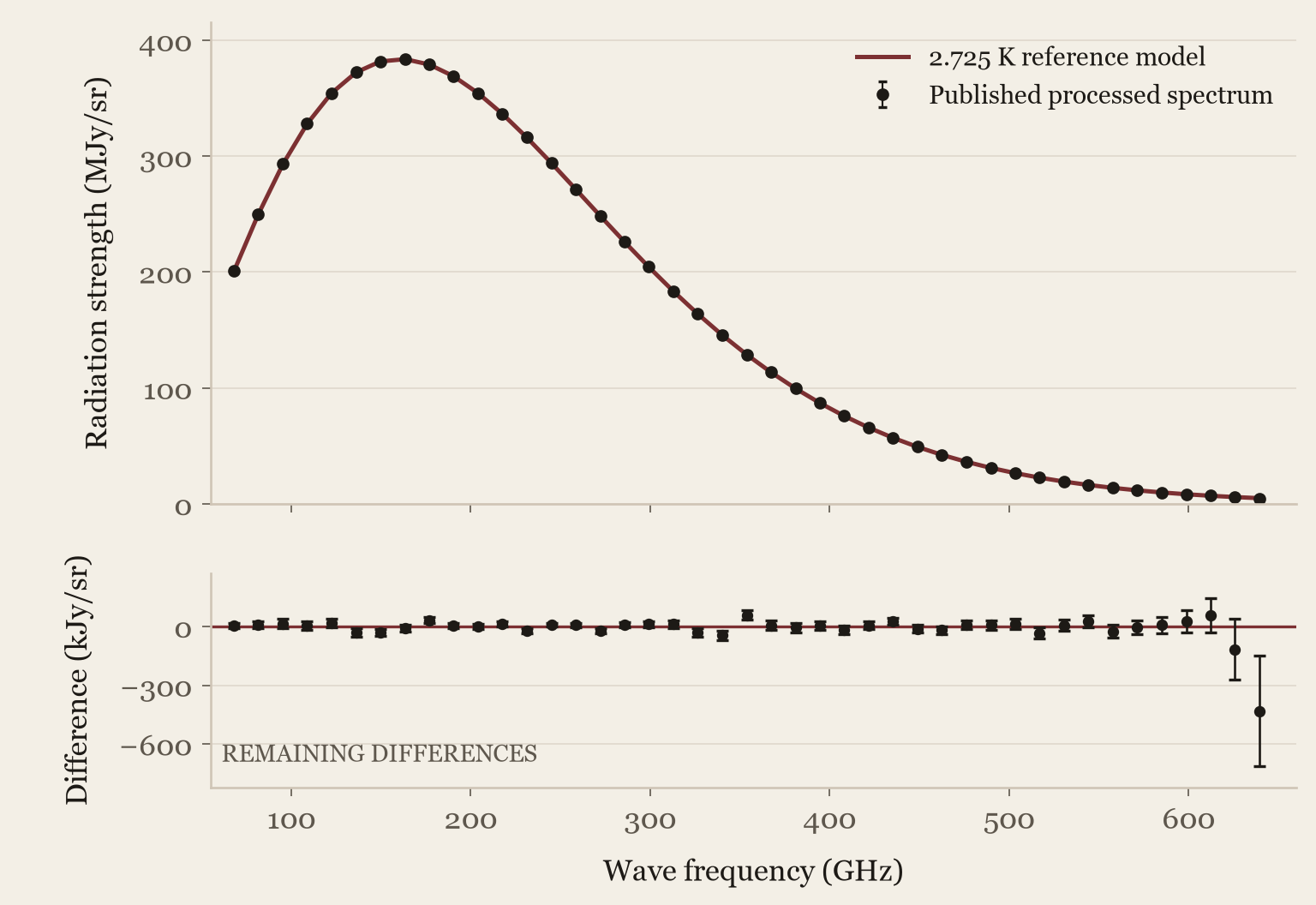
The upper panel compares NASA's archived, processed spectrum with its reference model. The differences are too small to see clearly at this scale. The lower panel enlarges the published residuals and shows their reported uncertainty as vertical bars. [7] [8]
GHz is a frequency unit. MJy/sr and kJy/sr measure radiation strength; one MJy/sr is 1,000 kJy/sr. K means kelvin, a temperature unit. You can first read the shape without doing the unit conversions.
The archive constructs its upper spectrum from the reference model plus the published residuals. It is not an independent second measurement. Evaluating the evidence also requires checking the original calibration, foreground modelling, and analysis in the research paper.
12A book cannot certify itself.
A statement of authority still needs a reason to trust it.
Suppose a page says this message comes from God. What has the page established so far? It has established that the text makes that claim. Whether the claim is true remains the question.
If I answer why trust the book with because God wrote it, then answer how do you know God wrote it with because the book says so, I have gone around a circle. I used the disputed claim to support itself.
That does not prove the text is false. It shows that this particular argument has not supplied independent support for its authority. The book may contain ordinary truths, valuable ideas, or evidence that deserves examination.
A believer can offer more: a historical argument, an alleged prediction, manuscript evidence, or a case for a revelation. Each needs to be checked for what it actually establishes. Evidence that a passage was preserved accurately would establish preservation; it would need another argument to establish a divine author.
I will read the texts and interpretations carefully in later parts. Here I am rejecting a shortcut: the word holy cannot be both the claim we are testing and the reason the claim wins.
13I believe you felt something.
The experience and its explanation are separate questions.
If someone says they felt a powerful presence during prayer, I do not need to begin by calling them a liar. I can take their report seriously and still ask what establishes the source of the experience.
There are at least two claims here: I had this experience, and a particular god caused it. Support for the first does not automatically settle the second.
Some philosophers argue that religious experience can justify belief in a way resembling ordinary perception, and that every justified belief need not come from a formal proof. That is a serious position, not simply a failure to think. Other philosophers dispute when such experiences warrant religious conclusions. [4]
My question is how to distinguish an encounter with that god from a powerful experience interpreted through an existing belief. If the experience tells us which religion is true, what feature reliably makes that distinction? Can someone else check it?
I do not demand that a meaningful experience become meaningless. I ask for the additional reason connecting it to a claim about reality. The comfort can be real even while its proposed cause remains unestablished. A person's sincerity deserves to be heard; it cannot do every step of the argument.
14An argument deserves an answer.
I will not pretend every believer relies only on an old book.
A thoughtful believer might say: things that depend on something else need an explanation; a chain of dependent things needs a foundation; that foundation is necessary rather than dependent. Versions of this are called contingency arguments. The details and objections matter. [5]
Necessary here means something whose existence could not fail, in the sense used by the argument. That definition does not establish that such a thing exists. The argument has to do that work.
It would be careless to reply who made God as though every version claimed that absolutely everything needs a maker. Some distinguish dependent things from a proposed necessary foundation. I need to address that distinction, not ignore it.
My questions would be: why accept the starting assumptions? Does the conclusion follow? Why must the proposed foundation be a conscious god? What additional reasoning connects it to a religion? These are questions for the actual argument.
An argument can matter without a laboratory experiment. Its premises are the starting claims it relies on. Clear wording alone cannot make them true. Part 5 will examine these arguments and their strongest replies.
15Beyond science does not mean established.
Changing the kind of claim changes the kind of question.
A believer may say God is not a physical object and should not be tested like a rock. Fair enough: an argument about a necessary foundation is different from a search for a hidden object.
Then I ask for the kind of support appropriate to that claim. It may be philosophical reasoning. We can examine the premises, the inference, and the objections. Calling something nonphysical does not make reasoning unnecessary.
If the account also says this god changes physical events, heals a particular illness, or caused a historical event, those additional claims meet questions about the observable world. Moving the god beyond science does not automatically move every claimed effect beyond investigation.
If every possible result is compatible with the claim, that result cannot help distinguish the claim from its alternatives on its own. Other arguments might still be offered. I should assess those rather than confuse immunity from one test with evidence of truth.
There is also a question of relevance. If I am asked to follow a rule because an undetectable being wants it, I need a reason to believe the being has that desire. A claim about existence does not establish a claim about instructions.
16I rely on people too.
The question is whether the reliance has a checkable basis.
A believer can fairly point out that I depend on testimony. I did not build COBE. I cannot perform every experiment behind every scientific claim. There is no honest argument here that says believers trust people while I never do.
Scientific work can expose its methods, results, uncertainties, and errors to other investigators. Peer review and scientific institutions can fail; no single procedure guarantees truth. Their value depends on how well evidence and criticism actually test a claim. [9]
That is the basis I want for trust. Which method was used? Can relevant experts examine it? Are the findings supported by further work? Would an error change the conclusion? I should demand those answers from claims I favour too.
Faith has different meanings. It can mean trust, commitment, or confidence in a religious claim. I cannot refute a person merely by choosing the weakest meaning of their word. I need to ask what reason supports the particular belief.
The issue is not whether another person told us something. It is how we justify relying on them, what checking is possible, and whether we can revise the belief when its support fails. Calling both situations trust does not establish that their supporting reasons are equal.
17Maybe is not a probability.
An open question does not give every proposed answer an equal chance.
Someone may hear I do not know and reply: then it is fifty-fifty. Why? Uncertainty alone does not supply a numerical probability.
Imagine a sealed jar containing an unknown number of red and blue beads. A bead will be drawn at random. There are two colours, but the probability of drawing red depends on how many beads of each colour are in the jar. Two possible outcomes do not automatically mean equal chances.
That is a simple illustration, not a calculation of the probability of God. I do not have a jar of universes from which to read that probability. The example shows why maybe true, maybe false is insufficient to establish fifty-fifty.
Likewise, being able to imagine a creator does not establish that one exists. Being unable to imagine a natural explanation does not establish that none is possible. Those are statements about our current thinking, not a completed explanation of reality.
I can keep a question open without handing every proposed answer equal credibility. I want to know what supports each answer. Where no justified number is available, I will not invent one just to make uncertainty sound precise.
18What would convince me?
I should be able to describe what better support would look like.
What would convince you is a fair question. My answer depends on the claim. Evidence for a historical event, an unusual physical effect, and a philosophical conclusion would not have to look identical.
For a claimed physical effect, I would want careful documentation, suitable checks against error or deception, consideration of alternatives, and further investigation. A unique historical event cannot simply be rerun, but its records and proposed traces can still be examined.
For a philosophical claim, I would want clear premises I have reason to accept and an inference that supports the conclusion. For a divine message, I would also need support identifying the source. An extraordinary event would not automatically establish every statement made about its author.
I cannot honestly list a test that excludes every possible mistake forever. I can say what would raise my confidence and why. The standard should be demanding enough for the claim, without becoming impossible merely because I dislike the conclusion.
If I rejected every conceivable reason in advance, I would have protected a belief instead of investigated it. I want to be able to change my mind. I also want the change to follow evidence, rather than fear, pressure, or spectacle.
19The claim can be questioned.
I do not owe an idea immunity because someone loves it.
I can respect a person's freedom and dignity while questioning a belief they hold. Those are separate responsibilities. A claim about reality does not become exempt from scrutiny because criticism feels uncomfortable.
If a religion asks me to accept an account of history, obey an instruction, or recognise somebody's authority, I can ask what justifies that request. The question does not disappear when the request is called sacred.
I will use direct language. If an argument is circular, I will explain the circle. If a specific claim conflicts with evidence, I will show the conflict. I will not soften a finding just to protect the claim's reputation.
But anger does not establish a fact either. Calling someone stupid cannot replace explaining an error. A religious person may understand an argument I have missed; an atheist may confidently repeat a bad argument. I need to inspect the reasoning whoever offers it.
I want criticism that survives a calm rereading. The person can challenge my sources and conclusions. I can challenge theirs. The aim is to expose the support for a claim, not to treat humiliation as though it were another form of evidence.
20Prove there is no God.
My reply starts by making the claim clear.
My short reply: tell me which god you mean and what you claim about it. I can examine those claims. I do not accept your account just because I cannot rule out every imaginable creator.
The fuller explanation is that three different positions can enter this conversation: I have not accepted your claim; I think your particular claim is false; and I think no possible god exists. They need different support. Ask which position I am defending.
The likely objection: so you have no argument, only doubt. My answer: doubt alone does not prove a claim false. I will explain why the evidence offered does not establish it. When I assert that a claim is false, I will present the relevant argument rather than hide behind doubt.
To make this useful, write down one clear claim. Then write down its supporting reason and the exact conclusion that reason reaches. A reason for a creator cannot silently become proof of a revelation.
What could change my response? Better evidence or an argument that answers the identified problem. The task is to assess a specified claim. An undefined god and an undefined demand for proof can keep a conversation going forever without settling anything.
21Then you are just agnostic.
A label should clarify the position rather than replace it.
My short reply: I do not believe in gods, and I do not claim complete knowledge about every possible creator. Use the labels that make that position clear. I use atheist for my lack of belief.
The likely objection: an atheist must positively deny that any god exists. My answer: that is an established philosophical use of the word. There is also the broader use we discussed earlier. If you prefer the narrower one, call my position nonbelief and uncertainty. The actual reasons still need examination. [1]
Another objection: uncertainty means you should believe, just in case. My reply: uncertainty about a claim is not evidence for accepting it. It also does not identify which religion I should accept. Fear of a possible consequence needs its own examination; it cannot supply the missing support.
Here is a way to keep the conversation useful. Put the labels aside for a moment and ask: what do you believe, how confident are you, and what is the reason? Both people should answer.
What would change my position is a stronger case for a god or against my reasons for rejecting the claim. Winning an argument about a word does not supply that case.
22The book says it. I felt it.
Listen to the support, then examine the step to the conclusion.
My short reply about a book: show me the passage and the reason for treating its claim as true. The text's own assertion of divine authority cannot be the whole argument for that authority.
The likely objection: the text is preserved, contains truth, or changed lives. My answer: those would be claims to investigate. Even if established, we still need the argument connecting them to a divine author. Preservation, a true detail, and usefulness are not identical to supernatural origin.
My short reply about an experience: I can take your report seriously. What supports the conclusion that this particular god caused it?
The likely objection: I know what I experienced, and you cannot disprove it. My answer: I am separating the experience from its proposed source. If I cannot independently establish the source, I should not pretend I have done so. Equally, I should not announce that every such experience is fabricated.
To check either case, identify the exact piece of support and the additional inference. Ask what rival explanation it excludes and why. Stronger support for that connection could change my response. Merely repeating the conclusion with greater conviction cannot perform the missing step.
23Science is your religion.
My answer has to show how the evidence is checked.
My short reply: I rely on scientific work because its evidence can be checked. If that support fails, I should change my belief. Calling this religion does not examine the evidence.
The likely objection: you believe what scientists tell you without doing it yourself. My answer: I do depend on other people. I can still investigate their methods, the relevant results, and whether criticism has exposed an error. I should never treat a scientist's name as sufficient support. [9]
Make the discussion concrete. Return to the COBE example. Identify the measured radiation pattern, the physical prediction, and the reported uncertainties. An objection should address one of those steps, or provide a better explanation of the observation.
Another objection: science does not explain everything, so God is the answer. My reply: an incomplete explanation leaves a question open. To establish your explanation, you still need to show why it follows. We will examine serious creator arguments rather than substitute an unknown for their reasoning.
An identified error, better measurements, or a stronger argument could change my response. I owe that openness to evidence. I do not owe automatic agreement to whichever answer someone puts into the gap.
24Let the claim earn belief.
These rules will follow us through the rest of the series.
I am not asking a believer to abandon a lifetime of convictions after one clever sentence. I am asking that a claim be examined through the reasons offered for it. That is a smaller request, and a more useful one.
We can start with five questions: what exactly is claimed? What supports it? How does that support reach the conclusion? What could count against it? What would make either of us change our mind?
Keep one claim in view long enough to examine it. If we begin with a historical event, replacing it halfway through with a vague creator does not answer the historical question. If we begin with a philosophical argument, demanding a photograph may miss what it actually claims.
The coming parts will apply these distinctions to evolution, cosmic origins, religious texts, miracles, morality, and consciousness. Each subject deserves its own evidence. No single slogan will settle them all.
My starting position remains straightforward: I do not accept the gods and stories offered to me on the strength of their sacred status. I want the reasons. If a claim survives checking, I should acknowledge that. If it fails, I will say where it fails. I do not need to know everything to refuse an unsupported answer.
NoteWhy I am writing this.
A few words from me, Lovepreet Singh.
I am an atheist, and I want this series to make my reasons understandable. I want a reader to be able to explain the argument afterward, instead of borrowing a line they cannot defend.
I can leave room for an unknown creator while refusing to treat a religious account as established truth. The possibility of something beyond my understanding does not tell me which book to trust or whose instructions to obey.
I kept the language simple on purpose. A difficult subject should not become harder because somebody enjoys difficult words. I want the examples to open the idea, and the sources to let you check what I claim.
I will criticise religious claims directly. I will also reject a weak atheist argument when it is weak. My confidence has to answer to the evidence. Otherwise I would only have changed the belief I protect.
Part 1 sets the starting rules. The later parts must do the detailed work: identify the claim, examine the support, answer the strongest objection, and state what remains uncertain. I want my conclusions to survive checking. That is what I owe the reader.
SourcesFollow the evidence.
Sources checked on 15 October 2026. Numbered references support the factual or scholarly statements marked in the essay. Imagined scenes and dialogue are illustrations, not reports of events or quotations from believers. My position, the critique of individual inferences, and proposed standards of inquiry are arguments offered for the reader to assess. Part 1 does not claim to have completed the scientific or scriptural investigations assigned to later parts.
[1] Atheism and Agnosticism
Paul Draper. Stanford Encyclopedia of Philosophy. Sections 1 and 2.
Maps differing definitions of atheism and agnosticism. It does not establish that any god exists or does not exist.
[2] Evidence
Thomas Kelly. Stanford Encyclopedia of Philosophy. Discussion of evidence and confirmation.
Background on what evidence means and how it supports a claim. The envelope illustration and its application are my explanatory reasoning.
[3] Absence of evidence and evidence of absence
Elliott Sober. Philosophical Studies 143 (2009), 63-90. DOI: 10.1007/s11098-008-9315-0. Sections 1 and 2.
Original philosophical analysis of when missing evidence counts against an explanation. The room, lamp, and search illustrations here are my own.
[4] The Epistemology of Religion
Peter Forrest. Stanford Encyclopedia of Philosophy. Sections 5 and 7.
Explains serious arguments about religious experience and beliefs held without formal proof. It records philosophical debate rather than experimentally confirming a deity.
[5] Cosmological Argument
Bruce Reichenbach. Stanford Encyclopedia of Philosophy. Especially the contingency argument and its objections.
Background on necessary and contingent existence. The brief discussion in this essay introduces the argument; Part 5 will examine its premises and replies.
[6] COBE Science
NASA Science. Sections describing predictions, FIRAS, and the cosmic microwave background.
Official explanation of the radiation measurements and their support for a hot early universe. That conclusion does not identify an ultimate creator.
[7] The Cosmic Microwave Background Spectrum from the Full COBE/FIRAS Data Set
D. J. Fixsen and colleagues. The Astrophysical Journal 473 (1996), 576. DOI: 10.1086/178173.
Original research analysing the measured spectrum, its agreement with a blackbody, and limits on deviations. The linked record provides the full paper.
[8] COBE/FIRAS CMB Monopole Spectrum
NASA LAMBDA. Data-product description and firas_monopole_spec_v1.txt; based on the published FIRAS analysis.
The plotted spectrum is an archive reconstruction: a 2.725 K blackbody plus published residuals. The residuals and one-standard-deviation uncertainties come from Table 4 of Fixsen et al. (1996). It is a processed result, not raw detector output.
[9] Scrutinizing Science: Peer Review
UC Museum of Paleontology, University of California, Berkeley. Understanding Science.
Explains expert scrutiny and why peer-reviewed work is not guaranteed correct or conclusive. The related page explains evidence, multiple tests, and checking by different investigators.