

01Show me how you know.
A confident answer still needs a route back to reality.
Imagine a mechanic says your car needs an expensive repair. You ask what failed. The reply is: trust me, I know cars. Experience matters, but you still want the fault explained and the check that found it.
Now suppose the mechanic shows a test, explains what the result means, checks another possible cause, and says what would make the diagnosis wrong. You have something more useful than confidence. You have a route you can examine.
I want that route when somebody offers a claim about the world. A scientific label should not close the question any more than a religious label should. I want to know what was found and how it supports the answer.
Part 1 asked why a claim deserves belief. This part asks how we investigate that question. Observations, comparisons, calculations, criticism, and further checks help us separate a good explanation from a convincing performance.
The mechanic is an imagined example, not a research result. It gives us the right starting question: show me how you know. That question applies to the scientist, the preacher, and me.
02What I saw. What I concluded.
The second sentence often adds more than we noticed.
Suppose I enter a room and find water on the floor. Water is there: that is the observation. Rain came through the window: that is a proposed explanation. A leaking pipe is another. Someone spilling a bucket is another.
An inference is a conclusion drawn from other information. Inferences are unavoidable in science and ordinary life. The important question is whether the information actually supports the conclusion. Seeing an effect does not automatically identify its cause. [1]
I could inspect the window, the pipe, nearby surfaces, and when the water appeared. Those further observations might favour one explanation over the others. The investigation adds reasons rather than simply adding confidence.
Some observations also depend on instruments and interpretation. A detector produces a signal; understanding it requires knowing how the detector works. Writing observation beside a result does not make every possible error disappear.
In a debate, separate the two sentences. What was observed? What was inferred? A recovery occurred and a particular god caused it are different claims. The connecting step has to earn its place.
03Could explain is only the start.
Ask why this explanation fits better than the alternatives.
Rain could explain the water. That alone does not establish rain. A burst pipe could explain it too. Listing a possible cause is easy; identifying the supported cause takes more work.
An explanation becomes useful when it tells us what else to expect. Rain through an open window might leave water on the sill. A pipe leak might continue when the window is dry. These are imagined possibilities to investigate, not guaranteed clues in every room.
If I discover the pipe leaking into the same patch, that finding gives the pipe explanation more support. I still need to consider whether the leak accounts for the water I am explaining, rather than treating a nearby fact as a complete answer.
I should also avoid inventing excuses after every failed check. A claim that can accommodate any result without explaining why that result occurred gives us little help choosing between accounts.
This is my standard for religious and scientific explanations alike: identify the claim, show its expected consequences, compare the available alternatives, and explain the step from evidence to conclusion. Possibility cannot do all that work.
04A useful map has limits.
A model represents selected features of the thing we want to understand.
A road map leaves out the colour of every front door. That does not make it useless for finding a route. But the same map would be a poor tool for deciding which doors need repainting.
A scientific model works in a related way. It represents features relevant to a question, often using equations, diagrams, or computer calculations. Its assumptions matter: the conditions it relies on help determine where it can be used. [1]
The coin model later in this part assumes equally likely heads and tails and independent tosses. Independent means that one toss does not change the probabilities of the next. Under those assumptions, we can calculate what to expect.
A real coin and tossing procedure might not match those assumptions. That would require investigating the model, the coin, and the procedure. It would not mean arithmetic stopped working.
When somebody says scientists assume things, I ask which assumption and how it was checked. That is a useful objection. Saying there are assumptions, therefore any religious answer wins, has skipped the evidence for that religious answer.
05Give reality a chance to disagree.
A useful test could uncover a problem with the claim.
Suppose somebody says a particular coin tends to land heads more often than an ordinary coin under the same tossing procedure. We can ask what more often means, then agree on a way to compare results.
A test connects the claim to an observation that could support or challenge it. The connection needs care. If we use the wrong procedure or a broken instrument, a failed result may not be a fair test of the claim.
Scientists use different methods for different questions. Experiments, observations, fieldwork, and historical reconstruction are not one rigid sequence repeated everywhere. Berkeley describes scientific investigation as a process that revisits questions and checks rather than following a single recipe. [2]
This does not mean anything goes. A method must suit the question, expose relevant errors, and allow the evidence to bear on the conclusion. Complicated words cannot replace those jobs.
For a claimed physical effect, ask what it should do and under what conditions. For a philosophical argument, inspect the starting claims and the reasoning. I will not demand a photograph of an argument, or accept an alleged physical effect without examining the physical evidence.
06Plan the coin test first.
Changing several things together can hide what made the difference.
Here is a proposed demonstration, not an experiment I am claiming to have performed. Compare the claimed special coin with an ordinary coin. Agree beforehand on the tossing method, the number of tosses, what to record, and what result would count as support.
A control is a comparison used to help identify an effect. The ordinary coin provides one here. If only the special coin is tossed carefully while the other is dropped differently, the procedure itself could explain a difference.
We could alternate or randomly assign the order, keep the recording rule the same, and have someone check the counts. If knowing which coin is special could affect a judgement, hiding that identity during the relevant step may help. The design should address the actual opportunities for error.
No comparison removes every problem. Coins may differ physically; tosses can be influenced by the person tossing them. If a difference appears, its cause still needs investigation. A repeatable effect would not automatically establish a supernatural cause.
Before collecting results, write down the rules. Afterwards, keep the failures as well as the successes. A demonstration teaches the checking process; it does not become evidence for a real claim until it has actually been conducted properly.
07Why one in 1,024?
The number comes from stated assumptions, not somebody’s authority.
Consider an ideal model: each toss has a one-half chance of heads, and the tosses are independent. The chance of two heads in a row is one-half times one-half, or one-quarter. Each extra required head adds another factor of one-half.
For ten heads in ten tosses, multiply one-half by itself ten times. The result is 1 divided by 1,024, about 0.098 percent. This is an exact calculation within the model. It is not a record of coins I tossed.
Another way to see it: ten tosses allow 1,024 ordered heads-and-tails sequences, all equally likely under these assumptions. Only one sequence is all heads. Many different sequences contain five heads, which is why five heads in any order is much more likely.
The next page shows the probabilities for every possible count of heads. The counts come from counting sequences, not fitting experimental data. You can check that the sequence counts add to 1,024 and the probabilities add to one.
If a real tossing procedure does not satisfy the assumptions, these numbers may not describe it. That is a reason to check the procedure. The calculation shows what follows from a model; observation tells us how well that model describes the world.
EvidenceCount the possible outcomes.
Ten fair, independent tosses. Exact model probabilities, not observed results.
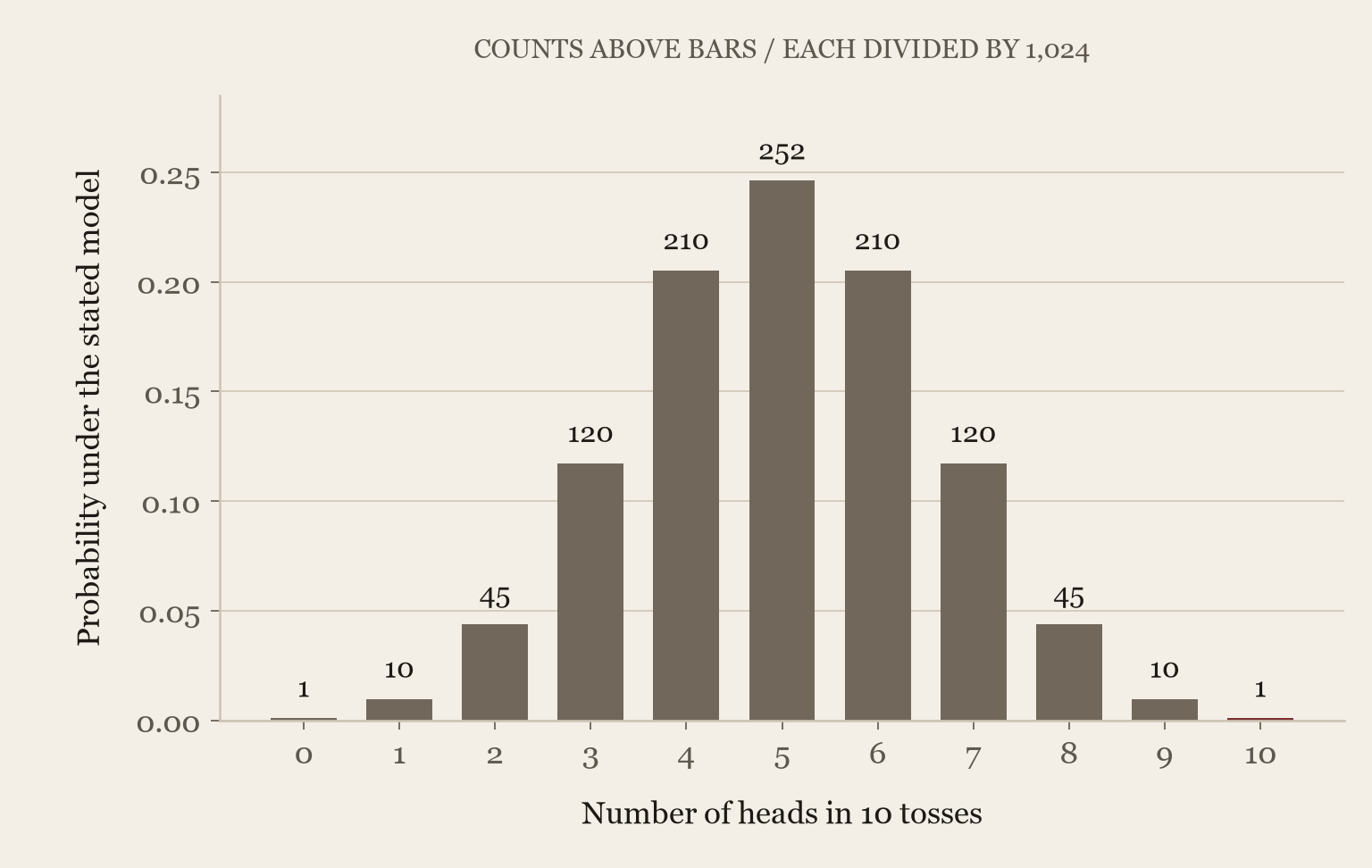
The horizontal axis counts heads in ten tosses. The vertical axis shows probability under the stated model. There are 252 sequences with five heads, but only one with ten heads. Their probabilities are 252/1,024 and 1/1,024.
The probabilities add to one. These are calculated possibilities, not measured toss frequencies. They do not establish that a real coin is fair. Download the table to check the counts.
Ten heads can challenge the model when that is the relevant event in an appropriately planned test. Its probability is not the probability that the model is true, and it does not identify a supernatural cause. [10]
Download the exact calculation table
08Rare does not identify the cause.
The probability of a result is not the probability that an explanation is true.
Suppose ten heads occur in a planned test. Under our fair, independent-toss model, that event has probability 1 in 1,024. It gives us a reason to investigate whether the model fits this procedure.
It does not mean there is a 1-in-1,024 probability that the coin is fair. That reverses the question. We calculated the chance of the result if the assumptions hold, not the chance that the assumptions hold after seeing the result.
A p-value is a statistical quantity that assesses how incompatible data are with a specified model, using a defined test. It is not the probability that the hypothesis is true. The American Statistical Association explicitly warns against that interpretation. [10]
We would need to examine other explanations: an uneven coin, a controlled tossing method, a recording error, or an unusual run from a fair process. Which explanation is supported depends on more than how surprising the result sounds.
Every particular ten-toss sequence has probability 1 in 1,024 in this model. Picking the observed sequence afterwards and announcing that it was impossibly unlikely would therefore manufacture amazement from any result. Specify the relevant event before celebrating it.
09Do not hide the other attempts.
A success looks different when the unsuccessful searches are visible.
Imagine trying many ten-toss runs and showing only the one that produced all heads. The audience sees one astonishing success. The full record shows how many opportunities there were to obtain it.
This is why the question what else was tried matters. Choosing the question after inspecting the answers can make a result look more impressive than a planned test of that question would justify.
Preregistration records a research plan before the relevant results are known. The Center for Open Science explains it as a way to distinguish planned tests from exploratory work. Exploration can discover useful ideas; those discoveries need checking rather than being passed off as predictions made beforehand. [11]
A plan can change for a good reason. Report the change and whether it followed seeing the results. Merely possessing a registration does not make a bad experiment good or remove the need to interpret all relevant findings.
The same question helps with prophecies and answered prayers: which outcomes were specified, how many attempts were made, and which failures disappeared from the story? Later parts will examine those claims in detail. Here, keep the whole search visible.
10The instrument needs checking too.
A precise-looking number can inherit a mistake from the tool.
Suppose a ruler starts its printed zero in the wrong place. Repeating a measurement carefully could repeat the same wrong answer. More digits would not repair the misplaced mark.
Calibration means checking a measuring system against suitable references and accounting for its behaviour. I want to know how the instrument’s readings are connected to the quantity being measured. Computers cannot rescue a conclusion from an incorrect input.
There are also confounders: other factors that could explain an apparent relationship. If one group of coin tosses uses a different surface and a different person, a difference between the coins may actually come from either of those changes.
A good investigation looks for these possibilities. It documents the method, examines controls, and uses further checks where appropriate. The goal is to make an error detectable rather than assume the investigator is incapable of error.
Keep this question ready: what could make this result appear even if the proposed explanation were wrong? It applies to a detector reading, an ancient document, a claimed healing, and a result I personally want to accept.
11An estimate should admit its limits.
Knowing roughly where a value lies can still be useful knowledge.
A measurement is not improved by pretending it has unlimited precision. If our tool cannot reliably distinguish very small differences, reporting many decimal places can create an impression the method has not earned.
Random variation makes repeated results fluctuate. A systematic error can push them in the same direction, as with the wrongly marked ruler. Repeating measurements may help assess variation while leaving a shared error untouched.
An uncertainty range needs an explanation of how it was obtained and what it means. It is not automatically a guarantee that the true value cannot lie outside it. The OPERA paper we discuss next separately reports statistical and systematic uncertainties. [9]
An uncertain detail also does not make every conclusion equally uncertain. We might be unsure about a room’s exact width while having excellent evidence that it is larger than a cupboard. The question is whether the uncertainty matters for the conclusion being drawn.
I will ask how large the uncertainty is, what creates it, and whether it could change the answer. A careful estimate can tell me more than a confident declaration that refuses to disclose its limits.
12The particles did not outrun light.
The checking process challenged an exciting result.
In September 2011, the OPERA experiment reported an apparent timing anomaly for neutrinos travelling from CERN to Gran Sasso, roughly 730 kilometres away. Neutrinos are subatomic particles. The result appeared to put their speed above the speed of light. [8]
Investigators questioned the measurement. CERN’s February 2012 update identified possible problems involving a timing oscillator and an optical-fibre connector. These affected how the travel time was measured; they required further checks. [8]
By June 2012, CERN reported measurements from four Gran Sasso experiments consistent with the speed of light. OPERA’s later paper describes its improved timing setup and a result compatible with that limit. [8] [9]
The initial repetition had not removed every source of error. This matters: repeating part of a procedure can reproduce a problem that the procedure still contains. Further measurements and examination of the timing system were necessary.
I do not present this as proof that every scientific mistake will be found quickly. It is a concrete case of a dramatic claim being checked and corrected. Read the dated updates and the later paper. The authority of the original announcement did not settle the measurement.
13Same data is one kind of check.
New observations provide another.
Suppose I give you a list of coin results and the calculation used to analyse it. You run the same calculation and obtain the same answer. That checks the computation. It does not establish that the original results were recorded honestly or accurately.
Now collect your own results using an appropriate procedure. That adds new evidence. We should compare the outcomes while allowing for variation and differences in conditions.
The National Academies’ 2019 report calls consistent computation using the same inputs reproducibility, and consistent results across studies with their own data replicability. Different fields sometimes use these words differently, so check the definition being used. [3]
A single successful repeat does not guarantee truth. A failed repeat also needs interpretation: was the earlier claim wrong, were conditions different, or did something fail in the later study? The Academies’ report warns against treating either result as an automatic final verdict. [4]
What matters is the pattern of relevant checks and how well we understand their differences. I want more than somebody pressing the same button twice and announcing that the question is permanently settled.
14Ten headlines may be one source.
Count the underlying checks, not the repetitions of the story.
If ten websites copy one press release, I have not acquired ten independent measurements. I have acquired ten versions of the same announcement. The number of times a claim appears is not the number of times it was checked.
The same problem can occur inside research. Several analyses may use the same data or the same instrument. They can provide valuable checks, but a shared flaw can pass through all of them.
Ask which parts are independent: the samples, instruments, calibration, calculations, or people interpreting the result. Independence is something to investigate, not a magic label that removes every shared assumption.
The crater study later in this part reports measurements from four laboratories. That provides a useful check on chemical analysis, while the laboratories still investigate material from the same drilling expedition. Four labs do not mean four unrelated impact events. [6]
In a debate, trace repeated claims back to their original work. Agreement becomes more informative when different methods and evidence support it. Copying the same statement cannot supply that independence.
15Expert review is a check, not a seal.
Passing review does not make a paper untouchable.
Peer review means that other relevant experts examine a contribution before or during publication, depending on the journal’s process. They can question the method, reasoning, reporting, and fit between the results and the conclusion. [5]
It is useful scrutiny. It is not a guarantee that every datum was verified or that the experiment was independently repeated. Berkeley’s explanation explicitly says reviewed work need not be correct or conclusive. [5]
A published paper should therefore remain open to criticism. Its value comes from what its evidence establishes, not from using the journal’s name to stop questions.
The reverse shortcut fails too. A preprint is a paper shared before journal review. It deserves examination on its methods and evidence, with the review status understood. Being new or unreviewed cannot by itself make a claim true or false.
I ask: what was checked, what remains untested, and what has happened when others investigated? An impressive publication can introduce me to a claim. It cannot do the whole job of justifying it.
16Scientists can cheat. Checks can fail.
I will not defend science by pretending its people are perfect.
Scientific research is done by people with incentives, limited resources, and opportunities for error. Fabrication means inventing data. Falsification means manipulating the record to misrepresent what happened. The National Academies discusses this real problem. [3]
An honest failure to reproduce a result is not automatically fraud. There may be noise, different conditions, missing details, or an error nobody intended. Identify what failed before accusing someone of deliberate deception.
For trust, I look for accessible methods, relevant data and code, independent checks, disclosed conflicts, and a record of responding to criticism. Access can have legitimate limits, such as protecting private information; those limits should be explained rather than hidden.
These safeguards can fail. Their value is that they provide routes for discovering problems. If a conclusion depends on unavailable evidence and a single uncheckable report, my confidence should reflect that weakness.
A documented fraud can damage the findings that depend on it. It does not logically establish that every unrelated result is fabricated, or that a religious alternative is true. Those are additional claims with additional responsibilities.
17We investigate what the past left behind.
Not witnessing an event does not mean having no evidence about it.
Imagine a broken window and wet footprints in a room. You did not watch them appear, but you can examine the traces, compare explanations, and ask what sequence the evidence supports.
This illustration does not license guessing whatever happened. A footprint alone may not identify a person; a wet floor alone may not establish rain. Historical reasoning depends on what the traces can actually distinguish.
Historical sciences examine surviving physical records. Researchers cannot rerun an ancient event, but they can analyse samples, test the relevant processes, and compare traces expected under different explanations. Scientific investigation includes direct and indirect observation, as the NSTA explains. [12]
Independent examination can repeat measurements of surviving material without repeating the original event. A new sample or method can add a check. The claim should remain limited by the quality and survival of its traces.
If somebody objects that we were not there, I ask whether they mean the event cannot be witnessed again or cannot be investigated at all. The first can be true while the second is false. The next example shows the difference.
18The impact left a chemical trace.
The evidence is in samples, not in an eyewitness story.
In 1980, Luis Alvarez, Walter Alvarez, Frank Asaro, and Helen Michel reported unusually high iridium in rocks at an extinction boundary. Iridium is a chemical element. Their paper argued for material from an extraterrestrial impact as part of an explanation for the extinction. [7]
The later case involves Chicxulub, a large impact structure in Mexico. In 2021, Steven Goderis and colleagues reported an iridium-rich layer in material drilled from within that structure, with chemical measurements from four laboratories. [6]
The study connects the crater’s record with the boundary layer found elsewhere. Alongside evidence such as impact-produced material and shocked minerals, meaning minerals altered by extreme pressure, the connection supports an ancient asteroid impact. [6]
The authors studied preserved rocks and chemistry rather than travelling into the past. The 1980 paper used an age of about 65 million years; the modern study places the event near 66 million. I use the modern estimate. Part 6 will examine how ages are established. [6] [7]
This is a brief example of historical evidence, not the complete account of extinction or dating. It shows why present traces can support a claim about an unwitnessed past event. The reasons are in the measured material and the argument connecting it to the impact.
19The layers have to connect.
One unusual detail cannot carry the entire explanation.
To examine the impact case, start with source 7’s original abstract. It identifies the measured chemical enrichment and the proposed explanation. Then open source 6, the full 2021 study, and look at its figures, methods, and discussion.
Figure 1 in the modern paper locates the crater and boundary sites. Later figures show chemical measurements through the drilled sequence. A sequence is an ordered set of rock layers; where a signal appears in that order matters for relating events. [6]
The useful questions are: what material was sampled, what was measured, where does the enriched layer occur, and how does that connect the crater to distant boundary deposits? The authors’ answer can be checked against their actual measurements.
Iridium alone is not a rule saying asteroid. The argument uses its concentration, accompanying material, geological setting, and relationship to the impact structure. A rival explanation needs to account for the relevant pattern, not merely remind us that another cause can sometimes produce an unusual element.
Errors in sampling, analysis, or the proposed connection would matter. Show which step is wrong and how much of the conclusion depends on it. I want a specific challenge to the evidence, not a demand that nobody may investigate anything older than themselves.
20These words are not a promotion ladder.
The label tells you less than the evidence supporting the particular claim.
In ordinary speech, theory can mean a guess. In science, a theory can be a developed explanation covering many observations. A hypothesis is a proposed explanation or claim to investigate. A law often describes a relationship under specified conditions. Usage varies across fields and history. [12]
These are not ranks through which an idea graduates: guess, theory, then law. In the standard teaching distinction, laws describe relationships and theories explain them. Gathering more evidence does not automatically rename a theory as a law. [12]
A fact is a statement we treat as established on the strength of the evidence. Facts and theories can work together: observations supply things to explain, and explanations help us understand their pattern.
None of this says every idea called a theory is well supported. Nor does calling something a law guarantee unlimited accuracy. Inspect the actual claim, the evidence, and the conditions where it applies.
Evolution’s detailed evidence belongs in Parts 7 to 10. Here the answer to just a theory is simpler: that word is not a demonstration of weakness. Show which observation or argument fails. A vocabulary shortcut cannot perform that work.
21I can know a lot without knowing everything.
Absolute certainty is a different demand from strong empirical support.
The coin calculation follows from its mathematical assumptions. Whether a real coin follows those assumptions is a question about the world. The distinction matters: a valid calculation cannot establish its own physical starting conditions.
Empirical knowledge means knowledge based on observing and investigating the world. It can be extremely well supported without excluding every imaginable possibility of deception, instrument failure, or a completely misleading universe.
If somebody says everything could be an illusion, that worry applies to reading a holy book and hearing a religious teacher too. It cannot selectively destroy scientific evidence while leaving a preferred religious claim untouched.
I cannot honestly solve every radical sceptical thought experiment in one paragraph. I can compare the reasons we have within the world we investigate, check mistakes, and distinguish a fragile report from evidence that survives many demanding tests.
My confidence should fit the support. I need not treat a measured room as an unknown void because I cannot prove that every conceivable illusion is impossible. Demanding unlimited certainty from one side and ordinary trust from the other is a double standard.
22Science keeps changing its mind.
A revision has to be judged by what changed and why.
My short reply: changing a conclusion after finding better evidence is a reason to inspect the correction, not a reason to prefer a conclusion protected from correction.
The fuller answer: an improved estimate, a corrected instrument reading, and the collapse of an explanation are different changes. Ask which occurred. The OPERA case concerns a timing result; it does not show that every scientific observation became unreliable. [8] [9]
The likely objection is that a future discovery might overturn today’s view. It might revise some part. That possibility does not tell us which part, how likely a revision is, or that a religious alternative has supporting evidence.
To check the claim, compare the original evidence with the revised evidence. What error was found? What measurements were added? Does the new explanation preserve the results that were already well supported?
A better measurement or an identified mistake should change my response. Saying you once corrected something cannot identify a mistake in the particular evidence being discussed now. Corrections must be followed through, not waved around as a universal excuse.
23It is just a theory.
The relevant objection has to reach the evidence.
My short reply: theory does not automatically mean guess in science. Tell me which claim you dispute and which evidence fails to support it.
The fuller answer: a broad explanatory theory and a law describing a relationship do different jobs. The NSTA’s statement explains that theories do not turn into laws as evidence accumulates. That distinction prevents a word from being used as a substitute for a criticism. [12]
The likely objection: then you accept any theory that scientists invent. My answer: no. A title cannot establish support. I need to examine observations, predictions, tests, and competing explanations for the particular theory.
Another objection: if it cannot become a law, it remains uncertain forever. My answer: law is not a higher certainty certificate. The actual strength of a conclusion depends on the evidence, not on a promotion to another word.
A specific failure would matter: an observation the account cannot explain, a prediction that fails under appropriate conditions, or a better-supported rival. Renaming a well-supported explanation guess does not produce any of those.
24You were not there.
Present evidence can bear on a past event.
My short reply: I was not there. I can still examine what the event left behind. Show why the traces fail to support the conclusion.
The fuller answer: an ancient impact cannot be rerun, but surviving rock can be sampled, its chemistry measured, and its position compared with other layers. The Chicxulub case illustrates those steps. It does not depend on my having personally watched the impact. [6] [7]
The likely objection: interpretation is still involved. My answer: yes. An inference has to be supported. That is why we inspect the measurements, the expected traces, and alternatives. Admitting interpretation does not make every interpretation equally good.
To make this checkable, choose one trace in the paper and follow the argument from sample to conclusion. Ask how it fits the impact account and what another explanation would predict.
A mistaken measurement, damaged sample, or failed connection could weaken the argument. A demand that every event be witnessed by the person discussing it would also undermine testimony about religious history. Apply the standard consistently.
25Scientists are paid to say it.
An incentive is a reason for scrutiny, not a completed refutation.
My short reply: conflicts of interest can matter. Which conflict, and how did it undermine this evidence? Show the affected step.
The fuller answer: money, status, pressure to publish, and deliberate misconduct can damage research. The National Academies discusses misconduct as a source of unreliable results. I should check disclosures, methods, data access, and independent work. [3]
The likely objection: they are all part of the same arrangement. My answer: specify the arrangement and its evidence. A sweeping accusation does not tell me which chemical measurement or timing calculation is wrong.
I also ask whether the proposed alternative has been investigated with comparable care. An accusation against one source cannot supply evidence for a god, a scripture, or a different historical account.
Documents demonstrating fabrication, a failed audit, or an independent measurement that exposes a problem should change my confidence. A suspicion may justify looking closer. It cannot be treated as though the investigation has already proved every conclusion false.
26Science is your religion.
The answer needs to show the checks, not advertise my intelligence.
My short reply: I depend on other people’s work, but I want reasons that can be investigated. If the evidence fails, the conclusion should change. Calling this religion does not examine those reasons.
The fuller answer: the real distinction is in the support for a particular belief. I should not treat a scientist as infallible. I should follow the method, results, uncertainties, independent checks, and responses to criticism.
Use a concrete example. CERN’s record shows an apparent anomaly being questioned and later measurements failing to support faster-than-light travel. The crater studies expose a different chain: samples, chemical measurements, geological connections, and interpretation. [6] [8] [9]
The likely objection: you cannot personally repeat all of that. Correct. I can inspect accessible records and depend on relevant expertise, while remaining aware of what I have not independently checked. That dependence needs justification rather than denial.
A hidden dataset, a credible error report, or failed checks should affect my confidence. The question is how the belief is supported and revised. Arguing over whether both sides use the word trust cannot settle that question.
27Science is not every kind of reasoning.
A claim still needs reasons when a laboratory is not the right tool.
Mathematics, philosophical argument, historical testimony, and ordinary judgement need not all take the form of controlled experiments. I do not define rationality as whatever happens inside a laboratory.
Science investigates the natural world through methods that connect claims to observable evidence. Its methods and philosophical boundaries are debated; there is no need to pretend a classroom recipe settles every question about knowledge. [1]
If somebody offers an argument for a necessary creator, I examine its starting claims and conclusions. If they claim that creator healed a particular illness or performed a historical action, those additional claims involve questions about events and evidence.
Testing a promised physical effect does not establish the cause merely by finding an effect. Failing to detect it under an appropriate test can challenge that promise without excluding every imaginable god.
Part 5 will examine the philosophical arguments. Here my position is straightforward: use the kind of reasoning appropriate to the claim, then inspect how it supports the conclusion. Outside a laboratory cannot mean outside the need for reasons.
28Take one claim to the evidence.
A conversation works better when both people can see the same steps.
I would begin like this: let us choose one claim, write what it means, and agree on what would support it. I will explain why I accept or reject it without asking you to copy my conclusion.
Then separate the observation from the interpretation. If we discuss an ancient event, show the surviving trace. If we discuss a measured effect, show the method and comparison. If we discuss an argument, state its starting points.
Open the source together. Explain one relevant figure or result in ordinary language. Ask what another explanation would predict, and which step either person thinks is wrong. Stay with that question long enough to examine it.
An objection such as I do not understand the graph deserves an explanation. An objection such as the measurement used the wrong reference deserves an investigation. Both are more useful than exchanging insults.
Evidence may not persuade someone immediately. My task is to make the argument understandable and checkable, not to guarantee a conversion. I should also say what would change my view. That is how I show that the rules apply to me.
29Start with the question and the measurement.
You do not have to understand every equation on your first visit.
When opening a paper, ask what question the authors investigated. Then look for what they measured or compared. Find the figures, the method, the uncertainties, and the conclusion. A summary can help, but it should lead back to the work.
For source 6, identify the drill core, the iridium measurement, and its place in the rock sequence. For source 9, identify travel time, the timing system, and the uncertainties. Do not treat these as identical kinds of measurement.
Ask whether the data directly support the conclusion being repeated in the debate. A result may support a narrower statement than a headline suggests. Note what the authors actually claim and what they leave uncertain.
Then look for criticism, corrections, and relevant later work. One paper can be a starting point without being the whole evidence base. A review can map that larger base, but its judgement still depends on the work it evaluates.
I do not pretend this makes a beginner an instant geologist or physicist. It makes the reliance more informed. When I cannot assess a technical step, I should identify that limit instead of borrowing certainty from an impressive title.
30Keep a record that could embarrass your guess.
Use the coin to practise checking, not to claim you settled the universe.
Here is a simple exercise. Before tossing a coin, write the number of tosses and the question you want to ask. Record every outcome in order. Do not stop or start a new record merely because a run looks impressive.
Compare the record with the ideal model, remembering its assumptions. A small sample cannot establish exact fairness, and an unusual run is not automatically a supernatural event. A proposed bias needs a suitable analysis and further checks.
For a second exercise, open the two impact references. Write down one measurement from the source and the conclusion it is used to support. Then write the connecting reason in your own words. Identify a possible weakness that would genuinely matter.
These exercises make different kinds of checking visible. The first can collect new observations if you actually perform it. The second examines published evidence for a past event. Neither licenses pretending you have personally reproduced every specialist step.
The habit I want is simple: keep the evidence that challenges your answer, not just the part that flatters it. In the next part we will ask why a belief can feel deeply certain even when its explanation still needs checking.
NoteWhy I insist on the checking.
A few words from me, Lovepreet Singh.
I am writing as an atheist, but I do not want the reader to replace religious authority with my authority. I want you to understand the reasons well enough to examine what I say.
This part is about how confidence is earned. A scientific institution can be wrong. A scientist can cheat. A paper can overstate its conclusion. Those possibilities make the checking more necessary; they do not justify accepting any alternative without evidence.
I chose the coin calculation because you can follow every step. I chose the impact and neutrino cases because they show real measurements, different methods, and limits that a slogan would hide. The examples introduce the process; later parts must investigate their own subjects fully.
My criticism will remain direct. If a conclusion outruns its support, I will say so. If I do the same, the rule applies to me. Being on the atheist side does not turn a weak argument into a strong one.
I want a reader who can ask a better question after finishing this part: what was found, how was it checked, and why does it support that answer? That question will follow us into the arguments about gods, holy books, evolution, and the universe.
SourcesFollow the evidence.
Sources checked on 15 October 2026. Numbered references support the marked factual or scholarly statements. The mechanic, wet room, ruler, maps, and proposed coin tests are explanatory scenarios, not reports of experiments performed by the author. The coin probabilities are exact results for a stated ideal model, not collected or simulated toss observations. The impact and neutrino cases are real published research, introduced within the limits described. This part does not complete the detailed investigations assigned to later parts. My standards for inquiry, critiques of individual inferences, and imagined debate replies are arguments the reader can assess.
[1] Scientific Method
Hanne Andersen and Brian Hepburn. Stanford Encyclopedia of Philosophy.
Scholarly discussion of observation, reasoning, models, scientific methods, and their philosophical limits. My room, ruler, map, and mechanic scenes are explanatory illustrations, not reported experiments.
[2] The real process of science
UC Museum of Paleontology, University of California, Berkeley. Understanding Science.
Explains investigation as an iterative process, with revisiting and combining activities rather than following a universal classroom recipe.
[3] Reproducibility and Replicability in Science
National Academies of Sciences, Engineering, and Medicine. 2019. DOI: 10.17226/25303. Chapters 3 and 5.
Chapter 3 defines computational reproducibility and replication using new data, while recognising inconsistent terminology across fields. Chapter 5 discusses fabrication, falsification, and other research failures.
Review replication failures and misconduct
[4] New Report Examines Reproducibility and Replicability in Science
National Academies of Sciences, Engineering, and Medicine. Official 2019 report release.
Summarises the report’s warning that one successful replication does not guarantee correctness and one failed replication does not conclusively refute a claim.
[5] Scrutinizing science: Peer review
UC Museum of Paleontology, University of California, Berkeley. Understanding Science.
Describes expert scrutiny and explicitly distinguishes publication review from guaranteed correctness or a conclusive result.
[6] Globally distributed iridium layer preserved within the Chicxulub impact structure
Steven Goderis and colleagues. Science Advances 7 (2021), eabe3647. DOI: 10.1126/sciadv.abe3647.
Original research: four laboratories measured an iridium anomaly in the crater drill core, connecting it to the worldwide extinction-boundary record. See the abstract, Figures 1 to 5, methods, and discussion. I use the modern approximate age of 66 million years.
[7] Extraterrestrial cause for the Cretaceous-Tertiary extinction
Luis W. Alvarez, Walter Alvarez, Frank Asaro, and Helen V. Michel. Science 208 (1980), 1095-1108. DOI: 10.1126/science.208.4448.1095.
The original paper’s accessible abstract records measured iridium enrichment and the impact hypothesis. Its older approximate age of 65 million years is retained when describing that record, not silently presented as the modern estimate. The record links to the publisher; the full paper may require access.
[8] OPERA experiment reports anomaly in flight time of neutrinos from CERN to Gran Sasso
CERN. Original September 2011 announcement, with dated February, March, and June 2012 updates.
A primary institutional record of the original anomaly, possible timing-system problems, and later measurements consistent with the speed of light. The 8 June 2012 update is essential; the original headline alone gives an incomplete account.
[9] Measurement of the neutrino velocity with the OPERA detector in the CNGS beam using the 2012 dedicated data
The OPERA Collaboration. arXiv:1212.1276v2; Journal of High Energy Physics 01 (2013), 153. DOI: 10.1007/JHEP01(2013)153.
Original experimental report describing an improved timing setup, separate statistical and systematic uncertainties, and agreement with the revised result. The abstract is accessible and the record links to the full paper.
[10] American Statistical Association Releases Statement on Statistical Significance and P-Values
American Statistical Association. 7 March 2016. Six principles summarised from its statement.
Principles 1, 2, 3, and 5 explain why p-values are not the probability that a hypothesis is true, not a standalone truth verdict, and not a measure of effect size. The ten-toss calculation here is my mathematical illustration, not an empirical dataset or a claim to have computed a posterior probability.
[11] Preregistration
Center for Open Science. Explanation and frequently asked questions.
Explains recording plans before relevant results are known, distinguishing planned tests from exploration, and reporting changes and all planned results. Registration improves transparency; it is not a guarantee of sound research.
[12] Nature of Science
National Science Teaching Association. Official position statement.
Describes direct and indirect observation, varied methods, and the standard teaching distinction between scientific theories and laws. The broader philosophical issues and terminology limits are also discussed in source 1.