

01Would I change my mind?
An honest conclusion must leave a door that evidence can actually open.
Imagine a conversation reaching its final question: 'After all these objections, would anything convince you?' My answer is yes. Otherwise I would be asking believers to do something I refuse to do myself. This scene is an illustration, not a story about my own life.
But yes does not mean accepting the next impressive video. I need a clear claim, a reason to trust the evidence and an explanation connecting the two. Surprise can start an investigation. It cannot finish one.
This final part states where I stand after the questions examined across the series. I will separate conclusions that have strong support, claims that fail particular tests and questions that remain open. Those are different positions, with different reasons behind them.
I will also say what could move me. A small correction may change one sentence. Stronger evidence may change a scientific explanation. Evidence identifying a real divine agent could change my disbelief. None of those changes should require permission from a team.
My position has to answer to reality. Reality does not have to protect the position I have printed. If I become more interested in defending the cover than checking the contents, I have lost the point of writing this series.
02Here is what I believe.
I reject the religious explanations offered to me without claiming unlimited knowledge.
I call myself an atheist because I do not accept the god claims presented to me as adequately supported. I leave open whether some unknown creator or deeper reality exists. An open possibility is not a belief that the possibility is true.
When I describe gods as human constructions, I mean that the accounts reaching us have human wording, interpretation and institutions, and that I find their claims to divine authority unconvincing. Human transmission alone cannot prove that revelation is impossible. The case must address the evidence.
God, Allah and Bhagwan are not interchangeable descriptions with one agreed list of properties. A personal judge, an impersonal ultimate reality and a creator who never intervenes raise different questions. I should identify which claim I am rejecting before announcing a victory.
I do not need to prove that every imaginable supernatural thing is impossible before withholding belief in a particular story. If I make the stronger claim that a specified god cannot exist, I owe a stronger argument. The burden applies to my statements too.
So my conclusion is direct: I do not find these religious accounts convincing descriptions of reality. That is a judgment about the reasons examined here. It is not a claim that I have inspected every religion, manuscript, experience or possible universe.
03Do not mix the drawers.
Strong support, failed claims and unfinished questions belong in different places.
Imagine three drawers on a desk. The first holds conclusions with strong evidence: an ancient Earth, evolutionary relationships and a hot early cosmic history. The second holds particular claims that conflict with evidence. The third holds questions we have not settled. The drawers are a teaching device.
The first drawer does not contain infallible truths handed down by scientists. It contains conclusions supported by methods and observations that can be challenged. Berkeley's account of science describes both a body of knowledge and a process for building it. [1]
The second drawer requires a named claim. An Earth only a few thousand years old clashes with the geological dating evidence. That does not refute every belief anyone has called religious. We must keep the target attached to the objection. [3]
The third drawer includes the complete historical route to the first life and the ultimate explanation for existence. Partial evidence does not become a complete answer because I prefer it. Unfinished questions also do not transfer ownership of the answer to a religion. [8][9]
The common mistake is to shake the desk and mix everything together: one uncertainty becomes 'science knows nothing', or one established finding becomes 'every god is disproved'. I reject both shortcuts. A useful conclusion says exactly which drawer a claim belongs in, and why.
04Certain enough for what?
Practical confidence does not require the impossibility of being wrong.
Someone asks, 'Are you absolutely certain?' I first ask what kind of certainty the question needs. A mathematical proof follows from stated rules. A conclusion about the physical world depends on observations, methods and inference. Calling both proof can hide that difference.
Suppose I see water entering through a broken roof during rain. I can have strong reasons to repair the roof without proving that every alternative explanation is logically impossible. This invented example shows how practical judgment works; it is not evidence about religion.
The possibility of error matters. It tells me to check the evidence and keep a way to revise. It does not tell me that a well-tested explanation and an unsupported guess deserve equal confidence. Uncertainty is not a machine for flattening every distinction.
Feynman's argument for scientific honesty includes reporting weaknesses and contrary evidence. That is a standard I want applied, not a guarantee that scientists always meet it. I cannot turn a famous scientist's advice into a certificate for every published paper. [2]
I will use ordinary words: strongly supported, contradicted under this interpretation, not established, unresolved. Those descriptions are more useful than pretending I have measured the exact percentage chance that a god exists. I have no defensible number for that.
05A young Earth fails the test.
Here the dispute reaches measurements, not just competing preferences.
If Earth formed only a few thousand years ago, the dating evidence conflicts with that claim. The USGS explains a formation age of about 4.54 billion years, using isotope evidence and meteorites. That number does not come from carbon dating. [3]
Dating systems concern different materials and events. A mineral's clock may date crystallisation or resetting, not Earth's formation. Oxford's radiocarbon account concerns once-living material, with a range of roughly 50,000 years and important calibration limits. [3][4]
The strong objection is that measurements rely on assumptions. They do. Investigate disturbance, initial conditions and cross-checks. The existence of assumptions does not show that every tested assumption failed as a preferred chronology requires.
Relevant, demonstrated errors could overturn the age evidence and change my view. A better account must explain the measurements. One contaminated sample requires correcting that sample; it does not automatically make every rock, meteorite and method fit recent creation.
With a believer, open the method before arguing about the calendar. What is measured? What event is dated? What could reset the clock? A symbolic creation reading avoids this young-Earth conflict. It does not independently establish divine authorship.
06Our relatives leave traces.
The conclusion rests on patterns of inheritance, not on saying we look alike.
Humans and living chimpanzees share earlier ancestors. We did not descend from today's chimpanzees. The Smithsonian describes branching relationships supported by genetics. Several family branches can survive together; one does not require another to disappear. [5]
Ijdo and colleagues reported an internal, oppositely arranged telomere-repeat region in human chromosome 2, with surrounding sequence and mapping evidence. They inferred an ancient joining of two ancestral chromosomes. Arrangement and context matter, not merely finding a repeated sequence. [6]
That is an inference from a surviving physical trace, not a film of the event. Historical evidence can be strong without a witness. A relationship need not have a recording of every generation to leave evidence.
Blount and colleagues studied new citrate use in one of twelve bacterial lineages under oxygen-present conditions. Frozen samples helped investigate earlier stages. That is observed evolution in a defined setting, not first life or proof of every ancient branch. [24]
Reliable genetic, fossil or experimental evidence could defeat an ancestry claim. A replacement must explain the wider pattern too. 'A designer can make anything' permits any outcome; by itself it does not explain why this particular inherited pattern occurs.
EvidenceChange the right conclusion.
A result can matter without proving every further claim.
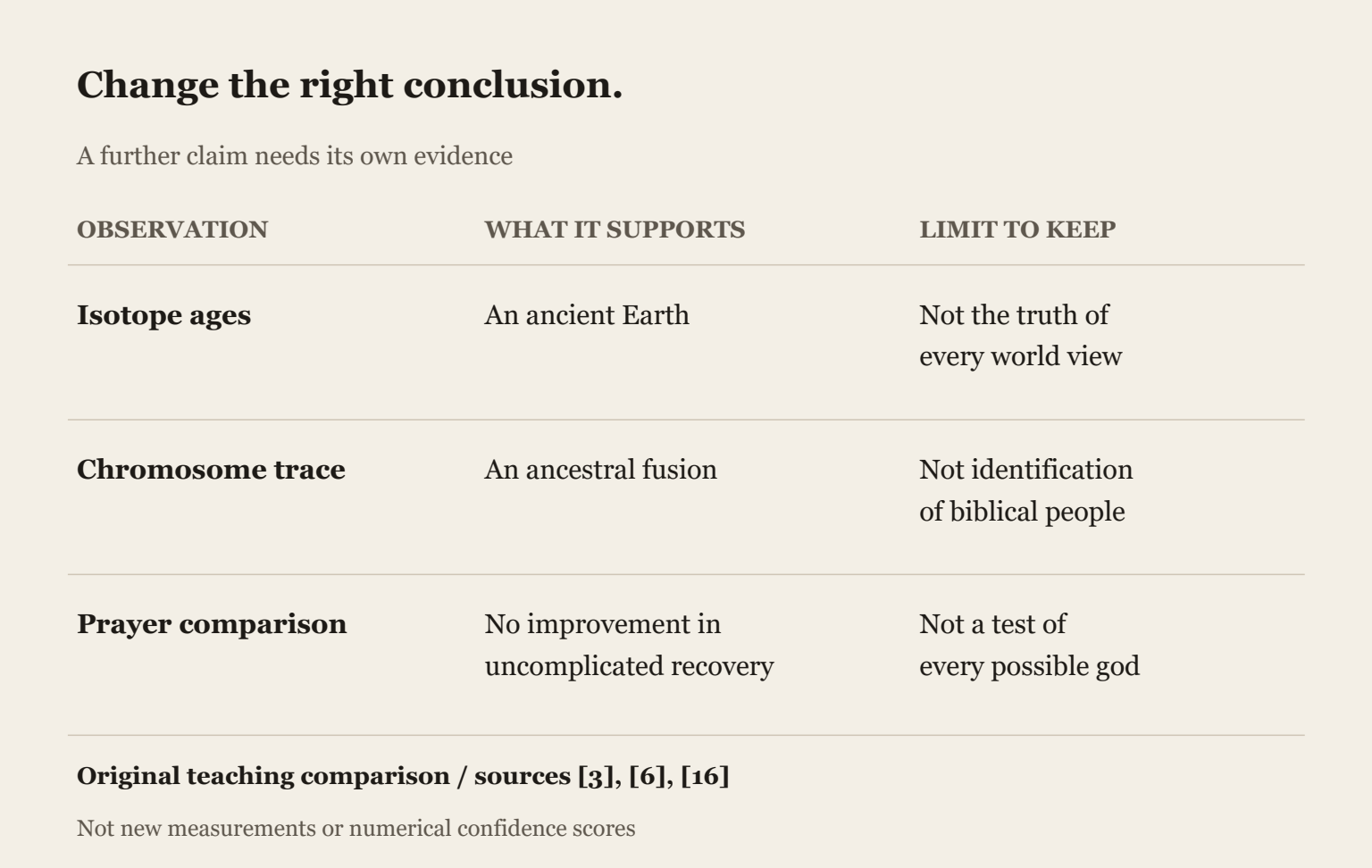
Each row links evidence to a particular conclusion. The prayer row compares groups uncertain whether prayer was provided. The next claim needs its own argument; a failed bridge does not erase evidence already earned.
The companion CSV contains the same guide in both languages. This is an explanation of scope, not a dataset measuring how likely God is. Read the source notes before extending any conclusion.
Open the figure reference table
07Which Adam and Eve claim?
A sole genetic founding pair and a theological story are different proposals.
Genesis 2-3, King James Version, describes man formed from dust and woman from a rib. This identifies the narrative. It does not provide a measured population history or an Earth formation date. [17]
A recent pair supplying all human genetic ancestry is a biological claim. A pair within a larger population, later ancestral in a broader family tree, is another. A symbolic account of responsibility is different again.
Li and Durbin reconstruct aspects of population history from genome variation using models. Effective population size is not a head count. Mutation, generation and structure assumptions matter. One study does not exclude every arbitrarily brief bottleneck someone could invent. [7]
The evidence does not support the simple recent sole-couple replacement story examined in Part 11. Genetics cannot identify biblical names or disprove every theological placement. A miracle replacing all expected traces changes the explanation; it supplies no genetic confirmation.
My reply is: 'Choose the claim, then show its evidence.' I can reconsider a population model when assumptions or data fail. A revised religious interpretation deserves examination, but agreement with science is not proof of revelation.
08A hot past is well supported.
That conclusion is narrower than an answer to why anything exists.
NASA's Big Bang explanation describes expansion and radiation from an early hot state. Mather's Nobel lecture explains how COBE's FIRAS compared the background spectrum with a thermal spectrum, including calibration. These are observations and measurements. [9][10]
The spectrum and expansion fit together in a hot expanding history. A bomb going off in an empty room is a misleading picture. The model concerns the universe's changing state and expansion, not debris flying from an ordinary central explosion. [9]
This does not settle an absolute first moment, existence's cause or whether 'before' applies at the proposed boundary. Extrapolation beyond established evidence is not a camera recording philosophical nothing becoming something.
Reliable measurements defeating the account could change my view even before a replacement is complete. A better model must explain new results and existing successes. Disagreement about one parameter does not automatically erase the measured background radiation.
'Why is there a universe at all?' remains a serious philosophical question. Adding a religious name does not answer it. I can reject an unsupported answer while admitting that I do not possess the ultimate explanation.
09I will not invent a solved origin.
Useful chemistry is a step, not a finished history of life.
I accept evolutionary evidence without claiming a complete reconstruction of the first living system. Evolution concerns inherited population change. The origin of the first system sustaining such processes is a related but different problem.
Miller's 1953 experiment produced amino acids under a specified gas mixture and energy input. It produced no living cell, nor proof the whole early atmosphere had those conditions. Advertising an achievement the experiment never made weakens the argument. [8]
Some relevant organic chemistry can occur without an organism making the products. That matters. Concentration, environments, replication and coupled systems still need investigation. Enthusiasm cannot fill the distance between a building block and a living system.
The objection is: 'Then perhaps God did it.' Perhaps is a possibility. Establishing that explanation needs reasons identifying the agent and connecting it to the event. An incomplete natural pathway is not an observation of divine action.
I would accept a well-supported origin pathway if experiments and environmental evidence earned it. I would examine positive evidence for agency too. For now the problem is unfinished; no religion acquires the answer merely by waiting beside the gap.
10A mystery is not a passport.
Consciousness deserves investigation without being turned into automatic proof of an afterlife.
Purdon and colleagues related propofol, EEG patterns and task responses, supporting connections between brain activity and conscious function. Unresponsiveness is not thereby an infallible no-experience test, nor is every philosophical question about consciousness settled. [14]
AWARE II investigated cardiac-arrest reports and resuscitation monitoring. Nobody identified the visual target; one auditory selection differs from explicit recall. CPR and recovery do not establish permanent loss of all brain function followed by return from a demonstrated afterlife. [15]
Neither dismiss every report as a deliberate lie nor promote an interesting report into proof of heaven. Experience, timing, medical records and explanation require separate examination. A gap in one account does not verify another.
Relevant evidence could include reliably acquired information with ordinary access excluded, documented timing, adequate monitoring and independent checking. That is a proposed investigation direction, not a simple test capturing every possible soul theory.
Even that result would first establish a difficult phenomenon. Further evidence would be needed to identify a particular afterlife or deity. I am willing to change more than one belief; I am not willing to skip the connecting steps.
11Name the claim that fails.
No serious conclusion should pretend every religious sentence was tested.
Criticising scripture requires the text, translation and interpretation. Parts 16-19 examine selected biblical, Qur'anic and Hindu claims, not every verse. Selected investigations cannot honestly become a complete catalogue of falsehood.
A recent-Earth chronology conflicts with geological evidence. The simple recent sole-genetic-pair account does not fit the population evidence discussed in Part 11. Identifying a place in a sacred story does not independently verify a miracle reported there. [3][7]
The first two concern empirical claims. The third concerns inference: evidence for one component does not establish another. Finding a real street address cannot prove every event in a novel set there. This is an analogy.
Where meaning or historical setting is disputed, explain the dispute. Do not print 'science disproved it' over an unanswered textual question. Where contrary evidence is strong, state that directly instead of hiding behind every view being equally valid.
Better manuscripts, archaeology, measurements or a convincing correction of my interpretation could change my judgment. The evidence must support the actual event or reading. Calling a book divine cannot independently certify its certificate.
12Context can change the question.
A nonliteral reading may be reasonable, but it carries a different evidential claim.
Suppose someone says, 'The creation story teaches meaning; it was never a laboratory account.' That can be a coherent reading. I must examine genre and context instead of forcing the person to defend a literal claim they do not hold.
But there is a further question: does this reading supply evidence that a god revealed the story? A passage can avoid conflict with geology without thereby gaining a verified supernatural author. Compatibility with a fact is weaker than independently predicting or explaining that fact.
The same care applies across religions. Allah, Bhagwan or God in a discussion may refer to very different ideas, and believers within a tradition disagree. A claim about an impersonal ultimate reality cannot be fairly tested as though it promised a dated physical miracle.
If a passage is offered as scientific prediction, ask what its words meant before the discovery and what result they ruled out. If it is offered as symbol, evaluate the symbolic interpretation. Switching between these uses whenever an objection appears makes the alleged prediction impossible to evaluate.
I can revise my criticism when I misunderstood a text. I can also accept a moral or literary insight without accepting divine authorship. Being blunt requires saying which conclusion follows. It does not require pretending that every sentence in a religious book is worthless.
13A cause would be a beginning.
It would not finish the argument for a particular religion.
Craig's presentation of the Kalam argument concerns things that begin to exist; it does not simply assert that everything has a cause. He also offers further reasoning for a personal cause. If I replace that with a weaker slogan, I am not answering his argument. [12]
I question whether the premises establish the relevant kind of cosmic beginning and causation, and whether the further steps establish the proposed agent. A valid argument is one whose conclusion follows if its premises are true. Validity alone does not show that every premise is true.
A serious demonstration of a necessary foundation would make me reconsider an important philosophical belief. Necessary here means unable not to exist, not merely very old or powerful. Calling a candidate necessary does not establish that it really has that property.
The further bridge matters: why should this foundation be conscious, morally perfect, interested in human worship or responsible for one scripture? A defender may offer additional arguments. I should examine them, rather than pretend the bridge is either automatically complete or impossible to build.
My answer is therefore conditional: show the premises and the connecting steps. I would accept what they genuinely establish. If they establish a cause but not a creed, I should change my view about the cause without claiming that the whole creed has been proved.
14Design must explain.
Pointing at something remarkable is the start of a case.
Fine tuning asks why physical conditions permit complex structures and observers. Barnes's review takes the physics seriously, including probability assumptions and alternative proposals. Dismissing it as merely admiring a sunset would miss the question. [11]
But a life-permitting range is not by itself a measured probability that a god exists. We need to know what alternatives are being compared and why their probabilities are assigned as they are. A hypothetical range is not a sampled bag of real universes.
Design also needs content. What does the proposed designer aim to produce, and what would be unexpected under that account? An agent capable of choosing anything is not automatically an explanation of why this particular outcome occurred.
The alternative 'a multiverse did it' needs evidence and a workable account too. I cannot use an unestablished proposal as a fact simply because it avoids a creator. Nor can I assume that every possible universe was equally likely without defending that choice.
What would move me toward design? A better supported model of agency that explains observations more successfully than its rivals, with its assumptions exposed. The mere fact that natural explanations remain incomplete does not supply that model. Serious wonder deserves a serious argument.
15The problem is specific.
Suffering bears on some gods more directly than on others.
The problem of suffering challenges a god described as all-powerful and perfectly good. It does not have the same force against an indifferent creator or an impersonal reality. The properties matter. Otherwise the argument keeps changing its target while pretending to deliver one conclusion.
Aquinas offers the reply that a supremely good god can permit evil for good. That presents a possible reason for permission. It does not identify the actual justification for every instance of suffering. Possibility and evidential support remain different. [13]
Similarly, I find persistent uncertainty about a supposedly relationship-seeking god relevant to the claim. A believer may reply that hiddenness protects freedom or permits growth. I ask why clearer knowledge would remove the freedom to reject a relationship; knowing someone exists is not the same as loving them.
These are philosophical objections, not laboratory measurements of divine intentions. A defence might explain why some difficulty is compatible with God. The further issue is whether the amount and pattern are what we should expect under the particular account.
I would reconsider if a defence supplied convincing reasons rather than an endlessly expandable excuse. I do not claim to know every possible purpose. But 'there must be a good reason because God is good' cannot independently establish the goodness it assumes.
16Do not build a locked door.
A genuine revision standard cannot secretly require evidence to be impossible.
Saying I am open to evidence requires more than politeness. Declaring every strange result fraud before looking, or every possible revelation a hallucination by definition, would make that promise empty.
Nor should I demand that a historical event recur in a laboratory. Records, traces, dating and independent accounts may be appropriate. A claimed repeatable power reasonably invites repeatable testing. The standard should fit the claim.
Hume asks how miracle testimony should be weighed against alternative errors. I use that as a reliability question, not a rule making supernatural events impossible in advance. I reject his dated cultural generalisations. [18]
A believer fairly objects that a free agent might refuse a demonstration. True. Refusal limits this route to evidence; it does not prove the agent absent. But an unperformed demonstration is not evidence that the agent is present either.
Evidence should discriminate between explanations: fit the proposed claim better than plausible rivals. Testimony and reasoning can count, not only laboratory measurements. I need a real route to revision without accepting every excuse that prevents checking.
17First establish what happened.
An extraordinary event and the name of its cause are separate conclusions.
Imagine a claimant saying a divine messenger can obtain specific information nobody present can normally access. This is hypothetical. I would request clear conditions and records before declaring the claim proved or ridiculous.
Control ordinary access, document when the target was fixed, preserve all attempts and allow independent investigation of leakage or tricks. These are proposed checks, not a report of an investigation I conducted.
A strong result would matter. I should update toward an unusual information-gaining ability while investigating it. An extraordinary result does not immediately establish unlimited power, perfect honesty or knowledge of cosmic origins.
Then identify the cause. Why a god rather than an unknown natural process, a limited agent or remaining error? Naming alternatives does not give them equal support. The evidence should distinguish them; they must not become permanent excuses to ignore a result.
I cannot promise that one spectacle would establish an entire religion. I can promise that solid evidence would change the relevant belief and further evidence could carry the argument further. My current expectation deserves no automatic immunity.
18Write the terms down first.
Changing the winning condition after the event destroys the test.
A useful step is to record the claim before looking at the outcome. What exactly is predicted? Under which conditions? How will success, failure and incomplete evidence be recognised? A written record makes it harder for either side to remember a different promise later.
Nosek and colleagues explain preregistration: fixing an analysis plan before outcomes are known helps distinguish prediction from explanation constructed afterward. They also describe limits; registration does not make poor design or selective reporting disappear. It is a transparency tool, not a truth stamp. [25]
Applied here, a claimant might propose a specific target test and investigators agree on safeguards and analysis first. This is my teaching proposal, not a published religious experiment or a guaranteed method for identifying a deity.
Some changes are legitimate. Equipment may fail, a record may be missing or an assumption may prove false. Report the change and its reason. Do not quietly turn a failed precise prediction into a successful metaphor after seeing what happened.
I have the same obligation. If a result meets the agreed conditions, I must not invent a new condition solely to avoid acknowledging it. I can investigate genuine weaknesses while stating openly that the result has already changed the balance of evidence.
19A real prediction would matter.
Its source and its meaning would still need examination.
A strong prophecy needs a securely dated statement before the event, clear meaning, a risky specific outcome, and a record including misses. These are proposed criteria, not a claim that I dated every religious manuscript.
A believer argues that fulfilment can identify revelation. It could support unusual knowledge. We must still examine ordinary information, deliberate fulfilment, editing, flexible interpretation and what distinguishes the proposed divine source from other causes.
Imagine a forecast naming an exact event, place and short date range, independently recorded, then succeeding in a way its author could not arrange. It would deserve more weight than predicting eventual conflict somewhere. This illustrates the comparison; it is not an actual fulfilled prophecy.
One genuine success would not certify everything else the predictor said. Accurate knowledge in one case does not establish moral perfection, universal expertise or an entire scripture. Additional claims need connecting evidence.
I would update if such evidence emerged. Part 21 examines actual arguments; here I state my revision rule. I reject cheap hindsight presented as foreknowledge, and an atheist rule that no possible prediction is allowed to count.
20Measure the promised effect.
A recovery can be real while its proposed explanation remains unestablished.
For a repeatable healing claim, specify the promised effect and population. Reliable diagnoses, recorded outcomes and fair comparisons matter. Grateful recovery stories alone cannot tell us what happened among everyone receiving the same prayer or treatment.
STEP compared specified prayer arrangements in bypass patients. Its public abstract reports no uncomplicated-recovery benefit in the uncertain-prayer comparison and more complications with certainty of prayer; major events and mortality were similar. This does not mean all prayer harms people. [16]
Nor does this disprove a god making no such promise. Relevance depends on the claim. If a claim predicts a reliable effect under specified conditions, a fair failure counts against that prediction, not as equal confirmation.
I would reconsider after a documented effect with appropriate comparisons and independent confirmation, connected to the intervention. Nobody needs to stop or delay medical care. Patient research requires proper clinical and ethical oversight.
One unusual recovery may justify investigation without identifying a supernatural cause. Stronger evidence for an effect should be accepted while attribution is examined. Gratitude, a medical finding and the identity of a divine agent are different questions.
21The feeling can be real.
An experience and the explanation attached to it are not the same thing.
Someone says, 'I know what I felt.' I need not deny that they had a powerful experience. The disputed step is what caused it and what it establishes beyond the experience itself. Sincerity matters to testimony, but sincerity cannot make every interpretation correct.
The strongest reply is that firsthand experience can justify a belief even when it cannot be handed to another person. I agree that personal evidence can affect the person who has it. The harder question is whether the evidence distinguishes the claimed source from alternatives.
I would treat an experience of my own seriously without declaring its first interpretation infallible. I would record what happened before retelling it, examine the circumstances and ask what independently checkable information, if any, came with it. That is a proposed habit, not an invented personal revelation.
An independently verified detail could add evidence beyond the feeling. A lack of such a detail does not prove no experience happened. It limits what I can reasonably ask others to accept on its basis. Respecting someone's experience does not require accepting their entire explanation.
My answer to a believer is: 'I take the report seriously. Help me understand why this identifies your god.' If I received strong identifying evidence, it could change my position. If I received only intensity, intensity alone would not settle the identity of the cause.
22Ten copies can be one source.
Agreement is strongest when the routes to it can expose different errors.
Imagine ten websites reporting one miraculous photograph. If all ten copied one account, we have ten repetitions of one source. We do not have ten independent witnesses. This invented example applies equally to an atheist rumour and a religious claim.
Independent evidence means more than different logos. Did investigators collect their own data? Do methods share a calibration or assumption? Could one common error produce the agreement? Dependence does not make evidence worthless, but it changes how much extra weight each piece adds.
For example, a museum explanation and the paper it summarises should not be counted as two separate genetic discoveries. In contrast, different kinds of physical evidence may support a conclusion while retaining some shared assumptions. We should name those assumptions instead of advertising perfect independence. [5][6]
A good case also preserves awkward results. Feynman's call to disclose contrary evidence is useful here: a favourable selection can manufacture an impression that the whole record does not support. The same demand belongs in an apologetic argument and a criticism of religion. [2]
I would explain this with a family message forwarded through ten phones: count its original source before counting the forwards. Then return to the real documents. The analogy helps explain dependence; the source investigation, not the analogy, establishes what happened.
23Let an unwelcome result count.
Methodological habits should help discovery rather than outlaw a possible answer.
Science usually investigates explanations by observable consequences and public checks. That practical approach does not, by itself, prove that only physical things exist. Berkeley's description concerns a process of inquiry; I should not quietly replace it with a complete metaphysical creed. [1]
If a proposed nonordinary agent produced detectable, reliable effects, those effects could be investigated. Investigating them would not automatically settle every claim about what the agent ultimately is. The boundary between measuring a result and interpreting its deepest nature remains important.
An atheist objection can be lazy too: 'Science would never accept that, so it cannot count.' If the objection rules out the conclusion regardless of evidence, it is not an evidential answer. Explain the actual measurement problem or competing explanation instead.
Equally, relabelling every unusual result supernatural would not be progress. Unknown is a description of our current explanation, not the name of an established cause. We need positive reasons to move from a surprising result to a particular account.
I want methods that make mistakes discoverable. If my preferred explanation fails a fair test, I must show the failure. Scientific institutions can behave badly; their authority must be justified by work that survives scrutiny, not protected by the word science.
24How much should change?
The scale of the revision should follow the scale of the evidence.
Suppose a reported fossil was misplaced or a sequence was contaminated. Correct that result first. Then ask which further conclusions depended on it. Neither 'nothing matters' nor 'the whole field has collapsed' follows automatically from discovering an error.
A single finding can be decisive if it contradicts a central prediction and survives the checks. A complete replacement need not exist before I acknowledge failure. Quality and relevance matter, not merely how many papers the finding opposes.
For evolutionary history, a robust, independently verified conflict with expected ancestry or chronology would deserve investigation. A surprising result might require a local revision, a new mechanism or a deeper change. It would be dishonest to decide the scope before examining the evidence.
The replacement account also owes explanations. If it rejects common ancestry, how does it explain the genetic relationships and specific traces? If it rejects a hot cosmic past, how does it explain the measured radiation? A rival cannot win by ignoring the evidence that made the existing account useful. [5][6][10]
My short reply is: 'Show the strongest contradiction, and let's trace what depends on it.' I would change one paragraph, one model or a wider position as the evidence requires. Correction should be proportionate, rather than chosen to save face or manufacture a dramatic victory.
25Evidence can move in steps.
A simple probability comparison helps without inventing odds for God.
Here is a made-up example. Box A contains nine red counters and one blue counter. Box B contains one red and nine blue. Someone selects a box by a fair coin, mixes it and draws one counter without looking. These conditions are assumptions of the example.
The counter is red. Before the draw, the boxes had equal chances. A red result is nine times as likely under A as under B. With these two equally likely starting options, the updated chance for A is nine out of ten. We have learned something without becoming absolutely certain.
Each box starts with a one-half chance. Multiply by its chance of red: A contributes 0.45 and B contributes 0.05. Red has a combined probability of 0.50. Within those red outcomes, A supplies 0.45 divided by 0.50, which is 0.90, or 90 percent. This is stipulated arithmetic, not a measured experiment.
Change the starting chances or contents and the answer changes. That is why saying a universe is unlikely does not give us a probability for a deity. We do not possess the agreed contents, selection process and complete list of alternatives that this toy example supplies.
The useful lesson is smaller: evidence can favour one explanation, more evidence can strengthen or weaken it, and uncertainty can remain. I want my beliefs to move that way. I will not paint an invented percentage over an unresolved religious question to make it look mathematical.
26My side gets no exemption.
A useful correction is one I would publish even when it weakens my case.
The Negative Association between Religiousness and Children's Altruism across the World received a formal Current Biology retraction notice in 2019. The original bibliographic record links the withdrawal to that paper. Its withdrawn claim cannot serve as settled support. [22]
I use the retraction record, not an independent reanalysis or unrestricted full notice. I should not supply a detailed error diagnosis from memory and pretend the record itself contains it.
An atheist might enjoy a headline suggesting religion makes children less generous. Enjoyment cannot rescue withdrawn evidence. Remove the unsupported argument even if correction makes a debate reply less convenient. Annoying religion does not make a conclusion sound.
Retraction does not prove the opposite generalisation, that religious upbringing always makes children kinder. It withdraws this paper's authority for the broad claim. Substituting an equally unsupported opposite repeats the mistake.
My rule is to identify the affected statement, explain the correction and stop using the failed support. That is a proposal for my conduct. A correction process is useful only when people accept corrections, especially the unwelcome ones.
27Open one source properly.
You do not need to pretend you repeated a laboratory experiment.
Choose one claim, such as the chromosome 2 fusion inference. Open reference 6 and check the title, authors, year and original abstract. Notice what was examined and what conclusion the authors draw. Reading the abstract checks the report at one level; it does not reproduce the research. [6]
Then read the reference note in this PDF. I disclose where access was limited to an abstract and where I used selected passages from longer originals. A linked paper is not proof that I read every page or verified every calculation. The note tells you what was actually used.
For a deeper check, compare the method and limitations in the full paper when accessible, look for later research and examine whether the same conclusion rests on other evidence. A specialist may be needed to assess some steps. Relying on expertise can be reasonable while remaining open to criticism.
For scripture, begin differently: locate the exact passage in an identified text and compare the interpretation being criticised with a serious defence. For a photograph, seek the original file and provenance. Different claims require different routes back to evidence.
In a conversation, offer one route the other person can follow, then say what remains unchecked. 'Trust me, I read science' is a weak ending. 'Here is the observation, here is the inference, and here is the limitation' gives both people something they can examine.
28Belief is not obedience.
Evidence that an agent exists does not automatically make every demand right.
Suppose I became convinced that a powerful nonhuman agent exists. That would change a belief about reality. Whether this agent created everything, tells the truth or deserves worship would require further reasons. Power alone cannot do all that argumentative work.
The believer may reply that a perfectly good god deserves trust by definition. If perfect goodness is genuinely established, that matters. But the definition does not prove that the agent making demands satisfies it, or that a human interpreter has reported the demands correctly.
Plato's Euthyphro examines the relation between holiness and divine approval. The familiar moral adaptation asks whether goodness follows approval or approval recognises goodness. Defenders may ground goodness in a necessarily good divine nature; naming that reply does not settle its truth. [20]
My point here is practical: evidence for existence, evidence for character and justification for obedience are distinct steps. A command to harm somebody does not become justified merely because the claimed speaker is stronger than us. That is a moral judgment I defend, not a laboratory measurement.
So I can honestly say that evidence could change my atheism without promising automatic worship. That is not a trick to evade belief. It is a refusal to confuse 'this being exists' with 'every instruction attributed to it deserves my submission'.
29Uncertainty is not a threat.
Practical choices still need reasons, even when the stakes are described as infinite.
Pascal's wager is a practical argument about belief and its consequences, with a proposal for cultivating belief through practice. It deserves that fuller description. It is not an observation establishing an afterlife, and it is not simply the sentence 'be frightened'. [19]
My objection is that a threatened consequence does not identify which religious account is true. Competing claims can propose incompatible rewards and punishments. We cannot assign them reliable odds merely by saying that disbelief is risky.
I also cannot honestly choose a conviction as casually as choosing a shirt. I can investigate, read and take part in practices. Whether those actions produce warranted belief depends on what I learn, not only on what outcome I would prefer.
Everyday decisions involve uncertainty. I can take a proportionate precaution without believing that every frightening story is true. The relevant questions are what evidence supports the risk, which action is justified and what competing costs or claims have been ignored.
My conclusion is not that nothing matters because I lack certainty. It is that fear should not be allowed to replace the missing evidence. I will keep examining reasons, including unwelcome ones, rather than call a threatened punishment a demonstration of its owner's existence.
30Meaning still needs living.
Rejecting a promised cosmic purpose does not remove every human purpose.
If I do not accept a divine plan, what is the point of living? I do not pretend that physics can hand me a command telling me what I must value. Purposes involve the lives, relationships and commitments of beings who can care about outcomes.
I can value reducing suffering, understanding something, keeping a promise or making another person's day easier. Those purposes need not last forever to affect a real life now. This is a view about value, not an experiment proving a universal meaning formula.
Nor must I deny that religion helps some people build meaning and community. Pew's analysis reports associations between participation and some measures of well-being, while warning that causation is unresolved. A benefit can deserve recognition without establishing the theology behind it. [21]
Death and uncertainty can remain painful. I have no evidence-based guarantee of a reunion after death to offer. I also should not demand that a grieving person settle a philosophical argument on my timetable. Being truthful does not require being cruel.
My answer is to make the commitments I can justify and keep asking where my assumptions fail. The absence of a complete cosmic explanation does not prevent a meal being shared or a hurt being repaired. I can act responsibly while leaving a difficult question open.
31Nobody owes me conversion.
My freedom to reject religion includes your freedom to remain religious.
I want freedom to question a scripture, reject a god claim and change a belief without punishment. The same freedom must protect a believer who disagrees with me. A right that disappears when someone gives the wrong answer is merely permission from the stronger side.
Articles 18 and 19 of the Universal Declaration of Human Rights affirm freedom of thought, conscience, religion and expression, including changing religion or belief. I cite them as stated principles, not proof that every government or community actually protects those rights. [23]
I can criticise claims and institutions sharply without treating every believer as dishonest or unintelligent. I can also condemn coercion by people calling themselves atheist. A label does not excuse conduct. My argument concerns reasons and actions, not inherited guilt for everybody in a category.
Rights do not make every claim true or every action beyond criticism. A harmful policy can be opposed with reasons and evidence. Protecting a person's freedom to believe does not require shielding their factual claims from questions.
If this series persuades nobody, I still want its arguments open to challenge and its readers free to leave. I do not want a new authority replacing an old one. I want disagreement that does not require surrendering another person's dignity or freedom.
32Say what changed.
A discussion can make progress without delivering an instant conversion.
Here is a made-up closing conversation. A believer says, 'You admitted that the first cause remains unresolved. Why not accept my creator?' I answer, 'Because uncertainty about the cause does not establish the identity, character or actions you attribute to it.'
The believer replies, 'What if I give you a sound argument for a conscious foundation?' I answer, 'Then I would change my judgment about that foundation to the extent the argument supports it. I would next examine the separate claim that it revealed your book.'
They ask, 'So you will keep moving the goalposts?' I answer, 'The steps should be written down now. Foundation, consciousness, revelation and particular commands are different claims. I must acknowledge a step when it is established, rather than demand every later step before accepting the first.'
Then I ask what would count against their position. Perhaps a particular chronology is surrendered, while a symbolic belief remains. That is a real change in a claim, even if neither person changes their identity. We should record what moved and what is still disputed.
This dialogue is a proposed way to keep reasoning clear, not evidence that a technique reliably persuades people. A successful conversation can end with a smaller disagreement and a source to investigate. Nobody needs to announce a winner before going home.
33I remain unconvinced.
A clear conclusion can coexist with unfinished questions.
After twenty-eight parts, I remain an atheist as defined at the beginning. The religious accounts examined here are not adequately established. Some literal claims conflict with evidence. Others are disputed, insufficiently supported or framed beyond ordinary tests.
The scientific conclusions are narrower and stronger than a slogan. Earth's deep age, common ancestry and a hot expanding cosmic history have substantial evidence. None supplies a complete life philosophy or demonstrates every possible god's impossibility. [3][5][9][10]
The complete origin of life, the deepest account of consciousness and existence's ultimate explanation remain difficult. I will not hide those openings, or let 'we do not fully know' become 'therefore my inherited story is established'.
Relevant evidence or reasoning could change my mind: better measurements, genuine corrections, reliable new phenomena or a sound philosophical case. These are routes, not a requirement for one theatrical event to settle everything at once.
My answer is no to these claims on their offered support, yes to investigation and yes to justified correction. I would rather carry an unfinished question than publish a finished answer the evidence cannot carry.
NoteNo claim gets a free pass.
The last page of the argument is not the last chance to question it.
I wrote this series to make difficult arguments readable without draining their meaning. Simplicity should reveal reasoning, not hide assumptions, remove the strongest objection or turn uncertainty into convenient certainty.
My criticism is blunt because reality claims should survive questions. Calling a statement holy does not make it accurate. Calling someone atheist does not make their reasoning careful. Both can be challenged while respecting people's dignity.
I am responsible for claims carrying my name. If a quotation, number, interpretation or explanation is wrong, identify the exact mistake and correct it. Protecting my error would turn this project against its purpose.
You owe me no agreement. Take a claim back to its evidence and examine the serious reply. Separate what happened, how we explain it and what remains unsettled. Then decide what the reasons warrant.
The planned series ends here. My position is clear; my willingness to learn must remain real. No claim gets a free pass for being called holy. No claim of mine gets a free pass for being printed in this series.
SourcesFollow the evidence.
These references support specific claims, not a blanket verdict on every religion or every possible god. Read the method and the scope of each note. References 6 and 16 use public original abstracts only; 22 uses an original bibliographic retraction record. Other long sources use selected relevant passages. Twenty-two source caches were re-read from the recorded Part 27 research; references 22, 23 and 25 were freshly retrieved. Cached access is not a new remote verification. The hypothetical tests, dialogues, box calculation and qualitative figure are my teaching proposals, not new experiments, measured belief scores or guaranteed persuasion methods.
[1] What is science?
University of California Museum of Paleontology, Understanding Science, institutional educational account.
Institutional account of knowledge and inquiry. Describes standards, not a guarantee that every scientist follows them. Relevant passages re-read from the recorded Part 27 public cache.
[2] Cargo Cult Science
Richard P. Feynman, Caltech commencement address, Engineering and Science 37(7), 1974, 10-13. Caltech original.
Disclosure, contrary-evidence and self-deception passages re-read. Methodological argument; not endorsement of every anecdote or dated cultural claim. No automatic reliability certificate for science.
[3] Age of the Earth
United States Geological Survey, Geologic Time educational publication.
Isotope systems, disturbance and roughly 4.54-billion-year formation age. Not carbon dating, every rock age or a fresh survey of oldest specimens. Relevant institutional passages re-read.
[4] Radiocarbon dating
Oxford Radiocarbon Accelerator Unit, University of Oxford.
Once-living material, roughly 50,000-year range, calibration and contamination limits. Dates the organism-related event, not automatically later use of an object. Not a method for dating Earth.
[5] Genetics: human evolution evidence
Smithsonian National Museum of Natural History, Human Origins Program.
Institutional account of genetic relationships and branching common ancestry. Not descent from living chimpanzees. Older fossil-date statements elsewhere on the page are not used as a current oldest-fossil inventory.
[6] Origin of human chromosome 2: an ancestral telomere-telomere fusion
J. W. Ijdo and colleagues, PNAS 88 (1991), 9051-9055. DOI: 10.1073/pnas.88.20.9051.
Public original abstract only, via the recorded Europe PMC response. Internal inverted telomere arrays, surrounding sequence and mapping support the fusion inference; not any repeat alone or a newly performed genome analysis.
[7] Inference of human population history from individual whole-genome sequences
Heng Li and Richard Durbin, Nature 475 (2011), 493-496. DOI: 10.1038/nature10231. Public original author manuscript.
Selected original PSMC, scaling, structure and limitation passages. Effective population size is not a head count. Not identification of biblical people or exclusion of every arbitrarily brief bottleneck; sole genetic founders and wider genealogy differ.
[8] A Production of Amino Acids Under Possible Primitive Earth Conditions
Stanley L. Miller, Science 117 (1953), 528-529. DOI: 10.1126/science.117.3046.528. Public original reprint.
Specified gas-mixture experiment and amino-acid findings. Not a cell, a completed origin pathway or proof of the entire early atmosphere. Original reprint passages re-read.
[9] The Big Bang: Q&A with John Mather
NASA Science, original explanation by a COBE principal investigator.
Hot expansion and background-radiation explanation. Not a settled absolute first moment, philosophical creation from nothing or observed spatial infinity. The deeper-origin discussion remains separate.
[10] From the Big Bang to the Nobel Prize and Beyond
John C. Mather, Nobel lecture, 8 December 2006; official Nobel text.
Selected COBE FIRAS spectrum and calibration passages. Historical 2006 lecture, not a new 2026 sky measurement or creator identification. No claim every technical calculation was replicated.
[11] The Fine-Tuning of the Universe for Intelligent Life
Luke A. Barnes, Publications of the Astronomical Society of Australia 29 (2012), 529-564. DOI: 10.1071/AS12015. Public arXiv version.
Selected fine-tuning, probability-assumption and alternative-model discussions. Not a measured probability of God, an established multiverse or a demonstrated uniform distribution of real universes.
[12] The Kalam Cosmological Argument
William Lane Craig, Reasonable Faith, original defence.
Original defender: qualified beginning-to-exist premise and further personal-cause reasoning. Not reduced to everything has a cause or treated as settled cosmology. Criticism concerns premises and additional inferential steps.
[13] Summa Theologiae, First Part, Question 2
Thomas Aquinas; English Dominican Province translation, revised 1920, New Advent.
Evil objection and permission-for-good reply read together. Philosophical defence, not identification of a good reason for every actual suffering. Possibility and evidential support are distinguished.
[14] Electroencephalogram signatures of loss and recovery of consciousness from propofol
Patrick L. Purdon and colleagues, PNAS 110 (2013), E1142-E1151. DOI: 10.1073/pnas.1221180110.
Original propofol, task-response and EEG passages re-read from the hash-recorded public cache. Not all conscious states, an infallible no-experience test or a completed metaphysical account. No clinical instructions.
[15] AWAreness during REsuscitation-II: A multi-center study of consciousness and awareness in cardiac arrest
Sam Parnia and colleagues, Resuscitation 191 (2023), 109903. DOI: 10.1016/j.resuscitation.2023.109903. Public original.
Original target-test, monitoring and survivor-report passages. No visual target identification; auditory selection differs from explicit recall. Cardiac arrest with CPR is not established permanent brain-function loss followed by return from a verified afterlife.
[16] Study of the Therapeutic Effects of Intercessory Prayer (STEP) in cardiac bypass patients
Herbert Benson and colleagues, American Heart Journal 151 (2006), 934-942. DOI: 10.1016/j.ahj.2005.05.028.
Public original abstract only, via Europe PMC: specified prayer arrangement, group comparisons, complications and similar major-event/mortality outcomes. Not every prayer, universal harm or a personal medical recommendation; full methods not claimed as read.
[17] Genesis 2-3, King James Version
Bible Gateway, identified primary religious text.
Identified primary narrative, Genesis 2-3, KJV: dust and rib passages. Does not state a measured genome history or Earth formation age. Literal sole-pair, wider genealogical and symbolic readings differ.
[18] An Enquiry Concerning Human Understanding, Section X: Of Miracles
David Hume, original philosophical text; Project Gutenberg edition.
Selected Section X testimony reasoning. A philosophical standard to examine, not an advance empirical disproof of miracles or endorsement of dated generalisations about cultures.
[19] Pensees, Section III: Of the Necessity of the Wager
Blaise Pascal, W. F. Trotter translation; Project Gutenberg, especially pensee 233.
Selected pensee 233 and practical belief-cultivating proposal. Not merely a threat, empirical proof of an afterlife or a source of invented numerical odds for God or hell.
[20] Euthyphro
Plato, Benjamin Jowett translation, MIT Internet Classics Archive.
Original holiness/divine-approval question. Modern moral version is an adaptation; later necessarily-good-nature replies are acknowledged. Not a claim that Plato disproved every moral theology.
[21] Religion's Relationship to Happiness, Civic Engagement and Health Around the World
Pew Research Center, original analysis, 31 January 2019.
Original participation and well-being associations, with causal limits. Not universal benefit, random assignment, proof of theology or a clinical recommendation.
[22] Retraction Notice: The Negative Association between Religiousness and Children's Altruism across the World
Jean Decety and colleagues, Current Biology 29 (2019), 2595. DOI: 10.1016/j.cub.2019.07.030. PubMed 31386841.
Original bibliographic retraction record checked via Europe PMC, including linkage to the 2015 paper. Record-only scope: no claim to full notice access, coding-error diagnosis or independent reanalysis. Withdrawal is not proof of the opposite generalisation.
[23] Universal Declaration of Human Rights, Articles 18 and 19
United Nations, original declaration, adopted 1948.
Original articles on freedom of conscience, religion, changed belief and expression read. Normative statement, not proof of implementation in every country, unlimited legal permission or a survey of present law.
[24] Historical contingency and the evolution of a key innovation in an experimental population of Escherichia coli
Zachary D. Blount, Christina Z. Borland and Richard E. Lenski, PNAS 105 (2008), 7899-7906. DOI: 10.1073/pnas.0803151105. Author-hosted original.
Original specified citrate-use result, frozen-sample replay and contamination checks. One of twelve lineages under oxic conditions; not first life or proof of every ancient evolutionary relationship.
[25] The preregistration revolution
Brian A. Nosek and colleagues, PNAS 115 (2018), 2600-2606. DOI: 10.1073/pnas.1708274114. University-hosted original.
Prediction/postdiction, advance analysis plans, deviations and poor-design limits read in the original seven-page article. Methodological proposal, not a guarantee of truth or a published divine-agent experiment. No current legal-policy claim borrowed from this 2018 text.