

01Start with one claim.
A useful discussion needs a question we can actually finish.
My starting sentence is simple: 'Tell me the one claim you want me to accept, and your best reason for it.' A conversation about whether a healing happened is different from one about whether the universe has an ultimate explanation.
This is a question bank, not a speech to memorise. Each entry gives a reply, an explanation, a serious objection and a next question. Use the PDF bookmarks or search a question. Earlier parts supply the longer investigation; the numbered sources let you check the evidence directly.
Imagine someone asking about evolution, then switching to consciousness before the first answer is finished. Both subjects matter. Neither becomes clearer when we treat changing the subject as answering it. I would write down the second question and finish the first.
That rule applies to me too. If I claim a particular story is false, I must identify the story and explain the contradiction. My disbelief is not permission to invent history, conceal a study or pretend I have solved every mystery.
Ask first: 'What would count as answering this question?' Agree on the claim and the standard before collecting victories. See Parts 1 and 2 for the underlying ground rules. These are proposed discussion habits, not a tested method guaranteed to change someone.
02Can you prove that no god exists?
Being unconvinced and proving universal impossibility are different tasks.
My answer is: 'I do not claim to have searched every possible reality and ruled out every possible creator. I do not find the religious claims offered to me sufficiently supported.' That is the position I am defending, not an imaginary claim of unlimited knowledge.
A person saying a god exists owes reasons. If I say a particular god cannot exist, I owe an argument for that stronger statement. The word atheist does not move that burden.
Imagine being told that an undetectable stranger lives in your cupboard. Not accepting the story does not require proving that no imaginable invisible person could exist anywhere. This is an invented example about justification, not an experiment showing that gods resemble cupboard occupants.
The objection is that atheism sometimes means the positive claim that there are no gods. Fine: define how we are using the word. Labels should clarify the position. They should not force me to defend a different proposition from the one I actually hold.
My next question is: 'Which god, with which properties, and what evidence?' A vague possibility, an intervention in history and the author of one book are three different claims. Parts 1 and 5 explain why answering one does not automatically establish the others.
03Is science just another faith?
Depending on other people is unavoidable. How we check them matters.
My short answer is: 'I trust a result in proportion to the evidence and the checks behind it. Calling that faith does not remove the difference between a testable account and an answer protected from failure.' The label cannot do the comparison for us.
Berkeley's Understanding Science describes knowledge and the process that produces it together. Feynman's 1974 address asks researchers to reveal weaknesses and contrary evidence, not merely advertise favourable results. Those are stated standards; quoting them does not prove every scientist meets them. [1][2]
I have not personally built every telescope or sequenced every genome. Neither has the person making the objection. Our practical question is whether methods, observations, criticism and independent checks can be examined, and whether contrary results can force a change.
A believer may also investigate, reason and trust testimony. I should acknowledge that. The relevant difference concerns the particular claim: what supports it, what could expose an error, and how it has survived that scrutiny. Nobody earns reliability simply by adopting a team name.
Ask: 'What result would count against this explanation, and who is allowed to publish it?' Then examine an actual case rather than exchange slogans. Parts 2 and 8 show how several kinds of evidence can be compared without demanding blind trust in a famous person.
04Evolution is only a theory, right?
Ask what the word means before treating it as a dismissal.
My reply is: 'In this context, a theory is an explanatory framework. The word does not mean an unsupported guess.' Berkeley's evolution guidance explicitly distinguishes the scientific use from an everyday hunch. Whether a particular theory works still depends on its evidence. [8]
There are observations, explanations and unresolved details. A fossil is an object we can examine. Common ancestry is an explanation connecting many observations. Debating a branch's exact position does not erase the existence of the specimens or every wider relationship.
The objection often changes into: 'But can you prove it with absolute certainty?' Empirical conclusions concern the world and can be revised. They are not mathematical proofs from fixed starting rules. Demanding the wrong kind of proof does not improve a comparison.
I can be highly confident without claiming that error is logically impossible. Equally, saying knowledge is revisable does not make every explanation equally good. A proposal that repeatedly explains the evidence has earned more confidence than one that merely survives by changing its meaning.
Ask: 'Which observation or inference do you think fails?' That gives us something to investigate. 'Only a theory' names no failure. Parts 2 and 7 explain the terms; Parts 8 and 9 examine the genetic and fossil evidence behind the explanation.
05Scientists keep changing their minds.
A correction needs an explanation, not a loyalty test.
My answer is: 'Changing an answer can be the right response to better evidence. The question is why it changed and how much of the earlier account failed.' Refusing to correct a mistake would not make the original answer more reliable.
Suppose I estimate a room's length with footsteps, then measure it with a tape. A revised number can preserve the fact that the room exists and has a measurable length. This is a teaching analogy, not proof that every scientific revision is that small.
Some corrections really are major. I should not disguise a failed prediction as a tiny adjustment. Others concern precision, conditions or competing mechanisms within a larger account. We need to identify the level of the change rather than treat all disagreement as total collapse.
'Then tomorrow everything could reverse' is a possibility claim, not evidence that the present conclusions are worthless. A replacement account would still have to explain the observations that made the earlier account successful, as well as the evidence it could not handle.
Ask: 'Which correction are we discussing, and what evidence caused it?' Feynman's argument for disclosing weaknesses is a useful standard for my preferred explanation too. It is not a guarantee of automatic honesty. Part 2 gives the fuller account of correction and confidence. [2]
06Can I check any of this myself?
You can begin checking without pretending to own a laboratory.
My reply is: 'Yes, at different levels. You can check a quotation, inspect a published table, follow a method, compare independent results or perform a suitable measurement.' These are different kinds of checking. Reading a paper is not repeating its experiment.
For a manageable example, open Hubble's 1929 distance-and-velocity paper. Look at the table and the stated uncertainty. You can inspect the reported relationship without accepting a motivational poster about science. The original also discusses limitations and the need for more distant observations. [13]
To reproduce the astronomy from scratch requires instruments, calibration and expertise. That is a larger task. I should not tell a beginner that clicking a graph is personal confirmation of every measurement behind it. An honest route separates checking the argument from independently collecting the data.
The objection is: 'So you still rely on someone.' Of course. Reliance becomes more reasonable when the record is available for criticism, methods can be repeated and different evidence converges. Dependence on expertise does not require treating the expert as incapable of error.
Ask: 'Which step would you like to examine first: the observation, the measurement method or the inference?' Parts 6, 8, 9 and 13 provide longer paths. Start with one check you can understand, then identify what further work would be needed.
EvidenceWhat does the evidence actually show?
A measured change, a historical trace and a cosmic signal answer different questions.
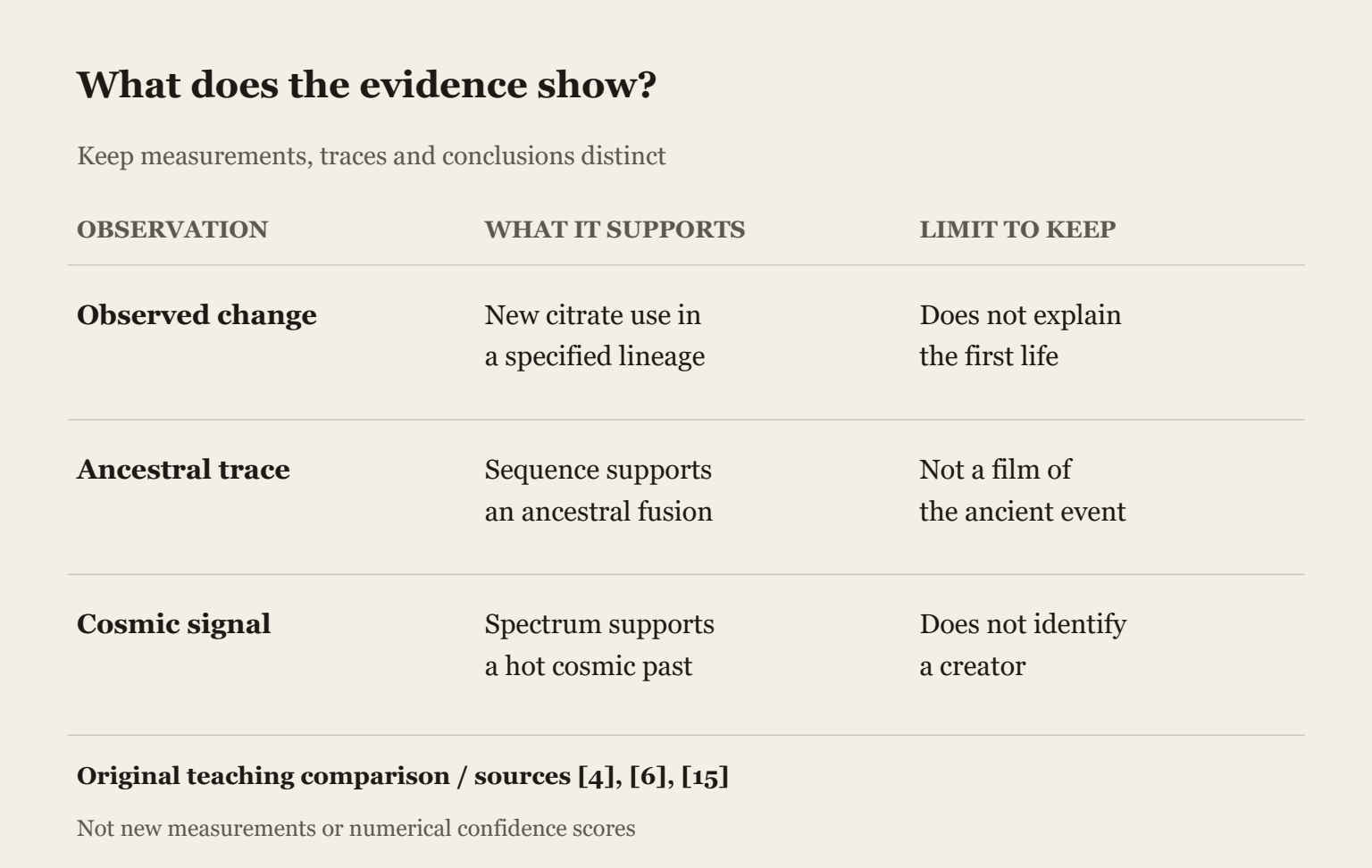
The citrate experiment tests a specific inherited function. The chromosome abstract reports a trace interpreted as an ancestral fusion. The COBE lecture describes a measured spectrum supporting a hot cosmic past. Each result needs its own route from observation to conclusion.
The bilingual CSV preserves those limits. None of these items, alone, explains the first living system, reconstructs every ancestor or identifies a creator. A strong reply says what its evidence supports before asking what remains open.
Open the figure reference table
07Why are monkeys still here?
Evolution describes branching descent, not a queue that everyone must leave.
My short answer is: 'Humans did not descend from the chimpanzees alive today. Our lineages share earlier ancestors.' The Smithsonian's genetics account explains that relationship. It also distinguishes the more distant common ancestry of monkeys and apes. [3]
Think about cousins. You and your cousin can share grandparents while both remaining alive. Your existence does not require your cousin's family to disappear. This is an analogy for branching; it does not supply the genetic evidence by itself.
The scientific claim is more specific than resemblance. Inheritance produces related lineages, and changes accumulate after populations separate. Evolution has no rule that every surviving branch must become human. Chimpanzees are modern relatives, not an unfinished stage waiting to turn into us.
'But you did not see the ancestor' is a different objection. We investigate past relationships through evidence left in genomes, bodies and fossils. Historical inference can be strong without a recording of the event. It still needs actual evidence rather than a clever family-tree comparison.
Ask: 'What would branching ancestry predict that separate creation would not explain as specifically?' Then move to the evidence in Parts 8-10. Do not say a cousin analogy proves the whole tree; use it to remove the mistaken demand that relatives must vanish.
08Show me evolution happening.
An experiment can establish a real change without replaying all history.
My reply is: 'Here is a documented example, and here is exactly what it shows.' Blount, Borland and Lenski's 2008 paper reports that one of twelve experimental E. coli populations acquired the ability to use citrate with oxygen present under the experiment's conditions. [4]
The researchers used stored earlier samples to investigate the lineage's history and checked whether contamination explained the result. The report gives observations and methods that can be scrutinised. It is more useful than saying that scientists somewhere have already proved everything.
The familiar objection is: 'They were still bacteria.' Yes. Descent with modification does not predict that a lineage stops belonging to its ancestry whenever it gains a function. A new inherited capacity in bacteria is still a real evolutionary change in bacteria.
That does not mean this one experiment proves every ancient branch, explains the first living system or produces a human in a flask. Those are different questions. Large historical relationships require the additional fossil, genetic and comparative evidence examined elsewhere in the series.
Ask: 'Do we agree this inherited functional change occurred? If so, what specific limit do you propose, and how would we test it?' The question turns an undefined word such as kind into a claim. Parts 7 and 8 explain the wider framework.
09Where are the missing links?
First say which transition you want evidence for.
My answer is: 'There are fossils with informative combinations of features. No one claims we possess every organism that ever lived.' A gap is a question about a particular record. Calling the entire record missing avoids looking at the specimens we actually have.
Daeschler and colleagues' 2006 original description of Tiktaalik reports fish features alongside a mobile neck and other features associated with the transition toward limbed vertebrates. The paper describes the anatomy and geological setting. It is a concrete case we can inspect. [5]
Transitional does not mean an impossible half-finished monster. It means a combination informative about evolutionary change. Nor must a fossil be demonstrably our direct ancestor to document a relevant branch near a transition. Close relatives can preserve evidence about the sequence of changes.
The reply 'Now there are two gaps, one on each side' can become a demand for an unbroken film. Ask whether the newly found anatomy fits an independently expected pattern. More evidence can narrow uncertainty without deleting every question about exact ancestry.
Ask: 'Which features, age or relationship are disputed, and what evidence would distinguish the alternatives?' Parts 9 and 10 examine fossil interpretation and human history. Do not turn Tiktaalik into the sole proof of every transition or claim every classification is settled forever.
10Does shared DNA mean design?
A possible story needs predictions that distinguish it from alternatives.
My reply is: 'A designer could be imagined behind almost any pattern. Which particular genetic pattern does that account predict, and why?' An explanation gains strength by anticipating details, not merely announcing that an unlimited being could have arranged whatever we found.
Chromosomes are DNA packages; telomeres mark their ends. The 1991 chromosome-2 paper reports oppositely arranged telomere repeats inside human chromosome 2, with surrounding evidence interpreted as an ancestral fusion. I use its original public abstract, not a new sequence analysis. [6]
The point is not that any repeated DNA automatically proves fusion. It is the specified arrangement and its context. Shared ancestry connects a pattern to a history that can be checked. Parts 8 and 10 set this beside further genetic and anatomical evidence.
A believer can answer that a creator used evolution. That is a different claim from saying the evidence contradicts common ancestry. The genetic finding can support the ancestry while leaving a proposed supernatural purpose unestablished. We should notice when the dispute has actually changed.
Ask: 'Does your design account predict this detail before looking, or can every result count as success?' Do not pretend one abstract reconstructs all evolutionary history. Equally, do not replace an explanation of a specific pattern with a being's unlimited possible abilities.
11Were we all from one couple?
Sole genetic founders and shared family-tree ancestors are different claims.
My first reply is: 'What exactly do you mean by one couple?' Two people among a larger population could become ancestors of many later people. That is different from claiming there were no other contributors to the human population's genetic ancestry.
Genesis 2 describes the man formed from dust and the woman made through a rib in the identified KJV text. Whether someone reads this as literal biological history or theological narrative matters. I should question their actual interpretation, not assign every believer the same one. [29]
Li and Durbin's 2011 study reconstructs population history from genome variation using an explicit model. Its population-size estimates depend on assumptions, including mutation rates and population structure. An effective population size is a model-based measure, not a direct head count. [7]
That paper does not identify scriptural people or exclude every imaginable brief bottleneck. 'Mitochondrial Eve' does not mean the only woman alive: one inheritance line is not every ancestor. Part 11 explains the distinctions.
Ask: 'Recent sole genetic founders under ordinary inheritance, shared genealogical ancestors, or symbolic teaching?' Each needs its own assessment. Miraculous replacement of the evidence changes what can be tested; it does not make genetics confirm the story.
12Is evolution just random?
Variation and the sorting of variation are different parts of the process.
My short answer is: 'Evolution is not the claim that a complete organism assembled in one random throw.' Berkeley's account distinguishes mutation and other sources of change from natural selection. Selection concerns inherited differences that affect reproductive success in particular conditions. [8]
Imagine a population with inherited differences in camouflage. If one difference makes its bearers less likely to be eaten before reproducing, it can become more common. This is a simplified teaching example, not a report of an experiment or a claim that every visible difference is adaptive.
Random mutation does not mean every mutation is equally likely or that organisms receive precisely the change they need. Nonrandom selection does not mean a planner chooses a final goal. Genetic drift also matters: some differences spread through chance sampling rather than an advantage.
The objection calculates tiny odds for a modern organism appearing at once. That substitutes a different mechanism for inherited intermediate stages across generations, then announces that the substituted mechanism is improbable.
Ask: 'Are we calculating a single complete assembly or a sequence with inheritance, reproduction and changing frequencies?' Parts 7-9 explain those mechanisms and the historical evidence. Do not claim every detail is solved merely because the one-throw objection asks the wrong question.
13What about the first life?
The origin of a reproducing system and its later history are separate questions.
My reply is: 'Not knowing every step to the first life does not erase evidence about what living populations later did.' Research on life's origin asks how chemistry produced the first evolving systems. Evolutionary evidence also concerns changes and relationships after such systems existed.
Miller's 1953 experiment produced amino acids under specified gas-mixture and electrical-discharge conditions. It did not produce a living cell. The selected original paper is evidence for a particular chemical result, not a complete reconstruction of early Earth or the origin of life. [9]
Suppose we knew how a language changed over centuries but did not know the first human utterance. The missing beginning would not erase documented later changes. That is an analogy about separate questions, not evidence that chemistry and language work by the same mechanism.
'A person set up the experiment, so it proves a creator' adds a different inference. An experiment tests what physical processes do under arranged conditions. Designing a test does not show that nature requires an intelligent operator wherever those conditions arise.
Ask: 'A chemical pathway, observed change or common ancestry: which claim are you challenging?' Part 12 covers the open origin problem. I need not pretend a flask contained the first organism to defend the evidence we have.
14How old is Earth?
An age estimate needs a method, assumptions and checks.
My short answer is: 'Through measurements of physical evidence, including radiometric relationships, not by asking a rock how old it feels.' The USGS explains the roughly 4.54-billion-year estimate and its connection to lead isotopes and meteorites. [10]
Radioactive parent isotopes change into daughter products at measurable rates. Interpreting a specimen requires deciding what event the clock records, how it started and whether the relevant material was later disturbed. Naming these assumptions is the beginning of the method, not its automatic refutation.
A kitchen timer is a useful analogy only if we know when it was started and whether someone reset it. Geological work asks comparable questions about materials and events, using actual physics and samples. The analogy explains the issue; it does not establish an age.
'Some dates are wrong' can be a legitimate criticism of a particular sample or method. It does not identify an error in every independent measurement. We should investigate contamination, resetting and consistency rather than choose whichever result supports our preferred chronology.
Ask: 'Which specimen, isotope system and calculation are you disputing?' Part 6 supplies the fuller method and cross-checks. Do not describe every rock as 4.54 billion years old: a rock's formation or later disturbance can be much younger than Earth's formation.
15Does carbon dating date Earth?
Using the wrong clock is not a test of the right one.
My answer is: 'Radiocarbon dating is mainly for suitable once-living material over a limited time range. It is not the clock used to establish Earth's billions of years.' Oxford's radiocarbon laboratory describes a practical range back to about 50,000 years. [11]
Carbon-14 is an unstable form of carbon. A suitable sample retains information about carbon taken in while the organism lived. Turning that measurement into a calendar estimate requires calibration because atmospheric radiocarbon has varied. Context and sample treatment matter too.
The objection often offers a supposedly ancient rock with an unexpected carbon date. First ask what material was tested, what method was appropriate, and whether modern carbon entered the sample. A method used beyond its useful range cannot fairly represent every radiometric system.
There are genuine complications, including contamination and reservoir effects, which occur when a sample's carbon history differs from the assumed atmospheric route. A laboratory explaining those problems is identifying things to check, not confessing that all dating is invented.
Ask: 'Are you challenging this organic sample's radiocarbon age, or a different isotope system used on minerals?' Part 6 explains the separation. The age of wood concerns when its carbon was incorporated, not automatically the date a building was constructed from it.
16Was the Big Bang an explosion?
The supported hot history is not a complete answer to ultimate origins.
My reply is: 'The Big Bang account describes an expanding universe with a much hotter, denser past. It is not simply a bomb going off inside an already empty room.' NASA's John Mather Q&A explains why the familiar explosion picture is misleading. [12]
An ordinary explosion has a location within space. Cosmic expansion concerns how large-scale distances in the universe change. I should not turn a helpful expanding-grid picture into evidence of an outside room, an edge we have seen or a place where a bomb was stored.
The account earns support from observations, especially expansion and the cosmic microwave background discussed next. 'We have no video of the first moment' is true but does not answer whether the later physical evidence supports a hot early history.
The stronger objection concerns what happened at the earliest extreme conditions and whether there was an absolute beginning. Those questions deserve care. Evidence for a hot expanding phase is not by itself proof of creation from philosophical nothing or a final theory of why anything exists.
Ask: 'Are you challenging the observed hot history or asking about an ultimate beginning?' Part 13 treats the measurements; Part 14 treats the open origin questions. I do not need to pretend the second is settled in order to explain why the first is well supported.
17How do we measure expansion?
Measure the pattern rather than appeal to a scientist's reputation.
My short answer is: 'Compare spectral shifts with independently estimated distances across many galaxies.' Redshift means recognisable spectral features appear at longer wavelengths. Under an expanding-universe account, the large-scale relationship is a measurable prediction rather than a declaration of faith. [12][13]
Hubble's 1929 paper presents a distance-and-velocity table and a relationship, with explicit limitations. Its distances and numerical expansion estimate were imperfect. I am citing a historical observation, not passing its original fitted number off as today's best value. [13]
For a simple illustration, imagine marks on a stretching strip. More widely separated marks acquire a larger separation change. The strip helps explain a pattern; real astronomical support comes from light, distance methods and cosmological analysis, not from the rubber in my hands.
'Some galaxies approach us' does not automatically defeat a large-scale relationship. Motions within groups and other local effects must be separated from the cosmological trend. One object is not the whole sample, and one redshift on its own does not establish an entire universe model.
Ask: 'Which measured pattern does your alternative predict, and can it also account for the other evidence?' Part 13 gives the longer argument. I have inspected published records; I have not personally repeated a survey of galaxies or recalibrated the distance scale.
18Where is the leftover heat?
A measured spectrum is more informative than a dramatic space picture.
My reply is: 'The cosmic microwave background is radiation reaching us from an early stage when the universe became transparent.' It is called microwave because of its present wavelengths. NASA explains that this light reaches us from roughly 380,000 years into the universe's early expansion. [12]
Penzias and Wilson's 1965 paper reported an unexplained excess antenna temperature. Later work measured much more. John Mather's Nobel lecture describes the Cosmic Background Explorer (COBE) satellite's near-thermal spectrum around 2.725 kelvin. These are different stages of evidence, not one magical photograph. [14][15]
A thermal spectrum is a specific pattern of radiation intensity across wavelengths. Matching that pattern is a physical test. A hot early universe that cools as it expands explains why a cooled relic should exist; the spectrum adds information beyond galaxies moving apart.
'Perhaps the instruments made it up' is a question about calibration and sources of unwanted signal. Those are investigated in the measurement work. Merely naming the possibility of error does not show that a proposed error reproduces the observed spectrum and the wider evidence.
Ask: 'Which part do you dispute: the detected radiation, the calibrated spectrum or its interpretation?' Part 13 separates them. This supports the hot-history account. It does not supply a detector reading labelled creator, atheist universe or one particular holy book.
19What happened before the Big Bang?
An honest unknown is not an empty slot owned by the next speaker.
My answer is: 'I do not have a settled account of the universe's ultimate origin. The question of before also depends on what time is doing in the proposed model.' I should not announce either an eternal universe or an absolute first moment as if this discussion settled it.
The hot expanding history and a claim about all reality's first cause are different levels of explanation. The observed radiation and expansion do not, by themselves, identify what preceded that history or establish that preceded is a physically meaningful relation in every account. [12][15]
Suppose we could reconstruct how a fire spread but could not identify the first ignition. The missing cause would not make every account of the spread equally good. This is an analogy about evidence, not a claim that the universe began through an ordinary fire-like mechanism.
The reply 'Then God did it' adds an explanation. It needs reasons of its own. My inability to supply a complete alternative does not select one person's creator, still less that creator's instructions about worship, marriage or a revealed text.
Ask: 'What positive evidence supports that particular cause, beyond the fact that an explanation is missing?' Parts 5 and 14 discuss the philosophical proposals. I can leave the origin open while asking a proposed answer to earn the confidence it demands.
20Who made God, then?
Answer the qualified first-cause argument.
My reply starts with a correction: 'If your premise is that everything has a cause, ask why God is exempt. If it is that whatever begins to exist has a cause, we need to discuss that different premise.' Craig's kalam presentation uses the qualified version. [16]
Its core moves from things beginning to exist, to the universe beginning, to a cause of that beginning. Craig then supplies further reasoning for a personal creator. I should examine those additional steps rather than pretend he never offered any or that the short syllogism alone proves his religion.
Ask what counts as beginning, what warrants applying the causal principle here, and what cosmology establishes. 'Quantum things happen, therefore anything comes from nothing' is not a substitute for that argument.
'God is necessary or beginningless' may be offered as a reason for a different status. Naming that status is not yet demonstrating that such a being exists. Nor is every reasoned distinction automatically special pleading; it becomes defective when an exception lacks adequate justification.
Ask: 'Which step establishes a personal mind, and which further evidence identifies a particular revelation?' Parts 5 and 14 give the longer examination. A good objection should survive the strongest wording, not depend on removing the words begins to exist.
21Do constants prove a designer?
A serious question still needs a justified comparison.
My answer is: 'Conditions permitting familiar complex life can raise a serious explanation question. That is not automatically a measured probability of a particular god.' Barnes's fine-tuning review discusses life-permitting conditions and the difficulty of assigning probability distributions over possible parameters. [18]
Imagine being told that a dial's winning setting is one in a trillion. Before accepting the odds, ask what settings are possible and how they are selected. This is a probability analogy, not a laboratory model of universes or a claim that the real parameters are freely adjustable dials.
A defender may argue that design explains life-permitting conditions better than chance. That comparison deserves examination. We still need to understand the proposed alternatives and what a designer would be expected to choose, rather than treat unknown possibilities as equally likely by default.
I should not answer with 'the multiverse is proved' when it is not established by this discussion. Nor should I infer that being observers removes every explanatory question. An observation-selection effect and a complete account of why the conditions exist are different things.
Ask: 'Which probability model and which prediction about the designer support the comparison?' Parts 5 and 14 go further. Even an argument for design would need more work before it could establish one book's authorship or a particular religious command.
22How could an eye evolve in pieces?
The intermediate stage needs a use, not the final organ's whole job.
My short answer is: 'The question is whether inherited, useful intermediate forms can be connected through plausible changes. It is not whether half a modern eye performs every task of a complete modern eye.' A simpler light-sensitive structure can have a different level of usefulness.
Darwin's 1859 discussion openly calls the eye a difficulty, then considers useful gradations, variation and inheritance. Quoting only the difficulty reverses the direction of the passage. The original is an argument to examine, not a modern experiment proving every developmental step. [19]
A first rough shelter can help before it has the features of a finished house. This analogy explains why partial usefulness is possible. It does not reconstruct eye ancestry; that requires biological evidence, comparative anatomy and mechanisms, discussed in Parts 7-9.
The stronger objection is that a proposed sequence lacks evidence or contains a nonfunctional step. That can be investigated. 'I cannot imagine a sequence' reports a limit of imagination. It does not identify which biological pathway is impossible or demonstrate an intentional maker.
Ask: 'Which intermediate, function or inherited change do you think cannot work?' I should not invent a detailed history merely to fill a gap. Equally, a gap does not let a creation claim skip the evidence for its own proposed explanation.
23What about consciousness?
A hard problem deserves a precise admission, not a borrowed certainty.
My answer is: 'There are strong connections between brain function and experience. That does not mean this series has solved why experience feels like anything.' A gap in our explanation is worth investigating. It does not, by itself, identify an immortal soul or a particular god.
Purdon and colleagues recorded brain activity and task responses during propofol induction and recovery. Their 2013 paper reports characteristic EEG changes linked to those transitions. It investigates a specified brain-state relationship, not every form of consciousness or every theory of mind. [20]
The evidence matters because an account of experience must accommodate what happens when brain conditions change. I should not pretend a study directly photographs subjective feeling. Nor should I turn unresponsiveness into an infallible measure that experience is absent in every clinical situation.
The strongest soul reply says the brain is a receiver rather than the producer. That can be proposed. It then needs evidence that distinguishes reception from other explanations and an account of why specific brain changes alter particular capacities. A radio analogy is not that evidence.
Ask: 'What observation would distinguish the receiver account from an alternative?' Part 24 examines the evidence and philosophical limits. I can reject an unsupported religious inference without announcing that every possible nonphysical theory has been conclusively disproved.
24Did someone visit heaven?
An experience, its timing and its explanation need separate support.
My reply is: 'Some people report vivid experiences around life-threatening events. Taking the report seriously is different from establishing that its interpretation is correct.' Cardiac arrest under resuscitation is also not interchangeable with correctly established permanent loss of brain function.
AWARE II followed 567 in-hospital arrests; 53 people survived and 28 were interviewed. It reported experiences and brain-monitoring findings during CPR. Those denominators matter: the paper did not interview 567 people who all returned with the same account. [21]
The target tests did not produce a successful visual identification. One auditory choice was correct; that is different from explicit independent recall of the played material. We should not advertise a dramatic hidden-target success the report does not contain.
'But they were completely unconscious' needs a defined condition and timing. A memory reported later does not automatically carry a verified timestamp for every detail. Nor does a failed target test prove that every account is dishonest or that every possible survival claim is false.
Ask: 'What was independently checked, when could the information have been acquired, and what alternatives were excluded?' Part 25 examines the full study and other cases. Neither sincerity nor uncertainty about a mechanism identifies heaven as the established location.
25What about answered prayer?
A good outcome does not identify its cause on its own.
My answer is: 'I am glad the outcome was good. To know whether prayer caused it, we need more than the order of events.' A recovery after prayer could involve treatment, ordinary recovery, an incomplete diagnosis or other factors. That is a question, not an accusation of lying.
The 1,802-patient STEP cardiac-bypass trial compared specified intercessory-prayer conditions. Its public original abstract reports no improvement in complication-free recovery from receiving the study prayer among groups uncertain about receiving it. This tested arrangement does not cover every possible prayer claim. [22]
The study also distinguished certainty of receiving prayer, which was associated with more complications in that group. It did not demonstrate that all prayer is harmful or explain every individual recovery. Major events and mortality were similar across the three groups.
A believer can reply that God is not obliged to cooperate with an experiment. That protects a possible theology, but it also limits what the trial can establish for that theology. A claim that prayer reliably improves a measurable outcome can still face a fair comparison.
Ask: 'What exactly happened, what records verify it, and what outcome would count against the causal claim?' Parts 20 and 25 go further. Hume raises the need to assess testimony as evidence; I am not using his argument to declare every unusual event impossible in advance. [23]
26Did the book predict this?
First establish what was written, when, and how specifically.
My reply is: 'Show me the precise passage, a defensible date before the event, and the rule connecting its wording to the event.' A striking match deserves investigation. It does not become a prediction merely because someone pairs a passage with a later headline.
Imagine a text saying a great city will face trouble. Wars, fires, political change and economic crises could all be made to fit. This is an invented example, not a quotation from any scripture. The problem is flexibility: many possible outcomes can look like success afterward.
A stronger case fixes the meaning beforehand, identifies a narrow event and date, records failures as well as successes, and addresses ordinary knowledge or influence. These are proposed evaluation standards. I am not claiming that this page has independently dated every manuscript or audited every prophecy.
The objection is that literary language allows several layers of meaning. It can. But the more outcomes a passage accommodates, the less precisely it predicted this one outcome. Interpretation needs context, language and a consistent standard, not a new translation whenever a prediction becomes inconvenient.
Ask: 'Would readers have identified this event before it happened, and what would have counted as failure?' Parts 4 and 21 examine transmission and actual prediction claims. A story reporting its own fulfilment is testimony to assess, not automatically independent corroboration.
27Why be good without God?
Motivation, moral truth and enforcement are different questions.
My answer is: 'I can care about another person's pain, freedom and future without believing a god ordered me to.' That explains a possible human motivation. It does not, by itself, settle the philosophical foundation of every moral truth or guarantee that I will behave well.
The objection can be stronger: 'What makes something objectively right?' We should discuss that question directly. A reward, a punishment and an authority's command are not automatically explanations of why an act is right. Fear can motivate conduct without justifying the rule.
Plato's Euthyphro asks about the relation between holiness and divine approval. A modern moral application asks whether approval creates goodness or recognises it. That is an adapted philosophical question, not a quotation in which Plato formulated every modern version of divine-command theory. [24]
A defender may ground goodness in God's necessarily good nature rather than arbitrary orders. I should address that stronger view. We still need to explain the nature's goodness, establish that the being exists, and judge which claimed commands actually come from it.
Ask: 'Are we discussing why people act, what makes an act right, or how a community enforces rules?' Parts 19 and 26 develop those distinctions. Atheist is a belief position, not a certificate of virtue; religious is not a certificate either.
28Does suffering disprove God?
A precise objection is stronger than claiming every defence has already failed.
My answer is: 'Suffering puts pressure on particular claims about a god's power, knowledge and goodness. It does not refute every imaginable creator by one definition-free argument.' State the properties first. Otherwise we are testing a position the believer may not hold.
Aquinas answers the evil objection by saying that God can permit evil and bring good from it. Freedom and greater-good defences likewise try to explain why a good creator might allow some suffering. These are philosophical proposals, not measurements establishing a reason for each actual case. [17]
A possible reason can answer one claim of strict logical contradiction. That is different from showing that the amount, kinds and distribution of suffering are what we should expect under a proposed god. Logical compatibility and evidential support are separate questions.
The free-will reply also needs scope. Explaining harmful human choices does not automatically explain an earthquake or suffering before humans existed. Other reasons may be proposed; each needs examination. I should neither hide the reply nor allow one word, freedom, to finish every case.
Ask: 'Which suffering does this defence explain, and what evidence makes that explanation more than a possibility?' Parts 5 and 19 go further. I can make an ethical objection forcefully without pretending my moral judgement alone is a laboratory detector for gods.
29Religion helps people. Why attack it?
Useful care deserves credit. A factual claim still needs its own support.
My reply is: 'I can value the help while questioning the explanation attached to it.' A community may offer meals, companionship or a way to face grief. Rejecting an unsupported doctrine does not require denying those experiences or insulting the people providing care.
Pew's 2019 cross-national analysis reports associations between active religious participation, happiness and civic involvement in many surveyed countries. It explicitly treats the causal explanation cautiously. The results do not prove a god or a universal benefit for every person. [25]
Imagine a neighbour comforting me while giving an incorrect explanation of the weather. The comfort can be real. The weather explanation can still be wrong. This example illustrates two questions; it is not a study showing that every religious belief has a harmless effect.
The objection may be practical: 'What replaces the community?' That deserves more than a clever rebuttal. Reliable friendships, service and support need actual organisation. Disproving a claim would not magically build those things or make a difficult transition costless.
Ask: 'Are we evaluating the service, the truth claim or the authority it gives someone?' Part 26 examines all three. I oppose granting an institution immunity because some of its work is useful. I also oppose erasing useful work merely because its workers believe differently.
30What if you are wrong and go to hell?
Fear changes a decision's stakes. It does not identify the true religion.
My answer is: 'I can be wrong. So can you. We still need a reason to decide which account is credible.' A frightening consequence does not become more likely merely because somebody describes it vividly. Possibility and established risk are different things.
Pascal's wager is a practical argument about belief and the prospect of an immense gain. His discussion also considers practices that might cultivate belief. It is stronger than simply shouting a threat, and it is not presented here as an experiment detecting an afterlife. [26]
The comparison still depends on which possibilities and costs we include. Different religious accounts prescribe different responses. I cannot quietly assign one favoured religion all the possible rewards, give alternatives no weight, and call the resulting decision neutral mathematics.
'Just believe to be safe' also meets a sincerity problem. I can attend an event by choice; genuine conviction does not necessarily appear on command. Practices may influence someone over time, but that does not establish that the belief produced is true.
Ask: 'What evidence selects this threatened outcome over competing accounts, and how are the probabilities justified?' Part 25 examines the wager in detail. I will not invent a numerical chance of God or hell to make either my disbelief or someone else's fear look mathematically settled.
31Why do smart people believe?
Respect a person. Examine the particular reason.
My reply is: 'Someone can be brilliant and still hold a belief that has not been established. Tell me their argument.' I do not need to diagnose every believer, and a list of impressive names cannot replace evidence for the proposition we are discussing.
Expertise can matter greatly. A specialist explaining a relevant measurement is different from a celebrity announcing a preference outside their subject. The useful questions concern competence, methods, independent criticism and whether the conclusion reflects the evidence, not merely a prestigious signature.
Suppose an excellent mathematician and an excellent surgeon disagree about a religious story. Their talent does not resolve the disagreement by itself. This is an imagined comparison, not a claim about named people's beliefs or a survey of professions.
The objection can rebound: 'Then why cite scientists?' Because a citation can provide access to the observations and reasoning. If I use it only as a person's authority, ask me to explain the actual result. A reference list should open the argument, not close it.
Ask: 'What specific evidence did this person provide, and can we inspect it?' Part 2 explains responsible dependence on expertise. A majority vote measures support; it does not date a manuscript, establish a miracle or settle the ancestry of a species.
32What about dictators who opposed religion?
An atheist argument gets no exemption from the standard it demands.
My answer is: 'Condemn their coercion. Do not excuse it because they rejected religion.' If I defend a person's freedom to leave a faith, I must also defend their freedom to remain religious. Forced unbelief does not become liberation because I prefer its label.
Lenin's 19 March 1922 letter, in the Library of Congress translation, proposes ruthless action against clergy and supporters in the context of church property and famine. It includes shooting. It is a record of coercive intent, not a verified count of every execution carried out. [27]
The document deserves criticism without pretending one belief alone explains an entire regime. Political power, ideology, property and institutions need examination. Nor can I infer that every atheist favours the programme merely from the fact that a particular ruler opposed religious institutions.
'Atheism therefore causes every such crime' needs evidence for the causal connection. 'Religion therefore must be true' is another leap. An atrocity cannot, by itself, establish a creator, confirm a scripture or justify coercion by a different group.
Ask: 'Which mechanism encouraged the harm, and what limits would protect people from it under any banner?' Part 26 develops that question. I can oppose the same abuse consistently without having to choose which group's victims count.
33God is beyond science. How can you question him?
A philosophical proposal and a claim about an event need different examination.
My reply is: 'Tell me what you mean by beyond science. Are you proposing an ultimate explanation, or claiming a particular event happened in the world?' Not every meaningful question is a laboratory question. That does not make every answer equally justified.
A philosophical argument can be examined for its premises and reasoning. A claim that a text predicted an event raises questions about the text, date and event. Calling the proposed author supernatural does not remove the ordinary historical steps in the claim.
Imagine someone saying their god leaves no observable trace, then offering a cure as the observable proof. Those are different positions. This is a hypothetical about consistency, not a claim that every theology makes both statements or that science can settle every metaphysical question.
The objection may be that God can freely choose whether to act. That can limit predictions. It also limits what absence or presence of a particular outcome establishes. If every possible result is compatible, the result alone cannot strongly distinguish the proposal from its alternatives.
Ask: 'Which reasons support the proposal, and what claim about the world are you actually making?' Parts 2, 5 and 20 separate philosophical argument, testimony and empirical tests. Beyond the reach of this test does not mean proved by exemption from it.
34You just hate God or want to sin.
An accusation about my feelings does not answer the evidence.
My answer is: 'You have made a claim about my motives. Even if it were accurate, you would still need to answer my reason for doubting the religious claim.' An argument's truth does not become settled by guessing what emotional benefit its speaker receives.
I can dislike an institution's conduct without believing its god exists. I can also recognise kindness in believers while rejecting their doctrine. Criticising a character in a story, or what people do in that character's name, does not require accepting the story as history.
Imagine a customer challenging a bill. Saying they dislike the shopkeeper does not establish that the arithmetic is correct. This is an analogy about relevance, not evidence that every disagreement about religion resembles a commercial dispute.
The accusation can be reversed just as badly: 'You believe only because you are frightened.' Fear may be relevant to a person's experience. It does not automatically refute their argument either. I should not use amateur mind-reading as a substitute for checking a claim.
Ask: 'Which part of the argument would change if my motives were different?' If none, return to the evidence. Parts 1-3 distinguish reasons for accepting a proposition from reasons a person might find it attractive. My standards should survive application to my own side.
35The book proves God, and God proves the book.
A circle can repeat a conclusion without giving it independent support.
My reply is: 'If I accept the book only because God guarantees it, and accept that God only because the book says so, where does the independent reason enter?' Repeating the claims in a loop does not make the starting point established.
A stronger believer may offer historical testimony, manuscript evidence or an argument for revelation. Good: examine those reasons. Accurate preservation of a text, the existence of a named city and divine authorship are different propositions. Evidence for one does not automatically establish all three.
The objection 'You ignored context' can be entirely legitimate. Read the surrounding passage, genre, original-language issues and the interpretation being defended. Context can change what a sentence asserts. Refusing to read it would weaken my criticism.
But context must have a consistent role. If a passage is literal when advertised as a prediction and symbolic when its prediction fails, ask what justified the reading before the outcome was known. Interpretation should explain the text, not simply guarantee that it can never be wrong.
Ask: 'What independent support establishes this step, and what rule fixes the interpretation?' Parts 4 and 15-18 supply the fuller textual and historical work. I should identify the actual edition and claim rather than invent a composite book that no one in the conversation defends.
36Why change the question?
Track the claim before naming a fallacy.
My reply is: 'Write down the original claim. Does this answer address it?' Moving goalposts means changing the success condition after it has been met. A legitimate new question is different from pretending the old one was never answered.
Imagine first being asked for an observed inherited change, then being told only a dog producing a cat would count. The new demand does not follow from evolution's account of branching populations. I would ask whether the original evidence was accepted before discussing the replacement standard.
Circular reasoning uses the conclusion as part of its own support. A special exception needs a relevant reason; not every distinction is an unfair exception. An attack on a speaker's character may matter for trustworthiness, but it does not substitute for answering independent evidence.
Ten new assertions can overwhelm without supporting any one. I would choose the strongest, record the others and return later. This proposed practice does not mean every long answer is dishonest or a short answer automatically true.
Ask: 'Are we revising the claim for a reason, or only because the previous version met a problem?' Parts 1 and 2 explain the standards. Use ordinary words before technical labels; naming a fallacy without showing the broken step is another way to avoid explanation.
37Is science a conspiracy?
Possible error deserves investigation. An unlimited excuse does not explain evidence.
My answer is: 'Fraud, bias and institutional pressure are possible. Tell me which evidence is compromised and how you know.' I do not claim that a scientific job title prevents dishonesty. An allegation still needs support rather than expanding to cover every inconvenient result.
Imagine two competing measurements disagreeing. We can examine instruments, data selection, calibration and incentives. That is a specific investigation. Announcing that everyone who could check the story is secretly involved prevents the accusation from facing the checks it demands of others.
A positive reason to trust a result can include independent methods that converge, accessible records and successful criticism. None is magic. Independence must be real; ten websites copying one press release are not ten independent confirmations.
'They have funding' identifies a possible influence, not a demonstrated fabrication. The same question applies to religious organisations, authors and me. Ask whether the claimed influence explains a specific error and whether the result survives checks that do not share that influence.
Ask: 'What would show this conspiracy allegation is mistaken?' Feynman's disclosure standard applies without making his authority a guarantee. Parts 2 and 26 discuss fallible people and accountable institutions. Blind trust and universal suspicion both avoid the work. [2]
38Do corrections backfire?
Do not turn a popular psychology slogan into an excuse to stop explaining.
My answer is: 'Not as an automatic rule. People can resist correction, but I should not assume that giving evidence always strengthens the false belief.' That assumption could make me abandon a useful conversation before discovering what the person actually thinks.
Wood and Porter's published abstract reports five experiments with more than 10,100 participants across 52 issues, finding no corrections that produced the studied backfire effect. I have read the public original abstract, not the subscription-only full methods. [28]
Those political-information experiments do not establish that everyone changes religious beliefs after one discussion. Nor do they show that emotions, identity or the manner of correction never matter. The bounded result challenges an automatic backfire slogan; it is not a universal persuasion recipe.
My practical approach is a proposal: ask which point matters, make one correction clearly, show the source and give the person time to examine it. If I made the error, correct it just as plainly. A pleasant tone cannot rescue a false claim, and a harsh tone does not make it more accurate.
Ask: 'Which factual point do we now agree on, even if our wider conclusions differ?' Parts 2, 3 and 26 explain why investigation and social belonging need separate attention. A conversation can make progress without producing an immediate public change of identity.
39How would I actually reply?
This is an invented teaching dialogue, not a transcript or a persuasion study.
They ask: 'If humans came from monkeys, why are monkeys still alive?' I answer: 'The claim is branching ancestry. Humans and living chimpanzees share earlier ancestors; one modern species did not have to vanish for another branch to exist.' Then I ask whether that distinction is clear. [3]
They reply: 'That is only a story.' I say: 'The family-tree analogy explains the claim; it does not prove it. Let us choose genetic or fossil evidence and inspect an actual source.' We open the chromosome-fusion abstract rather than exchange lists of famous people. [6]
They say: 'A designer could have done that.' I answer: 'Possible. What detail does that account predict, and what would count against it? Are you now allowing common ancestry and proposing a creator behind it, or still rejecting ancestry?' Those are different disputes.
They ask: 'But where did life come from?' I answer: 'That is the origin-of-life question. We can discuss its open problems next. Does our uncertainty there answer the genetic pattern we were examining?' If we need a fact neither of us knows, I stop and check it.
I would finish this exchange by recording the agreement and the remaining disagreement. That is the method demonstrated here, not a promised victory. Parts 7-12 supply the longer evidence. The point is to keep each answer connected to the question it can actually answer.
40Does evolution break physics?
The boundary of the system matters.
My answer is: 'The second law does not forbid local organisation.' Total entropy cannot decrease in an isolated system, which exchanges no energy or matter with its surroundings. Entropy concerns available physical arrangements, not simply visible untidiness.
Bunn's 2009 paper examines the alleged conflict using Earth, Sun and radiation together. Earth receives energy; it is not isolated. Local organisation can increase while entropy increases elsewhere. Count the wider process before declaring a contradiction. [30]
A refrigerator offers a familiar analogy. Its contents can be cooled while the device uses electricity and releases heat outside. The inside is not the complete system. This illustration explains the need to count surroundings; it does not establish the biochemical history of life.
The stronger objection is that supplying energy alone does not build a particular organism. Correct. A proposed pathway still needs mechanisms, conditions and evidence. Refuting a thermodynamic prohibition is different from proving that any imagined sequence will work.
Ask: 'Which system boundary and entropy calculation demonstrate the alleged violation?' Parts 7 and 12 examine evolution and life's origin. Neither a slogan about universal disorder nor merely pointing at sunlight replaces the physical and biological work.
41When should I stop the debate?
A conversation does not have to solve everything to finish honestly.
My reply is: 'Stop when the claim has become clear, the evidence has been identified and further repetition is no longer adding a checkable point.' We can agree to inspect a source later. Nobody owes an endless performance simply because another person can keep asking questions.
I would record three things: what we agree happened, what inference remains disputed and what evidence could help decide it. This is a proposed discussion record, not a scoring system tested in a study. It prevents a later argument from pretending no progress occurred.
If someone says no possible evidence could matter, I can point out that limitation and leave the discussion there. It does not prove their claim false. It explains why the present exchange cannot settle it through evidence. I should apply the same question to my own position.
If a factual correction weakens my favourite argument, I should give up that argument. I do not need to replace it immediately with another claim I have not checked. Admitting a limit is more useful than borrowing confidence from the loudest speaker in the room.
Ask before leaving: 'What exactly should each of us check next?' Part 28 will examine revision and the author's final position in depth. It has not been drafted here. This part gives a way to discuss the evidence while that larger work remains unfinished.
NoteI want reasons I can explain.
Being blunt should make the reasoning clearer, not make it careless.
Religious claims have not earned my belief. I can leave an unknown creator possible without pretending that a book, a miracle story or a demand for obedience has therefore been established.
A familiar question can sound unbeatable while its assumptions remain hidden. I wrote these replies to explain the claim, show the evidence and ask what follows, not to humiliate the person asking.
I owe the same honesty when a believer makes a good objection. The stronger first-cause argument is not 'everything has a cause.' A useful religious community is not proof of a god, but neither is it an imaginary benefit I should erase. A flawed atheist claim deserves correction.
The sources and limits are visible: public original abstracts, selected original passages and institutional explanations. I have not repeated the experiments, surveyed the sky, verified every prophecy or independently established life's entire history.
My position does not require those pretences. It requires a standard: confidence must answer to reasons, and authority must remain open to questions. If an argument only works while nobody is allowed to inspect it, calling it sacred will not make it better.
SourcesFollow the evidence.
Use the PDF bookmarks or search a question. These 41 entries connect short replies to earlier parts and numbered evidence. Relevant original passages, results and limits were read within the scope stated in each reference. Sources 6, 22 and 28 use public original abstracts only; source 20 was re-read from an earlier valid public full-text cache after current access failed. Other sources include institutional explanations, original studies, selected historical or philosophical passages and an identified scriptural translation. A quotation, analogy, possible explanation, moral judgement and completed experiment are not interchangeable. The dialogues and practical standards are teaching proposals, not measured persuasion results. This is not personal replication, a complete archive audit, medical advice or a guarantee of changing someone. Hindi preserves the reasoning and source numbers. Research checked 18 October 2026, India.
[1] What is science?
University of California Museum of Paleontology, Understanding Science, institutional educational account.
Knowledge and process distinction and evidence-oriented framework read. A description of standards, not evidence every scientist follows them. Initial National Academies response contained page furniture rather than usable chapter prose and was not treated as a chapter reading.
[2] Cargo Cult Science
Richard P. Feynman, Caltech commencement address, Engineering and Science 37(7), 1974, 10-13. Caltech original.
Relevant disclosure, contrary-evidence and self-deception passages read. Methodological argument, not an independent audit of every anecdote or endorsement of all dated claims about other fields.
[3] Genetics: human evolution evidence
Smithsonian National Museum of Natural History, Human Origins Program.
Relevant branching and common-ancestor explanation read. No claim that humans descend from living chimpanzees. Older date statements elsewhere on the page are not used as a current census of the oldest fossils.
[4] Historical contingency and the evolution of a key innovation in an experimental population of Escherichia coli
Zachary D. Blount, Christina Z. Borland and Richard E. Lenski, PNAS 105 (2008), 7899-7906. DOI: 10.1073/pnas.0803151105. Author-hosted original.
Original citrate-use, frozen-sample replay and contamination-check passages read. One of twelve specified lineages, oxygen-present conditions. Not the first life, bacteria becoming a distant taxon, or one experiment proving every ancient branch.
[5] A Devonian tetrapod-like fish and the evolution of the tetrapod body plan
Edward B. Daeschler, Neil H. Shubin and Farish A. Jenkins Jr., Nature 440 (2006), 757-763. DOI: 10.1038/nature04639. University-hosted original.
Original anatomy, combined fish/tetrapod features and geological discussion read. Transitional combination is not a requirement of demonstrated direct ancestry. Initial university route returned 404; valid SIUE reprint used.
[6] Origin of human chromosome 2: an ancestral telomere-telomere fusion
J. W. Ijdo and colleagues, PNAS 88 (1991), 9051-9055. DOI: 10.1073/pnas.88.20.9051.
Public original abstract read via Europe PMC: sequence arrangement, context and fusion inference. Not a new genomic analysis or full-paper reading. Initial PMC challenge response is not article content.
[7] Inference of human population history from individual whole-genome sequences
Heng Li and Richard Durbin, Nature 475 (2011), 493-496. DOI: 10.1038/nature10231. Public original author manuscript.
Relevant PSMC model, scaling assumptions, structure and limitations read. Effective population size is not a direct head count. Not identification of scriptural people or exclusion of every arbitrarily brief bottleneck; genetic and genealogical questions remain separate.
[8] Misconceptions about evolution
University of California Museum of Paleontology, Understanding Evolution.
Relevant theory, ancestry, selection, chance and origin-of-life distinctions read. Educational explanation, not a new experiment. The section does not use every historical, legal or teaching claim elsewhere on the page.
[9] A Production of Amino Acids Under Possible Primitive Earth Conditions
Stanley L. Miller, Science 117 (1953), 528-529. DOI: 10.1126/science.117.3046.528. Public original reprint.
Original apparatus, gas mixture and amino-acid findings read. A specified chemistry experiment, not a living cell or proof the whole early atmosphere had those conditions. Publisher route failed; public original copy used.
[10] Age of the Earth
United States Geological Survey, Geologic Time educational publication.
Relevant isotope-clock, disturbance and roughly 4.54 Ga formation-age explanation read. Not a claim every rock has that age or that this older overview is a fresh survey of the oldest known specimens.
[11] Radiocarbon dating
Oxford Radiocarbon Accelerator Unit, University of Oxford.
Organic material, approximate 50,000-year range, calibration, contamination and reservoir-effect discussion read. Not an Earth-age method or a promise every carbon sample produces an accurate calendar date.
[12] The Big Bang: Q&A with John Mather
NASA Science, original explanation by a COBE principal investigator.
Relevant hot expansion, misleading explosion image and early-background-light discussion read. Does not establish philosophical creation from nothing, a unique absolute beginning or one particular god. No assertion here that spatial infinity has been observationally established.
[13] A relation between distance and radial velocity among extra-galactic nebulae
Edwin Hubble, PNAS 15 (1929), 168-173. DOI: 10.1073/pnas.15.3.168. University-hosted reprint.
Original table, relationship, distance uncertainties and peculiar-motion limitation read. Historical estimate is not today's best expansion-rate value. Initial ADS failed; NASA legacy route redirected to unrelated APOD content; valid Groningen reprint used.
[14] A Measurement of Excess Antenna Temperature at 4080 Mc/s
Arno A. Penzias and Robert W. Wilson, Astrophysical Journal 142 (1965), 419-421. DOI: 10.1086/148307. ADS original scan.
Relevant excess-temperature observation and instrument discussion read. The scan begins with the preceding paper's ending, kept separate. One early-frequency result is not the whole later spectrum measurement or an observation of an absolute first moment.
[15] From the Big Bang to the Nobel Prize and Beyond
John C. Mather, Nobel lecture, 8 December 2006; official Nobel text.
Relevant COBE FIRAS spectrum, calibration and hot-history passages read. Historical lecture reports approximately 2.725 K; not a claim to a newly fitted 2026 value or to having read every technical derivation. No creator identity inferred.
[16] The Kalam Cosmological Argument
William Lane Craig, Reasonable Faith, original defence.
Qualified beginning-to-exist premise, core inference and further personal-cause reasoning read. The defender's actual argument is represented, not treated as established physics or reduced to everything has a cause.
[17] Summa Theologiae, First Part, Question 2
Thomas Aquinas; English Dominican Province translation, revised 1920, New Advent.
Relevant evil objection and permission-of-evil reply read alongside the argument. A philosophical defence, not evidence identifying the reason for each actual suffering or resolving every contemporary version of the debate.
[18] The Fine-Tuning of the Universe for Intelligent Life
Luke A. Barnes, Publications of the Astronomical Society of Australia 29 (2012), 529-564. DOI: 10.1071/AS12015. Public arXiv version.
Selected life-permitting-condition, probability-distribution and alternative-explanation discussions read. Not every calculation replicated, measured odds of a god, proof of a multiverse or a demonstrated uniform distribution over possible universes.
[19] On the Origin of Species, Chapter VI: Difficulties on Theory
Charles Darwin, 1859 first edition; Project Gutenberg text 1228.
Eye difficulty and the immediately following useful-gradation reasoning read together. Historical argument, not modern experimental proof of every step. Initial Darwin Online response was only frameset furniture; Gutenberg confirms the first edition, not the sixth.
[20] Electroencephalogram signatures of loss and recovery of consciousness from propofol
Patrick L. Purdon and colleagues, PNAS 110 (2013), E1142-E1151. DOI: 10.1073/pnas.1221180110.
Relevant original task, EEG and transition passages re-read from the valid Part 24 public-source cache. Current PMC fetch challenged and XML route failed. Not new replication, all states of consciousness, a diagnostic instruction or proof of every metaphysical theory.
[21] AWAreness during REsuscitation-II: A multi-center study of consciousness and awareness in cardiac arrest
Sam Parnia and colleagues, Resuscitation 191 (2023), 109903. DOI: 10.1016/j.resuscitation.2023.109903. Public original.
Original denominators, target tests and CPR monitoring read. 567 arrests, 53 survivors, 28 interviews; no successful visual target identification; one auditory choice differs from explicit recall. No proof of permanent brain-function loss followed by return or an established heaven location.
[22] Study of the Therapeutic Effects of Intercessory Prayer (STEP) in cardiac bypass patients
Herbert Benson and colleagues, American Heart Journal 151 (2006), 934-942. DOI: 10.1016/j.ahj.2005.05.028.
Public original abstract read via Europe PMC: 1,802 patients, three groups, recovery complications and similar major-event/mortality outcomes. Specific tested prayer arrangement, not every prayer or a finding all prayer harms. Full methods not claimed as read.
[23] An Enquiry Concerning Human Understanding, Section X: Of Miracles
David Hume, original philosophical text; Project Gutenberg edition.
Relevant testimony/miracle reasoning read. Used to frame evaluation, not adopted as a circular laboratory disproof or an endorsement of dated generalisations about cultures. No personal audit of all reported miracles is claimed.
[24] Euthyphro
Plato, Benjamin Jowett translation, MIT Internet Classics Archive.
Relevant holiness/divine-approval exchange read. Modern moral application is identified as an adaptation; not a claim Plato refuted every later good-nature or divine-command theory.
[25] Religion's Relationship to Happiness, Civic Engagement and Health Around the World
Pew Research Center, original analysis, 31 January 2019.
Participation associations and causal limitations read. Benefits acknowledged without universalising them or treating them as evidence of a god. Existing surveys, not random assignment or a clinical recommendation.
[26] Pensees, Section III: Of the Necessity of the Wager
Blaise Pascal, W. F. Trotter translation; Project Gutenberg, especially pensee 233.
Practical wagering and belief-cultivating practice argument read. Not merely a threat or an empirical proof of an afterlife. No numerical god/hell probability is invented; the broader options and sincerity objections are the author's analysis.
[27] Letter from Lenin to members of the Politburo, 19 March 1922
Library of Congress, original letter in public English translation, Revelations from the Russian Archives.
Relevant property, famine and shooting proposals read. Documents coercive intent; no implementation count or isolated claim that atheism alone caused a whole regime. No universal guilt by belief label.
[28] The Elusive Backfire Effect: Mass Attitudes’ Steadfast Factual Adherence
Thomas Wood and Ethan Porter, Political Behavior 41 (2019), 135-163; online 2018. DOI: 10.1007/s11109-018-9443-y.
Public publisher abstract only: five experiments, more than 10,100 participants, 52 issues, no studied correction producing backfire. Not a universal religious-persuasion finding or full subscription-methods reading.
[29] Genesis 2-3, King James Version
Bible Gateway, identified primary religious text.
Relevant dust, rib and narrative passages read. Literal genetic-founder, broader genealogical and theological interpretations are distinguished. Text alone does not establish its events as history or one interpretation as universal among believers.
[30] Evolution and the second law of thermodynamics
Emory F. Bunn, American Journal of Physics 77 (2009), 922-925. DOI: 10.1119/1.3119513. Public arXiv version 0903.4603v1.
Original boundary, Earth-Sun-radiation and entropy-budget discussion read. No claim of independently replicating every numerical bound or establishing a specific biochemical path. Compatibility with the law is not proof any imagined pathway works.