

01Ask the actual question.
A familiar objection can still deserve a careful answer.
Someone asks me: if humans evolved from monkeys, why are monkeys still here? I do not need to laugh. The question reveals a picture in the person’s head: one animal turns into another, and the first kind disappears.
That picture is the problem. Evolution describes populations changing across generations and lineages branching. It does not require every relative to become human. Humans and living chimpanzees have common ancestors; living chimpanzees are not our ancestral population. [1] [2]
A lineage is a chain of descent: parents, offspring, and later descendants. Branching happens when descendant populations take different evolutionary paths. Some branches survive together. Others die out. There is no rule requiring only one surviving branch.
I want to answer the strongest version of a challenge, not defeat a confused sentence and declare victory. That means explaining the claim first. Then we can ask whether bones, DNA, observed reproduction, and experiments support it.
The same discipline applies to my side. A clever comeback is not a specimen. A possible explanation is not a demonstrated history. This chapter will keep returning to three questions: what is claimed, what was checked, and what remains open?
02Why are monkeys still here?
Sharing an ancestor does not require replacing every relative.
Imagine that your grandparents had two children. One family branch eventually includes you. The other includes your cousin. Your existence does not require your cousin’s family to vanish. Shared ancestry produces relatives, not compulsory replacement.
That is an analogy for branching, not the evidence for human evolution. The evidence comes from anatomical and genetic comparisons, fossils, and their historical pattern. The family example simply removes a mistaken expectation before we examine that evidence. [2] [3]
A descendant population can split, with later branches surviving in different conditions. Neither branch must pass through the exact modern form of the other. Our ancestors were not the chimpanzees currently sitting in a zoo.
Nor does evolution say that all monkeys had to leave their habitats and become people. There is no appointment book in nature with human written as everybody’s final destination. Survival and reproduction depend on the circumstances facing each population.
My short answer is this: living monkeys are relatives on other surviving branches. Their continued existence is compatible with common ancestry. To challenge that ancestry, examine the proposed relationships and the evidence. The existence of cousins does not refute a family tree.
03Are we still apes?
Descendants stay inside their ancestry.
In ordinary speech, people often separate monkeys, apes, and humans. In biological classification, humans belong within the great apes. Apes and the animals commonly called monkeys are primates. These words name related groups, not levels of personal worth. [1] [2]
An ape is not defined by failing to use a phone or wear trousers. Classification compares inherited features and evolutionary relationships. Being human does not remove us from the larger groups mammal, vertebrate, or animal.
Think of an address: a street can sit inside a city, which sits inside a country. Adding a more specific label does not cancel the broader ones. This is an analogy for groups nested inside other groups.
Humans are more closely related to chimpanzees and bonobos than to gorillas. Genetic comparisons test these relationships. A genome is an organism’s complete DNA set. Improved assemblies, or reconstructions of that set, make more regions available for comparison. [2] [3]
I would not base the argument on one impressive similarity percentage. The chosen DNA regions and comparison method affect a percentage. Parts 7 and 8 explain mechanisms and genetic patterns. Here, remember the basic point: a new branch does not erase its ancestry.
Branching diagramRelatives on surviving branches.
Selected living primate groups; this is a relationship diagram, not a progress ladder.
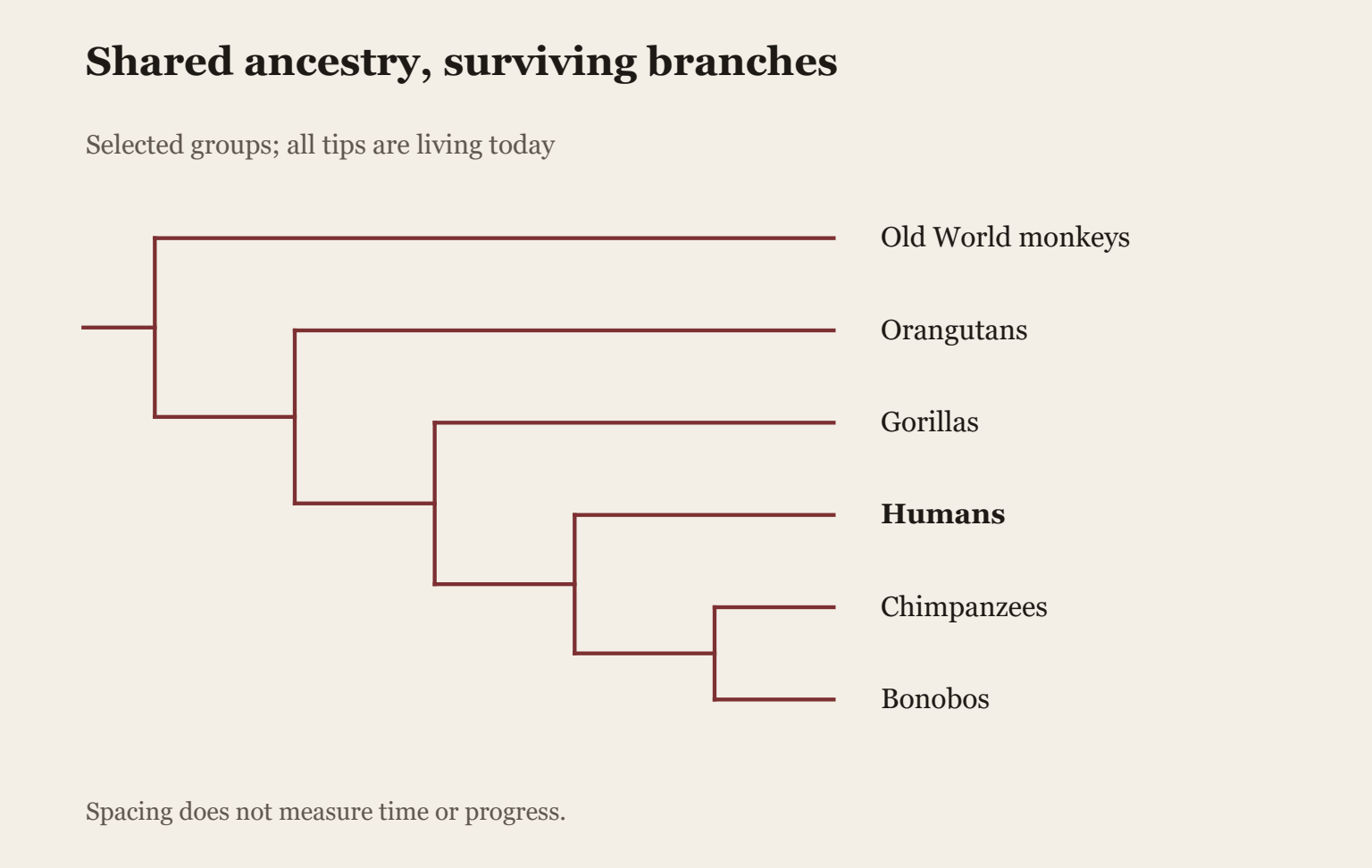
Only selected branches are drawn. Gibbons, New World monkeys, and many other primates are omitted. Node positions and branch lengths carry no numerical age, genetic distance, or degree of progress. [1] [2] [3]
Follow the human branch back to a shared node, then out toward chimpanzees and bonobos. One living tip is not being turned into another. The CSV lists the qualitative connections used in this drawing.
Download the diagram relationships and sources
04Why aren’t they changing now?
An adult changing species is the wrong test.
The question often means: why does nobody see a chimpanzee turn into a human today? Because that is not the predicted event. Evolution concerns inherited population changes across generations, not an adult suddenly rebuilding itself into a different modern species.
A population can change in the frequencies of inherited variants without looking dramatically different in a photograph. A variant is a version of a DNA sequence. Visible body shape is only one part of biological change. [27]
Living chimpanzees also have their own evolutionary history. They are not unchanged ancestors left behind while we did all the evolving. Common ancestry gives both descendant branches a history; it does not freeze one branch in the past. [2] [3]
For rapid experiments, researchers can follow organisms with short generations and sample their descendants. The citrate-use experiment discussed later connects a new ability in particular conditions with identified genetic changes. It does not show a modern bacterium turning into a person. [10]
So I ask what change the critic expects, in which population, over how many generations, and why. Watching one adult animal for an afternoon cannot test a claim about millions of years of branching descent. Choose an observation that addresses the claim.
05Where is the middle animal?
A useful fossil contains a particular combination of features.
Someone asks for the missing link as if there must be one creature exactly halfway between two modern species. That expectation treats the family tree like a straight queue. Evolutionary transitions can involve several branches and different features changing at different times.
Tiktaalik is a useful example from Part 9. Its fossil anatomy combines fish features with features relevant to the tetrapod body plan. The original description identifies specimens and geological context. That is more specific than a drawing labelled half fish, half human. [30]
A transitional fossil was a living organism suited well enough to leave remains. It need not have been a broken version of a future animal. Nor must a useful fossil be certified as the exact direct ancestor of a later species.
Gaps are real. Fossilisation and discovery are uneven, and some relationships remain uncertain. But an incomplete record still preserves information. Fossil succession concerns ordered patterns across rock sequences, not a promise to recover every parent and child. [29]
I would ask which transition is disputed, which specimens have been examined, and which features are missing. That produces a checkable discussion. Announcing that every new find creates two more gaps turns any possible discovery into an automatic failure. That rule cannot fairly test evidence.
06“I accept only microevolution.”
State the barrier instead of hiding it inside a label.
Microevolution usually concerns changes within populations. Macroevolution concerns patterns at and above the species level, including branching, extinction, and changes across long spans. Those are different scales of investigation, not two unrelated kinds of nature. [4]
Accepting a small change does not automatically establish every proposed large historical transition. Large claims need their own fossil, genetic, geographical, and other evidence. I should not pretend that watching antibiotic resistance alone photographs the whole history of mammals.
But the reverse shortcut also fails. Calling a change micro does not identify a mechanism that forbids further divergence. What stops it? A chemical limit? An inherited barrier? A measured maximum? State the proposed restriction so it can be investigated.
Branching and extinction also matter. Macroevolution is not simply one organism growing slightly larger forever. Different populations can separate; some lineages disappear; the survivors produce a pattern that must be reconstructed from multiple records. [4]
My answer is therefore a demand for detail: which evolutionary step is impossible, and what evidence establishes the impossibility? A label is useful when it organises a question. It becomes an escape hatch when it replaces the explanation it was supposed to provide.
07“But bacteria stay bacteria.”
Evolution does not predict that descendants leave every ancestral group.
A critic sees an experiment and replies that the bacteria are still bacteria. That may be perfectly true. It does not establish that nothing evolved. The relevant question is what inherited property changed and whether the experiment measured it.
If a lineage branches, its descendants retain their ancestry. Humans did not stop being mammals when our lineage separated from other mammals. Likewise, asking a bacterial descendant to stop belonging to every ancestral category misunderstands the expected pattern.
There is also a scale problem. A short bacterial experiment is not offered as a complete replay of animal evolution. It can test particular mechanisms or abilities. The larger historical explanation rests on additional comparisons and records. [4] [10]
Suppose someone demands a cat giving birth to a horse. That is an imagined event, not an evolutionary prediction. Rejecting evolution because that event was not observed is like rejecting a family history because nobody instantly changed into a distant cousin.
I would ask for the criterion before showing the experiment. If a new ability is dismissed because the organism keeps its ancestry, no possible descendant can qualify. The challenge has been designed so that the expected evolutionary result is counted as failure.
08Has a new species been seen?
Use a stated criterion and read the study’s limits.
Species boundaries require evidence. Biologists examine separately evolving lineages, using genetics, reproduction, anatomy, and other relevant observations. No single test works identically for sexual animals, bacteria, and fossils. Naming a group alone settles nothing. [5]
Tragopogon miscellus is a natural plant example involving hybrid ancestry and chromosome doubling. Research traces its formation in the early twentieth century and compares inherited gene copies with those of its parental species. It is not a flower turning into an animal. [6]
The Big Bird finch study followed a hybrid lineage in the wild. An immigrant G. conirostris male bred with a local G. fortis female. Later descendants bred within the new lineage, showing reproductive isolation from the local parental population. [7]
The authors explicitly say isolation from the other parent population, on another island, was not experimentally tested. I will not turn observed local isolation into a measured inability to breed with both parent species everywhere. Their conclusion concerns an incipient hybrid species. [7]
These cases show why the question needs precision. Ask which lineage formed, what changed, and which boundary was tested. You can challenge those observations or their interpretation. Saying that every example must remain a broad biblical kind supplies no boundary until kind is defined.
09Does change only cause damage?
A DNA change is not defined by whether we like its effect.
Mutation means a change in DNA sequence. Calling every mutation damage builds the conclusion into the word. Its effect can be harmful, helpful, or slight. Environment and genetic background matter. [27]
Some useful changes involve losing a costly function. Others alter when a gene works, change a protein, or involve duplicated material. Duplication means that a stretch of DNA has been copied; its consequences are not automatically beneficial or harmful. [28]
In a long-running E. coli experiment, one lineage gained the ability to use citrate under oxygen-rich conditions. Genomic analysis identified a duplication that placed a citrate-transporter gene under a different regulatory influence. The existing transporter could then be used in that setting. [10]
That was not the creation of an entire cell or a brand-new transporter from nothing. It was a condition-specific functional gain involving a changed arrangement of existing material. Pretending it was nothing because material already existed changes the question after the result.
I would compare the ancestor and descendant under the specified conditions, then examine the genetic explanation. A particular loss does not establish that all changes are losses. A particular gain does not establish that every mutation improves an organism. Both exaggerations are avoidable.
10Can randomness build anything?
Random variation does not make every outcome equally likely.
Critics sometimes describe evolution as a complete body appearing in one accident. That skips reproduction, inheritance, selection, and generations of change. A process retaining inherited material becomes a one-shot lottery.
Mutation is not a service that reliably supplies whatever an organism currently needs. In the classic Luria-Delbruck experiment, variation among bacterial cultures supported resistance mutations arising before exposure to the bacterial virus used in the test. The agent was a virus, not an antibiotic. [8]
Random does not mean that every DNA position changes at the same rate. Genome studies measure biases associated with sequence context and repair processes. Such biases do not mean a mutation foresaw a future task and chose the right solution. [9]
Natural selection means inherited differences affect reproductive success in a setting. More descendants can make a variant more common. Chance shifts in variant frequencies, called genetic drift, also matter.
My short answer is that variation and sorting are different parts of the explanation. Ask which part an objection targets. Calculating the odds of a complete modern organism assembling in one uniform draw does not calculate the probability of the evolutionary process being proposed.
11What about impossible odds?
A probability needs a specified event and a specified process.
Someone writes a gigantic number and announces that a protein is impossible without God. I ask what was calculated. One exact sequence? Any sequence with a relevant function? One attempt, or a population across generations?
A protein is a chain of amino acids that can perform biological roles. Calculating one exact modern sequence by drawing each position independently and uniformly is a mathematical exercise. It becomes an evolutionary argument only if those assumptions describe the process under dispute.
Existing inherited sequences, duplication, different useful functions, and intermediate effects can change the problem. The gene-duplication experiment in the next sections provides a concrete case of functional divergence rather than a fresh uniform draw of an entire finished system. [11]
Not every imaginable route is likely; not every intermediate works. Proposed steps require biological support. Cumulative change is a starting explanation. Identifying actual variants and measuring functions provides stronger evidence.
Ask for the event, assumptions, opportunities, and rejected alternatives. Then ask how the number selects a particular god. A calculation about one natural route cannot, by itself, establish a designer’s existence or identity.
12Does information require a mind?
Define the quantity before announcing its source.
DNA is often compared with a written message. The comparison can help explain inheritance, but it cannot by itself prove an author. Calling something a code does not establish that its physical origin must match the origin of a human book.
Information can mean sequence length, statistical uncertainty, or biological effect. Those are different quantities. Copying can increase DNA length without creating a useful ability. Regulatory change can alter ability without adding a whole new protein. [10] [28]
So when someone says information never increases, I ask what is being measured. How would the claim be tested? Does a duplicated gene with an altered function count? If no possible observation can count, the claim is protected by definition.
Experiments can examine copies, mutations, expression, and function. Those measurements are more useful than an argument that slides between different meanings of information. The next example follows gene copies becoming functionally different under selection. [11]
The honest atheist answer is not that every problem about biological origins has been solved. It is that a metaphor is not a causal demonstration. To establish a mind behind DNA, identify evidence for that mind and explain why competing physical accounts fail in the relevant case.
13Can gene copies take new jobs?
The starting setup belongs in the explanation.
In 2012, Nasvall and colleagues studied Salmonella bacteria with a gene that weakly supported two enzyme activities. An enzyme is a biological catalyst: it helps a chemical reaction proceed. The experiment followed amplification and later functional divergence under selection. [11]
The setup was arranged. Researchers selected a spontaneous mutant with both activities, then put its gene in a controlled genetic construct. They removed the usual corresponding genes, making growth depend on the dual-function gene. These details matter. [11]
During continued growth under the study’s conditions, copies increased and accumulated changes. Descendant gene variants included specialists with improved performance in one of the two activities. Researchers tested the functions rather than inferring them only from sequence appearance. [11]
This supports a particular route: an existing weak activity, amplification, and divergence into functionally distinct copies. It does not show life appearing from non-life, or every possible new gene originating this way. The controlled starting system limits how broadly the result should be applied.
I would show the starting arrangement beside the descendant measurements. Researchers supplied the experimental design, not every later mutation. A designed test can measure a physical process without proving a designer directed that process throughout nature.
14What use is an unfinished eye?
Detecting light can be useful without making a detailed picture.
The phrase half an eye encourages a misleading image: half of a modern eyeball sliced away. Evolutionary proposals concern earlier functional arrangements, not a modern organ damaged in an accident. A structure can be useful before it does everything our eyes do.
Detecting light is a different task from forming a sharp image. Detecting its direction is another. An organism need not recognise a face to benefit from responding differently to light from different directions. Those are separate abilities that can be investigated.
Jekely and colleagues studied light-directed swimming in marine worm larvae. Their simple eyespots contain a photoreceptor and a pigment cell. Targeted illumination and movement analysis connected the eyespot system with changes in the beating of swimming cilia. [12]
A photoreceptor is a light-sensitive cell. Pigment can shade it, making the response depend on light direction. Cilia are tiny beating projections used here for movement. This is an observed working system, not a declaration that the larva is our direct ancestor. [12]
My answer is to replace unfinished with less elaborate and ask what the structure can do. The study does not settle the full origin of human vision. It does defeat the blanket claim that anything less than a complete image-forming eye is necessarily useless.
15Has an eye been built in a study?
An optical model is useful evidence of possibility, with assumptions.
Nilsson and Pelger’s 1994 paper modelled changes from a light-sensitive patch toward a lens-bearing eye. They examined how changes in shape and optical properties could improve spatial information under their assumptions. It is a theoretical optical analysis. [13]
That matters because a proposed intermediate can be evaluated for performance instead of dismissed merely for being simpler than our eye. The model asks whether progressive optical improvement is possible along the examined route. It does not film an ancient population.
The starting light-sensitive system is assumed. The paper does not evolve the full chemistry of light detection, every required gene, the optic nerve, and a human visual brain from scratch. It is not a laboratory animal growing a new eye in front of the researchers.
Its estimated timescale also follows modelling assumptions. I would not present that estimate as a measured date for the actual origin of eyes. Demonstrating a workable route in a model and identifying the historical route are related but different achievements. [13]
If a believer asks for the complete history, I will not sell this paper as the complete history. If the claim is that no useful gradual optical route can exist, the model directly addresses that narrower objection. Match the evidence to the claim it can test.
16Could dependence evolve?
Removing a part today does not reproduce every earlier version.
An irreducible-complexity argument says removing a present part causes failure, so the system could not have evolved. The first claim is testable. The second does not follow automatically. Earlier systems may have had different parts or capacities.
Finnigan and colleagues studied the V-ATPase, a molecular machine involved in pumping protons. They inferred ancestral protein sequences from living relatives, made those proteins, and tested their functions in yeast. The ancestral sequences are reconstructions, not molecules dug out of ancient rock. [14]
Their results supported a simpler ring with two subunit types preceding one with three. After duplication, descendant proteins lost different interaction capacities. Together they retained the required operation; individually, each could no longer cover the other’s role. Dependence had increased. [14]
Alternative reconstructed sequences checked important uncertainties. This result concerns increased complexity and dependence, without evidence of a new function in the tested system. I will not call it a demonstration of an entirely new enzyme activity.
Current necessity does not establish original necessity. Ask about duplication, earlier functions, and tested ancestral reconstructions. This case does not solve every molecular machine’s history. It exposes the gap in the impossibility argument.
17What about the bacterial motor?
Related parts supply clues about their history.
A bacterial flagellum is a structure that can help a bacterium move. Its complexity is often presented as proof that all components had to appear together. The useful question is whether comparative biology can investigate its components and their history.
Some flagellar components are related to components of non-flagellar type III secretion systems. Those systems move material across bacterial membranes and, in relevant cases, into host cells. Related components can have roles outside the complete movement system. [15]
But I will not repeat the simplistic claim that a modern secretion injector is a proven earlier stage of every flagellum. Abby and Rocha’s comparative analysis supports the non-flagellar secretion system deriving from the flagellar lineage, not that easy reverse story. [15]
The study uses comparative genomes and evolutionary inference. It does not experimentally replay the entire origin of a flagellum from bare chemicals. Relationships among components, losses, and changes of function are evidence to examine; a complete historical account requires more than a resemblance.
My answer can therefore be firm and limited: present complexity is not a proof of sudden assembly or a named god. Some history is investigable, and some details remain open. I do not need an invented complete story to reject an unsupported claim of impossibility.
18Does entropy forbid evolution?
Count the energy flows instead of treating Earth as isolated.
The objection says everything becomes more disordered, so life cannot become organised. The second law of thermodynamics is more precise than that slogan. It concerns entropy and, for an isolated system, the requirement that total entropy does not decrease.
Entropy is a physical quantity related to energy distribution and possible microscopic arrangements. Calling it mess is a limited analogy. Biological complexity and entropy are different quantities. A tidy-looking object is not a thermodynamic calculation.
Earth receives energy from sunlight and releases energy to space. An account must include those exchanges and the entropy involved. The law still applies. It does not require every local part of a larger interacting system to become less organised at every moment. [16]
Bunn’s analysis addresses the claimed thermodynamic prohibition by comparing the relevant entropy budget. It does not establish that every proposed evolutionary pathway happened. It shows why treating biological change as if Earth were an isolated system is a faulty objection. [16]
I would ask for the actual system boundary, energy flows, and calculation. Saying everything falls apart is not enough. The existence of an energy flow does not prove a particular history, but a misapplied physical law cannot honestly disprove that history either.
19“Sunlight cannot build an eye.”
Correct. Energy alone is not the evolutionary explanation.
A useful follow-up says that pouring energy into something can destroy it. Sunlight does not automatically organise a pile of chemicals into an animal. I agree. The earlier answer removed a supposed thermodynamic ban; it did not supply a complete biological mechanism.
Living organisms use chemical processes that couple energy transfers to particular reactions. Evolutionary explanations additionally involve reproduction, inherited differences, and changes in populations. Stating only that Earth receives energy leaves out most of what needs explaining.
Bunn’s paper is relevant to whether the entropy argument blocks evolution. Its budget analysis is not a demonstration of how every organ was constructed, a prediction of evolutionary speed, or a complete explanation of the origin of life. [16]
This distinction prevents a weak atheist reply. If I only say the Sun did it, I have not answered how a particular biological system works or arose. For that, we need the relevant chemistry, genetics, functional tests, and historical evidence.
So I separate two questions. Is there a physical law forbidding the proposed change? What evidence supports the actual mechanism and history? Removing a bad objection is useful. It must not be advertised as doing all the positive evidential work by itself.
20Why isn’t life perfectly designed?
Evolution does not promise the best imaginable organism.
Survival of the fittest sounds like a competition to become universally strongest or smartest. Biological fitness concerns reproductive contribution in a particular setting. A trait’s advantage can depend on food, competitors, climate, partners, and other inherited traits.
A change can help in one setting and impose a cost in another. Selection works with available variation and existing bodies. It is not a promise that every population reaches the best imaginable design or that every useful mutation appears on demand.
The MEGA-plate study in Part 9 makes the importance of setting visible. Researchers followed bacterial spread across an arranged antibiotic landscape. The most resistant sampled variants did not automatically lead the advancing front; spatial position affected which lineages expanded. [18]
That observation does not mean selection is fake. It means reproductive success in the actual environment cannot be replaced by ranking organisms on one laboratory measurement. Resistance, location, and opportunities to expand are different aspects of the case.
I would ask what fitness means in the disputed example and how it was measured. The absence of a perfect organism does not refute an explanation that never promised perfection. Equally, an awkward feature alone does not identify its complete evolutionary history.
21Why do some forms persist?
A familiar outline does not mean an unchanged genome.
A coelacanth is often called a living fossil. The phrase can suggest that an ancient species stayed completely unchanged while evolution happened elsewhere. That is much more than a resemblance between some living and fossil forms establishes.
The African coelacanth genome study found slower evolution in protein-coding genes compared with tetrapods, while other genomic features did not show the same pattern. Slower is not stopped. A rate for one category is not automatically a rate for everything. [19]
External similarity can also hide change in physiology, behaviour, or DNA. Conversely, a conspicuous visible difference does not tell us by itself how much of the genome changed. The chosen feature and comparison matter.
Evolution does not require every lineage to change its body shape at the same speed. Persistence of a useful arrangement and substantial change in another lineage are compatible possibilities. To establish a particular explanation, examine the relevant environment, traits, and genetic record.
My answer is to ask what supposedly remained unchanged and how that was measured. The broad shape? One gene? Every nucleotide? Calling something a living fossil supplies none of those measurements. The actual genome study gives a more interesting answer than the slogan.
22Did animals appear overnight?
A geological explosion is not one afternoon.
The Cambrian explosion refers to a major diversification visible in the early animal fossil record. The word explosion does not mean that all modern animals appeared fully formed in a single day. The timescale is geological, and the preservation record matters.
Smithsonian’s fossil overview also describes complex life before the Cambrian, including Ediacaran organisms. Those fossils do not settle every relationship to later animal groups. They do prevent the record from honestly being described as absolutely nothing living, then everything at once. [20]
Different body plans, ecological interactions, and preservation conditions raise genuine research questions. How rapidly did particular lineages diversify? Which earlier organisms are related? What does a fossil deposit preferentially preserve? Those are questions for evidence, not embarrassment to conceal.
An incomplete early record limits detailed reconstruction. It does not automatically establish a miraculous event. To support that further claim, someone needs evidence that selects it over competing accounts, not merely a name for a period of rapid change.
I would put the relevant fossils on a timeline, with uncertainties and scale shown. Then ask which specific appearance conflicts with which evolutionary claim. A word that sounds sudden in everyday conversation cannot replace the actual ages, organisms, and geological context.
23Did humans live with dinosaurs?
First distinguish birds from non-bird dinosaurs.
There is a trap inside this question. Birds are surviving dinosaurs, so humans live with dinosaurs in that biological sense today. The usual debate concerns non-avian dinosaurs such as Triceratops or Tyrannosaurus, not the pigeon outside. [21]
Non-avian means non-bird. The major extinction that ended those dinosaur lineages occurred about 66 million years ago. Modern humans appear vastly later. Early Homo sapiens fossils at Jebel Irhoud are associated with an age of roughly 300,000 years. [21] [22]
The Jebel Irhoud study dated heated flints associated with the fossils and included a tooth-based analysis. The reported estimates have uncertainties. The result is not an exact birthday for the first human, nor proof that our species originated at only that location. [22]
Stories, carvings, and apparent monster pictures need their own provenance and interpretation. A resemblance to a modern dinosaur illustration does not automatically establish eyewitness contact. A claimed fossil footprint needs geological context and evidence that it is actually the claimed trace.
I would ask for an authenticated human find in an undisturbed context with the relevant non-bird dinosaur, plus defensible dating. That is a checkable challenge. Calling every dragon a dinosaur and every old story an eyewitness report skips the steps needed to establish coexistence.
24Does preserved material mean young?
The chemistry matters more than the dramatic headline.
A headline about soft tissue in a dinosaur fossil can sound like someone found fresh meat or flowing blood. That is not a safe description of the claim. Researchers examine preserved structures, chemical signals, contamination, and the conditions that could explain survival.
Schweitzer and colleagues investigated iron and oxygen chemistry in preservation. Their work included fossil material and experiments on ostrich tissues. Haemoglobin treatment greatly extended preservation under the experimental conditions compared with untreated controls. [23]
The modern experiment lasted on a human research timescale. It did not reproduce tens of millions of years in a laboratory. It investigated a possible preservation mechanism. I will not turn that into a completed account of every ancient molecule ever reported.
Equally, unusual preservation does not by itself reset the geological age to a few thousand years. A serious challenge must address what material was identified, whether contamination was excluded, how preservation could work, and the independent geological context.
The paper is not a report of an intact dinosaur genome. Preserved tissue-like structures, protein evidence, fresh cells, and recoverable DNA are different claims. I would open the methods before accepting either miracle preservation or obvious fraud as an all-purpose answer.
25What about Piltdown man?
A real hoax requires exposure, not excuses.
Piltdown was a fraud. I gain nothing by pretending otherwise. Later genetic and morphological work examined the manipulated material and the combination of human and orangutan remains. The case belongs in the history of scientific failure as well as correction. [24]
The useful question is what follows from that failure. One forged specimen establishes that this specimen was not what it was claimed to be. It does not establish that every independently examined fossil, DNA comparison, and bacterial experiment is another forgery.
Imagine discovering a counterfeit banknote. You would investigate its features and source. You would not thereby have demonstrated that every banknote in every bank was printed by the same counterfeiter. This is an analogy about the scope of an inference.
Scientific institutions can reward prestige, resist criticism, and make serious mistakes. Those human weaknesses are reasons to demand methods, provenance, independent checks, and correction. They are not evidence that a particular religious creation story is historically accurate.
I would ask which present evidence depends on the exposed forgery. Remove the bad evidence and assess what remains. If the larger case survives through independent findings, endlessly repeating the fraud’s name is not a response to those findings. The same standard should apply to every side.
26Did Darwin admit defeat?
Read the argument around the famous difficulty.
A short quotation can make Darwin sound as though he announced that the eye refuted his own explanation. In Chapter VI of the 1859 Origin of Species, he acknowledged how formidable the difficulty seemed, then discussed useful gradations and inherited variation. Read the surrounding argument. [25]
Pointing out a difficulty is not the same as accepting an impossibility. Nor does recognising that context make every detail of Darwin’s nineteenth-century account correct. He lacked the modern genetic evidence we can examine today.
I do not need to defend a founder as if he were a prophet. A mistaken statement by Darwin would need correcting. It would not erase later experiments or DNA comparisons that stand on their own methods and results.
The eye studies discussed earlier should therefore be assessed directly. What did the larval experiment observe? What did the optical model assume? Those questions are more useful than deciding whether one historical scientist sounded confident in a selected sentence. [12] [13]
My reply is simple: show the full passage, establish what it actually argues, then return to current evidence. A theory of nature is not validated by the purity of a famous person’s biography, and it is not overturned by editing a paragraph into a slogan.
27“Science keeps changing.”
Correction needs evidence; confidence should match the claim.
Theory in everyday speech can mean a guess. In science it can mean an explanatory framework connecting evidence and testable claims. Calling evolution a theory does not tell us it has no supporting observations. We must examine what those observations establish. [1] [17]
Scientific conclusions also differ in scope. The exact placement of a fossil can remain disputed while broader common ancestry has extensive support. Revising one estimated age is not automatically a collapse of geological time. State which conclusion changed and why.
This is not permission to call every revision progress. A change can be poorly supported or wrong. The useful feature is that methods, observations, and competing explanations can be criticised and checked; a scientist’s title does not settle the result.
Ayala’s discussion of science and creationism is explanatory commentary, not a new experiment. I cite it for the methodological distinction, while the empirical examples here point to original studies. Different kinds of source should not be made to do the same job. [17]
I would ask what observation would force a revision of the disputed claim. Then ask the same of the alternative. If every possible discovery can be reinterpreted as confirmation, the alternative may express a conviction, but it has supplied no discriminating test.
28Who made the first living thing?
That question deserves its own evidence.
Evolutionary biology explains changes in reproducing populations and their histories. Life’s origin concerns how the earliest relevant chemical and reproductive systems arose. These questions connect, but they are different. Distinguishing them does not make either disappear. [26]
The experiments in this chapter begin with living organisms or existing biological components. They do not create a first cell from non-living material. Anyone presenting them as a complete laboratory solution to life’s origin would be overstating their scope.
An incomplete origin account also does not erase measured inherited changes, gene duplication, or fossils. Not knowing how the first language began would not prevent us from comparing documented later languages. That is an analogy about distinct historical questions, not evidence for abiogenesis.
Nor does an unanswered question establish Allah, Bhagwan, or a particular creation narrative. That additional conclusion needs evidence connecting the unknown event to the proposed agent. Mystery alone does not identify its own answer.
Both statements stand: life’s origin is not fully settled, and evolution has substantial independent evidence. Part 12 addresses first life. I will not smuggle a complete solution into this chapter or abandon established observations because a different question remains open.
29Does evolution prove no God?
Test a particular claim instead of inflating the conclusion.
No experiment here rules out every imaginable creator. A creator defined as using natural processes might be made compatible with evolution. Compatibility, however, is not evidence that this creator exists. Those are different claims.
Evolutionary evidence can conflict with a particular physical story: for example, a claim that humans have no shared biological ancestry with other animals. Dating evidence can conflict with a recent creation of all earthly life. The wording and interpretation of the claim must be specified.
If a believer reads a story symbolically, I need to assess the revised claim rather than insist that every believer holds the same literal chronology. I can still ask why that interpretation should be accepted and what evidence supports its further theological conclusions.
My position is blunt: you cannot move from I cannot explain this to therefore my holy book is true. You need evidence for the proposed god, the alleged action, and the book’s connection to it. None of those arrives automatically through a gap in my knowledge.
I reject unsupported claims because their support fails, not because I possess an explanation for everything. The case for evolution concerns the history of living populations. My broader atheism requires examining religious arguments separately, which this series continues to do.
30How would I explain it?
One objection, one check, and an honest stopping point.
I would begin with one question: do you mean living monkeys must disappear if humans share ancestors with them? Then I would draw two branches from one earlier population. Both tips can survive. That is the short explanation; it clears up the claim before presenting evidence.
Next I would open one source that addresses the person’s actual challenge. For new functions, compare the starting gene and descendant assays. For species separation, read the mating record and its limits. For a fossil, inspect the specimen description and geological context.
I would ask what result would count against their present view and state what would weaken my own specific explanation. A mistaken fossil placement would weaken that placement. A failed functional assay would challenge that functional claim. Neither should be hidden behind a grand slogan.
If the discussion jumps from monkeys to eyes to the Big Bang without examining any answer, I would return to the unfinished question. A long list of objections is not evidence that each objection succeeded. One checked claim is more useful than twenty abandoned accusations.
I cannot guarantee that someone changes their mind. Identity, trust, family, and fear can shape a conversation. My job is to explain clearly and keep the evidence accessible. Humiliating the person is unnecessary; refusing to let an unsupported claim pass as a proof is necessary.
NoteI want checked answers.
Bluntness is useful only when the reasoning is sound.
I wrote this chapter because familiar objections can sound devastating when nobody slows down to define them. Why are monkeys still here? What use is half an eye? How can information grow? The confidence of the question is not evidence for its implied answer.
I reject weak atheist answers too. Models, inferred ancestral proteins, and local reproductive isolation each have limits. Being an atheist does not exempt me from stating them.
I want readers to open sources, identify observations, and recognise uncertainty without first learning an entire university course. Plain language invites examination. It does not justify removing the details that give an argument meaning.
If a particular explanation fails, I should change it. If a genuine unknown remains, I should say so. I will not turn ignorance into a divine certificate, and I will not cover ignorance with scientific vocabulary that I cannot explain.
My standard stays the same: show the claim, show the evidence, and keep the conclusion inside its support. A belief worth confidence should survive checking. A belief requiring protection from checking has not earned my trust.
SourcesFollow the evidence.
Sources checked on 15-16 October 2026. Original studies support particular observations and interpretations; institutional resources explain terms and broader context. The Ayala source is commentary, and Darwin is a historical primary text. This chapter is an explanation, not independent replication or reanalysis of all original data. Family branches, addresses, lotteries, banknotes, language history, and imagined conversations are original explanatory analogies, not experiments. The branching figure is an original qualitative schematic: selected living groups, omitted branches, and no numerical dates or meaningful branch lengths. Its CSV records drawn relationships, not measured sequence data. The finch account retains the untested other-parent limitation. The gene experiment discloses its arranged starting system. Eye modelling, ancestral-protein inference, and a thermodynamic budget are distinguished from complete historical replays. The flagellar study’s proposed direction is not reversed for convenience. Soft-tissue preservation is not presented as fresh blood, recovered dinosaur DNA, or a laboratory replication of deep time. Parts 6-9 provide dating, mechanisms, genetic evidence, fossils, and further experiments. Unknowns about first life or particular evolutionary pathways do not by themselves identify a creator or validate a holy book.
[1] Frequently Asked Questions
Smithsonian National Museum of Natural History / Human Origins Program
Institutional explanation of human ancestry and scientific theory. Living relatives are distinguished from ancestral populations; broad dates on this overview are not used as precise dating results.
[2] Genetics
Smithsonian National Museum of Natural History / Human Origins Program
Explains nested genetic relationships among humans and other great apes. The chapter avoids treating a single similarity percentage, or an older overview date, as the entire ancestry argument.
[3] Complete sequencing of ape genomes
DongAhn Yoo, Arang Rhie, Shilpa Hebbar and colleagues / Nature 641 / 2025 / doi:10.1038/s41586-025-08816-3
Original comparative-genome resource extending coverage of difficult regions in living apes. Better assemblies add evidence to investigate; they are not DNA recovered from the common ancestor.
Open the original study or supporting record
[4] What is macroevolution?
University of California Museum of Paleontology / Understanding Evolution
Institutional definition of patterns at and above species level, including branching and extinction. Mechanistic continuity is not used as a substitute for evidence about a particular large historical transition.
[5] Species Concepts and Species Delimitation
Kevin de Queiroz / Systematic Biology 56 / 2007 / doi:10.1080/10635150701701083
Distinguishes separately evolving lineages from operational evidence used to delimit them. Reproductive isolation is relevant in appropriate cases, not a universal identical checklist for every organism.
[6] Evolution and Expression of Homeologous Loci in Tragopogon miscellus (Asteraceae), a Recent and Reciprocally Formed Allopolyploid
Jennifer A. Tate and colleagues / Genetics 173 / 2006 / doi:10.1534/genetics.106.057646
Original study of a naturally formed hybrid plant lineage with genome doubling. Formation is placed in the early twentieth century; the paper’s relative age is not counted forward from today.
Open the original study or supporting record
[7] Rapid hybrid speciation in Darwin’s finches
Sangeet Lamichhaney and colleagues / Science 359 / 2018; online 2017 / doi:10.1126/science.aao4593
Original report with AAAS annotations. Directly followed Big Bird pedigree and local isolation; the authors explicitly state that isolation from the other parent population was not experimentally tested.
Open the original study or supporting record
[8] Mutations of Bacteria from Virus Sensitivity to Virus Resistance
Salvador E. Luria and Max Delbruck / Genetics 28 / 1943 / doi:10.1093/genetics/28.6.491
Original fluctuation-test paper. The selective agent was a bacterial virus. The result is not presented as showing that every mutation process has an identical rate or is unaffected by cellular conditions.
Open the original study or supporting record
[9] Determinants of spontaneous mutation in the bacterium Escherichia coli as revealed by whole-genome sequencing
Patricia L. Foster and colleagues / PNAS 112 / 2015 / doi:10.1073/pnas.1512136112
Original mutation-accumulation and sequencing study. Mutation biases and repair backgrounds distinguish random with respect to need from uniform probability at every DNA position.
Open the original study or supporting record
[10] Genomic analysis of a key innovation in an experimental Escherichia coli population
Zachary D. Blount, Jeffrey E. Barrick, Carla J. Davidson and Richard E. Lenski / Nature 489 / 2012 / doi:10.1038/nature11514
Original analysis of aerobic citrate use, including regulatory rearrangement and historical genetic background. A condition-specific gain is distinguished from inventing an entire transporter or cell from nothing.
[11] Real-time evolution of new genes by innovation, amplification, and divergence
Joakim Nasvall, Lei Sun, John R. Roth and Dan I. Andersson / Science 338 / 2012 / doi:10.1126/science.1226521
Original paper read for the selected dual-function mutant, engineered starting construct, amplification, and functional tests. Descendant specialisation is observed; the setup is not concealed or called a life-origin experiment.
Open the original study or supporting record
[12] Mechanism of phototaxis in marine zooplankton
Gaspar Jekely and colleagues / Nature 456 / 2008 / doi:10.1038/nature07590
Original experiments on a simple larval eyespot and light-directed swimming. A functioning non-image-forming system is not described as our exact ancestral eye.
[13] A pessimistic estimate of the time required for an eye to evolve
Dan-Eric Nilsson and Susanne Pelger / Proceedings of the Royal Society B 256 / 1994 / doi:10.1098/rspb.1994.0048
Theoretical optical model beginning with light sensitivity. It is not a laboratory replay, a complete genetic account, or a measured historical timescale.
Open the original study or supporting record
[14] Evolution of increased complexity in a molecular machine
Gregory C. Finnigan, Victor Hanson-Smith, Tom H. Stevens and Joseph W. Thornton / Nature 481 / 2012 / doi:10.1038/nature10724
Original ancestral-reconstruction and yeast experiments. Complementary losses after duplication increased subunit dependence; this specific result is not labelled acquisition of a novel biochemical function.
Open the original study or supporting record
[15] The Non-Flagellar Type III Secretion System Evolved from the Bacterial Flagellum and Diversified into Host-Cell Adapted Systems
Sophie S. Abby and Eduardo P. C. Rocha / PLoS Genetics 8 / 2012 / doi:10.1371/journal.pgen.1002983
Original comparative phylogenomic analysis. Its proposed direction is flagellum to non-flagellar secretion system. Homology is not advertised as an experimentally replayed complete flagellar origin.
Open the original study or supporting record
[16] Evolution and the second law of thermodynamics
Emory F. Bunn / American Journal of Physics 77 / 2009 / doi:10.1119/1.3119513
Author preprint of the thermodynamic analysis. A physical entropy budget addresses an alleged prohibition; it is not a reconstruction of organs, a biosynthesis recipe, or a measured evolutionary timescale.
Open the original study or supporting record
[17] Science, evolution, and creationism
Francisco J. Ayala / PNAS 105 / 2008 / doi:10.1073/pnas.0711608105
Explanatory editorial about scientific method and theory, not a new experiment. Cited for that distinction; the empirical examples use the original studies listed separately.
Open the original study or supporting record
[18] Spatiotemporal microbial evolution on antibiotic landscapes
Michael Baym and colleagues / Science 353 / 2016 / doi:10.1126/science.aag0822
Original MEGA-plate study. Spatial opportunity and resistance are distinguished; the most resistant sampled variants did not necessarily lead the front. The setup diagram and fuller explanation are in Part 9.
Open the original study or supporting record
[19] The African coelacanth genome provides insights into tetrapod evolution
Chris T. Amemiya and colleagues / Nature 496 / 2013 / doi:10.1038/nature12027
Original genome study. Slower protein-coding evolution compared with tetrapods is distinguished from rates of other genomic features; living fossil is not treated as an unchanged entire genome.
[20] Ocean Through Time
Smithsonian National Museum of Natural History / Ocean
Institutional fossil overview including Ediacaran life before the Cambrian and later animal diversification. No single-day event or complete resolution of Ediacaran relationships is claimed.
[21] Why are birds the only surviving dinosaurs?
Natural History Museum, London
Institutional explanation of birds as surviving dinosaurs and the extinction of non-bird dinosaurs around 66 million years ago. Tyrannosaurus is not described as the direct ancestor of living birds.
[22] The age of the hominin fossils from Jebel Irhoud, Morocco, and the origins of the Middle Stone Age
Daniel Richter and colleagues / Nature 546 / 2017 / doi:10.1038/nature22335
Original context and dating study, including heated flints associated with fossils and tooth analysis. Roughly 300,000 years is not an exact first-human birthday or an exclusive geographical origin.
Open the original study or supporting record
[23] A role for iron and oxygen chemistry in preserving soft tissues, cells and molecules from deep time
Mary H. Schweitzer and colleagues / Proceedings of the Royal Society B 281 / 2014; online 2013 / doi:10.1098/rspb.2013.2741
Preservation study including fossil chemistry and a modern ostrich-tissue experiment. The experiment is not a laboratory replication of millions of years, a report of fresh dinosaur blood, or a dinosaur genome.
Open the original study or supporting record
[24] New genetic and morphological evidence suggests a single hoaxer created “Piltdown man”
Isabelle De Groote and colleagues / Royal Society Open Science 3 / 2016 / doi:10.1098/rsos.160328
Original reanalysis of manipulated human and orangutan material. The chapter acknowledges fraud without treating it as evidence that every independent fossil or experiment is forged.
Open the original study or supporting record
[25] On the Origin of Species, first edition, Chapter VI
Charles Darwin / 1859 / Darwin Online, F373
Primary historical text. The discussion around the eye difficulty is paraphrased in context, not clipped into a false admission. Modern evidence is assessed independently of Darwin’s authority.
[26] Misconceptions about evolution
University of California Museum of Paleontology / Understanding Evolution
Institutional explanation used here for the distinction between biological evolution and the origin of life. Experiments beginning with organisms are not presented as creating the first life.
[27] Mutation
National Human Genome Research Institute / Talking Glossary
Institutional definition of a DNA-sequence change. The term does not, by itself, specify whether the effect is beneficial, neutral, or harmful in the relevant setting.
[28] Duplication
National Human Genome Research Institute / Talking Glossary
Institutional definition of copied DNA segments. Increased sequence length, changed function, and improved fitness are kept as separate claims.
[29] Fossil Succession
United States Geological Survey / Fossils, Rocks, and Time
Institutional account of the ordered fossil record and correlation. Used for relative pattern, not as a claim that fossil shape alone independently supplies every numerical age.
[30] A Devonian tetrapod-like fish and the evolution of the tetrapod body plan
Edward B. Daeschler, Neil H. Shubin and Farish A. Jenkins Jr / Nature 440 / 2006 / doi:10.1038/nature04639
Original Tiktaalik description. A documented mosaic of anatomical features is distinguished from a certified exact direct ancestor. Part 9 examines the fossil case in more detail.