

01Where are the middle forms?
A reasonable question deserves something you can actually examine.
Someone says: you talk about animals sharing ancestors, but where are the creatures in between? I think that is a fair demand. A drawing in a schoolbook is an explanation of evidence. It is not a substitute for the evidence itself.
The useful answer begins with particular things: a specimen, the place it came from, the features it preserves, the comparisons made, and the limits of the conclusion. Ask for those. A famous name should not end the conversation.
Fossils are physical remains or traces of past life. Experiments provide another kind of record: changes followed in living populations. Those are different routes to evidence. Neither requires treating a scientist as a prophet. [1] [22]
I will use both. We will look at fins with limb-like internal bones, early whales with legs, and a feathered animal with teeth and a long bony tail. Then we will look at measured changes in bacteria, yeast, and plants.
The point is not to overwhelm someone with impressive names. It is to make one question harder to dodge: which explanation actually accounts for the details? If an objection can survive only by ignoring every specimen and experiment, it has become an escape route.
02A fossil is not always a bone.
A body and a trace tell us different things.
A fossil may preserve part of an organism: a shell, a tooth, a leaf, or a bone. It may instead preserve evidence of activity, such as a footprint or burrow. A footprint is evidence that something moved there; it is not the animal itself. [1] [2]
Preservation also varies. Minerals can fill spaces in remains or replace original material. An impression can preserve a shape after the body has disappeared. Fossil does not mean that every specimen formed through exactly the same chemical process. [2]
This matters when someone says nobody found ancient DNA in a particular fossil. DNA is not required to identify every preserved feature. The shape of a joint or the arrangement of teeth can survive when usable DNA does not.
Imagine finding a clear shoe print after the person has left. You have evidence of a shoe-shaped contact, not a recording of the person’s whole life. That is an analogy for the difference between a preserved trace and an unlimited conclusion.
I want descriptions to stay that precise. Is the object original bone, mineral replacement, a mould, a track, or a cast displayed for visitors? A good explanation tells you. It does not hide the nature of the object behind a dramatic reconstruction.
03Most lives leave no fossil.
An incomplete record still contains information.
A dead animal does not automatically become a museum specimen. Remains can decay, be eaten, break apart, or never receive protective burial. Later heat, pressure, erosion, and exposure can destroy evidence that once existed. Preservation depends on conditions. [3]
Finding what survives is another filter. Suitable rock may be buried, underwater, inaccessible, or simply unsearched. Soft tissues and delicate bodies are generally harder to preserve than durable parts. The record is therefore uneven, rather than a complete attendance register. [3]
Think of a damaged family archive. Missing photographs would not prove that the photographed relatives never lived. But neither would a missing photograph allow you to invent anyone you liked and call the invention established history.
That is the balance I want. Gaps limit how much detail we can recover. They do not erase the features of specimens already found. Equally, an empty stretch of the record is not itself a photograph of the proposed ancestors.
So ask where a gap lies and what conclusion depends on it. Is a particular branching order uncertain? Is the timing poorly constrained? Those are useful questions. Repeating that the record is incomplete tells us much less than identifying the actual uncertainty.
04Which layer came first?
Relative order comes before a number of years.
Sediment is material such as sand or mud that accumulates. Over time, some sediment becomes rock. In an undisturbed sequence, a lower deposited layer was there before a layer deposited on top of it. This is the basic idea of superposition. [4]
But the word undisturbed matters. Rock can be folded, faulted, overturned, or cut by later material. A fault is a fracture along which rock has moved. Geologists investigate the structure instead of assuming that every visible stack is a simple upright pile. [4] [5]
Imagine stacking newspapers, then tipping the whole stack over. Its present position would not by itself tell you the original order. You would need other clues. The analogy explains why geological context matters; it is not a dating technique.
A younger intrusion cutting older rock gives a different relationship: the cut material existed before the intrusion. Several relationships can be combined. They establish a sequence even before an isotope measurement supplies an estimated numerical age. [5]
Do not confuse oldest-looking with oldest, or depth with a universal clock. The conclusion depends on how the site formed and changed. That is why the location and surrounding rock belong in a fossil report, alongside the interesting bone.
05Are the dates circular?
Relative order and independent mineral dates do different jobs.
The objection goes like this: scientists date the fossil from the rock, then date the rock from the fossil. There is a real practice called correlation, in which fossil patterns help match layers between places. But that is not the whole basis of geological time. [6] [7]
Radioactive dating uses measured isotope relationships and a decay model to estimate an event such as mineral crystallisation. An isotope is a version of an element with a different neutron count. Part 6 explains the clocks, assumptions, checks, and uncertainties in more detail. [6]
Suppose a fossil-bearing layer sits between two dated volcanic ash layers. That can bracket its age, if the ash formed and was deposited as interpreted. The number is not simply read from the fossil’s shape. This is a hypothetical example of the method.
Not every fossil can be dated directly, and not every isotope clock dates the same event. Radiocarbon is not a universal tool for ancient dinosaurs. Contamination, disturbed systems, and reworked material require checks; a date without its method is unfinished evidence. [6]
I would ask which material was measured, which event it dates, what uncertainty was reported, and how the site connects to that result. A specific failure deserves investigation. Calling every date circular without examining those steps skips the evidence rather than refuting it.
06A working animal, not a broken one.
Different features can change at different times.
When I say transitional fossil, I do not mean a helpless creature halfway through turning into something else during its own lifetime. I mean a fossil with a combination of features that helps document an evolutionary transition between ancestral and later conditions.
A fin can retain fin rays while containing internal joints and bones relevant to the origin of limbs. That combination is more informative than demanding an animal with half of a modern fish glued to half of a modern person. [8] [9]
Think of an old house with newer wiring but its original staircase. The features have different histories. This is an analogy for a mixture of conditions, not a claim that animals were renovated by a builder in the same way.
The fossil animal also lived its own life. It was not waiting to become a modern species. Its anatomy must be considered in relation to feeding, moving, and surviving in its environment. A transition need not have looked like a defective final product.
That is why I ask which features are transitional, compared with which organisms, and in what age and setting. The word alone is insufficient. The bones, the comparisons, and the proposed relationships carry the argument.
07A cousin can preserve a clue.
Evidence of a transition is not proof of direct parenthood.
If someone shows me an old family photograph, I cannot assume that every older relative pictured is my direct ancestor. A great-aunt can resemble the ancestral family without being my grandmother. Fossil relationships require the same distinction.
An extinct branch can preserve features relevant to the origin of another branch. Its importance does not depend on proving that this exact individual, or even this exact named species, directly produced every later member of the group.
That is how I will use Tiktaalik and the other fossils here. Their combinations of features help reconstruct relationships and anatomical change. They are not a certified birth register connecting one complete sequence of parents to you. [8] [10]
Calling something a side branch therefore does not automatically make it irrelevant. A side branch can tell us which features existed and how they were combined. The harder question is whether the proposed placement fits the evidence better than competing placements.
But I also reject the shortcut that turns a useful fossil into the exact missing ancestor without enough support. The argument becomes stronger when we state what the specimen establishes and leave direct ancestry open where the evidence cannot settle it.
08Meet Tiktaalik roseae.
A specimen number is more useful than a slogan.
In 2006, researchers described Tiktaalik roseae from Arctic Canada. It came from rocks of the Late Devonian, a geological time interval. A key specimen is the holotype NUFV 108, which anchors the species’ formal name. [8]
You do not have to memorise the Latin name. Remember the useful details: an actual fossil, an identifiable specimen, a geological setting, and a published description. Those details make the claim more open to checking than a floating picture on social media.
The fossil retains fish-like features, including scales and fin rays, alongside features relevant to the tetrapod body plan. Tetrapods are the vertebrate lineage associated with limbs bearing digits, including descendants whose limbs were later modified or lost. [8] [10]
Vertebrates are animals with a backbone. The issue here is how particular skeletal arrangements appeared in that lineage. It is not whether a modern fish suddenly gave birth to a modern human. That demand describes a different claim.
To challenge this evidence, examine the anatomy, preparation, age, context, or comparison. Saying that the name sounds strange is not an objection. Neither is pointing out that nobody filmed the animal alive. Fossils are historical evidence, with historical limits.
09Look past the outline.
The internal skeleton is the important comparison.
The 2006 study of Tiktaalik’s pectoral fin described internal bones and joints with similarities to early tetrapod limbs. Pectoral means the paired appendage near the shoulder region. The fin still retained fin rays; it was not a modern human hand. [9]
A silhouette can hide the point. From outside, you might simply say fish. Inside, the arrangement allows a much more specific comparison. Scientists examine correspondences among bones, joints, and neighbouring structures rather than relying only on the animal’s overall appearance. [9]
Imagine comparing two machines after removing their covers. Similar covers would tell you less than corresponding internal parts and their arrangement. That is an analogy for looking beneath the outline, not evidence that living bodies are manufactured machines.
Observed structure and inferred movement must also stay separate. A joint’s shape can support an interpretation of possible posture. It cannot supply a film of every movement. Soft tissues, forces, and the rest of the body affect what an animal could do.
I would therefore describe the bones first, then the functional interpretation and its limits. Dramatic claims about the first walk on land can outrun the evidence. The actual combination of fin features and limb-like internal anatomy is already worth explaining carefully.
10Bones hidden inside a fin.
CT scans add another line of anatomical evidence.
In 2020, researchers described a nearly complete Elpistostege watsoni from Canada and used high-energy computed tomography to examine its skeleton. CT uses measurements from different directions to reconstruct internal structure. It can reveal bones that are difficult to inspect from the surface alone. [10]
The pectoral fin contained rows of internal bones arranged in ways relevant to wrists and digits, while fin rays remained farther out. The study supports the idea that important parts of the hand’s skeletal pattern developed within a fin. [10]
This does not mean the animal carried a hidden modern hand identical to yours. Correspondence is not identity. Nor does the finding establish every developmental change or prove that the specimen was the direct ancestor of all later tetrapods.
The useful challenge is specific: are the reconstructed structures real, how were they identified, and do the comparisons hold? A person can question an interpretation without pretending that a scan is merely an artist imagining some bones.
I do not need a single magic fossil to carry the whole argument. Different specimens can preserve different useful parts. That also means a strong account must explain their differences and proposed relationships instead of forcing them into one tidy picture.
11What if tracks are older?
A discovery can change the timeline without deleting the bones.
In 2010, researchers reported tracks from early Middle Devonian sediments in Poland and interpreted them as tetrapod footprints. In their comparison, those tracks were substantially older than the earliest tetrapod body fossils then known. That challenged the record’s apparent timing. [11]
The honest response is to examine the tracks, their age, and the interpretation of their maker. A trace does not provide the complete skeleton of the animal that made it. We should not quietly replace that uncertainty with a confidently named ancestor.
But if the interpretation holds, the consequence is important: relevant animals existed earlier than the known body-fossil record suggested. A younger animal preserving useful transitional anatomy need not be the first of its kind or a direct ancestor.
Imagine finding an earlier dated photograph of a technology. That would change your estimate of when it already existed. It would not erase the mechanisms visible in a later example. This is an analogy, not a geological dating argument.
I will not protect an outdated straight-line story just because it once appeared in a popular diagram. The record can revise timing, ecology, and relationships. That is a reason to improve the account, not pretend that every fossil has disappeared.
12Why call it an early whale?
Classification should depend on features, not the name.
A whale with legs sounds ridiculous if whale means only the outward shape of a living blue whale. But an evolutionary group includes extinct relatives as well as its living members. The scientific question concerns relationships supported by anatomy and other evidence.
In 2001, researchers reported skeletons of the early cetaceans Pakicetus attocki and Ichthyolestes pinfoldi. Cetaceans are the group containing whales, dolphins, and porpoises. These fossils add a much more land-adapted anatomy to the group’s early record. [12]
Putting the word whale in a label would prove nothing by itself. A serious description compares many characters and tests possible relationships. A character here means a feature used in comparison, such as the form of a particular bone or joint.
Different analyses can disagree about some relationships, especially when specimens preserve different parts. That does not make every placement equally good. We need to see which features support it, what is missing, and whether new evidence changes the result.
I would show the comparison, not demand obedience to the label. If someone thinks a feature was misidentified or given too much weight, that is a claim we can investigate. Refusing the name before examining the anatomy avoids the actual argument.
13The skeleton and the swimmer.
Reconstructing movement is a testable inference.
The 1994 Ambulocetus study described an early whale skeleton from the Kuldana Formation in Pakistan. Its anatomy supported a more amphibious way of moving than living whales: using both water and land. [13]
The bones are the find. The proposed swimming and walking are interpretations based on them. That distinction does not make the interpretation worthless. It tells us which part can be directly inspected and which part requires comparison and functional reasoning.
Imagine finding an unfamiliar tool. Its hinges and worn surfaces can constrain how it was used, even without a video. Several uses may remain possible. That is an analogy for reasoning from structure, not proof of one exact movement.
A reconstruction can improve when more bones or better comparisons become available. Does the suggested movement fit the joints, proportions, and whole body? An attractive animation does not settle those checks.
Ambulocetus is not a filmed moment when a land animal decided to become a whale. Evolution concerns populations and inherited differences across generations. This skeleton contributes an anatomical condition, with limits on the behaviour we can recover.
14Small bones, large consequences.
An unexpected detail can distinguish competing ancestry claims.
In 2001, researchers reported partial skeletons of Artiocetus clavis and Rodhocetus balochistanensis from Pakistan. Their ankle features were diagnostic of artiodactyls: the group traditionally called even-toed hoofed mammals. Rodhocetus preserved substantial limb material. [14]
The point is not that an ankle looks vaguely like a whale. It is that particular bone shapes help test which mammal group early whales belong with. A small anatomical detail can be more informative about relationships than overall size or habitat.
This evidence also matters historically. Older accounts linked whales with mesonychians, an extinct mammal group. The 2001 finds supported an artiodactyl origin instead. I would not copy an older paper’s ancestry claim into this chapter as if later evidence never arrived. [12] [14]
A scientific explanation earns trust by exposing that change. It should tell you why one relationship lost support and another gained it. Hiding the revision would give a false picture of how the inference developed.
Do not turn a diagram into an exact genealogy. These fossils bear on relationships and changing anatomy. Every displayed specimen need not be the direct parent species of the next one in a museum illustration.
15A foot on an aquatic whale.
A reduced structure can still have a job.
Basilosaurus isis fossils from Egypt preserve reduced hind limbs, including foot bones. The 1990 description made those structures a concrete anatomical observation. Later work on bone microstructure also investigates the strongly aquatic anatomy of basilosaurid whales. [15] [16]
Reduced does not automatically mean absolutely useless. A structure can lose its old role in walking while retaining another role. The suggestion that these limbs helped in mating is a functional interpretation; the bones themselves are the more direct observation. [15]
Imagine an old doorway preserved after a building changes use. It might still serve a smaller purpose even though it no longer handles the original traffic. That analogy explains why a remaining function does not cancel evidence of history.
I also need to read old research carefully. The 1990 paper’s ancestry interpretation includes an older mesonychian connection. Later ankle and molecular evidence changed that picture. Accepting its observed foot bones does not require accepting every interpretation printed beside them. [14] [17]
Separate the specimen, the measurement, and the broader hypothesis. Correcting one does not automatically invalidate the others. Equally, an impressive specimen does not make every claim about its behaviour or relatives permanently correct.
16Why hippos?
Living relatives are not living ancestors.
A 1999 molecular study compared insertions of mobile DNA elements across mammals. It supported a close whale-hippopotamus relationship within the wider artiodactyl group. That is a different comparison from examining fossil ankles. [17]
This does not mean a modern hippopotamus gave birth to a whale. Closest living relatives share an ancestral branch; one living species need not be the ancestor of the other. Remember the family comparison: cousins can share grandparents.
Nor should I pretend every fossil analysis immediately identified the same exact relationship. The 2001 terrestrial-whale study supported the broader artiodactyl connection without identifying hippos as the specific sister group in its analysis. The levels of resolution differed. [12]
Different evidence tests related questions at different scales. Fossils contribute anatomy, context, and extinct diversity. Molecular comparisons contribute inherited patterns among sampled organisms. Agreement matters, but disagreements and missing data also need explanation.
I would ask a rival account to explain those particular patterns. A creator could do anything is a statement of possible power. It does not tell us why these specific anatomical and molecular relationships should occur together or how the proposal could be tested.
17Feathers, teeth, and a long tail.
The museum record is more useful than a cartoon.
Archaeopteryx is another useful case. The Natural History Museum’s description identifies feathers alongside teeth and a long bony tail. These features make it relevant to the dinosaur-to-bird transition. They do not require an imaginary creature with half-finished feathers. [18]
The London specimen has a collection number, PV OR 37001. Its record describes limestone slabs preserving much of the skeleton and impressions of wing and tail feathers. That gives us a particular object to discuss rather than an anonymous internet picture. [19]
A museum display may include casts, reconstructions, or restored portions. Those should be identified. A reconstruction helps visitors picture an animal; its unsupported details are not additional fossil discoveries. Ask which parts are preserved and which have been supplied for display.
Questions about exactly how well Archaeopteryx flew are different from questions about whether the preserved feathers, teeth, and tail are real. Functional conclusions need their own evidence. A dispute about flight ability does not remove the anatomical combination. [18]
I would not make one taxonomic label carry the whole case. The important issue is the pattern of features and relationships across specimens. Call the animal by its name, examine its anatomy, and ask what history best explains that combination.
18What about Piltdown?
A real fraud is a reason for better checking.
Piltdown was a real scientific fraud. Material presented as an early human included parts from humans and an orangutan, altered to appear to belong together. The Natural History Museum records the tests and the 1953 exposure of the deception. [21]
A 2016 investigation used genetic and detailed physical analyses to re-examine the material. It found evidence of deliberate manipulation. The case shows that scientific institutions and researchers can be deceived, especially when an attractive claim fits expectations. [20]
I will not defend that failure. A method does not become reliable merely because people call it science. Specimens, access, independent examination, and tests that might expose a false claim matter more than an institution’s confidence.
But one forged document does not prove that every archive is forged. To challenge Tiktaalik or the London Archaeopteryx, show a problem with those specimens or their analysis. Moving straight from one exposed fraud to a universal accusation avoids that work.
Nor does the eventual correction make the delay harmless. Bad claims can mislead research for years. The useful lesson is practical: preserve records, allow scrutiny, distinguish reconstruction from material, and make inconvenient tests possible. I want that standard applied to claims I like too.
19The location matters too.
A history must explain where the objects occur.
These fossils do not come from a pile arranged by somebody’s preference. Their contexts include Arctic Canada, Devonian Poland, Eocene Pakistan, Egypt, and Germany’s Solnhofen limestone. Eocene names another geological time interval. The locations can be investigated. [8] [11] [14] [18]
Geography does not mean that a creature lived everywhere its relatives later appeared. Fossils are samples from past environments. Comparing places requires attention to their geological history and to which habitats and rock types were preserved and searched.
Fossil succession means that assemblages change through the rock record in a recognisable order. An assemblage is a collection of fossils considered together. Correlating such patterns is useful, but environmental differences and disturbance must be considered. [7]
An apparently misplaced specimen deserves examination. Was it in its original layer? Was older material reworked into younger sediment? Did a younger object enter a crack? These are testable questions, not automatic excuses to dismiss awkward discoveries.
One surprising object can revise a local interpretation. A repeatedly verified, widespread pattern incompatible with a proposed history would be a much deeper problem. I want to know the scale of the evidence before announcing that an entire account has collapsed.
20Can we watch it happen?
Watching change and reconstructing ancestry are related tasks.
A fossil reveals past anatomy. An experiment tracks living populations and compares descendants with starting material. These methods answer overlapping but different questions. We should not ask either to supply evidence it cannot contain.
In a useful experiment, inherited changes can be connected to measured differences under stated conditions. Researchers can keep samples, test descendants, and compare genetic or physical features. The details matter more than simply pointing at two pictures and saying they look different. [22]
A bacterium changing during a laboratory study is not a replay of the entire history of animals. Equally, the fact that it remains a bacterium does not make an observed inherited change disappear. We need to identify the claim actually being tested.
Think of testing how rust forms while investigating corrosion on an old bridge. An experiment can illuminate a process without reproducing the bridge’s whole history. This is an analogy for combining process and historical evidence.
My argument therefore has several supports: measured change, mechanisms of inheritance, anatomical comparisons, genomic relationships, and geological context. No single jar contains all of that. The sensible question is how those lines fit together, including where the reconstruction remains uncertain.
21Bacteria reach a harder boundary.
The film is striking. The measurements make it stronger.
In 2016, Michael Baym and colleagues reported a large experimental plate with zones containing different antibiotic concentrations. E. coli began in drug-free regions and spread toward more demanding zones. Time-lapse imaging recorded the spreading fronts. [22] [23]
The paper did more than show a film. Researchers sampled bacteria, measured resistance, and analysed genomes: their DNA collections. The results connected visible spread with inherited differences among lineages. A lineage means a sequence of descendants connected through reproduction. [22]
Resistance means an ability to grow under a stated drug exposure compared with a reference. It is not invincibility against every antibiotic. Nor is a growing patch proof that each individual acquired exactly the same mutation at the same time.
The study also found that the most resistant mutants did not always lead the advancing front. Location and competition could leave them behind. That detail matters: evolution is not a procession in which the universally best organism automatically wins. [22]
I would show the original paper and video together, then explain the sampling and tests. An animation copied without its methods is easier to misunderstand. The evidence is a documented experimental system, not a demand that someone believe a moving picture without questions.
22The setup is not the outcome.
Antibiotic concentration and measured resistance are different quantities.
For the reported trimethoprim setup, the inward zones contained 0, 3, 30, 300, and 3,000 times the starting strain’s minimum inhibitory concentration. The full plate had a symmetric arrangement. Our diagram shows the concentration sequence on one side. [22]
Minimum inhibitory concentration, or MIC, is the lowest concentration that prevents visible growth under a specified assay. It is a measured threshold for that organism and test. Three times the starting MIC is not the same statement as a threefold genetic change.
The numbers describe the arranged antibiotic landscape. They are not a graph of how resistance increased over time. To make a claim about a descendant’s resistance, researchers must test that descendant. The original study includes those measurements. [22]
Imagine a staircase marked with increasing loads. The labels tell you the challenge at each step; they do not measure the strength of everyone who reaches it. This is an analogy for keeping environmental conditions separate from an organism’s measured response.
That separation protects the argument from an avoidable mistake. A diagram can explain the experiment, but it is not new laboratory data. The source paper contains the observations and analyses; the accompanying CSV records the setup values used in this drawing.
Experiment diagramThe challenge increased toward the centre.
Reported trimethoprim concentrations on one side of the symmetric plate.
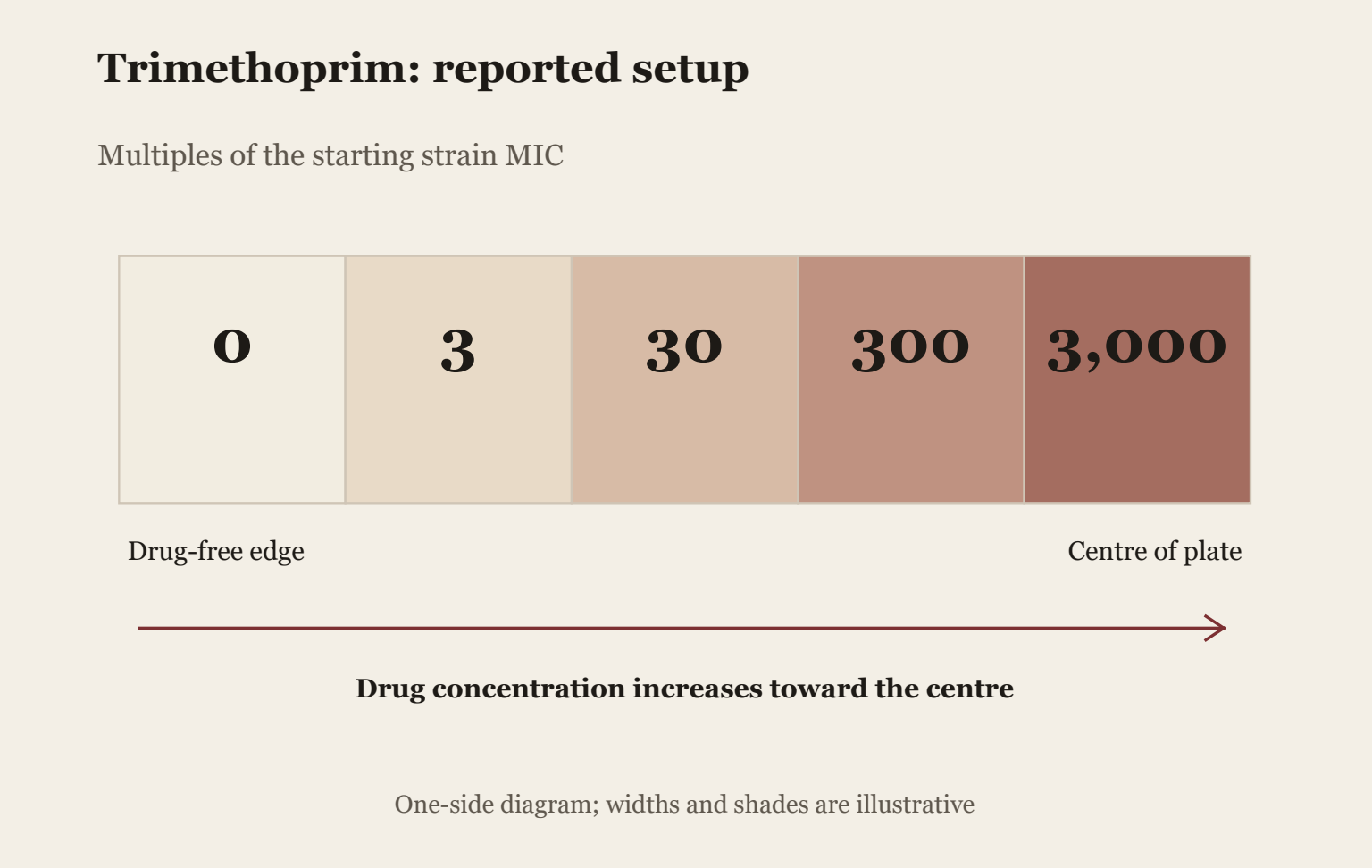
MIC means minimum inhibitory concentration in the stated assay. Multiples here refer to the starting strain’s MIC. These are arranged drug concentrations, not measured fold changes in descendant resistance. [22]
The original study used images, sampled isolates and additional tests to investigate what happened. Open its paper and video for the observations. The CSV preserves the five setup values and their source. [22] [23]
Download the setup values and source
23Starting to separate.
Speciation has testable stages, not one universal finishing line.
Naming something is not enough to establish a species. Biologists examine distinct evolving lineages. For sexual organisms, gene exchange through reproduction is often important, though it is not the only criterion. [28]
In a 2007 yeast experiment, populations adapted to different environments. Hybrids between diverged populations showed reduced reproductive performance against relevant controls. The researchers described incipient speciation: early steps toward reproductive separation. [24]
Reduced reproduction is not complete inability to reproduce together under every condition. I should not inflate initial separation into a claim that researchers watched a fully isolated new animal appear.
The result connects different adaptation histories with measurable reproductive consequences. If a critic says populations can never begin developing barriers to gene exchange, evidence of those barriers addresses that narrower claim.
Ask what was compared, how reproduction was measured, and where the difference persisted. Whether the yeast looks spectacularly different is another question. The proposed mechanism concerns reproduction and inheritance, not winning a beauty contest.
24A new plant lineage.
Extra chromosome sets can change reproductive compatibility.
Tragopogon miscellus formed through hybridisation, combining different lineages, and polyploidy, adding complete chromosome sets. Researchers studied independently formed natural populations, rather than merely renaming an unchanged garden plant. [25] [26]
Its parents, T. dubius and T. pratensis, reached western North America from Europe in the early twentieth century. Their normal chromosome complement is twelve; the new plant’s expected complement is twenty-four. [25] [26]
Doubling can provide matching chromosome partners and change reproductive compatibility. It does not guarantee that every hybrid becomes a fertile, stable species. Actual chromosome behaviour and the continuing lineage require investigation.
The 2012 study found extensive chromosome variation within these natural populations. A recognisable lineage can retain internal variation; every plant need not have an identical, permanently settled genome. [26]
This addresses the claim that observable biological processes cannot produce new plant lineages. It does not demonstrate every route to speciation or reproduce the complete ancestry of birds, whales, or humans.
25A simple beginning of multicellularity.
A cluster is worth studying without calling it an animal.
In the 2012 snowflake-yeast study, researchers repeatedly selected material that settled quickly. Descendants evolved branching clusters because cells remained attached after division. The study investigated inherited clustering and reproduction at the cluster level. [27]
Multicellular means involving multiple cells. But a temporary heap of unrelated cells and a reproducing group made through attached descendants are not identical situations. How the group forms, persists, and reproduces matters to the explanation. [27]
The result is relevant to early steps toward multicellular organisation. It is not a complete animal, a nervous system, or a laboratory recreation of the origin of life. Those would be much broader claims than the experiment supports.
Imagine demonstrating that a simple load-bearing arch can form under certain constraints. You have learned something about a useful arrangement, not built an entire city. This is an analogy for the scale of the inference, not a description of yeast cells building masonry.
I want neither exaggeration nor dismissal. Calling the clusters just yeast leaves the observed inherited organisation unexplained. Calling them the whole history of complexity would also be wrong. The useful response is to describe exactly what changed and what remains untested.
26But people arranged the experiment.
Choosing conditions does not erase a measured process.
Yes, researchers choose conditions. They prepare media, set concentrations, decide which material to transfer, and measure outcomes. That must be stated openly. A laboratory experiment is a deliberately arranged test, not a claim that nobody touched the equipment.
The next question is what the people actually supplied. In the examples discussed here, setting a selection regime is different from manually assembling every inherited change in every descendant. We should examine the methods rather than blur those actions together. [22] [24] [27]
Imagine testing whether ice melts at a particular temperature. Someone setting the temperature does not mean human intelligence directly pulls every molecule out of the crystal. This is an analogy about experimental control and causal processes, not a biological model.
Artificial conditions can limit how widely a result applies. A laboratory outcome may not occur at the same rate, in the same direction, or at all in another environment. That is a real issue to investigate; it does not make the measured result imaginary.
A believer can still hold that a creator ultimately made the laws of nature. The experiment does not identify or exclude every possible ultimate author. It does test whether the biological changes require a separate miracle instead of the processes being measured.
27One object. One experiment.
You do not need to master everything to improve the conversation.
For a fossil, begin with a name and a specimen record. Open the original description or museum entry. Find the location, the preserved material, and the features used in comparison. Then ask which conclusions are observations and which are reconstructions. [8] [19]
For a numerical age, find the material, method, geological relationship, and uncertainty. For a laboratory example, find the starting population, conditions, comparisons, measurements, and claimed result. The point is to make the chain inspectable, not simply collect more links. [6] [22]
You may still need specialist help. Reading a paper is not the same as independently repeating its analysis. Access to the methods, specimens, data, and criticism lets you assess more than an unsupported assertion, even when you cannot personally perform every operation.
Ask your debate partner to choose one objection that would actually change their view. Would a verified transitional combination matter? Would measured reproductive separation matter? If every possible result gets relabelled irrelevant after it appears, no shared test is taking place.
Apply the same rule to yourself. If the specimen were misidentified, the dating context wrong, or an experimental effect unrepeatable under its claimed conditions, the conclusion should change accordingly. I do not get to demand accountability from religion while exempting my preferred evidence.
28My answer in a debate.
Keep the conclusion within the evidence.
I would say this: we have fossils with specific combinations of features, found in investigated geological settings. We also have experiments measuring inherited changes and studies of emerging reproductive separation. That is a much stronger position than merely saying that scientists believe evolution. [8] [14] [22] [24]
I am not claiming that every ancestor has been found, every proposed relationship is settled, or a bacterial plate alone proves the whole ancestry of humans. Those would be avoidable overclaims. The case depends on several kinds of evidence fitting together.
If you accept the measured changes but dispute deep common ancestry, say so. Then we can examine fossils, genomic relationships, geological order, and the alternatives you propose. Moving the discussion to a clear disagreement is progress.
If you claim these findings establish your particular god, book, or creation story, show the additional evidence that connects them. A possible creator is not automatically the deity of the religion into which someone happened to be born.
My atheism is not a requirement that the universe must obey my preferences. I can leave ultimate questions open while rejecting unsupported answers. The practical demand is simple: explain the evidence, state the limits, and stop treating confidence as a substitute for a demonstration.
NoteWhy I insist on the details.
I want an explanation I could defend after the argument is over.
I do not want to win a conversation by handing someone a fossil name they cannot pronounce and hoping they feel embarrassed. That would teach obedience to a new authority, not a better way of thinking.
I want the person to understand what was found, why it matters, and where the interpretation could be wrong. That takes longer than a clever insult. It also leaves something useful after the room stops applauding.
My criticism of literal creation claims comes from that standard. A story does not acquire evidence because it is old, emotionally important, or repeated by millions. Those facts may explain its influence. They do not establish its physical history.
The same standard restrains me. I will not call a side branch a proved direct ancestor, an early reproductive barrier complete isolation, or a simple cell cluster an entire animal. Exaggeration hands a critic a real mistake to attack.
I can be blunt about unsupported claims and careful about evidence at the same time. For me, that is the point of this series: make difficult ideas understandable without replacing one protected belief with another.
SourcesFollow the evidence.
Sources checked on 15 October 2026. Primary studies are used for their specific observations and stated interpretations; institutional resources explain fossils, chronology and collection records. This is an evidence-led explanation, not a new excavation, isotope measurement, genome analysis or independent replication. The named specimens and studies are real. Newspapers, family photographs, houses, machines, tools, doorways, rust, ice and imagined conversations are original analogies. The volcanic-ash bracketing example is hypothetical. The figure is an original diagram of one side of the reported TMP experimental setup: its concentration values are sourced, while widths and shading are illustrative. It is not a photograph, measured resistance curve, or new experiment. Exact direct ancestry, inferred movement, initial reproductive barriers and early multicellularity are not inflated into stronger claims. Older whale-ancestry proposals are distinguished from later evidence; the Polish tracks are presented as the authors’ interpretation and a challenge to the body-fossil timeline then known. Geological dating is treated in depth in Part 6; common-descent mechanisms and DNA evidence are developed in Parts 7 and 8. This evidence does not by itself disprove every possible creator or establish any particular holy book.
[1] What Is a Fossil?
US National Park Service / paleontology resource
Defines physical remains and traces of past life. Used for what a fossil is, rather than for a numerical age or a particular ancestry claim.
[2] Body Fossils
US National Park Service / fossil types
Explains body remains, impressions, mineral replacement and related preservation. A fossil need not retain original DNA or form by one universal process.
[3] A Fossil’s Journey
US National Park Service / educational resource
Supports the roles of decay, burial, preservation conditions and later geological changes. The damaged-family-archive comparison is an original analogy.
[4] Rocks and Layers
US Geological Survey / Fossils, Rocks, and Time
Explains sedimentary layers and superposition, including overturned rocks. The manuscript explicitly limits the simplest stacking rule to an undisturbed sequence.
[5] Laws of Superposition and Crosscutting
US Geological Survey / Fossils, Rocks, and Time
Explains relative relationships between layers and later intrusions. These relationships do not assume a universal constant rate of sediment accumulation.
[6] The Numeric Time Scale
US Geological Survey / Fossils, Rocks, and Time
Explains numerical dating and its connection to relative chronology. This older teaching page is used for the method; its historical boundary-age examples are not imported as current dates.
[7] Fossil Succession
US Geological Survey / Fossils, Rocks, and Time
Explains changing fossil assemblages and correlation. Relative matching is distinguished from independent numerical mineral dating, and environmental context is retained.
[8] A Devonian tetrapod-like fish and the evolution of the tetrapod body plan
Edward B. Daeschler, Neil H. Shubin and Farish A. Jenkins Jr / Nature 440 / 2006 / doi:10.1038/nature04639
Primary Tiktaalik description, including holotype NUFV 108, the Arctic Canadian setting and a combination of fish and tetrapod-related features. It is not presented as a proved direct ancestor.
Open the original paper or supporting record
[9] The pectoral fin of Tiktaalik roseae and the origin of the tetrapod limb
Neil H. Shubin, Edward B. Daeschler and Farish A. Jenkins Jr / Nature 440 / 2006 / doi:10.1038/nature04637
Primary fin-bone and joint description. Preserved structure is distinguished from inferred posture; the manuscript does not equate this fin with a modern hand.
Open the original paper or supporting record
[10] Elpistostege and the origin of the vertebrate hand
Richard Cloutier and colleagues / Nature 579 / 2020 / doi:10.1038/s41586-020-2100-8
Original CT-based study of an articulated specimen. Digit-related internal arrangements and retained fin rays are distinguished from a claim of an identical modern hand.
Open the original paper or supporting record
[11] Tetrapod trackways from the early Middle Devonian period of Poland
Grzegorz Niedźwiedzki and colleagues / Nature 463 / 2010 / doi:10.1038/nature08623
The authors’ interpretation of older tracks challenges the body-fossil chronology then known. A track is not a complete skeleton or an identification of one exact ancestral species.
Open the original paper or supporting record
[12] Skeletons of terrestrial cetaceans and the relationship of whales to artiodactyls
J. G. M. Thewissen and colleagues / Nature 413 / 2001 / doi:10.1038/35095005
Pakicetid skeletons and an anatomical analysis supporting the broader artiodactyl connection. This analysis did not itself identify hippos as the specific sister group.
Open the original paper or supporting record
[13] Fossil evidence for the origin of aquatic locomotion in archaeocete whales
J. G. M. Thewissen, S. T. Hussain and M. Arif / Science 263 / 1994 / doi:10.1126/science.263.5144.210
Primary Ambulocetus skeleton report. Proposed locomotion is a functional interpretation of anatomy, not a directly observed video of an extinct animal.
[14] Origin of whales from early artiodactyls: hands and feet of Eocene Protocetidae from Pakistan
Philip D. Gingerich and colleagues / Science 293 / 2001 / doi:10.1126/science.1063902
Original Artiocetus and Rodhocetus skeletons with diagnostic ankle characters. The argument concerns specific bones and relationships, not a certified chain of direct parents.
[15] Hind limbs of Eocene Basilosaurus: evidence of feet in whales
Philip D. Gingerich, B. Holly Smith and Elwyn L. Simons / Science 249 / 1990 / doi:10.1126/science.249.4965.154
Observed pelvic limb and foot bones are retained; the mating interpretation is labelled an inference. The paper’s older mesonychian ancestry proposal is explicitly not adopted as the current conclusion.
[16] Transition of Eocene Whales from Land to Sea: Evidence from Bone Microstructure
Alexandra Houssaye and colleagues / PLOS ONE 10 / 2015 / doi:10.1371/journal.pone.0118409
Original microtomographic and virtual-section comparison of fossil bones. Supports aquatic adaptations and reduced basilosaurid hind limbs while noting limits in behavioural reconstruction.
Open the original paper or supporting record
[17] Phylogenetic relationships among cetartiodactyls based on insertions of short and long interspersed elements: Hippopotamuses are the closest extant relatives of whales
Masato Nikaido, Alejandro P. Rooney and Norihiro Okada / PNAS 96 / 1999 / doi:10.1073/pnas.96.18.10261
Primary mobile-element insertion comparisons. Closest living relative is distinguished from a living ancestor; missing observations must not be treated as established sequence absence.
Open the original paper or supporting record
[18] Archaeopteryx
Natural History Museum, London / Dino Directory
Institutional description of feathers, teeth and a long bony tail, the Solnhofen setting and uncertainty about flight. Anatomy and flight performance are treated as different questions.
[19] Archaeopteryx lithographica / PV OR 37001
Natural History Museum, London / collection specimen record 734808
Collection record for the London specimen: limestone part and counterpart, much of the skeleton, and wing and tail feather impressions. A collection record identifies material; it is not itself a complete ancestry analysis.
[20] New genetic and morphological evidence suggests a single hoaxer created “Piltdown man”
Isabelle De Groote and colleagues / Royal Society Open Science 3 / 2016 / doi:10.1098/rsos.160328
Primary genetic and physical re-examination of fraudulent material. Used for manipulation and mixed human/orangutan components; the manuscript does not claim to have independently solved the forger’s identity.
Open the original paper or supporting record
[21] Piltdown Man
Natural History Museum, London / library collections
Institutional history of the fraud and its 1953 exposure, including chemical and anatomical checks. Eventual correction is not used to excuse the long delay.
[22] Spatiotemporal microbial evolution on antibiotic landscapes
Michael Baym and colleagues / Science 353 / 2016 / doi:10.1126/science.aag0822
Original MEGA-plate experiment: imaging, isolate resistance assays and genome analysis. The figure reproduces reported TMP setup concentrations, not a measured resistance trajectory.
Open the original paper or supporting record
[23] MEGA-plate media and original experiment video
Baym Laboratory / Harvard Medical School
Author-laboratory video resource. The video illustrates spread; measured resistance and genetic claims require the original paper’s isolate analyses, not the film alone.
[24] Incipient speciation by divergent adaptation and antagonistic epistasis in yeast
Jeremy R. Dettman and colleagues / Nature 447 / 2007 / doi:10.1038/nature05856
Original yeast experiment reporting reduced hybrid reproductive performance after divergent adaptation. The chapter explicitly says initial separation, not universal complete reproductive isolation.
Open the original paper or supporting record
[25] Evolution and Expression of Homeologous Loci in Tragopogon miscellus (Asteraceae), a Recent and Reciprocally Formed Allopolyploid
Jennifer A. Tate and colleagues / Genetics 173 / 2006 / doi:10.1534/genetics.106.057646
Original study of independently formed natural allopolyploid populations and parental contributions. Historical formation is placed in the twentieth century rather than repeating “80 years ago” as a current date.
Open the original paper or supporting record
[26] Extensive chromosomal variation in a recently formed natural allopolyploid species, Tragopogon miscellus (Asteraceae)
Michael Chester and colleagues / PNAS 109 / 2012 / doi:10.1073/pnas.1112041109
Primary chromosome study in natural populations. Expected complement and actual internal variation are distinguished; genome doubling is not described as a universal guarantee of instant stable speciation.
Open the original paper or supporting record
[27] Experimental evolution of multicellularity
William C. Ratcliff, R. Ford Denison, Mark Borrello and Michael Travisano / PNAS 109 / 2012 / doi:10.1073/pnas.1115323109
Original snowflake-yeast experiment. Heritable post-division clustering and cluster reproduction concern early multicellular organisation, not a complete animal or the origin of life.
Open the original paper or supporting record
[28] Species Concepts and Species Delimitation
Kevin de Queiroz / Systematic Biology 56 / 2007 / doi:10.1080/10635150701701083
Explains evolving lineages and different operational evidence for delimiting species. Reproductive isolation is useful in appropriate organisms; no single checklist applies identically to all life.