

01Two parents. Two first people?
Those are different statements.
Someone says: everyone has a mother and father, so humanity must have started with one mother and one father. It sounds tidy. But the conclusion has slipped past the evidence. Your two parents also had parents, relatives, and other people around them.
A family can share an ancestor without that person being its only ancestor. The same distinction matters when we discuss all humanity. A common ancestor is someone included in everybody’s ancestry; a sole ancestral couple excludes all other contributors at the proposed starting point.
That exclusion is the important claim. Are we talking about the only two biological humans, a population reduced to two, or a couple living among other people? Those proposals make different statements about history. They should not borrow one another’s evidence.
Genetics investigates inherited material and relationships. Fossils and archaeology supply additional records. None of these methods reads a person’s name, divine appointment, or spiritual status straight from a DNA sequence. [5] [16]
I want the claim written clearly before the argument starts. Otherwise a failed account of two exclusive founders can quietly become a claim about two symbolic representatives. That is a change of claim, not a scientific confirmation of the first one.
02Which Adam and Eve?
Read the text and specify the interpretation.
Genesis 2 describes a man formed from ground and a woman made from his rib. Genesis 3:20 connects Eve with all the living. The Quran’s 4:1 speaks of one soul and its mate; 3:59 describes Adam’s creation from dust. Those are the passages, not genetic measurements. [1] [2]
Different readers interpret them differently. I will not pretend that every believer accepts the same date or excludes every wider population. Ask what the person actually means before testing the physical consequences of that interpretation.
A concrete literal position does exist. Answers in Genesis declares Adam and Eve the first two humans, separately created rather than descended from earlier life. It also places creation roughly four thousand years before Christ. That is its stated position, not a definition of all religion. [31]
If that is the proposal, fossils, dates, and inherited population patterns become relevant. If a couple instead represents humanity within an older population, the exclusive-founder claim has been withdrawn. The revised theology needs its own justification.
I do not accept an old story as established biology because it is sacred to someone. But criticism also needs accuracy. Keep the text, its interpretation, the proposed timeline, and the scientific test separate. A confident label cannot do those jobs.
03What does DNA record?
Start with a pair of chromosomes.
DNA is the inherited molecule whose sequence can be compared between people. A chromosome is a packaged stretch of DNA. Most human body cells contain 23 chromosome pairs: one set from the mother and one from the father. Egg and sperm cells normally contain one set. [3]
For an ordinary position on an autosome, you therefore usually carry two copies. An autosome is a chromosome other than a sex chromosome. Copies can have the same sequence at that position or different versions, called variants.
A genome is the complete DNA set. Comparing genomes reveals both shared sequence and variation. The important evidence is not simply that people look different. Researchers examine which variants occur together, how frequently they appear, and where related stretches occur. [5]
There are exceptions to simple two-copy rules, including duplicated regions and chromosome differences. That is why I specify an ordinary autosomal position. A classroom simplification becomes misleading when it is announced as a rule covering every piece of DNA.
You do not need to memorise every chromosome. Remember the practical question: which inherited copies are being examined? A conclusion about one special inheritance route cannot automatically become a conclusion about the whole genome or every ancestor.
04You inherit a reshuffled set.
Recombination changes combinations across generations.
You do not receive your mother’s entire genome plus your father’s entire genome. Normally, each supplies one chromosome set. During egg and sperm formation, corresponding chromosomes can exchange DNA. This process is called recombination. [3] [4]
Imagine two versions of a long recipe book exchanging sections. A resulting book may contain different combinations of old passages. That is an analogy for reshuffling. It does not establish that DNA was written by a human-like author.
Recombination helps explain why different stretches of your DNA can have different histories. Following one stretch backwards can lead through a different chain of inherited copies from the chain followed by another stretch.
This matters when someone asks for the one DNA family tree. Much of the genome has been reshuffled across generations. A reconstruction must account for that, instead of forcing every stretch to behave like one unbroken maternal line. [4] [29]
Reshuffling also differs from mutation. Mutation changes sequence; recombination rearranges inherited combinations. Both matter in a population-history account. Neither word, by itself, supplies the age, size, or identity of a founding population.
05What can we open and inspect?
A dataset and an interpretation are different things.
The 1000 Genomes Project’s 2015 report reconstructed genomes from 2,504 people in 26 populations. It combined several methods, including whole-genome sequencing and other genetic measurements. This is an identifiable research resource, not an unnamed group of scientists saying trust us. [5]
The observed variation is a starting point. Researchers then use models to investigate the history that could produce its patterns. A model is a specified account of processes and assumptions that can be compared with data and tested in simulations.
A large list of variants alone does not print the number of prehistoric people. Nor is counting today’s skin colours a substitute for population genetics. The arrangement, frequency, and relationships of inherited variation carry information that a photograph cannot supply.
Work combining modern and ancient genomes also reconstructs relationships across DNA regions. Such reconstructions handle missing and erroneous data under stated methods. They are inferred genetic genealogies, not a recovered register of every prehistoric marriage. [29]
I would open the original dataset description, then the method used for the particular conclusion. I have not independently rerun every analysis cited here. The reader deserves a route to the evidence, with that distinction made explicit.
06How much could two people carry?
Four inherited copies at a position is not four variants forever.
At an ordinary autosomal position, two diploid people carry four chromosome copies between them. Diploid means having two chromosome sets. Those four copies might contain fewer than four different versions. This is the starting constraint, not the entire argument. [3]
Later recombination can produce new combinations across positions. Later mutations can produce new sequence variants. Therefore the statement that present humans have more than four variants somewhere is not, by itself, a complete disproof of a past pair. [4] [13]
A serious test needs a date, a duration, starting variation, mutation and recombination assumptions, and the observed patterns to be matched. A very recent severe restriction and a remote brief restriction are different proposals with different detectability.
Older genetic lineages could also have already existed in two people who themselves had ancestors. A DNA lineage older than a proposed pair does not automatically establish that more than two people lived at that exact time.
I will not use weak arithmetic to defend a strong conclusion. The problem for a recent sole-couple origin is accounting for the combined genetic and historical evidence under a specified biological model. A slogan about four copies cannot replace that work.
07How can DNA reveal a population?
Follow inherited copies until their paths meet.
Take two DNA copies at a region and trace their inheritance backwards. At some point they can meet in a shared ancestral copy. That meeting is called coalescence. It concerns the ancestry of those copies, not a moment when the entire human population began.
Different regions provide different ancestry patterns. Mutation and recombination models connect observed differences with possible histories. Population size and movement affect how likely those patterns are. The conclusion is an inference from a model, not an ancient census discovered inside a cell. [6]
Li and Durbin’s 2011 method used whole-genome sequences to infer changing population histories. Later methods such as SMC++ could analyse much larger samples and improve aspects of inference. Different methods have different strengths and limitations. [6] [7]
The important question is whether the proposed history explains the data, and whether tests show that the method can recover such a history. Researchers can simulate known histories and see what their inference method reconstructs.
I would ask to see those checks alongside the attractive curve. A smooth graph is not automatically a reliable account of every generation. We must know what the method measures and where its resolution becomes weak.
08Does effective size count people?
A genetic summary is not a list of living adults.
Effective population size is the size of an idealised population that would produce a relevant genetic behaviour under the model. It is a way to describe processes such as genetic drift. It is not automatically the actual number of adults, families, or people alive. [8] [27]
Imagine two villages with the same headcount. In one, many adults contribute descendants; in the other, a few families dominate later ancestry. Equal headcounts need not produce equal genetic histories. This is an explanatory example, not a measurement of ancient humans.
Population structure also matters. Structure means that people are divided into groups with non-random patterns of mating and movement. Changes in connection between groups can resemble changes in population size if the analysis assumes one freely mixing population. [8]
Mazet and colleagues demonstrated this problem mathematically and through models. Giving a method more DNA does not cure a wrong demographic assumption automatically. It can make an incorrect estimate look more precise. [8]
So I will not read ten thousand on an effective-size curve as exactly ten thousand people in a prehistoric valley. Nor will I treat uncertainty in that number as evidence of exactly two. Both moves ask the graph to say more than it can.
09Can a graph rule out every pair?
A brief crash needs a test able to detect it.
A population bottleneck is a restriction in population size. Its genetic consequences depend on severity, duration, timing, and later history. A few generations and thousands of generations are not interchangeable events.
Li and Durbin’s original paper explicitly shows a limitation: a sudden change in simulated population size can be spread over a much longer interval in the reconstruction. The drawn curve is smoothed by the method’s resolution. [6]
Therefore, a curve staying above two cannot, on its own, exclude every one-generation reduction to two at every remote date. A claimed exclusion needs simulations or analysis for the actual scenario, with realistic data quality and a stated detection limit. [6] [7]
This is not a rescue of a recent exclusive first couple. It is a rule against overstating a particular test. Modern variation, ancient genomes, fossils, and dating need to be considered together. A proposal must account for their patterns, not merely find a weakness in one plot.
My question is specific: which date and which duration are proposed, and how was that proposal compared with the evidence? I reject a recent sole-couple account as an adequate ordinary biological explanation. I do not pretend one graph has tested every imaginable historical or miraculous alternative.
10What is mitochondrial DNA?
It follows a narrower path than most of your DNA.
Mitochondria are structures inside cells involved in energy production. They contain their own small DNA genome. In ordinary human inheritance, mitochondrial DNA is passed through the mother. Both sons and daughters receive it; daughters usually continue that maternal transmission. [9]
That gives researchers a useful route to follow: mother, her mother, her mother, and so on. It leaves out most branches in a person’s wider family tree. Your mother also had a father, but that route is not the one being traced.
The usual inheritance pattern is the point here. I am not declaring that every biological exception is impossible. Nor am I treating mitochondrial DNA as a miniature copy of all the DNA in the nucleus, the cell’s main chromosome-containing compartment.
Cann, Stoneking, and Wilson’s 1987 study compared mitochondrial DNA from 147 people. It inferred shared maternal ancestry and an African origin under its analysis. It did not identify a named woman in a garden. [10]
Before accepting a headline, ask which inheritance path it follows. One route can tell us something real while leaving other ancestors uncounted. That limitation is exactly what the popular phrase mitochondrial Eve tends to hide.
11Was she the only woman alive?
A surviving maternal line does not erase other women.
Mitochondrial Eve is the usual nickname for the most recent common ancestor along the relevant strictly maternal lines of living humans. Follow mothers backwards, rather than every possible parent, and the paths ultimately meet. That is the ancestry being described. [10] [11]
The nickname does not say she was the first human woman or the only woman then alive. Other women could have descendants through sons, or through chains that later include a father. Those descendants would not carry their mitochondrial DNA by that route.
Imagine three women. One has two daughters, who become mothers. The others have sons, who father those daughters’ children. All three women have grandchildren in this example, while only the first supplies every illustrated child’s maternal-line mitochondrial ancestry.
That is the hypothetical family shown in our diagram. It is not a reconstruction of the actual woman’s life. It demonstrates why a single surviving maternal source does not logically require a population containing only one woman.
My short answer is this: Eve here names an inheritance route, not an empty world with one surviving female. Anyone using the nickname to prove the biblical story must supply the missing identification and the missing evidence for exclusive parentage.
Inheritance diagramOne maternal source. More ancestors.
A hypothetical pedigree, not a reconstruction of human origins.
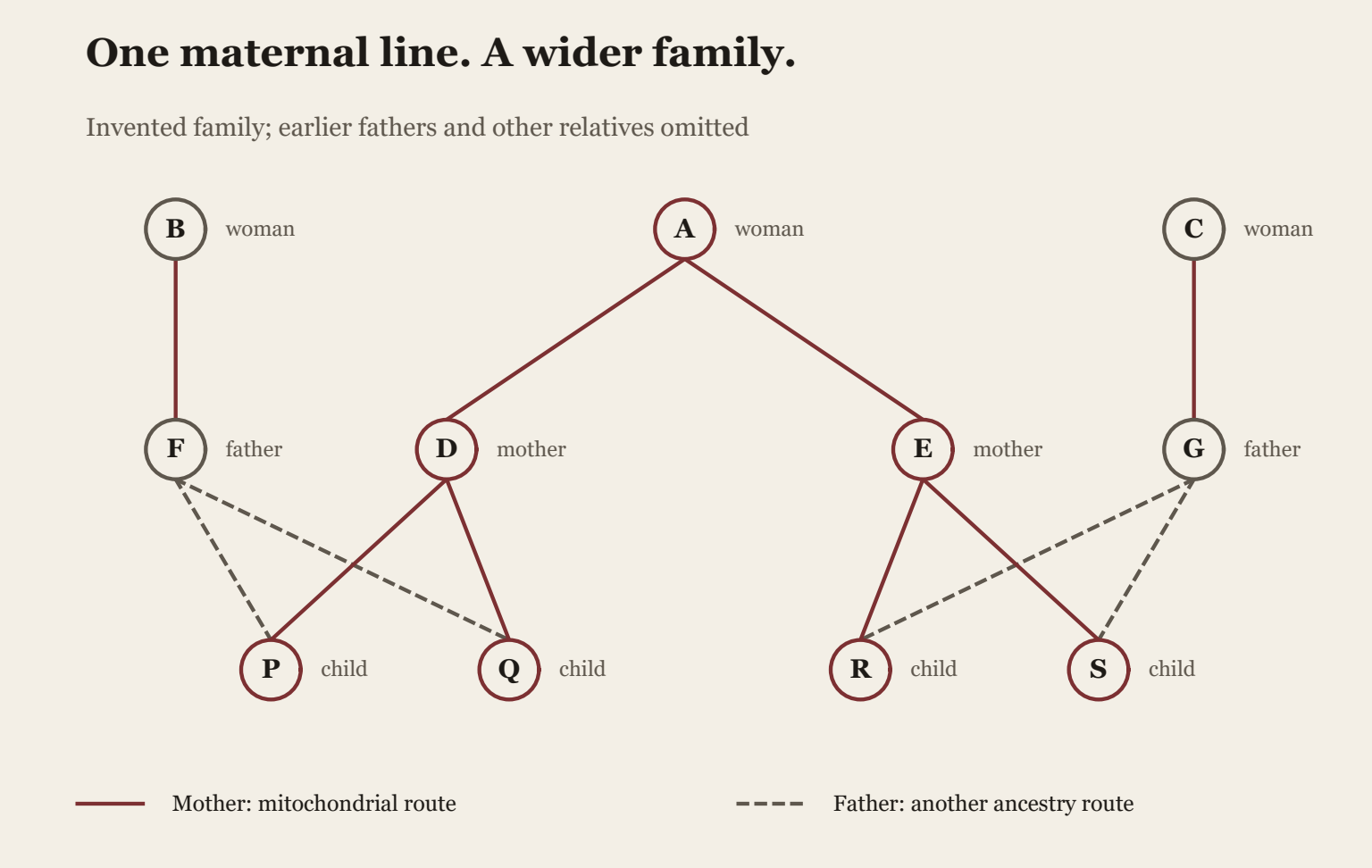
All four children trace their maternal mitochondrial route through A. B and C also have grandchildren: their sons are fathers of those children. Ending a strictly maternal line does not end every genealogical contribution. [9] [14]
The letters identify invented people, not real ancestors. The diagram proves no historical date or population size. It explains why one shared maternal source does not imply that only one ancestral woman was alive.
Download the invented pedigree and source notes
12Can a maternal line end?
Having no continuing maternal line does not mean having no descendants.
Suppose a woman has a son. He inherits her mitochondrial DNA. If he becomes a father, his children ordinarily receive mitochondrial DNA from their mother, not from him. His mother’s maternal route stops there, even though her family continues. [9]
Now repeat that kind of event across many generations. Some strictly maternal routes end; others continue. Looking only at the surviving route does not recover a count of every woman who once lived or every woman who contributed other inherited material.
The same general warning applies whenever a single genetic route is mistaken for the entire pedigree. A pedigree is the network of parents and offspring. Its many paths should not be reduced to one convenient line.
In our diagram, B and C are grandmothers through their sons. They are not removed from the family because their mitochondrial DNA is absent from the illustrated children. Their genealogical ancestry remains part of the account.
I would draw that family before arguing about dates. If someone can see how three ancestral women coexist with one maternal source in a simple example, the supposed proof of an exclusive first woman loses its force without any advanced mathematics.
13Does the father’s line find Adam?
A second special route is still a special route.
Y-chromosome ancestry usually follows a father-to-son path. The non-recombining part used in these analyses supplies a paternal lineage to compare. Some regions of the Y exchange DNA, so treating the entire chromosome as identical in its inheritance behaviour would be careless. [11]
Y-chromosomal Adam is a nickname for the relevant most recent common paternal ancestor. It does not mean the first man, the only man alive, or a man whose personal name has been read from his DNA.
A man can have descendants through a daughter without continuing the Y route through that daughter. His wider ancestry can therefore continue even when this particular paternal chain does not. Again, one genetic path is not every family connection.
Sampling also affects inference. Mendez and colleagues reported a deeply branching Y lineage in 2013, illustrating how previously unsampled variation could change the reconstructed root and dating of the paternal tree. Their estimate is a study result, not a final universal calendar date. [12]
I would ask which Y region, which samples, and which calibration were analysed. The name Adam adds no evidence that the man met mitochondrial Eve, was made from dust, or founded humanity together with a sole partner.
14Were genetic Adam and Eve married?
Two shared routes do not establish one household.
The maternal common ancestor and paternal common ancestor are defined by different inheritance paths. There is no requirement that their dates coincide. There is also no requirement that their dates must be different. The names alone establish neither relationship.
Poznik and colleagues compared the two routes using equivalent methods in 2013. Their estimated intervals overlapped. That is a useful correction to the easy claim that genetic Adam and Eve necessarily lived in completely different eras. [11]
But overlapping date estimates do not establish that two people met, married, or had children together. Think of two people known only to have lived during the same century. Shared timing would not supply a wedding certificate.
Even a real couple could have lived among many other people. To establish sole parentage for humanity, further evidence would need to exclude those other contributions. Neither a shared maternal ancestor nor a shared paternal ancestor performs that exclusion.
So I reject both shortcuts: genetics found the biblical couple, and genetics proved these two particular ancestors could never have been contemporaries. The actual evidence defines lineages and estimates their histories. It does not supply a complete biography.
15Why do the estimates change?
Sampling and mutation calibration affect the answer.
A DNA difference is not stamped with a calendar year. Researchers use mutation models, generation-time assumptions, sampling, and other information to estimate when ancestral copies shared a source. Each part of that account needs checking.
Mutation rates are investigated in families as well as through longer-term comparisons. Rahbari and colleagues studied inherited new mutations and found differences associated with paternal age and variation between families. A single unqualified mutation rate is not a perfect clock for every context. [13]
Finding a previously unrepresented deep branch can also change a reconstructed tree. The Mendez Y-lineage example shows why broader sampling matters. Updating an estimate does not mean the historical individual moved because someone published a paper. Our reconstruction improved or changed. [12]
Uncertainty should be reported rather than hidden behind one dramatic age. Equally, uncertainty does not mean that any date, including a preferred religious date, fits equally well. The alternative must explain the actual patterns under defensible assumptions.
I would compare the studies’ samples, mutation calibrations, and intervals before declaring a contradiction. The important lesson is methodological: an estimated age belongs to a defined genetic lineage and model. It is not automatically the age of humanity.
16Family ancestry and inherited DNA.
A place in a pedigree need not leave an identifiable segment.
A genealogical ancestor appears in your chain of parents, grandparents, and earlier forebears. A genetic ancestor, in the sense used here, contributes DNA that actually survives in the region or genome being examined. These are related but different questions.
Across generations, reshuffling and inheritance can leave a distant genealogical ancestor with no surviving autosomal segment in a particular descendant. Being a real ancestor does not guarantee that a consumer DNA test can identify that person.
Matsen and Evans investigated the relationship in a mathematical model of diploid inheritance. Their work distinguishes genealogical descendants from descendants of particular inherited copies. It is a theoretical analysis, not an identification of every person in your own family. [14]
Imagine a family archive in which not every ancestor left a surviving letter. Missing letters would not remove that person from the pedigree. The analogy is limited: DNA inheritance is a physical process, and its probabilities need an actual model.
This distinction becomes crucial when someone moves from a couple in everybody’s family tree to a couple supplying everyone’s entire biological ancestry. Those are not interchangeable claims. Changing the meaning of ancestor halfway through an argument creates a false confirmation.
17Could a common ancestor be recent?
Conditional models are not certificates for named people.
Rohde, Olson, and Chang studied genealogical ancestry using mathematical and computational models in 2004. Their models included population structure rather than assuming that everyone on Earth freely chose partners from one worldwide pool. [15]
In those models, shared genealogical ancestors could be surprisingly recent, within a few thousand years. That is a result under the model’s migration and mating assumptions. It is not a measured date for the actual most recent common ancestor of every living person.
Isolation matters. A group with no ancestral contact with another group cannot acquire a shared recent ancestor through a contact that never happened. The original discussion recognises such constraints; the headline alone often loses them.
The models also involve many people. Finding that everyone shares an ancestor does not reduce those populations to that individual or to one couple. Shared ancestry can spread through a large, connected pedigree with many other ancestors remaining in it.
I would use this work to explain possibility and the distinction between ancestry types. I would not claim it discovered Adam, proved a particular date in Genesis, or established every historical migration. A model needs evidence for its application to the actual case.
18A couple among other people?
That withdraws the exclusive-founder claim.
A believer may propose a pair within an existing population, with descendants eventually connected to everyone alive. That is different from humanity beginning biologically with only two people. Other people contribute ancestors and genetic material in the wider-population proposal.
Genetic diversity alone cannot identify or exclude every named couple somewhere in such a pedigree. The distinction between genetic and genealogical ancestry explains why. A pair might leave widespread family connections without an identifiable unique signature in everyone’s genome. [14] [15]
But compatibility is not confirmation. The possibility of a pair in a wider population does not show that this pair existed, bore those names, received a divine instruction, or committed the act described in a sacred story.
Those further claims need their own historical or other supporting evidence. If someone now defines humanity spiritually rather than biologically, that new definition also needs to be stated. A DNA study cannot directly test an unspecified spiritual boundary.
My answer is firm: you may offer a different claim, but you cannot announce that evidence for populations has proved a story of exclusive founders. Keep the revised proposal visible, and assess its remaining religious claims on their actual support.
19A network, not one tiny household.
The detailed population story is still being investigated.
Research supports an African origin for our species, while the exact population history remains debated. The 2021 review by Bergstrom and colleagues explains why one precise birthplace and one exact origin moment cannot simply be read from the available record. [16]
Ragsdale and colleagues’ 2023 analysis compared structured histories of African populations. Their favoured account involved connected ancestral groups exchanging genes over long periods. It was not a census of two first people. [17]
Cousins, Scally, and Durbin’s 2025 work tested a different structured model, involving two ancestral populations splitting and later mixing. Two populations means groups, not a man and a woman. Its inferred dates and proportions depend on the model and data. [18]
These studies should not be combined into one supposedly final map. Their differences are reasons to compare assumptions, fit, and predictions. Population structure can challenge a simple size curve without providing evidence for a recent sole-couple origin.
My conclusion is about the level the evidence supports: a deep, connected population history, with unresolved details. I will not sell one preferred reconstruction as settled in every feature. Nor will I turn disagreements about the network into proof of a garden narrative.
20People existed far earlier.
Named fossils and their context challenge a recent biological beginning.
Jebel Irhoud in Morocco supplies a concrete case. Hublin and colleagues described fossils with a mixture of features, including facial and dental anatomy associated with Homo sapiens and a less modern-looking braincase. The features did not all acquire their present form together. [19]
The associated dating study measured fire-heated flint artefacts from the excavation context and reported an age of 315,000 plus or minus 34,000 years. A tooth-based analysis supplied another result. These are method-linked estimates, not ages guessed from how old a skull looks. [20]
The age is not an exact birthday for the first human, nor proof that every important trait originated at that location. It places identifiable remains and associated material in a very old context, with stated uncertainties.
A proposal that the first biological humans appeared only a few thousand years ago must address that evidence. Calling the specimen an ape does not examine its anatomy or dating. Classification disagreements need actual comparisons, not a dismissive replacement name.
Fossils alone do not tell us every past population size. They do, however, constrain when human forms existed. The distinction matters: an old fossil challenges a recent first-human date without, by itself, excluding a later couple living among other people.
21The ash above Omo I.
A minimum age is not a direct birthday.
Omo I, from Ethiopia, gives another example. A 2022 study by Vidal and colleagues linked volcanic ash overlying the fossil-bearing formation to an eruption of Shala volcano. Dating the eruption provided a new constraint on the fossils beneath it. [21]
The paper reported a minimum age of 233,000 plus or minus 22,000 years. Minimum matters: the fossil must predate the overlying ash as interpreted. The result does not mean that a laboratory directly measured the exact moment this person died.
Imagine a letter sealed below a dated floor. If the context is undisturbed, the letter was there before that floor. This is an analogy for an ordering relationship; the actual volcanic dating and geochemical match do the scientific work.
The interpretation depends on correct layer relationships, chemical correlation, and dating. Those are things a critic can examine. Part 6 explains geological clocks and their checks more fully, rather than treating every date as self-authenticating.
My point is that human antiquity does not depend on one object or one measurement. Independent contexts constrain the story. A few-thousand-year biological beginning must account for them; the phrase scientists were not there does not inspect any of the evidence.
22The record includes other relatives.
Ancient genomes can be compared with living people.
Neanderthals were ancient human relatives. Researchers recovered DNA from their remains and compared its sequence with that of people living today. The 2010 draft-genome study described a particular pattern of shared variants, not merely similar-looking skulls. [22]
Neanderthals shared more variants with the sampled present-day Eurasians than with the sampled sub-Saharan Africans. The authors interpreted the pattern as evidence of gene flow into ancestors of non-African populations. Read the comparisons and the proposed history together. [22]
Gene flow means inherited material moving between populations through reproduction. It is a historical inference from genomic relationships. The original sample is not the whole of Africa or Eurasia, and later research can refine the detailed geography and proportions.
I will not use one old percentage as a permanent ancestry label for every person in a present-day group. Nor will I copy an older paper’s introductory extinction date as if it were the newest chronology. The relevant result here concerns genetic relationships and mixing.
That result makes our ancestry richer than an isolated recent household. A competing account has to explain the pattern. Merely insisting that all humans are one family does not do so; shared relatedness and a specific history of population contact are different statements.
23A finger bone opened another history.
Small remains can preserve substantial genetic information.
DNA from a finger bone in Denisova Cave, Siberia, helped identify another ancient group. Reich and colleagues’ 2010 study compared that genome with Neanderthal and present-day human data and called the group Denisovans. [23]
The paper found evidence that this lineage contributed ancestry to sampled present-day Melanesians. Its historical sample and estimated fraction are not a universal fixed percentage for everyone in a modern region. Later sampling can expand or refine the account.
The important point is how the claim is made: recovered sequence, comparisons, and an inferred history of ancestry. A small bone need not preserve a whole skeleton to contribute useful DNA. Equally, DNA cannot answer every question about how the individual looked or lived.
This is not an extra species invented simply to fill a missing gap. The proposed group is tied to particular remains and genetic relationships. Its connections can be tested against additional ancient genomes and modern samples.
I would ask what pattern the competing explanation predicts. If it rejects population contact, how does it account for the specific shared sequence relationships? A story that only repeats the names of first parents has not yet supplied that comparison.
24A Neanderthal mother, a Denisovan father.
A first-generation offspring is a particularly direct case.
In 2018, Slon and colleagues reported the genome of Denisova 11, from a bone fragment. The evidence supported a Neanderthal mother and a Denisovan father. This was a first-generation offspring, not simply a modern person carrying a distant trace of ancestry. [24]
The study compared maternal mitochondrial ancestry and genome-wide patterns. It examined whether the sequence fit an individual carrying the two different parental chromosome sets. The conclusion did not come from naming an unusual-looking piece of bone.
Present-day human contamination was investigated rather than ignored. The researchers used multiple estimates and described preparation procedures. Their comparisons also considered alternative ancestry patterns; a mixed genetic signal needs a method that distinguishes competing explanations. [24]
One offspring does not reveal how often every ancient group interbred. It does establish a concrete case supporting reproduction between these parental groups. Calling every hybrid impossible because of a simple species slogan cannot survive that evidence.
For a believer, I would show the specimen identity, the genomic comparisons, and the alternatives tested. This is a specific historical claim open to examination. It is much more useful than arguing about a cartoon in which every kind is sealed away from every other kind.
25What about contamination?
Authentication is work, not a magic label.
Ancient DNA is often fragmented and chemically altered. Dabney, Meyer, and Paabo describe characteristic damage processes, including changes concentrated near molecule ends. Researchers must distinguish ancient material from modern contamination and sequencing errors. [25]
Damage patterns help, but no single sign makes every interpretation automatically correct. Context, preparation, sequence comparisons, contamination estimates, and the alternatives considered all matter. The Denisova 11 study provides an example of those checks attached to a particular conclusion. [24]
Sampling also limits the history. DNA survives unevenly, and today’s reference panels do not contain every past population. The absence of a sampled genome is not proof that a population never existed. Missing evidence should remain visibly missing.
A study online in 2025 and in a 2026 Nature issue analysed 28 ancient southern African genomes. Some older ancestry patterns fell outside the variation represented by sampled living people. Modern reference panels do not capture all past ancestry. [30]
That finding does not make those ancient people nonhuman. It shows why new samples can revise our account. I would demand authentication and welcome better coverage. Rejecting every ancient sequence in advance is as unhelpful as declaring every sequence infallible.
26Was there a single first baby?
A species boundary is not necessarily a sharp family boundary.
We like stories with a first person and a definite opening day. Biological history need not arrange itself that way. In a gradually changing population, parents and offspring can resemble one another closely while descendants across much longer spans differ substantially.
Homo sapiens is a species classification based on evidence and comparisons. It does not require one generation in which wholly nonhuman parents suddenly produced a child with every modern human feature. The Jebel Irhoud mosaic illustrates features with different histories. [19]
A broad review of modern human ancestry likewise separates questions about biological traits, population origins, and later dispersals. The evidence does not supply a single universally agreed instant when every relevant aspect of modern humanity arrived. [16]
That does not mean any skull can be assigned anywhere without constraint. Anatomy, dates, and genetic relationships still matter. Uncertain boundary details do not remove the difference between hundreds of thousands of years and a recent literal creation chronology.
If someone means the first person with a soul, that is another claim requiring a definition and support. Neither a fossil label nor a DNA tree directly reads a soul. I will not mistake an unmeasured theological boundary for a demonstrated biological event.
27Did science find almost nobody?
Read the original result and its published criticism.
Hu and colleagues reported a severe ancient bottleneck in 2023, using a method called FitCoal. Their inferred effective size was about 1,280, around 930,000 to 813,000 years ago. These were model-based estimates, not people counted at an excavated campsite. [26]
The result became a dramatic origin headline. But 1,280 is not two, and that deep interval is not a few-thousand-year first-couple date. Even accepting the original result would not establish the religious claim under discussion.
There is also a serious published challenge. Deng, Nielsen, and Song argued that the inferred bottleneck was likely a statistical artifact. Their tests showed that a history without that sharp crash could produce data for which FitCoal inferred one. [27]
This criticism concerns a particular reconstruction and method. It does not show that human ancestry has no evidence, or that all models are equally successful. It demonstrates why robustness tests and alternative histories belong beside the headline.
I would not use the number as settled fact to win an atheist argument, then hide the critique. Read both studies. A fragile favourite result is a poor foundation; the broader case should stand on the evidence that actually survives scrutiny.
28Would the children all be ill?
Genetic risk is not an automatic verdict on every child.
A tiny closed population raises questions about relatedness and inherited harmful variants. But the quick reply that two founders would make every child disabled is wrong. Genetic consequences depend on the variants carried, inheritance, population history, and other conditions.
Consider a hypothetical autosomal recessive condition. If two unaffected parents each carry the relevant disease-causing variant, the standard model gives each pregnancy a one-in-four chance of an affected child. It does not mean every child is affected. [28]
Recessive here means that, for the model being discussed, two altered copies are needed for the condition. The example explains a mechanism; it is not a diagnosis of an imagined first family or a calculation for every possible disease.
Someone may now propose founders without harmful variants. That changes the starting assumptions. It still needs an account of present variation, later mutations, dates, and the rest of the evidence. Calling the original pair perfect does not supply that account.
I would keep inbreeding risk as one relevant consideration rather than pretend it alone settles all human origins. The stronger discussion specifies the founders, timeline, genetic assumptions, and predictions. An inaccurate medical slogan weakens a case that deserves better evidence.
29What if God supplied the DNA?
A claim able to imitate any record has not earned confirmation.
Someone can propose that a creator supplied two people with whatever DNA was needed, altered mutation rates, or created an already ancient-looking world. Such proposals can be adjusted to match observations after the fact. That flexibility is not positive evidence that they happened.
If any genome, fossil, or date can be explained by another miracle, what observation distinguishes the proposal? Without one, it offers no discriminating empirical test.
I cannot experimentally rule out every unrestricted supernatural act. I also have no reason to accept a particular act merely because it can be imagined. Possibility and justified belief are different standards, especially when the proposal is being presented as historical fact.
Answers in Genesis explicitly gives scripture priority over evidence that contradicts its interpretation. I reject that rule as a way to test a biological history. A conclusion cannot earn scientific support by declaring contrary evidence invalid in advance. That is this organisation’s rule, not every believer’s. [31]
My position is blunt: name the intervention, give its evidence, and show what would count against it. Adding God can do anything may protect a belief from testing. It does not make a failed ordinary biological account succeed as science.
30How would I explain the evidence?
Start with the ambiguity, then open one relevant source.
I would first ask whether the claim is two exclusive biological founders or a pair within a population. Then I would draw three ancestral women but only one continuing maternal source. That answers the mitochondrial-Eve confusion before arguing over ages.
Next, choose the relevant evidence. For a recent first-human date, open the fossil description and dating study. For an exclusive genetic bottleneck, state its timing and duration, then examine the population model and its power to test that scenario.
For a couple among other humans, acknowledge that genetics does not identify every named ancestor. Then ask for independent support for the couple’s identity and religious role. Do not let compatibility with a broad family tree become confirmation of a particular book.
I would also state the limits of my own evidence. A lineage estimate is not a census. A model is not a complete diary. A bone’s minimum age is not an exact death date. Those admissions make the explanation more accurate, not less direct.
The question remains: which account explains the actual record with assumptions that can be checked? Repeating sacred names does not answer it. Neither does repeating scientists proved everything. Open a source, define the claim, and follow one question through.
NoteI want a supported account.
I need a beginning supported by evidence.
A story about two first people is easy to remember. Connected populations, inherited fragments, and old bones take more work. Ease of remembering does not decide which account is true.
I reject a recent sole-couple origin as an adequate ordinary biological account. That does not mean one curve excludes every brief ancient bottleneck, or genetics excludes every theological couple within a population.
That precision is not softness. I will not claim to have found a named biblical couple because two genetic lineages received biblical nicknames. I will not grant an unsupported miracle the status of evidence because somebody says it cannot be ruled out.
Shared, exclusive, maternal, paternal, and genealogical ancestry differ. A spiritual claim is another question. Mixing them makes a dramatic story at the cost of a valid argument.
If better evidence changes a particular date or reconstruction, I should change with it. My conclusion does not need protection from questions. A religious story deserves the same scrutiny as any other claim about where real people came from.
SourcesFollow the evidence.
Sources checked on 16 October 2026. Original studies support particular observations and model-based interpretations; institutional resources define inheritance. Genesis, Quran passages and the Answers in Genesis statement document religious claims, not scientific confirmation. Bergstrom and Dabney are research/methods reviews. This is not independent replication or dataset reanalysis. Recipe books, villages, archives, a dated floor and the pedigree are explanatory examples. The diagram illustrates maternal mitochondrial transmission and paternal family connections, not real people, dates, or mitochondrial Eve’s life. Effective size is distinguished from census size; a smoothed curve is not treated as a universal test of every brief ancient bottleneck. Genetic, genealogical, maternal and paternal ancestry remain distinct. Overlapping ancestor-date estimates do not establish a couple, and old lineage ages alone do not count people at an instant. Jebel Irhoud dates are context-linked estimates; the Omo result is a minimum-age constraint. The 1,280 bottleneck claim is presented beside its published methodological challenge. The recessive-inheritance example assumes specified carriers. Scientific compatibility of a couple within a population does not establish names, miracles, spiritual status, or the truth of a holy book. Parts 6-10 explain the dating, mechanisms, genetic comparisons, fossils and common evolution objections used as background here.
[1] Genesis 2 and Genesis 3
New Revised Standard Version Updated Edition / Bible Gateway / Genesis 2:7, 2:21-23 and 3:20
Primary religious text for the narrated formation and maternal description. Paraphrased in context; the passages are not presented as genetic measurements or a chronology accepted by every reader.
Open the original study or related primary text
[2] Quran 4:1 and 3:59
Quran.com / The Clear Quran translation by Mustafa Khattab
Primary religious passages concerning a single soul and mate, and Adam created from dust. The text and a particular biological interpretation are distinguished; a universal young-earth date is not assigned to all Muslims.
Open the original study or related primary text
[3] Diploid
National Human Genome Research Institute / Talking Glossary
Institutional definition of two chromosome sets and ordinary human inheritance. Four founder copies refers to a specified ordinary autosomal position, not every DNA region without exception.
[4] Homologous Recombination
National Human Genome Research Institute / Talking Glossary
Explains exchange between corresponding chromosomes during egg and sperm formation. Reshuffling inherited material is distinguished from mutation and from a complete inferred population history.
[5] A global reference for human genetic variation
1000 Genomes Project Consortium / Nature 526 / 2015 / doi:10.1038/nature15393
Original report of 2,504 individuals from 26 populations and its combined measurement methods. A reference dataset is not a complete census of modern or ancient humanity.
Open the original study or related primary text
[6] Inference of human population history from individual whole-genome sequences
Heng Li and Richard Durbin / Nature 475 / 2011 / doi:10.1038/nature10231
Original PSMC method and simulation tests. Sudden simulated changes can be temporally smoothed; a plotted curve is not used to exclude every one-generation event or provide an exact ancient headcount.
Open the original study or related primary text
[7] Robust and scalable inference of population history from hundreds of unphased whole genomes
Jonathan Terhorst, John A. Kamm and Yun S. Song / Nature Genetics 49 / 2017 / doi:10.1038/ng.3748
Original SMC++ method extending sample scale and aspects of population-history inference. Better resolution does not mean every arbitrary bottleneck scenario has been tested.
Open the original study or related primary text
[8] On the importance of being structured: instantaneous coalescence rates and human evolution - lessons for ancestral population size inference?
Olivier Mazet, Willy Rodriguez, Simona Grusea, Simon Boitard and Lounes Chikhi / Heredity 116 / 2016 / doi:10.1038/hdy.2015.104
Original mathematical and model analysis of structure mimicking size changes. Effective size, coalescence rate and census size are not interchangeable in every demographic model.
Open the original study or related primary text
[9] Mitochondria
National Human Genome Research Institute / Talking Glossary
Institutional explanation of mitochondrial function and usual maternal inheritance. The chapter traces the ordinary maternal route without claiming every biological exception impossible.
[10] Mitochondrial DNA and human evolution
Rebecca L. Cann, Mark Stoneking and Allan C. Wilson / Nature 325 / 1987 / doi:10.1038/325031a0
Historical original study of mitochondrial DNA from 147 people. Its maternal ancestry inference is not an identification of Eve in Genesis or a count of all women alive.
Open the original study or related primary text
[11] Sequencing Y Chromosomes Resolves Discrepancy in Time to Common Ancestor of Males versus Females
G. David Poznik and colleagues / Science 341 / 2013 / doi:10.1126/science.1237619
Original comparison using equivalent methods. Overlapping estimated maternal and paternal intervals do not prove a couple, and the chapter does not insist that the ancestors necessarily lived in different eras.
Open the original study or related primary text
[12] An African American Paternal Lineage Adds an Extremely Ancient Root to the Human Y Chromosome Phylogenetic Tree
Fernando L. Mendez and colleagues / American Journal of Human Genetics 92 / 2013 / doi:10.1016/j.ajhg.2013.02.002
Original A00 lineage report illustrating sampling and root/dating revision. Its particular age is not copied as the current final universal date or an exact date for the origin of Homo sapiens.
Open the original study or related primary text
[13] Timing, rates and spectra of human germline mutation
Raheleh Rahbari and colleagues / Nature Genetics 48 / 2016 / doi:10.1038/ng.3469
Original family-based mutation study. Paternal-age association and variation between families inform the discussion of calibration; no universal perfect mutation clock is assumed.
Open the original study or related primary text
[14] To what extent does genealogical ancestry imply genetic ancestry?
Frederick A. Matsen and Steven N. Evans / Theoretical Population Biology 74 / 2008 / doi:10.1016/j.tpb.2008.06.003
Author preprint of a theoretical diploid-inheritance analysis. Genealogical descendants and descendants of particular DNA copies differ; this is not an identification of named ancestors in a real pedigree.
Open the original study or related primary text
[15] Modelling the recent common ancestry of all living humans
Douglas L. T. Rohde, Steve Olson and Joseph T. Chang / Nature 431 / 2004 / doi:10.1038/nature02842
Author-hosted original paper. Recent common genealogical ancestry is conditional on mating and migration assumptions, including isolation constraints; the model does not identify Adam, Eve or a measured universal date.
Open the original study or related primary text
[16] Origins of modern human ancestry
Anders Bergstrom, Chris Stringer, Mateja Hajdinjak, Eleanor M. L. Scerri and Pontus Skoglund / Nature 590 / 2021 / doi:10.1038/s41586-021-03244-5
Research review separating major phases and unresolved questions in human origins. Used as a synthesis, not a new excavation or proof of one exact birthplace and opening day.
Open the original study or related primary text
[17] A weakly structured stem for human origins in Africa
Aaron P. Ragsdale and colleagues / Nature 617 / 2023 / doi:10.1038/s41586-023-06055-y
Original comparison of structured demographic histories, including newly sequenced Nama genomes. A favoured connected-population model is not a final census or the only possible detailed map.
Open the original study or related primary text
[18] A structured coalescent model reveals deep ancestral structure shared by all modern humans
Trevor Cousins, Aylwyn Scally and Richard Durbin / Nature Genetics 57 / 2025 / doi:10.1038/s41588-025-02117-1
Original cobraa study of a structured split-and-rejoin model and its tests. Two inferred populations do not mean two individuals; proposed dates and fractions remain model-based.
Open the original study or related primary text
[19] New fossils from Jebel Irhoud, Morocco and the pan-African origin of Homo sapiens
Jean-Jacques Hublin and colleagues / Nature 546 / 2017 / doi:10.1038/nature22336
Original fossil description, including a mosaic of facial, dental and braincase features. A dated specimen is not the exact first human or a universally settled origin point.
Open the original study or related primary text
[20] The age of the hominin fossils from Jebel Irhoud, Morocco, and the origins of the Middle Stone Age
Daniel Richter and colleagues / Nature 546 / 2017 / doi:10.1038/nature22335
Original dating of associated heated flints and tooth-based analysis. The reported 315,000 +/- 34,000 years is a method-linked estimate with context, not an exact individual birthday.
Open the original study or related primary text
[21] Age of the oldest known Homo sapiens from eastern Africa
Celine M. Vidal and colleagues / Nature 601 / 2022 / doi:10.1038/s41586-021-04275-8
Original Shala ash correlation and eruption dating. The 233,000 +/- 22,000-year estimate constrains a minimum age for underlying Omo I material; it is not direct measurement of death.
Open the original study or related primary text
[22] A Draft Sequence of the Neandertal Genome
Richard E. Green and colleagues / Science 328 / 2010 / doi:10.1126/science.1188021
Original ancient/modern genome comparisons and gene-flow inference. Sampled populations are specified; an older introductory extinction date and fixed universal ancestry percentages are not imported.
Open the original study or related primary text
[23] Genetic history of an archaic hominin group from Denisova Cave in Siberia
David Reich and colleagues / Nature 468 / 2010 / doi:10.1038/nature09710
Original Denisovan genome report using finger-bone DNA and comparative data. Evidence for ancestry in sampled Melanesians is not a permanent percentage assigned to every modern population.
Open the original study or related primary text
[24] The genome of the offspring of a Neanderthal mother and a Denisovan father
Viviane Slon and colleagues / Nature 561 / 2018 / doi:10.1038/s41586-018-0455-x
Original Denisova 11 study. Genome-wide patterns, maternal ancestry, contamination estimates and alternatives support a first-generation offspring. One individual does not measure every group’s interbreeding frequency.
Open the original study or related primary text
[25] Ancient DNA Damage
Jesse Dabney, Matthias Meyer and Svante Paabo / Cold Spring Harbor Perspectives in Biology 5 / 2013 / doi:10.1101/cshperspect.a012567
Methods review describing fragmentation and chemical damage. A damage signature alone is not treated as an all-purpose authentication certificate for every result.
Open the original study or related primary text
[26] Genomic inference of a severe human bottleneck during the Early to Middle Pleistocene transition
Wangjie Hu and colleagues / Science 381 / 2023 / doi:10.1126/science.abq7487
Original FitCoal paper. About 1,280 is an inferred effective size, not a headcount or evidence for two people. Read the methodological challenge in source 27 beside the original.
Open the original study or related primary text
[27] A previously reported bottleneck in human ancestry 900 kya is likely a statistical artifact
Yun Deng, Rasmus Nielsen and Yun S. Song / Genetics 229 / 2025; online 2024 / doi:10.1093/genetics/iyae192
Original methodological challenge using an explicit alternative history and simulations. It disputes the particular severe-bottleneck inference, not all evidence of human population history.
Open the original study or related primary text
[28] If a genetic disorder runs in my family, what are the chances that my children will have the condition?
National Library of Medicine / MedlinePlus Genetics
Institutional explanation of inheritance probabilities. The one-in-four example assumes the specified recessive-carrier parents; it is not a diagnosis of imaginary founders or a universal outcome for related parents.
Open the original study or related primary text
[29] A unified genealogy of modern and ancient genomes
Anthony Wilder Wohns and colleagues / Science 375 / 2022 / doi:10.1126/science.abi8264
Original method integrating genetic datasets and ancient samples. Inferred relationships and geography are distinguished from a complete personal pedigree or a record of every ancient marriage.
Open the original study or related primary text
[30] Homo sapiens-specific evolution unveiled by ancient southern African genomes
Mattias Jakobsson and colleagues / Nature 650 / 2026; online 2025 / doi:10.1038/s41586-025-09811-4
Original report of 28 ancient southern African genomes. Older samples reveal ancestry patterns not fully represented by sampled living people. Outside a reference range is not described as outside humanity.
Open the original study or related primary text
[31] Statement of Faith
Answers in Genesis / sections Origins and History and Man / page updated 5 March 2021; checked 16 October 2026
Primary evidence of this organisation’s literal first-couple, recent-creation and scriptural-priority commitments. Used to represent its actual position, not as biological evidence or a statement of what every Christian believes.