

01Where did the first life come from?
I will not fill a gap with a made-up answer.
Someone asks: if there is no creator, where did the first living thing come from? That is a serious question. My answer begins with something plain: we do not yet have a complete, established account of how life began on Earth.
We do have experiments showing relevant chemistry, molecules recovered from space material, and laboratory systems that perform parts of reproduction. Those results are evidence. They are not a finished film of the first cell assembling. This chapter keeps that difference visible.
The word abiogenesis means the origin of living systems from chemistry that was not already alive. It names a research question and a family of proposed processes. Saying the word does not solve the question, just as naming a disease does not supply its cure.
But an unanswered chemical question does not identify a god. If someone says God, Allah, or Bhagwan supplied life, I still need evidence for that particular act. A name placed after because is not automatically an explanation.
I want to know what each experiment started with, what it produced, and what remains to be joined together. That gives us a stronger discussion than either life is impossible without God or scientists have already created the first life.
02Origin and evolution differ.
The first beginning and later branching need different evidence.
Biological evolution concerns inherited change across generations. The origin-of-life question asks how a system capable of sustained reproduction and evolution arose. The questions connect, but they are not interchangeable. Evidence about one does not automatically answer every part of the other.
Parts 7 to 11 examined mutation, selection, common ancestry, fossils, and human origins. A missing complete recipe for the first living system does not erase those observations. A family can establish relationships without knowing every detail of its earliest beginning.
The reverse shortcut is also wrong. Showing that bacteria evolve does not show how chemistry first became a reproducing system. An experiment that starts with bacteria already starts with life. We should not quietly move that starting line.
Selection can also operate in suitable experimental molecular systems when variants are inherited and reproduce differently. Lincoln and Joyce studied competing RNA replicators. That supplies a particular model of selection, not a reason to assume every prebiotic mixture already evolved. [21]
My answer to the challenge is specific: which claim are we testing? How whales acquired their history, how RNA can copy a sequence, and how the first evolving chemistry appeared are related questions with different requirements for evidence.
03A molecule is not a cell.
A useful working definition is not a magic boundary.
NASA uses a working definition centred on a chemical system that sustains itself and can undergo Darwinian evolution. It directs attention to a continuing system and inherited change. It is a research aid, not a final answer to every borderline case. [1]
A living system also exchanges material and energy with its surroundings. Self-sustaining does not mean sealed away without food, chemical resources, or energy. Even familiar organisms depend on an environment. The relevant question is what organisation continues and how.
For this chapter, follow three connected problems: obtaining useful chemistry, maintaining an organised system, and passing on features through reproduction. A membrane can help hold things together. Copying can help preserve information. Energy can drive reactions. None alone is the whole package.
A soap-like bubble is not a bacterium because it encloses water. A copied RNA fragment is not a complete cell because it carries sequence. An amino acid is not alive because cells use amino acids. The categories must stay clear.
There may not have been one dramatic instant when every modern feature appeared together. But uncertainty at that boundary is not permission to call any reaction living. State what the system actually does, and what definition is being used.
04Start with the ingredients.
Ingredients, chains and working systems are different levels.
An atom is a basic unit of a chemical element. Atoms joined together form molecules. Cells contain many kinds of molecules, interacting through physical and chemical processes. The question is how useful combinations and continuing processes could arise before cells existed.
Amino acids are building units of proteins. Nucleotides are building units of RNA and DNA. A nucleotide contains a base, a sugar and phosphate. A nucleobase alone is not a nucleotide, and a nucleotide alone is not a complete RNA chain.
RNA is a molecule whose sequence can carry information. Some RNA molecules also help chemical reactions occur. Lipids are another broad class of molecules; certain simpler fatty molecules can assemble into membranes under suitable conditions. We will examine each claim separately. [14] [18] [19]
Think of bricks, a wall and a house that remains usable. Finding bricks does not show that a house has been built. Yet it answers one real question: where some of the building material could come from. The comparison explains levels; chemistry is not literally house building.
When a headline says building blocks of life, I would ask which blocks, identified how, and in what amounts or conditions. That wording can describe an important discovery without claiming that an organism was found or assembled.
05What did Miller make?
The 1953 result concerned amino acids.
Stanley Miller circulated water vapour, methane, ammonia and hydrogen through apparatus with an electrical discharge. Water was heated and condensed as the mixture circulated. The setup tested chemical production under proposed early-Earth conditions; it was not a vessel secretly containing a first cell. [2]
After a week, he analysed the products using paper chromatography, a method that separates substances as they travel through a material. He compared the positions and behaviour of unknown products with known compounds. The original paper identified glycine and two forms of alanine. [2]
The finding was that relevant organic molecules could arise in the specified chemical setup without living organisms making them. Organic here describes a chemical category involving carbon; it does not mean certified food, biological origin, or life inside the flask.
Miller did not make an organism, a complete protein system, or an autonomous reproducing cell. Saying he did would hand a critic an avoidable error. Saying the experiment achieved nothing would ignore the actual chemical result.
I would open the two-page research article and point to the apparatus, the identification method and the conclusion. We can disagree about whether the proposed setting represents the early Earth without pretending the measured products were a religious rumour.
06Was that the early Earth?
A successful reaction and a historical setting are separate claims.
A fair objection asks whether Miller’s strongly reducing gas mixture represented the early atmosphere. Reducing here describes a chemical environment that can supply electrons for certain reactions. The early Earth cannot be treated as one permanently uniform flask.
Cleaves and colleagues investigated amino-acid synthesis in more neutral gas mixtures in 2008. They found that oxidation during analysis could suppress measured yields, and that including oxidation inhibitors before the relevant workup increased recovery. The chemicals and analytical steps matter. [4]
Johnson and colleagues also reanalysed archived extracts from a different Miller apparatus that generated a hot water mist. That volcanic-style setup produced a broader range of amino acids than the familiar arrangement. An old textbook picture was not the whole experimental programme. [3]
These studies do not establish every proposed early atmosphere or prove that a particular pond made the first life. They show why the criticism needs a specific environment and method. A limitation in one setup is not proof that all nonbiological synthesis fails.
I would grant the historical question, then ask what the other experiments show, what conditions they require, and whether geology supports those conditions. Scientific progress requires testing that connection, not protecting an old diagram.
07Bennu brought another test.
A sample result is different from a laboratory synthesis.
Spacecraft returned material from asteroid Bennu. Glavin and colleagues’ 2025 study identified amino acids, nucleobases and other soluble organic compounds in analysed samples. These were chemical measurements of retrieved material, not a calculation saying such molecules ought to exist. [5]
The samples were collected and handled through a controlled mission and laboratory programme. That matters because material lying on Earth can acquire contamination. Good evidence includes the sample history, analytical methods, comparison standards and controls, rather than only an exciting list of molecules.
The result does not mean life was found on Bennu. It also does not prove which particular molecules reached the early Earth or survived there in useful amounts. The measured asteroid inventory and a proposed delivery history are different claims.
What it does challenge is the sweeping statement that molecules used by life cannot arise outside living organisms. Space material provides an independent kind of evidence alongside laboratory chemistry. Biological usefulness does not automatically imply biological manufacture.
If someone says the phrase organic compound is just a scientific disguise for life, I would show the identified substances and explain their chemical role. An amino acid can be real, relevant and entirely insufficient to make an organism.
08Did the sample contain RNA?
Finding an RNA ingredient is not finding RNA.
Furukawa and colleagues reported sugars in a Bennu sample, including ribose and glucose. The study appeared online in December 2025 and in a 2026 Nature Geoscience issue. Ribose is the sugar used in RNA; glucose has familiar roles in metabolism. [6]
The researchers compared chemical signals with standards, used another analytical system and separation column to check identifications, and examined a procedural blank. A blank goes through relevant processing without the asteroid sample, helping reveal contamination introduced by that processing. [6]
The small sugar amounts did not allow measurements of handedness or isotope ratios, which compare forms of an element with different masses. I will not pretend an isotope result for another compound was measured for every sugar.
The study did not find assembled RNA or a self-reproducing organism. The DNA sugar, 2-deoxyribose, was below detection in the analysed sample. That absence is scoped to the sample and method, not a universal claim about all asteroids. [6]
I would explain the result in one careful sentence: ingredients relevant to RNA occur in this sampled material; their presence does not establish the full pathway to RNA or to life. Precision preserves the discovery instead of shrinking it.
09How do the pieces join?
Nature need not follow the most obvious assembly order.
It sounds easy to say: take a sugar, attach a base and add phosphate. But a short verbal instruction can conceal difficult chemistry. Competing reactions, unstable products and the wrong connections can prevent a useful result. That difficulty is part of the research question.
Powner, Gerland and Sutherland reported a route to activated pyrimidine ribonucleotides in 2009. Their pathway bypassed directly attaching a ready-made base to free ribose. It built through different intermediates from specified starting chemicals. [7]
Activated means chemically prepared to participate in a subsequent reaction more readily. It does not mean alive. The experiment established a chemical route under its conditions; it did not show that every required starting material and stage necessarily occurred together on the early Earth.
Becker and colleagues’ 2019 work reported compatible formation routes for purine and pyrimidine RNA components, including reactions driven by wet and dry cycles. Purines and pyrimidines are two families containing the bases needed for ordinary RNA pairing. [9]
The lesson is practical: an unsuccessful obvious route does not prove every route impossible. Equally, a working laboratory route still needs a plausible setting, supplies and connection to later steps. Both the achievement and that unfinished work belong in the explanation.
10A shared chemical source.
Compatible beginnings matter more than isolated successes.
Suppose one experiment makes a useful RNA precursor, another makes a membrane ingredient, and a third makes a protein precursor. We cannot simply pour their conclusions together. Their temperatures, chemicals and conditions may clash, and one product may interfere with another reaction.
Patel and colleagues addressed part of this integration problem in 2015. Their experiments connected precursors for RNA, amino acids and lipids through related chemistry involving hydrogen cyanide derivatives, ultraviolet light and other specified reagents. These were precursors, not three finished cellular systems. [8]
A shared chemical route can reduce the burden of imagining completely unrelated starting environments. But the paper does not establish one unattended mixture producing a modern cell. A related network of reactions is still different from a complete continuing organism.
Think of three journeys that can share roads instead of requiring contradictory starting places. The map still has to show whether the roads connect, supplies arrive and the travellers can continue. The analogy supplies no chemical evidence itself.
I would ask whether proposed stages work together under defensible conditions. The strongest criticism targets an actual incompatibility. The strongest reply shows an experimentally supported way around it, rather than listing unrelated successes as if the whole origin were solved.
11Water can help and hinder.
A useful setting must support more than one reaction.
Water helps molecules move and interact. It can also break certain chemical bonds through hydrolysis, a reaction involving water. Making a chain and preserving it can therefore pull in different directions. More water is not automatically better for every proposed step.
Ferris and colleagues reported mineral-assisted formation of longer chains in 1996. Their system used activated monomers and repeated additions of those monomers. Mineral surfaces helped under the tested conditions. It was not untreated clay producing a complete RNA genome from nothing. [10]
Wet and dry cycles offer another possibility for particular stages: drying can bring molecules together, while later hydration changes the available reactions and compartments. The hot-spring proposal draws on such processes, but remains a broader hypothesis requiring connected evidence. [9] [11]
I would not pretend that naming a mineral or a cycle eliminates problems of supplies, degradation or useful sequence. A long chain may still lack an inherited function. Its chemical bonds, composition and ability to participate in later reactions need examination.
The claim worth discussing is smaller and stronger: experiments identify conditions that assist specific steps. We can test those conditions and their geological plausibility. A real difficulty becomes a research target; it does not automatically become proof of a supernatural prohibition.
12A pond or a deep-sea vent?
A proposed setting must earn its place in the account.
One family of ideas emphasises surface pools and hot springs, where changing water levels can create wet and dry cycles. Damer and Deamer’s 2020 paper presents a hot-spring hypothesis, drawing together experiments and predictions. It is a proposed account, not a recovered recording of the first life. [11]
Another family emphasises alkaline hydrothermal vents. These are settings where chemically different fluids meet through mineral structures. Sojo and colleagues discuss how chemical gradients and mineral pores might contribute to early chemistry and energy use. [12]
A gradient is a difference across space, such as acidity or chemical concentration on two sides. Under suitable conditions, such differences can help drive processes. That does not establish every required reaction or show that the first organism lived in a particular vent.
The proposals face different constraints. Surface chemistry needs adequate supplies and ways to survive changing conditions. A vent account must connect its energy sources and reactions with heredity, compartments and later cellular organisation. A setting cannot be selected just because it makes an attractive picture.
I will describe the alternatives without declaring a winner the evidence has not established. Disagreement between natural proposals does not supply evidence for a specific god. It identifies questions on which experiments and geological constraints still have work to do.
13A system needs more than a container.
Useful reactions must be supplied and sustained.
Metabolism is the connected chemistry through which organisms obtain resources, build materials and maintain themselves. A first living system need not have used every modern pathway. But merely collecting ingredients leaves open how useful processes were driven and maintained.
Muchowska, Varma and Moran reported an iron-promoted chemical network in 2019. Starting with pyruvate and glyoxylate, they obtained several intermediates associated with familiar metabolic pathways, including the main precursor compounds discussed in the paper. [13]
That is evidence that a relevant network can occur without the modern protein enzymes performing those reactions. It does not mean a self-feeding bacterium emerged. The supplied starting materials, iron, environment and measured products remain part of the result.
Sunlight or a chemical gradient can provide a source of usable energy in a proposal. But energy availability alone does not establish a productive pathway. A lamp supplies energy to a kitchen; it does not by itself cook dinner. The analogy explains why a mechanism is needed.
I would ask what feeds the system, which reactions occur, what escapes or breaks down, and how the system persists. Those questions make metabolism-first and mixed proposals testable. Calling the whole process chance skips precisely the chemistry that needs to be examined.
14RNA can do chemical work.
Some RNA molecules also perform chemical work.
An objection says DNA needs proteins and proteins need genetic instructions, so neither can begin. Modern cells have interdependent systems. That does not prove the earliest evolving chemistry required the entire present arrangement.
RNA offers a concrete reason to investigate a different arrangement. Its sequence can provide a pattern for copying, while certain folded RNA molecules can assist chemical reactions. Such catalytic RNA is called a ribozyme. A catalyst helps a reaction proceed without being consumed in every reaction cycle.
Kruger and colleagues’ 1982 study showed a prepared RNA removing a segment and joining the remaining parts: self-splicing. Guerrier-Takada and colleagues’ 1983 study demonstrated catalysis by the RNA part of RNase P in appropriate buffers. These were experiments, not guesses that RNA might do chemistry. [18] [19]
Structural research places RNA at the ribosome’s catalytic centre for forming bonds between amino acids. The ribosome is the machinery that builds proteins. This feature supports investigation of RNA-based origins without establishing their complete history. [20]
RNA world names the hypothesis that RNA played major hereditary and catalytic roles before the present DNA-protein system. The evidence makes that proposal worth testing. It does not prove every early molecule was RNA or that the origin pathway is finished.
15What does copying RNA mean?
A complementary strand is a matching partner.
In ordinary RNA pairing, A can pair with U and C with G. A template is a strand used as a pattern for arranging another strand. The immediate product is normally a complementary partner, rather than an identical sequence in the same reading direction.
Copy that partner appropriately and the original sequence can be produced again. Researchers often label the two strands plus and minus to keep track of them. The signs do not mean electrical charge, better or worse, or two kinds of life.
Prywes and colleagues’ 2016 experiments showed copying of mixed RNA sequences using chemically activated components, without a protein polymerase doing the copying. Different parts of their work used different arrangements, including sequential additions for an extended functional-sequence demonstration. [26]
Horning and Joyce also reported an RNA polymerase ribozyme that could make several functional RNAs and amplify short RNA templates under supplied experimental conditions. Polymerase here means a catalyst that builds a chain using a template. [22]
Neither result means a simple pool spontaneously made and maintained every molecule it needed. I would distinguish copying a short template, making a functional RNA, copying the copying catalyst, and sustaining the entire process. Those are different experimental targets.
16Did RNA enzymes reproduce?
Prepared fragments can support a real replication system.
Lincoln and Joyce reported cross-replicating RNA enzymes in 2009. One RNA enzyme helped join two provided RNA fragments to make the other enzyme; the other enzyme helped assemble the first. The pair could increase while supplied with the required components. [21]
The system showed exponential amplification: more replicators could support production of still more replicators. Replacing used components allowed continuing replication in the experiment. The enzymes did not manufacture all their own chemical feedstock from simple gases.
This is a ligation system, meaning that existing RNA pieces are joined. It is not the same as a general polymerase making arbitrary RNA sequences letter by letter. Both are valuable chemical achievements, but swapping their descriptions would exaggerate the result.
The researchers also examined populations competing for shared substrates, with recombinant variants arising and increasing. That makes it more than two decorative molecules sitting beside one another. It is an experimentally managed model of replication and selection. [21]
My response is direct: yes, relevant replication chemistry has been demonstrated. No, that experiment did not show how the first fragments, catalysts and setting arose together on Earth. A positive result and an unfinished origin can both be true.
17A copier must be accurate.
Variation helps only if useful information can survive.
Copying errors create a difficult balance. Some differences can supply variation for selection. Too many can destroy the function being inherited. Making more molecules is not enough if the useful organisation disappears in their descendants.
Papastavrou, Horning and Joyce compared lower- and higher-fidelity RNA polymerase ribozymes in 2024. Fidelity means copying accuracy. They used the catalysts to copy and select hammerhead ribozymes, small RNAs with a cutting function. The more accurate lineage retained function and evolved improved reproductive performance. [23]
The improvement involved a balance between how readily a sequence was copied and its cutting activity. Evolution in this experiment was not simply every molecule becoming better at every task. The measured advantage belonged to the particular experimental selection. [23]
Researchers supplied the polymerase, separated products and managed the rounds. Between rounds they also used protein-based laboratory steps, including converting RNA to DNA and amplifying that DNA to make many copies. The study tested whether those steps introduced selection bias. [23]
The result concerns accuracy and inherited function, not an autonomous, protein-free origin of the whole system. I would show the managed procedure alongside the evolving sequences, including the laboratory help.
18The copies can get stuck together.
A product must become usable in another round.
An RNA strand and its complementary partner can bind tightly together. That helps copying by matching the pieces, but creates another problem afterwards. A paired product may be unavailable as a template for the next round, and separated strands can quickly pair again.
Attwater and colleagues addressed this problem in a 2025 study. Short, activated three-letter RNA pieces helped hold separated strands in a usable state while also supplying material for an RNA polymerase ribozyme to extend them. [24]
Combined changes in acidity and freeze-thaw cycles enabled repeated exponential copying of the tested RNA strands, including a fragment of the supplied ribozyme. Acidity describes how acidic or alkaline a solution is; changing it changes molecular interactions. [24]
This was not a complete copying catalyst spontaneously appearing and then reproducing its entire self indefinitely. The researchers provided the catalyst, substrates and controlled cycles. Demonstrating a fragment and certain templates is not demonstrating every required part.
I would ask whether a proposed natural setting can provide comparable useful changes without destroying the rest of the system. The experiment answers a real obstacle in RNA replication. It also makes the next environmental and integration questions more concrete.
19A copier only 45 letters long.
Small enough to change the discussion, not end it.
In 2026, Gianni and colleagues reported QT45, a 45-nucleotide RNA polymerase ribozyme obtained through laboratory selection from random-sequence pools. A smaller catalyst reduces some difficulties of making and copying a large one. [25]
QT45 could catalyse synthesis of its complementary strand. It could also catalyse synthesis of its own sequence from a complementary template in another reaction. Those are the two synthetic directions needed for a self-replication cycle. The experiment demonstrated them separately. [25]
The reported full-length yields were 0.24% for the complementary strand from a random triplet pool, and 0.17% for the own-sequence product using defined substrates. Both took 72 days under the reported cold conditions. Full-length product does not mean every copy had a perfect sequence. [25]
The own-sequence reaction also used a provided six-letter RNA piece, alongside the three-letter substrates. Primers, short starter strands, were supplied. One acidity-heat-freeze cycle assisted strand separation. The method is more informative than the headline RNA copies itself.
This is real progress. The authors also say further improvements are likely needed for sustained self-replication. I will include that limit. Neither an automatic dismissal nor a victory announcement explains the experiment.
RNA experimentTwo directions. Separate reactions.
QT45 in 2026: a chemical achievement with specific limits.
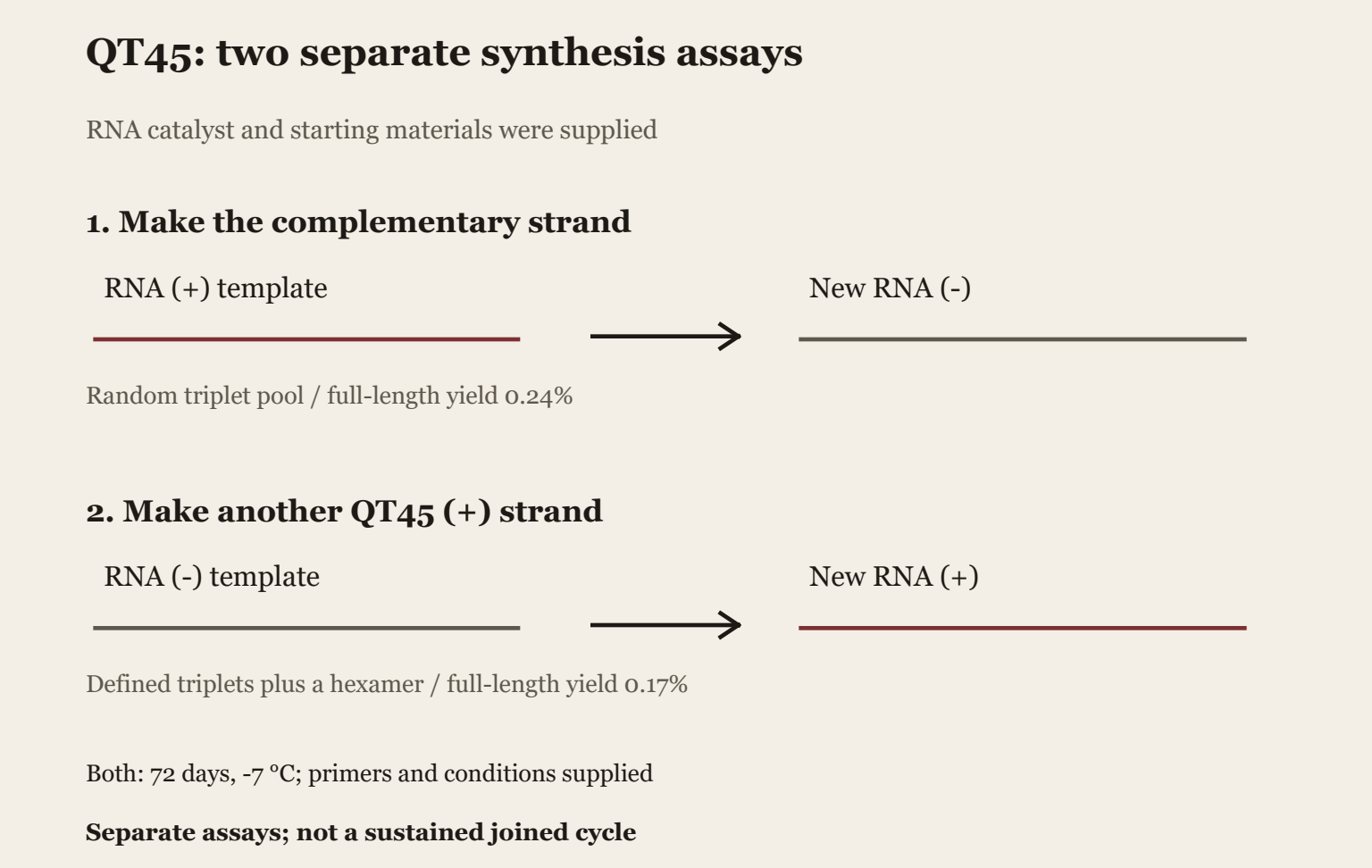
Both assays supplied QT45 RNA catalyst, primers and activated three-letter substrates. The complementary-strand yield shown uses a random triplet pool; own-sequence synthesis uses defined substrates plus a prepared six-letter piece. The reported reactions were incubated at minus 7 degrees Celsius for 72 days. [25]
The two self-synthesis directions were demonstrated separately. The drawing does not connect them into an unattended, sustained self-replication cycle or a living cell. The paper reports real progress and also identifies further efficiency and accuracy requirements.
Download the assay summary and source
20Will it keep itself going?
An origin account needs a connected, persistent system.
A copying catalyst has to be available when it is needed. Its template must be usable, its products must separate, and its sequence must survive errors and chemical damage. Suitable materials have to keep arriving. These requirements interact rather than politely waiting in separate chapters.
QT45’s two self-synthesis directions were slow and low-yielding in the reported assays. A product appearing is not yet evidence that production outpaces loss indefinitely. The authors explicitly identify efficiency and accuracy as targets for further improvement. [25]
The question is not whether a system needs resources. Every organism does. It is whether the system maintains and reproduces its relevant organisation while using resources, rather than depending on a researcher to replace essential missing machinery each round.
A complete origin proposal must also explain how the starting catalysts or earlier alternatives arose. Discovering useful RNA through laboratory selection maps chemical possibilities. It does not by itself measure the likelihood or actual history of those possibilities on the early Earth.
I would call the unfinished result unfinished. That does not erase the demonstrated reactions. It tells us exactly why those reactions are evidence toward an origin account, while the full pathway remains a harder question.
21Can a simple membrane form?
A compartment can emerge without a modern cell building it.
Certain fatty molecules have water-interacting and water-avoiding regions. Under suitable conditions they can assemble into enclosed structures called vesicles. A vesicle is a small membrane-bound compartment. The physical assembly is a useful possibility, not automatic proof that the compartment is alive.
Hanczyc, Fujikawa and Szostak studied model compartments in 2003. Clay accelerated vesicle formation in their system, and clay-associated RNA could become enclosed. Supplied fatty material allowed growth; physical extrusion through small pores supplied a division method. [14]
Zhu and Szostak’s 2009 experiments used a different arrangement. Fed fatty-acid vesicles grew into elongated shapes, and modest shear forces helped them divide. Encapsulated RNA was distributed to daughter compartments. Shear means fluid forces acting differently across an object. [16]
Those RNA molecules were not shown manufacturing a complete new genome during every division cycle. The experiments examined membrane behaviour and distribution of contents. We should not add a demonstrated inheritance system the result did not contain.
Still, the boundary need not begin as a modern cell membrane assembled by modern proteins. Experiments show simpler physical possibilities. The next question is whether useful internal chemistry and the boundary can continue together.
22Contents can affect growth.
A container and its contents need a useful connection.
Imagine a compartment carrying a helpful chemical system. For selection to preserve that system, its effects must connect with continued reproduction. If the benefit leaks away, the connection can fail. This needs a test, not an assumption.
Chen, Roberts and Szostak reported competition between model protocells in 2004. Protocell means a proposed or experimental cell-like precursor, not a certified first organism. In their experiment, enclosed RNA created osmotic pressure that promoted uptake of membrane material. [15]
Osmotic pressure concerns the effect of dissolved substances across a boundary through which water can move. In this setup, RNA-containing vesicles could grow while less-stressed vesicles lost membrane material. The connection arose through physical properties, not an RNA issuing conscious instructions.
The paper suggests how more efficient RNA replication could become linked with faster compartment growth. That suggestion is not a measurement of a fully reproducing genetic system in the experiment. The RNA content and membrane competition were the demonstrated connection. [15]
An observed physical coupling can help fill a missing step without completing every neighbouring step. Keep the proposed future system separate from the one actually measured.
23Can RNA copy inside?
A solution for one part can damage another.
Some conditions that assist RNA copying can damage simple fatty-acid membranes. Magnesium ions illustrate the difficulty: they can help relevant copying chemistry while destabilising the proposed compartment. A chemical ion is an atom or molecule carrying an electrical charge.
Adamala and Szostak addressed this conflict in 2013. Citrate protected fatty-acid membranes from magnesium’s disruptive effects while allowing nonenzymatic, template-directed RNA synthesis inside the model compartments. Citrate also helped protect RNA from certain magnesium-associated damage. [17]
Nonenzymatic here means the copying was not performed by a protein enzyme or ribozyme. It still required the specified chemical components. Refreshing the outside solution with activated nucleotides supported the experimental copying process. [17]
The result did not show an independently arising, fully self-replicating cell. Whether a proposed early environment supplies suitable citrate, activated building units and compatible conditions remains a separate requirement. A useful laboratory reagent is not automatically a proven ancient supply.
I want connected experiments. This work reconciles two requirements in a model and identifies environmental assumptions that a fuller origin proposal must support.
24Why handedness matters.
Mirror-image forms are a real part of the problem.
Some molecules exist in mirror-image forms that do not fit over one another, like left and right hands. This property is called chirality. Biology often uses a particular handedness: familiar proteins mainly use left-handed amino acids, while ordinary RNA uses right-handed ribose.
A chemical mixture does not automatically supply the useful pattern in the proportions a proposed system needs. Mixed handedness can interfere with particular reactions. That makes the origin of biological handedness a genuine research problem rather than a detail to hide.
Blackmond’s review describes physical and chemical ways that one form can become enriched. Enrichment means increasing its proportion. These mechanisms supply testable possibilities; listing them does not establish one complete historical route for every relevant molecule. [31]
The Bennu amino-acid work also matters here. It did not find an established extraterrestrial left-handed excess in the analysed material that could simply be imported as the answer for Earth’s proteins. The sugar study did not measure the sugars’ handedness because amounts were too small. [5] [6]
I would reject both careless claims: handedness is already fully solved, and no natural process can ever change a mixture’s balance. The actual question is which process works for the required molecules, under conditions supported by evidence, and how it joins the rest of the pathway.
25Did researchers build life from scratch?
A synthetic genome can still depend on an existing cell.
Gibson and colleagues reported a bacterial cell controlled by a chemically synthesised genome in 2010. They designed, synthesised and assembled DNA, then transplanted that genome into a recipient cell. The resulting cells could reproduce under the provided conditions. [27]
That was a major achievement in genome construction and cellular control. It also began with existing cellular machinery. A recipient cell is not a bag containing only water and simple nonliving feedstock. Its proteins, membranes and organised chemistry matter to what the new genome can do.
Hutchison and colleagues later reported a minimal synthetic bacterial genome in 2016. Their viable system retained 473 genes under its growth conditions. Minimal in this context is an experimental design result, not the measured gene count of Earth’s first life. [28]
A stripped-down modern bacterial system need not resemble the earliest evolving chemistry. It belongs to a long biological history and a particular laboratory environment. Removing genes until growth fails does not run the whole origin of life backwards.
I would celebrate genome engineering without changing its starting materials. These studies do not demonstrate a complete origin from simple chemistry. Their limits also do not prove such an origin impossible. They answer a different, impressive question.
26Was LUCA the first life?
The last shared ancestor is not the earliest beginning.
LUCA stands for last universal common ancestor. It concerns the shared ancestry of living cellular lineages, reconstructed through evidence such as genes and their relationships. It is not automatically the first organism, the first replicating molecule, or every living system that ever existed.
Other earlier or contemporary lineages could have left no surviving descendants in the sampled record. Finding a shared ancestral stage does not reveal all chemistry before it. Part 11’s distinction between common ancestry and an exclusive beginning remains useful here.
Weiss and colleagues’ 2016 work inferred aspects of LUCA’s physiology from gene families and evolutionary trees. Moody and colleagues’ 2024 study used other comparative and dating analyses, reconstructing a relatively complex ancestral organism and an ecological context. These are historical inferences, not a retrieved ancient cell. [29] [30]
Their assumptions, methods and differences matter. I will not combine every reconstruction into one indisputable portrait or borrow one model’s date as the directly measured birthday of life. A reconstruction must be assessed at the level its data support.
The origin question therefore does not end when somebody says LUCA. The earlier transition still needs explanation. Nor does a complex inferred common ancestor demonstrate that a fully modern organism had to appear in one leap from simple chemicals.
27What are the odds?
A dramatic number needs a defined model.
Someone calculates the chance of assembling one exact modern protein or genome in a single random draw, then declares life impossible. The calculation may answer its own mathematical question. It has not automatically modelled the chemical origin being discussed.
A meaningful probability needs specified starting materials, possible reactions, time, environments and what counts as success. Are all sequences equally likely? Is only one sequence functional? Does the proposal require a complete modern cell at once? Those assumptions need justification.
The experiments in this chapter involve chemical preferences, catalysts, changing conditions and, in some systems, copying with selection. They do not describe a modern cell assembled by one blind shuffle. Equally, I cannot simply assume selection solves every step before an inheritable reproducing system exists.
We do not know the entire range of workable early systems or the actual history of their formation. I will not manufacture a precise probability that abiogenesis was inevitable. Rejecting a bad impossibility calculation does not supply a good inevitability calculation.
My response is to ask for the model behind the number. Then compare it with the proposed mechanisms and observations. A huge denominator does not become evidence merely because it is difficult to read aloud.
28People set up experiments.
That objection identifies a limit, not an automatic creator.
Yes. Researchers choose chemicals, prepare templates, control conditions and measure products. Where they select or transfer molecules, that intervention belongs in the description. Hiding it would make the account weaker and give a critic a fair complaint.
But a controlled experiment can establish what a chemical system does under stated conditions. Its organisation by a scientist does not demonstrate that the same reaction requires a conscious agent whenever those conditions arise. The historical availability of those conditions is a further test.
Imagine using a prepared channel to investigate how water flows. The channel helps isolate a process; it does not prove every natural stream requires a channel builder. This analogy explains the logical distinction, not the early Earth’s chemistry.
The opposite overclaim also fails. Because a scientist can arrange a useful result, we cannot infer the entire arrangement was naturally available. Supplied catalysts, purified ingredients, repeated handling and incompatible stages need explicit environmental explanations.
I would separate two questions: has the reaction been demonstrated, and has its place in a natural origin been supported? A laboratory result can answer the first while leaving the second open. Neither side gets to erase that distinction.
29Why not restart a dead cell?
A broken organism is not a model of every possible beginning.
A dead cell contains relevant molecules, yet does not simply restart. Ingredients alone are insufficient. That does not exclude every chemical origin: repairing damaged modern machinery and developing a simpler evolving system are different tasks.
Familiar organisms come from earlier organisms. Turning that observation into a universal prohibition on earlier chemical origins requires more argument. Present reproduction does not test every past environment and transition.
Why do we not see new life beginning everywhere now? We do not yet know the actual pathway, requirements or frequency of such beginnings. Their absence from our observations does not supply those missing numbers. Present surroundings also need not reproduce a proposed early setting.
Another proposal puts life’s arrival in space, often called panspermia. If living material reached Earth from elsewhere, its own origin would still need explanation. Finding nonliving ingredients in Bennu does not establish transport of an organism, still less a universal account of life’s first beginning. [5] [6]
These questions need specific evidence. A failed restart, an unobserved event and a possible transport route are different arguments. None alone identifies a religion’s claimed agent or story.
30How would I explain this to a believer?
Start with one claim and open its evidence.
I would begin plainly: the complete origin of life is unsolved. Then ask whether the claim is that relevant chemistry is impossible, that no copying has been demonstrated, or that no complete natural history is established. Those are different propositions.
For ingredients, open Miller’s original paper and the Bennu studies. Show the setup or sample, how a compound was identified and what was not found. For RNA activity, open a catalytic-RNA study. For copying, inspect the actual template, catalyst and supplied components.
For the 2026 result, use our two-reaction diagram. Explain the plus and minus strands, separate assays, provided helper pieces and low full-length yields. Do not hide the remaining challenge of sustained reproduction. An accurate account can be impressive without becoming a creation claim.
If the reply is therefore my god did it, ask for the evidence that identifies that god and act. What does the explanation predict beyond the gap? Which observation would distinguish it from a different creator story or an unfinished chemical explanation?
I do not need to pretend every chemical step is known to reject an unsupported religious conclusion. I also owe the reader honesty about what science has not established. Open the paper, follow the method and keep the claim the same throughout the conversation.
NoteI will not borrow a miracle.
The unknown deserves work, not a protected answer.
I take the origin question seriously. That means reading experiments, checking their starting materials, and refusing to turn every useful molecule into the first living thing.
My atheism does not require a fabricated certainty that scientists know the full route. Nor does another person’s faith become evidence because a chemical pathway is incomplete. An unanswered question belongs to everybody; no religion gains ownership of it by announcing a name.
There is measured progress here: relevant ingredients, catalytic RNA, copying reactions, membrane behaviour and partial integration. There are also unsolved questions about starting systems, connected environments, persistence and history. Keeping both visible makes the explanation usable rather than brittle.
I will change conclusions when better evidence warrants it. Not every hypothesis will survive. Revise or drop a failed route; describe a real advance at its actual scale.
What I refuse is the demand to choose between pretending the whole origin is solved and accepting someone’s creation story. I want an account supported by evidence. Until the missing steps are understood, I will call them missing, not sacred.
SourcesFollow the evidence.
Sources checked on 16 October 2026. Original experiments support particular reactions, sample identifications or managed systems. NASA provides a working definition. Damer, Sojo and Blackmond are reviews or hypothesis syntheses; LUCA studies are historical reconstructions. This is not independent replication or reanalysis of every dataset. Houses, journeys, a kitchen and a water channel are explanatory comparisons. The original diagram summarises two QT45 assays from the 2026 study. Its CSV records reported full-length synthesis yields, supplied components and conditions; it is not raw laboratory data, perfect-sequence frequency, a historical reconstruction or a complete self-replication cycle. The assays are separate, and own-sequence synthesis used a provided hexamer. Miller’s result is amino-acid synthesis, not a cell. Bennu ingredients are not organisms or assembled RNA; the sugar study’s analytical limitations are retained. Activated ingredients and experimental handling remain explicit. RNA evolution in the 2024 study included protein-based laboratory steps between rounds. Membrane growth, internal copying and sustained whole-system reproduction are distinct. A synthetic genome in a recipient cell is not an origin entirely from simple feedstock. No complete established pathway to first life, precise probability of abiogenesis or identification of a creator is claimed.
[1] About Life Detection
NASA Astrobiology / Life Detection research
Institutional working definition centred on a self-sustaining chemical system capable of Darwinian evolution. Used as a research aid, not a universally final boundary or evidence of a completed origin pathway.
[2] A production of amino acids under possible primitive earth conditions
Stanley L. Miller / Science 117 / 1953 / doi:10.1126/science.117.3046.528
Original two-page article, also read in a public scanned copy with a cover page. Methane, ammonia, hydrogen and water circulated past a discharge for one week. Chromatographic identification of glycine and alanines is distinguished from the less certain products. No living cell was produced.
Open the original text or supporting primary record
[3] The Miller volcanic spark discharge experiment
Adam P. Johnson and colleagues / Science 322 / 2008 / doi:10.1126/science.1161527
Original reanalysis of archived extracts from Miller’s volcanic water-mist apparatus. A broader amino-acid inventory is not a complete organism or proof of one uniquely established early atmosphere.
Open the original text or supporting primary record
[4] A reassessment of prebiotic organic synthesis in neutral planetary atmospheres
H. James Cleaves and colleagues / Origins of Life and Evolution of Biospheres 38 / 2008 / doi:10.1007/s11084-007-9120-3
Original neutral-atmosphere synthesis study. Oxidation during hydrolytic workup and protection before that step affected measured amino-acid recovery. The analytical intervention and conditional environmental interpretation are retained.
Open the original text or supporting primary record
[5] Abundant ammonia and nitrogen-rich soluble organic matter in samples from asteroid (101955) Bennu
Daniel P. Glavin and colleagues / Nature Astronomy 9 / 2025 / doi:10.1038/s41550-024-02472-9
Original Bennu sample analysis of ammonia, amino acids, nucleobases and other soluble organic compounds. Ingredients are not life. The analysed chiral amino acids did not supply an established extraterrestrial left-handed excess that settles terrestrial biological handedness.
Open the original text or supporting primary record
[6] Bio-essential sugars in samples from asteroid Bennu
Yoshihiro Furukawa and colleagues / Nature Geoscience 19 / 2026; online 2 December 2025 / doi:10.1038/s41561-025-01838-6
Original Bennu sugar study. Ribose and glucose identification, standards, another analytical system and procedural blank are described. Sugar isotope and handedness measurements were not possible at the available amounts. Non-detection of 2-deoxyribose is specific to the analysed sample and method; no RNA organism was found.
Open the original text or supporting primary record
[7] Synthesis of activated pyrimidine ribonucleotides in prebiotically plausible conditions
Matthew W. Powner, Beatrice Gerland and John D. Sutherland / Nature 459 / 2009 / doi:10.1038/nature08013
Original route to activated pyrimidine ribonucleotides through specified intermediates rather than direct free-ribose/base assembly. A demonstrated synthesis under conditions is distinguished from its complete geological supply and integration.
Open the original text or supporting primary record
[8] Common origins of RNA, protein and lipid precursors in a cyanosulfidic protometabolism
Bhavesh H. Patel and colleagues / Nature Chemistry 7 / 2015 / doi:10.1038/nchem.2202
Original related chemistry for precursors of RNA, amino acids and lipids. These are precursors made through specified reactions involving ultraviolet light and reagents, not three completed subsystems or an unattended cell.
Open the original text or supporting primary record
[9] Unified prebiotically plausible synthesis of pyrimidine and purine RNA ribonucleotides
Sidney Becker and colleagues / Science 366 / 2019 / doi:10.1126/science.aax2747
Original compatible purine/pyrimidine synthesis work, including wet-dry cycling and phosphate-containing minerals. A connected chemical advance is not a complete self-maintaining origin pathway.
Open the original text or supporting primary record
[10] Synthesis of long prebiotic oligomers on mineral surfaces
James P. Ferris and colleagues / Nature 381 / 1996 / doi:10.1038/381059a0
Original mineral-surface oligomer synthesis. Activated monomers and successive feedings are explicit. Long chains are not assumed to be genomes, functional catalysts or products of untreated clay alone.
Open the original text or supporting primary record
[11] The Hot Spring Hypothesis for an Origin of Life
Bruce Damer and David Deamer / Astrobiology 20 / 2020 / doi:10.1089/ast.2019.2045
A hot-spring hypothesis and synthesis of experimental work, not an independently observed historical birthplace. Predictions and the integration of wet, dry and moist stages remain matters for testing.
Open the original text or supporting primary record
[12] The Origin of Life in Alkaline Hydrothermal Vents
Victor Sojo and colleagues / Astrobiology 16 / 2016 / doi:10.1089/ast.2015.1406
Review and hypothesis concerning alkaline vents, gradients, mineral pores and early energy use. Proposed mechanisms and modern biochemical comparisons are not described as a fully demonstrated path to first life.
Open the original text or supporting primary record
[13] Synthesis and breakdown of universal metabolic precursors promoted by iron
Kamila B. Muchowska, Sreejith J. Varma and Joseph Moran / Nature 569 / 2019 / doi:10.1038/s41586-019-1151-1
Original iron-promoted network starting with supplied pyruvate and glyoxylate. Relevant metabolic intermediates and breakdown reactions do not establish a self-feeding organism or a complete autonomous metabolism.
Open the original text or supporting primary record
[14] Experimental models of primitive cellular compartments: encapsulation, growth, and division
Martin M. Hanczyc, Shelly M. Fujikawa and Jack W. Szostak / Science 302 / 2003 / doi:10.1126/science.1089904
Original vesicle model: clay-assisted formation, encapsulation, feeding for growth and physical extrusion for division. The physical intervention and absence of a complete reproducing genetic system are preserved.
Open the original text or supporting primary record
[15] The emergence of competition between model protocells
Irene A. Chen, Richard W. Roberts and Jack W. Szostak / Science 305 / 2004 / doi:10.1126/science.1100757
Original osmotic competition between model vesicles. Enclosed RNA and membrane uptake were coupled physically. A proposed link from improved RNA replication to cell growth is distinguished from a complete genetic replication system measured here.
Open the original text or supporting primary record
[16] Coupled growth and division of model protocell membranes
Ting F. Zhu and Jack W. Szostak / Journal of the American Chemical Society 131 / 2009 / doi:10.1021/ja900919c
Original growth and division model using fatty-acid feeding and modest shear. Encapsulated RNA was distributed among daughter vesicles; this is not a demonstration that the RNA copied itself every division.
Open the original text or supporting primary record
[17] Nonenzymatic template-directed RNA synthesis inside model protocells
Katarzyna Adamala and Jack W. Szostak / Science 342 / 2013 / doi:10.1126/science.1241888
Original citrate-assisted compatibility of magnesium-dependent nonenzymatic RNA copying and fatty-acid compartments. Supplied chemicals, activated nucleotides and refreshed solution are retained; their prebiotic availability is a separate question.
Open the original text or supporting primary record
[18] Self-splicing RNA: autoexcision and autocyclization of the ribosomal RNA intervening sequence of Tetrahymena
Kelly Kruger and colleagues / Cell 31 / 1982 / doi:10.1016/0092-8674(82)90414-7
Original self-splicing RNA study. The deproteinised prepared RNA reacted with specified ions and guanosine. Intrinsic RNA reaction activity is not an origin from simple feedstock or a complete replication system.
[19] The RNA moiety of ribonuclease P is the catalytic subunit of the enzyme
C. Guerrier-Takada and colleagues / Cell 35 / 1983 / doi:10.1016/0092-8674(83)90117-4
Original catalytic RNA component of RNase P under appropriate buffer conditions. The RNA/protein requirements depend on conditions. The result supports RNA catalysis, not an unconditional claim that every cellular RNA reaction needs no protein.
[20] The structural basis of ribosome activity in peptide bond synthesis
Poul Nissen and colleagues / Science 289 / 2000 / doi:10.1126/science.289.5481.920
Original structural study of the large ribosomal subunit and its RNA catalytic centre. Used for the role of RNA in peptide-bond formation, not to adopt every proposed catalytic detail or prove the full RNA-world history.
Open the original text or supporting primary record
[21] Self-sustained replication of an RNA enzyme
Tracey A. Lincoln and Gerald F. Joyce / Science 323 / 2009 / doi:10.1126/science.1167856
Original cross-replicating ligase system using four provided RNA fragments and renewed substrate supplies. Replication, competition and recombinant variants are experimental results. It is not a general polymerase or synthesis of all starting components from simple chemicals.
Open the original text or supporting primary record
[22] Amplification of RNA by an RNA polymerase ribozyme
David P. Horning and Gerald F. Joyce / PNAS 113 / 2016 / doi:10.1073/pnas.1610103113
Original evolved RNA polymerase producing functional RNAs and amplifying short templates. Supplied catalysts, substrates and experimental conditions are distinguished from autonomous replication of the complete system.
Open the original text or supporting primary record
[23] RNA-catalyzed evolution of catalytic RNA
Nikolaos Papastavrou, David P. Horning and Gerald F. Joyce / PNAS 121 / 2024 / doi:10.1073/pnas.2321592121
Original comparison of copying fidelity during managed hammerhead evolution. RNA copying, selection and fitness are real results; researcher handling, purification, reverse transcription, DNA amplification and transcription between rounds are disclosed. The study checked selection bias from those protein-based steps.
Open the original text or supporting primary record
[24] Trinucleotide substrates under pH-freeze-thaw cycles enable open-ended exponential RNA replication by a polymerase ribozyme
James Attwater and colleagues / Nature Chemistry 17 / 2025 / doi:10.1038/s41557-025-01830-y
Original triplet-assisted strand separation and replication under coupled pH and freeze-thaw cycles. Supplied ribozyme and substrates are explicit. Replication of a ribozyme fragment is not autonomous reproduction of the complete catalyst.
Open the original text or supporting primary record
[25] A small polymerase ribozyme that can synthesize itself and its complementary strand
E. Gianni and colleagues / Science / 2026 / doi:10.1126/science.adt2760
Original QT45 study, including Figure 4 and methods. Separate complementary-strand and own-sequence synthesis, supplied triplets, primers and an extra hexamer for own-sequence synthesis are retained. Reported full-length yields of 0.24% and 0.17% after 72 days are not perfect-sequence frequencies or a sustained autonomous origin of life.
Open the original text or supporting primary record
[26] Nonenzymatic copying of RNA templates containing all four letters is catalyzed by activated oligonucleotides
Noam Prywes and colleagues / eLife 5 / 2016 / doi:10.7554/elife.17756
Original nonenzymatic copying with activated monomers and short oligomers. Mixed-template copying and the sequentially supplied, bead-supported extended functional-sequence experiment are distinguished rather than all called one-pot autonomous replication.
Open the original text or supporting primary record
[27] Creation of a bacterial cell controlled by a chemically synthesized genome
Daniel G. Gibson and colleagues / Science 329 / 2010 / doi:10.1126/science.1190719
Original synthetic-genome transplantation into an existing recipient cell. A chemically synthesised genome controlling reproducing cells is not a cell assembled entirely from nonliving simple feedstock.
Open the original text or supporting primary record
[28] Design and synthesis of a minimal bacterial genome
Clyde A. Hutchison III and colleagues / Science 351 / 2016 / doi:10.1126/science.aad6253
Original minimal synthetic bacterial genome with 473 genes under the stated conditions. Minimality is relative to the system and environment; it is not the measured composition of Earth’s first living system.
Open the original text or supporting primary record
[29] The physiology and habitat of the last universal common ancestor
Madeline C. Weiss and colleagues / Nature Microbiology 1 / 2016 / doi:10.1038/nmicrobiol.2016.116
Original comparative gene-family reconstruction of LUCA’s physiology. An inferred last shared ancestor is not the earliest life, a directly recovered organism or an exhaustive record of all early lineages.
Open the original text or supporting primary record
[30] The nature of the last universal common ancestor and its impact on the early Earth system
Edmund R. R. Moody and colleagues / Nature Ecology and Evolution 8 / 2024 / doi:10.1038/s41559-024-02461-1
Original model-based LUCA reconstruction and dating analysis. Its inferred complexity and ecology are not merged with every earlier model as one final portrait. No estimated LUCA date is treated as the directly measured beginning of life.
Open the original text or supporting primary record
[31] The origin of biological homochirality
Donna G. Blackmond / Cold Spring Harbor Perspectives in Biology 2 / 2010 / doi:10.1101/cshperspect.a002147
Review of mechanisms for physical or chemical enrichment of molecular handedness. Possibilities and experimental mechanisms are distinguished from a complete historical explanation for biological homochirality.