

01Then who made it?
A good question deserves more than a confident name.
I finish explaining the evidence for a hot early universe. Someone replies: fine, but who made that universe? It is a fair place to continue. Evidence about an earlier physical state does not automatically explain why physical reality exists at all.
My answer begins with an admission: I do not possess a verified, complete account of the ultimate origin of existence. Neither a diagram of expanding space nor a difficult equation gives me permission to pretend otherwise. Part 13 established a history, with limits. [30]
But an unanswered question does not make the next answer correct. If I cannot explain why a locked room contains a noise, that does not establish your claim that a particular person is inside. Your proposed explanation still needs support of its own.
This chapter tests the move from the existence of a universe to a creator. Some versions are serious philosophical arguments. Others jump straight from human ignorance to a religious conclusion. Treating all of them as identical would make my criticism weaker.
I am willing to examine a creator claim. I am not willing to call an assumption a discovery because it sounds satisfying. God, Allah or Bhagwan cannot become an established answer merely because I have reached the edge of my present knowledge.
02What does made mean?
The question can quietly assume the answer it asks for.
When someone asks who built a bridge, the word who makes sense because we already have evidence of bridge builders. Asking who caused a volcanic eruption would need another step: perhaps nobody intended it. A cause and a conscious maker are different claims.
Universe can mean our observable region, our entire connected spacetime, or all physical reality, including anything beyond our observable region. Changing definitions halfway through changes the argument. We must agree which meaning is being used. [30]
A larger physical process might explain our region's beginning while leaving the larger reality unexplained. Calling it a multiverse does not remove that question. Calling an unknown cause a creator does not establish a mind.
So I first replace who made everything with what, if anything, explains the existence of physical reality. This phrasing allows a personal answer if evidence or argument supports one. It also leaves other possibilities open instead of hiding a person inside the wording.
I want the believer to define the claim clearly enough that we can test the reasoning. Is the claim an earlier event, a timeless dependence, a necessary foundation, or an intentional act? Those proposals are not interchangeable just because each sounds like an answer to why.
03Check the steps, not the volume.
A conclusion can follow correctly from premises that have not been established.
A premise is a starting claim in an argument. A conclusion is what the argument says follows from those claims. We need to check both the starting claims and the connection between them. A loud conclusion cannot repair a missing step.
Here is an invented example. Every sealed box in this room contains a red ball. This box is sealed and is in the room. Therefore, it contains a red ball. If the two starting claims are true, the conclusion follows. But have we actually checked the boxes?
An argument is valid when its conclusion must follow if its premises are true. It is sound when it is valid and its premises are actually true. The distinction matters whenever someone displays three numbered sentences and announces that a debate has ended.
Creator arguments also have stages. An argument might establish some cause while leaving its character unsettled. Another argument might be offered for a necessary foundation, followed by further arguments for intelligence or goodness. Each stage must earn its conclusion. [8] [32]
I will ask which premise is supported, why it applies to the universe, and whether the conclusion says more than the premises allow. That is ordinary reasoning. A philosophical argument deserves this scrutiny just as a scientific claim deserves scrutiny of its evidence and assumptions.
04Not everything needs a cause.
Answer the stronger argument people actually defend.
The familiar objection goes like this: if everything needs a cause, who caused God? That objection works against someone who really says everything without exception needs a cause. It does not directly answer the better-known modern kalam argument defended by William Lane Craig. [1]
In simplified form, that argument says: anything that begins to exist has a cause; the universe began to exist; therefore the universe has a cause. God is proposed as beginningless. The first premise therefore does not, by itself, require God to have a cause.
I cannot honestly defeat that version by deleting the words begins to exist. The useful questions concern the causal principle, the claim of a cosmic beginning, and the further inference from a cause to a personal deity. Those are where the work must happen.
This does not give God a free pass. Calling something beginningless requires justification if its existence is being asserted. But there is a difference between exposing an unsupported claim and accusing an argument of a contradiction that its actual wording avoids.
My reply is straightforward: I understand why your rule does not include a beginningless God. Now show that physical reality began in the required sense, defend the rule at that boundary, and explain why the proposed cause has the properties you attribute to it.
05A potter starts with clay.
Making a new object is not an observation of absolute creation.
A potter can turn clay into a pot. We can identify the person, the material, the tools and the process. The pot has a beginning as a particular object, while its ingredients existed earlier. Everyday making usually involves this kind of rearrangement.
Philosophers distinguish an efficient cause, which brings about an effect, from a material cause, the stuff out of which something is made. A defender of creation can propose an efficient cause without a material cause. The proposal is not simply a potter working with hidden cosmic clay. [2]
That distinction blocks one easy objection, but creates a demand for clearer support. Observing people transform materials is not the same as observing the arrival of all physical reality with no prior material. The claim extends beyond the familiar examples offered for it.
A defender can reply that the principle is metaphysical: it concerns what can exist, rather than merely summarising pots we have watched being made. Then we should examine the reasons for that metaphysical principle. Repeating the pot example cannot do all that work.
I do not conclude that absolute creation is impossible because potters use clay. I conclude that the analogy has a limit. If the argument moves beyond observed transformations, it must explain why the rule remains justified in the new setting.
06Is quantum chance uncaused?
Quantum physics needs careful language on both sides.
Someone may object that radioactive decay happens without a cause. Standard quantum calculations predict probabilities rather than a clockwork result for each event. But decay still involves a physical system, a state and a theoretical description.
Unpredictable to us, not predetermined, and without any cause are different claims. Quantum experiments constrain accounts of outcomes. They do not establish that the whole universe appeared from absolute nothing without any explanation. [16]
Deterministic approaches also exist. Bohmian mechanics uses particle positions and a guiding wave function; it is nonlocal and has its own commitments. Quantum statistics alone therefore do not settle every question about causation. [17]
Bell tests rule out the relevant local hidden-variable account under their assumptions. They do not exclude every deterministic account. I will not turn a difficult result into an atheist slogan that says more than the experiment established.
The believer cannot simply insist that every microscopic event is a tiny classical machine either. My useful conclusion is narrower: the causal principle needs a precise meaning and a defence. Quantum uncertainty neither finishes the creator argument nor automatically destroys it.
07A vacuum still has physics.
Empty of ordinary particles does not mean empty of every physical feature.
An empty room contains air. Remove the air and there is still space, with physical fields described by a theory. A quantum vacuum is a physical state, often defined relative to a particular theoretical setting. It is not the absence of all physical reality. [15]
A calculation involving a vacuum still uses a framework, conditions and mathematical rules. Calling it something from nothing can mislead a reader who understands nothing to mean no space, fields or physical state.
Absolute nothing, as used in this philosophical question, would exclude those physical ingredients. It is not a dark container patiently waiting to produce a universe. A container and a period of waiting would already supply space and time.
This cuts both ways. I cannot use a quantum-vacuum model as a completed explanation of why anything whatsoever exists. A believer cannot refute a physical model merely by giving its carefully specified starting state a different everyday meaning of the word nothing.
I ask what the proposal contains and predicts. Define any specialised meaning of nothing before arguing. A change of vocabulary does not create an experiment, and an experiment about a vacuum does not settle every metaphysical question.
08What happened before time?
First ask whether before is defined in the proposed model.
Before describes an ordering in time. If a model has a first temporal boundary, asking for an earlier time inside that same model may have no answer. This is a conditional point about a description. It does not establish that our actual universe had such a boundary.
Nor does it prove that reality has no explanation. A defender may mean dependence rather than an earlier event: the universe could depend on something without that something occupying an earlier minute. Craig explicitly discusses such a timeless causal proposal. [3]
That proposal needs explanation too. Our ordinary examples of deciding, acting and producing changes unfold in time. Moving those ideas outside time raises questions about which features remain and how the relation is understood. A familiar verb alone cannot settle the difficulty.
I will not announce that timeless causation is logically impossible merely because it feels strange. I also will not accept its existence merely because someone has attached the word timeless to a deity. Both reactions would skip the argument.
The useful conversation is precise: does the physical model contain an earlier state? If not, is a non-temporal dependence being proposed? What supports that relation? This keeps an unresolved issue from becoming a contest over who can imagine the more impressive picture.
09A boundary is not a creator.
State what a mathematical result assumes and concludes.
The Borde-Guth-Vilenkin result is often advertised as proof of creation. Under its positive-average-expansion condition along the relevant path, a past-directed classical spacetime description is incomplete. The derivation does not require the usual energy condition. [11]
The path is a geodesic: roughly, a trajectory of freely moving matter or light. Past incompleteness means it cannot be continued indefinitely within that description. The result does not name what replaces or explains the boundary.
The paper says inflation needs other physics to describe its past boundary. A beginningless model must confront the condition. But the theorem supplies neither a quantum account of that boundary nor the identity or intentions of a creator.
Aguirre and Gratton proposed a global construction with special boundary conditions. This is a researched alternative, not proof of the actual history. Its assumptions and time orientation matter when comparing it with the theorem. [12]
So I refuse both exaggerated claims: that BGV establishes a particular God, or that speculative alternatives have already shown the actual universe is past eternal. A conditional theorem and a proposed cosmology must each be judged for what they really establish.
10The hotel with endless rooms.
Unusual arithmetic is not automatically a contradiction.
One philosophical case for a beginning says that an actually infinite collection of past events is impossible. A familiar illustration is Hilbert's Hotel, used in creator debates: imagine numbered rooms with no last room, and a guest already occupying every room. [2]
Move each guest from room n to room n plus one. Room one becomes available. This is an idealised mathematical reassignment, not an instruction for moving real guests in a measurable time. It illustrates how an infinite set differs from a finite one.
The defender's serious claim is not that mathematicians cannot discuss infinity. It is that the resulting situations cannot be instantiated in concrete reality. A critic must address that physical or metaphysical claim, rather than merely point at the existence of mathematics.
Equally, strange is not a logical contradiction. In the reassignment, every original guest still has a distinct room. The finite rule that a proper part must always have fewer members does not apply to infinite cardinalities in the same way.
The hotel therefore gives us a question to investigate. It does not, by itself, demonstrate that time has a first instant or that a personal agent created it. Mathematical consistency is not a photograph of an infinite past; discomfort is not a proof that one is impossible.
11Reaching today.
A beginningless past does not contain a first event called minus infinity.
Another objection says we could never reach today through infinitely many earlier events. Starting with an empty collection and adding events never produces a completed infinite collection. This motivates the successive-addition argument. [1]
The critic replies that a beginningless history does not start with an empty collection or a first event infinitely far away. In the simple mathematical ordering of the negative integers ending at zero, there is no first negative integer from which the whole process starts.
Each particular integer in that ordering is finitely many steps from zero, while there are infinitely many integers altogether. These statements are compatible. The example identifies a distinction between an endless past and a task launched at a first moment with infinitely many steps ahead.
This does not establish that physical time has that structure. The defender can still challenge whether concrete successive events can be beginningless, or whether the assumed account of becoming is coherent. That is a further debate. [32]
My point is that counting from minus infinity is a misleading picture if minus infinity is being treated as an actual first date. We need an argument about the possible structure of time, not a countdown that secretly inserts the starting point the proposal denies.
12Could it have failed to exist?
These words concern possibility, not importance or old age.
A contingent thing, in this discussion, exists but could have failed to exist. A necessary being is proposed as something that could not have failed to exist. Necessary does not mean very useful, very powerful, or something we badly want to keep.
Imagine a meeting that could have been cancelled. Its occurrence depends on conditions that might not have obtained. This is an everyday way into contingency, rather than a demonstration that the entire universe has exactly the same kind of dependence.
Leibniz distinguishes truths that cannot be otherwise from facts whose explanation must be sought beyond merely listing more such facts. His argument seeks a necessary reason for contingent reality. It is not simply a question about the earliest second on a clock. [7]
Something can be beginningless yet contingent in the philosophical sense: it might have existed for all time while still being capable of not existing at all. Conversely, physical necessity under particular laws is narrower than metaphysical necessity across all genuinely possible realities.
This matters when someone says God is necessary or the universe is necessary. Those are substantive claims. Writing the word necessary beside a favourite candidate does not establish that candidate's existence or show that its nonexistence is impossible.
13A sufficient reason?
This argument asks for more than another earlier event.
The principle of sufficient reason, or PSR, demands an adequate explanation. Versions differ: some cover all facts, others only contingent facts or restricted events. Defenders reject ultimately unexplained contingent existence. [10]
A simplified Leibnizian argument says contingent reality exists; contingent facts require adequate explanation; and a complete explanation cannot consist only of further contingent facts. A necessary foundation is proposed. That no-endless-deferral step needs defence too. [6]
This argument can be offered even with no first physical moment. An eternal chain might explain which event preceded another while leaving the further question: why does this contingent history exist? Earlier cause and ultimate explanation are different targets.
I take that challenge seriously. Scientific inquiry repeatedly succeeds by seeking explanations. But a fruitful policy of looking for reasons does not, without another argument, establish that every contingent fact has an ultimate explanation of the required kind.
The dispute is therefore about the scope and justification of the principle, what counts as adequate explanation, and whether a necessary ground follows. Saying who made God does not address those questions if the proposed ground is claimed to be necessary.
14Does each link explain the whole?
Both sides need to explain what their stopping point achieves.
Suppose everyone in a group borrowed a pen from someone else in the group. Have we explained why there is a pen at all? The example suggests why a defender thinks dependent explanations may still lack a foundation.
But the analogy assumes rules about pens, possession and borrowing. A physical or metaphysical history need not resemble a circle of borrowers. The example identifies a question; it does not settle the answer.
Pruss develops the case using contingent facts and explanation, rather than assuming every property of a part belongs to its whole. His discussion separates securing an explanation, ending the regress and connecting the result with God. [8]
In Hume's dialogue, Cleanthes replies that explaining individual members may leave no extra explanatory task. Demea presses the question of why the entire succession exists. The text stages a philosophical disagreement, not an experiment. [9]
I ask the defender what remains unexplained after the individual explanations, and ask the critic why that remainder is not a legitimate question. Neither the word whole nor the phrase fallacy of composition can replace the detailed argument.
15Aquinas asks another question.
A sustaining cause is not simply the first domino long ago.
Consider a lamp receiving electricity through extension leads. Adding leads does not supply the power source. The illustration helps introduce a present dependence: something can transmit a capacity it does not supply independently. It is an analogy with known electrical limits.
Aquinas's first two ways reason from change and ordered causal dependence. Change involves potentiality and actuality: a capacity becomes an actual condition through what is already actual in the relevant respect. This is a metaphysical framework, not just modern motion measured in metres. [4]
If every member only borrows its ability to act, what supplies that ability? The argument seeks a primary cause in the dependence order. Primary need not mean earliest in time.
Aquinas also says that a temporal beginning of the world cannot be demonstrated by reason alone. He accepted it on faith. So an infinite past, even if established, would not by itself answer his case for a creator understood as a continuing ground of existence. [5]
To criticise this argument, I must examine its account of change, the claimed termination of dependence and the properties attributed to the terminus. Saying physics allows motion without a continuing push leaves that wider argument largely untouched.
EvidenceThree routes to a first cause.
A beginning, a sufficient reason and sustaining dependence ask different things.
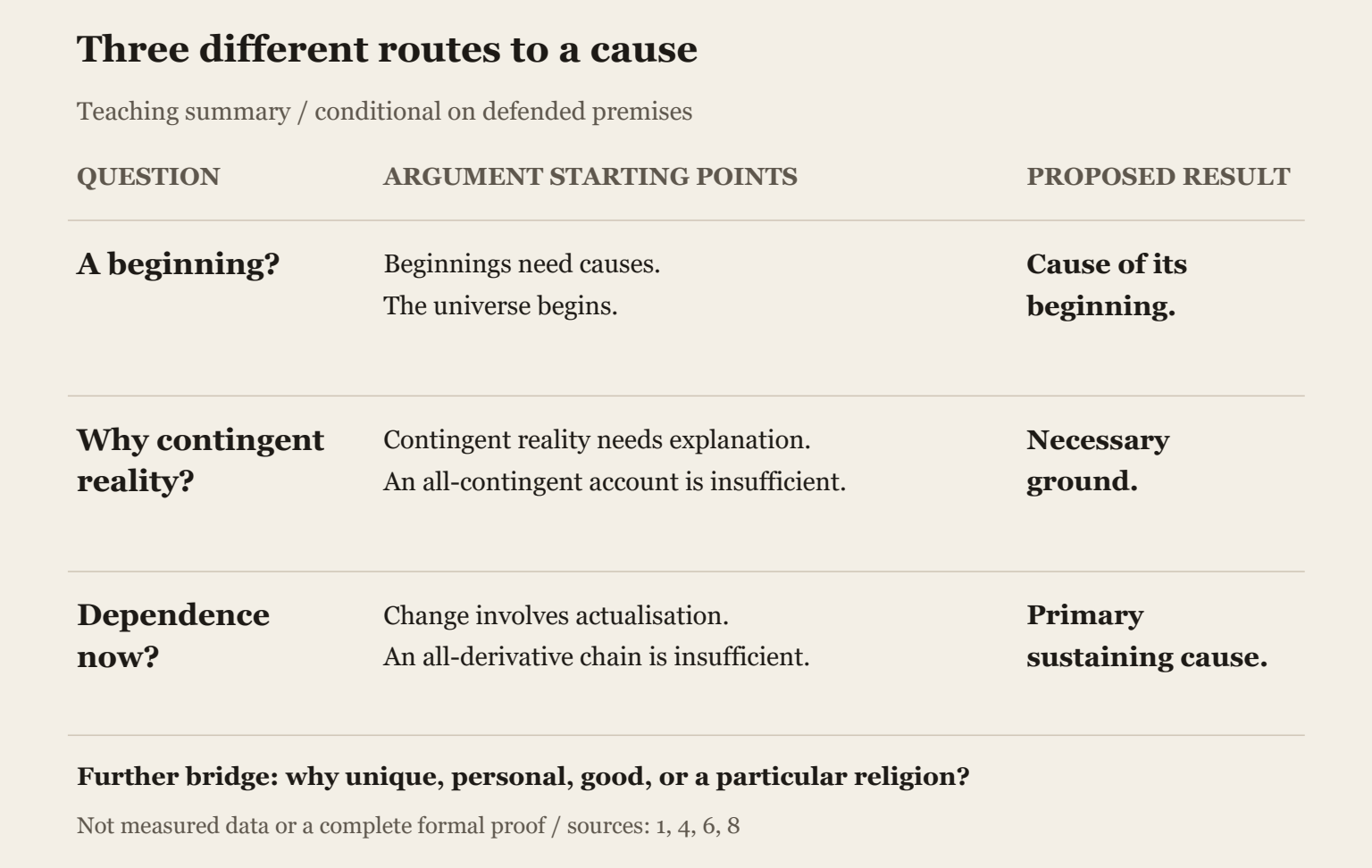
The temporal argument asks about a beginning. The contingency argument asks why contingent reality exists. The sustaining argument asks what grounds derivative causal activity. An answer about one target does not automatically answer the others.
The next bridge still matters: why should the proposed cause or ground be unique, personal, morally perfect, or the source described by a particular religion? Those claims need their own reasons. The linked CSV records the schematic wording and sources, not measurements or probabilities.
Download the bilingual argument map and sources
16Could existence be a brute fact?
A limit to explanation is a position to defend, not a solved mystery.
A brute fact is a fact with no further explanation. If physical reality is ultimately brute, that means its existence has no deeper reason. It does not mean we have discovered a machine called brute fact that creates universes.
This answer can feel unsatisfying. I understand why. A defender of the PSR argues that stopping at unexplained contingency abandons the very demand that drove the inquiry. The demand is strongest when it asks why this reality obtains rather than another. [10]
A critic can reply that intelligibility within reality need not guarantee an explanation of reality as a whole. Carroll defends an ultimate brute-fact position. That is a philosophical interpretation informed by physics, not a detector result that forces every reader to agree. [19]
There is also a distinction between presently unexplained and genuinely unexplainable. We frequently have the first. Claiming the second requires more. I should not turn my present inability to answer into knowledge that no answer could possibly exist.
My honest position can therefore remain open: perhaps there is a deeper explanation; perhaps some explanatory stopping point is unavoidable. I have not settled that dispute by rejecting a religious answer. I have only refused to treat an unsupported religious answer as settled knowledge.
17Why could nature not be necessary?
This is a challenge to justify, not an atheist escape hatch.
If a necessary foundation is possible, why assume it must be a mind? Could some fundamental physical reality exist necessarily? That is a legitimate question. It is not answered merely by imagining a universe different from the one we observe.
The believer can argue that changing, composite or dependent physical things cannot have the required necessity. A critic must engage the argument and its definitions. In particular, the question concerns the proposed fundamental reality, not just a chair or star within it.
Hume's dialogue explicitly raises the possibility that necessity might belong to material reality instead. It presents this as a challenge, not an established scientific finding. Modern theories that describe a physical system also do not automatically prove that no alternative reality was possible. [9]
I need the same discipline when God is proposed. An eternal thing is not necessary merely because it is old, and a thing is not necessary merely because its definition says so. We must establish that the definition identifies something real and that the claimed necessity follows.
It is fair to ask whether stopping at a divine foundation explains more than stopping at a physical one. The answer requires comparing the arguments and what each stopping point leaves unexplained. Giving one candidate a grander name cannot decide the comparison.
18Do laws need a lawgiver?
The word law has different uses in physics and government.
A traffic law is a rule issued by an institution. A physical law is part of a description of how nature behaves or is structured. Inferring a legislator from the phrase law of nature would rely on a shared word rather than a demonstrated shared mechanism.
A believer can still ask why these regularities hold, why mathematics describes them, or why any physical framework exists. Those questions deserve an answer at their actual level, beyond the legal wordplay.
Likewise, an equation on paper does not manufacture a universe. A theory describes a proposed physical reality and its behaviour. A claim that laws explain an origin must state the model and what kind of explanation it supplies. [19]
Adding a divine will raises the next question: what establishes that will, its capacity and this particular choice? The defender may offer necessity or agency as the stopping point. Then we are back to examining those arguments rather than settling the issue with a legal metaphor.
I also keep the separate design question in view. Whether constants or regularities favour a designer requires a further comparison of possibilities. That is Part 15's subject. The existence of an elegant equation alone does not tell us who, if anyone, wanted it.
19Why think the cause is a person?
Give the strongest bridge to agency before questioning it.
Craig asks how a timeless, unchanging cause could produce a universe with a first temporal event. If an impersonal sufficient cause were permanently present, why would its effect not be equally permanent? A free personal agent is proposed as the answer. [2]
Craig does not picture God waiting through endless years and changing his mind. He proposes a timeless intention to create a temporal world. His account must be judged on those terms. [3]
Have all relevant impersonal possibilities been excluded? Is timeless willing coherent and better supported? Ordinary experience of agency does not establish this extraordinary form. The inference needs more than a familiar word.
If the foundation exists necessarily, must this universe follow necessarily? Aquinas distinguishes God's necessary willing of himself from his willing of other things. A defender can appeal to freedom rather than accept that every outcome is necessary. [31]
But I can still ask why this choice occurred and what kind of explanation freedom supplies. Those questions are not a proof that agency is impossible. They show why personal creator is an additional claim with additional work to do.
20Which God follows?
Every added attribute needs a supporting step.
Suppose I grant a cause of our universe for the sake of discussion. What exactly have I granted? I have not yet granted that the cause hears prayers, issues commands, judges the dead or has revealed a particular book. Those statements add content.
Defenders offer further arguments for unity, immateriality, knowledge and goodness. Leibniz goes beyond a necessary source to argue for perfections. We should examine those steps rather than pretend they were never offered. [6]
Still, power sufficient for some effect does not automatically establish unlimited power over every possible effect. A proposed mind is not automatically morally perfect. The bare statement that there is a cause also does not, without further reasoning, establish that there is exactly one.
Even a successful argument for one intelligent necessary source would leave questions about particular revelations and historical claims. A philosophical conclusion does not independently authenticate an author's account of a miracle. Those questions require their own evidence.
I ask for the bridge one step at a time. Cause, necessity, personhood, moral perfection and a specific religion are different conclusions. Smuggling the later conclusions into the first word does not strengthen the argument.
21Energy and eternity.
A local physical rule is not an automatic history of all existence.
One speaker says energy cannot be created or destroyed, so God supplied it. Another uses the slogan to argue the universe has always existed. The slogan alone establishes neither ultimate history.
General relativity retains local conservation of energy and momentum. A single conserved total energy for an expanding universe is a different question. Ordinary flat-spacetime bookkeeping cannot simply be extended unchanged to the whole cosmos. [18]
Expansion stretches light to longer wavelengths with lower photon energy. We should not assume that energy must enter a universal external account. The changing spacetime geometry matters to which conservation statement is available.
Mathematical consistency still constrains models. Nor would a zero total cosmic energy explain why a universe exists: a bookkeeping balance, a physical mechanism and an ultimate explanation are different claims.
I would ask both speakers to specify the conservation law, the physical setting and the conclusion it actually licenses. Even a valid law within a model does not, by itself, establish the model's ultimate origin, a beginningless past or a creator.
22Would eternity be worn out?
Thermodynamic arguments have assumptions too.
Entropy measures how many microscopic arrangements fit a large-scale description. Under suitable conditions, systems overwhelmingly evolve toward greater entropy. This helps explain everyday processes such as heat flowing from hot objects to colder surroundings.
The creator argument then asks: if the universe had existed forever, why has it not already reached equilibrium? That is a serious challenge to some eternal scenarios. But the inference depends on the system, the available states, its dynamics and the assumed history.
A gravitating, expanding universe cannot simply be treated as a cup of tea left forever. Gravity, horizons and changing cosmic conditions complicate the question. The early universe's special low-entropy condition remains a substantive puzzle.
Carroll and Chen propose entropy increasing away from a special region in two temporal directions. This theoretical scenario has assumptions; it is not an observed history or an established solution. Alternatives must confront the entropy problem explicitly. [20]
I cannot dismiss thermodynamics because the conclusion feels religious. Nor does a difficulty for one eternal scenario establish a personal God. It tells us to investigate the difficulty and compare explanations.
23The no-boundary proposal.
A researched proposal is more than a slogan and less than a confirmed origin.
Quantum cosmology applies quantum ideas where a classical spacetime description may fail. A wave function is a mathematical object used to calculate quantum predictions. Applying it to the universe introduces assumptions that need explanation and testing.
The no-boundary approach proposes a quantum state through regularity conditions on geometry and fields. Halliwell, Hartle and Hertog describe probabilities for histories in a semiclassical framework. It is a particular physical proposal, not observed creation from philosophical nothing. [13]
Semiclassical means combining quantum reasoning with an approximate classical account where appropriate. The approximation and conditions matter. The words quantum and no boundary do not remove those commitments.
A model without an ordinary earlier temporal edge may change the question about a previous second. Why that model, its ingredients or its state obtains remains available to ask. Whether it requires an answer is the philosophical dispute already discussed.
I will not advertise this research as proof that existence needs no explanation. Its value is a specified framework that can be analysed. Its evidential status differs from that of the observed hot early universe.
24A bounce or a multiverse?
A model can challenge an inference without becoming a fact about our past.
Some models replace a classical singularity with a bounce, from contraction to expansion. Ashtekar, Pawlowski and Singh study this in a spatially flat, isotropic loop quantum cosmology model with a massless scalar field. Those conditions matter. [14]
This is a result inside a proposed framework, not a telescope observation of our universe contracting before the Big Bang. Whether the framework describes reality requires further justification and evidence.
Other proposals contain multiple cosmic regions or universes. Ellis, Kirchner and Stoeger distinguish possible universes from existing ensembles and discuss the measure needed for probabilities. Imagining many worlds is not evidence that they exist. [21]
A larger physical reality would invite questions about that reality's explanation too. It would not settle the ultimate why. Conversely, the lack of a completed multiverse theory does not establish a personal creator by elimination.
My atheism does not require a bounce, an infinite past or a multiverse to be confirmed tomorrow. It requires judging what has support. Rejecting an overconfident creator inference does not oblige me to declare a speculative physical alternative the winner.
25What is dark matter evidence?
An invisible cause needs effects that constrain the claim.
Dark matter is an inferred gravitating component unlike ordinary luminous material. Evidence includes galaxy motions, lensing, cosmic structure and the microwave background. These lines involve models and shared assumptions; they are not votes by scientists. [22] [24]
Gravitational lensing changes light paths. Researchers infer a mass distribution from distortions in background sources, using assumptions about geometry, distances and measurements. A mass map is not a photograph of a dark-matter particle.
In the Bullet Cluster merger, hot ordinary gas seen in X-rays is separated from the main lensing-inferred mass concentrations near the galaxies. Clowe and colleagues used this as evidence for unseen mass. Observation and inference must remain distinct. [23]
This is strong evidence against explaining that system with only the observed ordinary matter under a simple gravity-only modification. It is not an identification of a particular particle, nor a proof excluding every conceivable modified-gravity theory with additional ingredients.
I can show a believer which observations motivate dark matter and constrain its properties. Asked for its particle identity, I must keep that unresolved issue separate from the evidence for the gravitational discrepancy.
26Dark energy is another question.
It does not mean the same thing as dark matter.
Dark energy concerns inferred cosmic acceleration. In a standard general-relativistic model, an additional component represents it; a cosmological constant is one possibility. Modified gravity and other explanations must face the same observations. [25] [30]
The original studies compared redshifts with distances inferred from corrected Type Ia supernova brightnesses. These are not perfect identical light bulbs: calibration, dust, selection and light-curve shape matter. The inference uses a distance-versus-redshift model. [26] [27]
Later tests add distances, cosmic structure and the microwave background. Agreement strengthens a model while its physical explanation may remain unsettled. Fitting a parameter does not identify the additional component's nature.
The 2026 DESI Lyman-alpha component result agrees with the standard model, while combined fits still prefer evolving dark energy. These statements concern different data combinations and assumptions; they can coexist. [29]
Neither dark matter nor dark energy explains why existence exists. They concern particular patterns in our physical description. Their unresolved nature invites research; it is not evidence for a named deity in the missing part.
27Five percent of what?
Being honest about unknown physics does not erase measured evidence.
An objection says scientists know only five percent of the universe, so why trust them? Those familiar percentages describe a model's present energy-density inventory. They are not the proportion of all possible facts humanity knows.
In a standard flat Lambda-CDM fit, roughly five percent is ordinary matter, roughly twenty-seven percent dark matter and roughly sixty-eight percent dark energy. The estimates depend on the model and data. They are not a measurement of confidence in science or a census of all knowledge. [28]
We can know some properties or effects of something while not knowing its full underlying nature. Equally, a missing identity is a real limit. Neither saying we know everything nor saying we know nothing follows from that situation.
Ask which observations support the inventory, how parameters are inferred and what alternative models change. That is scientific scrutiny. Treating ninety-five percent as a blank space where any explanation fits misuses the number.
If someone wants to identify the inferred component with God, the new proposal must match the observations and justify the personal or divine attributes. A mysterious mass-energy component does not come with intentions written on it.
28Do not make either gap your proof.
A serious argument must add support, not just rename the unknown.
A weak religious move says science cannot explain this, therefore my God did it. A weak atheist move says a natural model has been suggested, therefore the origin is solved and every creator is impossible. Both exceed their support.
A contingency argument can ask for an ultimate explanation even after every physical process is described. Calling it God of the gaps without examining its premises misses its actual target.
But a deeper question is not automatically a successful answer. A proposed necessary mind still requires reasons, and a claimed revelation requires its own evidence. The persistence of the question does not increase the evidence for a preferred answer merely by making us uncomfortable.
I also avoid saying every religious person believes exactly the same thing. A personal creator outside time, a sustaining ground of being and a particular creation story are different proposals. Criticism should identify the proposition it actually reaches.
My standard is demanding in both directions: show the observation or argument, expose its assumptions and state its limits. I can live with an unfinished explanation. What I refuse is the pretence that a grand title has finished the work.
29Ask one question at a time.
Turn a slogan into a sequence someone can inspect.
Asked who made the universe, I first ask what universe and made mean. Then I request the argument in short steps and repeat them fairly. We need to identify the claim before debating it.
If the claim is kalam, I say: I understand the begins-to-exist rule. Which evidence or argument establishes the relevant beginning? If they cite BGV, we open the paper, identify the expansion condition and read what it concludes about a past boundary. [11]
If the claim is contingency, I ask what makes the fundamental reality contingent and why every relevant contingent fact must have an adequate explanation. Then we examine why a necessary foundation follows, and why it must be a mind. Another earlier event would not answer that argument.
If they cite dark matter as evidence that science runs on blind faith, we examine the lensing and gas comparison. I distinguish an observed distortion, an inferred mass map and a proposed particle identity. This gives us specific claims to discuss rather than rival declarations of certainty. [23]
Finally, I ask which further steps establish their religion. I do not need to solve existence before asking. Neither person should win by speaking so fast that an unsupported conclusion passes unnoticed.
30I do not know is allowed.
It describes a limit; it does not surrender the question.
Here is my plain answer. An expanding universe with a hot early history has strong evidence. Ultimate existence remains unresolved. Philosophical arguments seek a foundation; physical models explore earlier or more fundamental descriptions.
I have not established that every possible creator is impossible. I also have not been given adequate grounds here to identify a particular personal god as the explanation. Those are different statements, and my position does not require me to pretend the first has been proved.
I will examine an argument for a necessary source and a physical model with distinctive, successful tests. For either, show the premises, evidence, alternatives and actual conclusion. The presenter's name does not settle it.
What I will not accept is a demand to choose a religious answer merely because a complete alternative is unavailable. Rejecting your answer is not a promise that I already possess the final answer. That demand would protect any unsupported story from criticism.
An honest unknown leaves room for discovery. A falsely certain answer closes the door before the work is done. Until the supporting steps arrive, I will keep the question open and decline to sell a familiar name as knowledge about the origin of everything.
NoteKeep the hard question open.
My disbelief does not depend on pretending the mystery is small.
I wrote this part because the creator question deserves more care than the usual exchange of slogans. If I answer a serious argument with a weaker argument its defender never made, I have made noise instead of progress.
I do not regard humility about ultimate existence as a defeat. It is a requirement of being honest. The same requirement stops me from treating a quantum vacuum as absolute nothing, a bounce as observed history, or a conditional theorem as a certificate for a religion.
My position remains the one running through this series: I am not convinced by human religious accounts of gods as established descriptions of reality. That does not require knowledge that no unknown foundation or creator could possibly exist.
The criticism here concerns claims and the steps offered to support them. It does not require contempt for the person asking the question. I want a believer to be able to read my reply, recognise their strongest argument and see exactly where I ask for more support.
If the answer becomes better supported, I should change my judgement. Until then, uncertainty belongs in the sentence. I will not remove it just because a simpler, louder answer would be easier to sell.
SourcesFollow the evidence.
These sources do different jobs. Craig, Aquinas, Leibniz and Pruss state versions of creator arguments. Hume and Carroll develop challenges or alternatives; their philosophical conclusions are not telescope readings. Original physical papers report observations, prove conditional results or propose models, as identified in their notes. The argument map is an original teaching summary, not a measured dataset or a complete formal proof. Read each source with its assumptions and limits. Access and evidence checks are recorded separately; retrieval is not independent replication of every experiment.
[1] The Kalam Cosmological Argument
William Lane Craig / 2015 Birmingham lecture / author presentation
Craig's own lecture states the begins-to-exist formulation, a more restricted causal premise, infinity arguments and further reasoning toward a personal cause. It is a defence of the argument, not a neutral consensus report. This chapter preserves the stronger formulation and tests each stage separately.
[2] The Scientific Kalam Cosmological Argument
William Lane Craig / author defence of causal, infinity and personal-cause arguments
Read the distinctions between efficient and material causes, actual and potential infinity, and the proposed inference to a free personal agent. The hotel is an idealised thought experiment. Explaining its mathematical reassignment does not establish a physically realised infinite collection or an actual infinite cosmic past.
[3] God, Time, and Creation
William Lane Craig / author reply / 2021
Craig explains timeless causation and discusses how the causal premise changes with different notions of an event. This is the defender's own clarification, not evidence that timeless agency has been observed. The chapter questions the proposed bridge without replacing it with a deity waiting through earlier years.
[4] Summa Theologiae I, question 2, article 3
Thomas Aquinas / Five Ways / English Dominican translation at New Advent
Article 3 presents the Five Ways. The chapter focuses on the first two: change, actuality and potentiality, and ordered efficient causes. It does not reduce the argument to an earliest temporal push. The extension-lead example is the author's illustration of derivative power, not Aquinas's experiment or a complete proof.
[5] Summa Theologiae I, question 46, article 2
Thomas Aquinas / whether a temporal beginning is demonstrable / New Advent
Article 2 says that a temporal beginning of the world is held on faith and is not demonstrable by reason alone. This limits a common misreading of Aquinas. A beginningless past would not automatically answer his separate argument for the world's dependence on a creator.
[6] Principles of Nature and Grace, sections 7 to 9
G. W. Leibniz / 1714 / Jonathan Bennett modernisation, with additions marked
Sections 7 and 8 state the sufficient-reason demand and seek a necessary ground beyond contingent succession; section 9 adds arguments about divine attributes. Bennett's edition modernises the wording and marks additions. No wording from that modernisation is presented here as a verbatim historical quotation.
[7] Monadology, sections 31 to 39
G. W. Leibniz / 1714 / Jonathan Bennett modernisation
Sections 31 to 39 distinguish necessary truths and contingent facts and seek a sufficient reason beyond an indefinite series of contingent details. The philosophical use of necessary is stronger than old, permanent or necessary under an assumed physical law. The chapter's meeting example illustrates the distinction only.
[8] The Leibnizian Cosmological Argument; a 2021 author alternative
Alexander R. Pruss / Blackwell chapter, 2009; linked author PSR argument, 6 October 2021
The 2009 chapter's metadata and indexed passages were checked; full retrieval failed (publisher 403 and author-site certificate mismatch). Its scope was cross-checked against source 32. The linked 2021 author post was read: it offers a different modal argument using an ordinary-truth PSR. These are defended philosophical proposals, not an agreed empirical proof.
Read the author's 2021 argument from an ordinary-truth PSR
[9] Dialogues Concerning Natural Religion, Part IX
David Hume / 1779 / Hume Texts Online scholarly edition; arguments assigned to dialogue characters
Part IX stages a debate among Demea, Cleanthes and Philo about necessary existence, an eternal succession and explaining a collection. Claims must be assigned to their speakers. The dialogue raises rival positions; it neither measures a necessary universe nor experimentally disproves a divine foundation.
[10] Principle of Sufficient Reason
Yitzhak Y. Melamed and Martin Lin / Stanford Encyclopedia of Philosophy / scholarly analysis
This scholarly entry distinguishes versions, applications and objections to the PSR. A strong universal demand for explanation is a substantive philosophical position. A methodological preference to seek reasons is not automatically identical to a guarantee that all contingent facts have a complete explanation.
[11] Inflationary spacetimes are not past-complete
Arvind Borde, Alan H. Guth and Alexander Vilenkin / Physical Review Letters 90, 151301 / 2003
The paper derives past incompleteness for the relevant geodesics under its positive-average-expansion condition without an energy condition. Its conclusion requires further physics for the past boundary of inflation. It does not supply a quantum origin, establish creation from absolute nothing, or identify a personal cause.
[12] Inflation without a beginning: a null boundary proposal
Anthony Aguirre and Steven Gratton / Physical Review D 67, 083515 / 2003
This proposal uses particular global boundary conditions and time orientation to construct an inflationary scenario without a conventional beginning. It must be compared with the actual assumptions of incompleteness results. It is a theoretical alternative, not observational confirmation of a beginningless history.
[13] What is the No-Boundary Wave Function of the Universe?
Jonathan J. Halliwell, James B. Hartle and Thomas Hertog / Physical Review D 99, 043526 / 2019
The authors specify a semiclassical no-boundary quantum state and discuss probabilities for histories using regularity conditions on geometry and fields. This is a researched framework with assumptions and approximations, not direct observation of absolute creation or a demonstration that philosophical explanation is unnecessary.
[14] Quantum Nature of the Big Bang: Improved dynamics
Abhay Ashtekar, Tomasz Pawlowski and Parampreet Singh / Physical Review D 74, 084003 / 2006
The improved-dynamics result concerns a spatially flat, isotropic loop quantum cosmology model with a massless scalar field. The bounce occurs in that model's quantum evolution. The chapter does not present it as a telescope observation, a confirmed pre-Big-Bang history or a general result independent of the model.
[15] Much ado about Nothing - exploring the vacuum with the LHC
CERN Bulletin / 2012 historical institutional explanation; pre-Higgs-discovery context
CERN's 2012 explanation describes physical fields and the vacuum. Its historical discussion predates the Higgs discovery; its then-future expectations are not used as current news. A physical vacuum supplies structure and a theoretical state, rather than the philosophical absence of all physical reality.
Original CERN Bulletin issue (2012)
[16] Scientific background on the Nobel Prize in Physics 2022
Royal Swedish Academy of Sciences / Bell inequalities and entanglement / 2022 background document
The Academy's scientific background describes entanglement and Bell tests. The relevant exclusion concerns local hidden-variable accounts under the test's assumptions. It does not show that every deterministic interpretation is impossible or that an entire universe can originate from absolute nothing without explanation.
[17] Bohmian Mechanics
Sheldon Goldstein / Stanford Encyclopedia of Philosophy / author expert exposition
Goldstein explains Bohmian mechanics, including deterministic evolution, the quantum-equilibrium condition and nonlocality. This is an expert exposition of an approach with its own commitments. It is used to limit a sweeping claim about what quantum statistics alone establish, not to declare one interpretation experimentally selected.
[18] Energy Is Not Conserved
Sean Carroll / physicist author explanation / 22 February 2010
Carroll distinguishes the general-relativistic local conservation statement from a universally available conserved global energy in a changing cosmological spacetime. The absence of the latter is not a licence for arbitrary models. Neither cosmic eternity, a creator nor creation from nothing follows from a conservation slogan alone.
[19] Why Is There Something, Rather Than Nothing?
Sean M. Carroll / author philosophical chapter / revised June 2018; a defended position, not an empirical theorem
Carroll argues for a physical reality that can be self-contained and for an ultimate brute-fact position. This is an author's philosophical case, not a measured result compelling that metaphysics. The chapter separates presently unexplained facts from the stronger claim that no ultimate explanation exists.
[20] Spontaneous Inflation and the Origin of the Arrow of Time
Sean M. Carroll and Jennifer Chen / theoretical proposal / 2004
The paper proposes an inflationary arrow-of-time scenario, with special assumptions about the physical setting and entropy. It is used to show why thermodynamic arguments need explicit models. It is not cited as an established resolution of the low-entropy past or as a confirmed actual history.
[21] Multiverses and physical cosmology
G. F. R. Ellis, U. Kirchner and W. R. Stoeger / MNRAS 347 / 2004
The authors distinguish possible universes from realised ensembles, explain measure and generating-mechanism problems, and examine testability. A multiverse proposal needs a specified framework and evidence; imagining many universes does not establish their existence or explain why its generating reality exists.
[22] Dark Matter
NASA Science / institutional overview; observational evidence distinguished from particle identity
NASA summarises gravitational and cosmological evidence and candidate searches. The chapter distinguishes inferred gravitational behaviour from identifying a particular dark-matter particle. Related evidence can share assumptions, and unresolved particle identity should not be exaggerated into either total ignorance or a solved microphysical theory.
[23] A direct empirical proof of the existence of dark matter
Douglas Clowe and colleagues / Astrophysical Journal Letters 648 / 2006
The original Bullet Cluster paper compares lensing-inferred mass with galaxies and hot X-ray gas. Its title is stronger than the claim made here. The chapter uses the spatial separation as evidence for unseen mass, without claiming particle identification or exclusion of every elaborated modified-gravity alternative.
[24] Dark Matter
Particle Data Group / Review of Particle Physics / 2025 review
The review surveys the case for dark matter, models and observational or experimental constraints. It supports the distinction between evidence for an extra gravitating component and establishing its microphysical identity. Candidate names and detection limits are model-dependent; none is used here as a confirmed origin mechanism.
[25] What is Dark Energy?
NASA Science / institutional explanation; future mission schedules are outside this chapter
NASA explains accelerated expansion and possible interpretations. Its mission schedules and colourful vacuum-particle imagery are not used as evidence of absolute creation. The chapter states the cosmic-acceleration inference while keeping the physical identity of dark energy and modified-gravity alternatives open to investigation.
[26] Observational Evidence from Supernovae for an Accelerating Universe and a Cosmological Constant
Adam G. Riess and colleagues / Astronomical Journal 116 / 1998
The original supernova study infers cosmological parameters using light curves, distance estimates, redshifts and assumptions about the model. Brightness standardisation and possible systematics matter. The observation was not a direct measurement of a new force pushing a visible edge of the universe.
[27] Measurements of Omega and Lambda from 42 High-Redshift Supernovae
Saul Perlmutter and colleagues / Astrophysical Journal 517 / 1999
This separate team's study uses 42 high-redshift supernovae to constrain cosmological models. It adds a primary observational line behind the acceleration account. Shared supernova physics and modelling assumptions mean the two teams should not be described as tests without any common dependencies.
[28] Planck 2018 results. VI. Cosmological parameters
Planck Collaboration / Astronomy & Astrophysics 641, A6 / 2020; explicitly conditional cosmological parameters
Planck's parameter estimates are conditional on specified cosmological models and data combinations. The approximate five/twenty-seven/sixty-eight split is a present energy-density inventory in a standard flat model, not the percentage of all knowledge available to science or proof that the components' fundamental nature is known.
[29] DESI DR2 Results IV: Alcock-Paczynski Measurements from the Lyman Alpha Forest and Cosmological Constraints
DESI Collaboration / preprint revised 4 August 2026; component results and combined fits distinguished
This 2026 preprint's Lyman-alpha component constraints agree with the standard model, while combined fits still prefer evolving dark energy. Both statements are retained. The chapter does not present one component's agreement as a refutation of all evolving-dark-energy fits or as a settled explanation of acceleration.
[30] Big-Bang Cosmology
Particle Data Group / Review of Particle Physics / 2025 review
The expert review describes cosmological observations, assumptions, parameters and model extensions. It provides context for the hot early history and its limits. A successful description of that history does not automatically settle an absolute beginning, a quantum boundary, an ultimate explanation or a particular religious claim.
[31] Summa Theologiae I, question 19, article 3
Thomas Aquinas / whether God wills anything necessarily / New Advent
Article 3 distinguishes God's necessary willing of himself from willing things other than himself. This is a primary statement of a theistic reply to the necessity-versus-contingent-creation question. Stating the reply fairly does not independently establish divine freedom or settle what explains a particular choice.
[32] Cosmological Argument
Bruce Reichenbach / Stanford Encyclopedia of Philosophy / scholarly map of distinct argument families
This scholarly overview maps different cosmological arguments and their objections. It supports keeping temporal-beginning, contingency and sustaining-dependence arguments distinct. The original authors are cited for their own positions; the entry is not treated as a vote that declares either belief or atheism correct.