

01Look at how perfectly it fits.
Something can deserve an explanation without already proving your explanation.
Look at the Sun, the air, the water and the human body. Someone says the arrangement cannot be an accident. Surely somebody set it up. I understand the force of that question. A world in which we can exist is worth investigating.
But I want to separate two statements. This world permits our existence. This world was deliberately arranged for our existence. The second statement adds an intention. The first does not contain that intention simply because we find the arrangement impressive.
My answer will not be that everything is easy to explain. Some features of physics raise serious questions. Some popular claims about perfect balance are exaggerated. Neither fact gives me permission to treat all design arguments as one identical argument.
I also refuse the demand to choose between a fully solved natural history and God. An incomplete explanation does not make a competing explanation complete. If you propose a designer, I will ask what the proposal predicts and why the evidence favours it.
This part follows the question slowly: what is being explained, what has actually been calculated, where probability enters, and which further steps would identify a mind. I will not call a gap a god, or an unanswered question a victory for either side.
02Which kind of design?
The origin of physics, the location of a planet and the evolution of an eye are separate questions.
There are three questions here. Cosmic fine tuning concerns laws, constants and starting conditions that permit life. Planetary suitability concerns a particular environment. Biological organisation concerns features such as working organs and cellular machinery.
Their explanations need not be identical. Evolution describes changes in reproducing populations. It does not, by itself, explain why constants permit chemistry. A cosmic cause does not provide an eye's detailed history.
Barnes's physics review and Behe's argument about cooperating biological parts address different targets. Answering one does not automatically dispose of the other. [4] [14]
Someone may believe a god works through physical processes and evolution. Demonstrating those processes challenges a claim that they cannot work. It does not logically exclude every intention behind them. The additional intention still needs support.
So I first ask which claim we are testing: possible physics, a planet's environment, or a particular biological system? Changing the question whenever an answer arrives prevents a proper test.
03What a constant is.
A measured number is not evidence that somebody turned a knob.
A physical constant is a quantity treated as fixed within a theory. It helps specify how the theory behaves. Measurements interpreted with that theory estimate its value. Calling it a constant does not explain why its value is what it is.
Some numerical values depend on units. A table's length has different numbers in metres and centimetres without the table changing. Changing units for a dimensional constant likewise does not produce different physics.
Dimensionless means without a unit. The fine-structure constant, describing electromagnetic interaction strength, is an example. Ratios of masses provide others. Such quantities help distinguish a physical change from a change of ruler. [6]
Researchers can change parameters in equations and calculate consequences. They do not have spare universes in a laboratory. The question is conditional: if these values differed while other stated assumptions held, what would happen?
A control panel can illustrate the question. It must not supply a controller by stealth. An adjustable symbol is not an observation of a cosmic knob or anyone choosing its setting.
04The fine-tuning argument.
Present the argument before challenging its steps.
The serious argument is not merely that sunsets are beautiful. It says life-permitting conditions occupy a restricted part of relevant possibilities, would be surprising without design, and would be less surprising given an intentional creator.
Barnes's 2021 chapter reviews physical cases and discusses theism beyond physics. He is using physical reasoning within a philosophical argument. Saying believers dislike science does not answer it. [5]
The comparison is between expectations. Would life-permitting conditions be more expected given a creator with reason to produce embodied agents than under a specified alternative? If so, the observation could favour that proposal.
That structure is not automatically a fallacy. But which possibilities count, how are their probabilities assigned, and why would the creator prefer embodied life? Each step needs defence.
My criticism begins where those answers are missing or disputed. I will not replace the argument with everything looks nice. Nor will I treat a calculation about possible stars as a measurement of divine intentions.
05A tiny number, or tiny odds?
The cosmological constant problem is serious; its size is not automatically a lottery result.
A cosmological constant is a term in Einstein's theory that can contribute to acceleration. In familiar models, a sufficiently larger positive value prevents matter gathering into galaxies. Other assumptions, including initial clumping, matter too. [9]
Vacuum energy raises another problem. Quantum-field calculations and the small effective value inferred in cosmology leave a mismatch or cancellation to explain. Martin's review shows why its numerical size depends on the calculation and physical scale. [17]
These numbers were not obtained by watching nature manufacture many universes. A ratio between scales, or a required cancellation, is not automatically the probability of a life-permitting universe.
Asked to accept one chance in some enormous power of ten, I first ask what was calculated. A scale ratio? A successful interval divided by an assumed range? A probability from a defended model?
This distinction does not dissolve the physics puzzle. It stops us turning the puzzle into a measurement nobody made. A probability claim needs its assumptions beside it, however impressive the exponent looks.
06Carbon: a real calculation.
Useful chemistry depends on physics, but the details cannot be replaced with a slogan.
Carbon matters to life as we know it. Stars can produce it through the triple-alpha process, in which three helium nuclei contribute to a carbon nucleus. The Hoyle state is an excited nuclear state that greatly affects this production. [8]
Epelbaum and colleagues calculated how relevant nuclear energies respond to changes in light-quark masses and electromagnetism. They included uncertainties and correlations. Their 2013 analysis allowed some percent-level changes while retaining carbon and oxygen production; it did not conclude that any microscopic change kills all life.
Nor did the calculation grow living organisms in another universe. Its target was nuclear physics and stellar element production under specified assumptions. Carbon production, habitable environments and actual living observers are further stages, not interchangeable measurements.
Adams's later overview examines how stars and production routes can respond when assumptions change. It finds robustness in some cases and important restrictions in others. This is why one quoted tolerance cannot stand for every possible change in all physics. [7]
My reply is to open the calculation and ask what was varied, what was held fixed, what outcome counted as success, and what uncertainty remains. That takes the evidence more seriously than either pretending there is no constraint or declaring a designer from a narrow interval.
07Small is not yet unlikely.
Probability describes a model of possibilities, not just a small-looking interval.
Imagine an invented device displaying whole numbers from one to one thousand. We decide beforehand that one to ten counts as success. Ten winners form a small part of the list. But how does the device choose?
With equal chances for every number, success is ten divided by one thousand: one percent. Equal likelihood is an assumption in that answer. A device that always displays seven succeeds every time.
A probability distribution assigns chances across outcomes. A narrow successful interval implies low probability only after a distribution, or a justified representation of uncertainty, is supplied.
This does not prove that cosmic values are necessary. It identifies missing information in an odds claim. I cannot insert a convenient distribution and report it as measured.
Calculate one percent with a believer, then change the choosing rule while keeping the winners. The demonstration establishes a point about probability. It establishes nothing about how actual cosmic constants arose.
08The choosing rule.
The following examples are invented so that every step can be checked.
Keep the thousand possible output labels and the same ten winning labels. In model A, all thousand labels have equal chances. In model B, the device first chooses the winning group half the time, then selects uniformly within the group it has chosen.
Model B gives each winning label a five-percent chance and spreads the other half across the remaining nine hundred and ninety labels. Its total success chance is fifty percent. The winning interval is identical to model A's, but its probability is fifty times greater.
In model C, the device always outputs seven. Its chance of success is one hundred percent. The labels remain available to describe the target, but the rule assigns zero chance to all other outcomes. This is a third stipulated model, not evidence that nature uses one.
The next page records those three exact calculations. The numbers are teaching examples, not measured cosmic probabilities, estimates of God's existence, or a simulation of universe formation. The CSV includes the definitions needed to reproduce them.
The lesson is limited and useful: telling me how few values count as a success does not finish an odds calculation. Now we can ask which rule, if any, is justified for the physical parameter rather than fight over whose large number sounds more intimidating.
EvidenceOne target. Three choosing rules.
The ten winning labels stay the same; the stipulated distribution changes.
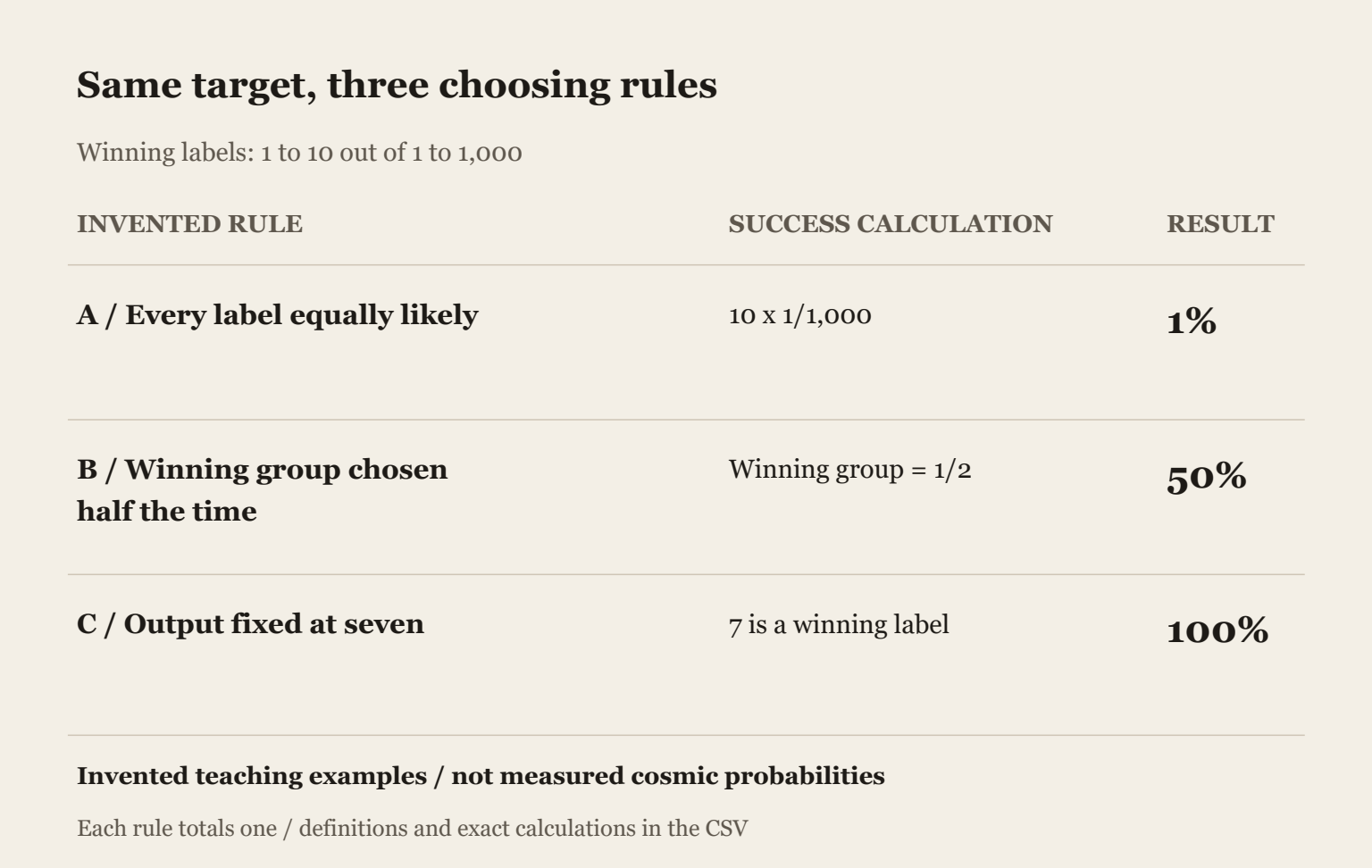
A: each label has probability 1/1,000, giving 10/1,000 = 1%. B: the winning group receives total probability 1/2, giving 50%. C: output is fixed at seven, giving 100%. Each rule has total probability one.
The example isolates one logical point: a target interval does not specify its probability. It does not establish a distribution for fundamental constants, a multiverse, physical necessity or design.
Download the example definitions and exact calculations
09Equal in which scale?
Ignorance does not automatically mean equal chances in every description.
A positive parameter can be described by its value or its logarithm. Logarithms turn multiplication into steps: one, ten, one hundred and one thousand are equally spaced on a base-ten logarithmic scale. They are not equally spaced on an ordinary ruler.
Equal probability for equal ordinary intervals differs from equal probability for equal multiplicative intervals. Both cannot be the same ignorance rule. The choice changes the weight given to a successful region.
Equal positive weight over an unlimited range creates another problem. A probability distribution must total one. Adding the same nonzero weight across infinitely many equal intervals cannot do that.
Barnes defends Bayesian theory testing using physical bounds and appropriate distributions. Theoretical constraints and rational uncertainty can matter without repeated cosmic trials. This is not permission to adopt any convenient distribution. [3]
I ask which scale, bounds and prior are defended, and how alternatives change the answer. A prior represents starting information or assumptions before the observation. Bayesian reasoning displays those commitments; it does not make them compulsory.
10Can we multiply the odds?
Separate small numbers are not automatically independent chances.
An invented box contains equal numbers of red and blue cards. We draw one card and report its colour twice. The chance of both reports being red is one half, not one quarter. Both depend on the same draw.
Multiplying as though the reports were independent gives the wrong result. Independence means learning one result does not change the other's probability in the model. That condition needs justification.
The same question arises when someone multiplies alleged odds for many constants. Deeper physics might relate them. One parameter's change might also be offset by another. A joint distribution must include correlations.
Adams's stellar models vary several parameters and find extended regions supporting working stars. Those results concern the model and surveyed ranges, not a measured percentage of all universes or observers. [22]
Changing one quantity while freezing others answers a useful conditional question. It does not cover every possible route through a larger parameter space. I ask whether the odds survive the conditions they require.
11Only one universe?
We can reason about probabilities without personally observing repeated examples.
We have only one universe, so no probability argument is possible. That reply is too quick. A physical model can assign probabilities, and rational uncertainty can be represented without observed repetitions of universe births.
I can calculate a stipulated fair die's chance of six before seeing it roll. Whether a real die deserves that model requires evidence. The conditional calculation and its justification are separate.
Barnes develops a Bayesian treatment of fine tuning, including answers to normalisation objections. I should examine it instead of declaring all probability language meaningless. [3]
But accepting that reasoning is possible does not endorse a particular cosmic distribution. Do the assumptions follow from a defensible theory or prior? How much does the conclusion depend on them? Limited direct access makes these checks harder.
My answer is neither probability is forbidden nor any quoted probability is science. Show the model, motivation, conditioning and uncertainty. A calculation can be exact about assumptions that remain debatable descriptions of reality.
12Give the designer a prediction.
An explanation should tell us why this observation is more expected under it.
A small probability under one hypothesis does not establish whichever alternative someone names next. An invented machine has two proposed faults. If a noise is unlikely under fault A, that alone does not show fault B would produce it. We need the second expectation too.
Design arguments can make that comparison. A defender proposes a creator who values embodied, conscious agents and therefore has a reason to make life-permitting conditions. This is stronger than saying an unlimited being could make anything. Capability and preference do different explanatory work. [5]
I ask why that goal should be attributed to the proposed creator before using our existence as its evidence. What otherwise independently supports the preference? Would a spiritual world, different physical life, or no creation also count as expected under the hypothesis?
Bayesian reasoning compares how well hypotheses predict the evidence, together with their prior weights. Prior weights express what we have reason to think before adding this particular evidence. A likelihood advantage can favour a hypothesis without making it certain or excluding every alternative.
An answer flexible enough to accommodate every result may tell us very little about which result to expect. The defender can narrow the hypothesis and defend its goals. Then we can assess that definite proposal instead of letting designed mean whatever happens.
13Who can report?
Where an observer can report from affects what that observer will see.
Imagine a survey allowing reports only from buildings with functioning air supplies. Every report comes from such a building. That does not show that every building has working air. The reporting condition filters the sample.
An observer-selection effect occurs when requirements for observing influence the observations available. A biological observer cannot report having developed in conditions that made that development impossible.
This answers one careless surprise: why am I not observing where I could never exist? It does not explain why any observer-permitting place exists. Those questions must stay separate. [11]
The example also does not establish other buildings or other universes. Selection describes a sampling condition within a model. It cannot create the population being sampled.
I use selection to check an inference, not as a complete origin theory. Are we comparing observers' existence, their particular observations, or observations conditional on their existence? Quietly changing the question changes the probability being calculated.
14Why was survival possible?
The selection point does not finish the discussion.
A believer can reply: only a survivor reports, but why was survival possible? A working air supply in the building could still need explaining. Without it you could not report does not say how it came to work.
That reply is fair. Otherwise we would not be here cannot erase every explanatory question. I must identify which inference selection weakens and which question remains. The word anthropic does not end a debate.
Anthropic here concerns conditions compatible with observers. It need not mean that humans were intended. A calculation about any suitable physical life and a claim about humanity's specific purpose have different targets.
We must compare explicit hypotheses with the same background information. Conditioning on observers in one calculation but not another can produce probabilities answering different questions. Philosophers dispute how to handle that conditioning. [11]
My short answer is that observer selection matters but is not a complete origin theory. Now defend the remaining odds and explanation. Conceding that limit supplies no evidence for a particular deity.
15More universes?
Many opportunities can change an expectation only within a specified generating model.
Independent attempts with a fixed nonzero success chance make success somewhere more likely as attempts accumulate. This mathematics does not establish that nature makes such attempts, their probability, or their independence.
Some multiverse proposals contain regions with differing conditions. Observer selection might then help explain our location. Weinberg explored anthropic weighting for a cosmological constant before the supernova acceleration results, using explicit cosmological assumptions. [9]
A generating theory can have independent motivations and consequences. That is more serious than simply inventing worlds to avoid God. But those motivations are not observations of the whole ensemble or a verified distribution of constants.
Ellis, Kirchner and Stoeger distinguish possible universes from actual ensembles and discuss statistical weighting. Infinitely many members do not supply unique ratios merely by being infinite. [10]
I need no established multiverse to question design. If I offer one as the explanation, however, I owe a clear account of mechanism, evidence and assumptions. A researched alternative must remain labelled as a proposal.
16Could deeper physics help?
An unanswered question does not establish either necessity or choice.
Perhaps deeper physics will relate quantities our present theories treat as independent inputs. Some apparent adjustments might then follow from a fundamental structure. That is a possible explanation, not a discovery I can substitute for evidence.
Even a value necessary under particular laws leaves the question of why those laws hold. Part 14's question about existence is distinct. Explaining something at a deeper level need not explain everything.
Some features might instead be brute facts, with no deeper explanation. Presently unknown does not establish genuinely unexplainable. Disliking brute facts does not establish a personal choice either.
Adams's reviews describe viable variations, real restrictions and uncertainty about distributions. A wider viable region changes a fine-tuning claim. It does not explain our actual values simply by showing others would work. [6] [7]
I can keep possibilities open without giving them equal evidential support. Necessity, contingent processes, multiple regions and design need different defences. Unfinished understanding calls for investigation, not the automatic selection of a familiar story.
17One exact distance?
One popular claim fails a check we can make with ordinary astronomy.
If Earth were a little nearer or farther from the Sun, all life would die. How little? An inch, a kilometre, or a large orbital change? A little conceals the numerical claim that needs testing.
Earth's distance already changes during its yearly orbit. NASA gives about 5.1 million kilometres between nearest and farthest approaches, around 3.4 percent. Life persists through that variation. [13]
The nearest approach is around early January, the farthest around early July. Axial tilt is the main cause of opposite seasons in the two hemispheres. One exact distance is therefore not required.
This does not make every orbital change harmless. Incoming energy, its distribution and climate response matter. An existing variation does not justify moving the planet anywhere and promising survival.
Open NASA's orbital explanation with a believer and compare the actual variation with the alleged tiny tolerance. That tests the exact-distance claim directly. It does not refute the separate cosmic fine-tuning argument.
18A habitable zone.
Enough incoming light for possible liquid water is not a certificate of life.
The habitable zone is a range around a star where surface liquid water could persist under suitable atmospheric conditions. It is not a magic line, and being inside it does not establish inhabitants. [12]
Atmosphere, planetary properties, the star and history matter. Scientists use the zone to guide a search, then investigate the actual planet. Potentially habitable leaves those further questions open.
The usual target involves familiar chemistry, especially liquid water. That is a practical choice based on known life. It neither rules out every alternative nor establishes that imagined alternative chemistry would work.
Many planets also do not give us a known probability of life. How often living systems begin, persist and produce observers needs further evidence and assumptions. Counting suitable-looking locations cannot finish that calculation.
I can recognise Earth's importance to us without making it the universe's intended destination. Suitability is a physical question. Purpose is an added claim; identifying that purpose with a religion adds another step.
19Which way does the fit run?
Populations can become suited to environments that were not arranged for them.
Imagine water filling an irregular hollow. The water fits because it responds to the boundary. This illustration does not prove evolution. It shows why fit alone does not identify which direction the explanation runs.
Evolution supplies a mechanism. Inherited differences affect survival and reproduction; variants leaving more descendants can become more common. Previous parts examined the evidence. This is not organisms changing simply because they need to.
Selection guarantees no solution. Populations can fail when conditions change. It does not anticipate a target and manufacture the required variation. Chance, inherited constraints and environmental history affect available paths.
Adaptation therefore matters to organisms' apparent fit. It does not explain why laws permit reproducing populations. Using it to dismiss cosmic fine tuning would overstate its reach.
I examine a population's history while keeping its enabling physical conditions separate. A creator working through evolution remains a possible additional belief. The mechanism's success does not establish that intention.
20The watchmaker.
A useful analogy is not a substitute for comparing real processes.
Paley imagines finding a watch whose cooperating parts serve a function. He argues for a maker even without witnessed manufacture, complete understanding or perfect workmanship. His case is stronger than an appeal to beauty. [1]
Design can indeed be inferred without witnessing construction. Materials, marks, context and known processes support ordinary investigations of artefacts. Refusing every unobserved maker would undermine those investigations too.
Paley also imagines a reproducing watch; he argues that reproduction still needs organised machinery. Reproduction alone is therefore no answer. The alternative involves inheritance, variation and cumulative evolution, tested against evidence about biological history.
An unfamiliar artefact need not resemble a familiar watch before intelligence could be inferred. The task is to identify features distinguishing the proposed cause from relevant alternatives, not equate every complicated arrangement with manufacture.
We know minds arrange parts. The question is whether this arrangement is better explained by the proposed mind than by available physical and evolutionary accounts, and what supports that comparison.
21Needed now. Needed first?
A deletion test examines a present system; an origin claim concerns its history.
Behe calls a system irreducibly complex when cooperating parts are required for its basic function. Remove a crucial part and it fails. He challenges construction through small undirected changes, including whether proposed intermediate steps work. [14]
A deletion test shows present dependence. It does not establish that every ancestor needed the same part, in the same arrangement, for the same function.
A component might initially be optional, perform another role, or overlap with another's role. Later changes can make both essential. The final system can break on deletion while having a less dependent ancestor.
That is a possible history, not evidence that a particular system followed it. A critic rightly asks for plausible transitions and evidence. A series of useful-looking drawings cannot replace them.
Equally, no complete history has been supplied does not mean no evolutionary route exists. The stronger reply investigates an actual system and tests changes. The next page connects this mechanism with experiments.
22Test a molecular machine.
Ancestral reconstruction combines an inference with experiments on its consequences.
Finnigan and colleagues studied a protein ring in a cellular proton pump that helps acidify compartments. Fungal versions use three related protein types where an earlier form used two. How did the extra type become essential? [15]
They inferred ancestral sequences, made the reconstructed proteins and tested functions in yeast. They also tested mutations and alternative reconstructions. These were laboratory checks of inferred ancestry, not unchanged ancient proteins recovered from fossils.
The results supported duplication followed by complementary losses of interaction capabilities. An ancestor's capacities became divided between descendants. Both became required without a new overall ring function at that step.
This specific finding does not establish every machine's origin or every proposed intermediate. Ancestry depends on data and modelling; functional tests constrain its consequences.
It nevertheless demonstrates the deletion argument's limit. Losing a required modern part does not rule out a less complex functional past. I would show the reconstruction, controls and assays, then ask which result the believer disputes.
23Read the historical direction.
Shared components matter, but the proposed historical direction matters too.
A bacterial flagellum can propel a cell. Some parts are related to non-flagellar type III secretion machinery, which delivers proteins into other cells. That relationship alone does not identify which complete machine appeared first.
Abby and Rocha's 2012 genome comparisons supported non-flagellar secretion systems deriving from flagellar ancestry through losses and acquisitions. They did not show a modern injectisome simply becoming the first flagellum. [16]
A common atheist shortcut reverses this direction. A simpler system with related components cannot be assigned a convenient place in history. Read what the research inferred, including deeper uncertainties.
The comparison supports relationships, reuse and diversification. It is not a film of every step in the earliest flagellum. That limit does not erase the evidence; it prevents exaggeration.
Asked for the complete first pathway, I distinguish established relationships, supported reconstructions and unresolved steps. An unresolved step is a research question. It does not reveal that a supernatural designer intervened there.
24DNA really has a code.
The biological term has a precise meaning; it does not supply a programmer by definition.
DNA contains sequences of chemical units called nucleotides. During protein production, information is copied into messenger RNA. Groups of three RNA units, called codons, correspond to amino acids or stopping signals. [18]
Amino acids build proteins. Ribosomes, transfer RNAs and other components implement the mapping physically. A transfer RNA can match a codon while carrying an amino acid. No tiny conscious reader must understand English inside the cell. [19]
Code meaningfully describes this systematic association. Biology need not abandon the word. But its definition does not include a conscious author merely because chemistry implements such a mapping.
Saying it is chemistry also does not explain the entire translation system's origin. Its present operation and first emergence are different questions. Modern protein synthesis is not a completed prebiotic history.
I first explain the mapping and machinery, then investigate history. Computer-code comparisons may help a beginner picture part of the process. They cannot finish the causal argument.
25The information argument.
Its defender offers a comparison of causes, not only a word analogy.
Meyer argues that intelligent agents produce functionally specified information while material explanations have not demonstrated the capacity required for its first appearance in life. He presents an inference to the best explanation, not merely DNA resembles a book. [20]
Functionally specified concerns an arrangement achieving a relevant function. A random-looking string can resist compression without doing a useful biological job. Complexity, unpredictability and function are different concepts.
Meyer's positive point is that minds make organised functional arrangements. But a cause producing some arrangements need not be the only cause of biological ones, or the cause involved in their particular history.
The comparison needs a defined function, justified alternatives and evidence for the proposed agency's capacity in that setting. Human writing does not demonstrate a disembodied mind assembling the first translation system.
Nor should I answer first origins solely with later evolution. New dependencies in an existing cell concern later change. The first system remains a separate question; respecting that distinction lets us test the actual argument.
26First code and later change.
Research can constrain a proposal without already supplying a complete beginning.
Koonin and Novozhilov review chemical affinities, changing metabolic systems and selection against translation errors. They distinguish formal scenarios from an established first coding principle. These historical proposals are research, not a completed origin demonstration. [23]
In 2026, Radford and colleagues prototyped altered codes in cell-free translation using engineered components and existing machinery. That is controlled evidence about those arrangements. [24]
It is neither life from nonliving starting materials nor the spontaneous first code. Researcher choices belong in the method; the laboratory should not be advertised as untouched early Earth.
A human-run experiment also does not prove that a related physical process in nature needs a human or supernatural operator. The demonstration answers its actual question. Inferring the historical setting needs additional evidence.
I can acknowledge that no complete origin has been established here without making intelligence the demonstrated cause. Proposed natural steps and design each need evidence. Neither wins simply by occupying the missing explanation.
27Mathematics and beauty.
A powerful description does not automatically identify an intention behind reality.
Wigner's 1960 essay reflects on mathematics' remarkable effectiveness in physics, including unexpected applications. This raises a serious philosophical puzzle. It does not report an experiment detecting a divine mathematician. [21]
Why nature has intelligible regularities is worth asking. But successful equations do not become commandments because they are called laws. The inference to a lawgiver needs more than shared vocabulary.
Some mathematics originated in physical problems; other mathematics found unexpected uses later. Philosophers disagree about mathematical objects and applicability. Questioning a religious conclusion does not require pretending those disputes are solved.
Beauty is another question. Finding a nebula, melody or proof beautiful is a real experience. Its intensity does not measure whether an external mind intended that response.
I need not stop enjoying beauty. I am being asked to accept a causal explanation of it. Appreciation supplies no missing premises. Wonder can prompt investigation without becoming knowledge of who planned what we see.
28Made for us?
Hostile conditions challenge some design claims more directly than others.
Much of the universe is lethal to an unprotected human. That challenges a claim that the cosmos is a comfortable human home. It does not refute the narrower claim that its physics permits life somewhere.
Those hypotheses predict different things. One habitable region does not require every region to be habitable. Permitting life somewhere also does not establish maximum human safety, wellbeing or importance.
A defender may propose stable laws, free agents or other goods instead of universal comfort. That changes the hypothesis. Why attribute those goals, and what observations would count against them?
Human benefit also differs from other organisms' needs. A parasite's useful feature need not benefit its host. Perfect design requires the next question: perfect for whose function and by which standard?
Suffering receives fuller treatment later. Here I insist on a definite purpose. Retreating from made for humans to permits something somewhere changes the claim; the change should be stated.
29Which designer, and which religion?
Even granting an intention would leave further claims to establish.
Suppose, for discussion, that we established intentional arrangement behind some feature of physical reality. That would be a substantial conclusion. It would not yet identify a particular holy book, a set of commands, a miraculous historical event or a promised afterlife.
How many designers are being proposed? What establishes their power, knowledge or moral perfection? What connects the arrangement to a particular act of revelation? The same questions apply whether the speaker names God, Allah, Bhagwan or an unnamed cosmic intelligence.
Hume's dialogue gives Philo a series of challenges about how much can be inferred from an apparently designed world. The point is to limit the conclusion to the evidence. The dialogue's imagined alternatives are challenges to inference, not discoveries of actual rival creators. [2]
A defender can offer further philosophical and historical arguments. Then those arguments deserve their own examination. Fine tuning cannot quietly authenticate them all in advance. A causal proposal and a verified scripture are different levels of claim.
I do not need a proof that every conceivable designer is impossible before declining a specific religion. The person asking me to believe a detailed account needs evidence for its details. A gap between physical explanation and ultimate meaning is not a signed page from their book.
30Use the argument.
Ask for the calculation, compare the hypotheses, and keep the conclusion within its support.
My short reply to too finely tuned for chance is: show the parameter, viable range, possible range and probability distribution. Then explain what your designer specifically leads us to expect. I will examine that comparison.
For carbon, read the calculation's assumptions and uncertainty. For an exact Earth-Sun distance, check the orbit. For a broken molecular machine, ask about ancestors and testable transitions. [8] [13] [15]
Have I proved no designer exists? No. I am asking whether the evidence establishes the claim made. Rejecting an unsupported answer does not mean possessing the complete answer myself.
Better-supported physics could change the possibilities and probabilities. Distinctive evidence of agency, or a defended prediction design handles substantially better than credible alternatives, could strengthen design. Loyalty to a label must not rule that out.
For now, striking conditions do not establish intention, or identify a religion from an unexplained number. We can investigate the universe carefully without pretending we know who wanted us here.
NoteWonder without pretending.
I can value this life without claiming the universe promised it to me.
Confident numbers and familiar analogies can make an unfinished argument look complete. I want to know what a number measures and which assumptions make it a probability. That is curiosity, not hostility to difficult questions.
Strong design arguments deserve stronger replies than mockery. Misstating a claim, reversing a study's history or calling a speculative multiverse observed fact makes disbelief less careful. I do not want those mistakes protecting my conclusion.
Human religious accounts of gods have not convinced me as established descriptions of reality. I leave open what evidence might show. Rejecting unearned certainty does not require denying every possible unknown intelligence.
Admiration and discomfort are not scientific instruments. Life can be remarkable while its ultimate explanation remains unsettled. I can value it without claiming every galaxy was built for humanity.
My blunt answer is: show the work. A calculation, probability model, inferred mind and religion are separate claims. I will follow evidence across them. Naming the answer does not supply the bridges.
SourcesFollow the evidence.
The sources serve different purposes. Paley, Barnes, Behe and Meyer state arguments that should be read in their own terms. Physical models explore conditional consequences; biological experiments and historical reconstructions supply different kinds of evidence. Hume and Wigner raise philosophical questions. The original numerical illustration uses invented choosing rules, not measured cosmic probabilities. Source access and relevant-passage checks are recorded separately. Reading a paper is not independent replication of its experiment.
[1] Natural Theology, chapters I and II
William Paley / 1802 original edition
Chapters I and II set out the watch inference and discuss imperfections, unseen manufacture and a watch that could reproduce. The original edition and OCR were checked; OCR is not used for verbatim quotations. Paley's case is presented before comparing it with reproducing populations and evolutionary evidence.
Open the original-edition OCR (check the page images for quotations)
[2] Dialogues Concerning Natural Religion, Part V
David Hume / 1779 / Hume Texts Online scholarly edition
In Part V, Philo challenges inferences to unlimited power, perfection and a single designer; Cleanthes defends the design inference. Positions are assigned to the dialogue's speakers. Imagined rival designers are philosophical challenges, not empirical discoveries.
[3] Fine-Tuning in the Context of Bayesian Theory Testing
Luke A. Barnes / author paper / 2017; published 2018
Barnes defends a Bayesian treatment of fine tuning and answers normalisation objections. Physical bounds and distributions require argument; they are not forbidden merely because repeated universes are unavailable. This primary defence is used instead of a separate 2019 article whose full text was inaccessible.
[4] The Fine-Tuning of the Universe for Intelligent Life
Luke A. Barnes / PASA 29 / 2012
Barnes reviews cases concerning laws, constants and initial conditions and criticises overly easy dismissals. His review explicitly does not defend a further conclusion from fine tuning. Physical sensitivity and a theistic interpretation are therefore kept separate.
[5] The Fine-Tuning of the Universe for Life
Luke A. Barnes / author chapter / 2021
The author chapter reviews fine tuning and discusses explanations beyond physics, including a creator who values embodied agents. It is an author's physical and philosophical case, not a measurement of divine preferences or an agreed proof of theism.
[6] The Degree of Fine-Tuning in our Universe -- and Others
Fred C. Adams / Physics Reports / 2019
This extensive review surveys alternate physical parameters and viability conditions. The chapter uses its distinctions and model scope, not a probability that a random actual universe permits life. Relevant passages were examined; retrieval does not mean every page was read.
[7] The Degree of Fine-Tuning Needed for a Viable Universe: Not Fragile?
Fred C. Adams / 2026 research overview; preprint
The 2026 preprint overview discusses robust and sensitive cases, multi-parameter changes and unknown underlying distributions. Its models are not observations of other universes. Wider viable ranges do not calculate the actual values or settle ultimate explanation.
[8] Viability of carbon-based life as a function of the light quark mass
Evgeny Epelbaum and colleagues / Physical Review Letters / 2013
The original nuclear calculation concerns sensitivities, correlations and uncertainties relevant to carbon and oxygen production. It does not grow life in another universe. Permitted parameter variations depend on its approximations and stellar-production criterion, not an unrestricted census of all possible life.
[9] Theories of the Cosmological Constant
Steven Weinberg / author conference contribution / 1996
Weinberg's 1996 contribution discusses cosmic structure and anthropic weighting of a cosmological constant. It predates the supernova acceleration studies. Its conditional ensemble reasoning is not direct observation of multiple universes or an exact parameter-free prediction of the present value.
[10] Multiverses and physical cosmology
G. F. R. Ellis, U. Kirchner and W. R. Stoeger / MNRAS / 2004
The authors distinguish possible universes, actual ensembles and probability measures. A proposed multiverse needs a generating framework and statistical weights. The chapter treats it as a potential explanation to investigate, not a confirmed alternative that atheism requires.
[11] Fine-Tuning
Simon Friederich / Stanford Encyclopedia of Philosophy / scholarly argument analysis
Friederich surveys fine-tuning concepts, probability assumptions, design and observer-selection disputes. The entry maps a philosophical debate. Its use does not imply a scholarly vote has settled theism, naturalism or the correct conditioning rule.
[12] The Habitable Zone
NASA Science / institutional explanation
NASA describes the habitable zone as a guide to possible surface liquid water under suitable conditions. Location alone does not establish an atmosphere, living organisms or a known probability of life. No changing exoplanet count is used.
[13] Milankovitch (Orbital) Cycles and Their Role in Earth's Climate
NASA Science / 2020 explanation
NASA gives the approximately 5.1-million-kilometre nearest-to-farthest orbital variation, around 3.4 percent, and explains axial tilt and orbital effects. This tests the exact-distance claim. It does not show that all orbital or climate changes are harmless.
[14] A Mousetrap Defended: Response to Critics
Michael J. Behe / author defence / 31 July 2000
Behe's own defence describes irreducible complexity and challenges the feasibility of proposed intermediate steps. The chapter retains that objection. A present deletion test and an evolutionary impossibility claim are assessed separately; an untested cartoon is not treated as historical evidence.
[15] Evolution of increased complexity in a molecular machine
Gregory C. Finnigan and colleagues / Nature 481 / 2012
The original study combines inferred ancestral sequences with yeast functional assays, mutational tests and alternative reconstructions. It supports complementary losses after duplication in a particular V-ATPase ring. It does not establish the complete origin of every molecular machine or of life.
Open the university-hosted original paper
[16] The Non-Flagellar Type III Secretion System Evolved from the Bacterial Flagellum and Diversified into Host-Cell Adapted Systems
Sophie S. Abby and Eduardo P. C. Rocha / PLOS Genetics / 2012
The primary comparative-genomic analysis supports non-flagellar type III secretion deriving from flagellar ancestry. The chapter preserves this direction. Shared components do not supply a complete account of the earliest flagellum. The publisher full text was used after a repository challenge page.
[17] Everything You Always Wanted To Know About The Cosmological Constant Problem (But Were Afraid To Ask)
Jerome Martin / Comptes Rendus Physique / 2012
Martin explains the vacuum-energy problem, regularisation and the dependence of numerical estimates on physical assumptions. A discrepancy between scales or required cancellation is distinguished from a probability of life. No unique lottery probability is extracted from an exponent.
[18] Genetic Code
National Human Genome Research Institute / glossary
The NHGRI glossary explains the association between nucleotide triplets and amino acids in protein production. Code is a meaningful biological description. Its definition does not establish a conscious author or provide the complete origin of translation.
[19] Ribosome
National Human Genome Research Institute / glossary
The NHGRI glossary explains the role of ribosomes, messenger RNA and transfer RNA in protein synthesis. Physical implementation is distinguished from a conscious reader. A present mechanism is not advertised as a complete prebiotic history.
[20] Denying the Signature
Stephen C. Meyer / author defence of information-based design / 2017
Meyer's own reply presents an inference to the best explanation using claimed causal adequacy of intelligence and limits of material alternatives. It is stated fairly before the exclusivity and historical inferences are challenged. The chapter does not reduce it to wordplay or claim later evolution alone solves first origins.
[21] The Unreasonable Effectiveness of Mathematics in the Natural Sciences
Eugene P. Wigner / 1960 essay, university-hosted transcription
Wigner's 1960 essay reflects on mathematics' effectiveness in physics. The university-hosted text was read as a philosophical essay. It is not an experimental detection of a divine mathematician or a settled theory of mathematical applicability.
[22] Stars In Other Universes: Stellar structure with different fundamental constants
Fred C. Adams / JCAP / 2008
Adams varies gravitational strength, electromagnetic strength and a nuclear-reaction parameter within a stellar model. Viable regions concern that model and surveyed space. Its fraction is not a measured frequency of all universes or the probability of observers.
[23] Origin and evolution of the genetic code: the universal enigma
Eugene V. Koonin and Artem S. Novozhilov / IUBMB Life / 2009
This 2009 expert review distinguishes chemical, metabolic and error-minimisation ideas from an established history of the first coding principle. It is historical context, not a claim to survey every later result. The accessible repository full text was used; the PubMed request returned a cookie page.
[24] Automated prototyping of genetic codes
Felix Radford and colleagues / Nature / 26 August 2026
This 2026 study uses engineered tRNAs, altered ribosomes and cell-free translation to prototype codes. Existing machinery and researcher choices remain explicit. It is controlled evidence about those systems, not spontaneous life from nonliving materials or proof of a designer of nature.