

01A real place is not a miracle.
Finding a name in stone does not make every sentence in a book true.
Someone shows me an ancient inscription. It contains a name also found in the Bible. Then comes the leap: archaeology has proved the Bible, so its miracles must be true. I accept the inscription. I question the leap.
A story can contain real rulers, real roads and real conflicts while being wrong about another event. Finding the address in a story is not the same as confirming everything said to have happened inside that house.
The opposite shortcut is just as careless. I cannot find a disputed story and announce that no biblical person ever existed. Historical claims deserve individual examination. My atheism does not give me permission to throw away inconvenient evidence.
In this part I examine selected claims: creation, Noah's flood, Babel, the Exodus, a destruction at Jericho, the birth chronology of Jesus and resurrection arguments. I distinguish the text from interpretations and the evidence from conclusions added to it.
My position is straightforward. A book does not become reliable history because somebody calls it sacred. Nor does it become worthless evidence because somebody calls it religious. Show me what the particular evidence actually supports.
02Wrong, unverified or beyond a test?
These answers do different jobs. Keep them separate.
Suppose a claim predicts that an entire town burned last night. We find its houses occupied and undamaged today. That is evidence against the claim. We have found something that should look different if the claim were true.
Now suppose somebody claims a traveller passed through that town centuries ago. We find no diary or inscription. That may leave the visit unverified. A traveller need not leave an identifiable trace. Missing evidence has different force in the two examples.
Finally, imagine a claim that an invisible power changed everything and then removed every possible sign. No observation can distinguish that story from its not happening. Such a claim escapes the test by surrendering a testable difference.
These are teaching examples, not archaeological discoveries. Their point is to ask what we should reasonably expect to survive. Scale, preservation, excavation coverage and the proposed event all matter. An absent footprint is not always a decisive objection.
My short reply is this: tell me the claim and the expected trace. Then we can decide whether we have contrary evidence, insufficient evidence or a claim constructed to leave none. None of those categories automatically means every possible god is disproved.
03Which Bible, which reading?
A library of writings needs more care than one slogan about literal truth.
I use the New American Bible, Revised Edition, available through the United States Conference of Catholic Bishops. Chapter and verse references let readers compare another translation. My explanations are paraphrases; the linked text supplies the actual wording.
Genesis contains creation and ancestral narratives. Its Catholic introduction discusses literary traditions and adaptation of ancient creation-flood material. That is a religious institution acknowledging textual complexity, not an atheist secretly rewriting the book. [1]
Some readers treat the early stories as an exact sequence of physical events. Others understand them as theological literature: writing about humanity, wrongdoing, divine order and responsibility. A geological objection to the first claim does not automatically defeat the second.
But the second reading cannot borrow the first reading's supposed scientific successes whenever convenient. If the days are a literary arrangement, they are not also an independently verified laboratory timetable. Tell me which claim you want assessed.
Genre means the kind of writing something is. A poem and a police report make different promises. Identifying a story's genre can clarify its meaning. It cannot, by itself, establish that a god inspired it.
04Do not win on one English verb.
A disputed translation needs an argument, not a screenshot.
Genesis 1 presents vegetation before the heavenly lights and describes humans after other living creatures. Genesis 2:4-25 centres on a man, a garden, animals and a woman. The two passages organise their accounts differently. [2] [3]
The NABRE renders Genesis 2:19 with God forming animals in the narrative. The NIV instead uses had formed, with a note allowing the other rendering. This opens a harmonisation: the second account can describe a closer view of the first. [3]
I will not pretend one English tense settles Hebrew grammar or every interpretation. Genesis 2:5 also specifies particular vegetation in relation to rain and cultivation; it need not be a statement that absolutely no plant existed anywhere. [3]
The serious question is whether the proposed harmonisation follows the language and context, rather than being selected only because a contradiction would be unwelcome. A translation can express an interpretation. It is not an extra ancient witness to the event.
My useful reply is: let us compare the passages, the translation notes and the proposed reading before discussing science. If a criticism survives only by ignoring a reasonable reading, it is a weak criticism. I want the strongest honest case.
05The book is not a dated rock.
A genealogy and a measurement are different kinds of evidence.
Genesis 5 gives ages and a sequence of descendants. Read together with other passages, genealogies have been used to construct short chronologies of humanity and creation. But the chapter does not print a modern calendar date for the formation of Earth. [4]
Before debating a proposed age, ask which textual tradition, starting point and assumptions produced it. Does the reader require consecutive generations? Are the creation days ordinary days? Do not impose one calculation on every Jewish or Christian reader.
Then compare the claim with physical records. The earlier dating chapter explains radiometric clocks and cross-checks. Here we examine ice and lake records that already require far more elapsed time than a world only several thousand years old. [8] [9] [10]
The problem is not merely that scientists dislike a genealogy. The short chronology must account for measured sequences and their uncertainties. Moving a few dates or allowing a few missing generations does not automatically explain tens of thousands of seasonal cycles.
If someone instead accepts an ancient Earth, that particular disagreement changes. I will stop arguing against a young Earth they do not defend. The separate claim that the genealogy comes from divine revelation still needs its own support.
06Plants before the Sun?
Stretching the days does not automatically fix the order.
Genesis 1:11-19 places seed-bearing vegetation and fruit trees on the third day, then the two great lights and stars on the fourth. The reading under examination treats these as successive physical acts of making the world. [2]
NASA's formation account describes the Sun forming at the centre of a collapsing cloud, with much remaining material becoming planets and other objects. It is not a history in which an already vegetated Earth waits for the Sun to be made. [5]
Someone may answer that the Sun already existed but became visible from Earth's surface on day four. That changes the event from formation to appearance. The reading needs textual and physical support; saying it is conceivable does not establish that it happened.
Another serious answer treats the days as a literary structure, not consecutive geological periods. The NABRE notes relationships between the first three days and the second three. That helps explain an arrangement without turning it into modern astronomy. [2]
My short reply is: making a day longer does not reverse an order. A symbolic reading can avoid a failed scientific timetable. It does not make that timetable a scientific prediction, or independently establish the text's supernatural source.
07Which claim about two people?
An ancestral role is not the same as a sole biological beginning.
Genesis 2 depicts the man formed from the ground and the woman made from his side. A familiar literal claim adds that all humans descend biologically from this pair alone, with no surrounding human population. That is a specific origin claim. [3]
Part 11 examined the fossils, genomes and population reasoning relevant to a recent sole-couple origin. Part 8 examined inherited genetic patterns. Those chapters supply the biological case; repeating the names Adam and Eve does not answer it.
Someone may instead propose that a pair lived among other people and acquired a special spiritual role. That proposal is different. A genealogical ancestor can contribute to family trees without being the only source of everyone's DNA. Part 11 explains the distinction.
I cannot honestly announce that genetics has disproved every possible theological role for any pair. Equally, a role designed to leave no identifiable biological trace has not been verified by genetics. Compatibility and confirmation are different achievements.
In conversation I ask: are you defending the only two humans, common ancestors within a larger population, or symbolic representatives? Until the claim is clear, evidence keeps being answered by changing the story instead of examining it.
08More than forty days.
Specify the water, the survivors and the time involved.
Genesis 7:19-23 describes mountains covered and land-breathing creatures destroyed outside the ark. Genesis 8 follows receding water, released birds and eventual dry ground. Forty days of rain is not the whole duration. [6] [7]
The tested reading is a recent flood covering the planet, eliminating outside human populations and land animals, followed by recolonisation from the ark. A devastating regional flood is a smaller claim.
I will not attack the story for forgetting fish on a boat. Its destruction language includes creatures breathing on dry land. Nor does it always specify one pair of every animal: clean animals receive different treatment. [6]
Some believers understand a regional catastrophe described in universal language. Others read theology about judgement and renewal. Assess those readings as those readings. A regional flood cannot establish global inundation.
My reply is: large floods happen, but size matters. Water in one valley establishes water in that valley. A worldwide event requires a worldwide case, not an emotional retelling of a local disaster.
09What should the flood change?
An event large enough to remake Earth cannot be tested like a lost sandal.
A natural flood covering every mountain should affect landscapes, sediments, ecosystems and surviving records. Assigning most fossil-bearing layers to that event adds claims about their order and time of deposition.
Do not demand one identical-looking layer everywhere. Erosion and different environments produce different deposits. Test whether the proposed event explains the actual sequences, including places preserving repeated seasonal change.
Ice and lake sediments are archives formed through different processes. Their dates involve interpretation and cross-checking. A professional-looking graph is not enough; inspect what was measured and how the chronology follows. [8] [9] [10]
The comparison is conditional. A recent global flood operating through ordinary processes must fit these records. A god miraculously preserving or rebuilding them is a different explanation, with a different evidential problem.
Ask for a date range and predicted consequences before inspecting evidence together. Otherwise every deposit can become flood evidence, and every inconvenient deposit an exception. A claim accepting every result has explained very little.
10Is a storm a year?
Count seasonal patterns, identify uncertainty and compare other records.
An ice core is a cylinder drilled from accumulated ice. Physical and chemical properties vary through it. Seasonal cycles help identify annual layers. Researchers do more than count every visible stripe as a year.
Svensson and colleagues extended the GICC05 Greenland chronology to about 60,000 years, tracking uncertain layers. One identified climate transition lies around 59,400 years before 2000, with a stated uncertainty of about 1,300 years. [8]
Could several storms create layers in one year? Yes. Recognising annual cycles across measured properties is the task. Ambiguous intervals, thinning and reference markers matter. Read the methods rather than counting snowfall events blindly.
The result has uncertainty. Comparisons have conditions too: matching Greenland and cave climate events assumes the relevant events occurred together. The paper states that condition and reports disagreements with another ice chronology. [8]
My reply is: show how a recent chronology explains these recurring patterns and markers together. Possible error is not a model compressing the archive into a few thousand years. Demonstrate the proposed mistake.
11The lake has corrections.
An honest explanation includes missing annual layers.
Lake Suigetsu preserves sediment and terrestrial plant remains. Bronk Ramsey and colleagues extended radiocarbon comparison across roughly 11,200 to 52,800 years before 1950. This is not carbon dating Earth's creation. [9]
Schlolaut and colleagues later revised the seasonal-layer chronology. About half the years in their examined interval had recognisable seasonal layers. The rest required interpolation: estimating missing cycles with a specified method. [10]
Do not sell this as fifty thousand perfect stripes counted without assumptions. The revision explains preservation problems and uncertainty. Being blunt about religion does not excuse misrepresenting scientific work.
Nor are the lake's dates and a calibration curve built partly from them wholly independent confirmations. Some information is shared. Explain what was measured, what was estimated and where comparisons enter.
These studied long sequences seriously challenge a recent world and an ordinary recent worldwide reset. That is a narrower conclusion than an infallible clock. A competing chronology must reproduce observations. Naming interpolation does not make the observed sediments disappear.
12Water was there. When?
A marine fossil does not arrive carrying a label saying Noah.
Someone points to marine fossils high in a mountain range. Surely water once covered the place. That observation can be correct. The disagreement concerns when the material formed and how it reached its present height.
The US Geological Survey explains the Himalayas through the collision of India and Eurasia. Rocks deposited in earlier environments were folded and lifted. Its account describes fossils and changing environments in the region. Former sea deposits can become mountain rocks. [11]
The explanatory picture is simple: raise an old seafloor and its shells rise with it. That picture is an analogy for the process, not its whole proof. The supporting case involves rock relationships, deformation and the history of moving plates.
A flood advocate must compare that account with a specified flood model. The presence of a shell alone does not identify one recent water level, one worldwide event or the date of a particular biblical narrative. Several histories can include water.
My short reply is: I accept that this was a marine environment. Show why this fossil's age and geological setting favour your proposed event over uplift of older deposits. We have agreed on the object; we still need to establish its history.
13God could protect the ark.
Possibility alone cannot supply a historical record.
If the account is a recent global restart, ask how surviving populations spread and rebuilt ecosystems. Those questions concern geography, reproduction, food, plants and the times available. A boat's capacity is only one part of the proposal. [6] [7]
A believer can answer that a god gathered animals, sustained them and guided their dispersal. I cannot refute that answer simply by observing that normal animal care would be difficult. The proposed intervention is precisely what suspends the normal restriction.
But this answer changes the evidential task. We now need reasons to believe those interventions occurred. The ability to imagine enough miracles to rescue a story is not an observation of any of them. It works equally well for incompatible stories.
I will not invent an exact number of biblical kinds and then pretend a calculation settles the question. A proposed kind needs a definition, evidence of membership and a feasible subsequent history. Changing the category whenever difficulty appears prevents testing.
My reply is: possible for an unlimited god is not the same as supported by evidence. If every contrary observation is answered with an invisible repair, explain what positive evidence distinguishes your account from a story that never happened.
14Stories are not rain gauges.
Shared motifs need a history of transmission as well as a history of water.
The British Museum holds an inscribed fragment of Gilgamesh Tablet XI, identified as the Mesopotamian flood story. It is an actual ancient object, not a modern invention aimed at biblical readers. The catalogue identifies the fragment and narrative. [12]
Genesis 8 sends birds to test conditions. The NABRE note compares Gilgamesh's bird sequence. Such parallels help explain an ancient storytelling environment; alone, they do not identify a worldwide physical catastrophe. [7]
Shared memory of a flood is one proposal. Transmission and adaptation, or separate experiences of destructive flooding, are others. They can overlap. Similarity alone determines neither borrowing direction nor exact composition dates.
The tablet dates a surviving copy, not automatically the story's beginning or every earlier oral stage. Keep the object, narrative and proposed event separate. Each question requires appropriate evidence.
My reply is: compare traditions, but do not count them as independent rain gauges. Establish dates, relationships and geographical evidence before announcing confirmation of Noah's entire account. A repeated story still needs an event-level test.
15A story is not a language tree.
Do not replace an unsupported certainty with another one.
Genesis 11:1-9 describes one language, a city and tower, divine confusion of speech and dispersal. The literal claim is a particular intervention explaining human language diversity. The passage is not a dated comparative study of languages. [14]
Genesis 10 already groups peoples by their languages. A defender can read chapter 11 as looking back to explain that diversity, rather than the next event on a continuous timeline. So chapter order alone is not a decisive contradiction. [13] [14]
The NABRE notes connect the tower with Babylonian temple towers and explain the narrative's wordplay. That supplies literary and cultural context. Finding such a tower would not independently demonstrate divine disruption of speech. [14]
I do not claim that linguistics has proved the exact first human language or excluded every possible intervention in language's deep past. That would overstate the case. Here, the specific Babel event lacks the independent confirmation needed to establish it as history.
My short reply is: show evidence tying a particular community, time and language change to this intervention. The existence of many languages is the thing the story tries to explain. It cannot also serve as sufficient proof that this explanation is correct.
16How many people left?
Six hundred thousand men is a population claim, not just a moving scene.
Exodus 12:37 describes roughly six hundred thousand men on foot, besides dependants. Exodus 14 describes the sea crossing and pursuing force's destruction. A literal mass departure makes population and event claims, beyond spiritual liberation. [15] [16]
The men are not the total population. Women, children and others increase it. An exact total requires demographic assumptions the verse does not supply, so I will not manufacture one.
A vast group and a handful of escaping workers make different archaeological demands. Food, camps and movement need discussion at the claimed scale. Rejecting a falsely precise total leaves the basic scale problem.
Some replies reinterpret Hebrew numerical language or regard numbers as literary magnification. Examine those proposals against the wider numerical context. Farber discusses difficulties with reading the term as clan rather than thousand. [17]
My question is: do you defend the mass movement, a smaller departure or theological narrative? Each needs different evidence. A small group's possible departure cannot silently confirm every number and miracle in the larger story.
17Would Egypt record a defeat?
A missing royal boast is not the whole archaeological case.
Someone argues that Egyptian rulers would not advertise humiliation. That is a fair caution about selective records. A missing confession of defeat is not sufficient to demonstrate that no escape or military disaster occurred.
But written records are only one kind of evidence. A proposed mass movement also raises questions about settlements, regional population and material traces. Farber's criticism concerns the enormous scale; Friedman's defence instead argues for a much smaller historical group. [17] [18]
Neither every campsite nor every object survives. Mobile people can leave faint traces, and excavation is incomplete. An honest criticism must state why this event should be visible in the places and periods actually studied. Absence is not equally informative everywhere.
The analogy is a football crowd compared with one pedestrian. Missing one person's dropped ticket tells us little. Finding no expected signs of the claimed crowd can matter more. The analogy explains an expectation; it does not replace archaeological work.
My reply is: I accept that kings select their stories. Now show the positive case for the event at the scale claimed. Explaining one missing record is not evidence for a sea opening, a nation's journey or an exact census.
18Could a smaller group have left?
A possible origin for a tradition is not the full narrative verified.
Richard Elliott Friedman argues for an Exodus involving Levites, rather than the entire later population of Israel. He appeals to textual features, names and religious traditions. This is a scholar's positive reconstruction, not a photograph of the departure. [18]
The possibility matters. I should not say that archaeology proves no person associated with Israel ever came out of Egypt. A small departure could be much harder to identify than the immense movement described in a literal reading of the numbers.
But the smaller reconstruction has its own assumptions and disputed steps. Egyptian features can be relevant without uniquely identifying one migration. The question is how much explanatory work each detail does, and what alternative histories could produce it.
Even if a small departure were established, more would be needed to confirm the plagues, the crossing as described and divine authorship of a book. A historical seed can support part of a tradition without verifying every branch that grew around it.
My short reply is: a smaller core is a serious possibility to investigate. It is neither automatically disproved nor automatically the whole Exodus made factual. I will follow evidence for that core as far as it reaches, and stop where it stops.
19Israel appears outside the Bible.
Accept a useful positive finding without inflating it.
The Merneptah stele is an Egyptian royal inscription that refers to Israel. Hasel's study places it around 1207 BCE and examines the name and its geographical context in Canaan. This is evidence outside the biblical narrative. [19]
That gives an important historical anchor: a group identified as Israel was known in the region by that time. It puts a constraint on reconstructions of Israel's emergence. An honest atheist should not pretend the inscription is irrelevant because it complicates a slogan.
The inscription does not tell us that this group travelled through a divided sea under Moses. Evidence that a people existed is not automatically evidence for a particular account of their origin. That extra connection needs independent argument.
Nor should a royal victory inscription be read as an unbiased modern census. Its language has political purposes. Hasel's argument concerns how to interpret the inscription, including the group described. The object and its interpretation should both remain open to inspection.
My reply is: yes, this supports an early Israel in Canaan. No, that fact alone does not establish every biblical statement about Israel. The appropriate conclusion is already interesting. It does not need to be stretched into something it cannot show.
20Who burnt Jericho?
Date the relevant destruction before connecting it to Joshua.
The question is which occupation, wall and destruction belong to which period, and whether those remains establish the conquest attributed to Joshua. Do not combine different layers into one event.
Bruins and van der Plicht dated cereal grains and charcoal from Kenyon's excavations. Their 1995 paper placed the studied Middle Bronze destruction in the late seventeenth or sixteenth century BCE, with calibration qualifications. It did not yield 1400 BCE. [20]
Grain helps because a beam can be centuries old when burnt. Grain dates approach its growing season. Sample association, contamination, calibration and the link between burning and destruction still require examination.
Wood argues for about 1400 BCE using archaeological interpretation. Examine his pottery and chronology arguments. The 1995 results challenge that identification; they do not establish that Jericho had no later occupation whatsoever. [20] [21]
My reply is: show the dated layer and its connection with Joshua. A date does not identify the attacker, prove a trumpet miracle or settle every archaeological dispute. What would a new securely associated sample change?
21David and Pilate.
Archaeology can support historical settings without certifying supernatural events.
The Tel Dan stele mentions the House of David in a ninth-century BCE inscription. The Jewish Museum describes the object loaned by the Israel Museum. This supports an early dynastic reference outside the biblical text. [22]
It does not supply David's contemporary biography or kingdom size. A dynastic name is useful evidence without answering every question about the founder, political power or associated stories.
The Israel Museum exhibits the Pontius Pilate inscription. This is material evidence concerning a historical official. It does not establish that the official encountered a resurrected person. [23]
Tacitus reports Christus's execution under Pontius Pilate during Tiberius's reign in Annals 15.44. He is an external Roman writer, not an eyewitness. The passage supports a historical setting, not an independently narrated resurrection. [30]
Accept what these sources support. The choice is not every biblical sentence true or every character imaginary. Real people can become subjects of embellished stories. A claim about an intervention needs evidence for that intervention, beyond a genuine name or setting.
EvidenceWhat does this evidence establish?
The finding and the larger claim are separate steps.
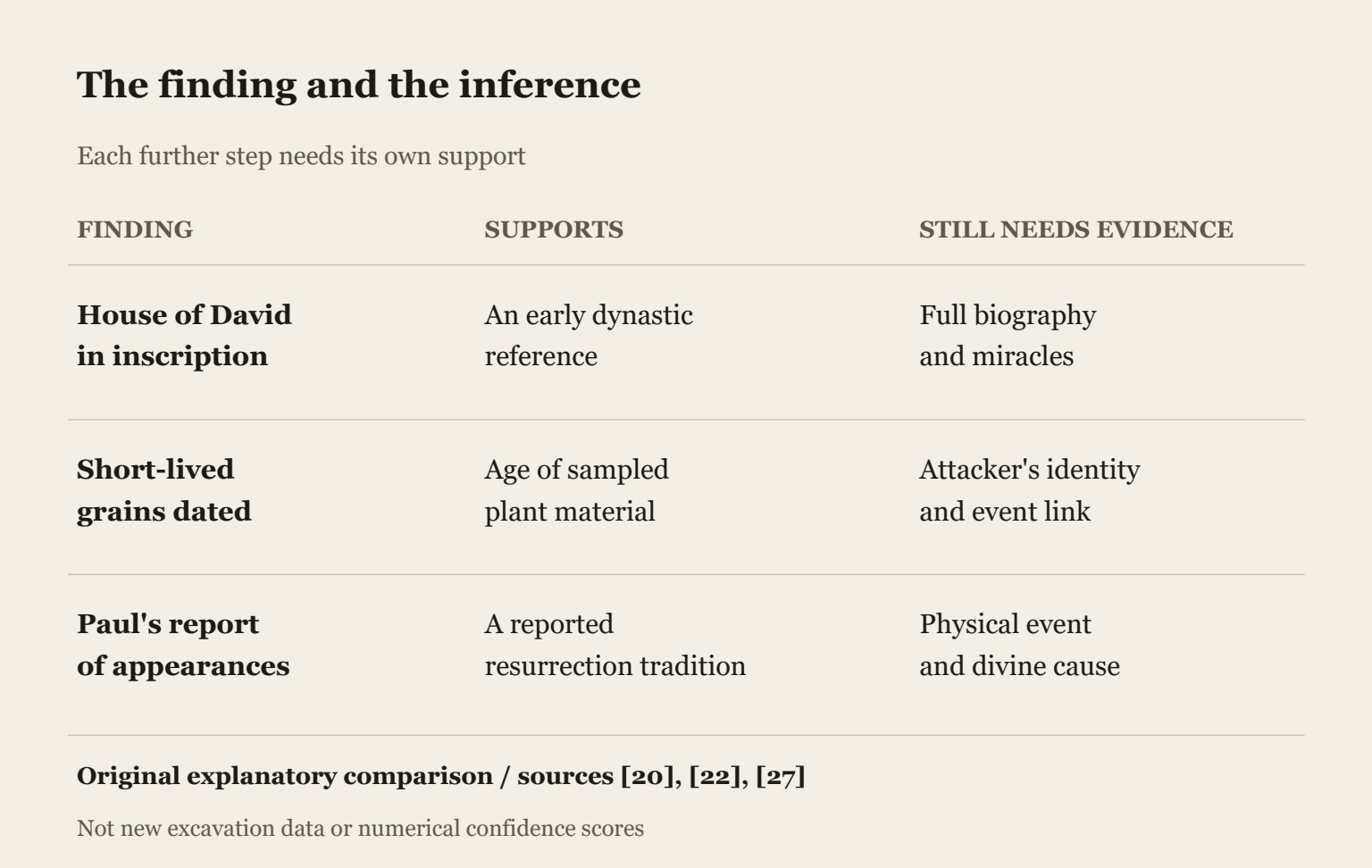
A name, a dated sample and a report are all useful evidence. Their usefulness depends on the question. Each supports a limited conclusion before any further reconstruction is added.
To reach the larger conclusion, identify the missing connection and provide evidence for it. A dynastic inscription cannot independently verify every dynastic story; a sample date cannot name a conqueror; a report cannot by itself isolate a divine cause.
Download the bilingual evidence checklist
22Herod and the census do not fit easily.
Two dated settings create a specific historical difficulty.
Matthew 2 places Jesus's birth during Herod's reign. Luke 2 associates the registration with Quirinius governing Syria. The NABRE notes date Herod's death to 4 BCE and the relevant Quirinian governorship and Judean census to 6-7 CE. [24] [25]
Put the ordinary chronology on a line: Herod's death comes first, then roughly a decade, then the census. A birth before the first point cannot also occur at the second. That is the difficulty to resolve, not a complaint that ancient people lacked modern calendars.
Josephus describes Quirinius arriving to assess property after Judea came under direct Roman administration. His account supports the context of this census. Josephus is a historical author to assess, not an infallible replacement scripture. [26]
The evidence does not identify the exact birthday of Jesus. It shows tension between proposed historical settings. The NABRE's own historical note explicitly recognises the difficulty, so acknowledging it is not restricted to opponents of Christianity. [25]
My short reply is: identify which census you mean and provide evidence for its date and administration. Saying a census once existed is insufficient. The registration needs to fit the ruler, place and time required by the story.
23An earlier census?
A possible repair needs evidence of its own.
Repairs propose an earlier Quirinian role, a different registration or a reading meaning before Quirinius governed. Examine them rather than rejecting an argument merely because a believer proposes it.
An earlier official role would not itself establish this census, its date or Joseph's journey. A translation must fit the Greek and context. Possibility at one step cannot become proof of every remaining step.
The NABRE note discusses an earlier legateship and further chronological problems. It distinguishes empire-wide Roman citizen registrations from the universal provincial enrolment implied by a simple reading of Luke. [25]
That does not exclude every forgotten administrative act. It means a firm historical reconciliation has not been demonstrated here. An unknown record can remain possible without being counted as one we possess.
My reply is: show the document and translation argument. Securely dated evidence of a matching registration would change this criticism. Uncertainty about ancient administration does not make an unsupported rescue established history. Its own evidential steps must be defended.
24What does the earliest testimony say?
Take an important Christian claim seriously before assessing it.
In 1 Corinthians 15:3-8, Paul passes on a tradition of Jesus's death, burial, resurrection and appearances. He includes Cephas, the Twelve, a larger group, James and himself. This is a source for early Christian resurrection belief, not a modern rumour. [27]
Paul distinguishes what he received from his own place in the list. That matters when asking which claims he personally makes and which he transmits. A source can preserve earlier material without giving us a separate signed statement from each named person.
Mark 16 narrates the empty tomb. Its longer ending, verses 9-20, has a separate textual history discussed in the NABRE notes. Do not count a later ending as an additional independent eyewitness simply because it appears in a printed Bible. [28]
This textual issue does not make resurrection belief disappear; Paul's letter already attests it. Nor does early belief establish the physical event by itself. The relevant question is what produced that belief and how well the surviving evidence distinguishes explanations.
My reply is: I accept that we have ancient testimony deserving analysis. Now separate an author's report, what that author personally experienced, a transmitted tradition and the proposed divine cause. Calling all four eyewitness proof hides the steps we need to examine.
25Where are the statements?
The number inside a testimony is not the number of surviving testimonies.
Paul reports an appearance to more than five hundred people, most still alive when he wrote. A defender reasonably sees a claim some contemporaries could challenge. That deserves engagement rather than laughter. [27]
What survives here is Paul's report about the group, not five hundred interviews. Multiplying the number inside his sentence does not produce five hundred independent accounts. Distinguish the reported event from the evidence we possess.
A newspaper reporting five hundred witnesses gives us a report. To examine independence and agreement, we still want the underlying witnesses and circumstances. The analogy does not accuse Paul of running a newspaper hoax.
Sincerity differs from accuracy. Someone can honestly describe an experience while misunderstanding its cause. I cannot diagnose each ancient person from a paragraph or present speculation as a discovered fact.
My reply is: this is evidence of a reported group appearance. More independently documented testimony would change its weight. The number alone cannot supply the separately checkable statements that have not survived.
26Compare the explanations.
Answer the comparison of explanations, not just the possibility of error.
Craig argues from appearances, the empty tomb and Christianity's origin to resurrection. His cumulative case says the combination is better explained by resurrection than by natural alternatives. Present that comparison before answering it. [29]
People sometimes lie is an inadequate response. Ask which facts are established or contested, which sources share information, and how competing explanations predict the surviving reports. Neither side gets to assume every disputed premise.
An empty tomb, if established, concerns a missing body. Divine resurrection requires further steps. Experiences interpreted as appearances can matter without independently isolating a divine cause. The cumulative case must defend those connections.
I need not invent a fully documented replacement story to withhold belief. Unresolved evidence can remain unresolved. But I cannot call an alternative true merely because it avoids a miracle. My explanation must earn confidence too.
My reply is: compare evidence and assumptions. A gap in one alternative is not automatically positive evidence for yours. I remain unconvinced that this record establishes supernatural resurrection rather than early conviction about one.
27Unverified is not logically impossible.
Neither a miracle ban nor a miracle exemption settles the evidence.
Historical work often studies events that cannot be rerun. We can still compare sources, physical traces, dates, motives and rival reconstructions. Requiring a personal laboratory rerun of every past event would destroy ordinary history as well as religious history.
A defender may say that if a god exists, resurrection is possible. That can be granted as a conditional statement. It does not establish that such a god exists, acted in this case or is correctly identified by the associated theology.
I do not need an absolute ban on miracles to demand stronger evidence for a large departure from ordinary expectations. The evidence should distinguish a real intervention from mistaken reporting, development of a tradition or other sources of the record.
Conversely, an unusual event would not automatically authenticate every doctrine in the book reporting it. The cause and its identity require argument. Even a confirmed surprise cannot sign a blank cheque for every claim made around it.
My reply is: show the event, then defend the explanation and identification. I will examine positive evidence. I will not grant a special exemption because the assertion is religious, or pretend that my failure to believe amounts to a proof of logical impossibility.
28Open one source together.
Keep the question small enough that an answer can actually reach it.
Ask whether the claim means an ordinary recent global flood or a regional story with theological meaning. Record the answer, then open Genesis 7-8 together. Address the position the person actually defends. [6] [7]
For a physical claim, open the methods. What was measured or estimated? What does uncertainty mean? Which result would force revision? The ice and lake papers expose such details for inspection. [8] [9] [10]
For an inscription, distinguish letters, historical reconstruction and supernatural conclusion. For a destruction, distinguish the dated sample and attacker's identity. Every further step needs its own support. One accurate detail cannot carry them all.
If the answer becomes God erased every contrary sign, acknowledge the changed claim. What positive evidence distinguishes it from its not happening? Endless argument about measurements cannot resolve a claim stripped of measurable consequences.
My shortest reply is: I accept genuine history in religious writings. One verified detail cannot authenticate an entire collection. We can respect each other while refusing to treat a missing evidential step as already supplied.
NoteSacred claims earn no discount.
Blunt criticism should still be precise enough to survive checking.
I do not want to humiliate someone who inherited a sacred story. I want to know whether that story deserves authority over beliefs about the world. Emotional importance cannot do historical evidence's job.
I accept an inscription, person or place when evidence supports it. I will also identify a physical chronology clashing with a literal account. Calling an account holy does not make the clash disappear.
I will not pretend a failed young-Earth reading disproves every creator, or an unverified resurrection is mathematically impossible. Those would be victories manufactured by changing the claim. I have no use for them.
Securely associated finds, better dates, earlier independent records or a stronger explanation could change my assessment. Demanding that I begin by assuming the book cannot be wrong will not. A conclusion cannot also be the price of entering the discussion.
Real geography does not authenticate a miracle. Sincere belief does not establish its cause. An imagined rescue is not discovered evidence. If a claim wants my belief, it has to earn it.
SourcesFollow the evidence.
The NABRE is the identified English scriptural edition; passages are paraphrased and linked, not silently blended across translations. Its religious notes are interpretations to examine. Ice, sediment and radiocarbon studies provide measured records with assumptions and uncertainties. Museum catalogues identify objects. Farber, Friedman, Wood and Craig make different original arguments, not one shared consensus. Josephus and Tacitus are historical writers, not eyewitnesses to everything they report. The evidence checklist is an original explanatory comparison, not a new excavation dataset. Relevant passages and methods were checked; full-text and access limitations are recorded separately. No claim is made to have personally repeated the laboratory measurements.
[1] The Book of Genesis: introduction
USCCB, New American Bible, Revised Edition (NABRE).
Read the Catholic introduction as a stated scholarly interpretation of Genesis, not as a verdict accepted by every Jewish or Christian tradition. Its literary approach does not independently establish inspiration.
[2] Genesis 1
NABRE, Genesis 1:1-31 and explanatory notes.
Genesis 1:11-19 supplies the vegetation/lights order; the notes explain the paired three-day structure. The criticism tests successive physical creation, not every literary reading. No long quotation is reproduced.
[3] Genesis 2
NABRE, Genesis 2:4-25 and explanatory notes.
Read 2:4-25 and the notes. Particular cultivated vegetation in 2:5 is not casually equated with all plants. The formed/had formed discussion identifies a harmonising proposal, not a claim that English tense settles Hebrew grammar.
Compare the NIV rendering had formed and its note
[4] Genesis 5
NABRE, Genesis 5 and explanatory notes.
The genealogy supplies named ages and descent, not a printed modern creation date. Short chronologies depend on further textual and interpretive assumptions; no single calculation is imposed on all believers.
[5] Sun: Facts
NASA Science, Formation section.
The Formation section describes a young Sun and surrounding material forming planets. This is an institutional account of the scientific reconstruction, not a direct observation of our Sun being born or a proof against every creator.
[6] Genesis 7
NABRE, Genesis 7:1-24 and explanatory notes.
Read 7:2-3 and 19-24. Clean animals receive different treatment; destruction concerns land-breathing life. A recent worldwide inundation is the specified interpretation tested, not every possible regional reading.
[7] Genesis 8
NABRE, Genesis 8:1-22 and explanatory notes.
Read the complete recession sequence, 8:4 on the mountains of Ararat, and the note comparing birds in Gilgamesh. Forty days of rainfall is not equated with the whole narrative duration. No modern ark discovery is claimed.
[8] A 60 000 year Greenland stratigraphic ice core chronology
Svensson et al. (2008), Climate of the Past 4, 47-57. DOI: 10.5194/cp-4-47-2008.
Original open-access paper; methods, uncertain-layer treatment and cross-comparisons read. The chronology extends to 60 ka; climate-event synchronisation has stated assumptions. It is not sixty thousand perfectly visible stripes with zero error.
[9] A complete terrestrial radiocarbon record for 11.2 to 52.8 kyr B.P.
Bronk Ramsey et al. (2012), Science 338, 370-374. DOI: 10.1126/science.1226660.
Original article hosted by Harvard; relevant methods and chronology read. Terrestrial plant remains and the lake sequence inform radiocarbon calibration. BP means before 1950 here. The record is not wholly independent of calibration products that use it.
[10] An extended and revised Lake Suigetsu varve chronology from ~50 to ~10 ka BP based on detailed sediment micro-facies analyses
Schlolaut et al. (2018), Quaternary Science Reviews 200, 351-366. DOI: 10.1016/j.quascirev.2018.09.021.
The authors revise seasonal-layer counting and interpolate poorly preserved intervals. Their analysed interval preserves distinguishable seasonal layers for about half the years. This limitation is stated, rather than describing an assumption-free fifty-thousand-stripe count.
Open the accepted author manuscript
[11] The Himalayas
US Geological Survey, This Dynamic Earth.
The USGS account explains collision, deformation, uplift and changing depositional environments. Marine material at elevation needs geological context; its presence alone does not date a recent global flood.
[12] Gilgamesh Tablet XI: flood-story fragment
British Museum, Neo-Assyrian tablet fragment, museum number SM.1881.
The museum catalogue identifies Neo-Assyrian fragment SM.1881 as Gilgamesh Tablet XI, the flood story. The indexed catalogue text was available; direct retrieval returned 403. This supports the inscribed tradition, not a global event or unique borrowing route.
[13] Genesis 10
NABRE, Genesis 10, especially verses 5, 20 and 31.
Verses 5, 20 and 31 group peoples by languages. Read with chapter 11 rather than assuming chapter order must represent strictly consecutive events. A retrospective explanation is a serious harmonising reading.
[14] Genesis 11
NABRE, Genesis 11:1-9 and explanatory notes.
Verses 1-9 and notes supply the Babel narrative, Babylonian tower context and wordplay. Context does not verify divine language confusion. No precise first language, universal language clock or dated global reset is asserted.
[15] Exodus 12
NABRE, Exodus 12:37-42 and explanatory notes.
Verses 37-42 give the scale and departure language. The number of travelling men is distinguished from the total population. No exact total is manufactured from unspecified household assumptions.
Open the accessible copy of the same NABRE edition
[16] Exodus 14
NABRE, Exodus 14:1-31 and explanatory notes.
Primary account of the sea crossing. The manuscript distinguishes the text, historical-core proposals and supernatural assertions. Neither an ordinary regional flood nor the mere existence of Egyptian settings verifies this intervention.
Open the accessible copy of the same NABRE edition
[17] The Torah's Exodus
Zev Farber (2015), TheTorah.com, original scholarly argument.
Farber presents critical arguments concerning scale and the numerical/clan interpretation. This is his scholarly case, not a primary excavation report or a unanimous measured conclusion that no smaller departure occurred.
[18] The Historical Exodus
Richard Elliott Friedman (2015), TheTorah.com, original scholarly argument.
Friedman makes a positive case for a smaller Levite departure using textual, naming and religious arguments. His reconstruction is presented as a proposal, with disputed inferential steps; it does not establish the full mass-and-miracle narrative.
[19] Israel in the Merneptah Stela
Michael G. Hasel (1994), BASOR 296, 45-61. DOI: 10.2307/1357179.
Hasel analyses the inscription dated about 1207 BCE and Israel in Canaan. The accessible publisher abstract supports this limited summary; the full article was not treated as read. The stele does not itself narrate Moses or the sea crossing.
[20] Tell es-Sultan (Jericho): Radiocarbon Results of Short-Lived Cereal and Multiyear Charcoal Samples from the End of the Middle Bronze Age
Hendrik J. Bruins and Johannes van der Plicht (1995), Radiocarbon 37(2), 213-220.
Original 1995 paper, relevant sample tables, methods and conclusion read. Short-lived cereal and multiyear charcoal are distinguished. Its calibrated late-seventeenth/sixteenth-century conclusion is not misreported as an exact universally settled destruction date or evidence of no later settlement.
[21] Carbon 14 Dating at Jericho
Bryant G. Wood (7 August 2008), Associates for Biblical Research; original reply.
Wood explicitly bases about 1400 BCE on pottery and Egyptian chronology. His reply acknowledges correction of an earlier erroneous radiocarbon result and reports later grain measurements. The indexed original reply was read. His broad claims about chronology and scholarly preferences are not adopted as an independently verified consensus.
[22] Tel Dan Stele
The Jewish Museum, exhibition with original object on loan from the Israel Museum.
The museum exhibition identifies the ninth-century BCE dynastic inscription and original lender. A House of David reference supports a historical anchor; it does not independently establish a complete biography or kingdom size.
[23] In the Path of Christianity
The Israel Museum, Jerusalem; exhibition including the Pontius Pilate inscription.
The Israel Museum identifies the Pilate inscription in its exhibition. Only the existence and relevance of this material object are used here. No specific restored wording or miracle is inferred from the exhibit listing. The indexed institutional listing was read; direct access had a certificate-chain failure. Certificate checks were not disabled.
[24] Matthew 2
NABRE, Matthew 2:1-23 and explanatory notes.
Matthew 2:1 places the birth under Herod; the notes give the usual 4 BCE death chronology. The chapter is examined as a primary narrative, not assumed to be a modern independent birth certificate.
Open the accessible copy of the same NABRE edition
[25] Luke 2
NABRE, Luke 2:1-7 and historical note on 2:1-2.
Read 2:1-7 and the historical note on 1-2. It discusses 6-7 CE, earlier-governorship difficulties and different registrations. A proposed reconciliation needs matching documentary and linguistic evidence. The exact birthday is not recovered.
Open the accessible copy of the same NABRE edition
[26] Antiquities of the Jews, Book XVIII
Flavius Josephus, Antiquities 18.1.1; William Whiston translation, University of Chicago host.
Antiquities 18.1.1 describes the assessment and Quirinius after annexation. Whiston is an older English translation on a university host. Josephus is not an eyewitness to every reported event or treated as immune to criticism.
[27] 1 Corinthians 15
NABRE, 1 Corinthians 15:1-19, especially 3-8.
Read 15:3-8 in its letter context. Paul transmits a tradition and includes his own claim. A report naming more than five hundred people is distinguished from five hundred surviving independent witness statements. The accessible same-edition copy includes the text and notes.
Open the accessible copy of the same NABRE edition
[28] Mark 16
NABRE, Mark 16 and textual notes on 9-20.
The chapter and textual notes separate the empty-tomb narrative from the longer ending. A textual addition does not erase the earlier resurrection tradition in Paul. Canonical acceptance and original authorship are different questions.
Open the accessible copy of the same NABRE edition
[29] Jesus' Resurrection
William Lane Craig, Reasonable Faith, original argument.
Craig's own cumulative argument from appearances, the empty tomb and Christianity's origin is presented before criticism. His claims about scholarly agreement are not silently adopted as an audited consensus. No alternative diagnosis is asserted as a demonstrated replacement history.
[30] Annals 15.44
Tacitus, Annals 15.44; J. Jackson Loeb translation, University of Chicago host.
Annals 15.44, Jackson translation. Tacitus reports Christus's execution under Pilate and Tiberius; he is a later Roman writer. His source of information is not independently established here, and the passage is not an eyewitness resurrection report.