

01A sacred cover changes nothing.
I want the claim, its meaning and the evidence for it.
Someone tells me the Qur'an contains perfect history because it comes from Allah. I ask how they know it comes from Allah. If the answer is that the Qur'an says so, we have returned to the starting point.
That does not make every sentence false. It makes this particular argument circular: the book guarantees its own authority, and that authority guarantees the book. A claim cannot become its own independent witness by repeating itself.
I will examine creation, Adam, Noah, moon splitting, Dhu al-Qarnayn and claims about Egyptian remains. These are selected questions, not an audit of every verse or every Muslim understanding. Later parts address other kinds of religious argument.
My test stays simple. What exactly does the passage assert? Which part is an interpretation? What evidence would look different if the proposed event happened? A critic and a defender should both answer those questions.
I do not need to prove that every possible creator is impossible before questioning one book. An unknown origin of existence and a particular story revealed by a particular god are different claims. The second needs evidence of its own.
02Which source says it?
Qur'an, hadith, commentary and a social-media caption are different things.
The Qur'an is the scripture under discussion. A hadith is a transmitted report about Muhammad's words, actions or related events. Tafsir means commentary explaining the scripture. A modern video may combine all three and add something none actually says.
I identify those layers instead of calling every religious statement a Qur'anic verse. For the passages here I use the Sahih International English translation. My explanations are paraphrases; the chapter and verse links let readers check the text.
For moon splitting, I also examine reports in Sahih al-Bukhari and the English abridged Ibn Kathir commentary. Sunnah.com identifies its Bukhari translation as M. Muhsin Khan's. Its introduction describes the collection's narrator and chain criteria. [17] [18]
Those criteria matter to the argument. They do not turn a report into a modern photograph or make different transmission chains automatically independent observations. A Sunni collection's authority should also not be silently imposed on every Muslim tradition.
My useful reply is: show me where this detail comes from. Is it the verse, a report, an explanation or your own conclusion? Once we know that, we can assess the right source instead of defending a bundle nobody has separated.
03Read the whole passage.
An English rendering can contain an interpretation.
I read the surrounding passage before declaring a contradiction. A bracket in an English translation may supply an explanation rather than reproduce a separate Arabic word. The sentence still needs its context, and disputed meanings need a linguistic argument.
Consider the sunset in 18:86. The translation used here includes an appearance explanation. Ibn Kathir also understands the scene from the traveller's viewpoint, like someone seeing the Sun apparently enter the sea. This is an older commentary, not a response invented after spacecraft. [20] [21]
That does not make every interpretation equally good. A proposed reading should fit the wording and the surrounding story. If it is defended only because another meaning would be embarrassing, the reason for choosing it deserves examination.
But an atheist cannot win honestly by pretending the defender has no serious reading. Nor can the defender treat the mere availability of a reading as proof of revelation. Understanding a sentence and establishing its divine author are separate tasks.
My reply is: let us open the whole passage, identify the translation and compare the explanation. Then decide what physical claim, if any, remains to test. Being blunt does not require being sloppy about what the other person actually believes.
04Old parchment is real evidence.
Accept the finding. Keep its date attached to the right object.
The University of Birmingham reports radiocarbon dating of its Qur'anic parchment to 568-645 CE, with 95.4 percent probability under the calibration used. The dated material is animal skin. The measurement concerns when that animal died, not the moment a pen touched it. [3]
The library also reports early handwriting, multispectral examination and ink analysis. It says no earlier hidden text was detected. It explicitly states that the inks have not themselves been age-tested. That is a useful limit, not something to hide. [3]
These findings are evidence of an early manuscript and its physical history. I accept them. Claiming that there is no early Qur'anic manuscript evidence would be a bad argument, and calling myself an atheist would not improve it.
But a dated page does not verify every event written on it. An early manuscript of an account can show that the account circulated early. Confirming its contents requires further work. The date of a record and the truth of its story are different questions.
My short reply is: yes, the manuscript matters. Now tell me which conclusion you think follows. The parchment date does not measure divine authorship, establish every modern reading or independently confirm that the Moon split.
05Preserved does not mean true.
Textual history and historical accuracy answer different questions.
Qur'an 15:9 makes a preservation claim. To examine a text's transmission, I want manuscripts and comparisons, not just a promise inside the text. There is real evidence worth discussing instead of dismissing the subject with a slogan. [2]
Marijn van Putten's study compares fourteen early manuscripts and recurring spelling choices. Shared unusual spellings in the same positions support descent from a common written exemplar: an earlier written copy behind the surviving copies. That is a checkable historical inference. [27]
His argument supports early standardisation of the Uthmanic text type and is consistent with the traditional association with Uthman. It does not erase the distinction between a consonantal text, spelling details and reading traditions, all discussed in the paper. [27]
Now imagine a person writes an inaccurate story and a hundred careful scribes copy it faithfully. Accurate transmission preserves the inaccurate story. This is an invented example explaining the logic, not an allegation that those manuscripts contain that imaginary story.
My reply is: preservation can strengthen our knowledge of what a text said. It cannot, by itself, establish that what it said happened, or identify a supernatural source. Even a perfectly preserved assertion still has to meet the evidence about the world.
06Days are not an Earth age.
Do not import a young-Earth calendar into a passage that does not give one.
Qur'an 7:54 describes creation in six days. It does not give a modern calendar date for Earth's formation or state that the universe is six thousand years old. A criticism should address an actual chronology someone defends. [4]
Some readers understand ordinary days; others propose longer periods. To evaluate that reply, ask what the passage means by a day and how its sequence relates to physical history. Making a unit flexible does not automatically produce a measured timetable.
Another argument borrows the thousand-year day in 32:5. But that passage concerns the direction of affairs and their ascent. The fifty-thousand-year day in 70:4 occurs in another setting. They are not printed instructions for converting six creation days into an Earth age. [5]
This is like reading two uses of the word day in different conversations and forcing them onto one stopwatch. Context must justify the conversion. A number selected from another passage cannot do that work merely because it is convenient.
My reply is: tell me the reading and its reasons before we compare it with the evidence. I will not accuse all Muslims of believing in a six-thousand-year-old Earth. I also will not accept an improvised calendar as a successful scientific prediction.
07First check whether four includes two.
An easy arithmetic accusation has a serious answer.
An often repeated objection adds the numbers in 41:9-12: two days for Earth, four for its provisions and two for the heavens. Two plus four plus two is eight. Does that automatically contradict the six-day statement? [6]
Ibn Kathir's commentary reads the four as including the first two. Earth and its provision together take four, followed by two for the heavens. On that reading the total is six. The commentary explains the inclusion explicitly. [8]
Here is an ordinary analogy. I spend two days laying a foundation and complete that stage with its walls in four days. Then I spend two on the roof. The four need not mean four additional days. This is an illustration, not a translation.
Someone can still ask whether this inclusive reading best fits the Arabic and context. But merely displaying an eight on a calculator has not answered it. The dispute concerns how the intervals relate, not whether anyone knows elementary addition.
My short reply is: the six-versus-eight accusation is not decisive once the inclusive explanation is on the table. I want criticisms that survive the strongest relevant answer. Rejecting a weak objection does not authenticate the book; it removes a weak objection.
08What came first, and what was prepared?
The serious reply distinguishes making Earth from spreading it.
In 41:9-12, Earth, its provisions, heaven as smoke and the seven heavens appear in the account. In 79:27-33, heaven is constructed before Earth is spread and its water and pasture described. Read both passages before comparing their order. [6] [7]
Ibn Kathir transmits an explanation associated with Ibn Abbas: Earth was created first, the heavens were fashioned, and Earth was then spread or prepared. Creating something and preparing it for use need not be the same event. [8]
That is a real harmonising argument. Saying that two English sentences look different is not enough to dispose of it. The question is whether the proposed stages fit the language consistently and what physical sequence the defender actually commits to.
If the reading asserts Earth existed before the first stars, it faces a scientific problem. NASA's cosmic account places the first stars in early cosmic history, while its solar account places our system's formation much later, about 4.6 billion years ago. [9]
If the defender instead means later arrangement or visibility of an already existing sky, that is a different proposal requiring support. My reply is: write down the stages. A sequence vague enough to fit anything cannot simultaneously count as a precise discovery.
09One word is not a model.
A resemblance needs more than a modern label placed beside it.
Someone points to the smoke in 41:11 and says the Qur'an predicted modern cosmology. I understand the appeal: science also describes changing matter and the formation of cosmic structures. But resemblance is only the beginning of a comparison. [6]
A useful scientific model specifies relationships that can be checked. Earlier chapters examined expansion, background radiation and the growth of structure. Saying smoke does not independently provide those measurements, their numerical relationships or a method for choosing between competing cosmic histories.
Ask a simple question: what result would this verse have ruled out before astronomers made the observations? If every possible mixture, cloud, gas or early state can be called smoke afterwards, the word has not selected a risky prediction.
A believer can reasonably answer that scripture communicates in accessible imagery rather than equations. That may explain a literary choice. It also limits the claim: accessible imagery is not the same achievement as independently deriving a scientific account.
My reply is: compatibility with a broad phrase does not establish revelation. Show the specific meaning, the prior prediction and the observation that discriminates it from alternatives. Part 19 returns to scientific-miracle arguments in greater detail; a striking resemblance will still need those steps.
10Dust is not a demonstration.
A statement about origin needs evidence about origin.
Qur'an 3:59 compares Jesus with Adam and describes Adam's creation from dust through divine command. Qur'an 4:1 describes a single soul, its mate and human multiplication. Those passages matter when identifying the religious claim. They are not genetic measurements. [10] [11]
One reading asserts a specially created couple from whom all human biology begins. Another gives Adam a special spiritual role among an existing population. These readings have different implications; I will not quietly replace one with the other during the argument.
Saying our bodies contain elements also found in Earth does not establish a particular person made directly from dust. Ordinary reproduction also uses matter already in nature. Shared ingredients do not distinguish the proposed miracle from the biological process.
What does the account predict differently from common ancestry? If it proposes a spiritual appointment leaving no biological difference, fossils and genomes cannot measure that appointment. It still needs positive support.
My reply is: identify the version you believe. Then use evidence relevant to that version. A verse documents what a text teaches; it cannot independently establish its own extraordinary origin story simply by teaching it with confidence.
11Ancestors or sole founders?
A family-tree claim differs from an exclusive genetic beginning.
Part 11 explains why a genealogical ancestor need not be the only source of our DNA. A couple within a larger population can appear in many later family trees. That is different from all humans beginning biologically with that couple alone.
For an ordinary recent exclusive pair, choose a position on a non-sex chromosome. Two people supply at most four inherited copies there. Later variation must arise through mutation and inheritance. Across many positions, that history has testable consequences.
Ragsdale and colleagues compare ancestral population histories with genomic data and find support for connected, structured populations in Africa. These are model-based inferences, not a recovered census or a study identifying religiously named individuals. Part 11 explains the wider evidence and limitations. [29]
An old genetic lineage alone does not count everyone alive at an instant. Nor does one smoothed population curve rule out every imaginable brief ancient event. The case concerns patterns across evidence and explicit assumptions, not one magic number labelled science.
My reply is: give the date, the exclusive-pair claim and the biological assumptions. If specially created DNA can mimic any older population, the proposal has surrendered a distinguishing test. A pair's possible place in a family tree still does not prove a miracle.
12Global or regional? Hold the claim still.
The scale determines which evidence can test it.
Qur'an 11:36-49 speaks of Noah's people, an ark, paired creatures, a drowned son and a landing at Judiyy. Do not silently replace that place name with the Genesis wording about Ararat. Related stories still need to be read separately. [12]
Qur'an 37:75-82 describes rescue and surviving descendants. Ibn Kathir's explanation includes the view that all later people descend from Noah's offspring. That is evidence for an expansive traditional reading, not proof every Muslim must adopt it. [13]
If someone defends a recent flood covering the entire planet and replacing its human population, that claim encounters physical chronology and population evidence. If they defend a regional disaster affecting particular people, the claim and its expected traces are smaller.
The Greenland study gives a layer-based chronology extending through about sixty thousand years, with uncertain layers and cross-checks stated. It is not simply a book announcing an age. The methods describe what was measured and how the timeline was assembled. [15]
My reply is: a recent worldwide reset must account for surviving long records, not just point at an old flood deposit. A regional flood can happen without establishing divine punishment, Noah's exact story or the global version that was initially defended.
13950 years is not a calendar.
The passage specifies time among a people, not a dated scientific chronology.
Qur'an 29:14 says Noah remained among his people for a thousand years less fifty. That is 950. The statement is not itself his precise birth and death dates, and it does not give the age of Earth or date the flood in a modern calendar. [14]
If someone reads it as ordinary elapsed years in one person's life, it is an extraordinary longevity claim. Its presence in the text shows the claim exists. It does not supply independently dated records covering those centuries of that person's life.
Another reading may propose a different calendar or symbolic meaning. Then ask what fixes the unit and why that reading follows from the passage. A convenient reinterpretation is a proposal to investigate, not a new measurement of Noah's lifetime.
For the proposed flood date, ask for the actual dating argument. Do not import biblical genealogies without acknowledging the added source and assumptions. We cannot compare a precisely dated scientific record with a date nobody has actually defended.
My reply is: I will examine a specified timeline. I will not manufacture one for you, and I will not call an unsupported 950-year biography established history. A sacred number does not become a verified human record by being repeated often.
14Which event does the verse describe?
A traditional past miracle and a future sign are different claims.
Qur'an 54:1 places the approaching Hour beside the splitting of the Moon. The following verses discuss people rejecting signs. Ibn Kathir understands the splitting as a miracle during Muhammad's lifetime and cites transmitted reports supporting that reading. [16] [18]
That is the substantial traditional argument, not merely a caption invented on the internet. A critic should engage the reports and the interpretation rather than announce there is no religious source for the claim. There plainly is one.
Muhammad Asad's own commentary instead favours a future event associated with the Last Hour. He explains his reading through the context and the use of past tense for a future certainty. I identify this as his interpretation, not a universally accepted translation. [28]
I also do not adopt Asad's suggested optical explanation for reported experiences as a discovered event. A possible explanation is not a confirmed diagnosis of what particular ancient observers saw. We should apply that discipline to natural and supernatural proposals alike.
My reply is: first tell me which claim you defend. For a past physical splitting, we can discuss historical and lunar evidence. For a future event, a present photograph cannot function as a record proving that future event has already occurred.
15What does a chain establish?
It is not automatically an independent measurement of the Moon.
Sahih al-Bukhari 4864-4865 transmits accounts attributed to Ibn Masud, describing a divided Moon in Muhammad's presence. These are meaningful evidence for a transmitted miracle tradition. They are not direct lunar measurements made with modern instruments. [17]
The collection's introduction describes conditions about narrator character, memory and connected transmission. A defender may argue that such scrutiny supports reliability. That deserves a response about those criteria and their application, not the empty reply that religious people cannot report anything accurately. [17]
But two chains can share an earlier source. Counting routes of transmission is not the same as counting independent first observations. We need to ask where accounts converge, when their wording is recoverable and whether sources can check each other.
Likewise, sincere transmission does not itself isolate the cause of an experience. Honest people can preserve what they understood as a miracle. Establishing that the entire Moon physically separated and rejoined requires a further evidential connection.
My reply is: let us inspect the reports and their relationships. I am not declaring every transmitter dishonest. I am refusing to treat a religious reliability classification as if it had already settled every historical, physical and explanatory question about the event.
16A fault is not a miracle receipt.
Open the original caption before trusting the viral claim.
A photograph shows a line on the Moon. Someone calls it the scar where the Moon was split and rejoined. Before accepting that story, I want the image's identity, its scale and the explanation supplied with the actual observation.
NASA's account identifies Rima Ariadaeus as a fault system extending about 300 kilometres. It describes a graben: ground lowered between faults. It also distinguishes proposals about the processes that produced such features. This is a local geological structure, not an identified seam around the entire Moon. [19]
The image therefore establishes neither a seventh-century splitting date nor a whole-Moon separation and reunion. It also does not identify a divine agent. Those are extra claims added to the photograph, and each needs its own evidence.
This is easy to explain without specialist vocabulary. A crack in a wall does not show that someone cut the entire house in half yesterday and rebuilt it by magic. First establish what caused that crack, when and on what scale.
My short reply is: the photograph is real; the caption added by the miracle argument has not been established by it. I will follow lunar evidence where it leads. I will not replace its measured scale and geological context with a story attached afterwards.
ComparisonText, report and photograph.
Each can be genuine while leaving a larger claim unproved.
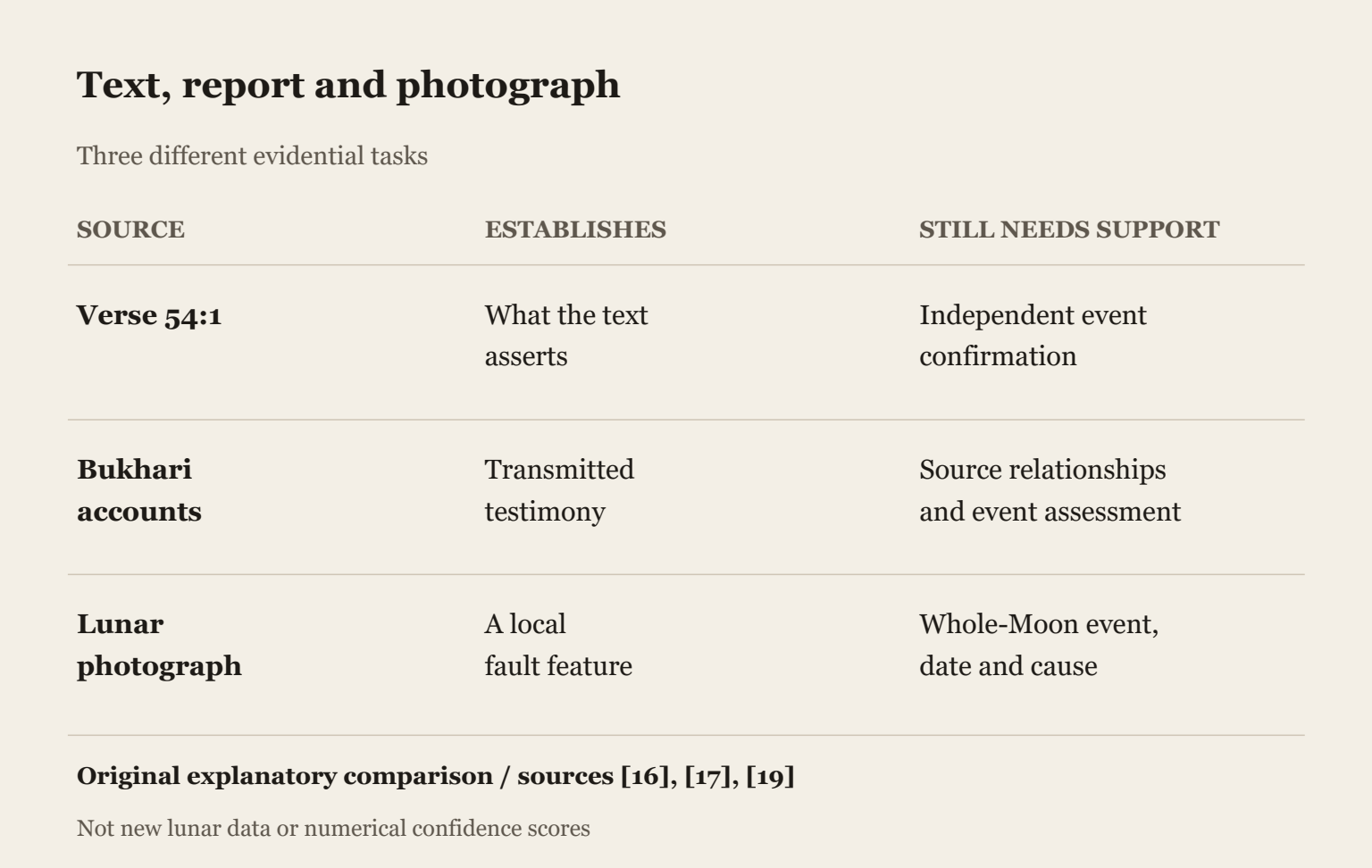
A verse is evidence for what the text says. A transmitted report is evidence to assess about a reported experience. A photograph supplies observable surface information. Calling all three proof of the same thing skips their different jobs.
To establish an entire Moon separating, a particular date and a divine cause, identify the added steps and support each one. Accepting that the sources exist does not oblige anyone to accept every explanation attached to them.
Download the bilingual evidence comparison
17What if God repaired every sign?
A possible escape is not positive evidence.
The reply may be that a god split the Moon, rejoined it perfectly and erased every physical trace. I can understand what that sentence proposes. It also explains why a lack of a seam cannot logically exclude every version of the miracle.
But notice the cost. If the repaired Moon must look exactly like a Moon that never separated, its present condition cannot distinguish those histories. The proposal has removed the very physical test that the crack photograph was supposed to supply.
We would then have to evaluate the historical testimony on its own merits. The divine repair is not additional observed evidence. It is an extra proposed action protecting the claim from an unfavourable physical comparison.
An invented burglar analogy helps. Someone says an intruder entered my room and restored every footprint, camera record and object perfectly. That story is not disproved just by a tidy room. The tidy room also does not prove that intruder existed.
My reply is: I am not confusing unverified with logically impossible. I am asking what positive reason remains to believe this happened. An explanation designed to fit every possible outcome cannot claim those outcomes as distinctive confirmations.
18What about other observers?
Absence has force only when we have reason to expect a surviving trace.
An atheist may ask why there are no reports from everyone on Earth. That wording is careless. At any moment the Moon is below the horizon for many people; others face daylight, clouds or simply are not looking at it.
If a proposed event were brief, we should not assume every observer would notice it, write it down and leave a record that survives. A historical claim needs its proposed time, duration and visibility before a worldwide reporting expectation can be assessed.
But that reply does not supply independent confirmation. A defender claiming an outside chronicle should produce the text, its dating, the relevant passage and a reason to identify the same event. A modern retelling is not automatically an ancient witness.
We must also distinguish a report of an unusual appearance from evidence that the entire lunar body separated. The report's wording, location, timing and independence matter. Similar descriptions do not establish identical causes merely because both sound remarkable.
My reply is: I will not make an exaggerated silence argument. Show the positive independent record you think exists. Explaining why some records might be absent can weaken one objection; it cannot manufacture the missing corroboration.
19Do not mistake a viewpoint for a universe.
The stronger religious reading has an older source.
In 18:86, Dhu al-Qarnayn reaches a western setting-place and finds the Sun setting in a murky spring in the translated account. The rendering used here includes an appearance qualification. Read it with the journey, not as a detached astronomy diagram. [20]
Ibn Kathir explicitly explains an observer seeing an apparent sunset into the sea. He rejects the idea that the traveller reached the Sun's actual place in the sky. The commentary therefore supplies a serious viewpoint reading, not just a modern emergency answer. [21]
We use appearance language ourselves. Someone watching from a beach can say the Sun went into the sea without claiming seawater swallowed a star. That ordinary analogy explains why this interpretation cannot be dismissed merely because the words mention a sunset.
It does not prove that every detail of the journey happened or that the book is divine. It addresses one proposed astronomical error. A successful reply to one criticism should receive the credit it earns, without becoming permission to skip all the other questions.
My reply is: I will not present the literal Sun-in-a-puddle accusation as a decisive refutation while ignoring the viewpoint explanation. Precision matters more than collecting a cheap debating point. Now let us examine the journey's other historical claims.
20A literary parallel is a clue, not a verdict.
Names, motifs and dates must be handled separately.
Qur'an 18:83-101 tells of Dhu al-Qarnayn's journeys and a barrier associated with Gog and Magog. The passage does not identify him by printing Alexander's name. A proposed identification needs an argument; it cannot simply be assumed. [20]
Tommaso Tesei's study of the Syriac Alexander Legend examines related king-and-gate traditions. Its publisher abstract argues for an earlier version under Justinian, alongside later development. I am using that stated research argument, not pretending I read the whole book. [22]
That matters because a motif has a literary history. A story can draw on a shared cultural environment without being a separately verified report of the physical event. Similarity is relevant evidence for comparison, not a second excavation of the same gate.
But similarity alone does not establish a unique borrowing route, the exact wording of an oral stage or the date of every layer. Calling it definitely copied skips questions that historians still have to investigate. I do not need to overstate the case.
My reply is: compare the actual texts, proposed dates and distinctive features. Then state the conclusion at the confidence the evidence supports. A familiar ancient story is not independent proof of revelation, and a parallel is not automatically a complete plagiarism investigation.
21Show the object and the connection.
A wall somewhere is not automatically the wall in this account.
The passage describes iron and molten copper in constructing a barrier, people unable to scale or pierce it, and its eventual destruction under divine promise. These details belong to the claim being assessed. They should not disappear when a photograph of a wall appears. [20]
Suppose someone identifies a particular mountain barrier. I want its location, materials, construction history and dating. Then I want the evidence connecting it to the named figure, people and episode. Those are distinct tasks, even if the first photograph looks impressive.
An old fortification can establish that people built a fortification. It does not automatically establish all the events a later narrative attaches to it. This is the same standard I used for inscriptions and destruction layers in the Bible chapter.
If someone instead reads the barrier as symbolic, ask what it symbolises and why the text supports that reading. The claim changes from an identifiable engineering project to an interpretation. A symbolic reading cannot borrow an unrelated wall as its physical confirmation.
My reply is: bring the object's record, not just the image. A location claim becomes testable when it specifies materials, dates and associations. Until those connections are supplied, we have an asserted identification, not a completed archaeological argument.
22Which Pharaoh?
Keep a historical background separate from the particular event.
Qur'an 10:90-92 narrates Pharaoh pursuing, drowning and his body being saved as a sign. The passage does not name Ramesses II or Merenptah. Attaching one of those names is an additional historical identification, not a name printed in these verses. [23]
A defender may argue that an Egyptian setting, royal practices or a possible departure from Egypt fits the narrative. Specific context can be relevant. It still does not establish which ruler drowned, the circumstances of death or the supernatural intervention.
The previous chapter examined the distinction between a smaller historical departure and the full Exodus narrative. Those distinctions remain useful here. Related traditions do not become independent confirmations merely because they appear in different sacred collections.
To investigate a named ruler, we need a matching chronology and evidence linking that person to the proposed event. We should also ask what alternative identifications or reconstructions the same evidence permits. A possible match is not a uniquely established match.
My reply is: let us specify the Pharaoh and show the identification argument. I will accept real Egyptian history. I will not treat the existence of Egyptian kings as proof that a particular unnamed king underwent every event in the story.
23The mummy needs a case.
An authentic body still needs identification, dating and a cause of death.
The National Museum of Egyptian Civilization displays royal mummies and describes their burial and recovery contexts. Its Merenptah account places his original burial in KV8 and a later transfer to KV35. This is a tomb-and-reburial history, not a body newly pulled from the Red Sea. [24] [25]
Now return to 10:92. It speaks of a body becoming a sign; it does not name a modern museum, a twentieth-century discovery or the particular mummy on a preacher's slide. Those extra details require their own evidential bridge. [23]
Even an identified royal mummy does not by itself establish drowning. A claimed cause of death needs an appropriate examination, findings, alternatives and limits. A preserved body is not a medical report, and an unexplained detail is not automatically proof of a sea-crossing miracle.
To call this a successful prediction of discovery, we would also need a sufficiently specific advance claim. An unnamed body and a later selected mummy leave room for choosing a match after the fact. The selection cannot replace the missing specificity.
My reply is: show that this is the narrated Pharaoh, the event occurred and the text uniquely anticipated this finding. A photograph cannot finish those steps.
24A similar name is not an identity.
Ask for the object record before arguing about a viral translation.
Qur'an 28:38 places Haman in Pharaoh's story and describes an instruction involving fired clay and a tower. A common kind of defence points to an allegedly matching Egyptian name or job. That is an inscription claim to inspect, not to accept from a cropped slide. [26]
Ask for the catalogue number, where the object came from, its date, a clear image, the original signs and a specialist reading. Provenance means the object's documented origin and history. Without that information we cannot tell what is actually being cited.
Then separate the steps. Does the inscription contain the proposed name? Does the reading identify the same person? Is the date right? Does the job match? Does anything connect that person to this particular command? A resemblance in one step does not settle the others.
I am not declaring an unidentified inscription disproved without examining it. Nor am I going to invent a museum confirmation because a video says scholars were shocked. This section supplies a checking method, not a verdict on an object nobody has adequately identified.
My reply is: give me the record and the original reading. If the evidence supports a real name or office, I will accept that limited result. The tower episode and divine authorship still require further support. A matching sound cannot carry the whole argument.
25Consistency alone would not prove God.
A necessary condition is not automatically a sufficient one.
Qur'an 4:82 invites reflection and says that a source other than Allah would produce much contradiction. A defender may therefore challenge me to find a genuine inconsistency. I should identify one carefully and engage reasonable interpretations. [1]
But suppose, for the argument, a book contained no contradictions. A human can write a consistent account. Consistency by itself would not identify a divine author. A story can be internally orderly while failing to describe the world accurately.
An invented map makes the point. It can label every road consistently and still describe an imaginary town. Internal agreement asks whether the parts fit each other. External accuracy asks whether the roads exist. We need both questions, not a substitution.
Conversely, an actual mistake would challenge a specified claim of complete factual inerrancy: the claim that the book cannot be wrong about facts. It would not, by itself, disprove every possible creator, every ethical teaching or every metaphorical reading.
My reply is: show what your authority claim requires. I will not announce a contradiction by ignoring context. You cannot establish revelation merely by answering one objection, or by demanding that I disprove every sentence before you provide a positive case.
26An unexplained event would still need a cause.
Event, explanation and divine identity are separate conclusions.
Suppose a strange event were securely documented tomorrow. I would examine it. I would not insist that the evidence must be false because my present understanding lacks an explanation. An atheist can recognise a surprise without giving up careful reasoning.
But establishing something unusual does not instantly establish Allah, a particular revelation and every associated doctrine. Those are additional identifications. The argument needs a reason that discriminates this proposed cause from other proposed causes or an unknown one.
A believer may answer that a divine sign makes sense within the whole religious case. Then examine that whole case and its independent support. Do not make each uncertain claim the sole guarantee of another uncertain claim in an endless circle.
Likewise, scientific ignorance about the ultimate origin of existence cannot authenticate a specific flood narrative or mummy identification. A missing explanation leaves a question open. It does not supply a historical fact that no one has yet established.
My short reply is: first establish the event, then argue for its cause and the identity of that cause. I can leave room for an unknown creator while rejecting this attempted shortcut. Possibility is cheap; a demonstrated connection is the work still to do.
27Open the verse and the original source.
One claim at a time gives the evidence room to matter.
Start with a precise sentence. Do you mean the Moon physically separated during Muhammad's lifetime? Or that a verse refers to a future event? Open 54:1 and the relevant commentary together. Do not argue against a claim the other person does not defend. [16] [18] [28]
For the NASA image, open the original caption and check the scale. Ask what the geologists identified and which claims they did not establish. For a mummy, open the museum record before trusting the modern caption attached to its photograph. [19] [25]
For a manuscript, ask whether a date concerns parchment, ink or handwriting. For a flood, agree on the scale and the proposed date. These small questions stop one kind of evidence from being quietly exchanged for another.
If the conversation jumps from a challenged image to fear of punishment, bring it back to the original claim. A threat does not repair an unsupported identification. Neither does my confidence or my irritation. We still need the connection we were discussing.
My useful reply is: what would show this interpretation wrong, and what evidence would make you revise it? I should answer the same question. A discussion can remain respectful while refusing to pretend that every reply has supplied the missing proof.
28Better evidence would matter.
I want a standard that applies when the answer is inconvenient too.
Securely dated, independent contemporary records could strengthen a historical claim. An authenticated object's materials and context could strengthen an identification. A physical finding with an appropriate date and mechanism could change how we assess a proposed event.
None of those is a promise that any one new discovery would establish an entire religion. Evidence changes particular conclusions first. The size of my change should match the size and relevance of the finding, rather than a demand for total surrender.
The same rule constrains me. If an objection depends on adding the days incorrectly or ignoring an old viewpoint reading, I should drop it. Keeping a weak argument because it helps my side would turn rationality into a team slogan.
What will not persuade me is a caption without its source, a name without its object, a date attached to the wrong material or an interpretation that claims success no matter what is discovered. Those methods cannot distinguish truth from a protected belief.
My reply is: show me the new evidence and the connection it actually supports. I am willing to revise. I am not willing to call a possibility a discovery or let an emotionally important conclusion dictate what a document must mean.
NoteEarn the authority.
The conclusion should be as direct as the evidence allows.
I do not accept the Qur'an's divine authority because it asserts it, people preserve it or a photograph receives a miraculous caption. Essential steps remain unsupported. I will not pretend they are there.
I refuse to pad my atheism with accusations that fail a source check. An inclusive six-day reading deserves a hearing. A classical appearance reading is not a NASA-era invention. Precision makes criticism harder to dismiss.
My conclusion is that the evidence examined here does not establish revelation or the claimed miracles. Some literal physical readings face contrary evidence; other claims remain unverified or are moved beyond a distinguishing test. Those are different reasons for withholding belief.
This judgment concerns claims, not human worth. Muslims can be thoughtful and careful. Nonbelievers can reason badly. Identity cannot turn a weak historical argument into a strong one.
Here is my blunt position: a preserved assertion is still an assertion, a real mummy is still not a verified miracle, and an escape you can imagine is still not evidence you have found. If a book wants authority over my understanding of reality, it has to earn it.
SourcesFollow the evidence.
Sahih International is the identified English Qur'anic translation. Passages are paraphrased and linked, not blended across editions. Hadith, tafsir and modern advocacy remain separate. M. Muhsin Khan is the identified Bukhari translator at Sunnah.com. Ibn Kathir is used through an English abridged commentary; Asad supplies his own alternative interpretation. Birmingham and museum accounts identify material findings and their limits. NASA describes scientific reconstructions and lunar geology, not miracle authentication. Original manuscript, ice and genomic studies supply particular inferences with assumptions and uncertainties. Tesei is used only at the level of the accessible publisher abstract. Relevant texts and methods were checked; laboratory work was not personally repeated. The figure is an original teaching comparison, not a new dataset or a numerical rating of belief.
[1] Qur'an 4:82
Sahih International translation; Quran.com legacy text.
Read the statement about much contradiction in context. The logical discussion distinguishes consistency, factual accuracy and divine authorship; it does not pretend every apparent tension is a settled contradiction.
[2] Qur'an 15:9
Sahih International translation; preservation claim.
Primary preservation assertion, not independent manuscript confirmation. A text may make a transmission promise; material comparisons are needed to assess its historical fulfilment.
[3] Birmingham Qur'an: conservation and research
University of Birmingham, Cadbury Research Library.
The institutional research account dates parchment to 568-645 CE at 95.4 percent probability, not ink. Multispectral work detected no underlying writing; ink composition was examined, but the university explicitly says the inks were not age-tested.
[4] Qur'an 7:54
Sahih International; six-day creation.
Six-day creation statement. No six-thousand-year Earth age or modern creation date is printed here. Different day interpretations must be argued rather than imposed on every Muslim reader.
[5] Qur'an 32:5
Sahih International; compare the separate statement at 70:4.
32:5 concerns affairs and ascent; compare the separate setting and fifty-thousand-year day at 70:4. These are not treated as an automatic conversion table for creation days.
Compare the different day statement at 70:4
[6] Qur'an 41:9-12
Sahih International; Earth, sustenance, smoke and heavens.
Read all four verses. The two/four/two intervals require interpretation of inclusion and sequence. Smoke is not silently equated with a quantified modern model or an independently demonstrated scientific prediction.
[7] Qur'an 79:27-33
Sahih International; heaven and spreading/preparing Earth.
The heaven-building and later Earth-spreading account is read with 41:9-12. Creation versus preparation is a serious harmonisation to assess. One English conjunction does not settle every Arabic temporal question.
[8] Tafsir Ibn Kathir on 41:9-12
English abridged commentary hosted by Quran.com; a classical interpretation in modern translation.
English abridged classical commentary. It explicitly includes the first two days in the four and transmits the creation/preparation explanation associated with Ibn Abbas. Its interpretation is represented, not adopted as a scientific account.
[9] The Universe: Cosmic History
NASA Science; early elements, first stars and cosmic development.
NASA institutional cosmic history, used for early elements and stars; the linked Sun account supplies our system's later formation. The hot early universe and uncertain inflationary details are not given identical evidential status, and this is not independent data reanalysis.
Read the Sun and solar-system formation account
[10] Qur'an 3:59
Sahih International; Adam and creation from dust.
Primary text comparing Jesus and Adam, including dust and command. Shared chemical ingredients do not independently demonstrate a specially created person. The prose paraphrases the identified English edition.
[11] Qur'an 4:1
Sahih International; one soul, mate and descent.
Primary soul/mate/descent passage. Exclusive biological founders, genealogical ancestors within a population and spiritual roles are distinguished. Part 11 develops the evidence; no universally agreed interpretation is imposed.
[12] Qur'an 11:36-49
Sahih International; Noah, the ark and the flood narrative.
Read Noah's people, the pairs, the son and Judiyy in the actual account. Genesis details, including the Ararat wording, are not silently imported. Regional and planet-wide readings carry different physical commitments.
[13] Qur'an 37:75-82
Sahih International; Noah, deliverance and descendants.
Read the surviving-descendants passage alongside Ibn Kathir's expansive descent interpretation, provided as an alternate link. The latter documents a traditional reading; it does not establish that every Muslim must endorse a global flood.
Read Ibn Kathir on the surviving descendants
[14] Qur'an 29:14
Sahih International; Noah's stated time among his people.
The thousand-less-fifty refers to Noah's time among his people. It is not automatically his total lifespan, a modern flood date or the age of Earth. Alternative calendar readings need independent reasons.
[15] A 60 000 year Greenland stratigraphic ice core chronology
Svensson et al. (2008), Climate of the Past 4, 47-57. DOI: 10.5194/cp-4-47-2008.
Original open-access study; relevant methods, uncertainty and comparisons read. The chronology extends to 60 ka, using annual signals with uncertain layers. Cross-record climate synchronisation has assumptions. It is not a zero-error stripe count or a claim that every possible local flood is excluded.
[16] Qur'an 54:1-5
Sahih International; the Hour, the moon and rejection of signs.
The verse and surrounding signs passage provide the primary assertion. Ibn Kathir's past-event reading and Asad's future-event reading are separately identified, not blended into an invented consensus.
[17] Sahih al-Bukhari 4864-4865
Arabic and M. Muhsin Khan English translation at Sunnah.com; translator identified on its collection introduction.
Reports 4864-4865 attributed to Ibn Masud. The collection introduction identifies M. Muhsin Khan's translation and describes its traditional narrator/chain criteria. Religious grading, transmission routes, independent observations and physical verification remain different questions.
Read the collection and translation introduction
[18] Tafsir Ibn Kathir on 54:1-5
English abridged commentary, Quran.com.
The abridged commentary defends a past miracle with several reports and transmission routes. Its asserted agreement is the commentator's position, not an independently audited claim that every Muslim interpretation is identical.
[19] Rima Ariadaeus - A Linear Rille
NASA Science Photojournal, LROC/Arizona State University image and geological interpretation.
NASA/LROC description identifies approximately 300 km of fault system and a graben. Possible formation processes have open details. The image is not presented by this source as a whole-Moon reunion seam or a dated confirmation of a seventh-century miracle.
[20] Qur'an 18:83-101
Sahih International; Dhu al-Qarnayn, journeys and barrier.
Read the full journey and barrier passage. It names Dhu al-Qarnayn, not Alexander explicitly. The iron/copper construction, people and future destruction belong to the claim; finding an unrelated wall would not establish those associations.
[21] Tafsir Ibn Kathir on 18:85-88
English abridged commentary; the apparent sunset interpretation.
Ibn Kathir explicitly explains an apparent sunset from the traveller's viewpoint and rejects reaching the Sun's actual celestial setting-place. This older interpretation is acknowledged; it does not independently verify the journey or divine authorship.
[22] The Syriac Legend of Alexander's Gate: Apocalypticism at the Crossroads of Byzantium and Iran
Tommaso Tesei (2023 online), Oxford University Press. DOI: 10.1093/oso/9780197646878.001.0001.
Limited use of the accessible publisher abstract, not a claim to have read the full book. Tesei argues for an earlier Syriac version under Justinian and examines Alexander/gate/Gog-Magog motifs. Literary relationships and composition layers require argument; no unique copying route is declared proved.
[23] Qur'an 10:90-92
Sahih International; Pharaoh, drowning and the body.
10:90-92 describes pursuit, drowning and the saved body. It does not identify Ramesses II, Merenptah, a modern museum or a twentieth-century discovery. A named-mummy identification and a cause of death require separate evidence.
[24] Royal Mummies Hall
National Museum of Egyptian Civilization, institutional collection account.
The museum describes royal mummies and their collection/burial histories. It is evidence for actual remains and archaeological contexts, not an institutional endorsement of a preacher's identification or supernatural reconstruction.
[25] Merenptah
National Museum of Egyptian Civilization; named mummy and original/secondary burial context.
The museum's Merenptah account identifies original KV8 burial and secondary KV35 context. It is not a report of a mummy recently recovered from the Red Sea. No diagnosis of drowning is inferred from the existence of the body.
[26] Qur'an 28:38
Sahih International; Pharaoh, Haman, clay and a tower.
The fired-clay/tower command supplies the textual claim. The inscription discussion is a conditional checking method, not a verdict on an unprovided object, an invented Egyptological translation or a declaration that a particular inscription confirms Haman.
[27] "The Grace of God" as evidence for a written Uthmanic archetype: the importance of shared orthographic idiosyncrasies
Marijn van Putten (2019), Bulletin of SOAS 82(2), 271-288. DOI: 10.1017/S0041977X19000338.
Original 2019 study; manuscript comparison, recurring spellings and conclusion read. Fourteen early manuscripts support a common written Uthmanic exemplar and early standardisation. Consonantal text, spelling details and reading traditions are distinguished; textual transmission does not establish supernatural authorship.
[28] The Message of the Qur'an, note on 54:1
Muhammad Asad, own translation/commentary; Online Quran Project host.
Asad's own commentary favours a future event in the Last Hour context and explains his grammatical reasoning. His suggested optical account of earlier experiences is not adopted as a verified historical explanation. This is an identified interpretation, not all Muslim views.
[29] A weakly structured stem for human origins in Africa
Aaron P. Ragsdale et al. (2023), Nature 617, 755-763. DOI: 10.1038/s41586-023-06055-y.
Original genomic comparison of structured ancestral histories, including Nama genomes; methods and limitations checked. Inferred connected populations are not a census or a universal test of every brief bottleneck. The exclusive recent pair example states ordinary inheritance assumptions; spiritual roles are not genetically measured.