

01One label is not one claim.
I will question a claim, not invent one belief for a billion people.
Someone puts a satellite picture in front of me. There is a pale line between India and Sri Lanka. Then comes the conclusion: Rama built it, the Ramayana is history, and Hinduism has been scientifically proved.
I do not dismiss the picture. I ask how we travelled from something visible in the sea to all those extra conclusions. A real feature, a human construction, a named builder and a divine incarnation are different claims. Each step needs a reason.
Hindu traditions do not come in one sealed box. A Vedic hymn, an epic, a Purana, a philosophical argument and a family story can say different things. Calling everything Hindu does not make every passage one person's position.
That variety is a reason to be precise. It is not a reason to stop asking questions. If someone makes a claim about the physical world, I can examine it even when another Hindu understands the same story differently.
My rule is the same one I used for the Bible and the Qur'an: identify the claim, read its context, and check the evidence. No religious label earns a free pass. My atheism does not earn one either.
02Open the right text.
A television scene is not a citation to the Vedas.
Before a debate runs away, I want the book, the passage and the edition. Is this a Vedic hymn? A story in the Ramayana? A passage in the Mahabharata? A Purana? Or an explanation added by a teacher or television writer?
Shruti, often explained as what is heard, is a traditional category that includes Vedic revelation. Smriti, what is remembered, is another broad category of received tradition. These labels describe religious authority. They do not themselves independently verify an event.
The sources here are identified translations and research reports. I use Griffith for two Rigvedic hymns, Wilson for the Vishnu Purana, Bühler for Manu and Ganguli for the Mahabharata episode. Translation choices remain open to examination. [1] [2] [3] [4]
I also distinguish an editor's footnote from the ancient passage and a devotional commentary from the verse it explains. These can be useful sources, but they are doing different jobs. A modern explanation must not quietly become a newly discovered ancient prediction.
My short reply is: show me where it says that. Then show me how you are reading it. I cannot examine a moving mixture of scripture, folklore and a caption that disappears whenever one detail is challenged.
03Old words, different clocks.
The date of an event, a composition and a surviving copy are not interchangeable.
An old manuscript tells us that a text existed when that copy was made. It may preserve much older material. It does not automatically put the narrated event at the manuscript's date, or at the date the story assigns to itself.
Oral transmission matters. UNESCO describes specialised Vedic recitation techniques intended to preserve sounds and word patterns. A critic who assumes that every oral text must change like an uncontrolled game of whispered messages has ignored the actual practice. [27]
Careful transmission still answers a different question from truth. A precisely remembered assertion can be mistaken. Preserving words does not date a cosmic event, identify a supernatural speaker or independently confirm what those words describe.
Scholars also examine language, textual relationships, place names and archaeological settings. Witzel's study of late Vedic and early Buddhist materials illustrates this combined approach. A date is an argument from evidence, not a number obtained by calling a passage ancient. [19]
My reply is: which age have you established? The age of this copy, of the wording, of a remembered tradition, or of the event? Mixing the four creates certainty by changing the question halfway through the answer.
04An honest creation question.
An honest question about origins is not a measured account of them.
Rigveda 10.129, often called the Nasadiya hymn, does not read like a simple creation timetable. It asks where creation came from. Its ending, in Griffith's translation, leaves open whether even the highest overseer knows. [1]
That matters because a cheap attack would pretend every Hindu text makes the same confident announcement. This one contains a striking question. I can recognise the intellectual value of that question without turning it into proof of any supernatural answer.
Someone replies that this anticipates modern scientific humility. There is a meaningful resemblance in attitude: recognising a limit to knowledge. But an attitude is not a physical theory. The hymn does not provide the observations or calculations behind modern cosmology.
Think of a person asking whether life exists on another planet. That is an excellent question. It is not the discovery of a particular organism. The comparison explains the distinction; it is not evidence about how the Vedic poet reached the question.
My short answer is: let the poem be a serious poem. Its uncertainty does not prove my atheism, and its depth does not authenticate a deity. Asking where everything came from is the beginning of inquiry, not the end of it.
05A cosmic person.
Read the image honestly before deciding what kind of claim it makes.
Rigveda 10.90, the Purusha hymn, presents a different creation image: a cosmic person and sacrifice. Verses 13-14 connect parts of that person with the Moon, Sun, sky and Earth. The surrounding hymn also connects social groups with body parts. [2]
A believer may understand this as symbolism about cosmic unity or ritual order. That deserves a different discussion from the claim that physical astronomy has established a literal cosmic body's dismemberment. Those are different readings with different commitments.
If the passage is offered as literal physical history, I want evidence for that physical process. Images of a mind, an eye or feet do not supply measurements of how the Moon or Earth formed. Familiar words cannot do the work of an investigation.
If it is symbolic, I can ask whether the symbolism is coherent or valuable. I should not announce that a telescope has disproved a metaphor. Equally, the defender cannot use metaphor when tested and then present the same verse as a precise scientific discovery.
My reply is: choose the kind of claim you are defending and give reasons for that reading. I will assess it on those terms. A moving target is difficult to examine because the claim keeps changing, not because it has become stronger.
06Let us do the yuga arithmetic.
The numbers are real features of a traditional scheme. That is where the test begins.
The Vishnu Purana, Book I, Chapter 3, describes four ages, including their opening and closing twilight periods. It uses divine years and a conversion into mortal years. Manu 1.67-73 gives a related scheme; the texts should be read with their units intact. [3] [4]
Using that conversion, the familiar durations are 1,728,000 years for Krita or Satya, 1,296,000 for Treta, 864,000 for Dvapara and 432,000 for Kali. Add them: one complete four-age cycle is 4,320,000 human years. [3]
A thousand such cycles make a day of Brahma: 4,320,000 multiplied by 1,000 equals 4,320,000,000 years. Bhagavad Gita 8.17 also describes a thousand-yuga day and a night of equal duration. The detailed conversion must not be silently supplied as if every number appears in that one verse. [3] [5]
Brahma here is the creator figure in the time scheme. Brahman, which we discuss later, is a philosophical term for ultimate reality. Similar spelling does not make these one simple concept or one scientific proposition.
You can check this arithmetic with an ordinary calculator. It establishes what follows from the stated units. It does not establish that a god's day occurred, that the clock started at a particular event, or that the units were measured in nature.
07A large number needs evidence.
Before calling two numbers a match, ask what each number measures.
The serious reply is that these traditions allowed enormous spans of time long before modern geology. That observation is fair. There is no need to pretend the only religious chronology anyone ever imagined was a few thousand years.
But 4.32 billion years for Brahma's full day is not automatically a prediction of Earth's age. USGS explains an Earth age of about 4.54 billion years from isotopic evidence involving terrestrial materials and meteorites. Isotopes are forms of one element whose atoms have different masses. The two ages describe different quantities reached by different procedures. [3] [6]
The difference is about 220 million years. More importantly, the whole duration of a recurring divine day is not the elapsed age of this planet. Even two identical numbers would need a justified connection between the things being counted.
The hot early universe is dated to roughly 13.8 billion years ago in the standard cosmological account. That is another quantity again. Its evidence and the open questions about ultimate origins were explained in Part 13. A chosen cosmic cycle cannot simply be relabelled as whichever modern age looks convenient. [7]
My reply is: ancient deep-time imagination is interesting. To establish a successful physical prediction, identify the event, units, elapsed interval and independent evidence. A large number is not an observation merely because a modern large number exists nearby.
08Whose date are we testing?
A literal chronology becomes testable when someone commits to its consequences.
Suppose someone places Rama in Treta and insists the full 864,000-year Dvapara followed before our present age. Their reading already puts that Rama earlier than an entire 864,000-year interval. This is a conditional calculation, not a date accepted by every Hindu. [3]
That creates a problem if the claim describes an ordinary civilisation of people biologically like us. The fossil account places Homo sapiens at roughly 300,000 years ago, with earlier human relatives distinguished from our own species. This is not a calendar chosen to insult an epic. [8]
For a concrete example, Richter and colleagues dated heated flint associated with Jebel Irhoud remains to about 315,000 years, with a reported uncertainty of 34,000 years. Their research abstract also describes a supporting tooth estimate using another dating approach. Dates attach to samples and contexts. [9]
This does not turn the oldest presently identified fossil into a magically exact birthday for humanity. Classification, sampling and dating have uncertainty. But a vast earlier urban human history needs its own evidence; it cannot be established by inserting a new calendar above the fossil record.
My reply is: if your yugas are symbolic, say so. If they are literal human history, explain the conflict and provide dated evidence. Changing the unit or the biological meaning of human after an objection changes the claim we are assessing.
09An ancestor is not an empire.
The existence of earlier humans does not supply every later human achievement.
Someone answers that human relatives existed long before the earliest Homo sapiens fossils. Correct. Science does not say that nothing remotely human existed before our species. Confusing ancestors with modern humans would be a bad atheist argument. [8]
But an earlier human relative is not automatically evidence of an earlier city, kingdom or metal-working civilisation. Those are additional claims about behaviour and material culture. A bone does not come with an excavated royal palace attached.
Compare a documented archaeological example. Dholavira preserves a fortified Harappan city, water-management works, craft activity and a cemetery. UNESCO places its occupation around 3000-1500 BCE. The claim rests on a material site that people can investigate. [28]
That does not mean Dholavira was the first place anyone lived or that every missing ancient settlement is impossible. It shows what substantial urban history can leave: related buildings, objects, water systems and contexts that form a connected archaeological argument.
My short answer is: show the evidence for the particular civilisation you propose. Earlier ancestors do not fill every gap in an epic chronology. Neither a gap in our knowledge nor national pride turns an unsupported city into an excavated one.
10An epic can remember history.
A historical core and a completely accurate narrative are different possibilities.
An epic can preserve memories of places, conflicts, customs and earlier stories while also containing literary expansion and religious interpretation. I do not have to choose between a stenographic recording of every scene and a story with no connection to history.
The Bhandarkar Oriental Research Institute's Mahabharata project compared a large manuscript tradition to prepare a critical edition. Its own account identifies 1,259 consulted manuscripts and a detailed apparatus recording textual evidence. This is real scholarship about the text. [18]
A critical edition is an argued reconstruction from surviving witnesses. It is not a time machine retrieving an untouched first performance. Nor does selecting a reading independently establish that the event described by that reading happened.
A defender may reasonably propose a historical conflict behind the narrative. That proposal needs archaeological and historical support appropriate to its precision. Evidence for a conflict in some period would still not establish every conversation, weapon or supernatural intervention in the finished epic.
My reply is: state the historical core you think the evidence supports, then examine it. We can investigate a modest historical proposal without granting the whole narrative. Certainty should grow with the evidence, not with the size of the book.
11The crossing exists.
Geography is evidence of geography. Additional history needs additional support.
The Ramayana's Yuddha Kanda, Sarga 22, describes Nala's role in building a crossing, with trees and rocks brought by the vanaras. The linked Sanskrit and English rendering lets us read that episode instead of arguing from a film scene. [10]
There is also a real chain of shoals between India and Sri Lanka. NASA's image page describes limestone shoals and a former land connection. A shoal is a shallow underwater rise that can make navigation difficult. I accept the existence of this feature. [11]
A defender's serious point is that a remembered crossing and a real coastal feature may be connected. That is a reason to investigate the relationship. It is stronger than pretending the narrative names a place that nobody can locate at all.
But a geographical connection does not identify a builder. A story can explain a landscape that was already visible. People can also use or modify a natural crossing. These possibilities require evidence that distinguishes them; naming them does not establish any one of them.
My short answer is: yes, the feature exists. Now separate its geological history, any human modification, its date and the named people in the story. The satellite image does not answer all four questions simply by being a genuine image.
12What the laser actually measured.
A depth map is useful evidence. It is not a construction certificate.
Two 2024 research papers use NASA's ICESat-2 satellite observations to study Adam's Bridge. One presents a high-resolution bathymetric elevation dataset; the other examines physical features using that model. Bathymetry means measuring the shape and depth of the underwater ground. [12] [13]
The instrument sends laser pulses. Some light returns from the water surface and some from the bottom in suitable shallow, clear water. Researchers process those signals, correct for refraction, meaning light changing direction as it enters water, and combine them with other elevation and sounding information. [12]
The physical-features paper reports a model with a 10-metre grid and a submerged ridge continuing between the two ends. Its methods also describe checks against reference depth information. A grid interval is the spacing of the model; it is not an age estimate. [13]
These papers share data and methods. They must not be advertised as two completely independent discoveries that an epic construction has been proved. Neither paper provides a dated construction layer or identifies Nala from the satellite returns.
My reply is: ask what the instrument recorded and what the researchers inferred. Light returning from the seabed helps map a ridge. It does not carry a timestamp saying when a god or an army placed it there.
13Shape cannot name a builder.
A convincing construction claim must survive alternatives that fit the same picture.
Someone says the line looks too convenient to be natural. That is an impression, not yet a comparison. To support deliberate construction, we need evidence that is better explained by construction than by the coastal processes and materials actually present.
For example, investigators could look for securely associated worked material, deliberate structural arrangements, construction deposits and dates that fit together. These are proposed evidential tests. I am not claiming that my list is an excavation result or that one missing item settles everything.
The 2024 physical-features study discusses the ridge's form and the influence of surrounding water systems. It does not eliminate every possibility of past human activity. Equally, a gap in the geological account is not independent evidence naming the Ramayana's builders. [13]
Imagine a path across a hillside. Finding the path is not enough to identify one particular person who walked it. That analogy explains the extra inference; the actual history of Rama Setu must be investigated with its own material evidence.
My short reply is: show me the evidence for the added step. Natural formation, later human use, deliberate modification and the complete epic episode are not one interchangeable proposition. Evidence can support a narrower conclusion while leaving the larger claim unestablished.
14A floating stone needs a test.
First establish what the object is and why it floats.
A video shows a stone floating, and someone calls it proof of Rama's name or a miraculous bridge. I want the actual object identified, the whole demonstration recorded and ordinary explanations checked. A surprising appearance does not identify its cause.
Pumice is a volcanic rock that can float. Fauria, Manga and Wei used X-ray imaging and flotation experiments to investigate how trapped gas keeps samples buoyant and how gas loss can eventually make them sink. This is a measured mechanism, not a slogan that stones never float. [29]
That study does not identify every stone displayed at a religious site as pumice. I have not examined those objects. If somebody shows a different material, test that material. Replacing an unidentified miracle claim with an unidentified atheist diagnosis would not improve the evidence.
Nor should we silently insert a popular demonstration into the Ramayana passage. The episode linked here describes Nala, an undertaking and materials including trees and rocks. The precise claim being defended must come from an identified passage or a separately identified tradition. [10]
My reply is: floating is an observation; a supernatural cause is a further conclusion. Compare identified samples under controlled conditions and account for density, pores, coatings and support. Even an unexplained floating object would not by itself date an entire crossing or establish its builder.
15Underwater remains are real remains.
Accept a discovery without automatically accepting every interpretation of it.
The Mahabharata's Mausala Parva, Section VII in Ganguli's translation, describes Dvaraka being flooded by the sea after the inhabitants leave. That is an identifiable narrative claim. It deserves a comparison with archaeology, not a careless denial that coastal flooding ever happens. [17]
There are real underwater archaeological finds off Dwarka. Gaur, Sundaresh and Tripati's 2004 field paper describes stone structures and many anchors. These support maritime activity. I would be wrong to tell a believer that nothing has been found there. [15]
The stronger religious response can also point to earlier interpretations. NIO's 1987-88 report described Rao's expedition in terms of Krishna's submerged city. That identification was put forward by researchers; it is not merely a recent internet invention. [14]
But an archaeologist's identification still needs an argument. We must examine which objects were found, their contexts, the proposed dates and why they identify this particular episode. An institution's name cannot settle those steps by itself.
My short answer is: yes, take the remains seriously. Then distinguish an old harbour, the submergence of a coastal site, a particular ruler and the entire religious narrative. The first findings do not automatically establish every later conclusion.
16Read the field report.
A specific finding can have a much narrower date and meaning than its publicity.
The 2004 Dwarka paper is worth opening at its discussion and conclusion. The authors interpret particular underwater structures as jetty remains. They report difficulty dating them precisely and suggest a late medieval date from the material used to bind the structures. [15]
They also discuss a block carrying Gujarati script, different types of anchors and the harbour's reuse. This is a reason to examine the age of each group of objects. It is not a finding that every settlement anywhere around Dwarka is medieval. [15]
An earlier paper on explorations in 1998 likewise distinguishes a long sequence of occupation around Bet Dwarka from doubts about assigning early dates to particular underwater structures. These are related researchers and sites, not wholly independent confirmations of one uniform ancient city. [16]
A believer can fairly answer that there may be earlier occupation, other submerged locations or discoveries still to be made. Those possibilities remain open. They do not make a later structure evidence of an earlier named king without a demonstrated connection.
My reply is: identify the exact object and read the authors' dating argument. Do not turn a finding about one jetty into a verdict on every site, and do not turn evidence of occupation into a complete biography of Krishna.
17A pot dates a pot.
An age estimate becomes historical evidence through its relationship to the event.
Suppose a dated fragment is brought up from the seabed. Before connecting it to a kingdom, I ask where it lay, whether it was moved, what surrounded it and which human activity the dated material actually records. These questions are part of the evidence.
Dating a sample and identifying an event are different operations. A date for a piece of material is not automatically the date a nearby wall was built. A harbour can be used, repaired and disturbed across many periods; the Dwarka papers explicitly discuss reuse and differing dates. [15] [16]
Consider a modern house built with an old wooden door. Dating the wood would not tell us that the whole house was built when the tree grew. This is an invented example explaining association, not a claim about a specific Dwarka sample.
The same care applies when dates support science. At Jebel Irhoud, the researchers connect heated flint, excavated layers and fossil remains, and describe a separate tooth estimate. The context matters as well as the laboratory number. I should demand that care from an argument I favour too. [9]
My short reply is: show me the chain from the dated object to the event you claim. A measured age can be valuable while its proposed historical identification remains uncertain. That uncertainty should travel with the date instead of disappearing from the sales pitch.
MapWhat does the evidence establish?
A finding can be real while a larger conclusion remains unsupported.
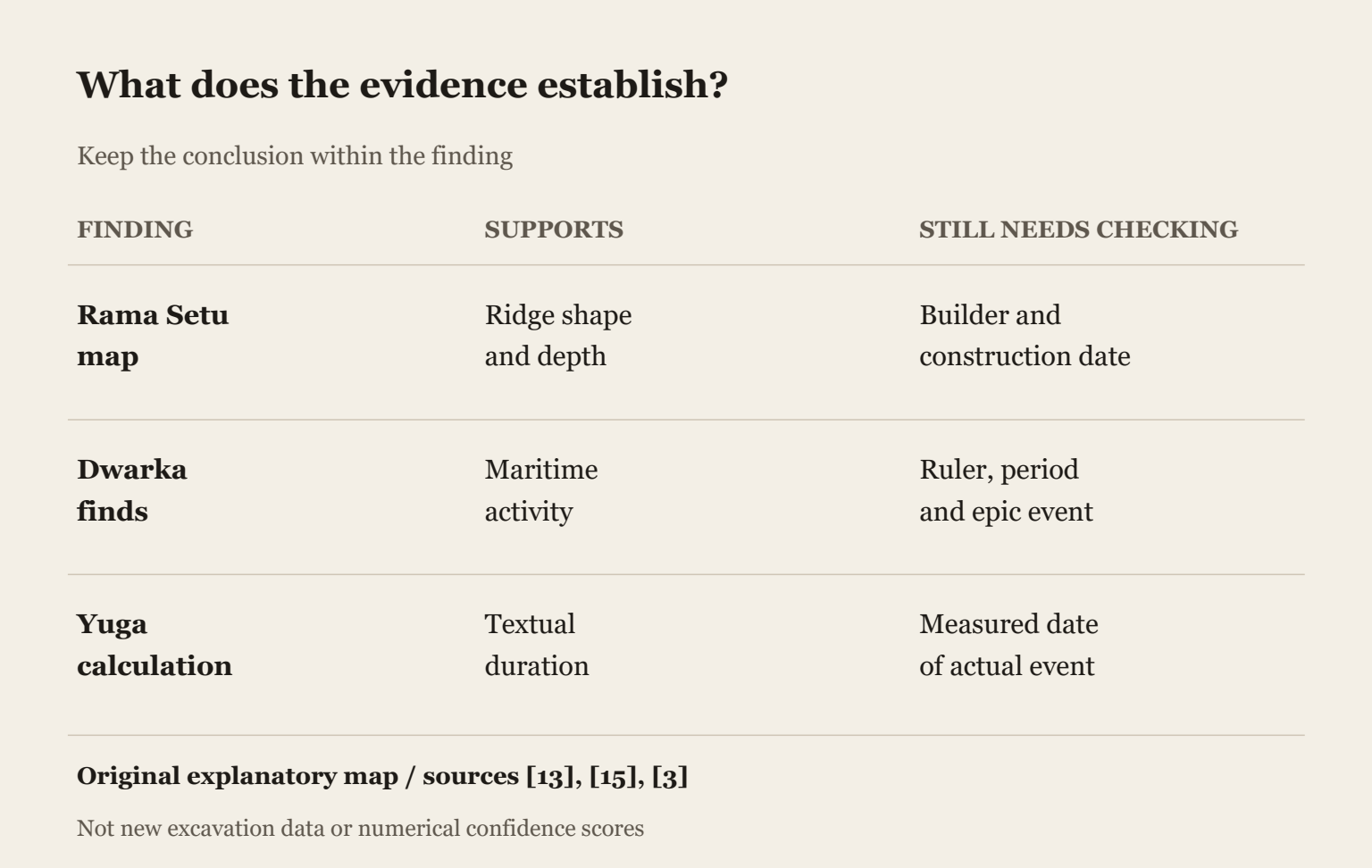
Read across each row. The middle column states a limited finding; the last column identifies an extra question that finding does not answer by itself. The rows describe different kinds of evidence and are not ranked as stronger or weaker measurements.
A better-supported historical identification could change a particular row. It would still need a further argument to establish divine identity. The map organises reasoning; the linked texts and studies supply the evidence.
Open the figure reference table
18An inscription can prove devotion.
Evidence that people worshipped a deity is not automatically evidence of that deity's biography.
The Heliodorus pillar at Besnagar provides a useful example. The Archaeological Survey's report for 1913-14 describes its dedication to Vasudeva by a Greek ambassador named Heliodorus. The report discusses the inscription and investigation of the pillar's setting. [20]
That is material evidence relevant to the history of worship. It is far more specific than a statement that people have always believed something. It identifies a dedication on an object that can be inspected and studied.
But a dedication does not independently verify every event in the deity's later or earlier narrative. A monument honouring a figure is evidence that somebody honoured that figure. To establish a biography, we need sources that actually bear on the proposed person's life and deeds.
This does not prove that Krishna never existed. A historical person behind a religious tradition and the truth of every supernatural account are different questions. The pillar should not be made to answer a question its inscription does not answer.
My reply is: accept the inscription and be precise about its value. The history of devotion is genuine history. It still does not turn a votive dedication into an eyewitness report of an incarnation or a complete epic war.
19Research is not a conclusion.
Let new work improve the evidence instead of treating the announcement as the result.
In February 2025, the Ministry of Culture announced renewed ASI underwater exploration near Gomati Creek at Dwarka. It described the investigation and earlier work, including the discovery of sculptures and stone anchors. That is a primary record of a research programme. [30]
It is reasonable to welcome more careful exploration. Earlier work can miss material, and better documentation can change a proposed date or identify a new structure. An atheist has no good reason to want useful archaeological evidence suppressed.
But announcing that researchers are investigating a traditionally identified place does not announce that every traditional claim has been verified. The next task is to read the resulting records: locations, samples, dates, methods, alternative explanations and conclusions.
The older papers discussed here are identified by year. I am not presenting a 2004 conclusion as an exhaustive report on everything anybody may discover later. A later result should be examined on its own evidence rather than accepted or rejected because it is later.
My short reply is: bring the new report, not only the announcement or an official's confident sentence. I will change a conclusion when the relevant evidence changes. A search for evidence and the evidence it may eventually produce are different stages.
20An eclipse is not a battle.
A sky that can be calculated is not automatically the sky of a recorded historical event.
Someone gives me an exact day for an epic war because a computer matched eclipses or planetary positions to descriptions in the text. Astronomy can calculate past configurations. NASA's eclipse catalogues are a concrete example of that capability. [21]
But a calculated eclipse and its connection to a story are different findings. We must identify the exact passages, justify their readings, establish which textual forms contain them and explain whether the sky description is an observation, a literary omen or a later calculation.
The BORI manuscript work shows why identifying the text matters. A date inferred from a particular reading inherits the uncertainty of that reading. A computer can process the chosen input perfectly while the historical interpretation of the input remains wrong. [18]
I also want the matching rules stated before the search. Which observations count? Which can be ignored? Is the proposed event visible at the required location? What are the calendar assumptions and uncertainties in ancient Earth rotation? NASA discusses limitations as well as predictions. [21]
My reply is: a fit can be interesting, especially if independent evidence supports it. It is not a battle certificate. A persuasive historical date needs a justified text-to-event connection, serious treatment of competing fits and agreement with evidence beyond the selected sky description.
21History and divine identity.
A historical person and a divine identity require different kinds of support.
Suppose unusually strong evidence established that a ruler named in an epic really lived. That would matter. I would accept the historical conclusion if the evidence justified it. Refusing a discovery because it helps a religious reader would be dogmatism.
But establishing a person's existence does not automatically establish that the person was a divine incarnation. An avatar is a divine manifestation in the religious claim under discussion. That adds a claim about the person's nature, not merely the spelling of a name.
The same distinction applies to a battle, a city or a successful crossing. A conflict can happen without every later description of it being accurate. A city can flood without that event identifying the supernatural status of a particular resident.
A defender can propose a cumulative case: several relevant discoveries, early testimony and a coherent chronology considered together. That is more serious than one isolated photograph. We still need to ask whether the pieces are independent and whether they support the added divine conclusion.
My short reply is: show me what each piece establishes and why the combination goes further. A pile of evidence for ancient occupation is still evidence for ancient occupation. Repeating a limited finding does not give it an unlimited meaning.
22Avatars and evolution.
A sequence of religious forms is not the same thing as inherited biological change.
A familiar argument lines up a fish, a tortoise, a land animal and human forms, then says the avatars predicted evolution. I understand why the sequence can look suggestive. The real question is what biological claim the text actually makes.
Evolution concerns populations, inheritance and branching ancestry. It is not a ladder in which every living fish becomes a tortoise and then every tortoise becomes a human. The mechanisms and evidence were explained in Parts 7-10; rearranging pictures cannot replace them.
An incarnation narrative is also not automatically a claim that one breeding population gave rise to another through inherited changes. Even a sequence from aquatic to terrestrial imagery would need further content to specify that process instead of merely resembling it.
The Bhagavatam itself calls the incarnations innumerable at 1.3.26. That does not cancel particular lists. It does warn against treating a selected ten-picture chart as the only possible scriptural sequence and quietly discarding material that does not fit the proposed scientific pattern. [22]
My reply is: identify a specific, prior statement about common descent, inheritance or a risky biological prediction. A modern analogy can be a useful way to teach a story. It becomes misleading when it is advertised as the discovery of evolutionary biology.
23Read Manu's own flood.
Do not copy an objection to Noah into another text without reading it.
The Satapatha Brahmana, I.8.1, tells of a fish warning Manu about a flood and a boat being fastened to its horn. In Eggeling's translation, the passage says the flood sweeps away the creatures and Manu remains. That is the actual account being discussed. [23]
But scope matters. Eggeling's note also records a commentator's geographically restricted explanation of the creatures. A regional reading and a claim that the entire planet was recently emptied of life face different evidence. They must not be treated as identical assertions. [23]
For a recent worldwide biological reset, the problem is the wider record: long human history, continuing environments and independently investigated natural archives. The EPICA Dome C ice-core chronology extends to about 800,000 years using models and age markers, with stated uncertainties. It is not simply an unbroken hand-count of every annual layer. [24]
An old ice record alone does not settle every imagined flood mechanism or disprove a local catastrophe. A serious global claim must specify a date, reach and physical effects that can be compared with the combined evidence. An unspecified flood can always change shape after an objection.
My reply is: tell me which flood you defend. A regional disaster may have historical evidence. That evidence would not by itself establish a speaking fish, the religious explanation or a worldwide event. Similar stories also do not automatically establish one shared catastrophe.
24Symbolic can mean something.
A symbolic reading can preserve an idea while giving up a particular historical claim.
Someone tells me the stories were never intended as physical reports. They express ethical struggle, devotion or the relationship between ordinary life and ultimate reality. That can be a serious interpretation. Literature does not become worthless because it is not an excavation diary.
I therefore ask what the interpretation is, where it comes from and why it fits the passage. An established reading with textual reasons is different from changing a meaning only because a particular claim has become difficult to defend.
Once a passage is defended as symbolic, a literal objection may no longer address it. But a symbolic meaning does not independently prove that a deity exists. It changes the question from whether a narrated event happened to whether an interpretation is justified and its further claims are supported.
The exchange becomes dishonest if a story is literal whenever a photograph looks helpful, symbolic when dates cause trouble, and then literal again in a sales pitch about scientific proof. The reader deserves to know which proposition is actually being offered.
My short reply is: defend the meaning consistently. I can value a story without treating it as a verified event. I can also criticise its ethical or philosophical claims without pretending that every sentence was meant as a piece of physical science.
25Understand Advaita first.
Advaita deserves to be understood before it is criticised.
A philosophically serious Hindu may reject the idea that God is simply a powerful person somewhere above the clouds. In Advaita Vedanta, nonduality means that ultimate reality, Brahman, is not fundamentally divided into separate things. The self, at its deepest level, is held to be Brahman rather than a separate reality. [25]
A forceful question follows: everything we know appears in awareness, so why assume awareness is merely a product of something outside it? That is a philosophical challenge about knowledge and reality. A satellite picture of a bridge does not answer it.
My response is that experiencing a world through awareness does not, by itself, establish that awareness is the ultimate substance of the world, or that all apparent subjects are one universal consciousness. The conclusion needs an argument beyond restating where experience appears.
The alternative must also be described fairly. This tradition does not simply say that a street exists only while I personally look at it. Shankara distinguishes ordinary empirical reality from ultimate reality. Dismissing him as somebody who cannot notice a wall misses the position. [25]
My short reply is: let us examine the premises about awareness, self and existence. I do not claim that dating a rock refutes every metaphysical proposal. I also will not treat a sophisticated proposal as established merely because it reaches beyond the questions that rock-dating can answer.
26Different Hindu philosophies.
Internal disagreement matters when someone claims one tradition has one final answer.
Advaita is not a summary of every Hindu position. Ramanuja's qualified nondualism understands the world and souls as real and dependent on God. Madhva's dualism preserves distinctions that Advaita ultimately denies. These are substantial disagreements about reality, not just different names for an identical conclusion. [26]
A defender may argue carefully for one of these positions. That argument should be heard on its own terms. It should not borrow the apparent simplicity of one school and the personal God of another while ignoring tensions between their explanations.
Nor does disagreement prove that every school is false. Scientists and philosophers disagree too. The relevant question is what reasoning or evidence favours one position and how objections to it are answered. Variety is neither an automatic refutation nor an automatic victory.
If all existence is called God without further commitments, I ask what the new name adds. If the claim adds consciousness, intention, moral authority or a power to answer prayer, those additions need support. A definition cannot smuggle in a list of unproved properties.
My reply is: state your version clearly. I can discuss Brahman, a personal deity or an unknown creator without pretending these are interchangeable. A successful argument for one carefully defined proposition does not automatically establish every story associated with the same tradition.
27An experience and its cause.
A powerful inner event and its final explanation are different questions.
A person says they directly experienced nonduality, a divine presence or a reality beyond ordinary distinctions. I do not automatically call that person a liar. A sincere report of an experience deserves to be heard before its proposed explanation is assessed.
But sincerity alone cannot identify the ultimate cause of an experience. The report may establish that something felt convincing or transformative. The further claim that it revealed one particular metaphysical reality needs reasons that distinguish that account from alternatives.
A defender may answer that first-person knowledge cannot all be replaced by measurements. Fair enough: understanding that someone is in pain is not the same as reading a thermometer. That does not make every interpretation of an inner event equally justified or immune to questions.
I ask what was experienced, what conclusion follows and why that conclusion follows. Did the experience establish the absence of ordinary boundaries, or also the identity of all consciousness, a deity's commands and the historical truth of a particular epic? Those are additional steps.
My short reply is: I accept that an experience can be important without accepting every explanation attached to it. The origin and nature of consciousness deserve serious discussion in Part 24. Unresolved questions do not automatically award the answer to the most confident religious interpreter.
28Check the steps yourself.
You can inspect an argument without owning a satellite or an excavation permit.
Here is a practical exercise for a conversation with a believer. Write one claim in a sentence: this image establishes that Nala built this crossing at this time. Underline built, Nala and the time. Now ask which observation supports each separate part.
Open the 2024 paper and read its abstract, methods and conclusion. Find what was measured, the model's grid spacing and what the authors actually conclude. Compare those statements with the much larger sentence on your piece of paper. [13]
For the timetable, open Vishnu Purana I.3. Write out the four durations with their units, add them and multiply by a thousand. Then identify which quantity is a full cycle, which is a full day and which is an elapsed age. Do not swap labels between the lines. [3]
For Dwarka, open the 2004 field paper at the sections on dating and the conclusion. Identify which underwater structures the authors discuss and how tentative their date is. Then compare that finding with a claim about all settlements, one named king or a divine identity. [15]
This exercise is a check of reasoning and source use, not a personal replication of remote sensing or laboratory dating. The goal is modest and useful: prevent a real observation from being expanded into an unsupported conclusion before anyone notices the extra steps.
29Do I need to know Sanskrit?
Translation opens a discussion. It does not make linguistic objections irrelevant.
Someone says I cannot question a passage unless I know Sanskrit. There is a valid concern inside that reply: meanings can be distorted by bad translation, missing context or an interpretation presented as if it were the only possible reading.
I therefore identify the translation and keep the reference visible. If a crucial word is disputed, we should compare the Sanskrit, relevant uses, established interpretations and competent scholarship. An argument that depends on a doubtful rendering must remain conditional until that issue is resolved.
But if a translation can be used to tell me that a religion has predicted science, it can also be questioned. It cannot be clear enough to establish a triumph and then become completely inaccessible the moment somebody asks whether the triumph follows.
The linked Ramayana text gives Sanskrit, word meanings and an English rendering. That is a starting point for checking the passage, not a claim that a website or I have settled every philological question. A genuine correction must point to the relevant wording and explain the difference. [10]
My short reply is: show the translation error and how it changes the argument. I will correct it. Repeating that Sanskrit is difficult does not establish the truth of a historical claim, and being confident in English does not excuse ignoring a serious linguistic objection.
30Bias is possible. Show the error.
Neither national loyalty nor a famous institution replaces a checkable argument.
Another reply is that scholars are biased, especially when older colonial scholarship is involved. Bias is possible. Translation choices, assumptions and institutional interests deserve examination. I should not treat an old European name as a certificate of perfect understanding.
The remedy is a specific check: which reading is wrong, which date is unsupported, which sample is misplaced, which alternative was ignored? A correction can come from any competent investigator. Its value depends on the evidence it brings, not the nationality of its author.
This chapter also uses Indian institutions and researchers, including the BORI manuscript project and marine investigations by NIO researchers. Their work still requires examination. Replacing automatic distrust of foreign scholarship with automatic trust of an Indian institution would preserve the same bad method. [18] [15]
Science is not protected from criticism by its name. But an accusation of bias does not itself establish a different chronology. A revised interpretation must explain the evidence at least as well, and a claim of fabrication needs support beyond disliking the result.
My short reply is: put the alleged mistake on the table. I will inspect it. I do not owe unquestioning belief to a scientist, a priest or an atheist. I owe the claim a fair test, and I owe myself the willingness to accept an inconvenient answer.
31What would change my mind?
A conclusion tied to evidence must move when the relevant evidence changes.
I could be persuaded about a particular historical event by securely documented finds, a justified chronology and independent sources that genuinely connect to that event. The exact standard depends on the claim: a harbour needs different support from a divine incarnation.
For Rama Setu, evidence identifying a construction episode would change the construction discussion. It would not automatically settle the builder's divine nature. For Dwarka, a securely dated inscription or related evidence could alter a proposed identification. Each conclusion should move as far as the new evidence warrants.
For a philosophical argument, I would need its premises explained and its reasoning defended against serious objections. If a conclusion follows only after accepting scripture as uniquely authoritative, the authority of that scripture remains part of the dispute, not a fact already established between us.
This is why I reject the demand to disprove every possible god before questioning a particular story. I can leave ultimate reality open while finding a literal chronology inconsistent with evidence or a divine claim insufficiently supported. These judgments do not require omniscience.
My answer is direct: show me a reason strong enough to carry the conclusion. I will not protect atheism by denying good evidence. I will not protect religion by pretending a photograph, a large number or an intense feeling proves more than it does.
NoteA note from the author.
A tradition can matter deeply while its factual claims remain open to examination.
I do not want to replace one unquestionable book with another. Specific religious accounts have not earned my belief as descriptions of divine reality. An unknown ultimate explanation remains a different, open question.
I have examined selected claims, not every Hindu text or school. Physical dates, symbolism and philosophy require different arguments. Recognising those differences makes criticism more accurate. It does not make an unsupported claim true.
The notes identify translations and access limits, including indexed NIO passages. The 2004 publisher scan was read visually. I have not visited the sites, redated samples myself or settled disputed Sanskrit readings.
Cultural and intellectual achievements deserve recognition for what they are. They do not need fabricated scientific approval. Treating every great story as a laboratory discovery weakens our appreciation of both.
I ask what was found, how it was checked and what follows. Neither reverence nor ridicule does that work. A claim worth believing should survive questions that would expose it if it were wrong.
SourcesFollow the evidence.
These sources support identified claims, not a blanket verdict on every Hindu tradition. Open the exact passage, study methods or field-report conclusion. Translations, commentary, physical findings and philosophical arguments do different jobs. Some indexed NIO passages and research abstracts were checked without complete downloads; the notes identify those limits. The 2004 Dwarka publisher scan was read visually. Source access does not imply personal replication, a site visit or complete reading of every cited book. Dates and conclusions should remain attached to the objects and interpretations that justify them.
[1] Rigveda 10.129: Creation
R. T. H. Griffith, English translation of the Rigveda, Book 10, hymn 129; Internet Sacred Text Archive.
Read all seven verses, especially 6-7. The reference supports the account of questioning in this particular hymn. It is not a claim that every Vedic passage advances the same position or that this English rendering settles Sanskrit interpretation.
[2] Rigveda 10.90: Purusha
R. T. H. Griffith, Book 10, hymn 90; Internet Sacred Text Archive.
Read the surrounding hymn and verses 12-14. The cosmic body and social imagery are paraphrased, not treated as a universal modern Hindu scientific doctrine. Literal and symbolic readings require different arguments.
[3] Vishnu Purana, Book I, Chapter 3
H. H. Wilson, English translation; Internet Sacred Text Archive. Main passage and the translator's time table were distinguished.
The chapter supplies the divine-year conversion, the four ages and the thousand-cycle day of Brahma. Check units and twilight intervals. The arithmetic follows this scheme; it is not an independent measurement or a universal chronology accepted by every Hindu.
[4] The Laws of Manu, Chapter I, especially 64-73
Georg Buhler, translation in Sacred Books of the East 25 (1886); Internet Sacred Text Archive.
A related traditional treatment of divine days and yugas. It is cited alongside, not silently merged into, the Vishnu Purana. The existence of a textual conversion does not itself validate a physical calendar.
[5] Bhagavad-gita 8.17
Sanskrit, word meanings, A. C. Bhaktivedanta Swami Prabhupada translation and devotional commentary, Bhaktivedanta Vedabase.
The verse gives a thousand-yuga day and an equally long night; the commentary adds explanation. These layers are distinguished. The IIT Kanpur legacy result was also inspected, but its current redirect required an interactive viewer; this reference supplies readable verse text.
[6] Geologic Time: Age of the Earth
U.S. Geological Survey, public explanation of lead-isotope and meteorite evidence.
Used for the roughly 4.54-billion-year Earth estimate and the kind of evidence behind it. This older page also contains older galaxy/universe estimates; those are not used as current cosmological measurements. A divine day and a planet's elapsed age are different quantities.
[7] The Universe: Cosmic History
NASA Science, current public overview.
Used for the roughly 13.8-billion-year cosmic chronology and to distinguish it from Earth's age. The observation-based hot early universe and unresolved ultimate-origin questions must not be collapsed into one claim. Part 13 contains the fuller evidence discussion.
[8] Homo sapiens
Smithsonian Institution, Human Origins Program; species account and related fossil evidence.
Places our species at roughly 300,000 years ago and distinguishes it from other early humans. This is not an exact birth date, an assertion that no older human relative existed, or a direct test of every possible symbolic epic interpretation.
[9] The age of the hominin fossils from Jebel Irhoud, Morocco, and the origins of the Middle Stone Age
Daniel Richter et al. (2017), Nature 546, 293-296. DOI: 10.1038/nature22335. PubMed research abstract.
The accessible indexed abstract reports heated-flint ages of 315 ± 34 thousand years and a supporting tooth estimate of 286 ± 32 thousand years. The complete paper was not read here. Neither estimate is presented as a personally repeated laboratory result.
[10] Valmiki Ramayana, Yuddha Kanda, Sarga 22
Sanskrit text, word meanings and English rendering from the Valmiki Ramayan project, preserved at Sanskrit Documents.
Relevant passages on Nala and the work include 44-47 and 52 onward. The chapter, its translation and later popular details are kept distinct. The mirror has inconsistent displayed book numerals; the page identifies the work as Book VI, Yuddha Kanda, Sarga 22.
[11] Adam's Bridge, India-Sri Lanka
NASA Science Photojournal, PIA24949; ASTER/Terra image and caption, 2021.
The caption identifies limestone shoals and a former land connection. It is evidence of a geographic feature, not a finding about Nala, a construction date or divine authorship. Differing study boundaries can produce different quoted lengths; no length-based identity proof is made here.
[12] A High-Resolution Digital Bathymetric Elevation Model Derived from ICESat-2 for Adam's Bridge
Scientific Data (2024). DOI: 10.1038/s41597-024-03550-3. Original data descriptor.
Background, photon processing, refraction corrections, validation and data description were checked. A spatial grid and a reconstructed seabed surface are not construction dates. This work and source 13 share material and must not be counted as wholly independent historical confirmation.
[13] Physical features of Adam's Bridge interpreted from ICESat-2 based high-resolution digital bathymetric elevation model
Scientific Reports (2024). DOI: 10.1038/s41598-024-65908-2. Open full research text, PMC11213924.
Abstract, results, methods and conclusions were checked. The study examines the present ridge and its physical form; it does not identify an epic builder or date a construction episode. The original teaching figure makes that evidential boundary explicit.
[14] NIO Annual Report 1987-88: Marine Archaeology
National Institute of Oceanography, section 4.11, printed page 64; account of S. R. Rao's expedition.
The publicly indexed report passage identifies the discoveries in terms of Krishna's submerged city. The direct file served a bot-check page, so the complete report was not read. Used only to identify that earlier interpretation, not to certify its date or theological conclusion.
[15] An ancient harbour at Dwarka: Study based on the recent underwater explorations
A. S. Gaur, Sundaresh and Sila Tripati (2004), Current Science 86(9), 1256-1260. Original publisher scan.
All five pages were read visually. Methods, jetty interpretation, Gujarati-script block, reuse, dating discussion and conclusion were checked. The proposed late date concerns particular structures; it is not a claim that every occupation around Dwarka or Bet Dwarka began in the same period.
[16] Recent Underwater Explorations at Dwarka and Surroundings of Okha Mandal
A. S. Gaur et al. (2000), Man and Environment 25(1), 67-74; NIO repository record of the 1998 explorations.
Indexed abstract, discussion and conclusion passages were read. They distinguish occupation around Bet Dwarka from problems dating particular offshore structures. Direct downloading met the repository's bot protection; a complete downloaded reading is not claimed. This overlaps the research programme of source 15.
[17] The Mahabharata, Book 16: Mausala Parva, Section VII
Kisari Mohan Ganguli, English translation; Internet Sacred Text Archive.
Read the departure from Dvaraka and subsequent inundation in this translation. Ganguli's section numbering is not interchangeable with every Sanskrit edition's chapter numbering. The passage establishes what this narrative says; independent event confirmation is a further task.
[18] The Mahabharata: Critical Edition project
Bhandarkar Oriental Research Institute, its own project description.
Describes manuscript comparison and the critical apparatus, including 1,259 consulted manuscripts. The number does not mean 1,259 independent eyewitnesses to a battle. An edited text is a scholarly reconstruction of readings, not archaeological confirmation of all its events.
[19] Moving Targets? Texts, language, archaeology and history in the Late Vedic and early Buddhist periods
Michael Witzel (2009), Indo-Iranian Journal 52(2-3), 287-310. DOI: 10.1163/001972409X12562030836859. Harvard DASH record.
The repository abstract was read for its combination of language, place names and historical context in relative dating. The full-paper download was rate-limited. No precise Ramayana or Mahabharata composition date is inferred from this abstract, and no complete reading is claimed.
[20] Annual Report of the Archaeological Survey of India, 1913-14, Part I: Besnagar
John Marshall, ASI report, published 1915; printed pages 18-19, scan hosted by IGNCA.
The scanned account of the Heliodorus pillar, dedication to Vasudeva and excavation setting was read visually. Used for that inscriptional example, not for every historical assertion or early chronological estimate elsewhere in this old report. No exact modern pillar date is needed for the argument.
Open the district description of the monument
[21] Five Millennium Catalog of Solar Eclipses: -1999 to +3000
Fred Espenak and Jean Meeus, NASA eclipse resources; prediction and uncertainty explanations.
Supports the ability to calculate past eclipses and the relevance of Earth-rotation uncertainty. It does not authenticate an epic date. The catalogue's stated range must not be extended silently to a proposed event outside it; astronomical and historical year numbering also differ.
[22] Srimad-Bhagavatam 1.3.26
Sanskrit, word meanings, A. C. Bhaktivedanta Swami Prabhupada translation and commentary, Bhaktivedanta Vedabase.
The verse describes innumerable incarnations. Used to question treating one selected chart as the entire textual account. The verse and its devotional commentary are distinguished; no claim is made that this passage teaches population genetics or establishes common descent.
[23] Satapatha Brahmana I.8.1: Manu and the fish
Julius Eggeling, Sacred Books of the East 12 (1882), especially paragraphs 1-7 and note 216:2.
Read the flood episode and the translator's note reporting a commentator's restricted geographic reading. This is why the chapter tests a specified global interpretation conditionally rather than imposing it on every Hindu. The main text, translation and explanatory note are separate layers.
[24] The EDC3 chronology for the EPICA Dome C ice core
F. Parrenin et al. (2007), Climate of the Past 3, 485-497. DOI: 10.5194/cp-3-485-2007. Full research PDF.
Methods combine an ice-flow/accumulation model with age markers; the abstract reports absolute-age uncertainties up to about 6,000 years back to 800,000 years. This is not 800,000 individually counted annual layers or a standalone refutation of every regional flood. Relevant methods and limits were checked.
[25] Shankara
Neil Dalal, Stanford Encyclopedia of Philosophy, especially sections on nonduality, reality, consciousness and methods.
A scholarly explanation of the philosophical position, including empirical and ultimate orders. Used to state a serious case before criticism, not as proof of that metaphysics. The arguments about what follows from awareness are presented as philosophical arguments, not new scientific results.
[26] Concepts of God, section 3: Theistic Vedanta and God's Relation to the World
William Wainwright, Stanford Encyclopedia of Philosophy, Spring 2019 archived edition.
Used for the contrast between Advaita, Ramanuja's qualified nondualism and Madhva's distinctions. The chapter does not claim these exhaust Hindu philosophy or that disagreement alone refutes every school. This identified archived edition is used because the former live entry URL no longer resolved.
[27] Tradition of Vedic chanting
UNESCO Intangible Cultural Heritage, element 00062; safeguarding account of a living oral tradition.
Used specifically for disciplined recitation techniques. Cultural recognition and transmission are not proofs of divine origin or every narrated event. This chapter does not adopt every incidental linguistic or historical sentence on the heritage page as an independently checked claim.
[28] Dholavira: a Harappan City
UNESCO World Heritage Centre, property 1645; archaeological description and statement of significance.
Documents a material city and its water systems, craft activity and cemetery, with occupation around 3000-1500 BCE. Used as an example of connected archaeological evidence, not as the first human settlement or as proof about the identity of a different epic city.
[29] Trapped bubbles keep pumice afloat and gas diffusion makes pumice sink
Kristen E. Fauria, Michael Manga and Zihan Wei (2017), Earth and Planetary Science Letters 460, 50-59. DOI: 10.1016/j.epsl.2016.11.055.
The authors' public paper copy was retrieved; relevant imaging, flotation methods and interpretations were read. It establishes a natural flotation mechanism for studied pumice, not the material identity or history of every object displayed as a sacred floating stone.
[30] Underwater Archaeology Wing Begins Explorations In Dwarka
Ministry of Culture, Press Information Bureau, release 2104411, 18 February 2025.
The official announcement describes renewed investigation and earlier finds. It is cited for what that notice announces, not as the final result of all subsequent work or as proof of Krishna's divine identity. New dated findings should be assessed through their actual reports.