

01We already knew that.
An old sentence and a modern discovery do not become the same thing on a poster.
Someone shows me an ancient sentence beside a photograph of a galaxy, an embryo or an aeroplane. The caption says the book knew this thousands of years before scientists did. The picture looks impressive. I want to know who supplied the connection.
Did the old words actually identify this result? Or did somebody learn the result first, choose a convenient passage and explain the words through what they already knew? Those are different histories. Putting them side by side hides the difference.
This chapter examines particular examples. The Qur'an, the Bible, Sanskrit philosophical texts, medical works and mathematical works are not one kind of book. Their purposes differ. I will not treat a useful surgical description as if it were the same claim as a divine flying vehicle.
I also will not deny an achievement because it came from people with religious beliefs. A correct calculation remains correct. The question is what the passage establishes and whether the next step, from knowledge to revelation, has been justified.
My short reply is: take away the modern picture for a moment. Show me the old wording, its context and the reason it meant this particular discovery. A caption written after the discovery cannot do that work by itself.
02Compatible is not predicted.
A statement can fit a result without having singled it out beforehand.
Imagine I write that tomorrow something will change in the sky. A cloud moves. You announce that I predicted it. My sentence fits, but it also fits rain, a clear evening and a passing bird. This invented example illustrates a problem with vague claims.
A stronger statement rules out alternatives. It tells us enough about the event that a different outcome would count against it. The point is not that every good prediction needs a complicated equation. It needs a meaning that can fail.
We must also distinguish prediction from an earlier description of something already observed. An ancient surgeon can record a useful procedure without predicting modern surgery. An astronomer can calculate a later event using observations. Both deserve credit, but for different achievements.
Likewise, an old clear statement might genuinely anticipate knowledge even if nobody used it to guide a later experiment. I do not make modern terminology or historical influence compulsory. I ask whether the old meaning really identifies the claimed fact.
My reply is: tell me whether you are claiming compatibility, anticipation, an observation, a working method or a successful prediction. Do not collect applause for one and quietly present it as all five.
03Freeze the meaning first.
A useful test keeps the claim steady when the answer becomes inconvenient.
Before checking a supposed prediction, I want the wording, the proposed meaning, the date and the possible failure written down. This is a practical rule for our discussion. It prevents the interpretation from changing unnoticed after the evidence arrives.
Suppose our imaginary passage says a hidden object will be found beyond a known planet. We agree which planet, what kind of object and what would make the claim wrong. That is more informative than deciding afterwards that any newly discovered thing was intended.
For an ancient text, we cannot return to its author's desk. We can inspect manuscripts, dated quotations, editions and earlier interpretations. The age of a surviving copy is not automatically the date of composition, but it can provide evidence that wording existed by then.
An earlier interpretation is useful because it shows what readers understood without today's discovery in front of them. It is not infallible. An old reader can miss a meaning. But a newly proposed meaning still needs textual reasons instead of automatic priority over inconvenient older readings.
My short reply is: write the interpretation before opening the scientific result. If it changes, record why. A correction may be honest; pretending there was never a correction is how a flexible reading becomes a fake perfect prediction.
04Read what the page says.
A translator can clarify a passage and also add choices that need examination.
I want the passage, the translation and the surrounding sentences. A word printed in brackets may be a translator's supplied explanation. A modern title may be an editor's addition. Neither should quietly become a word in the ancient original.
Qur'an 51:47 provides a useful example. The Clear Quran rendering on the linked page uses the language of an expanding universe. The same page's abridged Ibn Kathir commentary explains the expression through making the heaven vast. Verse, translation and commentary are distinguishable layers. [2]
This comparison does not settle Arabic by counting English versions. A defender can offer a linguistic argument for ongoing expansion. I should hear it. But the argument must establish the reading rather than merely point to a translation that already adopts it.
The same rule applies to Sanskrit and Hebrew. I cannot pick the weakest wording, ignore a competent correction and declare victory. A defender cannot choose scientific wording for a triumph and then say the passage is inaccessible whenever that wording is questioned.
My reply is: identify the disputed word and explain how its use and context support the proposed meaning. A serious language objection can change the argument. Repeating that a language is difficult cannot replace the argument.
05Show me the whole search.
A collection of selected matches does not supply its own probability.
Someone presents ten passages that seem to match ten discoveries. I ask how the ten were chosen. How many passages were searched? How many possible translations and scientific topics were allowed? Were awkward examples kept or quietly dropped?
Imagine inventing a hundred loose guesses and displaying only the five that later sound right. Five selected successes would not describe the record fairly. These numbers are a teaching example, not a measured survey of any holy book.
The same problem affects a claim that the chance of the matches is one in a billion. A probability calculation needs a defined process and justified assumptions. We cannot assign convenient tiny probabilities to flexible interpretations and multiply our way to certainty.
Nor are all matches independent. One interpretation can generate several versions of the same apparent success. Counting those versions as unrelated discoveries exaggerates the evidence. A proposed cumulative case must explain its search rules and dependencies.
My short answer is: show the attempts as well as the favourites. Several clear, independently supported anticipations could matter. A scrapbook that hides how it was assembled does not establish how surprising its contents are.
06What if there are many matches?
The serious argument deserves an answer stronger than a joke about one bad poster.
A careful believer may say that no isolated sentence proves revelation, but many accurate details together exceed what an author could have known. The argument can also appeal to an author's limited education or setting. That is stronger than pointing to one photograph.
I would test the details individually before combining them. Are they accurate? Are the meanings reasonably fixed? Was the information unavailable? Do the examples share one translation trick? Combining uncertain readings does not automatically remove their uncertainty.
Limited formal education would not by itself establish isolation from all information. A person can hear accounts, observe things and reason. That is a logical possibility, not a documented claim that a particular author copied a particular source.
Equally, I cannot explain a difficult case away simply by announcing that somebody must have guessed. If an old passage clearly states a surprising, correct and otherwise unexplained fact, it deserves serious investigation. Its date and possible information routes matter.
My reply is: give me your strongest clearly defined example first. Let us finish checking it before adding twenty more. A cumulative case should become stronger through verified components, not through exhausting the other person with unfinished claims.
ComparisonWhat came before the result?
The order of the claim, its interpretation and the test changes what has been achieved.
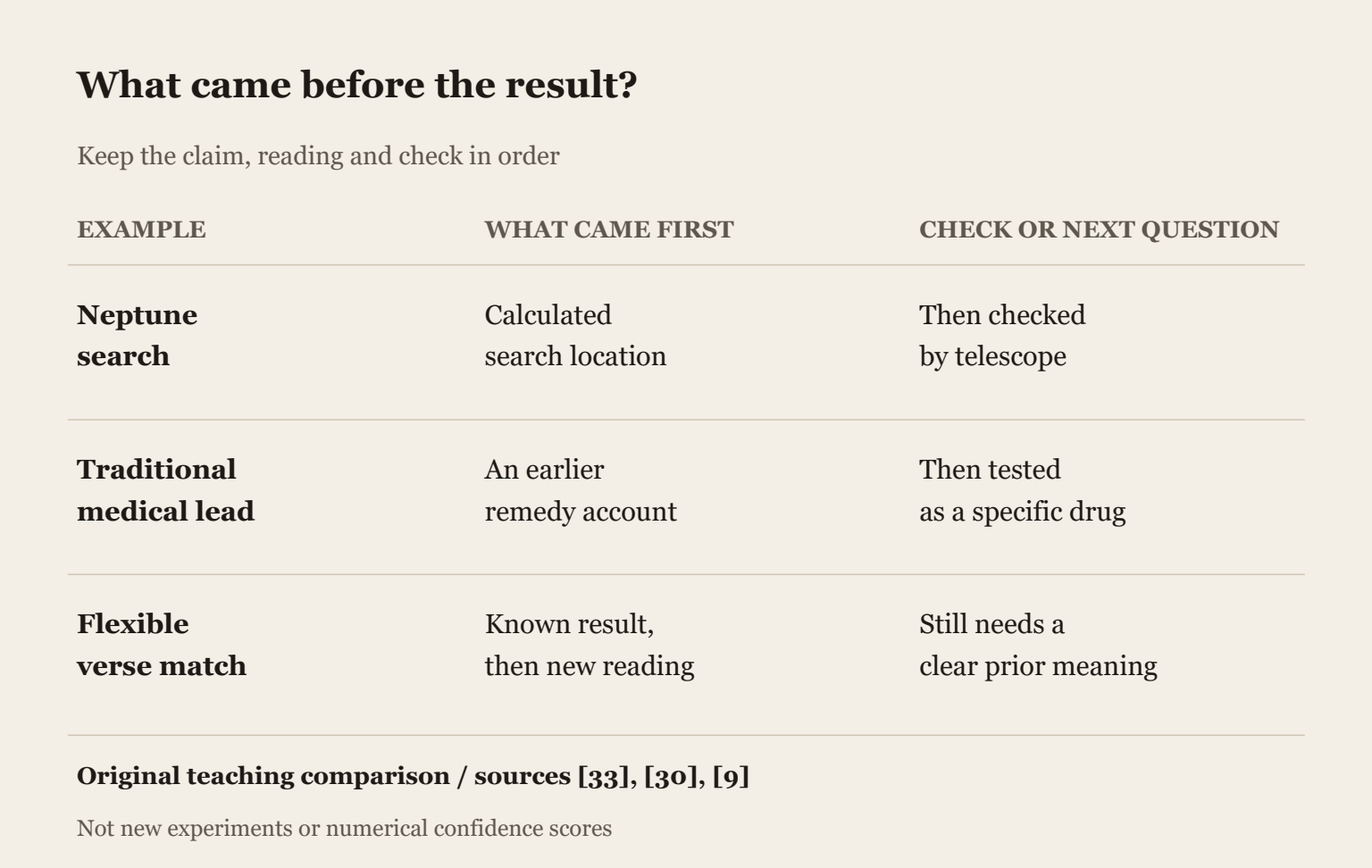
Read across each row. A calculated search, an inherited medical lead and a later interpretation are different achievements. The last row illustrates the retrospective-matching pattern; it is not a measured historical verdict on every verse or reader.
An old passage can still deserve credit for a clear insight even when it did not guide a later discovery. The question is whether its defensible prior meaning specified the result. The diagram helps frame that question; the sources supply the actual evidence.
Open the figure reference table
07A separation is not a cosmology.
Qur'an 21:30 needs a textual argument before it becomes a Big Bang prediction.
The linked translation of Qur'an 21:30 describes the heavens and earth as joined and then separated. A believer connects this with the early universe. I understand the proposed resemblance. The question is whether the verse specifically identifies the scientific account. [1]
The hot Big Bang account is not simply that two familiar objects, a finished Earth and a finished sky, were pulled apart. NASA's chronology places Earth's formation much later than the hot early universe. Expansion and cooling are investigated through observations, including the ancient background radiation. [3]
The abridged Ibn Kathir commentary on the page includes explanations involving the separation of heaven and earth and, in another reported reading, rain from heaven and vegetation from earth. This shows that the modern identification is not the only available reading. [1]
A defender may say that heavens and earth together mean all creation, and that the language is broad enough for cosmic development. That may address an overly literal objection about a pre-existing planet. It still leaves the task of showing that the wording singles out the modern account.
My answer is: resemblance can motivate a comparison. It does not supply the temperature history, expansion evidence or an independently dated prediction of those results. Explain why this interpretation is demanded by the passage rather than supplied by what we discovered later.
08Which meaning came first?
Vastness and ongoing expansion are related ideas, but they are not identical claims.
Qur'an 51:47 is presented as a direct prediction that the universe expands. The Clear Quran translation on the source page adopts that reading. The linked abridged commentary explains the relevant expression in terms of making the heaven vast. The distinction matters. [2]
Something can be very large without continuing to grow. The statement that a hall is spacious does not tell me that its walls are moving apart. This is an invented analogy about meaning, not a proposed translation of Arabic.
A serious defence must therefore argue from the word's range and the sentence's context for an ongoing process. It should also explain what earlier readers could reasonably have understood. I do not claim that the modern reading is linguistically impossible simply because another reading exists.
The physical case is a separate investigation. Astronomers compare distances and shifted spectral features, and test the expanding-universe account alongside other observations. Those measurements, introduced in Part 13, do not come from deciding how to translate a verse. [3]
My short reply is: even a defensible expansion reading needs its historical and predictive force assessed. The fact that a modern translation now says expanding cannot, by itself, establish that a precise scientific prediction was made and preserved before the result was known.
09A real connection, a larger claim.
Life's dependence on water does not identify one unique explanation of its origin.
The same Qur'anic passage, 21:30, connects every living thing with water. A believer points to the importance of water in biology and asks how an ancient text could have known. The connection deserves an answer rather than automatic dismissal. [1]
But we need to specify the claimed achievement. Is the sentence a broad statement that living things depend on water? Is it a claim about the chemical conditions of life's origin? Or is it supposed to describe one experimentally established pathway to the first cell?
These propositions contain different amounts of information. A statement about water does not itself identify a genetic molecule, a membrane, a sequence of reactions or the conditions under which those steps would work. The more specific conclusion needs more specific content.
There is also a difference between recognising a visible dependence and knowing a hidden mechanism. Observing living things around water does not reveal all cellular chemistry. Equally, the absence of a microscope would not make every observation about water and life impossible.
My reply is: I can recognise a meaningful general statement without pretending it contains a completed origin-of-life theory. Part 12 distinguishes actual chemical results from unsolved steps. Neither the importance of water nor a gap in our explanation independently establishes revelation.
10Read the stages carefully.
The translation and the meaning of each stage matter before comparing pictures.
Qur'an 23:12-14 describes human formation through successive terms, including a drop, an alaqa, a lump, bones and flesh. The linked page supplies the passage's translation and abridged Ibn Kathir commentary. I keep the verse separate from the explanation added around it. [4]
The term alaqa is disputed in these discussions: a clinging thing, a clot and a leech-like comparison can lead to different arguments. I should not treat my preferred English word as the only possible Arabic meaning or silently swap meanings halfway through.
A visual resemblance to a leech is not automatically a precise biological prediction. We need to know which specimen, developmental stage, scale and viewing angle are being compared. A chosen drawing can hide differences as easily as it can illustrate similarities.
A believer may answer that familiar descriptions were intended for ordinary people, not a laboratory manual. That is a serious reply to a demand for modern technical vocabulary. But accessible wording still needs to convey a sufficiently definite result before it can establish extraordinary advance knowledge.
My short answer is: settle the particular reading before judging it. Then compare it with actual development rather than two selected illustrations. A clear account of what the passage means is the beginning of this test, not a detail we can postpone until after announcing a miracle.
11Open the embryo research.
Modern knowledge comes from specimens and methods that readers can inspect.
In a 2016 study, de Bakker and colleagues built a three-dimensional human-development atlas from about 15,000 thin tissue sections. They labelled structures and connected the reconstructions to the original images. The point is that an anatomical diagram can be checked against specimens. [5]
A separate 2021 study by Wilde and colleagues examined early human forelimb muscles. Researchers labelled a muscle protein and used three-dimensional imaging to follow developing muscle bundles through identified developmental stages. These are observations of tissues, not opinions about a verse. [6]
The 1957 study of cartilage formation by O'Rahilly, Gray and Gardner examined staged embryos and recorded the sequence in hands and feet. Cartilage is a supporting tissue; the formation of cartilage and its later replacement by bone are not one event. [7]
These studies have limits. Their samples are not a continuous film of one embryo becoming an adult. Stages are assigned using anatomical features; reconstruction and interpretation require care. The atlas also documents ways familiar textbook pictures can become too schematic.
My reply is: inspect the original images, stage definitions and methods. A model earns trust through its link to the material and its checks. I do not need to know every laboratory step personally to understand why that is a stronger method than matching two convenient silhouettes.
12Bones, flesh and timing.
A strict two-step reading and a loose description face different objections.
One reading of 23:14 says an embryo becomes a completed set of bones and only afterwards receives flesh. If that means a bare finished skeleton waiting to be covered, it is not an accurate description of the observed developmental process. [4] [6] [7]
Muscles and skeletal tissues develop through interacting, overlapping processes. Different regions progress at different times. The hand-and-foot cartilage study records a sequence across structures, while the muscle study traces forming and dividing bundles. Neither presents a whole completed skeleton awaiting all soft tissue. [6] [7]
A defender may say that bones here includes early skeletal material, and that the sequence is a broad description rather than a strict timetable. This deserves examination. I should not announce that every possible reading requires hard, fully formed adult bone.
But making the reading broader also changes the miracle claim. A passage compatible with a general skeleton-and-covering description is not thereby a precise account of cartilage formation, muscle differentiation and ossification. Ossification means the formation of bone tissue.
My short reply is: tell me exactly which sequence is asserted. Test that sequence. Do not defend it as a loose description when challenged and then advertise it as a detailed modern embryology lesson when the audience stops asking questions.
13Ancient people could investigate.
A critic need not prove copying to question a claim of impossible human knowledge.
The argument then changes: nobody in the ancient world could have known anything about development. That claim is too broad. Aristotle's History of Animals, Book VI, discusses changes inside developing bird eggs, including a visible beating point and later bodily differentiation. [8]
That does not make Aristotle a modern human embryologist. His account contains errors and belongs to a different investigation. I use it for a limited point: observing development and describing stages were not activities invented with the modern microscope.
It also does not prove that a Qur'anic author copied Aristotle, Galen or anybody else. Similarities alone do not establish a route of transmission, the exact material transmitted or dependence rather than independent observation. A claim of borrowing needs its own historical evidence.
But the believer's stronger claim has an evidential burden too. To argue that a detail was humanly unavailable, we must investigate what people could observe, hear or infer. We cannot turn a gap in our historical knowledge into a demonstrated absence of every information route.
My answer is: check both the biological accuracy and the historical claim about availability. I do not have to invent a copying story. You do not get to declare information inaccessible merely because you have not investigated how people could have obtained it.
14A boundary can be real.
First identify the waters and the passage, then decide what the boundary means.
Qur'an 55:19-20 speaks of two waters meeting and a barrier. Qur'an 25:53 explicitly contrasts fresh and salty water. These passages are often connected with photographs of differently coloured waters meeting. The text and the photographed location must each be identified. [9] [10]
The abridged Ibn Kathir discussion on the linked 55:19 page explains the barrier through land separating types of water. That is not the same account as a modern caption claiming an invisible wall between two touching oceans. Both are interpretations needing their own examination. [9]
A believer can instead argue that the passages describe waters retaining different characteristics near a meeting place. That has a more defensible physical comparison than saying no water can ever cross an absolute boundary. It should be assessed in that more careful form.
But a photograph alone does not tell us the salt content, depth, current, mixing rate or permanence of the boundary. Different colours can have several causes. Without locating and investigating the image, I should not announce either a miracle or a complete explanation.
My reply is: which waters are these, what barrier is claimed and what measurement would distinguish your interpretation? A general mention of separation is not automatically a prior technical explanation of the particular oceanographic feature in the picture.
15Different does not mean sealed.
Water can keep a gradient while material still moves across it.
NOAA's estuary account describes both mixing and stratification. Stratification means layers with different properties. Less salty river water can lie above denser seawater, while tides, winds and river flow affect how much the waters mix. Not every estuary behaves the same way. [11]
NOAA also explains how investigators measure salinity, the amount of dissolved salt, at different positions and depths. Mapping those measurements reveals how properties change through an estuary. A boundary can therefore be investigated rather than judged solely by its colour. [12]
For a simple illustration, carefully layer coloured fresh water above salty water in a clear container, then stir. The demonstration can illustrate density and mixing. It does not replicate an ocean, establish the identity of a viral photograph or settle the Arabic interpretation.
The serious reply is that separation can persist even with some exchange. Correct. A persistent difference and zero mixing are different claims. Measuring exchange can contradict an absolute impermeable-wall claim without contradicting the existence of water masses or gradients.
My short answer is: the water does not have to be uniform to mix. Ask for salinity profiles and current information. Evidence of a real gradient supports a real gradient; it does not independently establish that one passage uniquely predicted the measured process.
16Roots are not tent stakes.
A useful geological comparison does not automatically validate every proposed function.
Qur'an 78:6-7 compares the earth with a resting place and mountains with pegs. A defender connects the peg image to mountain roots below the surface. It is a comparison worth examining rather than denying that deep mountain structure exists. [13]
Geophysicists investigate underground density and structure. A USGS explanation of gravity methods describes correcting for the gravitational effects of lower-density mountain roots. The measurements require models and corrections; the root is not established by deciding that a mountain looks like a nail. [15]
The basic idea is that support at depth can involve thicker or less dense material beneath elevated terrain. This is not a claim that every mountain is an identical rigid spike. The observed geology is more varied than a universal tent-peg diagram.
A metaphor can resemble that structure without specifying its measurable details or mechanism. I would ask what the wording predicts about depth, material and behaviour, and whether the supposed prior description excludes competing interpretations rather than being adjusted to whatever diagram is available.
My reply is: acknowledge the real geology, then test the extra inference. A resemblance between a peg and a subsurface root does not establish that mountains were installed as stakes, or that every further claim about their stabilising role is scientifically confirmed.
17Mountains and shaking.
An image of stability is not a measured guarantee against earthquakes.
Qur'an 16:15 describes mountains in connection with preventing the earth from swaying with people. Some defenders identify this with geological stability. We must ask which motion is meant and what observable claim is being defended. [14]
USGS describes mountain building and strong earthquakes within plate interactions. In the Andes, for example, convergence and subduction are associated with uplift and destructive earthquakes. A subducting plate is one moving beneath another. Mountain belts are not simply regions where shaking has been eliminated. [16]
This does not mean that mountains cause every earthquake, or that removing a mountain would give a straightforward experiment in stability. Earthquakes involve faults, stress and movement. The relation between terrain and deeper processes is more complicated than either slogan.
A believer may mean long-term support or habitability rather than a promise that no earthquake will occur. That changes the test. Ask what support means, how it works and what evidence connects it to the passage. Do not refute one claim and pretend every possible interpretation has been answered.
My short reply is: root structure, long-term support and freedom from shaking are different propositions. The first does not automatically prove the other two. State the mechanism you claim instead of using one impressive geological term as a pass for the whole argument.
18How do we know about iron?
The scientific evidence is more interesting than a label saying scientists confirmed it.
A familiar argument points to Qur'an 57:25 and the sending down of iron. The believer connects this with the stellar origin of elements. Before examining the language, I want to understand the physical finding being attached to it. [17]
NASA's Chandra account explains how particular elements in the Cassiopeia A supernova remnant emit X-rays within characteristic energy ranges. Those signals allow researchers to map material including iron. The colours in the published image represent selected emissions; they are not a naked-eye photograph of purple iron. [19]
The wider account combines such observations with nuclear physics and the history of stars. NASA's explanation describes material from earlier generations of stars contributing to the matter from which our Sun, Earth and bodies formed. This is a physical account with evidence beyond the wording of a verse. [20]
It does not mean that a fully formed, iron-free Earth waited for all its iron to fall onto it later. The history of material before the planet assembled and subsequent delivery to the planet are different questions. A useful interpretation must keep the chronology straight.
My reply is: accept the real astronomical result and learn how it was investigated. Then ask whether the passage specified that result. A correct scientific discovery can be used in an incorrect argument about where somebody first learned it.
19A phrase is not a nuclear model.
The claimed meaning needs evidence beyond recognising the same English words.
Qur'an 57:25 places iron in a passage about messengers, the Book, the balance and justice, and describes iron's power and benefits. That context matters when someone presents one expression as a technical statement about the origin of atomic nuclei. [17]
The abridged Ibn Kathir commentary on 39:6 also uses sending down in its explanation of livestock provided for people. This comparison raises a legitimate question about the expression's range. It is not an argument that the two passages must have exactly the same intended meaning. [18]
A defender can argue that the iron expression has a specifically physical reference. I would ask for linguistic and contextual reasons. Even that reading would need to distinguish stellar production before Earth's formation from a meteorite arriving after a planet exists.
None of this requires the verse to teach an entire physics course. The narrower problem is whether the proposed extraordinary information is actually specified. A phrase broad enough to describe provision or arrival does not, by itself, tell us which nuclear process occurred where and when.
My short answer is: show the extra information in the passage rather than importing it from astronomy. I am not denying that matter has a cosmic history. I am questioning whether the offered words independently identify the particular history now being advertised.
20The Bible gets the same test.
A favourable comparison still needs a justified meaning and a justified conclusion.
The King James Version of Isaiah 40:22 describes the circle of the earth and the heavens spread like a curtain or tent. Job 26:7 describes the earth hanging upon nothing. These passages are offered in arguments that the Bible anticipated modern astronomy. [21] [22]
I should not simply insist that circle proves a flat Earth or that every poetic description must be an error. A comparison about the world's form may be understood in more than one way. A serious argument needs its textual and linguistic case stated.
But a circle is not automatically a specified three-dimensional sphere, and a statement about hanging without visible support does not by itself state a theory of gravity. Neither verse supplies the claimed modern orbital mechanism merely through a familiar English expression.
The believer may answer that accessible imagery is enough to express a true insight. That is possible in principle. We should assess the insight at the level actually conveyed, without promoting a broad image into an independently derived scientific system.
My reply is the same: show which physical proposition is identified, how the old language conveys it and how much follows. I will not demand precision from one religion while awarding a different religion a scientific miracle for imagery of comparable flexibility.
21Atoms: match the meanings.
An important philosophical idea deserves its actual credit.
The Vaiseshika tradition offers arguments about ultimate constituents of matter. In Nandalal Sinha's edition, sutra 4.1.2 and its surrounding commentary discuss inferring ultimate atoms from their effects. This is a real philosophical investigation, not a theory invented by a modern poster. [23]
But the short sutra, the commentator's argument and a translator's use of atom are distinct layers. Their age and content cannot be collapsed into one sentence saying that an ancient thinker discovered everything modern atomic physics would later describe.
Modern atoms have internal structure. CERN distinguishes electrons and the quarks making up protons and neutrons; NIST publishes element data with specific atomic numbers and weights. An inferred ultimate indivisible part is not automatically the same object with those measured properties. [35] [24]
A defender may reasonably say the older theory was a precursor rather than a complete modern account. That is a more modest historical and philosophical claim. It does not need a prediction of particle physics to be worth studying.
My short answer is: identify the old proposition and honour it accurately. Then show the particular later result it supposedly anticipated. Similar English labels cannot substitute for matching definitions, mechanisms and evidence. An intellectual ancestor of an idea is not its finished modern experimental form.
22Check the quantum claim.
An experiment supports a specific conclusion.
Someone says quantum physics has proved that everything is one, therefore ancient spirituality already contained modern physics. The word one is doing too much work. A philosophical unity and a precisely specified relation between measured particles are different claims.
The 2022 Nobel background describes entanglement: the pair's quantum state cannot be explained by assigning independent quantum states to its members. A local hidden-variable explanation assigns underlying properties without a distant setting instantly controlling what happens here. Bell's inequality limits the correlations such explanations allow. [25]
Under the test's conditions, experiments exceed those limits. That challenges these local models, not every hidden-variable theory; the report discusses nonlocal alternatives. It establishes neither a universal mind nor a particular deity or scripture. [25]
Rigveda 10.129 asks profound questions about existence and creation. It does not supply the measurement settings, correlation limits and experimental result being tested in these Bell experiments. Recognising philosophical depth does not make that specific scientific content appear in the hymn. [34]
My reply is: write down what the experiment measured and what your passage predicts about it. A reader's mind and an experimental measurement cannot be interchanged without argument. Unsettled questions about interpreting quantum mechanics are not evidence that one preferred spiritual interpretation has already won.
23A flight story is a flight story.
Imagination, a working machine and a construction manual require different evidence.
Valmiki Ramayana, Yuddha Kanda, Sarga 123, describes the Pushpaka vehicle rising into the sky and a journey on which Rama points out places to Sita. I acknowledge that the text contains a flying vehicle. Denying the passage would be a bad argument. [26]
The further claim is that this establishes an ancient aviation technology. That requires evidence of a functioning mechanism or a historical technological practice. The presence of an aerial journey in a narrative establishes the narrative's content first.
A defender may say an old story preserved memory of lost machinery. It could be investigated as a historical proposal. We would look for coherent technical descriptions, securely dated material, supporting records and practical tests appropriate to the specific mechanism proposed.
I do not demand that ancient authors use today's engine names. I ask how the proposed device produces lift, receives energy, carries its load and remains controllable. If the claim is supernatural transport rather than machinery, it becomes a different claim requiring different support.
My short answer is: show what turns the described journey into evidence for manufactured flight. A story can imagine an ability before people possess it. That possibility is not a refutation of every story; it is a reason the extra historical inference needs evidence.
24Check which book was examined.
A modern Sanskrit work must not silently borrow the age of an ancient epic.
Another text, the Vymanika Shastra, is often brought into this argument. Mukunda and colleagues' 1974 study examined its provenance and technical content. Their inquiry traced the work to the early twentieth century, including accounts connected with Subbaraya Shastry. [27]
That conclusion concerns the particular work they investigated. It does not date the Ramayana to the twentieth century. Confusing these documents would turn a useful criticism of an aviation claim into a false claim about the whole literary tradition.
Their engineering analysis also identifies serious problems in the proposed designs. This is an analysis of the descriptions and configurations, not a report that they built every described craft and experimentally proved every form of ancient flight impossible. [27]
The answer to that study should address its evidence: an older documented manuscript, a mistaken provenance argument, a corrected reading or a functioning design faithful to the specified mechanism. A materially different modern aircraft would not establish that these instructions supplied its working principles.
My reply is: open the actual study and separate its historical and engineering arguments. Neither the investigators' nationality nor a Sanskrit title makes the answer automatic. A claimed manual must survive the practical and historical checks appropriate to a manual.
25Give the surgeon the credit.
A documented procedure is a stronger achievement than a vague resemblance.
Ancient medical traditions contain real technical material. The Suśruta Project studies a Sanskrit medical work using early manuscript evidence, including Kathmandu KL 699, dated to 878 CE. That is the manuscript's date; it does not make it the date when every operation was invented. [28]
The project's 2023 edition and translation of the chapter on ears and noses presents specific reconstructive procedures. The nose passage discusses taking a measured piece of tissue from the cheek and attaching it to the prepared area. This is much more concrete than merely saying restoration is possible. [29]
It deserves recognition as a record of surgical knowledge. That conclusion does not require pretending that the surviving manuscript is the author's first draft, that every reading is certain or that the work's whole development happened on one exact date.
Nor does one detailed procedure establish every surrounding medical theory or every later claim about ancient technology. Each has to be examined. A historian can recognise an achievement without declaring all medicine from the same tradition universally correct.
My short answer is: preserve the actual achievement instead of inflating it. Clear instructions and textual evidence give us something substantial to study. They support a particular history of knowledge; they do not independently demonstrate supernatural authorship.
26A clue can become a treatment.
The route from an old remedy to reliable evidence contains important new work.
Tu Youyou's Nobel lecture offers a useful example. She describes returning to a traditional account associated with Ge Hong when investigating Qinghao and being prompted to reconsider extraction conditions. That historical contribution should not disappear from the story. [30]
The work did not end with finding a sentence. Her account describes experiments, extraction, investigation of the active material and clinical work in developing artemisinin. An inherited lead and the later evidence are connected steps, not interchangeable achievements. [30]
The general question for a treatment is what it does for a specified condition, in a specified preparation, compared with an appropriate alternative, and with what harms. NIH's clinical-research explanation describes how trials evaluate interventions and how comparison groups can help. [31]
A defender is right that useful knowledge can be passed down without modern theory. A critic is right to ask for reliable testing before accepting a broader medical claim. Neither answer justifies assuming all old remedies work or that none could contain anything useful.
My reply is: name the treatment, preparation, condition and supporting research. Evidence for one compound does not validate an entire system by association. Turning a valuable historical clue into tested knowledge gives credit to both the tradition and the investigation.
27Here is a number you can check.
A specific calculation needs no modern picture to tell us what it says.
In Walter Eugene Clark's translation of the Aryabhatiya, the mathematics section's verse 10 gives a rule: add four to a hundred, multiply by eight, then add sixty-two thousand. It connects the result approximately with a circle whose diameter is twenty thousand. [32]
Do the calculation: 104 multiplied by 8 is 832; add 62,000 and you get 62,832. Divide the stated circumference by the diameter, 20,000, and you get 3.1416, an approximation for pi. Pi is the ratio between a circle's circumference and diameter. [32]
This is a specific mathematical achievement. We do not have to import a contemporary photograph and reinterpret an ambiguous metaphor to find the calculation. The text's numbers allow a reader to check what the rule yields.
Its religious opening does not make the calculation wrong. Its correct calculation does not make every other claim in the work correct or prove that a deity supplied it. The authority comes from the mathematical result and the evidence about the text, not an exemption from checking.
My short answer is: genuine historical knowledge is welcome. Give it a precise name and an accurate scope. The past looks more impressive when we study its actual work than when every modern discovery is retrospectively assigned to a sentence that never specified it.
28Lost is not the same as proved.
A possible missing history cannot supply whatever evidence an argument needs.
Someone says the real manuals were destroyed, the knowledge was secret or invaders erased the evidence. Loss of records is possible. A historical critic cannot assume every past document or invention survived for us to inspect.
But a possible missing document does not establish its proposed contents. The more detailed the claim, the more work remains: which document, what date, which independent reference and which evidence that it contained this technology rather than something else?
A related reply says future science will eventually prove the verse. It might change our understanding. But we cannot count a hoped-for future result as evidence already obtained. Record a clear interpretation now so that a future outcome can genuinely test it.
I apply that rule to myself. I cannot claim that science will surely explain an unresolved experience and then present the future explanation as an existing result. A promising research programme, a possibility and an established finding have different evidential status.
My reply is: investigate the loss and state the prediction clearly. I will examine new material if it arrives. Until then, the missing evidence remains missing. Calling it suppressed, secret or destined to return does not make it available to support today's conclusion.
29What a prediction can achieve.
Neptune supplies a useful comparison, with a limited conclusion.
NASA's account of Neptune describes an unusual discovery: mathematical calculations helped locate the planet before its recognised telescopic discovery in 1846. The calculation addressed departures in the observed motion of Uranus. The point is a testable location, not a vague promise of something hidden. [33]
A proposed additional planet could affect Uranus through gravity. Astronomers calculated where to search, and the later observation could be compared with that expectation. This is the kind of connection between an earlier proposal and a later result that a prediction argument should make visible.
It does not mean the calculations were perfect or that every detail of every proposed orbit was correct. Nor should the historical credit disputes be replaced by a myth that one genius knew everything instantly. The limited success is sufficient for this comparison.
A genuine success supports the relevant claim or method. It would not prove that the mathematician was incapable of error or divinely inspired. The same restraint should apply if an ancient author clearly anticipates a genuine result.
My short answer is: show an old statement precise enough to compare with the later finding. Then let the conclusion match the success. One correct prediction is evidence to investigate, not an unlimited certificate of truth for every belief held by its author.
30Keep one claim on the table.
The purpose is to understand the evidence, not to overwhelm another person.
Here is how I would begin a conversation. Choose one passage and one claimed discovery. Write the exact conclusion: this verse specifically identified this scientific result before people could otherwise know it. Keep that sentence visible while checking each step.
Open the text and identify the edition, translation and added explanation. Then open the scientific source. For the oceans example, compare the asserted barrier with NOAA's account of layers, circulation and measured salt content. Ask what the evidence actually distinguishes. [9] [11] [12]
If the answer changes from never mixing to remaining different while mixing, record that change. The revised claim may be more defensible. It still needs a separate argument that the text specified the process before the modern result was supplied.
If the discussion switches to embryology or iron, write the next topic down rather than lose the unfinished one. A challenge involving Arabic needs a particular word and reason. A scientific challenge needs a method, observation or analysis we can inspect.
My short reply is: let us finish the claim we actually chose. I can accept a correction and still question the larger conclusion. A conversation has achieved something when both people can state what the evidence supports and where the remaining disagreement begins.
31What would count for me?
Neither atheism nor faith earns permission to ignore a clear, inconvenient result.
A securely dated, unambiguous passage that states a correct, surprising fact before its ordinary discovery could change my judgment about that passage. Evidence of a working historical method could change my view of a particular technology. I do not rule such findings out by definition.
I would still investigate alternative explanations: observation, inference, transmission, chance and an incorrect date or interpretation. These are possibilities to test, not automatic excuses. An explanation becomes stronger by accounting for the evidence, not simply by being nonreligious.
Suppose the anticipation remains extraordinary after serious scrutiny. That would be a real question deserving further investigation. Moving from that result to a specific deity, an infallible book and every associated doctrine would require additional arguments.
Equally, a vague match that depends on reading modern results back into old words has not earned my belief as a scientific miracle. I do not have to disprove every possible unknown creator to reject that particular inference.
My answer is blunt: a discovery does not become ancient because somebody found a sentence to place under its photograph. Show the dated words, the defensible meaning and the actual result. If they survive scrutiny, I will change my view as far as the evidence warrants.
NoteA note from the author.
The past and my disbelief both deserve scrutiny.
I do not need ancient people to be ignorant for my atheism to make sense. Real knowledge in an old book is welcome. It does not automatically settle who created the universe or whether a religious authority is infallible.
I have examined selected claims and identified readings, not every verse or every historical theory. Language disputes remain open to competent correction. Similarities do not prove borrowing, and uncertainty does not prove revelation.
The notes identify original studies, editions and access limits. I have not performed the embryology, gravity, astronomy or clinical experiments myself. Source inspection is a useful check; it is not personal laboratory replication.
I want the surgeon, mathematician and investigator remembered for their actual work. Decorating that work with an unsupported supernatural certificate adds no evidence. Denying it because its author believed in God would be equally dishonest.
My rule is simple: read the words, check the date, understand the method and keep the conclusion within the finding. A claim worth believing should survive that process. Neither reverence nor ridicule is a substitute for it.
SourcesFollow the evidence.
These references support identified passages, observations and methods, not a blanket judgment about every ancient text. Read the verse separately from translation and commentary, and a scientific result separately from its religious use. Original research, official scientific explanations and identified primary translations do different jobs. The notes state relevant access limits. The Aryabhatiya calculation was read from the rendered scan. Source inspection is not personal replication of the laboratory or a complete reading of every cited book. Keep the age of the text, the proposed meaning and the measured result visible together.
[1] Qur'an 21:30 and Ibn Kathir (Abridged)
Arabic text, The Clear Quran translation by Mustafa Khattab, and identified abridged commentary; Quran.com.
Read the verse and the reported separation/rain readings separately. The passage supports this textual comparison, not a measured Big Bang model. The current English abridgement is not itself an ancient manuscript.
[2] Qur'an 51:47 and Ibn Kathir (Abridged)
The Clear Quran translation and the separately labelled commentary; Quran.com.
Compare the translation's ongoing-expansion wording with the commentary's account of making the heaven vast. This establishes a difference of readings, not a final adjudication of Arabic or every historical interpretation.
[3] The Universe: Cosmic History
NASA Science, public account of the early universe and subsequent cosmic development.
Used for expansion, the hot early universe, background radiation and Earth's later formation. The fuller observational argument is in Part 13. Unresolved ultimate-origin questions remain distinct from this chronology.
[4] Qur'an 23:12-16 and Ibn Kathir (Abridged)
The linked 23:14 page includes the surrounding passage group, translation and separately labelled commentary; Quran.com.
Read the developmental terms in context. Translation, analogy and an exact biological timetable are different commitments. No single English rendering is presented as settling disputed Arabic meanings.
[5] An interactive three-dimensional digital atlas and quantitative database of human development
B. S. de Bakker et al. (2016), Science 354(6315), aag0053. DOI: 10.1126/science.aag0053. Amsterdam UMC public paper copy.
Relevant reconstruction methods, specimen basis and limits were read in the full institutional copy. The models retain a link to original tissue sections. This is not a continuous film of one individual.
[6] 4D formation of human embryonic forelimb musculature
Susan Wilde et al. (2021), Development 148, dev194746. DOI: 10.1242/dev.194746. Open original article, PMC7904005.
Relevant methods and results: human limbs, muscle-protein labelling, optical projection tomography and development across Carnegie stages. The study concerns forelimbs; it is not a single universal timetable for all tissues.
[7] Chondrification in the hands and feet of staged human embryos
Ronan O'Rahilly, D. I. Gray and Ernest Gardner (1957), Contributions to Embryology, no. 250. Original paper reproduced by UNSW Embryology.
Read the original methods, observations and summary, distinct from modern navigation. Chondrification means cartilage formation. Different structures develop in sequence; cartilage formation must not be equated with completed hard bone.
[8] The History of Animals, Book VI, especially Part 3
Aristotle, translated by D'Arcy Wentworth Thompson; Internet Classics Archive, MIT.
The bird-egg observations illustrate an ancient investigation of development. Incidental errors are not adopted. This is not modern human embryology or evidence of a particular transmission route into the Qur'an.
[9] Qur'an 55:19-20 and Ibn Kathir (Abridged)
Arabic text, The Clear Quran translation and commentary covering 55:14-25; Quran.com.
The commentary describes a land barrier and cross-refers to 25:53. Keep that explanation distinct from a modern ocean photograph. No geographic identity or measured mixing rate is supplied by the picture alone.
[10] Qur'an 25:53
Arabic text and The Clear Quran translation; Quran.com.
The fresh/salty contrast is explicit here. This reference identifies the passage under discussion. It does not establish that a particular viral image shows these waters or that no material can mix across a boundary.
[11] Classifying Estuaries: By Water Circulation
NOAA National Ocean Service, Estuaries Tutorial.
Supports the distinction between stratification and mixing and the effects of tides, flow and wind. Different estuaries behave differently. The classroom container analogy is not an ocean-scale replication.
[12] Monitoring Estuaries
NOAA National Ocean Service, Estuaries Tutorial.
Used for salinity measurements at positions and depths and maps of equal salinity. The chapter proposes inspecting such measurements; it does not invent a profile for an unidentified photograph.
[13] Qur'an 78:6-7
Arabic text and The Clear Quran translation; Quran.com.
The resting-place and peg imagery is the claim being compared with geology. A structural analogy, a claim of deliberate installation and a physical claim about stability require different arguments.
[14] Qur'an 16:15
Arabic text and The Clear Quran translation; Quran.com.
Read the reference to mountains and swaying in context. The chapter tests specified stability claims, not every possible literary or theological understanding of the verse.
[15] Introduction to Potential Fields: Gravity
U.S. Geological Survey, Fact Sheet FS-239-95; retrieved two-page edition marked October 1997.
Read the discussion of gravity corrections, density and modelled mountain roots. This explains a geophysical inference, not a universal rigid-peg geometry. No old incidental numerical estimate is adopted as a new measurement.
[16] This Dynamic Earth: Understanding Plate Motions
W. Jacquelyne Kious and Robert I. Tilling, U.S. Geological Survey, online chapter.
Used for plate interactions, subduction, uplift and strong earthquakes, particularly the Andes example. The chapter does not claim mountains cause all earthquakes or supply a simple mountain-removal experiment.
[17] Qur'an 57:25 and Ibn Kathir (Abridged)
Arabic text, The Clear Quran translation and commentary; Quran.com.
Read the iron expression with the Book, balance, justice, power and benefit. A proposed physical interpretation must establish what history is specified rather than borrow all its detail from modern astronomy.
[18] Qur'an 39:6 and Ibn Kathir (Abridged)
Verse and separately labelled commentary on livestock; Quran.com.
The commentary's sending-down wording supplies a comparison about linguistic range. It is not a claim that all uses of an expression must have one identical meaning or that a language question can be settled through English alone.
[19] Chandra Reveals the Elementary Nature of Cassiopeia A
NASA, Chandra X-ray Observatory image and scientific explanation, 2017.
Explains mapping elements through characteristic X-ray energies. Image colours encode selected emissions. Used for the observational link, not as proof that a verse predicted a particular nuclear process.
[20] How Are We Made of Star Stuff? We Asked a NASA Expert: Episode 58
NASA expert account, published 28 April 2025.
Supports material from earlier stellar generations preceding the Sun and Earth. It must not be recast as a claim that every iron atom arrived only after an iron-free planet was fully formed.
[21] Isaiah 40:22, King James Version
Identified biblical verse and translation, reproduced by Bible Gateway.
Read the circle, curtain and tent imagery together. This chapter does not declare an English circle a decisive Hebrew proof of either a flat Earth or a modern orbital theory.
[22] Job 26:7, King James Version
Identified biblical verse and translation, reproduced by Bible Gateway.
The hanging-upon-nothing expression is the specific comparison discussed. Its possible insight and the added claim of an independently specified modern physical mechanism are different questions.
[23] Vaiseshika-sutra 4.1.2: Mark of existence of ultimate atoms
Nandalal Sinha (1923), translation with separately identified commentaries; Wisdom Library transcription.
Read the short sutra and extended commentary as different layers. The passage gives an argument for ultimate constituents; it is not a table of modern measured element data. The translation is not a modern critical edition.
[24] Periodic Table of the Elements
U.S. National Institute of Standards and Technology, Physical Measurement Laboratory.
An identified source of modern element data, atomic numbers and weights. It supports the comparison with measured properties, not a claim that the ancient term atom uniquely specified every modern particle.
[25] The Nobel Prize in Physics 2022: Scientific Background
Royal Swedish Academy of Sciences, Entanglement and the Einstein, Podolsky and Rosen paradox; 4 October 2022.
Relevant Bell-test protocols, assumptions, loopholes and nonlocal alternatives were read. The award concerns measured correlations and quantum information, not a test establishing divine or universal consciousness. The hosting path is newer than the document date.
[26] Valmiki Ramayana, Yuddha Kanda, Sarga 123
Sanskrit, word meanings and English rendering from the Valmiki Ramayan project, preserved at Sanskrit Documents.
The chapter describes the aerial vehicle and journey. It establishes the narrative's content. A historical machine, its mechanism and its operation need additional evidence; a literary vehicle is not denied.
[27] A Critical Study of the Work Vymanika Shastra
H. S. Mukunda, S. M. Deshpande, H. R. Nagendra, A. Prabhu and S. P. Govindaraju (1974), Scientific Opinion; author-hosted paper.
Historical inquiry and technical analysis concern this particular work. They do not date the epics or establish that every possible ancient flight mechanism was experimentally tested. Relevant sections of the full eight-page paper were read.
[28] The Suśruta Project 1.0: Manuscript Research
The research project's own account of the Compendium and Kathmandu KL 699.
Identifies the manuscript dated 878 CE and explains the textual project. A manuscript date is not the invention date of every procedure. Current project infrastructure is distinguished from the historical medical text.
[29] On the Plastic Surgery of the Ears and Nose: The Nepalese Version of the Sushrutasamhita
D. Wujastyk et al. (2023), Heidelberg Asian Studies Publishing. DOI: 10.11588/hasp.1203. Project-hosted full edition and translation.
Relevant manuscript discussion and translated nose-reconstruction passage in chapter 1.16 were read. Specific procedural detail is acknowledged without certifying every medical theory or claiming a complete reading of all 102 pages.
[30] Artemisinin: A Gift from Traditional Chinese Medicine to the World
Tu Youyou, Nobel Lecture delivered 7 December 2015; published lecture text.
Relevant sections on Ge Hong, extraction, active material and clinical development were read. The inherited lead and subsequent research receive distinct credit. This historical account is not proof of every traditional remedy.
[31] NIH Clinical Research Trials and You: The Basics
U.S. National Institutes of Health, public explanation of clinical research and comparison groups.
Relevant sections explain interventions, comparison groups and trial methods. This is a research-method reference, not a report proving an unspecified remedy or patient-specific treatment advice.
[32] The Aryabhatiya of Aryabhata, Mathematics II.10
Walter Eugene Clark, translation with notes (1930), University of Chicago Press; printed page 28, PDF page 57.
The relevant scan was rendered and read visually because extraction was nearly empty. The arithmetic yields 62,832 / 20,000 = 3.1416. This precise achievement does not establish every other claim in the work.
[33] Neptune: Facts, Discovery and Namesake
NASA Science, historical discovery account.
Describes Le Verrier's calculation and Galle's recognised 1846 discovery, while noting Galileo's earlier sighting as a star. Used for a prediction/test comparison, not a claim of perfect orbital calculations or an exhaustive credit history.
[34] Rigveda 10.129: Creation
R. T. H. Griffith, identified English translation; Internet Sacred Text Archive.
The questioning creation hymn is recognised as philosophical literature. It does not supply the particular Bell-test settings and statistical claim being compared here. This is not a verdict on every Sanskrit passage.
[35] The Standard Model
CERN, its public explanation of elementary particles and their interactions.
Used for the distinction between electrons, quarks and composite protons/neutrons. This explains why an ultimate indivisible constituent and a modern atom cannot be identified by their shared English label alone.