

01I know what I felt.
A powerful experience deserves attention. Its explanation still needs evidence.
Someone tells me a prayer saved their mother. Someone else saw a presence, heard a voice or watched a healer do something they cannot explain. Their conclusion arrives immediately: now tell me there is no God.
I am not going to win this conversation by laughing at somebody's mother. A recovery can be real. Relief can be real. The experience can be unforgettable. The next question is what actually caused it, and how we know.
If I cannot explain your recovery, that does not make your explanation correct. You cannot turn my empty answer into a filled-in answer of your own. An unanswered question does not come with a god's name already attached.
But I must follow the same rule. Calling everything a trick or a hallucination without investigating it would also be pretending to know. I can reject an unsupported conclusion without claiming that I have solved every event behind it.
This chapter is about that gap: between something happening and knowing why. I will examine prayer trials, medical recoveries, visions and personal testimony. I want a method that works when the story moves me, not only when I already dislike it.
02What counts as a miracle?
A beautiful coincidence and a breach of nature are different claims.
People use miracle to mean several things: an unlikely escape, a meaningful coincidence, an unexpected recovery, or an event that requires supernatural action. Philosophers also disagree about whether a miracle must violate a natural law or can involve divine action through ordinary events. [1]
I do not need to settle every definition before checking a claim. I need the speaker to tell me which claim they are making. Calling a newborn a miracle may express wonder. Saying a healer can repair a damaged organ makes a more specific assertion.
If miracle just means something that feels precious, I have no laboratory objection to the feeling. If it means that a deity caused an observable change, we need evidence connecting the change to that cause. The word cannot do both jobs unnoticed.
Nor does unusual mean impossible. An event may surprise me because my information is poor, because it is rare, or because our present explanation is incomplete. Establishing which of those applies is part of the investigation, not something I can skip.
My first reply is: describe the event without using the word miracle. Tell me what changed, when it changed, who recorded it and what supernatural explanation you propose. A clear description gives us something to examine together.
03Do not skip the middle.
An event, its cause and a religion are three separate steps.
First: did the reported event happen? A person walking after a meeting is an observation. A person whose permanently severed spinal cord regenerated is a medical claim. Those descriptions require different records. A caption cannot quietly upgrade one into the other.
Second: what caused the change? Treatment, an initial diagnostic mistake, fluctuating symptoms, an unknown process and deliberate manipulation are possibilities to examine where relevant. Listing a possibility does not prove that it explains this particular case.
Third: if an extraordinary cause is supported, why identify it with a particular god, saint, guru or holy book? Even evidence against a familiar medical explanation does not establish the whole theology of the people standing beside the patient.
Imagine that an unexplained light appears above a temple. Establishing that the video is genuine would matter. It would not, by itself, tell us the light's cause, whether it has a mind, or whether every teaching of the temple is true.
My short answer is: show me the evidence for each step. I will not accept three conclusions because you have evidence for one. I will not deny a genuine observation merely because I reject the extra conclusions being placed on top of it.
04Give me your best evidence.
A serious believer can offer more than a blurry video.
A careful believer may offer independent medical records, a dramatic lasting recovery, several witnesses and a specific prayer just before the change. They may argue that the timing and religious context together favour divine action. That case deserves examination on its actual details.
The strongest version does not require every testimony to be accurate. It claims that some well-supported cases remain after weak reports are removed, and that the combined pattern needs an explanation. Dismissing one obvious fake would not answer that whole argument.
I would ask how the cases were selected, whether the witnesses are independent, what alternatives were checked and what result the proposed explanation predicts. Several copies of one story do not become several independent discoveries simply because they appear on different channels.
Nor can I assume that the chance of every ordinary alternative is zero because nobody has proved one. The believer needs support for the divine explanation. I need support for any specific diagnosis or deception that I accuse them of overlooking.
My reply is: let us choose the strongest documented case and finish investigating it. If it survives, I should acknowledge what survives. A difficult case deserves better than a sneer, and it also deserves better than a conclusion protected from every question.
05Sincere is not infallible.
Confidence tells me how certain a witness feels, not how accurate every detail is.
When someone says they would never lie, I can accept their sincerity without accepting every detail of their memory. There is a difference between inventing a story and remembering an event differently. An honest witness is still a human witness.
Talarico and Rubin asked 54 students to record memories just after September 11, 2001, and tested them later. Consistency declined for both the dramatic memories and ordinary ones, while confidence remained stronger for the dramatic memories. This was a memory study, not a study of miracles. [19]
The lesson is limited but useful: an unforgettable feeling does not guarantee an unchanged account. I cannot use this experiment to declare that a named person's vision is false. I can use it to explain why early records deserve more weight than later certainty alone.
Ask when the account was first written down. Did the first version mention an exact diagnosis, time and prediction? Did later retellings add those details? A dated message can help answer that question more directly than an argument about the person's character.
My reply is: I am not accusing you of lying. I am asking how we can check the details. Recording a story early protects a truthful witness too, because it gives their account something firmer than how confident either of us feels today.
06A crowd is not a camera.
Many witnesses matter most when their observations are independent and specific.
A thousand people repeating that something extraordinary happened could be important. But did a thousand people observe the same thing directly? Or did some hear a claim, accept the crowd's interpretation and repeat it? Counting people without tracing their information can inflate the evidence.
In Simons and Chabris's filmed attention experiments, people concentrating on a ball-passing task sometimes missed an unexpected person crossing the scene, including a person in a gorilla costume. The study concerns attention; it does not identify the cause of any religious event. [20]
This is why I ask what witnesses were watching, what they expected and what each actually reported. Seeing a person stand up is different from knowing their prior medical condition. A witness can be accurate about the first and uninformed about the second.
Independent accounts recorded before discussion are more useful than a chorus after a shared announcement. Consistent details can strengthen a case, although shared expectations or a shared source can also create agreement. Differences do not automatically prove fraud either.
My answer is: preserve the earliest accounts and compare them. Who saw which part, from where, and with what relevant knowledge? A large number becomes evidence through the quality of those observations, not through applause or the size of a gathering.
07How many chances were there?
A surprising hit means less if we hide all the opportunities for a hit.
Suppose a person thinks of an old friend and the friend calls that evening. It can feel extraordinary. Before identifying the cause, I want to know how often the person thinks of friends without receiving a call and how many kinds of contact would have counted.
Here is invented arithmetic to explain the issue. If a defined coincidence had a one-in-a-thousand chance on each of a thousand independent opportunities, the chance of at least one occurrence would be 1 - 0.999 raised to 1,000: about 63.2 percent.
Those are teaching assumptions, not measured odds for telepathy, prayer or anybody's life. Real opportunities may overlap and may not be independent. I cannot assign the one-in-a-thousand figure to an anecdote just because the result would support my argument.
The example shows why an unlikely event somewhere in many opportunities is different from one specified event on one specified attempt. Choosing the meaning after the event, such as allowing any friend, any message or several days, also changes what is being counted.
My reply is: define the hit and record the misses before calculating the odds. If an effect remains unusually accurate under fair conditions, investigate it. Do not manufacture astronomical probabilities from an undefined story, whether you are defending religion or attacking it.
08Keep the unanswered ones.
A prayer diary is more useful when its rules are written before the outcome.
If every successful request gets a testimony and every failed request disappears, the collection cannot tell me how reliably requests succeed. I need the total attempts, the outcomes and a comparison. This is a problem with the selection method, not a claim that no prayer has ever been followed by recovery.
For an everyday, harmless example, record a request, a clear time limit and what would count as success before the outcome. Keep the unsuccessful entries. Do not turn a request for one outcome into a success because a different pleasant thing happened later.
This personal record can expose changes in memory and counting. It cannot, by itself, isolate a supernatural cause. The desired event might have occurred without prayer. A proper comparison would need more thought than splitting a diary into good days and bad days.
Do not experiment by withholding medicine or essential help. A person who needs treatment needs treatment. A safer discussion can use existing records or nonmedical claims without making somebody's welfare depend on who wins an argument.
My answer to the success scrapbook is: keep the complete record. If the explanation is yes for success, no for failure and wait for every delay, it may express faith. It has not yet told us which observable result would count against the advertised success claim.
09What was actually promised?
Read the wording and its qualifications before testing somebody else’s interpretation.
Some believers appeal to a promise, not just an anecdote. John 14:13-14 connects requests made in Jesus' name with his action. Qur'an 2:186 presents God as near and responsive to the caller. These passages make prayer a reasonable subject to ask believers about. [2][3]
Bhagavad Gita 7.22, in the linked Bhaktivedanta translation, describes a worshipper receiving desired benefits, ultimately granted by Krishna. Its translation and accompanying commentary belong to a specific devotional tradition. I should not present that interpretation as the position of every Hindu. [4]
There are qualifications too. First John 5:14 connects being heard with asking according to God's will. A believer may understand prayer through that condition rather than as an unlimited guarantee. I need to hear that interpretation before claiming that a failed request disproves it. [5]
The next question is what the interpretation predicts. Does it promise a defined external result, a tendency, an answer that may differ from the request, or only a relationship? Those claims require different assessments. Quoting a powerful line does not remove that distinction.
My reply is: explain your reading clearly before showing the success stories. A conditional promise can be a real theological position. It cannot honestly be advertised as an unconditional medical guarantee whenever the advertising would attract more followers.
10Which effect are we discussing?
Comfort, human help and a distant medical effect should not be mixed together.
Prayer can mean speaking privately, joining a community, receiving comfort, or asking for an external change. Intercessory prayer means praying for somebody else. Distant intercessory prayer means doing so away from that person. Clinical studies specify a version rather than testing every possible religious practice. [6]
If someone says prayer makes them feel supported, I can discuss their experience without claiming it proves an organ healed. If a prayer group visits, brings food and arranges transport, those helpful actions offer a different possible route to benefit from a distant supernatural intervention.
This distinction does not make comfort worthless. It makes the explanation more precise. We should not erase ordinary care in order to award all credit to a supernatural cause, and we should not erase a person's comfort because it is not proof of that cause.
Ask what would be measured: anxiety, a symptom score, blood pressure, a scan, hospital complications or survival? These are not interchangeable. A success on one cannot be silently reported as success on all the others.
My short reply is: tell me the proposed effect first. I will not answer a claim about comfort with a heart-surgery trial. I also will not accept comfort as evidence that a distant prayer caused a medically verified change when that is the claim on the table.
11Better than what?
Improvement after an intervention is not the same as improvement because of it.
Suppose patients improve after a prayer session while also receiving normal care. To assess an added medical effect, I need a comparable group receiving the same care without the study's added prayer. Otherwise treatment, time and differences between patients remain tangled together.
Random assignment uses a chance procedure to allocate people, making systematic starting differences less likely. It does not guarantee perfectly identical groups. Blinding keeps relevant people unaware of assignment where possible, reducing the opportunity for expectations or assessment choices to affect the comparison. [6]
The outcome and analysis should be specified in advance. Looking through many measurements and announcing only the favourable one can make an intervention appear more convincing than the full record warrants. NIH explains how trial registration helps address selective reporting and publication bias. [26]
A p-value concerns how unusual data at least this extreme would be under a specified statistical model. It is not the probability that God acted or that a hypothesis is true. The American Statistical Association warns against those interpretations. [25]
My reply is: a fair comparison is how we avoid fooling ourselves about causation. The method must be open to a positive result as well as a negative one. If I accept a similar design for medicine, I need a reason to reject it merely because prayer is being tested.
12Yes, positive trials exist.
Ignoring favourable papers would make my argument weaker.
Byrd's 1988 randomized study involved 393 coronary-care patients. It reported a lower severity score and less use of some interventions in the prayer group. I should acknowledge that reported result rather than pretend every prayer study has returned exactly the same answer. [8]
Harris and colleagues' 1999 trial involved 990 patients. The prayer group had lower weighted and unweighted coronary-care course scores, with reported p-values of .04. Lengths of coronary-care and hospital stays did not differ. A favourable score is not a finding that every outcome improved. [9]
A believer can reasonably ask why these results do not settle the issue. My answer is that publication makes a claim available for scrutiny; it does not exempt it from scrutiny. We need to inspect the outcomes, analytical choices and wider evidence before calling an effect established.
I must apply that requirement to an unfavourable paper too. One negative trial does not automatically defeat all conceivable effects. A collection of studies should be assessed for quality and comparability, rather than arranged into a scoreboard where each paper gets one unquestionable vote.
My reply is: put the positive papers on the table. Then put the larger and less favourable ones beside them. A method that permits only agreeable results into the conversation is the very method I am objecting to in miracle advertising.
13What STEP tested.
The trial distinguished added prayer from knowing that prayer was being offered.
STEP examined patients undergoing coronary artery bypass surgery in six US hospitals. The study design explicitly said it was not a test of God's existence. It compared specified additional intercessory prayer and patients' certainty about receiving it. That is a narrower and answerable question. [6]
There were three assigned groups: uncertain and receiving study prayer; uncertain and not receiving study prayer; and certain of receiving study prayer. The distinction lets us ask separately about the added prayer and awareness of that assignment. [6]
The control condition was not a universe in which nobody prayed for those patients. The design concerned additional study prayer alongside medical care. Relatives and personal religious lives cannot simply be switched off. That matters when interpreting the result.
A believer may object that a specific style of prayer or a different clinical setting would matter. That is a narrower hypothesis worth stating clearly. It does not change what the study tested or turn its observed result into support for a different result.
My reply is: compare the proposed claim with the actual protocol. If you offer a stronger, more specific claim, explain how it would be investigated. A study can have limits without becoming useless, and a limit is not automatically a finding in favour of prayer.
14What the numbers actually say.
A null benefit is not a licence to invent either a cure or a cosmic verdict.
In the two uncertain groups, complications occurred in 315 of 604 patients receiving study prayer and 304 of 597 not receiving it: about 52 and 51 percent. The reported relative risk was 1.02, with a 95 percent confidence interval of 0.92 to 1.15. [7]
The trial did not demonstrate improved complication-free recovery from added prayer. A relative risk of 1 means equal rates; the interval shows uncertainty around the estimate. This is not a measurement of exactly zero effect in every population or under every prayer condition.
Among patients certain of receiving study prayer, 352 of 601 had complications, about 59 percent. Major events and 30-day mortality were similar across the three groups. Those findings must stay distinct; more complications does not mean that more people died. [7]
I will not turn the higher complication rate into a claim that prayer is poisonous or that anxiety definitely caused the difference. The result does not, by itself, establish that mechanism. A clever-sounding psychological explanation still needs its own evidence.
My reply is: this trial failed to show the claimed added benefit under its conditions. That matters against treating prayer as a demonstrated way to improve this surgical outcome. It does not prove that no god exists, and I do not need to pretend that it does.
EvidenceWhat has actually been established?
Keep the observation, the proposed cause and the religious conclusion distinct.
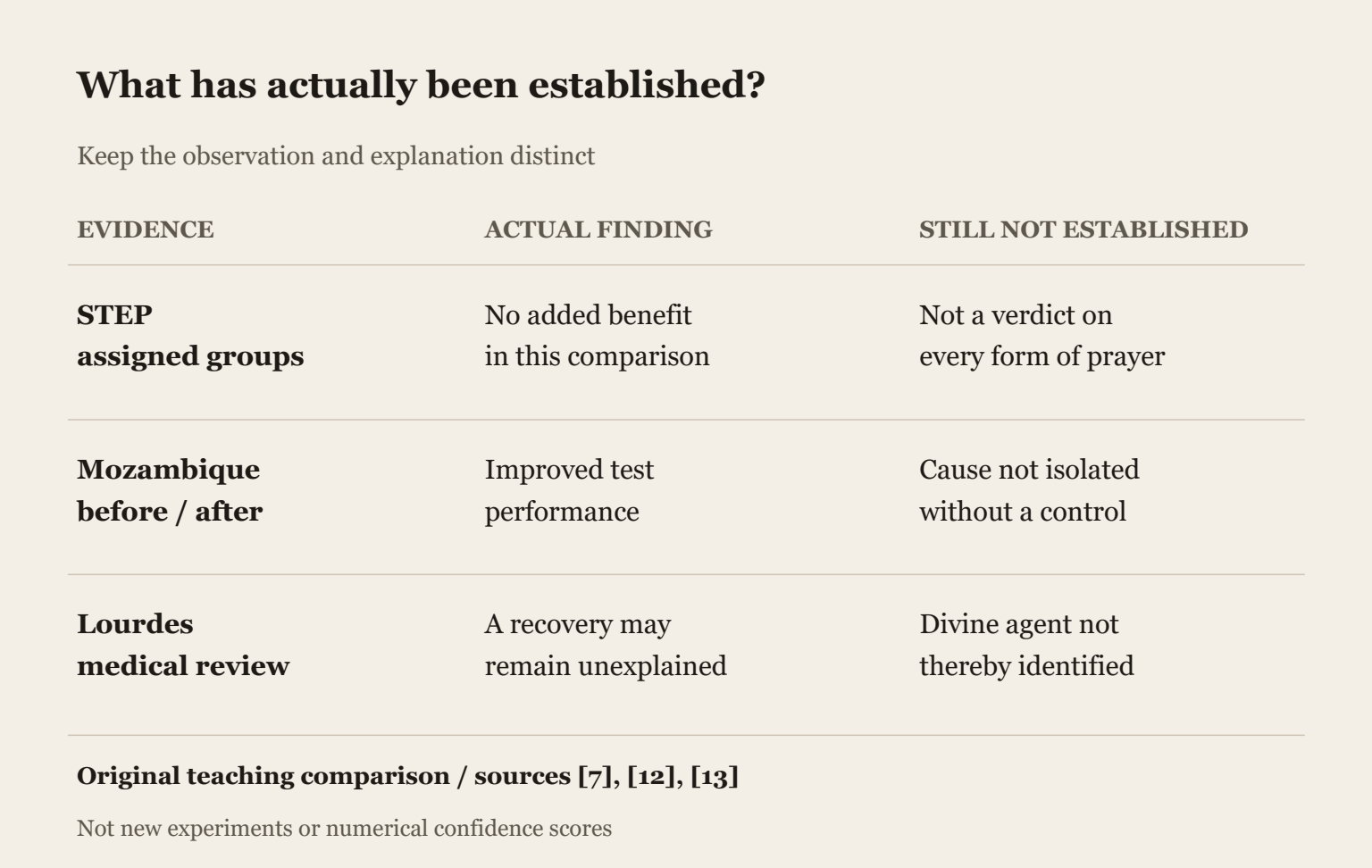
STEP reports a comparison of assigned groups. The Mozambique study reports before-and-after performance changes without a control group. A Lourdes assessment can identify a recovery as medically unexplained. These are different findings, with different strengths and limits.
None of these descriptions alone supplies an independently established identity for a divine agent. The additional causal and religious claims need their own support. The accompanying bilingual CSV records the same distinctions.
Open the figure reference table
15God is not a machine.
That can limit a test. It cannot turn every outcome into supporting evidence.
A believer can say that God is free and does not perform on demand. I understand the objection. A claim that God sometimes acts for undisclosed reasons may make no clear prediction about a particular experiment. An experiment cannot refute every such unrestricted claim.
But notice what follows. If the claim predicts neither better outcomes nor any identifiable pattern, the trial cannot establish that claim through a favourable-looking result either. You cannot use scientific testing as a certificate of success and then remove its authority whenever success fails to appear.
The same applies to background prayer. Perhaps control patients also received prayers outside the study. That limits a claim about all prayer versus none. The study can still ask whether its added intervention produced the proposed additional effect.
Someone may propose that all prayer helps equally, that God avoids experiments, or that only a particular tradition works. These are different explanations. Each needs a reason beyond its ability to protect an earlier belief from an awkward result.
My short answer is: you may hold a faith that does not promise a measurable difference. Then say that plainly. It does not give you evidence to sell a measurable healing power that disappears the moment we try to measure it.
16Do not stop at one trial.
The available research does not establish a dependable medical effect of distant prayer.
MANTRA II assigned 748 cardiac patients to off-site prayer or no study prayer and, separately, music, imagery and touch therapy or none. Prayer groups came from several religions. No treatment comparison significantly improved the primary combined outcome. Its results do not show that every secondary outcome was identical. [10]
The 2009 Cochrane review included ten studies and 7,646 patients. It found no clear overall effect on death or general clinical state. Some individual results were favourable; most were not. The authors described the evidence as equivocal, without support for recommending either for or against intercessory prayer. [11]
That review searched through June 2007. I am identifying its date, not presenting it as a freshly completed review of every paper published since. Its studies also varied in conditions and methods, which limits sweeping generalizations. [11]
My conclusion is narrower than all prayer is useless: these sources do not establish distant intercessory prayer as a dependable medical intervention. A stronger claim would need additional, good evidence. Personal comfort and a deity's possible existence are separate questions.
My reply is: bring the most relevant later evidence if you think this record has changed. We should inspect its methods and results. A rational position can be revised; it should not be revised simply because an old claim has been reposted with a newer date.
17The Mozambique study.
Measuring a change is stronger than collecting cheers. Establishing its cause takes more.
Brown and colleagues' 2010 paper studied 24 people reporting hearing or visual impairments at religious meetings in Mozambique. It measured performance before and after nearby, often hands-on prayer and reported improvements. This was a different intervention from distant prayer in a hospital. [12]
The paper itself states important limitations: no control group, no double blinding, difficult field conditions and no diagnosis of the causes of the impairments or assessment of structural change. Most participants could not be followed systematically over time. [12]
That means a better result on a hearing or vision test is not automatically documented repair of an identified damaged organ. A measurement is useful, but the interpretation depends on what was measured, under what conditions and with what checks.
I cannot honestly claim to have proved that suggestion or practice explains every improvement in the study. The authors considered these issues and argued that they did not fully explain the findings. The lack of an adequate comparison leaves causal questions unresolved. [12]
My reply is: treat it as a reason for a stronger follow-up, not a completed demonstration of supernatural healing. Independent testing with appropriate controls, clearer diagnoses and lasting follow-up would help. Acknowledging an interesting positive report does not require adopting its most ambitious interpretation.
18Feeling better is a real outcome.
It is also different from showing that the underlying disease has improved.
A placebo is an inactive comparison intervention presented in a treatment setting. Expectations and the surrounding encounter can affect what a person reports. But placebo is not a magic explanation for every unexplained recovery. The outcome and the condition matter.
Wechsler and colleagues randomized 46 people with asthma; 39 completed their repeated-visit study. Mean improvement in an objective airflow measure was about 20 percent with albuterol and about 7 percent with a placebo inhaler, sham acupuncture or no intervention. [17]
Reported symptom improvement was different: 50 percent with albuterol, 45 with the placebo inhaler, 46 with sham acupuncture and 21 with no intervention. People could report substantial relief without the same physiological benefit that the active medicine produced. [17]
This study does not establish that every faith healing is a placebo effect. It explains why feeling better and repairing an organ require separate evidence. A patient reporting relief is not necessarily lying, even when a scan or other objective test does not show the claimed repair.
My reply is: take the person's relief seriously and check the relevant medical outcome. Do not replace effective treatment on the strength of a feeling. Calling a person healed should mean more than obtaining a hopeful answer immediately after an emotionally powerful meeting.
19What did the doctor actually say?
A diagnosis, a prognosis and a retold sentence are different pieces of evidence.
The doctor said it was impossible is a powerful sentence. I want to know whether those were the doctor's words, whether they were recorded and what they referred to. A severe prognosis is not automatically a statement that recovery has literally zero probability.
A diagnosis identifies the condition. A prognosis estimates its likely course. Neither becomes certain simply because a white coat is involved. Before comparing a claimed cure with medical expectations, qualified reviewers need the relevant diagnosis, tests, treatment history and later findings.
Consider a hypothetical person described as blind who later reads a sign. What type of vision loss was documented? Was it partial or complete, structural or functional, stable or changing? A broad label conceals differences that matter to judging the alleged change.
These are questions for competent clinicians reviewing records with the person's consent. They are not an invitation to diagnose a stranger from a video or demand that a patient post private files to prove their honesty. Privacy can limit public investigation without proving deceit.
My reply is: show what the records support, with appropriate permission and independent review. If we only have a retelling, say so. A remarkable story can remain worth investigating without being presented as a medically verified event that the available documentation cannot establish.
20Spontaneous is not divine.
The natural course of the specific condition matters more than a dramatic label.
Sometimes disease diminishes without the treatment that would normally be credited for that change. The National Cancer Institute describes spontaneous regression in particular groups of infants with neuroblastoma, a childhood cancer. This is a condition-specific observation, not a claim about every cancer. [18]
Its clinical account also distinguishes risk groups and circumstances requiring treatment. Carefully supervised observation in selected patients is not the same as abandoning cancer care. Nothing here gives a reader a reason to stop prescribed treatment or wait for a miracle. [18]
The point is logical: recovery without an identified effective treatment does not automatically require a supernatural cause. We must ask how surprising that recovery is for the actual condition. A general label such as cancer is not enough to assign its probability.
I also cannot say spontaneous remission and close every file. The example of one disease does not explain a different person's neurological recovery. The relevant diagnosis, mechanisms and evidence need checking in the case being discussed.
My reply is: unexpected deserves investigation. It does not deserve an automatic divine certificate, and it does not deserve a careless sceptical diagnosis either. If the available evidence leaves the cause unknown, unknown is the accurate conclusion until something better is established.
21Lourdes gets scrutiny.
I should examine the stated procedure before declaring that nobody checked anything.
Lourdes has a medical bureau and an International Medical Committee. Its account describes the committee's task as assessing whether a recovery remains unexplained by current medical knowledge. That is more demanding than accepting an enthusiastic stage testimony. [13]
The procedure describes comparing medical documents before and after recovery and consulting specialists. It refers to serious illness, sudden recovery, and a complete, lasting result. Medical assessment and the bishop's religious recognition are distinct stages. [14]
I can respect the attempt to filter weak cases without assuming that the final religious conclusion has therefore been scientifically demonstrated. Showing that a committee cannot supply a medical explanation and identifying a divine agent are different evidential tasks.
Nor can I dismiss the process merely because it operates within a religious institution. Institutional interests make transparency and independent scrutiny valuable; they do not replace examination of the evidence. Affiliation does not automatically make observations false.
My reply is: let us see what the process actually established in a particular case. I will not turn medical uncertainty into proof of God. I also will not pretend that a documented, prolonged investigation is equivalent to somebody shouting that they feel better.
22Bernadette Moriau’s recovery.
A named serious case deserves a precise statement of what I can and cannot verify.
The sanctuary's account describes Sister Bernadette Moriau recovering on July 11, 2008, after returning from a Lourdes pilgrimage. It identifies cauda equina syndrome, involving the nerve roots at the lower end of the spinal canal, and describes a sudden, lasting recovery. [15]
The same account reports recognition by her bishop on February 11, 2018. Those dates distinguish the reported recovery from its later recognition. They should not be collapsed into a claim that a doctor instantly certified a supernatural cause at the scene. [15]
I have the institution's public account, not her full clinical file independently examined by my own medical panel. I cannot honestly claim to have verified every diagnosis and treatment detail, or to have discovered the true alternative cause from my desk.
A believer may say that the religious context and lasting improvement make divine action the best explanation. I can understand that argument while asking what evidence distinguishes that explanation from unresolved medical possibilities. Calling the possibilities unresolved does not prove any specific one.
My conclusion here is limited: the reported case is serious enough to examine and is religiously recognized; the public material reviewed here does not let me independently establish supernatural causation. I leave that causal question unresolved. I do not fill the gap with either a god or an invented diagnosis.
23Approved is not proved.
Read what a religious authority actually authorized.
A headline may say that the Church approved an apparition. I want the document and the type of decision. Permission to encourage devotion, acceptance of spiritual benefit and a declaration of supernatural origin are not identical claims.
The Vatican's May 2024 norms say that, as a rule, the relevant authorities do not declare supernatural origin, even when granting a Nihil obstat. They allow an exceptional papally authorized procedure. I should preserve both the rule and the stated exception. [16]
A Nihil obstat can permit a prudent religious response without asserting certainty about the event's supernatural authenticity. These norms concern discernment of alleged supernatural phenomena; I should not present them as a blanket reversal of every earlier healing recognition or canonization decision. [16]
This distinction matters beyond Catholicism too. A community leader may endorse someone's sincerity, teaching or devotion without having independently established the physical cause of a reported event. We must read the actual endorsement rather than the strongest version circulating online.
My reply is: show the exact finding. An authority's statement can be evidence of what that authority concluded. It is not automatically independent evidence for a stronger conclusion that the statement itself carefully avoids making.
24I felt someone there.
A vivid presence is an experience; identifying its source remains a further task.
People describe a god's presence, an ancestor, a spirit or a profound sense of unity. I do not need to pretend that every such report is a deliberate lie. The felt experience and the proposed external being are separate claims.
Luhrmann and colleagues studied spiritual-presence reports across four studies involving more than 2,000 participants in five countries. Reports were associated with cultural understandings of the mind and with absorption, a tendency to become deeply immersed in experiences. [21]
That does not prove that culture invented every experience or that no deity could ever communicate. The research concerns reports and their associations, not a detector that verifies or rules out supernatural beings. Its value is in showing relevant human differences we should investigate. [21]
If sincere people interpret powerful experiences through different religious frameworks, intensity alone cannot tell me which framework is correct. They could all be partly mistaken, or somebody could have a better case. I need distinguishing evidence rather than a contest over who felt more certain.
My reply is: I accept that you experienced something powerful. What would help us identify its source? If that question remains unanswered, I can respect your experience without treating its religious interpretation as established knowledge that everyone else must accept.
25The presence beside the bed.
Some frightening experiences already have a medically recognized description.
A person wakes, cannot move and feels that somebody is in the room or pressing down on them. It can be terrifying. The NHS describes these experiences among the features of sleep paralysis, which occurs while falling asleep or waking. [22]
The description provides a plausible avenue to investigate when the timing and symptoms fit. It does not let me diagnose every report of a spirit, or infer a stranger's medical history from one sentence. A suitable explanation must fit the actual event.
The person's fear is real even if the feared intruder is not established. Saying it was only imagination can sound like saying nothing happened, when an intensely distressing experience did happen. Clear explanation works better than contempt.
Repeated frightening episodes, fear of sleep or persistent tiredness are reasons to consult a health professional; the NHS specifically advises seeking help in such circumstances. That is a better response than treating an unverified supernatural explanation as a diagnosis. [22]
My reply is: before concluding that a being attacked you, compare the experience with known sleep phenomena and get appropriate help if needed. Recognizing a possible ordinary explanation can reduce confusion. It does not require calling the person foolish or dishonest.
26Do not oversell the God helmet.
A scientific-sounding story can become a sceptical slogan too.
You may hear that magnetic stimulation creates God experiences, so religion has been disproved in a laboratory. That jumps from an experimental claim to an enormous philosophical conclusion. Before even discussing that jump, I need to check whether the experimental finding is secure.
Granqvist and colleagues' 2005 double-blind study used 89 participants and a sham-field control. It found no evidence that the tested weak magnetic fields produced the reported experiences; participants' characteristics predicted the reports instead. [23]
St-Pierre and Persinger later reported a reanalysis of 19 experiments supporting a field-pattern effect and emphasized the stimulation protocol. These are opposing claims in a research dispute. Linking them does not mean I have independently resolved all their methodological differences. [24]
Even a reliable way of inducing a presence would not prove that every similar experience has that exact cause. Creating an illusion of a thing and establishing that no real example of the thing exists are different achievements.
My reply to fellow atheists is: do not demand replication from believers and then ignore it when a convenient neuroscience headline flatters us. The case against an unsupported religious inference should not depend on an overstated scientific inference of our own.
27Who controls the check?
A demonstration needs independent observation and a traceable record.
Suppose a guru claims to produce an object, identify a sealed message or transform a substance. The first question is what exactly happened under what conditions. A participant's confidence and a short edited clip cannot replace a record of the whole procedure.
For a claimed object production, sensible checks might include an independently inspected setting and uninterrupted observation from relevant angles. A competent illusion specialist can help identify ordinary opportunities for deception. That is a proposed investigative method, not an accusation that a named guru committed fraud.
For a claimed special substance, independent sampling and a documented chain of custody matter. Chain of custody means recording who held the sample, when and how it was transferred. Identifying ordinary human tissue, for example, would not by itself identify a divine owner or establish how it arrived.
A camera can record a genuine mystery, but it can also leave crucial facts outside its frame. A laboratory can accurately identify the material handed to it while knowing little about that material's history. Evidence for composition is not automatically evidence for origin.
My reply is: let independent people help design the check before the demonstration. If the claimant refuses, that does not logically prove fraud. It does leave the power unverified under those conditions. Refusal is not a successful test of an advertised ability.
28It happened only once.
An event need not repeat before it can leave evidence.
A believer may say a miracle was a unique act, not a repeatable laboratory process. That is a serious distinction. We investigate historical events through traces and records; we do not need to recreate every event in order to reason about it.
For a one-off claim I would ask about early independent testimony, physical evidence, provenance, relevant medical or other records, and whether alternative explanations fit. Different kinds of events leave different traces, so the appropriate standard depends on the claim.
If an event should have left strong evidence but the evidence is absent, that absence can matter. If the evidence would probably never have survived, its absence tells us less. No video, therefore impossible is not a fair rule for every ancient claim.
But lowering the demand for repeatability does not mean abandoning the demand for evidence. A report copied centuries later, with no clear route to an eyewitness, has different evidential strength from a dated contemporaneous record that can be independently checked.
My reply is: show the best surviving evidence and state its limits. A unique event can be credible. Its uniqueness does not automatically establish a supernatural cause, and the difficulty of investigation cannot be turned into an entitlement to certainty.
29Which god did it?
Even an extraordinary event needs an argument connecting it to a particular source.
Suppose, for the sake of argument, we establish an event that our best current natural explanations cannot explain. What follows about Allah, Krishna, Jesus, a saint, a spirit, an unknown intelligence or no agent at all? The event alone may not discriminate between them.
A believer can argue that the prayer's content, timing and setting provide the connection. Those details can be relevant. I would ask whether the proposed explanation predicts them better than the alternatives and whether the selection of the case has hidden contrary examples.
Nor does a verified extraordinary ability automatically establish unlimited knowledge, moral perfection or the infallibility of a book. A person who demonstrates one remarkable capacity has demonstrated that capacity. The rest of their advertised authority remains a separate set of claims.
A cumulative argument can be stronger than one weak item if it combines genuinely independent, reliable evidence. It can also exaggerate its strength if many items depend on the same storyteller, selection rule or interpretive assumption. More pages do not automatically create more independence.
My reply is: explain the bridge from the evidence to the specific conclusion. I am willing to examine a bridge. I am not willing to pretend that it exists because the destination has a familiar name and the story was told inside a place of worship.
30Agree on the rules beforehand.
A good check protects both a genuine effect and the people involved.
For a claimed repeatable power, write down the exact ability, the conditions under which it should work and the result that would count against it. Choose a safe task and enough attempts to make the claimed effect meaningfully distinguishable from ordinary performance.
Keep necessary medical care intact. Medical research requires qualified professionals and proper ethical safeguards, not a debate opponent improvising an experiment on a vulnerable person. For a historical recovery, seek consensual review of existing records rather than staging another illness.
Use independent evaluators, suitable controls where relevant and complete reporting. Agree how incomplete records and withdrawals will be handled. If the ability is claimed to reveal hidden information, prevent ordinary access to that information instead of relying on a solemn promise not to look.
Registration can preserve the planned outcomes and design; reporting the full results helps others see failures as well as successes. NIH's description of clinical-trial records explains why that transparency matters. Registration itself is not a certificate that a study is correct. [26]
My reply is: let us build a test that could persuade either of us. I should not choose impossible conditions to guarantee failure. You should not reserve the right to change the ability after seeing the result. A claim becomes clearer when its owner helps make it checkable.
31How I would explain this.
Start with a shared question before arguing over an entire worldview.
If someone says, My father recovered after we prayed, I would answer: I am glad he recovered. What was the documented condition, what treatment did he receive, and when did it change? Those questions examine the claimed cause without dismissing the recovery.
If they say, The doctors could not explain it, I would answer: that makes the cause unresolved. What additional evidence identifies God? I would not add a diagnosis of my own just to avoid admitting that I do not know.
If they say, You only trust scientists, I would answer: I trust independently checkable methods more than a person's title. We can inspect a study's design and criticism. The same principle lets us challenge a doctor, a priest, a guru or an atheist.
If they say, You would reject any miracle, I would answer: give me a clearly defined case and a fair way to verify it. I can state what would change my assessment. Can we both name evidence that would count against our preferred explanation?
Do not throw all of these questions at a grieving person. Choose the discussion they actually want to have. My aim is to make the reasoning clear, not to corner somebody at their most vulnerable moment or mistake an argument won by pressure for a mind honestly changed.
32What would change my mind?
An open mind needs more than a promise to stay open.
A well-documented recovery can change my assessment of that recovery. Repeated, independently verified performance under fair conditions can change my assessment of a claimed ability. Evidence does not need to answer every question at once before it can count for something.
To move further, towards a particular divine explanation, I would need evidence that distinguishes it from competing explanations. Accurate information unavailable through ordinary routes could be relevant. But its source, reliability and connection to the proposed agent would still need investigation.
I should not set the prior chance of every extraordinary claim to zero and then announce that evidence cannot matter. I also should not give every explanation equal credibility merely because I cannot rule it out with absolute certainty. Possibility is not probability.
For the cases examined here, I do not have evidence that establishes a supernatural healing mechanism or identifies a particular god. Some studies fail to show a benefit, some report findings with limitations, and an individual case may remain unresolved. Those categories should stay visible.
My reply is: I can be wrong, and I can say what kind of evidence would help correct me. That does not oblige me to believe now. A willingness to revise is a commitment to better evidence, not a promise to accept whichever extraordinary story I hear next.
NoteMystery is not authority.
Lovepreet Singh / a position that remains answerable to evidence.
I wrote this because a powerful story can make an argument feel finished before checking begins. A person survives, a crowd cheers, a voice feels real, and suddenly I am expected to accept a complete account of the universe.
I do not accept that shortcut. I can acknowledge a recovery without identifying its cause. I can take a witness seriously without making their memory infallible. I can admit that a case is unresolved without treating uncertainty as a religious surrender.
I have not personally examined every clinical file or replicated these studies. The references distinguish original abstracts, institutional accounts and full papers, stating their limits.
The blunt point is this: your inability to explain an event is not a licence for somebody else to claim divine authority over you. If a person advertises knowledge or power, they owe an argument for that claim. Sincerity, status and dramatic timing cannot pay that debt alone.
My position is simple. Investigate the event. Check the cause. Explain the connection to the god being named. Stop the conclusion where the evidence stops. I would rather leave a question open than close it with an answer I have not earned.
SourcesFollow the evidence.
Numbered references support particular claims, not every conclusion somebody might draw from them. Original studies, primary religious texts and official institutional statements are identified. Some research is available here as its original abstract; that access limit is stated. The 2009 review is dated and is not presented as an exhaustive current review. Examples and proposed tests are labelled; the coincidence arithmetic is invented for teaching. No new experiment, independent clinical diagnosis or universal probability of miracles is claimed. Sources checked 17 October 2026 (India).
[1] Miracles: definitions and arguments
Timothy McGrew; Stanford Encyclopedia of Philosophy.
A philosophical reference on definitions, testimony and arguments for and against miracle claims; not an experimental finding.
[2] John 14:13-14
King James Version; Bible Gateway.
Primary religious text about requests in Jesus' name. Interpretation of its promise needs context; the passage is not evidence that an event occurred.
[3] Qur'an 2:186
The Clear Quran, Mustafa Khattab; Quran.com.
Primary religious passage on God's nearness and response to prayer. A translation is identified rather than treated as the Arabic original.
[4] Bhagavad Gita 7.22
A. C. Bhaktivedanta Swami Prabhupada; Vedabase.
Primary devotional text and named translation. Verse and separately labelled purport represent a particular Vaishnava reading, not every Hindu position.
[5] 1 John 5:14
King James Version; Bible Gateway.
Primary religious text qualifying petitions by God's will. Read alongside the stronger-sounding promise rather than silently omitting the qualification.
[6] STEP: study design and research methods
Dusek et al., American Heart Journal 143 (2002), 577-584. DOI: 10.1067/mhj.2002.122172.
Original study abstract: additional prayer, three assignments and blinded record review; explicitly not a test of God's existence. Abstract read through Europe PMC when direct PubMed access returned a minimal page.
[7] STEP: cardiac bypass trial results
Benson et al., American Heart Journal 151 (2006), 934-942. DOI: 10.1016/j.ahj.2005.05.028.
Original abstract supplies the group sizes, complication counts, relative risk and interval. Additional study prayer is the intervention. Major events and mortality must remain separate. Original abstract read via Europe PMC.
[8] Intercessory prayer in coronary care
R. C. Byrd, Southern Medical Journal 81 (1988), 826-829. DOI: 10.1097/00007611-198807000-00005.
Original abstract reports favourable findings in 393 patients. Included to represent positive evidence honestly; it does not settle the wider literature. Abstract read via Europe PMC.
[9] Remote prayer: a randomized coronary-care trial
Harris et al., Archives of Internal Medicine 159 (1999), 2273-2278. DOI: 10.1001/archinte.159.19.2273.
Original abstract: 990 patients, lower course scores, no difference in lengths of stay. Bibliographic record notes an erratum. Abstract read via Europe PMC; no claim to a full independent reanalysis.
[10] MANTRA II randomized study
Krucoff et al., The Lancet 366 (2005), 211-217. DOI: 10.1016/S0140-6736(05)66910-3; Duke Scholars.
Author-institution research abstract: 748 patients and a factorial design. Primary combined outcome not significantly improved; a secondary finding for music/imagery/touch must not be labelled a prayer effect.
[11] Intercessory prayer for ill health
Roberts, Ahmed, Hall and Davison, Cochrane Database of Systematic Reviews (2009), CD000368. DOI: 10.1002/14651858.CD000368.pub3.
Full review read for methods, outcomes, conclusion and amendments. Ten studies; 7,646 patients; search through June 2007. Equivocal evidence, not proof of an exact zero effect. A contested fertility study was removed in the review history.
[12] STEPP: proximal prayer in Mozambique
Brown, Mory, Williams and McClymond, Southern Medical Journal 103 (2010), 864-869. DOI: 10.1097/SMJ.0b013e3181e73fea.
Original six-page paper read: 24 participants; positive before/after performance findings. No control group or double blinding; limited diagnosis and follow-up. Changes do not independently establish a repaired organ or supernatural cause.
[13] The Medical Bureau of the Sanctuary
Sanctuary of Our Lady of Lourdes; official institutional account.
Describes the committee's medical task as assessing a cure unexplained by current knowledge. The page also contains older office-holder information, which is not used as a current staffing claim.
[14] Recognition of a miracle
Sanctuary of Our Lady of Lourdes; official procedure.
Read the stages, before/after records, specialist consultation and criteria. Institutional medical assessment and subsequent religious recognition are distinguished; access to every underlying clinical file is not claimed.
[15] Bernadette Moriau: recovery and recognition
Lourdes Sanctuary interview account; interview 4 July 2018; web posting 7 February 2023, in French.
Public institutional account reports recovery on 11 July 2008 and recognition on 11 February 2018. It is not her full clinical file, and this chapter does not claim an independent medical diagnosis or causal resolution.
[16] Norms on alleged supernatural phenomena
Dicastery for the Doctrine of the Faith, 17 May 2024; Vatican Press Office.
Official norms, especially the presentation and Part I, paragraphs 17 and 23. Nihil obstat does not certify supernatural origin. Exceptional papal procedures remain possible; do not generalize this to all canonization processes.
[17] Active albuterol, placebos and no intervention in asthma
Wechsler et al., New England Journal of Medicine 365 (2011), 119-126. DOI: 10.1056/NEJMoa1103319; author manuscript in PMC.
Full original study read: 46 randomized, 39 completed; distinct objective airflow and self-reported outcomes. A pilot asthma study, not a universal explanation of faith healing. Percentages in the chapter are rounded study means.
[18] Neuroblastoma Treatment: spontaneous regression
National Cancer Institute, health-professional PDQ; sections on fetal/neonatal regression and low-risk disease.
Institutional clinical evidence summary documents condition-specific regression and strict selection for observation. It does not support extrapolating to all cancers or stopping treatment. Relevant sections read, not the entire large treatment reference.
[19] Confidence and consistency in flashbulb memories
Talarico and Rubin, Psychological Science 14 (2003), 455-461. DOI: 10.1111/1467-9280.02453.
Original abstract: 54 students, initial records and later tests; confidence and consistency can diverge. This is not a clinical diagnosis or a finding that a particular miracle witness is mistaken. Abstract read via Europe PMC.
[20] Gorillas in our midst
Simons and Chabris, Perception 28 (1999), 1059-1074. DOI: 10.1068/p2952; author-hosted paper.
Original methods and results on selective attention in filmed scenes. It shows an observation limit under specified tasks, not a universal explanation of crowd reports or a measure of believers' intelligence.
[21] Sensing gods and spirits across cultures
Luhrmann et al., PNAS 118 (2021), e2016649118. DOI: 10.1073/pnas.2016649118; full paper in PMC.
Four studies, over 2,000 participants, five countries. Methods and discussion concern reported experience, absorption and cultural models. Associations do not experimentally prove that every experience has one cause or resolve divine existence.
[22] Sleep paralysis
NHS; public clinical information.
Describes waking/sleep-onset inability to move, sensed presence and pressure, plus when to seek help. A relevant recognized phenomenon, not a remote diagnosis of every spiritual experience.
[23] Weak magnetic fields: a blinded test
Granqvist et al., Neuroscience Letters 379 (2005), 1-6. DOI: 10.1016/j.neulet.2004.10.057.
Original abstract of a sham-controlled experiment with 89 participants; no tested-field effect found. Included with the opposing analysis, not advertised as a complete neuroscience explanation of religion. Abstract read via Europe PMC.
[24] Weak magnetic fields: opposing reanalysis
St-Pierre and Persinger, International Journal of Neuroscience 116 (2006), 1079-1096. DOI: 10.1080/00207450600808800.
Original abstract reports reanalysis of 19 experiments, 407 subjects, and argues for field-pattern effects and protocol importance. A documented disagreement, not independently adjudicated here. Abstract read via Europe PMC.
[25] Statement on significance and p-values
American Statistical Association, 7 March 2016; official release of its six principles.
Official guidance: p-values do not give the probability a hypothesis is true or measure effect size. A threshold alone cannot establish divine action, clinical importance or replication.
[26] What belongs in a ClinicalTrials.gov entry?
NIH Office of Extramural Research, 29 June 2026.
Official account of protocol information, outcomes, participant flow and adverse events; explains accountability and selective-reporting concerns. Public article read through the web tool after direct HTTP 403. Registration is not quality certification.