

01A feeling can be real.
The explanation still has to earn my belief.
Imagine three people leaving three places of worship. One thanks Jesus. One thanks Allah. One thanks a Hindu deity. Each describes a deep sense of peace and says: I know whom I felt.
This is an imagined scene, not a survey or a claim that every worshipper experiences the same thing. It raises a real question: how do I move from a powerful experience to identifying its cause?
I do not need to accuse anybody of lying. A person can describe an experience honestly and still misunderstand it. Honesty concerns what somebody believes happened. Accuracy concerns what actually happened.
My own certainty has no special protection. If an atheist feels completely sure that a story is nonsense, that feeling does not replace checking the story. I have to apply the same rule to myself.
This part asks why a god can feel real. It examines some influences on belief, then asks what those influences establish. I will challenge the explanation without pretending I can read every believer’s mind.
02What happened? What did it mean?
An experience and a religious conclusion are different steps.
Suppose someone says: I prayed, felt warmth through my body, and understood that God had forgiven me. I can separate that account into three claims without mocking the person.
First, there was a reported experience: warmth and a change in feeling. Second, there was an explanation: a divine being caused it. Third, there was a further message: that being granted forgiveness.
Evidence for the first claim does not automatically establish the other two. A witness could sincerely report warmth without knowing its source. Identifying a source takes reasons that connect the experience to it.
Ask what specifically made the experience recognisable as this god. Was the identity part of what was experienced, an interpretation supplied afterwards, or something the person already expected? These possibilities need different checks.
I am not ruling the account false merely by dividing it up. I am making the reasoning visible. If the connecting reasons are missing, I will say the conclusion has not yet earned my agreement.
03We learn before we can investigate.
Trust helps a child learn. It can also carry an error forward.
A child cannot independently check the water supply, the history book, the language spoken at home, and every warning from an adult. Learning begins with substantial reliance on other people.
Now imagine a household where a particular god is discussed as an ordinary fact. Prayers, festivals, stories, and explanations of good or bad luck arrive together. The child meets an existing world of meanings.
This is an illustration of how transmission could work, not a diagnosis of every religious family. Some parents invite questions. Some children doubt early. Others keep, revise, or abandon their childhood religion later.
The important question is whether I eventually examine what I inherited. Familiar people can pass on useful knowledge and sincere mistakes. Loving my family does not require treating every inherited explanation as correct.
I can respect the people who taught me while checking what they taught. Refusing to inspect a claim because it came from home would give its place of origin authority over its evidence.
04The family connection is measurable.
A survey can show a pattern without deciding whether a god exists.
Pew Research Center’s 2019-20 India survey involved 29,999 adults. Its 2021 findings reported that 98% identified with the same religion they said they had in childhood. This describes religious identity at that time. [1]
The survey did not ask whether every person had independently proved the family’s theology. Keeping an identity can involve belief, practice, culture, family, or several things together. Identity and certainty about God are different measurements.
Different homes and communities expose children to different answers. That gives me a useful question: if I had grown up with another tradition, what might I now find obvious? I cannot know my exact alternative life.
People also convert, migrate, investigate philosophy, and change their minds. Birthplace is not destiny. The survey is evidence of strong continuity in one setting, not a universal rule that every adult simply repeats a parent.
I will not turn an accident of upbringing into proof of divine truth. But I also will not turn upbringing into proof of falsehood. The next pages show the pattern and then make that distinction explicit.
EvidenceChildhood identity often stays.
India, 2019-20. Three published estimates of religious identity, not measures of divine truth.
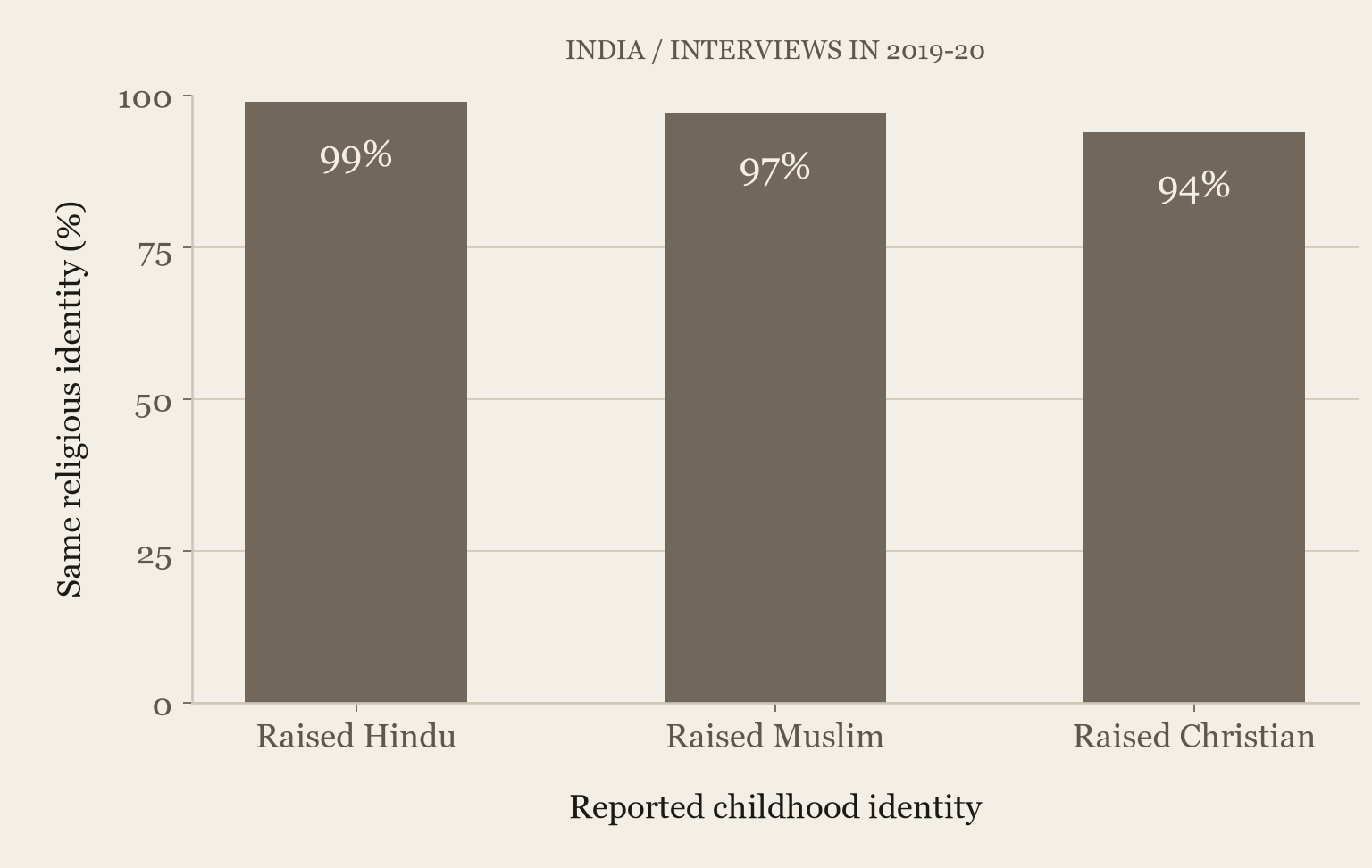
Read 99% as about 99 out of every 100 adults who said they were raised Hindu reporting a current Hindu identity. The corresponding reported figures are 97% for Muslim and 94% for Christian childhood identity. [2]
These are three selected published estimates, not every religious group in the survey. The chart starts at zero. It does not show how certain respondents were, why each stayed, or whether the theology is true.
The figures describe the survey period. They are not a forecast of any child’s future, a randomised upbringing experiment, or a claim that everyone who keeps an identity holds identical beliefs.
Download the published estimates
05An inherited answer can still be true.
Rejecting an idea only because of its origin skips its actual merits.
I learned arithmetic from other people. That does not make two plus two equal four only in my family. I can check the relationship independently of the person who first taught it.
The same basic point applies to religion. A person’s childhood may help explain why they accept a claim. It does not, by itself, show the claim is false. Philosophers often call that mistake the genetic fallacy.
Here genetic means the origin of an idea, not DNA. The mistake is substituting a story about how someone acquired a belief for an examination of whether the belief has adequate support.
Origins can still matter to reliability. If a story came from an admitted fabrication, that affects how I assess its testimony. I need the connecting reason; merely saying you learned it from your parents is insufficient.
My challenge is therefore stronger than you were born into it. I ask what supports the claim beyond inheritance, familiarity, or pressure. An atheist whose only answer is that religion has human causes has not finished the argument.
06Children can see that adults mean it.
Sincere practice can make a teaching credible without making it correct.
Imagine a parent who talks about the importance of prayer and also gives time, money, and attention to it. A child sees that this belief affects actual choices. It is more than a passing sentence.
Researchers use the term credibility enhancing displays for actions that make somebody’s professed commitment convincing to an observer. In ordinary language: the person appears to live by what they say.
Maij and colleagues’ 2017 research linked reported exposure to such religious behaviour during upbringing with later religious belief and practice. Their studies also found that the cognitive measures they used did not offer one simple division between believers and nonbelievers. [3]
These associations do not randomly assign children different families or isolate every cause. Memories, measurement choices, and cultural differences matter. The study gives evidence about learning; it does not identify the cause of every individual’s faith.
The parent need not be deceiving anybody. Sincerity itself can transmit a mistaken claim. I can recognise the commitment while still asking whether the belief behind it is justified.
07Repeated does not mean independently confirmed.
A sentence can become easier to accept without gaining new evidence.
Imagine hearing the same explanation at home, at a gathering, and in a video. It can feel as though the whole world is confirming it. I should first ask whether these are independent checks or repeated transmission.
In a registered study published in 2026, Bowes and Fazio analysed 296 US adults. Repeated statements about conspiracies and general-knowledge topics received higher average truth ratings than new statements. The materials were matched for initial plausibility. [4]
That experiment concerned ratings of particular statements. It was not an experiment proving that repetition creates an entire religion. It does show why familiarity deserves scrutiny when I ask how convincing information feels.
An atheist slogan can become familiar in exactly the situation I should worry about: seeing it shared repeatedly without opening its source. Repetition is not an exemption I grant to my own preferred conclusions.
When a familiar claim feels obvious, I ask for its earliest reliable source and the actual evidence. Hearing it a hundred times may explain my confidence. It cannot supply a hundred independent reasons.
08I can protect a favourite answer.
The label rational does not do the checking for me.
Suppose I search for evidence that a religious story is false and immediately accept the first convenient post. Then I demand much stronger evidence from anyone defending the story. My standards have quietly changed sides.
Confirmation bias is the name commonly given to favouring information that supports an existing view. Naming it is easy. The useful work is identifying the specific selection or judgement I made unfairly.
I can try a practical correction: write what would count against my position before looking for examples. Read the strongest relevant objection. Check whether I would accept the same method if its conclusion favoured a religion.
This is a checking exercise, not a test I claim to have performed on believers. It cannot guarantee that I become unbiased. It can expose a particular double standard I might otherwise overlook.
I want an argument that survives scrutiny after its comforting label is removed. Calling myself rational will not make a bad quotation accurate, a weak study decisive, or a preferred explanation true.
09A belief can be part of a whole life.
Questioning it may feel larger than changing an answer.
Imagine someone whose friends, weekly routine, family celebrations, and trusted helpers all belong to one religious community. A doubt about doctrine could also raise questions about where that person will belong.
That possibility helps me understand why an argument may meet resistance. I am not entitled to conclude that this is the hidden motive of a particular person. I need to listen rather than announce a psychological diagnosis.
A community can offer real friendship and practical help. Those benefits are facts about people’s relationships. They do not automatically verify the community’s claims about the origin of the universe or life after death.
Some communities welcome disagreement; others attach serious costs to it. In a conversation, I should ask what an objection actually challenges. Examining a historical claim need not become a demand to reject everyone somebody loves.
I will not count social pressure as evidence for a god. I will also not mistake a person’s caution about family or belonging for an inability to understand an argument.
10Doing something together can matter.
The bond needs a separate argument before it becomes proof of a deity.
A group sings together, moves together, or repeats familiar words. A person may leave feeling connected and lifted. I can take that experience seriously while asking what produced it.
Reddish, Fischer, and Bulbulia’s 2013 paper reported three experiments on coordinated movement or vocalisation and cooperation. Synchrony combined with a shared goal produced more cooperation in their experimental comparisons. [5]
These were particular tasks and economic games. They did not test the truth of sacred texts or establish what every ceremony does. Extending a laboratory result to a whole religious tradition requires further evidence.
Consider a concert or a team celebration as an everyday comparison. Togetherness does not tell us, by itself, that the group’s account of invisible reality is correct. A connection can be valuable while its theological interpretation remains unverified.
If someone says a ritual changed how they felt, I do not have to deny that change. I ask which additional reason turns the change into evidence for the specific divine claim.
11A helpful belief still has a truth question.
What an idea does for me and what makes it true can come apart.
Imagine a person facing an uncertain future who finds strength in the thought that a loving power watches over them. That thought may help them get through a difficult day.
I can acknowledge the help without claiming to know that the explanation is correct. A belief’s emotional usefulness is relevant to its practical effects. It is not sufficient evidence for every factual claim attached to it.
The reverse inference also fails. A comforting belief is not automatically false. Good news can be true and comforting. The question is what supports its truth apart from the comfort.
In a debate, I can ask: are we discussing whether this belief helps you cope, or whether its account of reality is correct? Those questions can overlap, but answering one does not automatically answer the other.
My position is direct: I will not accept a supernatural claim just because I want its promise to be true. I do not need to sneer at someone’s need for comfort to maintain that standard.
12A frightening warning needs support too.
The size of a threatened punishment does not establish who can deliver it.
Suppose someone says I must believe a particular doctrine because the punishment for rejecting it is terrifying. Fear can make the warning difficult to ignore. It does not establish that the warning is accurate.
I need to ask whether the being exists, whether it issued this condition, and whether the person reporting the threat has reliable access to that information. Increasing the threatened punishment does not answer those questions.
Competing traditions can offer different warnings. I cannot treat fear of one outcome as a method that automatically selects its theology over every rival. The alternatives need the same scrutiny.
This is an argument about justification, not a claim that fear explains all religious belief. Some believers emphasise love, philosophical reflection, family practice, service, or experiences they regard as divine.
Later parts will examine afterlife claims and wagers in detail. For now, I refuse the shortcut: this would be awful if true, therefore I should accept the person claiming it is true.
13Religion is not explained by one emotion.
Even an atheist explanation has to fit the research.
It would be convenient to say that everybody believes because they fear death. Convenience is not evidence. That explanation would need to account for people’s different beliefs, experiences, and reasons.
Jong and colleagues’ systematic review and meta-analysis found mixed relationships between religious belief or practice and anxiety about death. Many results showed no statistically clear linear relationship: a steady rise or fall in one as the other increased. Findings varied substantially between studies and measures. [9]
A meta-analysis statistically combines findings from multiple studies. Its strength depends on the studies and the questions being combined. Here, a single simple slogan would hide important variation.
The relationships do not establish the cause of a particular person’s belief. Nor does a low level of fear prove that a religion is true. Emotional state and theological accuracy remain separate questions.
I can discuss fear as a possible influence without pretending it is the master explanation of every believer. If my criticism needs an oversimplified picture of people, I should improve the criticism.
14A sense of presence deserves a careful hearing.
I can respect a loss while examining what an experience establishes.
Imagine a grieving person saying they felt a loved one nearby. I do not need to begin by calling them dishonest, foolish, or unwell. I can ask what the experience was like and what they think it means.
In 1971, W. Dewi Rees reported interviews with 227 widows and 66 widowers in a defined area of mid-Wales. Almost half reported experiences of seeing, hearing, or sensing their deceased spouse. [8]
That historical study documents reports in a particular sample. It does not give a current worldwide rate or verify communication from the dead. Its terminology does not justify diagnosing a stranger from a conversation.
If the person felt comforted, that matters to their experience. If the further claim is that a deceased person supplied new, independently checkable information, I can investigate that distinct claim and its supporting record.
Respect does not require accepting a supernatural explanation in advance. Careful doubt does not require cruelty. I want enough detail to understand what is known, what is reported, and what remains uncertain.
15An inner event can feel like a presence.
Research examines conditions associated with that experience.
Luhrmann and colleagues reported four studies across five countries in 2021. They examined experiences people interpreted as the presence of gods or spirits, alongside individual and cultural differences. [6]
One factor was absorption: becoming deeply immersed in an experience, as when losing yourself in music. Another was porosity: ways of understanding the mind as open to influence from outside. The researchers found both related to reports of spiritual presence.
These are descriptions of studied tendencies, not insults or diagnoses. The research relies on reports and measured relationships. It does not establish whether an external spirit exists or identify every cause of every experience.
My inference is limited but important: vividness alone cannot settle the explanation. I need to consider how attention, expectations, and learned interpretations might be relevant, rather than treating vividness as automatic identification of a god.
A believer may argue that a god works through ordinary mental processes. That possibility would need its own support. The existence of a possible divine explanation does not make it the established one.
16A brain scan is not a divine detector.
It can study an experience without settling its ultimate source.
Ferguson and colleagues studied 19 selected, devout Latter-day Saint participants using functional MRI. They found religious feelings associated with activity in brain networks involved in reward, attention, and related processing. [7]
The sample was small and selected for the study’s purpose. Participants encountered religious material and reported their feelings. This was not a random sample of all religions or a test detecting an external god.
Functional MRI tracks changes related to blood oxygenation as an indirect indicator of activity. Finding an association with reported spiritual feelings is different from finding a signal labelled divine presence.
It would also be too quick to say that brain involvement proves the experienced object is unreal. Ordinary experiences of actual people involve the brain. The crucial question is how we distinguish an accurate perception from a mistaken interpretation.
I therefore reject both shortcuts: a scan does not certify a deity, and a neural association alone does not disprove one. The specific claim still needs evidence connecting the experience to its proposed source.
17Something happened does not mean someone planned it.
Recognising a pattern and identifying an agent are separate jobs.
Imagine seeing a face in a cloud. The shape may genuinely resemble eyes and a mouth. That resemblance does not establish that somebody put a face in the sky to send me a message.
This is an everyday illustration, not a reported experiment about religious people. It shows a distinction: recognising a pattern does not, by itself, identify an intention behind it.
Likewise, an event that matters deeply to me need not have been arranged for me. A delay followed by a lucky encounter gives me a story. Establishing that a god planned the encounter requires further support.
I should not use this point to declare every unusual event ordinary or every religious experience explained. Sometimes the available information is inadequate. I can leave the cause unresolved without inventing a confident answer.
The useful question is what would distinguish a planned message from a pattern noticed afterwards. Specific information, a prior record, and independent checks can matter more than how striking the story feels.
18Keep the misses in the story.
A memorable match needs a record before I can judge how surprising it is.
Suppose I think of a friend and the friend calls soon afterwards. It feels meaningful. Before assigning a supernatural cause, I need more of the record than this one match.
How often did I think of friends who did not call? How wide was soon? Did I predict a call before it arrived, or connect the thought with it afterwards? Were there ordinary reasons for contact?
These questions do not prove the call was coincidence. They identify information needed to evaluate the claim. A possible ordinary explanation is not automatically the established explanation either.
A proposed exercise is to record specific expectations before the outcomes and retain every entry. If someone claims an ability, agree on a fair method and comparison beforehand. I am not claiming to have conducted this exercise here.
A result that repeatedly survives suitable checks would deserve investigation. Jumping straight from a memorable match to my religion is confirmed bypasses those checks and adds a whole theology to a single event.
19Other people feel sure too.
A reliable method needs a way to distinguish incompatible conclusions.
Imagine one person thinks an experience confirms a revelation: a message believed to come from a god. Another thinks an experience confirms an incompatible message. Both may be sincere. Their sincerity cannot make contradictory claims simultaneously correct.
This does not mean every religious experience contradicts every other one. Some reports are compatible, vague, or interpreted within traditions with very different ideas about divinity. I have to identify the actual conflicting claims.
For incompatible claims, I ask what helps choose between them. If each side answers only that the experience was unmistakable, the method has not yet given an outsider a dependable way to decide.
A proposal that one reality lies behind many traditions is another possible interpretation. It needs reasons too. It cannot simply inherit all the specific doctrines that the traditions disagree about.
My conclusion is limited: felt certainty alone is insufficient to sort the competing accounts. That leaves room to investigate particular evidence. It does not justify declaring that all accounts must therefore be false.
20Why not trust the experience?
The serious argument deserves a serious answer.
A thoughtful believer can object that we normally rely on experience. I do not demand a laboratory report before accepting every ordinary sight or another person’s account of their day. Why demand a special barrier here?
Swinburne’s principle of credulity, discussed in the Stanford Encyclopedia of Philosophy, gives experiences initial credibility unless there is a suitable reason to doubt them. Religious philosophers disagree about how that principle applies. [10]
That argument is stronger than saying a feeling automatically proves a religion. My reply asks whether the experience reliably identifies an external source, how alternatives are excluded, and how conflicting interpretations are handled.
Ordinary perception is also checked when circumstances make error plausible. I can improve the lighting or ask another observer. A divine interpretation needs a relevant route for addressing its own possible errors.
I will examine the experience as possible evidence rather than dismiss it by definition. But I do not grant every interpretation immunity from challenge merely because it feels direct to the person having it.
21I experienced God myself.
A short reply, a fuller explanation, and a useful next question.
My short reply: I accept that you are reporting an experience. I need to understand what makes it evidence for the particular god you identify.
The fuller explanation starts with detail. What did you perceive? What did you already believe? Was there new information that could be checked independently? What alternatives have actually been investigated?
If I have no access to part of the experience, I should admit that limitation. I cannot inspect somebody else’s private awareness as though it were a public recording. That also limits what the report can establish for me.
I do not assume the person is dishonest. I also do not assume sincerity guarantees correct identification. The same distinction would apply if I reported an extraordinary experience that conflicted with their religion.
My next question: what feature would let an outsider distinguish your explanation from a sincere but mistaken interpretation? That asks for the missing connection without demanding that the person deny what they felt.
22You have to try it first.
Participation can teach me something without deciding the answer in advance.
My short reply: experience can be relevant, but we should agree on what the exercise could actually establish. Feeling something after a practice is not automatically evidence for every claim made about it.
Some knowledge requires participation. Instructions, practice, and attention can change what a person notices. It would be unreasonable to reject a method simply because it requires learning how to use it.
I still need to ask how the method distinguishes the proposed divine source from expectation, interpretation, or the effects of the activity. A suitable comparison depends on the precise claim.
The method becomes unhelpful if every success confirms the doctrine and every failure is blamed on insufficient sincerity. A condition like sincerity needs a usable description, rather than being redefined after any unwelcome result.
My next question: what outcome would count against this interpretation, and would you apply the same standard to a rival tradition’s practice? I can investigate without promising the conclusion before the investigation.
23You cannot prove love either.
Evidence comes in different forms; the claim still needs suitable support.
My short reply: I do not require every claim to be a mathematical proof. I can have reasons to believe someone loves me while admitting that my judgement is fallible.
In an imagined relationship, those reasons might include what the person says, how they act over time, whether their behaviour is consistent, and what happens when their promises are tested.
Those observations do not give perfect access to a private mind. They can still support a reasonable judgement. If contrary evidence appears, I may need to revise it. The absence of absolute certainty does not erase every useful distinction.
For a claim about a god, I likewise ask for reasons suited to the claim. An emotional state, an alleged message, and an intervention in the world are different claims with different opportunities for checking.
My next question: which evidence identifies this god and supports the particular conclusion you want me to accept? Comparing belief with love cannot supply that missing evidence by itself.
24Billions of people believe.
A headcount tells me something about people; the claim needs more.
My short reply: widespread belief makes the question worth understanding. It does not automatically make the proposed answer correct.
I need to know how people arrived at the answer. Were they repeating one tradition, relying on overlapping sources, making independent observations, or defending different claims under the same broad word God?
I would not accept a religious claim merely because it became popular. I should not accept an atheist claim on that basis either. The route from the evidence to the conclusion still matters.
Expert agreement can be relevant when it reflects specialist knowledge and a body of checked work. Its evidential value depends on those reasons and methods, not on treating popularity as a truth-making property.
My next question: what evidence would remain if I removed the number of followers from the argument? That evidence is what we can examine together.
25Science cannot explain what happened to me.
An unresolved case gives me a question, not an automatic answer.
My short reply: perhaps the available explanation is incomplete. I need to examine the case before deciding what follows. Unexplained does not mean explained by your particular god.
I ask for the best original record, the timing, the independent witnesses, and any information that distinguishes the proposed cause from alternatives. I should not invent a natural explanation merely because I prefer it.
If a person supplied surprising information, for example, I would ask what was recorded before it was checked and how ordinary access to it was investigated. A vague recollection after the outcome is a different kind of evidence.
Detailed investigation of miracles belongs in Part 20. The principle here is already useful: the failure of one explanation does not by itself establish another. The proposed replacement must have support of its own.
My next question: what positive evidence connects the event to this source? If there is strong, checkable evidence, I should face it. If the record remains inadequate, I can honestly leave the cause unresolved.
26Thoughtful people can believe.
A believer’s intelligence does not prove the claim or explain it away.
Some people defend religion through deliberate arguments, extensive reading, and serious reflection. Some change religions or adopt a faith they were not raised in. My account must leave room for those possibilities.
It would be lazy to answer every argument by saying you were conditioned. I need to identify its starting claims and examine whether the conclusion follows. Part 5 will consider major philosophical arguments for God directly.
Conversion itself shows a change in belief. To evaluate the new belief, I need the reasons for the change. A moving story can invite investigation without making the new doctrine automatically correct.
Likewise, a clever person can make a weak argument outside or inside their field. Expertise matters where it is relevant. Admiring somebody’s intelligence cannot transfer correctness to every conviction they hold.
I will not rank people’s human worth by a religious label or turn a debate into an intelligence contest. I want to know which particular argument survives the checking. That is a stronger test than applause for either side.
27Maybe you just want atheism to be true.
A possible motive does not decide whether my reasons are sound.
My short reply: preferences could influence me. That is a reason to check my reasoning. It is not a reason to accept your theology without checking it.
Even if someone dislikes religious rules, that dislike does not establish whether a god exists. Even if someone wants a loving creator, that wish does not establish one either. The desired answer and the supported answer can differ.
I can answer the concern concretely: identify evidence against my view, describe what would change my mind, and correct an argument when a source does not support it. Those actions matter more than declaring myself free from motives.
Accusations about pride, rebellion, or a closed heart should not become a way to avoid the actual objection. If I have misquoted a text or misunderstood a study, show that error. It can be examined.
My next question is reciprocal: what evidence would change your interpretation, and what would change mine? Neither of us gets an exemption because we regard our own motives as pure.
28Put the missing step on paper.
One clear claim is more useful than a fight about every religion.
Start with one experience the person is willing to discuss. Ask them to describe it in their own words. Do not silently replace their account with a weaker one that is easier to dismiss.
Then write two separate lines. First: what was reported or independently observed? Second: what conclusion about its cause is being proposed? Mark which details were recorded at the time and which were remembered later.
Ask what connects the two lines. What competing explanation has been checked? What would distinguish this god from another source? What finding would make either person revise their answer?
A useful reply could be: I hear that you felt a presence. I am asking how you identified it. Can we examine the reason for that identification together? Plain language keeps the disputed step in view.
This exercise is a way to clarify reasoning, not a new experiment or a promise that anybody will agree. I can finish a conversation with an unresolved question. I would rather leave that question open than force an answer the evidence has not earned.
NoteWhy I take the feeling seriously.
A few words from me, Lovepreet Singh.
I am an atheist. I do not accept a claim about a god merely because it is sacred, comforting, widely repeated, or intensely felt. I want to understand what supports it.
That position does not give me permission to pretend every believer has the same history or motive. Family, experience, reflection, community, fear, and hope can matter in different ways. A quick psychological label is not an investigation.
I have kept the studies within their limits because I want the criticism to survive checking. A survey is not a divine detector. A brain scan is not a verdict on every god. An association is not a complete explanation of somebody’s life.
My criticism remains blunt: a powerful feeling does not automatically verify the story attached to it. If the story asks for belief, obedience, or authority over other people, the reasons deserve public scrutiny.
I want a reader who can take a person seriously without surrendering the question. That is the habit we carry into Part 4: how did holy books reach us, and what can their actual history establish?
SourcesFollow the evidence.
Sources checked on 15 October 2026. Numbered references support the marked research findings and philosophical descriptions. The worshippers, families, relationships, cloud, phone call, and imagined conversations are explanatory scenarios, not biographies or experiments conducted by the author. The chart redraws rounded survey estimates from the same 2019-20 India survey discussed in sources 1 and 2; these are not two independent datasets. Psychology can investigate influences on belief without deciding whether every possible god exists. Source notes distinguish original research, a research synthesis, and philosophical discussion. My evaluations of the arguments are reasoning for the reader to examine.
[1] Key findings about religion in India
Jonathan Evans and Neha Sahgal. Pew Research Center, 29 June 2021.
Primary survey summary: 29,999 adults interviewed in 2019-20; 98% reported the same current and childhood religious identity. See the question wording and weighting. This is neither a 2026 estimate nor a measurement of theological truth.
Open the survey overview and methodology links
[2] Causes of religious change in India
Pew Research Center, 21 September 2021. Religious switching section.
The same India survey reports retention of childhood identity at 99% for those raised Hindu, 97% Muslim, and 94% Christian. My chart redraws these rounded weighted estimates on a 0-100% scale. These three groups are not a complete ranking of surveyed religions.
[3] Mentalizing skills do not differentiate believers from non-believers, but credibility enhancing displays do
David L. R. Maij and colleagues. PLOS ONE 12(8), e0182764 (2017). DOI: 10.1371/journal.pone.0182764.
Original studies in the Netherlands, Switzerland, and the US. Read the measures, differing results, and limitations. Associations with reported upbringing practices do not isolate every causal influence or establish that any religion is false.
[4] Does repetition increase perceived truth equally for conspiracy and trivia statements? A registered replication report
Shauna M. Bowes and Lisa K. Fazio. Psychonomic Bulletin & Review 33, article 39 (2026). DOI: 10.3758/s13423-025-02836-w.
Published 7 January 2026; the analysed sample contained 296 US adults. Repetition increased average truth ratings for the studied materials. This experiment did not measure the creation of whole religious worldviews. Planned and additional analyses are distinguished in the paper.
[5] Let's Dance Together: Synchrony, Shared Intentionality and Cooperation
Paul Reddish, Ronald Fischer, and Joseph Bulbulia. PLOS ONE 8(8), e71182 (2013). DOI: 10.1371/journal.pone.0071182.
Three original experiments used specific coordinated activities and cooperation measures. They help investigate social effects of synchrony; they did not test sacred texts, all rituals, or the existence of gods.
[6] Sensing the presence of gods and spirits across cultures and faiths
Tanya Marie Luhrmann, Kara Weisman, and colleagues. PNAS 118(5), e2016649118 (2021). DOI: 10.1073/pnas.2016649118.
Four cross-cultural studies relate reported spiritual presence to absorption and cultural models of the mind. The article supports the limited psychological discussion here, not a claim that researchers proved or disproved external spirits.
[7] Reward, salience, and attentional networks are activated by religious experience in devout Mormons
Michael A. Ferguson and colleagues. Social Neuroscience 13(1), 104-116 (2018; online 2016). DOI: 10.1080/17470919.2016.1257437.
Original functional-MRI study reporting data from 19 selected participants. Inspect recruitment, religious tasks, self-reports, and the indirect BOLD signal. Neural associations do not by themselves establish whether a perceived external source exists.
Read the introduction to functional MRI
[8] The Hallucinations of Widowhood
W. Dewi Rees. British Medical Journal 4(5778), 37-41 (1971). DOI: 10.1136/bmj.4.5778.37.
The original abstract describes interviews with 227 widows and 66 widowers in mid-Wales. The historical terminology and particular sample should not be used to diagnose strangers, estimate a worldwide rate, or certify contact with the dead.
[9] The religious correlates of death anxiety: A systematic review and meta-analysis
Jonathan Jong, Robert Ross, Tristan Philip, Si-Hua Chang, Naomi Simons, and Jamin Halberstadt. Religion, Brain & Behavior 8(1), 4-20 (2018; online 2017). DOI: 10.1080/2153599X.2016.1238844.
Author manuscript in an institutional repository. The quantitative synthesis reports varied associations, many null linear findings, and substantial heterogeneity. Read its measures and limitations before claiming fear explains everyone’s religion.
[10] Religious Experience
Mark Webb. Stanford Encyclopedia of Philosophy. Substantive revision 26 August 2022.
A scholarly philosophical overview, including arguments by Swinburne, Alston, and others and objections concerning reliability and conflicting traditions. It is not a psychological experiment. My replies are arguments the reader can assess.