

01Show me the earlier words.
A passage and a later event do not prove that somebody knew the future.
Someone shows me a verse beside a photograph of a war, a skyscraper or a political leader. Look, they say. Our book predicted this. How could a human being have known? The conclusion is already waiting: the book must come from God.
I want to slow that down. What were the exact words before the event? When can we establish that those words existed? What did they mean before everybody knew the outcome? And what independent evidence tells us the event matched them?
These questions do not assume that prediction is impossible. A genuinely specific, well-documented forecast can be evidence of something worth investigating. I would be making a mistake if I ruled it out simply because it would disturb my present opinion.
But a meaning invented after the event is a different achievement. So is a story written to resemble an older passage. So is a broad warning that fits almost any century. Calling all of these fulfilled prophecy hides the work that still needs doing.
This part examines serious examples as well as the method. I will not call an old text recent just because that would be convenient. I also will not accept a divine certificate because somebody has placed a confident caption under an old sentence.
02What would have counted?
A prediction becomes stronger when success and failure are clear in advance.
Imagine that I write: a powerful person will fall, trouble will spread and a new age will begin. Afterwards I choose a president, a war and an election. The sentence may sound impressive, but I gave myself a great deal of freedom.
Now imagine a forecast naming a person, a particular event, a place and a short time window, with a dated record deposited before the outcome. That would be a stronger case. Specificity matters because fewer different futures would satisfy the claim.
No prediction has to name every imaginable detail before it can count as evidence. A useful forecast can be approximate. The question is how much uncertainty it removed, given the information available, rather than whether it sounds dramatic after we know the answer.
I also want a failure condition. If the named person survives, can the prediction fail? Or will fall become a spiritual fall, a relative's death or a change in popularity? A test whose success changes with every result does not test the original claim.
My reply is: describe success and failure before counting either. I am not demanding impossible precision from ancient poetry. I am asking you to match the strength of the evidence to the strength of the claim you want me to believe.
03The page has more than one clock.
The age of a manuscript, its wording and its claimed author are different questions.
A manuscript is a physical copy. Its age tells us when that copy was produced, within the limits of the dating evidence. It does not automatically tell us when every sentence was first composed or when the events described in it happened.
An old copy can establish that particular wording existed by that time. That can be important. But if the copy is later than the alleged fulfilment, it cannot by itself demonstrate that the wording preceded the event. Additional evidence would be needed.
There is also the date claimed inside the story. A text may present a speaker living centuries earlier. That setting is evidence of what the text claims, not automatic independent confirmation of its composition date. A historical novel can be set long before its author.
I am not saying every ancient religious work is a historical novel. I am separating three propositions that need different support: this object is old; these words existed before a certain event; this named person originally spoke them at the claimed time.
My short reply is: put the relevant dates on one line. A manuscript that is earlier than one event can still be later than another. The calendar will often clarify an argument that the word ancient has made unnecessarily mysterious.
04Copies can preserve older words.
An oral tradition or later copy can preserve earlier material, but its history still needs evidence.
The oldest surviving copy is not necessarily the first time words were written. Losing earlier copies is possible. Oral transmission can also preserve material. I should not confuse we do not possess an earlier object with nobody could have said this earlier.
The opposite shortcut is equally weak. A tradition saying that a passage is very early does not settle how its exact wording, meaning and setting were transmitted. We need to examine the evidence for that transmission instead of treating a claimed chain as its own confirmation.
Different passages may have different histories. A book can preserve older material and also contain later additions or editorial organization. Establishing one early passage does not automatically date every part of the collection to the same moment.
Useful evidence can include dated quotations, independent references, earlier translations and comparisons between manuscripts. Each has limits. A quotation establishes what it actually quotes; it does not silently supply missing words or guarantee that its source's traditional authorship is correct.
My reply is: show the relevant evidence for this passage. Do not dismiss transmission because it is inconvenient, and do not turn transmission into a magic word that removes every historical question. An honest argument can distinguish established dates from disputed reconstructions.
05Freeze the reading first.
Flexible words can acquire impressive meanings once the event is known.
When a passage says king, nation, generation or a few years, I want the proposed meaning stated clearly. Does king mean a monarch, any political leader or a spiritual teacher? Does a few years have a fixed range, and when does its clock start?
A translation is part of this examination. A modern English word can make a passage appear more precise than the older wording. A defender can offer a linguistic argument for that choice. Merely pointing to a convenient translation does not finish the argument.
The surrounding passage matters too. Who is being addressed? Is the writer warning contemporaries, describing something past, using symbolism or announcing a future event? Extracting one phrase can remove the details that tell us which kind of statement it is.
An earlier interpretation can help show what readers understood without the modern event in front of them. It is not infallible. A new reading may be justified, but we should record the reasons for changing the interpretation instead of pretending that it was always unambiguous.
My reply is: give me the passage, the translation and the meaning you want tested. If the interpretation changes, explain why. A defensible reinterpretation may be intellectually interesting while still being weaker evidence of a prediction understood beforehand.
06Who checked the fulfilment?
The source reporting an event may already know the prophecy it is said to fulfil.
Suppose an old poem describes a humble ruler on a donkey. Centuries later a narrator tells us that a ruler arrived on a donkey, fulfilling the poem. There are now two records, but are they independent evidence of an accidental match?
Matthew 21 describes Jesus arranging an entry with animals and explicitly connects the scene to a prophetic passage; Zechariah 9:9 supplies the earlier royal imagery. The later account openly presents the action through scripture. I should examine that relationship rather than hide it. [10]
Knowing a prophecy can influence an action. It can also influence how an action is described afterwards. Neither possibility proves that the story is fabricated. They explain why the match alone does not establish knowledge of a future event unavailable through ordinary means.
A believer can answer that intentional fulfilment is exactly what a Messiah would do. That may be meaningful within a theological argument. It does not make the event an independent, uncontrollable lottery result whose only possible explanation is supernatural prediction.
My reply is: establish the event and the connection separately. A story can be sincere, historically informative and shaped by an earlier text. The more an argument depends on a surprising coincidence, the more important that possible dependence becomes.
07Where did those odds come from?
Arithmetic cannot rescue unsupported inputs.
Peter Stoner's Science Speaks uses classroom estimates about eight prophecies and Jesus. Its adjusted chance is one in a number with 1 followed by 17 zeros. This is a model's result, not a measured historical frequency. [31]
Some questions are conditional: given earlier characteristics, how many people would also have this one? Multiplication using appropriate conditional probabilities is mathematically valid. The issue is whether Stoner's assigned values and comparisons are justified.
Agreement in a classroom does not establish a historical probability. We need a defensible reference population, reliable information about the proposed events and a model that allows for related details, deliberate actions and narrators' knowledge of earlier scripture.
Even a very small chance under one model would not give the probability that God inspired the text. It would challenge that model, together with its assumptions. Other explanations and the likelihood of the evidence under the proposed divine explanation would still need assessment.
My reply is: show the inputs before showing me the zeros. If we have guessed the rates, selected the matches and assumed the history, the final number cannot independently prove the things that were already built into its construction.
08What if the pattern is cumulative?
Several reliable, independent matches could matter more than one.
A careful believer need not claim that one verse settles everything. They may argue that a pattern of earlier, specific, fulfilled predictions becomes difficult to explain naturally. That is a stronger argument than a single vague phrase on a poster.
I should check the components before combining them. Was each passage genuinely earlier? Is each meaning well supported? Was each outcome independently established? Do several examples depend on the same later narrator or on the same disputed historical reconstruction?
Dependence does not make evidence worthless. It changes how much extra weight another item adds. Ten articles copying one witness are not ten independent witnesses. Similarly, several narrative details drawn from one scriptural model do not automatically provide several unrelated coincidences.
The whole selection process matters too. How many predictions, possible meanings, candidate people and historical events were searched? Were failed expectations retained? We cannot estimate the surprise of the selected winners while pretending the rest of the search never happened.
My reply is: a cumulative case deserves cumulative checking. I will not dismiss it by laughing at one weak example. But I will not let the size of the list replace the quality and independence of what is actually on it.
09Some warnings have conditions.
A conditional warning and an unconditional forecast must be assessed differently.
Deuteronomy 18:20-22 treats a prediction failing to occur as a reason not to fear the speaker's claimed authority. The passage also prescribes a violent penalty. I am examining its evidential rule, not endorsing that punishment or applying it to people today. [1]
Jeremiah 18:7-10 supplies a qualification: a threatened nation turning from wrongdoing can change the announced outcome, and promised benefit can be withdrawn if conduct changes. This is part of the text, not merely a modern excuse invented by a defender. [2]
A warning can aim to prevent the event it warns about. If a clearly stated condition changes, non-occurrence need not refute the original conditional statement. A forecast that says what happens unless people change is different from an unconditional date and event.
But conditions cannot be added without limit after failure. If an interpreter announces a definite result, then later introduces an invisible exception that was never available to readers, the revised claim needs fresh justification. It cannot inherit the original appearance of a precise successful prediction.
My reply is: put the conditions into the claim before checking the outcome. I can recognize a genuine textual qualification without allowing any missed prediction to be saved by any explanation somebody happens to propose afterwards.
10This passage names a person.
The Cyrus argument is more specific than a general warning about war.
Isaiah 44:28 names Cyrus and connects him with Jerusalem and the temple; Isaiah 45:1 names him again as God's anointed. A believer who dates these words to the eighth-century prophet can offer a striking argument about a later named ruler. [3]
The British Museum's Cyrus Cylinder record identifies a Babylonian account of Cyrus's conquest of Babylon in 539 BCE. This supplies external evidence about the ruler and his conquest. It does not automatically establish when the biblical passage naming him was composed. [4]
That is the central issue. Proving that Cyrus existed and conquered Babylon is different from proving that someone named him in a document before he became historically knowable. The event's reality does not settle the prediction's date.
Nor should I deny the specificity of the name just to weaken the case. If a securely earlier source named a future ruler and accurately described a surprising action, that would deserve close attention. The strength of that hypothetical is why the dating question matters.
My reply is: the name is real, so let us investigate the text's history properly. A serious answer needs more than saying all prophecy is vague. In this example, the proposed lead time has to be established rather than borrowed from the book's traditional attribution.
11One copy, two different dates.
The Great Isaiah Scroll is important evidence with a particular chronological reach.
The Israel Museum dates the Great Isaiah Scroll, containing all 66 chapters, to about 125 BCE. That is before Jesus but after Cyrus's conquest in 539 BCE. This copy alone cannot establish a prediction made before Cyrus. [5][4]
This does not prove that the Cyrus passage was written only in 125 BCE. Copies can preserve older material. It means we need other evidence to decide how much earlier that particular material is and which historical setting best explains it.
Christine Hayes's Yale lecture explains the scholarly distinction between the eighth-century material and chapters 40-55, commonly called Second Isaiah. Relevant reasons include the addressed audience's exile, Jerusalem's destruction and Babylon's role, alongside differences in style and outlook. [6]
A defender can propose one prophet speaking about a future exile. I cannot reject that merely because it predicts. But this needs evidence beyond assuming the prophetic authorship the argument is meant to establish.
The scroll defeats a claim that all Isaiah material was invented after Jesus. It leaves the earlier Cyrus question open. The historical argument about composition needs its own evidence. One archaeological date cannot answer two different questions by magic.
EvidenceEarlier than which event?
The same manuscript date can answer one question and leave another open.
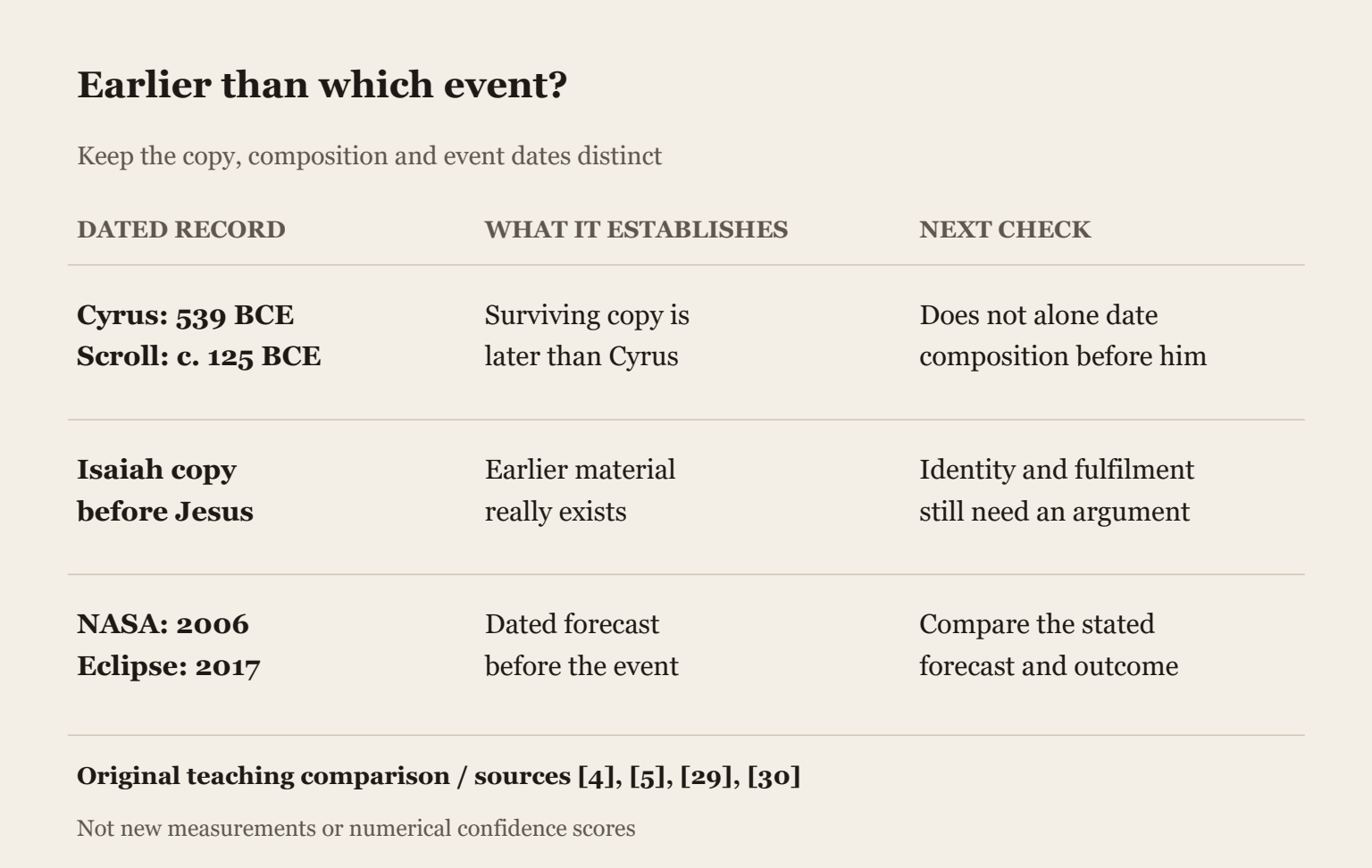
BCE means Before the Common Era; CE means Common Era, using the same year numbering as BC and AD. BCE dates count down towards CE: 539 BCE is earlier than 125 BCE. That is why the Isaiah copy predates Christianity while remaining later than Cyrus.
A copy can preserve older words, so a later copy does not prove a late composition. It also cannot establish an earlier composition all by itself. For the eclipse example, a dated forecast and later record can be compared directly. The bilingual CSV records the same distinctions.
Open the figure reference table
12The words precede Christianity.
Here the question moves from the age of the words to whom they describe.
Isaiah 52:13-53:12 describes a suffering servant: rejection, suffering connected with others' wrongdoing, death and later vindication. Christians see Jesus in this. The Great Isaiah Scroll establishes that this material predates Christianity. I acknowledge that evidence. [7][5]
The passage does not name Jesus. Isaiah 49:3 names a servant as Israel. Christian arguments distinguish an individual servant, representative Israel and a fuller later fulfilment. One label does not settle every servant passage; we need to examine each in context. [7]
Hayes presents the suffering servant in relation to Israel and exile. This is an identified scholarly reading, not an independently measured identity. A Christian may offer a different textual argument; we should compare how each accounts for the whole passage. [6]
The later account also needs examination. Which details of Jesus' life are independently supported, which come from authors interpreting scripture, and which meaning of vindication is being asserted? Pre-existing words do not by themselves verify every later story said to fulfil them.
My reply is: the earlier text is a real part of the evidence. The proposed identification and claimed fulfilment still require arguments. A strong resemblance can support an interpretation without automatically establishing supernatural foresight or the entire theology attached to it.
13Read the king’s question too.
The surrounding verses matter when a later writer applies a passage to Jesus.
Matthew 1:22-23 applies the Immanuel passage to Jesus' birth. That is a clear fact about Matthew's interpretation. To evaluate the prophecy argument, I must also read Isaiah 7, where a sign is addressed to King Ahaz amid a political crisis. [8][32]
Isaiah 7:16 connects the child's development with the fate of two kings. That nearby time reference belongs in the discussion. An argument that displays only verse 14 and hides the surrounding explanation has removed evidence relevant to the passage's original setting. [32]
Christians can argue for a fuller fulfilment, a pattern realized again in Jesus, or a meaning extending beyond the first setting. Those are theological approaches that need to be explained. They are not identical to a plainly stated, single-event forecast understood centuries beforehand.
The translation choices also deserve attention. I am using an identified English version here, not pretending that one English word settles every Hebrew or Greek question. A language argument should bring competent evidence instead of making either translation automatically unquestionable.
My reply is: show how your interpretation handles both the earlier context and Matthew's application. A later religious reading can be meaningful. To establish a uniquely fulfilled prediction, it must do more work than placing two selected sentences next to one another.
14A fulfilment can be a pattern.
A later author may apply an earlier story rather than quote a straightforward forecast.
Matthew 2:15 links Jesus' return from Egypt with Hosea's language about a son called out of Egypt. Read Hosea 11:1-2: it speaks of Israel's childhood and then Israel's departure into worship of other gods. The immediate reference is to Israel, not a named future Jesus. [8][9]
A Christian can understand this through typology: an earlier person or event becomes a pattern that a later one embodies. In that reading Jesus recapitulates Israel's story. Typology is an interpretive connection, not automatically a random event predicted by a hidden code.
Similarly, Matthew's donkey scene explicitly connects action with earlier royal imagery. Deliberate enactment can carry religious meaning. It does not require a modern believer to pretend that nobody in the later story could have known the old passage. [10]
I should not call all such readings dishonest. A writer can consciously develop a theological pattern. My objection begins when that pattern is sold as an independently verified statistical forecast while its literary dependence and interpretive choices are quietly removed.
My reply is: tell me which kind of claim you are making. A symbolic fulfilment should be defended as one. It cannot borrow the evidential force of a precise prediction by changing the word fulfilment between one sentence and the next.
15Who is speaking, and when?
An ancient setting inside a vision is not an independent date for its composition.
Daniel presents visions within the life of an ancient court figure. A traditional reading places predictive knowledge in that earlier setting. A historical reading of the later visions relates their detailed concerns to the persecution under Antiochus IV in the second century BCE. [12]
The issue is not settled by saying that scholars hate miracles. Christine Hayes explains the sequence of kingdoms and the focus on the suppression of worship. Dale Martin discusses how detailed knowledge of events changes near the author's apparent historical horizon. Those are arguments to inspect. [12][13]
A defender can challenge the identifications, language or dating evidence. I should hear the challenge. But I should not confuse the story's claimed setting with a surviving sixth-century manuscript that independently records the same visions. They are different kinds of evidence.
Nor does calling a passage apocalyptic mean that it is meaningless. Here the term refers to revelatory visions using symbols to explain oppression and announce divine resolution. Understanding the genre can help identify what a writer is doing rather than dismissing the text with a label.
My reply is: examine the proposed historical matches and where they stop fitting. A composition date needs an argument. Neither traditional attribution nor a modern scholarly title is a replacement for the evidence behind the date.
16Read the ending too.
A proposed failed expectation can help distinguish prediction from retrospective history.
Daniel 11 moves through a detailed sequence of rulers and conflicts. In the historical reading explained by Martin, the material fits events around Antiochus IV until the expected final outcome diverges from what followed. That shift is part of the argument for dating the passage near those events. [13]
Verses 40-45 describe a final campaign involving Egypt and an end associated with the region of the holy mountain. First Maccabees 6 instead places Antiochus's final illness and death while he is in Persia. This is a later historical narrative, not an eyewitness medical record. [11][14]
On that identification, the ending is not another verified success. Detailed earlier history followed by an unfulfilled expectation offers a different explanation from centuries of perfectly accurate supernatural forecasting.
A defender may say the last verses switch to a future ruler. We need textual reasons for that transition. A difficulty with keeping the same subject cannot, by itself, prove the change. Explain the continuity and the proposed break.
My reply is: do not stop the comparison at the last impressive match. Read the ending too. I will not claim that one interpretation settles every debate about Daniel, but an argument for perfect prediction must account for the difficult parts it usually leaves off the poster.
17The arithmetic has assumptions.
A calculation can be correct while the interpretation remains disputed.
Daniel 9:24-27 refers to seventy weeks and divides the period into parts. Hayes explains a reading in which these are weeks of years connected with the writer's historical expectations. Christian interpretations often connect the passage with a Messiah, but the passage still needs careful interpretation. [11][12]
The first calculation is simple: seventy groups of seven years give 490 years. Seven plus sixty-two such groups give 483 years. The arithmetic does not decide which decree starts the clock, what event ends it, or how the final group relates to the others.
Consider an explicitly conditional example: if someone chooses a 360-day year for 483 years, the result is 173,880 days. That is about 476.1 years of 365.2425 days. Changing the year length changes the result; it is not an invisible adjustment outside the argument.
A proposed exact fulfilment must justify its start, calendar, gaps and endpoint from evidence. Crossing from BCE to CE also requires accounting for the absence of a year zero in that numbering convention. I should not choose whichever combination happens to land near the event I already want.
My reply is: write the assumptions beside the multiplication. I can agree that a sum is correct without agreeing that its inputs describe the intended prophecy. A date produced by an interpretive model is not independent proof that the model was demanded by the text.
18Read the whole threat.
The passage includes a named attacker and broad language about destruction.
Ezekiel 26 names Nebuchadnezzar and also speaks of many nations coming against Tyre. It describes destruction, material placed in the water and a city not rebuilt. A serious defender can point to more than one episode of warfare rather than insist every line names one army. [15]
This matters because I should not create an easier target by deleting the many-nations wording. An interpretation can argue that successive attackers fulfil different parts. The next question is whether the text and historical evidence actually support that distribution of the claims.
Arrian's account of Alexander's siege describes a causeway constructed towards the island using stone and wood. It supplies ancient historical material relevant to a later attack. Arrian wrote after Alexander; this is a surviving narrative source, not a video or an eyewitness statement by Arrian himself. [18]
The construction provides a real reason to compare the history with the imagery. It does not establish every claimed detail about the source of each stone, or prove that the entire prediction succeeded. The broader outcome still needs checking.
My reply is: I will include the details that make the defender's case stronger. Then we must include the named attacker, the wider context and the language about rebuilding too. A fair comparison should not be a contest over which side can crop the passage more effectively.
19The later passage matters too.
Read the outcome against the entire claim, including the difficult parts.
Ezekiel 29:17-20 looks back at Nebuchadnezzar's labour against Tyre and says neither he nor his army received wages from it; Egypt is then promised as compensation. That statement belongs in an assessment of the earlier claim about Tyre's riches and destruction. [16]
This does not establish every siege detail. A defender can argue about tribute, evacuation, surrender or fulfilment across several attackers. Those historical explanations need evidence; their usefulness to an interpretation does not make them facts.
UNESCO's Tyre account describes Greek and Roman cities constructed on the former island site and the modern town of Sour. This creates a problem for an unrestricted reading in which the place would never be built or inhabited again. It is more than a photograph of an unrelated neighbouring village. [17]
A defender may read the language as permanent loss of imperial identity or commercial supremacy. That needs support from wording and context. If never rebuilt becomes never regained the same political role, the claim has become less specific.
My reply is: separate actual destruction, the causeway and the absolute language about the future. Some historical correspondences can be real without every clause being literally fulfilled. A prophecy argument must state which reading it defends rather than alternate between a literal triumph and a metaphorical escape.
20A defeated power will win.
The opening of Qur’an 30 is a serious prediction claim to examine.
Qur'an 30:2-4, in the linked Sahih International translation, says that the Byzantines have been defeated and will overcome within three to nine years. This is more specific than saying that wars will happen someday: it names a side, a reversal and a period. [19]
The traditional account places the announcement during Roman defeats before their recovery. Tirmidhi 3194 reports Abu Bakr's public confidence and a wager: six years passed without the expected victory, then a victory came in the seventh. The account supplies a claimed earlier public commitment. [20]
I should not pretend that a strong side always wins or that a reversal would have been obvious. A bold forecast can be interesting. But unexpected to some people does not mean impossible to predict through ordinary judgement, hope or risk-taking.
The important checks concern the announcement's date, the defeat used as the starting point and the event counted as victory. The wager narrative is evidence within a transmitted religious tradition. It is not automatically an independently dated document made by a witness before the result.
My reply is: this example deserves a timeline, not a joke. Let us inspect its wording, the external war history and the evidence for its earlier announcement. The strength of the case depends on those connections, not simply on the fact that the Romans eventually recovered.
21Which defeat, which victory?
The start and endpoint cannot be chosen only after seeing which interval fits.
Judith Herrin's historical account places the Persian capture of Jerusalem in 614, a notable Roman victory in the winter of 622-23 and the decisive victory near Nineveh late in 627. These are different milestones in a war, not interchangeable dates for one event. [21]
Using year labels alone, 623 minus 614 gives nine years; 627 minus 614 gives thirteen. Those are illustrations of how the chosen endpoint changes the argument, not precise elapsed-time calculations. Months, the date of announcement and the calendar must also be considered.
A defender can reasonably argue that overcome need not mean the final peace treaty or the complete recovery of every territory. I should not insist on the latest event merely because it would produce a failed match. An earlier military success may be relevant.
Equally, the defender must show why the selected victory and starting event fit the passage and its transmitted setting. Abdallah Marouf's 2009 study explicitly examines chronological, linguistic and calendar choices to defend a connection. That detailed argument is more serious than a poster that hides those choices. [23]
My reply is: put the alternatives on the timeline and justify the pairing. A fit under a defensible reconstruction can count differently from a fit obtained by trying every possible pair. The simple subtraction cannot settle the historical and linguistic work that chooses its inputs.
22How did the words reach us?
Neither a traditional report nor a modern reconstruction should be treated as unquestionable.
The relevant words and expectation must precede the selected victory. A later account can preserve earlier information, but we must examine its date, transmission and relation to the outcome. Narrative order alone does not establish historical accuracy.
Tommaso Tesei's 2018 study compares the passage with seventh-century political and end-time expectations, proposing a different transmission setting. This is a scholarly reconstruction. It is not archaeological proof of forged verses. [22]
Tesei favours the standard defeated-then-victorious reading despite discussing alternatives. Disputed readings do not let me give the text any meaning I please. Marouf defends the traditional direction of prediction through a different argument. [22][23]
Even if I grant an earlier announcement and a successful forecast for the sake of argument, I still need to ask how strongly it discriminates between divine revelation and a human prediction about an ongoing conflict. I do not have a measured probability for that historical forecast.
My conclusion is that the passage presents a genuine prediction claim, with important dating and mapping questions. I cannot honestly convert uncertainty into either a proven forgery or a mathematically demonstrated divine source. A believer seeking more than that must supply the additional historical argument.
23An old report, a modern skyline.
A resemblance can be real while a precise modern identification remains an extra claim.
Sahih Muslim 8a describes destitute herders competing in magnificent buildings among signs of the Hour. In the same exchange, the person questioned does not claim to know when the Hour will occur. This is part of the report's setting, not a modern date hidden in a skyline. [24]
A believer points to modern Gulf cities and sees a striking resemblance. I can acknowledge the proposed resemblance without pretending that the old report is a recently invented social-media sentence. The remaining question is what the words specifically identify.
The passage does not name Dubai, a particular tower, its height, an architect or a construction year. Those details come from the modern identification. A claim that it unmistakably predicted one specific skyscraper is stronger than the wording supplied in the report. [24]
A defender may argue that the social reversal from poor herders to competitive builders is the important detail, rather than an exact building. That is a better argument to evaluate. It still needs a justified meaning, relevant historical context and a reason that other transformations would not qualify too easily.
My reply is: distinguish an old, broad social prediction from an exact modern specification. An indefinite sign does not become an exact timetable because its illustration is impressive. Explain the proposed match without quietly adding the most distinctive facts after the event.
24Which century would not fit?
A moral description needs a way to distinguish its predicted era from other eras.
Bhagavatam 12.2 describes wealth being treated as a sign of status and power shaping justice, alongside other moral and social deterioration. A believer sees today's corruption and says that the text predicted the world we live in. The comparison begins with an actual passage. [25]
The question is what makes this a discriminating forecast. Could readers in another period point to powerful people receiving unfair advantages and declare the same words fulfilled? If many different societies could qualify, a present-day resemblance provides less specific evidence than the caption suggests.
That is a test of the argument, not a claim that the text contains nothing valuable. A moral criticism can be perceptive without uniquely identifying the twenty-first century. Describing a recurring human problem and predicting an otherwise unknowable future are different achievements.
Nor can a photograph of one corrupt official establish a worldwide decline. A trend claim needs defined measures, a comparison period and representative evidence. Selecting a few ugly examples cannot prove that every relevant feature has worsened exactly as a text envisages.
My reply is: state what would distinguish the forecast era from a mistaken match. If the conditions are mainly broad moral complaints, explain why the present identification should count as supernatural knowledge rather than one application of a familiar criticism.
25A future claim is still a future claim.
A prediction that remains unverified cannot be counted as an established success.
The same chapter goes beyond broad social criticism. It describes Kalki appearing in Shambhala, names Vishnuyasha, and describes the horse Devadatta and a renewal of the age. These are more particular claims than the statement that wealth influences status. [25]
Their particularity makes them potential subjects of future assessment, under a sufficiently clear interpretation. It does not establish that the events have happened. A future hope is not evidence of successful prediction simply because believers are confident that it will occur.
I also should not call an unmet future claim a failed prediction before its own stated deadline. The fair category may be not yet assessable or not verified. That category differs from fulfilled and also from a deadline that has already passed.
A defender can propose symbolic readings of names, places or a horse. Then those meanings need to be stated and justified. If almost any reformer, location or technology can qualify after the event, the appearance of specificity will have disappeared from the actual test.
My reply is: keep the categories honest. Do not count a future prediction as proof in the present. If you want a later event to count as a fulfilment, explain beforehand what evidence would establish the relevant identity and what would count against it.
26What did this generation mean?
End-time language needs its context and its difficult time reference.
Mark 13:24-32 describes cosmic disturbance, the Son of Man's coming and the gathering of the elect. It then speaks of this generation not passing before these things occur, while also saying that the day and hour are not known. Both statements belong in the comparison. [26]
On a reading referring to the speaker's contemporaries and a final cosmic event, that creates a serious problem of unfulfilled expectation. Saying that nobody knows the precise hour does not by itself remove a broader stated time window. Unknown hour and unlimited centuries are different claims.
Defenders offer other readings: some connect the imagery with judgement on Jerusalem, distinguish different events or understand generation as a different group. I need to examine how such readings handle the full sequence rather than announcing that no alternatives exist.
But a proposed interpretation must earn its choices. Which words refer to the earlier catastrophe, which to a future return, and where does the passage establish the transition? Moving every difficult detail into an indefinite future is not automatically the original meaning.
My reply is: the time reference deserves an answer. I will not decide every theological question from one English phrase, but an argument that celebrates clear fulfilled prophecy must also address passages where the apparent schedule is difficult for its own interpretation.
27A date that really did pass.
A movement’s own account can preserve the difference between expectation and reinterpretation.
The Adventist Encyclopedia describes Millerite expectations of Jesus' return on October 22, 1844, and the disappointment when he did not appear. This is a documented public forecast with a missed date; the deadline was not imposed by a sceptic. [27]
The present Seventh-day Adventist statement identifies 1844 with a stage of Christ's ministry in the heavenly sanctuary. The church distinguishes this later understanding from the expected earthly return. It does not claim that the expected visible return happened. [28]
A believer can argue that the original calculation was right and the expected kind of event was wrong. That is a new interpretive argument to assess. It is not evidence that the original public forecast of a visible return succeeded on the announced date.
I do not need to label every later adherent dishonest. People can sincerely change an interpretation after disappointment. The evidential issue is whether the revised, less publicly observable claim has independent support, rather than gaining confirmation from the failure that prompted the revision.
My reply is: preserve the original forecast alongside its successor. The date can remain important to a religion without becoming a successful prediction of the event originally advertised. Honest belief and an accurate public forecast are separate questions.
28A revision needs fresh reasons.
Changing an interpretation can be honest without preserving an earlier claim of predictive success.
People revise mistaken ideas in every field. I would be unreasonable if I treated all revision as evidence of deceit. The relevant question is whether the new explanation brings independent reasons and makes the overall account more informative.
Suppose a forecast says a public event will occur this year. After it fails, the event is said to have happened invisibly, or the year is changed to an age. That may introduce a new belief, but it cannot be counted as the original forecast coming true.
A correction is stronger when it explains why the earlier reading was mistaken and allows further evidence to matter. It is weaker as a predictive argument when every possible outcome, including failure, is guaranteed to count as confirmation.
This standard applies to me too. If I predicted that no surviving earlier copy existed and somebody produces one, I should correct the claim. I cannot rescue it by changing earlier to an arbitrarily earlier date without acknowledging that the first claim was wrong.
My reply is: revise openly, and reassess what the revision establishes. A belief may survive a failed interpretation. Its survival is not evidence that the failed interpretation was secretly a success all along.
29An earlier, checkable forecast.
Successful prediction can arise from a method whose workings are open to inspection.
NASA's October 2006 Five Millennium Canon of Solar Eclipses contains a labelled map for the total eclipse of August 21, 2017. The document identifies its authors, modelling methods and limits. Here an identifiable earlier publication specifies a future event and its expected geography. [29]
NASA's later account records the 2017 eclipse. Prediction and later observation can be compared. I am not claiming that this chapter personally replicated orbital calculations or measured every point of the shadow; I am showing a documented forecast with a checkable process. [30]
The explanation matters. Astronomical models use observations of the Sun, Moon and Earth to calculate their relative positions. The publication discusses uncertainties, including Earth's rotation. It does not need to pretend to provide unlimited precision for every ancient or future date. [29]
This does not prove that no god exists. It demonstrates why a correct prediction alone is insufficient to establish a supernatural source: an ordinary, publicly examinable method can also produce a correct forecast. We need evidence distinguishing the proposed explanations.
My reply is: a claim becomes stronger when the earlier record, the expected outcome and the checking method are visible. I do not demand that every prophecy be an astronomical calculation. I do ask that its alleged success be made comparably open to examination where possible.
30Find the passage behind the poster.
A quotation on an image needs a source before it becomes historical evidence.
When a post says an ancient book predicted a named modern event, I want the actual passage and edition. A photograph of a manuscript beside modern text does not establish that the modern text is written on the photographed page.
Ask for a chapter, verse or folio, a usable copy, and a translation tied to the original wording. Separate the source's words from brackets, captions and explanations added by a modern writer. If that information is missing, the claim remains unverified.
For a circulating modern prediction, find the earliest dated version you can check. Was it published before the event, or does only a later screenshot survive? A page's present date is not automatically proof that its current contents were present on that earlier date.
If an old text really does contain the words, acknowledge that first. Then assess the meaning and outcome. Do not keep attacking the screenshot after the underlying source has been produced; the point of checking is to improve the discussion, not protect my first suspicion.
My reply is: let us read the source together. A striking claim can earn further attention by supplying its evidence. It cannot demand historical certainty while refusing to provide the historical object or wording on which that certainty supposedly depends.
31Keep more than the winners.
A success rate needs a defined set of attempts and a fair scoring rule.
Suppose I publish a hundred forecasts and later promote the three that seem closest to an event. That collection could impress someone who never sees the other ninety-seven. These numbers are an invented example, not a measured failure rate for any religion.
For a meaningful assessment, define the set of forecasts and keep the unsuccessful and ambiguous cases. Specify what counts as one prediction. A repeated claim does not become several independent successes merely because it appears in several lists.
Score the details consistently. If a passage's precise place and deadline are counted as strengths before an event, they cannot become irrelevant poetry afterwards whenever they miss. An appropriate symbolic reading should be justified by the text, not selected according to convenience.
This does not require finding and refuting every claim ever made before examining one case. A single very strong case could matter. It means that claims about a perfect record or overwhelming statistical pattern need evidence about the full record they invoke.
My reply is: bring the strongest case, and preserve the scoring rule. If you later claim that hundreds of other successes multiply its force, we will need to check those claims too. A large unexamined total is not extra evidence simply because there is no time to inspect it.
32How I would explain this.
One clear question often helps more than ten competing quotations.
If someone says, My book predicted this, I would answer: let us write down the exact passage, its proposed meaning, its date and the event. Which source establishes each? That turns an argument about loyalty into a shared task with visible pieces.
If they say, It is thousands of years old, I would answer: which part is that old, and what establishes that date? Earlier than the event we are discussing is the important relationship. A later copy can preserve an earlier text, but we still need evidence for the earlier date.
If they say, There are too many matches for chance, I would answer: how were the matches chosen, what are the probabilities based on and which items are independent? I would not invent my own tiny probability for human authorship and pretend it was a measurement.
If they say, The text has a deeper meaning, I would answer: explain it and show what supports it. Then let us distinguish that interpretive case from an exact prediction whose meaning was clearly fixed in advance. A deeper reading does not automatically provide an earlier public forecast.
I would keep the conversation on one example until we understand it. The aim is not to bury somebody under names and dates. It is to help both of us see which link is established, which is disputed and which conclusion is still being assumed.
33Make the next claim checkable.
A fair prospective record prevents the goal from moving unnoticed.
For somebody claiming a present ability to predict future events, write a clear forecast before the outcome. Include the relevant time window, conditions and how success will be judged. Preserve it with an independent timestamp or a public record whose changes can be traced.
Keep every attempt and every revision. Where it helps, have evaluators assess the predictions without knowing whose prediction they are scoring. Compare performance with appropriate ordinary forecasts, not an artificially helpless opponent designed to make the claimant look impressive.
If the claim concerns information, prevent ordinary access where relevant. A prediction of something the claimant can arrange has a different meaning from accurate knowledge of an independently determined event. A legitimate skill should not need us to ignore how the information could have arrived.
Use safe, nonmedical tasks. Do not create danger, withhold help or wager money you cannot afford to lose to make an argument exciting. A historical religious case can be assessed through existing evidence; it does not require staging another crisis.
My reply is: help design a test that would genuinely change our assessment. I should not demand impossible conditions merely to guarantee failure. The claimant should not reserve the right to redefine the event afterwards while still calling the original forecast precise.
34What would success prove?
Accurate unusual information and an infallible religion are different conclusions.
Suppose we establish a genuinely earlier, specific forecast and an independently verified fulfilment that ordinary explanations struggle to account for. That would be evidence deserving investigation. My position should change in proportion to what the evidence actually establishes.
It would not automatically identify the source as an all-knowing, morally perfect creator, establish a particular scripture's every claim or validate every institution speaking in its name. Those are further propositions. One demonstrated capacity does not contain all of them.
A believer can offer additional evidence for the connection to God. I am willing to examine it. But merely labelling the unexplained information divine does not distinguish that proposal from unknown ordinary access, an unknown capacity or some other extraordinary cause.
I also will not set the chance of prediction to zero by definition. Nor will I give every imaginable explanation equal credibility because absolute certainty is unavailable. The right question is which explanation is best supported by the full evidence and its alternatives.
My conclusion for the examples examined here is that their claimed divine force depends on disputed dates, interpretations, selection or later reporting that cannot be skipped. Some contain real earlier words and real historical correspondences. Those facts deserve accuracy; they do not make the further theological argument automatic.
NoteI want to see the work.
Lovepreet Singh / curiosity does not require surrendering the standard of evidence.
I wrote this part because prophecy arguments often reach me as finished conclusions. The verse is old, the photograph is new, and I am expected to supply God as the missing connection. I want to see the work hidden between those steps.
My position is straightforward. An old passage can be real. A forecast can be bold. A historical match can deserve attention. None of that gives an interpreter permission to conceal a disputed date, change the meaning after the result or count an unverified story as independent confirmation.
I have not handled the manuscripts, recreated sieges or recalculated the eclipse. I checked identified sources and their limits. A reconstruction is not certain because I like it.
The blunt point is that unearned certainty does not become evidence when it is written in sacred language or dressed in a huge probability. If someone claims special access to the future, I want the earlier record and the actual result. The title prophet does not do that work for them.
Better evidence can change my conclusion. Until then, I will keep the words, their date, the interpretation and the event separate. I will leave a missing link open instead of inventing its answer.
SourcesFollow the evidence.
References support particular passages, dates or arguments. A primary religious text establishes its wording, not automatically its authorship date or the truth of every narrated event. Historical lectures and original research present identified scholarly arguments, with alternatives and uncertainty retained. Later ancient histories are not called eyewitness reports. Public access limits are noted. Calendar illustrations and proposed tests are labelled; no universal probability of prophecy is invented. Source review is not personal handling of manuscripts or replication of specialist dating and orbital work. Checked 17 October 2026, India.
[1] Deuteronomy 18:20-22
King James Version; Bible Gateway.
Primary text on unfulfilled prediction and claimed authority. Its violent penalty is explicitly not endorsed. Read with the separate conditional principle in Jeremiah.
[2] Jeremiah 18:7-10
King James Version; Bible Gateway.
Primary text states conditions on threatened destruction and promised benefit. Conditions are recognized rather than all warnings being treated as unconditional forecasts.
[3] Isaiah 44:24-45:7: Cyrus
King James Version; Bible Gateway.
Primary passage names Cyrus and connects him to Jerusalem and the temple. Specificity is acknowledged; the text alone does not independently establish its composition date.
[4] The Cyrus Cylinder: museum description
The Trustees of the British Museum; collection image record 262895001.
Official description identifies a Babylonian account of Cyrus conquering Babylon in 539 BCE. Museum text read through indexed public material after direct 403. It is not a pre-Cyrus Isaiah manuscript or a claim that the cylinder names Jesus.
[5] The Great Isaiah Scroll: introduction
Israel Museum, Jerusalem; exhibition prospectus prepared for its 2025 anniversary.
Original institutional PDF, printed page 2: all 66 chapters, about 125 BCE. Relevant page read. Copy date is before Christianity but after Cyrus. Proposed exhibition plans are not treated as confirmed current opening dates.
[6] Exile, Ezekiel and Second Isaiah
Christine Hayes, Open Yale Courses, RLST 145, Lecture 19.
Scholar's own lecture explains historical setting, audience and literary distinctions supporting Second Isaiah, plus a reading of servant songs. This is a historical argument, not a direct laboratory date or an uncontested theological ruling.
[7] Isaiah 49:3; 52:13-53:12
King James Version; Bible Gateway.
Primary servant passages read together. Earlier wording is distinguished from the later identification with Jesus. Naming Israel in one passage does not automatically decide every use of servant language.
[8] Matthew 1:18-2:23
King James Version; Bible Gateway.
Primary later narrative explicitly applies earlier passages to Jesus. Evidence for Matthew's interpretation is not automatically independent verification of each narrated event.
[9] Hosea 11:1-2
King James Version; Bible Gateway.
Primary context names Israel and describes subsequent departure to other worship. Typological application is distinguished from a straightforward named future forecast.
[10] Zechariah 9:9; Matthew 21:1-11
King James Version; Bible Gateway.
Earlier royal imagery and a later narrative of deliberate arrangement and fulfilment. This literary relationship does not itself prove fabrication or establish an independent lottery-like coincidence.
[11] Daniel 9:24-27; 11:21-45; 12:1-3
King James Version; Bible Gateway.
Primary chronology and final-vision passages. Calendar arithmetic, historical identifications and changes of subject require separate argument. The 360-day illustration is labelled conditional rather than required by this citation.
[12] Daniel and apocalyptic literature
Christine Hayes, Open Yale Courses, RLST 145, Lecture 23.
Scholar's original exposition of genre, kingdoms, Antiochus and weeks of years. Scholarly interpretation is identified; not presented as a surviving sixth-century manuscript or the last word on every Christian reading.
[13] Ancient Judaism: Daniel’s historical horizon
Dale B. Martin, Open Yale Courses, RLST 152, Lecture 4.
Original lecture explains the detailed sequence and its divergence around the expected end of Antiochus. This supports the stated historical-critical argument, not certainty derived solely from scholarly affiliation.
[14] 1 Maccabees 6:1-16
Douay-Rheims 1899 American Edition; Bible Gateway.
Primary ancient narrative places Antiochus's final illness and death while in Persia. A later account, not an eyewitness medical report. DRA is identified; the unavailable initial KJV display was not mistaken for text.
[15] Ezekiel 26: Tyre
King James Version; Bible Gateway.
Whole primary chapter includes many nations, Nebuchadnezzar, material in water and absolute rebuilding language. Both the staged-fulfilment reply and difficulties for unrestricted literal readings are included.
[16] Ezekiel 29:17-21
King James Version; Bible Gateway.
Primary retrospective statement on unpaid labour against Tyre and promised Egyptian compensation. Not treated as a complete independent reconstruction of every siege outcome.
[17] Tyre: World Heritage account
UNESCO World Heritage Centre, property 299, Outstanding Universal Value.
Official archaeological account describes Alexander's dike, later Greek/Roman cities on the site, and modern Sour. Ancient island, later headland and mainland zones are distinguished; an unrelated village is not substituted.
[18] Anabasis of Alexander, Book II, chapters 18-24
Arrian; E. J. Chinnock translation, 1884; Project Gutenberg.
Relevant siege narrative read, especially II.18 on the stone-and-wood mole. Arrian is a later ancient historian, not an eyewitness to Alexander's siege. No complete reading of the very large book is claimed.
[19] Qur’an 30:1-7
Sahih International translation; legacy Quran.com.
Named primary translation gives defeated-then-victorious and three to nine years. The translation is not silently changed to a more convenient reading. Exact start and victory identification need historical argument.
[20] Tirmidhi 3194: the reported wager
Jami at-Tirmidhi; English translation and Darussalam grading at Sunnah.com.
Transmitted religious account describes a six-year wager and victory in the seventh. A grading is a judgement within a hadith framework, not an independently dated pre-event wager document.
[21] Byzantine recovery under Heraclius
Judith Herrin, The Formation of Christendom (1987), excerpt beginning at page 183; Fordham Internet History Sourcebooks.
Historian's own account: Jerusalem 614; notable victory winter 622-23; Nineveh late 627. Year-label subtraction illustrates endpoint choice, not a precise elapsed solar/lunar interval or independent date for Qur'anic proclamation.
[22] The Romans Will Win: a historical argument
Tommaso Tesei, Der Islam 95.1 (2018), 1-29. DOI: 10.1515/islam-2018-0001; public author-copy PDF.
Original study read for readings, political setting and conclusion. It favours the standard reading and proposes a different transmission context. This reconstruction is not reported as proven forgery or a consensus beyond dispute.
[23] Islamicjerusalem and the first Qur’anic prophecy
Abdallah Ma'rouf Omar, Journal of Islamicjerusalem Studies 10 (2009), 27-59; original journal PDF.
Original 33-page argument read for chronological and calendar choices defending a fulfilment. Presented alongside a competing interpretation, with disputed dating choices identified. It is not an independent pre-event manuscript.
[24] Sahih Muslim 8a: the signs of the Hour
Sunnah.com, Book of Faith; identified primary hadith translation.
Report includes destitute herders competing in buildings and lack of knowledge of the Hour. It supplies no Dubai name, exact height, architect or construction year. Modern illustration and text remain separate.
[25] Bhagavatam 12.2: Kali Yuga and Kalki
Vedabase, Bhaktivedanta Book Trust English edition, chapter with numbered verse translations.
Primary devotional chapter: 12.2.2 moral/social conditions; 12.2.18-23 named Kalki expectations. Chapter summary and verse translations are distinguishable from later purports. Future claim is not counted as already fulfilled or prematurely failed.
[26] Mark 13:24-32
King James Version; Bible Gateway.
Primary sequence includes cosmic imagery, this generation and an unknown day/hour. Alternative interpretations are acknowledged; the time-window difficulty is not erased or treated as resolving every theological dispute.
[27] The Millerite movement
Encyclopedia of Seventh-day Adventists, Millerite Movement (c. 1820s and 1840s).
Movement's institutional history describes October 22, 1844 and its disappointment. Public text read via the web tool after direct 403. A documented historical expectation, not a claim that every believer was dishonest.
[28] Christ’s ministry in the heavenly sanctuary
Seventh-day Adventist Church, official Fundamental Belief 24 and explanation.
Current official account identifies a heavenly ministry in 1844 and distinguishes the earlier expected earthly return. This is primary evidence for its theology, not independent verification of an invisible event. Web text read after direct retrieval limits.
[29] Five Millennium Canon of Solar Eclipses
Fred Espenak and Jean Meeus, NASA/TP-2006-214141, October 2006, section 1 and figure 1-1.
Original technical publication; printed page 1/PDF page 9 was also read visually. It labels a 2017 August 21 map and explains model and rotation uncertainty. Text-only volume is the Canon introduction, not an invented complete catalogue.
[30] Total Eclipse 2017
NASA STEM resource, retrospective event description.
Official later record of the August 21, 2017 eclipse. Used with the earlier publication, not a claim to personal observation or independent replication of the entire eclipse model.
[31] Science Speaks, chapter 3
Peter W. Stoner; online edition maintained by Don W. Stoner, The Christ of Prophecy.
Original probability argument read through public web text. Student estimates and conditional framing are retained. One-in-10^17 is its model claim, not a measured chance of divine inspiration. A direct verification screen was not bypassed.
[32] Isaiah 7:10-17: the sign to Ahaz
King James Version; Bible Gateway.
Primary setting and verse 16's reference to the child and two kings are retained. An identified English edition does not settle every Hebrew/Greek translation question or rule out all typological readings.