

01Start with the person.
Suffering is an experience before it becomes an argument.
Picture a parent beside a seriously ill child. Now picture someone explaining that the child's suffering must be part of a perfect plan. The explanation may comfort its speaker. I still want to know what makes it true, and what it explains for the child.
I am not beginning with the complaint that life occasionally disappoints me. I am asking about severe suffering, including suffering inflicted on people who did not choose it and cannot understand it. A missed promotion and a child's agony are not interchangeable examples.
The question is directed at a particular claim: a being knows what is happening, has the power to prevent it and is perfectly good. How does that combination fit the world we actually encounter? The existence of pain makes this a question, not an instant proof.
I also want to separate two conversations. Someone grieving may want company, practical help or silence. Someone making a public claim about God's perfect plan can be asked for reasons. Another person's worst day is not my invitation to stage a debate.
My position is blunt: the pain does not become justified because I can attach a religious sentence to it. An explanation must do more than protect the speaker's confidence. In this part I will examine what the strongest answers actually establish.
02Which god are we discussing?
An objection to a perfectly good ruler is not an objection to every possible divine idea.
By all-knowing, I mean that the being knows about the suffering and the relevant ways to prevent it. By all-powerful, I mean power over what is genuinely possible. A square circle is a contradiction, not a difficult engineering project that omnipotence has failed.
By perfectly good, I do not mean a servant who grants every wish. I mean a being whose treatment of creatures is consistent with perfect goodness. The issue is whether permitting severe harm has an adequate justification, rather than whether everyone receives unlimited comfort.
This combination appears in influential forms of Christianity, Islam and other theistic traditions, although their explanations differ. Rowe's philosophical argument explicitly targets this kind of creator. I must identify the claim being tested instead of putting every religion into one definition. [1]
An impersonal ultimate reality, a limited deity or a creator who never promised goodness raises different questions. Changing the conception can change the objection. It also changes what has been defended; it does not automatically establish the original perfectly good, unlimited ruler.
My reply is: tell me which powers, knowledge and moral qualities you actually claim. Then we can ask whether the proposed explanation fits them. I will not defeat a god you do not believe in, or quietly accept a different one halfway through the answer.
03A contradiction is a strong claim.
Showing that two statements cannot both be true takes more than pointing to pain.
A logical argument says that the stated God and the stated suffering cannot possibly coexist. That is stronger than saying the combination looks doubtful. To establish a contradiction, I need the connecting premises about what perfect goodness must prevent and what prevention could cost.
A good person can permit some pain for a justified reason. An operation may hurt while saving a life. This familiar example defeats the crude rule that goodness always eliminates every pain immediately. It does not show that a particular disaster is morally comparable to surgery.
Plantinga's free-will defence offers a possible connection between valuable freedom and the risk of wrongdoing. A coherent possibility can challenge an alleged contradiction. His excerpt also rejects arguments against God's existence more broadly; I am not presenting that judgement as an agreed result. [2]
The distinction matters. A defence asks whether God and suffering could fit together. A theodicy proposes an explanation of why God permits suffering. Neither word makes the explanation true. The claims still need the kind of support their conclusions require.
My reply is: I will not call the problem a finished mathematical disproof. But removing one alleged contradiction does not establish that the actual world is governed perfectly. The next question concerns the evidence, including the amount and distribution of suffering. [1]
04Could happen is not did happen.
A possible justification is not automatically the explanation of an actual event.
Imagine finding a locked medical room and hearing distress inside. A necessary procedure might be happening. So might an assault. The mere availability of a harmless explanation would not settle which account is true. We would need information about the people, procedure and circumstances.
That is an invented comparison, not an experiment or a perfect model of God. Its point is the difference between could be justified and has been shown to be justified. The gap remains even when the proposed explanation is emotionally attractive.
An evidential argument asks whether the suffering we observe gives us reason to doubt a particular divine description. Rowe distinguishes a rationally supported judgement from a proof that no greater good could exist. He acknowledges that an unseen connection is possible. [1]
I should therefore say apparently unnecessary when that is what my evidence supports. I have not surveyed every possible good, every future or every connection. But uncertainty does not require me to treat all explanations as equally well supported.
My reply is: a possible reason can keep a claim logically open. Show why it should also make this actual event understandable under your claim. If the answer supplies no further evidence, it has established a possibility, not the promised explanation.
05Compare the explanations.
The question includes where pain occurs, not just whether it exists.
The relevant evidence includes who suffers, how badly, for how long and under which conditions. Pain associated with injury, vulnerable bodies and unequal access to protection calls for explanation. A single recovery story cannot stand in for the whole pattern.
Draper compares belief in that God with an alternative: feeling creatures and their conditions were not planned by kind or cruel nonhuman beings. Feeling creatures means beings able to experience pleasure or pain. This is a comparative argument, not a measured probability of God. [6]
For a simple example, an alarm system can benefit an organism without tracking its moral character. A physical explanation of why a body hurts is different from a claim that the sufferer needed or deserved this particular pain. Those are additional propositions.
A believer can offer a wider case for God, including arguments examined in earlier parts. Evidence should be assessed together. But a favourable item does not make an unfavourable item disappear; we need to explain how the full case is being weighed.
My reply is: do not count the rescue as evidence of perfect care while making every unrescued case irrelevant by definition. State what the divine claim leads us to expect, and how this pattern affects it. I have no defensible percentage to attach to that judgement.
EvidenceWhat has actually been established?
A possibility, a physical mechanism and a promised future do different work.
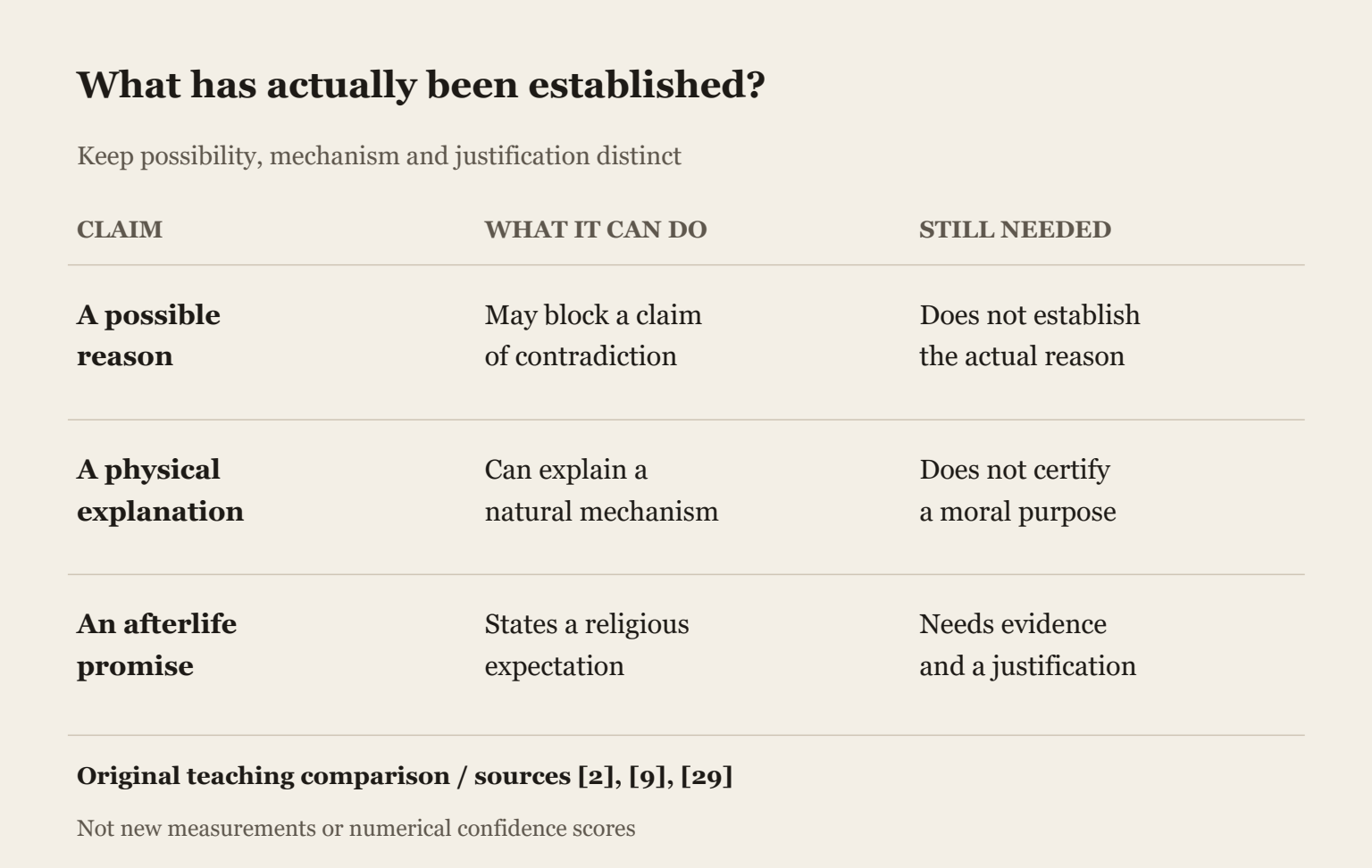
A coherent possible reason can challenge a claim of logical contradiction. It does not, by itself, identify why a particular harm was permitted. The evidence for that explanation needs separate examination.
A physical process can explain how damage happens without settling its moral purpose. A promise of future healing can matter to a religious account while still needing evidence and an argument about the earlier harm. The bilingual CSV preserves these distinctions.
Open the figure reference table
06The wrongdoer chooses.
Human responsibility is real evidence against blaming every harm directly on God.
The strongest free-will reply begins with meaningful choice. Freely given love, trust and responsibility seem different from programmed performances. A world with people who can choose may contain goods unavailable in a world of machines.
Plantinga's defence uses freedom in a sense that excludes God determining a person's choice while leaving that same choice free. That is a conceptual constraint, not simply a shortage of divine strength. I cannot demand both determination and its absence in the same respect. [2]
If a person deliberately harms someone, that person's responsibility matters. Saying God is powerful does not make the attacker innocent. Nor should the victim's suffering be redescribed as a mistake committed by the victim merely because someone else chose it.
But identifying the wrongdoer answers who committed the act. It does not yet explain every decision by a knowledgeable protector to permit the result. Appealing to a tempter or another supernatural wrongdoer would leave that permission question in place too.
My reply is: freedom may explain why harmful intentions and choices are possible. We still need to examine which consequences must be permitted, how severe they must be and why protection would destroy the relevant freedom. Those are further steps.
07Knowing is not causing.
Do not hide a different philosophical dispute inside the suffering argument.
Someone answers that God knew what the wrongdoer would do, so the action was not free. That conclusion needs an argument. Knowing that an event occurs and causing it to occur are different relations. A recording of yesterday does not cause yesterday's action.
The recording is only an illustration of that distinction. Future divine knowledge raises additional questions about necessity and alternative choices. I have not solved that debate by comparing it with a video, and the believer has not solved it by using the word freedom.
For the present discussion, I can grant meaningful human choice and ask what follows. Would every attempted harm have to succeed? Would every consequence have to reach its actual severity? Granting the defender's starting point makes those questions easier to isolate.
A protector can know someone's hostile intention, preserve evidence of the attempt and still protect the target. The person's intentions do not automatically vanish because another person's body survives. We need to distinguish choosing an act from controlling all its results.
My reply is: let us avoid winning the wrong argument. Even if divine foreknowledge and freedom are compatible, the problem of permitted consequences remains. Even if they are incompatible, that would require its own explanation rather than a slogan slipped into this one.
08Protection need not create a robot.
Preventing one consequence is not identical to abolishing every meaningful choice.
If I stop an attacker reaching a child, I do not thereby turn every person into a machine. The attacker can still intend, choose, attempt and be responsible. My intervention changes what happens to the child. These distinctions already matter in ordinary protection.
The analogy has limits. A defender can argue that a dependable world, real responsibility and stable expectations require consequences that are not constantly cancelled. A world of universal intervention might be very different from ours. I should take that concern seriously.
But that does not settle a narrower case. What good requires this particular severe consequence to continue? Why would limited protection remove all relevant responsibility? The jump from some consequences matter to every actual consequence is needed must be justified.
I cannot prove that a proposed intervention would have no remote costs. That is part of the evidential dispute. Equally, the defender cannot establish its intolerable costs merely by repeating that freedom exists. Neither side has acquired a complete map of possible worlds.
My reply is: explain the relevant connection. An appeal to freedom is stronger when it addresses the victim's lost freedom as well as the attacker's options. Protecting someone's ability to live and choose is also a serious moral concern.
09A fault does not make a moral choice.
A physical cause and a moral justification answer different questions.
USGS explains tectonic earthquakes through faults, moving plates and the release of stored energy. Instruments record the resulting waves. This provides a physical account that can be investigated without first deciding which community God favours. [9]
The damage is not explained by geology alone. UNDRR defines disasters through hazardous events interacting with exposure, vulnerability and capacity. Where people live, building conditions and the ability to respond help determine the consequences. Human decisions can make a dangerous event much worse. [10]
This means I should not classify every disaster death as wholly separate from human responsibility. Neglect and inequality can matter. It also means that assigning blame to a local official does not explain the underlying hazard or every illness and injury in nature.
A believer can say that God works through natural processes. A physical explanation does not logically exclude that proposal. It does, however, leave the further question: why would a perfectly good controller permit these processes to impose this burden on these creatures?
My reply is: identify the mechanism, identify the human contribution and then state the claimed divine reason separately. Measuring a fault does not measure a moral purpose. Declaring a disaster punishment does not supply the missing evidence.
10A usable world can contain risks.
The serious reply concerns a world in which actions and learning are possible.
A stable world has obvious value. If the effects of ordinary actions changed unpredictably every moment, building, planning and helping would become difficult. The same regular processes can support life and create dangers. This is stronger than saying that pain must be good because it exists.
Catholic teaching describes creation as still developing and distinguishes physical from moral evil. It appeals to providence and goods that God can bring from permitted evil. This is a stated theological account, not a scientific measurement of a disaster's purpose. [23]
The question remains whether the particular risks, severity and distribution are required for the relevant goods. Showing that regularity matters does not prove that this exact arrangement is the only workable one. Showing a risk does not prove that eliminating it would have no cost either.
I cannot simulate every alternative universe. The defender cannot prove every apparent excess unavoidable by citing stable laws. Both of us must state the limits of this comparison.
My reply is: regularity may explain a general need for consequences. It does not, by itself, certify each consequence as morally necessary. The burden is to connect the proposed good with the harm being defended, at a level stronger than assertion.
11Illness is not a moral diagnosis.
A medical description does not identify a child’s suffering as deserved.
WHO's childhood-cancer account explains that cancer begins with genetic changes in cells and says that most childhood cancers have no known cause. That does not mean they have no cause. It means the available evidence does not identify the cause of most cases. [11]
Nothing in that description establishes that a child or parent committed a spiritual offence. Moving from an illness to deserved suffering requires additional evidence about wrongdoing, responsibility and the alleged connection. The disease cannot supply those missing premises merely by existing.
WHO also describes barriers to diagnosis and treatment that affect outcomes. Human care and access matter; a discussion of God should not erase those practical responsibilities. A condition having a biological basis does not make all of its consequences beyond human influence. [11]
A defender can answer that the child's experience forms part of a larger life or a future that we cannot see. That is a further claim to examine. Calling it a test or a plan does not establish what the child gains or why this severity was needed.
My reply is: discuss the proposed theology without diagnosing the victim's moral worth. We can investigate illness and reduce harm while the philosophical question remains open. Uncertainty about a cosmic explanation is no reason to withhold available help.
12Useful pain is not every pain.
An alarm can protect us without every possible alarm state being beneficial.
Pain can warn of injury. MedlinePlus describes an inherited condition in which people cannot feel physical pain. Injuries can go unnoticed and accumulate. This shows why a warning system can be valuable; it does not mean we should romanticize the condition. [12]
The sensible question is therefore not why bodies have any warning system. It is why pain can be severe, prolonged or disabling, including where the person cannot use it to escape the damage. Explaining an alarm's function does not establish that every intensity and duration is necessary.
IASP's definition and notes distinguish pain from the detection of harmful stimuli. They also recognize that pain can have adverse effects even though it often serves an adaptive role. A useful general function does not guarantee a beneficial outcome in each case. [16]
The claim that we need darkness to understand light has a similar limit. Contrast can help us understand a difference; it does not identify the amount of misery required. Understanding kindness does not, by itself, explain why one person must endure devastating harm.
My reply is: I accept that warning, learning and contrast can matter. Now explain the additional burden. The question is about the connection between a particular suffering and an adequate reason, not whether an entirely sensationless body would be ideal.
13Disease did not wait for humans.
The history of animal illness makes some simple blame stories harder to sustain.
In 2020, researchers from the Royal Ontario Museum and McMaster University reported osteosarcoma, a form of bone cancer, in a Centrosaurus fossil about 76 million years old. Their institutional account describes scans, microscopic examination and comparison with other bones. [13]
The original paper's bibliographic record identifies the researchers, journal and DOI. I am using that record for identity, and the team's public account for the described investigation. I have not personally diagnosed the fossil or independently repeated the team's examination. [14]
A diseased bone is evidence of pathology. It is not a recording of the animal's entire conscious experience. Nor does this one finding establish the earliest disease ever. Its relevant point is simpler: serious biological damage occurred long before our species' choices.
That challenges an explanation in which all animal disease began after wrongdoing by recent humans, under an ordinary forward chronology. A defender can propose symbolic readings or a different relation between the Fall and time. Those are additional interpretations, not things demonstrated by the fossil.
My reply is: include prehuman nature in the account. A human free-will explanation cannot silently assume that every damaged body is downstream of a human decision. The history of life is part of the evidence the proposed explanation must address.
14Animals are not scenery.
Evidence about experience needs care, not automatic dismissal or mind-reading.
Animal suffering cannot simply be assigned the role of teaching humans. Much animal life occurs outside our observation. If the good being claimed is compassion for creatures, their experiences matter as experiences, not only as opportunities for us to improve.
Sneddon and colleagues' original trout-study abstract reports receptors responding to harmful stimuli and prolonged changes in behaviour and physiology after noxious treatment. The authors describe evidence of nociception and suggest discomfort. That is the scope of the evidence used here. [15]
Nociception means a nervous system detecting harmful stimuli. It is not identical to the felt experience of pain. IASP warns against inferring pain from sensory-neuron activity alone, while also warning that inability to communicate does not exclude human or animal pain. [16]
I should therefore avoid both shortcuts: every reaction proves an experience exactly like mine, and an animal cannot describe pain so there is nothing to explain. Relevant evidence includes more than a verbal report, while its interpretation still has limits.
My reply is: a theory about perfect care needs an account of creatures who do not make human moral choices. Calling them lesser beings does not establish that their suffering has no moral weight, or explain why its actual extent is needed.
15Who learns when nobody sees?
Some cases challenge the claim that suffering exists to educate a human observer.
Rowe asks us to imagine a young deer trapped by a forest fire, suffering before it dies. This is a philosophical thought experiment, not a documented animal case with a verified timeline. Its purpose is to isolate suffering with no visible human beneficiary. [1]
The animal does not become a more morally responsible adult by dying. No nearby human is stipulated to observe it and learn compassion. An explanation built only around the education of human witnesses therefore does not directly answer the example.
A defender can propose wider ecological connections, animal afterlives or goods beyond our knowledge. Those proposals deserve evaluation. The example does not prove that no such connection is possible, and Rowe explicitly acknowledges that limit. [1]
But naming an unknown benefit is not identifying one. We can still ask what supports the proposed connection and why this suffering, at this intensity, would be required. An explanation that works only by leaving all those details unknown has a limited explanatory achievement.
My reply is: follow the victim beyond the human classroom. The question concerns its experience, not only whether someone else might eventually tell a moving story about nature. I will not count an invented benefit as an observed result.
16Growth can be a serious answer.
The strongest character-building argument is about freely developed persons.
Hick's soul-making account proposes that persons develop through their own choices in a challenging world. Freely acquired character can have a value different from ready-made innocence. Courage, patience and generosity are not simply quantities of comfort delivered to a passive recipient. [3]
This deserves more than the reply that a good God would give everyone a permanently pleasant afternoon. A meaningful life can include effort and difficulty. The defender's claim is that development matters, not merely that unpleasantness should be renamed a blessing.
But the account needs to connect the difficulty with the proposed development. Learning through a manageable challenge and being overwhelmed by a catastrophe are not interchangeable descriptions. A general possibility of growth does not certify the usefulness of every burden.
Hick also looks beyond earthly life for fulfilment. I should not pretend his position requires everyone to finish their development before death. That future completion is part of the defence, and consequently another claim needing support. [3]
My reply is: show what the explanation claims for the actual sufferer. I can respect someone's hard-won growth without concluding that the harm was necessary, chosen by them or arranged for their benefit. An achievement after injury does not identify the injury's author.
17Who carries the cost of the lesson?
An explanation must include the person whose life is damaged.
Some people describe becoming more compassionate after hardship. Their interpretation of their lives deserves attention. It cannot establish that every other sufferer receives the same benefit. A personal achievement is not a universal finding about the purpose of misery.
Earp's critique of soul-making asks about excessive burdens, unequal distribution and experiences that frustrate rather than enable development. This is a philosophical challenge, not a clinical claim that every trauma affects every person in the same way. [7]
If someone says a child's suffering teaches adults kindness, I want to hear what justifies using that child as the classroom material. Benefits to bystanders do not automatically settle the treatment of the person who pays for them.
Adams argues that divine goodness must address horrors within the sufferer's own life, beyond a favourable global total. Her proposed answer draws on Christianity; she is not endorsing atheism. [8]
My reply is: do not leave the victim outside the promised good. Explain the severity, the unequal burden and the people who never visibly get the advertised lesson. A theory about perfect goodness needs more than a selection of inspiring survivors.
18A test for whose benefit?
An all-knowing examiner does not need to discover an unknown result.
Qur'an 67:2 describes life and death as a test, and 21:35 speaks of trials through both good and bad. The proposed religious meaning is real; I should not pretend that believers have invented it only for this debate. [17][18]
A serious defender can say the test lets people act, develop or have their choices made manifest. It need not supply information that an all-knowing God previously lacked. The objection that God already knows therefore does not, by itself, defeat that stronger answer.
We still need an explanation of the test's terms and burdens. Qur'an 2:155-157 describes fear, loss and patience; 4:40 affirms divine justice. Those are theological commitments to assess together, not independent measurements showing why one person's catastrophe was necessary. [19][21]
Verse 2:286 speaks of capacity, responsibility and prayer. Its application needs interpretation. It is not a clinical guarantee that every person can psychologically withstand every loss without help. Repeating the verse cannot establish an individual sufferer's capacity. [22]
My reply is: stating that life is a test names a proposed purpose. Explain why this test, its unequal conditions and its severity are justified. Knowledge of a result and a moral reason to permit the process remain different questions.
19Explain the inheritance.
Do not confuse a doctrine about humanity with proof of a child’s personal fault.
Genesis 3 connects the human condition with disobedience, and Romans 5 relates Adam, sin and death. Christians interpret these passages in different ways. A literal recent sequence and a theological account of alienation are not the same historical claim. [25]
The Catholic Catechism specifically distinguishes original sin as an inherited state from a personally committed act by Adam's descendants. It would be inaccurate to present that doctrine as saying that each infant personally performed Adam's action. [24]
That correction leaves an ethical question: why should creatures bear these burdens through a condition they did not personally choose? Describing the condition as inherited identifies the proposed arrangement. It does not, by itself, establish the goodness of permitting every consequence.
The prehuman evidence also remains relevant to accounts that make human wrongdoing the ordinary chronological origin of all animal pathology. A symbolic or nonstandard temporal account must be defended as such. We cannot change the kind of explanation without saying so.
My reply is: state the actual doctrine, then examine it. Misdescribing original sin makes an easy target and a poor argument. But correcting that mistake does not turn inherited vulnerability, a suffering child or an ancient diseased animal into an explained moral necessity.
20Karma is a claim to examine.
A past-life explanation needs evidence for the past life and the alleged moral connection.
Some people answer that present suffering results from actions in another life. In that explanation, what looks undeserved now belongs to a longer moral history. The proposal is different from simply saying that the person made an identifiable mistake yesterday.
Gita 6.40-45 describes continuity of spiritual practice across births. It supplies a religious account involving earlier lives. It does not identify which past wrong, if any, explains the illness of a particular child. I must not make the text answer a case it has not examined. [31]
For that specific diagnosis, I would need evidence of the person's relevant earlier life, the wrongdoing and the connection to this suffering. Inferring guilt from suffering, then using that supposed guilt to explain the suffering, is circular. Neither step independently checks the other.
Indian traditions should not be collapsed into one view. The Sivaka discourse rejects the claim that every feeling is entirely caused by previous action and lists other causes. Its ancient medical framework is not modern clinical evidence; its relevance here is the rejection of that total explanation. [32]
My reply is: do not present an unverified past as an established verdict against someone in pain. A serious account must also explain how its consequences are just and how help fits within it. The label karma cannot replace those arguments.
21Read more than the punishment line.
Religious sources themselves contain challenges to simplistic victim-blaming.
In John 9, Jesus rejects the offered explanation that a man's blindness resulted from his own sin or his parents' sin. The passage then gives a religious purpose and a healing story. Rejecting the blame does not make the rest an independently verified medical report. [26]
Luke 13 rejects the suggestion that particular people who suffered were worse sinners than others. It also calls the audience to repentance. I should retain both parts of the passage rather than trim it into a modern secular slogan. [27]
Job begins by portraying its sufferer as upright. Its opening includes permitted affliction, and its ending rebukes the friends' speech about God. The later divine response emphasizes the scale of creation. These elements resist a tidy rule that misfortune reveals personal wickedness. [28]
None of this proves that the proposed divine response is morally adequate. It shows why I cannot honestly say every religious text gives the same simple punishment answer. A source can challenge one bad explanation while offering another account that still needs assessment.
My reply is: argue with the real passage and the real interpretation. I can reject a theological explanation without inventing a weaker one for its defender. Accuracy strengthens criticism because it leaves the difficult question where it actually belongs.
22Perhaps the reason is beyond us.
Human ignorance is a serious reply to a claim of exhaustive knowledge.
The strongest mystery reply is not that an explanation has been found. It is that we are poorly placed to judge all the goods, harms and connections an unlimited mind would consider. Our failure to see a sufficient reason may therefore be less informative than we think.
Bergmann develops this position as skeptical theism. His argument questions whether our known possibilities represent the full range of relevant possibilities. It is not an argument that humans are ignorant of every moral fact or that every atrocity should be accepted without intervention. [4]
This can challenge the inference from I see no adequate reason to there probably is none. How strong that challenge is depends on how reliable our judgement should be in this domain. Calling the disputed inference obvious would not answer the objection.
I should concede the limit: I cannot exclude every hidden justification. But the defender should concede another limit: describing our ignorance does not identify God's actual reason or establish that a perfectly good God exists. The reply limits an objection; it does not supply all the positive evidence.
My reply is: mystery may keep a possibility open. It cannot honestly be reported as a discovered explanation. We still need to assess the wider case and decide how much confidence the unanswered suffering should permit.
23Ignorance works in both directions.
Explain which judgements remain justified and why.
If my judgement is too limited to evaluate a troubling event, I should be careful about declaring it proof of perfect care too. The same unseen possibilities cannot erase every unfavourable observation while leaving every favourable interpretation automatically secure.
A defender can answer that independent reasons establish God's goodness first. Another answer distinguishes what God may permit, with complete knowledge, from what humans may do on the evidence available to them. These are serious distinctions, not admissions that morality is meaningless.
Bergmann explicitly argues that a person can retain ordinary moral knowledge and a duty to prevent harm despite uncertainty about ultimate consequences. I should not claim that skeptical theism logically requires standing aside while someone is attacked. [4]
My remaining question concerns consistency and explanatory reach. What supports the positive claims about divine goodness? Which observations can count against them? If good becomes whatever an unknown being permits, the reassuring meaning of good has not yet been established.
My reply is: keep the limits symmetrical. We can lack a complete cosmic verdict and still have strong reasons to protect people. A claim of hidden wisdom does not transfer that wisdom to the human speaker who announces what another person's pain was for.
24A story cannot certify the hidden reason.
Knowing the ending inside a narrative differs from independently establishing it outside one.
Qur'an 18 tells of Moses accompanying a servant with special knowledge, commonly called al-Khidr. The linked translation includes that name in explanatory brackets. Apparent wrongdoing is later given hidden explanations involving a boat, a boy and a wall. [20]
The killing of the boy provokes Moses' objection. The later explanation concerns the believing parents, feared future wrongdoing and a better replacement. That is a genuine part of the passage's theological claim, not merely an online rumour invented by a critic. [20]
Within the story, the narrator supplies special knowledge and a divine explanation. In an actual case before us, a person saying there must be a hidden reason has not independently established comparable knowledge. The narrative cannot verify that person's diagnosis of another tragedy.
A defender can argue that uniquely authorized divine action is unlike ordinary human action. That distinction needs its own support. It does not give a present speaker permission to claim secret authority over a child's life or to treat an imagined future offence as established guilt.
My reply is: discuss the passage's moral argument directly. I will not disguise the difficult act, and I will not pretend its narration proves the hidden purposes claimed for today's suffering. A theological illustration is not an investigation of the present case.
25Restoration and permission.
A future good could matter without automatically explaining the harm that came before it.
Revelation 21 promises an end to death, sorrow and pain. Gita 2.20 describes the self as not being destroyed with the body. These are distinct religious claims, not interchangeable descriptions of one proven afterlife. Both can change how a believer understands death. [29][30]
For this argument, I can temporarily grant future restoration and ask what follows. Someone being healed or receiving a later good does not, by that fact alone, establish that permitting the original injury was necessary or right. Restoring a loss and justifying its imposition are different tasks.
A stronger reply is more than compensation. Adams proposes that relationship with God could defeat horrors within the sufferer's own life, making that life a great good to the person. Her Christian account concerns personal meaning and divine intimacy, not a payment that buys permission. [8]
That addresses a real weakness in crude balancing. I still need reasons to believe the promised transformation occurs and that the complete account answers the permission question. A possible restoration is relevant; a bare assurance is not an independently established outcome.
My reply is: explain the victim's future, its evidence and the moral connection separately. I will not assume an afterlife is impossible to simplify the objection. I also will not treat its promised existence as already proved by the need for a better ending.
26Would freedom survive there?
A promised harmless future raises questions about claims that harm is required forever.
Suppose a believer describes a future life with meaningful persons and no devastating suffering. I can ask how freedom, goodness and safety fit together there. The question is especially relevant if earthly harm has just been called an unavoidable feature of any meaningful personal existence.
The reply may be that mature character differs from initial innocence. People in the final state could have completed a process that cannot simply be skipped. Hick's developmental account explicitly distinguishes the present setting from a perfected future. [3]
That means paradise is not a one-sentence refutation of every free-will or growth argument. Different conditions might matter. I must examine the proposed difference rather than assuming that any state described in one context can be copied unchanged into another.
But the defender now owes an account of the required process, including people who die before visible completion and creatures outside human moral development. Announcing that this world is not heaven identifies a distinction. It does not justify every feature of the route.
My reply is: use the future consistently. If good personal life can finally exist without these harms, explain which earlier burdens are indispensable and why. The promise of a final state cannot do that work simply by being repeated.
27Why the silence?
A loving relationship concerns access to the other person, not only protection from harm.
Imagine a person who wants to know whether a loving God exists, sincerely looks and remains unconvinced. This is different from knowing that a person exists and choosing to reject the relationship. The first person lacks a belief needed to make that conscious choice.
Schellenberg argues that a perfectly loving God would keep relationship available to capable, nonresistant people. Their nonbelief challenges that claim. The premise about love is philosophical, not a laboratory result. [5]
The issue would remain even in a relatively comfortable life. Someone can lack access to the proposed relationship without currently experiencing a disaster. Hiddenness is therefore related to suffering without simply being another name for the same argument.
A believer can question whether perfect love requires that availability at every relevant time. They can also question whether apparent nonresistance is genuine. Both moves need reasons; the argument should not be dismissed as merely demanding that God perform a spectacle.
My reply is: clarify what kind of relationship is said to be offered and what makes it available. A person cannot knowingly accept an invitation whose sender they reasonably do not believe exists. That is a distinct difficulty for a perfectly loving personal God.
28Not knowing is not refusing.
Do not diagnose a stranger’s motives merely from the conclusion they reached.
Nonresistant does not mean morally flawless, knowledgeable about every religion or certain about one's own psychology. In this discussion it concerns resistance to relationship with God. Someone can have ordinary faults without deliberately blocking a relationship they would be willing to explore.
Some nonbelievers may resist particular possibilities. That cannot establish that all nonbelief has that cause. A person could reject an abusive institution, dislike a doctrine or be angry about suffering while still being open to reliable evidence of a different divine reality.
Schellenberg identifies nonresistant nonbelief as the disputed factual premise of his argument. I should not pretend to inspect everyone's inner life infallibly. But the believer does not gain that ability either by announcing that everyone secretly knows. [5]
Ask what evidence would distinguish sincere nonbelief from resistance. If every statement of openness is declared a lie solely because the person remains unconvinced, the diagnosis has become protected against the very evidence that could challenge it.
My reply is: address the reasons and the person's actual account. You can challenge a mistaken inference without inventing a hidden wish to sin. A theory of perfect love must explain why capable, willing seekers would be left without the belief needed for conscious relationship.
29Knowing does not force loving.
Information, obedience and affection are different things.
Someone replies that unmistakable divine evidence would destroy freedom. I need to know which freedom they mean. Knowing another person exists does not force me to love, trust or obey that person. Information can make a meaningful response possible without choosing the response for me.
The strongest reply concerns the overwhelming character of an encounter with unlimited power. A person might respond from fear, dependence or self-interest rather than free affection. That is more serious than simply equating belief with compulsory obedience.
But it raises a further question: must all adequate evidence take that overwhelming form? Could a perfectly capable being make its existence accessible in a way suited to a willing person's capacities? We should assess that possibility rather than treating coercive spectacle as the only option.
I am not prescribing one universal miracle or claiming to know precisely what every person would require. The challenge concerns adequate access, under the conception of love being defended. A defender may argue that access can be indirect or develop over time; that proposal needs explanation too.
My reply is: distinguish making an invitation intelligible from forcing its acceptance. If the absence of evidence is said to protect freedom, explain why the same freedom could not survive an adequately understood invitation. The word freedom alone does not establish that connection.
30What does distance achieve?
A proposed benefit needs a connection to the actual absence or harm.
A defender may value trust, independent moral motivation or space to develop without constant awareness of divine observation. These are proposed goods of distance. They deserve examination rather than being treated as obviously absurd or automatically sufficient.
The question is whether those goods require the nonbelief being discussed, for these people and for this long. A person can trust someone whose existence is clear. The argument must identify what a more accessible relationship would spoil, not simply praise trust in general.
Another reply says the creator owes creatures nothing. That questions duties; it does not establish perfect kindness. Having no contractual entitlement and being perfectly loved are different claims. The moral description still needs a meaning and a defence.
A believer can also offer resurrection, revelation or personal experience as positive evidence supporting trust despite unanswered questions. Those claims need their own assessment, as earlier parts explain. They do not become stronger merely because suffering makes a comforting answer desirable.
My reply is: take the strongest answer one connection at a time. Do not pile a test, a hidden purpose and future compensation together without saying which does what. Several unverified possibilities do not add up automatically to one established explanation.
31Can an atheist call this wrong?
An argument about God need not settle every theory of morality first.
Sometimes the reply is that I cannot call suffering bad without God. That introduces a debate about what grounds moral truths. It does not directly explain why a particular harm fits the perfectly good God being defended. Changing the question does not answer the original one.
One way to proceed is internal: grant the believer's own moral commitments and ask how their account fits them. If the defender affirms compassion and God's perfect justice, I can examine the consistency of those claims without first deriving a complete secular moral philosophy.
Another question asks what reasons nonbelievers have to care, and whether objective morality requires a divine source. That deserves a full examination. It is the subject of the next planned part, not a result established by slipping one sentence into this discussion.
Equally, natural explanation does not tell us that suffering ought to be accepted. Explaining how an injury happens does not endorse inflicting it. A world lacking a cosmic protector would make human protection no less relevant to the person who needs it.
My reply is: tell me which moral premise you reject and why. If we disagree about its foundation, we can examine that. But an appeal to moral foundations cannot itself certify that this victim's suffering was deserved, required or perfectly governed.
32What does the evidence establish?
A strong objection should state its scope as carefully as its force.
I find the scale, distribution and apparent excess of suffering serious reasons to doubt a perfectly good, fully informed and unlimited controller. The explanations examined here leave major connections unestablished. I do not regard their confident repetition as sufficient evidence.
That is not a scientific experiment which detects the absence of every possible god. A limited being, an impersonal ultimate or an indifferent creator would change the comparison. They would also leave their own existence, character and relevance to be established.
The objection is not that a good life must contain no difficulty. It is that specific valuable aims have not been shown to require the actual burdens being defended. I have not demonstrated that every proposed alternative world is possible or that every hidden reason is excluded.
Nor have I proved that no wider evidence could support theism. Rowe and Draper frame arguments with qualifications about rational support and other reasons. Taking the full evidence seriously requires stating both the force of the suffering and the limits of my conclusion. [1][6]
My position is therefore direct and revisable. I do not accept the claimed perfect governance on the reasons presented. Better evidence could change my assessment. Until it does, I will not call the unanswered part a solved mystery merely to keep the conclusion comfortable.
33How I would explain it.
Keep the question specific, and let the other person finish the answer.
If someone says suffering is necessary for free will, I would answer: let us grant meaningful choice. Why does protecting this victim require abolishing every relevant choice? Which consequence must remain, and what supports that necessity? That asks for the missing connection rather than trading slogans.
If they say it is a test or a lesson, I would ask who benefits and how the burden is justified. If they propose karma, I would ask for independent evidence of the relevant past and causal link. I would not infer a hidden crime from the visible injury.
If they say the reason is beyond us, I would agree that our knowledge is limited. Then I would distinguish that limitation from proof that a sufficient reason exists. If they offer future restoration, I would ask about its evidence and its relation to permitting the original harm.
If they say I secretly refuse God, I would ask what evidence could change that diagnosis. Being unconvinced and knowingly rejecting a relationship are different. We can examine my reasons without inventing motives that neither of us has established.
In grief, I would begin elsewhere: what help does this person want? Job's friends initially sit with him in silence; the text itself can illustrate that difference. Companionship is not a theological explanation, and another person's pain is not my debating equipment. [28]
34What would change my mind?
A serious position needs room for evidence and a reason to act now.
I would reconsider in response to stronger evidence for the specific divine conception, and a better account of why the observed harms fit it. The evidence would need to address the claim being made, not merely establish an unexplained event and then attach every divine attribute.
A detailed reason might explain a connection I previously missed. Credible evidence of future restoration could affect the comparison. A convincing objection to my assumptions about freedom, love or judgement could change the argument. I will not protect my view by defining all possible replies as worthless.
What would not suffice is confident labelling alone. Test, karma, mysterious plan and afterlife each introduce claims. Their force depends on supporting reasons and on what they actually explain. A hundred repetitions cannot manufacture the missing link.
Meanwhile, uncertainty about ultimate reality does not prevent action against preventable harm. Better care, safer environments and protection from abuse address consequences within human reach. Believers and nonbelievers can contribute without first agreeing on the universe's final explanation.
My reply is: leave the cosmic question as open as the evidence requires, and do the available good with the knowledge we have. Refusing an unsupported explanation does not require refusing hope, compassion or cooperation. It requires saying honestly what has and has not been established.
NoteThe plan still needs evidence.
Lovepreet Singh / compassion needs honesty as well as concern.
I wrote this part because the sentence everything happens for a reason can close a conversation exactly where the hardest question begins. Of course an event may have causes. A morally sufficient purpose is a further claim, and I want to see the reasons for it.
I will not tell a suffering person what they are required to feel. Someone may find strength in faith or meaning in survival. That does not give me permission to announce that their harm was necessary, or that someone else's loss was a lesson arranged for my benefit.
I have not inspected every mind, future or possible world. I read identified arguments, religious passages and scientific sources, keeping their different kinds of support distinct.
The blunt point is this: calling a plan perfect does not explain the person crushed beneath it. Freedom, growth and hidden purposes can be serious proposals. They still have to earn the connection between their claimed good and the suffering they are asked to justify.
For now, I do not find that connection adequately established. I remain willing to revise the judgement. Until then, I would rather admit an unanswered question and help someone than borrow certainty from a story I cannot substantiate.
SourcesFollow the evidence.
Sources establish different things. Religious passages document teachings, not automatically the truth of their histories or future promises. Original philosophical papers supply arguments whose premises and inferences remain open to assessment. Institutional scientific sources and an original research abstract support the specified biological and physical claims. Bibliographic inspection is distinguished from full-paper reading; thought experiments are labelled. No divine probability, universal trauma outcome or direct recording of prehistoric experience is invented. Access limits are recorded. This is not independent replication of specialist work or a complete survey of every tradition. Checked 17 October 2026, India.
[1] The Problem of Evil and Some Varieties of Atheism
William L. Rowe, American Philosophical Quarterly 16.4 (1979), 335-341; University of Colorado teaching copy.
Original argument, its scope and acknowledged uncertainty; the fawn is explicitly a thought experiment. A rational evidential judgement is distinguished from a proof that no sufficient reason is possible. Relevant passages read, including the defender reply.
[2] The Free Will Defence: an original excerpt
Alvin Plantinga, God, Freedom and Evil, excerpt from pages 29-64; one-page public teaching transcription.
Primary author excerpt on significant freedom and moral evil. Includes a broader judgement against atheological arguments, which is not called consensus. Not presented as inspection of the complete book or a full technical proof.
[3] Evil and Soul-Making
John Hick, four-page public excerpt of his soul-making account.
Original account read through its future-directed conclusion. Freely developed character and eventual fulfilment are retained; Hick is not reduced to pleasure maximization or forced to require completion before death.
[4] Commonsense Skeptical Theism
Michael Bergmann, author preprint; published in Science, Religion, and Metaphysics (2012), 9-30.
Relevant skeptical theses and moral-knowledge reply read. Questions the representativeness of known goods and connections. The author explicitly defends ordinary moral judgement and intervention; the position is not caricatured as requiring moral paralysis.
[5] Divine Hiddenness: Part 1
J. L. Schellenberg, author version; corrected publication in Philosophy Compass 12 (2017). DOI: 10.1111/phc3.12355.
Argument and relevant replies read. Targets perfectly loving personal divinity and capable nonresistant nonbelievers. The love/relationship premises and nonresistance judgement are philosophical commitments to assess, not direct measurements of every mind.
[6] Pain and Pleasure: An Evidential Problem for Theists
Paul Draper, Nous 23 (1989), 331-350; public original article PDF.
Original comparative argument and indifference hypothesis read in relevant sections. The alternative is not silently equated with every claim of metaphysical naturalism. No numerical posterior for God is manufactured, and possible overriding evidence remains relevant.
[7] Why Soul-Making Won’t Suffice
Brian D. Earp, Think 23.66 (2024), 11-15. DOI: 10.1017/S1477175623000301; Oxford repository.
Original open-access philosophical criticism. Excess, unequal distribution and frustrated development are arguments to assess, not a clinical claim that every person responds to trauma identically.
[8] Horrendous Evils and the Goodness of God
Marilyn McCord Adams, first contribution, 297-310, in the 1989 symposium with Stewart Sutherland; Yale-hosted original PDF.
Adams’s relevant argument about victims, personal meaning and divine intimacy was read. The full file also contains Sutherland’s separate contribution. Their arguments are not conflated. Restoration is represented as more than crude compensation; the proposed Christian account is not independent proof of its future fulfilment.
[9] The Science of Earthquakes
Lisa Wald / USGS Earthquake Hazards Program.
Official physical explanation of faults, plate movement, energy and recording. Public web text read after direct retrieval returned an empty 202 response. Does not establish a supernatural purpose or claim that every earthquake is solely tectonic.
[10] Disaster: the official terminology
United Nations Office for Disaster Risk Reduction.
Official definition includes hazard, exposure, vulnerability and capacity. It prevents treating every disaster consequence as unrelated to human decisions. It does not assign cosmic blame or measure the moral worth of victims.
[11] Childhood cancer
World Health Organization, fact sheet updated 10 March 2026.
Causes and access-to-care sections read. Most childhood cancers lack a known cause; that is not absence of causes. Genetics and treatment barriers do not diagnose spiritual guilt. No individual medical prognosis or treatment plan is offered.
[12] Channelopathy-associated congenital insensitivity to pain
MedlinePlus Genetics, US National Library of Medicine.
Actual redirected page names this particular condition. Describes unnoticed injuries and pain’s protective role. It is not conflated with the distinct condition involving anhidrosis, or used to justify every pain intensity and duration.
[13] Malignant cancer diagnosed in a dinosaur
Royal Ontario Museum / McMaster University research release, 3 August 2020; EurekAlert.
Original research-team account describes a roughly 76-million-year-old Centrosaurus fossil, CT, microscopy and comparisons supporting osteosarcoma diagnosis. It is not personal re-diagnosis, direct measurement of subjective prehistoric pain or proof of the earliest disease.
[14] First case of osteosarcoma in a dinosaur
Seper Ekhtiari and colleagues, Lancet Oncology 21.8 (2020), 1021-1022. DOI: 10.1016/S1470-2045(20)30171-6; PubMed 32758461.
Bibliographic identity checked through public records after a minimal direct response. No full-paper reading is claimed. The detailed investigation description here comes from the research team’s original public account [13].
[15] Do fishes have nociceptors?
L. U. Sneddon, V. A. Braithwaite and M. J. Gentle, Proceedings B 270 (2003), 1115-1121. DOI: 10.1098/rspb.2003.2349.
Original abstract read through public web text after a direct challenge page. Reports trout receptors and prolonged physiological/behavioural effects, suggesting discomfort. Not a full-paper review, direct access to subjective experience or proof that every animal feels exactly as humans do.
[16] IASP’s revised definition of pain
International Association for the Study of Pain, 16 July 2020 announcement and six notes.
Original institutional definition and notes read through public web text after direct 403. Distinguishes pain and nociception, recognizes adverse effects, and does not treat inability to communicate as proof against pain. No species-wide certainty is inferred from one definition.
[17] Qur’an 67:1-2: life and death as a test
Sahih International translation; legacy Quran.com.
Primary identified translation. The test is not caricatured as necessarily supplying information God did not possess. Its proposed benefit, conditions and justification remain separate questions.
[18] Qur’an 21:35: trials through good and bad
Sahih International translation; legacy Quran.com.
Primary text includes both good and bad as trial. Theological purpose is distinguished from independent evidence identifying why a particular event happened or was necessary.
[19] Qur’an 2:155-157: loss and patience
Sahih International translation; legacy Quran.com.
Primary passage about fear, hunger, loss and the patient. Kept within its religious setting; not an empirical demonstration of the purpose or proportionality of a particular burden.
[20] Qur’an 18:60-82: Moses and the servant
Sahih International translation; legacy Quran.com.
Whole linked narrative read. The boy’s killing, Moses’ objection and later explanation are retained. Al-Khidr is supplied in explanatory brackets by this translation. Narrative authorization is not evidence of a present debater’s access to hidden reasons or authority to harm.
[21] Qur’an 4:40: divine justice
Sahih International translation; legacy Quran.com.
Primary affirmation of justice and reward. Establishes a religious commitment under discussion, not independent measurement showing why any specific suffering is just.
[22] Qur’an 2:286: capacity, responsibility and prayer
Sahih International translation; legacy Quran.com.
Full verse read, including earned consequences and prayers about burdens. Application requires interpretation. It is not treated as a clinical guarantee of any individual’s ability to endure catastrophic loss without help.
[23] The Creator: providence and evil
Catechism of the Catholic Church, especially paragraphs 309-314; Vatican.
Primary Catholic account distinguishes physical/moral evil, a creation still developing, permission and goods brought from evil. It is a particular theological explanation, not the view of every Christian or an independently measured cosmic plan.
[24] The Fall: inherited state and personal fault
Catechism of the Catholic Church, especially paragraphs 404-405; Vatican.
Primary doctrine explicitly distinguishes inherited original sin from a personally committed act by descendants. Correcting that misdescription does not independently settle the justice of inherited burdens or every interpretation of the Fall.
[25] Genesis 3:14-19; Romans 5:12-19
King James Version; Bible Gateway.
Both primary passages read. Theological relations between Adam, sin and death are distinguished from independently established chronology. Literal recent and symbolic readings are not silently treated as identical.
[26] John 9:1-7
King James Version; Bible Gateway.
Primary text rejects the offered sin/parental-sin explanation, while retaining a religious purpose and healing narrative. Not converted into an independently verified clinical case or a wholly secular teaching.
[27] Luke 13:1-5
King James Version; Bible Gateway.
Primary passage rejects a comparison of victims as worse sinners and also calls for repentance. Both elements are kept, rather than selecting only the part convenient to the argument.
[28] Job: suffering, response and the friends
Job 1:1-2:13; 38:1-7; 42:7-10, King James Version; Bible Gateway.
Relevant primary passages read: upright sufferer, permitted affliction, friends’ initial silence, creation speech and rebuke. No full commentary on the entire book is claimed, and narrative portrayal is not independently verified event history.
[29] Revelation 21:1-4
King James Version; Bible Gateway.
Primary promise of a future without death, sorrow and pain. A promise is distinguished from independently verified fulfilment and from a justification for permitting the preceding harm.
[30] Bhagavad Gita 2.20
Vedabase, Bhaktivedanta Book Trust English edition.
Numbered verse translation describes the self as not destroyed with the body. Religious account is distinguished from empirical proof of survival, and not equated with all Christian or Hindu conceptions of the afterlife.
[31] Bhagavad Gita 6.40-45
Vedabase, Bhaktivedanta Book Trust English chapter 6, numbered translations.
Relevant verses describe continuity of spiritual practice across births. They do not independently identify a past wrong causing a particular child’s illness. Chapter verse translations are distinguished from later purports.
[32] Sivaka Sutta, SN 36.21
Nyanaponika Thera translation, Buddhist Publication Society; Access to Insight.
Primary translated discourse rejects attributing every feeling entirely to previous action and lists other causes, including karma. Used to show internal diversity, not to certify its ancient humoral medicine or to claim it rejects karma altogether.