

01The owner still loses the money.
Begin with the person affected, before asking who is watching.
Imagine finding a wallet containing someone's money and identity cards. Nobody sees you pick it up. For this example, suppose there is no camera, no reward and no chance of punishment. Does the owner's loss disappear when the audience disappears? That is where I want to start.
I can understand reasons to return it: the money belongs to someone else, its loss may hurt them, and taking advantage of their accident uses their vulnerability for my benefit. These reasons concern an actual person. They do not wait for me to choose a religious label.
A believer can agree with every word and add that God created the person and the obligation. That is a further claim about the foundation of the reasons. It deserves an argument. The wallet example has not disproved it, and my compassion has not proved it.
This part asks whether moral life requires God. It also asks whether a person needs belief in God to behave well. Those questions sound similar until someone answers one and claims to have settled the other. I intend to keep the difference visible.
My answer to the everyday question is yes: I can care, reason, accept responsibility and try to act well without religious belief. That is a commitment to practice. Calling myself an atheist gives me no advance certificate of honesty, kindness or courage.
02Behaviour, motivation and reasons.
What I do, why I do it and what makes it right require different answers.
Behaviour means what a person actually does: returns money, cheats, shares or threatens. We investigate it through observation, records and carefully designed research. Calling someone religious or atheist is not a substitute for examining the act and its circumstances.
Motivation means what moves a person to act. Concern for someone, a promise, love of God, fear of prison and desire for praise are different possible motives. A person can have several together. Learning which motive operates needs evidence about that person or situation.
Justification asks what reasons make the action right or wrong. A thief's motive might be profit. That explains the choice without justifying it. A person might return the wallet only to impress a friend; the owner can still have a valid claim to its return.
William Lane Craig's defence of religious morality explicitly allows that nonbelievers can behave well and recognise moral requirements. His deeper claim is that objective values and duties need God. Answering him with a photograph of a generous atheist misses that particular argument. [1]
My reply is to identify the question before trading examples. Evidence of decent nonbelievers challenges the claim that belief is necessary for decent conduct. A claim about morality's ultimate foundation needs further reasoning. Neither question gets to swallow the other.
03What does objective mean?
Does a moral truth depend on our approval?
Objective morality here means some moral truths do not depend on human approval. On that view, deliberately hurting an innocent person for fun could remain wrong even if the crowd approves. It does not mean the same action is right in every context, or that my judgement is infallible.
Moral realism is the position that there are moral truths of that kind. A nonreligious realist can think there are facts about reasons or value without thinking a god creates them. Erik Wielenberg defends a godless account of value and obligation. Its existence as an argument is not proof that it wins. [4]
Other nonreligious views understand morality through human commitments, attitudes or standards reached through fair reasoning. These views disagree among themselves. They need not mean that every passing preference is equally defensible, or that a sadist's enjoyment ends every objection to cruelty.
Subjective can mean dependent on an individual's attitude. Intersubjective means shared between people. A constructed standard develops through a process; its quality still matters. Rules negotiated under threats differ from rules people can question as equals.
I will not pretend atheism selects one complete moral philosophy. It concerns belief about gods. My practical position is to demand reasons about harm, freedom, fairness and the people affected, while leaving the ultimate status of moral facts open to serious argument.
EvidenceWhich question are we answering?
Conduct, motivation and moral justification need different kinds of support.
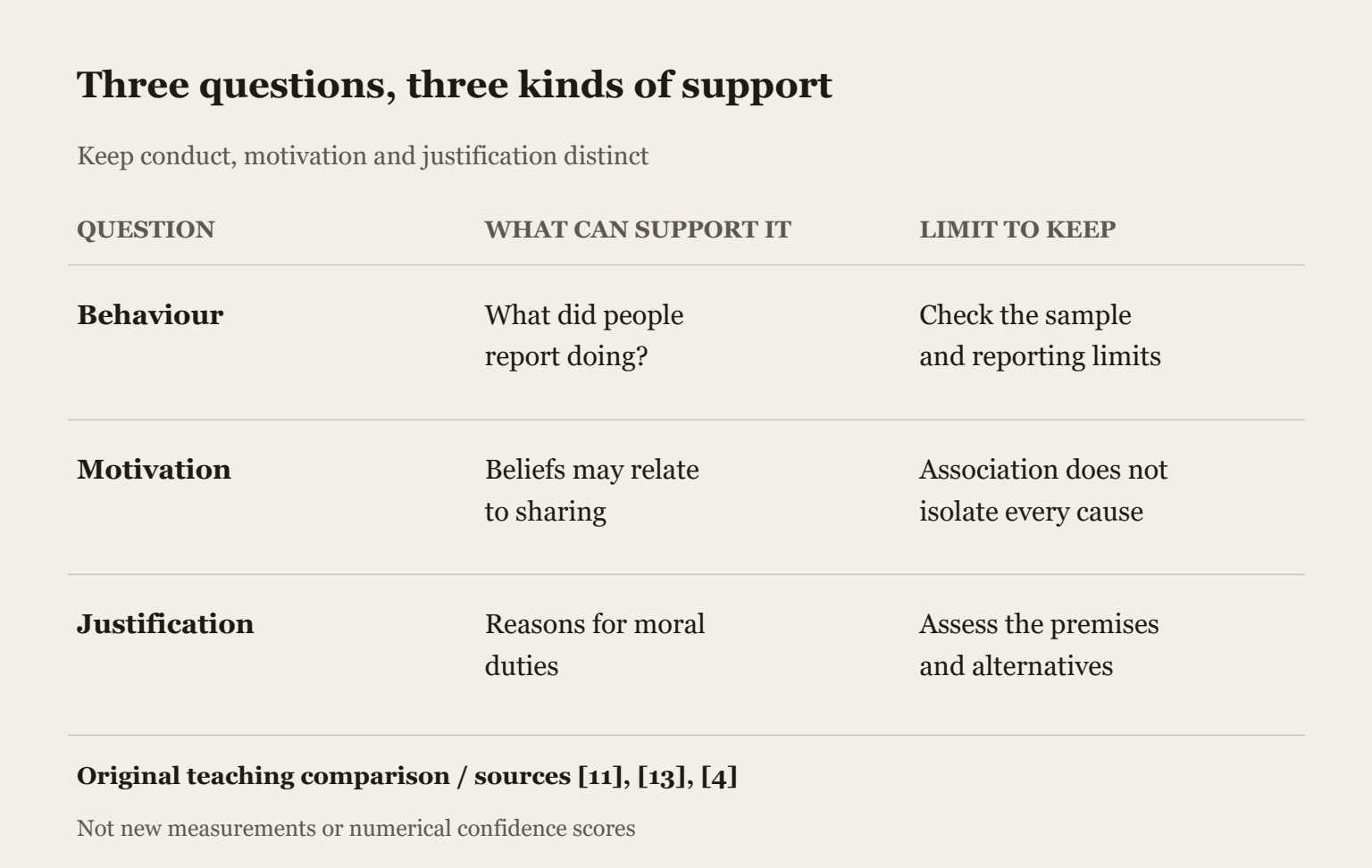
A diary study can inform us about reported conduct. Beliefs and experiments can inform an explanation of motivation, within their design limits. Neither result by itself decides what ultimately makes an action right.
A philosophical argument can propose reasons for moral duties. Its premises still need assessment. The bilingual CSV preserves the three distinctions so a discussion does not quietly change questions.
Open the figure reference table
04The religious argument.
The serious claim concerns a foundation.
A familiar moral argument says: objective moral values and duties exist; they could not exist without God; therefore God exists. Craig offers a case of this kind. He distinguishes valuable things from duties: something may be generous without being an obligation every person must fulfil. [1]
The reasoning has a valid conditional shape. If both starting claims are true, the conclusion follows. The dispute is over those starting claims, especially the claim that God is necessary. A formally valid argument can still depend on a premise it has not adequately established.
The defender may say an impersonal universe cannot issue binding obligations, while a perfectly good creator can. That is more substantial than accusing me of secretly wanting crime. I can ask why a person's suffering or a promise cannot supply reasons without first becoming someone's command.
The defender can also present God as the best explanation rather than the only logically possible explanation. Then we compare explanatory proposals and their costs. An incomplete secular account does not automatically establish divine existence, character, commands and reliable access to those commands.
My short reply is: show why the moral reasons require your proposed source. Naming a possible source does not establish its necessity. Even a successful argument for a moral foundation would need further work to identify a particular religion and certify its books.
05Who needs a lawgiver?
Different kinds of law can have different origins.
Someone says every law needs a lawgiver, so morality needs God. A traffic law is an enacted rule backed by institutions. A scientific law describes a regularity. A moral requirement concerns how we ought to act. The shared word law does not establish a shared origin.
An official can create a legal requirement to pay a fee. That does not mean officials create every reason for helping someone or keeping a promise. Wielenberg challenges the assumption that commands are the only possible source of moral obligations. [4]
Consider a government ordering people to betray an innocent neighbour. Its power explains how the order can be enforced. The moral question is whether anyone ought to obey. If all rightness came simply from whichever authority issued the instruction, criticising that authority would become difficult to explain.
The theist can reply that ordinary rulers lack God's perfect goodness and rightful authority. Fair enough: a divine-command account need not endorse every human order. But now the important work lies in goodness, legitimate authority and reasons for obedience, rather than the word law alone.
My reply is: establish the authority and its moral relevance. Creating something, owning the strongest weapons or being able to punish does not by itself explain a right to mistreat it. A command needs more support than a raised voice and a larger throne.
06Does approval make it good?
An old question still exposes a real distinction.
In Plato's Euthyphro, Socrates asks about piety, meaning holiness or religious rightness, and the approval of the gods. The familiar modern question about morality adapts that dialogue. It is not an exact quotation of a discussion about today's single, perfectly good God. [2]
The adapted question is this: does God command an action because it is good, or is it good simply because God commands it? In the first answer, goodness provides a reason for the command. We can then ask whether understanding that reason requires the command to create it.
In the second answer, the instruction appears to determine the action's moral status. If arbitrary will alone does the work, why could cruelty not become right through a different instruction? The objection concerns what makes the judgement true, not merely how unpleasant I find the possibility.
A careful believer usually rejects the arbitrary-will version. They may distinguish God's essential nature, valuable things and obligations. That reply deserves its own examination. Repeating the two options louder does not refute an account that explicitly challenges how the options were framed.
My reply is: explain the relation between goodness, divine nature and commands. The old dilemma is a useful question, not a magic sentence that ends all religious ethics. I want a defensible explanation, including why a harmful instruction could never receive moral immunity.
07The good-nature reply.
Commands are proposed to express a necessarily good nature.
Craig's answer is that God's nature is necessarily loving and good, while God's commands give us duties. On that view God could not reverse love and hatred at whim. His discussion explicitly rejects an unrestricted divine will that can command absolutely anything. [3]
That blocks a cheap objection. Calling it God's personal opinion does not refute a view about an essential nature. Questions remain: why is this nature goodness's standard, how is that connection supported, and does the proposed being exist?
If love and fairness help me understand why the proposed nature is good, those concepts are doing real explanatory work. Can their moral importance be defended without identifying them with a divine person? The theist may answer that the identification is a basic truth, rather than a definition chosen for convenience.
A basic truth is not automatically circular or false. Secular theories also reach fundamental starting points. We must compare the reasons for accepting them. Adding the word necessarily states that something could not be otherwise; it does not, by itself, demonstrate that status.
Craig also distinguishes God's lack of imposed duties from the goodness of God's character. That makes it especially important to explain difficult alleged commands. My reply is: a theory of perfect goodness must illuminate the cases it is used to defend, rather than merely rename every case good. [3]
08Who gave the instruction?
A good source still needs a reliable route to us.
Suppose, for the argument, that a perfectly good divine source exists. A new question remains: how do I know a particular instruction came from it? A human saying God told me is evidence of the person's claim. It does not independently certify the speaker's access.
The same problem reaches books and interpretations. A passage must be identified, translated and understood. We must distinguish a command from a description, a limited instruction from a universal rule, and a later explanation from the words being explained. Certainty about God does not remove those tasks.
A believer can appeal to a wider case for revelation: historical evidence, experience, arguments and the coherence of a tradition. That can be assessed. The position is stronger than treating every private feeling as unquestionable, but the evidence still has to support the particular authority being claimed.
I can also ask how we recognise a source as morally trustworthy. If the answer uses its compassion and fairness, moral assessment is already involved. This does not prove that God is unnecessary as a foundation. It shows that identifying the foundation is not accomplished by forbidding moral questions. [1][3]
My reply is: take the instruction and the evidence one step at a time. The existence of moral disagreement does not privilege whichever claimant shouts loudest. An alleged instruction to harm someone needs scrutiny proportionate to what is at stake.
09Reason within religion.
Faith also contains arguments about human goods.
Religious ethics is not one theory of blind obedience. Thomas Aquinas's natural-law account connects practical reason with goods such as preserving life and living in society. In that tradition, understanding moral requirements involves reflection on human life, rather than finding a verse for every decision. [25]
The Catholic Catechism likewise says reason can discern good and evil, while grounding natural law in the Creator. It also acknowledges difficulty: people do not perceive all its requirements clearly and immediately, and its account gives revelation and grace further roles. [26]
This matters when someone claims atheists could recognise nothing wrong without reading scripture. Some influential religious accounts already distinguish recognising moral reasons from explaining their ultimate source. I should answer the account actually offered instead of assigning every believer a weaker theory.
I can still question the proposed source, the interpretation of human nature and particular conclusions drawn from it. A tendency being natural does not automatically make acting on it right. Natural-law defenders have fuller accounts of reason and human fulfilment; their actual arguments need evaluation.
My reply is: we can discuss the relevant goods and reasons directly. If we agree that another person's safety and freedom matter, that is usable common ground. Whether those goods ultimately reflect God remains a further philosophical dispute, not a reason to stop helping.
10Why care without a prize?
Helping can have a real cost to the helper.
If I return the wallet, I may lose an opportunity to profit. That does not erase the owner's claim. A reason to respect another person and a guarantee of personal reward are different things. Moral conduct can cost the person doing it something real.
The objection becomes stronger when it asks why I should accept that cost. My answer is that my advantage is not the only thing that supplies reasons. Another person's freedom, suffering and justified expectations have claims on my attention even when exploiting them would be profitable.
A defender of divine accountability may promise that justice and self-interest finally meet. That would matter if established. Wielenberg distinguishes this promised alignment from the existence of moral reasons themselves. Wanting eventual justice cannot, on its own, demonstrate that the universe guarantees it. [4]
Religious motives also include love, gratitude and devotion, not just fear of hell. A person who helps because they love God need not be cynically calculating a reward. Craig himself describes religious moral strength in richer terms, and I should not rewrite every believer's inner life. [1]
My reply is: explain what is owed to the person, then discuss why people are moved to honour it. A decent action can grow from different motives. A threat can produce obedience without settling whether the threatened demand is morally justified.
11What if I do not care?
An unwilling listener challenges every moral outlook.
Someone may say another person's suffering means nothing to them. They want a reason that benefits them personally. I cannot promise every just act makes a selfish person richer, safer or happier. That would be an unreliable sales pitch.
I can explain trust, relationships and mutual protection. But there may be cases where a powerful person can harm someone and escape punishment. If I accept respect only when it is profitable, I have already abandoned the person's claim in precisely the case where protection is most needed.
The religious reply is that nobody escapes God. That introduces a proposed watcher and future judgement whose existence still needs support. It may motivate a convinced believer. It will not compel someone who rejects the premise merely because the possible punishment is frightening.
This separates having a reason from being persuaded or emotionally moved by it. A person can ignore a well-supported reason. If a philosophical argument fails to make an abuser compassionate, that failure is not a discovery that abuse has become harmless or justified.
My practical response includes protection, fair enforcement and institutions that limit power. An ethical argument matters, but victims also need safeguards. I will not make their safety depend entirely on whether a threatening person accepts a sermon or wins an argument about ultimate reality.
12Empathy needs judgement.
Feeling is a starting point for further reasoning.
Empathy means, in one common use, feeling or imagining something of another person's experience. Compassion means concern for their suffering and a wish to help. The words overlap in everyday speech, but neither feeling automatically provides an answer to every difficult moral decision.
Suppose I feel much more for a familiar person than for a stranger facing the same harm. That emotional difference does not, by itself, show the stranger deserves less protection. I need a reason for treating the cases differently. Feeling strongly is not the same as judging fairly.
I also reject making a person's rights depend on their ability to give an impressive speech, feel what I feel or repay my care. Babies, people with substantial disabilities and strangers can have claims on us without passing a test of usefulness or resemblance to me.
The equal dignity affirmed in the Universal Declaration of Human Rights is a public moral commitment, not a laboratory measurement of a substance called dignity. I support it through reasons about vulnerability, equal standing and protection against domination. Stating that commitment openly makes it available for criticism. [30]
My reply is: let concern alert us to suffering, then examine facts, fairness, consent and competing claims. If my sympathy fails today, the other person's need does not evaporate. Ethical reasoning should help correct my selective attention, not merely applaud whatever I happen to feel.
13Cooperation also evolves.
Biological success is different from moral rightness.
Survival of the fittest is sometimes treated as an order to crush the weak. Evolution describes changes in populations; it does not instruct us about who deserves protection. Fitness concerns reproductive success in a setting, rather than a moral rank for the strongest bully.
Cooperation is also a biological problem with studied explanations. Martin Nowak's review sets out models involving relatives, repeated interactions, reputation, networks and groups. Different arrangements can let cooperative behaviour persist under selection. A simplistic picture of solitary competitors misses those mechanisms. [10]
For illustration, helping today may make future mutual help possible. Reputation can affect whom others cooperate with. These examples explain possible advantages. They do not prove every generous act is secretly calculated, or that every society follows one model.
An origin account does not settle a moral judgement. A tendency to favour relatives could help explain behaviour without justifying corruption for my family. Likewise, an evolved capacity for learning can be corrected and extended. Describing where a tendency came from is one task; assessing its reasons is another.
My reply is: evolution gives us ways to investigate cooperation and conflict. It does not prove that everything natural is right, or that moral truth has been disproved. A theological guarantee of reliable moral knowledge would also need evidence rather than being assumed because the natural story is incomplete.
14Watch the helping task.
A controlled task supports a limited conclusion.
Felix Warneken and Michael Tomasello studied 24 children aged 18 months and three young chimpanzees. In the children's tasks, an adult struggled with problems such as retrieving an object. Control situations helped distinguish helping from merely picking up something that had fallen. [9]
For example, reaching for an accidentally dropped object was compared with intentionally discarding it. Children helped in several kinds of task. The chimpanzees showed a narrower pattern, reliably helping with out-of-reach objects. No reward or praise was supplied for helping during these trials.
The chimpanzees had been raised by humans and previously rewarded for handing over objects on request, though not for retrieving the out-of-reach objects used here. This matters. I cannot present them as untouched nature, or say the study removed all earlier social learning.
Nor did the experiment establish that infants are philosophical atheists, prove complete human morality innate, or measure universal moral truth. It identified early helping and some shared capacities in these settings. The small chimpanzee sample also limits generalisation. The original paper explains both the tasks and their limitations.
My reply is: here is a real observation you can inspect, with a comparison condition and a limited conclusion. It challenges a picture in which helping can appear only after understanding a religious command. It does not settle whether a god ultimately designed the capacities involved.
15What did people report?
Keep the sample attached to the finding.
A 2014 study by Wilhelm Hofmann and colleagues followed 1,252 adults in the United States and Canada. Their phones prompted them repeatedly over three days to report recent moral or immoral experiences. The researchers distinguished acts committed from acts witnessed, received or learned about. [11]
In these reports, religious and nonreligious participants did not show a discernible difference in how frequently they committed moral or immoral acts. Independent judges also rated the submitted descriptions. Religious participants reported some different emotional responses, so the result was not that the groups were identical in every respect.
This is evidence against a sweeping claim that nonreligious people simply cannot conduct themselves morally. It is not a census of humanity, a lifelong surveillance record or an experiment that randomly assigned people a religion. Participants could omit or misdescribe events; judges still received descriptions, not direct access to the acts.
No discernible difference in that study does not establish exact equality everywhere. Other measures, populations and situations could produce different results. Inspect those methods instead of replacing a religious stereotype with the claim that atheists always behave better.
My reply is: judge the evidence at the level it measured. This study concerns reported everyday conduct in particular places and times. It cannot decide whether moral facts ultimately depend on God, and it cannot issue a character certificate to the next person I meet.
16Count the helpful effects.
A useful belief still needs evidence of its truth.
Martin Lang and colleagues' 2019 study used interviews and money-allocation games with 2,228 participants across 15 populations. They investigated beliefs about gods who monitor and punish wrongdoing. Some recipients were distant people sharing the participant's religion. [13]
Stronger monitoring-and-punishment beliefs were associated with less local favouritism and more sharing with distant fellow believers in specified comparisons. That matters: religion can be connected with cooperation beyond the immediate family or village. I cannot honestly claim the research shows religious belief never helps.
The treatment of religious outsiders varied between sites. The experimental reminders of moralising gods also did not simply outperform a neutral control in every comparison. The paper separates existing beliefs, experimental reminders and different recipients; compressing all of that into religion makes everyone generous would misstate it.
These were particular games and populations. Existing beliefs were not isolated from every other influence. A supernatural being was not observed allocating money. The study concerns people's beliefs and actions; it does not experimentally confirm the gods' existence.
My reply is: credit a helpful effect where supported, then ask how widely it applies and who receives the benefit. Whether a practice encourages cooperation, whether it is fair to outsiders and whether its theology is true remain separate questions.
17Suspicion is not a crime record.
A judgement about a group does not establish its conduct.
Will Gervais and colleagues studied intuitive moral prejudice in a sample of 3,256 people across 13 countries. Their published abstract reports that extreme moral violations were associated with atheists in most, though not all, of those countries. The tendency appeared among atheist participants too. [12]
That is a finding about judgements and suspicion. It does not show that atheists commit more of those acts. A question about whom people picture as a wrongdoer is different from verified records of who offended. Confusing the two would turn prejudice into alleged evidence for itself.
The study also does not establish that every believer dislikes atheists, or that every country has the same pattern. Its sample and task matter. I should not respond to a broad accusation about my character by making a broad accusation about everyone who prays.
If someone says they instinctively distrust a person who rejects God, I can ask what that particular person has done. Has the person lied, harmed someone or failed a responsibility? Or is a label replacing the evidence that would normally be needed to make that judgement?
My reply is: give individuals the scrutiny their conduct warrants. A stereotype can be widespread and still be a poor guide to a person's character. The question of moral foundations remains available for argument without treating nonbelief as an advance confession of guilt.
18A retracted study is not my winning card.
Evidence does not earn immunity by flattering the conclusion I like.
A 2015 paper reported a negative association between religiousness and children's altruism across the world. Its conclusion attracted attention because it appeared to challenge religious moral superiority. The publication was retracted in 2019. The indexed retraction notice identifies the withdrawn paper. [14]
I will not recycle that original headline as an established result proving religious children are worse. A withdrawn conclusion cannot carry the weight it once appeared to carry. If I want to discuss a revised analysis, I need to identify it and explain what actually survived.
Retraction also does not prove the opposite headline: that religious children are always kinder. Removing a flawed support for one conclusion does not automatically establish its rival. Both conclusions need their own evidence, with their measures and populations visible.
This is what I mean by being rational in practice. My preferred argument must survive the same checking I demand from an apologetic claim. If I quietly keep a useful error after learning about it, my public commitment to evidence is becoming a team slogan.
My reply is: ask for the actual study and check its publication status. Read corrections and retractions as well as the attractive first report. Losing a convenient talking point is a small price for keeping an honest argument.
19How does ought follow?
Evidence informs ethics; the starting reasons also matter.
Suppose an investigation shows a practice causes severe suffering. That establishes something relevant about its effects. To conclude that we should stop the practice, we also use an ethical reason: suffering counts against an action unless sufficiently strong competing reasons justify it.
David Hume drew attention to writers moving from statements about what is to statements about what ought to be without explaining the new step. His original discussion includes religious and human affairs. A divine fact does not escape the need to explain how an obligation follows. [5]
For example, God created me is a claim about a relationship. Therefore I ought to obey every alleged command needs further premises about the creator's goodness, authority and the instruction's authenticity. Stating the first sentence louder does not supply all the missing reasoning.
Secular ethics owes the same honesty. Human wellbeing matters is a value commitment or moral claim needing reasons; it is not a chemical discovered in a laboratory. Once a goal and constraints are defended, evidence can help determine which actions serve them, and reveal consequences we overlooked.
My reply is: make the ethical bridge explicit and examine it. Science is indispensable for many facts about harm and help. It does not relieve us of judging ends, rights and acceptable costs. Acknowledging that limit is part of using science accurately.
20Could a reason exist without a commander?
One nonreligious answer treats some value as fundamental.
A secular moral realist can hold that suffering supplies reasons against causing it, or that people have claims against being used, independently of a divine order. Wielenberg presents an account in which intrinsic goods and bads provide moral reasons and obligations. [4]
Intrinsic here means valuable or bad in itself, rather than only as a means to another end. Food may be useful because it sustains someone. A person's agonising experience can count against causing it without first being converted into a cost paid by an invisible observer.
This is a philosophical proposal, not a new physical measurement. A critic can ask what these moral truths are, why we should believe in them and how we could know them. Answering those questions requires arguments; pointing at suffering does not finish the entire theory.
The theist faces related questions about the proposed divine standard. Neither side can demand an explanation of every starting point while exempting its own starting point from assessment. We should compare explanatory support, coherence and what each account makes us accept.
My reply is: there is a serious alternative to the claim that every binding reason must be an instruction. I need not announce that every dispute in moral realism is solved to reject the claim that atheism logically leaves me with nothing but personal taste.
21Who is helped, and who pays?
The effects extend beyond the convenient first example.
Consequentialist approaches judge actions through their consequences. John Stuart Mill's utilitarianism gives a prominent version: the wellbeing involved should be assessed beyond the chooser's own advantage. His discussion of justice also takes rights and security seriously, rather than dismissing them as irrelevant. [6]
The useful habit is to ask what actually happens. Does a policy prevent suffering, shift it onto people with less power, or merely look generous? My good intentions cannot establish that my plan helps. Evidence about outcomes can force a change of mind.
A hard objection asks whether enough benefits to others could justify violating one innocent person's rights. That is a real challenge. Thought experiments can expose the issue, but estimates should not be invented to make the victim disappear inside a satisfying total.
Defenders can appeal to reliable rules, long-term consequences and the insecurity created when anyone can be sacrificed. Different consequentialist accounts answer differently. Their answers need attention to uncertainty and the people bearing the risk; a slogan about the greatest good cannot do that work alone.
My reply is: calculate honestly where calculation is possible, state the limits and include everyone's losses. This approach contributes a powerful question to moral reasoning. I do not treat it as permission to add up imagined benefits until an act I already wanted becomes acceptable.
22The person has a claim.
A desirable result does not settle every duty.
Duty-based approaches ask what we owe people, including limits that cannot casually be traded away for a useful outcome. Immanuel Kant's formulation asks us to treat humanity as an end, never merely as a means. His lying-promise example explains how deception uses another person's decision for our own purposes. [7]
Merely matters. Paying someone fairly for a freely agreed task can serve my purpose while respecting theirs. Deceiving them about the task or forcing them into it prevents a comparable choice. The question includes their standing as a person, rather than just the efficiency of the transaction.
Consent therefore requires more than finding a convenient yes. Is there a real option to refuse? Is essential information hidden? Is someone exploiting a threat or a dependent position? I cannot turn domination into respect simply by giving the coercion a polite name.
This does not mean one sentence resolves every conflict of duties. We still need to discuss deception to protect someone, competing responsibilities and how to protect people unable to make a particular decision. Invoking duty should sharpen those questions, not conceal them.
My reply is: tell me whose choice, safety or standing your plan overrides, and give the reason. I can learn from Kant's argument without treating him as an atheist spokesman or endorsing every conclusion of his philosophy. A useful argument needs examination rather than ownership by a team.
23Character needs practice.
Repeated choices also shape the person making them.
Virtue ethics focuses on qualities of character, such as honesty, courage and practical wisdom. Aristotle's discussion of habituation explains becoming just through doing just acts. Reading about a quality and practising it are different activities; an admired word does not install a character trait. [8]
Imagine someone who gives impressive speeches about honesty while routinely hiding mistakes. An ethical identity is being announced, but a different habit is being rehearsed. The same problem can occur in a temple, an office or an atheist discussion group. The label cannot repair the repeated act.
Character also needs judgement. Courage is not automatically doing the riskiest thing, and kindness is not always agreeing. Sometimes care requires a firm refusal, admitting a failure or defending someone whose complaint makes my own group uncomfortable.
Virtue language becomes vague unless good judgement is explained in real cases. A leader can train obedience and call it virtue. We still need reasons, evidence about consequences and protection for people questioning the institution's definition of good character.
My reply is: examine the repeated practice, including how a person handles correction and power. Consequences, duties and character ask different useful questions. I can use them together in deliberation without pretending I have fused their competing foundations into a finished universal theory.
24What does disagreement show?
A headcount cannot settle moral truth.
People disagree about moral questions. The easy leap is to say that because they disagree, every answer must be equally valid. Another easy leap says that because many agree, their shared answer must be objectively true. Neither conclusion follows from the headcount alone.
Disagreement can reflect different facts, interests, concepts or starting values. Sometimes clarifying an error changes the judgement; sometimes a deeper disagreement remains. If we cannot resolve everything today, we can still identify contradictions, hidden costs and unequal treatment in a particular argument.
Religion does not automatically resolve disputes about revelation and its application. Secular explanations also leave disagreements. The practical need is for a way to hear reasons, protect dissent and correct harmful decisions.
The Universal Declaration's equal-rights commitments illustrate a shared public standard. Their adoption records a human achievement and a set of obligations to defend; the document is not an experiment proving moral realism. Its principles themselves remain open to explanation and philosophical justification. [30]
My reply is: argue about the case instead of treating disagreement as permission. If you offer a reason to excuse your own group, ask whether that reason would justify the same treatment when your group is the vulnerable one. This test can reveal unfairness without claiming infallibility.
25Context must do real work.
A setting can explain a rule; it still needs justification.
Criticising a religious command requires the passage, an identified translation and enough context to understand its role. Describing a crime differs from permitting it. An isolated slogan can miss that distinction.
Historical context can explain why an institution was familiar and how a law regulated it. That is relevant. But explaining why people accepted an arrangement is different from justifying it as the instruction of a perfectly good source. The question about the source does not disappear inside the word ancient.
I should also state the interpretation being challenged. A reader who treats a rule as limited to a past covenant is making a different claim from a reader defending it as an eternal permission. Whether the text supports that distinction and what justifies the earlier permission remain discussable.
The following cases use Leviticus and Exodus, Qur'anic passages and the Bhagavad-gita. They document teachings in specified translations. They are not a licence to invent one view shared by every Jew, Christian, Muslim or Hindu, or to call every present believer an advocate of the criticised practice. [15][18][22]
My reply is: read the best contextual defence, then ask what has actually been explained. If the defence appeals to compassion, consent or equal worth, examine how those reasons apply to the people living under the rule. The reader's identity must not replace that examination.
26The foreigner is a person.
Read the different protections inside the text.
Leviticus 25:39-55 distinguishes an impoverished Israelite's service and release from the purchase of foreign slaves. Verses 44-46 permit acquiring people from surrounding nations and treating them as inheritable possessions. Reducing that entire passage to a modern voluntary employment contract misses its explicit distinction. [15]
Exodus 21 also contains limits: verse 16 condemns kidnapping, verses 20-21 address beating a slave and the consequence of death or survival, and verses 26-27 provide release for specified injuries. These protections are part of the text. They do not erase the institution of ownership. [16]
A defender can say these laws restrain an existing institution in a particular society. They may distinguish historical forms of slavery and argue for divine accommodation or progressive moral development. Those distinctions can matter without making every form of ownership harmless.
My objection is specific: why is the foreigner's freedom given a different protection, and why should a person be inheritable property at all? If the source is perfectly good, explain why this permission was justified for the person owned. Simply observing that worse practices existed does not finish the answer.
I am not saying every biblical reader must enforce these laws now, or that one paragraph supplies the whole history of Jewish or Christian ethics. I am challenging an identified permission and the claim that calling its source divine settles its moral justification.
27Include religious reformers.
Their actual arguments are part of the evidence.
The New Testament provides material used in a different direction. Philemon appeals for Onesimus to be received as a beloved brother, while Galatians 3 speaks of unity in Christ across slave and free. These passages have theological settings; neither is a modern legislative code abolishing every form of slavery. [17]
A defender can argue that this moral direction undermines ownership and supports later abolition. That argument deserves discussion, rather than dismissal through another isolated verse. It also needs to explain the relation between spiritual equality, actual freedom and the earlier permissions under examination.
Frederick Douglass's own appendix to his Narrative sharply distinguishes the Christianity he supports from the slaveholding religion he condemns. His criticism is morally fierce and religiously expressed. Turning him into evidence that every opponent of slavery rejected religion would falsify his stated position. [29]
This does not prove divine authorship of the Bible. It shows why assigning every oppression to religion and every reform to nonbelief is historically inadequate. Recognising religious contributions does not exempt texts or institutions from criticism.
My reply is to credit reform and examine why it is right. If freedom and equal standing justify rejecting ownership, apply those reasons consistently. A humane interpretation needs its argument defended; the holy cover cannot settle it.
28Freedom and ownership.
Keep both the encouragement and the permission visible.
Qur'an 23:1-11 praises prayer, charity and keeping trusts. Its sexual rule also distinguishes spouses and people described through possession by the right hand. The Sahih International translation retains that ownership category. Discussing the passage requires acknowledging it rather than quietly replacing it with ordinary paid employment. [18]
Other passages encourage freeing people and supporting those in need. Qur'an 90:8-18 makes freeing a slave part of its difficult moral path. Verse 24:33 addresses contracts for eventual emancipation, with a stated condition, and condemns compelling slave women into prostitution. These are real parts of the evidence. [19][20]
A defender can read this as a reforming direction toward freedom in an already slaveholding world. That is stronger than saying the text values no freedom at all. My question remains why retaining ownership was morally justified, including the dependency and power imbalance experienced by the person owned.
A permission is not proof of free consent. Nor does it establish that every modern Muslim supports slavery or sexual coercion. The text, historical interpretation and a present person's beliefs need separate assessment.
Qur'an 4:135 demands justice even against oneself or relatives. I can endorse that demand for fair dealing while questioning the claim that a divine source guarantees every related institution. My reply is: apply the reasons for justice to the enslaved person too, and explain any exception. [21]
29What does the category allow?
Separate work, inherited status and equal standing.
Bhagavad-gita 18:41-48 assigns different work to brahmanas, kshatriyas, vaishyas and shudras, with service assigned to shudras. It connects these differences with qualities arising from nature and urges performing one's own work. This is more specific than a generic instruction to be kind. [22]
A serious reply points to 4:13, which relates the divisions to qualities and work, and 5:18, which describes the wise person's equal vision. Those passages matter. They prevent me from pretending that these selected verses explicitly say every later inherited caste restriction is compulsory. [23][24]
My question is about what a proposed interpretation permits: can a person choose an occupation, question an assigned role and retain equal standing? Organising work is one thing; fixing rights or worth by birth is another. A divine label does not remove the need to justify the restriction.
Ambedkar's Annihilation of Caste directly challenges the sacred authority that protects caste. His argument cannot be reduced to a harmless disagreement over job descriptions. Nor should I enlist him as an atheist spokesman merely because this particular criticism supports a point I make. [32]
My reply is: specify whether you defend voluntary work, a spiritual classification or inherited social control. Then justify its effects on the person classified. Equal spiritual language must be connected to actual treatment; a critic must also establish the interpretation being criticised instead of substituting a convenient one.
30The minority still has rights.
A protection needs reasons and effective institutions.
The Universal Declaration of Human Rights rejects slavery and affirms freedom of thought, conscience and religion. India's Constitution abolishes untouchability in Article 17. These are identifiable public texts expressing standards; they are not discoveries made by extracting morality from a rock. [30][31]
I support such protections because a person's freedom should not depend on pleasing the dominant community. The same demand protects a believer facing an atheist state and a nonbeliever facing religious power. It loses its point if I defend it only when my own side needs shelter.
A majority vote can establish a decision-making result. It does not by itself justify every decision. If a crowd votes to make another group property, the crowd has increased the danger rather than supplied a sufficient moral reason. Institutions need limits that protect people against that use of power.
These documents do not establish that every signer agreed on the ultimate source of rights, or that governments always honour the promises. Believers and nonbelievers can defend a shared protection for different deeper reasons. Agreement on a rule need not settle all the philosophy beneath it.
My reply is: give reasons people can examine, hear those bearing the cost and build correction into the system. I want freedom of belief protected in practice. Criticising a religious proposition does not justify coercing its followers into my own position.
31State atheism can oppress.
The history must stay visible in the argument.
When someone raises Stalin, the answer cannot be that nonbelief had nothing to do with any Soviet persecution. The Library of Congress's archival exhibition describes an ideological aim to eliminate religion, the promotion of atheism and attacks on religious institutions and believers. That anti-religious purpose matters. [27]
The exhibition also describes concentrated party power, secret police, forced labour and repression under Stalin. State interests shaped religious policies. This is ideology operating through coercive institutions, not a one-word experiment in whether God exists.
Atheism supplies no complete political programme. It does not logically require secret police, suppressed religious gatherings or surrendering rights to a party. That point must not become an excuse to deny the wrongs committed by officially atheist movements.
To assess causation, examine the actual policy, justification, machinery and people targeted. Listing Stalin, Mao and Hitler together does not make their histories interchangeable. Nor does blaming everything on generic human badness explain why a particular regime selected religious people for persecution.
My reply is: condemn the documented abuse and protect the freedom it violated. It does not follow that disbelief makes everyone cruel, that all political ideologies are equivalent, or that a god exists. An atheist outlook still needs ethical commitments and restraints on power; nonbelief cannot supply those automatically.
32Read the historical record.
A label cannot explain a dictatorship.
The Nazi Party's 1920 programme makes explicit racial exclusions. Its point 24 also invokes positive Christianity and allows religious denominations only under conditions tied to the state and its racial outlook. That document complicates presenting Nazism as a straightforward manifesto of ordinary atheism. [28]
It does not establish Hitler's private convictions at every point in his life. A party programme is a public political text, with persuasive purposes. Nor does the Christian label in it demonstrate that all Christian teaching entails the Nazi programme or that every Christian supported it.
The responsible question asks how particular ideas, decisions and institutions contributed to specific acts. A label alone can hide that work. Public religious language may matter, racial ideology may matter, and coercive power may matter; assigning a percentage without a method would merely decorate a guess.
The same standard applies when an atheist uses a religious atrocity as a universal character judgement. Sharing one belief with a wrongdoer is insufficient to share every commitment that produced the wrong. Conversely, claiming a peaceful identity does not immunise harmful teachings from investigation.
My reply is: show the relevant causal connection. Then assess the act and its justification. Historical wrongdoing can expose dangerous doctrines and institutions. It is not a shortcut from a villain's label to the truth or falsity of an entire account of the universe.
33Here is my short answer.
Clarify which question the other person is asking.
My short answer would be: I have reasons to care about harm, freedom, honesty and fairness. I can act on them without believing in God. If you mean that these reasons cannot ultimately exist without God, explain that further premise. My behaviour and morality's foundation are different questions.
If the answer is that a law needs a lawgiver, ask whether moral reasons work exactly like government regulations. If the answer is God's good nature, discuss that stronger proposal. Neither a generous atheist nor a corrupt priest, taken alone, resolves that philosophical disagreement. [1][4]
If someone says I would commit crimes without fear of hell, ask for evidence about my actions. Then explain a case involving another person's claim, such as returning the wallet. This is a practical illustration of reasons, not a scientific experiment proving the universe's ultimate moral structure.
If they cite a study, read its method and status together. If they cite a verse, read the passage and interpretation together. If they cite a dictator, inspect the specific history. Keep one claim visible long enough to assess it before a new accusation changes the subject.
I would finish by asking what evidence or argument could change either person's view. A debate becomes useful when both sides can state the other's actual position and identify a possible correction. Humiliating someone is not evidence that I have explained the issue accurately.
34What would change my mind?
A revisable position can still make a firm moral commitment.
I would take a stronger case for a divine moral foundation seriously: evidence for the being, an intelligible connection to goodness and obligation, and a reliable way to identify its relevant instructions. Demonstrating one part would not automatically complete the rest of that chain.
I would also revise a particular secular judgement if its facts were wrong, its reasons inconsistent or its protection unfair. A policy I expect to help may fail. Someone affected may identify a cost I ignored. Listening to that correction is part of responsibility rather than a betrayal of nonbelief.
I do not need to pretend every moral foundation is settled before condemning slavery, coercion or abuse. I can give reasons, examine objections and cooperate with others to prevent harm. Acknowledging philosophical uncertainty does not require treating every proposal as equally defensible.
Nor will I treat religious people as lesser citizens because I reject their claims about gods. Freedom of conscience would be hollow if it existed only for people who reach my conclusion. I defend the protection while retaining the right to criticise ideas and institutions. [30]
My reply is: show me better evidence and better reasons. Until then, I intend to consider consequences, respect people's claims and correct my failures. A label cannot do that work for me. Neither can an unanswered question about the universe relieve me of the work within reach.
NoteMy label cannot do the good for me.
Lovepreet Singh / responsibility starts with the person affected.
I wrote this part because a question about morality often becomes an accusation before an argument begins. I want the accusation replaced by an identifiable claim, a reason and a fair test.
My atheism supplies no certificate of character. I can make excuses, ignore suffering or protect my own group. When I do, another person's religious belief does not make the criticism less valid.
I read arguments, specified religious passages and original research within their stated limits. Behavioural findings are evidence about behaviour. They do not settle every philosophical question about what makes something right.
I remain unconvinced that a divine command is the only possible source of moral obligation. Calling an instruction holy does not finish its justification. The person who must live with its consequences deserves an answer.
For now, I will defend freedom, take harm seriously and accept correction. I want those commitments judged through what I do. A good argument matters. So does returning the wallet when nobody is watching.
SourcesFollow the evidence.
These sources do different jobs. Philosophical texts supply arguments, not experimental verdicts. Research measures specified behaviour or judgements in specified samples; it does not settle every question about moral truth. Religious passages document teachings in identified translations, with context and serious interpretive replies retained. Historical documents require attention to ideology, institutions and causation. Public rights texts state standards rather than proving their ultimate foundation. Relevant passages were checked within the stated access limits, including an original retraction record. No personal replication, complete reading of every book, numerical probability of God or universal moral ranking of religious groups is claimed. Checked 17 October 2026, India.
[1] Can We Be Good without God?
William Lane Craig, original essay, Reasonable Faith.
Primary defence distinguishes moral behaviour, knowledge, objective values, duties and accountability. Its concessions about decent nonbelievers are retained. The necessity of God is assessed as an argued premise, not an observed scientific result.
[2] Euthyphro
Plato; Benjamin Jowett translation, Internet Classics Archive, MIT.
Relevant dialogue on piety and the gods' approval read. The modern question about moral goodness is explicitly an adaptation, not an exact quotation about a single contemporary conception of God.
[3] What Could God Not Have Commanded?
William Lane Craig, question 523, 24 April 2017, Reasonable Faith.
Original reply rejects unconstrained divine whim, distinguishes a necessarily good nature from commands and discusses God's lack of imposed duties. That stronger position is assessed without claiming it permits arbitrary hatred.
[4] The Moral Argument for God's Existence; or, How I Learned to Stop Worrying and Love Godless Morality
Erik J. Wielenberg, The Philosophers' Magazine 86 (2019), 93-98. DOI: 10.5840/tpm20198669.
Original author argument read; DOI and identity checked. Presents intrinsic value, reasons and obligations without a divine commander. An argued position rather than consensus or an experiment. Its personal biography is not assigned to this book's author.
[5] A Treatise of Human Nature, Book III, Part I, Section I
David Hume; Project Gutenberg text, ebook 4705.
Relevant passage on the unexplained move from is/is not to ought/ought not read with its surrounding discussion. Used to require an explicit ethical step, not to claim empirical knowledge can never inform ethics. No complete reading of the book is claimed.
[6] Utilitarianism, Chapters II and V
John Stuart Mill; Project Gutenberg text, ebook 11224, from the 1879 seventh edition.
Relevant account of the happiness principle, rights, justice and security inspected. Consequentialism is not reduced to the chooser's pleasure or a command to ignore rights. Not an endorsement of every argument in the book.
[7] Fundamental Principles of the Metaphysic of Morals, Second Section
Immanuel Kant; Thomas Kingsmill Abbott translation, Project Gutenberg ebook 5682.
Relevant humanity formulation and lying-promise application read. Never merely as a means is distinguished from never participating in useful cooperation. Kant is not presented as an atheist spokesman or a complete solution to every conflict.
[8] Nicomachean Ethics, Book II
Aristotle; W. D. Ross translation, Internet Classics Archive, MIT.
Primary account of habituation and practising virtue. The chapter draws a practical question from it without endorsing every view of Aristotle or equating repetition alone with justified virtue.
[9] Altruistic Helping in Human Infants and Young Chimpanzees
Felix Warneken and Michael Tomasello, Science 311 (2006), 1301-1303. DOI: 10.1126/science.1121448. Public original-paper reprint.
Original three-page paper read. Twenty-four 18-month-old children and three human-raised chimpanzees; task/control distinctions and training limits retained. No claim that the study establishes philosophical atheism, complete innate morality or universal moral truth.
[10] Five Rules for the Evolution of Cooperation
Martin A. Nowak, Science 314 (2006), 1560-1563; public author manuscript. DOI: 10.1126/science.1133755.
Original review's mechanisms and relevant modelling discussion read. Fitness explanations are distinguished from ethical permission and from a complete history of every human action. No independent mathematical or empirical replication claimed.
[11] Morality in everyday life
Wilhelm Hofmann, Daniel C. Wisneski, Mark J. Brandt and Linda J. Skitka, Science 345 (2014), 1340-1343. DOI: 10.1126/science.1251560. Public original-paper reprint.
Original report read within a five-page reprint containing adjacent material. Repeated reports from 1,252 US/Canadian adults over three days, plus ratings of descriptions. Observational, with reporting and sample limits; a null difference is not proof of exact universal equality.
[12] Global evidence of extreme intuitive moral prejudice against atheists
Will M. Gervais and colleagues, Nature Human Behaviour 1, 0151 (2017). DOI: 10.1038/s41562-017-0151.
Public original abstract and figure captions read; full article access is not claimed. The 3,256-person, 13-country judgement finding is not a measure of actual offending. The 2018 correction adds a funding acknowledgement; no personal reanalysis claimed.
[13] Moralizing gods, impartiality and religious parochialism across 15 societies
Martin Lang and colleagues, Proceedings of the Royal Society B 286 (2019), 20190202. DOI: 10.1098/rspb.2019.0202.
Original methods/results/discussion inspected: 2,228 participants, money-allocation games and interviews. Existing beliefs, experimental reminders, distant fellow believers and outgroups are distinguished. Site variation and control comparisons prevent a universal causal claim.
[14] Retraction Notice: The Negative Association between Religiousness and Children's Altruism across the World
Jean Decety and colleagues, Current Biology 29 (2019), 2595. DOI: 10.1016/j.cub.2019.07.030; PubMed 31386841.
Public indexed retraction record and original bibliographic identity checked after a minimal direct response. Establishes the 2019 withdrawal of the identified 2015 paper. No full-notice statistical explanation, raw-data reanalysis or proof of the opposite conclusion is claimed.
[15] Leviticus 25:39-55
King James Version; Bible Gateway.
Full selected primary passage read. Israelite service/release and acquired foreign slaves/inheritance are distinguished. The argument does not silently equate every ancient institution with the Atlantic system or every modern believer with its defender.
[16] Exodus 21:12-27
King James Version; Bible Gateway.
Selected primary context includes kidnapping, beating, death/survival and release for specified injuries. Limits on mistreatment are retained rather than edited out. Historical regulation is distinguished from sufficient moral justification of ownership.
[17] Philemon 1:8-21 and Galatians 3:26-29
King James Version; Bible Gateway.
Both passage blocks read, not only the first. Fraternal appeal and unity in Christ are kept in their theological settings. An argument for an emancipatory direction is distinguished from an explicit modern universal abolition statute.
[18] Qur'an 23:1-11
Sahih International translation; Quran.com legacy text.
Selected passage read with its prayer, charity, trust and sexual-rule context. The possession category is not silently changed into employment. It is not treated as evidence that every contemporary Muslim supports slavery or coercion.
[19] Qur'an 90:8-18
Sahih International translation; Quran.com legacy text.
Primary passage on the difficult path, freeing a slave, feeding people, faith, patience and compassion. These positive prescriptions are retained alongside the ownership question rather than omitted to strengthen a criticism.
[20] Qur'an 24:33
Sahih International translation; Quran.com legacy text.
Full selected verse read. Emancipation contracts retain the stated condition; coercion into prostitution is distinguished from the separate sexual-status passage. No claim that one verse exhausts Islamic law or proves free consent in every ownership relationship.
[21] Qur'an 4:135
Sahih International translation; Quran.com legacy text.
Primary demand for justice even against oneself and relatives, including rich/poor distinctions. Recognising a defensible principle does not independently establish the whole text's divine authorship.
[22] Bhagavad-gita 18:41-48
Vedabase, Bhaktivedanta Book Trust English chapter 18, numbered verse translations.
Relevant numbered translations read through verse 48 and nearby context. Work, qualities, service and one's own duties are assessed without asserting that these verses explicitly command every later hereditary caste restriction.
[23] Bhagavad-gita 4.13
Vedabase, Bhaktivedanta Book Trust English edition.
Verse translation distinguishes qualities and work. Its relation to the later purport and to contested interpretations of caste is not collapsed into one universal Hindu position.
[24] Bhagavad-gita 5.18
Vedabase, Bhaktivedanta Book Trust English edition.
Verse translation's equal vision is retained as a serious reply. Spiritual vision, interpretation and actual social freedom remain distinct questions. The purport is not presented as the words of the verse itself.
[25] Summa Theologiae I-II, Question 94, especially Article 2
Thomas Aquinas; English Dominican Fathers translation, New Advent.
Relevant natural-law account of practical reason and inclinations read, with theological commitments retained. It is not reduced to obeying isolated verses, or presented as secularism simply because it uses reason.
[26] Catechism: The Natural Moral Law, 1954-1960
Catechism of the Catholic Church; official Vatican English text.
All specified paragraphs read: reason, Creator, universality, application and the stated role of grace/revelation amid difficulty. Recognition of moral claims is distinguished from their proposed divine foundation.
[27] Revelations from the Russian Archives: Internal Workings of the Soviet Union
Library of Congress archival exhibition, especially Anti-religious Campaigns and sections on repression and state power.
Relevant institutional history and document context read. Official anti-religious aims, propagation of atheism and persecution are acknowledged. No invented death total or single-factor explanation of every Soviet policy is offered.
[28] NSDAP Party Program (1920)
Primary political document, German History in Documents and Images, German Historical Institute; edited English translation, points 4 and 24 among the relevant text.
Original public programme read. Racial exclusion and conditional religious freedom accompany its positive-Christianity language. This does not independently reveal Hitler's private convictions or demonstrate that all Christians supported Nazism.
[29] Narrative of the Life of Frederick Douglass, Appendix
Frederick Douglass, 1845; Project Gutenberg ebook 23.
Relevant original appendix read. Douglass's explicit distinction between the Christianity he endorses and slaveholding religion is preserved. Neither the complete history of abolition nor atheism for every reformer is inferred from it.
[30] Universal Declaration of Human Rights
United Nations, official text; especially Articles 1-5 and 18.
Primary public rights commitments read. Equal dignity, rejection of slavery and freedom of conscience are normative standards, not experimental confirmation of moral realism or proof of perfect governmental compliance.
[31] Constitution of India, Article 17
Government of India, Ministry of Law and Justice; 2024 English-Malayalam second diglot edition, English printed page 8 / PDF page 68.
Official PDF retrieved and the English Article 17 passage checked. Its prohibition of untouchability is the specific claim used, not a complete account of constitutional law. Failed exploratory India Code/MEA routes are not counted as the final text.
[32] Annihilation of Caste, Sections XX-XXI and XXIV
B. R. Ambedkar, in Dr. Babasaheb Ambedkar: Writings and Speeches, Volume 1; relevant printed pages 69 and 78.
Public indexed primary passages on the authority and sacred status protecting caste read after direct PDF timeouts. No complete-volume reading is claimed. Ambedkar's stated criticism is retained without labelling him an atheist to recruit him for this chapter.