

01Which part of me is me?
Memory makes the question about a soul harder.
Imagine that someone you love can still speak, laugh and hold your hand, but cannot remember meeting you yesterday. This is an example, not a diagnosis. The question is uncomfortable: if their memories change, what exactly remains unchanged inside them?
Someone might answer, 'Their soul.' I understand the comfort in that answer. But comfort and explanation have different jobs. Does soul mean their dignity, their awareness, their personality, or an invisible person who remembers everything even when the brain cannot?
Those claims need different kinds of support. I can insist that someone deserves care without claiming to have detected an immortal object inside them. I can acknowledge an experience without accepting every explanation attached to it.
My starting point is that our ordinary mental lives are deeply dependent on the brain. Memory research provides concrete reasons for taking that dependence seriously. I will examine those reasons without pretending that one damaged brain settles every question about reality. [5][6]
My position is straightforward: I do not have a good evidential reason to believe in a separate, immortal owner of my mind. I also do not have a completed explanation of consciousness. An unanswered question is a reason to investigate, not a licence to invent the answer.
02What is consciousness?
Wakefulness, experience and reporting are different.
Sometimes conscious means awake rather than asleep. Sometimes it means having any experience at all: pain, a colour, a dream or a feeling. Sometimes it means being able to use information to answer a question or guide a deliberate action.
Self-awareness adds another question: do I recognise an experience as mine, think about myself, or understand that other people see me too? These abilities need not always arrive or disappear together. A debate becomes confused when a speaker quietly changes meanings halfway through.
A sleeping person can dream. A person unable to move can sometimes follow instructions through measurable brain activity. Therefore open eyes, movement and a spoken answer are useful evidence in context, but none is a complete definition of experience. [9][10][11]
For this chapter, mind is a practical name for processes such as experiencing, remembering, feeling and deciding. Brain names the living organ involved. Naming the two does not, by itself, prove that they are two separable substances, just as naming a dance and a dancer does not establish two independent bodies.
When I ask whether consciousness needs a soul, I mean whether experience requires an additional nonphysical subject that can exist independently of the functioning brain. If someone means something else, I want that meaning stated before we start offering proof.
03What does soul mean?
A metaphor is different from a claim about reality.
If someone says a song has soul, they may mean it feels sincere. If they say every person has a soul, they may be expressing dignity. These uses do not establish a surviving, invisible mind. I do not object to a metaphor simply because it is not an anatomical description.
Religious claims can go much further. Bhagavad-gita 2.20 describes the self as unborn and undying, surviving the body's destruction. The identified translation and commentary represent a particular devotional tradition; Hindu philosophies do not all explain self and mind in the same way. [1]
Qur'an 17:85, in Sahih International, answers a question about the spirit or soul by referring it to the Lord's affair and limited human knowledge. The Arabic ruh has interpretive complexities. This verse is not a detailed experimental model of memory or a universal definition of every Islamic account. [2]
The Catholic Catechism describes body and spiritual soul as profoundly united, calls soul the body's form, and teaches its immortality. Reducing that account to a little ghost operating levers would misrepresent the claim. A sophisticated claim can still be questioned. [3]
My challenge is not 'your vocabulary sounds strange.' It is: what does this claim explain, what supports it, and what would count against it? A passage establishes that a tradition teaches something. Whether that teaching describes reality remains a further question.
04The main positions
Atheism does not select a complete theory of mind.
Substance dualism says mind and body are fundamentally different kinds of thing. Descartes argues for a real distinction, but also emphasises their intimate union in ordinary life. His actual position deserves examination, rather than a cartoon made easy to defeat. [4]
Physicalism says mental reality is physical or depends on the physical without an extra nonphysical substance. Different physicalists disagree about reduction, explanation and the best model. This is broader than imagining thoughts as tiny solid objects rolling around inside the skull.
Property dualism distinguishes kinds of properties rather than necessarily proposing two independent substances. Other accounts treat experience as fundamental, or regard mental and physical descriptions as aspects of a deeper reality. Chalmers explores a nonreductive option; naming it does not establish it. [18]
Atheism concerns belief in gods. It does not logically require me to settle every dispute about consciousness first. Equally, rejecting physicalism would not automatically establish a creator, an immortal personality, a judgement day or the authority of one religious book.
I favour explanations that connect mental capacities to the brain and survive testing. That is a reasoned working position. I will not disguise it as a laboratory certificate saying that every possible metaphysical alternative has been eliminated.
05No tiny person inside
A network can work without a smaller person inside it.
Think about reading this sentence. You recognise marks, connect them to words, hold earlier words in mind and work out a meaning. Describing these jobs does not yet solve consciousness, but it shows why 'the brain is a lump of meat' is an inadequate description of its organisation.
Neurons are cells that communicate through electrical and chemical processes. A network means connected cells whose interactions matter. Different regions participate in different functions, with connections allowing information to be combined. A region's involvement does not mean it performs its entire job alone.
When memory changes after injury, or a drug alters responsiveness alongside brain activity, we get clues about how those functions depend on physical conditions. These clues are more informative than simply weighing a brain or staring at its colour. [5][8]
I do not expect to open a skull and find a tiny picture of a thought labelled 'Tuesday.' A description at one level need not resemble what it explains at another. Music does not look like the movement of a speaker, although the speaker's movement matters to the sound.
That analogy explains a mistake in expectations; it does not prove that brains produce experience exactly as speakers produce sound. The evidence must do the proving. An illustration should help us understand a claim without secretly taking the place of its support.
06Change and compare
Correlation and intervention give different clues.
If two things change together, they are correlated. Ice-cream sales and swimming accidents may both rise in hot weather. That does not make an ice cream a swimming hazard. Another factor can influence both observations.
In brain research, a correlation between activity and a report does not by itself establish that the activity creates the experience. It might reflect preparing a response, noticing a stimulus, or remembering what happened. Researchers must separate these possibilities through design and comparison.
Intervention means changing a relevant condition and observing what follows. Purdon's team varied propofol while measuring EEG and auditory responses. Casali's team stimulated cortex and measured the complexity of its response. These are different ways of probing dependence rather than merely collecting opinions. [8][12]
Controls matter: compare conditions, repeat measurements, check other explanations and specify what was measured. Injury studies bring real-world evidence but cannot ethically assign people random brain damage. Drugs can affect several processes at once. Every method has limits.
My case therefore depends on converging evidence: different approaches connecting particular mental functions to brain conditions. This strongly supports brain dependence. Moving from dependence to a complete account of what experience ultimately is requires further argument.
EvidenceWhat does the observation establish?
Keep a measured capacity, its supported inference and the remaining question apart.
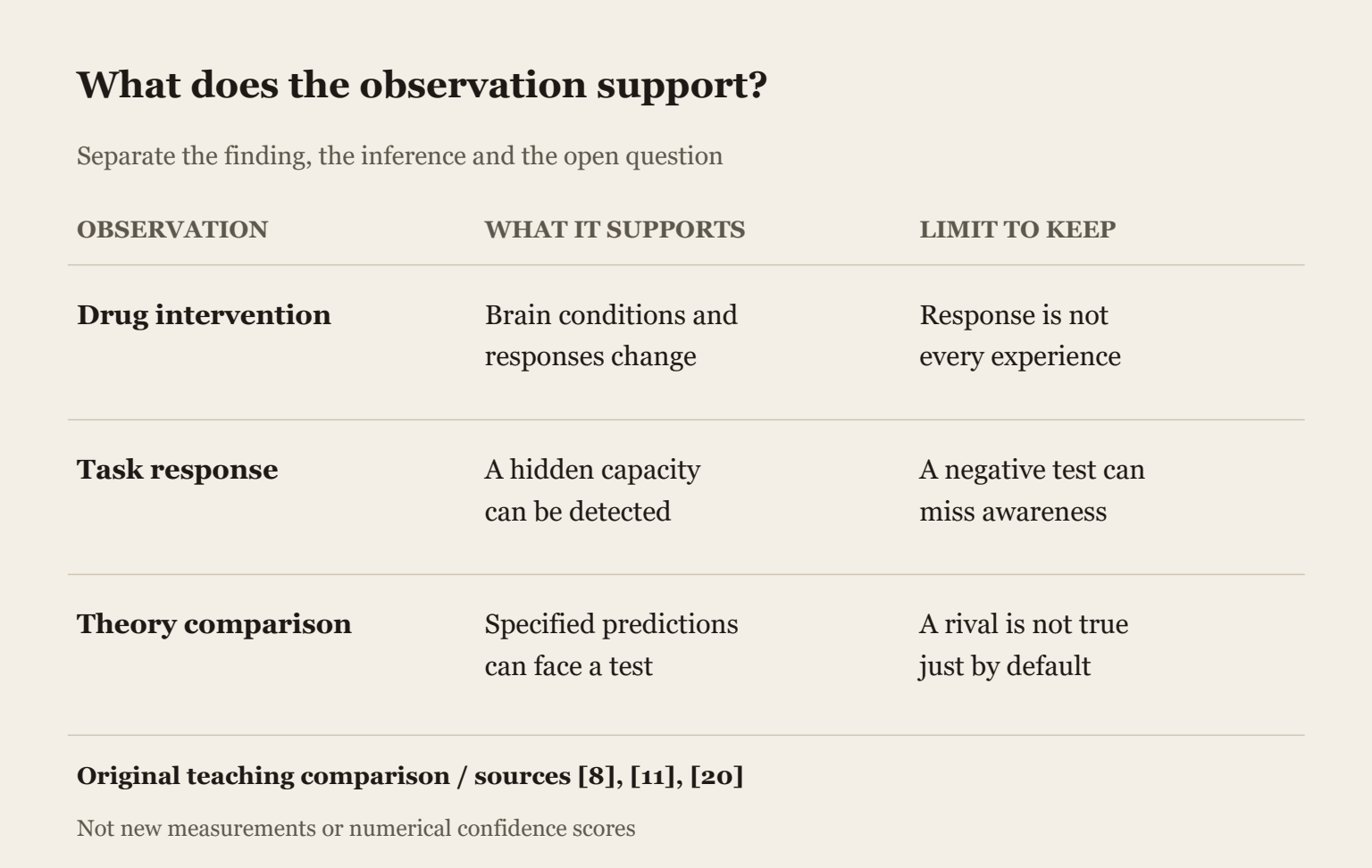
A drug-related change supports a relationship between brain conditions and measured responsiveness. A task response can reveal a capacity missed at the bedside. A theory test evaluates specified predictions; it does not test every imaginable explanation at once.
These findings do not have identical meanings. The bilingual CSV records the distinctions and their limits. The question of what experience ultimately is still requires an explanation; it cannot be settled by renaming every unknown a soul.
Open the figure reference table
07The day would not stay.
H.M. could think, but new experience would not stay.
In their 1957 report, William Scoville and Brenda Milner described profound memory problems after bilateral medial temporal surgery. Bilateral means on both sides. Their patient H.M. had undergone surgery for severe seizures. The damage involved more than one neatly isolated structure. [5]
He could converse and reason, yet could not retain many everyday events. The report describes his eating a meal in front of Milner and later being unable to remember having eaten it. This was a specific failure of memory, not the disappearance of every mental ability.
The researchers compared cases with different surgical extents. Their discussion recognised uncertainty about the exact tissue removed and the contributions of nearby regions. The evidence did not justify saying that one small structure stores every memory like a single cupboard.
Nevertheless, the pattern matters. Change particular brain structures and an important part of a person's continuing mental life can change profoundly. My imagined hidden memory-owner has not been independently detected simply because I give the remaining person the name soul.
A dualist can answer that the soul needs the brain to express or access memory. That reply is possible; I will examine it. It also accepts the dependence that the evidence demands and adds another claim whose support still needs to be shown.
08Different kinds of memory
Doing better is not the same as recalling practice.
Imagine improving at a movement while being unable to tell a normal story about practising it. That distinction helps explain why memory cannot sensibly mean one all-or-nothing power. Knowing how and remembering an event need not fail together.
Suzanne Corkin's 1968 study examined selected motor skills in a severely amnesic man after bilateral medial temporal surgery. He improved across sessions on the tested tasks, and retained improvement on the task retested several days later. The public original abstract supplies this limited finding. [6]
This was not a demonstration that every kind of learning was normal. His performance was worse than age-matched men on two tasks. A striking preserved ability should not erase the impairment surrounding it, or become a claim about every person with memory loss.
For me, the important lesson is organisation. A whole person can contain capacities that dissociate: one damaged, another partly preserved. This makes more sense of the observations than treating the mind as a single indivisible container in which all remembering must work together.
It does not logically disprove every soul theory. A sufficiently detailed soul theory might accommodate these distinctions. But accommodating a result after it happens is weaker than explaining why those particular capacities should separate and predicting a new result before seeing it.
09Choices and character
Understanding and using a rule are different abilities.
We often assume that someone who can explain a rule must be able to use it normally. Brain research challenges that assumption. A person may retain ordinary intellectual abilities while struggling with the choices through which other people come to know their character.
Bechara and colleagues reported decision-making problems after damage involving the ventromedial prefrontal cortex. In a task involving uncertain rewards and punishments, affected patients favoured immediate prospects despite later costs. I rely here on the original public abstract, not an independently inspected full dataset. [7]
This is evidence about a specified decision task and the clinical problem motivating it. It is not permission to diagnose a stranger, predict that every frontal injury makes someone cruel, or claim that moral responsibility can be read from a coloured brain picture.
The question for a simple soul theory is serious: if an unaffected inner person is doing all the deciding, why should damage to particular brain systems alter how future consequences guide the visible decision? 'The body is damaged' names the difficulty without yet explaining its pattern.
I do not need a sensational retelling of Phineas Gage to make this point. The better argument is the specific relationship between a tested capacity and its brain conditions. A careful result survives more scrutiny than a famous story inflated beyond its records.
10The person still matters.
Brain dependence is compatible with love and dignity.
Suppose someone loses a memory, becomes confused or needs help making decisions. Their difficulty does not turn them into an object. It gives other people more reason to take their needs, history and remaining choices seriously.
My commitment to their dignity is an ethical commitment. It does not wait for a scientific instrument to find a soul. A person who cannot tell me their life story can still be someone to whom I owe patience, comfort and protection.
Personal identity is partly a philosophical question: what makes someone the same person across time? Continuity of body, memory, relationships and psychological life can pull in different directions in imagined cases. Saying 'same soul' offers an answer only if we can explain how that identity is established.
If we define the soul as something that keeps every memory perfectly while none of those memories can be accessed, the definition may preserve a hope. It does not provide independently checkable evidence that the hidden record exists. The clinical evidence concerns the capacities we can investigate. [5][6]
I can reject an unsupported explanation while caring deeply about the person it tries to protect. My argument is directed at claims about reality. It is not a ranking of people by memory, intelligence, independence or religious belief.
11A drug changes the brain.
A physical intervention can change responsiveness.
Anesthesia matters because it lets researchers study changes over time under controlled conditions. I am discussing evidence, not suggesting an experiment for anyone to perform. General anesthesia is specialist medical care, and different drugs and situations must not be treated as interchangeable.
In a 2013 study, Purdon and colleagues gradually increased and decreased propofol in ten healthy volunteers. They recorded EEG, which measures electrical activity at the scalp, while participants answered an auditory task presented every four seconds. [8]
Patterns of activity changed along with responsiveness. Responses to less noticeable clicks disappeared before responses to more noticeable verbal stimuli; recovery had its own pattern. This was not simply an on/off switch whose every position could be read from movement alone.
The careful conclusion concerns drug-related brain dynamics and measured responses. The study does not let me inspect another person's experience directly, and lack of a later memory would not by itself establish that there had been no experience at the time.
Still, a physical intervention repeatedly changes capacities central to ordinary conscious life. A soul account has to explain that relationship in detail. Calling the drug a spiritual curtain merely renames the result unless the added mechanism produces independently supported predictions.
12Vivid inside, silent outside
A sleeper can experience a dream without answering.
In a dream, you may feel fear, see a place and speak to someone who is not there. Your experience can be vivid even while you are not answering the person beside your bed. This makes dreaming useful for separating outward responsiveness from inner experience.
Siclari and colleagues repeatedly awakened sleepers and compared their reports with preceding EEG activity. They found associations between dream reports and activity in posterior cortical regions, including during both REM and non-REM sleep. REM is one sleep stage, not a synonym for every dream. [9]
The method depends on reports after waking. A person might forget an experience, and estimating exactly when a reported dream occurred is difficult. Associations with particular contents are not a video recording of the dream or a complete explanation of why it felt like anything.
I therefore avoid the shortcut 'no response means nobody home.' The research itself gives reasons to be more careful. That caution strengthens the argument by aligning it with what was actually measured instead of forcing every result into a slogan.
Nor does an unusual dream establish that a soul travelled somewhere. To support travel or information obtained outside ordinary senses, we would need evidence that distinguishes that claim from an internally generated experience. Feeling present somewhere and being physically present there are different propositions.
13Hidden awareness
Some patients follow instructions without moving.
In 2006, Owen and colleagues reported a severely brain-injured patient who met the clinical criteria then used for a vegetative state. When asked to imagine playing tennis or moving through her home, she produced different task-related patterns in fMRI, a scan of activity-related blood-oxygen changes. This was more specific than brain activity merely being present. [10]
The inference concerned understanding and following instructions through brain activity. It was not a report of a brain functioning outside a body. It showed that ordinary bedside behaviour could miss an important capacity in that patient.
A larger 2024 study collected data from 353 adults at six centres. Among 241 without an observable response to commands, 60, or 25%, showed a response on task-based fMRI or EEG. This was a convenience sample, not a universal rate for every unresponsive patient. [11]
The limitation cuts both ways: only 43 of 112 participants who did visibly respond to commands produced a detected task response. A negative scan was therefore not a reliable declaration of absent awareness. Different tests, conditions and capacities affect what can be detected.
Coma, vegetative state, minimally conscious state and brain death are not interchangeable labels. This chapter cannot classify an individual patient or guide a family's medical decisions. The argument here is narrower: don't confuse failure to display awareness with proof that awareness is absent.
14An index, not a soul meter
Brain complexity can be tested without solving everything.
Imagine tapping different systems and watching what happens. One gives a brief, local reaction; another produces a richer pattern spreading through connected parts. The comparison helps introduce a brain experiment. It is not a claim that any complicated object must have experience.
Casali and colleagues used transcranial magnetic stimulation, a controlled magnetic pulse, together with EEG. Their perturbational complexity index, or PCI, summarised how complex the brain's evoked response was. The 2013 report included 208 sessions in 52 subjects across different conditions. [12]
The aim was to assess consciousness without relying on normal sensory input and a person's ability to answer. That is valuable where injury interferes with communication. The authors nevertheless identified a small patient sample, stimulation-site concerns and the need for further independent validation.
They also called for testing situations such as dreaming and ketamine anesthesia, where behavioural unresponsiveness can coexist with experience. I must not turn tests proposed for future work in that paper into results that the paper already demonstrated.
The lesson is practical: a brain measure can supply evidence about a capacity even when movement cannot. It does not identify a nonphysical soul, prove that every conscious state has been classified, or make the philosophical question of subjective experience disappear.
15Can a mind come apart?
Split-brain findings resist the simple two-person slogan.
The corpus callosum is a major connection between the brain's hemispheres. In some patients with severe epilepsy, surgery has disconnected it. Specially arranged tasks can then reveal information available to one hemisphere that is not normally available to the other.
Sperry's original discussion describes these dissociations and considers their meaning for conscious awareness. Showing something briefly in one visual half-field can produce different responses depending on the task and response pathway. Each eye does not simply send everything to one separate hemisphere. [13]
This challenges the easy picture of one indivisible inner observer with effortless access to everything the brain handles. But it does not establish that a surgeon has cut an invisible soul in two or created two complete everyday personalities.
Pinto and colleagues examined two split-brain patients in 2017. They replicated a failure to compare stimuli across visual half-fields, while finding more unified responding than a familiar textbook account predicts. Their interpretation favoured preserved unity of conscious agency; two cases cannot settle every case or philosophical interpretation. [14]
The defensible lesson is that access, integration and responding depend on neural organisation, while the number and unity of conscious subjects remain harder to infer. I will not use 'two souls' as an atheist punchline and pretend it is the measured result.
16Outside the body?
The felt location of the self can be manipulated.
Blanke and colleagues reported repeatedly inducing out-of-body-like perceptions by stimulating a particular brain region in one patient undergoing epilepsy evaluation. Their public original summary connects this to disrupted integration of body-related information. This is one clinical report, not an explanation of every unusual experience. [15]
Ehrsson later used cameras, head-mounted displays and coordinated touch to alter healthy participants' sense of where they were located. Comparisons with asynchronous touch and a threat-response measure added evidence beyond a story told afterwards. [16]
The experiments matter because they show that the feeling of bodily location can be manipulated through sensory conditions or brain intervention. Having the feeling does not require us to conclude that an immaterial traveller actually left the body.
These studies do not prove that every out-of-body report is fabricated or that every reported detail has been explained. An illusion is an experience with a misleading interpretation, not necessarily a lie. Sincere people can describe exactly what they felt and still misidentify its cause.
If someone claims accurate perception of a concealed target beyond ordinary access, that additional claim deserves an appropriately controlled test. The intensity of the feeling and the accuracy of otherwise inaccessible information are separate questions. Afterlife cases receive fuller treatment in the next planned part.
17I believe you felt it.
A report and its interpretation are different claims.
Suppose a friend tells me, 'I felt completely separate from my body, and I have never felt anything so certain.' I can take the report seriously. Certainty is part of what they experienced. It does not automatically identify the source of the experience.
Consider a less dramatic example: a dream can feel convincing until waking changes the context. I do not accuse the sleeper of dishonesty. I distinguish the occurrence of an experience from the claim that the experienced scene existed in the way it seemed.
The brain and sensory experiments we just examined give concrete reasons for this distinction. They do not make every private experience worthless; they show why interpretation needs checks beyond confidence alone. [9][15][16]
A useful conversation begins with details: what happened, when was it recorded, what information was available, and what can be checked independently? We should avoid both instant supernatural endorsement and instant accusations of fraud.
My blunt objection is to the jump from 'I cannot explain this feeling' to 'therefore my religion's soul doctrine is true.' Several possible explanations can fit an incomplete description. A conclusion needs evidence that helps distinguish between them, rather than merely repeating how powerful the event felt.
18Why does it feel like this?
Function and subjective experience pose different questions.
I can ask how a person detects light, names a colour or remembers a face. I can also ask why any of that activity is accompanied by an experience at all. A description of information processing may seem to leave that second question unanswered.
Chalmers calls this the hard problem of consciousness. His easier problems concern explaining functions such as discrimination, integration and reporting. Easier here does not mean trivial; some are enormously difficult scientific tasks. The distinction concerns the kind of explanation being requested. [18]
Imagine an excellent account of how someone identifies a painful stimulus and withdraws a hand. A critic can still ask why there is felt pain rather than processing without feeling. That is a serious explanatory challenge, not a measurement of an escaping spirit.
Some thinkers expect a sufficiently developed physical account to close the gap. Others think experience needs fundamental explanatory principles. Still others question whether our intuitions create part of the puzzle. These alternatives need argument, rather than a vote based on which sounds most comforting.
I refuse the claim that an incomplete explanation makes every religious answer equally supported. 'A soul does it' must explain what that soul is, why it has experience and how it relates to the brain. Moving the mystery into another noun does not automatically solve it.
19Another point of view
Facts about a creature differ from its own perspective.
Thomas Nagel's bat argument asks us to take subjective experience seriously. A bat's way of sensing the world is different from ours. Imagining myself flapping around in darkness is not automatically knowing what the bat's experience is like for the bat. [17]
The point is deeper than 'bats are difficult to interview.' An objective description aims to be available from different perspectives; an experience has a particular point of view. Explaining the relationship between those two kinds of understanding is the philosophical challenge.
For an everyday illustration, I may learn a great deal about someone's grief without feeling their grief from inside their life. That difference does not make their report unscientific nonsense. It shows why studying experience requires care about perspective and evidence.
But a limit in my imagination does not establish an immortal owner of the bat's experience. It does not identify a creator or tell me which religious account is correct. Those are additional conclusions with additional burdens of support.
My reply is to acknowledge the challenge rather than laugh it away. A view can expose a weakness in a proposed explanation without supplying the final replacement. I can take subjectivity seriously and remain unconvinced by the leap to a supernatural person within us.
20Mary sees red.
A thought experiment can challenge physicalism.
Frank Jackson's 1982 argument imagines Mary, a scientist who knows all physical information about colour vision but has lived with only black-and-white visual experience. When she first sees red, does she learn something? The imagined completeness of her knowledge is crucial. [19]
If she learns a new fact about experience, the argument says the physical information was not the whole story. It is a powerful challenge to physicalism. It is also a thought experiment, not an actual scientist whose brain has been examined under those impossible ideal conditions.
A physicalist can reply that Mary gains an ability, acquaintance or a new way of representing something already physically described. An opponent can answer that this understates the new knowledge. I present these as competing lines of reasoning, not as a laboratory result announcing a winner.
There is also a demanding assumption: can we really imagine possessing every physical fact and what follows from it? An intuition about an incompletely pictured situation may be less decisive than it first feels. That objection needs its own defence too.
Even if the argument succeeds against physicalism, more work is needed to establish a separable soul, survival after death or a particular god. Rejecting one account of knowledge does not deliver the full contents of a religious doctrine. The historical argument is not a claim about Jackson's current beliefs.
21Put theories to the test.
A research programme must risk unwelcome results.
Global neuronal workspace theory links conscious access to information becoming widely available across a network. Integrated information theory connects consciousness to a system's intrinsic causal organisation. These are rough starting descriptions, not interchangeable labels or complete accounts in a sentence.
In 2025, the Cogitate Consortium published a preregistered comparison involving 256 participants and several brain-recording methods. Theory proponents and a consortium agreed on predictions before analysing the test. The study examined particular predictions about conscious visual content. [20]
Some observations supported predictions, while others challenged important commitments of both theories. The paper reports problems including the predicted sustained posterior synchronisation for one account and expected patterns of ignition and representation for the other. This is a bounded test, not a census of every consciousness theory.
I do not need to pretend the field has one finished answer. Testing rivals in advance is a strength: it reduces the freedom to announce afterwards that every possible outcome confirmed what you already believed.
Nor does a challenged scientific prediction automatically support a soul. To gain support, the soul account needs its own clear expectations and evidence. 'Your answer has problems' and 'my answer is established' are different sentences, and the first does not contain the second.
22Is the brain a receiver?
A serious alternative needs independent evidence.
Here is a stronger religious reply: damage to a radio can damage the sound without damaging the broadcast. Perhaps the brain receives or filters consciousness rather than producing it. Brain dependence would then be expected even if mind existed independently.
William James discussed permissive and transmissive brain functions in Human Immortality. His illustrations included coloured glass, lenses and an organ. I am using the radio as a modern illustration of the reply, not attributing that exact example to his original lecture. [21]
The logical point is valid: dependence of an output on an instrument does not, by itself, prove that the instrument creates everything involved. This is why I avoid claiming that a single anesthesia experiment mathematically disproves every nonphysical account.
But radios are known receivers because broadcasts, transmitters and transmission mechanisms have independent evidence. The analogy does not supply equivalent evidence for a consciousness broadcast. It shows how a receiver explanation could work in principle, not that this proposed receiver actually exists.
My question is therefore concrete: what observation distinguishes receiving from the brain-based account, and has that observation survived controlled investigation? If every possible brain result can be explained by an invisible filter adjusted after the fact, the account has flexibility without equivalent explanatory success.
23What would separate them?
Set the conditions before collecting the story.
Suppose someone claims awareness can obtain information without ordinary sensory access. That claim makes a difference to what we could observe. We can ask them to specify what information, under what conditions, how often and with what expected accuracy.
One possible professional research design would use randomly selected concealed targets, independent records, protection against information leakage, and scoring rules fixed in advance. Blinded assessment means that the person judging an answer does not know information that might bias the judgement.
We would also need enough trials to compare results with chance, include misses, avoid selecting only impressive stories and invite independent replication. The correct comparison depends on the actual claim and available alternatives. One matching detail selected from a long narrative is not automatically a successful prediction.
This is an illustration of a test standard, not a report that I ran such an experiment or a claim that every proposed soul theory makes this prediction. A theory explicitly denying all observable differences cannot use the same unobservable difference as an established empirical discovery.
If reliable evidence survives those controls, I should revise my view. Even then, we must determine what it supports: unusual information access would not, without further steps, identify an immortal person, a deity or an entire holy book as its cause.
24Who watches the watcher?
Adding an observer can repeat the original puzzle.
People sometimes ask, 'If I can notice my thoughts, who is noticing them?' It is a reasonable question about self-awareness. It is not yet a demonstration that noticing must be done by an independent, invisible person.
If a little observer watches an inner screen, how does that observer experience the screen? Do we put another observer inside it? Repeating the same requirement produces a regress: the explanation keeps demanding another copy of the thing it was meant to explain.
A serious dualist need not accept this cartoon. They can say the subject experiences directly rather than watching a physical screen. Descartes' emphasis on an intimate mind-body union is one reason to engage the actual philosophical position. [4]
My reply is that direct experience still needs an account of its relation to brain organisation. Calling the subject nonphysical does not, by itself, explain why particular memories fail, why reportability changes, or why information can become divided between processing pathways.
Equally, saying 'the brain watches itself' is not a complete answer from me. It points toward processes of monitoring and representation, while the question of subjective feeling remains. I want explanations from both sides, not a different label granting one side an exemption.
25Basic does not mean divine.
There are more options than one theory or one religion.
Suppose experience is fundamental in some way, as basic as certain other features of reality. That is a philosophical possibility. It would still leave questions about which systems experience anything, how experiences combine and why my memories depend on this particular brain.
Panpsychism, broadly, assigns experiential features widely at a basic level. It need not claim that a stone thinks about its childhood. A major problem is explaining how basic experiential features could relate to a unified human subject rather than merely a collection of tiny experiences.
Idealism gives mind or experience a fundamental place; neutral accounts propose something underlying both mental and physical descriptions. Chalmers' original nonreductive proposal illustrates that resisting reduction is not limited to traditional substance dualism. These options disagree and need separate arguments. [18]
None of these descriptions alone establishes a personal god, a moral judge or my survival as the person with these memories. 'Something mental is basic' and 'my preferred deity wrote this book' have an enormous distance between them.
I remain more persuaded by investigating brain-based capacities than by filling gaps with these larger claims. But I can state that preference without pretending that atheism requires a finished metaphysical map. Honest uncertainty must remain available when neither side has earned certainty.
26Which kind of freedom?
A choice without coercion is not a choice without causes.
If I choose tea instead of coffee, several questions arise. Did someone threaten me? Did I understand the options? Could I respond to reasons? Was the decision ultimately independent of every prior physical cause? A single phrase, free will, can hide all these questions.
Determinism means that a complete state of affairs together with the laws fixes what follows. Indeterminism allows some outcomes not to be fixed in that way. Randomness alone does not supply control: a coin toss inside my head would not automatically make me the author of its result.
Compatibilists argue that meaningful freedom can coexist with determinism, for example through acting from one's own reasons and capacities without coercion. Incompatibilists dispute that adequacy. Some defend a stronger freedom; others reject ultimate desert or ultimate self-authorship.
These are philosophical positions, not different readings of one stopwatch. Neuroscience can constrain claims about deliberation, awareness and control. Whether those findings eliminate the kind of freedom relevant to responsibility depends partly on which kind is being discussed.
A soul also does not solve the issue merely by being nonphysical. Does its choice follow its character and reasons? Is it random? How does it control the outcome? The causal and responsibility questions cannot be avoided by moving the chooser outside the brain.
27Before I noticed the urge
Libet measured a particular voluntary-movement task.
In Libet and colleagues' 1983 work, people made simple self-initiated movements and used a revolving clock-like display to report when they first felt the urge to act. Brain activity and muscle activity were recorded. The core report used repeated sessions from five subjects. [22]
An averaged readiness potential preceded reported conscious intention. The report described differences of hundreds of milliseconds, depending on the kind of trial and analysis. This challenges the simple picture that every voluntary movement begins exactly when I notice my intention.
But an average is a pattern combined across trials, not a film showing every individual decision being irrevocably made at its beginning. The reported time also depends on remembering and judging an internal event using the display. Those methodological details matter to interpretation.
Libet himself discussed possible conscious veto and distinguished more deliberative actions. His paper is not a straightforward declaration that conscious control never exists. A narrow experimental result should not become 'science proved no person ever chooses anything.'
Nor would an early brain signal prove a soul absent, or a late conscious report prove it present. The question is what the measured activity represents and which account explains the timing. That is where further experiments and careful models become necessary.
28A buildup or a verdict?
Averaging fluctuations can produce a rising pattern.
Imagine watching a fluctuating line and recording every moment it crosses a threshold. If you align all the crossings and average what came just before, a rising pattern can emerge. That does not mean every individual line had a long, smooth plan to cross at that exact time.
Schurger, Sitt and Dehaene proposed an accumulator model for spontaneous movement in 2012. In a low-pressure arbitrary task, ongoing fluctuations can contribute to reaching a movement threshold. Aligning activity to movement can help produce the familiar averaged buildup. [23]
The model was connected to behavioural and EEG data and to a further experimental prediction. It offers a mechanistic alternative to treating the entire readiness potential as an already completed unconscious decision. It does not say that all brain activity is meaningless noise.
The authors limit their account to particular features of this task near movement onset. It does not explain every instance of self-initiation or settle every philosophical version of freedom. A successful alternative interpretation is not a general certificate that free will has been proved.
For a debate, the point is enough: the old experiment has more than one serious interpretation. Someone cannot fairly take a contested interpretation, call it the bare observation, and then demand that I accept every wider conclusion attached to it.
29A movement or a life choice?
Purpose and consequences can change the task.
Moving whenever you happen to feel like it is different from choosing which cause should receive a donation. The movement of a finger can look similar while the reasoning that produces it is very different. A result from one task needs support before being extended to the other.
Maoz and colleagues directly compared arbitrary and deliberate choices in a 2019 donation task. They found the expected readiness potential for arbitrary choices but not the same pattern for deliberate ones. The design included real consequences through a donation procedure. [24]
That result challenges the easy generalisation from arbitrary timing tasks to every meaningful decision. It does not show that deliberate decisions have no unconscious causes, or that consciousness floats free from neural processes. The authors also examined models and alternative explanations.
The broader philosophical dispute remains: what kind of control is enough, and what would count as ultimate authorship? No single donation task can answer every part of that dispute. It can tell us that the tasks were not interchangeable in the measured way.
My reply to an overconfident slogan is therefore concrete: name the task, the measurement and the proposed inference. If the claim concerns every moral decision, ask where the study measured every moral decision. Science gains clarity when we stop giving a small experiment an unlimited job.
30My brain is part of me.
A physical account need not make reasons pointless.
Someone says, 'If your brain does it, you did not do it.' That assumes the real me must be something separate from my brain. It cannot be used as a neutral premise in a debate about whether that separation exists.
If my ability to compare reasons is carried out through brain processes, it is still an ability to compare reasons. The useful question is whether it tracks evidence, revises mistakes and guides action, rather than whether it escapes having any physical implementation.
Consider a person who changes a decision after hearing that a plan would hurt someone. The new information belongs in the causal story. Calling behaviour caused does not, by itself, show that reasons made no difference. Nor does unpredictability by itself prove freedom.
Responsibility also has several jobs: protecting others, asking for repair, changing behaviour and deciding what blame is justified. People disagree about ultimate desert. Those disagreements do not mean that every response to harmful behaviour is suddenly identical or pointless.
I do not derive a complete justice system from the experiments above. I use them to challenge exaggerated claims about agency and to take impaired capacities seriously. My commitments to fair treatment and proportionate responsibility require ethical reasoning alongside the empirical evidence.
31What meditation can show
Practice can change experience without proving a worldview.
Meditation can involve careful attention, compassion or an altered sense of self. A practitioner may describe its effects in spiritual terms. I can respect their report and ask separately which claims about external reality follow from it.
Lutz and colleagues' 2004 study compared eight experienced Buddhist practitioners with ten student volunteers, measuring EEG during a compassion practice. They reported distinctive gamma activity and synchrony in the practitioners. Gamma names a range of electrical oscillations, not a spiritual substance. [25]
The groups differed in age and extensive prior experience; this was not random assignment to decades of training. Such a design cannot isolate every cause of the group differences. The authors considered artefacts and interpretation, and a small specialised sample should not be promoted into a result about every form of meditation.
The finding supports investigating relationships between practice and brain activity. It does not establish that a tradition's cosmology, rebirth doctrine or supernatural explanation is true. Something can be useful or profound without making every associated belief factual.
If someone says an experience of a witness proves an eternal witness, I ask how the conclusion was distinguished from a change in attention or self-representation. Taking experience seriously means taking the interpretation seriously enough to examine it, not granting it immunity from questions.
32Quantum is not the proof.
A physical proposal still needs evidence for its mechanism.
Quantum physics describes aspects of nature for which everyday intuitions often fail. That makes it interesting, not a blank cheque for any story. 'Quantum' does not simply mean mysterious, spiritual or capable of granting a human mind whatever powers we imagine.
Hameroff and Penrose propose an account involving quantum processes in neuronal microtubules, which are cellular structures. Their objective reduction is a proposed physical process selecting an outcome from quantum alternatives. The 2014 review sets out arguments, replies to critics and proposed tests. It advocates a mechanism; it does not report detecting an immortal soul. [26]
I do not dismiss a proposal merely because it sounds unusual. I ask which assumptions are established, what distinguishes its predictions and whether the relevant effects occur under the conditions required. Showing one physical effect in a structure would not, by itself, demonstrate the whole account of consciousness.
Even if a quantum mechanism turned out to be important for experience, it would still require a separate argument to establish personal survival, a deity or one religion. Quantum would describe part of how a process works; it would not automatically explain why a holy book is authoritative.
My demand is ordinary: state the mechanism and the evidence. A debate does not become deeper when an unexplained word is replaced by a harder unexplained word. Respect for physics includes refusing to use its name as decorative authority for an unrelated conclusion.
33Could a machine feel?
Fluent behaviour is not the whole test of experience.
An artificial system might produce a convincing sentence about pain. That sentence alone would not establish that anything hurts. A system can generate language through mechanisms that require separate investigation; we cannot settle experience merely by how moving its answer sounds.
Conversely, we should not define consciousness so that only familiar human bodies qualify before examining the evidence. The question is what organisation and capacities, if any, would support an inference of experience in a very different kind of system.
Butlin and colleagues' 2023 report proposes indicators derived from several scientific theories. Its argument depends on assumptions, including a functional approach to the relevant capacities. The authors explicitly distinguish meeting indicators from definitely being conscious. [27]
I use it as a research framework from that time, not a fresh 2026 verdict about every present system. It does not settle the mind-body problem or provide a machine that measures souls. A functional test can be informative while remaining tied to a contested theory.
For my discussion, the lesson is restraint in both directions. Impressive performance is not automatically felt experience, and unfamiliar construction is not automatically its impossibility. Neither an enthusiastic claim nor a dismissive joke supplies the missing evidence.
34Other animals matter too.
Different minds and uncertain boundaries require care.
If a soul is required for any experience, what about other animals? If it is required only for human experience, which evidence establishes that boundary? I want an answer beyond the convenience of placing our own species at the centre of the story.
The 2024 New York Declaration says there is strong scientific support for experience in other mammals and birds, and a realistic possibility across all vertebrates and many invertebrates. It is an identified expert declaration, signed personally, not a new experiment or a unanimous vote by every scientist. [28]
The declaration does not say that every creature has a human inner monologue. Experience, intelligence, language and self-reflection are different questions. We should not mistake a failure to speak like us for a demonstration that nothing can be felt.
Nor does possible animal experience by itself decide between physicalism, dualism or a religious teaching about animals. The significance for this chapter is that experience needs investigation wherever the relevant evidence arises. A doctrine should not quietly change its definition whenever the boundary becomes uncomfortable.
My ethical response to credible uncertainty is care. If an animal may suffer, the possibility deserves weight in how we treat it. That is a moral judgement informed by evidence, rather than a claim that this declaration has discovered or excluded an animal soul.
35One question at a time
Find the missing step without drowning someone in jargon.
If someone asks, 'Can you show me a thought in a brain scan?', I reply: a scan is not a photograph of meaning. It measures a signal related to brain activity. We test relationships between that signal, conditions and capacities; expecting a tiny written thought inside the image misunderstands the claim.
If they say, 'Science cannot explain consciousness, so a soul exists,' I reply: I agree that a complete explanation is lacking. What evidence establishes the soul, and why would that evidence select your account over the alternatives? A question mark cannot do that selection.
If they say, 'A broken radio does not destroy the broadcast,' I reply: that is a possible model. What is the independent evidence for the broadcast, and which result would distinguish receiving from the alternative? The analogy opens a question; it does not close it. [21]
If they say, 'My experience was too real to be an illusion,' I reply: illusions can be experienced vividly. Let us separate what you felt from any independently checkable information. Sensory and brain studies show why those are different questions. [15][16]
If they demand that I disprove every possible soul first, I reply: possibility alone does not establish reality. I am explaining why I withhold belief in this claim. You do not get an automatic proof simply because no one has eliminated every imaginable version of it.
36What would change my mind?
A conclusion must remain open to relevant evidence.
I would take reliable, independently repeatable evidence of mental capacities operating beyond the proposed brain dependence seriously. The claim would need clear conditions and controls, including ordinary information access, chance and selective reporting. I do not demand that an unexpected result resemble my preferred explanation.
I would also revise a particular brain-based account if good experiments repeatedly contradicted its predictions. Revision might concern a mechanism, a measure or a larger theory. A wrong scientific model would not require accepting every supernatural alternative together.
A proposed soul theory should have comparable accountability. If it predicts no observable differences, I cannot treat an observation as its unique confirmation. If it predicts something testable, I should examine the real result rather than invent a reason it can never succeed.
The current evidence gives me strong reasons to regard memory, access, decision-making and ordinary mental life as deeply brain-dependent. I am less confident about a final metaphysical explanation of experience. Those confidence levels need not be identical for the position to be coherent. [5][8][11][20]
My refusal to believe in an immortal soul is therefore not a claim of omniscience. It is a refusal to promote an additional explanation beyond the support it has earned. I can say 'I do not know the final answer' without saying 'therefore the religious answer is true.'
NoteI will leave the gap open.
Written by Lovepreet Singh.
I wrote this part because the mind is often used to hide conclusions that have not been demonstrated. The subject is difficult enough without making every unexplained feeling divine or every brain result the end of philosophy.
I remain atheist and sceptical of an immortal, separate soul. Brain-based investigation seems far more productive than naming an invisible owner and treating the name as an explanation. That judgement is mine, not a quotation from a paper.
I included the receiver reply, the hard problem and serious challenges to physicalism because a strong argument faces difficult questions. Leaving them out would make the chapter easier to shout and easier to dismantle.
I have not repeated these studies or solved consciousness. Sources and limits let the reader examine the reasons. If a measurement is narrower than its debate slogan, I want the narrower truth.
I will care about the person, investigate the brain and leave unanswered questions honestly open. My memories and loves are not worthless because they have physical conditions. I need no second life inside this one to take it seriously.
SourcesFollow the evidence.
These sources perform different jobs. Religious texts document identified teachings; philosophical works offer arguments; clinical and experimental studies measure specified capacities under specified conditions. A report, brain signal, behaviour and subjective experience must not be silently equated. Relevant original passages, methods, findings and limits were read within the stated access scope. The scanned memory paper was inspected visually; two references use original public abstracts, and one clinical report uses its public original summary. This is not independent replication, a full reading of every cited book, medical advice or a final proof about all possible metaphysics. Source numbers match the Hindi edition. Research checked 17-18 October 2026, India.
[1] Bhagavad-gita 2.20
A. C. Bhaktivedanta Swami Prabhupada translation and commentary; Vedabase.
Verse and identified devotional commentary read. Describes the self as unborn, undying and not slain with the body. Used to document this teaching, not to flatten all Hindu philosophies into one account or treat a verse as experimental proof.
[2] Qur'an 17:85
Sahih International translation; Quran.com legacy text.
Specified verse read. The rendering of ruh as soul/spirit has interpretive complexity; the verse refers the question to the Lord and limited human knowledge. No detailed neural mechanism or complete account of Islamic anthropology is attributed to it.
[3] Catechism: body and soul, 362-368
Catechism of the Catholic Church, official Vatican English text.
Specified paragraphs read: spiritual principle, bodily dignity, soul as form, profound unity and immortality. Hylomorphic unity is not reduced to a little ghost in a machine. This is an authoritative statement of teaching, not an experimental result.
[4] Meditation VI: the real distinction between mind and body
Rene Descartes, Meditations on First Philosophy; John Veitch translation, Toronto Metropolitan University Pressbooks.
Relevant passages on distinction, indivisibility and the intimate union signalled by pain/hunger read. The pilot illustration is retained in context: Descartes rejects mere external lodging in the body. No complete reading of every work is claimed.
[5] Loss of Recent Memory after Bilateral Hippocampal Lesions
William Beecher Scoville and Brenda Milner, JNNP 20 (1957), 11-21. DOI: 10.1136/jnnp.20.1.11. Public university scan.
Original scanned pages visually read: introduction, H.M.-related clinical passage, discussion and summary, printed pages 11, 14, 20-21; diagram page 13 also inspected. Text extraction is inadequate. Lesions were not isolated to a single structure; precise tissue and comparison limits retained.
[6] Acquisition of motor skill after bilateral medial temporal-lobe excision
Suzanne Corkin, Neuropsychologia 6 (1968), 255-265. DOI: 10.1016/0028-3932(68)90024-9.
Original publisher abstract read through its public indexed text after direct routes failed. One man, selected motor tasks, improvement and limited retesting/retention; poorer performance on two tasks retained. Full article or dataset inspection is not claimed.
[7] Insensitivity to future consequences following damage to human prefrontal cortex
Antoine Bechara, Antonio R. Damasio, Hanna Damasio and Steven W. Anderson, Cognition 50 (1994), 7-15. DOI: 10.1016/0010-0277(94)90018-3.
Original abstract and publication record read through the public Europe PMC service. Decision-task and clinical motivation only, not full dataset, universal personality changes or individual diagnosis. Direct PubMed response was minimal, not full article text.
[8] Electroencephalogram signatures of loss and recovery of consciousness from propofol
Patrick L. Purdon and colleagues, PNAS 110 (2013), E1142-E1151. DOI: 10.1073/pnas.1221180110.
Original public text, task, findings and relevant interpretation read. Ten volunteers, gradual propofol changes, EEG and four-second auditory task. Responsiveness is an operational marker, not direct access to every experience; no medical instructions or inference from amnesia alone.
[9] The neural correlates of dreaming
Francesca Siclari and colleagues, Nature Neuroscience 20 (2017), 872-878. DOI: 10.1038/nn.4545; public author manuscript.
Original relevant methods/results read. Serial awakening reports and preceding EEG, both REM and non-REM conditions. Recall, timing, sample selection and non-blinded analysis limits matter. Correlations do not provide a recording of subjective dreams or a complete metaphysical explanation.
[10] Detecting Awareness in the Vegetative State
Adrian M. Owen and colleagues, Science 313 (2006), 1402. DOI: 10.1126/science.1130197. Institutional original-paper reprint.
One-page original report read: one patient and task-specific tennis/home imagery compared with controls. Evidence for following commands through brain activity, not merely any activation, an out-of-body mind or a universal prognosis. Clinical terminology is historical.
[11] Cognitive Motor Dissociation in Disorders of Consciousness
Yelena G. Bodien and colleagues, New England Journal of Medicine 391 (2024), 598-608. DOI: 10.1056/NEJMoa2400645; public manuscript.
Original methods/results/limitations read. Convenience sample of 353 at six centres; 60/241 without observable command-following had a task response, versus 43/112 with observable command-following. Neither population prevalence nor negative-test certainty is inferred. No individual clinical advice.
[12] A theoretically based index of consciousness independent of sensory processing and behavior
Adenauer G. Casali and colleagues, Science Translational Medicine 5 (2013), 198ra105. DOI: 10.1126/scitranslmed.3006294. Institutional reprint.
Original PCI method, sample and caveats read: 208 sessions in 52 subjects, including 20 brain-injured patients. Dreaming/ketamine validation is proposed future work in this paper, not a completed result. Structural damage and effective stimulation matter; not a soul meter.
[13] Forebrain Commissurotomy and Conscious Awareness
Roger W. Sperry, Journal of Medicine and Philosophy 2 (1977), 101-126. DOI: 10.1093/jmp/2.2.101. Public university original reprint.
Original clinical-task discussion and interpretation read, distinguishing human observations from preceding animal studies. Separated information pathways do not directly measure the number of souls. Initial Nobel PDF routes were unavailable; this identified original paper is the actual source.
[14] Split brain: divided perception but undivided consciousness
Yair Pinto and colleagues, Brain 140 (2017), 1231-1237. DOI: 10.1093/brain/aww358. University repository copy.
Original two-patient study and discussion read. Preserved responding and impaired cross-field comparison complicate a universal textbook story. Authors interpret conscious agency; no final metaphysical count of subjects or universal refutation of earlier dissociations is claimed.
[15] Stimulating illusory own-body perceptions
Olaf Blanke, Stephanie Ortigue, Theodor Landis and Margitta Seeck, Nature 419 (2002), 269-270. DOI: 10.1038/419269a.
Public original summary and figure caption read, not full subscription article. Repeated induction in one epilepsy-evaluation patient is the reported scope. Does not establish that every out-of-body report is dishonest or that all unusual perception has been explained.
[16] The experimental induction of out-of-body experiences
H. Henrik Ehrsson, Science 317 (2007), 1048. DOI: 10.1126/science.1142175; author-hosted reprint with supporting material.
Original report and relevant supporting methods/control conditions read. Visual perspective, coordinated versus asynchronous touch, ratings and skin-conductance threat response. Evidence about manipulated self-location, not demonstrated perception from outside the body.
[17] What Is It Like to Be a Bat?
Thomas Nagel, Philosophical Review 83 (1974), 435-450. DOI: 10.2307/2183914. Public university reprint.
Original argument about subjective character and objective understanding read. The issue is not reduced to an inability to imagine flapping wings. A philosophical challenge, not an experiment detecting an immortal subject or a claim that Nagel has demonstrated a religion.
[18] Facing Up to the Problem of Consciousness
David J. Chalmers, Journal of Consciousness Studies 2 (1995), 200-219. Author-hosted original text.
Relevant easy/hard distinction, explanatory argument and proposed nonreductive approach read. Easy does not mean practically trivial. The proposal is distinguished from a settled consensus and from independent evidence for a specific deity or surviving personality.
[19] Epiphenomenal Qualia
Frank Jackson, Philosophical Quarterly 32 (1982), 127-136. DOI: 10.2307/2960077. Public university reprint.
Original Mary argument and assumed completeness of physical information read. Historical philosophical argument, not an actual experiment or claim about the author's current views. Replies in the chapter are presented as assessable competing arguments rather than measured findings.
[20] Adversarial testing of global neuronal workspace and integrated information theories of consciousness
Cogitate Consortium, Oscar Ferrante, Urszula Gorska-Klimowska and colleagues, Nature 642 (2025), 133-142. DOI: 10.1038/s41586-025-08888-1.
Original preregistered comparison, results and limitations read. 256 participants across methods; some predictions supported and key commitments of both accounts challenged. Tests of particular biological implementations of visual-consciousness predictions, not all theories or every mathematical core claim.
[21] Human Immortality: Two Supposed Objections to the Doctrine
William James, Ingersoll Lecture, published 1898; public reprint of primary text.
Relevant productive, permissive and transmissive-function passages and surrounding argument read. James uses glass/lenses/organ illustrations; the radio analogy is the chapter's modern illustration. Logical compatibility is distinguished from independent evidence for a broadcast or personal survival.
[22] Time of conscious intention to act in relation to onset of cerebral activity
Benjamin Libet, Curtis A. Gleason, Elwood W. Wright and Dennis K. Pearl, Brain 106 (1983), 623-642. DOI: 10.1093/brain/106.3.623. INCF public reprint.
Original summary, task, subjects, timing method and veto/deliberation discussion read. Six recruited students, main repeated-session results from five subjects. Averaged readiness potential and reported intention are not equated with an irrevocable early decision in every trial or disproof of all freedom.
[23] An accumulator model for spontaneous neural activity prior to self-initiated movement
Aaron Schurger, Jacobo D. Sitt and Stanislas Dehaene, PNAS 109 (2012), E2904-E2913. DOI: 10.1073/pnas.1210467109. Original-paper reprint.
Original model, interpretation, experimental prediction and stated scope read. Fluctuations, threshold and averaging offer an alternative account in an arbitrary movement task; not a completed theory of all voluntary behaviour, proof of free will or claim that the brain does nothing.
[24] Neural precursors of decisions that matter: an ERP study of deliberate and arbitrary choice
Uri Maoz, Gideon Yaffe, Christof Koch and Liad Mudrik, eLife 8 (2019), e39787. DOI: 10.7554/eLife.39787. Author-laboratory reprint.
Original donation task, arbitrary/deliberate contrast, results and modelling discussion read. Absence of the same readiness-potential pattern in deliberate choice does not establish absence of unconscious influence, a nonphysical cause or every form of free will.
[25] Long-term meditators self-induce high-amplitude gamma synchrony during mental practice
Antoine Lutz, Lawrence L. Greischar, Nancy B. Rawlings, Matthieu Ricard and Richard J. Davidson, PNAS 101 (2004), 16369-16373. DOI: 10.1073/pnas.0407401101. University reprint.
Original methods/results and artefact discussion read. Eight experienced practitioners versus ten students, with substantial age/training differences. Observational group comparison during practice, not random assignment to decades of training, all meditation or proof of the tradition's metaphysics.
[26] Consciousness in the universe: a review of the Orch OR theory
Stuart Hameroff and Roger Penrose, Physics of Life Reviews 11 (2014), 39-78. DOI: 10.1016/j.plrev.2013.08.002. Public original-paper reprint.
Authors' original proposal review: microtubules, objective reduction, arguments, criticisms and proposed tests inspected. Treated as an argued mechanism requiring evidence, not established immortality, a decisive new experimental demonstration or dismissal of all quantum effects in biology.
[27] Consciousness in Artificial Intelligence: Insights from the Science of Consciousness
Patrick Butlin, Robert Long and colleagues, 2023 report, arXiv:2308.08708; version 3.
Relevant assumptions, indicators, caveats and explicit amended abstract read. A framework tied to theories and functional assumptions; satisfying indicators is not certainty of consciousness. The report's assessment of systems at its time is not a current 2026 census.
[28] The New York Declaration on Animal Consciousness
Original declaration, 19 April 2024, hosted by its authors.
Declaration and personal-capacity statement read. Distinguishes strong support in other mammals/birds from realistic possibility in wider groups. Expert statement rather than a new controlled study, universal unanimity or detection of souls; welfare conclusion is normative.