

01I want the answer to be yes.
Wanting another meeting does not tell me whether it will happen.
Imagine losing someone whose voice made an ordinary day feel safe. Someone says, 'You will meet again.' I understand why that promise matters. I would like love to survive the grave. My wanting it does not make the promise true.
This part asks a narrower question than 'Does life matter?' It asks whether a person continues after death, returns in another body, communicates through a medium, or enters a place of reward or punishment. These are claims about reality. They need support.
My position is blunt: I do not have a good evidential reason to accept these religious accounts of what happens to me after death. Their emotional power is obvious. Their truth is what remains to be demonstrated.
I will examine actual reports, including findings favourable to survival claims. Dismissing an experience because I dislike its interpretation would be lazy. Accepting the interpretation because an experience feels overwhelming would be lazy too.
Nothing here asks a grieving person to stop loving someone. I am questioning promises made about the dead, not grading anyone's grief. The question is whether the explanation earns our belief. Affection cannot do that job for it.
02Which kind of death?
A stopped heart and permanent loss of brain function are different.
Cardiac arrest means the heart has stopped pumping effectively. CPR attempts to circulate blood while treatment tries to restore circulation. A person who survives this emergency has survived a life-threatening interruption. That does not mean every brain function was permanently gone.
Brain death is a different determination. The 2023 American multisociety consensus describes permanent loss of function of the whole brain, including the brainstem, with required clinical findings and safeguards. It requires exclusion of conditions that could confuse the assessment. [1]
Coma, lack of an outward response and a later gap in memory are not interchangeable with that determination. Neither is a dramatic headline saying someone was 'dead for minutes.' The medical facts underneath the headline matter more than the label.
This is not a guide to diagnosing death, and the cited American guideline is not a statement of every country's law. The distinction is enough for our argument: successful resuscitation is not, by itself, a documented return after correctly established permanent brain failure.
When someone says, 'They came back from death,' I ask which condition was measured, when, and by whom. That is not playing with words. If the starting description is wrong, the conclusion built on it can be wrong too.
03Real in what sense?
Having an experience and correctly locating its source are two claims.
A person reports a bright light, a view from above, a meeting with a dead relative, or an unusually clear review of their life. The report can be sincere and important. Sincerity does not identify where the experience came from.
Think of a frightening dream. The fear really happened. That does not establish that the creature in the dream was in your room. This analogy explains a distinction; it does not establish that every near-death experience is a dream.
Greyson's 1983 research developed a 16-item near-death experience scale to describe and study reported features. Its public original abstract reports reliability and meaningful distinctions between reports. A scale for classifying an experience is not a detector of another world. [30]
Researchers can investigate an experience without first accepting its religious explanation. Calling something a hallucination also needs care: a label is not a complete account of its timing, content or cause. I will not pretend every case has been individually solved.
My reply is simple: 'I accept that you experienced something. What connects that experience to a world outside the body?' That question allows honest investigation. It does not require calling the person a liar or treating their explanation as already proved.
04When did the experience happen?
A remembered sequence is not automatically a medical timestamp.
Imagine waking after an emergency with a vivid sequence in your memory. You may feel it happened while you were completely unresponsive. The feeling of a time is not the same thing as a recording that places each experience at that time.
The relevant possibilities include the onset of the crisis, periods during CPR, recovery, and later reconstruction. Naming these possibilities does not prove which one produced a particular report. It identifies what a stronger investigation must distinguish.
A useful record would align the clinical timeline, monitoring, any independently presented information and the later report. If the monitoring is incomplete, 'no activity was detected here' cannot silently become 'every relevant brain process was absent throughout.'
The AWARE studies try to move beyond a story collected long afterwards by prospectively studying resuscitation and, where possible, presenting test information. Their practical difficulties show why matching an experience to a precise physiological interval is hard. [2][3]
I ask for a timeline because a survival claim depends on it. An unusual memory formed during a surviving brain's crisis would teach us something important. It would not establish that a person continued after the brain permanently ceased functioning.
05The case worth taking seriously.
One corroborated account deserves accuracy in both directions.
The 2014 AWARE study covered 2,060 cardiac-arrest events. Its abstract reports 140 survivors completing an initial interview; 101 completed the next stage. Nine of those 101 had experiences meeting the study's near-death criteria. These are different denominators. [2]
Two described specific seeing or hearing associated with resuscitation. One could not complete follow-up because of ill health. The other described people, sounds and activities that the researchers compared with medical records. They found corroboration for his account.
That is stronger than an anonymous internet story. The researchers used the defibrillator's expected sequence to estimate timing. This was not a continuous recording of every brain process proving that an experience occurred while all relevant brain function was absent.
Crucially, neither of those arrests occurred where the study's hidden visual targets were installed. The corroborated account was therefore not a successful reading of a hidden image. Saying it passed that test would invent a result the paper does not report.
My answer is neither 'nothing happened' nor 'the soul left.' There is an interesting corroborated report with important measurement limits. Investigate it. Do not replace those limits with a certificate of immortality.
06Read the actual numbers.
A small group of interviewed survivors cannot stand for every arrest.
The 2023 AWARE II study included 567 in-hospital cardiac arrests. Fifty-three people survived to discharge; 28 completed interviews. Eleven of those 28 reported memories or perceptions. That is not eleven people returning after established brain death. [3]
The experiences included emergence during CPR or afterwards, dream-like reports and transcendent accounts. Categories could overlap. A separate group of 126 community survivors supplied additional narratives; it must not be merged into the prospective sample as if everyone underwent the same monitoring.
No interviewed survivor explicitly recalled the independent image or the test sounds. In a later choice task, one of 28 selected the correct three fruits used as an auditory stimulus. That isolated choice is not the same as independently describing what was heard.
Nobody identified the visual target. Low survival, incomplete equipment coverage and the small interviewed sample limited what the tests could establish. Lack of a target hit here does not logically rule out every survival claim. It does mean these results supply no positive hidden-image demonstration.
My practical reply is: 'Show me the result, the denominator and the actual task.' A headline can make a modest finding sound enormous. Reading those three things usually returns the claim to its real size.
EvidenceWhich step has been established?
A report, a checked detail and a surviving person are different claims.
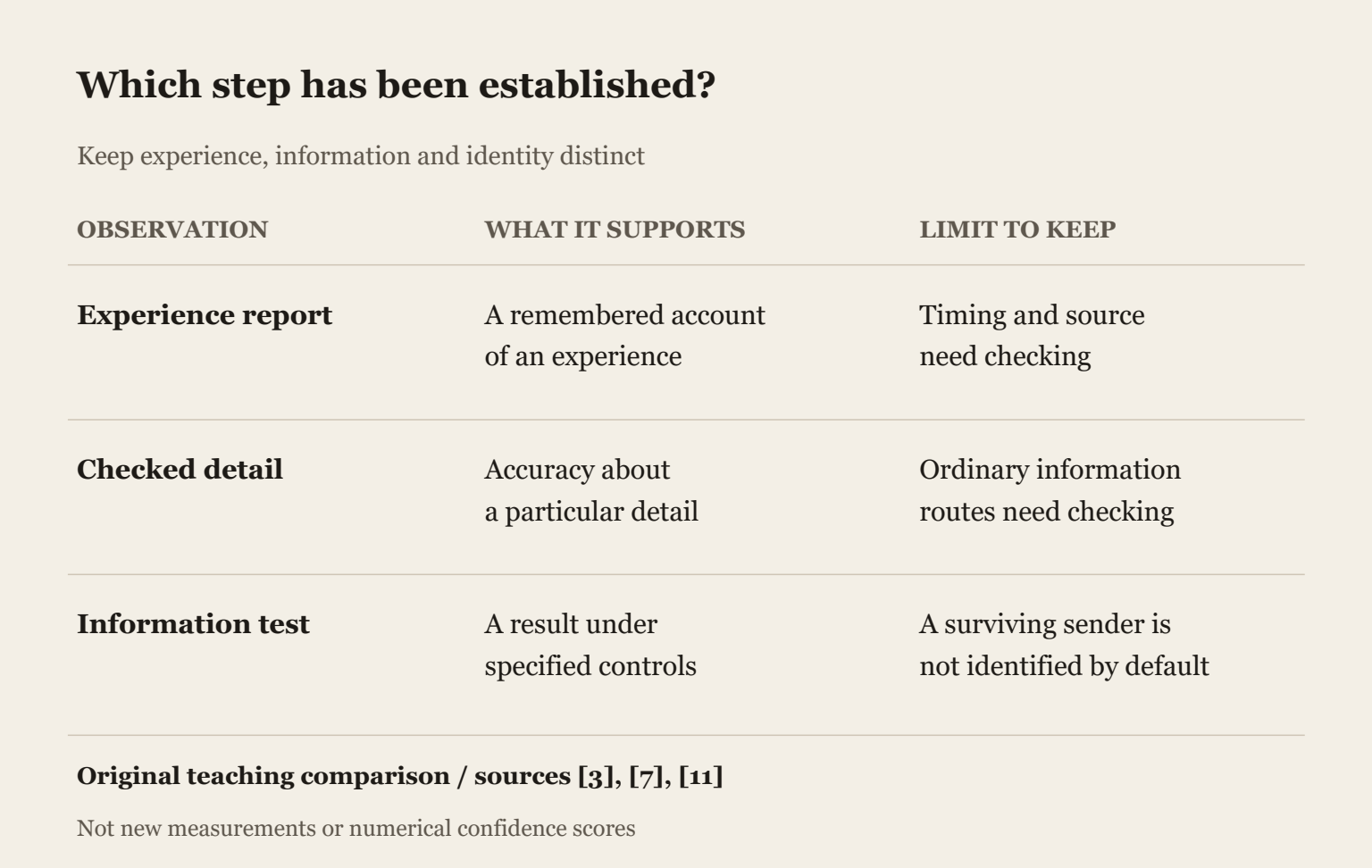
A report establishes what someone later says they experienced. A checked detail can establish accuracy about that detail, with timing and information-access questions still to resolve. Neither automatically identifies a continuing person outside the body.
The comparison is a guide to inference, not a ranking of people or a claim that every study offers the same kind of evidence. Its bilingual CSV preserves the questions and limits. Each additional conclusion needs its own support.
Open the figure reference table
07Activity is not a travel record.
Electrical findings matter without becoming a report from heaven.
AWARE II obtained interpretable EEG data from 53 of 85 monitored patients. EEG records electrical activity associated with the brain. Patterns consistent with possible conscious processing appeared as late as 35-60 minutes into CPR. CPR supplies some circulation; it does not mean permanent brain failure. [3]
The authors also acknowledged that they could not determine whether the alpha activity reflected a physiological pattern or alpha coma associated with brain injury. A signal related to consciousness is not an automatic demonstration of a particular experience.
In a separate 2023 study, Xu and colleagues examined four comatose dying patients and reported increased gamma activity and connectivity in two after ventilatory support was withdrawn. None survived to describe an experience. The authors explicitly recognised that the activity could be pathological or incidental. [4]
Do not connect a signal in one patient to a detailed memory in another and call that a synchronized recording. The participants, time windows and measurements must actually match. Otherwise the argument is assembled from pieces that have not been linked.
These studies make the dying and resuscitated brain worth investigating. They do not record a departing person, identify a destination or demonstrate that a named deity exists. A brain signal does not come with a religious address attached.
08Can a drug resemble an NDE?
Overlapping features challenge one inference, not every report.
Timmermann and colleagues studied 13 healthy volunteers given DMT, a psychedelic drug. They compared reports with placebo, an inactive comparison substance, and a selected near-death experience group. DMT produced substantial overlap on the near-death experience scale. [5]
This matters because some features presented as unmistakable signs of leaving the body can also occur during a drug-altered state. A feature's intensity does not make it unique to an afterlife. We need more than resemblance before identifying a destination.
The study was small. Placebo always came first, doses varied, and the comparison group was selected differently. Participants' reports and a shared scale do not prove that both groups underwent the same biological process.
It also does not demonstrate that a natural burst of DMT causes every near-death experience. Showing what an administered drug can produce is different from measuring that drug, at the required level and time, in a dying person's brain.
My answer to 'Science has explained every case with DMT' is no. My answer to 'No living brain could produce anything like this' is that the reported overlap undermines that certainty. Both claims should stay within the actual experiment.
09An honest memory can change.
Being mistaken does not require trying to deceive anyone.
In Loftus and Palmer's 1974 experiments, wording about filmed collisions influenced estimated speed and later reports about broken glass. These were controlled memory experiments, not near-death experiments. They show why confidence and accuracy need separate checks. [6]
Suppose I first say, 'I heard something.' Later someone asks whether it was a relative's voice. After repeated discussion I may remember a clearer story. That is an illustrative possibility, not a finding about every person who reports a relative.
The protection is to preserve the earliest account: exact words, date, questions asked and later additions. Compare that with records independently. A first recording is more useful than a polished account whose development cannot be traced.
I should apply this rule to sceptical witnesses too. A critic's confidence does not make their recollection infallible. Evidence standards that only inconvenience believers are team loyalty dressed up as method.
The fair conclusion is not that testimony is worthless. Testimony is a starting point whose strength depends on detail, timing, independence and possible error. A sincere witness deserves a careful hearing; a major conclusion deserves a careful test.
10Energy is not my identity.
Conserving a quantity does not preserve an organised person.
'Energy cannot be destroyed, so you cannot truly die.' This sounds scientific because its first half resembles a physical law. The second half introduces something the law does not say: that my memories and point of view must continue.
Conservation of energy is an accounting principle about physical change. The OpenStax treatment explains energy transfers and conservation under the relevant system conditions. It does not identify energy with a person's autobiography or awareness. [32]
Imagine a guitar being broken. Its material and energy have not escaped physics, but the instrument no longer performs its former organised function. This is an analogy about organisation, not a complete model of consciousness or a proof of everything about death.
To establish my survival, someone must connect continued energy to continued personal experience. Where is my memory? What maintains it? What evidence distinguishes a continuing me from heat, chemical change and the effects I left in other people's lives?
I do leave consequences behind. So does every action. That ordinary continuity is meaningful. Calling it personal immortality changes the meaning of the claim halfway through. A surviving influence and a surviving experiencer are different things.
11Did someone weigh a soul?
A memorable number is not a reliable result.
Duncan MacDougall's 1907 report describes attempts to weigh six dying people. In the first case he reported a loss of three-quarters of an ounce, approximately 21 grams. This is the famous number, not a consistent loss demonstrated in all six. [31]
His own accounts include different amounts, uncertainty in timing and tests he considered of no value. In the last case, the patient died while the apparatus was still being adjusted; MacDougall acknowledged that the apparent change could involve the sliding weight.
A balance changing is an observation about a balance. Establishing why requires reliable equipment, a clearly defined event, suitable comparisons and reproducible results. Naming an unexplained change 'soul substance' does not measure a personality leaving a body.
Even a clean physical change would need a further argument connecting the measured thing to memory and awareness. A weight difference is not automatically a self. The apparatus does not identify the meaning we want the number to have.
My reply is to open the original report rather than repeat the legend. Its inconsistent cases cannot support the familiar claim that science has established a 21-gram human soul. This does not disprove every imaginable massless soul; it rejects this advertised evidence.
12Religions do not agree on death.
Resurrection, rebirth and liberation make different claims.
The Qur'an's 23:99-100 describes a request to return after death being refused, with a barrier until resurrection. Paul's first letter to the Corinthians places resurrection at the centre of its message. These are not descriptions of an ordinary repeating cycle of new human lives. [22][16]
Bhagavad-gita 2.22 compares the embodied self's change of bodies to changing worn clothes. Verse 9.21 describes a heavenly enjoyment that ends when its supporting merit is exhausted. That temporary heaven is not identical to liberation or to every Christian account of eternal life. [23][33]
Buddhist accounts complicate the picture further. The not-self discourse rejects identifying form, feeling, perception, mental formations or consciousness as self. Buddhist rebirth therefore cannot simply be described as every tradition agreeing on one unchanged soul changing clothes. [27]
These identified passages do not exhaust their traditions. Believers debate literal readings, symbolism and philosophical interpretation. A particular translation or commentary cannot stand for every Hindu, Muslim, Christian or Buddhist.
The disagreement matters because an unexplained experience cannot verify all these different maps at once. First ask which map the evidence specifically supports. 'Something unusual happened' cannot choose the next life, its rules and its judge for us.
13Who exactly comes back?
A copied fact and a continuing person are not the same claim.
Suppose a child accurately describes a dead person's home. Establishing accuracy would be an achievement. But there are further questions: how was the information obtained, and why should having it make the child that same person?
I can learn someone else's memories from a diary without becoming its author. This illustration does not explain a particular child. It shows why information and identity require separate arguments. A correct fact is not automatically a transferred self.
Some rebirth accounts appeal to a continuing self; others describe causal continuity without a permanent self. The Gita and the Buddhist not-self discourse should not be forced into the same theory. Ask the person which claim they are defending. [23][27]
If nothing of memory or personality transfers, how would we test that this new life belongs to that previous person? If some information transfers, how can it be distinguished from ordinary learning, suggestion or a mistaken match?
These questions do not prove rebirth impossible. They stop us from accepting a word before understanding it. A claim needs enough detail to identify both what continues and what observation would count against that account.
14James and the wartime pilot.
Start with the favourable evidence, not a convenient caricature.
Jim Tucker's 2016 case report describes James Leininger's childhood nightmares and statements that his parents connected to a wartime pilot, James Huston Jr. Reported details included a carrier name, Natoma, and the name Jack Larsen. [7]
The report describes some documentation made before Huston was identified, including an unaired television interview with the parents. That is a real evidential advantage over a story recorded entirely after a family has found a possible previous person.
It also records ordinary aviation exposure: museum visits, toy planes and a repeatedly watched aviation video. Exposure to aviation is not evidence that the child learned every specific claimed detail. It means 'no possible normal source' needs investigation rather than assumption.
The case deserves attention because specific details and earlier records are more useful than a vague feeling of familiarity. I do not need to pretend that every account starts with a family casually inventing a story.
However, the study remains a reconstructed case, not a controlled experiment isolating every source of information. A record made before the final identification is not necessarily a record made before searching, conversations or all normal access. That distinction will matter next.
15How did the story develop?
A matching story is only as strong as its original details.
Michael Sudduth's 2021 reanalysis challenges the case's chronology, access to aviation information and treatment of statements as precise matches. It argues that ordinary learning and the story's development were insufficiently excluded. This is a published criticism, not an uncontested verdict. [8]
One concrete issue appears even in Tucker's report: James seemed to say he crashed in a Corsair. Huston died in an FM-2, though he had flown Corsairs earlier. 'He flew that type sometime' and 'he died in that type' are different matches. [7]
Imagine a claim saying a person died in a red car. If the candidate died in a blue car but once owned a red one, I should not quietly rewrite the original statement into a perfect hit. The example illustrates a scoring problem; it does not settle this whole case.
Criticism is strongest when it identifies an actual alternative route, a changed detail or a missing early record. Merely saying 'children can hear things' is weaker than showing what was available, at what time, and how it could affect the particular claim.
The sceptical position should not need a proved deception. Normal memory, incomplete records and flexible matching can lower confidence without showing intentional fraud. My conclusion must track those evidential weaknesses rather than announce motives I cannot demonstrate.
16The reply matters too.
A fair audit cannot stop after reading the critic.
In his 2022 response, Tucker argues that Sudduth mischaracterises the evidence and focuses on an incomplete table. He defends documentation predating the pilot's identification and the importance of particular matching details. A reply is part of the evidence dispute. [9]
For Natoma, he points to the father's dated printout and the earlier television material, and explains a later chronology's different date as an estimate corrected by the document. He rejects treating possible exposure to general aviation as an explanation of every specific detail.
He acknowledges the Corsair discrepancy while treating it as partly correct because Huston flew that aircraft earlier. I can understand that response without accepting that the original crash statement has become fully accurate.
My assessment is narrower than either dramatic headline: this case contains interesting pre-identification evidence and unresolved disputes about its strength. I have not independently interviewed the family, inspected every underlying archive or reproduced the investigators' work.
It does not establish rebirth to my satisfaction. That is different from claiming that every detail has been conclusively explained or that the family lied. Read the original report, the criticism and the reply together; do not use one side's confidence as a substitute for comparison.
17What would strengthen a case?
Record first. Search and score afterwards.
I would take a childhood-memory case more seriously if its earliest statements were recorded accurately before identifying a candidate, with the questions included. A recording should preserve uncertainty, not turn an adult's interpretation into the child's exact words.
Next, document possible information channels: relatives, visits, media, online searches and contact between families. This is not an accusation. In the Leininger debate, ordinary information access and the timing of records are precisely what the investigators contest. [7][8][9]
Specify how a match will be judged before looking for the best candidate. Record wrong statements as carefully as correct ones. If many candidates are searched, a striking resemblance is less surprising than if one uniquely identified person was specified in advance.
Independent reviewers should compare records without being guided toward the favoured answer. Preserve dates and revisions. A later investigator should be able to see how the result was obtained, rather than inherit a narrative already edited into a success.
These are ways to improve evidence, not a guarantee of discovering rebirth. Even an unusually strong information result leaves the identity question. I want the next conclusion earned by the next test, not smuggled in with the first one.
18Does a mark remember a wound?
Correspondence needs a fair comparison and a causal explanation.
Ian Stevenson's 1993 report discusses children whose birthmarks or birth defects were linked to wounds on proposed previous persons. It reports that, in 43 of 49 cases with a medical document, the document confirmed a correspondence. These are selected investigated cases. [10]
That figure is not a finding that 43 of every 49 children in the population have previous-life wounds. Nor does a postmortem record by itself show how a mark formed in a later child. Documentation of a wound and proof of its proposed cause are different jobs.
I would ask whether the mark and matching rules were recorded before searching, how many possible deceased people were considered, and how close a match had to be. A large permitted area or flexible description can create more matches than a strict rule.
A comparison group matters too. How often would similar-looking marks and wound locations be matched when there was no claimed connection? Without that baseline, an impressive collection does not directly tell us how unusual the matching process is.
These questions do not show that every investigated correspondence is false. They explain why the report does not establish a transferred personality or settle the biological cause of a particular birth defect. A child's condition is not evidence that they deserve suffering.
19Vivid does not mean recovered.
A detailed past-life story still needs independent history.
Hypnotic regression is sometimes presented as unlocking an earlier life. But an experience becoming detailed does not establish that it was retrieved from history rather than shaped during the session. The questions and suggestions are part of the evidence.
Young Don Pyun's 2015 original abstract reports two small experiments in which suggested past-life identities were produced by five of six participants. The suggested identities included a real historical person and a fictional character. This illustrates the importance of suggestion. [34]
The small, television-requested experiments do not explain every childhood case or prove that every hypnosis report is deliberate fabrication. They do undermine the claim that a vivid hypnotic identity must be a genuine recovered life.
For an alleged unknown language, I would want an unedited recording, assessment by qualified speakers and spontaneous comprehension and conversation. Repeating a few phrases is not the same capacity as understanding new questions. Prior exposure must also be checked.
These are proposed evidential requirements, not a claim that I have audited every reported language case. 'I cannot explain this clip' does not establish an earlier birth. First establish the actual ability, then investigate how it was acquired.
20How personal is the message?
Recognition can feel precise when the words are broad.
Imagine a reader saying, 'You care deeply but hide some of your pain.' Many people can find a true experience that fits. A sentence can feel intimate without identifying anything the reader could only know from a dead relative.
Forer's 1949 original abstract describes students receiving the same general personality sketch, supposedly based on their own questionnaire. They accepted it as accurate. This is a demonstration about personal validation, not a direct test of every medium. [13]
Cold reading uses ordinary cues and feedback; advance research can supply information before the meeting. These are possible routes a serious test should control. Naming a technique does not prove that a particular person used it.
Preserve the whole reading: incorrect guesses, prompts, revisions and the client's responses. A short compilation of apparent hits hides the denominator. 'The reader eventually mentioned a name I recognise' may be less impressive when dozens of suggestions preceded it.
My question is not whether a message made someone feel close to a loved one. It is whether the information was specific, independently correct and obtained through a route that the proposed explanation uniquely accounts for. Comfort and information accuracy need separate checks.
21The controlled result I must include.
Blinding can improve a test without proving its final explanation.
Beischel and Schwartz's 2007 study used eight selected mediums and eight student sitters. Mediums gave readings remotely through a proxy; the intended sitters were absent. The design blinded mediums, proxy and later raters to specified information. [11]
Mediums received the deceased person's first name. Each medium gave two readings; the eight sitters were used in paired comparisons. The study found higher ratings for intended than control readings and more correct choices than expected under its test.
This is a stronger design than an interactive stage performance. Dismissing it as nothing but visible body-language reading would ignore the actual controls. Equally, sixteen readings are not sixteen independent sitters; the participants and structure matter.
The sample was small and selected, and the evaluation depended on sitter ratings. Independent replication and close review of the procedure are necessary before extending the finding to a broad claim about mediums. A favourable statistical result does not itself identify its cause.
The authors explicitly say their data cannot distinguish survival from certain alternative paranormal information hypotheses. Those alternatives are not thereby established either. Even the positive paper does not turn its result into a unique demonstration that a deceased person spoke.
22Information is not a sender.
Neither a positive study nor a failed study settles everything.
O'Keeffe and Wiseman's 2005 original abstract reports that their controlled test of professional mediums did not support genuine mediumistic ability. It also discusses competing interpretations and methodological issues. I am using that public abstract, not claiming to have inspected its full journal text. [12]
This negative result and the favourable 2007 study do not cancel each other by simple vote. They used different participants and designs. We need to examine what was tested, how it was scored and whether findings recur under independently run conditions. [11]
A failure in one test does not logically show that no one could ever obtain unusual information. A success in one test does not establish that every reader is accurate, or that the successful information came from a surviving dead person.
Imagine an anonymous message containing a true private fact. First I establish that the fact was private and correctly reported. Next I investigate its route. Establishing who sent it is another task. That illustration explains why correct information alone cannot identify a ghost.
My standard is demanding because the conclusion is large, not because I need it to fail. A successful, repeatable information test would change what I think about information access. Evidence of personal survival would need to establish that further connection.
23Who keeps the account?
Ordinary consequences do not establish a cosmic balance sheet.
If I repeatedly betray people, they may stop trusting me. That is an ordinary consequence with a visible route. It does not establish that another person's illness was assigned because of a deed in a life nobody can independently identify.
Karma has different meanings across traditions. Gita 4.17 stresses complexities of action and inaction. The Buddhist MN 135 links conduct with rebirth and differences in life circumstances. Neither should be reduced to a single slogan shared by everyone. [24][25]
Where the claim is moral accounting across lives, I ask how the account can be checked. What connects this particular suffering with that particular earlier act? If every outcome can be explained by an invisible previous entry, the explanation risks fitting anything after it happens.
Fairness is a desire, not an observed mechanism. If a cruel person prospers, saying punishment will arrive later can preserve the belief without supplying evidence. The same applies when misfortune is treated as proof of hidden wrongdoing.
I reject using a child's pain as an accusation about their earlier character. That is my ethical judgement. The evidential objection is separate: the proposed previous act and the causal connection have not been established merely by pointing at the suffering.
24Not every pain is past karma.
The original texts can challenge the popular slogan too.
In the Buddhist Sivaka discourse, the claim that everything a person feels is entirely caused by past action is rejected. The text lists several sources of painful feeling, including bodily conditions, seasons, careless behaviour and assault, as well as kamma. [26]
Its bodily categories belong to an old medical setting; citing them is not endorsing them as modern physiology. The point here is interpretive: a recognisable Buddhist source resists reducing every present pain to past action.
This matters in conversation. If someone says, 'You have attacked a view I do not hold,' I should check whether that is true. An argument against a crude version of karma does not automatically defeat every more careful account.
The further questions remain for any account that makes claims about previous lives: what establishes them, what connects them to present events, and what would count against the explanation? Complexity does not remove the need for evidence.
Whatever the metaphysical answer, I can respond to suffering by helping. Speculation about an invisible history does not establish that help is undeserved. The person in front of me needs care; I do not possess a verified record of their alleged earlier life.
25What does Paul actually give us?
A report of witnesses is not hundreds of surviving statements.
In 1 Corinthians 15, Paul passes on a tradition about Jesus dying, being buried, rising and appearing to others. He lists appearances to named individuals and groups, including more than five hundred people, and says Jesus also appeared to him. [16]
That makes the resurrection central to the text, not a decorative later detail we can remove without changing its argument. A strong Christian reply points to this testimony and asks what best explains the reported appearances and conviction.
But Paul's statement about five hundred is one surviving text reporting a group. It is not five hundred independently preserved interviews whose questions, conditions and mutual influence we can inspect. The size of the reported group does not multiply the documents we actually have.
I distinguish evidence that people held and transmitted a belief from evidence establishing its supernatural explanation. Sincere conviction can matter historically without being infallible. I do not need a complete alternative story before noticing gaps in the proposed proof.
This chapter does not establish exact dates for every tradition or settle all historical scholarship. It examines the identified passage and its evidential form. The question is what the source can support, not whether I can make its central claim sound impressive or ridiculous.
26A source also has a history.
Read textual notes before treating every printed ending alike.
The NET notes to Mark 16 explain that some important manuscript witnesses end at verse 8, while many include verses 9-20. The notes judge the longer ending secondary on textual grounds. An edition itself can openly document this problem. [17]
This does not mean no Christian text reports appearances. Paul does, and other Gospel accounts are separate sources. Nor does an ending dispute prove that every earlier line is false. A limited textual conclusion should remain limited.
It does mean I should not use disputed verses as though their transmission were uncomplicated. Establish what text is being used before asking it to carry a historical argument. Printed confidence is not a substitute for a manuscript record.
Hume's discussion of miracles asks us to weigh testimony and possible error against the event proposed. His reasoning is a philosophical argument, not an experiment and not a licence to define all surprising events as impossible. Its application can be debated. [15]
My usable principle is to compare explanations with actual evidence. 'I cannot give a complete reconstruction' does not make a miracle the only remaining option. Gaps in a sceptic's account do not supply missing evidence for a divine intervention.
27The threat is a claim too.
Mercy and punishment both belong in an honest account.
Matthew 25 connects judgement with treatment of people in need and contrasts eternal life with everlasting punishment. Reducing this passage to 'anyone outside my label burns' would miss its stated moral setting. The punishment claim still deserves scrutiny. [18]
Qur'an 4:40 says God does no injustice, while 4:56 describes punishment with skins renewed after burning. Qur'an 39:53-54 urges hope in mercy and turning back before punishment. These identified passages include both warning and mercy, not only one. [20][21]
Muslims and Christians disagree internally about interpretation, scope and final outcomes. I am identifying texts and questioning claims, not assigning one identical view to everyone who belongs to either religion.
My objection is direct: a terrifying description is not evidence that its destination exists. Nor does calling a punishment perfectly just settle its moral justification. Those are further claims, even when they appear in the same sacred book.
If a person threatens me with a prison I cannot verify, the severity of the proposed sentence does not establish the prison. It establishes that the warning is severe. I still need reasons to believe the speaker knows it is real.
28What if hell is freely chosen?
A careful defence deserves a careful reply.
The Catholic Catechism describes hell as definitive self-exclusion from communion with God. It teaches its eternity, connects it with unrepented mortal sin and says God predestines no one to hell. This is more careful than a cartoon of arbitrary divine cruelty. [19]
The reply is that love cannot be forced and a person can reject it. I recognise the importance of freedom in that argument. A relationship chosen freely differs from obedience extracted by force.
But I still ask what counts as an informed rejection. Is honestly failing to believe a claim the same as knowingly rejecting an unmistakably real good? Does finite confusion justify an irreversible outcome? Those questions concern the adequacy of the defence.
Calling an outcome chosen does not automatically justify its design. If someone creates the available options and their consequences, I can ask whether those conditions are proportionate and whether later correction remains possible. Freedom alone does not answer every question.
This is ethical and philosophical criticism, not laboratory disproof of hell. Conversely, a coherent defence would not establish that hell exists. Moral justification and evidence of existence are two tasks; neither can quietly stand in for the other.
29Which version are you defending?
Believers disagree about sincere doubt and final punishment.
Romans 2 discusses judgement, deeds and conscience, including people without the law. The Christian Universalist Association explicitly teaches eventual reconciliation. Catholic teaching has its own careful account. These positions cannot all be reduced to one popular threat. [28][29][19]
The universalist source records that association's belief, not proof of its truth and not the opinion of every Christian. A selected organisation cannot settle the full history of a religion. Its relevance is that real disagreement exists.
So I first ask a believer what they mean by hell, salvation and rejection. If their view allows honest doubt or eventual restoration, I should engage that account. Refuting a harsher view they reject would waste both our time.
The evidential question survives the change. A kinder afterlife is not established because it is kinder. A harsher afterlife is not established because it is frightening. Both need reasons that connect their descriptions with reality.
My atheism does not require every believer to be equally rigid. It requires me to assess the claim actually offered. Precision strengthens criticism: it removes the easy escape of saying I attacked a belief nobody in the conversation held.
30Is belief the safer bet?
A decision argument is not a discovery that a god exists.
Pascal's wager asks a practical question under uncertainty: if belief could bring an infinite gain, should we choose the religious path? In the Pensees, the argument concerns how to live and wager, rather than a new observation establishing God. [14]
Its strongest simple form is not 'I have proved God.' It is 'Even without proof, the possible stakes may make commitment rational.' That deserves a reply about the proposed choice, not the irrelevant accusation that Pascal forgot to run a laboratory experiment.
I ask where the possible outcomes and their probabilities came from. Writing an infinite reward into an argument does not establish that the reward is real, that this path earns it, or that the other options carry the stated costs.
In ordinary decisions we consider uncertain outcomes, but we still need reasons for which possibilities deserve attention. Otherwise anyone can advertise an unlimited reward for following their instruction and claim to have defeated every competing choice.
My answer is that the wager does not supply evidence for its religious map. It may describe a commitment someone finds compelling. It cannot turn an assumed payoff table into verified knowledge of what happens after death.
31Which bet should I place?
Competing religions do not disappear from the calculation.
The popular version gives me two boxes: believe or do not believe. But believe what? A generic spiritual belief, Christian resurrection, a particular Islamic account of judgement and a rebirth doctrine do not have identical requirements or outcomes. [16][22][23]
I cannot assume that one religious choice is rewarded under every possible map. Nor can I assume that all maps condemn honest disbelief. A hypothetical deity who values evidence and dislikes strategic worship would change the proposed calculation again.
That hypothetical deity is not something I have discovered. It exposes a missing premise: the wager needs a justified account of the judge's preferences. Inventing another possibility does not prove atheism, but an unexamined binary choice does not compel belief either.
A believer can answer that independent arguments make their own religion much more credible than rivals. Good: then we should assess those arguments. The work shifts back to evidence, precisely where the simple threat-and-reward shortcut tried to finish it.
I do not have to pretend every imaginable deity is equally likely. I need the offered choice and probabilities justified. 'My religion is the only serious option' cannot function as both the starting assumption and the conclusion.
32Can I believe on command?
Choosing a practice and finding a claim convincing are different.
Ask me to believe that a cup of water is on this table when I can see it is empty. I can repeat the sentence, act politely or imagine the cup. I cannot simply command the evidence to look convincing. This is an illustration about belief, not a psychological experiment.
Pascal recognises difficulty in believing and recommends practices associated with faith. He is not merely saying that a person can instantly manufacture conviction. Habits and participation may influence what feels believable. [14]
But becoming convinced through practice and establishing truth are different questions. Similar practices can reinforce incompatible traditions. The fact that a route changes my conviction does not show which account of death is correct.
If a deity values sincerity, strategic outward compliance raises a further problem. If the deity values honest inquiry, withholding assent may be appropriate when the evidence is insufficient. Either claim about divine preferences needs support.
My position is not that I choose disbelief as an act of defiance. I do not find the supplied reasons convincing. Telling me the consequences are enormous does not make the reasons stronger; it gives me more reason to examine them carefully.
33What if nobody pays?
The absence of a fair ending cannot establish an invisible one.
Some people harm others and avoid an adequate reckoning. That is a serious problem, not a clever debating trick. I understand why a future judgement feels necessary when human justice fails.
But 'there ought to be justice' does not establish 'there will be another court after death.' The first statement is a moral demand. The second describes a proposed part of reality. Its truth requires more than our need for a fair conclusion.
The same distinction applies to rebirth accounting. Wanting an explanation for unequal lives does not verify a history of previous lives. A story can make the world feel balanced while leaving its supposed mechanism unobserved. [25]
I do not need to claim that believing in a later reckoning always prevents action; many believers act courageously for justice. My objection concerns the inference, not a universal claim about religious behaviour. Human motivation varies.
For me, uncertain future justice strengthens the urgency of present responsibility. We can investigate wrongdoing, protect people and repair what can be repaired. Hoping for another court is not a substitute for evidence that it exists, or for work we can do now.
34How I would say it aloud.
Short answers can open the evidence rather than end the conversation.
If someone says, 'My relative saw heaven,' I would say: 'I accept that they report a powerful experience. What establishes when it happened, and what independently checked detail connects it to heaven rather than another explanation?' That keeps experience and interpretation separate. [2][3]
If someone says, 'This child knew a dead person's life,' I would say: 'Let us preserve the earliest words, check normal information routes and count incorrect details too. Then we can ask whether the result establishes information, identity or both.' [7][8][9]
If someone says, 'Why risk hell?' I would say: 'Which account, and what establishes it? A frightening possibility is not yet a reason to regard your specific warning as true.' If they offer evidence, I should examine it rather than keep repeating the reply. [14]
These replies are not magic lines that guarantee another person agrees. A conversation can clarify where disagreement lies even when it does not end it. Ask one question at a time and allow the person to state their strongest case.
I can be firm without treating grief as a contest. I can also stop when discussion becomes threats or personal pressure. Leaving an unproductive argument does not concede that its claims are true. The argument still owes the evidence it owed at the beginning.
35Make the claim testable.
A serious standard should allow a real result to matter.
I would take reliable, independently repeated access to inaccessible information seriously. Better timing records, advance target selection, complete reports and transparent analysis would strengthen a case. Tests designed to protect against error are not an insult to the proposed ability.
The AWARE target approach and blinded mediumship comparisons illustrate attempts to create such tests, despite their limitations. I can recognise the value of their questions without treating every result as decisive. [2][3][11][12]
The result would need to match the conclusion. Evidence of unusual information access would establish an information problem first. Connecting it to the continued identity of a deceased individual would require additional discriminating evidence.
By contrast, an account that can accommodate every hit, every miss and every absence of a result offers little guidance about what would make it wrong. 'The spirits chose not to cooperate' may preserve the story, but it does not turn a failed prediction into support.
I am not demanding that a person prove every conceivable negative. I am asking the offered explanation to earn its specific claims. My willingness to revise should be matched by a clear statement of what would lead its defender to revise too.
36I can leave the answer open.
Uncertainty does not oblige me to accept a ready-made map.
I cannot demonstrate from these studies that no conceivable form of experience could ever continue after bodily death. That is a much larger claim than the evidence here can carry. I do not need to carry it to withhold belief in particular afterlife stories.
The reports examined here do not establish their religious explanations to my satisfaction. Some are interesting. Some familiar arguments confuse quantities, experiences and identities. Some promises and threats simply repeat a text's authority as though that settled its truth.
'I do not know' is not a gap that automatically belongs to a priest, a medium or me. It describes a limit. If someone offers an answer, the answer must still do the work required of an explanation.
Nor does uncertainty erase what I can recognise now: affection, suffering, responsibility and the importance of attention. A relationship does not need to last forever to have happened. A finite conversation can still change a life.
I will not promise a reunion I cannot establish, and I will not pretend uncertainty feels easy. I can honour a person through memory and care while leaving the cosmic claim unaccepted. That is the honest place the evidence leaves me.
NoteWhy I wrote this part.
I want honesty that survives both grief and pressure.
I am an atheist because the religious claims do not convince me. I need not enjoy the thought of death or know everything about reality. I need honest reasons.
I included favourable studies and a researcher's reply because an argument should survive strong objections. Hiding inconvenient evidence would turn investigation into defending my identity.
Experiences, measured signals, accurate information, personal identity and theology are different steps. Confusion starts when one quietly becomes another. The missing step often contains the very claim supposedly proved.
References identify reports, texts and limits, including abstract-only access. I have not reproduced experiments, investigated families or read every archive. My ethical criticisms are arguments, not laboratory findings.
Better evidence can change my conclusion. Until then, I will not call a threat knowledge or a hope a discovery. Even the questions I most want answered should not tempt me to invent the answer.
SourcesFollow the evidence.
These sources do different jobs: clinical studies examine resuscitation and signals; case reports investigate claimed memories; controlled readings examine information; religious texts document teachings; philosophical works offer arguments. None automatically proves the next step. Relevant original passages, methods, results and limits were examined within the stated access scope. Four references use public original abstracts only, explicitly marked; a selected reanalysis is not a complete independent archive audit. This chapter does not diagnose death, report personal replication, provide a probability of survival, or claim that every unexplained report has been solved. Hindi uses the same source numbers. Research checked 17-18 October 2026, India.
[1] Pediatric and Adult Brain Death/Death by Neurologic Criteria Consensus Guideline
David M. Greer and colleagues, Neurology 101 (2023), 1112-1132. DOI: 10.1212/WNL.0000000000207740. Public original reprint.
Relevant definition and assessment safeguards read. American 2023 consensus, not every jurisdiction or a clinical instruction. Resuscitated cardiac arrest is distinguished from correctly established permanent loss of whole-brain function.
[2] AWARE-AWAreness during REsuscitation-A prospective study
Sam Parnia and colleagues, Resuscitation 85 (2014), 1799-1805. DOI: 10.1016/j.resuscitation.2014.09.004. Original-paper reprint.
Original methods, results and corroborated case read. 2,060 arrests; abstract reports 140 initial interviews and 101 second-stage interviews. Nine of 101 met NDE criteria; one follow-up account was corroborated. It occurred without a hidden-target shelf, so is not a hidden-image hit. Timing inferred from resuscitation details, not continuous proof of absent brain function.
[3] AWAreness during REsuscitation-II: A multi-center study of consciousness and awareness in cardiac arrest
Sam Parnia and colleagues, Resuscitation 191 (2023), 109903. DOI: 10.1016/j.resuscitation.2023.109903. Original-paper reprint.
Original results, tasks and limitations read. 567 arrests, 53 survivors, 28 interviews, 11 memory reports; categories overlap. Separate 126-person narrative sample is not pooled. No explicit image/sound recall; no image identification and one auditory forced-choice selection. EEG available in a different, incompletely monitored subgroup; activity does not timestamp every experience or establish an afterlife.
[4] Surge of neurophysiological coupling and connectivity of gamma oscillations in the dying human brain
Gang Xu and colleagues, PNAS 120 (2023), e2216268120. DOI: 10.1073/pnas.2216268120. Original-paper reprint.
Original four-patient report and discussion read. Two showed relevant activity; none survived to report an experience. Authors allow pathological or incidental activity. Signals cannot be equated with subjective reports, travel or permanent-brain-death recovery.
[5] DMT Models the Near-Death Experience
Christopher Timmermann and colleagues, Frontiers in Psychology 9 (2018), 1424. DOI: 10.3389/fpsyg.2018.01424.
Original design, results and limitations read: 13 participants, scale overlap, placebo-first order, varied dose and differently selected NDE comparison sample. Similar reports do not establish identical mechanisms, universal explanation or an endogenous DMT surge at death.
[6] Reconstruction of automobile destruction: An example of the interaction between language and memory
Elizabeth F. Loftus and John C. Palmer, Journal of Verbal Learning and Verbal Behavior 13 (1974), 585-589. DOI: 10.1016/S0022-5371(74)80011-3. Original reprint.
Original wording and memory experiments read. Evidence that questioning can influence reports, not a direct study showing every NDE or childhood case to be false. Illustrations in this chapter are identified as illustrations.
[7] The Case of James Leininger: An American Case of the Reincarnation Type
Jim B. Tucker, EXPLORE 12 (2016), 200-207. DOI: 10.1016/j.explore.2016.02.003. University-hosted original.
Original case report, documentation table, normal aviation exposure and discrepancies read. Some pre-identification records exist. They do not automatically precede all searches or information access. No independent family investigation by this author is claimed.
[8] The James Leininger Case Re-examined
Michael Sudduth, Journal of Scientific Exploration 35 (2021 issue; journal record dated 2022), 933-1026. DOI: 10.31275/20212361. Author-hosted original.
Relevant chronology, ordinary-access and matching criticisms read, alongside the report and reply. No complete independent archive audit or uncontested fraud finding is claimed. The original prints a different DOI; this identity was corrected against the journal and Crossref records.
[9] Response to Sudduth’s “James Leininger Case Re-Examined”
Jim B. Tucker, Journal of Scientific Exploration 36 (2022), 84-90. DOI: 10.31275/20222487. University-hosted original.
Original reply read, including pre-identification documentation, Natoma chronology and Corsair interpretation. The response is represented without treating either investigator as automatically decisive. Reported information and demonstrated personal survival are distinguished.
[10] Birthmarks and Birth Defects Corresponding to Wounds on Deceased Persons
Ian Stevenson, Journal of Scientific Exploration 7 (1993), 403-410. University-hosted original reprint.
Original report and matching discussion read. The 43/49 medical-document correspondences concern selected cases, not a population estimate or demonstrated cause. Baselines, prior recording and matching rules remain important. Historical biological claims are not offered as current clinical knowledge.
[11] Anomalous Information Reception by Research Mediums Demonstrated Using a Novel Triple-Blind Protocol
Julie Beischel and Gary E. Schwartz, EXPLORE 3 (2007), 23-27. DOI: 10.1016/j.explore.2006.10.004. Author-hosted original.
Original procedure, results and interpretation read. Eight selected mediums, eight sitters, sixteen readings with first names supplied and absent sitters. Intended ratings/choices favoured; small selected sample and judging limits retained. Authors explicitly do not uniquely distinguish survival from other proposed paranormal information accounts.
[12] Testing alleged mediumship: Methods and results
Ciaran O’Keeffe and Richard Wiseman, British Journal of Psychology 96 (2005), 165-179. DOI: 10.1348/000712605X36361.
Public original publisher abstract read: test did not support mediumistic ability and discusses methodological interpretation. Full journal PDF could not be retrieved through checked routes. No detailed procedure or effect-size claim here relies on unread full text; one negative test is not universal disproof.
[13] The fallacy of personal validation: A classroom demonstration of gullibility
Bertram R. Forer, Journal of Abnormal and Social Psychology 44 (1949), 118-123. DOI: 10.1037/h0059240.
Public original APA/PsycInfo abstract read. Identical general sketches were accepted as accurate. No exact rating statistic is used, and this classroom finding is not represented as a test of all mediums. Retrieved scan is not relied on as fully read text.
[14] Pensees, Section III: Of the Necessity of the Wager
Blaise Pascal; W. F. Trotter translation, public-domain text, Project Gutenberg 18269.
Relevant wager passage and reply about forming belief through practice read. Decision argument under uncertainty, not experimental proof. The chapter distinguishes Pascal’s argument from a simplified popular two-box version; alternative judges are illustrations, not discoveries.
[15] An Enquiry Concerning Human Understanding, Section X: Of Miracles
David Hume, public-domain primary text, Project Gutenberg 9662.
Relevant argument weighing testimony and error against a miracle claim read. Philosophical reasoning open to criticism, not a scientific finding that miracles are impossible by definition or a complete survey of historical scholarship.
[16] 1 Corinthians 15
King James Version, Bible Gateway; identified primary religious passage.
Verses 3-8 and surrounding resurrection argument read. Paul reports appearances, including a group of more than five hundred and his own experience. One text reporting a group is not hundreds of independently preserved depositions. No precise reconstruction of all early dates is claimed.
[17] Mark 16, with textual notes
New English Translation, Bible Gateway; primary text and edition’s critical notes.
Passage and ending note read. Some important witnesses end at verse 8; many include 9-20, judged secondary by the cited edition. This limited textual point does not erase Paul, other Gospel appearance accounts or every earlier line.
[18] Matthew 25:31-46
King James Version, Bible Gateway; identified primary religious passage.
Judgement, care for people in need, eternal life and punishment read in the stated context. The moral setting is not reduced to a simple religious-label test. Moral proportionality and historical existence are separate arguments.
[19] Catechism of the Catholic Church: IV. Hell, 1033-1037
Vatican; original institutional statement of Catholic teaching.
Teaching on self-exclusion, unrepented mortal sin, eternity and no predestination to hell read. Represents this tradition, not every Christian. The stronger freedom defence is examined; its coherence alone would not establish existence.
[20] Qur’an 4:40-56
Sahih International English rendering, Quran.com legacy reader.
Identified verses on justice and renewed skins in punishment read in the linked passage. Textual teaching is distinguished from empirical evidence, and one reading is not assigned to every Muslim.
[21] Qur’an 39:53-54
Sahih International English rendering, Quran.com legacy reader.
Mercy and the call to turn back before punishment read together. Not represented as unconditional universal forgiveness or omitted in order to make the warning appear harsher.
[22] Qur’an 23:99-100
Sahih International English rendering, Quran.com legacy reader.
Request for return, refusal and barrier until resurrection read. Relevant to distinguishing this teaching from a simple cycle of reincarnated human lives; does not survey every interpretive school.
[23] Bhagavad-gita 2.22
A. C. Bhaktivedanta Swami Prabhupada rendering and commentary, Vedabase.
Body/clothes comparison read. Identified devotional interpretation, not all Hindu philosophies or independent demonstration that an enduring self changes bodies. The chapter’s Hindi paraphrases are not newly attributed canonical translations.
[24] Bhagavad-gita 4.17
A. C. Bhaktivedanta Swami Prabhupada rendering and commentary, Vedabase.
Action, forbidden action and inaction passage read. Used to resist flattening karma into one popular slogan; scriptural complexity is not empirical verification of cross-life moral accounting.
[25] Cula-kammavibhanga Sutta: The Shorter Analysis of Action, MN 135
Thanissaro Bhikkhu, 1995 Pali translation, Access to Insight archived edition.
Relevant rebirth and action/circumstance teachings read. A primary teaching, not proof that a particular suffering person has a verified previous wrongdoing. Archived translation identified, not claimed to be the newest edition.
[26] Sivaka Sutta: To Sivaka, SN 36.21
Thanissaro Bhikkhu, Pali translation, Access to Insight archived edition.
Discourse distinguishes several causes of feeling and rejects the claim that all is entirely due to past action. Translator’s introduction is distinguished from the discourse. Old medical categories are not endorsed as modern physiology.
[27] Pancavaggi Sutta: Five Brethren / Not-self, SN 22.59
Thanissaro Bhikkhu, 1993 Pali translation, Access to Insight archived edition.
Relevant form, feeling, perception, formations and consciousness not-self teaching read. Used to distinguish Buddhist accounts from an unchanged soul model, not to deny every conventional use of person or survey all schools.
[28] Romans 2:6-16
King James Version, Bible Gateway; identified primary religious passage.
Judgement by deeds, law and conscience passage read. Supports the need to identify the actual view of judgement in discussion, not an independent finding about an afterlife or a complete doctrine of salvation.
[29] Christian Universalist Association: Our Beliefs
Original association statement, Christian Universalist Association.
Relevant final reconciliation teaching read. Evidence of what this association teaches and of diversity, not all Christianity, the truth of universalism or a complete historical census.
[30] The near-death experience scale: Construction, reliability, and validity
Bruce Greyson, Journal of Nervous and Mental Disease 171 (1983), 369-375. DOI: 10.1097/00005053-198306000-00007.
Public original abstract read through Europe PMC; retrieved original PDF is an image scan and is not claimed as fully read. Sixteen-item classification/reliability is distinguished from verification of a location outside the body.
[31] Hypothesis Concerning Soul Substance Together with Experimental Evidence of the Existence of Such Substance
Duncan MacDougall, 1907 original report, public text reprint.
Six human case descriptions and stated limitations read. Famous three-quarter-ounce loss concerns one case; varying amounts, timing and invalid tests prevent a consistent 21-gram conclusion. No current clinical or soul-detection claim is established.
[32] University Physics, Volume 1, 8.3: Conservation of Energy
OpenStax, original educational physics text.
Relevant system/transfer/conservation discussion read. Energy conservation is not conservation of memories or personal identity. Guitar illustration is the author’s explanatory analogy, not an experiment establishing a theory of consciousness.
[33] Bhagavad-gita 9.21
A. C. Bhaktivedanta Swami Prabhupada rendering and commentary, Vedabase.
Passage describes heavenly enjoyment ending with exhausted merit and a return to mortal life. Temporary heaven is distinguished from liberation and from other traditions’ eternal-afterlife claims.
[34] Creating Past-Life Identity in Hypnotic Regression
Young Don Pyun, International Journal of Clinical and Experimental Hypnosis 63 (2015), 365-372. DOI: 10.1080/00207144.2015.1031557.
Public original abstract read through PubMed/publisher and Europe PMC. Two small television-requested experiments, suggested identities produced by five of six subjects. Shows suggestion risk in this setup, not an explanation of all spontaneous childhood memories or every regression account.