

01The meal and the question.
I can appreciate help without surrendering my right to ask.
Imagine entering a community kitchen when you are hungry. Someone gives you food without asking what you believe. That help matters. Now imagine a second door where you must accept a leader's explanation of the universe before being allowed to question them.
These are illustrative situations, not an accusation against a named kitchen. They show two different relationships: receiving care and surrendering judgement. A good meal can establish that someone helped me. It cannot establish that their religious account of reality is correct.
This part asks what religion does in human lives. It can gather people, organise service, offer rituals and supply meaning. It can also support authority, mark outsiders and make dissent costly. Which claim applies depends on the institution, practice and evidence.
My position is direct: no organisation earns an exemption from criticism by calling itself sacred. Its help deserves recognition. Its claims deserve checking. Its power deserves limits. Those judgements need not be bundled into one all-good or all-bad verdict.
I do not have to insult a volunteer to reject a supernatural claim. I also do not have to excuse an institution's failures because its volunteers are kind. Separating these questions makes the criticism sharper and fairer.
02What do we mean by religion?
Belief, practice, community and authority are different things.
Belief concerns what someone thinks is true. Ritual is a repeated practice with shared or personal significance. Community means the people and relationships around it. An institution is an organised body with roles, rules and resources. These parts can overlap without being identical.
A person may doubt a miracle and still attend a festival. Someone else may believe in a god while avoiding religious organisations. A family can value an inherited ceremony without agreeing on every doctrine. We should ask which part a person actually means.
Durkheim's early sociological account emphasises sacred things, practices and a moral community. It helps direct attention beyond private opinions to collective life. It is a historical theoretical account, not a final definition proven for every society. [1]
This distinction prevents a common argument from changing subjects. I question a creation story; someone answers that the community feeds people. That may defend the feeding, but it has not answered the question about creation.
The same discipline applies to criticism. An institution abusing authority does not establish that every member behaves that way. Name the claim, practice or structure. A word as large as religion cannot do all the explanatory work by itself.
03Useful, true, or justified?
These questions require different kinds of support.
An idea can help someone cope. That is a claim about its effect. An idea can accurately describe the world. That is a claim about truth. A person can demand obedience based on that idea. That raises a question about authority and justification.
Suppose believing that a lucky pen helps me makes an exam feel less frightening. The comfort could be real even if the pen has no special power. This is an illustration of the distinction, not a study of exam performance.
Likewise, discovering that a belief caused harm would not automatically prove every factual statement within it false. Harm matters for judging a practice and its enforcement. Truth still requires evidence about the particular statement.
What I reject is the shortcut: 'This helps people, therefore its god exists, therefore its leaders should rule.' Each therefore hides another step. None of those steps becomes valid merely because the opening benefit is genuine.
In a discussion, I ask which question the evidence answers. A soup kitchen needs evidence about service. A miracle needs evidence about the event. A power to govern others needs a defensible basis that includes those who must live under it.
04Belonging is not stupidity.
People need relationships as well as explanations.
Imagine a gathering where someone knows your name, notices your absence and visits when your family is struggling. Leaving a belief can then feel like risking a network of care. This hypothetical explains a possible cost; it is not everyone's experience.
If I answer that person with 'Just stop being stupid,' I have failed to understand the situation. Their attachment may include love, memory, language and practical support. Recognising that does not require accepting the community's supernatural claims.
The need for belonging also gives institutions leverage. A person who depends on the group may find it harder to question a rule. Whether questioning actually brings punishment must be investigated in the particular setting, not assumed from a label.
My criticism concerns the condition placed on care. Can I remain respected while disagreeing? Can I receive help without pretending to believe? Can I leave without threats or humiliation? These are questions about how a community treats people.
Reasoning alone does not build the replacement relationships someone might need. If I want a world with freer inquiry, I should also care about the ordinary human arrangements that make honest disagreement possible.
05Are religious people happier?
A reported association deserves attention, with its limits.
Pew's 2019 analysis found that people active in religious congregations often reported more happiness and community involvement, such as voting and joining groups, than inactive or unaffiliated people. Active meant identifying with a religion and attending services at least monthly. [2]
The evidence came from existing surveys. The country sets differed by measure, with 26 used for several comparisons; they were not a representative experiment covering every culture. The meaning of attendance also differs between religious traditions.
I should not hide a favourable association because it inconveniences my position. It suggests something about participation worth understanding. It does not mean every religious person is happy or every atheist lonely.
Nor does it establish that the religious explanation caused the difference. A community's relationships, opportunities to volunteer, personal circumstances and who chooses to attend could all matter. The report explicitly warns against treating the association as direct causation.
My reply is: 'Let us take the benefit seriously and find out what produces it.' That question is more useful than pretending the survey proves a god, or pretending a positive finding must be fake.
06What caused the difference?
Two things moving together do not explain why.
If people carrying umbrellas are often wet, the umbrella did not necessarily cause the wetness. Rain may explain both. This ordinary example shows a shared cause: something else influencing the two things we noticed.
The direction can also be reversed. Does participation make someone feel better, or do people already feeling better find it easier to participate? Both directions might operate. A snapshot cannot automatically separate them.
Comparing groups requires attention to age, income, health, family circumstances and local culture. Adjusting for measured differences can help, but it does not guarantee that every important difference has been measured. Pew recognises these problems in its analysis. [2]
A stronger design follows people over time or, where appropriate, randomly assigns a specific activity. Even then, the result concerns the tested activity and people. A brief exercise does not settle what every religion has done throughout history.
So I resist both shortcuts: 'Religion caused every advantage' and 'Religion could never help.' A claim about a cause needs a route, a fair comparison and an honest account of what the study cannot separate.
EvidenceWhich question does it answer?
A social effect, a claim about reality and a power to rule differ.
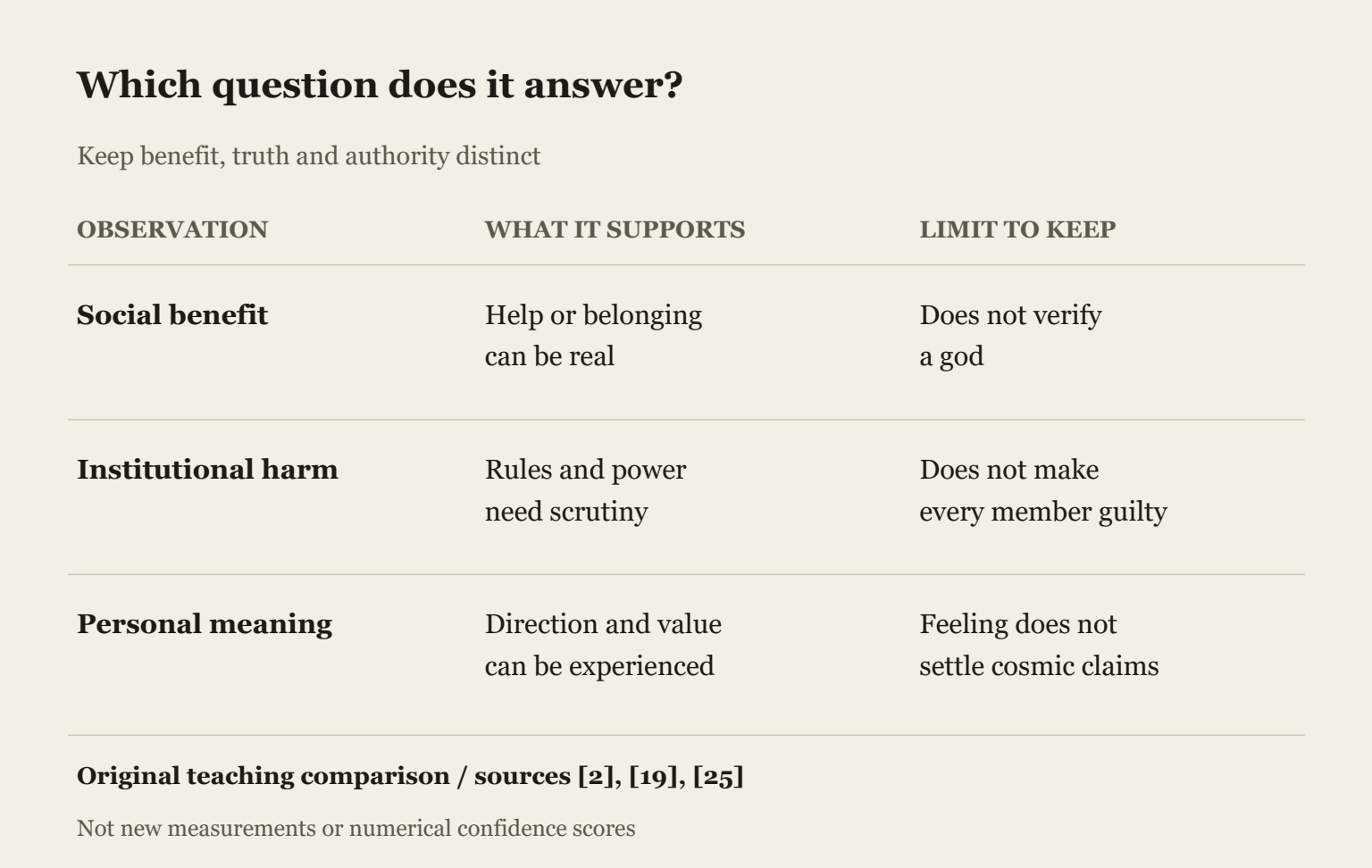
A social benefit can deserve support without verifying a god. An institutional failure can justify scrutiny without making every member guilty. A sense of meaning can matter without settling an ultimate account of the universe.
These questions are connected but require different evidence. The bilingual CSV preserves the distinctions. Before accepting a conclusion, check whether its support answers that question or has quietly changed the subject.
Open the figure reference table
07Why doing things together matters.
Shared action can have an effect without verifying a doctrine.
Synchrony means doing something in time with others: walking in step, singing together or coordinating movement. It is found in religious and nonreligious settings. The shared timing is something researchers can manipulate without first proving anyone's theology.
Wiltermuth and Heath's 2009 paper reports three experiments linking synchronous action with greater cooperation in later group tasks. The activities included walking and coordinated musical tasks. These were small, specified experiments, not a survey of all religious rituals. [3]
The finding provides a possible human mechanism for one effect of collective practice. It does not establish that every ceremony works equally, that the effect lasts indefinitely or that cooperation always serves a good purpose.
People cooperating closely can build a shelter or enforce an unfair rule. Strong attachment tells me something about a group's coordination. Whether its goal is worth pursuing requires another judgement.
My reply to 'You felt something, so the teaching must be divine' is to ask what the feeling actually demonstrates. An experience of togetherness can be real. The existence of its proposed supernatural source remains a separate question.
08Can belief encourage fairness?
Pay attention to whom the measured cooperation benefits.
Purzycki and colleagues' 2016 study involved 591 participants in eight communities. It examined beliefs and allocation games. People rating their gods as more knowledgeable and punitive tended to allocate more to distant strangers sharing their religion. [4]
That is an interesting result. A belief about being watched and punished may influence conduct beyond a person's immediate circle. I do not need to deny the possibility simply because I do not share the belief.
But distant co-religionists are not the same category as all humanity. This result does not establish equal generosity toward every outsider. Nor were entire populations randomly assigned different lifelong religious beliefs.
The study examines people and their representations of gods. It does not observe a god monitoring the game. An idea influencing behaviour and the idea's supposed observer actually existing are different claims.
For a practical discussion, ask what was measured, who received the help and what comparison was made. 'Religion makes everyone good' is much larger than this evidence. 'Belief can have no social effect' is also too crude.
09Who gets to belong?
A caring group can still draw a restrictive boundary.
Suppose a neighbourhood group gives its members generous support but rejects a family marrying outside it. The internal care and the exclusion can both be real. This is a hypothetical, not a claim about every religious community.
To evaluate the group, I need more than stories of kindness among members. I ask how it treats the stranger, the dissenter and the person whose choices challenge its boundary. Internal loyalty is not the whole of fairness.
The distinction matters when research measures help for people sharing a religion. Such a result may show a wider circle than relatives alone, while leaving other boundaries intact. The 2016 allocation study must be read within that scope. [4]
Nor is boundary-making unique to religion. Political parties, families and secular organisations can protect insiders while mistreating outsiders. Naming a general mechanism does not remove responsibility from the particular institution using it.
My standard is whether belonging can coexist with equal dignity and honest disagreement. A community that needs an enemy to hold itself together owes us a better defence than 'Look how much we love each other.'
10What langar shows.
Recognise the service and describe the rule accurately.
The Sikh Rehat Maryada's section on voluntary service describes langar, the common kitchen and eating place. It gives service and overcoming high-low distinctions as purposes, and permits people of any caste or colour to sit and eat. [5]
The same passage rejects discriminatory seating by origin, colour, caste or religion. That is a concrete inclusive rule I can recognise. The passage also reserves eating off one plate to initiated Sikhs; inclusive seating is not the claim that every distinction in the code disappears.
This source records an identified teaching. It is not an independent audit of every kitchen, a measurement of meals served today or proof that every Sikh follows the code perfectly. I should not invent a daily meal count to make the example impressive.
The work of cooking, donating, cleaning and serving can have value whether or not I accept the associated theology. Recognising that value does not oblige me to call the theology verified.
My reply is straightforward: 'Yes, this service deserves credit. Now let us examine the separate claim you want it to prove.' A useful human practice should not be erased by criticism or used as a shield against it.
11Who else can provide care?
A humanitarian rule need not require a religious test.
The MSF charter commits the organisation to assistance regardless of religion and to independence from religious, political and economic powers. This is the organisation's stated rule, not a claim that every worker is an atheist. [8]
A charter alone does not prove flawless practice. The same standard applies to a religious code: distinguish the stated commitment from independently evaluated performance. If someone asks about a particular operation, examine its records rather than recite its mission.
The relevant point is that organised care can be framed around human need and professional responsibilities without making agreement on theology a condition. That possibility matters when someone says charity requires shared belief in God.
I am not proposing that removing religion automatically supplies food, funding, trained staff or trust. Those must be built and maintained. An atheist slogan cannot replace an ambulance any more than a sacred slogan can.
Judge assistance through what people do, whom they reach, how they account for resources and how complaints are handled. A label cannot perform that evaluation. Care deserves practical support and honest scrutiny wherever it comes from.
12The argument ran both ways.
A tradition can contain resources for reform and obedience.
The 1688 Germantown petition opposes slavery using reciprocity, freedom of conscience and the wrongness of buying people against their will. It challenges people claiming Christian identity to consider how they would want to be treated. [6]
That is evidence of religiously situated moral protest. It prevents me from saying believers only defended oppression. A petition does not by itself establish that every Quaker immediately agreed, or that the institution of slavery ended when it was written.
Ephesians 6:5-9, in the identified KJV text, addresses obedience by servants and instructs masters to stop threatening, invoking a shared heavenly master. It does not simply announce abolition. Those instructions and a later abolitionist argument are not identical. [10]
This comparison concerns actual texts, not a numerical balance sheet for an entire religion. People can use inherited moral resources to challenge an inherited social order. Other passages or interpretations can support keeping it.
My question is which reasoning should survive scrutiny now. Saying a reformer was religious does not verify every religious doctrine. Saying oppression had religious defenders does not erase the reformer's courage or prove every believer guilty.
13King did not stay quiet.
A religious reformer can criticise religious leadership.
In his 1963 Letter from Birmingham Jail, Martin Luther King Jr. responds to clergymen and argues for action against racial injustice. He writes as a Christian minister while criticising white churches and moderates who prefer delay or order to justice. [7]
The letter also recognises exceptions and allies. Treating it as a statement that every church opposed reform would misread the author. Treating his religious commitments as irrelevant to his argument would misread him too.
This is why 'religion did it' often explains too little. Which institution, which interpretation and which people? In the same broad tradition, some defend existing arrangements while others draw on faith to challenge them.
For me, the admirable element is the willingness to put an institution's conduct under moral examination. Authority should have to answer for delay and exclusion. A religious identity does not excuse cowardice, and an atheist identity does not guarantee courage.
I can disagree with King's theology while recognising the content and force of his protest. Honest criticism should help us distinguish a claim's truth, a person's motivation and the value of what they did.
14Who authorised the ruler?
An appeal to God can give a human command extra protection.
Romans 13:1-7 presents governing authorities in relation to God and urges submission, dues and taxes. Its account describes rulers as serving good and restraining wrongdoing. That stated role matters when interpreting the passage. [9]
It is not enough to quote submission and announce that every action of every ruler is justified. King offers a clear example of Christian reasoning that challenges unjust arrangements. Traditions contain interpretive disputes, not one automatic political instruction. [7]
Still, a political use of divine authority creates an obvious question: who verifies that this human command speaks for God? A ruler's claim to represent heaven is not its own evidence. Their office does not make their judgement immune to error.
I would ask whether the rule can be defended to the people affected, including those who reject that religious premise. Can they challenge it, review its evidence and replace the decision-maker? Or must disagreement be treated as an offence against the universe?
My objection is to the added shield around power. Ordinary officials can be wrong. Religious officials can be wrong. Combining their titles should increase scrutiny of what they can enforce, not decrease it.
15Was it all invented to control?
A useful explanation should be more than a universal conspiracy.
It is tempting to say rulers invented religion solely to control everyone else. That sentence feels decisive because it gives one intention to a huge, varied history. Feeling decisive is not evidence that the history happened that way.
Durkheim directs attention to collective practices and community. Marx's 1844 discussion treats religion as an expression of suffering and a response to it, alongside criticism of its consolations. These are argued accounts, not proof of one origin for every religion. [1][24]
The familiar opium image should not be reduced to calling believers stupid. The surrounding argument concerns people seeking relief in painful circumstances. I can disagree with the explanation while recognising that the suffering it addresses is not imaginary.
Institutions can grow from many motives and later be used for control. A practice need not have been consciously designed by a ruler for a ruler to find it useful. Benefit to power and deliberate invention are different historical claims.
My stronger criticism is specific: show where a rule protects authority, who benefits, what happens to dissent and what evidence supports the claimed origin. A single story about every priest secretly lying would be another unsupported story.
16What do the passages say?
Four named divisions are not the full history of caste.
Rigveda 10.90 describes social divisions through the body of the cosmic person: Brahman, Rajanya, Vaishya and Shudra are associated with different body parts. This is an identified hymn's symbolic account, not an observed biological origin. [11]
Bhagavad-gita 4.13 connects four divisions with qualities and work in the cited devotional translation. A defender may emphasise those words when arguing against a rigid birth-based reading. That reply deserves to be represented rather than silently removed. [12]
Varna names broad categories. Jati refers to more particular inherited communities. Treating those terms as identical, or deriving every later rule directly from one hymn, would skip a complicated social history. A passage alone cannot reconstruct all of it.
The question remains whether sacred descriptions are used to justify an unequal status that a person cannot freely leave. Invoking complementary roles does not settle whether opportunities, dignity and choice are equal.
My objection is not to people doing different jobs. It is to assigning worth or restricting a person's life through inherited rank and shielding that restriction from criticism. Whatever interpretation someone prefers, its actual rule should face that examination.
17A division of people too.
Ask who chooses the work and who can leave the rank.
In Annihilation of Caste, Ambedkar challenges the defence that caste is merely a useful division of labour. His argument concerns the separation and ranking of workers, restricted movement and the authority protecting those divisions. [13]
Think of two arrangements. In one, people train for different jobs and can change them. In the other, a family identity limits where a person belongs before their abilities or wishes are considered. Both involve different work; they are not the same system.
Ambedkar also argues that reform must confront the sacred authority supporting caste, rather than simply blaming individuals while preserving the beliefs shaping their conduct. That is his diagnosis and argument, not a controlled measurement isolating every historical cause.
I find the challenge important because it asks what makes a rule hard to question. If an inherited restriction is treated as divine duty, correcting it can be portrayed as moral failure. Calling it traditional does not answer whether it is defensible.
I am using the relevant original address, not endorsing every historical or scientific statement in a collected edition. Its argument should be read critically too. No author earns immunity from the standard I am applying to religious authority.
18Read the marriage question.
An attitude measure is not a count of what everyone actually did.
Pew's 2021 India report describes a survey conducted in late 2019 and early 2020. Its caste chapter reports that 62% considered it very important to stop men in their community marrying outside caste, and 64% said so about women. [14]
These percentages concern whose marriage would be restricted, not a simple comparison of male and female respondents. They are reported attitudes. They do not measure how many marriages were prevented or how each person would act in a specific case.
The chapter reports caste identities and variation across several religious groups. This makes it inadequate to assume that changing a religious label automatically removes every inherited social boundary. It also does not show every community or individual holding the same view.
The association between religious importance and such attitudes is not a controlled demonstration that religion alone caused them. Family networks, region and wider social arrangements need consideration. The fieldwork is an older snapshot, not a new 2026 survey.
My practical question is concrete: can two adults choose each other without inherited rank deciding their worth? That ethical question matters even when someone reports that they personally have not experienced much discrimination.
19A ban is not its own completion.
Legal equality and social practice need separate checking.
India's Constitution provides equality before law in Article 14 and abolishes untouchability in Article 17. Article 25 protects freedom of conscience and religion, with stated qualifications. These are identified constitutional provisions, not a claim that every promise has been fully realised. [15]
Article 25 also allows regulation of associated secular activities and provides for social welfare and reform. Religious freedom is therefore not simply a statement that every practice calling itself religious is beyond public examination.
I am explaining the text, not advising someone on a particular dispute or summarising every later judgement. Constitutional interpretation and enforcement involve further law and facts. A short passage cannot replace those steps.
The important distinction is between a norm and an outcome. A norm states what should be respected or prohibited. An outcome concerns what actually happens. The existence of a legal ban cannot, on its own, establish the disappearance of social exclusion.
Equally, a remaining injustice does not make the legal protection worthless. It can give people a basis to challenge that injustice. Ask both whether the rule protects equal standing and whether institutions make the protection real.
20Equal dignity, different power?
An honourable description does not settle an exclusion.
In Ordinatio Sacerdotalis, the 1994 Catholic apostolic letter, John Paul II states that the Church lacks authority to ordain women as priests. The document also explicitly rejects interpreting this as women having lesser dignity. [16]
The stronger defence is therefore not that women are worthless. It is that equal dignity can coexist with different divinely specified roles. Criticising a weaker claim that the document denies would miss the actual argument.
My reply is to ask how the divine restriction is established and what access to authority the rule allows. Praising a person's importance does not by itself give them the same decision-making position. Equal praise and equal institutional power are different things.
This example is a specific teaching about a specific office, not a statement that every religion has identical rules or that every woman responds to the teaching in the same way. Evaluate the actual rule and the reasons supplied for it.
I do not accept 'God assigned the roles' as the end of the discussion. That is the disputed premise. Its defenders still owe reasons for treating it as true and for the consequences they attach to it.
21Can someone say no?
Consent needs more than a sentence saying the rule is voluntary.
Imagine someone choosing a community's strict practice. If they understand it and can refuse without losing basic safety, that differs from compliance under threats. The example concerns conditions of choice, not a claim that every strict practice is coerced.
Coercion means forcing or pressuring a person through consequences that undermine their freedom to decide. Its exact legal meaning depends on context. Here I am asking a practical question: what happens when someone disagrees or leaves?
The 1965 Catholic declaration Dignitatis Humanae argues for immunity from coercion in religious matters. This is a religious defence of freedom that I should acknowledge even while rejecting other religious claims. [21]
The defence does not make every choice in every institution free. Check the actual conditions: information, material dependence, treatment of dissent and access to help outside the group. A signature or public profession does not answer all those questions.
I can respect a person's voluntary commitment while criticising the pressure surrounding someone else's. My standard is their freedom, including the freedom to remain religious. It is not whether their eventual answer matches mine.
22When an institution polices an answer.
The record concerns Earth's motion, not a flat Earth.
The translated 1633 judgement against Galileo identifies holding and defending the moving Earth and central Sun as a religious offence. It imposes a sentence and requires rejection of the condemned view. The document is evidence of an institution enforcing a disputed answer. [17]
This was not a trial over whether Earth is flat. It is also not evidence that Galileo's every argument was correct, or that every religious person opposed astronomy. A historical example should not grow into a myth merely because the myth helps my side.
The core problem is the authority to punish inquiry by treating an interpretation as protected truth. Scientific disagreement can require better observations and arguments. A threat of punishment does not supply those observations or make an argument sound.
One case does not prove a universal war between all religion and all science. It demonstrates a particular conflict involving institutional power, interpretation and investigation. Its strength is its specificity.
My lesson is to keep any organisation from making its preferred explanation immune to challenge. Even a currently popular scientific explanation should stand through evidence and correction, not the authority to silence the person questioning it.
23Can authority admit error?
A later correction matters without undoing the earlier act.
In his 31 October 1992 address, John Paul II revisits the Galileo affair and recognises errors in the handling and interpretation of the issue. The original French address also discusses distinctions between scientific questions and biblical interpretation. [18]
It notes Galileo's sincere belief and the failure of many theologians to reconsider their interpretive criteria. This complicates a simple story with science on one side and every believer on the other. The actual document is more useful than that slogan.
Acknowledging error is better than preserving it to protect a reputation. It does not make the earlier exercise of power correct or restore opportunities lost under it. Those are separate judgements.
I ask what changed and what protects the next dissenter. A retrospective statement is not the same as a procedure allowing an unpopular challenge before punishment happens. Correction should influence the structure of decision-making.
The standard applies to my preferred institutions too. When an authority discovers an error, it should explain the correction, expose the failed reasoning and make future review possible. Prestige cannot substitute for a working way to catch mistakes.
24When reputation comes first.
A documented failure deserves more than a slogan.
Australia's 2017 Royal Commission findings describe religious leaders protecting institutional reputation in responses to child sexual abuse. The published discussion examines governance, clerical culture and failures of accountability. These are findings about identified institutional responses. [19]
This is not evidence that every believer or every religious worker is an offender. Nor do the inquiry's participants provide a simple population comparison showing how all religious and secular organisations rank. I will not turn selected records into an invented universal rate.
The structural question is whether loyalty to the institution overrides the person harmed. If complaints threaten a sacred reputation, leaders may treat disclosure as the problem. Protecting authority can then obstruct the very care the organisation claims to provide.
Calling misconduct a betrayal of faith may express a sincere moral judgement. It does not settle whether rules and leadership structures made that betrayal harder to report or easier to repeat. Those mechanisms need their own examination.
I want independent scrutiny, usable complaints processes and accountability that does not depend on the accused authority's goodwill. The commission's governance recommendations matter for that reason. No sacred name should function as permission to keep harm beyond review.
25Drop the convenient bad evidence.
An atheist argument does not get a special exemption.
A 2015 paper claimed a negative association between religiousness and children's altruism. A 2019 retraction notice formally withdrew that paper. The original publication record identifies the retraction and the paper to which it applies. [30]
I should not keep circulating the original conclusion as a settled finding because it makes religious people look worse. The retraction record is enough to require caution. I am not claiming here to have independently reanalysed the underlying data.
Nor does a retraction prove the opposite universal slogan, that religious children are always more generous. Removing unreliable support for one conclusion does not supply evidence for its contrary.
This is what loyalty to evidence costs: sometimes I must give up a useful debating line. If I demand that religious authorities correct themselves but excuse bad research on my own side, I am protecting a team rather than a standard.
The lesson is to check the publication's status as well as its attractive headline. A citation is not a permanent guarantee. An argument remains responsible for the evidence it uses after problems become known.
26The freedom includes the believer.
My right to doubt cannot require someone else's forced disbelief.
The Universal Declaration of Human Rights protects freedom of thought, conscience and religion, including changing religion or belief. It also protects expression and association. These are stated rights principles, not a report that every country fully enforces them. [20]
Dignitatis Humanae makes an identified religious argument against coercion. Acknowledging that position does not mean I accept its theology. It means a commitment to freedom can be defended from more than one starting point. [21]
My principle is reciprocal: I should be free to question a religion, and someone else should be free to practise it without being forced into my conclusion. Disagreement is not a reason to take away a person's equal standing.
This does not make every act labelled religious exempt from rules protecting other people. Questions about harm and competing rights need reasoned examination. Nor does criticising a belief automatically justify mistreating its believers.
I oppose using the state to manufacture either faith or unbelief. If my argument cannot survive another person being allowed to disagree, it has not earned the confidence with which I present it.
27Secular does not mean forced atheism.
A public rule and a private worldview are different things.
Atheism concerns belief in gods. A secular arrangement concerns how public authority relates to religion. People can support equal citizenship while holding very different religious or nonreligious worldviews. These are not interchangeable labels.
India's Constitution combines protections for conscience and religious affairs with qualifications and provisions for regulation and reform. Its text should not be replaced with a claim that every country has one identical wall separating religion and public life. [15]
My preferred rule is that public power must answer to people who do not share its leaders' creed. Officials should be able to explain restrictions and spending through publicly assessable reasons and equal rights, rather than require everyone to accept revelation.
That is an argument about justification, not a claim that every arrangement calling itself secular already meets it. Inspect the actual law, opportunities for challenge and treatment of minorities. A label on a constitution cannot establish how power behaves.
Religious people do not disappear under this principle. They remain citizens, able to speak and organise. What they lack, along with me, is an automatic right to make their disputed cosmic answer binding on everyone else.
28A vote cannot settle a god.
Counting supporters and checking a claim do different jobs.
Imagine every person in a town agreeing that an invisible being demands a particular rule. Their agreement establishes widespread support. It does not independently establish that the being exists or issued the demand. This is a reasoning example, not a survey.
A claim is not false merely because many people believe it, either. Sometimes a majority accepts something for good reasons. The question is whether those reasons support the claim, not whether popularity itself can do the proving.
Political decisions often require procedures even amid disagreement. A vote can help choose a policy without making the winner's whole worldview factually correct. The power granted by a procedure also needs limits protecting people affected by it.
If someone says criticism insults the majority, I distinguish people from propositions. People deserve equal protection. A claim can face criticism, including when it is popular, inherited or deeply loved.
My question is: 'What evidence would matter if the numbers were reversed?' If an argument only works when my own group has the votes, it has not supplied a general reason for treating its religious answer as knowledge.
29I cannot excuse Lenin's letter.
An anti-religious cause can also be used to protect brutal power.
Lenin's 19 March 1922 letter, in the Library of Congress translation, proposes using the church-property crisis and famine conditions to defeat opponents and calls for executions. It is a primary document of coercive political intent directed at clergy and their supporters. [22]
I will not excuse that programme because it opposed religious institutions. A person's freedom cannot depend on whether their beliefs inconvenience a revolutionary authority or my argument. Using punishment to impose unbelief violates the standard I defend.
The letter combines political enemies, institutional property and state strategy. It is not an experiment isolating disbelief in gods as the sole cause. Explaining its setting does not justify its proposals; it identifies the actual reasoning on the page.
Equally, pointing to it does not establish that every atheist favours coercion. That conclusion would require a connection the word atheist alone cannot provide. A person can reject gods and reject the regime's methods.
My answer is to condemn the specific programme and examine the power enabling it. If I use universal freedom against religious coercion, I must also use it against coercion carried out in the name of defeating religion.
30A census category is not a philosophy.
Unattached, atheist and authoritarian are different descriptions.
Pew's 2025 analysis explains that religiously unaffiliated people can still hold spiritual or religious beliefs. The category includes several different answers to identity questions. Its population comparisons concern 2010-2020, not a fresh census of everyone in 2026. [29]
It follows that I cannot treat an unaffiliated population as a population unanimously committed to materialism, liberal democracy or my ethics. Nor can I infer a government's actual practice from a religious or secular label.
The later 1936 Soviet constitutional text recognises religious worship and anti-religious propaganda, while qualifying other political freedoms through the socialist system. This is an identified historical text, in a reprint including later amendments. [23]
It comes after Lenin's 1922 letter. The two documents do not prove that he violated a constitution written later. One records a coercive proposal; the other states later formal guarantees and conditions. A complete history of implementation would need further evidence.
The useful discipline is to separate belief, affiliation, ideology, law and conduct. Otherwise a discussion about atheism can quietly become a discussion about every action of a state, as though a missing god explained everything else.
31Who checks the person in charge?
Removing a sacred title does not remove the problem of power.
A secular group can also become closed, self-protective or devoted to a leader. I am identifying a possibility, not presenting a measured rate. The question is whether its rules make correction possible when the leader is wrong.
Ostrom's research and Nobel lecture examine how people govern shared resources through varied institutional arrangements. Local participation, monitoring and ways to address conflict matter in the cases and frameworks she discusses. There is no single recipe guaranteed to work everywhere. [28]
The research is not a test proving religious people cannot cooperate or secular organisations are automatically superior. It gives reasons to examine rules and incentives rather than assume cooperation needs either an infallible leader or one universal structure.
For any group I would ask: who sees the accounts, who can complain safely, who reviews decisions and who can replace a failing leader? An inspiring mission cannot answer these questions merely by being inspiring.
I want institutions that can retain their useful work while changing their mistakes. If removing a founder's special status destroys the entire organisation, that is a reason to examine its dependence on authority more closely.
32Three different needs.
Understanding, direction and value are not one question.
When someone asks what life means, they may be asking why events make sense, what to work toward, or whether their life matters. These questions overlap, but an answer to one may leave the others untouched.
Martela and Steger's 2016 conceptual paper distinguishes coherence, purpose and significance. In plain words: a life making sense, a life with direction, and a life experienced as worth living. This is a framework for clarity, not a discovery that settles ultimate reality. [25]
A person may have a detailed story of the universe but feel lost about tomorrow. Another may care for a family and know what they value while leaving cosmic questions open. These are illustrations, not diagnoses or a ranking of lives.
Religion can offer answers across all three areas. Whether those answers help is a question about experience and effects. Whether its cosmic story is accurate requires evidence beyond the fact that the answers feel complete.
My reply to 'Without God, there is no meaning' is to ask which kind of meaning has allegedly vanished. The claim is too broad until we know whether we are discussing an explanation, a goal, a sense of worth or an independently assigned cosmic task.
33Who says a purpose must be assigned?
Being given a task is not the only way something matters.
Suppose I help someone learn to read. That work can have a purpose I understand: it expands their choices and allows us to share ideas. Its value does not disappear because I have not established a supernatural employer.
A believer may argue that a divine purpose gives life a deeper or objective place in reality. That is a philosophical claim worth examining. It is different from showing that nobody can care, choose or pursue worthwhile goals without accepting it.
An assigned task also invites questions. Why is the task good? Does its source care about those affected? Can I understand its value, or must I accept it solely because the giver is powerful? A command is not a complete justification.
I am not proving that no cosmic purpose could exist. I am refusing to treat its absence from my knowledge as the absence of every human purpose. Limited knowledge and a worthless life are not the same condition.
I can choose commitments that survive questions: care, learning, honest work and reducing avoidable suffering. These are my reasons and values, not a laboratory result that everyone must find the same project fulfilling.
34Belonging can be built differently.
A real example is more useful than promising loneliness away.
Sunday Assembly describes itself as a nonreligious community gathering around shared activities and celebration of life. Its own account includes singing, talks and opportunities to connect. This demonstrates an organised alternative, not guaranteed success for every attendee. [26]
Price and Launay's 2018 study followed 92 interested participants over six monthly surveys. More small-group participation was associated with later improvements in measured wellbeing. It studied people already drawn to the organisation, not a randomly assigned population. [27]
The authors explicitly discuss causal and selection limits. Their findings do not establish that every secular gathering works, that it outperforms every religious group or that joining is a treatment. The study offers a limited example worth taking seriously.
The practical lesson I draw is modest: shared meals, repeated contact and useful activities can be organised without requiring a common supernatural belief. Designing and maintaining them still takes work, inclusion and attention to who feels welcome.
I should not tell someone to abandon their only support network and assume a replacement will appear. Rejecting a doctrine answers a belief question. Building friendships and reliable care answers further human needs.
35What would I put in its place?
Start with the need rather than copy every old form.
If a gathering supplies friendship, build regular chances to meet. If it supplies help during illness, arrange a voluntary check-in and practical support network. These are design suggestions, not a tested programme or a substitute for professional care when needed.
If people need a way to mark a death, they can gather, share memories and support those left behind without promising an afterlife. If they enjoy music or festivals, they need not abandon every shared pleasure when their beliefs change.
An alternative also needs rules: no compulsory profession of belief, clear handling of money, accessible complaints and permission to disagree. These safeguards are my proposed standards. Giving an organisation a secular name would not make it satisfy them automatically.
For a small beginning, imagine a recurring meal, a reading group or a neighbourhood service project. Keep commitments realistic and participation voluntary. The example is not a guarantee against loneliness; it is a concrete place to begin building relationships.
I want criticism to make room for useful construction. A person can lose a story before finding new belonging. That difficulty does not prove the old story true. It means the transition deserves patience and practical care.
36How I would answer.
Keep the benefit, truth claim and power claim separate.
If someone says religion feeds people, I answer: 'That work deserves credit. Which claim about God does it establish, and how?' If the discussion is about service, examine service. Do not demand that gratitude settle a different factual question. [5][8]
If they say atheists can also oppress, I answer: 'Yes. I oppose forced unbelief too. Let us examine the rules that let any leader punish dissent.' Acknowledging Lenin's coercive proposal does not require endorsing religious coercion. [22]
If they say a life without God is empty, I answer: 'Are you asking about cosmic explanation, personal goals, value or community?' These need separate discussion. A person lacking one answer has not automatically lost every other source of meaning. [25]
If someone says their religion's reformers prove it is true, I distinguish the reformer's reasons, work and theology. I can respect the protest and still question the claim about reality. King and the Germantown petition make simplistic stories harder to defend. [6][7]
My final question is whether the argument allows correction and freedom. A useful community should be able to hear a question without treating the questioner as an enemy. Neither my confidence nor someone else's sacred title should close that conversation.
NoteWhy this part matters to me.
I want clear criticism and freedom that applies to everyone.
I do not believe religious accounts because they have not earned my confidence. That position does not require denying religious charity, a believer's courage or the human importance of belonging.
It does require refusing the bargain that useful work buys immunity. A sacred institution can help and still misuse authority. Its claims and its conduct must remain open to examination.
I owe the same scrutiny to atheists, secular organisations and research I find convenient. Correction should cost me a favourite argument before it costs someone else their freedom.
The sources identify original passages, studies and limits. Examples and ethical arguments are marked as such. I have not repeated the experiments, audited every institution or established one cause for religion's entire history.
I want a life where care does not demand pretence, questioning does not invite punishment and people can build meaning without selling certainty. A better community should protect the freedom to ask how it could become better.
SourcesFollow the evidence.
These sources answer different questions. Surveys and experiments examine specified human patterns; institutional documents state rules; historical texts record arguments or decisions; constitutional and rights texts state norms; the meaning paper offers conceptual distinctions. None automatically verifies a supernatural claim. Relevant original passages, methods, results and limits were read within the stated scope. The Royal Commission uses selected original published findings, and the retraction source uses the original bibliographic record only. This is not personal replication, a complete history, an audit of every institution, medical or legal advice, or a current census of every belief. Hypotheticals, proposed safeguards and ethical judgements are identified. Hindi uses matching source numbers. Research checked 18 October 2026, India.
[1] The Elementary Forms of the Religious Life
Emile Durkheim, 1912; Joseph Ward Swain English translation, 1915. Project Gutenberg original text.
Relevant sacred/practice/community definition and surrounding discussion read. Historical sociological theory, not a current universal causal finding or endorsement of its dated anthropology. No full-book reading is claimed.
[2] Religion’s Relationship to Happiness, Civic Engagement and Health Around the World
Pew Research Center, original cross-national analysis, 31 January 2019.
Definitions and causal limitations read. Existing surveys and differing country sets; 26 for several measures. Participation associations are not universal, random assignment, a direct theological effect or proof of a god. No clinical recommendation is made.
[3] Synchrony and Cooperation
Scott S. Wiltermuth and Chip Heath, Psychological Science 20 (2009), 1-5. DOI: 10.1111/j.1467-9280.2008.02253.x. University-hosted original reprint.
Original three experiments, tasks and discussion read. Specific coordinated activities and group-game behaviour, not every ritual, permanent effects or an assessment of whether a cooperative goal is good. Initial university route failed; UC San Diego reprint used.
[4] Moralistic gods, supernatural punishment and the expansion of human sociality
Benjamin Grant Purzycki and colleagues, Nature 530 (2016), 327-330. DOI: 10.1038/nature16980. University-hosted original.
Original report, methods and inference read: 591 participants/eight communities; allocation toward distant co-religionists. Not random assignment of lifelong beliefs, kindness to all outsiders, personal divine intervention or one sole cause of complex societies.
[5] Sikh Reht Maryada, Section Five, Article XXI: Voluntary Service
SGPC code, identified public transcription by Sikh Missionary Society UK.
Service, langar and inclusive seating read together with the qualification about initiated Sikhs sharing one plate. Records a teaching, not an independent audit of every kitchen, universal implementation or a current daily meal count. Original downloaded SGPC PDF was an image scan, not claimed as fully read.
[6] 1688 Germantown Quaker Petition Against Slavery
Original petition transcription, Arch Street Meeting House.
Reciprocity, conscience, bodily freedom and slavery passages read. Identified religious moral protest, not proof every Quaker agreed immediately or that the petition abolished slavery. Initial college archive returned a connection-verification page.
[7] Letter from Birmingham Jail
Martin Luther King Jr., 16 April 1963; original letter transcription, Encyclopedia Virginia / Virginia Humanities.
Relevant religious reasoning, criticism of white churches/moderates and recognition of exceptions read. A primary protest, not a claim every church held one view. Author’s praise of earlier Christian history is not adopted as separately verified historical fact.
[8] The MSF Charter
Medecins Sans Frontieres, original institutional charter.
Assistance regardless of religion and independence commitments read. Evidence of stated principles, not a flawless operational audit, an atheist identity for all staff or a clinical recommendation.
[9] Romans 13:1-7
King James Version, Bible Gateway; identified primary religious text.
Submission, governing authority, stated role of restraining wrongdoing and dues read. Not a complete theory of every Christian’s politics or a proof that every ruler’s act is justified.
[10] Ephesians 6:5-9
King James Version, Bible Gateway; identified primary religious text.
Servant obedience, master’s restraint and shared heavenly authority read together. Does not explicitly announce abolition. The comparison does not establish every later historical use or a single view shared by all Christians.
[11] Rigveda 10.90, especially verse 12
Ralph T. H. Griffith translation, Internet Sacred Text Archive.
Identified cosmic-body account and surrounding hymn read. A religious description, not observed biological origin or a complete history deriving every jati rule from one verse. Varna and inherited communities are kept distinct.
[12] Bhagavad-gita 4.13
A. C. Bhaktivedanta Swami Prabhupada rendering and commentary, Vedabase.
Qualities/work and four divisions passage read. Particular devotional account; the defence against a simple birth reading is acknowledged. Neither every Hindu interpretation nor an independent demonstration of divine authorship.
[13] Annihilation of Caste
B. R. Ambedkar, 1936 original address; Columbia University 2004 print edition.
Relevant division of labour/labourers, hierarchy, mobility and sacred-authority arguments read. Author’s critique, not controlled causal measurement or endorsement of every dated statement. Failed MEA route was replaced with the identified original-address edition.
[14] Religion in India: Tolerance and Segregation, 4. Attitudes about caste
Pew Research Center, 29 June 2021; late-2019/early-2020 fieldwork.
Original marriage-attitude results and cross-group cautions read. 62% concerns stopping men marrying outside caste; 64% concerns women, not respondents’ own gender. Attitudes are not actual prevention counts, sole-cause proof or a fresh 2026 survey.
[15] The Constitution of India, Articles 14, 17, 25 and 26
Government of India / Kerala Official Language Commission, second English-Malayalam diglot edition, 2024; includes 106th Amendment.
Relevant English provisions read in the official bilingual text; first 80 PDF pages extracted. Rights, qualifications and reform/regulation provisions retained. Not a full survey of later cases, legal advice or proof of implementation. Earlier Bodo-only and unavailable routes were not treated as English legal text.
[16] Ordinatio Sacerdotalis
John Paul II, apostolic letter, 22 May 1994; Vatican original.
Male priestly ordination teaching and explicit equal-dignity defence read together. Identified historical document, not every religious gender rule, every woman’s response or a new 2026 doctrinal census.
[17] The Crime of Galileo: Indictment and Abjuration of 1633
Translated original documents, Internet Modern History Sourcebook, Fordham-hosted.
Relevant condemnation, sentence and abjuration read. Concerns Earth’s motion and central Sun, not flat Earth. One institutional conflict is not every religious person opposing science or proof every Galileo argument was correct.
[18] Address to the Pontifical Academy of Sciences, 31 October 1992
John Paul II, original French address, Vatican.
Relevant Galileo/error, sincere belief and interpretive-method passages read in French. Sparse English landing page was not treated as the full address. Later recognition does not erase earlier coercion or prove automatic future safeguards.
[19] Final Report, Volume 16: Religious institutions - published findings
Australian Royal Commission into Institutional Responses to Child Sexual Abuse, 2017; original government findings page.
Selected original public findings on reputation, governance and response failures read through web access after local timeouts. Not every volume or individual case. No population prevalence comparison, universal guilt inference or present-day compliance finding is offered.
[20] Universal Declaration of Human Rights, Articles 18-20
United Nations, 1948 original declaration, official UN text.
Conscience/religion/change of belief, expression and association read. Normative declaration, not automatic identical domestic enforcement or unrestricted permission for every act labelled religious. OHCHR route failed; official UN text used.
[21] Dignitatis Humanae
Second Vatican Council / Paul VI, declaration on religious freedom, 7 December 1965.
Relevant immunity-from-coercion and religious truth commitments read together. A religious argument for civil freedom, not abandonment of all truth claims or proof every institutional choice is free.
[22] Letter from Lenin to members of the Politburo, 19 March 1922
Original letter, Library of Congress public translation, Revelations from the Russian Archives.
Relevant church-property, famine, political-strategy and execution passages read. Documents coercive proposals, not independently established implementation of every instruction or sole-cause proof from atheism. No execution total is invented.
[23] Constitution (Fundamental Law) of the USSR, Articles 124-125
1936 historical constitution in a translated reprint including later amendments, Marxists Internet Archive.
Religion/worship, anti-religious propaganda and qualified political freedoms read. Later than the 1922 letter, so not used to claim that Lenin violated a future constitution. Text alone is not a full history of enforcement.
[24] Introduction to A Contribution to the Critique of Hegel’s Philosophy of Right, selected passage
Karl Marx, 1844; identified primary-text excerpt, Marxists Internet Archive.
Relevant suffering, protest, consolation and religion criticism read. The opium metaphor is not reduced to an insult about intelligence. Philosophical/social argument, not an experiment or verified single origin of all religions.
[25] The three meanings of meaning in life: Distinguishing coherence, purpose, and significance
Frank Martela and Michael F. Steger, Journal of Positive Psychology 11 (2016), 531-545. DOI: 10.1080/17439760.2015.1137623. University reprint.
Original conceptual distinctions and relevant discussion read. Framework for clarity, not experimental disproof of ultimate purpose, diagnosis or a claim everyone experiences meaning in the same way.
[26] Sunday Assembly: Learn About Us
Sunday Assembly, original organisational description.
Nonreligious community, shared activities and founding description read. Evidence of an organised alternative, not independent proof every chapter succeeds or a guarantee against loneliness. Current chapter totals are not used.
[27] Increased Wellbeing from Social Interaction in a Secular Congregation
Michael E. Price and Jacques Launay, Secularism and Nonreligion 7 (2018), article 6. DOI: 10.5334/snr.102.
Original methods, results and limitations read. 92 volunteers, six monthly surveys, existing interest and no random assignment. Small-group participation/later wellbeing association is not universal causation, superiority over all groups or a treatment recommendation.
[28] Beyond Markets and States: Polycentric Governance of Complex Economic Systems
Elinor Ostrom, 8 December 2009 prize lecture, official Nobel text.
Relevant common-resource, varied institutions, communication and governance-principle passages read. Polycentric means multiple interacting centres of decision-making. No single guaranteed recipe or finding that only nonreligious people cooperate. This is the Nobel text, not claimed to be the separately paginated AER version.
[29] Religiously unaffiliated population change, 2010-2020
Pew Research Center, original 9 June 2025 analysis.
Definition and belief-diversity passages read. Unaffiliated is not synonymous with atheist, a uniform philosophy or a government type. Population analysis covers 2010-2020; linked belief surveys have their own dates.
[30] Retraction Notice to: The Negative Association between Religiousness and Children’s Altruism across the World
Jean Decety and colleagues, Current Biology 29 (2019), 2595. DOI: 10.1016/j.cub.2019.07.030.
Original publication/retraction record checked through PubMed and Europe PMC. Retraction status and target paper only; not full notice text, an independent data reanalysis or proof of the opposite universal claim. Initial minimal PubMed response is not treated as article content.