

01A cover cannot prove God.
Before I obey a book, I want to know how it reached me.
Imagine someone placing an old book on a table and saying: the creator of the universe wants you to live by this. That is a serious claim. A decorated cover cannot do its proving.
I would ask who composed the words, who passed them on, and how we know. Then I would ask a different question: what makes the message true? Age, survival, and truth need separate answers.
This is an imagined conversation, not a claim that every believer thinks a book fell from the sky. Many believers openly accept human writers, collectors, translators, and teachers. Their claim is that something divine worked through them.
That stronger claim deserves an actual answer. Showing a human process does not, by itself, disprove divine involvement. But documenting that process does not prove divine involvement either. The additional claim still needs support.
I am going to follow the trail through the Bible, the Qur'an, and several Hindu textual traditions. They have different histories. Throwing them into one bag would make the criticism easier and the explanation worse.
02Exact copies can be wrong.
Preserving a message and verifying a message are different jobs.
Suppose I write that a dragon lives under my bed. You photograph the page, print it accurately, and store copies in three countries. A century later, the wording survives perfectly.
What have we established? We have good evidence of what I wrote. We have not established that there was a dragon. This invented example isolates the difference between transmission and truth.
Now suppose someone discovers a copying mistake in one of those prints. That mistake would not prove that no dragon existed. It would show that this copy differs. The factual claim still needs its own examination.
These rules work in both directions. A believer cannot jump from faithfully preserved to divinely true. An atheist cannot jump from one variant to every sentence is false. Neither shortcut finishes the investigation.
I do not need to prove total corruption before withholding belief in revelation. Even a perfectly preserved original would leave the main question open: why should I accept what its author claimed?
03A book has several birthdays.
The story, the composition, the copy, and the translation can have different dates.
Composition means putting the words together. An oral tradition passes material through speech and memory. An editor arranges or revises material. A manuscript is a handwritten copy. These are different parts of a text's life.
A canon is a community's recognised collection of authoritative books. A translation expresses a text in another language. A commentary explains it. Selecting books, copying their wording, and explaining their meaning are not the same operation.
A story can describe a king who supposedly lived long before the oldest surviving copy. The date of that copy does not automatically date the king, the story's first telling, or its final wording.
Nor does a recent copy make an old work recent. If I copy an older letter today, the paper belongs to today and the wording can be much older. We need evidence connecting those stages.
When someone announces that scripture is thousands of years old, I ask what exactly is being dated. A surviving object? A reconstructed wording? An oral layer? A traditional event? Without that distinction, the number is doing several jobs at once.
MapDo not skip the last question.
Age, wording, transmission, and truth each need their own evidence.
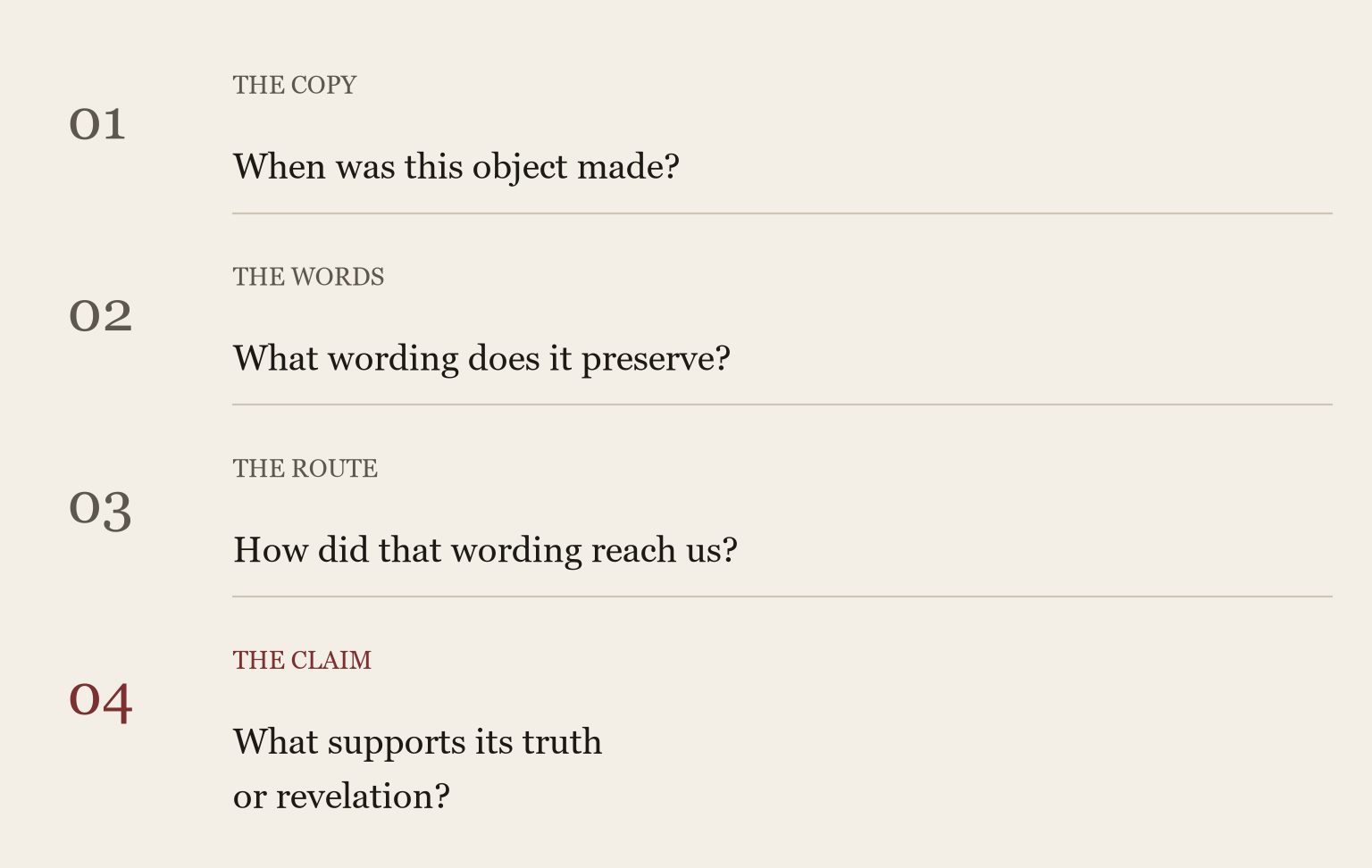
Read the four rows as four different jobs. The age of an object concerns when the surviving copy was made. Comparison concerns its words. Transmission concerns their route through people and copies.
The fourth row asks what supports the claim itself. Evidence answering an earlier row may help a larger argument, but there is no automatic arrow from old or well-preserved to divinely revealed.
These questions can overlap in real research. The point of the map is to stop one finding being silently substituted for a different conclusion. Its downloadable table contains questions, not numerical observations.
04Old skin does not date every sentence.
A real laboratory result has a specific object and a limited meaning.
The University of Birmingham holds two Qur'an leaves containing portions of surahs 18, 19, and 20. Its published radiocarbon result places the parchment in 568-645 CE at 95.4% probability. This is an early physical witness. [1]
Parchment is prepared animal skin. The university explains that the test dates the animal's death, not the moment the ink was applied. It also states that the inks have not been age-tested. Do not quietly turn a skin date into an ink date. [1]
A date range is not a certificate for one exact year. CE means Common Era, the same year numbering used by AD. BCE counts years before that era. Explaining the labels should not disguise uncertainty.
Researchers also examine handwriting, material, corrections, and the relationship to other copies. A handwriting comparison is called palaeography. A dated note can help too, but its wording and relationship to the object must be checked.
The Birmingham pages support the presence of particular Qur'anic passages on an early manuscript. Two leaves cannot stand in for a complete surviving volume, identify every earlier stage, or demonstrate that an angel dictated the words.
05Memory is not automatically a broken telephone.
The way people teach and check a text matters.
An atheist sometimes describes every oral tradition as a game of whispers: one person mishears a sentence, passes it on, and the errors multiply. That can illustrate a risk. It is not a history of every tradition.
A trained recitation system can include repetition, correction, shared performance, and carefully taught sounds. UNESCO's account of Vedic chanting describes techniques using accents, pronunciation, and combinations of words. That is more organised than a casual rumour. [14]
Careful oral training can therefore be evidence relevant to preservation. I should examine the actual system and surviving witnesses. I should not replace them with an analogy that assumes the result I want.
The limit remains. Hearing accurate recitation today does not let me inspect every performance across all earlier centuries. It also does not establish that the statement being recited is a fact about the universe.
I can recognise an impressive human achievement without calling it supernatural. The preservation question is how a tradition maintained wording. The truth question is whether its claims deserve belief.
06More copies can mean more information.
Differences are evidence to investigate, not a reason to give up.
Here is a made-up example. Copy A says the visitor arrived at noon. Copy B says the visitor arrived at night. Copy C says noon. We have found a difference in wording, often called a textual variant.
Two votes for noon are not automatically two independent witnesses. Perhaps C was copied from A. Perhaps both descend from an older source. We need dates and relationships, not just a head count.
A critical edition compares witnesses and explains which wording its editors print. Its apparatus is the record of alternatives and editorial reasons. Critical here means examined, not hostile to religion.
Some differences are spelling changes; others alter a name, a sentence, or a whole passage. Their importance depends on the question. Ten spelling differences need not matter as much as one missing instruction.
A large number of recorded variants can reflect a large number of surviving witnesses and careful documentation. It does not tell me, by itself, how much of a work is recoverable. Show me the actual variation and the evidence behind the decision.
07The Bible is a collection.
It was not one author writing one continuous document.
The Hebrew Bible contains law, narrative, poetry, prophecy, and other writings. Christian Bibles include a New Testament as well. These works come from different settings, and the collection's history is not one event. Christine Hayes introduces that diversity in her Yale course. [2]
Even the name Old Testament already places the Jewish scriptures inside a Christian framework. A Jewish reader does not accept a New Testament merely because a Christian edition binds the two collections together.
It is therefore a mistake to ask who wrote the Bible as though the answer must be one person. I need to ask about a particular book, its sources, its later editing, and the evidence for its attributed author.
A believer can accept several human writers and still believe in inspiration. That position does not collapse merely because I find different styles. I must ask why these particular writings should count as divine communication.
The collection can be evidence about ancient communities, language, and belief even where its supernatural explanations are unproved. Useful historical material and divine authority are separate assessments.
08A name starts the inquiry.
It is not a substitute for investigating authorship.
The Torah is the first five books: Genesis, Exodus, Leviticus, Numbers, and Deuteronomy. Tradition connects them with Moses. But Deuteronomy 34 describes Moses' death and burial. That is a specific authorship question, not an internet insult. [2]
A reader can check that chapter before arguing. If the claim is that Moses personally wrote every sentence as an ordinary account of events he had already witnessed, this ending requires an explanation.
A believer may propose a later addition, a different writer for the ending, or prophetic knowledge. Those are different proposals. Calling an addition possible does not demonstrate which person added it or when.
Historical scholars also investigate repeated accounts, differences of style, and signs of editing. Hayes explains this method. Particular models of the Torah's sources and dates are debated; I will not pretend scholars possess a complete list of named authors. [2]
The responsible conclusion is more precise than Moses wrote everything or nobody knows anything. We can question a simple attribution and evaluate layered composition without inventing certainty about every layer.
09A title and a witness are different things.
Ask how the attributed author is connected to the account.
Matthew, Mark, Luke, and John are the four Gospels included in the New Testament. Their familiar names are traditional attributions. In his Yale course, Dale Martin presents the common historical view that the narratives were published anonymously. The attributions remain defended by other scholars. [3]
Anonymous does not mean certainly false. It means that identifying the writer requires more than pointing to a modern heading. Claims about eyewitness access need evidence concerning that particular narrative.
Luke 1:1-4 gives the reader something concrete to inspect. Its writer describes earlier accounts, traditions handed down from eyewitnesses, and his own decision to produce an ordered account. That is a description of using received material. [4]
This does not tell us every source was reliable or unreliable. It does show why written account, eyewitness testimony, and later copying must not be treated as interchangeable labels.
If someone says a Gospel comes from an eyewitness, I ask which author, which passage, and which evidence establishes the connection. Repeating the book's traditional name does not settle the entire chain.
10Continuity and differences can coexist.
A real archive is more useful than an absolute slogan.
The Israel Antiquities Authority dates the Qumran cave scrolls from the third century BCE to the first century CE. The collection includes copies of writings now in the Hebrew Bible, along with other religious works. These are physical witnesses we can study. [5]
Its introduction explains that many biblical copies closely resemble the later standard Hebrew text, called the Masoretic Text. It also describes other copies with differences, including additions and deletions. Both observations belong in the explanation. [5]
An atheist should not conceal the continuity because it is inconvenient. A believer should not turn continuity in many passages into a claim that every ancient witness has identical wording. The archive supports a more specific account.
Nor are these scrolls the original handwritten pages of every biblical author. An early copy can move our evidence back substantially without taking us all the way to the first composition.
The practical question is which scroll and which passage. That turns a vague fight over whether the Bible ever changed into an investigation the other person can actually follow.
11Open the ending of Mark.
The manuscript issue is disclosed in a Christian Bible's own notes.
Read Mark 16 on the US Conference of Catholic Bishops' website. It prints a Longer Ending at verses 9-20 and a separate explanatory note. This is a source a believer can open without relying on an atheist's screenshot. [6]
The note says that Mark's composition ends at 16:8, discusses the possibility of a lost ending, and attributes the longer passage to another writer on stylistic grounds. It also states that the longer ending is accepted as canonical in Catholic teaching. [6]
That matters because original wording and later religious acceptance are different questions. A community can recognise a passage as scripture while its textual scholarship distinguishes that passage from the earliest composition.
I should not exaggerate this into a claim that the entire resurrection story was invented by adding these verses. Mark 16:6 already reports Jesus as raised. The specific issue is the status of this particular ending.
A useful reply is: let us read the passage and the note together. What exactly does your preservation claim cover? Every printed verse as the first author's wording, or the authority of the form your community later accepted?
12The list also has a history.
Preserving words does not answer which books belong.
The Codex Sinaiticus Project describes this fourth-century Bible manuscript as a witness to the making of the Christian collection. Its contents include the Epistle of Barnabas and the Shepherd of Hermas appended after the New Testament. [7]
Those works are not in the usual modern New Testament. Their presence does not, by itself, prove that every community gave every included work equal authority. It does make the history more complicated than one timeless printed contents page.
Dale Martin's lecture discusses early disagreements over authoritative writings and criteria such as apostolic connection, acceptance, and theology. Canon formation means tracing that process, not imagining one unknown person choosing a modern Bible in an afternoon. [3]
A believer may say the community recognised books that were already divinely authoritative. A historian can investigate the recognition process. The further assertion that God guaranteed its result needs its own defence.
I ask which community's collection we are discussing and why its boundaries should bind someone outside it. A book's inclusion tells me that a community valued it. It does not independently certify its supernatural claims.
13Separate the recitation from reports about it.
The Qur'an, hadith, and commentary are different sources.
Muslims understand the Qur'an as revelation delivered to Muhammad, and its Arabic recitation has a central place in transmission. Hadith are reports about words and actions associated with Muhammad and the early community. Tafsir means interpretation or commentary. They are not interchangeable books. [10]
If a claim about collecting the Qur'an comes from a hadith, I should identify that report. Saying the Qur'an says it, when the source is actually a later report about its collection, sends the reader to the wrong evidence.
Equally, I should not use a doubtful online story about a hadith to declare that a Qur'anic passage says something it does not. The reference must point to the actual source under discussion.
The first question is what a religious tradition reports. The next is how that report compares with manuscripts and other historical evidence. A tradition is evidence of what has been transmitted; its detailed historical accuracy still has to be assessed.
This is why I separate the Islamic collection account, the early manuscript evidence, and the divine-origin claim. They can relate to one another without becoming one claim that is either completely proved or completely destroyed.
14The tradition records choices.
Read the Uthman report before inventing a simpler story.
Sahih al-Bukhari 4987 reports concern over differences in Qur'anic recitation. It describes Uthman arranging copies using manuscripts held by Hafsa, sending copies to provinces, and ordering other Qur'anic written materials burned. These details are in the report itself. [8]
I am identifying what this hadith says. A report preserved in a later collection is not the same object as a surviving instruction written by Uthman. Its transmission and historical credibility need investigation.
For a believer, the account can describe protection against disagreement. For a historian, it also describes organised standardisation: people selecting and distributing an authorised form. Naming that process is not an accusation of secret forgery.
The burning order alone cannot tell us the wording of every destroyed page. An atheist who fills that gap with a made-up list of suppressed doctrines is adding a story, not following evidence.
The better question is what survives and whether its features fit an early common text. That leads from the report to manuscripts, where the case can become stronger or weaker through comparison.
15Stability is evidence too.
A serious atheist argument must survive the strongest manuscript evidence.
The Birmingham leaves are not the whole case. In a 2019 study, Marijn van Putten compared unusual spellings across 14 early Qur'anic manuscripts. He argued that their matching patterns point to a shared written ancestor. [9]
An ancestor here means an earlier written model from which copies descend, not a person. A repeated choice at the same places can help distinguish copying from a written source from independently writing down an oral performance.
Van Putten judged the early manuscript evidence consistent with standardisation associated with Uthman. I will not replace that result with a convenient claim that the Qur'an must have been invented centuries later. [9]
But a common written ancestor is not a surviving autograph from God or a record of an angel's visit. Its historical force concerns the text's transmission and early standardisation. The supernatural explanation is an additional step.
If a believer presents evidence of early stability, I can accept the relevant finding and still ask why the message is divine. I do not need the history to be worse than it is in order to reject an unsupported conclusion.
16Unchanged needs a definition.
The written outline, the recitation, and a translation are not identical layers.
Early Arabic writing did not consistently display all the marks a modern learner uses. Scholars call the basic written outline the rasm. Reading traditions, called qira'at, carry more information than that outline alone. [10]
Van Putten's 2024 chapter gives a concrete example at Qur'an 1:4: malik means king, while maalik, with a longer vowel, means possessor or owner. This is a recognised reading difference affecting a word's meaning, not merely two English translators choosing synonyms. [10]
A Muslim can understand both readings as authorised and complementary. That reply differs from saying there has only ever been one identical pronunciation with no variation. We should discuss the actual claim being defended.
The example does not establish two unrelated religions or a completely unstable book. It shows why every letter, every vowel, the same basic text, and the same message are claims with different scopes.
In a debate I ask: what do you mean by preserved, and which form are we comparing? A clear definition lets us check the evidence without turning a limited difference into a sensational accusation.
17One object can preserve two stages.
An erased earlier text deserves examination rather than a slogan.
A palimpsest is a writing surface reused after earlier writing was erased. Traces of that lower writing can remain. The Sanaa 1 Qur'anic manuscript has been studied as such an object. [11]
Behnam Sadeghi and Mohsen Goudarzi's 2012 study distinguishes a lower text with variants from the standard Uthmanic text type and an upper text belonging to the standard tradition. Their work presents transcriptions and comparisons. [11]
The precise reconstruction and historical interpretation of difficult lower writing are scholarly questions, not something I can settle from a blurred social-media photograph. Researchers can disagree about readings and how the object was used.
The defensible point is that early textual history includes evidence requiring comparison, alongside strong evidence of a widely standardised text. I should not deny either side to protect a preferred story.
Nor does an erased layer establish the intention behind erasure, let alone prove a conspiracy. The useful next step is a named manuscript, a specified difference, and an explanation of the evidence. Suspicion cannot fill unreadable space.
18There is no single Hindu Bible.
Different kinds of authority must not be collapsed into one.
The Hindu American Foundation's own introduction describes an extensive collection of scriptures rather than one central book. It includes the Vedas, Upanishads, epics, Puranas, Agamas, and other traditions. This is a statement from a Hindu organisation about its religion. [12]
The four Vedas are the Rigveda, Samaveda, Yajurveda, and Atharvaveda. The Vedic corpus also has ritual and philosophical layers. Familiar epic stories are not simply chapters of the Rigveda. [14]
Shruti, literally what is heard, commonly names the Vedic revelation. Smriti, what is remembered, names another broad category of tradition. Exact status and use vary across communities; one person's preferred hierarchy is not every Hindu's practice. [13]
Some traditions describe sages as receiving or seeing sacred knowledge. Some philosophical accounts defend the Veda as authorless rather than as a book composed by a creator god. These are distinct positions, not careless versions of the same claim.
Before criticising a passage, I ask which work, which textual tradition, and which authority the person actually accepts. Refuting a Puranic story does not automatically refute a different person's philosophical account of Brahman.
19Unknown and authorless are different claims.
A philosophical defence cannot be replaced by a missing signature.
The Mimamsa school offers a serious version of the authorless-Veda position. Its reasoning connects Vedic authority with the absence of a limited speaker whose ignorance or dishonesty could introduce error. It is not simply the claim that a god wrote an unusually old book. [13]
The Stanford Encyclopedia's discussion also explains disagreement with other Indian schools about scriptural authority. That internal debate matters. Hindu philosophy is not one speaker giving one answer about where reliable testimony comes from. [13]
My reply is that the premise needs a defence. Failing to identify a human composer is not the same as demonstrating that no composer existed. We must not turn missing information into a certificate of eternal truth.
Even a more elaborate argument for beginningless words must explain why these particular inherited statements carry reliable knowledge. A proposed way to avoid a speaker's defects does not automatically verify every interpretation or application.
I can examine this argument without pretending that a carbon test on one manuscript answers all of Mimamsa. The manuscript measures an object. The philosophical claim concerns authority and knowledge. Each must face the kind of questions it actually raises.
20Recitation can preserve.
It supports a preservation argument, not automatic cosmic authority.
UNESCO's description of Vedic chanting identifies specialised techniques taught from childhood to preserve sounds, accents, and word combinations. The practice deserves recognition as a disciplined way of transmitting texts. [14]
This corrects an easy atheist mistake: assuming oral means casual and therefore worthless. Different systems can have very different controls. We should ask what was actually preserved and how it was checked.
Preserving sounds and agreeing on meaning are also separate questions. A person can pronounce an old line carefully while interpreters disagree about what it implies. Exact sound is not a complete commentary.
The recognition of a cultural tradition is not an institution issuing a certificate that its theology is true. It documents and values human heritage. I should not turn UNESCO recognition into a scientific test of revelation.
My response to an excellent recitation is therefore not mockery. It is: that is impressive preservation work; now show me how the claim being preserved is independently justified. Those two judgements can stand together.
211464 does not mean the Rigveda began then.
Nor does an old composition make every surviving page equally old.
India's UNESCO nomination for a Rigveda manuscript collection identifies 30 manuscripts and lists 1464 CE as the date of its oldest dated manuscript. That statement concerns this nominated collection, not every Rigveda witness anywhere. [15]
The same document describes the Rigveda as composed over centuries by generations of poet-priests. A medieval copy and a much older body of orally transmitted material are therefore not contradictory claims. They concern different stages. [15]
If I say the oldest copy in this collection is medieval, I have not proved that the hymns were invented in the Middle Ages. If someone says the hymns are ancient, they have not dated that particular sheet to the original composition.
Scholars use language, relationships between texts, and historical context as well as surviving objects. A proposed composition date should name its method and uncertainty. A traditional cosmic chronology is another kind of claim, not a laboratory date.
When a debate produces a screenshot saying the manuscript is only a few hundred years old, I ask what that fact is supposed to establish. A true fact can still be attached to a false conclusion.
22An editor can show the work.
The Mahabharata and Ramayana have manuscript histories to examine.
The Mahabharata is traditionally associated with Vyasa, and the Ramayana with Valmiki. Those attributions belong to the traditions. They do not identify the date and writer of every line in every surviving version.
BORI reports that its Mahabharata Critical Edition consulted 1,259 manuscripts, with the project running from 1919 to 1966. The work includes an apparatus of alternatives. This is documented comparison, not a promise that one editor found an untouched original. [16]
The Maharaja Sayajirao University of Baroda describes its own critical-edition work on the Valmiki Ramayana. The existence of this editorial research is a practical place to begin when someone claims all available versions have identical wording. [17]
A critical edition aims to reason from the available witnesses. It does not turn a reconstructed text into eyewitness footage of the narrated events. Textual reconstruction and historical verification remain different tasks.
A story can also be retold deliberately in another language or setting. A retelling is not automatically a secret copying error. Before declaring contradiction or forgery, identify whether we are comparing copies of one text or different literary works.
23A title can cover a changing tradition.
Check the particular work and version before assigning one date.
Puranas bring together stories, religious teaching, sacred places, and other material. Their histories should be investigated work by work. I cannot responsibly stamp one date or one named human author onto every text in the category.
The Skandapurana Project at Leiden gives a concrete example. Its researchers compare manuscripts from different centuries, reconstruct transmission, and study the text alongside inscriptions, monuments, and images. The project describes an evolving textual tradition. [18]
This is useful because it puts the evidence on several tracks. A manuscript can help establish wording. An inscription can help establish a place, patron, or practice. Neither automatically verifies every divine action in a story.
A claim that a passage predicted a later event needs the history of that passage, not merely an ancient title on a modern volume. Was this wording demonstrably present before the event? Which witness shows it?
The same rule applies outside Hindu traditions. A late addition carrying an old book's name does not inherit an early date by wearing the same cover. We have to date the relevant words.
24Read the line before reading the slogan.
A disagreement in English or Hindi may have more than one cause.
A translation involves choices. A word can have a range of meanings; a sentence can depend on context. A commentary may make an interpretation explicit that the short translated line leaves unclear.
Two translations differing does not automatically mean two ancient manuscripts differed. They may translate the same wording differently. Conversely, two similar translations can conceal a difference in their underlying texts.
My first check is therefore the work, chapter, verse, translation, and edition. Then I ask whether the disagreement concerns the underlying words or the interpretation. Those questions stop a vague accusation from spreading.
A fluent specialist can help explain grammar and context. That is useful expertise, not a reason to surrender judgement. The explanation should show its basis and make clear where other qualified readers disagree.
You must learn the language before making a fine grammatical claim is reasonable. You must master every sacred language before asking why a book is divine is not. The person claiming authority still owes an understandable reason.
25Even the strongest copy claim leaves a gap.
I can grant perfect transmission for the sake of argument.
Suppose a believer could establish that every word of a particular original had reached us without change. I would accept that transmission finding. I would still ask why the original deserved belief.
A careful record can preserve a human mistake. A coordinated community can protect a text it sincerely regards as sacred. Neither possibility requires every person in the chain to be dishonest.
If the reply is that only God could preserve a text so well, that is another claim to defend. We need a reason why the documented human practices are insufficient, and why this particular divine explanation follows.
Qur'an 15:9 presents a promise of preservation. I can recognise what the verse claims while asking for evidence of its source. Using the book's authority to certify its divine origin, then its divine origin to certify its authority, goes in a circle. [19]
A broader argument might offer several independent reasons for revelation. Then let us examine those reasons. Preservation can be part of a historical case without doing a job it cannot accomplish alone.
26A difficult challenge needs clear rules.
Admiration alone cannot identify a supernatural author.
Qur'an 2:23 challenges doubters to produce a surah like it. Some believers present its literary character as evidence of revelation. I should engage that argument rather than pretend the claim is just that the pages are old. [20]
I would ask what counts as like it, who judges, and whether a contrary verdict is possible. If a judge assumes in advance that every human attempt must fail, the test cannot independently establish its conclusion.
Literary judgement can involve genuine knowledge of language, structure, and genre. Calling it subjective does not make expertise worthless. But an expert's admiration still needs an argument connecting the work's features to a divine source.
Failure to name an author or immediately compose a rival does not establish that humans could not create the work. I cannot reproduce every remarkable human achievement. My inability is not a detector of miracles.
The same standard applies to an epic, a hymn, or a philosophical passage that moves me deeply. Powerful writing deserves careful reading. It does not gain authority over reality merely by overwhelming the reader.
27God could work through us.
Possibility is not yet evidence that it happened here.
The strongest reply is not necessarily that human hands never touched scripture. It may be that God inspired writers, guided a community, or ensured a reliable message through ordinary historical processes.
That proposal can accommodate copying, editing, selection, and translation. So finding those activities alone does not logically refute it. My criticism should not pretend to defeat a position by assuming it made a different claim.
My answer is direct: could happen does not establish did happen. What evidence distinguishes divine guidance from humans developing and preserving a tradition they valued? The claim needs an identifying reason.
A believer may offer testimony, fulfilled prophecy, moral insight, miracles, or philosophy. Each can be stated clearly and examined. An undefined appeal to guidance cannot replace checking them, especially where traditions reach incompatible conclusions.
If every possible manuscript result is declared exactly what God intended, the claim may avoid a textual refutation. It also loses the ability to claim that one special textual result independently proved divine control.
28Open one claim together.
The aim is to expose the missing step, not overwhelm the other person.
I would begin with a plain question: are you showing that this wording is old, that it survived accurately, that an event happened, or that a god revealed it? Let us choose the actual claim first.
For a Christian example, open Mark 16 and its notes. For an Islamic example, open the Birmingham catalogue and the conservation explanation. For a Hindu example, open the Rigveda nomination or a critical-edition project. These are specific, named starting points. [1] [6] [15] [16]
Next, write one sentence saying what the source establishes. Beside it, write what it leaves unanswered. For instance: the test dates parchment; it does not identify the supernatural source of the words. Keep the two sentences visible.
Then ask what would connect that finding to revelation. If another religion offered the same kind of argument, would you accept it? I must answer the same question about my own preferred explanations.
This is a proposed exercise, not a conversation I claim to have conducted or a guarantee of agreement. A person can leave unconvinced. The useful result is a clearer claim, a source both can inspect, and no invented certainty.
NoteI will not bow to a cover.
A few words from me, Lovepreet Singh.
I am an atheist. I do not accept the claimed authority of a god because a book is old, treasured, beautifully recited, or preserved with extraordinary care. I want reasons that establish the claim being made.
That does not require me to call every religious writer a fraud. People can compose, collect, interpret, and transmit sincerely. The human record is worth understanding even when I reject the authority built around it.
I have kept continuity where the evidence shows continuity, and differences where it shows differences. A blunt argument is stronger when its examples survive checking. Exaggeration would give me a louder line and a weaker case.
My conclusion is that these histories do not, by themselves, establish revelation. They show texts reaching us through human communities. If someone adds a divine guarantee, that addition needs an argument; the sacred label cannot supply it.
The next part turns to the strongest philosophical arguments for God. Before answering them, I will state what they actually claim. I want the reader to understand the reasoning well enough to challenge it without borrowing a slogan.
SourcesFollow the evidence.
Sources checked on 15 October 2026. References identify primary religious passages, manuscript-holding institutions, research projects, original textual research, and philosophical explanations. They support the specific marked statements, not every supernatural claim in the works discussed. The book on the table, dragon, copied letter, visitor, and proposed conversations are invented teaching examples. The figure is an explanatory map, not a survey, experiment, or ranking of religions. Historical inference, traditional attribution, religious belief, and the author's criticism are distinguished. Composition dates and source reconstructions can remain disputed even when a particular manuscript or wording can be examined. My argument does not require a claim that every religious statement is false or every ancient writer dishonest.
[1] Birmingham Qur'an: FAQs and conservation research
University of Birmingham, Cadbury Research Library. Accessed 15 October 2026.
The holding institution identifies two leaves and their passages. The 568-645 CE range at 95.4% probability concerns parchment, specifically the animal's death. Ink composition was examined but the inks were not age-tested. Neither page is a complete Qur'an.
Open the conservation and dating explanation
[2] Doublets, seams, and the historical-critical method
Christine Hayes. Open Yale Courses, RLST 145, lectures 4 and 1.
Historical and literary teaching on composition and editing. Deuteronomy 34 is a specific authorship example. Competing source models are scholarly reconstructions, not a recovered complete list of authors. No claim that different styles alone disprove inspiration is made here.
Open the introduction to the Hebrew Bible collection
[3] From Stories to Canon
Dale B. Martin. Open Yale Courses, RLST 152, lecture 2.
Historical discussion of Gospel attributions and the gradual recognition of authoritative writings. This presents a common critical position; defenders of traditional authorship dispute aspects of it. Anonymous authorship, textual reliability, and inspiration are distinct questions.
[4] Luke 1:1-4
New American Bible, Revised Edition, hosted by the USCCB.
Primary religious text. The prologue describes previous accounts, material handed down from eyewitnesses, and an ordered account. Read the text and its notes in context. This establishes what the writer says about the process, not the truth of every narrated event.
[5] The Dead Sea Scrolls: Introduction
Israel Antiquities Authority, Leon Levy Dead Sea Scrolls Digital Library.
The archive describes Qumran dates, biblical and non-biblical works, similarity to the Masoretic Text, and textual differences. The Qumran date range is not a date for every document found at every Dead Sea site. Continuity and variation are both reported.
[6] Mark 16 and its textual notes
New American Bible, Revised Edition, hosted by the USCCB.
Read the notes on 16:1-8 and 16:9-20. They distinguish the composition, the longer ending, possible loss of an ending, and Catholic canonical acceptance. Verse 16:6 already announces resurrection; the example must not be misused to deny that earlier statement.
[7] Codex Sinaiticus: Significance
Codex Sinaiticus Project, a collaboration of the holding institutions.
Describes the fourth-century manuscript, later corrections, collection history, and Barnabas and Hermas appended after the New Testament. Physical inclusion does not independently establish that every included work held identical status for every ancient community.
[8] Sahih al-Bukhari 4987
Book 66, hadith 9. Arabic text and English translation at Sunnah.com.
Primary source for the transmitted religious report about Uthman, Hafsa's manuscripts, copying, distribution, and destruction of other written materials. It is a later transmitted account of earlier events, not a surviving order issued by Uthman. Its existence does not verify every historical detail.
[9] Shared spellings and a written Uthmanic archetype
Marijn van Putten. Bulletin of SOAS 82(2), 271-288 (2019). DOI: 10.1017/S0041977X19000338.
Original study of orthographic patterns in 14 early Qur'anic manuscripts. It argues for a common written ancestor and early standardisation consistent with the traditional Uthmanic account. The historical inference does not identify a divine source.
[10] Textual Criticism of the Quran
Marijn van Putten. In The Comparative Textual Criticism of Religious Scriptures, Brill (2024). DOI: 10.1163/9789004693623_009.
Scholarly chapter on written and recited transmission. Its reading examples include king and possessor at Qur'an 1:4. Rasm, reading traditions, and translation are distinct layers. Recognised differences should not be exaggerated into completely unrelated scriptures.
Find the chapter on the author's publication page
[11] Sanaa 1 and the Origins of the Quran
Behnam Sadeghi and Mohsen Goudarzi. Der Islam 87, 1-129 (published 2012). DOI: 10.1515/islam-2011-0025.
Original edition and analysis of the palimpsest's lower and upper texts; see the introduction and comparative discussion. The linked PDF is a copy of the researchers' paper, not an endorsement of the hosting site. Readings, use, and historical interpretation remain subjects of scholarship.
Read an openly available copy of the original study
[12] Short answers to real questions about Hinduism
Hindu American Foundation. Hinduism FAQ, scripture section.
A Hindu organisation's own presentation of scripture and diversity. Used to represent a religious self-description, not as independent proof of the theology or exact dates. Its list includes Vedas, Upanishads, epics, Puranas, and Agamas.
[13] Language and Testimony in Classical Indian Philosophy
Madhav M. Deshpande. Stanford Encyclopedia of Philosophy, especially section 4.
Explains the authorless Veda, Mimamsa's epistemic defence, and disagreement with other Indian schools. This is philosophical scholarship, not a radiocarbon study. Authorlessness as a defended doctrine is different from an unidentified historical composer.
Read Ann Taves on revelation, shruti, and smriti (Harvard, 2026)
[14] Tradition of Vedic chanting
UNESCO Intangible Cultural Heritage, nomination 00062; inscribed 2008, proclaimed 2003.
Describes the four Vedas and specialised methods for preserving recited sound. Used for the transmission practice, not as certification of supernatural truth. Cultural recognition does not independently date every performance or verify every religious claim.
[15] Rigveda manuscript collection: nomination document
India, Memory of the World nomination 2006-41. UNESCO record inscribed 2007.
The nomination identifies 30 manuscripts, the oldest dated witness in that collection as 1464 CE, and composition over generations. See PDF pages 2-3 and 7-9. The collection's date is not the composition date or a claim about every Rigveda manuscript in existence.
Open the UNESCO collection record
[16] The Mahabharata Critical Edition
Bhandarkar Oriental Research Institute, Pune. Project description.
The institution reports consulting 1,259 manuscripts and dates its project from April 1919 to September 1966. The edition includes constituted text and a critical apparatus. This documents editorial work, not physical recovery of Vyasa's own pages or proof of every narrated event.
[17] Critical Edition's Wing: Valmiki Ramayana
Oriental Institute, Maharaja Sayajirao University of Baroda.
The institution describes its Ramayana critical-edition project and later work on Puranic texts. Used as a checkable example of textual scholarship. A modern edition's publication date does not date the epic's original composition or the events of its story.
[18] The Skandapurana Project
Leiden University. Research team's description and published e-texts.
Explains its manuscript comparison and study of composition, transmission, inscriptions, monuments, and images. This is a particular Puranic tradition; it does not establish one date or one textual history for every Purana.
[19] Quran 15:9
Al-Hijr. Arabic and translations, including Mustafa Khattab's The Clear Quran.
Primary religious passage presenting a promise of preservation. The passage is identified and paraphrased, not treated as independent verification of its own divine origin. Whether manuscript history fulfils a particular interpretation is an additional argument.
[20] Quran 2:23
Al-Baqarah. Arabic and translations, including Mustafa Khattab's The Clear Quran.
Primary passage for the challenge to produce a surah like it. The chapter examines the argument's criteria and inference, rather than claiming to settle Arabic literary judgement by personal taste. Literary distinction and divine origin are separate propositions.