

01Give the argument a fair fight.
A bad reply does not become good because an atheist says it.
Imagine a believer saying: forget the stories for a minute. Why does anything exist? Why does the universe have order? Why is cruelty wrong? These are serious questions. Laughing at them would leave them unanswered.
I am an atheist. I do not accept a god merely because someone attaches one to a difficult question. But if I want to criticise a belief honestly, I must first describe its strongest relevant argument in words its defender could recognise.
That does not mean every version deserves equal confidence. It means I should not replace a careful argument with a silly one, defeat the silly one, and announce victory. That would be theatre, not examination.
This part examines several influential arguments. Strongest is my selection for this discussion, not a scientific ranking of every argument ever written. Different believers defend different versions, and they sometimes disagree with one another.
My job is simple: identify the starting claims, follow the steps, and ask what conclusion actually follows. If a step fails, name it. If a question remains open, leave it open. I do not need a fake answer to reject an unsupported one.
02Good logic can start badly.
Check the ingredients as well as the recipe.
An argument has premises: the starting claims it asks us to accept. It also has a conclusion: the claim those premises are supposed to establish. A valid argument connects them so that true premises could not produce a false conclusion.
Here is an invented example. Every animal in this room can fly. The cat is an animal in this room. Therefore the cat can fly. The structure works. The first premise does not. A valid arrangement has not made a flying cat.
A sound deductive argument has both a valid structure and true premises. Deductive means the conclusion must follow if those premises are true. Other arguments aim at a probable or best explanation. Their conclusions need comparison and degrees of confidence.
When someone says an argument proves God, I ask them to write its steps. Which claim comes from observation? Which is a definition? Which is a disputed philosophical principle? A long sentence can hide a large assumption.
Experiments are not the only form of reasoning. Mathematics and logic matter too. But a valid calculation about a model does not establish that the model describes reality. The connection to the world must earn its place in the argument.
03Which God are we discussing?
An unknown cause and a god who gives commands are different claims.
God can mean a personal creator, a sustaining source of existence, an impersonal ultimate reality, or even a poetic name for nature. If we keep changing the meaning, we can appear to prove one thing while actually defending another.
Classical theism commonly concerns a supreme personal reality with power, knowledge, and goodness. A deist may accept a creator without accepting revelation. Some Hindu accounts of ultimate reality differ sharply from the picture of a separate cosmic person.
I therefore ask for the actual claim rather than treating every Muslim, Christian, or Hindu as if they had signed the same philosophical statement. A label is not a complete description of somebody's beliefs.
Suppose an argument establishes some necessary foundation. We must still ask whether it thinks, chooses, loves, knows everything, or communicates. Calling the foundation God does not establish those additional properties by itself.
I also reject a moving target. If a claim begins as a being who answers prayer and ends as the fact that something exists, the prayer claim has not been defended. Keep the definition visible from the first sentence to the last.
MapDo not skip a step.
Check the premises, the inference, the conclusion, and the identity.
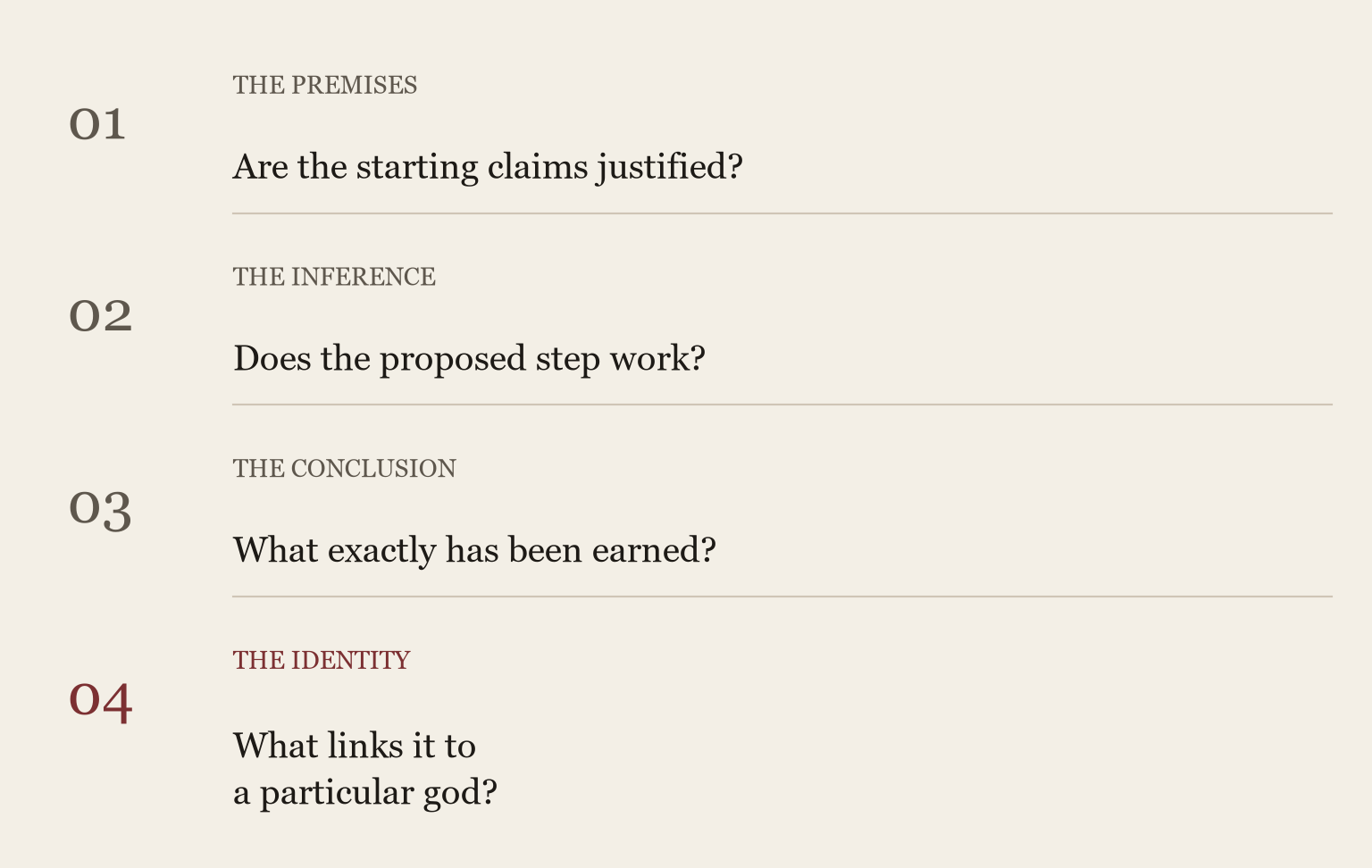
Start with the premises: the claims an argument needs. Then examine whether the proposed conclusion follows deductively or is supported as a probable explanation.
Next, state exactly what has been earned. A cause, a necessary foundation, an intelligent designer, and a perfectly good personal God are different descriptions. Each added property needs support.
Finally, ask what connects the conclusion to a particular religious identity or revelation. Some arguments aim at more than one of these tasks. The map does not assume they all stop at the same place.
04Did the universe need a cause?
The careful version says that what begins has a cause.
The kalam argument says: things that begin have a cause; the universe began; therefore it has a cause. William Lane Craig defends this beginning-restricted version. [1]
The conclusion follows if both premises hold and the terms keep the same meaning. That is why simply shouting that God also needs a maker does not answer this version. Its first premise never said that absolutely everything needs a maker.
I ask about the first premise. Our everyday examples concern changes within an existing world: a house assembled from materials, a person developing from earlier life. Those examples are not observations of an entire physical reality emerging from absolute nothing.
The defender can reply that causation is a basic principle, not just a collection of household examples. Fine. Then we need an argument for applying it at this boundary. Calling that principle obvious is a starting point for discussion, not the end.
My short reply is: I understand the logic. I need reasons to accept the premises in this setting. And even if I accept a cause, I still need the further argument that identifies it as a conscious, divine being.
05The Big Bang is not a name tag.
A history of expansion is not an identification of a creator.
The hot Big Bang account describes an early hot, dense phase and the universe's subsequent expansion and cooling. That scientific account should not be casually rewritten as a laboratory demonstration that absolute nothing turned into something.
NASA explicitly says scientists are unsure what preceded inflation or powered it. Inflation is a proposed early episode of extremely rapid expansion. Its details and what, if anything, preceded it are questions to investigate, not blanks already signed by God. [2]
Someone may offer a theorem about the past of particular cosmological models. Then read its assumptions and its actual conclusion. A limit on a model's past description is not automatically proof of a supernatural agent or of creation from absolute nothing.
I am not claiming that an eternal universe has been established. I am separating confidence in an expanding cosmic history from certainty about the ultimate beginning of all reality. Later parts will examine the observations and dating methods in detail.
Ask the believer to point to the extra step: where does the evidence stop describing the universe and start identifying a mind? The word beginning cannot secretly do all that work on its own.
06Use the objection that fits.
The strongest reply asks why the proposed exception is justified.
If someone says everything needs a creator, asking who created God exposes a problem with that exact claim. If everything needs one, God does too. If something can exist without one, the original statement was too broad.
But a more careful believer says only things that begin, or only dependent things, require a cause or explanation. Their God is supposed to be beginningless or non-dependent. Repeating who made God ignores the restriction they actually proposed.
My better question is: what establishes that such a being exists and has those properties? A definition can describe an uncaused being. It cannot, by itself, put that being into reality. The defender still has a case to make.
I also ask why the ultimate foundation must be a mind rather than some other non-dependent reality. This is a request for a distinction, not a claim that physics has already proved a particular alternative.
It is not automatically special pleading to apply different rules to genuinely different categories. It becomes a problem when the relevant difference is merely asserted to protect the preferred answer. Show the difference and why it matters.
07Why must the cause think?
This step needs its own defence.
Craig further proposes a free personal agent to explain a timeless cause producing a universe with a beginning. This is additional philosophy, not a telescope measuring personality. [1]
Personal here means capable of intention or choice. It does not mean a human body. Saying that such a cause lacks a brain is therefore not, by itself, a contradiction in the proposal. The debate concerns whether disembodied agency is possible and supported.
I ask how a choice relates to time. Our familiar choices involve differences between considering, deciding, and acting. If the proposed choice is timeless, the defender needs to explain the idea rather than borrowing the ordinary meaning whenever convenient.
There may be sophisticated answers. I should read them. But identifying a difficulty for one impersonal model does not prove that every possible impersonal explanation fails. A claimed list of only two options must be justified as complete.
Even a successful personal-cause argument would not yet establish perfect goodness, unlimited knowledge, one particular scripture, or a rule about my dinner. Those properties cannot enter the conclusion just because the discussion has become abstract.
08The first cause need not be the first event.
Some arguments concern what sustains change now.
Aquinas's First Way starts with change and a distinction between what something can become and what is already actual. Wood can become hot; something actual brings about the heating. This belongs to a philosophical account of change. [3]
The important question is not simply who pushed the first domino long ago. A defender may ask why dependent causes have any power here and now. Aquinas also held that reason could not demonstrate that the world had a temporal beginning. [4]
Think of a lamp receiving power through connected equipment. The analogy helps explain borrowed power, but it does not prove that the universe works exactly like a household circuit. Teaching the proposal and establishing it are different tasks.
A compact version says: real dependent activity exists; an entirely derivative chain cannot account for it without a non-derivative source; therefore such a source exists. The second claim carries serious philosophical weight and needs defence.
I ask whether that dependence picture applies universally and whether it establishes one source with the proposed divine attributes. An older physical picture can be questioned. Still, replying that the universe might be eternal does not answer an argument about present dependence.
09An endless chain is not settled by a slogan.
Different kinds of regress raise different questions.
A regress is a chain in which one explanation points to another, which points to another. A temporal regress goes back through earlier events. A dependence regress concerns what relies on what. These are not automatically the same problem.
One believer argues that an infinite past could never be completed. A critic replies that a beginningless past has no first moment from which counting had to start. That reply identifies a disputed assumption; it does not establish an infinite physical past.
Another argument says that infinitely many borrowed powers never produce an independent source. The critic asks whether the whole chain really needs the kind of foundation being demanded. Repeating infinitely many is not enough does not settle that disagreement.
Mathematical descriptions of infinity do not by themselves establish what can exist physically. Equally, an unfamiliar implication of infinity is not automatically a logical contradiction. We need the actual reasoning, including what kind of infinity is meant.
My position does not depend on declaring every regress possible. If someone establishes that a particular regress must stop, we can discuss what follows. Stopping the chain still does not supply a complete divine personality.
10Why is there anything at all?
This argument asks for an explanation, even if the universe has no first day.
A contingent thing exists but could have failed to exist. I could have failed to be born. This particular chair could have remained unmade. A necessary reality, in the relevant philosophical sense, could not have failed to exist.
Leibniz appeals to a sufficient reason for contingent reality and locates the ultimate explanation beyond the series of contingent things, in a necessary source. Read sections 7-9 of his Principles of Nature and Grace for his own presentation. [5]
Here is a simplified reconstruction: contingent reality exists; contingent reality requires an adequate explanation; an explanation consisting only of further contingent things is not ultimately adequate; therefore the explanation must involve something non-contingent.
That is more serious than everything has a beginning. It could be offered even for a universe lasting forever. Its disputed steps concern the demand for a complete explanation and whether a contingent chain can meet that demand.
I ask which version of the sufficient-reason principle is being defended, why I should accept it without exception for contingent reality, and why the totality being discussed is contingent. Examples of individual dependent objects do not settle every claim about the whole.
11Could it have been absent?
It is a claim about what could not have been absent.
When a philosopher says a being exists necessarily, they do not merely mean it has existed for a long time or is needed for our comfort. They mean its non-existence is impossible in the relevant sense. That is an enormous claim.
Do not confuse must exist if this world is to function with could not have failed to exist at all. A key may be needed to start a particular car. That does not make the key a metaphysically necessary object.
A defender may offer arguments that a necessary source must be simple, unique, intelligent, or good. Those arguments deserve separate examination. It would be unfair to say no defender has tried. It would be careless to pretend the word necessary already proves every property.
Nor can I win by declaring the universe necessary and walking away. That would copy the unsupported move I am criticising. If I propose a necessary physical foundation, I owe reasons for that proposal too.
The honest disagreement is about which premises are justified and what they establish. I can withhold belief in a necessary divine mind without claiming to have solved the metaphysical status of all reality.
12Not knowing is an answer.
An unresolved foundation does not select a religion.
A brute fact is a fact for which there is no further explanation. A necessary foundation is a proposed reality that could not have been absent. These are different ideas, though either may appear in discussions of where explanations end.
The believer may say an unexplained universe is unacceptable, while a necessary God provides an ultimate answer. I ask what demonstrates the necessity and what connects that source to this particular universe. Naming the proposal does not settle either question.
Another possibility is that some demand for explanation goes beyond what reality provides. I do not assert that this is the truth. I say that rejecting it requires an argument, just as accepting a necessary creator does.
Even the question why something rather than nothing contains something to examine: is absolute nothingness a genuine alternative? I do not know that it is. I also cannot prove that it is impossible. We should not turn either uncertainty into a theorem.
My reply is blunt: I do not know the ultimate explanation. You may think your account is better. Then show why. My ignorance is not evidence that your account is true, any more than your ignorance would establish mine.
13Does a definition make it real?
Anselm tries to reason from the greatest conceivable being.
Anselm's Proslogion argues from the idea of a being greater than any conceivable rival. Roughly, if that being existed only in thought, a real being of that kind would be greater; so the greatest being cannot exist only in thought. [6]
This is called an ontological argument. It aims to reach existence through reasoning about the concept, rather than through an astronomical measurement. To evaluate it, we need to inspect the move from an understood description to something real.
My imagined example is a perfectly described meal. Adding actually exists to the description does not fill my plate. That example illustrates the gap; it is not a complete refutation of every specialised argument about necessary existence.
Kant objects that existence does not add another descriptive property in the required way. His discussion of possible and actual money separates the content of a concept from whether the object is there. Read his criticism, not just the slogan about it. [7]
I ask which premise authorises the jump. If existence is simply inserted into the definition, I have been told what the proposed being would be like if real. I have not yet been given a reason to accept that there is such a being.
14Maybe is doing a lot of work.
The modal version uses a stronger kind of possibility than ordinary uncertainty.
A possible world, in this discussion, means a complete way reality could have been. It need not mean another planet or an actually existing parallel universe. Modal reasoning concerns possibility and necessity.
Plantinga's version uses a being with maximal greatness, including necessary existence. In the relevant modal framework, if such a being is metaphysically possible, its existence follows. The crucial possibility premise is stronger than saying we do not know it is impossible. [8]
Think about the difference between I have not ruled out this key fitting and I have established that this exact lock can accept this key. Ignorance of a barrier is not the same as a demonstration that no barrier exists. The example is only an aid.
My objection targets the starting claim: what justifies the required possibility of this fully specified necessary being? Giving it that description is not enough. If the premise remains disputed, the conditional result does not compel an unbeliever to accept it.
I should not call every valid modal argument a word trick. I should identify its commitments and ask whether they are warranted. Formal precision can clarify the disagreement; it cannot manufacture an agreed premise.
15Does nature need a maker?
A watch has a maker. Does the analogy reach the universe?
Paley begins Natural Theology with a watch and argues from the arrangement of its parts to a maker. He then develops comparisons with living structures. Read the opening chapters: the claim concerns functional organisation, not merely anything that looks complicated. [9]
We recognise manufactured watches through a wider background of evidence about people, tools, materials, and production. Moving from those objects to all of nature requires justification. We do not have the same direct comparison class of known manufactured universes.
Living populations also reproduce with inherited differences. Natural selection can preserve differences that affect reproductive success across generations. Darwin's original account is in On the Origin of Species, especially chapter 4; the modern evidence will receive its own part. [10]
Selection is not the picture of a finished eye appearing in one lucky throw. Nor does explaining biological adaptation automatically explain the origin of life or the laws of physics. Those are related questions, but they are not interchangeable.
A believer may reply that God works through evolution. That is compatible with accepting a natural mechanism, but it adds a further claim about intention. The mechanism does not establish the intention simply because someone can attach it to the account.
16Was it made for life?
A serious probability claim needs a specified model.
Some physical models are sensitive to their parameters: changing them can alter whether familiar complex structures and life could exist. Luke Barnes reviews examples in the scientific literature. That research question deserves attention rather than an eye roll. [11]
The design argument then adds an inference: life-permitting conditions are more expected if a designer wanted life than under the relevant non-design alternative. To assess that comparison, I need actual assumptions about both alternatives.
What values were possible? How were they distributed? Could they vary together? Why assign that particular chance to a designer wanting creatures like us? A tiny-looking interval is not, on its own, a complete probability calculation.
Observer selection means that observers will find themselves where observers can exist. That matters to the question being asked. It does not, by itself, explain why any life-permitting world exists. Equally, a proposed multiverse is not an established escape hatch I may simply assume.
My reply is: show the physical analysis, then show the probability argument, then show how the conclusion identifies your God. I will not replace missing information with a spectacular number or pretend that uncertainty proves design.
17Who designed the designer?
Useful objections examine explanatory work and added commitments.
A critic asks: if complexity demands a designer, would a divine mind need one too? That is a fair challenge to that exact complexity rule. But a classical theist may say God is simple in a technical sense, without composed parts.
That proposal is not the claim that God has a tiny human brain. I should ask whether divine simplicity is coherent and whether it helps explain the observed world. Simply calling God complicated can miss the actual position.
An explanation does not always require a completed explanation of its own source. I can identify the writer of a note before knowing who taught that person to write. Otherwise no ordinary investigation could ever finish a step.
The real question is whether the proposed source is independently supported and explains the evidence better. A theory that can accommodate every conceivable result without telling us why this result is expected may offer less than it first appears to.
Hume's Dialogues explores how limited an inference from the world to its maker may be. Even granting design does not automatically establish one unlimited, perfect creator. A proposed designer and the God of a particular theology are not identical conclusions. [12]
18Does morality need God?
What makes a moral claim true?
A common moral argument says: without God, no objective moral obligations; such obligations exist; therefore God exists. Craig defends this foundation claim, distinct from whether atheists behave well. [13]
Objective here means that a moral truth does not become false merely because a person or crowd dislikes it. The question concerns what grounds that truth. Grounding means what makes it hold, not how someone first learned the rule.
Saying atheists can be kind does not answer that foundation question. It answers a different accusation. Equally, saying some atheists are cruel does not establish divine moral authority. Personal conduct cannot substitute for the missing philosophical step.
I challenge the premise that God is the only possible foundation. Why could moral reasons not depend on features such as suffering, agency, fairness, or facts about conscious beings? Different secular accounts defend different answers; their existence does not prove them, but they must be addressed.
If I do not claim fully objective morality, I should say so and explain my position. I cannot borrow the moral argument's second premise for convenience and dismiss its meaning a moment later. The honest debate concerns both premises.
19Can cruelty become good?
The stronger religious answer appeals to God's nature.
Plato's Euthyphro asks about the relation between holiness and the gods' approval. A modern moral version asks: is something good because God commands it, or does God command it because it is good? The adaptation is not a verbatim quotation. [14]
If a command alone makes anything good, apparently even cruelty could become good by order. If God instead recognises an independent standard, that standard appears to do some of the explaining. Either option raises a question for the simple lawgiver picture.
A stronger answer grounds goodness in God's necessarily good nature, with commands expressing it. Craig defends this response. It rules out arbitrary approval of cruelty. [13]
My follow-up is: why does identifying goodness with that nature explain its authority? How do we establish the being and its nature, and distinguish its commands from human claims about them? These are questions to answer, not a declaration that every nature-based account is contradictory.
If someone tells me to approve an atrocity because their book attributes it to God, I still need reasons to trust the attribution and the moral defence. A signature allegedly belonging to the universe's owner does not switch my reasoning off.
20Do logic and mathematics require a mind?
Using reason does not settle the ultimate source of reason.
Another believer asks why a universe without God would be understandable or why reasoning should be trustworthy. The proposal is that a rational creator explains both an ordered world and minds capable of understanding it.
I accept the importance of the question. But I ask what connects those facts specifically to a divine mind. A claim that nature has no dependable order without God needs support; it cannot serve as its own justification.
Consider a triangle. Its three-sidedness is not the kind of rule that becomes false when someone votes against it. Does that require an eternal person thinking about triangles? That is a further philosophical account, not something contained in the word three.
My confidence in ordinary reasoning can be examined through consistency, correction, shared checking, and successful applications. None makes human thought infallible. The same fallible reasoning is also being used to recognise a supposed revelation and interpret it.
I need not prove a complete theory of logic before noticing an unsupported conclusion. But if I claim a complete explanation of reason, I owe one. The believer and I both have to distinguish using a reliable method from explaining why it ultimately exists.
21A difficult mind problem is still a problem.
An explanatory gap does not identify a divine mind.
Consciousness includes what experience feels like: pain, colour, awareness. Describing a process and explaining its felt character may be different tasks. Chalmers's 1995 paper develops that distinction; I am citing the problem, not a proof of God. [20]
A theist may argue that mind is less surprising if reality ultimately comes from mind. That is a proposed explanation. I ask what it predicts or clarifies and why it should beat competing accounts of consciousness.
Saying a cosmic mind made smaller minds can leave major questions untouched. How does that mind exist? How does it act? Why these particular experiences? This does not automatically refute the proposal, but it shows what still needs explanation.
A critic should not pretend every philosophical problem about consciousness has already been solved. Nor should a believer treat every unfinished problem as private property. Unresolved does not mean supernatural has been established.
I can admit that consciousness is hard without accepting a soul, an afterlife, or an all-knowing creator. Those are further claims. The later discussion of mind will examine them separately rather than bundling them into one emotional word.
22An experience can be real. Its interpretation can fail.
Take the person seriously and examine the explanation.
A believer may say: I encountered God directly. I did not reason my way there. This can be a powerful reason for that person. It does not follow that the same report should settle the question for everyone else.
William James takes mystical experience seriously while distinguishing its authority for the person experiencing it from an obligation imposed on outsiders. Read the closing discussion in his lectures on mysticism; it is more careful than either automatic dismissal or automatic belief. [15]
I ask what was experienced and what was inferred. A feeling of presence, a vision, and a conclusion about the source are not one indivisible fact. Recognising that difference does not require calling the person dishonest or mentally ill.
If two sincere people offer incompatible religious interpretations, sincerity alone cannot tell me which interpretation is right. They might share an underlying reality, or one or both accounts might be mistaken. Each possibility needs reasons.
My practical question is: what could help an independent person distinguish your explanation from alternatives? Part 3 examined experience in more detail. Here the point is its place in an argument: personal certainty cannot automatically become public certainty.
23An unusual event needs a second investigation.
Establish what happened before identifying its ultimate source.
Miracle arguments can supply the missing link to a particular faith, a believer says. A prophet performs a sign; a scripture predicts an event; a prayer is answered. These claims deserve investigation as specific claims, not a single undifferentiated category.
I first ask for the earliest available record, independent witnesses, the exact claim, and access to the relevant evidence. For a prediction, I need the wording securely fixed before the event, clear success conditions, and an honest account of misses.
Hume's Enquiry, section 10, famously examines testimony for miracles against other explanations of a report. I do not need to accept every part of his treatment to ask whether mistake, exaggeration, deception, or an unknown natural event has been adequately considered. [16]
Suppose an event really exceeds our current explanation. That would establish a puzzle. To establish a particular divine source, I need evidence connecting the event to that source. Unexplained and revealed by this god are different conclusions.
A testable claim should be tested on its own terms. I will not dismiss a well-supported event just because it is surprising. I also will not convert surprise into approval of an entire religion's history, ethics, and demands.
24Clues can combine.
Do not count the same clue repeatedly.
A thoughtful believer may say no argument stands alone. A cause, order, morality, and experience together make God the best explanation. That is a cumulative case: the combined force matters, even if each item is inconclusive.
That possibility is real. Here is an invented example. A note, a distinctive recording, and independently checked location evidence might together identify a visitor better than any one clue. Rejecting each clue for failing to prove everything would be a bad response.
Now change the example. Three newspapers copied the same anonymous rumour. They are not three independent confirmations. If several arguments all depend on the same unsupported principle, repeating that principle under new headings does not create fresh evidence.
I ask whether the observations are more expected under the proposed God than under serious alternatives, and whether the proposal was adjusted after every result. A creator who might want absolutely anything does not obviously make this particular world likely.
I must assess the strongest combined case, including counterevidence. I should not announce that uncertain arguments can never add up. I should also refuse impressive-looking percentages when nobody has justified the probabilities or the dependencies.
25Count the whole world.
A loving, powerful God must face suffering and hiddenness too.
If the beauty of the world is evidence for a good creator, suffering cannot be excluded from the file. The question is not merely why one unpleasant thing happened. It is whether the world's suffering fits the particular power and goodness being proposed.
A believer may appeal to freedom, growth, stable natural laws, or reasons beyond our knowledge. Those are possible defences to examine. Their mere availability does not show that every kind, amount, and distribution of suffering has been explained.
Hiddenness raises another issue. Schellenberg argues from nonbelief without resistance to a relationship against a perfectly loving personal God. This targets a specified conception, rather than every possible ultimate reality. [17]
My plain question is: if a loving being wants people to know it, why can an honest seeker remain unconvinced? Replies about freedom, the timing of a relationship, or spiritual development must explain that situation rather than simply accuse every doubter of lying.
Neither suffering nor hiddenness is a one-sentence disproof of every creator concept. But a cumulative argument must count relevant difficulties as well as favourable clues. Otherwise it is an advertisement selecting its photographs.
26Which God?
Revelation needs its own support.
The Quran, at 52:35-36, challenges its audience about their existence and the creation of the heavens and earth. The Bhagavad Gita, at 9.10, describes nature producing the world under Krishna's supervision. These are distinct scriptural claims to examine. [18] [19]
A verse can present a question or a theological account. Its presence in scripture does not independently establish the account's truth. If the audience does not accept that scripture, the reasons cannot assume its divine authority.
Nor are Allah, God, Bhagwan, and Brahman simply interchangeable labels in every theology. Some traditions share important claims and disagree about others. Some descriptions are personal; some are not. We must examine the actual view rather than caricature an entire population.
Suppose I grant a necessary intelligent source for discussion. Which evidence establishes a particular prophet, incarnation, text, ritual obligation, or afterlife? A separate historical or experiential case may be offered. That case must also be checked; the cosmic argument supplies no exemption.
This is not a dishonest refusal to accept any conclusion. I can accept precisely what an argument earns and withhold the rest. A bridge reaching one bank of a river has not reached the other merely because someone paints the destination on it.
27Keep one claim on the table.
This is a proposed conversation, not a report of a debate I won.
Believer: the universe must have a cause. My reply: please give the exact argument. Do you mean it began, it depends on something now, or every contingent reality needs an explanation? I want to answer the claim you actually mean.
Believer: whatever begins needs a cause, and the universe began. My reply: I understand the conclusion. Which evidence establishes an absolute beginning, and why does the causal principle apply there? Let us check those two premises separately.
Believer: suppose I establish both. My reply: then I would accept that the universe has a cause, as your premises imply. Now show why the cause must be a mind. If you supply that argument, I will examine it too.
Believer: morality and experience support the same mind. My reply: let us examine their premises and whether they provide independent support. Then we also need to include suffering, hiddenness, and rival explanations. What would count against your conclusion?
If the conversation jumps to evolution, return to the unfinished claim or openly change the topic. You do not owe thirty instant answers at once. Write down the source, the disputed step, and what would resolve it. Accuracy is more useful than a fast performance.
28I still need a reason.
I can stay open without pretending to be convinced.
My position is not that every philosophical question has a finished scientific answer. It is that the arguments examined here have not earned my belief in the divine minds and religious authorities being proposed. That is a judgement about their support.
Could a creator exist? Leaving a possibility open is different from assigning it equal probability or treating it as established. I do not have a justified numerical probability for every imaginable creator. I will not invent one to look precise.
What could change my mind? An argument with justified premises and a conclusion that really follows, or independently checkable evidence that clearly favours a specified divine explanation over serious alternatives. I would inspect the evidence rather than promise in advance that nothing could count.
Here is my short reply for everyday use: tell me exactly what you mean by God, give your strongest reasons, and show the step from those reasons to that conclusion. I can acknowledge what is established while questioning the rest.
An origin question does not automatically prove a creator. A creator does not automatically prove revelation. Revelation would not automatically settle every interpretation. I will follow the reasons as far as they go. I will not carry the conclusion across the missing ground for you.
NoteTest the claim.
Written by Lovepreet Singh.
I wrote this part because an atheist should be able to recognise a thoughtful religious argument before criticising it. Calling believers stupid would tell us nothing about whether their premises are true. It would also make this series less honest.
I have simplified technical debates, not claimed to close centuries of philosophy in a few pages. The references let you inspect the original positions and the exact questions being discussed. My examples and proposed dialogue are invented teaching aids.
My criticism remains direct. I will not accept a conclusion merely because it sounds profound, comforts somebody, or arrives in formal language. A missing explanation does not belong to the first religion that claims it.
The same standard applies to me. If I use a weak objection, correct it. If a source supports the believer's narrower point, say so. Atheism does not improve when it borrows the habits it criticises.
Next we turn from these arguments to the timeline of the universe, Earth, life, and human history. Before arguing about whether a sacred timeline fits the evidence, I want us to understand how those dates are actually established.
SourcesFollow the evidence.
Sources checked on 15 October 2026. Primary philosophical texts and contemporary advocates identify the arguments actually being examined. NASA and the research paper support narrow scientific statements; they do not certify theological conclusions. Religious passages identify teachings rather than independently verify them. The criticism and simplified reconstructions are the author's reasoning. Possible, necessary, contingent, valid, and sound are explained where used. No philosophical consensus, new experiment, probability of God, or completed debate is invented. The flying cat, meal, key, lamp, visitor, newspapers, and dialogue are teaching examples. The figure is an original conceptual map, not measured evidence or a claim that all arguments have the same structure. Later parts examine cosmic history, evolution, design, morality, and consciousness in greater depth.
[1] The Kalam Cosmological Argument
William Lane Craig / Reasonable Faith / 2015 lecture
Primary advocacy: inspect the causal restriction and the further personal-cause argument, rather than assuming their truth.
[2] Overview: The Universe's History
NASA Science / official cosmology overview
Read the discussion of inflation and what remains unknown about its origin or predecessor. An account of cosmic expansion is not an empirical identification of a divine agent.
[3] Summa Theologiae I, Question 2, Article 3
Thomas Aquinas / Five Ways / New Advent text
Primary philosophical text. The First Way uses actuality and potentiality; the Second concerns efficient causes. Read the reply and arguments, not only the objections Aquinas lists before answering them.
[4] Summa Theologiae I, Question 46, Article 2
Thomas Aquinas / the beginning of the world / New Advent text
Aquinas distinguishes belief in a temporal beginning from what he regards as demonstrable by reason. This prevents treating every cosmological argument as dependent on a first moment.
[5] Principles of Nature and Grace, sections 7-9
G. W. Leibniz / 1714 / Jonathan Bennett adaptation
Primary philosophical work in modernised English. The cited sections connect sufficient reason, contingent reality, and a necessary source. The essay's compact reconstruction and objections are explanatory analysis.
[6] Proslogium, chapters II-III
Anselm / Fordham University Medieval Sourcebook
Primary text of the classic argument. Chapters II and III concern the greatest conceivable being and necessary existence. The meal example in this essay is an illustration, not Anselm's argument.
[7] Critique of Pure Reason: the ontological proof
Immanuel Kant / J. M. D. Meiklejohn translation / Project Gutenberg
Find the section on the impossibility of an ontological proof and its possible/actual money example. Kant's criticism addresses existence as a real predicate; it does not replace examining later modal arguments.
[8] Ontological Arguments: modal arguments
Graham Oppy / Stanford Encyclopedia of Philosophy / 2024 revision
An expert's philosophical analysis of modal premises and inference. Used narrowly for the structure and possibility requirement, not as an experimental result or a substitute for argument.
[9] Natural Theology, opening chapters
William Paley / 1809 edition / Darwin Online
Primary design argument from a watch and functional arrangements. Paley even considers a reproducing watch; do not pretend that mentioning reproduction alone answers his whole case.
[10] On the Origin of Species, chapter IV
Charles Darwin / 1859 first edition / Darwin Online
Primary historical presentation of natural selection. It explains the mechanism discussed here; this reference alone is not a review of all present genetic, fossil, and experimental evidence.
[11] The Fine-Tuning of the Universe for Intelligent Life
Luke A. Barnes / original review paper / arXiv:1112.4647
Research review of physical life-permitting conditions and objections. Sensitivity of a model is distinct from a justified probability over possible universes or proof of a particular deity.
[12] Dialogues Concerning Natural Religion
David Hume / Parts II-V and X-XI / Project Gutenberg
Primary philosophical dialogue. Read the limits of design inferences and the discussion of suffering. Characters voice competing positions; a sentence from a character should not silently become a report of Hume's settled personal belief.
[13] Can We Be Good Without God?
William Lane Craig / Reasonable Faith / moral argument
Primary advocacy: moral foundations and God's nature. Read the stronger claim before evaluating it.
[14] Euthyphro
Plato / Benjamin Jowett translation / MIT Classics Archive
Primary dialogue about holiness and divine approval. The modern moral dilemma in this essay is an adaptation, not a quotation or a claim that Plato addressed every later theory of divine nature.
[15] The Varieties of Religious Experience, lectures XVI-XVII
William James / mysticism / 1902 / Project Gutenberg
Primary philosophical treatment. The closing discussion distinguishes mystical authority for an experiencer from authority over outsiders. James takes these experiences seriously; he is not cited as dismissing them all as meaningless.
[16] An Enquiry Concerning Human Understanding, section X
David Hume / Of Miracles / Project Gutenberg
Primary argument about miracle testimony. The practical checking questions here are the author's framework, not a report of a newly performed investigation or endorsement of every generalisation in Hume.
[17] Divine Hiddenness, Part 1
J. L. Schellenberg / Recent Work on the Hiddenness Argument / Philosophy Compass
Primary philosophical defence of an argument involving nonresistant nonbelief and perfect divine love. Its target is a specified personal God, not every conceivable source of reality.
[18] Quran 52:35-36
Surah At-Tur / Quran.com text and translations
Primary religious passage used to identify a scriptural creation challenge. Its presence is evidence of the teaching, not independent proof of the proposed creator.
[19] Bhagavad Gita 9.10
IIT Kanpur Gita Supersite / text and identified commentaries
Primary religious verse with translations and commentary. Nature acting under Krishna's supervision is a theological claim here, not a laboratory finding or a summary of every Hindu school.
[20] Facing Up to the Problem of Consciousness
David J. Chalmers / Journal of Consciousness Studies / 1995
Original philosophical paper distinguishing questions about functions from felt experience. Used to identify an explanatory problem, not as Chalmers endorsing this essay's atheism or a divine-mind argument.