

01A child is not a photocopy.
Family resemblance is a starting point, not the whole proof.
A child resembles the parents without being an exact copy. Brothers and sisters can differ too. Nobody needs a microscope to notice that. Evolution asks what happens to inherited differences across many generations, among whole groups of living things.
Then someone objects: I have never seen a monkey give birth to a human. Neither have I. That is not what evolutionary biology says happens. Refuting a ridiculous claim is easy. First make sure it is the actual claim. [20]
I want to begin before the argument turns into slogans. What gets inherited? What changes? Why do some differences spread? How can a population split into separate lineages? Those questions have answers we can examine, rather than merely cheer for.
Family resemblance alone does not establish the entire history of life. It opens a familiar door. We still need experiments, measured changes, and evidence that distinguishes shared ancestry from competing explanations. A useful introduction must keep those jobs separate.
This part explains the machinery and some direct tests. The next parts examine the wider evidence in bodies, DNA, fossils, and laboratories. I am not asking you to swallow the conclusion before understanding what it actually means.
02A population changes.
Watch inherited differences across generations.
A population is a group of organisms of the same species living and reproducing in a connected setting. Think of the mice in one area, rather than one mouse considered alone. The exact population boundary depends on the biological question.
Biological evolution involves changes in inherited characteristics of populations across generations. A common way to measure it is to count how frequent particular DNA variants are. Frequency simply means the share of the total. [1]
Suppose a heritable variant is found in twenty out of a hundred copies at one generation, then forty out of a hundred later. Its frequency has changed. Before explaining why, we must check the samples, inheritance, and possible measurement errors.
A visible new body part is not required every time evolution occurs. Genetic changes can be subtle. Some have little effect on appearance, and some have no important effect on survival or reproduction in the conditions being studied. [5]
This is why a photograph is not a complete evolutionary test. Two populations can look similar while their inherited variants differ. We need to say what was counted, in which population, over which generations. Otherwise change remains a vague word.
03Growing up is different.
An individual changing is not automatically a population evolving.
A child becomes an adult. Someone learns Hindi. A person develops stronger muscles through training. Those are real changes, but describing them is not yet showing an inherited population change across generations.
Sunlight can darken a person's skin during life. That does not mean the acquired tan becomes a new skin-colour DNA variant automatically passed to the children. Changes to body cells and changes that reach offspring are different questions. [4]
For this chapter, our main focus is genetic inheritance: DNA differences transmitted through reproduction. Biology includes other forms of inheritance and complex environmental effects. That complexity does not erase the need to show which difference actually passes between generations.
If a bird changes its feeding behaviour today, ask whether it learned something, moved somewhere, or inherited a relevant difference. Similar appearances can come from different causes. We should not use one word to hide all of them.
In a debate, I would ask: are we talking about one organism changing during its lifetime, or inherited characteristics changing through a population's descendants? Until that is clear, both people may be answering completely different questions.
04DNA, genes, and variants.
Three useful words, without the textbook fog.
DNA is a physical molecule found in cells. Its sequence helps cells develop and function. Calling it information describes the importance of that arrangement. It does not, by itself, establish that somebody consciously wrote the sequence.
A gene is a stretch of DNA with a functional role. Many genes provide instructions used to make proteins; others produce functional RNA. RNA is another kind of molecule involved in the cell's work. Not all DNA is protein-making code. [2]
An allele is a version of a DNA sequence at a particular location. If two people have different versions there, those are different alleles. In the usual human case, a person carries two copies at many such locations, one from each parent. [3]
Do not imagine one gene neatly controlling every complicated feature. Many characteristics involve multiple genes and environmental influences. The simple examples here isolate a mechanism; real biology often combines several.
The important point is concrete. These are molecules, locations, and inherited variants that researchers can investigate. When someone says evolution changes genes, ask which sequence, which variant, and how its frequency was measured. Impressive vocabulary should lead to a checkable claim.
05Shuffling the family pack.
New combinations and new variants are different things.
In sexual reproduction, offspring receive genetic material from parents. Recombination reshuffles parts of that material. You can therefore get a new combination of existing variants without inventing a new variant at every location. [5]
Imagine combining ingredients already in two kitchens. The resulting meal can differ without a new ingredient appearing. That is only an analogy. Actual inheritance is tested by following DNA and family relationships, not by looking at a recipe.
Mutation can introduce new DNA variants. Recombination can place existing variants into different combinations. Natural selection and chance can then affect which variants and combinations become common. Those are distinct steps, not interchangeable names for magic.
In humans, a change confined to ordinary body cells is not usually passed to children. A heritable genetic change has to reach the reproductive pathway. A skin-cell mutation and a mutation in an egg or sperm are not the same inheritance case. [4]
So ask two questions separately: where did the variation come from, and what happened to it afterward? Explaining why an existing variant spread is not automatically explaining its original appearance. Good reasoning does not quietly skip that distinction.
06A change is not a curse.
The effect depends on the change and its setting.
A mutation is a change in DNA sequence. It can arise when DNA is copied or through processes that damage or alter it. The word does not mean that a creature suddenly becomes a monster. [4]
Some mutations are harmful. Some have little relevant effect. Some can improve reproductive success under particular conditions. Calling every mutation harmful is wrong. Calling every mutation an improvement is equally wrong. [5]
A useful difference in one environment may be useless or costly in another. What matters is what the change does, in the organism and conditions being studied. Helpful is not a permanent gold sticker attached to a sequence.
Mutations also differ in size and consequence. Changing one DNA letter, losing a segment, and duplicating a segment are not identical events. We should inspect the actual alteration before declaring that information was either destroyed or created.
When someone tells me mutations can only damage things, I ask for a testable definition of damage and the relevant evidence. We can then compare real changes with real outcomes. A dramatic word is not a substitute for that comparison.
07Need does not write DNA.
Chance variation is not the same as aimless selection.
When biologists call mutations random with respect to an organism's needs, they do not mean that every DNA position has the same mutation probability. Nor do they mean that mutations have no physical causes. [11] [21]
The central point is that needing a helpful change does not instruct the right DNA sequence to appear. Exposure and stress can affect mutation processes or rates. That is different from a cell reliably producing precisely the useful answer because it needs one.
Selection is a different step. If one inherited difference consistently helps organisms leave descendants in an environment, its spread is not just a lottery with identical odds for every variant. Variation and its filtering must not be mixed into one word.
Imagine a search that keeps some results and discards others. Its outcome differs from blindly restarting with no memory. This analogy explains why repeated filtering matters. It does not establish that a particular biological history occurred.
I therefore reject the slogan that evolution says everything happened by pure chance. Evolutionary biology investigates chance processes and systematic differences in reproduction together. If an objection deletes half the explanation, it has not defeated the explanation.
08Before the threat arrived.
Bacterial resistance gave a way to test the timing.
In 1943, Salvador Luria and Max Delbruck studied bacteria facing viruses that infect bacteria. Such viruses are called bacteriophages. The question was whether resistant variants could arise before the bacteria encountered that threat. This was not an antibiotic experiment. [11]
They considered separate bacterial cultures grown before exposure. If a resistance mutation happened early in one culture, its descendants could multiply into a large resistant group. A late mutation would leave far fewer resistant descendants. Some cultures would have none.
That reasoning predicts large differences between separately grown cultures: occasional jackpots among many smaller counts. Samples from one well-mixed culture provide a useful comparison. The distribution of counts, not merely the existence of survivors, helps test the explanation.
Their results supported mutation before exposure rather than resistance being produced only as an immediate response to the virus. Read the original paper for the experimental arrangements and statistical argument. Do not replace its results with an invented classroom story. [11]
The limit matters too. This does not establish that environments never affect mutation rates, or that every resistance mechanism works identically. It shows why a precise experiment can answer a precise question better than saying the bacteria wanted to survive.
09Different descendants.
Three ingredients explain the basic process.
Start with variation: organisms differ. Add inheritance: some relevant differences pass to offspring. Add unequal reproductive contribution: some variants tend to leave more descendants in the conditions being studied. These are the basic ingredients of natural selection. [6]
Suppose an inherited difference helps an organism obtain food and consequently leave more offspring. Its descendants can make up a larger share of later generations. Nobody needs to notice the difference or decide that it deserves to win.
Survival can matter because dead organisms may leave no offspring. But staying alive alone is not the entire measurement. Mating, fertility, and offspring survival can also affect the contribution to future generations. That is why the reproductive part matters. [7]
Selection works with available inherited variation. It does not summon the perfect new mutation on demand. If there is no suitable variation, or conditions change too fast, a population can decline or disappear instead of being rescued.
Notice what must be demonstrated in a real case: a relevant difference, inheritance, and different reproductive outcomes. Merely announcing that the survivors survived explains little. We need the reason, the measurements, and a comparison with other possibilities.
10Strongest is not the rule.
Fitness is reproductive success in a particular setting.
In everyday conversation, fit might mean strong or athletic. In evolutionary biology, fitness concerns reproductive contribution, compared with alternatives in a particular environment. A heavier animal is not automatically fitter in that biological sense. [7]
Imagine two inherited types of a tiny organism, A and B. In these conditions, A contributes twice B's expected offspring: twice as many on average. If descendants retain their type, A can become more common. The next page calculates this simplified example.
Change the conditions and the advantage can vanish or reverse. Fitness is therefore not a permanent ranking of all life. It concerns a biological comparison with stated conditions, not a ladder with humans sitting at the top.
Nor is it a judgment of human value. A person's dignity is not measured by the number of children they have. Moving from a description of reproduction to a moral instruction requires additional ethical arguments. Biology does not provide that permission slip.
When someone turns survival of the fittest into a celebration of cruelty, I reject the leap. Explaining how a trait spreads does not tell us whom to help, exploit, respect, or abandon. A mechanism is not a moral commandment.
ModelA different share each time.
Two hypothetical types. Six generations. Stated assumptions.
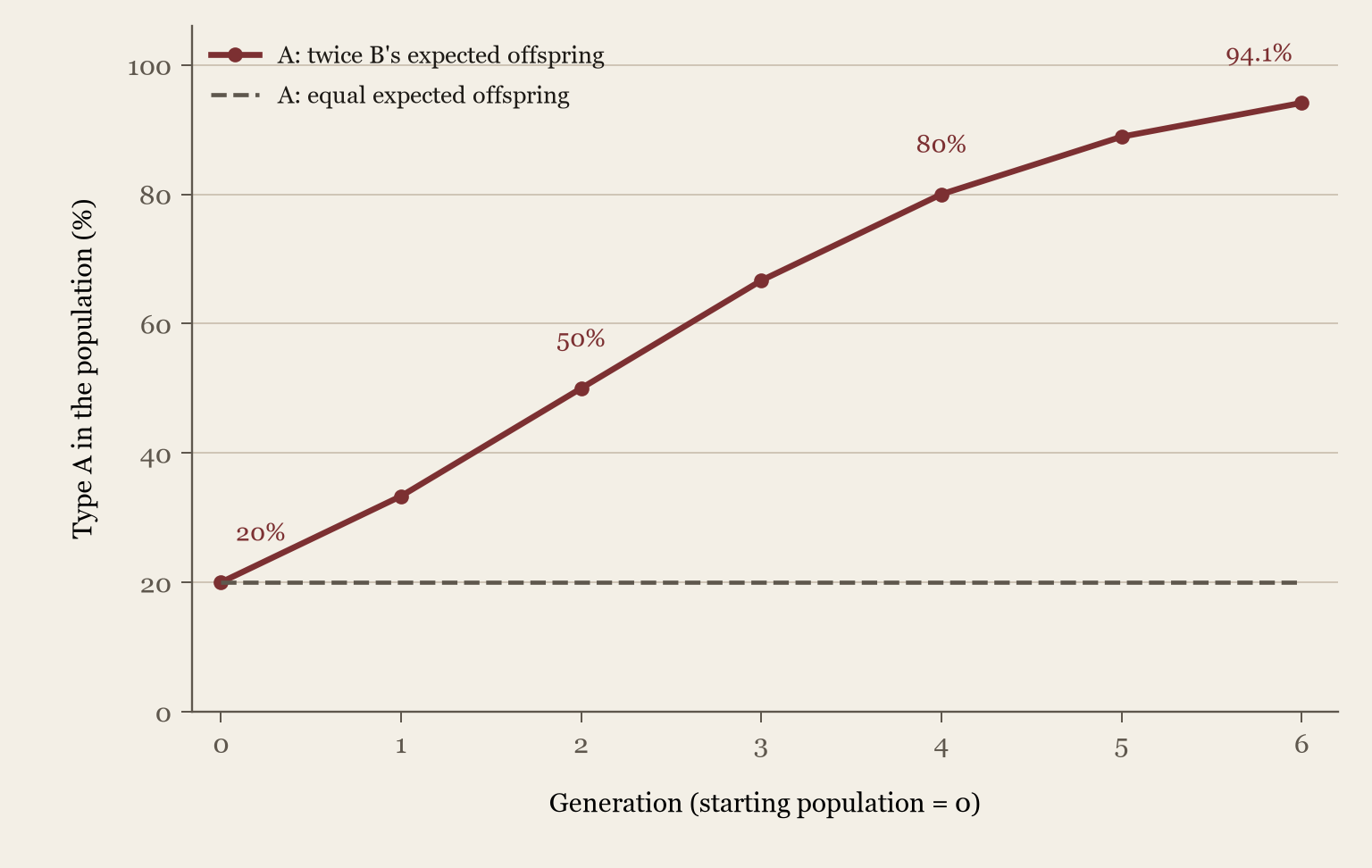
Asexual here means one parent, without mating. Offspring retain their type; whole generations are replaced; mutation, movement, drift, and changing conditions are omitted. Use fractions: 20% = 0.20. Next A share = twice the current A share, divided by one plus that share.
Example: start with 20 A and 80 B. Weighted offspring contributions are 40 and 80, so A becomes 40 out of 120, or one third. The model explains selection arithmetic. It does not demonstrate speciation or prove all shared ancestry.
Download the calculated values
11Who is doing the choosing?
The name describes an outcome, not a hidden person.
The word selection can sound as though nature holds a meeting and chooses a winner. It does not. Different inherited traits can produce different reproductive outcomes through ordinary physical and biological interactions. Selection names that process. [6]
A surface can let some objects pass through openings while stopping others. It has no opinion about them. That analogy helps explain filtering without intention. It does not prove that genes behave exactly like objects passing through a surface.
Actual biological evidence comes from organisms, inheritance, measured conditions, and descendants. If a particular difference gives no reproductive advantage, we should not invent one just because an adaptation story sounds satisfying. Not every trait is an adaptation. [21]
A believer can propose that a god works through natural processes. But that is an additional claim needing its own support. Discovering a workable mechanism does not independently identify Allah, Bhagwan, the biblical God, or any other proposed author of it.
My objection is to smuggling a conscious decision into the word selection. If you want to argue for a selector, make that argument openly. Do not put the conclusion inside a metaphor and pretend the mechanism demanded it.
12Beaks, food, and a drought.
The useful beak depends on the actual conditions.
Peter and Rosemary Grant studied finches on Daphne Major in the Galapagos. Their 2006 paper examined competition between medium ground finches, Geospiza fortis, and large ground finches, G. magnirostris. These are identified populations, not anonymous birds in a story. [12]
During the 2004 drought, food became severely limited. The large ground finches were strong competitors for large, hard seeds. Under those circumstances, smaller-beaked medium ground finches had a survival advantage. Bigger was not automatically better.
The researchers connected measured beak differences, survival, inheritance, and the subsequent evolutionary response. This concerns differences among birds and their descendants, rather than an adult bird consciously shortening its beak because it understands the drought. [12]
Do not confuse this example with the often-discussed 1977 drought, which favoured deeper beaks under different conditions. The important lesson is not memorising a preferred direction. An environmental comparison predicts which existing variation matters.
This study supplies evidence of selection and an inherited population response. It does not, on its own, reconstruct every ancestor of every bird. I do not need to inflate one strong result into a claim the study never tested.
13Useful does not mean perfect.
A history of modification can leave compromises.
An adaptation is an inherited feature shaped by selection because it contributed to reproductive success in the relevant circumstances. Calling something an adaptation is a claim about its history, not merely an observation that it exists. [21]
A feature may bring a benefit with a cost. A change useful in one situation may cause trouble in another. Selection works with an organism's existing development and available variation, rather than redesigning everything freely from a blank sheet.
Also, some features can spread without being beneficial adaptations. They may be associated with another selected change, result from chance, or reflect developmental constraints. We should compare those possibilities instead of automatically inventing a purpose for every detail. [21]
Saying a trait is imperfect does not prove every possible designer impossible. A defender can always propose different intentions. But that move needs evidence for those intentions; it cannot turn every possible result into a successful scientific prediction.
I ask a narrower, sharper question: which explanation predicts the actual pattern, including its limits? An account that can accommodate absolutely anything afterward may be emotionally convenient. It has still not shown why this outcome should have been expected.
14Chance can change the share.
A variant can spread without being more useful.
Genetic drift means chance fluctuations in inherited variant frequencies between generations. It can happen even when the alternatives have equal reproductive prospects. Finite populations do not produce their descendants in perfectly balanced proportions every time. [8]
Imagine making repeated small samples from a mixed collection of coloured tokens. Each sample can contain a different share of the colours. This is an analogy for sampling effects, not a living population or an experiment proving biological ancestry.
Drift tends to have stronger effects in small populations, though it is not confined to them. A variant can become common or disappear through chance. That result does not automatically reveal an advantage in the variant itself. [8] [21]
Selection and drift can operate together. A helpful variant is not guaranteed to spread from its first appearance; chance can remove its few early carriers. Conversely, a common variant is not necessarily common because it is the best possible solution.
This is why an evolutionary explanation needs more than the sentence it must have been useful. Researchers compare predicted patterns, population sizes, measured effects, and alternative histories. Evolution includes chance. It does not therefore stop being something we can investigate.
15A small sample can matter.
Who starts, or who remains, can reshape later generations.
A founder effect can occur when a small group establishes a population. Its inherited variation may be an unrepresentative sample of the larger population it came from. Some variants can therefore be unusually common among its descendants. [9]
Imagine a few seeds reaching an island and giving rise to many later plants. If those seeds carry only part of the source population's variation, the new population begins with that limited sample. This imagined scene explains the principle, not a documented island history.
A bottleneck is a sharp reduction in population size. The survivors may likewise carry only part of the earlier variation. Causes can differ, and survival can involve selection as well as chance. A small remainder alone does not identify the whole cause. [21]
Do not turn these concepts into a claim of genetic purity or human superiority. A population can differ in variant frequencies because of its history. That does not assign a higher moral status, a better culture, or a destiny to its members.
In a real case, ask how small the founding or surviving group was, what evidence supports that history, and which genetic patterns follow from it. We need those details before attaching a sweeping story to a present-day difference.
16Variation can arrive.
Populations exchange inherited material.
Gene flow is the transfer of genetic variation between populations. Individuals may move, pollen may travel, and inherited material may enter another population. You do not need a fresh mutation in that destination for a variant to appear there. [10]
For example, imagine pollen from plants in one valley fertilising plants in another. Variants present in the first valley can enter descendants in the second. An individual merely visiting and leaving no genetic contribution is not that reproductive transfer.
Gene flow can make connected populations more similar and can introduce variation on which selection acts. Its consequences depend on how much exchange occurs and what the variants do in the receiving environment. It is not automatically beneficial or harmful. [10]
This also matters for speciation. Populations exchanging many genes can remain connected; reduced exchange can let them diverge more independently. Geography is one way to affect that exchange, but a map alone does not tell the whole reproductive story.
Keep the four ideas separate: mutation introduces variants; gene flow moves them between populations; drift changes their shares through chance; selection reflects differences in reproductive contribution. Real populations can experience several of these processes at the same time.
17The freezer kept the past.
An evolving population left samples researchers could revisit.
Richard Lenski's long-term experiment began with twelve E. coli bacterial populations in 1988. They were grown under controlled conditions and repeatedly transferred into fresh medium. Frozen samples preserved earlier populations for later comparison. [13]
A 2008 study by Zachary Blount, Christina Borland, and Lenski examined an innovation in one population: using citrate while oxygen was present under the experiment's conditions. A citrate-using group was detected by about 31,500 generations. This is a count of bacterial generations, not years. [13]
Researchers revived earlier samples and ran replay experiments. These investigated how prior history affected a population's later ability to evolve that capacity. Earlier populations could be tested directly rather than imagined from the final result.
The exact details matter. Not all twelve populations made the same change. Detection at a particular generation does not identify the exact moment every necessary mutation arose. And the claim concerns citrate use in specified conditions, not every possible activity of E. coli.
This was evolution of an existing organism, not creation of life from nonliving chemicals. It demonstrates observable biological innovation and historical contingency. It would be dishonest to dismiss it as nothing happened, or inflate it into proof of every evolutionary claim.
18Think of a family tree.
Evolution has branching relationships, not a single ladder.
You and your cousin can share grandparents without your cousin being your grandparent. A shared ancestor produces different descendant branches. One branch existing now does not require every other branch to disappear. [14]
This family example explains the structure of the claim. It is not, by itself, evidence that two particular species share an ancestor. Establishing those relationships requires comparisons of inherited features, DNA, fossils, and other relevant evidence.
An evolutionary tree represents a hypothesis about relationships. Researchers test it against data. A particular branch arrangement can be revised when new evidence arrives. That does not make every possible arrangement equally consistent with what is already known. [14]
Descendants also remain members of ancestral groups. A new mammal species is still a mammal. Evolution does not predict that every new branch must abandon every feature of its ancestry in order to count as a real change.
The ladder picture creates unnecessary confusion: primitive things at the bottom, humans as the final destination. A branching account instead asks who shares which ancestors. It does not appoint us as the purpose for which every other organism existed.
19Why are chimps still here?
Living relatives are not a contradiction of shared ancestry.
Humans did not descend from chimpanzees alive today. Both lineages descend from earlier ancestral populations. Humans belong to the ape group too, a group that includes chimpanzees and gorillas. Those are biological relationships, not rankings of worth. [20]
So the question why are chimps still here misses the branching claim. The continued existence of one descendant branch does not prevent another branch from existing. Asking it is like treating a cousin's survival as evidence against shared grandparents.
That comparison clears up the logic; it does not supply the evidence for the actual relationship. The genetic and anatomical case still has to be shown. The next part examines those kinds of evidence rather than asking you to trust a family metaphor.
Also, evolution does not say every living species is trying to become human. Populations encounter different environments and histories. There is no biological graduation ceremony in which a chimpanzee must eventually earn a human body.
I can answer this objection directly without pretending that the whole subject is settled by one clever sentence. The objection misunderstands the proposed relationship. Whether that relationship is supported is a further question, with evidence we can examine.
20Where is the boundary?
A useful category can have difficult edge cases.
A species is a way of identifying a distinct biological lineage. For many sexually reproducing organisms, reproductive relationships are especially useful: who normally breeds with whom in nature, and how separated are the groups? [15] [16]
But fertile offspring is not a universal definition that solves every case. Many organisms reproduce without sexual mating. Fossils cannot be brought into a laboratory and asked to breed. Some recognisable lineages also hybridise occasionally. [15] [16]
Biologists therefore use different kinds of evidence, including reproductive patterns, inherited differences, ancestry, and ecological relationships. The best practical test depends on the organisms and question. Disagreement about a difficult boundary does not mean every boundary is imaginary.
Imagine tracking when related dialects become separate languages. There may be a gradual history rather than a universal date on which every speaker crossed a sharp line. That analogy helps explain classification difficulties, but language change is not a genetic experiment.
I would ask someone demanding a new species: what criterion would count, and why is it appropriate here? A fair test states the criterion before seeing the result. Moving it afterward can turn every observation into something that supposedly does not count.
21How a lineage can split.
Separation can grow across generations.
Speciation is the formation of distinct species. Consider a population divided into groups with limited genetic exchange. Each group can accumulate its own changes through mutation, selection, and drift. That is a possible starting point, not an automatic guarantee of a split. [16]
Over generations, differences can affect mating times, mating signals, habitat use, or whether offspring develop successfully. Reproductive separation may increase. Physical separation is one route; it is not the only possible route, and different cases need different evidence. [16]
An island does not create a new species the moment an organism lands. We must investigate what happened to the descendants. Are the groups still exchanging genes? Do they choose different mates? Can reproductive barriers be demonstrated?
Nor must one ordinary parent give birth to a radically different creature on a particular Tuesday. Large differences between separated populations can accumulate while parents and offspring remain very similar. A gradual history need not supply a convenient first individual for every category.
Real histories can include hybridisation, where different lineages interbreed. The biology is messier than two sealed boxes. Explain the complication and its evidence. Pretending it is simple makes the explanation easier to attack.
22The Big Bird example.
A rare case can be informative without being a universal rule.
A study published in Science in 2018 followed the origin of a distinct finch lineage on Daphne Major. Its founder was an immigrant male Geospiza conirostris that bred with a local G. fortis female. Genetic evidence helped establish the family history. [17]
Researchers followed the descendants and their breeding relationships. The resulting Big Bird lineage developed distinctive features and bred within its own lineage. The study documented reproductive isolation arising within only a few generations in this particular hybrid case. [17]
The mechanism involves more than noticing a different-looking bird. Ancestry, mating patterns, inherited characteristics, and field observations matter together. Read the study's actual criteria instead of treating a dramatic headline as the whole argument.
This is not a claim that every species forms within a few generations. It does not guarantee that every reproductive barrier remains absolute forever. It is evidence that a new, reproductively distinct lineage can arise and be studied while researchers are watching.
Saying they are still birds does not answer it. Descendants are expected to retain their broader ancestry. To challenge this example, examine its lineage evidence and reproductive separation. Requiring a bird to stop being a bird demands something the theory does not predict.
23A wider view needs evidence.
Small changes and the history of major branches.
Microevolution concerns evolutionary change within populations. Macroevolution examines patterns at and above the species level: branching, diversification, extinction, and major historical transformations. The labels describe different scales of investigation. [19]
A change in bacterial metabolism or a finch population is not, alone, a complete demonstration of every proposed ancient relationship. I agree with that objection. A bigger historical claim needs a broader body of evidence than one present-day example.
But accepting inherited change and denying every possible lineage split requires an argument about the proposed limit. Where is the biological barrier? How is it measured? Which results would show that the barrier had been crossed?
The broader account uses fossils, comparisons among living organisms, genetics, and the sequence of historical changes. Population processes interact with speciation and extinction. Simply saying add time is not a substitute for examining that evidence. [19]
Likewise, calling the disputed boundary a kind does not explain it. Define the group and the predicted restriction before examining the data. An elastic category that expands whenever a new result appears is a way to avoid a test.
24That is another question.
The origin of life and its later evolution are related but distinct.
How did the first life arise? That is a serious scientific question. Research into life emerging from nonliving chemistry is called abiogenesis. It is not the same question as how existing, reproducing populations change and diversify. [18] [21]
I am not going to claim that scientists possess a complete, established account of every step to the first cell. They do not. We will examine what experiments have achieved and what remains unresolved in the dedicated origin-of-life part.
However, uncertainty about that first beginning does not erase measured inheritance, selection, drift, or evolutionary change in organisms that already reproduce. Not knowing how the first language began would not make later documented language changes disappear. Again, that is a logical analogy, not genetic evidence.
A believer may propose that a god started life and evolution followed. The proposal still needs support, and it does not rescue claims contradicted by evidence about later history. Separate claims must be assessed separately.
So when the debate switches from a demonstrated population change to where did the first cell come from, name the switch. Answer honestly about the unresolved question, then return to the evidence the original objection was supposed to address.
25Darwin is not a prophet.
A scientific theory earns support through evidence.
In science, a theory is an explanatory framework supported and tested with evidence. It does not merely mean somebody's casual guess. A fact concerns an observation or established occurrence; a law describes a regular relationship. Theories do not graduate into laws. [18]
Observed inherited changes are part of evolution's factual basis. Evolutionary theory explains mechanisms and relationships, while individual historical reconstructions can carry different degrees of uncertainty. We should identify the particular claim instead of treating everything as one indivisible slogan. [18]
Charles Darwin made major contributions. That does not turn his books into scripture or every sentence he wrote into a permanent scientific commitment. Modern evidence includes genetics and experiments unavailable to him. His authority cannot rescue a claim the evidence defeats.
A scientist's religion does not decide whether an experiment worked. A believer can do sound research; an atheist can argue badly. Ask whether the method and evidence support the conclusion.
When someone quotes Darwin expressing a difficulty, I want the passage, its context, and subsequent evidence. A quotation can identify a question. It cannot freeze later investigation at the point convenient for an argument.
26Follow one complete test.
Independent checking need not mean owning a laboratory.
Start with one study, such as the 1943 resistance experiment. Write down the exact alternatives: resistance appearing before exposure, or being produced only when the virus arrives. Then ask what different count patterns each explanation predicts. [11]
Next examine the methods, comparisons, and results. Why use separately grown cultures? Why compare samples from a single culture? Which result would have weakened the preferred interpretation? An explanation becomes clearer when you can state how it might fail.
For the finches, distinguish measured body differences, survival, inherited resemblance, and the next generation. For the bacterial replay experiments, distinguish a revived ancestral sample from an imagined ancestor. Those details explain why the evidence is stronger than an anecdote. [12] [13]
Check the earlier graph and its CSV too. Recalculate each generation from the stated rule. That verifies the teaching model's arithmetic; it does not replicate a biological experiment.
I do not pretend I personally performed these studies. Sensible confidence rests on accessible methods, records, critical comparison, and opportunities for further testing. Trust can be justified without becoming blind. Nobody earns an exemption from questions by wearing a laboratory coat.
27Keep the answer on target.
Answer the real objection without overselling the reply.
Suppose someone says: your graph only shows a changing percentage. Correct. It illustrates one mechanism under stated assumptions. The measured experiments and the evidence for shared ancestry are further steps. I would rather make a limited true claim than a grand false one.
They say: the bacteria were already bacteria. Yes. A population can evolve while remaining inside its broader ancestral group. Whether it acquired a measurable new capacity is a separate question from whether it ceased to be a bacterium. [13] [14]
They say: why are monkeys still here? Because shared ancestry involves branches, not every living relative replacing every other one. Then we should examine the actual evidence for that ancestry. A cousin analogy explains the claim; it does not finish the case. [20]
They say: you cannot explain the first life. A complete account is unresolved. That uncertainty does not make the observed changes disappear, and it does not independently establish a particular creation story. What evidence supports that additional story? [18]
They say: I will never accept it. Then evidence may not be the obstacle. I can explain the reasoning, identify its limits, and listen to a relevant challenge. I cannot force someone to use a test they have decided in advance to reject.
28I want the mechanism.
Rejecting a story does not require knowing everything.
I reject confident religious accounts when the evidence does not support them or contradicts their factual claims. That does not require me to pretend that science has solved every question about life, consciousness, or existence. A gap is a question, not an ownership certificate for a god.
This chapter has explained ways inherited populations change and shown several specific investigations. It has not yet presented the full comparative case for deep shared ancestry. The next two parts take that work further, using bodies, DNA, fossils, and named studies.
Some believers accept evolution. Others reject it, interpret scripture differently, or accept changes only within a chosen boundary. I criticise the particular argument or factual claim being made. Pretending every believer holds the same position would only make my criticism sloppy.
I also reject the idea that evolution makes humans worthless. A description of ancestry does not decide what we should care about. You do not lose love, grief, responsibility, or curiosity because your body has a biological history.
The blunt point is this: disbelief in a mechanism is not evidence for a replacement story. If you propose special creation, explain what it predicts and what supports it. I will ask the same question of evolution. That is a standard, not a sacred exception.
NoteWhy I started here.
Understanding should come before the argument.
I wrote this part because evolution debates often begin with a caricature: a monkey giving birth to a person, wishes changing bodies, or everything appearing in one lucky accident. Those pictures block understanding.
Simple language should remove unnecessary difficulty without removing the distinctions that make an explanation true. That is why I keep returning to inheritance, populations, and evidence. The reader deserves the actual reasoning.
My atheist position gives me no permission to invent results or hide limits. Scientific claims need support whether the reader agrees with my wider view or hates it.
The imaginary scenes, conversations, and graph are teaching devices. The cited studies provide evidence examples. I have not personally performed those experiments or independently reanalysed all their raw data.
Next comes The Evidence Is in Our Bodies: DNA, anatomy, relationships, and competing explanations. First understand the claim. Then make it face the evidence.
SourcesFollow the evidence.
Sources checked on 15 October 2026. These references support particular definitions, experimental results, field observations, and methodological limits. They do not imply a new independent reanalysis of all original data. Older studies retain their actual dates. The fluctuation test concerns bacteriophages; the finch example concerns selection in 2004-2005; the citrate example concerns one population under specific oxygen-present conditions. The Big Bird study is a particular hybrid lineage, not a universal timetable. Family, token, kitchen, language, pollen, and imagined conversation examples explain reasoning; they are not reported experiments. The graph and seven CSV rows are an original deterministic calculation for hypothetical asexual types. They omit drift, mutation, migration, changing conditions, and complex inheritance. They are not measured biological data or a complete model of evolution. The distinction between evidence for a mechanism and evidence for a particular ancestry is maintained. The criticism of unsupported creation claims is the author's argument, not a claim that every religious person rejects evolution.
[1] Descent with modification
UC Museum of Paleontology / Understanding Evolution / Evolution 101
Defines inherited change across generations and distinguishes biological evolution from other kinds of change. The imagined frequency examples here are teaching devices, not reported population measurements.
[2] What is a gene?
US National Library of Medicine / MedlinePlus Genetics
Explains genes and their functional products. Not all DNA makes proteins, and not every complex characteristic has a simple one-gene explanation.
[3] Allele
National Human Genome Research Institute / Talking Glossary
Defines versions of a DNA sequence at a genomic location. The usual two-copy human example is not imposed on all organisms; the figure explicitly uses hypothetical asexual types.
[4] What is a gene variant and how do variants occur?
US National Library of Medicine / MedlinePlus Genetics
Explains inherited, acquired, and new variants, including reproductive-cell versus body-cell changes. A mutation is not automatically a disease or an inherited population change.
[5] How are gene variants involved in evolution?
US National Library of Medicine / MedlinePlus Genetics
Explains mutation, reshuffling, inherited variation, neutral changes and context-dependent advantages. A useful variant is not a promise of inevitable evolutionary success.
[6] Natural Selection
UC Museum of Paleontology / Understanding Evolution / Evolution 101
Introduces variation, differential reproduction and heredity. The original chapter graph calculates a stipulated reproductive difference; it does not present the educational example as measured data.
[7] Evolutionary fitness
UC Museum of Paleontology / Understanding Evolution / Evolution 101
Distinguishes reproductive success in an environment from physical strength alone. The chapter separately rejects treating a biological reproductive comparison as a moral ranking of people.
[8] Genetic Drift
National Human Genome Research Institute / Talking Glossary
Explains chance changes in allele frequencies and their importance in small populations. Drift is not restricted to small populations; that correction is also supported by source 21.
[9] Founder Effect
National Human Genome Research Institute / Talking Glossary
Explains how a small founding group can carry a limited, unrepresentative sample of variation. The invented island example is illustrative and does not date a real migration.
[10] Gene flow
UC Museum of Paleontology / Understanding Evolution / Evolution 101
Explains movement of genetic variation between populations. The pollen example identifies a reproductive contribution rather than treating every visit by an organism as inherited genetic exchange.
[11] Mutations of Bacteria from Virus Sensitivity to Virus Resistance
Salvador E. Luria and Max Delbruck / Genetics 28 / 1943 / doi:10.1093/genetics/28.6.491
Original fluctuation-test paper: resistance to bacteriophages, not antibiotics. Independent cultures and clonal jackpots help distinguish pre-exposure mutations from an exposure-only response. Its scope is not every mutation process in every environment.
[12] Evolution of Character Displacement in Darwin's Finches
Peter R. Grant and B. Rosemary Grant / Science 313 / 2006 / doi:10.1126/science.1128374
Original field study of competition, selection in 2004-2005 and the smaller-beaked descendant generation. Contrasts this episode with 1977. The authors distinguish observed food scarcity from a directly quantified food supply; the chapter does not invent such measurements.
[13] Historical contingency and the evolution of a key innovation in an experimental population of Escherichia coli
Zachary D. Blount, Christina Z. Borland and Richard E. Lenski / PNAS 105 / 2008 / doi:10.1073/pnas.0803151105
Original study of citrate use with oxygen present in one long-term experimental population, detected by about 31,500 generations. Frozen samples and replay tests investigate contingency. This is neither an origin-of-life experiment nor a result shared by all twelve populations.
[14] The family tree
UC Museum of Paleontology / Understanding Evolution / Evolution 101
Explains branching relationships, ancestral groups and evolutionary trees as testable hypotheses. A family analogy clarifies the claim but does not establish a particular biological relationship.
[15] Species Concepts and Species Delimitation
Kevin de Queiroz / Systematic Biology 56 / 2007 / doi:10.1080/10635150701701083
Separates a lineage concept of species from criteria used to identify lineages. Reproductive isolation is important in many cases but is not a single practical test applicable to every organism or fossil.
Read the institutional full-text PDF
[16] Defining speciation
UC Museum of Paleontology / Understanding Evolution / Evolution 101
Explains a possible geographically separated lineage split; the companion page explains limits of interbreeding definitions and hybrids. A simplified scenario is not a measured account of every speciation event.
Read the companion species-definition page
[17] Rapid hybrid speciation in Darwin's finches
Sangeet Lamichhaney and colleagues / Science 359 / 2018 / doi:10.1126/science.aao4593
Primary study of the Big Bird hybrid lineage and rapid reproductive isolation. The chapter says a few generations rather than collapsing the abstract's generation-count distinctions into a universal two-generation rule. Future complete isolation is not guaranteed.
Read the researchers' university account
[18] Science and Creationism: scientific terms and origins
National Academy of Sciences / Science and Creationism: A View from the National Academy of Sciences, second edition / 1999
The introduction defines scientific facts, theories and laws; the linked origins chapter distinguishes evidence and unresolved questions about beginnings. This is the 1999 second edition, not the different 2008 book. It is not used as a catalogue of present-day abiogenesis experiments.
Read the origin-of-life discussion
[19] What is macroevolution?
UC Museum of Paleontology / Understanding Evolution / Evolution 101
Explains broad historical patterns and their reconstruction from multiple kinds of evidence. The chapter does not treat one model or one laboratory change as the entire evidence for deep common ancestry.
[20] Introduction to Human Evolution
Smithsonian National Museum of Natural History / Human Origins Program
Supports human membership in the ape group and shared ancestry with living African apes. Older dates elsewhere on this introductory page are not imported as current fossil record claims.
[21] Misconceptions about evolution
UC Museum of Paleontology / Understanding Evolution / Teaching resource
Clarifies randomness, drift, adaptation, progress, fitness and moral misuses. Evolution does not require every trait to be optimal, every population to become human, or cruelty to be an ethical rule.