

01Show me the evidence.
A familiar face is a clue. An inherited pattern is a better test.
Someone says: you keep saying humans and other apes share ancestors. Where is the evidence? I think that is a fair question. A confident voice, a famous scientist, and a classroom diagram are not enough on their own.
Imagine an argument about whether two families are related. Similar noses would be a weak place to stop. You would want records that carry details through generations. Biology has physical records too, although they require careful interpretation rather than a quick glance.
DNA is one of those records. It is a molecule, not an ancient story somebody asks us to protect. Researchers can extract it, read its sequence, compare samples, and investigate where particular features occur. Those operations can be checked. [1] [3]
The important question is not merely whether humans resemble chimpanzees. It is whether shared ancestry explains the particular pattern of similarities and differences better than the alternatives being offered. General resemblance starts the conversation. Detailed comparisons make the case.
I will explain three kinds of evidence: how DNA relationships fit together, what human chromosome 2 preserves, and how inherited viral sequences help reconstruct ancestry. Then I will address the objections without pretending that one chapter answers every question about life.
02Four letters, real chemistry.
DNA is physical. Its letters are our shorthand.
DNA contains four kinds of chemical bases, usually written A, C, G, and T. A sequence is their order along a strand. The letters in a database represent chemistry in a sample; they are not tiny printed characters sitting inside a cell. [1]
A gene is a DNA region whose sequence contributes to making a functional product, such as a protein or an RNA molecule. RNA is another kind of molecule used in cells. A genome is the whole DNA collection being considered. [2]
Think of a long collection of instructions, switches, repeated passages, and other material. That comparison can help you follow the discussion. It does not mean that DNA is literally a book or that a conscious author has been established.
Not all DNA makes proteins. A comparison restricted to protein-making regions therefore answers a narrower question than a comparison of an entire genome. Remember that distinction. It will stop several impressive-sounding percentage arguments from misleading you. [2]
When someone asks who wrote the code, I first ask what biological process they mean by code. Calling a molecule information does not settle its origin. We need evidence about copying, inheritance, variation, and history, rather than a conclusion hidden inside a metaphor.
03The machine measures something.
A DNA sequence is an interpretation of physical signals.
Sequencing means finding the order of DNA bases. Different technologies use different signals. Some detect labelled bases during copying. Nanopore methods measure electrical changes as DNA passes through a tiny pore. Neither method asks a machine which religion to believe. [3]
The instrument produces readings. Software interprets them, checks their quality, and assembles pieces into longer sequences. An assembly is that reconstructed sequence. It can contain errors or gaps, especially where repeated DNA makes the pieces difficult to place. [6]
Picture rebuilding a shredded document when many scraps contain the same sentence. That is an analogy for one assembly problem, not a description of a laboratory procedure. Longer readings and other checks can help distinguish repeated regions. [6]
I would not tell someone every published base is infallible. I would ask about read quality, coverage, assembly methods, and independent checks. Coverage means how much supporting reading exists across the sequence. A colourful screenshot does not answer those questions.
The useful chain is sample, measurement, reconstruction, comparison, and conclusion. Each step deserves scrutiny. A possible error at one step is a reason to investigate that step; it is not permission to announce that every genetic result is fiction.
04Compare the matching places.
An alignment is a proposed correspondence, not a licence to cheat.
To compare two DNA regions, researchers align them: they work out which stretches correspond. They consider sequence, neighbouring material, order, and orientation. A region copied twice needs special care; the wrong copy can give a misleading comparison. [4] [14]
Imagine comparing two editions of a long document. An added paragraph shifts the page numbers. Page forty in one edition may correspond to page forty-two in the other. Matching page numbers alone would be a poor method.
DNA has insertions, deletions, duplications, and rearrangements too. An insertion adds sequence; a deletion removes it; a duplication makes another copy; a rearrangement changes where material sits. These differences must be studied, not silently thrown away. [5]
An alignment is itself something to check. Which genome versions were used? Which regions aligned reliably? Which did not? Were repeated regions excluded? Were gaps counted? A reader should be able to find the methods rather than guess what a number means.
Researchers do not need every base to line up perfectly for ancestry to be supported. Descendants are expected to differ. What matters is whether the method handles those differences honestly and whether the resulting pattern survives comparisons using other evidence.
05Similar by which calculation?
One number cannot describe every difference.
Someone says humans and chimpanzees are almost identical. Someone else gives a much lower percentage and declares evolution dead. Before choosing a team, I want the denominator: what total was used to calculate the percentage?
Here is an invented arithmetic example. Suppose ninety of a hundred reliably aligned positions match. That gives ninety per cent identity for those positions. It does not tell us how much extra DNA exists outside that comparison or how large the genomes are.
The 2005 chimpanzee genome study distinguished single-base changes, insertion and deletion events, and chromosome rearrangements. Those are different quantities. Folding them into one headline without stating the counting rule loses information. [5]
The 2025 ape-genome study resolved many previously difficult regions and enabled comparisons with less dependence on mapping everything to a human reference. Better access to difficult sequence can change estimates. That is a reason to read the methods, not hide the update. [6]
Human and chimpanzee bodies also differ in important ways. Shared ancestry does not require identical bodies. My argument rests on inherited relationships and specific genomic features, not a magic similarity percentage that must never be questioned.
06Groups inside groups.
Shared ancestry predicts a structure, not just resemblance.
Imagine a family recipe passed down through several households. One branch adds a line. A later branch within it adds another. Descendants can share the first addition, while a smaller group shares both. These are nested groups: groups inside larger groups.
The recipe is an invented analogy. The biological test uses inherited features. If lineages split, changes acquired before a split may be shared widely, while later changes may be restricted to descendants of a more recent branch.
For humans and living apes, whole-genome comparisons support a branching relationship in which humans are closer to chimpanzees and bonobos than to gorillas. This concerns shared ancestors, not humans descending from a chimpanzee alive today. [5] [22]
The question is whether many features fit that relationship, allowing for known complications. A useful tree must explain differences as well as similarities. Drawing a tree around one convenient trait and ignoring everything else would not be a convincing test.
Nor should I claim every DNA stretch has exactly the same history. Ancestral variation and later genetic exchange can complicate particular regions. We will return to that. A strong explanation makes room for actual inheritance instead of demanding a perfectly tidy cartoon.
07Could a designer reuse parts?
That possibility still needs a testable explanation of the details.
A believer may say: similar creatures need similar working parts, so a creator reused a good design. That is a better argument than pretending no similarities exist. Similarity by itself cannot logically exclude every possible designer.
But the evidence is more specific than two creatures needing muscles or eyes. We can compare where DNA sits, how large blocks correspond, which insertions occur in matching locations, and how differences group across several species. [8] [16]
Suppose several versions of a document share an unusual inserted paragraph at the corresponding place. Shared copying history deserves consideration. Saying an editor could independently add anything anywhere does not give us a competing prediction. This remains an analogy.
A designer hypothesis becomes scientifically useful when it tells us which patterns to expect and which would count against it. If the answer is always that the creator wanted whatever we discovered, the proposal has no clear way to lose.
I am not claiming that a god is logically unable to create inherited-looking DNA. I am saying that unrestricted ability is not evidence that it happened. The ancestry explanation earns support by connecting observations with mechanisms and consequences we can investigate.
08Forty-six and forty-eight.
A difference can become a test of the explanation.
Chromosomes are packages of DNA and associated proteins. A typical human body cell with a nucleus has forty-six chromosomes, arranged in twenty-three pairs. Eggs and sperm normally carry one set. We are comparing equivalent chromosome complements, not mixing those cases. [7]
Chimpanzees, gorillas, and orangutans typically have forty-eight chromosomes in their corresponding body cells. Comparative chromosome studies found that human chromosome 2 corresponds broadly to two chromosomes that remain separate in these other apes. [8] [12]
The serious question is therefore: did two ancestral chromosomes become one in the lineage leading to humans? That proposal makes the chromosome-count difference understandable. But a convenient explanation is not enough. It must leave evidence.
If the correspondence had failed, or the supposed join had no appropriate support, that would weaken this particular account. Scientists had a concrete target to investigate: the structure and sequence of chromosome 2, especially the proposed joining region.
Notice what happened to the objection. Different counts did not get waved away. They led to a specific historical hypothesis and further tests. That is a much stronger response than shouting that humans and chimpanzees are basically the same.
09Ends and attachment regions.
Telomeres and centromeres do different jobs.
A telomere is a region of repetitive DNA at a chromosome end. In humans, its characteristic short repeat is often written TTAGGG. Telomeres are associated with protecting chromosome ends. You do not need to memorise the letters to follow the argument. [9] [11]
A centromere is a chromosome region involved in separating chromosome copies during cell division. Cellular machinery attaches there through a protein structure. It is not simply another name for the chromosome end, or a requirement that the location be the exact middle. [10]
For a simple picture, imagine two long strips, each with marked ends and an attachment region. Joining two strips changes where the old ends sit. It also raises a question about what happened to their original attachment regions.
This strip picture explains the search. It does not establish that a fusion occurred. The actual tests concern corresponding chromosome regions, the orientation of repeat sequences, and evidence associated with an additional ancestral centromere.
Keep the two words separate. Without that distinction, a debate can become a pile of labels that sound scientific but explain nothing. The next step is to connect each proposed feature with an observation, rather than treating the vocabulary as the proof.
10What should a join leave?
Expect related pieces and a plausible junction.
Under the fusion account, substantial parts of human chromosome 2 should correspond to the two separate ape chromosomes. A chromosome comparison should show more than a similar overall length. The arrangement of material matters. [8] [12]
A joining region might preserve end-associated sequences internally, with the orientation expected from the proposed joining event. In 1991, researchers reported head-to-head arrays of telomere-like repeats in the relevant human chromosome 2 region. [11]
Head-to-head describes opposing orientations of the repeat arrays. It does not mean a complete, pristine pair of ancient chromosome ends survived unchanged. Ancient sequences can be altered, shortened, duplicated, or lost. The surrounding genomic context is important. [14]
An additional ancestral centromere is another expectation. In 1992, probes detected extra alphoid DNA on chromosome 2: repeated sequences associated with centromeres. That supports a centromeric relic, not another active centromere. [13]
These clues concern different features of the same historical explanation. They are not three completely independent worlds with no shared assumptions. Together they make the hypothesis more specific and harder to dismiss as a resemblance somebody imagined.
11The researchers looked there.
Chromosome mapping and sequence analysis connect the claim to material.
The 1991 team isolated human DNA clones containing the opposing repeats and investigated their sequence and location. A clone is a laboratory-copied DNA segment. This linked the proposed fusion to an identifiable chromosome 2 region. [11]
A later comparative mapping study used FISH, short for fluorescence in situ hybridization. In plain language, labelled DNA probes help locate matching material on chromosomes. It supported correspondence between the human region and the relevant separate ape chromosomes. [12]
The 1992 alphoid-DNA study used probes too. Its result supports a relic associated with an ancestral centromere; it does not show two fully functioning centromeres pulling chromosome 2 apart in normal human cells today. [13]
In 2002, researchers analysed over six hundred thousand DNA bases around the junction and related duplicated regions. Duplications and rearrangements complicate the history. The evidence is richer than a clean join on a poster. [14]
I would show a reader the studies and explain each method. My diagram is not a microscope photograph, and I did not sequence these samples. The reason for the inference must remain visible.
12The pieces fit together.
A joined ancestry explains several observations at once.
Think of the reasoning as a chain. Two separate ape chromosomes correspond to a human chromosome. The proposed junction contains opposing telomere-like repeat arrays. Another region preserves DNA associated with an ancestral centromere. The features fit a fusion account. [11] [12] [13]
This is an inference about history from present evidence. It is stronger than guessing because the explanation connects particular observations. It is not a recording of the original event or an identification of the exact individual in which it occurred.
The diagram on the next page separates the old chromosome ends, the proposed junction, and the centromere relic. Its lengths and marker positions are illustrative. The accompanying file lists evidence and sources, not invented laboratory measurements.
A fusion does not explain every difference between humans and other apes. It is not the moment a chimpanzee suddenly became a person. Nor does the diagram tell us the exact date when the fused chromosome spread through the ancestral population.
What it gives us is a specific, physically grounded piece of the ancestry case. A challenger needs to address that combined pattern. Pointing out that the drawing is simplified, or that chromosomes can contain other repeated sequences, is not enough by itself.
Evidence diagramTwo ancestral pieces, one human chromosome.
A simplified guide to the fusion evidence. Not to scale.
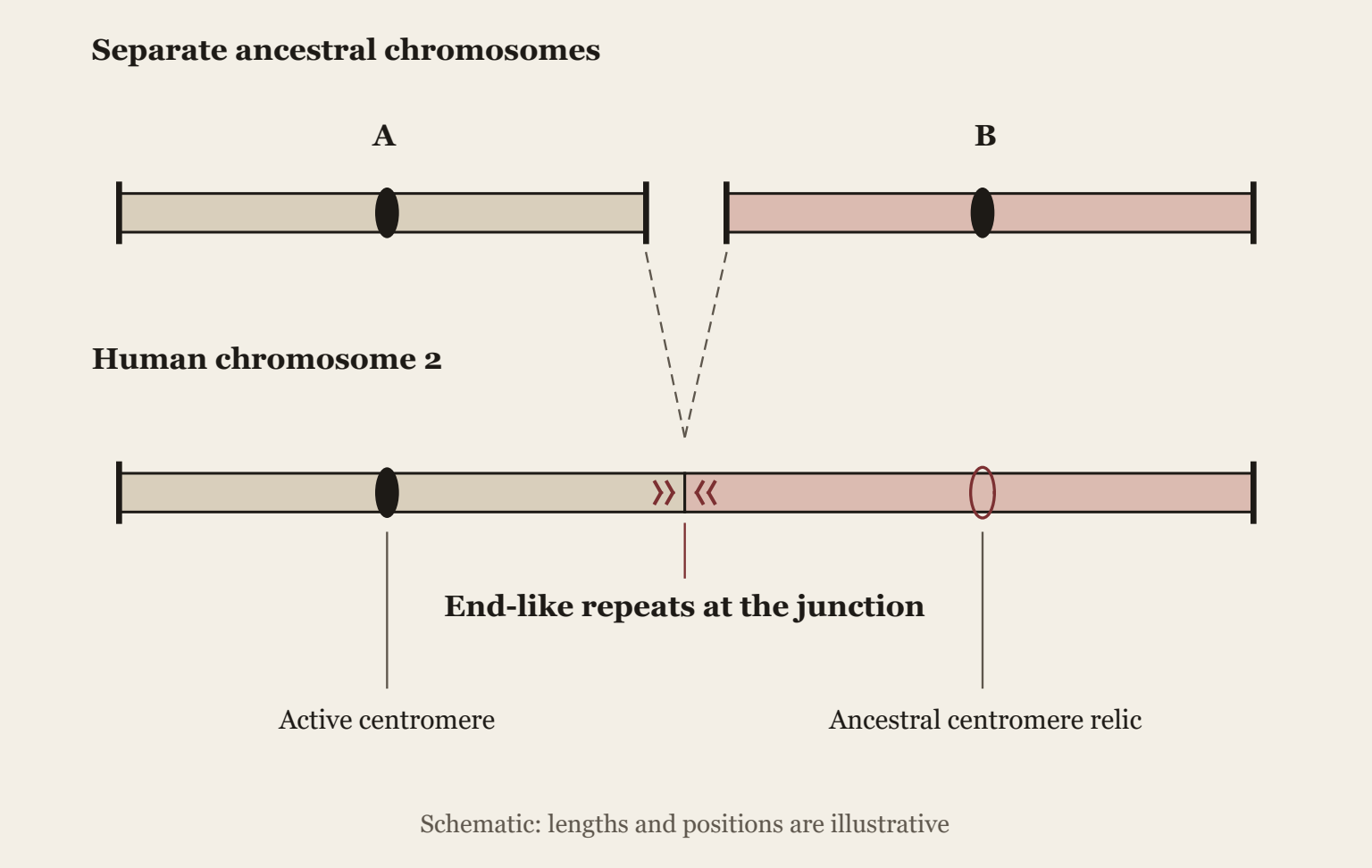
The inference combines large-scale correspondence, opposing telomere-like arrays at the proposed junction, and additional ancestral centromeric DNA. It does not rest on the presence of one short repeated motif alone. [11] [12] [13]
The CSV names each feature, its method and its source. It contains no invented measurements. Duplications and rearrangements make the actual region more complicated than this drawing. [14]
Download the evidence and source list
13A function does not erase history.
Neither an imperfect repeat nor useful nearby DNA settles the case.
One objection says the internal repeats are shorter or less regular than modern telomeres. That matters when reconstructing the event. But the published account concerns altered telomere-like arrays in a particular surrounding structure, not two untouched modern end caps. [14]
Another objection says there is functional DNA in or near the region, so it cannot mark a fusion. That conclusion does not follow. A sequence can have an identifiable history and a present function. These are different questions.
A building may use a doorway created during an earlier renovation. Its current usefulness does not show that no renovation happened. This is only an analogy. The actual chromosome question is answered through sequence, correspondence, orientation, and genomic context.
Conversely, finding a short telomere-like motif somewhere would not automatically establish a fusion. We need the wider pattern. I cannot insist context matters when defending a claim, then ignore it whenever a convenient repeated sequence appears.
A serious challenge would show why a different account fits these specific observations better, or expose an error in the evidence. Saying there is still something to learn is fair. Saying that uncertainty makes the entire fusion inference disappear is a much bigger claim.
14Could they reproduce?
Chromosome changes can matter without obeying one absolute rule.
Would the first fusion carrier be unable to reproduce? That is a legitimate question. Chromosome rearrangements can affect fertility, development, and inheritance. Their consequences depend on the actual change, not the count alone. [15]
Joining packages is different from losing all the DNA inside one package. A count by itself does not tell us which essential sequences were retained, which were disrupted, or how chromosomes behaved during reproduction. Those are the relevant mechanisms.
Some structural rearrangements have little effect on health; others are harmful. Balanced rearrangements retain the overall genetic material, although they can still create reproductive problems. A general reference on these changes explains why universal claims are unsafe. [15]
We lack a complete family record of the original carriers. I will not invent one. The structural evidence supports a historical fusion without supplying every mating or step by which it became widespread.
It is also a mistake to answer this question by proposing that humans and living chimpanzees should reproduce today. That is not the historical event being explained. The question concerns inherited rearrangements within ancestral populations, followed by later divergence.
15An infection can leave DNA.
Some viral material can enter the inheritance pathway.
A retrovirus can make a DNA copy of its genetic material and insert that copy into a host cell's DNA. If an insertion enters a lineage of cells that produces offspring, descendants can inherit it. Ordinary infections do not all become inherited features. [16]
An endogenous retrovirus, often shortened to ERV, is viral-derived DNA inherited as part of the host genome. Endogenous means it is now inside that inherited system. It does not mean every such sequence remains an infectious virus.
Over time, mutations and deletions can alter these sequences. Some preserve recognisable viral features despite losing the ability to produce a working virus. Researchers compare those features and their surrounding DNA rather than identifying them by a vague resemblance alone. [16]
Imagine an extra paragraph entering one copy of a document before that copy is passed on. Later descendants may inherit the paragraph too. This analogy explains the inheritance logic; experiments and genomic comparisons establish what viruses and DNA actually do.
The ancestry question is more precise than whether two animals encountered a virus. Do related insertions occur in corresponding locations, with surrounding sequences supporting shared inheritance? That is a more demanding comparison.
16The address matters.
Compare the insertion and the DNA around it.
Two species carrying material from a similar viral family is not enough. Viruses can infect different hosts. What makes an inherited insertion useful is its genomic setting: where it sits relative to corresponding neighbouring DNA, and how its sequence compares. [16]
The same address means corresponding biological locations, not identical database coordinates. Rearrangements and new assemblies can change numbering. Researchers must establish the correspondence rather than match printed labels. [4]
Consider two documents sharing an unusual addition between corresponding passages. Shared copying is a straightforward explanation. If further branches share later alterations inside the addition, the copying history becomes more informative. Again, this is an analogy, not a probability calculation.
The stronger test combines location, surrounding sequence, internal changes, several species, and several loci. A locus means a genomic location. One ambiguous match should not carry the argument when broader comparisons are available.
I would ask a challenger to explain the actual matched pattern. I would also check whether a claimed absence is a genuine absence, rather than a gap in the available sequence. Missing data and a demonstrated missing insertion are not interchangeable.
17Six locations, not a slogan.
One study illustrates the method and its complications.
In 1999, Welkin Johnson and John Coffin compared ancient retroviral sequences across primates. Their analysis included six unlinked loci from five unrelated HERV sequence families. Unlinked here means the study examined separate inherited genomic locations. [16]
They compared corresponding viral-derived sequences. Broad primate relationships generally agreed, but these trees did not consistently resolve the split order among humans, chimpanzees, and gorillas. The authors investigated recombination and other complications. [16]
Recombination means genetic material is rearranged through exchange between sequences. It can make one segment carry a different history from another. This is why a careful study investigates conflicting patterns rather than quietly deleting them from the discussion.
The paper is an example of the method, not a claim that every human ERV is shared with chimpanzees, or that every primate has exactly the same insertions. Later insertions can be restricted to a later branch. Ancestry predicts differences too.
To explain this to a believer, start with one matched locus and the species compared. Then ask whether other loci support the relationship. A long string of scientific terms helps nobody unless each term leads to an observation and a reason for the conclusion.
18What about hotspots?
Do not defend good evidence with a bad probability claim.
A believer may say viruses prefer certain genomic regions, so shared insertions could happen independently. The premise deserves attention. Retroviral integration has biases. Different viral systems need not favour the same kinds of locations. [17] [18]
A 2002 study mapped 524 HIV integration sites and found preferences for active genes and regional hotspots. A 2004 comparison found different preferences among retroviral systems. Neither result means all old ERV insertions have identical targeting behaviour. [17] [18]
I should therefore avoid a fake calculation that assumes every genomic position is equally likely, multiplies tiny numbers, and declares coincidence impossible. The actual probabilities depend on the mechanism, the locations, the observations selected, and the comparison being made.
But a preference for a region is not automatically an explanation for multiple corresponding insertions, their surrounding DNA, their internal alterations, and their distribution across species. Those details still require comparison with shared inheritance. A real alternative must address the pattern.
Demonstrated repeated independent insertions would reduce the weight of that locus. Other comparisons would not vanish. The honest response is to improve the test, not pretend integration has no preferences.
19Old viral DNA can do work.
A useful sequence can still have a viral origin.
Another objection says some viral-derived DNA is useful, so it cannot be evidence of an old infection. That confuses present function with historical origin. Evolution can preserve or recruit material that becomes useful in a new setting.
In 2000, researchers reported that syncytin, a protein derived from a retroviral envelope gene, promotes cell fusion and is expressed in placental tissue. They proposed a role in placental development. This is a concrete example of viral-derived material with a biological job. [19]
An envelope protein normally helps a virus interact with cells. A cell-fusion role in another biological setting does not erase that relationship. The relevant evidence includes sequence relationships and experimental activity, not merely calling the material useful. [19]
Do not reverse the exaggeration. One functional viral-derived gene does not establish that every ERV fragment has an essential function. Each claimed function needs its own evidence. A label such as junk cannot substitute for those investigations either.
So my answer is simple: tell me which sequence and which function. Then we can ask how it originated and how it was inherited. Discovering a present function can add to the history rather than demolish it.
20A lost job leaves traces.
Loss of one function is not proof of no possible function.
A pseudogene is gene-like DNA that has lost the usual protein-coding capacity of the gene it resembles. Such regions can preserve evidence of copying and subsequent change. That description does not establish that every pseudogene has no biological effect whatsoever. [20]
A concrete example concerns vitamin C production. In 1994, researchers isolated and mapped part of the human nonfunctional gene corresponding to an enzyme involved in making vitamin C. They compared it with the functioning rat gene. [21]
The narrow result is important: humans retain recognisable material related to a biochemical function we lack. It is not, by itself, a complete comparison of every primate or a demonstration that all vitamin-C-dependent animals inherited exactly the same disabling event.
For ancestry, we would want corresponding regions in several species, the particular changes, and the pattern those changes form. Simply announcing that two animals cannot make vitamin C is weaker. A similar lost ability can arise through different histories.
The recipe analogy helps here. A damaged instruction can reveal its earlier form, even if someone later uses the paper for another purpose. But the actual argument needs DNA evidence. I would rather give a narrower supported answer than repeat an inflated internet claim.
21One region is not the family.
Inherited variation can survive more than one split.
Someone finds a DNA region in which humans appear closer to gorillas than to chimpanzees and announces the human family tree has collapsed. Before accepting that conclusion, we need to distinguish the history of a particular sequence from the history of species.
An ancestral population can contain several versions of a sequence. If descendant populations separate before those versions have sorted out, different descendants may retain different old variants. Incomplete lineage sorting is the name for this inherited-variation complication. [22]
The 2012 gorilla-genome study reported that about thirty per cent of the analysed genome showed the alternative relationships expected from this process. It did not conclude that humans are thirty per cent gorilla or that every region has the same genealogy. [22]
Think of branches inheriting different old family objects. One object's history may not mirror the latest household split. This analogy explains the distinction; the genetic test uses explicit models and the observed distribution of sequence relationships.
Conflicts deserve investigation. Models can be wrong, and genetic exchange or analysis errors can also matter. But variation predicted by population inheritance is not automatically a contradiction of descent. The test is whether the model explains the pattern and survives further checks.
22A different job, related parts.
Anatomy adds evidence beyond a DNA headline.
A human arm, a bat forelimb, and a whale flipper do different jobs. Yet their skeletons preserve corresponding arrangements of bones. Comparative anatomy examines those relationships, including position and structure, rather than simply saying all three look a little alike. [23]
Homology means a similarity explained by inheritance from a shared ancestor. Calling something homologous is the conclusion being investigated, not permission to assume ancestry before looking. The supporting comparison needs to be shown.
Similar function can also arise separately. Flight alone does not establish that every flying structure came from the same winged ancestor. The level of comparison matters: a shared underlying forelimb and the later development of a flying wing are different questions.
A believer can again suggest a designer reused a pattern. I would ask how that proposal explains the combined anatomical and genetic relationships, including features unrelated to the immediate task. Repeating the word design does not perform that comparison.
Anatomy does not answer every molecular question, and DNA does not replace every anatomical observation. The case becomes stronger when different kinds of evidence support compatible histories while their uncertainties and shared assumptions remain visible.
23Why do apes lack tails?
A proposed genetic contribution can be tested.
Humans and other apes lack the long external tails found in many monkeys. In 2024, researchers investigated a shared insertion in TBXT, a gene involved in tail development. The inserted material belongs to a mobile DNA family called Alu. [24]
Mobile DNA means sequence that can generate copies at new genomic locations. It is not the same thing as an ERV. Different kinds of inserted material should not be mixed together simply because both can help investigate history.
The study linked the insertion to altered RNA processing. The same gene can produce differently processed RNA products. The team then engineered mouse models producing the relevant kinds of products and observed shortened or absent tails in those models. [24]
This supports a plausible genetic contribution to tail loss. It does not prove that this was the only relevant change, identify the original ape individual, or show that a mouse became human. The researchers also reported developmental costs in some models. [24]
I like this example because it joins a historical comparison with a functional experiment. Researchers found a candidate change, investigated what it does, and tested a consequence. They did more than point at a body part and invent a story about it.
24Keep the claim the right size.
A mechanism test is not a recording of ancient history.
Suppose changing a sequence in a laboratory alters a feature. That supports a causal role under those experimental conditions. It does not, alone, establish when the change first arose in nature or everything it did in a different ancestral organism.
The tail study combines several steps: comparative sequence evidence, a proposed RNA-processing effect, and engineered mouse experiments. These are connected tests with different strengths and limitations. A mouse model informs the mechanism without reproducing an entire ancestral ape. [24]
The same care applies to chromosome 2. Its structure supports a historical fusion; it does not supply a complete account of human language, consciousness, or social life. Asking one piece of evidence to explain every human feature is an unfair test.
I can therefore be confident about a broad conclusion while remaining uncertain about a detail. The alternatives are not perfect knowledge or total ignorance. Evidence can strongly support a relationship without naming every ancestor or reconstructing every generation.
This guards against careless atheist arguments too. Inflating a study gives a critic a real mistake to attack. Clear limits improve accuracy, which matters more than sounding unbeatable.
25Start with one claim.
You can inspect the trail without owning a laboratory.
Open the 1991 paper and identify the opposing telomere-like arrays. Read the comparative mapping and centromeric-DNA reports too. Write down what each method examined and which observation it supports. The reference notes help you start. [11] [12] [13]
Open the UCSC Genome Browser documentation. Learn to choose an assembly, search regions, display comparisons, and read track descriptions. A track is a displayed information layer, with its own sources and limitations. [4]
Record the assembly name and coordinates. Coordinates can change between assemblies. Mixing versions can look like a biological contradiction when it is a mapping problem. Read the conversion guidance before drawing that conclusion. [4]
For ERVs, ask which locus, which surrounding sequence, which species, and which alignment support the claim. A shared viral-family name alone is insufficient. For the tail study, separate the comparative observation from the mouse experiment and the authors' proposed historical interpretation.
This is inspection, not replication of specialist laboratory work. You can understand the steps, examine accessible material, and identify questions for a trained researcher. That beats collecting screenshots without understanding them.
26What if a study is wrong?
Authority should lead to methods and records.
They can be wrong. Samples can be contaminated, assemblies can contain mistakes, and analyses can use poor models. Investigate those possibilities. Treating scientists as incapable of error is a bad reason to accept their conclusions.
The practical response is to ask what can be checked. Are the methods described? Are sequence data or assemblies available? Do other comparisons support the result? The 2025 ape-genome publication provides public data and analysis resources for further work. [6]
Several papers using the same reference genome are not wholly independent measurements. A new analysis may inherit errors from its source. That is why new samples, different measurement methods, and improved assemblies can matter. Count the real cross-checks, not just the citations.
A universal fraud claim needs evidence too. Saying all disagreeing laboratories must be lying does not explain the measurements. If someone identifies an actual error, investigate it. If they declare every possible result fraudulent in advance, there is no shared test left.
I rely on work I have not repeated, as does anyone using specialised knowledge. Does that reliance lead to inspectable procedures, criticism, and correction? Calling it all faith does not make every kind of trust equally justified.
27What I would say in a debate.
Begin with one example. Let the next question choose the next step.
I would say: humans and other apes share a detailed inherited pattern. Human chromosome 2 corresponds to two separate ape chromosomes and preserves evidence consistent with their fusion. Shared viral insertions and broader DNA comparisons add evidence. The case is much stronger than two animals looking alike. [11] [12] [16]
If they reply that the creator reused a design, I would ask which observation their proposal predicts differently. If any possible DNA pattern counts as the creator's choice, the proposal has not supplied a competing scientific explanation.
If they say an ancestor should have survived unchanged beside its descendants, I would return to branching. Your cousin can exist without being your parent. Living chimpanzees are relatives on another branch, not unfinished humans waiting to become us. [25]
If they ask whether this proves no god exists, I would say no. It strongly challenges claims that require separate biological origins incompatible with this ancestry. A creator who permits evolution is a different claim and needs its own evidence.
Then I would stop and examine their actual next objection. A useful explanation is a conversation about a clear claim. Throwing twenty studies at someone before they understand one can make the argument harder to evaluate, even when the studies are good.
28A claim must face a test.
A conclusion earns confidence by surviving relevant challenges.
A demonstrated sample mix-up would weaken the affected result. A better assembly could alter a particular comparison. A repeated insertion hotspot could reduce the value of one ERV locus. A convincing alternative model could change how a pattern is interpreted.
For the broader ancestry case, the challenge would need to address the converging evidence rather than one weak internet example. Widespread reliable genomic comparisons incompatible with the proposed relationships would matter. So would a supported alternative that explained the combined pattern better.
Finding that one DNA region has a function would not automatically do that. Neither would finding ordinary variation among gene histories. We have already explained why function and history can coexist, and why ancestral variation can produce different regional genealogies. [19] [22]
This chapter also leaves other questions open. It does not explain the origin of the first life, every step of human cognition, or why anything exists. An unanswered question deserves investigation. It does not supply evidence for whichever religious answer somebody prefers.
My position is therefore direct: I accept shared ancestry because the evidence supports it. I reject unsupported stories of separate creation because they have not earned the same support. I do not need absolute certainty about everything before refusing a claim that lacks evidence.
NoteI want reasons I can check.
The evidence matters more than which side gets the last word.
Saying science proves evolution is too easy. A reader deserves to understand the measurements, comparisons, and reasoning. Otherwise I am asking for allegiance while pretending to teach thought.
I am an atheist who leaves open the possibility of an unknown god. That does not make unsupported religious accounts convincing to me. A story does not become evidence because it gives somebody comfort or because rejecting it feels offensive.
I also refuse to improve my case by inventing measurements, overstating a paper, or calling every useful DNA sequence useless. If a correction makes the explanation less dramatic and more accurate, I want the correction.
The point is not to humiliate a believer. It is to make a claim answer to evidence. I would ask the same of an atheist repeating an impressive line they do not understand.
I want a reader to leave with a method: define the claim, inspect the observation, compare explanations, and keep the limits visible. Belief should follow the evidence. The evidence should not be edited to protect belief.
SourcesFollow the evidence.
Sources checked on 15 October 2026. Primary studies retain their original dates and are used for the particular observations described. Institutional glossaries explain terms; they are not presented as new experiments. This chapter is an evidence-led explanation, not a new sequencing project or independent reanalysis of all raw data. Documents, recipes, strips, buildings, family objects and imagined conversations are original analogies. The ninety-of-a-hundred example is invented arithmetic. The chromosome figure is an original schematic with qualitative source-linked features, not a photograph, measured plot, base-level alignment or exact reconstruction. Marker positions and lengths are illustrative. The ERV argument does not assume uniform integration probabilities; the vitamin C example does not claim one shared loss in every dependent animal; the tail study identifies a potential contribution, not the only possible cause. Historical ancestry, current function, experimental mechanism, unresolved details and philosophical claims are kept separate. Evidence for common descent does not by itself disprove every possible creator.
[1] Deoxyribonucleic Acid (DNA)
NHGRI / Talking Glossary
Defines the physical molecule and the four bases. The document and recipe comparisons in this chapter are original analogies, not evidence of a conscious author.
[2] Gene
NHGRI / Talking Glossary
Supports protein-coding and functional RNA genes. A protein-coding comparison is not automatically a whole-genome comparison.
[3] DNA Sequencing Fact Sheet
National Human Genome Research Institute
Explains sequencing and physical readout technologies. Some descriptions on this dated fact sheet are historical; no current price, throughput or clinical timetable is inferred from them.
[4] Genome Browser User Guide
University of California, Santa Cruz / Genome Browser
Official documentation for viewing assemblies, DNA, alignments and track descriptions. Its coordinate-conversion guidance explains why genome versions must be recorded. A browser annotation is not an independent laboratory measurement.
[5] Initial sequence of the chimpanzee genome and comparison with the human genome
Chimpanzee Sequencing and Analysis Consortium / Nature 437 / 2005 / doi:10.1038/nature04072
Original draft-genome comparison; distinguishes substitutions, insertion/deletion events and rearrangements. The chapter avoids presenting one identity percentage as an unconditional description of both entire genomes.
[6] Complete sequencing of ape genomes
DongAhn Yoo and colleagues / Nature 641 / 2025 / doi:10.1038/s41586-025-08816-3
Original long-read, phased ape-genome study, with public assemblies and analysis resources. Resolves difficult regions and reduces human-reference mapping bias. Complete in the title does not mean every repeat in every individual was resolved.
[7] Chromosome
NHGRI / Talking Glossary
Supports DNA packaging and the usual human chromosome complement. The text explicitly distinguishes typical nucleated body cells from gametes and does not deny individual chromosome variations.
[8] The origin of man: a chromosomal pictorial legacy
Jorge J. Yunis and Om Prakash / Science 215 / 1982 / doi:10.1126/science.7063861
Original comparative chromosome study. Read alongside molecular fusion and mapping studies; chromosome appearance alone is not presented as the entire evidence.
[9] Telomere
NHGRI / Talking Glossary
Defines chromosome-end repeats and their protective role. The fusion example does not require two pristine modern telomeres to survive unchanged internally.
[10] Centromere
NHGRI / Talking Glossary
Defines the chromosome region involved in segregation. The inactive ancestral remnant is distinguished from an additional functioning centromere.
[11] Origin of human chromosome 2: an ancestral telomere-telomere fusion
J. W. IJdo and colleagues / PNAS 88 / 1991 / doi:10.1073/pnas.88.20.9051
Original cloned-sequence evidence for head-to-head telomere-like arrays. Supports a particular ancestral fusion inference, not its exact population history or a claim that fusion alone made humans.
Open the primary abstract and bibliographic record
[12] Comparative FISH mapping of the ancestral fusion point of human chromosome 2
F. Kasai and colleagues / Chromosome Research 8 / 2000 / doi:10.1023/A:1026745505264
Primary probe-mapping study supporting correspondence of the human fusion region and separate ape chromosomes. The paper uses older chimpanzee chromosome numbering; the illustration uses descriptive A and B labels instead.
[13] Evidence for an ancestral alphoid domain on the long arm of human chromosome 2
R. Avarello and colleagues / Human Genetics 89 / 1992 / doi:10.1007/BF00217134
Primary detection of additional alphoid sequences around 2q21.3-q22.1, consistent with ancestral centromeric material. Does not demonstrate two active centromeres in ordinary modern chromosome 2.
[14] Genomic structure and evolution of the ancestral chromosome fusion site in 2q13-2q14.1 and paralogous regions on other human chromosomes
Yuxin Fan and colleagues / Genome Research 12 / 2002 / doi:10.1101/gr.337602
Original analysis of more than 600 kb around the junction and related sequences. Describes degenerate arrays, duplications and rearrangements; the drawing does not claim a simple untouched junction.
Read the original full paper PDF
[15] Can changes in the structure of chromosomes affect health and development?
U.S. National Library of Medicine / MedlinePlus Genetics
Explains balanced and unbalanced structural changes and variable consequences. Used for mechanisms and limits, not as a reconstructed pedigree of the first chromosome 2 carriers or a guarantee of fertility.
[16] Constructing primate phylogenies from ancient retrovirus sequences
Welkin E. Johnson and John M. Coffin / PNAS 96 / 1999 / doi:10.1073/pnas.96.18.10254
Original six-locus, five-family study. Supports sequence comparisons and investigates recombination. These trees did not consistently resolve the human-chimpanzee-gorilla split order. Not all human ERVs occur in all primates.
Read the university-hosted original paper PDF
[17] HIV-1 integration in the human genome favors active genes and local hotspots
Astrid R. W. Schroder and colleagues / Cell 110 / 2002 / doi:10.1016/S0092-8674(02)00864-4
Original study mapping 524 HIV integration sites. Used to demonstrate integration bias, not to assign the same targeting distribution to every endogenous retroviral family.
[18] Retroviral DNA integration: ASLV, HIV, and MLV show distinct target site preferences
R. S. Mitchell and colleagues / PLoS Biology 2 / 2004 / doi:10.1371/journal.pbio.0020234
Primary comparison of different retroviral targeting preferences. Supports rejecting equal-position probability assumptions; does not establish independent origin for any particular matched ancient insertion.
[19] Syncytin is a captive retroviral envelope protein involved in human placental morphogenesis
Sha Mi and colleagues / Nature 403 / 2000 / doi:10.1038/35001608
Primary sequence, expression and cell-fusion study proposing a placental role. One functional viral-derived protein is not evidence that every retroviral fragment is essential.
[20] Pseudogene
NHGRI / Talking Glossary
Defines gene-like sequences that have lost protein-coding ability. The chapter does not equate this with proof that a sequence has no regulatory or other possible effect.
[21] Cloning and chromosomal mapping of the human nonfunctional gene for L-gulono-gamma-lactone oxidase, the enzyme for L-ascorbic acid biosynthesis missing in man
M. Nishikimi and colleagues / Journal of Biological Chemistry 269 / 1994 / PMID:8175804
Primary human gene-remnant isolation and rat comparison. The text deliberately avoids claiming this study establishes identical disabling mutations across all primates or all animals unable to make vitamin C.
[22] Insights into hominid evolution from the gorilla genome sequence
Aylwyn Scally and colleagues / Nature 483 / 2012 / doi:10.1038/nature10842
Original gorilla-genome analysis reporting about 30% incomplete lineage sorting in the analysed genome. A regional sequence genealogy is not a percentage of gorilla ancestry in a human.
[23] Homologies: Anatomical evidence
UC Museum of Paleontology / Understanding Evolution
Institutional anatomy teaching resource. Supports comparing underlying skeletal correspondences across different uses. The chapter distinguishes an inferred homologous structure from merely assuming shared ancestry.
[24] On the genetic basis of tail-loss evolution in humans and apes
Bo Xia and colleagues / Nature 626 / 2024 / doi:10.1038/s41586-024-07095-8
Primary comparative genomics, RNA-processing and engineered mouse study. Supports a potential contribution to tail loss, not an exclusive complete cause or a mouse-to-human transformation.
[25] Introduction to Human Evolution
Smithsonian National Museum of Natural History / Human Origins Program
Supports shared ancestry and humans as members of the ape group. Living chimpanzees are relatives, not the particular ancestral population. No disputed date is imported from this introductory page.